
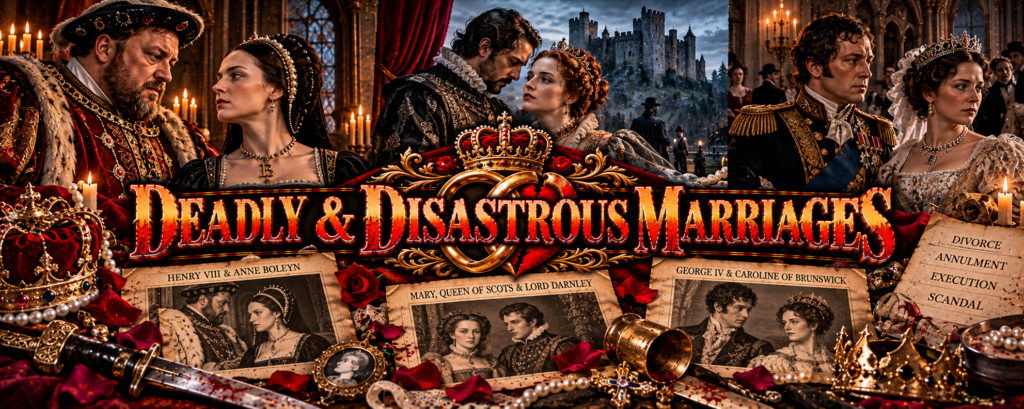
Royal weddings were supposed to secure dynasties, produce heirs, settle disputes, and forge alliances between powerful families. Behind the elaborate ceremonies and magnificent jewels, however, some royal marriages became bitter struggles involving adultery accusations, political conspiracies, imprisonment, public humiliation, annulment, murder, and execution. From Henry VIII and Anne Boleyn, whose celebrated courtship ended with Anne on the scaffold, and Mary, Queen of Scots and Lord Darnley, whose disastrous marriage culminated in scandal and Darnley’s mysterious murder, to George IV and Caroline of Brunswick, whose mutual hostility became a humiliating public spectacle, discover the marriages in which the promise of a royal union descended into catastrophe.
For kings, queens, princes, and princesses, marriage was rarely an entirely private decision. Royal children could be promised to prospective spouses years before they were old enough to marry, and negotiations might involve territorial concessions, enormous dowries, military alliances, trade agreements, and complicated questions of succession. A successful marriage could unite kingdoms or strengthen a dynasty. A disastrous one could destabilize a court, create rival political factions, threaten the succession, and occasionally help plunge entire countries into conflict.
The pressure to produce legitimate heirs made royal marriage particularly dangerous. Queens and princesses were expected to become pregnant, preferably with sons, while infertility, miscarriages, stillbirths, and the deaths of young children could become political crises rather than private tragedies. Because medical understanding of reproduction was limited, women were frequently blamed when marriages failed to produce surviving children. A ruler desperate for an heir might seek an annulment, take mistresses, question the legitimacy of existing children, or search for increasingly drastic ways to escape an inconvenient marriage.
Few rulers demonstrate these dangers more dramatically than Henry VIII. His determination to end his marriage to Catherine of Aragon ultimately contributed to England’s break with papal authority, while his subsequent marriage to Anne Boleyn initially appeared to represent Anne’s extraordinary triumph after years of royal courtship. Yet when Anne failed to provide Henry with the surviving male heir he desperately wanted, her position deteriorated with terrifying speed. In 1536 she was accused of adultery, incest, and plotting the king’s death, charges whose credibility has long been questioned by historians, and she was executed at the Tower of London. A marriage that had helped transform England’s religious and political landscape ended with the queen beheaded less than three years after her coronation.
The marriage of Mary, Queen of Scots and Henry Stuart, Lord Darnley, became equally destructive. Darnley possessed royal blood and initially appeared an attractive dynastic match, but the relationship deteriorated amid jealousy, political ambition, and violence. In 1566, Darnley participated in the brutal murder of Mary’s secretary David Rizzio in the pregnant queen’s presence. Less than a year later, Darnley himself was killed following an explosion at Kirk o’ Field, although his body appeared to have escaped the blast and the precise circumstances of his death remain debated. Suspicion surrounding Mary and her subsequent marriage to James Hepburn, Earl of Bothwell, contributed to the political crisis that ended with her forced abdication.
Not every disastrous royal marriage ended in murder or execution. Some became prolonged wars of reputation in which husband and wife attempted to destroy one another before the public. George, Prince of Wales—the future George IV—and Caroline of Brunswick married in 1795 and quickly developed an intensely unhappy relationship. They separated soon after the birth of their daughter, Princess Charlotte, and allegations concerning Caroline’s private life became the subject of investigations and political controversy. When George became king, his unsuccessful attempt to divorce Caroline through the notorious proceedings surrounding the Pains and Penalties Bill transformed their marital conflict into one of Britain’s great royal scandals.
Other royal couples discovered that religion could make an already difficult marriage politically explosive. A spouse belonging to an unpopular faith might be accused of manipulating the monarch, introducing foreign influences, or threatening the religious identity of the kingdom. Foreign-born queens were particularly vulnerable to accusations that they remained loyal to their birth families rather than their husbands’ countries. When wars, financial crises, or political unrest followed, an unpopular royal spouse could become a convenient target for public anger.
Adultery accusations were especially dangerous because royal sexuality had political consequences. A queen accused of taking a lover was not simply suspected of betraying her husband; she could be accused of threatening the legitimacy of the entire succession. If there were doubts about who had fathered a royal child, questions could arise over whether that child possessed any right to inherit the throne. Consequently, sexual accusations could become extraordinarily effective political weapons even when the evidence behind them was weak or deliberately manufactured.
Kings generally possessed greater freedom to maintain extramarital relationships, but royal mistresses could create problems of their own. Favorites received titles, money, property, and political influence, provoking resentment among courtiers and sometimes furious hostility from queens. Illegitimate children might receive recognition and prestigious marriages, creating additional complications within royal families. A marriage could therefore become the center of an entire network of competing households, lovers, children, relatives, and political factions.
Some royal marriages were destroyed by accusations of conspiracy or treason. A spouse who became politically inconvenient might find private correspondence examined, servants interrogated, and personal relationships transformed into evidence of criminal behavior. In courts where the monarch controlled prosecution and patronage, determining where genuine wrongdoing ended and political convenience began can be extraordinarily difficult. The spectacular accusations surrounding Anne Boleyn demonstrate how rapidly a queen’s intimate life could become a matter of state security.
Other marriages produced imprisonment rather than execution. Estranged queens could be removed from court, confined to castles, separated from their children, or denied access to political supporters. Husbands could also find themselves displaced or imprisoned when they married reigning queens whose advisers regarded them as dangerous. Royal marriage therefore raised a fundamental question that appeared repeatedly throughout history: when two people with competing claims to authority married, who was actually supposed to rule?
There were also marriages in which violence existed within the relationship itself. Surviving sources describe royal spouses accused of physical cruelty, coercion, humiliation, sexual misconduct, and attempts to intimidate or control their partners. Such accounts require careful examination because hostile chroniclers and political enemies could exaggerate private behavior, while victims themselves often left few records. Nevertheless, royal status offered no immunity from abusive relationships—and could make escaping them considerably more difficult.
Divorce and annulment created their own political earthquakes. Before modern divorce laws, ending a royal marriage could require religious authorities to declare that a valid marriage had never existed, producing complicated arguments about consanguinity, previous engagements, consummation, legitimacy, and canon law. A rejected spouse’s relatives might regard the separation as an insult to their dynasty, while children from the marriage could suddenly find their inheritance threatened. What began as a marital dispute could therefore become an international diplomatic crisis.
The children of these marriages frequently paid the greatest price. Princes and princesses could be declared legitimate one year and illegitimate the next, separated from disgraced parents, used as political bargaining pieces, or forced to navigate courts where supporting the wrong parent could prove dangerous. The collapse of a royal marriage could reshape the succession for generations, creating rival claims that survived long after both husband and wife were dead.
Yet not every famously disastrous marriage was exactly as later legend portrayed it. Political propaganda frequently transformed unpopular queens into adulteresses, foreign husbands into scheming outsiders, and failed marriages into morality tales. Romanticized accounts could likewise turn complicated relationships into simple stories of innocent victims and monstrous spouses. Letters, diplomatic reports, court records, financial documents, and contemporary chronicles often reveal a far messier reality.
Explore the darker history of royal marriage, from political unions and disastrous wedding nights to adultery accusations, annulments, imprisonments, domestic conflict, mysterious deaths, treason trials, and executions. Follow the husbands and wives trapped inside dynastic arrangements, the lovers and favorites who destabilized royal households, the ministers who exploited marital crises, and the children whose inheritance depended upon whether their parents’ marriages survived.
Separate documented events from court gossip, hostile propaganda, romantic legend, and accusations manufactured for political advantage as we investigate what really happened inside some of history’s most disastrous royal relationships. These are the marriages intended to unite dynasties and secure kingdoms—but instead produced scandal, imprisonment, betrayal, bloodshed, and royal divorces so explosive that some helped change the course of history itself.