
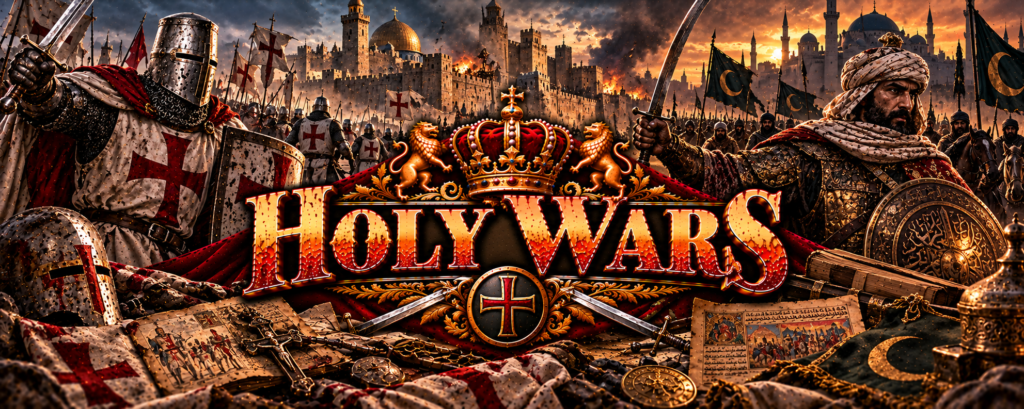
Throughout history, some of humanity’s most devastating conflicts have been fought beneath sacred banners. Armies marched carrying crosses, crescents, relics, and religious standards; rulers claimed divine sanction for conquest; communities were divided by competing faiths; and political struggles became inseparable from questions of belief, identity, and salvation. From the medieval Crusades and the brutal Albigensian Crusade against the Cathars to the French Wars of Religion and the catastrophic Thirty Years’ War, discover the conflicts in which religion became intertwined with ambition, territory, dynastic rivalry, and the struggle for political power.
Yet wars described as religious were rarely about religion alone. Medieval rulers might answer a call to holy war while simultaneously pursuing land, prestige, wealth, dynastic interests, or political influence. Popes and religious leaders could use warfare to extend authority or confront perceived threats, while kings and nobles formed alliances that sometimes crossed religious boundaries when political necessity demanded it. For ordinary participants, motivations could be equally complicated: sincere faith existed alongside hopes for social advancement, economic opportunity, adventure, protection, survival, or the remission of sins. Understanding holy war therefore requires looking beyond simple explanations and examining the complicated mixture of belief and worldly ambition that drove people into conflict.
The Crusades remain among the most famous examples. Beginning with Pope Urban II’s call for the First Crusade in 1095, armies from Western Europe traveled eastward toward Jerusalem and the wider eastern Mediterranean. The capture of Jerusalem in 1099 was accompanied by extensive killing, while the establishment of Crusader states created generations of warfare, diplomacy, trade, alliances, and cultural contact between Christians, Muslims, and other communities. Later crusading expeditions produced famous confrontations involving figures such as Richard the Lionheart and Saladin, but the reality was considerably more complicated than a simple clash between two unified religious worlds.
Crusading warfare was not confined to the Holy Land. In southern France, the Albigensian Crusade beginning in 1209 targeted the Cathar heresy and became entangled with struggles over territory and political authority. Cities were besieged, populations suffered devastating violence, and powerful nobles lost lands as northern French forces expanded their influence in the region. The notorious massacre at Béziers became one of the darkest episodes associated with the campaign, while the destruction of Cathar communities demonstrates how accusations of religious error could become justification for extraordinary violence.
Centuries later, the French Wars of Religion showed how sectarian division could tear apart a kingdom from within. Catholics and Huguenots fought through decades of civil conflict, political assassination, factional rivalry, and intermittent peace. The St. Bartholomew’s Day Massacre of 1572, in which thousands of Huguenots were killed in Paris and elsewhere in France, became an enduring symbol of the period’s brutality. Yet religion was only part of the struggle, as noble families competed for influence, foreign powers intervened, and the French monarchy attempted to preserve authority amid deepening division.
The Thirty Years’ War brought destruction on an even greater scale. Beginning in the Holy Roman Empire in 1618, the conflict emerged from religious and constitutional tensions but expanded into a vast European struggle involving dynastic rivalry and geopolitical competition. Catholic France eventually fought against the Catholic Habsburg powers despite supporting Catholicism at home, demonstrating just how thoroughly political interests could override simple religious divisions. Armies devastated communities across Central Europe, while famine, disease, displacement, and economic destruction compounded the horrors of military violence.
Religious conflict also extended beyond Christian Europe. Islamic states developed their own traditions concerning jihad and warfare, while conflicts between Muslim dynasties, Christian kingdoms, and other powers combined questions of faith with control of territory and trade. The Ottoman expansion into southeastern Europe produced centuries of warfare involving states with different religious identities, but alliances and political arrangements frequently crossed confessional lines. Elsewhere, religious movements and political authorities clashed across Asia, Africa, and the Americas under circumstances unique to their own societies.
The Reformation and Counter-Reformation created another particularly dangerous intersection between faith and politics. When rulers adopted new religious identities, subjects could suddenly find their beliefs politically suspect. Rebellions, persecutions, forced conversions, confiscations, and foreign interventions followed as governments attempted to impose or defend religious settlements. A person’s faith could determine access to political office, property, marriage, education, or even personal safety.
For civilians, the consequences could be devastating regardless of which side claimed divine support. Cities were besieged, villages burned, populations displaced, and communities subjected to massacres or reprisals because they were associated with the opposing faith. Religious buildings were destroyed or repurposed, sacred objects became targets, and generations inherited memories of persecution that could keep old conflicts alive long after treaties were signed.
Explore the violent intersection of faith, politics, and warfare, from medieval crusading armies and battles for sacred cities to religious civil wars, sectarian massacres, rebellions, and the great confessional struggles of early modern Europe and beyond. Examine the rulers, preachers, soldiers, rebels, communities, and political factions that transformed disputes over belief into struggles capable of destroying kingdoms and reshaping borders.
Separate genuine religious conviction from political propaganda, later mythology, and overly simple narratives of one faith fighting another as we investigate why these wars began, how they changed over time, and why people continued fighting long after their original causes had become obscured. These are the stories of history’s holy wars—conflicts in which faith could inspire extraordinary devotion, political ambition could disguise itself as sacred duty, and the struggle for heaven produced devastating consequences on earth.