
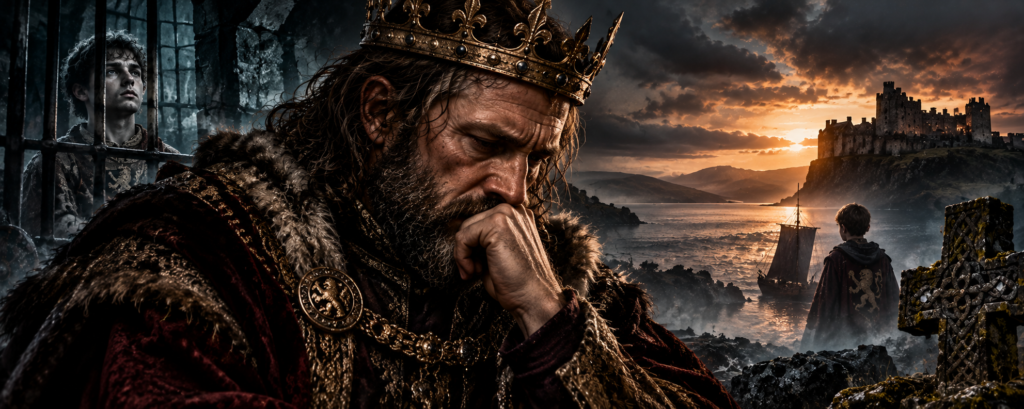
Robert III of Scotland: The Broken King, the Murdered Prince, and the Crown He Could No Longer Bear
King of Scots, 1390–1406 | Born John Stewart | Physical Disability, Political Withdrawal, Family Betrayal, Melancholy, and the Dark Struggle for the Stewart Crown
The King Who Called Himself the Most Miserable of Men
Some kings remembered as “mad” terrified their courts with violence, delusions, unpredictable rages, or spectacular displays of instability. Robert III of Scotland belongs to a much darker and quieter category. There is no convincing evidence that he suffered from psychosis, hallucinations, mania, or a complete break with reality, but later chroniclers remembered a king crushed by physical disability, political humiliation, family catastrophe, and an almost unbearable sense of personal failure. By the end of his life, Robert was associated with one of the bleakest statements attributed to any medieval monarch: he supposedly called himself the worst of kings and the most miserable of men and declared that he deserved to be buried not in a magnificent royal tomb, but on a dunghill.
The image is so powerful that it has shaped Robert’s reputation for centuries, yet it needs to be handled carefully. The famous words come through later historical tradition, and we cannot know whether Robert spoke them exactly as subsequently recorded. Nor can modern historians confidently diagnose him with clinical depression simply because his remembered behavior resembles what we might now recognize as severe depressive symptoms. What can be said is that Robert’s later life contained more than enough genuine tragedy to explain why contemporaries and later writers associated him with melancholy, withdrawal, hopelessness, and profound self-condemnation.
Robert’s suffering was not created by imaginary enemies. His body had been badly damaged before he became king, his younger brother accumulated enormous political power, his wife died during a period of escalating dynastic crisis, and his eldest son died while imprisoned by men who benefited from his removal. Robert’s remaining son was then captured by the English while being sent abroad for safety, and the king himself died soon afterward. The story of Robert III is therefore not one of a ruler losing himself in fantasy, but of a ruler gradually losing his ability to control a terrifyingly real world.
That distinction makes Robert one of the most fascinating figures to place among the Mad Monarchs. His supposed madness was not the madness of a tyrant raging through a palace or a delusional king imagining conspiracies that did not exist. If Robert suffered from serious mental illness, it appears to have manifested through despair, withdrawal, self-reproach, and diminished confidence rather than violent frenzy. His reign shows how a crown could become psychologically crushing even when the man wearing it remained perfectly capable of understanding what was happening around him.
Before Robert There Was John
Robert III was born around 1337, but he was not born Robert. His baptismal name was John Stewart, and he was the eldest son of Robert Stewart, the future Robert II of Scotland, and Elizabeth Mure. His family stood close to the Scottish throne, and John grew up in the shadow of the wars, dynastic disputes, and political upheavals that had shaped Scotland during the age of Robert the Bruce and David II. Long before he became king, his identity was tied to a dynasty still establishing its right to rule.
The circumstances surrounding his parents’ marriage later generated questions about legitimacy because Robert Stewart and Elizabeth Mure were related within prohibited degrees. A papal dispensation and a subsequent formalization of their marriage helped secure the status of their children, while political arrangements firmly established John within the succession. The matter was important because Robert Stewart later had children by another wife, creating another branch of a family already capable of producing dangerous rivalries. John nevertheless emerged as his father’s principal heir and occupied a central place within the developing Stewart monarchy.
The young John should not be imagined as the defeated and withdrawn figure of his later reign. He became Earl of Carrick in 1368 and participated actively in Scottish politics, demonstrating that the political passivity associated with his kingship was not a permanent feature of his personality. When his father became Robert II in 1371, John was already an adult prince with substantial status, responsibilities, and expectations. He was not a man who had always been incapable of governing; for a significant portion of his life, he appears to have been entirely capable of exercising authority.
This earlier career matters because Robert’s later reputation can otherwise become dangerously circular. Historians know that he eventually became a physically impaired and politically weakened king, so it is tempting to search his youth for evidence that he had always been fragile, indecisive, or psychologically unstable. The surviving record does not justify that conclusion. The Robert III who ended his life overwhelmed by catastrophe had once been John Stewart, an active royal prince with enough political standing to govern on behalf of his father.
A New Dynasty Under Pressure
The Stewart dynasty itself was still young when John reached adulthood. Robert II became Scotland’s first Stewart king in 1371 after the death of David II, the son of Robert the Bruce. The memory of Bruce remained enormously powerful, and any dynasty succeeding his direct line had to operate beneath the shadow of a king who had become inseparable from Scotland’s struggle for independence. The Stewarts possessed legitimate dynastic claims, but legitimacy did not automatically produce unquestioned authority.
Scotland was a difficult kingdom to govern. Powerful magnates controlled extensive territories, private military followings, castles, kinship networks, and regional alliances, while the northern and western parts of the realm contained political structures that could resist or evade central authority. The border with England remained volatile, and Anglo-Scottish warfare could strengthen aristocratic warlords as easily as it strengthened the crown. A king therefore needed more than a title; he needed the ability to travel, negotiate, intimidate, reward, punish, and appear personally among the men whose loyalty held the kingdom together.
John initially seemed capable of functioning within this brutal political environment. During the declining years of Robert II, dissatisfaction with the aging king led to John taking a major role in government. In 1384 he became lieutenant of the kingdom, effectively exercising substantial royal authority while his father remained king. That position is difficult to reconcile with the image of a man inherently terrified of responsibility or psychologically incapable of command.
The political landscape was nevertheless dangerous. John’s younger brother Robert Stewart, Earl of Fife, was ambitious, capable, and increasingly influential. As long as John remained active and healthy, the elder brother’s position as heir and lieutenant gave him the advantage. A physical catastrophe would change that balance and, with it, the future of the Scottish monarchy.
Annabella Drummond and the Stewart Family
John married Annabella Drummond in the 1360s, creating an alliance with an influential Scottish family and establishing the household that would eventually produce the next generation of Stewart kings. Their children included David, who would become Duke of Rothesay, and James, the future James I of Scotland. These two sons would eventually stand at the center of the darkest episodes of Robert’s reign, and the fate of each would contribute to his later reputation for despair.
Annabella appears to have been an important political presence rather than merely a ceremonial wife. Medieval queens could act as patrons, intercessors, dynastic negotiators, and protectors of their children’s interests, and Annabella had obvious reasons to strengthen the position of her eldest son as Robert’s physical condition deteriorated. Later tradition sometimes depicts her as the forceful partner beside an increasingly passive husband, although the surviving evidence does not allow us to reconstruct the emotional balance of their marriage in such simple terms. What can be said is that her death in 1401 removed an important member of the royal family at precisely the moment when conflict surrounding her eldest son was becoming lethal.
Robert’s family would become both his greatest hope and his greatest vulnerability. His sons offered a means of transferring practical authority away from his increasingly powerful brother, but empowering those sons also placed them directly into the struggle for control of Scotland. David’s rise threatened Albany, while the young James eventually became valuable precisely because David was gone. Robert’s kingship therefore became inseparable from a vicious family contest in which the people closest to him were also potential rivals, victims, or successors.
By the final years of the reign, almost every important political relationship had become painfully personal. Robert was not merely struggling with an overmighty magnate; he was struggling with his own brother. The political prisoner whose death would haunt the monarchy was not simply a rebellious noble; he was Robert’s son. The child sent away for protection was not merely a diplomatic asset; he was the king’s last surviving male heir.
The Accident That Changed Everything
Around 1388, John suffered a serious accident involving a horse, traditionally described as a kick that left him badly injured and physically impaired. The exact medical consequences cannot be reconstructed with certainty, but contemporary political developments make clear that his ability to perform his previous governmental role was substantially reduced. In a medieval warrior society, that was not simply a private medical problem. Physical incapacity could alter the balance of power throughout an entire kingdom.
Kingship and high aristocratic leadership were intensely physical. A ruler was expected to travel through difficult terrain, preside over councils, hunt, ride, inspect fortifications, appear before armies, and project an image of strength before a nobility whose own authority rested heavily upon military power. A man who could no longer ride easily or endure the demands of constant travel might remain intellectually capable while becoming practically dependent upon others. That dependence created political opportunities for anyone strong enough to step into the space around him.
John’s younger brother Robert, Earl of Fife, did exactly that. Following John’s physical deterioration, Fife assumed the leading governmental position that his elder brother had previously occupied. The transfer demonstrated how quickly bodily impairment could become political displacement, and it established a pattern that would follow John after he became king. Other men would increasingly perform the work of monarchy while he retained its title.
It is easy to imagine the psychological effect of such a reversal, but historical caution is essential. We cannot prove that the accident immediately plunged John into clinical depression, nor can we reconstruct his private thoughts as his brother replaced him in government. Chronic pain, restricted mobility, humiliation, and loss of status can certainly contribute to depression, but possibility is not diagnosis. What the evidence does show is that the accident transformed John’s political life before he ever wore the crown.
The Brother Who Learned to Rule
Robert Stewart, Earl of Fife and later Duke of Albany, became the central political rival of Robert III’s life. Albany was energetic, experienced, well connected, and capable of exercising authority in ways his physically impaired elder brother increasingly could not. Later narratives sometimes portray him as a calculating villain who spent decades plotting to steal the throne, but the reality was more complicated. Scotland genuinely needed effective government, and Albany possessed qualities that made him useful as well as dangerous.
That ambiguity made him extraordinarily difficult for Robert to confront. Albany was not an obvious rebel standing outside the royal system; he was the king’s brother and one of the most important members of the Stewart dynasty. Removing him could destabilize government, while tolerating him allowed his political network to grow stronger. Robert therefore became dependent upon a man whose power simultaneously weakened the monarchy.
The relationship created an almost impossible problem. Robert possessed the superior dynastic title, but Albany increasingly possessed the practical ability to govern. The king could appoint lieutenants and authorize political arrangements, yet every transfer of authority gave another person resources, followers, and experience that Robert himself lacked. Delegation solved immediate problems while deepening long-term weakness.
This was not necessarily evidence of irrationality. Medieval kings frequently relied upon relatives and great nobles, particularly when they were minors, ill, absent, or physically incapacitated. Robert’s tragedy was that his most obvious substitute was also the man most capable of becoming an alternative center of power.
John Becomes Robert III
Robert II died in April 1390, leaving John Stewart to inherit the Scottish throne. Yet Scotland did not receive a King John II. The new monarch instead took the regnal name Robert III and was crowned at Scone later that year, creating one of the more unusual features of his reign.
Later tradition associated the decision with the supposedly unlucky history of kings named John. John Balliol carried particularly damaging associations in Scotland because his reign had become linked with English interference, humiliation, deposition, and the crisis from which the Wars of Independence emerged. Later writers also pointed toward unfortunate rulers named John elsewhere in Europe, reinforcing the idea that the new king regarded his birth name as cursed.
It is possible that Robert personally shared medieval beliefs about ominous names, but the decision did not require irrational superstition. The name Robert connected him immediately with his father, Robert II, and more powerfully with Robert the Bruce. In a kingdom where Bruce’s memory remained one of the greatest sources of royal prestige, adopting the name Robert offered obvious political advantages.
The popular claim that John was so psychologically obsessed with the bad luck of his name that he effectively begged to abandon it therefore goes beyond what the evidence can securely support. Medieval rulers understood the political power of names, genealogy, saints, symbols, and inherited memory. Choosing Robert over John may have been unusual, but it was also entirely intelligible. Ironically, changing his name would do nothing to protect the new king from one of the most disastrous reigns in Stewart history.
A Crown Already Too Heavy
Robert III was already in his fifties when he became king, and his physical impairment preceded his accession. Unlike a young monarch capable of building an independent political household and establishing dominance over rival magnates, Robert entered kingship after his brother had already demonstrated an ability to govern in his place. The crown gave Robert greater dignity, but it did not restore the physical capabilities he had lost.
His reign consequently began with a dangerous contradiction. Robert was the legitimate source of royal authority, yet other men possessed increasing control over the mechanisms through which that authority operated. He could authorize government without always controlling the people who carried it out. Every failure still belonged to his reign, even when he had not personally created it.
Later chroniclers remembered Scotland under Robert as a kingdom plagued by disorder, magnate violence, and the oppression of weaker people by the powerful. Such accounts contain moralizing exaggeration and should not be read as neutral administrative statistics, but they reflect a genuine perception that central royal authority struggled to impose itself consistently. A king already limited by physical disability could easily become the symbol of problems he lacked the strength to solve.
Robert’s weakness therefore became self-reinforcing. Magnates who perceived the king as unable to punish them had greater incentive to pursue independent interests, and every successful act of defiance further advertised royal impotence. The more authority slipped away, the more difficult it became for Robert to recover it.
The Brutal Expectations of Medieval Kingship
Robert’s physical disability should never be confused with mental incapacity, yet medieval political culture often blurred the distinction. Kings were expected to embody strength. Their bodies represented not only themselves but the vitality, fertility, courage, and authority of the monarchy itself.
A ruler who could not ride or campaign normally risked being judged against younger, healthier, more militarily active relatives. Robert’s brother Albany could travel and govern. His son David would eventually appear capable of energetic political action. Robert himself increasingly depended upon others to represent the crown’s authority.
Modern readers should resist the assumption that his impairment made him inherently weak-minded. Before the accident, he had already exercised significant authority, proving that his later political limitations were not simply the result of a lifelong lack of ability. The transformation occurred after his body was damaged and his political circumstances changed.
Nevertheless, perception had consequences. A medieval king could possess intelligence and judgment yet still lose power because he could no longer perform the physical theater of monarchy. Robert’s body became part of the political crisis whether he wanted it to or not.
The Battle of the Clans
Robert’s reign was not entirely devoid of public royal action. One of its most famous spectacles occurred at Perth in 1396, when a violent Highland feud was addressed through an arranged combat fought before the king and his court. Later known as the Battle of the Clans, the encounter has accumulated layers of romantic legend, and even the precise identities of the groups involved remain debated.
The spectacle was brutal by modern standards. Selected warriors fought before an audience that included the king, transforming a regional feud into a controlled and highly visible confrontation. Men died in the process, and later storytelling turned the event into a dramatic example of Scotland’s violent clan culture.
Yet the combat should not be interpreted as evidence that Robert possessed a morbid or irrational fascination with bloodshed. Medieval conflict resolution could include methods that appear deeply alien today, and the crown was attempting to contain a feud that might otherwise continue producing uncontrolled violence. The event demonstrated that Robert still participated in the ceremonial and judicial performance of kingship even while practical authority remained fragmented.
The episode also reveals something important about the kingdom he ruled. Violence was not an abnormal interruption of Scottish politics; it was one of the instruments through which power was negotiated. Robert’s inability to dominate such a society personally left him dependent upon arrangements that could look crude, unstable, and dangerous even by medieval standards.
The Rise of David, Duke of Rothesay
As Robert’s physical limitations became increasingly significant, his eldest son David emerged as a potential solution. In 1398 David was created Duke of Rothesay, while Albany received the title Duke of Albany. The creation of the two dukedoms formalized the prominence of the two men who would increasingly compete beneath Robert’s crown.
Rothesay was young, energetic, ambitious, and capable of performing duties his father struggled to undertake. Queen Annabella had every reason to support her son’s advancement because David represented not merely the future succession but an immediate counterweight to Albany. If practical government had to be delegated, placing it in the hands of the heir offered an obvious way to keep authority within Robert’s immediate family.
In 1399, Rothesay was given a major role as lieutenant of the kingdom. This transfer has sometimes been portrayed as another example of Robert voluntarily dismantling his own authority because he could no longer tolerate the burden of kingship. The political circumstances were more complicated, involving Robert’s acknowledged bodily infirmity and broader aristocratic concerns about government.
The arrangement nevertheless carried enormous risk. Rothesay was not simply administering Scotland; he was entering a political arena already dominated by his uncle. The king’s attempt to solve the problem of Albany’s power had created a direct confrontation between Albany and the man who would inherit Robert’s throne.
The Dangerous Prince
David, Duke of Rothesay, was not a passive victim waiting for Albany to destroy him. He possessed his own ambitions, allies, enemies, and controversial reputation. His behavior generated political hostility, and his marital affairs became entangled with the interests of powerful noble families.
Marriage among medieval royalty and nobility was rarely a private matter. A broken engagement or disputed alliance could mean the loss of lands, influence, money, and political advantage. Rothesay’s dealings therefore produced resentments that could become dangerous in a kingdom where powerful families maintained armed followings.
Yet David remained the legitimate heir. His authority offered Robert a way to shift government away from Albany while preparing the next king to rule. For a time, the arrangement may have seemed capable of restoring a more direct line of royal control.
Instead, it intensified the family struggle. Albany could view Rothesay’s rise as a threat to his own influence, while Rothesay had every reason to reduce his uncle’s power before becoming king. Robert remained above them in title but increasingly lacked the means to control the rivalry.
The king had tried to escape dependence upon one powerful relative by empowering another. Both men now had reason to fight for the space created by Robert’s weakness.
The Trap Around the Heir
By 1401 and 1402, Rothesay’s political position had deteriorated badly. He was eventually arrested and placed in the custody of Albany and Archibald Douglas, another enormously powerful Scottish magnate. Robert himself appears to have been involved in or to have accepted the political process that led to his son’s detention, a fact that makes the later tragedy considerably more complicated than the simple story of Albany secretly kidnapping the heir.
David was taken to Falkland, where he died in March 1402. His death immediately became one of the most sinister events associated with the Stewart dynasty. Later accounts described deliberate starvation and increasingly horrifying details of the prince’s final days, although not every element of those stories can be treated as secure contemporary evidence.
Alternative explanations included illness, and a formal political process subsequently cleared Albany and Douglas of responsibility. The official finding did little to erase suspicion because both men benefited from Rothesay’s removal, while the circumstances of his imprisonment were inherently troubling. Historians therefore have good reason to regard the death as suspicious without pretending that the surviving evidence provides the certainty of a modern criminal investigation.
For Robert, the distinction may ultimately have mattered less than the outcome. His eldest son had entered the custody of political rivals and died there. Whatever Robert intended when the arrest was authorized, the king had failed to protect the man who was supposed to inherit his crown.
The Prince Who Never Came Home
The death of Rothesay fundamentally altered Robert’s family and his kingdom. The adult heir who might have restored royal authority after his father’s death was gone, while Albany remained alive, powerful, and deeply embedded in government. Robert’s surviving son James was still a child and could not immediately replace his brother as an effective political counterweight.
Later tradition transformed David’s imprisonment into a nightmare of deliberate starvation, with the helpless prince wasting away while Albany tightened his grip on Scotland. Some versions became increasingly elaborate and gruesome, and those details should not be repeated as established fact without adequate evidence. The secure historical core is already disturbing enough: the heir to the Scottish throne died while imprisoned by men whose political interests were advanced by his disappearance.
The official clearing of Albany and Douglas cannot be treated as conclusive proof of innocence. Medieval inquiries involving the most powerful men in a kingdom did not function like independent modern investigations, and political necessity could shape the outcome. At the same time, suspicion is not proof, and there is no surviving document in which Albany orders his nephew to be murdered.
Robert was therefore left with uncertainty as well as grief. He may have suspected his brother, or he may have believed that David’s own conduct contributed to the disaster, or he may have accepted some portion of the official explanation. His private thoughts cannot be recovered, but his political position became even more precarious after the death.
A Father Surrounded by Loss
Rothesay’s death came only a short time after Queen Annabella’s death in 1401. Within a compressed period, Robert lost his wife and his eldest surviving son while his political dependence upon Albany remained unresolved. These events provide the strongest context for later descriptions of the king as profoundly melancholic.
It is entirely possible that Robert suffered severe depression during these years. Chronic physical impairment, loss of independence, bereavement, political humiliation, and the suspicious death of a child are all circumstances capable of producing devastating psychological effects. What historians cannot do is reconstruct a modern diagnostic checklist from the fragments left by medieval chroniclers.
The distinction is important because Robert’s political withdrawal can otherwise be treated as automatic evidence of psychiatric illness. Some of his retreat resulted from physical limitations, while some reflected the political reality that Albany and other magnates possessed resources Robert could not easily challenge. A king who avoided confrontation with a powerful brother was not necessarily paralyzed by irrational fear if that brother genuinely had the ability to defeat him.
Robert’s despair may therefore have been both psychological and brutally rational. His kingdom was difficult to control, his body restricted him, his wife was dead, and his eldest son had died in circumstances involving his own family. The darkness surrounding him was not imagined.
The King Who Condemned Himself
It is in this atmosphere that Robert’s famous self-condemnation becomes emotionally believable. Later tradition remembers him describing himself as the worst of kings and the most miserable of men, words that seem to reveal a monarch who had turned the judgment of history against himself before history had the opportunity to do so.
The statement resembles the extreme worthlessness and self-reproach associated with severe depression. Robert supposedly did not blame only his brother, rebellious nobles, England, bad fortune, or physical disability. He blamed himself, transforming political failure into a judgment upon his entire worth as a ruler.
Yet medieval Christian culture also possessed a powerful language of humility, sin, penitence, suffering, and contempt for worldly glory. A king describing himself as wretched could draw upon religious concepts that do not map neatly onto modern psychiatric categories. The statement therefore cannot function as a medical diagnosis even if it preserves genuine despair.
What makes it extraordinary is its apparent rejection of the normal language of kingship. Medieval monarchs surrounded themselves with genealogies, ceremonies, monuments, and sacred claims designed to magnify royal dignity. Robert’s remembered words stripped all of that away and replaced majesty with misery.
The Dunghill
The most famous extension of Robert’s despair is the story that he asked to be buried on a dunghill. According to later tradition, he wanted an inscription identifying him as the worst of kings and the most miserable of men, turning his own grave into a permanent declaration of failure. Whether he literally made such a request exactly as recorded cannot be established, but the story became inseparable from his historical image.
A dunghill carried an obvious symbolic force. Royal tombs proclaimed continuity, legitimacy, piety, dynastic pride, and the sacred status of monarchy, while a heap of refuse represented degradation and rejection. To imagine an anointed king asking for such a burial was to imagine him repudiating the entire public identity kingship had imposed upon him.
The story should not be interpreted too literally. Medieval writers used dramatic language, moral symbolism, and memorable anecdotes to express character, and Robert may have been speaking rhetorically even if some version of the statement was genuine. There is no reason to believe serious preparations were made to throw the king’s corpse onto refuse.
Yet the legend reveals how later generations understood him. Robert III was not remembered as a king desperately demanding that posterity recognize his greatness. He was remembered as a king who believed posterity should know how badly he had failed.
Paisley Abbey and the Grave He Actually Received
Robert was not buried on a dunghill. After his death, he was laid to rest at Paisley Abbey, an important religious house with deep connections to the Stewart family. His burial there was therefore neither an anonymous disposal nor an act of deliberate humiliation.
Popular retellings sometimes claim that Robert refused burial at the traditional royal centers of Scone or Dunfermline because he considered himself unworthy of resting among kings. The idea fits beautifully with the dunghill legend, but the evidence for interpreting his burial choice exclusively as pathological self-loathing is much weaker. Paisley had genuine dynastic significance and was an entirely respectable resting place for a Stewart monarch.
This difference between legend and reality is important. Robert may have expressed extraordinary despair, but the dynasty did not treat him as though he had ceased to be king. His body remained part of Stewart memory and was buried within a sacred institution closely associated with his family.
The supposed dunghill became his psychological monument rather than his physical grave. It survived because it captured something later writers believed to be true about the man even when the literal burial never happened.
The Last Surviving Son
After Rothesay’s death, the future of Robert’s dynasty rested upon his younger son James. The boy was still very young, which made him simultaneously precious and vulnerable. Whoever controlled James potentially controlled the future king.
Robert had good reason to worry. His adult heir had already died while held by powerful Scottish relatives, and Albany’s position had become stronger as a result. Whether Robert possessed specific evidence that Albany intended to harm James is unknown, but fear for the boy’s safety was hardly irrational.
Plans were therefore made to remove James from immediate danger. Sending him to France offered the possibility of placing him beyond the reach of domestic factional politics while preserving him within the orbit of Scotland’s traditional French alliance. The decision has sometimes been portrayed as the act of a frightened and unstable father, but it was politically understandable.
Robert was not imagining threats in empty corridors. The first heir was already dead. Protecting the second was one of the most rational priorities the king could have possessed.
The tragedy came because the plan failed in a way Robert could not have anticipated.
The Voyage That Became a Nightmare
In 1406, James was placed aboard a vessel intended to carry him toward France. The prince was only around eleven or twelve years old, and the journey represented an attempt to preserve the Stewart succession from the dangers surrounding it at home. Robert had lost one son and was trying to prevent the loss of another.
The ship was intercepted by English seamen, and James was captured. Instead of reaching safety in France, the heir to the Scottish throne became a prisoner of the English king. England suddenly possessed one of the most valuable political hostages imaginable.
The consequences would extend for approximately eighteen years. James would spend much of his youth and early adulthood in English captivity, receiving an elite education but remaining unable to return to his kingdom. Scotland, meanwhile, would continue to be governed largely by Albany and later by Albany’s son.
Robert could not know that James would survive, mature, return, and eventually assert royal authority with ferocious determination. All he knew was that his final attempt to protect his child had ended in another catastrophe.
For a man already associated with despair, the news could hardly have been more devastating.
Did Robert Die of a Broken Heart?
Robert died on 4 April 1406, shortly after the capture of James. The closeness of the events naturally encouraged chroniclers to connect them, and the tradition developed that the king was emotionally destroyed by the news. Later retellings sometimes claim that he stopped eating, withdrew completely, and essentially allowed himself to die.
That dramatic version should be treated cautiously. There is not enough evidence to establish that Robert intentionally starved himself or consciously chose death. He was already physically impaired and approaching seventy, a considerable age for the period, and an existing illness could have combined with the emotional shock of his son’s capture.
Severe grief can also have powerful physical effects without becoming deliberate self-destruction. Robert may have lost his appetite or deteriorated rapidly after hearing the news, but that is different from demonstrating that he intentionally refused nourishment until death. The popular phrase that he died of a broken heart therefore works better as an emotional description than as a literal medical conclusion.
The chronology remains haunting without embellishment. Robert tried to save his last son, learned that the attempt had failed, and died before he could know what would become of the boy. His reign ended with the heir to Scotland in English hands.
Was Robert III Clinically Depressed?
Modern writers frequently describe Robert as suffering from depression or severe melancholia. The interpretation is understandable because later accounts associate him with withdrawal, despair, self-condemnation, feelings of failure, and apparent hopelessness. His life circumstances also provide a powerful context in which serious depressive symptoms would be entirely plausible.
Yet diagnosing a medieval ruler from such evidence is inherently uncertain. We do not possess detailed observations of Robert’s sleep, appetite, concentration, energy, suicidal thoughts, mood patterns, or the duration and severity of particular episodes. Medieval chroniclers were not psychiatric clinicians, and the language through which they described sadness, weakness, sinfulness, or melancholy belonged to a very different intellectual world.
The historical concept of melancholia also does not correspond perfectly with modern major depressive disorder. Medieval medicine interpreted illness through frameworks involving bodily humors, temperament, environment, diet, and spiritual condition. Using “melancholia” as a descriptive historical term can therefore be useful, but presenting Robert as though a modern psychiatrist had definitively diagnosed him would be misleading.
The responsible conclusion is that Robert may well have suffered severe depressive symptoms, particularly in his later years. His physical disability, loss of political authority, wife’s death, son’s imprisonment and death, and remaining son’s capture created extraordinary pressures. His remembered self-loathing strengthens the possibility, but certainty remains beyond the evidence.
Political Weakness Was Not Mental Illness
Many of Robert’s supposedly irrational actions become more understandable when examined within their political context. His change of name connected him with the prestigious Robert tradition rather than the disastrous memory of John Balliol. His delegation of authority responded to genuine physical incapacity and the need for active government.
His fear for James was equally rational. Rothesay had already died in the custody of powerful relatives, making concern for the surviving heir entirely justified. Sending James abroad was a reasonable attempt to preserve the succession, even though the voyage ended disastrously.
Robert’s reluctance to confront Albany directly can also be explained without assuming psychiatric paralysis. Albany possessed extensive political support and resources, while Robert’s own physical limitations made personal military leadership difficult. A king who launched an unsuccessful struggle against his brother could lose far more than political dignity.
None of this makes Robert a successful ruler. His reign was marked by serious weakness, and he repeatedly failed to control the people exercising authority in his name. It does, however, demonstrate the danger of turning every political failure into a symptom of mental illness.
A monarch can be ineffective without being insane, and Robert III provides one of medieval Scotland’s clearest examples.
Responsibility Without Control
One of the most psychologically punishing features of Robert’s kingship was the gap between responsibility and power. He remained King of Scots, which meant the successes and failures of the kingdom were attached to his name. Yet practical government repeatedly passed into the hands of Albany, Rothesay, and other powerful figures.
Robert therefore experienced an especially cruel form of monarchy. He possessed enough authority to be blamed but not always enough power to prevent the disasters for which he might be blamed. His reign belonged to him even when its government did not.
This helps explain why the famous language of self-condemnation feels so appropriate. Robert could look across Scotland and see disorder associated with his kingship, even when he had not personally created every crisis. He could look at his family and see one son dead and another endangered, even when powerful rivals and foreign enemies bore much of the responsibility.
The crown did not allow him to escape judgment simply because he had delegated authority. Robert remained the symbolic center of the system until death. For a man who may already have been psychologically vulnerable, responsibility without control could become an almost unbearable burden.
Albany: Villain, Governor, or Both?
Albany’s role in Robert’s tragedy resists simple categorization. He benefited enormously from his brother’s physical weakness and from Rothesay’s death, and suspicion surrounding the prince’s fate has followed him for centuries. Yet Albany was also an experienced political operator who helped provide government when Robert could not.
The two realities are not mutually exclusive. A medieval noble could serve the kingdom while advancing his own family, preserve order while eliminating rivals, and defend royal authority while simultaneously weakening the king. Politics did not divide neatly into loyal servants and obvious traitors.
This ambiguity may have made Albany especially frightening. Robert could not simply identify him as an enemy and remove him without consequences. Scotland needed powerful men capable of maintaining government, and Albany had become one of the most capable.
The king therefore faced a situation in which the man he may have distrusted was also one of the men he most needed. If Robert felt trapped, the feeling was grounded in political reality rather than delusion.
Albany’s power survived Robert’s death. The new king, James I, remained imprisoned in England, leaving Albany to govern Scotland as regent. The brother who never took Robert’s crown nevertheless became the dominant figure of the kingdom Robert left behind.
The Son Who Returned
James remained in English captivity for approximately eighteen years, far longer than Robert could ever have imagined. He eventually returned to Scotland in 1424 as an adult king, bringing with him a far more aggressive conception of royal authority than the one associated with his father. The contrast between father and son would become striking.
James moved forcefully against the Albany Stewarts. Murdoch Stewart, Duke of Albany, and members of his family were arrested, tried, and executed in 1425, effectively destroying much of the political power accumulated by that branch of the dynasty. Whether James’s actions represented revenge, political consolidation, or a combination of both remains open to interpretation.
The outcome nevertheless gives Robert’s final disaster an unexpected afterlife. The child whose capture seemed to complete his father’s ruin survived. He returned to Scotland and reasserted the royal authority that had weakened so dramatically during Robert’s reign.
Robert never knew any of this. He died while James remained a prisoner and Albany remained powerful. From the king’s perspective, the dynasty must have appeared to be entering another period of dangerous uncertainty.
History could eventually see survival where Robert saw only loss.
The Man Behind the Miserable King
Robert III is easy to reduce to a collection of gloomy images: the crippled king, the dead prince, the powerful brother, the captive child, and the dunghill grave. Those images are compelling, but they can obscure the man who existed before the disasters accumulated.
John Stewart had once exercised political authority. He had been Earl of Carrick, lieutenant of the kingdom, husband to Annabella, father of a growing family, and heir to Scotland’s first Stewart king. He was not born expecting to become the pathetic figure of later chronicles.
His transformation therefore appears less like the inevitable revelation of a weak personality and more like a gradual erosion. Physical injury reduced his independence, political authority shifted toward his brother, and the crown arrived after that shift had already occurred. Family losses then stripped away some of the people most capable of strengthening his position.
The psychological effect cannot be measured, but the trajectory is unmistakable. Robert’s world became progressively narrower while the burdens attached to kingship remained immense. By the time James was captured, there may have been very little left from which the king could draw hope.
That is a more compelling explanation for his remembered despair than any attempt to force him into the category of a conventionally “mad” monarch.
The Worst of Kings?
Robert’s own supposed verdict upon his kingship was harsher than the one history needs to deliver. His reign was weak, troubled, and frequently humiliating, but many of the problems he faced had existed before his accession and continued after his death. Scotland’s magnates were powerful, regional conflicts were difficult to control, and England remained an enduring threat.
His physical impairment deprived him of advantages that medieval kingship heavily rewarded. The fact that he had once governed actively before the accident suggests that his later weakness cannot be understood without considering the consequences of disability. He was forced to rule through others in a political culture where the people entrusted with delegated authority could easily become rivals.
Robert also made decisions that were defensible even when they ended badly. Empowering Rothesay offered an alternative to Albany. Sending James abroad attempted to preserve the succession. Taking the name Robert strengthened his dynastic symbolism.
The tragedy was that sensible decisions repeatedly produced terrible outcomes. Rothesay’s rise contributed to a struggle that ended with his imprisonment and death, while James’s attempt to reach safety ended in captivity. Robert’s reign could therefore feel cursed without requiring the king himself to be irrational.
A King Trapped Between Action and Inaction
Robert’s experience contained a particularly cruel pattern. When he withdrew, stronger men gained power around him. When he acted, his interventions could create new dangers that he lacked the strength to control.
Allowing Albany to govern strengthened Albany. Empowering Rothesay challenged Albany but exposed the prince to political enemies. Sending James away protected him from Scottish rivals but exposed him to capture at sea.
This does not mean Robert was uniquely unlucky in every respect, but it helps explain why a sense of helplessness might have developed. A person who repeatedly experiences catastrophic outcomes despite attempts to improve circumstances can become convinced that nothing he does will succeed. In modern psychological language, such patterns can contribute to hopelessness, though applying a specific theory directly to Robert would go beyond the evidence.
The historical pattern itself is enough. Robert repeatedly encountered situations in which neither action nor inaction offered safety. The crown demanded decisions while providing fewer and fewer effective choices.
A king could survive many enemies. It was harder to survive the belief that every available decision might end badly.
No Delusions Were Necessary
Robert’s story is particularly unsettling because almost none of the dangers surrounding him needed to be imagined. Albany really was powerful. Rothesay really was imprisoned. The prince really did die in custody, and James really was captured by the English.
A ruler suffering from paranoia fears conspiracies that may not exist. Robert inhabited a political world where conspiracies, betrayals, imprisonment, assassination, and dynastic displacement were entirely possible. Distrust was often a survival skill rather than a symptom.
There is no good evidence that Robert hallucinated, suffered elaborate delusions, entered manic states, or lost his grasp on reality. His famous statements concern misery and worthlessness rather than an imaginary universe. If they reflect his genuine mental state, they suggest a man painfully aware of reality rather than detached from it.
That makes his suffering different from the spectacular royal madness found elsewhere in European history. Robert did not need demons whispering in his chambers. His son’s empty place at court was real enough.
His brother’s power was real enough, and the English possession of his surviving heir was real enough. Reality itself had become the source of terror.
The Crown as a Prison
For Robert, kingship may eventually have become something close to a prison. He could delegate its work but could not surrender its responsibility without formally abandoning the throne. He could retreat from political conflict, but every crisis remained attached to his reign.
The medieval crown carried sacred and dynastic obligations that did not disappear because a ruler was physically disabled or emotionally exhausted. Robert remained responsible for justice, peace, succession, defense, and the protection of his family. His inability to fulfill those expectations consistently could therefore become a source of profound shame.
This is one reason the dunghill tradition possesses such symbolic power. A royal tomb would proclaim that Robert had fulfilled the role of king and deserved to stand among his predecessors. The imagined dunghill rejected that judgment and replaced it with his own.
Whether Robert literally requested such a burial matters less than the historical memory it created. He became the king who supposedly believed himself unworthy of kingship even after death. Few royal reputations contain a more complete inversion of monarchy’s usual obsession with glory.
The crown that elevated Robert above every other man in Scotland may have become the standard against which he found himself perpetually inadequate.
The Irony of the Name Robert
There is a final irony in the name John Stewart chose for his kingship. Robert was the name of Robert the Bruce, the warrior king whose perseverance through defeat became central to Scotland’s national memory. It was also the name of Robert II, founder of the Stewart royal dynasty.
Robert III could hardly have chosen a more powerful identity. The name promised continuity, strength, and legitimacy. Yet his reign became associated with almost the opposite qualities: weakness, withdrawal, family division, and political helplessness.
That contrast should not be used cruelly. Robert the Bruce had experienced his own defeats, reversals, and periods of extreme danger, and the later heroic image of Bruce was itself shaped by memory. Nevertheless, medieval kings were judged through comparisons, and Robert III suffered badly beside his legendary namesake.
The king had changed his name partly to escape the disastrous associations attached to John. Instead, his own reign gave the name Robert a very different kind of tragedy.
Names could shape royal memory, but they could not control fate.
Robert III Among the Mad Monarchs
Robert III belongs in a Mad Monarchs collection only if the category is broad enough to examine how societies interpreted royal instability rather than merely catalogue rulers with obvious psychosis. His case demonstrates how physical disability, grief, political weakness, and possible depression could become entangled in the reputation of a medieval king.
There is no compelling evidence that Robert was “mad” in the sense of losing contact with reality. His decisions were usually responses to genuine political problems, even when they failed. His fears concerning his family were tragically justified, and his dependence upon stronger relatives reflected practical limitations rather than fantasy.
The possibility of severe melancholia remains much more credible. Later tradition consistently associated him with misery and self-condemnation, while the circumstances of his life provide an extraordinary accumulation of psychological stress. A serious depressive condition is therefore possible, perhaps even likely in his later years, but it cannot be diagnosed with modern clinical certainty.
Robert’s importance lies precisely in that ambiguity. He reminds us that historical discussions of “madness” often bundled together very different conditions and experiences. A grieving, disabled, politically overwhelmed king could be remembered as mentally broken even if he never experienced psychosis at all.
The King Who Could Not Save His Sons
For all the complicated politics surrounding Robert’s reign, its emotional core is painfully simple. He had two sons who mattered enormously to the future of the dynasty, and he failed to keep either of them safe.
David died while imprisoned within Scotland. James was captured while attempting to leave Scotland. One son was lost because Robert could not control the forces inside his kingdom, while the other was lost because his attempt to escape those forces collided with England’s power.
Neither disaster was entirely Robert’s fault. David’s imprisonment involved a complex struggle among powerful political actors, and James’s capture at sea was hardly something the king could personally prevent. Yet monarchs were expected to protect the succession, and Robert may have judged himself according to that impossible standard.
The difference between responsibility and blame becomes crucial here. Robert was responsible for the dynasty because he was king and father, but that did not mean he possessed the power to control every outcome. A man already prone to self-condemnation might not have recognized the distinction.
If the famous description of himself as the worst of kings contains genuine emotion, the fate of his sons provides the darkest possible explanation for it.
The Final Days of the Miserable King
Robert’s last months were marked by fear for James and the attempt to secure the boy’s future. He was no longer the active Earl of Carrick who had once exercised authority for Robert II. Age, disability, bereavement, and political disappointment had transformed his circumstances.
When news arrived that James had been captured, Robert’s final hope for securing the succession beyond the reach of Scottish faction had failed. The boy was alive, but he was in the possession of England, and no one could know how long his captivity would last. Robert had already witnessed one son’s imprisonment end in death, giving the news an especially sinister meaning.
The king died shortly afterward. Later generations naturally interpreted the timing as evidence that grief had killed him, and the image of Robert simply collapsing beneath the final blow became part of his legend. Whether emotional shock materially accelerated his death cannot now be determined.
What matters is that Robert died without seeing the resolution. He could not know that James would survive captivity, return to Scotland, marry, rule, and continue the Stewart line. The final chapter visible to Robert was almost entirely dark.
His son was alive, but to the dying king he may have seemed lost.
Paisley and the End of the Reign
Robert’s burial at Paisley Abbey brought the reign to an end in 1406. There was no midden and no abandonment of his body to disgrace. The supposedly most miserable of kings was buried within a religious house intimately associated with the Stewart dynasty.
The location provides an important counterpoint to the later legend. Robert may have believed himself unworthy, but royal and dynastic memory did not erase him. He remained an anointed King of Scots and the father of the monarch who legally succeeded him.
James became king immediately upon Robert’s death even though he remained captive in England. Albany governed, but Albany did not become king. This distinction reveals that Robert’s supposedly hollow crown still possessed enormous constitutional and dynastic power.
The monarchy had weakened, but it had not disappeared. Robert had failed to dominate Scotland, yet he had preserved a succession strong enough that his imprisoned child remained recognized as king. The dynasty survived the man who supposedly believed he had ruined it.
The Son Who Proved His Father Wrong
James I finally returned to Scotland in 1424. By then Robert had been dead for eighteen years, Albany himself was dead, and Albany’s son Murdoch had inherited much of the family’s political position. James soon moved ruthlessly against them.
The destruction of the Albany Stewarts in 1425 dramatically reversed the power relationship that had dominated Robert’s reign. Murdoch and members of his family were executed, and the crown reclaimed lands and authority from the branch that had flourished during Robert’s weakness. The captive child had returned as a king determined not to repeat his father’s political helplessness.
James’s later reign was hardly peaceful, and his own forceful style eventually contributed to the hostility that culminated in his assassination in 1437. The contrast is revealing because it demonstrates that simply replacing weakness with aggression did not solve every problem of Scottish kingship. Medieval Scotland could destroy strong kings as effectively as it humiliated weak ones.
Robert therefore deserves more sympathy than his legendary self-judgment allowed. He governed within a political environment where royal authority was constantly negotiated against powerful families capable of violence. His personal limitations intensified the problem, but they did not create it from nothing.
The son who seemed lost in 1406 ultimately proved that Robert’s dynasty had survived. The miserable king simply did not live long enough to see it.
Broken, Not Mad
The most defensible description of Robert III is not insane but broken. His body was damaged before his accession, his practical authority was repeatedly diminished, and his family suffered a sequence of disasters that would have devastated almost anyone. By his final years, later tradition remembered a man who had turned those failures inward and judged himself with extraordinary cruelty.
That does not prove clinical depression, although severe depressive suffering is entirely plausible. It certainly does not prove psychosis. Robert appears to have understood the world around him all too well, and many of his darkest fears were grounded in genuine danger.
His supposedly eccentric behavior also becomes less irrational under examination. Changing his name had political advantages, delegating authority was partly necessary because of his disability, and sending James abroad was a reasonable attempt to protect the succession. Even his withdrawal from confrontation with Albany can be understood as the behavior of a king who knew the limits of his own resources.
What remains is the emotional darkness. Robert’s reign was a long lesson in the inability of royal status to protect a person from helplessness. A crown could command obedience in theory while failing to save a son locked behind a door.
For Robert, that contradiction may have become unbearable.
The Crown He Could No Longer Carry
Robert III began as John Stewart, an active prince who once possessed enough authority to govern during his father’s reign. He did not begin life as the pathetic monarch of later legend, and there is no reason to believe he was always psychologically incapable of rule. The transformation came through injury, political displacement, age, family conflict, and loss.
The horse accident of the late 1380s appears to have been the first great turning point. It damaged his ability to perform the physical demands of leadership and allowed his brother to move into the center of government. When John finally became king as Robert III, he inherited the crown after the balance of power within his own family had already shifted against him.
His attempts to recover control never fully succeeded. Albany remained powerful, Rothesay’s rise produced another dangerous rivalry, and the heir’s death left the king in an even weaker position. Annabella’s death removed another source of family support, while James’s youth made the surviving prince vulnerable.
Robert’s world therefore contracted year after year. The crown remained on his head, but the range of actions available to him became smaller. The man responsible for Scotland increasingly lacked the power to make Scotland obey.
If Robert suffered severe depression, it developed in circumstances where hopelessness had a terrible logic. He was not staring into an imaginary abyss. He was watching the ground disappear beneath his own dynasty.
The Most Miserable of Men
Robert’s famous words endure because they reverse the normal language of monarchy. Kings were supposed to proclaim legitimacy, victory, divine favor, ancient lineage, and glorious memory. Robert is remembered as proclaiming failure.
The dunghill story pushes that reversal to its most extreme conclusion. The king supposedly wanted no magnificent monument capable of disguising what he thought of himself. He wanted his grave to announce that he had failed both as ruler and as man.
Whether the exact words were ever spoken cannot now be proved, and the anecdote should remain clearly identified as later tradition. Yet historical legends often survive because they compress complicated reputations into unforgettable images. Robert’s dunghill became a symbol for a reign defined by the gap between royal dignity and personal despair.
The actual man was more complicated than the legend. He had once governed, he continued to make political decisions, and he attempted to preserve his dynasty. His failures were substantial, but they were not proof that he possessed no judgment or courage.
Robert’s tragedy was that he may have been incapable of granting himself the same nuance history can grant him.
The Final Verdict
Robert III of Scotland was almost certainly not “mad” in the sensational sense later generations often expect from that word. There is no reliable evidence of hallucinations, delusions, manic frenzy, or sustained loss of contact with reality. His political failures, physical disability, and periods of withdrawal should not be transformed into psychiatric symptoms simply because they occurred in an unsuccessful king.
There is, however, good reason to take his reputation for profound melancholy seriously. His later life brought chronic physical limitation, diminished authority, the death of his wife, the imprisonment and death of his eldest son, continuing dependence upon a powerful brother, and the capture of his surviving heir. The famous traditions of extreme self-condemnation fit a man who may have experienced devastating depression, even though a precise modern diagnosis remains impossible.
His story also exposes the cruelty of judging medieval kings according to ideals they could not always fulfill. Robert was expected to embody strength in a body that had been badly injured, command magnates who possessed their own armies and political networks, protect sons caught inside dynastic conflict, defend a kingdom threatened by England, and maintain the dignity of a sacred monarchy while watching practical power slip away. His crown magnified every weakness because it made private suffering into a public crisis.
The king’s darkest fears were not fantasies. David really did die in captivity. Albany really did grow enormously powerful. James really was seized by the English, and Scotland really did face years in which its lawful king remained a prisoner abroad. Robert did not need a disordered mind to believe catastrophe surrounded him because catastrophe repeatedly did.
Yet the judgment Robert supposedly passed upon himself was still too harsh. He was not the last Stewart king, and he did not destroy the dynasty. James survived, returned, and reclaimed the throne, while the royal line Robert feared he had failed continued for generations.
Robert never saw that vindication. He died at the moment when his life seemed to offer the strongest possible evidence for his own despair, with one son dead, another captive, and the brother who had overshadowed him still standing at the center of Scottish government. From his perspective, the future may have appeared almost entirely closed.
History can see beyond the room in which Robert died. It can see James returning from England, the Albany Stewarts falling, and the dynasty continuing through generations of Scottish kings and eventually onto the English throne. It can see that the supposedly broken line was not broken at all.
That knowledge changes the meaning of Robert’s story. He was a weak king in important respects, but weakness was not madness. He may have been severely depressed, but depression was not proof that his political fears were irrational. He was physically disabled, but disability did not erase the capable prince he had once been.
The man later remembered as the most miserable of kings was trapped between an ideal of monarchy and a reality he could no longer master. He had been raised in a culture that expected kings to command, protect, punish, ride, fight, judge, and preserve their bloodline. By the end of his reign, almost every one of those expectations had become a reminder of something he believed he had failed to do.
His body had failed him first, then his political authority had weakened, and finally his family seemed to collapse around him. If the story of the dunghill preserves anything genuine about Robert III, it may be less a statement of madness than the final expression of a man who had confused catastrophic outcomes with personal worthlessness. He believed the failures of his reign meant that he himself deserved contempt.
Paisley Abbey tells a different story. Robert was buried not as refuse but as a king, within a religious house deeply connected to the Stewart dynasty. Whatever judgment he had passed upon himself, his family and kingdom did not erase his place in their history.
His surviving son became James I. His dynasty endured. His name remained in the line of Scottish kings despite all the misery attached to it.
Robert III therefore deserves to be remembered not as Scotland’s delusional king, but as something more complicated and perhaps more unsettling: a ruler who seems to have understood his failures so intensely that they consumed his sense of himself. His mind did not need to invent monsters because the politics of late medieval Scotland supplied enough real ones, and his despair did not require insanity because grief, guilt, pain, helplessness, and humiliation were already present in abundance.
The crown did not drive Robert III into a fantasy world. It trapped him inside a real one from which he increasingly found no escape. By the time his last son disappeared into English captivity, the king who had once governed Scotland as an energetic prince appears to have believed there was almost nothing left of the man he had been.
That is what makes Robert III one of the darkest figures in the history of Scotland’s troubled monarchy. His story is not terrifying because a mad king lost touch with reality. It is terrifying because a king may have seen reality with devastating clarity, watched his power disappear piece by piece, and finally decided that every disaster surrounding him was proof that he had never deserved the crown at all.