
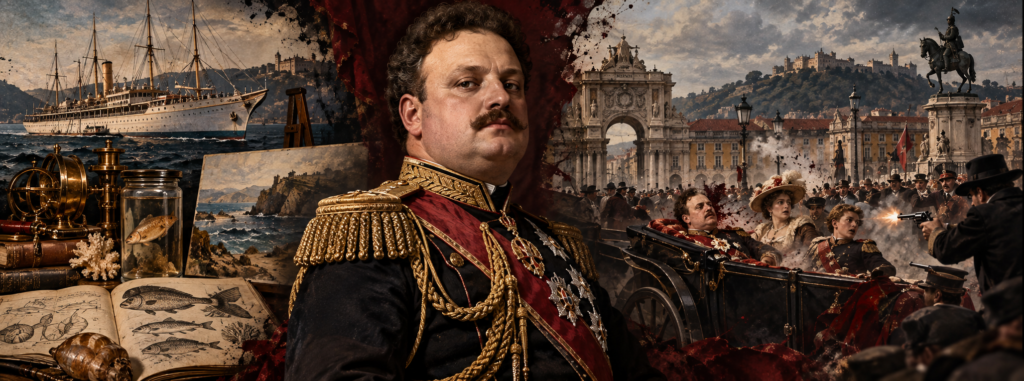
Carlos I of Portugal: The Doomed King, the Dictatorship, and the Bullets That Shattered a Monarchy
King of Portugal, 1889–1908 | Carlos the Diplomat | Financial Scandal, Colonial Humiliation, Political Repression, and the Lisbon Regicide
The King Who Rode Toward His Assassins
On the afternoon of February 1, 1908, King Carlos I of Portugal returned to Lisbon with his family after spending time at the royal estate of Vila Viçosa. The monarchy was in crisis, the capital was tense, republican conspirators had recently attempted an uprising, political arrests were multiplying, and the king’s support for the increasingly authoritarian government of João Franco had turned him into the most hated symbol of the regime. Yet Carlos entered the heart of Lisbon in an open carriage with Queen Amélie and their two sons, Luís Filipe and Manuel, exposed to the crowds gathered around the great riverside square of the Terreiro do Paço. It was an extraordinary vulnerability for a monarch whose enemies were no longer merely writing hostile newspaper articles or shouting republican slogans, but openly conspiring against the Crown.
The attack came with terrifying speed. Armed men emerged from the crowd and opened fire on the royal carriage, one using a carbine and another a handgun. Carlos was struck and killed, while the twenty-year-old Crown Prince Luís Filipe attempted to respond before he too was mortally wounded. Queen Amélie survived, as did the younger prince Manuel, who was wounded but suddenly found himself heir to a throne drenched in his father and brother’s blood. In a matter of moments, Portugal had lost both its king and the man expected to succeed him.
The Lisbon Regicide was not the spontaneous act of an angry crowd. It emerged from an atmosphere of revolutionary conspiracy, authoritarian government, bitter republican opposition, financial scandal, political humiliation, and escalating violence. Carlos had not created all of those forces, and his assassins alone bore responsibility for deciding that political conflict should end in murder, but the king had made decisions that placed the monarchy in an increasingly dangerous position. His alliance with João Franco, particularly the move toward government without a functioning parliament, had transformed a struggling constitutional monarchy into something its enemies could plausibly denounce as dictatorship.
Carlos was not clinically insane, nor is there persuasive evidence that he suffered from a psychiatric disorder that explains his political behavior. The “madness” surrounding his reign was political rather than medical: the apparent madness of a monarch watching republicanism spread while weakening parliamentary government, the apparent madness of royal expenditure during a financial crisis, and the fatal recklessness of traveling through a hostile capital in an open carriage after revolutionary plots had already been uncovered. His reign belongs among the Mad Monarchs not because Carlos lost touch with reality, but because his enemies increasingly portrayed him as a king so arrogant, extravagant, or politically blind that he seemed determined to destroy his own dynasty.
The reality is considerably more complicated. Carlos was intelligent, cultured, artistically talented, scientifically curious, physically imposing, internationally connected, and capable of understanding sophisticated political problems. He was also trapped inside a constitutional system whose established parties had become increasingly discredited, while republicanism offered an expanding section of Portuguese society an alternative to monarchy itself. His tragedy was not that he could not think. It was that a clever king repeatedly failed to find a political solution capable of saving the institution he had inherited.
A Prince Born Into a Fading Monarchy
Carlos Fernando Luís Maria Vítor Miguel Rafael Gabriel Gonzaga Xavier Francisco de Assis José Simão was born in Lisbon on September 28, 1863. He was the eldest son of King Luís I and Queen Maria Pia of Savoy, making him heir to the Portuguese throne from birth. His childhood unfolded within a monarchy that remained constitutionally established but no longer possessed anything resembling the unquestioned authority of Portugal’s earlier kings.
The Portugal Carlos inherited belonged to the constitutional world created after the Liberal Wars. The absolutism of Miguel I had been defeated, representative institutions had become part of political life, and the Crown operated within a system dominated principally by two major monarchical political organizations, the Regenerator and Progressive parties. Governments alternated in a practice often described as rotativismo, with elite political networks managing elections, parliamentary majorities, and ministerial appointments in a manner that increasingly looked artificial to critics.
For decades, the arrangement provided a degree of stability. Yet beneath that stability lay growing dissatisfaction. Portugal struggled with public debt, economic weakness, political patronage, social inequality, colonial ambitions it could barely afford, and a republican movement that portrayed monarchy as corrupt, antiquated, and incapable of national regeneration.
Carlos therefore grew up as heir to a crown that still possessed grandeur but was losing its emotional hold over parts of the country. The palaces remained magnificent, ceremonies continued, uniforms glittered, royal yachts sailed, and aristocratic society maintained its rituals. Beneath the surface, however, a new political age was approaching.
The Large Prince With the Artist’s Hands
Carlos developed into a striking physical presence. He became a large, heavily built man, recognizable by his beard and commanding appearance, and he embraced many of the traditional pursuits expected of a European aristocrat. Hunting, shooting, riding, yachting, and country life all appealed to him.
Yet he was more intellectually curious than the caricature of the gluttonous, pleasure-loving king created by some of his enemies suggests. Carlos possessed genuine artistic ability and became particularly accomplished in watercolor painting. Landscapes, birds, maritime scenes, and natural subjects attracted him, and his artistic work was not merely a royal affectation performed for flattering courtiers.
His interest in the sea became even more serious. Carlos developed a genuine passion for oceanography and marine biology, eventually participating personally in scientific expeditions along the Portuguese coast. He collected specimens, supported research, recorded observations, and worked with specialists rather than merely attaching his name to their accomplishments.
These interests later became politically useful to his enemies. A king studying fish aboard a yacht while Portugal struggled with debt could easily be portrayed as an absurd figure playing scientist while his kingdom deteriorated. The criticism was emotionally powerful, but it also distorted what Carlos was actually doing, because his oceanographic work made a legitimate contribution to Portuguese science.
Amélie of Orléans and the Royal Marriage
In 1886, Carlos married Princess Amélie of Orléans, daughter of Philippe, Count of Paris, the Orléanist claimant to the French throne. The marriage joined the Portuguese royal house to one of Europe’s most prominent exiled dynastic families. Amélie brought intelligence, discipline, charitable interests, and a strong sense of royal duty to Lisbon.
Their first child, Luís Filipe, was born in 1887 and became heir to the throne when Carlos succeeded his father. A daughter, Maria Ana, died shortly after birth, while a second surviving son, Manuel, was born in 1889. The royal family thus appeared dynastically secure, with a young crown prince being prepared to continue the Braganza-Saxe-Coburg line.
Carlos and Amélie’s marriage nevertheless became surrounded by stories concerning the king’s extramarital relationships. Carlos was widely believed to have had mistresses, and republican journalism eagerly exploited stories of royal adultery and private extravagance. Some allegations are better supported than others, while later retellings often embellished his sexual life to fit the image of a decadent monarchy.
The political damage did not depend upon proving every affair. Republicans wanted to contrast the hardships of ordinary Portuguese families with a royal household portrayed as morally indulgent and financially privileged. Carlos’s private reputation therefore became part of a broader indictment of the monarchy.
A Crown Arrives With a Crisis
King Luís I died on October 19, 1889, and Carlos inherited the throne at twenty-six. He was young, energetic, intelligent, and interested in modernizing the image of the monarchy. He was also about to confront one of the most humiliating diplomatic crises in modern Portuguese history.
Portugal still possessed an enormous colonial empire, most importantly Angola and Mozambique in Africa. During the late nineteenth-century Scramble for Africa, European powers were attempting to transform vague historical claims into actual territorial control. Portuguese imperial ambitions envisioned connecting Angola on the Atlantic coast with Mozambique on the Indian Ocean through a vast belt of Portuguese-controlled territory across south-central Africa.
This vision became associated with the famous Pink Map. Unfortunately for Portugal, British imperial ambitions collided directly with it. Britain wanted influence across the region connecting southern Africa toward the interior and was unwilling to accept Portuguese claims unsupported by sufficient occupation.
The confrontation reached its breaking point almost immediately after Carlos became king. In January 1890, Britain issued an ultimatum demanding the withdrawal of Portuguese forces from disputed territories. Portugal was in no realistic military position to fight the British Empire.
The British Ultimatum and the Humiliation of a Nation
The Portuguese government yielded to British pressure. Strategically, there was little credible alternative. Britain’s naval and military superiority was overwhelming, while Portugal’s finances were already fragile and its oldest alliance offered no protection against British demands when British interests themselves were involved.
Politically, however, the surrender was devastating. The British Ultimatum became a national humiliation, and republican propagandists transformed it into evidence that the monarchy had failed to defend Portugal’s honor. Crowds protested, patriotic anger spread, and Britain became the object of intense resentment.
Carlos had been king for only a few months and had not personally created the colonial confrontation, but monarchy inevitably absorbed the blame. The Crown represented the nation, and national humiliation therefore became royal humiliation. Republicans argued that a decaying dynasty had allowed Portugal to be bullied by its supposed ally.
The episode also inspired one of republican Portugal’s most powerful cultural weapons. The patriotic song A Portuguesa, written in response to the crisis, would later become the national anthem after the monarchy itself had disappeared. The ultimatum thus produced not merely anger but symbols around which republican nationalism could gather.
Calling Carlos’s response cowardly misses the military reality. Fighting Britain over central Africa could have been catastrophic. Yet political leadership depends partly upon perception, and the perception was disastrous.
The First Republican Blood
The anger generated by the ultimatum helped radicalize opposition. On January 31, 1891, a republican revolt erupted in Porto. Soldiers and civilians attempted to proclaim a republic, but government forces suppressed the movement.
The uprising failed militarily, yet it demonstrated something the monarchy could no longer ignore. Republicanism had moved beyond newspapers, speeches, and intellectual clubs. People were willing to take up arms against the Crown.
Carlos’s reign would repeatedly confront this problem. Suppression could stop an individual uprising without eliminating the political movement behind it. Each act of repression could also provide republicans with martyrs and further evidence for their claim that constitutional monarchy was constitutional only when convenient.
The Porto revolt was therefore an early warning. Carlos survived it easily enough, but the monarchy had begun its final confrontation with organized republicanism.
Bankruptcy Behind the Palace Doors
Portugal’s financial situation deteriorated dramatically during the early years of Carlos’s reign. The state had accumulated heavy debts while depending upon foreign credit, remittances, colonial expectations, and a weak domestic economic base. In 1892, Portugal suspended part of its external debt payments, a financial crisis frequently described as partial bankruptcy.
The crisis was not caused by Carlos’s personal spending. Portugal’s structural financial problems were far larger and had developed over many years. Nevertheless, royal expenditure became politically explosive because the monarchy’s lifestyle offered a visible target during national hardship.
Palaces, court ceremonies, hunting estates, yachts, travel, servants, royal households, and aristocratic entertainments looked very different when viewed from a country struggling with debt. Republicans could turn every luxury into a moral accusation. Even legitimate royal expenditure could be represented as money stolen from an impoverished population.
Carlos therefore faced a problem shared by many late monarchies. Royal magnificence was supposed to project national prestige, yet in an age of mass politics it could just as easily become evidence of parasitism.
The Scandal of the Royal Advances
The most damaging financial controversy involved the adiantamentos, advances of state money to the Royal Household beyond the formally established civil-list arrangements. These payments had accumulated through successive governments and were not simply a secret operation invented by João Franco for Carlos. Nevertheless, once the issue became public, it was politically poisonous.
In 1906, the controversy exploded in parliament. Republican deputy Afonso Costa accused the monarchy and government of improperly taking public money and demanded accountability. The confrontation became so heated that Costa invoked the fate of Louis XVI during the French Revolution, a chilling comparison in a country where republican revolutionaries were already openly challenging the dynasty.
The scandal mattered because it gave republican attacks something tangible. Complaints about constitutional theory or colonial diplomacy could appear abstract, but money was easy to understand. Portugal had endured financial crises while the Royal Household had received advances beyond its regular allocation.
João Franco later attempted to regularize the issue, including through arrangements involving royal property. Instead of ending the scandal, the effort kept attention focused upon it. The monarchy increasingly appeared to be explaining why it had taken money rather than persuading the public that the system itself remained trustworthy.
Claims that Franco simply “siphoned” money from the treasury to satisfy Carlos’s limitless personal debts are too crude. The advances were a longstanding governmental practice involving royal expenses and successive ministries. Yet the political optics were disastrous, and republicans needed little encouragement to describe the affair in the darkest possible terms.
The King of the Sea
While politics became increasingly poisonous, Carlos devoted serious attention to oceanography. Beginning in the 1890s, he undertook scientific voyages aboard vessels named Amélia in honor of the queen. Several yachts carried the name over the years, with increasingly capable vessels supporting his research.
Carlos studied the waters off Portugal, collected marine organisms, examined fisheries, recorded depths and conditions, and collaborated with scientific specialists. His work belonged to a wider late nineteenth-century expansion of oceanographic research in Europe. This was not simply a bored king throwing nets into the sea.
He also supported institutions connected with marine science, including what became associated with the Vasco da Gama Aquarium. His collections and studies contributed to Portuguese knowledge of marine life. The king who appeared politically old-fashioned in some respects was scientifically engaged with a distinctly modern field.
Yet the very seriousness of his interest created the contrast his enemies exploited. Portugal struggled with debt while the king sailed on yachts. Working people faced hardship while Carlos catalogued marine specimens. Republicans could erase the scientific context and leave only the image of a wealthy monarch playing with expensive boats.
The caricature was unfair, but successful propaganda rarely requires fairness. It requires an image people already want to believe.
The Painter on the Throne
Carlos’s painting generated a similar contradiction. His watercolors reveal genuine observation and technical ability, particularly in representations of nature. He was not merely a royal amateur whose work received praise because critics feared offending the palace.
Painting also provided refuge from politics. The quiet concentration required by art stood in stark contrast to parliamentary quarrels, ministerial crises, republican attacks, financial disputes, and the relentless ceremonial obligations of kingship. Carlos could disappear into a world of landscape, wildlife, light, and color that obeyed rules very different from Portuguese politics.
His critics interpreted this tendency less generously. To them, Carlos was escaping into hobbies while the monarchy deteriorated. The artist-king became another variation on the absent ruler: a man painting birds while revolution gathered outside the palace.
There is little basis for calling the behavior pathological or compulsive. Monarchs have always possessed private interests, and Carlos’s artistic work was unusually accomplished. The problem was political symbolism rather than psychology.
A king’s leisure ceases to look private when his subjects believe they are paying for it.
The Sportsman King
Carlos was also an enthusiastic hunter and marksman. Hunting was deeply embedded in European aristocratic culture, and the Portuguese royal estates provided ample opportunity for it. He took pride in his shooting ability and appears to have been genuinely skilled.
His physical confidence contributed to his public personality. Carlos was not a timid figure hiding permanently behind palace gates. He traveled, hunted, sailed, participated in scientific expeditions, and appeared publicly with the self-assurance expected of a nineteenth-century king.
That confidence could shade into carelessness. Security around royalty was becoming an increasingly serious problem across Europe, where anarchists, nationalists, and revolutionaries had assassinated monarchs, presidents, empresses, and political leaders. Carlos lived in precisely this age of political assassination.
The mythology of his final day later turned his courage into fatal arrogance. According to the darker interpretation, the great marksman believed himself somehow untouchable even as revolutionary conspiracies surrounded him. The truth is less theatrical: open royal carriages remained normal ceremonial vehicles, but in Lisbon in February 1908, normality had become dangerously obsolete.
A Monarchy of Rotating Governments
Carlos’s deeper political problem lay in the structure of Portuguese constitutional politics. The Regenerator and Progressive parties alternated in government, often through royal appointment followed by elections managed to provide the incoming ministry with a parliamentary majority. The system had once created stability but increasingly appeared corrupt and hollow.
Elections were frequently shaped by patronage, administrative pressure, local political bosses, and restricted participation. Parliamentary politics therefore did not always reflect mass public opinion in anything resembling the modern democratic sense. Republican critics could plausibly describe the system as an elite arrangement designed to preserve the monarchy and its political class.
Carlos became increasingly frustrated with this stagnation. Governments came and went, factions split, ministries struggled to address financial and social problems, and republican opposition grew. The king possessed constitutional powers that allowed him to appoint and dismiss governments, dissolve parliament, and influence political direction, making it impossible for him to remain above the crisis.
His attempts to break the system would eventually bring him to João Franco. What Carlos saw as necessary reform, opponents would call royal dictatorship.
João Franco Enters the Center of the Storm
João Franco was not initially a republican or revolutionary enemy of the constitutional monarchy. He emerged from the monarchical political establishment and eventually formed the Liberal Regenerator Party after breaking with the traditional Regenerator leadership. He promised administrative reform and a challenge to the corrupt practices associated with the old rotation system.
Carlos increasingly saw Franco as a man capable of breaking political paralysis. In May 1906, Franco became head of government. At first, his ministry operated within parliamentary politics and even received support from groups hoping for reform.
The experiment quickly encountered resistance. Franco’s political enemies attacked him, parliamentary conflict intensified, and the coalition supporting his government fractured. Rather than abandon Franco, Carlos moved closer to him.
In May 1907, parliament was dissolved. Franco continued governing without a sitting parliament, relying upon royal authority and decree. This period became known to opponents as the Francoist dictatorship.
Carlos had crossed a dangerous line. The constitutional king was now personally identified with a government ruling outside ordinary parliamentary life.
The Dictatorship That Was Supposed to Save the Monarchy
Carlos and Franco did not necessarily imagine themselves abolishing constitutional monarchy permanently. Their supporters could argue that extraordinary government was needed to clean up a corrupt political system before normal constitutional life resumed. European constitutional monarchies sometimes experienced periods of government by decree or extraordinary executive authority without immediately ceasing to exist.
The political consequences in Portugal were nevertheless severe. Franco’s opponents included not only republicans but dissatisfied monarchists. By trying to bypass the traditional parties, Carlos weakened the political networks that had previously defended the dynasty.
Censorship and repression intensified. Opposition newspapers attacked the government, demonstrations and conspiracies multiplied, and the language of politics became increasingly violent. Republicans no longer needed to argue merely that monarchy produced bad governments; they could claim the king himself had abandoned constitutional government.
Carlos had attempted to escape the discredited party system. Instead, he made himself personally responsible for what replaced it.
This was the central political gamble of his reign. It was not clinical madness, but it proved catastrophically dangerous.
Afonso Costa and the Shadow of the Guillotine
The confrontation over the royal financial advances provided a glimpse of how dangerous political rhetoric had become. Afonso Costa’s comparison between Carlos and Louis XVI was not subtle. It invoked the most famous executed monarch of the revolutionary age.
Such language shocked monarchists, and Costa was suspended from parliamentary activity after the confrontation. Yet suppressing the words could not erase their significance. The Portuguese Crown was now being discussed in terms that made regicide imaginable.
Republicans increasingly portrayed Carlos as personally corrupt and authoritarian. Caricatures attacked his body, appetite, finances, private life, political interventions, and relationship with Franco. The monarch was becoming less sacred and more vulnerable to ridicule.
Once a monarchy loses the protective aura surrounding the person of the sovereign, political opposition changes character. Carlos was no longer simply the king whose ministers might fail. He was becoming the accused.
The King’s Private Life Becomes Public Ammunition
Carlos’s alleged extramarital relationships fed this process. Royal adultery was hardly unprecedented, and nineteenth-century European courts were filled with discreet affairs. The political environment surrounding Carlos made discretion increasingly impossible.
Republican newspapers had every incentive to portray the king as sexually self-indulgent. Stories about mistresses could be combined with financial allegations, producing the image of a monarch using public money to support private pleasure. Whether every expense attributed to a mistress actually came from state funds mattered less than the cumulative impression.
Queen Amélie, meanwhile, maintained a very different public image. She became associated with charitable and medical work and often appeared more disciplined than her husband. The contrast could make Carlos’s reputation look worse.
It would be irresponsible to reproduce every named mistress or scandalous anecdote as established fact. The king’s infidelity was widely reported and has substantial historical basis, but republican polemic and later gossip expanded the details. Carlos’s sexual life should therefore be treated as part documented behavior and part political mythology.
A King Increasingly Alone
The Franco experiment isolated Carlos from portions of the political elite that monarchy traditionally relied upon. The old parties resented being bypassed, republicans wanted the monarchy destroyed, radicals embraced conspiracy, and ordinary dissatisfaction with economic conditions provided fertile ground for opposition.
Carlos appears to have understood that he was taking a risk. He was not an oblivious man wandering happily through palaces while everyone else knew revolution was coming. Correspondence and political decisions show a monarch actively engaged with the crisis.
The problem was that his solution increased his dependence upon Franco. As opposition to the government intensified, criticism of Franco became criticism of Carlos, and criticism of Carlos strengthened republican arguments against the monarchy itself. The king had tied his personal authority to one controversial political experiment.
Constitutional monarchy works most safely when the monarch can survive the failure of a ministry. Carlos increasingly surrendered that protection.
When Franco fell, the king would have nowhere left to hide.
The Republican Underground
Portuguese republicanism was not a single unified organization operating according to one plan. It included parliamentary politicians, journalists, intellectuals, activists, secret societies, revolutionary networks, and people prepared to use violence. Organizations associated with radical republicanism and the Carbonária contributed to an increasingly conspiratorial political environment.
By 1907 and early 1908, revolutionary plotting was serious. The monarchy was not imagining the existence of conspirators. People genuinely intended to overthrow it, and some were prepared to kill.
This reality complicates simple descriptions of Francoist repression as paranoia. The government faced actual revolutionary activity. Yet authoritarian measures could strengthen precisely the forces they were intended to destroy by convincing moderates that peaceful political opposition was becoming impossible.
Portugal entered a familiar spiral. Conspiracy justified repression, repression encouraged conspiracy, and each side used the other’s actions as proof that compromise had become impossible.
Carlos stood at the center of that spiral.
The Failed Revolution of January 1908
A republican revolutionary attempt was planned for January 28, 1908. The conspiracy involved republicans and dissident opponents of the government, with plans to strike against the Franco regime. Authorities uncovered the plot and arrested numerous participants.
The failure should have frightened the monarchy profoundly. It demonstrated that the political crisis had progressed beyond speeches and parliamentary obstruction into organized revolutionary action. Lisbon was filled with rumors, arrests, searches, and fear.
Prominent republicans were detained. Afonso Costa and António José de Almeida were among those imprisoned in connection with opposition to the dictatorship. The government moved toward stronger measures against people considered dangerous to public order.
Instead of restoring calm, the crackdown pushed Portugal closer to catastrophe. Franco and Carlos now faced a question familiar to endangered regimes: how far should a government go to suppress people it believed were preparing revolution?
Their answer would become one of the most controversial decisions of the reign.
The Deportation Decree
In the aftermath of the failed uprising, the government prepared a decree permitting severe action against political offenders, including banishment or deportation without the protections of ordinary judicial procedure. Carlos signed it on January 31, 1908.
The decree became a symbol of the dictatorship’s final turn toward repression. Critics saw it as confirmation that constitutional guarantees had become meaningless. The king was no longer merely allowing Franco to govern without parliament; he was personally signing extraordinary measures against political opponents.
A famous statement has long been attributed to Carlos as he signed the decree, usually rendered as some variation of his having signed his own death sentence. The line is irresistibly dramatic because he was assassinated the following day. It should nevertheless be treated as a reported remark rather than a verbatim certainty established beyond dispute.
Whether he uttered the exact words or not, Carlos understood that the political situation was dangerous. He had reason to know. The January conspiracy had just demonstrated the existence of revolutionaries willing to act.
Twenty-four hours later, the symbolism of the alleged remark would become almost unbearably grim.
February 1, 1908
The royal family had been staying at Vila Viçosa in the Alentejo. On February 1, Carlos, Amélie, Luís Filipe, and Manuel returned toward Lisbon. Their train arrived south of the Tagus, after which they crossed the river and entered the city.
The royal party proceeded through the Terreiro do Paço, the monumental square opening toward the Tagus. Carlos and his family rode in an open carriage. There was security present, but nothing resembling the sealed vehicles, controlled perimeters, and modern protective systems surrounding endangered heads of state today.
The decision has often been described as astonishingly reckless given the events of the preceding days. That judgment is understandable, although stories that Carlos ignored repeated, specific warnings of the exact assassination awaiting him should be treated cautiously unless tied to solid contemporary evidence. The monarchy wanted to project normality and confidence rather than appear imprisoned by fear.
Normality lasted only moments.
The Guns in the Square
As the carriage crossed the square, assassins attacked. Manuel Buíça, armed with a carbine, and Alfredo Costa, armed with a handgun, became the two principal identified attackers. Shots tore into the royal carriage amid confusion and panic.
Carlos was hit and fatally wounded. The attack happened so quickly that meaningful escape was nearly impossible. Queen Amélie reacted amid the chaos, while Luís Filipe attempted to defend the family.
The crown prince reportedly drew a revolver and fired at an attacker before being struck himself. He survived his father only briefly. Manuel was wounded in the arm but remained alive.
The assassins were themselves killed during the immediate response. Buíça and Costa therefore never stood trial, leaving important questions about the organization and full scope of the conspiracy unresolved. Debate has continued over who knew of the plan, who authorized it, and how directly it connected with the failed revolutionary conspiracy of January 28.
What is certain is terrible enough. A king and his heir had been shot to death in broad daylight in the center of Lisbon.
Queen Amélie in the Carriage of Death
Queen Amélie’s presence gave the regicide an especially horrifying human dimension. Within moments, she saw her husband killed and her eldest son mortally wounded while her younger son was also struck. The royal carriage, intended as a public display of monarchy, became a confined scene of blood, gunfire, terror, and bereavement.
Later accounts emphasized Amélie’s courage, including her attempt to defend her family with the bouquet she carried. The image became one of the defining memories of the regicide. Whether every gesture was later remembered with perfect precision matters less than the undeniable fact that she remained physically exposed in the carriage during the attack.
Luís Filipe’s death was especially consequential. Had Carlos alone died, Portugal would have immediately received a mature twenty-year-old king already prepared for his role. Instead, the succession passed to Manuel, only eighteen and never expected to inherit while his elder brother lived.
The assassins therefore did more than kill Carlos. They removed two generations of monarchical leadership in seconds.
The Crown passed to a wounded teenager beside the bodies of his father and brother.
The King Is Dead, Franco Is Finished
Manuel II became king immediately. One of the first political necessities was ending the Franco dictatorship. João Franco was dismissed, and a government of “acclamation” or pacification was created in an attempt to reduce tensions.
The change itself revealed how closely Carlos had become identified with Franco. Once the king was dead, the political experiment that had dominated his final years was abandoned almost immediately. The monarchy’s surviving advisers understood that continuing it would be disastrous.
Political prisoners were released, constitutional government resumed, and the young king attempted to distance himself from his father’s final policies. Yet the damage could not simply be reversed. Republicans had acquired martyrs, revolutionary mythology, and evidence that the monarchy could be struck at its very center.
Carlos’s assassination did not immediately destroy the monarchy. It did, however, leave it dramatically weakened.
Two years later, it was gone.
Was Carlos Responsible for His Own Death?
No political decision by Carlos makes his murder morally inevitable or justified. Responsibility for assassination belongs to those who planned and carried it out. Political incompetence, authoritarian government, financial controversy, adultery, colonial failure, or personal arrogance does not turn murder into a legitimate sentence.
Yet historical explanation requires asking why Carlos became a target. His support for Franco’s government made him personally identified with the suppression of opposition. The royal financial controversy damaged his reputation, while the British Ultimatum remained part of the republican indictment of the monarchy.
The decision to continue appearing publicly during an acute security crisis increased his vulnerability. The open carriage provided assassins with the opportunity they needed. That was a security failure, whether it resulted from royal confidence, inadequate planning, ceremonial convention, or some combination of factors.
The distinction between cause and blame is essential. Carlos helped create the political conditions in which hatred of the Crown intensified, but the assassins chose to transform that hatred into gunfire.
The Myth of the Madly Extravagant King
Republican propaganda portrayed Carlos as grotesquely extravagant while Portugal starved. The image proved extraordinarily durable. A large king enjoying food, hunting, yachts, mistresses, painting, and aristocratic life made an easy target.
There was substance behind some criticism. The Royal Household exceeded its formal allocations, and the advances became a genuine political scandal. Carlos lived at a level of privilege unimaginably distant from most Portuguese people.
Yet blaming Portugal’s national financial crisis on his personal consumption would be absurd. The country’s debt problems were structural, longstanding, and connected to government finance, weak economic development, international borrowing, and chronic fiscal imbalance. Eliminating Carlos’s paintings or hunting trips would not have solved them.
Even the yachts require context. They were royal vessels and symbols of privilege, but Carlos also used them for legitimate scientific research. The republican caricature worked by collapsing science, luxury, debt, and personal indulgence into one damning picture.
The king did not bankrupt Portugal by studying fish. But in politics, symbolism can become more powerful than accounting.
The Oceanographer Who Understood the Sea Better Than Politics
Carlos’s scientific work remains one of the most intriguing contradictions of his life. He possessed patience, curiosity, observational discipline, and willingness to engage with specialists. These are not qualities associated with a foolish man.
At sea, problems could be measured. Depths could be recorded, specimens classified, currents studied, and observations compared. Nature offered complexity, but it did not form parliamentary factions or publish cartoons accusing the researcher of corruption.
Politics was different. Carlos could recognize that the rotation system was failing without discovering a safe replacement. His attempt to escape stagnation through Franco ultimately damaged the constitutional legitimacy upon which the monarchy depended.
There is something tragic in that contrast. The king who carefully observed the natural world misjudged the political ecosystem surrounding his own throne.
He was capable of scientific patience while making an extraordinarily dangerous political gamble.
The Artist Who Could Not Paint Over the Cracks
The same contrast applies to Carlos’s art. His paintings reveal sensitivity to atmosphere, landscape, animals, and changing light. He possessed an eye trained to notice detail.
Yet no artistic ability could repair the monarchy’s public image. Republican caricaturists were painting Carlos too, metaphorically and literally, and their portrait reached an increasingly receptive audience. Their Carlos was fat, decadent, expensive, authoritarian, sexually indulgent, and indifferent to national suffering.
Political caricature deliberately exaggerates. But it becomes dangerous when exaggeration attaches itself to recognizable facts. Carlos really was large, privileged, fond of expensive pursuits, associated with royal financial controversy, and supporting a government ruling without parliament.
The republicans did not invent the raw material. They arranged it into the most destructive composition possible.
By the end of his reign, their portrait of Carlos competed with the monarchy’s portrait of itself, and the monarchy was losing.
Affairs, Masculinity, and Royal Reputation
Carlos’s extramarital life also belonged to an older model of elite masculinity increasingly vulnerable to modern political scrutiny. Kings and aristocrats had maintained mistresses for centuries, often with surprisingly little damage to their political legitimacy. Mass newspapers changed the equation.
A mistress could now become evidence of corruption. Private gifts could be interpreted as public theft. Sexual behavior could be transformed into a symbol of national decadence.
Carlos’s enemies exploited these possibilities relentlessly. Stories about women, money, appetite, and luxury blended into a single republican narrative in which the monarchy consumed Portugal while ordinary citizens paid the bill. Not every detail was true, but the overall accusation became politically powerful.
Queen Amélie’s respectable public image could not neutralize it. If anything, the contrast between the disciplined queen and her pleasure-loving husband sharpened the criticism.
The private king was becoming inseparable from the public crisis.
Was Carlos Arrogant?
Carlos possessed the confidence expected of a hereditary sovereign. He had been raised from birth to believe that kingship was his duty and right, surrounded by ceremonial deference and embedded within Europe’s royal network. Such an upbringing inevitably created distance from ordinary political experience.
Yet portraying him as stupidly arrogant ignores his awareness of the monarchy’s difficulties. Carlos knew the political system was malfunctioning, which was precisely why he supported Franco. He knew republicanism was dangerous, which was why the government intensified its response.
His error lay less in failing to see the crisis than in misunderstanding how to solve it. He believed stronger royal intervention could break political paralysis without destroying the legitimacy of the Crown. Instead, intervention made him personally responsible for the government’s failures.
The distinction is important. Carlos did not sleepwalk toward disaster. He walked toward it while trying to escape another disaster.
That is one reason his reign is so compelling. Intelligent people can make catastrophic decisions precisely because they believe they understand the danger.
Was the Open Carriage an Act of Madness?
The image is irresistible: a king warned of revolutionary conspiracy deliberately entering Lisbon in an open carriage as though daring assassins to try. It seems like the final proof of Carlos’s reckless personality. Yet the story should not be dramatized beyond the evidence.
Royal ceremonial culture depended upon visibility. A monarch hidden behind military protection could appear frightened and politically weak. Open carriages remained normal for public appearances, even though the age of anarchist and revolutionary assassination was making such traditions increasingly dangerous.
Carlos also had reason to believe security forces had disrupted the most immediate revolutionary conspiracy on January 28. Numerous suspects had been arrested. The government may therefore have believed the danger was being contained rather than increasing.
In retrospect, the decision was disastrous. The assassins exploited exactly the vulnerability the open carriage created.
But hindsight turns risk into inevitability. Carlos did not know he was riding into the last minutes of his life.
The Famous “Death Sentence” Remark
Few details surrounding Carlos are more dramatically perfect than the statement attributed to him when signing the January 31 decree against political dissidents. In its familiar form, the king supposedly remarked that he was signing his own death sentence. He was murdered the following day.
The line may preserve something Carlos actually said, and traditions surrounding his final political conversations developed quickly. Nevertheless, exact formulations transmitted through memoirs and later histories deserve caution. Historical dialogue often becomes cleaner and more prophetic with repetition.
Its importance lies in what the story communicates. Contemporaries understood Carlos to be aware that the decree was dangerous. The king was not entirely blind to the hatred surrounding his government.
If the sentiment is authentic, it suggests fatalism rather than insanity. Carlos believed the political situation demanded a measure that could increase the threat against his own life.
The terrible irony is that history supplied the legend with an ending almost too perfect to seem real.
The Assassins and the Unanswered Questions
Manuel Buíça and Alfredo Costa died at the scene, preventing investigators from questioning the two central attackers. Their deaths helped ensure that the regicide would generate conspiracy theories for generations.
The assassins belonged to the radical republican and revolutionary environment of the period, but the exact organizational chain behind the attack remains debated. Some accounts connect it closely with the Carbonária and revolutionary networks involved in the January conspiracy, while others caution against assuming that every prominent republican leader knew of or approved the assassination.
This distinction matters. Republican opposition to Carlos ranged from parliamentary agitation to revolutionary violence, and those categories should not be collapsed. A politician demanding the end of monarchy was not automatically part of a murder conspiracy.
The immediate killing of the gunmen also benefited later mythmaking. Monarchists could imagine a vast republican conspiracy, while republicans could isolate the assassins as individuals acting within a broader revolutionary climate.
The complete truth died partly with the men in the square.
Luís Filipe: The King Who Almost Was
The death of Luís Filipe intensified the catastrophe. At twenty, the crown prince had already received political and diplomatic preparation and had represented Portugal abroad. He was old enough to assume the throne with substantially more preparation than his younger brother.
His behavior during the attack contributed to a posthumous image of courage. Accounts describe him attempting to respond with a revolver before being struck by gunfire. Whatever romantic embellishments later surrounded the scene, he clearly became a second target and died from his wounds.
There is a popular statement that Luís Filipe was technically king for approximately twenty minutes because he survived his father. Under the Portuguese constitutional succession, however, the throne passed immediately upon Carlos’s death, which has encouraged this dramatic interpretation. He was never formally proclaimed or able to exercise royal authority, making descriptions of an actual twenty-minute “reign” more a dynastic curiosity than a meaningful kingship.
His death mattered because it eliminated the prepared heir. Manuel suddenly inherited not merely a throne but a political disaster.
The assassins had struck the monarchy twice.
Manuel II Inherits the Ruins
Manuel was eighteen when he became king. He had been the younger son, not the principal heir, and his preparation reflected that reality. His first experience of kingship came while wounded and grieving the murder of his father and brother.
The new regime immediately attempted political pacification. Franco was dismissed, ordinary constitutional government resumed, and the monarchy tried to distance itself from the dictatorship. Manuel hoped to restore confidence by standing above factional conflict.
It was too late. The monarchy’s traditional parties remained fragmented and discredited, while republicans had grown stronger. The regicide itself demonstrated the vulnerability of the Crown and destroyed much of the mystique surrounding royal authority.
On October 5, 1910, republican revolution overthrew the monarchy. Manuel fled Portugal, beginning the exile from which he would never return as king.
Carlos had been dead for less than three years.
Did João Franco Destroy the Monarchy?
João Franco became an obvious scapegoat after the regicide. His dictatorship had intensified opposition, and his removal immediately after Carlos’s death seemed to confirm that his policies had become intolerable. Even many monarchists believed his experiment had endangered the Crown.
Yet blaming Franco alone is too simple. The Portuguese monarchy faced structural problems long before he became prime minister: financial weakness, discredited party politics, republican growth, social unrest, colonial humiliation, and divisions among monarchists themselves. Franco inherited a sick political system.
Carlos chose to back him because the king recognized that sickness. The fatal question was whether authoritarian reform could cure a constitutional monarchy without destroying its constitutional credibility. In Portugal, it could not.
Franco’s methods provided republicans with their most powerful argument. They could now claim monarchy was not merely corrupt but incompatible with political liberty.
The attempt to save the Crown by strengthening royal government helped make the Crown the central target.
Financial Scandal and Political Reality
The adiantamentos deserve similar nuance. Republicans were correct that royal finances required scrutiny and that money had been advanced beyond the established Royal Household allocation. The issue was politically legitimate, not simply fabricated slander.
Yet the practice crossed multiple governments and could not honestly be reduced to Carlos secretly raiding the treasury whenever he wanted another luxury. The relationship between royal expenditure, state property, civil-list arrangements, and governmental advances was more complicated. Franco’s attempt to regularize the matter demonstrates that it was a real administrative and political problem.
The scandal became lethal because it fit the existing republican story. A financially troubled country had a privileged royal household receiving money beyond its regular allocation. No amount of accounting complexity could make that look good in a political cartoon.
Carlos’s scientific yachts, hunting, art, travel, court life, alleged mistresses, and physical appearance could all be added to the picture. The king became a symbol of expenditure.
Republicanism transformed accounting into morality, and morality into revolution.
The King Who Loved Portugal’s Empire
Carlos was deeply interested in Portugal’s international standing and colonial empire. The British Ultimatum wounded the monarchy precisely because empire had become intertwined with national identity. Portugal possessed memories of extraordinary global expansion but lacked the economic and military strength of the great imperial powers surrounding it.
Carlos worked to maintain Portugal’s diplomatic position, cultivating relationships with other European monarchies and powers. His reign included important royal visits and diplomatic activity intended to reinforce the country’s international prestige. In this sphere he was often more capable than the caricature of the incompetent king suggests.
Yet diplomacy could not erase the memory of 1890. Republican propaganda continually returned to the ultimatum as proof that monarchy had failed the nation. The humiliation became part of the political mythology of the regime’s decline.
There was another irony. Carlos’s instinct for international diplomacy was often sophisticated, but domestic politics proved far less manageable.
He could navigate Europe’s courts more easily than Lisbon’s parliament.
The Alleged Madness of a Doomed King
Carlos’s inclusion among supposedly mad monarchs requires careful definition. There is no substantial evidence that he suffered psychosis, mania, dementia, or another severe psychiatric disorder that impaired his ability to understand government. His artistic and scientific work alone demonstrates sustained concentration and intellectual engagement.
His critics instead described political behavior that seemed irrational. Why support dictatorship when the monarchy needed broader legitimacy? Why allow royal financial controversy to fester when republicanism was growing? Why maintain conspicuous aristocratic pursuits when economic hardship made luxury politically toxic? Why ride openly through Lisbon after a revolutionary conspiracy?
Those are legitimate questions about judgment. They are not psychiatric symptoms.
Political leaders routinely make decisions that later appear astonishingly self-destructive. Calling such decisions madness can conceal the pressures, assumptions, and limited choices visible at the time.
Carlos was not detached from reality. He miscalculated it.
A King Caught Between Two Centuries
Carlos belonged culturally to the nineteenth-century world of hereditary monarchy, aristocratic hunting, royal yachts, dynastic marriages, court ceremony, and personal diplomacy. He governed, however, in an age rapidly moving toward mass newspapers, ideological parties, urban political activism, revolutionary networks, public scandal, and modern nationalism.
The old monarchy depended heavily upon deference. The new politics thrived on ridicule. Carlos could command a courtier to bow, but he could not force a republican newspaper to respect him.
His personal interests made the generational conflict even more visible. Oceanography and painting were modern pursuits in intellectual terms, yet the wealth allowing him to pursue them belonged to the world of royal privilege. The same yacht could therefore symbolize scientific progress to one observer and decadent monarchy to another.
Carlos never found a convincing way to reconcile those images. His enemies proved better at defining him publicly than the palace did.
That failure became part of the monarchy’s collapse.
The King as Caricature
Carlos’s body itself became political. He was large and grew heavier with age, allowing hostile caricaturists to depict him as physically bloated by privilege. The symbolism required no explanation: the king grew fat while Portugal grew poor.
Such imagery was cruel and deliberately simplistic, but politically effective. Physical appearance has long been weaponized against rulers, particularly when critics want to suggest appetite, laziness, greed, or moral corruption. Carlos offered caricaturists an instantly recognizable figure.
His beard, hunting clothes, food, yachts, and court life became visual shorthand for everything republicans claimed was wrong with monarchy. Once the king had been reduced to a recognizable comic type, reverence became increasingly difficult to restore.
This is an important stage in the psychological collapse of a monarchy. A ruler does not need to be hated by everyone. He merely needs to stop seeming sacred.
By 1908, Carlos was vulnerable not only to bullets but to laughter.
The Personal Tragedy Behind the Politics
Political analysis can make the regicide seem inevitable, but inevitability disappears when the event is viewed inside the carriage. Carlos was forty-four years old. Luís Filipe was twenty. Manuel was eighteen, and Amélie was a wife and mother watching her family being shot around her.
Whatever political mistakes Carlos had made, his final moments were not an abstract constitutional reckoning. They were an assassination. The violence was immediate, intimate, and irreversible.
The deaths also produced trauma that continued long afterward. Amélie survived both the destruction of her family in the carriage and the fall of the monarchy two years later. Manuel inherited a crown under circumstances almost designed to overwhelm an inexperienced young ruler.
The monarchy’s political failures should not be romanticized, but neither should assassination. Murder does not become less brutal because the victim wore a crown.
The Terreiro do Paço was simultaneously a political turning point and a family catastrophe.
The Monarchy Dies Slowly After the King
Carlos’s death did not immediately create the Portuguese Republic. Manuel II attempted to stabilize the monarchy, and many Portuguese people remained monarchists. The political system continued functioning for more than two years.
Yet the regicide accelerated processes already underway. The monarchy had lost its experienced sovereign and heir, Francoism had collapsed, traditional parties remained divided, and republican organization continued expanding. The young Manuel lacked the authority to rebuild the system from the ground up.
The revolution of October 1910 finally ended the monarchy. Manuel departed into exile, while republican leaders proclaimed a new regime. The House of Braganza’s centuries-long rule over Portugal had come to an end.
Carlos therefore became the penultimate king of Portugal, but in emotional terms he often appears as the monarchy’s last powerful sovereign. Manuel inherited the aftermath.
The bullets of 1908 did not formally abolish the monarchy, but they helped make its survival far more difficult.
The Oceanographer After Death
Carlos’s scientific reputation survived his political destruction. His oceanographic collections and research continued to attract attention, and later assessments have often been kinder to his scientific work than contemporary political critics were. The king’s interest in marine biology was real and productive.
This produces one of the strangest images in Portuguese royal history. A monarch remembered for dictatorship and assassination was also carefully studying organisms pulled from the Atlantic depths. The same hands signing political decrees handled scientific specimens and paintbrushes.
There is no contradiction in human beings containing such different interests. Political failure does not erase intellectual accomplishment, just as scientific curiosity does not excuse authoritarian decisions. Carlos was complicated because people are complicated.
The republican caricature needed him to be a foolish parasite. Monarchist nostalgia sometimes needs him to be a brilliant king destroyed entirely by wicked conspirators.
Neither version is sufficient.
The Dictator Who Was Still a Constitutional King
Calling Carlos a dictator personally also requires precision. João Franco headed the government, while Carlos remained monarch under the Constitutional Charter. The 1907–1908 regime did not simply replace Portugal with a personal royal dictatorship in the twentieth-century totalitarian sense.
Nevertheless, Carlos used his constitutional authority to sustain government without parliament, and his personal backing made Franco’s rule possible. The distinction between prime minister and king therefore cannot absolve him. Carlos chose the experiment.
The political system depended upon royal powers that were broad enough to permit significant intervention. Earlier monarchs had used those powers within the rotating party system. Carlos attempted to use them to break that system.
His mistake was believing that royal authority could stand above the political consequences. Once parliament was absent and Franco governed through decree, responsibility traveled upward.
The king who tried to become the solution became part of the problem.
The Final Winter
The winter of 1907–1908 was increasingly ominous. Political hostility had reached levels at which opponents were no longer merely discussing government change but revolution. Secret societies, republican militants, dissident monarchists, police, ministers, and military officers operated within an atmosphere saturated with conspiracy.
Carlos continued his ordinary royal activities amid this tension. That ability to compartmentalize can look extraordinary in retrospect. He hunted, traveled, dealt with ministers, and maintained family life while his government confronted revolutionary plots.
Perhaps this was confidence. Perhaps it was fatalism. Perhaps it was simply the practiced routine of a monarch who had spent years living with political hostility and could not behave every day as though assassination were imminent.
The failed January 28 uprising should have broken that routine. Instead, the government responded by intensifying repression while the royal family prepared to return to Lisbon.
Four days separated the failed conspiracy from the regicide.
What the Assassins Actually Destroyed
Buíça and Costa killed Carlos and Luís Filipe, but they did not immediately create the republic they wanted. The monarchy survived under Manuel II, and political instability continued. Violence simplified nothing.
Their attack did, however, transform Portuguese political psychology. A king had been killed publicly in his own capital. The monarchy’s aura of permanence was shattered.
For royalists, the regicide became an atrocity demonstrating the barbarism of revolutionary politics. For radical republicans, the dead king could become the fallen embodiment of dictatorship. For moderates, the spectacle showed how dangerously far Portuguese politics had deteriorated.
The assassination therefore became whatever each political faction needed it to be. Beneath those interpretations remained the bodies of a father and son.
History would spend the next century arguing about everything surrounding them.
Carlos and the Charge of Self-Destruction
There is a compelling temptation to describe Carlos as the king who destroyed himself. The pattern appears almost too neat: national humiliation, financial scandal, royal extravagance, political intervention, dictatorship, repression, revolutionary conspiracy, deportation decree, open carriage, assassination. Each step seems to move inexorably toward the Terreiro do Paço.
But history did not unfold according to a script Carlos could read. The British Ultimatum occurred at the beginning of his reign and arose from international realities he largely inherited. Portugal’s financial weakness predated him. The party system had developed over decades, while republicanism emerged from forces far larger than one monarch.
His decisions still mattered. Carlos chose to support Franco, accepted government without parliament, and signed harsh measures against political opponents. Those decisions narrowed the monarchy’s options and made the king personally responsible for an increasingly unpopular regime.
Self-destruction is therefore too simple, but miscalculation is not. Carlos gambled that extraordinary royal intervention could preserve constitutional monarchy.
The gamble failed catastrophically.
A Different Kind of Mad Monarch
Carlos I belongs in the Mad Monarchs category precisely because his case exposes how casually the word “mad” can be used against rulers. There was no documented collapse comparable to Maria I, no evidence of sustained delusion, and no reason to diagnose his scientific interests, painting, hunting, affairs, or political mistakes as symptoms of mental illness. His enemies were describing political insanity, not medical insanity.
The distinction becomes especially important when discussing his hobbies. Oceanography was not a bizarre compulsion draining Portugal’s treasury for no purpose. Painting was not evidence that he had abandoned reality. Hunting and marksmanship were conventional aristocratic activities, however extravagant they appeared beside widespread poverty.
Even his fatal security choices do not demonstrate psychiatric abnormality. Carlos lived in a ceremonial culture that expected kings to appear publicly, and the exact intelligence available to him on February 1 remains less clear than later legends suggest. What looks suicidal after an assassination may have looked like an assertion of normal royal authority before it.
The real story is darker because it is more ordinary. Carlos was a functional, intelligent ruler who made political decisions that helped isolate his monarchy at precisely the moment its enemies were becoming more organized and violent.
The King and the Country That No Longer Believed
Monarchies survive partly through institutions and partly through belief. People must believe the Crown represents something worth preserving, whether stability, religion, national identity, tradition, constitutional balance, or dynastic continuity. By the end of Carlos’s reign, that belief was weakening among important sections of Portuguese society.
Republicans offered a competing national story. Portugal was poor because monarchy was corrupt. Portugal had been humiliated because monarchy was weak. Politics was stagnant because monarchy protected rotten parties. Public money disappeared because the royal household was extravagant. Franco’s dictatorship existed because the king feared democracy.
Every claim contained simplifications, but together they formed a powerful narrative. Carlos struggled to offer an equally compelling alternative.
His scientific accomplishments could not answer accusations about constitutional government. His diplomacy could not erase the ultimatum. His artistic talent could not repair royal finances.
The monarchy was losing the argument about what Portugal’s future should look like.
The Last Great Irony
Carlos wanted to modernize aspects of Portugal. He supported science, cultivated international diplomacy, understood that the existing political rotation system was failing, and sought administrative reform. Yet his attempt to break political stagnation ultimately made him appear more authoritarian rather than more modern.
The contradiction consumed his reign. The scientist supported government by decree. The cultured European monarch became associated with censorship and political deportation. The constitutional king helped suspend ordinary parliamentary life in the hope of rescuing the constitutional system.
He was not simply a reactionary fighting to restore medieval absolutism. That makes his failure more interesting than Miguel I’s in some respects. Carlos was attempting to preserve a modernized monarchy and still helped undermine it.
His story is therefore not about a man refusing to recognize that the world had changed. It is about a man recognizing change but choosing a remedy that accelerated the disease.
The Blood on the Terreiro do Paço
The physical setting of Carlos’s death adds another layer of historical symbolism. The Terreiro do Paço had long been one of Lisbon’s great ceremonial spaces, rebuilt after the catastrophic earthquake of 1755 that had transformed the city under Joseph I and Pombal. It represented royal authority, imperial commerce, state power, and the monumental reconstruction of Portugal’s capital.
On February 1, 1908, that space became the scene of royal slaughter. A carriage crossed the square, shots cracked through the afternoon, and the monarchy’s carefully constructed ceremonial image collapsed into confusion. Carlos died where Portuguese royal power was supposed to be most visible.
There could hardly have been a more devastating setting. The assassination did not happen in a remote hunting lodge or behind palace walls. It happened in public.
The people of Lisbon could understand immediately what had occurred. Their king had been killed in the center of his own capital.
The monarchy had never looked more mortal.
What Carlos Could Not Control
One of the dangers of royal biography is attributing an entire national crisis to the person wearing the crown. Carlos possessed meaningful constitutional powers, but he did not control the international economy, colonial competition, every ministry, every election, every newspaper, every republican organization, or every revolutionary conspirator.
Portugal’s problems were structural. Industrial development remained limited compared with more powerful European states, public finances were weak, political participation was restricted, emigration was substantial, and imperial ambitions exceeded available resources. The monarchy sat on top of these tensions rather than creating all of them.
Carlos could influence how the Crown responded. That is where responsibility becomes meaningful. His alliance with Franco turned structural crisis into a direct confrontation between royal authority and its political enemies.
He could not control the storm, but he chose how to steer into it.
The final course brought him into the Terreiro do Paço on February 1.
The Man Beneath the Crown
Stripped of propaganda, Carlos emerges as a more human and therefore more tragic figure. He loved the sea, painted, hunted, studied natural history, enjoyed aristocratic pleasures, maintained relationships outside his marriage, worried about politics, and attempted to exercise the authority he believed belonged to his office. He was neither the grotesque parasite of republican caricature nor the flawless martyr of nostalgic royalism.
He could be intelligent and politically mistaken. He could contribute to science while living extravagantly. He could recognize corruption while using extraordinary royal power in ways that weakened constitutional government.
Those contradictions make him historically valuable. Real rulers rarely fit the moral categories created after their deaths.
Carlos’s greatest failure was not stupidity. It was his inability to translate intelligence into a sustainable political settlement.
The sea he studied could be charted. The currents destroying his monarchy could not.
The Dynasty After Carlos
The Portuguese monarchy survived Carlos by only thirty-two months. Manuel II attempted conciliation, but the political forces unleashed before the regicide could not easily be contained. Republican organization expanded, while monarchists remained divided and the old parties struggled to recover credibility.
In October 1910, revolution broke out in Lisbon. The military situation was confused, and republican forces were not overwhelmingly powerful, but the monarchy’s political foundations proved too weak to sustain resistance. Manuel departed, and the Republic was proclaimed.
Queen Amélie went into exile having lost almost everything that had defined her adult life. Her husband and eldest son were dead, her surviving son had lost his throne, and the country she had adopted no longer possessed a monarchy. She would live until 1951, carrying memories of a vanished court deep into the twentieth century.
Carlos never saw the final collapse. The assassins spared him that humiliation.
Whether they accelerated the monarchy’s death or temporarily generated sympathy that prolonged it remains debatable. What cannot be doubted is that the system Carlos had inherited never recovered from the crises surrounding his final years.
Was He the King Who Killed the Monarchy?
Carlos did not single-handedly destroy the Portuguese monarchy. No serious account of its collapse can ignore decades of financial problems, electoral manipulation, party stagnation, colonial crisis, social change, republican organization, and ideological transformation. The monarchy’s weaknesses were older than his reign.
He nevertheless bears responsibility for decisions that intensified the crisis. Supporting João Franco’s rule without parliament personalized the political conflict around the Crown. The royal advances scandal damaged the moral authority of the dynasty, while the government’s response to revolutionary opposition strengthened the image of royal repression.
Carlos was trying to rescue monarchy from a failing political system. The method he chose deprived monarchy of some of the very political buffers that had previously protected it. When Franco became hated, Carlos could no longer plausibly stand apart from him.
That was the fatal political error. The king ceased to be the referee and became one of the players.
Once that happened, opponents who wanted to overthrow the government could easily conclude that they also needed to overthrow the king.
A Death Too Perfect for Propaganda
The circumstances of Carlos’s assassination were almost designed to become legend. A king accused of dictatorship signs an extraordinary decree against political opponents. The next day, he enters his rebellious capital in an open carriage. Gunmen appear, the king falls, his heir attempts to fight back and is killed, the queen survives amid the gunfire, and an unprepared younger son suddenly becomes monarch.
Political mythology could hardly ask for more. Every faction found symbols in the scene. Republicans saw the violent collapse of tyranny, monarchists saw innocent royal blood spilled by assassins, and later historians saw the moment a nineteenth-century monarchy visibly entered its death agony.
This dramatic perfection is precisely why caution is necessary. Prophetic quotations become sharper, warnings become more explicit, gestures become more heroic, and conspiracies become more elaborate when retold after a spectacular death. Carlos’s final days attracted all of these processes.
The documented events are already dramatic enough. They do not require invented dialogue or exaggerated foreknowledge.
Carlos knew he was in danger. He did not know exactly how little time remained.
The King Who Wasn’t Mad
Carlos I of Portugal was not a mad king. There is no persuasive medical evidence that he experienced severe mental illness, and his sustained artistic, scientific, diplomatic, and governmental activity argues strongly against attempts to explain his reign through psychiatric collapse. The label belongs to political rhetoric rather than medicine.
He was capable of poor judgment. He could be indulgent, stubborn, confident in royal authority, and dangerously willing to support extraordinary government when ordinary politics frustrated him. His personal lifestyle gave opponents ample material, while financial controversies surrounding the Royal Household damaged his credibility.
Yet none of those things requires madness. The more historically meaningful explanation is that Carlos faced a political system losing legitimacy and chose a risky method of reform. His solution temporarily strengthened executive authority while weakening the monarchy’s ability to stand above partisan conflict.
He also underestimated how quickly political language was becoming political violence. The threats surrounding the monarchy were no longer theoretical. Revolutionary networks existed, conspiracies were underway, and some opponents were prepared to kill.
The king who understood the depths of the Atlantic failed to measure the depth of hatred beneath his own throne.
The Final Portrait
Carlos left behind several competing portraits. There is Carlos the oceanographer leaning over specimens collected from Portuguese waters, a monarch fascinated by the hidden life of the sea. There is Carlos the painter studying birds and landscapes with an artist’s patience, and Carlos the hunter carrying a gun through royal estates with the confidence of an aristocratic sportsman. There is also Carlos the privileged sovereign surrounded by palaces, yachts, political favors, royal advances, and stories of mistresses while his country struggled with debt.
Then there is the political Carlos: the young king humiliated by the British Ultimatum, the monarch watching republicanism grow, the sovereign frustrated by parliamentary stagnation, and finally the king who entrusted João Franco with an increasingly authoritarian experiment. None of these portraits is false simply because another one also exists. Together they reveal why Carlos remains difficult to reduce to either villain or martyr.
His enemies succeeded in turning his contradictions into accusations. Scientific curiosity became expensive eccentricity, artistic sensitivity became political escapism, hunting became arrogance, royal finances became theft, sexual affairs became national decadence, and constitutional intervention became tyranny. Some accusations were exaggerated, while others grew from genuine mistakes and scandals.
Carlos’s defenders have sometimes gone too far in the opposite direction, portraying him as a farsighted reformer destroyed almost entirely by malicious republican propaganda. That interpretation also avoids uncomfortable evidence. Carlos chose Franco, supported rule without parliament, and signed extraordinary measures against political opponents. Those were not inventions of republican cartoonists.
He was a complicated king governing a country whose political system was approaching breaking point. Complexity did not save him.
The Last Ride
The final journey through Lisbon remains impossible to separate from everything that came before it. Carlos sat in an open carriage not merely as a husband returning with his family, but as the king associated with a dictatorship, the sovereign attacked over royal finances, the monarch whose reign had begun beneath the humiliation of the British Ultimatum, and the head of a dynasty republican revolutionaries wanted removed. Around him stood a capital in which political hatred had become increasingly organized and armed.
Yet he was also still performing kingship. A king was expected to be visible, composed, and unafraid. Hiding behind palace walls might have protected Carlos physically while confirming every rumor that the monarchy had lost control of the streets.
That dilemma illustrates the trap into which his reign had fallen. Showing confidence created danger, while showing fear could create political weakness. Repression provoked resistance, while tolerating conspiracy threatened the state. Breaking the old party system weakened the monarchy, but leaving it untouched allowed stagnation to continue.
Carlos repeatedly chose action, but each choice narrowed the path ahead.
On February 1, the path ended in the Terreiro do Paço.
The King, the Heir, and the Gunfire
The regicide stripped away every abstraction surrounding monarchy. Constitutional theory, royal prerogative, republican ideology, colonial policy, state finance, and parliamentary procedure disappeared for a few seconds beneath the sound of gunfire. Carlos was no longer an institution. He was a man trapped in a carriage being shot.
Luís Filipe was no longer merely the Crown Prince. He was a young son attempting to respond while his father lay mortally wounded. Amélie was no longer simply Queen of Portugal but a woman caught between the bodies of her husband and child, while Manuel’s life changed from that of a younger prince into that of a wounded king before the carriage had even escaped the square.
That human reality should remain visible even in a dark political history. Carlos’s mistakes were real, and the suffering caused by political repression was real. So was the violence inflicted upon his family.
Assassination did not resolve Portugal’s political problems. It merely added two more bodies to them.
The monarchy would fall anyway.
The Madness Was in the Gamble
If there was a kind of madness in Carlos’s reign, it lay not in delusion but in the increasingly desperate gamble of trying to save a discredited constitutional order by temporarily weakening its constitutional practices. Carlos recognized that the old system was failing. He simply chose a remedy that made the Crown personally responsible for the cure.
His decision was understandable within the pressures of the moment. Governments were unstable, parties were discredited, republican agitation was growing, and the country needed reforms. João Franco appeared to offer energy where the traditional political establishment offered paralysis.
But political systems contain their own logic. A constitutional monarch gains protection by allowing ministers and parliamentary parties to absorb political anger. Carlos stepped beyond that protective distance and tied the prestige of the Crown to Franco’s success.
When Franco’s government became associated with dictatorship, censorship, arrests, financial controversy, and deportation, the king could no longer retreat easily into constitutional neutrality. His crown had become part of the argument.
That was not insanity. It was a strategic mistake of enormous consequence.
The Sea, the Crown, and the Abyss
There is a haunting irony in Carlos’s devotion to oceanography. He spent years studying depths invisible from the surface, sending instruments and nets downward into waters whose hidden worlds fascinated him. He understood better than most monarchs of his age that a calm surface could conceal extraordinary complexity below.
His kingdom operated according to the same principle. Court ceremonies continued, ministers took office, parliament met and dissolved, royal yachts sailed, diplomatic visits were exchanged, and Portugal outwardly remained a functioning European constitutional monarchy. Beneath that surface accumulated debt, republicanism, political cynicism, social anger, colonial resentment, secret societies, and revolutionary violence.
Carlos could measure the Atlantic. He could not measure all of that.
By 1908, the hidden currents had become strong enough to pull the monarchy under. The king’s response was to concentrate authority around a government he hoped could restore control, but the effort only intensified the turbulence.
The oceanographer king had spent years exploring depths. The deepest danger was waiting on land.
The Crown After the Bullets
Carlos was buried beside Luís Filipe at the Royal Pantheon of the House of Braganza in São Vicente de Fora. The funeral transformed political figures into dead members of a family, and Portugal confronted the extraordinary spectacle of burying both king and heir together. Foreign representatives came to Lisbon while the surviving monarchy attempted to project continuity.
Manuel II took the throne but abandoned the Franco experiment. The reversal demonstrated that even royalists understood the need for immediate political change. Yet removing Franco could not restore the world that existed before Carlos backed him.
The monarchy had suffered something more serious than the loss of a king. It had lost confidence. Republicans had demonstrated that the royal family could be physically attacked, while political elites increasingly doubted whether the dynasty could stabilize the country.
When revolution finally came in October 1910, the monarchy collapsed with remarkable speed. Manuel went into exile, and Portugal became a republic.
Carlos’s murder had not automatically caused that outcome, but his reign had become inseparable from the road leading toward it.
Carlos I and the Dark End of Portuguese Kingship
The Portuguese monarchy had survived extraordinary disasters before Carlos. It had endured the earthquake of 1755, the mental collapse of Maria I, Napoleon’s invasion, the flight of the court to Brazil, Brazilian independence, royal family conspiracies, Miguel’s usurpation, and the Liberal Wars. Again and again, the dynasty had bent without breaking.
Carlos confronted a different enemy. The danger did not come from one invading army or one rebellious prince. It came from the gradual erosion of confidence in monarchy itself.
That made the crisis harder to fight. Armies can be defeated, conspirators arrested, and ministries dismissed. A government cannot easily imprison the idea that the political system itself has lost legitimacy.
Franco attempted repression. Carlos supplied royal authority. Republicans supplied an alternative political mythology.
By 1908, those forces collided in the streets of Lisbon.
The King Who Signed and Rode On
The reported story that Carlos believed he was signing his own death sentence survives because it captures the fatalism surrounding his last hours. Even if the exact wording cannot be established with certainty, the king had ample reason to understand that the decree he approved would intensify opposition. The country had just experienced another revolutionary conspiracy, and arrests had filled Lisbon with anger.
Still he returned to the capital. Still the royal carriage remained open. Still the rituals of monarchy continued as though royal visibility could itself demonstrate that the regime remained in control.
That determination can be read as courage, arrogance, duty, miscalculation, or some combination of all four. It should not be diagnosed as madness.
Carlos had spent his life being taught that the king must embody the state. In his final years, that principle became his greatest political vulnerability because every grievance against the state could be directed toward his person.
On February 1, that metaphor became literal. Men who wanted to strike the regime aimed directly at the king’s body.
The Final Judgment
Carlos I was neither a lunatic stumbling toward assassination nor a helpless victim of forces entirely beyond his control. He was an intelligent, cultivated, privileged, politically engaged monarch caught between a failing nineteenth-century political system and the emerging mass politics of the twentieth century. His talents were genuine, his mistakes were consequential, and the propaganda surrounding him magnified both his weaknesses and the public meaning of his private life.
His scientific accomplishments deserve to be separated from republican mockery. Oceanography was not evidence of obsessive madness, nor was painting proof that he ignored government. His hunting and marksmanship belonged largely to the aristocratic culture into which he had been born, while stories of his affairs should be distinguished carefully between well-supported infidelity and the embellishments of hostile political gossip. Even the royal financial scandal, damaging as it was, was more complicated than the image of a king simply emptying the treasury for pleasure.
Yet complexity does not erase responsibility. Carlos supported João Franco’s increasingly authoritarian government, accepted the dissolution of parliamentary government, and placed royal authority behind extraordinary measures against political opposition. In trying to break a discredited party system, he weakened the constitutional distance that protected the Crown from ordinary political hatred. By the final year of his life, opposition to Franco and opposition to Carlos had become almost impossible to separate.
The British Ultimatum had wounded the monarchy at the beginning of his reign. Financial crises and the scandal of the royal advances weakened it further. Republicanism transformed these failures into a story of national decline in which the king became the central villain. Franco’s dictatorship then supplied the final argument that the monarchy was not merely useless but dangerous.
Carlos responded with confidence when caution might have protected him and with executive force when compromise might have preserved broader support. Yet it is too easy, more than a century later, to imagine that every correct choice was obvious. He faced genuine conspiracies, real governmental paralysis, financial problems he had inherited, and a republican movement containing people openly committed to overthrowing his dynasty.
That is what makes his story darker than a simple tale of royal stupidity. Carlos could see many of the problems clearly. He simply could not find a solution that did not create new ones.
His reign ended in the most brutal way imaginable. The royal carriage crossed the Terreiro do Paço beneath the open sky, surrounded by the architecture of Portuguese state power, while assassins waited among the people. Within moments the king was dead, his heir was dying, his younger son was wounded, and Queen Amélie was trapped inside the destruction of her family.
There was no medical madness in that carriage. There was the accumulated violence of a political system that had ceased to contain its own conflicts. There was a monarchy that had mistaken authority for security, revolutionaries who had mistaken murder for political solution, and a country approaching the end of an institution that had ruled it for centuries.
Carlos had spent years studying the sea, fascinated by the hidden world beneath its surface. His instruments could measure depth, retrieve specimens, and reveal creatures invisible from the deck of the Amélia. He could paint the horizon, track marine life, and transform careful observation into scientific knowledge. Yet the kingdom beneath his feet contained currents more dangerous than anything he encountered in the Atlantic, and neither science nor royal authority gave him an instrument capable of measuring how close they had carried him to disaster.
The monarchy survived his death, but only briefly. Manuel II inherited a crown already cracked by scandal, dictatorship, political hatred, and the sight of royal blood on Lisbon’s streets. In October 1910, revolution finished what the regicide had foreshadowed, and the last Portuguese king went into exile.
Carlos therefore stands near the end of a long line of rulers whose stories fill the darker corners of Portuguese history. Maria I had been genuinely incapacitated by mental illness. João VI had been ridiculed for anxiety and caution. Miguel I had been branded monstrous for absolutism and civil war. Carlos inherited a different kind of accusation: that he had become politically irrational, so disconnected from the condition of his kingdom that he could not see he was helping to destroy his own throne.
That accusation contains enough truth to remain compelling, but not enough to become a diagnosis. Carlos was not mad. He was a king who gambled with royal authority during a period when monarchy could no longer afford to lose.
He lost.
The price was not merely a crown. It was a father and son dead together in a carriage, a traumatized queen, a teenager forced onto a collapsing throne, and a dynasty that would disappear from power less than three years later. Carlos I did not live to see the Portuguese monarchy fall, but when the bullets struck him in the Terreiro do Paço on February 1, 1908, the sound carried far beyond the square. It was the sound of a political order approaching its end.