
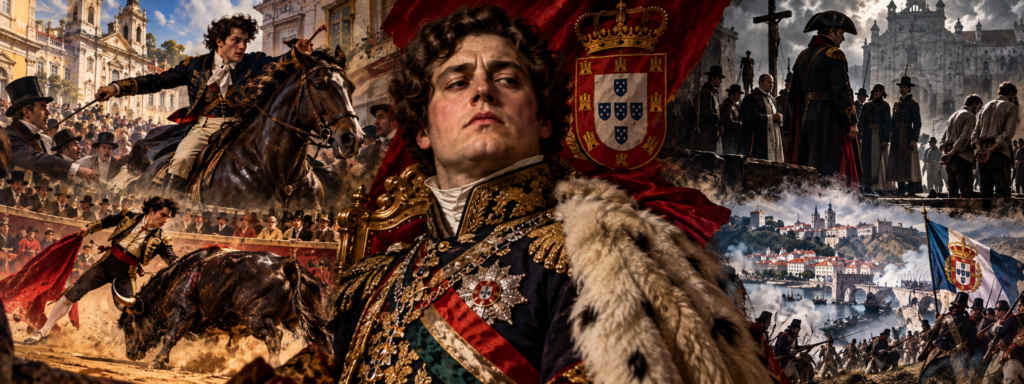
Miguel I of Portugal: The Absolutist Prince, the Family Coup, and the Civil War That Tore Portugal Apart
King of Portugal, 1828–1834 | Miguel the Absolutist | Royal Rebellion, Political Repression, the Liberal Wars, and the Violent End of the Old Order
The Prince Who Came Home to Take a Crown
When Miguel of Portugal returned to Lisbon in 1828, he did not arrive as an obscure pretender sneaking into the kingdom under cover of darkness. He came as a prince of the House of Braganza, the younger brother of Pedro IV, uncle of the young Queen Maria II, and the man expected to govern Portugal as regent while honoring a constitutional settlement designed to prevent the royal family from destroying itself. He had already sworn allegiance to the Constitutional Charter and was expected eventually to marry his niece Maria, thereby reconciling two bitterly divided branches of Portuguese politics. Crowds welcomed him, church bells rang, absolutists celebrated, and conservatives believed the young prince had finally returned to rescue Portugal from the revolutionary ideas they blamed for years of instability. Within months, the constitutional arrangement was collapsing around him.
Miguel dissolved the Chamber of Deputies and summoned the traditional Cortes of the Three Estates, which recognized him as king in 1828. To his supporters, this was not usurpation but restoration: Pedro had become emperor of an independent Brazil, and Miguel represented the legitimate Portuguese monarchy liberated from foreign-inspired constitutionalism. To his opponents, Miguel had committed an extraordinary betrayal, accepting the regency and constitutional settlement only to destroy both once he possessed the machinery of government. The young Maria II was displaced, liberals were persecuted, prisons filled, exiles fled abroad, and Portugal descended into the political struggle that became the Liberal Wars. Miguel’s reign would last only six years, but those six years helped decide whether nineteenth-century Portugal would return to traditional absolutism or continue toward constitutional monarchy.
Miguel has occasionally been swept into the broad historical category of supposedly “mad” monarchs, but there is no persuasive evidence that he suffered from the catastrophic psychiatric illness that incapacitated his grandmother Maria I. He was volatile as a young man, intensely physical, reckless, politically uncompromising, and capable of supporting severe repression. Hostile contemporaries and later liberal histories turned those qualities into a portrait of a wild, almost primitive prince driven by instinct rather than judgment. Yet ideological extremism, violence, impulsiveness, and authoritarianism are not psychiatric diagnoses, and calling Miguel clinically insane would obscure the political ideas and social forces that made his movement possible.
The darker truth is arguably more disturbing. Miguel did not need to be insane to preside over repression or help plunge his country into civil war. He belonged to a generation of European reactionaries who believed revolution had unleashed chaos, constitutionalism threatened legitimate monarchy, liberalism undermined religion, and concessions to representative government would eventually destroy the traditional social order. Thousands of Portuguese people agreed with him strongly enough to fight for him. Miguel’s story is therefore not the tale of one mad prince inexplicably dragging a peaceful nation into catastrophe, but of a deeply divided society finding a young royal figure around whom its most irreconcilable political passions could gather.
The Son of Portugal’s Most Explosive Marriage
Miguel was born at Queluz on October 26, 1802, the son of the future King João VI and Carlota Joaquina of Spain. Few royal marriages provided a more poisonous environment in which to grow up. João and Carlota had become bitter political and personal enemies, living increasingly separate lives while gathering competing factions around themselves. Carlota was ambitious, combative, and hostile to her husband’s cautious political style, while João repeatedly attempted to survive by compromise, delay, and avoidance of irreversible confrontation.
The family situation became still stranger because Miguel’s grandmother, Queen Maria I, was alive but severely mentally ill. Her condition had become incapacitating in 1792, forcing João gradually to assume government and eventually become Prince Regent. Miguel therefore grew up in a dynasty where the reigning queen was incapable of ruling, his father exercised power in her name, and his mother actively resented her husband’s political dominance. Questions of legitimate authority were not abstract constitutional issues in Miguel’s childhood; they existed inside his own family.
Rumors concerning Miguel’s paternity circulated during his lifetime and afterward because of Carlota’s reputation and the miserable state of her marriage. Such stories became useful weapons in an era when royal legitimacy mattered enormously, but scandalous repetition does not establish biological fact. João publicly recognized Miguel as his son, and Miguel belonged legally and dynastically to the House of Braganza. Attempts to transform gossip about his mother’s private life into certainty about Miguel’s parentage go beyond the evidence.
His relationship with Carlota nevertheless mattered enormously. Miguel became politically associated with his mother’s deeply conservative and absolutist outlook, while his elder brother Pedro followed a different path. The royal household was gradually producing not merely quarrelling siblings but representatives of opposing visions of monarchy.
A Childhood Carried Across the Atlantic
Miguel was only five when Napoleon’s invasion transformed his life. In late 1807, the Portuguese royal family abandoned Lisbon and sailed for Brazil rather than allow itself to fall into French hands. Miguel crossed the Atlantic with his parents, siblings, grandmother, courtiers, ministers, servants, and the enormous royal establishment that transformed Rio de Janeiro into the effective capital of the Portuguese monarchy.
Brazil became the landscape of his childhood and adolescence. The environment differed dramatically from the formal European court culture into which Portuguese princes had traditionally been raised. Miguel became known for vigorous outdoor activity, horsemanship, hunting, and an enthusiasm for physical pursuits that could appear rough beside the polished expectations surrounding European royalty.
Later writers transformed this Brazilian upbringing into the legend of an almost feral prince. Miguel supposedly preferred grooms, stable hands, farm workers, and rough companions to educated aristocrats, tearing through streets on horseback while respectable courtiers looked on in horror. Some descriptions probably contain genuine observations about his informal social preferences and physical temperament, while others clearly reflect the class prejudices of aristocratic observers who considered familiarity with socially inferior companions inherently degrading.
The distinction matters because Miguel’s reputation was created partly by people who already disliked what he represented. A prince who enjoyed horses, bullfighting, rough company, and physical danger could easily become “the brute” in liberal or diplomatic descriptions. His actual behavior could be reckless without every hostile characterization being literally true.
The Wild Prince of Rio
One of the most persistent images of the young Miguel shows him galloping through Rio de Janeiro with companions, deliberately disturbing pedestrians and knocking hats from men’s heads with a riding crop. Variations of the story became part of his reputation for aggressive adolescent mischief. Other versions enlarge the incidents into gangs of young men racing through markets, overturning stalls, frightening civilians, and treating public streets as their private playground.
There is enough evidence for Miguel’s rough youthful reputation to take the general picture seriously. He was regarded as physically energetic, impulsive, fond of horses, and far less restrained by court etiquette than diplomats expected from a royal prince. What deserves greater caution is the assumption that every later anecdote describes a documented event exactly as it occurred.
The famous judgment attributed to the Duke of Palmela—that Miguel could be good among good companions and worse than bad companions among bad ones—captures how contemporaries understood his susceptibility to influence, although exact quotations should always be treated carefully when transmitted through later histories. The underlying criticism was that Miguel possessed energy without sufficient judgment and could be pushed toward extremes by the people surrounding him. That assessment would acquire political significance once absolutist courtiers began treating the young prince as their champion.
His youthful recklessness should not be retroactively diagnosed as mania or some other psychiatric condition. Plenty of privileged young men behaved violently, irresponsibly, or arrogantly without suffering serious mental illness. Miguel’s problem was not that riding too fast proved him insane; it was that the habits of a reckless prince eventually became attached to a political movement willing to use force.
Bulls, Horses, and the Cult of Physical Courage
Miguel developed a strong reputation as an accomplished horseman and enthusiast for dangerous physical pursuits. Bullfighting became especially associated with him, and accounts emphasize his willingness to expose himself personally to risks that other royal spectators might have preferred to observe from a safe distance. His participation helped construct an image of masculinity dramatically different from that of his cautious father.
Some later descriptions depict Miguel repeatedly confronting bulls on foot, being gored almost to death, breaking bones, and horrifying foreign diplomats with one reckless injury after another. The broad association between Miguel and dangerous equestrian or bullfighting activity is credible, but individual injuries and dramatic encounters should not automatically be accepted simply because they have been repeated in colorful biographies. His legend accumulated physical exploits in much the same way João VI’s accumulated chickens and bathing stories.
Politically, however, the contrast between father and son mattered. João had become famous for evasion, negotiation, retreat, and compromise. Miguel cultivated or naturally projected the opposite qualities: physical courage, decisiveness, confrontation, and apparent contempt for danger.
To absolutists frustrated by João’s willingness to negotiate with liberals, Miguel looked like the prince Portugal needed. The characteristics that made him alarming to diplomats made him attractive to supporters who believed the monarchy had spent too long retreating. His body and temperament became part of his political appeal.
Revolution Calls the Royal Family Home
The Portuguese Liberal Revolution of 1820 transformed Miguel’s life once again. The movement demanded constitutional government and the return of the royal court from Brazil. João VI eventually agreed to sail back to Portugal in 1821, taking much of the family with him while leaving Pedro behind in Brazil.
Miguel returned to a country profoundly different from the Portugal his family had abandoned in 1807. Liberal politicians were attempting to redefine monarchy through constitutional institutions, while conservative clergy, aristocrats, royalists, and rural communities feared that revolutionary politics would dismantle religion and traditional authority. The ideological struggles that had torn apart France and Spain now ran directly through Portugal.
Carlota Joaquina fiercely resisted the new constitutional order. Miguel increasingly aligned himself with her political camp, becoming the royal figure around whom opponents of liberalism could organize. His youth and energy made him particularly valuable to reactionaries who regarded João as too willing to compromise.
The political conflict also deepened the division between Miguel and Pedro. Pedro’s position in Brazil increasingly connected him with constitutional monarchy and Brazilian independence, while Miguel became associated with Portuguese absolutism. Two brothers born into the same royal family were becoming symbols of opposing political futures.
The Vilafrancada: Miguel’s First Great Revolt
In May 1823, Miguel made his first dramatic intervention in Portuguese politics. A military uprising known as the Vilafrancada challenged the constitutional regime, drawing upon the broader reaction against liberal government. Miguel placed himself at the center of the movement and was hailed by absolutist supporters as a defender of throne and altar.
João VI eventually appeared and took control of the situation. The existing constitutional system was dismantled, but the king did not simply hand unrestricted authority to Miguel or allow the most radical reactionaries to dictate the future. João once again demonstrated his preference for occupying the political center, accepting the collapse of one arrangement while refusing to become the prisoner of the faction that had helped destroy it.
Miguel emerged from the episode with enhanced popularity among absolutists. He had demonstrated willingness to act where his father hesitated, and conservatives increasingly regarded him as the prince capable of restoring the old monarchy. The distinction between loyal son and political challenger was already becoming dangerously blurred.
The Vilafrancada was not yet an attempt by Miguel to crown himself king. It was, however, an unmistakable demonstration that he was willing to use military pressure against the constitutional order and that troops could rally around his name. The lesson would not be forgotten.
The Abrilada: A Son Turns on His Father
The next confrontation was considerably darker. In April 1824, Miguel led another military movement, the Abrilada, ostensibly directed against conspirators and dangerous political enemies. Troops occupied strategic positions, prominent figures were arrested, and the political atmosphere in Lisbon became increasingly threatening.
This time João himself was effectively caught within the crisis created by his son. Miguel’s actions went beyond opposition to liberalism and raised the possibility that the king’s own authority was being subordinated to a reactionary military faction. Foreign diplomats, particularly the British, became deeply concerned.
João eventually escaped the immediate pressure and reasserted control. Miguel was removed from his military command and sent abroad, beginning a period of exile that took him to Vienna. The father had survived another family conspiracy, while the son who claimed to defend royal authority had demonstrated his willingness to endanger the authority of the reigning king.
The Abrilada is central to understanding Miguel. His later seizure of power in 1828 did not emerge from nowhere. Years earlier, he had already participated in attempts to reshape Portuguese government through military intervention, and his absolutism had become entangled with personal ambition.
Exile in Vienna
Miguel’s exile removed him temporarily from Portuguese politics but did not destroy his importance. Vienna placed him within the heart of conservative post-Napoleonic Europe, where governments remained deeply suspicious of revolutionary liberalism. Prince Metternich’s Austria represented precisely the kind of political order Portuguese absolutists admired: dynastic, conservative, hierarchical, and committed to containing revolutionary movements.
Miguel’s time abroad also exposed him to more formal European court culture. The wild Brazilian prince was now a royal exile whose future depended upon international diplomacy. His supporters in Portugal did not disappear, and his name continued to carry enormous political weight.
Meanwhile, events within the Braganza family moved rapidly. João VI died in March 1826 under circumstances that later scientific investigation would make even more intriguing through evidence consistent with arsenic poisoning. His eldest surviving son Pedro was already Emperor Pedro I of Brazil, creating a constitutional and dynastic problem.
Pedro briefly became Pedro IV of Portugal but could not realistically unite Portugal and Brazil under his personal rule. He therefore devised a settlement intended to preserve constitutional monarchy while reconciling the competing branches of the family. The arrangement would bring Miguel back into the center of Portuguese politics.
The Crown Offered Through a Child
Pedro granted Portugal the Constitutional Charter of 1826 and eventually abdicated the Portuguese throne in favor of his young daughter Maria da Glória, who became Maria II. The plan envisioned Miguel returning as regent, accepting the Charter, and eventually marrying his niece. The arrangement was dynastically uncomfortable by modern standards but entirely recognizable within European royal marriage politics.
Miguel formally accepted the settlement and swore to uphold the constitutional framework. That oath would become one of the central accusations against him when events unfolded differently. Liberals later portrayed everything that followed as deliberate perjury by a prince who had never intended to honor his promises.
Miguel’s defenders argued that the constitutional settlement itself lacked legitimacy and that Pedro, as ruler of independent Brazil, no longer possessed the right to dictate Portugal’s constitutional order. They maintained that traditional Portuguese succession and political principles favored Miguel. The dispute therefore involved competing theories of legitimacy, not simply one side possessing law while the other possessed ambition.
Nevertheless, Miguel had personally accepted obligations before returning. Whatever his private intentions, his public position was clear enough to create expectations. Portugal was about to discover how fragile those expectations were.
The Triumphal Return
Miguel returned to Portugal in February 1828 and received an enthusiastic welcome from supporters. Absolutists saw him as the embodiment of national restoration after years of revolution, foreign influence, constitutional experimentation, and dynastic confusion. His popularity in significant parts of the country was genuine.
That fact is essential because describing Miguel simply as a lone usurper conceals the social depth of Miguelism. Conservative clergy, portions of the nobility, military officers, traditional royalists, and many rural communities supported him. They feared liberalism for religious, political, economic, and cultural reasons that cannot be reduced to manipulation by one prince.
Miguel’s supporters also portrayed the Constitutional Charter as foreign or Brazilian interference imposed by Pedro. They emphasized traditional monarchy, Catholicism, and Portuguese independence. For them, Miguel represented continuity with an older political order rather than revolutionary dictatorship.
Liberals saw the same movement as a counterrevolution threatening rights, constitutional government, and the legitimate queen. Portugal was therefore not merely choosing between two individuals. It was choosing between competing definitions of what monarchy itself should mean.
The Oath Begins to Collapse
The constitutional settlement deteriorated almost immediately. Miguel dissolved the Chamber of Deputies and moved toward the restoration of traditional political forms. The old Cortes of the Three Estates was summoned to consider the succession, providing a framework through which his supporters could proclaim him legitimate king.
In July 1828, Miguel was acclaimed as king by the traditional Cortes. Maria II’s claim was rejected by the Miguelist regime, while Pedro’s constitutional arrangements were treated as illegitimate. The regent had become King Miguel I.
To liberals, this was straightforward usurpation. Miguel had accepted the regency under constitutional conditions and then destroyed those conditions once securely in Portugal. His broken oath became one of the defining moral charges against his reign.
Miguelists offered a different constitutional argument, insisting that Pedro had forfeited or lacked authority to settle the Portuguese crown from Brazil. Historians need not pretend the two interpretations possessed identical legal strength to recognize that contemporaries genuinely fought over them. The succession crisis became combustible precisely because both camps could construct narratives of legitimacy.
A Kingdom Divides
Resistance appeared quickly. Liberal opposition was particularly strong in Porto and among military and political figures committed to the constitutional settlement. Revolts against Miguel were suppressed, and many constitutionalists fled Portugal.
The Azores became crucial. Terceira eventually emerged as the principal liberal stronghold, providing a territorial base from which Maria II’s supporters could maintain resistance. The island would later become the launching point for Pedro’s campaign to recover the Portuguese throne for his daughter.
Miguel controlled most of mainland Portugal, giving his regime a substantial advantage. His government was not merely a palace clique holding Lisbon while the country rejected him. For years he commanded the resources, institutions, troops, and popular support necessary to maintain effective rule over much of the kingdom.
That support makes the coming repression more historically important, not less. Political violence was not simply imposed from above by one unstable ruler. Miguelism became a social movement capable of mobilizing communities against people suspected of liberal sympathies.
The Darkening of the Regime
The years after 1828 brought severe political repression. Liberals and suspected constitutionalists faced arrest, imprisonment, confiscation, exile, and in some cases execution. Political policing and denunciation created an atmosphere in which association with the defeated constitutional movement could become dangerous.
The scale is difficult to summarize through a single reliable number. Partisan histories produced competing statistics, and claims that “thousands were publicly executed” are exaggerated if interpreted literally as judicial executions. Thousands were, however, affected by imprisonment, persecution, displacement, confiscation, or exile during the Miguelist period and the broader civil conflict.
Executions did occur. The repression following liberal resistance, particularly in northern Portugal, produced martyrs who became central to liberal political memory. Porto’s Mártires da Liberdade—liberal figures executed under Miguel’s regime—became enduring symbols of the struggle against absolutism.
Political violence also existed outside formal judicial processes. Denunciations, intimidation, mob attacks, and local retaliation could blur the line between state repression and popular political vengeance. Once society had been divided into loyalists and traitors, violence became easier to justify.
Terror, Propaganda, and the Problem of Numbers
Liberal writers described Miguel’s government as a reign of terror, and there was substantial repression behind the phrase. Yet the term was also political language produced during a civil conflict in which both sides sought European sympathy. British and French opinion mattered because foreign diplomatic and military support could determine Portugal’s future.
Miguel’s enemies therefore emphasized executions, prisons, censorship, arbitrary government, and persecution. Miguelist propaganda responded by depicting liberals as revolutionaries, Freemasons, enemies of religion, foreign agents, and destroyers of legitimate monarchy. Each side portrayed the other as an existential threat.
This does not mean the repression should be dismissed as propaganda. People were imprisoned, executed, driven abroad, stripped of property, and persecuted because of political affiliation. The Miguelist government consciously attempted to suppress organized liberal opposition.
What requires caution is sensational arithmetic. Claims involving tens of thousands of executions or uniformly organized state murder often collapse different categories of victims into one number. Civil-war displacement, prisoners, deportees, exiles, suspected liberals, and executed prisoners should not be treated as interchangeable.
The Gallows of Porto
Some of the most powerful liberal memories of Miguel’s reign centered on executions in Porto. Constitutionalists who had participated in resistance were condemned and killed, creating a pantheon of martyrs around whom later liberal Portugal constructed a moral narrative of victory over absolutism. Public execution transformed political enemies into symbols.
For Miguel’s government, harsh punishment served a practical purpose. Rebellion had to be deterred, especially because liberal conspiracies and military resistance threatened a regime whose international recognition remained uncertain. The state treated opposition not as legitimate political disagreement but as treason against lawful monarchy.
That distinction is characteristic of authoritarian systems. If the king’s legitimacy is considered sacred and constitutional opposition inherently unlawful, compromise becomes difficult. Political opponents cease to be citizens with competing ideas and become criminals attacking the foundations of society.
Miguel’s uncompromising conception of monarchy therefore helped make repression systemic. He did not need to be personally ordering every arrest or local beating for his regime to create an environment in which violence against liberals could flourish.
The Church, the Crown, and the Absolutist Cause
Religion stood near the center of Miguelism. Many Portuguese clergy regarded liberalism with deep suspicion because revolutionary movements elsewhere had attacked Church property, religious orders, clerical privileges, and ecclesiastical authority. Memories of the French Revolution remained powerful throughout Catholic Europe.
Miguel presented himself as a defender of traditional Catholic monarchy. His supporters connected throne and altar, portraying constitutional liberalism as part of a broader assault upon the religious foundations of society. Sermons, religious symbolism, and clerical networks could therefore reinforce political loyalty.
Liberals responded by accusing Miguel’s clerical supporters of fanaticism and obscurantism. Later liberal histories sometimes portrayed rural Miguelists as ignorant peasants manipulated by priests, an interpretation that underestimates the genuine social and religious convictions involved. People could rationally perceive liberal reforms as threats to institutions around which their communities had long been organized.
The conflict was therefore ideological at a very deep level. Miguelism was not merely loyalty to one prince. It represented resistance to the political and cultural transformation associated with nineteenth-century liberalism.
The Prince Who Preferred the Stable to the Salon
Miguel’s personal style reinforced his political image. He appears to have been more comfortable with soldiers, horsemen, attendants, and practical outdoor companions than with polished diplomatic society. Foreign aristocrats sometimes regarded his manners as rough and insufficiently cultivated for a European sovereign.
Stories that he “despised the aristocracy” altogether are too sweeping. Miguel depended heavily upon aristocratic supporters and traditional social hierarchy, making ideological hatred of the nobility difficult to reconcile with his political program. What seems more plausible is that he disliked certain polished liberal aristocrats and preferred companions who shared his interests and political instincts.
His social informality could nevertheless shock courtiers. A monarch was expected to perform majesty through ceremony, controlled speech, dress, posture, and carefully regulated access. Miguel’s rougher manner undermined those expectations.
To supporters, this could make him appear authentic, masculine, and close to ordinary royalists. To hostile diplomats, the same behavior confirmed that Portugal had placed an uncultivated reactionary on the throne.
Was Miguel Emotionally Unstable?
Contemporary descriptions sometimes emphasize Miguel’s rapid changes of mood, impulsiveness, and susceptibility to companions. Those observations have encouraged later writers to speculate about psychological instability. The evidence does not justify a specific psychiatric diagnosis.
His grandmother Maria I suffered genuine severe mental illness, which naturally encouraged later attempts to search for hereditary psychiatric patterns among her descendants. His father João VI was anxious and melancholy but remained politically functional. Miguel’s volatility therefore became easy to place within a family narrative of inherited instability.
Yet political aggression is not evidence of psychosis. Neither are bullfighting, reckless riding, bad companions, temper, ideological extremism, or cruelty. A retrospective diagnosis would require evidence of symptoms that surviving sources do not reliably provide.
Miguel’s behavior can be understood without medicalizing it. He was a young prince raised amid dynastic conflict, revolution, exile, ideological polarization, military culture, and an extraordinarily hostile family. Those circumstances are sufficient to explain much of his political development without inventing an illness.
Europe Refuses to Settle the Question
Miguel’s international position remained complicated. Conservative governments might sympathize with resistance to liberal revolution, but diplomatic interests did not automatically align with his claim. Britain in particular had longstanding interests in Portugal and could not simply ignore the succession crisis.
Pedro’s supporters worked tirelessly abroad to present Maria II as the legitimate queen and Miguel as a usurper who had violated his oath. Portuguese liberal exiles gathered resources, political support, and military experience. The struggle increasingly became international.
The Azores provided the crucial territorial foothold. Liberal control there meant Miguel could not claim undisputed possession of the entire Portuguese monarchy. As long as Terceira remained outside his control, the constitutional cause possessed a place from which to rebuild.
Miguel attempted to eliminate that resistance but failed. The survival of the Azorean base would eventually prove fatal to his regime.
Pedro Returns to Fight His Brother
Pedro’s position had changed dramatically by the early 1830s. In Brazil, political conflict led him to abdicate the imperial throne in 1831 in favor of his young son, the future Pedro II. Freed from the Brazilian crown, Pedro turned his attention toward Portugal and his daughter Maria’s claim.
The conflict now became intensely personal. Two brothers stood at the head of opposing political systems. Pedro represented the constitutional cause and his daughter’s legitimacy, while Miguel represented absolutism and his own claim to the crown.
Pedro traveled to Europe, organized support, and joined the liberal forces based in the Azores. An expedition was prepared to invade mainland Portugal. The Portuguese succession dispute was becoming a full civil war.
For João VI, compromise had always been preferable to dynastic confrontation. His sons were now going to settle the question with armies.
The Landing at Mindelo
In July 1832, Pedro’s liberal expedition landed near Porto at Mindelo. The operation established a major foothold on the Portuguese mainland and began the decisive phase of the Liberal Wars. Porto became the center of constitutional resistance.
Miguel’s forces surrounded the city, beginning the long Siege of Porto. Conditions became increasingly harsh as bombardment, disease, shortages, and military pressure affected soldiers and civilians alike. The conflict was no longer a sequence of coups and political declarations but sustained civil war.
Miguel possessed numerical and territorial advantages, while Pedro’s forces depended heavily upon organization, foreign volunteers, naval power, and the ability to maintain Porto. Neither side could easily destroy the other. The war became a brutal test of endurance.
Families and communities were divided. Portuguese fought Portuguese over competing monarchs and competing constitutional orders, turning ideological labels into matters of life and death.
The Siege of Porto
The Siege of Porto became one of the defining episodes of the war. Miguelite forces attempted to contain and destroy the liberal enclave while Pedro’s supporters endured months of hardship. Artillery fire, disease, hunger, and military casualties made the city a symbol of liberal resistance.
The siege also damaged Miguel politically. His government could control most of Portugal yet could not eliminate the enemy stronghold. Each month Porto survived demonstrated that the liberal cause remained viable.
Foreign volunteers and officers played important roles. The conflict attracted men from Britain, France, and elsewhere who saw the Portuguese war as part of the broader European struggle between constitutionalism and absolutism. Miguel’s regime increasingly appeared internationally isolated.
The war was becoming more than a Portuguese family dispute. It formed part of the ideological battle reshaping Europe after the Napoleonic Wars.
The Sea Turns Against Miguel
Naval power became crucial. Pedro’s cause benefited from experienced foreign officers, among them the British naval commander Charles Napier. In 1833, liberal naval forces won a decisive victory off Cape St. Vincent, badly damaging Miguel’s ability to control the maritime dimension of the war.
The victory allowed liberal strategy to expand beyond the siege of Porto. A force under the Duke of Terceira landed in the Algarve and advanced northward. Lisbon, suddenly vulnerable, fell to the constitutionalists in July 1833.
Miguel’s government had lost the capital. The symbolic significance was enormous, although the war continued. A regime that had once controlled nearly all mainland Portugal was being squeezed from multiple directions.
Miguel still possessed loyal forces and substantial support, but momentum had shifted. The prince who had seized Lisbon’s political machinery in 1828 was now fighting to prevent the kingdom from slipping away.
Civil War Without Romance
Dynastic wars can appear almost elegant when reduced to portraits and family trees. Pedro and Miguel were brothers, Maria was Pedro’s daughter and Miguel’s niece, and the conflict can be summarized as a dramatic struggle for a crown. On the ground, however, civil war was uglier.
Soldiers died from combat, disease, exhaustion, and poor conditions. Civilians endured requisitions, disruption, political suspicion, and economic hardship. Communities were forced to navigate changing control while deciding which loyalties could safely be expressed.
Political revenge deepened the wounds. Liberals remembered Miguelist prisons and executions, while Miguelists feared what would happen if the constitutionalists won. Each side carried lists of grievances that made reconciliation increasingly difficult.
Portugal was not merely deciding who would sit on the throne. It was destroying part of itself in order to decide what kind of state would emerge afterward.
Miguel’s “Reign of Terror”
The phrase “reign of terror” appears frequently in hostile descriptions of Miguel’s government. It captures something real about the fear experienced by political opponents, but it should be used with historical precision. Miguelist Portugal was authoritarian and repressive, yet it was not identical to the centralized revolutionary Terror of France or a modern totalitarian state.
Censorship, imprisonment, political prosecution, confiscation, execution, and exile were genuine tools of the regime. Suspected liberals could find themselves vulnerable not only to official authorities but to hostile local networks and popular royalist violence. The boundary between formal repression and partisan vengeance was often dangerously thin.
Miguel’s government also faced real armed opposition. That fact does not excuse abuses, but it helps explain how the regime justified them. Officials could describe repression as necessary defense against rebellion rather than persecution of peaceful political disagreement.
This is one reason authoritarian violence becomes self-reinforcing. Once opposition has been criminalized, every revolt proves the government was right to fear conspirators, while every act of repression gives opponents additional reasons to revolt.
A King Surrounded by Loyalists
Miguel’s critics sometimes portray him as paranoid, but as with his father, political suspicion existed in an environment filled with genuine enemies. Liberal exiles were organizing abroad, Terceira resisted him, Pedro openly sought his removal, foreign volunteers joined the constitutionalists, and Britain and France could influence the balance of power.
Miguel nevertheless helped create the environment that surrounded him with enemies. By rejecting the constitutional settlement and suppressing opposition, he made peaceful accommodation increasingly difficult. People who might have accepted a conservative constitutional monarchy were forced to choose between submission and resistance.
His ideological rigidity therefore magnified the threat he feared. The more violently the government attacked liberalism, the more the struggle became existential for liberals. Compromise became treason on both sides.
That dynamic helps explain the ferocity of the civil war without resorting to claims of insanity. Miguel was not necessarily imagining enemies who did not exist. He was pursuing policies that ensured those enemies would fight him to the end.
The International Tide Turns
By 1834, Miguel’s international position deteriorated sharply. Britain, France, Spain, and the Portuguese liberal government formed the Quadruple Alliance, connecting Portugal’s civil conflict with the struggle against absolutist claimants elsewhere on the Iberian Peninsula. Miguel could no longer rely upon the conflict remaining primarily domestic.
Spain was confronting its own dynastic struggle involving Don Carlos, whose absolutist cause resembled Miguelism in important ways. Liberal governments increasingly saw the Iberian reactionary movements as interconnected threats. Diplomatic pressure and military intervention shifted the balance.
Miguel’s armies suffered decisive defeats, including at Almoster and Asseiceira. The latter, fought in May 1834, severely damaged the remaining Miguelist military position. The final collapse forced Miguel toward surrender as the possibility of maintaining an effective national war rapidly disappeared.
The war that had begun with Miguel controlling most of Portugal was ending with his forces retreating toward the Alentejo. His supporters could continue guerrilla resistance, flee into Spain, or accept defeat, but restoring the strategic situation of 1828 was becoming impossible.
Évora Monte: The Crown Is Lost
By late May 1834, Miguel’s position had become untenable. His military commanders considered their options and moved toward ending the war. Continuing resistance promised further bloodshed without a realistic prospect of reversing the outcome.
On May 26, the Convention of Évora Monte ended the conflict. Miguel agreed to abandon his claim and leave Portugal, while provisions included an amnesty connected with the political struggle and arrangements for his departure. The constitutional cause had prevailed, and Maria II would reign.
Miguel’s supporters regarded the settlement as a catastrophe. Liberals regarded it as the destruction of absolutism and the restoration of legitimate constitutional government. For Miguel personally, it meant losing the throne at thirty-one.
He had entered Portugal six years earlier amid celebrations from supporters convinced he would restore the nation. He left as a defeated claimant aboard a foreign vessel, condemned never again to rule the country for which his supporters had fought.
The Exile from Sines
On June 1, 1834, Miguel embarked at Sines aboard the British frigate Stag and sailed toward Genoa. He would never return to Portugal alive. The man who had spent his youth crossing the Atlantic with an exiled royal court was once again leaving his homeland, this time permanently.
Once abroad, Miguel repudiated the settlement imposed at Évora Monte, declaring that he had accepted it under coercion. That refusal had financial consequences because it undermined arrangements concerning the pension contemplated for him. His supporters continued to regard him as the legitimate king.
In December 1834, legislation formally banished Miguel and his descendants from Portugal and excluded his line from succession. The constitutional order was not content merely to remove him from the throne; it attempted to prevent Miguelism from returning through his descendants.
The political exile lasted beyond Miguel’s lifetime. The banishment associated with the Miguelist branch remained part of Portuguese legal history long after the civil war generation had disappeared.
The Strange Quiet of the Former King
Miguel’s later life presents one of the most striking contrasts in his biography. The reckless prince, military conspirator, absolutist king, and central figure of a bloody civil war gradually became a far less dramatic exile. Removed from the political machinery of Portugal, he spent years moving through Italy, Britain, and eventually the German states.
He was not immediately wealthy or comfortable. During portions of his exile, Miguel depended upon supporters and experienced financial difficulty. The former sovereign who had once commanded the resources of Portugal now lived without a kingdom and without the governmental machinery that had given his political convictions such destructive reach.
In 1851, Miguel married Princess Adelaide of Löwenstein-Wertheim-Rosenberg. The marriage produced a large family, including one son and six daughters, and his household became connected through later marriages with numerous European Catholic dynasties. The exiled branch that Portugal had attempted to exclude from national political life became deeply woven into European aristocratic genealogy.
The transformation should not be overstated into a miraculous personality cure. A former king living privately in the German lands had neither the opportunities nor the pressures that had defined the revolutionary politics of Portugal. A quieter life in exile does not prove that an earlier psychiatric disorder suddenly disappeared, particularly when there is little evidence such a disorder existed in the first place.
Did Exile “Cure” Miguel?
Popular retellings sometimes present Miguel’s later domestic life as psychologically baffling. How could the violent young absolutist become a respectable husband and father? The implied answer is that some mysterious instability vanished once he lost power.
A simpler explanation is available. Political circumstances changed. Miguel was no longer commanding armies, facing conspiracies, defending a contested throne, or serving as the focus of a mass ideological movement. He had entered a completely different social role.
Human beings can behave very differently in different environments without suffering alternating psychiatric personalities. A man capable of ruthless political action can also be affectionate toward his children. A ruler willing to imprison opponents can behave politely toward neighbors.
The contrast therefore reveals less about “madness” than about power. Miguel without a throne possessed neither the state apparatus nor the political circumstances through which his absolutism had once operated.
The Family Man of Bronnbach
Miguel eventually settled with Adelaide and their children in the German lands, where the former king grew into the image of a bearded Catholic patriarch, far removed from the youthful horseman and conspiratorial prince of the 1820s. He remained attached to his dynastic claims and political identity, but his everyday life became increasingly domestic.
His daughters made notable marriages into European aristocratic and royal houses, giving the supposedly defeated Miguelist branch remarkable dynastic reach. Through his descendants, Miguel became connected to several Catholic ruling families.
The irony is considerable. Portuguese legislation had attempted to erase his line from the national succession, yet his descendants flourished within European dynastic society. Miguel lost Portugal but did not disappear from royal genealogy.
He died in the German lands on November 14, 1866, aged sixty-four, after more than three decades outside Portugal. His remains were eventually returned to Lisbon in the twentieth century and placed in the Braganza pantheon, bringing the exiled king home long after the political passions of his reign had faded.
Was Miguel a Usurper?
The word “usurper” remains inseparable from Miguel’s historical reputation, particularly within the liberal narrative that emerged victorious in 1834. From that perspective, the sequence appears straightforward: Pedro established a constitutional succession, Maria II was legitimate queen, Miguel swore to uphold the arrangement, and then he seized the crown.
Miguelists rejected that interpretation. They argued that Pedro’s position as emperor of independent Brazil disqualified or limited his ability to dispose of the Portuguese crown, and that traditional Portuguese institutions could recognize Miguel as legitimate sovereign. The Cortes summoned in 1828 supplied the institutional framework for that claim.
The political circumstances surrounding those Cortes, however, were hardly neutral. Miguel already controlled the government, constitutional opposition was being suppressed, and the old representative system was summoned within an environment shaped by the collapse of the Charter. Liberal historians therefore regarded the proceedings as political theater designed to legitimize a seizure already underway.
For the purposes of understanding Miguel rather than relitigating nineteenth-century dynastic law, the crucial fact is that legitimacy was contested. Enough Portuguese people believed Miguel was king to sustain his regime for six years, while enough believed Maria was queen to fight a civil war to restore her.
Was Miguel a Tyrant?
“Tyrant” is another term that belongs partly to political judgment and partly to historical description. Miguel governed as an absolutist monarch, rejected the constitutional order established by Pedro, suppressed organized liberal opposition, and presided over a regime that used imprisonment, censorship, political prosecution, exile, confiscation, and execution. Those are concrete features of his government.
His supporters did not generally understand those actions as arbitrary tyranny. They believed the king was suppressing rebellion, defending legitimate monarchy, protecting Catholic society, and resisting revolutionary subversion. Political repression was framed as restoration of lawful order.
The victims experienced the situation differently. Families lost relatives to prison, execution, or exile, property could be endangered by political affiliation, and liberal networks were driven underground or abroad. Later constitutional Portugal remembered these people as martyrs.
The historian’s task is not to pretend those perspectives cancel one another out. It is to distinguish the documented machinery of repression from the competing moral languages used to justify or condemn it.
Was Miguel “Mad”?
There is no compelling evidence that Miguel I was clinically insane. His political behavior was extreme, but extremism is not psychosis. His youthful recklessness was notorious, but reckless adolescence is not proof of bipolar disorder, schizophrenia, or hereditary madness.
His family history inevitably raises the question. Maria I suffered severe psychiatric illness, while João VI displayed anxiety and melancholy without losing functional capacity. Miguel’s enemies could therefore place him within a convenient narrative of Braganza instability.
Yet Miguel demonstrated sustained political purpose. He built alliances, led military movements, navigated exile, accepted and later overturned a constitutional settlement, maintained a government for six years, directed a war effort, negotiated at defeat, and lived a coherent adult life for decades afterward. Nothing in that record requires psychosis as an explanation.
His place among the Mad Monarchs is therefore metaphorical and political. The “madness” lies in how contemporaries and later generations interpreted recklessness, fanaticism, violence, and refusal to compromise—not in a defensible medical diagnosis.
The Madness of Absolutism?
Calling Miguel’s politics mad can also become a convenient way of avoiding the uncomfortable fact that absolutism possessed a substantial constituency. If Miguel alone were irrational, then the civil war could be blamed upon one disturbed prince. History was not that simple.
Thousands supported him because they believed constitutional liberalism threatened their religion, communities, political traditions, and social order. Clergy preached for his cause, soldiers fought for him, nobles served him, and rural populations in several regions remained strongly Miguelist. These people did not all share one psychological disorder.
Portugal’s civil war emerged from structural political conflict created by revolution, imperial transformation, economic strain, dynastic succession, religion, and competing ideas of sovereignty. Miguel became the human symbol around whom one side organized.
His personal extremism mattered, especially because he repeatedly chose confrontation. But without the movement behind him, Miguel would have been another angry prince in exile rather than a king capable of ruling Portugal for six years.
Mother and Son
Carlota Joaquina’s influence hangs over Miguel’s story. She had spent years resisting João VI’s cautious politics and constitutional concessions, and Miguel became the child most closely associated with her absolutist cause. Together they represented the militant reaction João repeatedly attempted to contain.
It would be simplistic to claim Carlota created Miguel entirely. He was an adult political actor responsible for his own choices. Yet their alliance strengthened both of them, giving Carlota a physically energetic royal champion and Miguel an experienced political conspirator whose hatred of liberalism was deeply established.
Their relationship also contributed to the extraordinary dysfunction of the Braganza family. João faced political intrigue from his wife and rebellion from Miguel, while Pedro ultimately fought his brother over the succession of his own daughter. Family loyalty repeatedly collapsed beneath ideology and ambition.
The Portuguese Civil War was therefore simultaneously national and intimate. The constitutional future of an entire country became entangled with resentments inside one royal household.
Brother Against Brother
Pedro and Miguel make one of the most dramatic sibling pairings in nineteenth-century royal history. Both were sons of João VI and Carlota Joaquina, both spent formative years in Brazil, both became monarchs, and both claimed to defend legitimate political order. Yet they ended up commanding opposite sides of a civil war.
Pedro was hardly a modern democrat. His constitutionalism remained monarchical and gave substantial powers to the Crown. Nevertheless, compared with Miguel’s absolutism, Pedro represented a political system accepting written constitutional limits and representative institutions.
Miguel regarded such concessions as dangerous or illegitimate. The brothers therefore embodied different responses to the same revolutionary age. Pedro attempted to preserve monarchy by adapting it, while Miguel attempted to preserve monarchy by restoring traditional authority.
The battlefield decided which strategy would govern Portugal. Pedro’s side won, although he himself died only months after the conflict ended in 1834. Miguel lived for another thirty-two years, long enough to watch the political world he had fought against become established in his homeland.
The Price Portugal Paid
The Liberal Wars inflicted damage that cannot be measured solely through battlefield deaths. Political exile scattered Portuguese intellectuals, soldiers, merchants, and aristocrats across Europe. Property changed hands, local communities divided, and political hatred survived long after armies stopped fighting.
The war also hardened ideological identities. “Miguelist” and “liberal” became more than descriptions of constitutional preference. They could represent family histories, religious loyalties, regional affiliations, and memories of persecution.
Victory did not immediately produce political tranquility. Constitutional Portugal continued to experience coups, revolutions, factional struggles, and competing constitutional experiments. Defeating Miguel did not solve every question liberalism had raised.
What it did accomplish was decisive in one respect. The restoration of the old absolutist monarchy as Miguel understood it had been defeated militarily. Portugal’s future political struggles would take place within a world fundamentally transformed by constitutionalism.
The Brutal Irony of Miguel’s Reign
Miguel presented himself as the defender of order, yet his reign produced civil war. He claimed to restore legitimate monarchy, yet his seizure of power created a succession struggle that destroyed his crown. He fought against revolution, yet the violence of his regime strengthened the liberal movement determined to remove him.
This does not mean everything that followed was solely his fault. Portugal was already deeply divided before 1828, and Pedro’s constitutional settlement contained tensions of its own. International powers intervened according to their interests, while local political factions were prepared to fight regardless of royal personalities.
Miguel nevertheless repeatedly chose the most confrontational path available. He had participated in the Vilafrancada, escalated the Abrilada, rejected the constitutional settlement after returning as regent, accepted the crown, and suppressed opposition rather than finding a durable compromise.
The young prince admired for decisiveness became trapped by it. Once his legitimacy depended upon complete rejection of the liberal order, compromise threatened the foundations of his kingship.
The Wild Prince Becomes the Quiet Exile
The later Miguel is difficult to reconcile emotionally with the man who dominated Portuguese politics in the 1820s and 1830s. He married, raised children, lived relatively quietly, and became a familiar patriarchal figure within conservative Catholic dynastic circles. The streets of Rio, military coups, political prisons, and Portuguese battlefields belonged increasingly to another life.
This transformation has sometimes been described as though the “madness” simply disappeared. That interpretation assumes what it is trying to prove. There is no need to posit an untreated psychiatric illness in order to explain why a dispossessed former king behaved differently from a young prince fighting for power.
Power changes behavior because it changes possibilities. Miguel on the throne could command ministers, police, judges, armies, and prisons. Miguel in Germany could manage a household, ride, hunt, practice his religion, maintain correspondence, and raise children.
The contrast is unsettling precisely because it is ordinary. People capable of tenderness in private life can support brutality in politics. History provides no shortage of examples, and Miguel does not need a diagnosis to belong among them.
The Man Behind the Black Legend
Liberal victory inevitably shaped Miguel’s reputation. Victors named streets, erected monuments, commemorated martyrs, published memoirs, and wrote histories. The defeated Miguel became the reactionary villain against whom constitutional Portugal could define itself.
Miguelist memory survived as well. Supporters remembered him as the legitimate king, defender of Catholicism, victim of foreign intervention, and ruler betrayed by revolutionary forces. His descendants continued to embody an alternative dynastic tradition long after his death.
Neither tradition should be accepted uncritically. Liberal propaganda could exaggerate Miguel’s personal savagery and transform every youthful eccentricity into proof of barbarism. Miguelist apologetics could minimize repression and portray constitutional opponents as little more than foreign-backed revolutionaries.
The historical figure lies between those political mythologies. Miguel was neither a raving lunatic nor an innocent saint. He was an absolutist prince with a reckless temperament who made consequential choices and presided over genuine repression within a bitterly divided country.
The Crown That Could Not Go Backward
Miguel’s fundamental political tragedy was that he attempted to restore a world that had already changed. The French Revolution, Napoleonic Wars, independence of Brazil, Portuguese Liberal Revolution, and spread of constitutional politics had altered the foundations of monarchy. Simply declaring the old order restored could not erase those transformations.
His supporters understood the past as stability and the new order as chaos. That perspective was not irrational, especially for communities that associated revolution with war, anticlericalism, confiscation, and social disruption. Yet restoring absolutism required suppressing people who had already experienced constitutional politics and were unwilling to surrender it.
Repression therefore became inseparable from restoration. Every liberal newspaper, political club, military officer, exile network, and constitutional institution represented evidence that the old political monopoly had been broken. To rebuild it required coercion.
Miguel’s project consequently contained a contradiction. He sought order through a political program that could only be imposed upon a deeply divided society through escalating force.
The Defeated King Who Would Not Admit Defeat
Évora Monte removed Miguel from Portugal, but it did not persuade him that his cause was illegitimate. Once abroad, he repudiated the agreement and continued to regard his dynastic rights as valid. His supporters maintained the same belief.
That refusal contributed to his difficult early exile. By rejecting the terms under which he had departed, Miguel sacrificed financial security that might otherwise have been available. Pride and legitimacy remained intertwined even after military defeat.
The persistence reveals that his absolutism was not merely opportunistic. Whatever ambitions accompanied his seizure of power, Miguel appears genuinely to have believed in the political and dynastic principles he represented. He did not become a liberal after losing.
This ideological consistency makes the psychiatric explanation even less necessary. Miguel’s actions followed a recognizable political worldview shared by movements elsewhere in Europe. He was extreme, but he was not incomprehensible.
The Last Ride of Miguel I
Miguel lived until 1866, surviving nearly everyone who had fought at the center of the Portuguese succession crisis. João VI had died before the conflict began, Carlota Joaquina died in 1830, and Pedro died in 1834 shortly after defeating his brother’s cause. Maria II herself died in 1853.
The exiled Miguel therefore outlived the niece whose throne he had taken. He also lived to see constitutional monarchy become firmly established in Portugal under the descendants of the branch he had opposed. The political defeat of 1834 proved permanent within his lifetime.
He died on November 14, 1866, after decades away from the country he had once ruled. Contemporary descriptions of his final years present a figure almost unrecognizable beside the reckless prince of youth: older, heavily bearded, domestic, religious, and surrounded by family.
Portugal had moved on without him. The absolutist king became a dynastic memory while the political system he fought against continued evolving.
Miguel I and the Meaning of “Madness”
Miguel’s inclusion among Mad Monarchs reveals how broad the historical idea of royal madness can become. In Maria I, the Portuguese monarchy confronted genuine psychiatric incapacity. In João VI, political enemies attempted to weaponize anxiety, eccentricity, and the fear of hereditary instability. In Miguel, “madness” becomes largely a metaphor for recklessness, extremism, authoritarian violence, and ideological refusal to compromise.
Those categories should not be confused. Calling every cruel ruler mad medicalizes political choices and can unintentionally diminish responsibility. A king who persecutes opponents because he consciously believes absolutism must be defended is historically different from a monarch unable to distinguish reality from delusion.
Miguel understood that liberals opposed him. They really did. He understood that Pedro intended to overthrow him. Pedro really did. He understood that foreign powers might intervene against his regime, and eventually they did.
His tragedy was not that imaginary enemies controlled his mind. It was that his political decisions helped turn opponents into mortal enemies and made civil war increasingly difficult to avoid.
The Prince Who Had Everything to Prove
Miguel spent much of his youth in the shadow of people who seemed to possess stronger claims upon history. His father was the ruling prince and later king. His elder brother Pedro became heir, emperor of Brazil, and constitutional king of Portugal. Miguel was the younger son associated increasingly with his politically isolated mother.
Absolutism gave him a distinct identity. He could become the energetic royal champion his father’s conservative critics wanted and the defender of traditional monarchy against the constitutional system associated with his brother. The ideological conflict provided both political purpose and personal opportunity.
That does not mean Miguel embraced absolutism solely because of sibling rivalry. His religious and political convictions appear genuine. Yet dynastic psychology and ideology could reinforce one another.
By 1828, the younger son had achieved what once seemed impossible. He was King of Portugal. Six years later, the crown was gone forever.
The Violence Beneath the Romance
There is a temptation to romanticize the Liberal Wars because their principal figures belonged to the same spectacular royal family. Pedro, the constitutional emperor turned soldier; Miguel, the absolutist warrior prince; Maria, the displaced child queen; Carlota Joaquina, the conspiratorial matriarch—the cast seems designed for historical drama.
But royal drama should not obscure ordinary suffering. Portuguese civilians did not experience the war as a beautiful dynastic tragedy. They experienced military occupation, conscription, shortages, fear, political persecution, bereavement, and economic disruption.
The prisons of the Miguelist regime were not metaphors. Neither were liberal exiles, executions, confiscations, battlefield casualties, or families divided by allegiance. Political ideals became physical suffering.
That reality is the strongest argument against reducing Miguel to an entertaining “mad king.” His reign mattered because policies and ideological choices had consequences far beyond the palace.
The King Who Tried to Stop the Nineteenth Century
Miguel’s political project can almost be understood as an attempt to hold back time. He wanted monarchy grounded in traditional dynastic legitimacy, Catholic authority, hierarchy, and royal power at precisely the moment constitutional politics was becoming impossible to contain. The old order still possessed millions of defenders across Europe, but it no longer possessed the unquestioned dominance it once enjoyed.
Portugal became one battlefield in that continental struggle. Spain would experience its own Carlist wars, France repeatedly changed regimes, and revolutionary movements continued challenging conservative governments. Miguelism belonged to this broader European conflict rather than existing as a uniquely Portuguese eruption of royal insanity.
That context does not absolve Miguel of responsibility. It makes his choices more understandable and therefore more historically significant. He was not lashing out randomly; he was fighting deliberately for a political order.
The horror lies partly in how rational political objectives can produce irrational quantities of suffering once compromise becomes impossible. Portugal paid for that lesson in blood.
The Man Who Lost Everything Except His Convictions
By 1834 Miguel had lost the war, throne, country, and practical possibility of returning home. The young man who had once ridden through royal capitals surrounded by supporters was reduced to exile. Even the settlement that might have provided financial security became entangled with his refusal to accept defeat.
Yet he did not renounce the principles for which he had fought. His dynastic claim survived in exile, maintained by supporters who continued to regard him as Portugal’s legitimate sovereign. The political movement had been defeated, but Miguelist identity did not vanish immediately.
His later domestic life therefore existed alongside continuing dynastic pretension. The gentle family patriarch and the defeated absolutist claimant were not necessarily contradictory. People can compartmentalize political conviction and private affection with remarkable ease.
This is one of the most unsettling lessons of Miguel’s life. The capacity for political ruthlessness does not require someone to be monstrous every hour of every day.
The Mad Monarch Who Wasn’t
Miguel I was not Maria I. There is no comparable record of psychotic breakdown, incapacity, persistent delusions, or a medical crisis that made him unable to govern. His grandmother’s illness should not be used to diagnose her grandson by association.
He was also not simply João VI with a more aggressive temperament. João survived by retreating from confrontation, while Miguel repeatedly moved toward it. Father and son represented almost opposite political instincts.
João fled Napoleon and saved the dynasty. Miguel launched military revolts, challenged constitutionalism, seized the throne, and eventually fought until defeat made continued resistance untenable. One man’s caution looked cowardly while the other’s decisiveness looked courageous, yet João died a king and Miguel died an exile.
That contrast would have been bitterly ironic to anyone who had mocked João as the weak member of the family. The cautious father survived his enemies; the fearless son created too many.
The Exile and the Ghost of the Crown
Miguel never returned to Portugal during his lifetime. For thirty-two years after Évora Monte, the country existed beyond his reach. He could remember palaces, crowds, military ceremonies, and the intoxicating moment when supporters proclaimed him king, but he could not recover them.
His descendants inherited the memory of his claim rather than the throne itself. The Miguelist branch remained politically significant within Portuguese royalist traditions, and the old divisions of the nineteenth century echoed through dynastic debates long afterward.
More than a century after Miguel’s death, his remains and those of his wife were transferred to Portugal and placed in the Braganza pantheon at São Vicente de Fora. The king banished from Portugal finally returned as a corpse, when his political cause could no longer threaten the state that had expelled him.
There is a grim symmetry in that journey. Miguel had spent his youth in exile because his family fled Napoleon, his early adulthood in exile because he rebelled against his father, and his final decades in exile because he lost a civil war. Movement, banishment, and failed returns shaped almost his entire life.
The Crown, the Bullring, and the Battlefield
The popular Miguel remains easy to visualize: a young prince on horseback racing through streets, a reckless royal challenging bulls, an absolutist surrounded by soldiers and priests, a king presiding over prisons, and a defeated man leaving Portugal aboard a British ship. Some of those images are more securely documented than others, but together they created the legend.
The danger is allowing spectacle to substitute for explanation. Miguel did not become absolutist because he enjoyed dangerous sport. He did not persecute liberals because he preferred stable hands to diplomats. He did not start a civil war because he knocked hats from pedestrians.
Those personal stories illuminate temperament, not causation. The causes of the Liberal Wars lay in dynastic succession, constitutional conflict, religion, imperial transformation, social division, foreign intervention, and the political aftermath of revolution.
Miguel’s temperament mattered because it influenced how he responded to those pressures. His instinct was repeatedly to confront rather than accommodate, and when a prince with that instinct became the symbol of a mass reactionary movement, personal character and political catastrophe could reinforce each other.
Portugal’s Dangerous Son
Miguel entered history as the younger son who was never expected to inherit Portugal in the ordinary course of events. His brother Pedro stood before him, and Pedro’s daughter Maria stood at the center of the constitutional succession. Yet revolution and dynastic crisis created an opening large enough for Miguel to become king.
He seized that opportunity and attempted to rebuild an absolutist monarchy. For six years he controlled most of Portugal, commanded armies, enjoyed genuine popular support, and suppressed those who rejected his authority. His reign was real even though its legitimacy remained contested.
Then the tide reversed. The exiled constitutionalists returned, Pedro came to fight, foreign support strengthened the liberal cause, Porto endured, Lisbon fell, and Miguel’s armies were defeated. The king who had promised restoration became the ruler whose defeat marked the effective end of the old absolutist order in Portugal.
That historical role is far more important than whether he was personally eccentric. Miguel stood at the point where an old conception of monarchy attempted one last violent return and failed.
The Darkness Was Political, Not Psychiatric
The most responsible conclusion about Miguel’s supposed madness is also the most disturbing. There is no need to invoke mental illness to explain what happened between 1828 and 1834. The repression, broken constitutional settlement, absolutist restoration, and civil war emerged from political choices made within an intensely polarized society.
Miguel’s youthful behavior could be reckless. His temperament could be volatile. His preference for physical danger and rough companions could violate aristocratic expectations. None of those characteristics establishes clinical insanity.
His authoritarianism likewise does not become more comprehensible by calling it madness. Miguel possessed an ideological framework that told him monarchy was legitimate, liberalism was dangerous, traditional religion required defense, and opponents of his authority could be treated as enemies of lawful order. Many people around him believed much the same thing.
That is precisely why his reign became so dangerous. Political violence backed by conviction can be far more durable than the unpredictable violence of individual mental collapse. Miguel did not rule alone inside a delusion; he ruled at the head of a movement.
The King Who Became a Family Man
The final decades of Miguel’s life destroy the comforting idea that violent rulers must remain visibly monstrous in every setting. In exile he married, became a father, practiced his religion, established a household, and entered the respectable world of European Catholic dynastic society. The wild prince gradually disappeared beneath the beard of an aging patriarch.
Nothing about that transformation erases the political repression of his reign. Nor does the repression prove that every affectionate moment in exile was false. Human beings are capable of contradictions that simple labels cannot contain.
Miguel could love his family and believe liberals deserved punishment. He could be generous toward people near him and support an authoritarian system that imprisoned political enemies. He could become personally quiet without reconsidering the political principles for which others had died.
That is a more uncomfortable portrait than “mad king.” Madness can create distance between us and a historical figure. Ordinary human contradiction does not.
The Brother Who Won and the Brother Who Lived
Pedro defeated Miguel’s cause but barely lived to see the new order established. He died in September 1834 at only thirty-five, exhausted and ill after years of political struggle. Miguel, the defeated brother, survived until 1866.
For more than three decades, Miguel lived with the knowledge that the political future of Portugal belonged to the side that had defeated him. Maria II reigned, constitutional monarchy continued, and the absolutist restoration he had attempted never returned.
Yet Pedro’s victory did not erase Miguel’s descendants. Through dynastic marriages, the exiled branch spread across European royal families, preserving a genealogical legacy that military defeat could not destroy. History had denied Miguel Portugal while allowing his family to flourish elsewhere.
The two brothers therefore achieved strangely different forms of survival. Pedro’s political system remained in Portugal, while Miguel’s bloodline continued through European dynastic networks. Neither completely erased the other.
The Last Absolutist King of Portugal
Miguel I is often described as Portugal’s last absolutist king, and the description captures his historical position better than any psychiatric label. His reign represented the final serious attempt to restore traditional royal authority against the constitutional revolution that had begun in 1820. Its defeat made the old system increasingly impossible to revive.
The liberal order that followed was imperfect, unstable, and frequently violent in its own ways. Portugal did not suddenly become a peaceful modern democracy in 1834. Coups, factional struggles, constitutional revisions, and political instability continued.
Nevertheless, the fundamental battlefield had shifted. Future conflicts concerned the form and operation of constitutional government rather than a successful restoration of Miguel’s absolutist monarchy. The civil war had settled at least that much.
Miguel’s defeat therefore marked the end of more than one reign. It marked the failure of an entire political restoration.
The Prince Who Mistook Force for Permanence
Miguel’s greatest political error may have been confusing the ability to seize power with the ability to settle legitimacy. In 1828 he possessed the machinery of government, widespread support, military strength, and enough institutional authority to have himself recognized as king. For a time, that looked decisive.
But coercion could not erase Maria II’s claim or the constitutional movement. Driving liberals into exile merely moved part of the opposition beyond his immediate reach, where it could reorganize. Holding mainland Portugal did not eliminate resistance in the Azores.
Every harsh measure could create another family committed to the opposing cause. Every execution could create a martyr. Every confiscation could finance resentment for another generation.
Miguel could capture the throne, but he could not force everyone to agree that the succession question had been settled. Eventually the people he had driven out returned with ships, soldiers, money, foreign allies, and his brother at their head.
The Final Judgment of Miguel I
Miguel I of Portugal remains one of the darkest figures in the nineteenth-century history of the Braganza monarchy, but darkness should not be confused with madness. He was reckless as a young man, politically radicalized, deeply absolutist, and repeatedly willing to use force against constitutional opponents. His government became associated with censorship, imprisonment, persecution, exile, confiscation, and execution, while his refusal to accept the constitutional settlement helped drive Portugal toward civil war.
His personal eccentricities add color but require caution. Stories of racing through streets, striking hats from passersby, surrounding himself with rough companions, and recklessly challenging bulls reflect a genuine reputation for physical bravado and unruly behavior, but later political hostility enlarged the portrait. Claims of extreme mood swings or psychological abnormality cannot support a modern diagnosis. The historical evidence shows an aggressive temperament far more clearly than it shows mental disease.
The distinction matters because declaring Miguel insane risks making his reign seem inexplicable. It was not. Absolutism remained a coherent political ideology with genuine supporters, particularly among people frightened by revolutionary change, anticlericalism, constitutional experimentation, and the destruction of familiar institutions. Miguel gave those fears a royal face.
He also gave them a sword. Once constitutional opponents became enemies of legitimate monarchy, repression could be presented as justice. Once liberals regarded Miguel as a perjured usurper, resistance could be presented as liberation. Each side’s certainty made the other’s existence intolerable.
The result was a country divided between competing kingships and competing futures. Porto endured siege, political prisoners filled cells, exiles organized abroad, armies marched across Portuguese soil, and foreign powers eventually intervened. The quarrel of one royal family became the war of an entire nation.
Miguel lost. At Évora Monte in May 1834, the absolutist project that had carried him onto the throne collapsed beneath military defeat. Days later he sailed from Portugal, beginning an exile that would last until death.
The wild young prince then became something almost ordinary. He married, raised children, grew older, and lived quietly enough that later observers were struck by the contrast with the political violence of his youth. Yet there is no great psychological mystery in that transformation. A man without armies cannot behave like a king commanding armies, and a family home in the German lands offered fewer opportunities for political repression than a contested throne in Lisbon.
Miguel’s story therefore ends with an uncomfortable truth about the way history uses madness. It is tempting to look at a ruler who helped tear a country apart and decide that something inside his mind must have been fundamentally broken. The explanation creates emotional distance because sane people, we prefer to believe, would not make such choices.
History offers no such reassurance. Miguel did not need to hear voices, experience delusions, or lose contact with reality to believe that his political vision justified destroying the constitutional order. He needed conviction, supporters, opportunity, and power. For six years, those forces were enough to make him king, and they were also enough to help turn Portugal into a battlefield.
When Miguel finally left his country aboard the Stag in June 1834, he carried no kingdom with him. Maria II’s constitutional monarchy survived, Pedro’s armies had prevailed, and the old absolutist restoration had been broken. Miguel would spend thirty-two more years alive, but his reign was already becoming a warning from a political world Portugal had fought a civil war to escape.
The prince once celebrated for courage had gambled his crown on confrontation and lost it. His cautious father João VI, so often mocked for retreating and compromising, had died a king. Miguel, the son who seemed stronger, bolder, and more willing to fight, died an exile.
That may be the darkest irony of his life. Miguel spent his youth proving that he was not afraid to charge forward, whether on horseback, into political rebellion, or against the constitutional order itself. But monarchy is not a bullring, and a nation cannot be forced indefinitely to move in one direction simply because its king refuses to yield.
Miguel I was not the mad king his enemies could conveniently imagine. He was something historically more consequential: a determined absolutist who believed he was defending legitimate order, possessed enough support to make that belief dangerous, and discovered only after years of repression and civil war that force could seize a crown without securing the future.
Portugal paid the price for that discovery.