
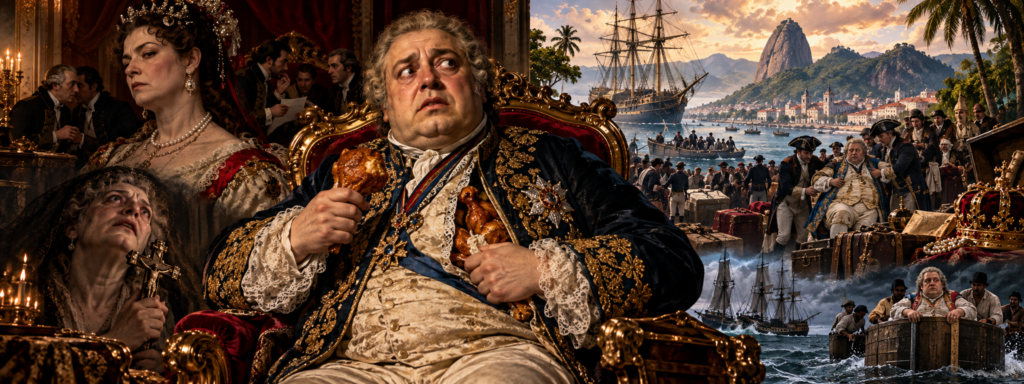
John VI of Portugal: The Anxious King, the Scheming Queen, and the Crown That Fled Across an Ocean
King of Portugal, 1816–1826 | Prince Regent, 1799–1816 | The Flight to Brazil, Carlota Joaquina, Revolution, Family Betrayal, and the Survival of the Braganza Crown
The King Everyone Thought Was Running Away
On a wet and chaotic November morning in 1807, one of Europe’s oldest royal houses appeared to be doing something humiliating. The Portuguese court was abandoning Lisbon while Napoleon’s army marched toward the capital, loading members of the royal family, ministers, officials, servants, archives, money, possessions, and whatever else could be carried aboard a fleet bound for Brazil. At the center of the confusion stood Prince João, the future John VI, a heavy, anxious, deeply cautious man whom enemies had spent years portraying as weak, indecisive, frightened, and perhaps mentally unstable. His mother, Queen Maria I, was already profoundly mentally ill and incapable of ruling, and now her son seemed to be confirming every insult ever thrown at him by fleeing rather than remaining in Lisbon to make a heroic stand. To many observers, it looked less like strategy than panic.
Yet João’s supposedly cowardly decision accomplished something that courage might not have. Napoleon could occupy Lisbon, but he could not capture the Portuguese sovereign, abolish the Braganza dynasty, or seize direct control of the enormous Portuguese Empire while its government remained beyond his reach on the other side of the Atlantic. The prince who supposedly lacked the nerve to confront Napoleon deprived the emperor of the political prize his invasion was intended to secure. Portugal would suffer invasion and war, but its monarchy survived, and Brazil was transformed by the arrival of the royal court. The retreat that looked ridiculous from Europe became one of the most extraordinary acts of dynastic survival in the Napoleonic age.
John VI belongs in the Mad Monarchs category for a reason very different from his mother Maria I. There is no convincing evidence that João suffered from the kind of severe psychotic illness that eventually made Maria incapable of governing. He appears to have been anxious, cautious, emotionally vulnerable, conflict-averse, and at times melancholy, while hostile contemporaries eagerly converted those characteristics into stupidity, cowardice, incompetence, or hereditary instability. His physical appearance and personal habits supplied additional material for caricature, and later popular culture exaggerated him into a grotesque figure who ate chickens from specially lined pockets, refused to wash, scratched himself before ambassadors, panicked whenever his routine changed, and shuffled through history almost accidentally.
The real João is considerably more interesting. He spent much of his adult life surrounded by genuine reasons to be afraid: a mother suffering catastrophic mental illness, a wife who participated in political intrigues against him, a brother whose early death unexpectedly made him heir, revolutionary France, Napoleon, British pressure, Spanish hostility, conspiracies at court, rebellion in Portugal, revolution in Brazil, and finally an ambitious younger son who helped turn the royal palace itself into a battleground. His caution was sometimes excessive, and his reluctance to make decisions could frustrate almost everyone around him. Yet he repeatedly survived situations that destroyed stronger-looking rulers, which raises an uncomfortable question at the heart of his reign: perhaps the man everyone mocked for being afraid understood danger better than the people laughing at him.
The Prince Who Was Never Supposed to Rule
João Maria José Francisco Xavier de Paula Luís António Domingos Rafael was born in Lisbon on May 13, 1767, the second surviving son of the future Queen Maria I and her husband Pedro III. Nothing about his position initially suggested that he would become one of the most consequential Portuguese rulers of the modern era. His elder brother José, Prince of Brazil, stood before him in the succession and was educated as the future sovereign. João could therefore grow up in relative political obscurity, a younger prince important enough to require a royal education but not burdened with the expectation that an empire would someday depend upon his decisions.
Popular caricature later portrayed João as intellectually dull and poorly educated, but that picture should be treated cautiously. He received the kind of education appropriate to a Portuguese infante, including religion, history, law, languages, and courtly conduct, even if he never developed the reputation of an intellectual prince. Foreign diplomats sometimes described him dismissively, and his hesitant manner could reinforce assumptions that he lacked intelligence. Hesitation, however, would become one of the most persistent and frequently misunderstood features of his political personality.
His life changed dramatically in 1788 when his elder brother José died of smallpox at only twenty-seven. João suddenly became heir to the Portuguese throne. The transition was especially important because he had not spent childhood being psychologically prepared for kingship in the way his brother had. A secondary prince had become the future of the Braganza dynasty almost overnight, and the change occurred during a period when his mother’s emotional stability was already deteriorating.
Within only a few years, João would lose the protection of political obscurity entirely. Maria’s mental illness became so severe that she could no longer perform the functions of monarchy, forcing the reluctant second son into the center of government. João did not seize power from his mother; power came toward him because there was increasingly nobody else capable of exercising it.
Growing Up Beneath Maria’s Shadow
Maria I’s psychological collapse profoundly shaped the environment in which João became a political adult. After a devastating succession of family deaths during the 1780s, the queen developed severe psychiatric symptoms involving depression, agitation, religious terror, disordered behavior, and probable psychotic features. By 1792 her condition had deteriorated so far that she could no longer reliably govern. João began exercising governmental responsibilities in her name and formally adopted the position of Prince Regent in 1799.
It is easy to imagine that witnessing his mother’s condition affected João deeply, but historians should be careful about turning plausible emotional consequences into unsupported psychiatric diagnosis. Claims that Maria’s screams permanently traumatized him into a collection of specific phobias are difficult to demonstrate. He certainly lived within a family experiencing severe illness and repeated bereavement, and he inherited enormous responsibilities precisely because his mother’s mind had failed her. That alone would have given any anxious person reason to wonder whether the same fate might someday await him.
Political enemies understood the vulnerability perfectly. If Maria had become incapable of ruling because of mental illness, then suggesting that João was displaying similar symptoms could become more than an insult. It could provide a constitutional argument for removing him from power. His hesitancy, melancholy, nervous temperament, and avoidance of confrontation could therefore be interpreted not merely as personality traits but as supposed evidence of hereditary incapacity.
There is no strong evidence that João followed his mother into psychosis. He remained capable of sustained political calculation across decades, managed complicated diplomatic situations, presided over major institutional changes in Brazil, survived repeated conspiracies, and made strategic decisions with enormous consequences. He may have been frightened often, but fear and madness are not the same thing.
The Child Bride Who Became His Greatest Enemy
In 1785, when João was seventeen, he married the Spanish Infanta Carlota Joaquina, daughter of the future Charles IV of Spain and Maria Luisa of Parma. Carlota was only ten years old at the time of the marriage ceremony, and because of her age the union was not immediately consummated. The marriage had been arranged for dynastic reasons, strengthening ties between the Portuguese and Spanish royal houses. Whatever hopes existed for domestic harmony eventually collapsed spectacularly.
João and Carlota became one of the most notoriously hostile royal couples of their age. They had a large family together, but political and personal incompatibility increasingly divided them. João was cautious and usually preferred delay, compromise, or strategic ambiguity, while Carlota was forceful, ambitious, combative, and intensely interested in political power. Later hostile portrayals of Carlota turned her into a grotesque villainess, so accusations about her appearance, sexuality, lovers, and personal cruelty require the same caution as the stories told about João’s supposed stupidity.
What does not depend upon caricature is her political ambition. Carlota repeatedly pursued projects independent of her husband and cultivated factions that might advance her influence. Their marriage gradually became less a partnership than an armed truce conducted inside the royal family. The couple increasingly lived separately, and political disagreement became inseparable from marital hostility.
Their children grew up within this poisonous atmosphere. Two sons in particular would transform the future of the Portuguese monarchy: Pedro, who would become emperor of an independent Brazil, and Miguel, who would align himself with the absolutist reaction and eventually rebel against his father. João survived conspiracies involving his wife only to face political defiance from his sons, making the Braganza household one of the most dangerous places in his political world.
Carlota’s Attempt to Have Him Declared Incapable
The conflict between husband and wife became particularly dangerous in 1805, when Carlota participated in a political intrigue intended to displace João from the regency. The conspirators exploited precisely the vulnerability created by Maria I’s illness. If João could be portrayed as mentally incapable, Carlota might present herself as the person who should exercise authority instead.
This was not merely marital gossip. Members of the Portuguese aristocracy became associated with the intrigue, demonstrating that dissatisfaction with João’s government had created a genuine political faction. The episode is variously known in connection with Mafra or Alfeite, and the precise details have been reconstructed differently, but the central objective is clear: João’s supposed incapacity was to become the justification for transferring power.
João discovered the scheme and survived it. Characteristically, he did not respond by staging spectacular executions or creating a bloodbath comparable to earlier Portuguese political purges. Carlota was not sent to the scaffold or imprisoned in a fortress. The royal couple instead became increasingly separated, with their residences and political circles reflecting the breakdown of their relationship.
The episode reveals why accusations of madness surrounding João require particular skepticism. His enemies had a direct political incentive to portray him as mentally unfit because his mother’s incapacity had already established the mechanism by which a Braganza sovereign could remain alive while another person governed. The specter of hereditary madness was therefore a weapon, and Carlota was prepared to use it.
A Europe Becoming Impossible to Navigate
João’s caution developed in an international environment that punished wrong decisions brutally. Revolutionary France had overturned the Bourbon monarchy, executed Louis XVI, and plunged Europe into war. Portugal remained connected to Britain through a longstanding alliance while sharing the Iberian Peninsula with Spain, whose own diplomatic position shifted dramatically during the revolutionary and Napoleonic conflicts.
In 1801, Portugal suffered invasion during the brief War of the Oranges, in which Spanish forces supported by France defeated Portuguese resistance. The resulting settlement cost Portugal Olivença, whose sovereignty remains disputed between Portugal and Spain even in modern diplomatic history. The episode demonstrated the weakness of Portugal’s military position and the danger of attempting to resist stronger continental powers without sufficient support.
Napoleon’s rise made the dilemma worse. Britain controlled the seas while France increasingly dominated continental Europe. Portugal depended heavily upon maritime trade and British connections, but Napoleon demanded compliance with his Continental System against British commerce. Fully satisfying France risked British naval retaliation and the loss of Portugal’s overseas empire, while refusing Napoleon risked invasion.
João responded with delay, ambiguity, negotiation, partial concessions, and attempts to avoid making an irreversible choice. His critics interpreted this as paralysis. Yet Portugal’s position was genuinely almost impossible, and a dramatic declaration of defiance might simply have accelerated disaster.
Napoleon Comes for Portugal
By 1807, delay could no longer prevent confrontation. Napoleon and Spain agreed upon plans that contemplated the occupation and partition of Portugal, while General Jean-Andoche Junot led French troops across the peninsula. João faced a decision that had haunted Portuguese strategic thinking before: whether the royal family should remain in Lisbon or move the center of government to Brazil.
The idea of transferring the monarchy to Brazil was not invented in a moment of panic. Portugal’s overseas empire offered the Braganzas a refuge unavailable to rulers whose states existed entirely within Europe. Brazil was economically important, geographically enormous, and protected by the Atlantic, while British naval power could make a French attempt to seize the royal family there extraordinarily difficult.
The final departure was nevertheless chaotic. The royal household, ministers, servants, officials, records, valuables, and other possessions had to be loaded rapidly as French forces approached. Contemporary and later estimates of the number of people who departed vary considerably, and the often-repeated figure of fifteen thousand should not be treated as exact. What matters is the scale: this was not merely a king escaping with his immediate family but the transplantation of a substantial royal and governmental establishment.
Maria I, already severely mentally ill, was taken with them. Carlota Joaquina and the royal children also embarked, despite the bitter divisions within the family. João had managed something almost unimaginable: he placed an entire dynasty and the functioning center of an imperial monarchy beyond Napoleon’s reach.
Cowardice or One of the Great Escapes of History?
European critics found the spectacle easy to mock. Kings were supposed to defend their capitals, rally armies, and demonstrate courage before their subjects. João instead boarded a ship. The contrast with the heroic ideal of monarchy was so dramatic that accusations of cowardice followed him for generations.
Yet staying in Lisbon would probably have accomplished little militarily. Portugal could not defeat Napoleon’s forces alone, and capture of the royal family would have allowed the French emperor to dictate the political future of the kingdom. Other European dynasties discovered exactly how dangerous that could be when Napoleon removed rulers, reorganized territories, and installed relatives or allies upon conquered thrones.
João sacrificed prestige to preserve sovereignty. His choice imposed enormous suffering and uncertainty upon Portuguese subjects left behind, and it understandably created resentment. Nevertheless, the Braganza dynasty remained independent and capable of governing because its ruler was not Napoleon’s prisoner.
The famous later claim that Napoleon regarded João as the only ruler who had deceived him has circulated widely, although exact formulations of supposed remarks from Napoleon’s exile should be treated cautiously. The larger historical irony requires no quotation. Napoleon occupied Portugal but failed to capture its monarchy, and the supposedly timid João remained sovereign long after Napoleon’s own empire had collapsed.
Rio de Janeiro Becomes a Royal Capital
The Portuguese royal court arrived in Brazil in 1808, first reaching Salvador before continuing to Rio de Janeiro. The arrival transformed the colony. Never before had the central government of a European imperial monarchy relocated itself so completely to an overseas possession.
João opened Brazilian ports to friendly nations, breaking important elements of the old colonial commercial monopoly. Government departments, courts, military institutions, cultural organizations, financial structures, and royal establishments expanded in Rio. The city suddenly had to accommodate an enormous influx of officials and aristocrats whose expectations of housing and status collided with those of existing residents.
The transformation produced resentment as well as opportunity. Houses could be requisitioned for royal or court use, prices rose, and inhabitants found themselves living in a city abruptly remade to serve a monarchy. At the same time, trade expanded, institutions developed, and Rio’s political importance increased dramatically.
João therefore did far more in Brazil than hide from Napoleon. The relocation changed the administrative relationship between colony and metropolis so profoundly that restoring the old arrangement would eventually become impossible. The supposed escape helped prepare the conditions for Brazilian independence.
The King of Chickens: Separating Habit from Caricature
No discussion of João’s reputation can avoid his relationship with food. Contemporary observers and later writers consistently portrayed him as a hearty eater, and poultry became particularly associated with his image. Over time, this developed into one of the most famous stories attached to him: that he carried roasted or fried chicken in his coat pockets so that he could eat whenever anxiety or appetite struck.
The most elaborate versions claim that João had special grease-resistant leather linings sewn into his clothes and stuffed entire chickens into them, tearing pieces away during audiences, carriage rides, and theatrical performances. These details are repeated so frequently that they can appear firmly documented, but repetition is not the same as reliable contemporary evidence. The image belongs partly to a long tradition of reducing João to appetite, obesity, untidiness, and comic bodily excess.
It is reasonable to say that João enjoyed food and that his eating habits attracted comment. It is much less responsible to diagnose “nervous overeating” from stories written in a hostile cultural environment or to state as fact that royal tailors manufactured special chicken compartments without strong primary evidence. The difference matters because caricature accumulated around João precisely by transforming ordinary weaknesses into grotesque compulsions.
His body became political propaganda. A heavy, food-loving king who avoided military heroics was easy to contrast with Napoleon’s cultivated image of energetic command. The more João could be made to look ridiculous, the easier it became to dismiss his survival as luck rather than strategy.
The Dirty King and the Problem of Royal Hygiene
João’s hygiene generated another enormous body of legend. Later descriptions claim that he hated bathing, refused to change clothing, wore garments until they deteriorated, and tolerated dirt that horrified attendants and diplomats. Some degree of personal untidiness is plausible and appears consistent with hostile contemporary descriptions, but the most extreme versions should be handled carefully.
Bathing practices in early nineteenth-century Europe differed greatly from modern expectations. Full immersion bathing was not necessarily a daily activity among European elites, even though linen, washing, grooming, and other forms of personal hygiene were common. Comparing João directly with modern Brazilian bathing culture can therefore exaggerate the strangeness of behavior that was partly shaped by European custom.
Stories of clothing literally rotting from his body or servants pinning decaying garments together may preserve genuine complaints about his reluctance to change familiar clothing, but they also fit perfectly within the established caricature. João’s enemies repeatedly presented him as physically repulsive because bodily disorder could symbolize political disorder. Dirt, appetite, cowardice, and stupidity became mutually reinforcing elements of the same hostile portrait.
The responsible approach is neither to sanitize João nor to accept every grotesque anecdote. He seems to have been personally informal, physically ungainly by aristocratic standards, and less concerned with elegant presentation than many monarchs. That gave observers plenty to talk about without requiring every later story to be true.
The Sea-Bathing Cage
One particularly memorable story concerns João’s use of sea bathing while in Brazil. He suffered from problems affecting his legs, and physicians recommended exposure to seawater. Accounts describe the use of a protective structure or bathing apparatus that allowed him to enter the water while reducing the risks he feared from the open sea.
Later retellings turned the device into proof of a bizarre phobia, sometimes claiming that João was terrified specifically of crustaceans or marine creatures and therefore had to be lowered into the ocean inside an enclosed wooden box. There may be a genuine historical core behind the bathing contraption, but claims of a formally diagnosable “crustacean phobia” go far beyond the evidence. A monarch worried about injury, animals, drowning, or exposure while suffering painful leg problems did not necessarily have a psychiatric disorder.
The story nevertheless became irresistible because it seemed to summarize João perfectly. Here was a king supposedly too frightened even to enter the sea normally, sitting protected inside a wooden apparatus while ruling an empire that stretched across that same ocean. His caution could be made visually absurd.
Yet the Atlantic was also the reason he still possessed a crown. The man mocked for fearing the sea had crossed it when remaining on land would have placed him in Napoleon’s hands. João’s relationship with fear was always more complicated than his caricaturists admitted.
Ticks, Fleas, Scratching, and the Grotesque João
Stories about parasites also became attached to João’s Brazilian years. His association with rural residences and reported personal hygiene habits made tales of ticks, fleas, itching, and public scratching especially appealing to later writers. Some accounts portray him scratching himself openly during formal audiences, supposedly indifferent to the disgust of foreign diplomats.
Again, the problem is not that such behavior is impossible. João lived in environments where insects and parasites were common, and contemporary observers did comment harshly upon his appearance and habits. The difficulty lies in separating eyewitness description from anecdotes repeated and embellished precisely because they fit an existing comic stereotype.
Brazilian popular memory eventually inherited a João who could be made almost cartoonish: greasy chicken in his pockets, filthy clothes, constant scratching, terror of bathing, and nervous panic. This image survived because it was vivid and because nineteenth-century political narratives had reasons to diminish the Portuguese court. Brazilian national history could make the old colonial monarchy appear backward, while Portuguese critics could blame João for abandoning the kingdom.
The result is a monarch whose body has often overshadowed his government. The ridiculous João is easier to remember than the cautious statesman who transformed Brazil’s political status and preserved his dynasty through the Napoleonic catastrophe.
Carlota Joaquina Builds Her Own Political World
While João governed from Brazil, Carlota continued pursuing political ambitions of her own. Napoleon’s intervention in Spain created an extraordinary opportunity because members of her Spanish Bourbon family had been displaced or imprisoned. Carlota attempted to position herself as a legitimate Bourbon authority who might govern Spanish territories in South America.
The project, often associated with Carlotismo, demonstrated that she was far more than the comic or monstrous wife portrayed by later popular culture. She understood dynastic legitimacy and recognized that the collapse of Spanish royal authority created a political vacuum. Supporters considered whether her Bourbon blood might provide an alternative to revolutionary juntas or Napoleonic rule.
João did not enthusiastically surrender power or resources to her ambitions. Their political separation continued in Brazil, where husband and wife maintained distinct households and networks. Carlota’s projects also collided with the interests of British diplomats, Portuguese officials, local elites, and emerging political movements throughout Spanish America.
The marriage had effectively become an international political rivalry. João had to worry not only about Napoleon, Britain, Spain, Portugal, and Brazil but also about what his own wife might attempt if circumstances gave her an opening. His caution existed within a family where trust was an increasingly scarce commodity.
Becoming King Without Returning Home
Maria I died in Rio de Janeiro on March 20, 1816. João had governed in her name for approximately twenty-four years, first informally and later as formal Prince Regent. At last, at forty-eight, he became King João VI.
His accession created an unusual situation because the King of Portugal was still living in Brazil. The temporary refuge established during the Napoleonic invasion had become a long-term royal capital, and João showed little enthusiasm for abandoning it. Brazil had been elevated in 1815 within the United Kingdom of Portugal, Brazil and the Algarves, giving formal recognition to the transformed relationship between the monarchy’s European and American territories.
For many Brazilians connected to Rio’s expanding institutions, the royal presence brought advantages. The city possessed a status unimaginable before 1808, and local elites had gained access to the center of government. For many Portuguese in Europe, however, the arrangement increasingly appeared intolerable.
Portugal had helped fight a brutal war against French occupation, only to discover that victory did not bring its king home. The old metropolis seemed to have become secondary to the former colony. João’s successful escape was beginning to create the political crisis that would eventually force his return.
Portugal Without Its King
The Peninsular War devastated Portugal. French invasions, British military intervention, destruction, economic disruption, and population displacement left deep scars. After Napoleon’s forces were driven out, British influence remained powerful, particularly through William Carr Beresford, who became an important figure in Portuguese military and political affairs.
Resentment grew against both British dominance and the continued absence of the royal court. Portuguese merchants also suffered from economic changes associated with the opening of Brazilian ports, which weakened the privileged commercial relationship that had benefited metropolitan interests. The monarchy’s survival strategy increasingly looked to some Portuguese subjects like abandonment.
In 1817, a conspiracy associated with Gomes Freire de Andrade was suppressed, and its aftermath intensified dissatisfaction. Political ideas associated with constitutionalism and liberalism continued spreading through Portugal. The old absolutist order could not simply be restored as though the French Revolution and Napoleonic Wars had never occurred.
João’s reluctance to return therefore had consequences. His caution had saved the dynasty in 1807, but the same preference for remaining safely in Brazil became politically dangerous after the European threat had receded. Survival strategies can outlive the circumstances that made them wise.
The Revolution That Ordered the King Home
In August 1820, a liberal revolution began in Porto and rapidly transformed Portuguese politics. The revolutionaries demanded constitutional government, the restoration of Portugal’s political centrality, and the return of the royal court. The movement spread, leaving João with another decision he could not postpone indefinitely.
Remaining in Brazil risked losing Portugal. Returning to Lisbon meant entering a political environment in which royal absolutism was under direct attack. João again chose compromise rather than a dramatic attempt to crush the opposition.
He agreed to return in 1821, leaving his son Pedro in Brazil. The decision would prove enormously consequential because Pedro now occupied the position from which he could resist attempts by the Portuguese Cortes to reduce Brazil’s political status. João’s solution preserved his Portuguese crown in the short term while leaving a Braganza prince at the center of Brazilian power.
The king’s departure from Rio produced another flood of hostile stories. Later accounts described chaotic preparations, money removed from institutions, crowded ships, parasite infestations, and the humiliating spectacle of courtiers arriving in Portugal with shaved heads after battling lice. Some details have historical foundations, while others have been magnified into comic folklore.
Did João Empty the Bank of Brazil?
One particularly persistent accusation is that João emptied the Bank of Brazil when he left, plunging the country into financial disaster. The reality is more complicated than the familiar image of a greedy monarch stuffing the treasury into ships. The royal court and government had enormous financial obligations, and the departure placed severe pressure upon institutions already experiencing serious difficulties.
Large withdrawals associated with the Crown and departing Portuguese interests did contribute to financial instability. The Bank of Brazil suffered badly and would eventually be liquidated in the 1820s. It is therefore reasonable to connect the royal departure with a serious monetary crisis.
It is less accurate to imagine João personally marching into a vault and stealing every coin. The financial system was already strained by government spending, paper money, loans, and the costs of maintaining the transplanted court. The departure exposed and intensified structural weaknesses that had accumulated during the Brazilian royal period.
The simpler story survived because it matched the established caricature. The gluttonous king who carried chickens in his pockets could also be imagined carrying Brazil’s money back to Portugal. Political memory prefers a villain with bags of treasure to a complicated financial crisis.
The Flea-Ridden Return
Stories of the voyage back to Portugal became almost as colorful as those of the original flight to Brazil. One enduring tradition claims that the returning ships suffered severe infestations of lice or fleas, forcing members of the royal party to shave their heads. The image of a bald or parasite-ridden court arriving in Europe provided irresistible material for satire.
Crowded nineteenth-century ships certainly could suffer from lice, fleas, disease, poor sanitation, and miserable living conditions. It would not be surprising if passengers experienced such problems. What deserves caution is the transformation of a plausible shipboard infestation into a universal comic catastrophe involving every member of the royal entourage.
The story nevertheless reflects a deeper change in royal imagery. João did not return as the magnificent sovereign of a triumphant court. He returned because political revolution had compelled him to do so, leaving behind a Brazil that no longer accepted its former subordinate position.
Fourteen years earlier, he had fled Portugal because Napoleon threatened his crown. Now he left Brazil because constitutional revolution threatened to separate him from the Portuguese half of his monarchy. João’s reign had become a sequence of departures imposed by crises he could survive but never fully control.
A King Returns to a Different Portugal
João arrived back in Lisbon in July 1821. The Portugal he encountered was not the absolutist monarchy he had left in 1807. Liberal politicians expected constitutional government, and the king was required to navigate institutions that explicitly limited traditional royal authority.
Carlota Joaquina reacted very differently. She strongly opposed the liberal constitutional order and became a focal point for absolutist resistance. The couple who had fought over power before the Napoleonic invasion now found themselves on opposing sides of a constitutional revolution.
João again chose accommodation. He accepted the new political reality sufficiently to preserve his throne, even though he was uncomfortable with many liberal demands and later benefited from opportunities to weaken or reverse them. His willingness to compromise frustrated absolutists who wanted him to destroy the constitutional system and liberals who suspected him of secretly longing to restore unrestricted royal authority.
This political flexibility was characteristic of him. João rarely offered ideological purity because ideological purity could be fatal. His goal was often less to win completely than to remain king when everyone else had finished fighting.
Pedro Refuses to Come Home
The Portuguese Cortes attempted to restore metropolitan control over Brazil and ordered measures that would have reduced the autonomy gained since the arrival of the royal court. Pedro, left behind as prince in Brazil, increasingly aligned himself with Brazilian political interests. In January 1822, he famously decided to remain rather than obey demands that he return to Portugal.
The crisis escalated throughout the year. On September 7, 1822, Pedro proclaimed Brazil’s independence, and he was subsequently acclaimed Emperor Pedro I. João’s eldest surviving son had transformed the most important part of the Portuguese Empire into an independent monarchy.
The personal dimensions must have been painful, but the political outcome was unusual. Brazil did not become an anti-monarchical republic after a revolutionary war against the Braganzas. It became an empire ruled by João’s own son.
This meant the dynasty survived on both sides of the Atlantic even as the empire split. Whether João anticipated or quietly accepted this possibility at earlier stages remains debated, and claims that he secretly instructed Pedro to seize the Brazilian crown before someone else did should be handled cautiously. What is certain is that Braganza rule survived the separation.
The Son Who Took Brazil
Brazilian independence represented both defeat and dynastic success. Portugal lost its largest and most valuable overseas possession, destroying the imperial structure that had shaped the monarchy for centuries. Yet João’s family remained on the Brazilian throne, and the separation avoided the complete displacement of the dynasty.
Formal recognition took time. In 1825 Portugal recognized Brazilian independence through a negotiated settlement. João retained an honorary imperial title within the diplomatic arrangement while Pedro remained the actual emperor of Brazil.
The settlement again displayed João’s preference for accepting irreversible realities rather than sacrificing everything in an attempt to restore the past. Portugal lacked a realistic path to reconquer Brazil without enormous costs and uncertain prospects. Recognition allowed diplomatic relations and dynastic continuity to replace an unwinnable struggle.
His absolutist wife and younger son would prove less willing to compromise over Portugal’s internal political future. João had survived losing Brazil to one son. He would soon face an attempt by another son to seize power from him personally.
Miguel, the Son of Reaction
Infante Miguel became the great hope of Portuguese absolutists. Young, energetic, and politically aligned with his mother, he offered everything João’s critics claimed the king lacked. Where João hesitated, Miguel appeared decisive; where João compromised, Miguel embraced confrontation.
Carlota Joaquina encouraged resistance to liberal constitutionalism, and Miguel became increasingly central to reactionary politics. Their alliance transformed the royal family into opposing political camps. João stood between liberal revolutionaries demanding constitutional government and absolutists within his own household demanding restoration of unrestricted monarchy.
In 1823, the Vilafrancada uprising allowed Miguel and absolutist forces to challenge the constitutional regime. João maneuvered through the crisis and ultimately emerged with increased authority, while the 1822 constitution collapsed. Yet he did not simply surrender the monarchy to Miguel’s most extreme supporters.
The temporary resolution did not end the conflict. Carlota and Miguel continued to believe João’s moderation was weakness. The king who had once faced an attempt by his wife to declare him mentally incapable now confronted a political movement centered upon his own son.
The Abrilada: A Coup Inside the Royal Family
The crisis exploded again in April 1824 in the episode known as the Abrilada. Miguel, supported by reactionary forces and associated with his mother’s political camp, mobilized troops and claimed to be acting against dangerous conspirators. Political opponents were arrested, and João himself effectively found his freedom constrained.
The palace had become the site of a coup. The king was no longer merely threatened by revolutionaries, foreign armies, or distant conspirators. His own son was using military force within the capital, while Carlota’s hostility toward her husband remained part of the political atmosphere.
João escaped the immediate crisis with diplomatic assistance and ultimately reasserted authority. Miguel was removed from command and sent abroad. Once again, the supposedly helpless king had survived a confrontation with a more aggressive opponent.
The episode demonstrates why João’s anxieties should not be mocked too casually. He lived in a world where fears of conspiracy were repeatedly justified by actual conspiracies. His wife had supported efforts to remove him, his son participated in a military revolt, Napoleon had invaded his kingdom, and political revolutions had erupted on both sides of the Atlantic.
Was João Paranoid—or Surrounded by Enemies?
Retrospective descriptions sometimes portray João as pathologically suspicious. He supposedly feared assassination, disruption of routine, strange foods, storms, animals, political meetings, and almost every sudden change around him. Some of these stories are weakly documented, while others may reflect genuine anxiety.
The crucial distinction is between unreasonable paranoia and reasonable fear expressed by an anxious personality. João did not imagine that people wanted to remove him from power. People repeatedly did want to remove him from power.
Carlota’s conspiracy against his regency was real. The Napoleonic threat was real, the Portuguese liberal revolution was real, Brazilian separatism was real, and Miguel’s revolt was real. A king facing those circumstances did not need a psychiatric disorder to become cautious about whom he trusted.
His temperament may have magnified danger, and his reluctance to decide could become politically frustrating. Yet the historical environment constantly rewarded vigilance. João survived partly because he was reluctant to assume that apparently stable situations were actually safe.
Thunderstorms, Crustaceans, and the Manufacture of a Neurotic King
Among the colorful claims attached to João are supposed intense fears of thunderstorms and crustaceans. These stories fit neatly into the established image of a monarch ruled by phobias. They should not, however, be elevated into psychiatric diagnoses without stronger evidence.
Fear of thunderstorms was hardly extraordinary in an era when lightning could kill, buildings lacked modern electrical protection, and severe tropical storms could be genuinely dangerous. Likewise, concern about creatures in unfamiliar waters does not automatically constitute a clinical phobia. Later storytellers frequently convert preferences, dislikes, and anxieties into dramatic compulsions because eccentricity makes better copy than ordinary caution.
Claims that João suffered panic attacks whenever meals were delayed or carriages followed unfamiliar streets are even more difficult to establish. They may reflect his preference for routine, but describing them as obsessive-compulsive behavior or “routines of terror” imports modern psychiatric terminology without sufficient evidence.
João may indeed have been an anxious man who found routine reassuring. That is a far more defensible conclusion than diagnosing obsessive-compulsive disorder, panic disorder, specific phobias, or inherited psychosis from anecdotal stories. His mental life deserves the same historical caution applied to Maria I, even though the two cases were profoundly different.
The King Who Spoke Like a King
Another story claims that João habitually referred to himself in the third person as “the Prince” or “the King” because of severe impostor syndrome. The psychological interpretation is particularly dubious. Royal speech followed conventions unfamiliar to modern readers, and sovereigns often used formulaic language that cannot simply be translated into evidence of psychiatric insecurity.
João certainly had reason to feel unprepared for his position. He had grown up as the younger son, became heir after José’s unexpected death, and assumed government because his mother became incapacitated. Those circumstances may have contributed to insecurity or reluctance.
But “impostor syndrome” is a modern psychological concept, not a diagnosis that can responsibly be applied to João because of royal forms of speech. The temptation to explain every unusual habit through a modern disorder should be resisted.
His political career demonstrates that whatever private doubts he possessed, João understood the practical reality of sovereign power. He appointed ministers, negotiated with foreign governments, moved a court across an ocean, reorganized institutions, handled rebellions, and repeatedly protected his position. He may have disliked the role he inherited, but he knew how to occupy it.
The Brazilian View of the Strange Portuguese King
Brazilian reactions to João were complicated and changed over time. The arrival of the court brought disruption, requisitions, social tension, and an enormous expansion of royal bureaucracy. Residents of Rio could resent arrogant Portuguese courtiers even while benefiting economically from the transformation of their city.
João himself became a recognizable public figure. His informality and physical appearance contrasted with idealized images of royal magnificence, while stories about eating, clothing, bathing, and bodily habits circulated widely. Such anecdotes could inspire ridicule, but the king also became associated with tangible institutional changes that permanently altered Brazil.
The opening of the ports, establishment and expansion of state institutions, encouragement of cultural and educational initiatives, creation of financial structures, and elevation of Brazil’s political status changed everyday realities. Brazilian elites increasingly experienced direct access to monarchy rather than distant colonial administration.
This helps explain why João’s legacy in Brazil cannot be reduced to mockery. The same king caricatured as dirty, gluttonous, and cowardly helped create conditions under which Brazil could function as an independent state. His personal dignity may have suffered, but his political consequences were enormous.
The Myth of the Complete Buffoon
Much of João’s posthumous reputation developed through political cultures that had reasons to make him ridiculous. Portuguese liberals could portray the old absolutist court as backward. Brazilian nationalists could depict colonial Portuguese rule as corrupt and absurd. Republican writers could mock monarchy itself through the bodily weaknesses of one particularly caricature-friendly king.
Foreign observers contributed their own prejudices. João did not resemble the ideal of martial kingship admired during an age dominated by Napoleon. He was not physically glamorous, did not cultivate a heroic battlefield image, and often preferred negotiation to confrontation.
His wife and political enemies also had incentives to emphasize weakness. Once a ruler has been labeled timid and stupid, every habit becomes evidence. Eating becomes gluttony, caution becomes cowardice, routine becomes compulsion, informality becomes filth, and compromise becomes incapacity.
The historical João was flawed enough without the cartoon. He could procrastinate, avoid decisions, tolerate inefficient administration, and allow problems to worsen while searching for compromise. Yet a fool could scarcely have navigated his family and kingdom through so many successive crises without being destroyed.
The Politics of Looking Ridiculous
João’s career raises a larger question about monarchy. Rulers are often judged not merely by whether their strategies work but by whether they look powerful while pursuing them. Napoleon looked powerful because he commanded armies and occupied capitals. João looked weak because he retreated.
In the short term, Napoleon’s style appeared incomparably more successful. By 1815 Napoleon was defeated and exiled, while João remained sovereign and ruled from a transformed transatlantic monarchy. The contrast does not make João a hidden military genius, but it complicates conventional ideas about courage.
João repeatedly surrendered appearances to preserve substance. He left Lisbon rather than surrender himself, compromised with revolution rather than immediately risk his throne, accepted Brazilian independence rather than attempt an impossible reconquest, and neutralized Miguel rather than plunge instantly into dynastic civil war.
These choices did not save the old Portuguese Empire intact. Nothing probably could have. They did, however, preserve the Braganza dynasty through an age that destroyed or displaced numerous European rulers.
The Final Mystery: The King’s Sudden Illness
In March 1826, João suddenly became gravely ill. Contemporary descriptions of his final sickness included severe gastrointestinal symptoms and rapid deterioration. Given the extraordinary number of enemies and political factions surrounding him, suspicions of poisoning naturally emerged.
João died on March 10, 1826, aged fifty-eight. His death immediately created another succession crisis because Pedro was already Emperor of Brazil, while Miguel represented the absolutist alternative. The king who had spent his life trying to keep political conflicts from becoming catastrophes left behind a dynasty still divided between constitutional and absolutist futures.
For generations, poisoning remained a possibility rather than a proven fact. The story acquired new significance when scientific examination of preserved biological material associated with João detected extremely high levels of arsenic. Researchers concluded that the findings were consistent with acute arsenic poisoning.
That evidence makes poisoning a serious explanation for his death, but it does not identify the poisoner. Arsenic could have been administered intentionally, accidentally, or through medical treatment, although the levels detected strengthened suspicion of a substantial acute exposure. Naming Carlota, Miguel, a court faction, or any other individual as João’s murderer without direct evidence would go beyond what the investigation established.
A King Who May Have Been Poisoned
The possibility that João died from arsenic gives his life an appropriately unsettling final chapter. Here was a ruler repeatedly accused of irrational fear who may ultimately have had very good reason to fear what entered his body. The irony is powerful, but it should not be allowed to substitute for evidence.
His marriage had produced bitter political conflict, and his children represented competing visions of monarchy. Pedro stood at the head of an independent Brazilian Empire and would briefly become Pedro IV of Portugal. Miguel remained associated with absolutist reaction and would eventually seize the Portuguese throne, precipitating a dynastic civil war.
Carlota Joaquina survived her husband and continued supporting Miguel’s political cause. Her long history of conspiracy naturally makes her an attractive suspect in popular retellings of João’s death. Attraction is not proof.
The scientifically detected arsenic can establish a probable mechanism far more confidently than it can establish a murderer. The mystery therefore remains precisely where responsible history should leave it: João’s death is consistent with acute arsenic poisoning, but who administered the arsenic, and with what intention, has not been conclusively demonstrated.
The Kingdom After João
João’s death removed the figure who had repeatedly occupied the political middle ground between competing extremes. Pedro inherited the Portuguese crown as Pedro IV but could not realistically rule Portugal and Brazil simultaneously under the political conditions of the time. He soon abdicated the Portuguese throne in favor of his young daughter Maria da Glória, the future Maria II.
Miguel was expected to participate in a constitutional settlement but ultimately seized power and declared himself king. Portugal descended into the Liberal Wars, pitting Miguel’s absolutist supporters against forces supporting Maria II and constitutional monarchy. The family conflict João had spent years containing finally erupted after his death.
Pedro eventually returned to Europe and fought on behalf of his daughter’s claim. The conflict ended with Miguel’s defeat in 1834, establishing the constitutional branch of the dynasty. João’s two sons had thus become leaders of opposing political worlds.
His family had divided not merely an inheritance but an age. Pedro became associated with constitutional monarchy and Brazilian independence, while Miguel became the symbol of Portuguese absolutist reaction. João had spent his life standing uneasily between forces that his sons would eventually carry into open war.
Was John VI Mentally Ill?
The evidence does not justify placing João alongside Maria I as a monarch incapacitated by severe psychiatric illness. He may have suffered periods of anxiety and melancholy, and contemporary observers often described him as hesitant, fearful, or emotionally uncomfortable. None of that demonstrates psychosis, bipolar disorder, schizophrenia, obsessive-compulsive disorder, or any other specific severe psychiatric condition.
His functional capacity is difficult to reconcile with claims of profound mental incapacity. He governed for decades, participated in diplomacy, evaluated competing political factions, made consequential strategic choices, managed a transatlantic monarchy, and survived attempts to displace him. He could be indecisive without being incapable.
The distinction matters because his mother’s illness made accusations against him unusually potent. Maria had genuinely become unable to rule, so enemies could suggest that João’s caution represented the beginning of the same hereditary decline. Carlota’s attempt to exploit claims of incapacity demonstrates that the issue was political, not merely medical.
João belongs among the Mad Monarchs because his reputation shows how easily temperament can be transformed into pathology when power is at stake. His mother’s genuine illness cast a shadow that political enemies repeatedly attempted to stretch over him.
Anxiety in an Age of Catastrophe
If João was anxious, history gave him abundant material. He watched his mother lose the ability to govern. His elder brother died unexpectedly, placing him in a role for which he had not originally been destined. His wife conspired against his authority, and his younger son later participated in a military challenge to his rule.
France threatened and invaded Portugal. Britain was an indispensable ally but also a powerful force capable of exerting enormous pressure upon Portuguese policy. Spain shifted between neighbor, enemy, ally, and Napoleonic battleground. Portugal endured revolution, Brazil moved toward independence, and absolutism itself began collapsing across the Atlantic world.
In that environment, a certain degree of fear was rational. João’s political method was built around the assumption that circumstances could change rapidly and that today’s ally might become tomorrow’s threat. He delayed because time sometimes changed the choices available to him.
That method could be infuriating, and it did not always work. Yet when historians describe him as pathologically indecisive, they risk forgetting how often decisive rulers of the same period made catastrophic decisions. João’s reluctance to leap sometimes prevented him from falling.
The Strange Triumph of Retreat
The defining act of João’s career remains the departure for Brazil. It looked like surrender because the king abandoned his capital. Strategically, however, it transformed geography into a weapon against Napoleon.
Napoleon’s power depended heavily upon controlling continental territory and compelling rulers to submit. João removed the central institution Napoleon needed to capture. The French could occupy Portuguese ground without possessing the Portuguese monarchy.
The cost was enormous. Portugal endured occupation and warfare while the court lived across the Atlantic, and resentment over the monarchy’s absence contributed directly to the Liberal Revolution of 1820. João’s escape solved one crisis while helping create another.
That pattern repeated throughout his life. His compromises rarely produced permanent solutions, but they often bought time. For a ruler living through the revolutionary and Napoleonic age, time itself could be a form of victory.
The Court That Could Not Stop Fighting
The most remarkable threat to João may ultimately have come not from Napoleon but from his own household. Carlota Joaquina’s political ambitions repeatedly collided with his authority. Pedro’s Brazilian position eventually produced an independent empire. Miguel’s absolutism brought armed rebellion into the royal family’s struggle.
Few monarchs had such a politically explosive immediate family. The royal household became a miniature version of the ideological conflicts tearing apart the Atlantic world. Constitutionalism, absolutism, colonial independence, dynastic legitimacy, and personal ambition all existed around the same dinner table, at least metaphorically, even when husband and wife increasingly avoided sharing one.
João’s preference for compromise becomes more understandable in this setting. Choosing one faction completely could mean destroying another part of his own family. The political conflicts were intimate before they became national.
By the end of his life, he had been challenged by his wife, separated politically from his eldest surviving son by Brazilian independence, and nearly overthrown by his younger son. The monarchy survived, but the family beneath it was fractured beyond repair.
The Man Behind the Chicken Stories
João’s bizarre habits remain entertaining because they make an extraordinary ruler seem human. He apparently loved food, disliked discomfort, lacked elegant physical presence, and did not project the polished majesty expected from a European king. Those traits made him vulnerable to ridicule both during his life and afterward.
But the most extravagant anecdotes should not be allowed to become biography. Special grease-lined chicken pockets, clothes rotting from his body, pathological terror of crustaceans, compulsive third-person speech caused by impostor syndrome, panic attacks over carriage routes, and constant public scratching belong to a mixture of historical observation, satire, repetition, and later embellishment. Some may contain kernels of truth, but their psychological interpretations are often much newer than the stories themselves.
João was unusual enough without inventing diagnoses for him. His personality seems to have combined caution, informality, appetite, religious belief, anxiety, pragmatism, and a strong instinct for self-preservation. None of those qualities prevented him from understanding political danger.
Indeed, the contrast between his ridiculous reputation and his remarkable survival may be the most revealing feature of his entire life. People laughed at the way João behaved while repeatedly failing to remove him.
The King Who Would Not Play the Hero
John VI was not a heroic monarch in the conventional sense. He did not die at the head of an army, challenge Napoleon to a glorious final battle, or sacrifice himself for an abstract ideal of royal honor. He escaped, negotiated, stalled, compromised, conceded, and waited.
That made him an easy target in an age obsessed with military greatness. Napoleon looked like history’s master while João looked like history’s comic relief. Yet João died a king in his own capital, while Napoleon died in exile on Saint Helena.
This does not mean João defeated Napoleon personally or that every cautious decision was secretly brilliant. British military power, Portuguese resistance, geopolitical circumstances, and Napoleon’s own failures mattered enormously. João benefited from forces beyond his control just as every ruler does.
But he recognized something many monarchs did not: survival sometimes requires abandoning the performance of invincibility. A crown preserved through retreat remains a crown.
The Last Years of an Exhausted Survivor
After the Abrilada, João’s final years were consumed by attempts to stabilize a monarchy already transformed beyond recognition. Brazil was independent, Portugal’s constitutional future remained unsettled, Carlota continued representing absolutist opposition, and Miguel had been removed from the immediate political scene but not from dynastic importance. Pedro remained both a son and the ruler of a separate empire.
João had spent almost his entire adult life managing crises. He became a governing prince because his mother was ill, a refugee because Napoleon invaded, a Brazilian-based monarch because Europe was unsafe, a returning king because Portugal revolted, and the father of an emperor because Brazil separated. Each solution changed the problem rather than ending it.
By 1826, the cautious younger son who had never expected to rule had become one of Europe’s great political survivors. His kingdom was smaller than the empire he inherited, and absolutism had been permanently destabilized. Yet the Braganza dynasty still occupied thrones on both sides of the Atlantic.
Then João became violently ill, and the survivor finally encountered a crisis from which negotiation could not save him. His death opened the door to precisely the dynastic confrontation he had spent years postponing.
The Mad King Who Wasn’t Mad
John VI’s place among the Mad Monarchs is ultimately a story about perception. His mother had suffered genuine, catastrophic mental illness, and the possibility of hereditary instability haunted the politics surrounding him. His enemies understood that suggesting João was following Maria into madness could become a method of taking power.
His temperament made the accusation easier. He was cautious where others wanted aggression, hesitant where others wanted immediate decisions, physically unglamorous in a culture that celebrated royal spectacle, and apparently anxious in an age that demanded public confidence. His personal habits supplied endless ammunition.
Yet there is a fundamental difference between being strange and being insane. There is an equally important difference between being frightened and being incapable. João may have been both eccentric and anxious without being mentally unfit to rule.
The political record strongly supports that distinction. An incapacitated man does not easily survive more than three decades at the center of government while navigating Napoleon, Britain, Spain, Brazil, constitutional revolution, marital conspiracy, dynastic rebellion, and imperial disintegration.
A Crown Built on Anxiety
Perhaps João’s greatest political strength was the very characteristic his enemies despised. He expected things to go wrong. That expectation could make him slow, evasive, and maddeningly reluctant to commit himself, but it also prevented him from trusting appearances.
He knew France could invade because it did. He knew political factions could conspire because they did. He knew his wife could move against him because she had. He knew his son could become a threat because Miguel eventually did.
In another ruler, constant suspicion might have become destructive paranoia. In João’s circumstances, much of the danger was real. The challenge is determining where rational caution ended and personal anxiety began, something the surviving evidence cannot precisely measure.
What history can measure is survival. João repeatedly entered crises from positions of apparent weakness and emerged still holding authority. That does not make every decision wise, but it makes the caricature of the helpless fool increasingly difficult to sustain.
Brazil, the Empire He Lost and Helped Create
João’s greatest historical legacy may lie in the country that ceased to belong to Portugal. By moving the royal court to Brazil, he transformed the colony’s political status, opened its ports, expanded institutions, and made Rio de Janeiro the center of an empire. Those changes could not easily be reversed after 1815.
When the Portuguese Cortes attempted to restore Brazil to a more subordinate position, Brazilian elites resisted. Pedro became the political center around which that resistance could organize. Independence followed in 1822.
João therefore helped create the conditions that destroyed Portugal’s control over Brazil. Yet he also ensured that independence occurred under his own dynasty. The Braganzas lost an empire while gaining another throne.
It is a perfect example of João’s ambiguous historical legacy. He repeatedly preserved something by surrendering something else. Portugal lost Brazil, but the family kept Brazil; the king lost absolutism, but kept his throne; he abandoned Lisbon, but saved the monarchy.
The Family That Finished What Napoleon Could Not
Napoleon failed to destroy the Braganza dynasty. João’s own family came much closer. Carlota attempted to undermine his regency, Pedro separated Brazil from Portugal, and Miguel challenged his authority through absolutist revolt.
After João’s death, the conflict escalated into open dynastic struggle. Pedro and Miguel represented rival constitutional visions, while Maria II became the focus of the liberal succession. The resulting wars demonstrated how much political tension João’s personal authority had been containing.
This does not mean João was a master strategist controlling every faction. Often he was improvising, postponing, and attempting to prevent immediate disaster. Yet postponement had value because it kept political conflicts from exploding simultaneously.
Once he was gone, there was nobody in the family with the same combination of legitimacy, caution, and willingness to compromise. The Braganza house entered the civil conflict João had spent years avoiding.
A Suspicious Death for a Suspicious Age
The discovery of high arsenic levels in preserved tissue associated with João has ensured that his death remains one of the darker mysteries surrounding the Portuguese monarchy. Scientific analysis published in the early twenty-first century found concentrations dramatically above ordinary levels and consistent with acute arsenic poisoning. That finding gives far more substance to poisoning suspicions than many royal death legends possess.
It still does not provide the murderer’s name. Arsenic was present in nineteenth-century medicine and could enter the body through routes that complicate retrospective investigation. The concentration and clinical circumstances make deliberate poisoning a serious possibility, but motive and opportunity cannot substitute for direct proof.
Carlota Joaquina is inevitably mentioned because of her history of conspiracy and hostility toward João. Miguel’s supporters and other political factions also possessed interests that could inspire suspicion. None can responsibly be declared guilty on the available scientific evidence alone.
The uncertainty is almost fitting. João spent his life navigating threats he could not always see clearly, and even his death leaves historians confronting the same problem. Something dangerous may indeed have entered the king’s body, but the hand behind it remains hidden.
The Strange Victory of John VI
John VI died without the martial glory that made other rulers legendary. He left no image comparable to Napoleon crossing the Alps or Wellington at Waterloo. His popular iconography instead became chickens, shabby clothes, nervous habits, bodily discomfort, and retreat.
Yet the political map tells a different story. The Braganza monarchy survived Napoleon. Portugal remained independent. Brazil emerged as an empire ruled by João’s son rather than becoming another conquered possession or fragmented revolutionary territory.
João survived his wife’s attempt to undermine his regency. He survived the transfer of the court, the loss of Lisbon, the collapse of Napoleonic Europe, the Portuguese Liberal Revolution, his return from Brazil, Brazilian independence, and Miguel’s revolt. Even when the empire itself fractured, his dynasty remained on both sides of the Atlantic.
A glamorous king might have attempted to defend Lisbon in 1807 and ended his reign as Napoleon’s prisoner. João chose the less dignified road and remained free. History is uncomfortable with rulers who survive through retreat because retreat does not look heroic, but survival has its own political logic.
The King Who Was Afraid—and Survived
John VI should not be transformed into a secret genius merely to correct the old caricature. He could be indecisive, politically evasive, personally eccentric, and excessively cautious. His government contained serious weaknesses, and his decisions helped create resentment in Portugal while accelerating Brazil’s transformation away from colonial dependence.
But he was not the drooling, filthy, chicken-hoarding madman of hostile legend. Nor is there persuasive evidence that he inherited the severe psychiatric illness that incapacitated Maria I. His enemies attempted to turn temperament into pathology because doing so offered a route to power.
The real João was more complicated. He was an anxious ruler living in an age when anxiety was repeatedly justified. His wife conspired against him, his mother became incapable, his brother died unexpectedly, Napoleon invaded his country, revolution forced him back across the Atlantic, one son broke away with Brazil, another rose against him in Portugal, and his final illness may have involved arsenic poisoning.
In such a life, fear was not necessarily weakness. Sometimes it was information.
João understood, perhaps more instinctively than intellectually, that a monarch did not need to win every confrontation to survive it. He could surrender ground, delay decisions, change continents, accept compromise, and allow enemies to underestimate him. His pride might suffer, his reputation might become ridiculous, and historians might laugh at him for generations, but the crown could remain upon his head.
That may be the most revealing contrast between John VI and the heroic rulers of his age. Napoleon sought to dominate Europe and ended on a remote island under guard. João fled from Napoleon and ended his life still King of Portugal, surrounded by a dynasty that had survived even the loss of its empire.
The Braganza monarchy would continue fighting after him, and the family conflicts he had contained would eventually erupt into civil war. Brazil would never return to Portuguese rule, constitutionalism would reshape the monarchy, and the old absolutist world of João’s childhood was gone forever. He did not preserve that world because no ruler could have preserved it.
What he preserved was the dynasty itself.
Behind the stories of chicken, shabby clothing, sea-bathing contraptions, scratching, hesitation, and fear stands a ruler who repeatedly confronted impossible choices and chose survival over spectacle. His enemies called that cowardice. His wife tried to call it incapacity. Later caricaturists turned it into buffoonery.
But John VI kept escaping the traps set for him, sometimes literally across an ocean. He was not Maria the Mad’s equally mad son, nor was he the heroic mastermind revisionism might be tempted to create in reaction to the old stereotype. He was something stranger and perhaps more interesting: a frightened, cautious, frequently underestimated monarch whose instinct for retreat repeatedly kept him alive when bolder rulers were being destroyed.
For a king so often remembered as weak, John VI proved remarkably difficult to defeat.