
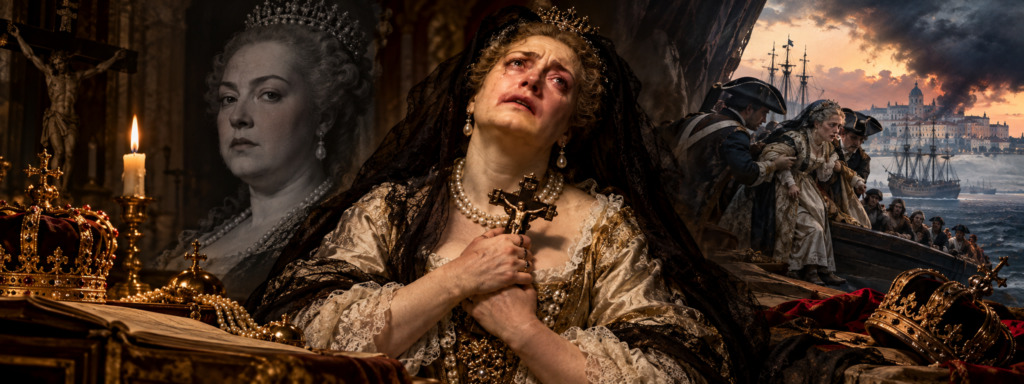
Maria I of Portugal: The Pious Queen, the Voices of Damnation, and the Long Descent Into Madness
Queen of Portugal, 1777–1816 | Maria the Pious | Maria the Mad | Grief, Religious Terror, Mental Illness, and the Regency of João
The Screams Behind the Palace Walls
By the final years of the eighteenth century, the Palace of Queluz had become the setting for one of the darkest personal tragedies in the history of the Portuguese monarchy. Behind its elegant Rococo façades, gilded rooms, formal gardens, painted ceilings, and carefully ordered ceremonies lived a queen whose mind had become a place of almost continuous torment. Maria I of Portugal had once been an intelligent, conscientious, politically engaged sovereign who took government seriously and had begun her reign by dismantling parts of the authoritarian system inherited from her father. Now those around her witnessed periods of terrible agitation, confusion, religious despair, sleeplessness, and emotional collapse. Accounts from the period describe cries coming from her apartments, while the woman who had once governed an empire increasingly depended upon attendants to manage the most ordinary parts of her existence.
Maria’s illness was not simply the convenient political accusation of an ambitious relative seeking her throne. Nor was it merely the misogynistic slander so frequently attached to powerful women who challenged male authority. By 1792, her deterioration had become serious enough that physicians judged her unable to continue governing, and her surviving son João assumed responsibility for the administration of the kingdom. A celebrated British physician who had treated George III, Francis Willis, was summoned to Portugal in the hope that he might restore her. He could not. Maria remained queen until her death in 1816, but for more than two decades the authority exercised in her name increasingly belonged to her son.
The tragedy becomes even more haunting because Maria’s breakdown did not emerge from a life devoid of understandable causes for despair. Within a remarkably short period she lost her husband, her eldest son and heir, a daughter, a son-in-law, a newborn grandson, a beloved confessor, and other members of the extended royal family. At the same time, revolution erupted in France and threatened the political and religious order Maria regarded as sacred. For a woman whose Catholic faith shaped almost every part of her understanding of life, death, sin, monarchy, and eternity, grief became increasingly entangled with terror that she had offended God. Religious devotion, once a source of structure and consolation, became incorporated into the symptoms tormenting her.
Yet reducing Maria to the screaming woman remembered by later generations does her a serious injustice. Before illness overwhelmed her, she had ruled Portugal for approximately fifteen years, made significant political decisions, reversed some of the harshest measures associated with the Marquis of Pombal, and presided over a kingdom navigating the increasingly dangerous world of the late eighteenth century. She was Portugal’s first undisputed queen regnant, ruling in her own right rather than merely as the wife or regent of a king. Her story therefore contains two very different versions of Maria I, although they belonged to the same woman: the capable queen who inherited an authoritarian state in 1777, and the tormented monarch who eventually became known to posterity as Maria a Louca—Maria the Mad.
A Princess Raised Beneath a Frightened King
Maria Francisca Isabel Josefa Antónia Gertrudes Rita Joana was born in Lisbon on December 17, 1734, the eldest daughter of the future King Joseph I and Mariana Victoria of Spain. Her grandfather John V still occupied the throne, presiding over a monarchy enriched by Brazilian gold and famous for spectacular religious patronage. Maria therefore entered a dynasty in which Catholicism, monarchy, ceremonial magnificence, and family duty were inseparable. Religion was not simply something practiced on Sundays; it provided the moral architecture through which members of the royal family understood their responsibilities and their place in the universe.
When Joseph became king in 1750, Maria became the probable future of the dynasty because her parents had no surviving sons. The absence of a male heir placed unusual importance upon her marriage and eventual succession. In 1760 she married her paternal uncle Pedro, who was approximately seventeen years older than she was. Such close dynastic marriages were hardly unprecedented among European royalty, although they created unusually high levels of consanguinity within certain ruling houses and have attracted considerable attention from later medical researchers examining patterns of illness within Maria’s family.
Maria and Pedro appear to have developed a genuinely affectionate partnership. Their marriage produced several children, although not all survived to adulthood, and Pedro would eventually become king consort when Maria inherited the throne. He shared her intense Catholic devotion, and their household possessed a religious atmosphere that later observers sometimes regarded as excessive. Yet piety in eighteenth-century Portugal must be judged within its own cultural environment rather than automatically treated as evidence of pathology.
The future queen’s personality was shaped by another powerful figure as well: Sebastião José de Carvalho e Melo, the Marquis of Pombal. Pombal dominated the government of Maria’s father, particularly after the catastrophic Lisbon earthquake of 1755 and the attempted assassination of Joseph in 1758. He rebuilt Lisbon and introduced significant administrative, economic, and educational reforms, but he also presided over political repression, the destruction of the Távora family, the expulsion of the Jesuits, censorship, and imprisonment of opponents. Maria never forgot the human cost of his regime.
The Daughter Who Hated Her Father’s Minister
The Távora affair cast a particularly long shadow over Maria’s political consciousness. Following the attack on Joseph I in 1758, Pombal’s government accused members of the powerful Távora family, the Duke of Aveiro, and others of participating in a conspiracy to murder the king. The condemned were subjected to extraordinarily brutal public executions in January 1759, while their property and reputations were systematically attacked. Pombal used the crisis to break aristocratic opposition and strengthen royal government, leaving many Portuguese nobles terrified of the minister.
Maria’s hostility toward Pombal was strengthened by religion. She disapproved of his campaign against the Jesuits and regarded aspects of his treatment of aristocratic families and political enemies with horror. This did not make her a political liberal in the modern sense, because Maria remained an eighteenth-century Catholic monarch who believed strongly in hierarchy and royal authority. Her opposition to Pombal emerged instead from a different understanding of what legitimate monarchy and Catholic government should look like.
Joseph protected his minister throughout his life. Pombal’s extraordinary authority depended upon the king’s confidence, meaning that Maria could do relatively little while her father remained alive. Court factions therefore understood that Joseph’s death would almost certainly bring a political reversal. When the king finally died on February 24, 1777, Pombal’s enemies did not have long to wait.
Maria inherited the throne at the age of forty-two. Her husband became Pedro III as king consort, but sovereign authority belonged to Maria. Portugal had entered the reign of its first queen regnant, and one of her earliest political priorities was to dismantle the personal dominance of the man who had overshadowed her family for decades.
The Fall of Pombal
Pombal’s fall came swiftly. Maria dismissed him from government and ordered him away from the royal court, ending an extraordinary political career that had lasted through much of Joseph’s reign. Prisoners associated with the previous regime were released, exiles returned, and grievances that had been suppressed under Pombal resurfaced. The political reversal became known as the Viradeira, an overturning of the previous order.
Maria did not simply destroy everything Pombal had created. Many administrative, educational, and economic changes survived because they had become integrated into the Portuguese state or were considered useful. Her reign was therefore not a wholesale return to the world before Pombal. The queen rejected his personal authoritarian dominance more completely than she rejected every element of his reform program.
The Távora affair also underwent renewed examination. The reputation of members of the condemned family was partially rehabilitated, reinforcing suspicions that the original prosecution had been politically manipulated. For Maria, the reconsideration had personal and religious significance because she had long regarded the violence of Pombal’s government with discomfort. The new reign deliberately distanced itself from the atmosphere of fear associated with the previous one.
These decisions reveal a queen perfectly capable of political judgment. The later image of Maria as a helpless madwoman can make it easy to forget that she spent a substantial portion of her reign governing before her illness became incapacitating. Her eventual collapse should not be projected backward across her entire life. The woman who dismissed Pombal in 1777 was not yet the woman whose cries would later echo through Queluz.
Maria the Pious
Religion occupied an enormous place in Maria’s life from childhood. Her Catholic devotion was sincere, intense, and central to her identity as both a woman and a monarch. She understood kingship as a moral responsibility before God, and political decisions could therefore carry spiritual consequences far beyond ordinary questions of administration. This seriousness earned her the epithet a Piedosa—the Pious.
It is tempting to interpret everything that followed as evidence that Maria had always been dangerously fanatical. That would be a mistake. Deep religious devotion was normal within the Portuguese royal family and common throughout eighteenth-century Catholic Europe. Prayer, confession, fasting, religious patronage, concern with sin, and devotion to saints did not in themselves constitute mental illness.
What became pathological was the transformation of religious belief into overwhelming and apparently irrational terror. As Maria’s health deteriorated, ideas of sin and damnation became increasingly intrusive. She feared divine punishment and appears to have developed intense guilt that could not be relieved by ordinary religious reassurance. The faith that had once organized her world increasingly became the language through which her illness expressed itself.
That distinction is essential. Maria did not become mentally ill because she was Catholic, and Catholic devotion should not be retroactively diagnosed as madness. Rather, when severe mental illness developed, it drew upon the religious concepts already most emotionally powerful in her mind. Her deepest source of meaning became one of the principal forms taken by her deepest fear.
The First Shadows of Melancholy
Signs of psychological difficulty appeared before Maria’s complete collapse. Sources differ over precisely when her symptoms first became unmistakable, but periods of melancholy and emotional disturbance were increasingly noticed during the 1780s. A significant episode of delirium or severe disturbance was reported by the middle of that decade, indicating that the crisis did not suddenly appear from nowhere in 1792. Her mental condition seems instead to have deteriorated progressively, with periods of greater and lesser severity.
The death of her mother, Mariana Victoria, in 1781 was an early emotional blow. Maria had enjoyed a close relationship with her, and the loss removed an important family presence from the queen’s life. Grief alone cannot explain the illness that eventually followed, but it began a sequence of bereavements that became almost relentless. The psychological burden accumulated over years rather than arriving through a single event.
In May 1786, Maria suffered an even more devastating loss when her husband Pedro III died. Contemporary evidence indicates that she was profoundly affected, and court entertainment was curtailed in the atmosphere of mourning. Maria had lost not merely a dynastic husband but a companion with whom she had shared more than twenty-five years of marriage.
Reports of melancholy became increasingly prominent around this period. Modern psychiatric researchers examining the surviving descriptions have argued that depressive illness may have been present before the most dramatic later symptoms. The evidence supports genuine psychiatric deterioration, although assigning a precise modern diagnosis remains difficult.
The Year Death Came Again and Again
If Pedro’s death weakened Maria emotionally, 1788 subjected her to a concentration of bereavement that would have been devastating under almost any circumstances. Her eldest surviving son and heir, José, Prince of Brazil, died of smallpox in September at the age of twenty-seven. His death destroyed not only a beloved child but the dynastic future Maria had expected. The succession now shifted toward her younger son João, a man who had not been raised with the expectation that he would soon carry the burden of government.
The losses continued. Maria’s daughter Mariana Vitória, married to the Spanish Infante Gabriel, also died in 1788, as did Gabriel and their young child amid an outbreak of smallpox. The queen’s trusted confessor, Inácio de São Caetano, died during the same terrible period. Charles III of Spain, another close dynastic relative, also died before the year was over. The extraordinary concentration of death surrounding Maria during these years formed the emotional background against which her psychological condition worsened dramatically.
The death of her confessor may have carried a special psychological weight. Maria’s religious anxieties required reassurance from trusted spiritual authorities, and the loss of someone capable of guiding her conscience removed a stabilizing presence precisely when her fears were intensifying. Grief and religious guilt began feeding one another in ways that would become increasingly destructive.
It would be simplistic to say that bereavement alone caused Maria’s mental illness. Millions of people endure terrible losses without developing psychosis, while researchers have noted possible familial vulnerability in Maria and some of her sisters. Nevertheless, the concentration of deaths clearly formed part of the context in which her condition deteriorated. The queen was not breaking beneath an imaginary tragedy; she was surrounded by real death.
A Family Vulnerability?
Maria’s family history has attracted considerable attention from psychiatric historians. Two of her sisters reportedly experienced significant mental health problems, suggesting that hereditary vulnerability may have existed within the dynasty. Modern researchers analyzing available historical descriptions have proposed severe mood disorders within the family, while others have considered bipolar-spectrum illness in Maria herself. High levels of consanguinity among the Portuguese and Spanish royal families have also been examined as a possible contributing factor.
These findings require caution. Genetic vulnerability is not the same thing as a simple hereditary “madness gene,” and eighteenth-century royal genealogy cannot provide a complete psychiatric explanation. The Braganzas and Bourbons intermarried heavily, but identifying exactly which genetic factors contributed to Maria’s condition is impossible from historical records alone. Environmental stress, bereavement, personality, physical health, and inherited vulnerability may all have interacted.
Her great-uncle Afonso VI had also been regarded as mentally and behaviorally impaired, although his condition followed a severe childhood illness and appears to have included neurological disability. Later generations would include other psychologically troubled members of European royal families, but these cases differed substantially. Treating all of them as expressions of one dynastic curse would be sensational rather than scientific.
What can reasonably be said is that Maria may have possessed an underlying susceptibility to severe mood disorder. The extraordinary grief of the 1780s may then have contributed to the emergence or intensification of symptoms. Her religious worldview provided the language through which much of that suffering was expressed.
Revolution and the Destruction of Sacred Order
While Maria’s family world was collapsing, the political world began collapsing as well. The French Revolution erupted in 1789, overthrowing institutions that European monarchs had regarded as permanent. For Maria, the revolution was not merely an interesting political development abroad. It threatened monarchy, aristocratic hierarchy, and the Catholic religious order upon which her understanding of legitimate society depended.
News from France became increasingly horrifying from a royalist perspective. Clerical authority was attacked, Church property was confiscated, and the French royal family was eventually imprisoned. Louis XVI and Marie Antoinette belonged to the same international dynastic world as Maria. Their destruction demonstrated that sacred monarchy could be dragged from its palaces and dismantled by political violence.
Maria’s condition was already deteriorating before the French monarchy reached its bloody end, so the Revolution cannot be identified as the cause of her illness. It nevertheless supplied additional material for anxiety and religious terror. A woman already preoccupied with divine judgment watched a Catholic monarchy descend into revolution.
The timing could scarcely have been worse. Personal death had devastated her family while political revolution threatened the world she believed God had ordained. By 1791, Maria was approaching a psychological crisis from which she would never fully recover.
The Breakdown of 1791
During 1791, reports of Maria’s mental condition became increasingly alarming. One frequently discussed episode occurred around a theatrical or court performance, when she suffered a severe attack and had to be removed. Accounts of the crisis describe extreme agitation afterward, including restless pacing, crying or moaning, disordered speech, and other behavior completely unlike the composed public conduct expected from a queen. Some later retellings embellish the episode dramatically, so individual details such as exactly how long she paced or whether she literally tore at her hair should be treated cautiously unless tied to a contemporary account.
The broader event, however, is consistent with the well-documented worsening of her illness during this period. Maria was becoming unable to conceal her distress behind court ceremony. Symptoms that might once have been managed privately increasingly erupted in public or required intervention by attendants. The queen’s mental state was becoming a constitutional problem because Portugal depended upon her capacity to make sovereign decisions.
Her language during periods of illness reportedly changed as well. Some contemporary descriptions characterize her speech as inappropriate, coarse, disordered, or strikingly unlike her ordinary manner. Such reports are medically interesting because abrupt changes in speech, inhibition, and behavior can accompany severe mood episodes or psychosis. They should not be sensationalized into lurid claims about a formerly proper queen suddenly becoming deliberately obscene.
Maria’s psychological suffering also became increasingly religious. She feared damnation, divine punishment, and the spiritual consequences of actions committed during her reign or by her dynasty. Reassurance could not permanently relieve these fears. The queen who had spent her life seeking security in religion increasingly found terror there instead.
The Queen Who Believed Herself Damned
Religious guilt became one of the most memorable features of Maria’s illness. She appears to have developed an overwhelming conviction that she was spiritually condemned, a fear that went far beyond ordinary Catholic concern about sin and salvation. For someone who believed deeply in eternal judgment, the idea of damnation was not an abstract philosophical worry. It represented an eternity of punishment from which political power, wealth, family, and physicians could provide no escape.
Her fears were sometimes associated with violent acts committed under her father’s government. The executions following the Távora affair, the persecution of enemies, and other actions connected with the Crown existed within a moral world Maria had inherited even though she had personally reversed parts of Pombal’s system. Whether every later claim about the exact sins she believed responsible for divine punishment can be documented is uncertain. What is clear is that guilt became pathological in intensity.
This is where Maria’s religious devotion and psychiatric illness become particularly difficult to separate without distorting either one. Eighteenth-century Catholicism took hell seriously, and a devout person could fear damnation without being mentally ill. Maria’s condition differed because the fear became relentless, resistant to reassurance, and part of a much broader syndrome involving severe mood disturbance and impaired ability to function.
Her spiritual advisers faced an almost impossible task. The ordinary religious mechanisms designed to relieve guilt—confession, absolution, prayer, reassurance, and sacramental practice—could not resolve a belief generated or intensified by illness. Each attempt at reassurance could be swallowed by the next wave of fear. The queen’s faith remained real, but her illness increasingly turned it against her.
Nights Without Peace
Accounts from Maria’s later life describe periods of profound agitation and disturbed sleep. She could spend long hours awake, praying, crying, speaking, or moving restlessly, while attendants struggled to calm her. Other periods brought withdrawal and depressive stillness. The alternation between agitation and profound depression has contributed to modern speculation about bipolar-spectrum illness, although historical evidence cannot reproduce the detailed clinical observation available to psychiatrists treating living patients.
The famous descriptions of screams echoing through royal residences belong particularly to the later image of Maria at Queluz. Visitors and courtiers were disturbed by the sounds associated with her episodes, which transformed an elegant palace into an environment shadowed by suffering. Later writers understandably seized upon these descriptions because they create such a powerful Gothic image. Yet behind the dramatic imagery was a sick woman experiencing something terrifyingly real to her.
Claims that Maria routinely attacked attendants, slapped servants, or became physically uncontrollable appear in various retellings of her illness, but individual anecdotes vary in reliability. Severe agitation is well supported, while every colorful story about violence should not automatically be accepted. The same caution applies to claims about bizarre clothing rituals, rigid schedules of particular foods, or elaborate compulsions. Some may preserve authentic memories of her behavior, but later accounts of “mad” monarchs have a habit of accumulating eccentric details.
There is enough reliable evidence without embellishment. Maria suffered episodes of severe depression, anxiety, agitation, disordered behavior, and probable psychotic symptoms serious enough to make continued personal government impossible. Her suffering does not become more significant by adding every macabre story later attached to her name.
The Problem of Governing Through a Broken Mind
By early 1792, Portugal could no longer avoid the constitutional implications of Maria’s condition. Government required decisions, signatures, appointments, diplomatic responses, and consistent judgment. A queen unable to understand or reliably participate in these processes could not simply be hidden indefinitely behind palace doors. Physicians were therefore asked to assess whether she remained capable of governing.
The conclusion was devastating. Maria was judged unable to carry out the normal responsibilities of sovereignty, and her son João began exercising governmental authority in her name. He did not immediately adopt the formal title of Prince Regent, which came later in 1799, but from 1792 the practical transfer of governing responsibility had begun. Maria remained queen, preserving dynastic legitimacy while power moved to her son.
This arrangement protected the monarchy from the destabilizing consequences of formally removing an anointed sovereign. There was no need to declare Maria deposed or replace her while she remained alive. João could govern on her behalf while official documents and court ceremony continued to recognize her as queen.
For Maria herself, the change represented the effective end of the political life she had begun in 1777. She would live another twenty-four years, longer than the period in which she had personally governed. The remainder of her reign became an extraordinary constitutional twilight in which Portugal possessed a living queen who could no longer rule.
Francis Willis Comes to Lisbon
The Portuguese court was not immediately prepared to accept that Maria could never recover. Across Europe, one physician had recently acquired an extraordinary reputation for treating royal mental illness: Francis Willis. He had attended King George III of Great Britain during the king’s severe episode of 1788–1789 and was widely credited at the time with helping restore him. If Willis could help one monarch return to government, perhaps he could do the same for another.
Willis arrived in Lisbon in March 1792. His approach differed in important ways from many traditional medical treatments of the period, which could include bleeding, purging, baths, restrictive diets, enemas, and various medications. Maria had been subjected to several such interventions, including bleeding and medicinal regimens that would have done little to address a severe psychiatric disorder. Willis favored what was then described as “moral management,” emphasizing behavioral control, routine, nutrition, environment, and psychological management.
His reputation has itself become surrounded by myth. Willis was not practicing modern psychotherapy in the contemporary sense, and eighteenth-century “moral treatment” could involve restraint, strict discipline, and methods that modern patients would find coercive. Nevertheless, his approach represented an important attempt to manage mental illness through environment and behavior rather than relying exclusively upon physical interventions. Initial reports concerning Maria apparently provided some reason for optimism.
The optimism did not last. Willis wanted greater control over the queen’s environment and hoped to remove her from the pressures and routines of court life. The Portuguese royal household was unwilling to grant him the degree of authority he had enjoyed with George III, and attempts to isolate Maria therapeutically were frustrated by courtiers and officials who insisted upon remaining around her. His role consequently remained more limited than he wished.
The Doctor Who Could Not Cure Her
Willis eventually concluded that Maria’s condition was effectively incurable. He recommended continuing care and returned to Britain in August 1792 after several months in Portugal. His inability to restore Maria did not necessarily mean his treatment had been uniquely poor. Her illness may simply have been more chronic and resistant than George III’s earlier episode.
The contrast between the two monarchs fascinated later medical historians. Both experienced serious psychiatric illness, both eventually required sons to exercise royal authority, and both became associated with the Willis medical circle. Yet their courses differed substantially. George experienced significant recoveries between episodes before his final permanent decline, while Maria never recovered sufficiently to resume personal rule.
Modern researchers have revisited the historical evidence in an attempt to determine what Willis was actually treating. Some analyses have proposed major depressive disorder, particularly severe depression accompanied by psychotic features. Other researchers have argued that Maria’s mixture of depressive symptoms and periods of extreme agitation may fit a bipolar-spectrum disorder more closely. Neither diagnosis can be established with certainty across the distance of more than two centuries.
The safest conclusion is therefore not that Maria unquestionably had bipolar disorder or any other single modern diagnosis. She suffered a severe mood disorder involving profound depression and periods of marked agitation, with probable psychotic features. Whatever diagnostic label is preferred, the functional outcome is beyond dispute: she became incapable of governing.
João, the Son Who Had Never Expected to Rule
The burden of government fell upon Maria’s surviving son João, the future John VI. He had not originally been expected to inherit responsibility for the monarchy because his elder brother José stood before him in the succession. José’s death in 1788 abruptly transformed João’s position. Within only a few years, his mother’s illness transformed it again.
João possessed a personality very different from the forceful image associated with Pombal or the grand royal style of his ancestors. He was cautious, deeply religious, often hesitant, and inclined toward delay when confronted with dangerous choices. Later caricatures would portray him as ridiculous or cowardly, but he proved remarkably capable of surviving one of the most destructive periods European monarchy had ever faced. His caution sometimes became a political asset.
From 1792 João administered the government in his mother’s name. In 1799 he formally assumed the title Prince Regent, acknowledging what had already been political reality for seven years. Maria continued to occupy the throne legally, but sovereign decision-making had passed to her son.
The arrangement created an unusual emotional and constitutional situation. João was not replacing a dead parent whose reign had ended cleanly. His mother remained alive, sometimes physically present within the same royal world, while he exercised the authority that belonged legally to her. Portugal lived with a queen whose name represented sovereignty and a prince whose decisions represented government.
Queluz: A Palace of Beauty and Horror
The destruction by fire of the wooden royal residence at Ajuda in 1794 contributed to the court’s greater use of Queluz. The palace was among the most graceful royal residences in Portugal, filled with decorative interiors and surrounded by elaborate gardens. Its elegance makes the later descriptions of Maria’s illness there particularly haunting. Beauty and suffering existed side by side.
Maria increasingly lived apart from ordinary political life. Attendants managed her daily existence while João governed. Visitors and members of the court sometimes reported hearing disturbing cries from the queen’s apartments, giving rise to some of the most enduring stories about her final Portuguese years. Later accounts amplified these scenes, but the underlying reality of chronic severe illness is well established.
Her episodes could involve agitation and religious terror, while other periods appear to have been dominated by depressive withdrawal. She feared spiritual punishment and could not reliably be reassured that she had not been abandoned by God. The psychological prison was especially cruel because its central threat could never be disproved to someone whose illness prevented reassurance from taking hold.
Queluz consequently became something more than a royal residence. It housed the constitutional contradiction at the center of Portugal: the reigning queen remained alive within its rooms while the business of monarchy increasingly took place without her. Maria had become both sovereign and patient.
The Queen and the Inquisition
Maria’s religious reputation has sometimes produced an exaggerated picture of her as a fanatical persecutor who enthusiastically restored every institution Pombal had weakened. The reality is more complicated. She was unquestionably devout and more sympathetic to traditional Catholic institutions than Pombal had been, but Portugal did not simply return to the political and religious system of the early eighteenth century.
The Inquisition continued to exist during her reign, although its power and functions had already been altered substantially. Maria’s government was conservative by later revolutionary standards but operated within a European environment in which confessional states remained normal. Her piety therefore needs to be understood without either romanticizing or pathologizing it.
This matters because later descriptions of her illness sometimes treat her religious fears as the inevitable consequence of a life of fanaticism. Such an interpretation mistakes content for cause. A person’s delusions often draw upon ideas emotionally important within their culture and personal history. For Maria, those ideas were overwhelmingly Catholic.
Her fear of hell was therefore culturally recognizable while becoming clinically extreme. The distinction between ordinary belief and pathological conviction lay in intensity, rigidity, suffering, and impairment. Maria crossed that boundary not because she believed in damnation, but because the belief became an overwhelming certainty that helped destroy her ability to function.
Europe Turns Against Its Kings
As Maria disappeared from government, the revolutionary crisis in Europe became increasingly violent. Louis XVI was executed in January 1793, and Marie Antoinette followed him to the guillotine later that year. For royal families throughout Europe, the executions represented something almost unimaginable: an anointed king and queen had been tried and publicly killed by their own former subjects. The political order Maria had been raised to regard as natural and sacred was visibly disintegrating.
Portugal joined the struggle against revolutionary France, although its strategic position was difficult. Britain was Portugal’s longstanding ally and an indispensable maritime partner, while neighboring Spain shifted between hostility and alliance according to the rapidly changing European situation. João therefore inherited an increasingly impossible diplomatic problem while governing in his incapacitated mother’s name.
The queen’s own understanding of these events is difficult to reconstruct because her illness prevented sustained political participation. News of revolution and regicide may have aggravated her anxieties, particularly given the religious dimensions of her fears. Yet later accounts sometimes turn every European crisis into another direct trigger for a dramatic episode, claims that should be treated cautiously.
The broader irony is unmistakable. Maria had once feared the spiritual consequences of monarchy, while monarchies across Europe were now confronting physical destruction. Her personal crisis and Europe’s political crisis unfolded simultaneously, leaving João responsible for preserving both his mother and her crown.
Portugal Between Britain and Napoleon
By the beginning of the nineteenth century, Napoleon Bonaparte had transformed the revolutionary conflict into a struggle for European domination. Portugal’s traditional alliance with Britain placed it in an increasingly dangerous position. Napoleon’s Continental System sought to exclude British commerce from European ports, but Portugal’s economy and diplomatic history made a complete break with Britain extraordinarily difficult.
João attempted to maneuver between incompatible demands. Cooperation with France risked British retaliation and the loss of Portugal’s overseas empire, while defiance of Napoleon risked invasion from across the Spanish frontier. Delay and ambiguity became tools of survival, but they could not postpone the decision indefinitely.
In 1807 Napoleon reached an agreement with Spain that opened the way for French troops to enter Portugal. General Jean-Andoche Junot advanced toward Lisbon while the Portuguese government faced a choice with enormous consequences. Remaining in Portugal risked capture of the royal family and the destruction of independent Braganza government.
The alternative was extraordinary but not entirely new. The possibility of relocating the monarchy to Brazil had been discussed before because the Portuguese Crown possessed something most threatened European dynasties did not: an enormous overseas territory capable of becoming a refuge. As French troops advanced, that contingency became a desperate strategy for survival.
The Flight of 1807
In late November 1807, the royal family, ministers, officials, servants, courtiers, and enormous quantities of state and personal property crowded toward the Tagus. The number of people who ultimately sailed has been estimated differently by historians, but the movement involved thousands and represented the transplantation of a substantial portion of a European court across an ocean. British naval power helped protect the departure, while Junot’s army approached Lisbon.
Maria had no meaningful role in deciding the strategy. By then she had been incapable of government for fifteen years, and the sudden disruption of her surroundings appears to have caused intense distress. Accounts describe the queen crying out during the preparations and fearing that those around her intended to harm or abduct her. Her inability to understand fully what was happening transformed a calculated dynastic retreat into a terrifying personal ordeal.
Some later versions claim that she had to be physically carried aboard while screaming that she was being taken to her execution. The broad picture of severe agitation surrounding the departure is credible, but the exact theatrical details vary among retellings and should not all be accepted as verbatim fact. What is certain is tragic enough: an elderly, chronically mentally ill queen was removed from the country she had ruled and placed aboard a ship because Napoleon’s soldiers were approaching her capital.
The fleet departed shortly before the French occupation of Lisbon. For João, it was a strategic retreat that preserved the dynasty and the Portuguese state. For Maria, whose world had already narrowed to familiar people and controlled surroundings, it meant being uprooted once again by forces she could scarcely be expected to comprehend.
Across the Atlantic
The voyage to Brazil was difficult, crowded, and uncomfortable even for mentally healthy passengers. Ships carried members of the royal family and court through Atlantic weather under conditions far removed from palace life. Supplies, privacy, hygiene, and space were limited. For Maria, already elderly and severely ill, the journey must have been particularly disorienting.
Popular accounts describe her screaming across the water or remaining convinced that she was being abducted. Such images fit the documented distress surrounding her departure, but specific episodes during the voyage are less securely recorded than later storytelling sometimes implies. Her chronic psychiatric condition undoubtedly continued, yet she was not necessarily continuously performing the dramatic scenes that legend has attached to the “mad queen.”
The fleet reached Brazil in early 1808, initially arriving at Salvador before the royal household continued to Rio de Janeiro. The consequences for the Portuguese Empire were enormous. For the first time, the effective seat of a European monarchy had been transferred to one of its American territories. Rio became the center from which João governed the Portuguese world.
Maria had crossed the Atlantic as the reigning queen of Portugal, but she arrived in a political system transformed beyond recognition. The colony had become the home of the court. The queen who could no longer direct government had nevertheless participated, involuntarily, in one of the most consequential relocations in Portuguese and Brazilian history.
A Queen in Rio de Janeiro
Life in Rio did not restore Maria’s health. By then her illness had been chronic for many years, and neither a new climate nor the removal from European war produced meaningful recovery. She remained under care while João continued to govern as prince regent. Her presence nevertheless retained symbolic importance because she remained the legal sovereign.
The arrival of the court transformed Rio de Janeiro. Government institutions, royal households, aristocrats, diplomats, merchants, soldiers, artists, and administrators altered the social and political life of the city. João opened Brazilian ports to friendly nations, reducing the old colonial monopoly and accelerating Brazil’s economic transformation. Institutions normally associated with a royal capital began developing on American soil.
Maria remained largely outside this activity. Her name stood above a government she could no longer direct, and her son made decisions that fundamentally changed the empire inherited from her father. The contrast between formal sovereignty and actual power had never been greater.
Yet the transfer to Brazil also protected her dynasty. Napoleon could occupy Lisbon, but he could not easily capture a monarchy now protected by the Atlantic and British naval power. The Braganzas survived while other European dynasties were deposed or subordinated. The mentally incapacitated queen remained on her throne precisely because the government acting in her name had escaped.
The Kingdom Moves Around Her
The political consequences of the transfer became increasingly permanent. Brazil was no longer governed simply as a distant colony while the royal court remained in Lisbon. The presence of the monarchy altered trade, administration, culture, and political expectations. Rio de Janeiro became, in practical terms, the center of the Portuguese imperial monarchy.
For Portugal itself, the arrangement created resentment. The mother country had suffered French occupation, warfare, and economic disruption while its monarch and court governed from across the Atlantic. British military influence became substantial during the Peninsular War, further complicating Portuguese perceptions of sovereignty. The dynasty had survived, but survival carried political costs.
Maria was incapable of addressing these tensions. Her reign continued chronologically through some of the most dramatic transformations in Portuguese history, yet after 1792 she had little meaningful role in directing them. This creates a strange distortion in conventional lists of monarchs. A table may state that Maria ruled from 1777 to 1816, but those dates conceal two profoundly different periods.
For approximately the first fifteen years she was an active sovereign. For roughly the final twenty-four, she was a queen in title whose son increasingly governed in her place. Understanding Maria requires keeping both realities in view.
The Strange Question of Her Diagnosis
Modern physicians and historians have repeatedly attempted to diagnose Maria retrospectively. The temptation is understandable because surviving accounts describe severe depression, anxiety, agitation, possible mania, religious delusions, disordered behavior, and chronic impairment. Bipolar disorder has frequently been proposed, particularly because some descriptions suggest alternating depressive and highly agitated states. Other analyses have favored major depressive disorder with severe or psychotic features.
The disagreement itself is instructive. Historical records were not psychiatric charts, and courtiers did not systematically record symptoms according to modern diagnostic criteria. Observers selected behaviors they considered remarkable, scandalous, frightening, or politically important. Period terminology such as “melancholy,” “mania,” “delirium,” and “madness” does not map perfectly onto modern diagnoses.
There are also physical possibilities that cannot be completely excluded. Neurological illness, metabolic disorders, seizure phenomena, medications, and other conditions have been discussed in connection with historical royal patients. Some older theories invoked porphyria, particularly because of comparisons with George III, although that explanation has itself been heavily debated.
The strongest conclusion is therefore deliberately broad. Maria suffered from a genuine, severe, chronic mental disorder characterized especially by profound mood disturbance and eventual psychotic symptoms. It became disabling enough to remove her from government and persisted for the remainder of her life.
The Woman Behind “Maria the Mad”
The epithet a Louca is memorable, but it can flatten Maria into a caricature. “The Mad” invites images of screaming, incoherent royalty wandering through dark corridors, which is precisely how popular history has often remembered her. That image contains fragments of truth while excluding most of her life.
Maria had been a daughter, wife, mother, grandmother, devout Catholic, political opponent of Pombal, and ruling queen long before her final deterioration. She had opinions about government and exercised authority. She experienced relationships that mattered deeply to her, which helps explain why the cascade of bereavements struck with such force.
Her illness did not reveal some secret monstrous personality hiding beneath royal etiquette. Reports of coarse speech, agitation, aggression, or bizarre behavior during episodes should be understood as symptoms occurring in a woman whose normal behavior was strikingly different. The contrast is precisely why contemporaries found them so disturbing.
Nor should her illness become moral punishment in historical storytelling. Maria was not driven mad because she was too religious, because her family deserved divine judgment, or because monarchy itself was corrupt. Those interpretations reproduce the very logic of guilt and punishment that appears to have tormented Maria herself.
The Question of Restraint
Treatment of severe mental illness in the eighteenth century could be frightening by modern standards. Physical restraint was widely accepted when patients were considered dangerous to themselves or others, and Maria appears to have experienced periods in which her behavior required close control. Accounts of her treatment indicate that the royal status of the patient did not protect her from interventions that could be uncomfortable, frightening, or degrading.
Medical treatments could be equally unpleasant. Bleeding, enemas, special diets, baths, quinine, valerian, and other remedies were used in an age when physicians possessed little understanding of psychiatric disease. Some treatments may have provided temporary calming effects, while others were useless or physically weakening. None produced a lasting recovery.
Willis’s approach appeared innovative because it reduced emphasis upon some traditional physical remedies and focused more heavily upon behavioral management and environment. Yet even “moral treatment” could involve coercion and rigid discipline. The history of psychiatry was not a simple progression from cruelty to kindness.
Maria experienced her illness at an unfortunate historical moment. Physicians increasingly recognized mental disorders as conditions that might be managed systematically, but they still lacked effective modern medication and a sophisticated understanding of mood and psychotic disorders. A queen could summon one of Europe’s most famous specialists and still remain beyond medicine’s ability to help.
The Deaths That Never Stopped
Bereavement remained central to Maria’s story even after she withdrew from government. The losses of the 1780s had already transformed her emotional world, but age ensured that death continued removing people around her. For someone whose illness had become saturated with religious anxiety, each death could potentially reinforce the sense that earthly life was fragile and divine judgment close.
Historians should resist the temptation to turn every bereavement into a neat medical trigger. Psychiatric illness does not progress according to the dramatic requirements of biography, and Maria’s condition had become chronic. Nevertheless, the emotional environment surrounding her was unusually harsh. She had outlived children, a husband, close relatives, and trusted spiritual advisers before reaching old age.
Her longevity made the contrast with her lost family particularly stark. Maria would live to eighty-one, an advanced age for her era. The son whose death had helped devastate her in 1788 had been only twenty-seven. She survived him by nearly three decades.
The queen who had feared death and damnation so intensely therefore spent an extraordinarily long time living with both fears. Her illness did not mercifully end quickly. It followed her from Portugal to Brazil and remained with her until death.
From Portugal to a United Kingdom
In 1815, while Maria was still alive, the political status of Brazil changed dramatically. The United Kingdom of Portugal, Brazil and the Algarves was created, formally elevating Brazil from colonial status and reflecting the reality that the monarchy now operated from Rio de Janeiro. Maria consequently became queen of a political entity very different from the Portugal she had inherited in 1777.
She had no meaningful role in designing this transformation. João and his ministers governed while the international settlement following Napoleon’s defeat reshaped Europe and the Portuguese monarchy sought to regularize its unusual transatlantic position. Yet Maria’s royal title remained necessary for the constitutional continuity of the dynasty.
There is something almost surreal about the final stage of her reign. While the queen lived largely within the confined world created by illness, the geographical meaning of her monarchy expanded and shifted around her. A European kingdom had effectively moved its political center to South America.
Her reign therefore connected two ages. She had inherited the Portugal of Pombal, aristocratic privilege, absolutism, and the old Atlantic empire. She died as queen of a transatlantic United Kingdom created in response to revolution, Napoleon, and the extraordinary relocation of her court.
Death in a Foreign Capital
Maria died in Rio de Janeiro on March 20, 1816, aged eighty-one. She had been queen for nearly thirty-nine years, although she had been incapable of personally governing for most of the final twenty-four. Her son finally ceased being merely the prince who governed for an incapacitated mother. He became King João VI.
Maria’s death ended one of the strangest reigns in Portuguese history. She had begun as the queen who overthrew Pombal’s political dominance and ended as an elderly sovereign living across the Atlantic from Portugal, unable to participate meaningfully in the transformations occurring under her name. Between those points lay grief, revolution, psychiatric collapse, medical intervention, regency, invasion, and exile.
Her remains were eventually returned to Portugal and interred in Lisbon, bringing the queen physically back to the country she had left in 1807. Yet the monarchy she left behind would never fully recover the political world of her youth. João’s years in Brazil had permanently changed relations between Portugal and its largest overseas possession.
Within six years of Maria’s death, Brazil would declare independence under her grandson Pedro. The dynastic consequences of the Atlantic transfer therefore continued long after the queen herself was gone. The escape that had saved the Braganza monarchy from Napoleon helped create conditions that ultimately transformed the empire.
Maria I and the Myth of the Mad Queen
Maria is one of the rare figures in the Mad Monarchs category for whom serious mental illness is not merely speculation or political propaganda. Her incapacity was recognized during her lifetime by physicians and by the government itself. Her son assumed administrative responsibility because she could no longer reliably exercise it. Francis Willis was summoned precisely because the court desperately wanted her restored to health.
That makes accuracy even more important. There is no need to exaggerate Maria’s symptoms, repeat every sensational anecdote, or portray her as continuously screaming and violent. Genuine mental illness provides enough tragedy without transforming a suffering woman into Gothic entertainment.
Some of the most colorful stories attached to her require caution. Claims that she followed elaborate weekly food rituals, always wore clothing associated with dead people, constantly attacked servants, or spent entire days battling invisible demons may derive from genuine behaviors but are difficult to verify consistently. Similarly, exact quotations supposedly shouted during her episodes often appear in later retellings without reliable contemporary documentation.
The secure historical record is already powerful. Maria experienced severe depression and anxiety, periods of intense agitation, disordered behavior, and religiously themed fears or delusional convictions. Her illness destroyed her capacity to govern and resisted the efforts of one of Europe’s most celebrated physicians.
Grief, Genetics, Faith, or Disease?
No single explanation completely accounts for Maria’s breakdown. The concentration of bereavements was extraordinary, and contemporary evidence clearly connects her emotional deterioration with the deaths of people she loved. Her husband Pedro’s death in 1786 was followed by the devastating losses of 1788, creating an environment of almost relentless grief. Those events can reasonably be treated as major precipitating or aggravating factors without claiming they were the sole cause of her illness.
Familial vulnerability may also have mattered. Similar psychiatric problems among Maria’s sisters have led researchers to investigate hereditary factors, while the high level of consanguinity within the dynasty provides another possible component. These observations do not prove a specific genetic disorder, but they make an inherited predisposition plausible.
Religion shaped the content of her suffering without adequately explaining its cause. Maria’s Catholicism gave her mind a vocabulary of sin, judgment, hell, absolution, and divine punishment. When illness intensified, those ideas became the material from which terrifying convictions could be constructed.
Political stress added still another burden. The French Revolution destroyed a Catholic monarchy, radical politics threatened Europe’s dynastic order, and war eventually placed Portugal itself in danger. Maria’s illness therefore developed at the intersection of personal grief, possible biological vulnerability, intense religious conscience, and extraordinary historical upheaval.
A Queen Trapped Inside Her Own Faith
Perhaps the cruelest feature of Maria’s condition was that the beliefs that should have comforted her became sources of terror. Catholic teaching offered forgiveness, confession, absolution, divine mercy, resurrection, and eternal life. Yet a mind convinced of its own damnation could interpret the same religious universe as proof of inescapable punishment.
Spiritual advisers could tell her that she had been forgiven, but illness could answer that forgiveness did not apply to her. Priests could reassure her that God was merciful, while pathological guilt could insist that her sins were uniquely unforgivable. Prayer itself could become compulsive rather than consoling.
This is why descriptions of her “religious mania” require sensitivity. Maria’s illness did not consist simply of praying too much or taking Catholic teaching seriously. It involved a destructive distortion of belief in which ordinary mechanisms of reassurance no longer worked.
The distinction also explains why the loss of her confessor may have been so destabilizing. A trusted spiritual authority capable of calming an anxious conscience had disappeared at exactly the time she most needed one. The voice that might once have reassured her was gone, leaving the voice of fear increasingly unchallenged.
The Palace Became Her World
As Maria’s political life disappeared, her physical world narrowed. Court residences, apartments, attendants, physicians, family members, and religious figures became the boundaries of an existence once connected to decisions across a global empire. Her name still appeared at the summit of Portuguese sovereignty, but the woman herself lived increasingly apart from the machinery that name authorized.
This narrowing of experience is one reason later observers focused so heavily upon sounds coming from her rooms. They could not easily access Maria’s internal world, but they could hear its distress. The cries associated with her illness became a kind of public evidence that the queen behind closed doors remained profoundly unwell.
The palace setting magnified the drama. Mental illness occurring within an ordinary household might remain a private family tragedy. Mental illness occurring within a royal palace became a matter of diplomacy, constitutional government, dynastic succession, and international gossip.
Maria could therefore never simply be a patient. Every improvement raised political hopes, every deterioration affected government, and every medical opinion carried constitutional implications. Her mind had become an affair of state.
The Son Who Ruled While His Mother Lived
João’s long regency deserves particular attention because it demonstrates the political consequences of Maria’s illness. He spent years exercising authority without initially assuming the full ceremonial position of a reigning monarch. His legitimacy derived from his mother’s incapacity and his status as heir, creating a government suspended between two reigns.
In 1799 his formal adoption of the title Prince Regent acknowledged the permanence of Maria’s condition. By then seven years had passed since he first assumed administrative responsibility, and hope of a meaningful royal recovery had effectively disappeared. The temporary solution had become a political system.
João would remain regent through the Napoleonic crisis, the flight to Brazil, and the transformation of Rio into the seat of the monarchy. He made decisions of enormous historical significance while his mother remained technically sovereign. Maria’s illness therefore created one of the longest periods of regency in Portuguese history.
It also shaped João himself. He spent much of his mature political life governing in another person’s name before finally becoming king. His reign as João VI cannot be understood without the twenty-four years during which he had already carried responsibilities his mother could no longer bear.
The Difference Between Madness and Propaganda
Maria’s case provides an important contrast with several other monarchs traditionally described as mad. Joanna of Castile almost certainly experienced serious psychological difficulties, but her incapacity was also politically useful to men who wanted her power. Afonso VI of Portugal had genuine neurological and behavioral problems, yet his enemies had strong incentives to emphasize his incapacity while stripping him of authority. Other rulers acquired reputations for madness largely because their cruelty, eccentricity, sexuality, religion, or political failures offended contemporaries.
Maria’s situation is different because the evidence for profound illness is unusually strong. Her government did not merely declare her incapable while she protested that she was perfectly healthy and attempted to reclaim authority. Physicians were summoned from abroad specifically in the hope of treating her. Her symptoms persisted for decades across radically different political environments.
That does not mean politics played no role in the way her illness was managed. Every royal incapacity creates political opportunities and constitutional problems. João’s authority depended upon recognition that his mother could not govern, while courtiers inevitably competed for influence around the regency.
Nevertheless, Maria’s illness cannot reasonably be dismissed as an invention designed to remove a troublesome queen. The tragedy was genuine. The politics developed around it because the illness existed.
What Modern Psychiatry Can—and Cannot—Tell Us
Modern psychiatric scholarship has made Maria’s case more understandable while also revealing how difficult retrospective diagnosis can be. Researchers have examined contemporary correspondence, medical descriptions, family history, symptom patterns, and the experiences of her sisters. Some conclude that major depressive disorder provides a plausible explanation, while others emphasize evidence of severe agitation or possible manic symptoms and consider bipolar disorder.
Psychotic depression is another possibility because profound depressive illness can include delusions of guilt, punishment, worthlessness, or damnation. Maria’s religious fears could fit such a pattern, although the available descriptions do not allow a definitive diagnosis. The reported agitation and behavioral changes complicate the picture further.
What should be rejected is certainty unsupported by evidence. Statements that Maria unquestionably had bipolar disorder, schizophrenia, porphyria, epilepsy, or any other specific condition go beyond what historical records can establish. Psychiatry depends upon detailed longitudinal observation that eighteenth-century sources rarely provide.
The responsible conclusion is simultaneously less dramatic and more meaningful. Maria suffered from severe psychiatric disease with mood and psychotic features. Its precise modern label remains uncertain, but its reality does not.
The Cruel Transformation of a Reputation
Maria’s early political achievements gradually disappeared beneath the reputation created by her illness. Later generations remembered a Louca more readily than a Piedosa. The queen who dismissed Pombal, released political prisoners, participated in government, and presided over years of functioning monarchy became primarily the woman whose cries were remembered in palaces.
This process is common in historical memory because breakdown is more dramatic than competence. Fifteen years of administration can be compressed into a few paragraphs, while a single disturbing episode can become legendary. Mental illness provides storytellers with vivid images that overwhelm quieter political accomplishments.
Gender almost certainly influenced the way Maria was remembered as well. Female rulers were frequently judged through emotional and bodily stereotypes unavailable in precisely the same form to men. Yet acknowledging that bias should not lead us to deny her illness. Maria’s case requires holding two truths together: women could be unfairly labeled irrational, and this particular woman also became genuinely and severely mentally ill.
Recovering the first Maria does not require erasing the second. The capable queen and the psychiatric patient were the same person at different stages of a long life.
The Queen Who Outlived Her Reign
By the time Maria died in 1816, the world of her accession had almost vanished. Pombal was long dead. The French monarchy had fallen, been replaced by revolution and empire, and then partially restored. Napoleon had risen, conquered much of Europe, invaded Portugal, and finally been defeated.
Portugal’s royal court was in Rio de Janeiro. Brazil had been elevated within a new United Kingdom. João had governed for nearly a quarter of a century while still technically remaining his mother’s regent.
Maria had outlived not only many of the people she loved but the political age in which she had learned to rule. The woman who ascended the Portuguese throne in 1777 could scarcely have imagined a monarchy headquartered in South America or a Europe transformed by revolutionary warfare. Yet her name remained attached to the Crown throughout all of it.
Her longevity turned illness into an entire political era. Had she died shortly after becoming incapacitated, João would simply have succeeded and the constitutional story would have been straightforward. Instead, Portugal lived for decades beneath the nominal sovereignty of a queen unable to govern.
The Horror Was Not That She Was “Mad”
There is an easy way to tell Maria’s story badly. It is possible to collect the screams, vulgar outbursts, violent episodes, religious terrors, restraints, bizarre rituals, and dramatic departure for Brazil and assemble them into a portrait of a grotesque “mad queen.” Such a version might be sensational, but it would ultimately reveal very little about Maria.
The more unsettling story is the gradual destruction of a functioning human personality. Maria understood government, loved members of her family, possessed strong religious convictions, and occupied one of Europe’s oldest thrones. Then grief and illness progressively altered the way she experienced all of those things.
Love became entangled with bereavement, faith with terror, and royal responsibility with incapacity. The palace became a place of confinement rather than authority, while the son she had never expected to govern began ruling the kingdom in her name. The transition was not a theatrical transformation from sanity into madness but a prolonged deterioration witnessed by people who could remember the woman Maria had once been.
Her illness therefore deserves neither mockery nor romanticization. It was not a mystical curse and not simply the inevitable product of royal inbreeding. It was a catastrophic psychiatric disorder occurring in a woman whose position made the consequences visible across an empire.
Maria the Pious, Maria the Mad
The two epithets attached to Maria—a Piedosa and a Louca—capture the cruel division in her historical memory. One recalls the devout queen who took religion and moral responsibility with extraordinary seriousness. The other recalls the woman whose mind eventually turned those same religious concerns into unbearable fear.
They are not actually separate identities. Maria’s piety existed before her illness, while her illness later used the emotional vocabulary of her piety. The continuity between the two explains why the breakdown was so personally devastating.
Her terror of damnation would have meant little to someone indifferent to religion. For Maria, it struck at the center of reality itself. A monarch could lose a crown and still hope for heaven, but a woman convinced that heaven had rejected her possessed nowhere else to retreat.
That is what makes her religious delusions among the most haunting aspects of her illness. The queen lived surrounded by priests, chapels, sacred images, prayers, and rituals intended to promise salvation, yet her mind increasingly interpreted the same world as evidence of condemnation.
The Longest Night of the Portuguese Crown
Maria’s illness lasted far longer than the acute crisis that removed her from government. Francis Willis came and went. Physicians tried remedies, João assumed administration and then the formal regency, palaces changed, wars came, Napoleon invaded, and the court crossed the Atlantic. Through all of those transformations, Maria remained profoundly ill.
There was no triumphant recovery in which the queen returned to the council table. There was no final lucid political comeback. The woman who disappeared from active government in 1792 never meaningfully reclaimed it.
This chronic course is one reason her case differs from that of George III during his earlier episodes. George experienced periods of substantial recovery and resumed royal duties after major attacks. Maria’s decline proved far more enduring.
For her family, that must have created a peculiar form of grief. Maria was physically alive for decades after the queen they had known politically and psychologically had largely disappeared from public life. João could remain the son of a living mother while simultaneously exercising the sovereign power she could no longer use.
The Final Queen in the Room
Maria I died not in Lisbon, not at Queluz, and not in the kingdom over which she had once personally ruled, but in Rio de Janeiro. Her final geographical displacement reflected the extraordinary political world created during her incapacity. Napoleon’s invasion had driven the monarchy across an ocean, and João’s government had transformed that flight into a new imperial arrangement.
Her death finally united legal title and political authority. João, who had governed since 1792, became João VI. After nearly a quarter of a century, Portugal once again had a monarch whose name and governing authority belonged to the same person.
The transition must have felt less like the beginning of an entirely new reign than the formal recognition of a political reality that had existed for years. João had already survived revolution, war, invasion, Atlantic flight, and the transplantation of a court. His mother’s death changed his title more dramatically than it changed his responsibilities.
For Maria, however, death brought an end to an ordeal that had consumed the final decades of an exceptionally long life. She had spent most of the latter part of her reign trapped within an illness medicine could neither understand completely nor cure.
The Queen History Heard Screaming
Maria I deserves her place among history’s most psychologically troubled monarchs, but not because the word “mad” provides an easy spectacle. Her case is important precisely because there is unusually strong evidence that severe mental illness genuinely overwhelmed a reigning sovereign. Unlike rulers whose supposed insanity was largely political propaganda, Maria’s incapacity was recognized by family, physicians, courtiers, and government.
Her story also demonstrates why diagnosis should not become destiny. Maria was not born as “the Mad Queen,” waiting for madness to reveal itself. She lived more than half a century before the worst phase of her illness and spent approximately fifteen years exercising sovereign power in her own right. The illness was part of her life, not the explanation for everything she had ever been.
The tragedies surrounding its development were brutally real. Her mother died, her husband died, her eldest son died, and other children and close relatives followed. Her trusted confessor was lost as well. Revolution then threatened the religious and monarchical world in which she had placed much of her remaining certainty. The accumulation does not prove why her mind broke, but it helps us understand the world in which it happened.
Modern medicine can give that breakdown names Maria’s contemporaries did not possess. Major depression, bipolar-spectrum disorder, psychotic depression, genetic vulnerability, severe bereavement, and pathological guilt all provide possible pieces of the puzzle. None can restore the missing clinical information necessary for absolute certainty.
The Crown She Could No Longer Carry
There is something particularly cruel about mental illness in a monarch because sovereignty assumes precisely the faculties severe psychiatric disease can destroy. A monarch is expected to judge, remember, decide, recognize advisers, distinguish danger from rumor, understand documents, maintain public composure, and embody continuity. Maria’s illness attacked the very abilities upon which her political identity depended.
Portugal solved the constitutional problem by transferring practical authority to João while leaving the crown upon his mother’s head. It avoided the trauma of formal deposition while preserving dynastic continuity. Yet it also created the strange spectacle of a reign continuing for decades after the sovereign had ceased meaningfully to govern.
Maria therefore became a living symbol rather than an active ruler. Prayers could still be offered for the queen, documents could still recognize her sovereignty, and diplomats could acknowledge her title. Behind those forms stood João, making the decisions that determined Portugal’s survival.
The arrangement worked because monarchy was capable of separating the person of the sovereign from the exercise of sovereignty. Maria’s body remained royal even when her mind could no longer perform the work expected of a queen.
The Woman Beneath the Epithet
The phrase “Maria the Mad” survives because it is short, memorable, and dramatic. It is also profoundly inadequate. It tells us how later generations categorized her suffering but almost nothing about the woman who suffered.
Maria had once been capable enough to dismantle Pombal’s personal political dominance almost immediately after her accession. She understood the grievances of aristocrats and clergy, made appointments, participated in dynastic decisions, and occupied the center of Portuguese government. Her reign before 1792 deserves to be treated as a reign rather than merely a prelude to madness.
She also possessed emotional attachments strong enough that their destruction mattered enormously. The deaths surrounding her were not interchangeable entries in a genealogical table. They represented a husband, children, a grandchild, relatives, and a trusted spiritual adviser disappearing within a compressed span of years.
The queen who eventually cried out in terror at imagined damnation had once believed religion offered order to a frightening world. That transformation is more tragic than any collection of eccentric anecdotes could ever be.
The Last Judgment of Maria I
Maria I’s life ended far from the corridors where her illness had first become impossible to hide. She died in Brazil after revolution and war had pushed her dynasty across the Atlantic, still carrying the title of queen while João carried the burden of government. The monarchy survived her illness because political institutions adapted around it, just as the dynasty survived Napoleon because it moved an entire court across an ocean.
Her mind did not experience the same rescue. Francis Willis could cross Europe to treat her, physicians could bleed or bathe her, priests could pray beside her, attendants could restrain or soothe her, and her son could remove the responsibilities of government from her shoulders. None could permanently silence the fears that had taken hold.
For historians, the temptation is to search for a single cause. Perhaps grief helped precipitate the collapse, perhaps inherited vulnerability made severe illness more likely, perhaps her religious culture intensified pathological guilt, and perhaps the pressures of monarchy and revolution aggravated an existing mood disorder. The most plausible explanation may involve several of these factors rather than one dramatic answer.
The same caution should govern the colorful stories attached to her final decades. Maria unquestionably became profoundly ill, but that does not authenticate every tale of screaming, violence, bizarre food rituals, macabre clothing, demons, and theatrical outbursts. Historical madness attracts legend because observers search for visible signs that make an invisible illness understandable.
The reality needs no embellishment. A woman who had ruled Portugal effectively lost her husband and much of her family, descended into severe psychiatric illness, became consumed by fears of divine punishment, lost the ability to govern, endured ineffective treatments, and spent more than two decades while her son exercised royal authority in her name. She was then carried across an ocean as an invading army approached the kingdom she had once ruled.
Maria’s story is therefore not ultimately about the spectacle of a mad queen. It is about the terrifying fragility of identity. Crown, education, wealth, faith, family, physicians, palaces, and imperial power could surround her, yet none could guarantee the continued integrity of the mind that made those things meaningful.
She had inherited a monarchy capable of commanding armies and fleets. Her father had survived an earthquake and an assassination attempt. Her grandfather had spent Brazilian gold building monuments intended to outlast generations. Maria herself possessed authority over territories stretching across oceans, yet none of that power could protect her from the illness developing within her own mind.
By the time she died in Rio de Janeiro in 1816, the cries associated with Queluz had become part of her legend, and the title a Louca was destined to overshadow much of what came before. Yet behind that label remained Maria the daughter, Maria the wife, Maria the grieving mother, Maria the devout Catholic, Maria the political sovereign, and Maria the patient whom eighteenth-century medicine could not save.
The darkest part of her story is not that Portugal once had a queen called mad. It is that the woman behind that name seems to have understood enough, at least during portions of her illness, to experience the full horror of what her mind was telling her. She feared that God had rejected her, that punishment awaited her, and that the spiritual order upon which she had built her life had turned against her.
For years, people around Maria could tell her those fears were not true. Priests could offer absolution, doctors could prescribe remedies, family members could protect her, and attendants could close the doors of her apartments against curious eyes. Severe mental illness, however, does not surrender merely because reality contradicts it.
Maria remained a queen surrounded by people who could command almost anything on her behalf, yet they could not command her mind to be quiet. That helplessness, more than the screams, the palace corridors, or the old epithet of Maria the Mad, is what makes her story one of the most haunting tragedies of the Portuguese crown.