
John II of Portugal: The Perfect Prince, the Murdered Duke, and the King Who Broke the Nobility
King of Portugal, 1481–1495 | “The Perfect Prince” | Executions, Conspiracies, and the Ruthless Consolidation of Royal Power
The King Who Killed His Own Brother-in-Law
In 1484, Diogo, Duke of Viseu, entered the presence of King John II of Portugal and did not leave alive. Diogo was not an obscure rebel dragged before the throne after losing a battle. He was one of the most powerful aristocrats in Portugal, a cousin of the king, and, most dangerously of all on a personal level, the brother of Queen Eleanor. John believed that Diogo stood at the center of a conspiracy to assassinate him and overturn the political order he had spent the first years of his reign imposing upon Portugal. Instead of placing the duke through the kind of public treason trial he had used against another great noble only a year earlier, John confronted Diogo privately and killed him with his own hands. The king who had promised to bring the Portuguese aristocracy under royal control had become judge, executioner, and political survivor in a single terrifying encounter.
It was not the first time John’s determination to dominate the nobility had ended in blood. In 1483, Fernando II, Duke of Braganza, head of perhaps the richest and most powerful noble house in Portugal, had been arrested after the discovery of politically dangerous correspondence with Castile. John accused him of treason, placed him on trial, and had him publicly beheaded at Évora. The duke’s enormous estates were confiscated, members of the family fled abroad, and the House of Braganza was temporarily smashed as an independent political force. Other nobles would be imprisoned, executed, exiled, dispossessed, or frightened into submission as the king made it brutally clear that the political freedoms tolerated under his father would not survive under him.
These actions have given John II a reputation for paranoia, cruelty, and almost obsessive distrust. Yet there is no convincing evidence that he was clinically mentally ill, and describing him simply as paranoid can actually make his behavior seem less deliberate than it was. John did have genuine enemies, powerful nobles really did oppose his policies, and at least some of the conspiracies he feared had substantial political foundations. His great aristocratic rivals possessed wealth, castles, retainers, foreign connections, private jurisdictions, and enough influence to challenge the monarchy in ways that would have been impossible for ordinary subjects. John was not hallucinating enemies in empty palace corridors; he was confronting men who had strong reasons to resist him and who operated in a political culture where rebellion, secret alliances, foreign intervention, and assassination were very real possibilities.
What makes John so disturbing is therefore not evidence of madness but the coldness of his political reasoning. He could negotiate patiently, govern intelligently, sponsor exploration, protect strategic information, and understand the shifting balance of Iberian power with remarkable sophistication. He could also decide that a relative represented a mortal political danger and personally drive a weapon into him. His reign strengthened Portugal and helped prepare the kingdom for the spectacular maritime expansion that followed, but it also left a trail of confiscated estates, ruined families, political executions, enslaved refugees, and children torn from their parents and sent across the sea. John II was frightening not because he could not understand what he was doing, but because he usually understood it very well.
A Prince Raised in the Shadow of Overmighty Nobles
John was born in Lisbon on March 3, 1455, the son of King Afonso V and Isabella of Coimbra. His mother died while he was still young, and he grew up in a royal world shaped by powerful aristocratic families whose influence had expanded dramatically during his father’s reign. Afonso V rewarded noble supporters generously, granting lands, privileges, revenues, judicial rights, and offices that allowed certain families to build formidable regional power. This system could help a monarch secure loyalty, but it also carried an obvious danger: every privilege transferred from the Crown strengthened someone who might later resist the Crown. By the time John reached adulthood, he was looking at a kingdom in which some great magnates possessed enough wealth and authority to behave less like ordinary subjects than semi-independent political powers.
The House of Braganza was the most imposing example. Its possessions were vast, its family connections extensive, and its political influence difficult for any king to ignore. The houses of Viseu and Beja were also enormously important, creating a small circle of aristocratic dynasties whose power could rival that of the monarchy in particular regions. These families controlled more than impressive residences and ceremonial titles. They possessed networks of dependents, local jurisdictions, offices, armed followers, and international family connections, particularly across the border in Castile, where Portuguese aristocrats could seek refuge or political support if relations with their king collapsed.
John developed a conception of monarchy fundamentally different from the loose political arrangement he believed his father had allowed to develop. He wanted royal justice to reach places where noble jurisdiction had become dominant, royal revenues restored where they had been alienated, and aristocratic privileges examined rather than automatically respected because a powerful family claimed ancient possession of them. This did not make John a modern absolutist in the later seventeenth-century sense, but it did make him a determined centralizer. He believed the Crown should stand unmistakably above every duke, count, lord, and family in Portugal, and he was prepared to make that principle painfully clear.
The danger was intensified by the fact that John’s political opponents were often his relatives. In 1471 he married Eleanor of Viseu, tying himself directly to one of the aristocratic families he would later attack. Her brother Diogo would eventually become Duke of Viseu, and another brother, Manuel, would one day inherit John’s throne. The king’s struggle against aristocratic independence therefore could never remain an impersonal contest between monarchy and nobility. Every political blow risked becoming a family wound, and every family grievance could become a political threat.
Castile and the Education of a Suspicious King
John’s political education unfolded against the backdrop of war with Castile. When Henry IV of Castile died in 1474, the succession was disputed between his daughter Joanna and his half-sister Isabella. John’s father, Afonso V, supported Joanna, married her, and attempted to secure the Castilian crown, dragging Portugal into a major dynastic war. Prince John participated in the conflict and witnessed firsthand how quickly questions of inheritance could become international crises involving armies, noble factions, marriage claims, propaganda, and foreign alliances. The struggle culminated politically in the triumph of Isabella and her husband Ferdinand of Aragon, even though the military encounter at Toro in 1476 produced a more complicated result than later triumphalist accounts sometimes suggest.
The experience left Portugal with a sobering lesson. Castile was too large and powerful to be treated casually, and Portuguese aristocrats with connections across the frontier could potentially become instruments of foreign pressure. John also saw how dynastic legitimacy could mobilize entire political factions and how rapidly noble loyalties could shift when rival claimants offered better prospects. None of this required paranoia to make an impression upon him. A prince who had watched his father gamble for another kingdom had good reason to appreciate how dangerous succession disputes and cross-border aristocratic networks could become.
The Treaty of Alcáçovas in 1479 eventually helped settle the conflict and clarified important aspects of Portuguese and Castilian Atlantic ambitions. Portugal’s future increasingly appeared to lie not in conquering Castile but in exploiting its growing maritime advantages along the African coast and Atlantic islands. John embraced that direction with remarkable seriousness. He would become one of the most strategically important royal patrons of the Portuguese voyages that ultimately opened a sea route around Africa.
Yet the Castilian experience also reinforced his determination to control the political situation at home. If Portugal was to compete internationally, John believed the Crown could not remain dependent upon magnates whose loyalties might be divided between family interest, foreign connections, and royal service. When he inherited the throne after Afonso V’s death in 1481, he was prepared to change the balance of power. The great nobles soon discovered that the new king had not forgotten what he had learned.
The Cortes of Évora and the Beginning of the Crackdown
John’s intentions became apparent at the Cortes of Évora in 1481–1482. Rather than simply confirming the political arrangements of his father’s reign, the new king began examining noble privileges and attempting to recover rights that he believed had been improperly alienated from the Crown. Royal officials investigated grants and jurisdictions, while complaints against aristocratic abuses offered John additional justification for intervention. What might appear on paper as an administrative review carried explosive political implications. Every royal right recovered was a privilege potentially lost by a noble family.
Later accounts have embellished the opening of John’s reign with theatrical stories about deliberately humiliating grandees during ceremonies of homage. Famous phrases attributed to him, including declarations that he intended to be the “lord of lords,” capture the spirit of his policies but should not automatically be treated as stenographic records of what he actually said. The important point does not depend upon a dramatic quotation. John made it unmistakably clear that he rejected the idea that Portugal’s greatest aristocrats should behave as near-equals of their sovereign.
The conflict was therefore larger than personal dislike. Noble families believed they possessed legitimate inherited rights, while John believed many of those rights represented dangerous erosions of royal authority. Both sides understood that the dispute concerned the future political structure of Portugal. If John succeeded, the monarchy would emerge stronger and the great houses weaker; if the nobles resisted successfully, the Crown might remain constrained by the same aristocratic networks that had flourished under Afonso V.
John did not initially need to execute anyone to communicate his intentions. Investigations, demands for documentation, restrictions upon jurisdiction, and assertions of royal authority were enough to alarm the nobility. But administrative pressure created political resistance, and political resistance increasingly looked to John like conspiracy. The first great collision came with the richest noble house in the kingdom, and it would end beneath an executioner’s blade.
Fernando II of Braganza and the Scaffold at Évora
Fernando II, Duke of Braganza, represented exactly the kind of aristocratic power John wanted to reduce. His family possessed enormous wealth and extensive territorial influence, and its political connections stretched beyond Portugal. When the king’s government uncovered correspondence between Fernando and figures in Castile, John interpreted the communications as evidence that the duke was prepared to involve a foreign power in opposition to his sovereign. In the tense aftermath of the Castilian succession conflict, such correspondence could appear far more threatening than an ordinary exchange between aristocratic relatives.
The precise nature of Fernando’s intentions remains important to treat cautiously. Powerful medieval nobles regularly maintained cross-border family and political connections, and not every communication with Castile necessarily constituted a developed plan to overthrow the king. John also had an obvious political interest in eliminating Braganza power, because a conviction for treason would justify confiscating an extraordinary concentration of wealth and territory. The existence of royal self-interest does not prove the accusations were fabricated, but it does warn against accepting the prosecution’s interpretation without qualification.
John nevertheless believed, or at least publicly maintained, that the evidence established treason. Fernando was arrested in 1483 and brought before a judicial process at Évora. The spectacle itself mattered because the accused was not being treated as an untouchable prince whose birth placed him beyond ordinary royal punishment. He was being treated as a subject who could be judged for betraying his king. Fernando was condemned and publicly beheaded, a punishment that sent a shock through Portugal’s aristocracy far beyond the death of one man.
The Crown confiscated Braganza possessions, while surviving members of the family fled or saw their political position collapse. John had simultaneously eliminated a rival, increased royal resources, and demonstrated that aristocratic magnificence offered no immunity from royal justice. Whether one sees the prosecution as legitimate treason enforcement, calculated political destruction, or some combination of the two, its effectiveness is difficult to deny. The House of Braganza had been one of the greatest powers in Portugal, and John temporarily broke it.
This was not the behavior of a king lashing out randomly. Fernando’s destruction served several coherent political purposes at once, which is precisely why describing John as simply insane misses the deeper danger of his reign. His brutality could be strategic. The execution was terrifying because it worked, and every noble watching the fall of Braganza had to wonder whether the king’s investigations would eventually reach his own door.
Diogo of Viseu and the Conspiracy Inside the Royal Family
The destruction of Braganza did not eliminate aristocratic resistance. It may instead have convinced other nobles that they faced an increasingly urgent choice between submission and action. Among the most important figures remaining was Diogo, Duke of Viseu and Beja, a man connected to John by both blood and marriage. His position made him powerful, but it also made any confrontation extraordinarily dangerous because Diogo was Queen Eleanor’s brother.
John came to believe that Diogo stood at the center of another conspiracy against him. Accounts of the alleged plot include plans to assassinate the king, and the political circumstances make serious opposition entirely plausible. Nobles who had watched Fernando of Braganza lose his head and estates could reasonably fear that John’s centralization would eventually destroy them as well. A preemptive attack upon the king might therefore have seemed, to desperate opponents, like the only remaining way to stop him.
The exact details preserved in later chronicles must nevertheless be handled carefully. Dramatic historical narratives often provide private conversations, memorable threats, and perfectly timed revelations that cannot be independently verified. One famous version has Diogo making an arrogant remark about killing an enemy first if he knew that enemy intended to strike him, supposedly provoking John’s response. Such scenes are compelling, but the essential facts do not require them.
In 1484 John summoned Diogo into his presence at Setúbal. The meeting became fatal. Rather than arresting the duke and staging another public trial, John personally stabbed his brother-in-law to death. Whatever words passed between them, the political meaning of the killing was unmistakable: even a prince of the blood and brother of the queen could be destroyed if John believed he threatened the Crown.
A King Who Became His Own Executioner
The killing of Diogo remains one of the most unsettling moments of John’s reign because it erased the customary distance between royal judgment and physical violence. Medieval kings regularly condemned men to death, but the actual killing was normally delegated to executioners or soldiers. John did something much more intimate. He confronted a relative and personally became the instrument of his death.
It is tempting to explain such an act as a sudden fit of uncontrollable rage, but John’s conduct before and after the killing suggests something more deliberate. He already believed Diogo was involved in a conspiracy when the duke was summoned, and he moved methodically against other suspected participants afterward. The death therefore fits within a wider campaign against aristocratic opposition rather than standing apart as an inexplicable emotional eruption. John may have been angry, but anger alone does not explain the political preparation surrounding the encounter.
The subsequent crackdown extended beyond Diogo. Suspected associates faced arrest, confiscation, exile, execution, or flight, while aristocratic families that had once exercised enormous independence discovered how thoroughly the balance of power had shifted. Later retellings sometimes claim that more than eighty nobles or conspirators were executed, but such precise and dramatic totals should be treated cautiously. Punishment took many forms, and the surviving record does not justify turning every opponent into another body on a scaffold.
The political result was nevertheless profound. Within only a few years, John had broken the Braganza and Viseu power blocs and frightened much of the remaining aristocracy into submission. The monarchy emerged stronger, wealthier, and less constrained by the great families that had dominated parts of the kingdom. John had demonstrated that his conception of royal authority was not theoretical.
The king was willing to kill for it.
Queen Eleanor and the Wound Inside the Palace
The death of Diogo placed Queen Eleanor in a position almost impossible to reconstruct emotionally. Her husband had personally killed her brother, yet she remained queen beside him and continued to occupy an important place within the monarchy. There is no reliable private diary in which Eleanor describes what she felt, and inventing scenes of confrontation would turn historical tragedy into fiction. What survives instead is the political evidence of a royal marriage forced to continue despite a wound that would have destroyed most ordinary families.
John and Eleanor shared one overriding dynastic concern: their surviving legitimate son, Prince Afonso. The boy represented continuity for the monarchy and the future of the royal house. As long as he lived, husband and wife had a powerful reason to preserve the political partnership surrounding the throne, regardless of what private bitterness might have existed after Diogo’s death. Royal marriage was not merely an emotional relationship; it was an institution upon which succession, alliances, and political stability depended.
Eleanor also proved that she was not simply a powerless wife living beneath John’s authority. When the succession became uncertain after Afonso’s death, she would oppose her husband’s attempt to advance his illegitimate son Jorge and support her surviving brother Manuel instead. That later struggle suggests a queen capable of defending her own dynastic interests even against one of the most formidable kings in Portuguese history. John could kill Diogo, but he could not erase Eleanor’s family from the succession.
The irony would become extraordinary. The king had killed one of Eleanor’s brothers because he believed the man threatened the Crown, only for another of her brothers eventually to inherit that Crown. John’s violence changed Portugal, but it could not permanently dictate the future. The family he had tried to subordinate would survive him.
The “Perfect Prince” and the Politics of Fear
John became known as o Príncipe Perfeito, the “Perfect Prince,” an epithet that can sound almost grotesque when placed beside executions and political murder. Yet the title reflected admiration for a particular ideal of kingship rather than a declaration that John was morally flawless. He appeared disciplined, intelligent, decisive, strategic, and capable of placing royal interests above personal hesitation. To supporters of strong monarchy, these were virtues rather than warning signs.
His methods have frequently been compared to the political principles later associated with Niccolò Machiavelli. The comparison is retrospective because John died before The Prince was written, but it captures something important about his style. He understood that fear could be politically useful, that a ruler’s reputation mattered, and that decisive punishment of powerful enemies could discourage others from testing royal authority. He also understood that cruelty was most effective when it produced a clear political result rather than degenerating into indiscriminate violence.
John was therefore not simply a king who enjoyed punishing nobles. His attack on aristocratic autonomy was connected to a broader program of strengthening the monarchy. Confiscated estates increased royal resources, greater control over jurisdictions expanded the reach of royal justice, and the weakening of great houses reduced the number of domestic powers capable of pursuing foreign alliances independently of the Crown. Portugal became more centralized because John made resistance extraordinarily expensive.
This is also why his reputation among nobles could be so dark while later political historians admired him. State-building often looks different from the palace than it does from the scaffold. To a royal administrator, John restored authority; to a duke facing execution, restoration looked remarkably like tyranny. Both perspectives reveal something real about the reign.
The King Turns Toward the Ocean
While John was crushing opposition at home, Portugal was pushing farther into the Atlantic and down the coast of Africa. Maritime exploration had begun long before his reign, but John gave it renewed strategic direction. He understood that access to African gold, trade routes, navigational knowledge, and ultimately the Indian Ocean could transform Portugal from a relatively small European kingdom into a commercial power with influence far beyond the Iberian Peninsula.
The voyages were not romantic expeditions into the unknown undertaken merely for curiosity. They were state projects connected to commerce, diplomacy, religion, military competition, and royal finance. Knowledge of coastlines, winds, currents, harbors, and astronomical navigation could be worth enormous sums because such information allowed ships to travel where rivals could not. John treated geographic knowledge as a form of strategic property.
Portuguese secrecy surrounding exploration has consequently become part of John’s legend. Later stories sometimes portray him as imposing an almost total information blackout, executing foreigners who obtained maps and deliberately destroying records to deceive Castilian spies. Some secrecy was certainly real and entirely rational in the context of international competition, but the most sensational claims are difficult to substantiate. The surviving evidence does not justify imagining Lisbon as a city where every curious foreign cartographer quietly disappeared.
The underlying policy nevertheless suited John perfectly. He wanted Portugal to know more than its rivals while revealing as little as possible about what Portuguese navigators had discovered. The same political instincts that made him monitor noble correspondence made him protective of maritime intelligence. Information, whether gathered in a duke’s household or on a distant African coast, was another form of power.
Bartolomeu Dias and the Road Around Africa
One of the greatest achievements of John’s reign came through Bartolomeu Dias. In 1487 Dias departed on an expedition that pushed Portuguese navigation farther south along Africa than any previous voyage. By the time the expedition turned homeward, it had demonstrated that ships could pass around the southern end of the African continent and enter waters leading toward the Indian Ocean.
The implications were enormous. European merchants had long desired more direct access to the lucrative trading networks of Asia, particularly the spice trade, but Portugal’s strategy required proving that Africa could actually be rounded. Dias provided that proof. A sea route to India was no longer merely an ambitious theory; the geographic obstacle that had dominated Portuguese exploration for decades had been overcome.
John did not live long enough to see Vasco da Gama reach India in 1498, but the later triumph belonged partly to the strategic program developed under him. Manuel I inherited navigational knowledge, experienced sailors, royal institutions, and a political commitment to exploration that John had helped strengthen. The celebrated Portuguese maritime expansion of the early sixteenth century did not suddenly appear after John’s death.
This achievement complicates any attempt to portray him merely as a murderous tyrant. John could think beyond immediate court rivalries and pursue objectives whose full rewards might not appear for years. His political vision was often impressive. The same man who could personally stab a duke was capable of supporting a geographic project that would alter the course of world history.
Columbus and the King Who Chose Another Route
Christopher Columbus also brought his westward proposal into the Portuguese orbit before receiving support from Ferdinand and Isabella. John ultimately declined to finance the scheme, a decision that later generations sometimes describe as a spectacular failure of imagination. Such judgments benefit enormously from knowing that the Americas existed between Europe and Asia.
Columbus underestimated the distance that would have separated Europe from Asia if one sailed west across an uninterrupted ocean. Portuguese experts had legitimate reasons to question his calculations, while Portugal already possessed a maritime program producing concrete progress around Africa. From John’s perspective, rejecting Columbus was not evidence of irrational stubbornness. He was choosing an established strategy over a speculative alternative based upon questionable geographic assumptions.
After Columbus returned from his first voyage in 1493, however, John immediately understood the geopolitical implications. Castilian claims to newly encountered western lands threatened to collide with Portuguese interests and earlier agreements concerning Atlantic expansion. Rather than plunging impulsively into war, John pursued negotiation. The resulting diplomatic process contributed to the Treaty of Tordesillas in 1494, which established a dividing line between Portuguese and Castilian spheres of expansion.
The episode demonstrates the limits of the “paranoid tyrant” caricature. John could be flexible when flexibility served him. He could recognize when diplomacy was more effective than violence and when compromise protected Portuguese interests better than confrontation. His brutality toward domestic enemies therefore cannot be dismissed as evidence that he was incapable of restraint.
He could restrain himself when he chose to.
Gold, Slavery, and the Price of Expansion
Portugal’s maritime achievements carried a much darker history alongside them. Portuguese expansion along the African coast became increasingly entangled with the trafficking of enslaved Africans, commercial exploitation, and the use of military and political power to control trade. The ships that carried navigators and geographic knowledge were part of the same expanding system that transported human beings in bondage.
The construction of São Jorge da Mina, later known as Elmina, on the West African coast in 1482 became an important part of Portugal’s commercial network. Gold was central to the early significance of the fortress, and access to African wealth strengthened the Portuguese Crown. Over time, the broader Atlantic system in which Portugal was participating became deeply connected to slavery and coerced labor.
For John, overseas commerce also had a domestic political advantage. A Crown drawing resources from African trade was less dependent upon Portugal’s great aristocratic families. The expansion of royal revenue and the reduction of noble power therefore reinforced each other, creating a monarchy increasingly capable of pursuing policies without bargaining constantly with magnates.
The darker side of this system reveals a recurring feature of John’s rule. He tended to view people, territories, information, and institutions according to their usefulness to the Crown. Such calculation could produce impressive strategic successes, but it could also strip vulnerable people of any protection when their suffering appeared politically convenient. His treatment of Jewish refugees fleeing Spain would provide one of the most disturbing examples.
The Jewish Refugees of 1492
In 1492, Ferdinand and Isabella ordered practicing Jews to leave their realms unless they converted to Christianity. Families who had lived in Iberia for generations suddenly faced expulsion, the loss of property, dangerous travel, and an uncertain future. Neighboring Portugal became an obvious destination for many of those fleeing.
John allowed substantial numbers of Jewish refugees to enter, but his policy was conditional rather than purely humanitarian. Many were required to pay for admission and were granted only a temporary period in which to remain before arranging passage elsewhere. The exact number of refugees involved is uncertain, and surviving sources offer different estimates, but thousands unquestionably crossed into Portugal.
The arrangement quickly became disastrous for many of them. Refugees who had already lost wealth during expulsion could not easily finance another journey, while transporting large numbers of people out of Portugal required ships that were not always available. Disease and overcrowding added to the suffering. When the permitted period expired, many remained inside the kingdom through poverty or practical impossibility rather than deliberate defiance.
John’s government responded harshly. Refugees who remained beyond the authorized period could be treated as slaves of the Crown, transforming people who had entered Portugal seeking safety into royal property. The policy demonstrates the cold utilitarianism that characterized some of John’s darkest decisions. Their desperation did not protect them because compassion was not the primary standard by which the monarchy evaluated their situation.
The Children Sent Away to São Tomé
The most disturbing episode came when Jewish children were removed from their families and transported to São Tomé, a remote island in the Gulf of Guinea that Portugal was attempting to colonize. Traditional accounts often place the number at around two thousand, although exact totals and age limits vary and should not be repeated as unquestionable statistics. The essential event, however, is well grounded: children from vulnerable Jewish families were forcibly separated and sent into an extraordinarily dangerous colonial environment.
São Tomé was difficult for European settlers. Tropical disease, unfamiliar conditions, inadequate infrastructure, and the general dangers of early colonization produced severe mortality. Many of the children sent there are believed to have died, turning a royal colonization policy into a tragedy for families already shattered by expulsion from Spain.
Later narratives sometimes blend John’s actions with the even broader forced conversions carried out under Manuel I in 1497. The distinction is historically important because Manuel’s mass coercive baptisms constituted a separate phase of persecution. John nevertheless bears responsibility for his own government’s treatment of refugees and the forced transportation of children.
This episode also exposes the inadequacy of explaining all John’s cruelty as necessary resistance to dangerous nobles. Jewish refugee children possessed no castles, armies, Castilian alliances, or aristocratic jurisdictions threatening the throne. Their suffering cannot be justified as the suppression of rebellion. Here the ruthless logic of state utility operated against people almost completely incapable of resisting it.
The Contradictory King
John’s relationship with Jewish communities was not one of simple, uniform hostility. Jewish physicians, astronomers, mathematicians, financiers, and scholars could possess skills highly valued by the Portuguese monarchy. Scientific knowledge connected to astronomy and navigation was especially important to the maritime program John considered essential to Portugal’s future.
This produced a contradiction typical of many late-medieval governments. A ruler could value an individual Jewish expert while permitting or imposing policies devastating to other Jews. Privilege was personal and conditional, not a recognition of universal rights. A protected physician at court and an impoverished refugee at the frontier could therefore experience entirely different versions of the same monarchy.
The contradiction fits John’s broader political personality. He was capable of valuing people intensely when they served objectives he considered important, yet usefulness did not necessarily translate into compassion for those outside the protected circle. His government could be sophisticated without being humane.
That distinction matters because it returns us to the question of madness. John’s harshest actions were rarely the meaningless explosions of an irrational man. They were often policies shaped by political calculation, financial interest, or strategic goals. Rationality, in his reign, was no guarantee of mercy.
Prince Afonso: The Boy Who Carried the Dynasty
Amid the political executions and overseas expansion, the future of John’s dynasty rested upon his only legitimate surviving son, Prince Afonso. Born in 1475, Afonso was not simply a beloved child. He represented continuity for everything John had built.
The importance of the prince increased as John dismantled rival aristocratic power. A stronger monarchy required a stable succession, because the death of a king without an accepted heir could reopen every political struggle the previous ruler had suppressed. Afonso’s survival therefore mattered to Portugal as well as to his parents.
In 1490, the prince married Isabella of Aragon, eldest daughter of Ferdinand and Isabella. The marriage connected the Portuguese dynasty with the rulers of neighboring Castile and Aragon and appeared to promise a more peaceful future after decades of rivalry. The young couple occupied an important place within the complicated network of Iberian succession politics.
For John, the marriage must have represented a rare moment when dynastic and diplomatic interests aligned neatly. His legitimate son would continue the royal line, while the union strengthened Portugal’s connection to its powerful neighbors. The king who spent so much of his life preparing for threats could look toward a future that seemed unusually secure.
It lasted less than a year.
The Fall From the Horse
In July 1491, Prince Afonso suffered a fatal riding accident near Santarém. He was only sixteen. A horse, a fall, and a few terrible moments destroyed the dynastic future John had spent years protecting.
The emotional impact upon John and Eleanor was profound, but the political consequences were equally serious. The king now had no surviving legitimate son, and the succession that had seemed straightforward became uncertain. Afonso’s young widow was left without the marriage around which an important international alliance had been constructed, while Portugal suddenly had to consider who would inherit after John.
The accident struck directly at the central philosophy of John’s reign. He had spent years identifying threats and controlling them. Rebellious nobles could be prosecuted, conspiracies uncovered, strategic information concealed, foreign powers negotiated with, and estates confiscated. A fatal riding accident offered no such solution.
It also occurred in a political environment already saturated with suspicion. John had accused some of Portugal’s greatest nobles of conspiracy, executed one duke, personally killed another, and created powerful enemies among exiled families. His son now died suddenly at the moment when that son’s future mattered enormously.
Almost inevitably, people began to wonder whether the horse had really been the only cause.
The Murder Theory: Was Afonso Assassinated?
Conspiracy theories surrounding Afonso’s death have survived because the circumstances appear almost designed for historical mystery. A teenage heir with a politically significant marriage dies unexpectedly. His father has many enemies. Portugal and Castile have a long history of dynastic rivalry. Powerful aristocratic families have been destroyed and might desire revenge.
Yet compelling circumstances are not the same as evidence. The surviving historical record does not establish that Afonso was murdered. There is no reliable confession identifying an assassin, no persuasive documentary trail revealing an assassination order, and no securely demonstrated evidence that the horse or riding equipment was deliberately sabotaged.
Fatal riding accidents were entirely plausible in the fifteenth century. Horses were central to aristocratic life, and even highly experienced riders could be killed when an animal stumbled, bolted, collided, or threw them. A prince’s status did not make riding less dangerous.
The conspiracy theories remain worth examining because they illuminate the political world around John. They reveal who contemporaries and later generations considered capable of wanting the prince dead. But a responsible historical account must distinguish between motive, possibility, rumor, and proof.
In Afonso’s case, proof of murder has never emerged.
The Castilian Conspiracy Theory
One theory places suspicion upon Castile and the rulers Ferdinand and Isabella. Afonso’s marriage to their daughter created potentially important future dynastic consequences, particularly if the couple produced children. Later developments in the Spanish succession make it tempting to imagine that eliminating Afonso somehow served Castilian interests.
The problem is chronology. In 1491 Ferdinand and Isabella still had their own son, Prince John, as well as other children, and the later sequence of deaths that transformed Iberian succession had not yet occurred. The extraordinary dynastic possibilities that modern readers can see in retrospect were not fixed realities at the time Afonso died.
Murdering their daughter’s husband would also have been an extraordinarily dangerous act. Discovery could have shattered relations with Portugal, provoked war, humiliated their daughter, and damaged the Catholic Monarchs’ reputation. Such enormous risks require stronger evidence than the observation that Castile might eventually have benefited from a changed Portuguese succession.
No convincing documentation establishes that Ferdinand, Isabella, or their agents arranged Afonso’s death. The theory survives because Castile makes an obvious suspect in a story filled with Iberian rivalry. It remains speculation rather than demonstrated history.
Revenge From the Braganzas or Viseu
A second group of suspects lies much closer to home. John had humiliated and destroyed powerful aristocratic families whose surviving members had every reason to hate him. The Braganzas had lost their leader and estates, while the Viseu faction had seen its duke killed personally by the king.
From the perspective of revenge, Afonso would have been an devastating target. Killing John might simply have placed his son on the throne, allowing the dynasty to continue. Killing Afonso while leaving John alive would force the king to endure the destruction of his own succession.
The psychological logic is compelling, but again there is no persuasive evidence connecting Braganza or Viseu survivors to the accident. A motive can establish why someone might commit a crime; it cannot establish that the crime occurred. The prince’s fall does not become an assassination simply because John had created enemies.
The theory nevertheless reveals one of the political costs of governing through fear. A king who destroys enough powerful families creates a world in which almost every tragedy can plausibly be attributed to revenge. John’s enemies were real enough that suspicion never sounded completely absurd.
He had taught Portugal to look for conspirators behind political events. When catastrophe struck his own household, the same habit of suspicion turned toward his son’s death.
Did John Believe Afonso Had Been Murdered?
Popular portrayals sometimes claim that John became convinced Castilian agents had murdered Afonso and that his final years descended into increasingly extreme fear of poisoning and assassination. The image is dramatically satisfying because it transforms the king who hunted conspirators into a man haunted by conspiracies himself. The historical evidence is less clear.
John remained politically functional after 1491. He continued managing Portugal’s maritime ambitions, dealing with Castile, responding to the implications of Columbus’s voyage, participating in negotiations surrounding Tordesillas, and struggling over the succession. These activities required sustained judgment and strategic thinking.
It would not have been irrational for John to consider assassination as one possible explanation for Afonso’s death. His political experience included genuine conspiracies, aristocratic rebellion, foreign intrigue, and threats against his own life. A man with that history would naturally ask whether an unexpected death had political causes.
What cannot responsibly be done is transform reasonable suspicion into a modern psychiatric diagnosis. There is no convincing basis for claiming that Afonso’s death shattered John’s sanity or left him psychotically convinced that imaginary enemies surrounded him. His grief was real, and his succession anxiety intensified dramatically, but neither fact proves mental illness.
The king remained calculating to the end.
Jorge: The Son John Wanted to Make King
Afonso’s death left John without a legitimate surviving son, but he did have an illegitimate child, Jorge de Lencastre, born in 1481 to Ana de Mendonça. John cared deeply about Jorge and increasingly sought to secure his position after the legitimate heir’s death. The possibility of making Jorge successor offered the king a way to preserve his direct bloodline.
The difficulty was legitimacy. A monarch could grant an illegitimate son estates, titles, offices, and extraordinary prestige, but the throne involved a much larger political community. Nobles, churchmen, royal relatives, foreign rulers, and established dynastic expectations all mattered.
John’s desire to promote Jorge is sometimes presented as a late-life obsession bordering upon irrationality. That interpretation exaggerates the psychological mystery. Hereditary rulers routinely cared intensely about preserving their bloodlines, and John had just lost the son upon whom his entire dynastic future had rested.
The problem was that Portugal already possessed a strong legitimate alternative. Manuel, Duke of Beja, had a defensible claim and powerful support. He was also Queen Eleanor’s brother and the brother of Diogo, whom John had killed in 1484.
The political ghosts of John’s earlier violence had returned to the succession.
Eleanor’s Revenge Without a Blade
Queen Eleanor supported Manuel rather than John’s illegitimate son. Her position created a remarkable reversal of the political situation of the 1480s. John had once been powerful enough to kill her brother Diogo and destroy the faction surrounding him. Now he could not simply force her to accept Jorge as Portugal’s future king.
Eleanor’s opposition demonstrated that even John’s monarchy possessed limits. Legitimacy, custom, dynastic expectation, and political support could constrain royal will in ways that armies and executions could not easily overcome. John might have been able to eliminate Manuel physically, but doing so would have risked reopening the very instability he had spent his reign suppressing.
Later stories sometimes suggest that relations between John and Eleanor deteriorated into fears of poisoning and murderous suspicion. Such claims fit the dramatic atmosphere but should not be repeated as established fact without stronger evidence. The political disagreement between husband and wife was real enough and needs no fictional poison cup to make it extraordinary.
Eventually John had to accept Manuel as heir. For a king accustomed to defeating opponents, the concession must have been deeply frustrating. The monarchy he had strengthened would pass not to Jorge but to the surviving brother of the man he had personally killed.
Eleanor did not need to avenge Diogo with a weapon. Dynastic legitimacy accomplished something far more enduring.
Her brother would wear John’s crown.
Illness, Poison Rumors, and the Final Years
John’s health deteriorated during the final years of his reign. Contemporary descriptions indicate serious physical illness, although attempts to diagnose him precisely more than five centuries later remain uncertain. Various diseases have been proposed based upon reported symptoms, but the evidence does not allow a confident modern medical conclusion.
As with many powerful rulers who became unexpectedly ill, rumors of poisoning flourished. John had no shortage of enemies, making assassination an easy explanation for physical decline. The families he had dispossessed, Castilian rivals, political opponents, and even figures within the royal household could all be transformed into suspects by later storytellers.
There is no compelling evidence that John was poisoned. Natural disease is fully capable of explaining his deterioration, and the absence of a proven assassin should not be treated as evidence that an exceptionally clever poisoning plot succeeded. Medieval medicine could not reliably distinguish many natural illnesses from imagined poisoning, allowing rumor to fill gaps in understanding.
Claims that John became pathologically terrified that Eleanor or Spanish agents were slowly poisoning him should likewise be treated carefully. A ruler who had killed powerful enemies had rational reasons to fear retaliation, but rational concern and clinical paranoia are not the same thing. The historical record supports a suspicious and secretive monarch far more clearly than it supports a king who had lost contact with reality.
John’s body was failing.
His political mind remained active.
The King Who Could Not Control Death
There is a cruel symmetry to John’s final years. His entire reign had been an attempt to impose order upon forces he considered dangerous. He restricted aristocratic power, monitored political opposition, protected strategic information, directed exploration, negotiated borders, and tried to shape the future of the dynasty.
Yet the most important events of his later life resisted control completely. Afonso died. Jorge’s illegitimacy could not simply be erased. Eleanor supported Manuel. John’s own health deteriorated.
The king who had made Portugal’s greatest nobles fear him discovered that hereditary monarchy remained vulnerable to accidents of birth and death. Political centralization could not create another legitimate son. Confiscated estates could not purchase one. African gold could not restore Afonso.
John continued struggling because struggle was what he understood. He attempted to secure Jorge’s future, remained engaged in international affairs, and tried to manage the succession as effectively as possible. But his room for maneuver steadily narrowed.
He died at Alvor in the Algarve on October 25, 1495, only forty years old. Manuel succeeded him, beginning a reign that would oversee some of Portugal’s most famous maritime achievements. John had prepared much of the machinery Manuel inherited, but the future belonged to the family line John had once tried to crush.
Manuel I and the Return of the Suppressed
Manuel I inherited a kingdom transformed by his predecessor. The Crown was stronger, aristocratic independence had been reduced, Portuguese exploration had passed the southern end of Africa, and the monarchy possessed a clear strategic commitment to reaching Asian markets by sea. Within three years Vasco da Gama would arrive in India, opening a new phase in Portuguese history.
John deserves significant credit for creating the political and maritime foundations of that achievement. His support for exploration, protection of strategic knowledge, and strengthening of royal resources helped make later expansion possible. The Portuguese empire associated with Manuel did not emerge from nothing after 1495.
Yet Manuel also reversed aspects of John’s domestic settlement. The House of Braganza was rehabilitated, allowing the family John had devastated to recover titles, property, and political importance. The supposed final destruction of aristocratic rivals proved less permanent than John might have imagined.
Jorge remained an important figure but never became king. John’s direct dynastic plan therefore failed even as his broader political program survived. Portugal inherited his stronger monarchy while rejecting his preferred successor.
The irony is difficult to miss. John won many of the individual battles of his reign, but history quietly reversed some of his most personal victories after his death. Families returned, Manuel reigned, and the Crown continued without John’s direct legitimate line.
Was John II Really Paranoid?
John’s reputation for paranoia needs to be separated into two different questions. Was he unusually suspicious? Almost certainly. Was that suspicion evidence of a psychiatric disorder? The historical evidence does not support such a confident conclusion.
He lived in a political environment containing real conspiracies and genuine threats. Fernando of Braganza maintained politically sensitive contacts beyond Portugal. Aristocratic resistance to John’s centralization was substantial. Diogo of Viseu became associated with a conspiracy against the king. Exiled nobles had every reason to seek foreign support.
A ruler who ignored these threats might have lost his throne or his life. John’s vigilance therefore had a rational foundation. The more troubling issue is how readily he interpreted political independence as potential treason and how extreme his responses became once he believed a threat existed.
Suspicion can be excessive without becoming delusional. John appears to have possessed an authoritarian political temperament in which secrecy, surveillance, and decisive punishment seemed preferable to allowing potential enemies time to organize. His willingness to personally kill Diogo reveals the extraordinary intensity of that outlook.
There is no need to diagnose him retrospectively with paranoid personality disorder or another modern condition. Such labels imply a level of medical certainty the evidence cannot provide. The historically defensible description is already unsettling enough: John was a deeply suspicious, highly intelligent ruler operating in a dangerous political environment who responded to perceived threats with extraordinary severity.
Tyrant or State Builder?
John’s reign produces radically different interpretations depending upon where one stands. To the aristocrats whose jurisdictions he restricted and whose relatives he executed, he could look like a tyrant destroying lawful privilege. To royal administrators and later admirers of centralized monarchy, he could appear as the ruler who rescued the Crown from overmighty subjects.
Both interpretations contain truth. Great nobles were capable of abusing local power, pursuing private interests, and resisting royal authority. Strengthening the monarchy could make government more coherent and reduce the ability of individual magnates to behave like semi-independent rulers.
At the same time, centralization concentrated coercive power in John’s hands. Weakening private aristocratic violence did not automatically make royal violence just. When John concluded that a noble was dangerous, the institutional balance available to restrain him was limited.
Diogo’s death represents that problem in its most extreme form. The king believed a conspiracy existed, confronted the suspected leader, and personally killed him. Whatever the reality of Diogo’s guilt, there was no authority above John capable of reviewing the king’s private judgment before the blade struck.
John therefore strengthened the state while simultaneously making royal power more frightening. The two outcomes were not contradictory. They were different sides of the same political transformation.
The Machiavellian King Before Machiavelli
John’s frequent description as a Machiavellian ruler is anachronistic if taken literally, but useful as shorthand for his political style. He understood fear, information, reputation, timing, and the value of decisive action. He could use violence without allowing violence to become his only instrument.
His treatment of the succession demonstrates that distinction. John wanted Jorge to inherit, but eventually recognized that forcing the issue could destabilize Portugal. The king who had killed Diogo did not simply kill Manuel and every other obstacle standing between Jorge and the throne. He compromised when political reality demanded it.
That ability makes his earlier brutality more significant. John was capable of restraint, which means his most violent actions cannot easily be excused as uncontrollable temper. He chose severity because he believed severity would produce the desired result.
Fernando’s execution weakened Braganza. Diogo’s death destroyed another center of resistance. Confiscations enriched the Crown. Political fear discouraged further aristocratic defiance.
The strategy succeeded in important ways. That does not make it morally defensible, but it demonstrates why John cannot be reduced to a caricature of a mad tyrant. His reign possessed a coherent political logic.
The terrifying part is where that logic could lead.
The Conspiracy World John Created
John’s reign became surrounded by secrecy both during his life and after it. His interest in maritime intelligence, investigations of aristocratic correspondence, genuine political plots, and reputation for controlled information encouraged later generations to imagine additional mysteries wherever the historical record contained gaps.
Perhaps Portuguese sailors reached unknown lands earlier than officially acknowledged. Perhaps maps were destroyed. Perhaps foreign spies disappeared. Perhaps Afonso was assassinated. Perhaps John himself was poisoned. Each possibility has appeared in some form within the broader mythology surrounding the reign.
Historical caution requires resisting the temptation to turn possibility into fact. Secretive governments naturally produce conspiracy theories because missing information can always be interpreted as evidence that secrecy worked. The less documentation survives, the easier it becomes to imagine that the most important evidence was deliberately destroyed.
Afonso’s death is the clearest example. Because John’s political world contained real assassinations and conspiracies, murder feels emotionally plausible. Yet the evidence continues to support a riding accident far more securely than any elaborate assassination theory.
John had spent his life discovering hidden enemies.
His reputation ensured that later generations would continue inventing them.
The Cruelest Irony: Afonso’s Death Needed No Conspiracy
The possibility that Afonso simply died by accident may have been more psychologically devastating than any assassination plot. Murder would have given John an enemy. An enemy could be identified, pursued, punished, and destroyed.
An accident offered nothing. There was no duke to prosecute, no correspondence to seize, no Castilian agent to interrogate, and no estate to confiscate. There was only a dead sixteen-year-old prince and a monarchy suddenly without its intended heir.
This is what makes the tragedy so perfectly suited to John’s life. He built his political identity around the belief that dangers could be controlled through knowledge and decisive action. If a conspiracy existed, enough vigilance might uncover it. If a noble rebelled, enough force might destroy him.
Chance obeyed none of those rules. A horse could stumble without political motive. A prince could die without anyone wanting him dead. History could change without a conspiracy.
For John, whose reign had been defined by hidden plots and carefully calculated responses, that was the one kind of enemy against which royal power meant absolutely nothing.
The Blood Beneath Portugal’s Golden Age
John II occupies an important place at the threshold of Portugal’s imperial expansion. Bartolomeu Dias rounded the southern end of Africa during his reign, Portuguese trade networks expanded, and the Crown accumulated geographic knowledge that would soon help Vasco da Gama reach India. The achievements were extraordinary.
Yet the traditional golden-age narrative becomes misleading when stripped of its human costs. Portuguese overseas expansion was connected to enslavement, coercion, military force, and the exploitation of populations encountered along emerging commercial routes. John’s government participated in those systems while simultaneously strengthening the Crown at home.
The treatment of Jewish refugees exposes the same mentality in a different context. People who could pay were admitted under particular conditions; those unable to leave could lose their freedom; vulnerable children could be used to support colonial settlement. Political utility repeatedly outweighed individual suffering.
John’s achievements and cruelties therefore cannot be separated into two different kings. The ruler who understood the strategic importance of reaching the Indian Ocean was the same ruler who regarded harsh measures as acceptable when they served the interests of monarchy. His strengths and his dangers grew from many of the same qualities: discipline, determination, strategic calculation, and a willingness to subordinate individuals to larger objectives.
The result was a stronger Portugal.
The cost was paid by people whose names rarely appear beside the famous navigators.
A Different Kind of “Mad Monarch”
John II does not belong among historically troubled rulers because he lost contact with reality. There is no persuasive evidence that he hallucinated, suffered psychotic delusions, experienced uncontrollable manic episodes, or became incapable of rational government. His place in a Mad Monarchs category requires a different interpretation.
His reign illustrates the frightening extremes to which royal power could be pushed by a ruler who believed political necessity justified extraordinary acts. John could personally kill his wife’s brother and still continue governing effectively. He could destroy a great aristocratic house and calculate the resulting political benefits. He could support sophisticated navigation while imposing brutal policies upon vulnerable refugees.
This is not clinical madness. It is the darker phenomenon of rational cruelty operating inside an authoritarian political system. John did not need to misunderstand reality to become terrifying. He only needed to believe that the Crown’s interests outweighed competing moral restraints.
The distinction matters because calling him insane can inadvertently excuse him. If John had been incapable of understanding his actions, his responsibility would become easier to separate from his policies. The historical evidence points in the opposite direction.
He knew what power could accomplish.
He repeatedly chose to use it.
The Limits of the Perfect Prince
For most of his reign, John seemed almost vindicated by success. The great aristocratic factions were weakened, royal authority expanded, overseas exploration advanced, and Portugal maintained its independence while competing with much larger Castile. Even the diplomatic crisis following Columbus’s voyage was managed through negotiation rather than disaster.
The final years revealed the fragility hidden beneath that success. Afonso’s death destroyed the succession John wanted. Jorge could not simply be transformed into an uncontested legitimate heir. Eleanor resisted her husband’s plans, and Manuel’s claim became impossible to ignore.
John’s declining health imposed another limit. The king who had made dukes powerless could not command his own body to recover. Rumors of poisoning could provide a human enemy, but natural illness required no conspirator.
By the time John died in 1495, he had demonstrated both the extraordinary reach and the unavoidable limits of monarchy. A king could take land, command armies, execute nobles, sponsor voyages, and negotiate the division of distant oceans. He could not guarantee that his child survived.
He could not guarantee that his preferred heir succeeded.
He could not guarantee his own life.
Power remained enormous.
It was never absolute.
The King, the Knife, and the Fallen Prince
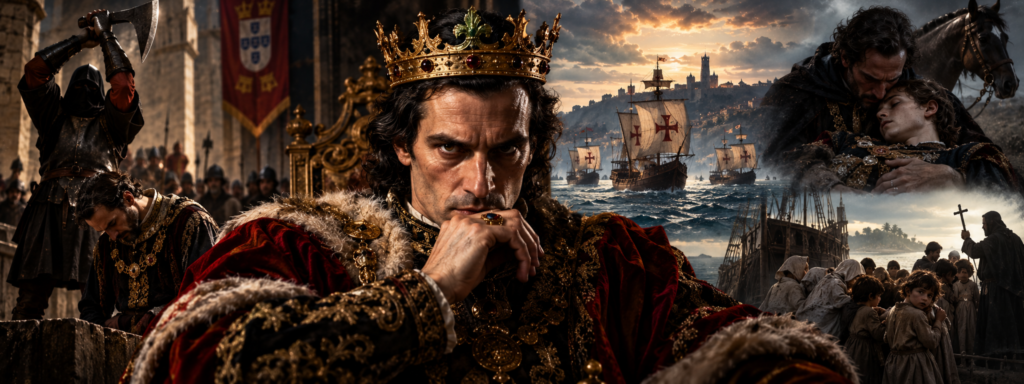
Three images capture John II better than any psychiatric label. The first is Fernando of Braganza beneath the shadow of royal justice, a great noble discovering that his wealth could not save him from the scaffold. The second is Diogo of Viseu confronting a king who would personally kill him rather than risk allowing a suspected conspiracy to survive. The third is Prince Afonso lying mortally injured after a riding accident, his death defeating a father who had spent his reign attempting to control every threat around the throne.
These images reveal a monarch of extraordinary contradictions. John could be ruthless without being irrational, suspicious without being delusional, and secretive without being clinically paranoid. He could display strategic brilliance in international affairs while showing astonishing hardness toward individual suffering.
The conspiracy theories surrounding Afonso’s death fit this world so perfectly that they are unlikely ever to disappear. Castile can be imagined as a suspect, exiled nobles can be imagined as suspects, and the remnants of families John destroyed certainly possessed motives for revenge. Yet none of those possibilities has produced convincing evidence of murder.
The simplest explanation remains the strongest: a teenage prince died in a catastrophic riding accident.
For almost any other king, that would simply be a tragedy.
For John II, it became an unbearable contradiction to everything his reign represented.
The Perfect Prince’s Darkest Legacy
John died leaving Portugal substantially stronger than he had found it. Royal authority had been reasserted against the aristocracy, the Crown possessed greater control over resources and justice, and Portuguese navigators had pushed beyond one of the greatest geographic barriers standing between Europe and the Indian Ocean. Manuel I would inherit those advantages and preside over spectacular expansion.
It is easy, from the perspective of later success, to see John’s ruthlessness as the necessary price of national greatness. That interpretation should be resisted. Political effectiveness does not transform every execution into justice or every act of coercion into necessity. The fact that Portugal benefited from stronger royal government does not erase the suffering inflicted during its creation.
Fernando of Braganza may have engaged in dangerous political dealings, but his destruction also enriched and empowered the Crown. Diogo of Viseu may have participated in a genuine conspiracy, but his death still demonstrates how little separation existed between royal suspicion and lethal punishment. Jewish refugees presented no comparable threat, yet John’s government could reduce them to bondage and tear children from families.
These episodes show that John’s severity was not confined exclusively to moments of immediate self-defense. Once the interests of the Crown became the supreme measure of policy, people with little power could be sacrificed as easily as dangerous aristocrats.
That is the shadow behind the Perfect Prince.
When the Crown Becomes the Only Measure
John’s political philosophy can be understood through a single recurring principle: the Crown must prevail. Noble privilege could be curtailed if it weakened royal authority. International information could be concealed if secrecy strengthened Portugal. Human lives could be subordinated when the monarchy believed a larger objective justified it.
Such a philosophy could produce effective government because it removed hesitation. John did not spend years allowing rebellious aristocratic factions to grow while hoping they would eventually become harmless. He struck early and with enough force to change the political structure of the kingdom.
But certainty creates its own dangers. A ruler convinced that he alone understands the interests of the state can begin treating disagreement as betrayal and compassion as weakness. The more successful that ruler becomes, the easier it is for every victory to confirm the righteousness of his methods.
John’s successes were numerous enough to encourage precisely that confidence. Braganza fell. Viseu fell. Exploration advanced. Portugal remained independent. Royal authority strengthened.
The system appeared to work.
Until it confronted something power could not intimidate.
The King Who Defeated Everyone Except Fate
Prince Afonso’s death provides the most powerful conclusion to John’s reign because it stripped away the illusion of total control. John could investigate a duke’s letters and discover dangerous foreign contacts. He could summon a suspected conspirator and kill him. He could guard maps, finance expeditions, and negotiate with rival monarchies.
He could not command the future to unfold according to plan. The entire legitimate continuation of his dynasty rested upon one young man, and that young man died before him. Whether the fatal fall occurred through a frightened horse, a misstep, or some other ordinary riding disaster, no political strategy could reverse it.
John tried to rebuild the succession around Jorge, but Portugal would not simply bend to his preference. Eleanor supported Manuel, legitimacy mattered, and the king eventually had to accept an outcome he had not wanted. The brother of Diogo of Viseu stood ready to inherit.
That final reversal was almost cruel enough to resemble poetic justice, although history rarely arranges itself so neatly. John had spent years demonstrating that no Portuguese noble was too powerful to be brought beneath the Crown. In the end, he discovered that even the Crown could be brought beneath forces larger than itself.
Disease weakened him.
Death took Afonso.
Dynastic reality defeated Jorge’s succession.
Manuel waited.
John II and the Madness of Power
John II was not a mad king in the medical sense, and forcing him into that category through retrospective psychiatric labels would distort the evidence. His suspiciousness had real political foundations, his enemies genuinely existed, and his government remained capable of sophisticated planning throughout his reign. Nothing requires hallucination or psychosis to explain his behavior.
His story belongs among darker royal histories for another reason. John demonstrates how far a ruler can travel into brutality without losing rationality at all. His intelligence made him more effective, his patience made his attacks more dangerous, and his understanding of political consequences allowed him to use fear with precision.
That is a far more unsettling form of royal extremity than a king simply losing his mind. John could weigh options and choose violence. He could recognize consequences and accept them. He could distinguish between moments requiring compromise and moments when he believed destruction would serve him better.
When he killed Diogo, he did not cease being the calculating king who supported exploration and negotiated with Castile. When his government brutalized refugees, it did not cease being administratively competent. The same monarchy could be efficient and cruel at the same time.
History repeatedly proves that those qualities are not opposites.
John II is one of its clearest examples.
The Perfect Prince
The epithet the Perfect Prince has survived for more than five centuries because John embodied qualities admired in a powerful monarch. He was intelligent, decisive, politically alert, strategically ambitious, and difficult to manipulate. He inherited a Crown surrounded by powerful aristocrats and left one substantially stronger than before.
Yet the title becomes more interesting when placed beside the darker record. What kind of perfection requires a scaffold at Évora? What kind permits a king to kill his own brother-in-law? What kind can coexist with children torn from their families and transported toward a deadly colonial settlement?
The answer lies partly in the values of monarchy itself. A “perfect” ruler was not necessarily a merciful one. Effectiveness, authority, courage, intelligence, and defense of royal interests could matter far more to chroniclers and political admirers than kindness toward enemies or vulnerable outsiders.
John succeeded according to many of those standards. He strengthened the Crown, weakened rival powers, expanded Portugal’s horizons, and helped prepare the kingdom for extraordinary global influence. The very qualities that made him successful could also make him terrifying.
Perfection depended upon who was doing the judging.
The Final Judgment
John II of Portugal should not be remembered as a deranged tyrant driven by imaginary conspiracies. That version is too simple and, in a strange way, too forgiving. He was a formidable monarch operating within a violent political culture, and many of the dangers he perceived were genuine.
Fernando of Braganza really was powerful enough to worry a king. Aristocratic opposition really did exist. Diogo of Viseu was associated with a serious conspiracy. Castile really was a formidable rival, and maritime information really was valuable enough to protect.
John’s darkness lay in what he was prepared to do with those realities. He could convert political suspicion into execution, family conflict into bloodshed, and vulnerable populations into instruments of policy. His determination to strengthen Portugal repeatedly overrode considerations that might have restrained a less ruthless monarch.
His reign also demonstrates why political success must never be confused with moral vindication. John achieved much of what he wanted. The nobility was subdued, royal authority increased, and the maritime program he supported helped open the route that would soon carry Portuguese ships into the Indian Ocean.
But every triumph had another side. The scaffold was as real as the caravel. The confiscated estates were as real as the African gold. The Jewish children sent toward São Tomé belonged to the same reign as Bartolomeu Dias.
John’s story therefore leaves a far more uncomfortable question than whether he was mad. It asks what happens when a ruler is intelligent enough to recognize exactly how much cruelty power will allow him to use.
The answer can be found in the kingdom he left behind: stronger, more centralized, more ambitious, and carrying scars that political success could never entirely erase.
In the end, the most haunting moment of John’s life was not an execution at all. It was the death of Afonso, because the prince’s fall exposed the one weakness John’s entire system could not overcome. If an assassin had killed the boy, John could have hunted him. If a duke had ordered the murder, John could have destroyed another house. If Castile had engineered it, the king could have threatened retaliation or prepared for war.
But if Afonso simply fell from his horse, there was nobody to punish. There was no confession to extract, no property to confiscate, no conspirator to drag before a tribunal, and no throat upon which royal vengeance could close. There was only grief, uncertainty, and the collapse of a future John had assumed he could secure.
That may be the most fitting ending for the king remembered as the Perfect Prince. He had spent his reign proving that Portugal’s greatest nobles were not beyond his reach. He had broken Braganza, killed Viseu, guarded the secrets of an expanding maritime kingdom, and forced political rivals to reckon with a monarchy far stronger than the one he inherited. Yet the very end of his story revealed that there were boundaries even he could not cross.
John II could control men through fear and institutions through authority. He could control information through secrecy and political rivals through force. He could help send ships beyond the known edges of European geography and negotiate with kings over oceans neither side fully understood.
What he could not control was chance.
He could not command his son to survive a fall. He could not make illegitimacy disappear from Jorge’s birth. He could not prevent Eleanor’s brother from becoming the strongest successor. He could not force his failing body to remain alive until the future changed in his favor.
John II was therefore not destroyed by the conspiracies he feared. He survived the great nobles who challenged him and left most of them politically defeated. His final enemy was something far more ordinary and infinitely more powerful: the inability of even the most ruthless monarch to command fate.
That is what makes his story worthy of the darkest corner of the Mad Monarchs. There is no need to invent insanity, poisoned goblets, secret assassins, or imaginary enemies. The historical John is disturbing enough precisely because he appears to have understood reality with exceptional clarity and still chose methods capable of horrifying those who lived beneath his authority.
Portugal remembered him as the Perfect Prince because he made kingship powerful.
His enemies remembered what that perfection cost.
And somewhere between the royal title, the executioner’s scaffold, the blood of Diogo of Viseu, the ships disappearing toward Africa, the cries of displaced families, and the body of a sixteen-year-old prince lies the real legacy of John II: a ruler who spent his life mastering power, only to discover that power could never master everything.