
Peter I of Portugal: The Vengeful King, the Hearts of His Enemies, and the Legend of the Dead Queen
King of Portugal, 1357–1367 | Pedro the Just | Pedro the Cruel
The King Who Could Not Forget the Dead
When Peter I of Portugal became king in 1357, the woman who would define his legend had already been dead for more than two years. Inês de Castro had been killed in January 1355 with the approval of Peter’s father, King Afonso IV, after the Portuguese court became alarmed by her relationship with the crown prince and the growing influence of her powerful Galician family. Peter had responded with grief, fury, and rebellion, taking up arms against his own father before a political reconciliation temporarily ended the fighting. The peace prevented Portugal from being consumed by a longer civil war, but it did nothing to erase what had happened. When Afonso died and the thirty-seven-year-old Peter inherited the throne, the prince who had once been forced to accept compromise suddenly possessed the authority of a king.
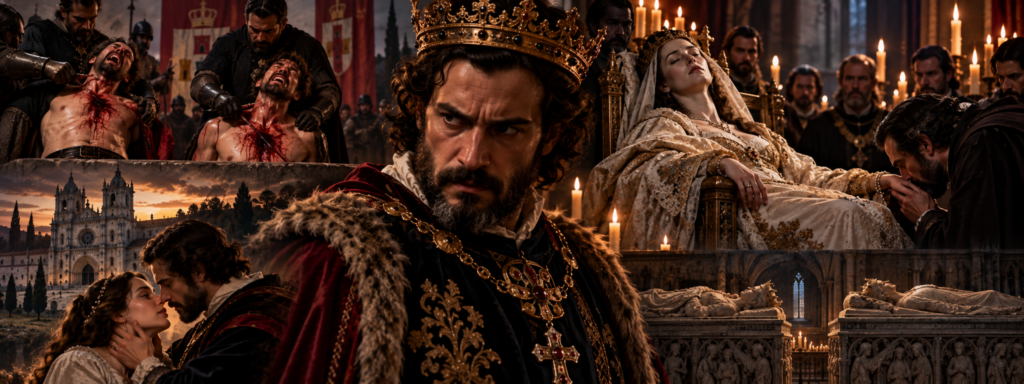
What followed helped create one of the darkest royal legends in European history. Peter pursued the men associated with Inês’s killing, obtained custody of two of them, and subjected them to executions of extraordinary brutality. According to the great Portuguese chronicler Fernão Lopes, Pêro Coelho and Álvaro Gonçalves had their hearts torn from their bodies, one through the chest and the other through the back. Peter also publicly asserted that he and Inês had secretly married before her death, giving her a posthumous claim to queenship, and arranged an extraordinary royal transfer of her remains to the monastery of Alcobaça. In later centuries, these events grew into something even more macabre: the story that Peter exhumed Inês, dressed her decomposing body in royal clothing, crowned her, seated her upon a throne, and forced his nobles to kiss the dead queen’s hand.
That horrifying coronation is almost certainly legend rather than securely documented history. Fernão Lopes, who wrote extensively about Peter’s revenge, his claimed marriage to Inês, and the magnificent transfer of her remains, does not describe the famous corpse enthronement. The story emerged much later and grew through literature, drama, painting, and romantic retelling until it became almost inseparable from the king himself. The genuine history, however, hardly needs embellishment. Peter really did turn royal justice into an instrument of personal vengeance, really did pursue Inês’s killers across political borders, and really did create monuments that transformed his dead beloved into a permanent presence within Portuguese royal memory.
Peter’s reputation is complicated further by the fact that vengeance was only one aspect of his personality. Fernão Lopes depicts a king obsessed with justice, capable of punishing powerful and humble offenders with an intensity that made him admired and feared at the same time. The same ruler could appear among ordinary people, enjoy music and dancing, and display an energetic appetite for life, yet he could also impose punishments whose cruelty shocked even within a violent medieval society. His later reputation therefore split between two apparently contradictory identities: Pedro o Justiceiro, Peter the Just or the Justicer, and Peter the Cruel.
There is no good historical basis for diagnosing Peter with bipolar disorder, psychosis, mania, or any other modern psychiatric condition. Medieval chroniclers described behavior rather than clinical syndromes, and dramatic shifts between festivity, anger, devotion, and cruelty do not allow a diagnosis across seven centuries. Yet Peter fits the broader Mad Monarchs tradition extraordinarily well because his contemporaries and later generations encountered a king whose emotional intensity seemed capable of breaking ordinary boundaries. His grief became rebellion, his justice became terror, his love became a posthumous royal cult, and his vengeance culminated in the removal of human hearts.
The most unsettling Peter is therefore not the mythical king sitting beside a crowned corpse. It is the historical ruler underneath the legend: a man capable of effective government and coherent political calculation who nevertheless believed that some wrongs could only be answered through spectacular violence. To understand how Portugal acquired a king remembered simultaneously for justice and cruelty, it is necessary to begin before the crown, before the executions, and before the magnificent tombs of Alcobaça—with the relationship that Peter’s father decided had become too dangerous to survive.
A Prince, a Political Marriage, and Inês de Castro
Peter was born on April 8, 1320, the son of Afonso IV of Portugal and Beatrice of Castile. He was not initially his father’s only son, but the deaths of his brothers left him as the surviving male heir to the Portuguese throne. Like almost every medieval prince of his rank, his marriage was never expected to be purely personal. Royal children were diplomatic assets, and the marriages arranged for them could settle disputes, construct alliances, strengthen claims, and sometimes prevent wars.
Peter eventually married Constanza Manuel, a Castilian noblewoman whose complicated family connections tied Portugal to the turbulent political world of neighboring Castile. Their marriage produced children, including Ferdinand, the future Ferdinand I of Portugal. Constanza’s household also introduced Peter to the woman whose name would eventually eclipse almost everyone else associated with his life. Inês de Castro was a Galician noblewoman connected to one of the most powerful aristocratic families operating across the Portuguese-Castilian political frontier.
The relationship between Peter and Inês apparently began while Constanza was still alive. Later romantic tradition often treats the affair as a perfect love story interrupted by cruel politics, but its beginnings were considerably messier. Constanza was Peter’s lawful wife, and Inês belonged to her household, meaning that the relationship humiliated the princess as well as alarming the Portuguese court. Whatever the depth of Peter’s feelings, their affair was never politically innocent.
Afonso IV became increasingly concerned about Inês and particularly about her Castro relatives. The Castros were not obscure foreigners hovering harmlessly around the prince. They were participants in Castilian aristocratic politics, and the possibility that Peter might fall under their influence raised legitimate concerns about Portugal becoming entangled in disputes across the border. Afonso had spent much of his own life dealing with dangerous dynastic rivalries, and he understood how easily royal families could become vehicles for foreign intervention.
Attempts were made to separate Peter and Inês, but the relationship survived. After Constanza died in 1345, Peter was no longer an adulterous husband maintaining a relationship with one of his wife’s ladies. He was a widowed heir openly attached to a woman whom his father considered politically unacceptable. Peter and Inês had children together, deepening both their personal connection and the political danger perceived by Afonso’s court.
Peter’s legitimate son Ferdinand remained the recognized heir after him, but the children of Inês carried royal blood and Castro connections. If Peter married their mother, their dynastic position could become much more complicated. Afonso therefore confronted a problem that was simultaneously political, familial, and emotional. Unfortunately for everyone involved, the king ultimately decided that ordinary political containment had failed.
The Woman the Crown Decided Had to Die
By the early 1350s, Afonso’s hostility toward the Castro influence around Peter had hardened. Castile itself was descending into increasingly dangerous dynastic conflict, making Portuguese fears of foreign entanglement far from imaginary. Members of Inês’s family possessed connections to powerful factions there, and Peter’s attachment to them could potentially pull the future Portuguese king into struggles that Afonso wanted his kingdom to avoid. The question was no longer simply whether the crown prince had chosen an inconvenient lover; it was whether that lover and her relatives might shape the political environment of the next reign.
Inês was living at Coimbra with her children when the crisis reached its fatal conclusion. Peter was absent when she was killed on January 7, 1355. Later literature created elaborate scenes of Inês begging Afonso for mercy while her children clung to her, and the emotional power of those images has made them central to the legend. The precise circumstances of the confrontation cannot be reconstructed with that degree of certainty, but Afonso’s responsibility for approving her death is not merely romantic invention.
Popular accounts frequently state that Inês was decapitated, although medieval evidence does not establish every physical detail of her killing with the confidence sometimes implied by later retellings. What mattered politically was that the king had authorized an irreversible solution. Afonso intended to remove the woman around whom he believed a dangerous faction might form. Instead, he gave his son a grievance that no political settlement could truly repair.
Peter reacted violently. He joined forces with Castro interests and rebelled against his father, bringing fighting into northern Portugal. The conflict was not an endless nationwide civil war, but it was serious enough to demonstrate immediately how badly Afonso’s attempt at preventive statecraft had backfired. The king had killed Inês to prevent future instability and had instead provoked the heir to take up arms against him.
Peter’s mother, Queen Beatrice, helped mediate between father and son, and a settlement was reached in 1355. Political necessity demanded compromise because Afonso could not easily eliminate the man destined to succeed him, while Peter could not destroy his father’s monarchy without damaging his own inheritance. Outwardly, peace returned. Emotionally, the conflict had merely been suspended.
Afonso died on May 28, 1357. Peter inherited Portugal, and the balance of power changed instantly. The grieving prince who had once lacked the authority to punish his beloved’s killers was now king. The reconciliation that had restrained him while his father lived could no longer guarantee the safety of the men Peter held responsible for Inês’s death.
A King With Two Faces
Peter’s ten-year reign developed a reputation unusual even among medieval monarchies. He became remembered as an energetic enforcer of justice who showed comparatively little patience for the social privileges that allowed powerful offenders to escape punishment. Fernão Lopes made justice one of the central themes of his chronicle, presenting Peter as a ruler whose determination to punish wrongdoing could inspire admiration while simultaneously becoming frighteningly severe.
The distinction between the Just and the Cruel is important because Peter’s brutality did not necessarily appear arbitrary to those who admired him. Medieval justice was often physically violent. Execution, mutilation, public humiliation, and corporal punishment were accepted instruments of government, and rulers were praised for punishing criminals decisively. Peter’s reputation emerged partly because he pursued this ideal with exceptional personal intensity.
Later audiences can easily interpret his punishments as sadism, particularly when chroniclers describe him taking direct interest in the suffering of offenders. Yet it is difficult to reconstruct Peter’s private emotional experience from narratives designed to illustrate royal justice. A chronicler describing a king’s enthusiasm for punishment is not providing a psychiatric assessment. Claims that Peter derived “profound personal pleasure” from torture should therefore be made cautiously unless a specific episode supports them.
What is clear is that Peter cultivated a highly personal form of kingship. He did not always remain distant while officials administered justice in his name. Stories repeatedly place him close to investigations, punishments, and confrontations, creating the image of a king who wanted to see justice done rather than merely sign documents authorizing it.
This proximity made him appealing to subjects who believed powerful people too often escaped consequences. A monarch willing to punish nobles, clerics, officials, and ordinary criminals according to the same conception of royal justice could appear as the protector of those without influence. At the same time, the absence of distance between king and punishment could make royal anger terrifying. When Peter decided that someone deserved suffering, there was little higher authority to restrain him.
His reign consequently poses an uncomfortable question about the meaning of justice under an absolute personal monarchy. A king who ignores privilege can look egalitarian, yet equality before an unpredictable and brutal ruler is not the same thing as impartial law. Peter’s justice could be admired precisely because it was immediate and personal, but those same qualities could turn it into vengeance with extraordinary ease.
The King Who Wanted Justice to Hurt
Fernão Lopes preserves a series of episodes intended to demonstrate Peter’s fierce commitment to justice. Some show a ruler unwilling to tolerate corruption or violence regardless of an offender’s social standing. Others make modern readers recoil because the punishments appear wildly disproportionate or because the king’s personal involvement transforms judicial authority into something resembling fury.
Clerical privilege presented a particular problem in medieval justice because churchmen could claim ecclesiastical jurisdiction and sometimes escape the penalties imposed upon lay offenders. Peter’s dealings with criminal clergy therefore became useful stories for demonstrating his insistence that status should not provide immunity. The broader tradition that he demanded punishment for priests guilty of serious crimes fits his reputation, although individual anecdotes should be distinguished from general policy rather than blended into one portrait of indiscriminate brutality.
One of the stories associated with Peter involves his treatment of the Bishop of Porto, whom the king allegedly assaulted or had physically punished during a dispute. The episode has been retold in increasingly colorful forms, and the safest historical approach is to preserve the chronicled conflict without converting every later flourish into fact. What matters is that Peter’s reputation allowed contemporaries and later writers to imagine remarkably little distance between royal displeasure and physical coercion.
Other punishments attributed to him involve sexual crimes, betrayal, murder, and offenses against people attached to his household. Castration and mutilation appear in accounts of his justice, penalties that were not unknown in medieval Europe but nevertheless reinforced his reputation for terrifying severity. Peter’s world accepted physical punishment far more readily than modern legal systems, yet his intensity stood out even against that background.
This is one reason the label “mad” can mislead. Peter’s violence did not generally emerge from confusion about reality. He appears to have possessed a coherent, if extremely harsh, conception of justice in which punishment should answer wrongdoing visibly and decisively. His danger came from certainty rather than disorientation.
That certainty becomes most disturbing when personal grievance enters the equation. Peter could insist that ordinary criminals face punishment because justice required it, but the men responsible for Inês’s death were not ordinary criminals in his mind. Their offense had entered the deepest part of his private life. When he finally gained control over two of them, justice and revenge became almost impossible to distinguish.
The Hunt for Inês’s Killers
Three men became particularly associated with the killing of Inês: Pêro Coelho, Álvaro Gonçalves, and Diogo Lopes Pacheco. They had reason to fear Peter’s accession and sought safety beyond Portugal. Peter, however, was not prepared to allow political borders to end the matter.
The king reached an arrangement with his Castilian counterpart, Pedro I of Castile, involving the exchange of fugitives. The Castilian king had enemies of his own whose return he desired, and the two monarchs could therefore satisfy each other’s interests. Medieval diplomacy and personal vengeance merged neatly. Peter did not need to send secret assassins across the frontier when royal agreements could deliver his enemies into his hands.
Pêro Coelho and Álvaro Gonçalves were captured and returned to Portugal. Diogo Lopes Pacheco escaped, eventually avoiding the fate suffered by the other two. Peter had obtained only part of what he wanted, but two living men connected to Inês’s death were now completely at his mercy.
Fernão Lopes’s account of what happened next is among the most famous passages associated with the king. The prisoners were interrogated and subjected to brutal execution. Their deaths were not merely administrative punishments carried out quietly beyond the king’s sight; they became a demonstration of what Peter believed the murder of Inês deserved.
One man’s heart was reportedly removed through his chest and the other’s through his back. Later versions often embellish the scene with elaborate speeches in which Peter explains that the men who destroyed his heart deserved to lose theirs. Such perfectly shaped dialogue belongs more comfortably to literary tradition unless securely sourced. The historical execution itself is already sufficiently symbolic without invented words.
The king’s vengeance had been delayed for years, but when it came it was spectacular. The men who had participated in the political killing authorized by Afonso IV were now treated as criminals under Afonso’s successor. Royal justice had reversed itself because the identity of the king had changed.
The Hearts of Pêro Coelho and Álvaro Gonçalves
The removal of the prisoners’ hearts became the defining image of Peter’s cruelty. It is easy to understand why. Medieval execution could be brutal, but the heart carried obvious symbolic significance in a story centered upon love, betrayal, and grief. Later generations inevitably interpreted the punishment as Peter physically attacking the organs that represented the compassion his enemies had supposedly lacked.
Fernão Lopes wrote decades after Peter’s death, and his chronicle is a crafted historical narrative rather than a modern court transcript. Nevertheless, his account is far closer to the events than the later corpse-coronation legend and forms the principal basis for the story of the executions. The broad fact of Peter’s gruesome revenge is therefore historically much stronger than many of the romantic embellishments attached to it.
Peter’s presence matters as much as the method. The king did not merely permit execution under ordinary law. His personal grievance shaped the event, and his emotional investment in the fate of the prisoners was obvious. In this moment, the Just and the Cruel became the same man.
From Peter’s perspective, there may have been no contradiction. Inês had been killed despite his love for her, and the men who carried out that decision deserved punishment. The fact that his father had approved the killing could not be answered directly because Afonso was dead, leaving the surviving agents of the murder as available targets for retribution.
The problem was that Peter was now king rather than merely a bereaved lover. His vengeance therefore carried the authority of the state. The executioner’s violence was royal violence, and personal memory had become public justice.
This fusion is one of the strongest reasons Peter belongs in the Mad Monarchs category without requiring any psychiatric diagnosis. He possessed enough control to plan revenge across years, negotiate internationally, capture his targets, and decide their fate. His behavior was not chaotic in the ordinary sense. It was deliberate, organized, and horrifyingly purposeful.
The Man Who Escaped the King’s Revenge
Diogo Lopes Pacheco escaped the fate of his companions, which added another layer to the story. Peter’s vengeance was therefore incomplete. Two men died spectacularly, but one of the principal figures associated with Inês’s killing remained beyond his reach.
Pacheco’s survival is important because it complicates the image of an omnipotent king systematically destroying everyone connected to the murder. Medieval royal power had limits. Borders, alliances, aristocratic networks, and simple opportunity could frustrate even a monarch determined to punish an enemy.
Peter eventually moved toward forgiveness of Pacheco, although the chronology and circumstances should not be transformed into a sentimental deathbed reconciliation without careful qualification. The fact that the surviving fugitive was not ultimately dragged back for another heart-ripping execution shows that Peter’s vengeance, intense as it was, did not expand endlessly.
This matters when assessing his mental state. An uncontrollable obsession might be expected to consume every other priority indefinitely. Peter instead ruled for a decade, conducted diplomacy, managed government, dispensed justice, dealt with neighboring Castile, and made decisions unrelated to Inês. Her memory remained extraordinarily important, but it did not make him incapable of kingship.
The historical Peter is therefore more complex than the romantic madman who spends every waking moment communing with a dead lover. He could compartmentalize. He could govern. He could pursue vengeance and still function as a medieval king.
That combination makes the violence more unsettling. Peter’s cruelty cannot simply be dismissed as the behavior of a man who had lost his mind after unbearable grief. He appears to have understood exactly what he was doing.
“I Married Her”
Peter’s most consequential attempt to reshape Inês’s status came in 1360, when he publicly declared that they had secretly married before her death. According to the account preserved by Fernão Lopes, witnesses were produced to support the claim, including the Bishop of Guarda and a member of Peter’s household. The announcement transformed the political meaning of their relationship.
If Peter and Inês had been validly married, she was not merely his mistress. She had been his wife and could consequently be regarded as queen, while the position of their children might also be strengthened. The claim therefore carried significant dynastic implications.
The difficulty was evidence. Peter’s inability or unwillingness to provide a clear date for the supposed marriage created doubts, and historians have never been able to establish the union with absolute certainty. The possibility that a private marriage occurred cannot simply be dismissed, but neither can Peter’s assertion be treated as unquestionable proof.
His motive may have been emotional, dynastic, political, or some combination of all three. Declaring Inês his wife vindicated her memory after Afonso’s government had treated her as a dangerous mistress. It also elevated their children and transformed the narrative of her death from the removal of an inconvenient lover into the killing of the future king’s lawful spouse.
Peter was using kingship to rewrite the public status his father had denied her. Afonso had prevented Inês from becoming a living queen at court. Peter could not reverse her death, but he could use royal authority to insist that she had possessed the status of his wife nonetheless.
The declaration became another foundation upon which later legend was built. Once Inês was imagined as a queen who had been denied recognition while alive, the story almost demanded a dramatic ceremony in which that recognition was restored. Eventually, storytellers supplied one.
The Corpse Queen of Portugal
The most famous version of the story is unforgettable. Peter orders Inês’s grave opened. Her body, dead for years, is removed from the earth and dressed in magnificent royal clothing. A crown is placed upon her head, and the corpse is seated on a throne as the queen she was never allowed to become while alive.
The nobility is then summoned before her. One by one, the most powerful men and women of Portugal supposedly kneel before the dead queen and kiss her decomposing hand. Peter watches, ensuring that the court gives Inês the obedience denied to her in life.
It is one of the great pieces of Gothic royal horror, and it almost certainly did not happen in this form. The crucial problem is the silence of the early chronicle tradition. Fernão Lopes knew about Peter’s declaration of marriage, the revenge upon Inês’s killers, and the elaborate transfer of her remains, yet he did not describe the spectacular corpse coronation that later became the centerpiece of the legend.
The story appears in substantially later literary traditions, particularly from the sixteenth century onward. By then Peter and Inês had become ideal subjects for tragedy: forbidden love, a murdered woman, a vengeful king, dynastic conflict, and death transcended through devotion. A corpse forced to receive the homage of the court was an irresistible addition.
The absence of contemporary evidence does not mean that Inês’s body was never exhumed. Her remains were indeed transferred from their original burial place to Alcobaça. That genuine exhumation, combined with Peter’s declaration that she had been his wife and the magnificence of her new tomb, may have provided the raw material from which the coronation legend grew.
The distinction is essential. Peter did extraordinary things in memory of Inês, but the most “insane” act attributed to him is precisely the one historians have the strongest reason to doubt. The real king does not need the corpse queen to remain disturbing.
A Funeral Fit for the Queen She Might Have Been
Peter ordered Inês’s remains transferred from the monastery of Santa Clara in Coimbra to the great Cistercian monastery at Alcobaça. Fernão Lopes describes the event as extraordinarily magnificent, accompanied by nobles, clergy, ladies, attendants, horses, and an immense display of lights. The transfer was not a secretive movement of bones from one grave to another. It was a public act of royal memory.
Peter commissioned an elaborate Gothic tomb for Inês, surmounted by her recumbent effigy wearing a crown. The visual message was unmistakable even without a corpse seated upon a throne. In stone, Inês received the royal dignity that had been denied her during life.
The tomb is one of the great masterpieces of medieval Portuguese sculpture. Its imagery participates in a sophisticated religious and courtly visual world concerned with salvation, judgment, death, memory, and the instability of earthly fortune. Peter later commissioned a similarly magnificent tomb for himself.
The monuments transformed personal grief into permanent royal architecture. Afonso had solved the Castro problem through physical elimination, but Peter answered by placing Inês within one of Portugal’s most prestigious religious spaces. Every generation entering Alcobaça could encounter the woman Afonso had wanted removed from the political future.
The tombs also helped feed later legend. Their emotional and artistic power encouraged viewers to imagine the relationship through the language of eternal love. Centuries of storytelling eventually attached the famous idea that Peter and Inês were positioned facing one another so that, when resurrected on Judgment Day, each would immediately see the other.
That interpretation is romantic but historically problematic. The tombs have been moved over the centuries, and their current facing arrangement does not securely reproduce their original medieval placement. The famous Judgment Day explanation should therefore be treated as part of the later legend surrounding the monuments rather than as a documented instruction from Peter.
Yet the legend captures something genuine about the project. Peter wanted the memory of Inês to survive beside his own. In that goal, he succeeded more completely than almost any medieval ruler could have imagined.
The King Who Danced Through the Night
The grimness of Peter’s reputation becomes stranger when placed beside another side of his personality preserved by Fernão Lopes. The chronicler describes a king who loved music, festivity, and dancing, including nocturnal celebrations that could transform quiet streets into scenes of royal excitement. Peter was not remembered solely as a brooding widower surrounded by executioners.
One particularly vivid tradition describes the king unable or unwilling to sleep, ordering torches lit and musicians summoned before taking to the streets in nocturnal revelry. People might be drawn into the festivities, turning the night into an extension of courtly celebration. These accounts have sometimes been interpreted as evidence of chronic insomnia or even manic episodes.
That interpretation goes considerably beyond the evidence. Medieval kings frequently maintained schedules that would seem unusual today, and nocturnal entertainment was not itself evidence of mental illness. Fernão Lopes’s colorful portrayal of Peter’s energy tells us something about his temperament and court culture, but it cannot establish bipolar disorder seven centuries later.
The contrast nevertheless fascinated later readers. This was the same ruler remembered for brutal punishments and the destruction of Inês’s killers, yet he could also appear exuberant, sociable, and delighted by music and dancing. Modern observers may find the transition emotionally jarring, but human beings do not need psychiatric illness to possess radically different public moods.
Peter’s nocturnal celebrations fit a larger portrait of physical energy and emotional intensity. He does not emerge from the chronicles as a distant ceremonial figure who lived behind layers of protocol. He appears active, immediate, sometimes impulsive, and unusually present within the world around him.
That temperament could make him magnetic during celebration and terrifying during anger. The same intensity that animated a night of music could animate the enforcement of a sentence. His reputation grew from the unpredictable possibilities created when such intensity belonged to a king.
The Stammer Behind the Royal Voice
Peter is also traditionally described as having a speech impediment, commonly characterized as a stutter. Fernão Lopes’s portrayal has contributed to the image of a physically expressive monarch whose speech could become more difficult when he was excited or angry. Later writers have sometimes dramatized the impediment until it becomes another symptom of supposed mental instability.
There is no reason to interpret a stutter as evidence of madness. Speech disorders are neurological or developmental phenomena that occur in otherwise mentally healthy people, and emotional arousal can intensify stammering without indicating psychiatric disease. The detail is relevant because it contributes to Peter’s historical personality, not because it diagnoses him.
In a medieval royal court, however, speech carried enormous symbolic importance. Kings issued commands, judged disputes, negotiated with ambassadors, and performed authority through spoken as well as written communication. A ruler whose speech became strained during moments of anger may have appeared especially intense to those around him.
It is easy to imagine later storytelling turning this into something sinister. A furious king struggling through words while deciding someone’s fate is more memorable than an ordinary judicial proceeding. Chroniclers and subsequent writers naturally gravitated toward details that made Peter vivid.
The stammer therefore belongs in his portrait, but not in a list of “behavioral disorders.” It is better understood as one physical characteristic of a monarch whose personality already attracted powerful stories. Peter did not need a fluent voice to make himself feared.
His commands carried royal authority regardless of how they were spoken. For anyone awaiting sentence, the frightening part was not whether the king stumbled over his words. It was what those words might order.
Justice Without Distance
Peter’s approach to kingship appears unusually immediate in the stories told about him. He questioned offenders, intervened in disputes, and took personal interest in punishments. This could create the impression of a monarch who refused to hide behind bureaucracy.
For ordinary subjects, that image had enormous appeal. Medieval government depended heavily upon local officials, nobles, judges, and clerics, all of whom could abuse authority. A king willing to punish corrupt or violent elites could therefore become a symbol of justice even when his methods were severe.
Fernão Lopes’s narrative must still be approached critically. He wrote in a later political environment and shaped Peter’s reign according to themes important to his own conception of monarchy. His Peter is not an unfiltered psychological portrait but a literary and political construction grounded in historical memory.
Nevertheless, the consistency of Peter’s reputation suggests that his severe justice was not simply invented from nothing. He became remembered as o Justiceiro because his reign genuinely left an impression of forceful royal punishment. That reputation coexisted with the epithet the Cruel because the line between exemplary justice and excessive brutality could be very thin.
Peter’s personal intervention also meant that anger could influence justice more directly than in a system with strong institutional separation between ruler and judiciary. The king was the ultimate source of authority. If Peter believed a punishment was appropriate, few mechanisms existed to tell him that his sense of proportion had failed.
This is where the medieval admiration of strong kingship becomes uncomfortable. The same ruler who protects the weak from powerful offenders can become dangerous when convinced that his own emotions perfectly reflect justice. Peter’s vengeance for Inês is the ultimate example of that collision.
Did Peter Enjoy Cruelty?
The question inevitably arises because so many stories place Peter close to punishment. Was he simply a stern medieval king, or did he enjoy watching people suffer? Some later portrayals push him toward outright sadism, presenting executions almost as entertainment.
Historical evidence cannot provide a psychiatric answer. Fernão Lopes emphasizes Peter’s fierce pleasure in justice and records punishments with memorable detail, but medieval narrative conventions often treated a ruler’s determination to punish wrongdoing as a virtue. Modern readers can easily interpret that determination differently because contemporary moral assumptions about corporal punishment have changed radically.
Peter unquestionably authorized punishments that qualify as gruesome by modern standards. Some were gruesome even by medieval standards, particularly the executions of Inês’s killers. It is therefore unnecessary to soften his violence merely because the cultural context differed from ours.
At the same time, cruelty should not automatically become sadism. Sadism implies a particular psychological gratification from suffering that historians cannot reliably establish from chronicles alone. Peter may have experienced satisfaction when enemies were punished, but satisfaction in vengeance is not itself a diagnosable disorder.
The better description is that he possessed an unusually severe conception of punitive justice and was willing to make punishment intensely personal. His emotions mattered because he held enormous power. Anger that would produce a quarrel in an ordinary person could produce mutilation or death when experienced by a king.
Peter’s danger therefore came not from proven mental illness but from the combination of emotional intensity and sovereign authority. He did not need to enjoy suffering for his punishments to become terrifying. He only needed to believe that suffering was deserved.
The Myth of the “Bipolar King”
Modern popular accounts sometimes describe Peter’s contrasting behavior as bipolar: joyful dancing followed by savage punishment, affection for ordinary people alongside merciless treatment of offenders, intense love for Inês alongside political violence. The contrast makes the label tempting, but it is historically and medically unsound.
Bipolar disorder is not simply a tendency to alternate between happiness and anger. Diagnosis depends upon identifiable episodes involving patterns of mood, energy, sleep, cognition, functioning, and duration. A medieval chronicle written after a ruler’s death cannot provide the clinical evidence necessary to establish those criteria.
Peter’s nighttime activity is similarly insufficient. Staying awake for celebrations or maintaining unusual hours does not prove decreased need for sleep associated with mania. Nor does emotional volatility automatically indicate a mood disorder.
There is also a cultural problem. Medieval kings were expected to display emotion differently from modern political leaders. Royal anger could be theatrical and purposeful, while public festivity could demonstrate generosity, accessibility, and magnificence. Behavior that appears psychologically erratic to a modern observer might have communicated recognizable political messages to contemporaries.
None of this means Peter was psychologically ordinary. He may have possessed a volatile temperament, unusually strong emotional reactions, or traits that a modern clinician would find noteworthy. The evidence simply cannot take us from possibility to diagnosis.
The historical Peter is compelling precisely without that diagnosis. His contradictions do not need a medical explanation. People can dance at night, grieve profoundly, govern effectively, love obsessively, and punish brutally without belonging to a single psychiatric category.
Peter and the Common People
Peter’s reputation among ordinary Portuguese subjects became remarkably positive despite the brutality associated with his name. The explanation lies partly in the target of his severity. A ruler who punished elites rather than merely protecting them could appear as an ally to people accustomed to aristocratic privilege.
Stories of Peter moving among his subjects reinforced this image. His enjoyment of popular festivities and relative informality could make him seem more accessible than rulers who remained insulated behind elaborate court ceremony. The same directness visible in his justice appeared in his social behavior.
This did not make him a democratic monarch in any modern sense. Peter ruled within a hierarchical medieval society and possessed assumptions about royal authority completely incompatible with contemporary representative government. His popularity should not be romanticized into egalitarianism.
Yet medieval kingship depended upon reputation as well as institutions. Subjects wanted a ruler who would hear grievances, restrain abusive officials, maintain order, and punish offenders. Peter’s willingness to act personally could therefore generate genuine admiration.
The contradiction between popular king and cruel king is less puzzling once justice is understood through this lens. The people most likely to praise his severity were not necessarily the people suffering it. To a peasant or townsman who feared a powerful noble, an uncompromising king could look like protection.
Peter’s legend therefore developed two faces because his government genuinely contained both. The sword that terrified an offender could reassure someone who believed that offender had escaped justice for too long. Whether Peter was Just or Cruel depended partly upon which side of royal judgment a person occupied.
Portugal Under Peter Was More Than Inês
The extraordinary power of the Inês story can make Peter’s entire reign appear like an extended episode of personal mourning. In reality, he governed Portugal for nearly a decade after becoming king and dealt with the ordinary responsibilities of medieval monarchy. Administration, finance, diplomacy, royal justice, aristocratic relationships, and foreign affairs continued regardless of the tragedy that dominates modern memory.
Peter maintained particularly important relations with neighboring Castile. His namesake and nephew, Pedro I of Castile, was involved in violent conflicts that eventually became part of a wider Castilian civil war. Portuguese policy required careful calculation because Castilian instability could easily spill across the border.
The Portuguese king provided assistance to his Castilian counterpart on occasions, including military support. These decisions show Peter operating as a conventional dynastic monarch rather than as a ruler psychologically incapacitated by private grief. He could distinguish foreign policy from his personal history with Inês even though the Castro family itself remained entangled in Iberian politics.
His reign was also remembered for attention to royal authority and legal order. Fernão Lopes regarded the decade as exceptional enough to remark upon it emphatically. Whatever one thinks of Peter’s punishments, he was not remembered as a king under whom government simply collapsed.
This is another reason retrospective claims of insanity must be treated carefully. Peter’s reign was functional. He made coherent decisions, conducted diplomacy, enforced royal authority, and left the crown to his legitimate son Ferdinand.
A clinically incapacitated monarch and a violent monarch are not the same thing. Peter belongs among history’s disturbing rulers because he could govern effectively while committing acts that later generations found horrifying. Competence did not restrain cruelty; in some circumstances, it made cruelty easier to execute.
Love, Possession, and Memory
Peter’s devotion to Inês has been romanticized so extensively that it can be difficult to distinguish the historical relationship from the cultural monument constructed around it. The surviving evidence leaves little doubt that she mattered profoundly to him. He maintained their relationship despite his father’s opposition, rebelled after her death, avenged her, declared their secret marriage, transferred her remains, and commissioned an extraordinary tomb.
Calling this simply “obsession” risks turning emotional intensity into a diagnosis. Peter had lost a longtime partner and the mother of several of his children through a killing authorized by his own father. Grief, anger, and the desire to preserve her memory are understandable responses even when the forms his vengeance took were extreme.
At the same time, Peter’s royal power allowed grief to become something ordinary mourners could never create. He could transform personal memory into public architecture. He could declare a dead woman his lawful wife, command ceremonial honors, and punish the people he blamed for her death.
The result blurred the line between mourning and statecraft. Inês became part of the official memory of the monarchy because Peter had the authority to make her so. Her tomb was not simply a lover’s memorial; it was a royal statement.
Peter therefore reshaped the meaning of her death. Under Afonso IV, Inês had been eliminated as a political danger. Under Peter, she became the wronged royal woman whose memory the monarchy itself honored.
The transformation was so successful that later generations almost forgot the complicated political woman behind the legend. Inês became the eternal beloved, Peter became the grieving king, and Afonso became the cruel father who tried to separate them. History became tragedy.
When Grief Becomes Government
Peter’s reign raises a broader question about rulers who use public authority to resolve private wounds. Kings could not easily separate family from politics because royal families were themselves political institutions. The murder of a prince’s companion, particularly one with dynastic children, could never be purely personal.
Nevertheless, Peter’s pursuit of Inês’s killers demonstrates how easily sovereign power could transform grief into state action. An ordinary man might spend years imagining revenge. A king could negotiate extradition and have executioners carry it out.
The danger lay in the absence of an independent boundary between the injured individual and the ruler administering justice. Peter was simultaneously victim, prosecutor, judge, and sovereign. His personal conviction that the men deserved death became sufficient to make death happen.
Medieval observers did not necessarily see this combination as inherently illegitimate. Kings were expected to avenge injuries, defend honor, punish treachery, and maintain justice. The modern ideal of institutional neutrality was not the framework within which Peter operated.
Even by medieval standards, however, the theatrical brutality of the executions stood out. That is why chroniclers remembered them. Peter could have ordered the men beheaded or hanged; the removal of their hearts turned punishment into symbolism.
The heart executions therefore represent the point where justice becomes unmistakably personal. Peter was not simply eliminating political enemies. He was answering the emotional wound that had shaped his life since 1355.
The King in the Chronicle
Much of what makes Peter vivid comes from Fernão Lopes, who wrote his chronicle several decades after the king’s death. Lopes was one of medieval Portugal’s greatest chroniclers, but he was not a neutral camera recording events as they happened. He selected episodes, organized them around themes, and wrote within the political world of the later Portuguese monarchy.
His Peter is especially associated with justice. The chronicler repeatedly explores what it meant for a king to punish wrongdoing and how Peter’s severity could cross into cruelty. This literary framing is invaluable because it preserves traditions that might otherwise have disappeared, but it must also be read critically.
Stories of eccentric kings attract embellishment quickly. A monarch who once enjoyed nocturnal dancing can become an insomniac roaming streets every night. A king with a stutter can become a man whose speech dissolved whenever rage overtook him. A ruler who imposed severe punishments can become a sadist personally delighted by torture.
The process is even more obvious with Inês. A genuine transfer of her remains becomes an exhumation for coronation. A crowned effigy becomes a crowned corpse. Royal honors become a throne, and a solemn funeral becomes nobles forced to kiss decomposing flesh.
Separating these layers does not weaken the story. It reveals how Peter became a legend. The historical king generated enough extraordinary material that later imagination needed only to exaggerate what was already there.
For Mad Monarchs, this distinction is particularly valuable. Peter’s reputation for madness was created not by a documented diagnosis but by the interaction between extreme behavior and centuries of storytelling. The king and the myth became inseparable, but they are not identical.
The King Who Was Both Just and Cruel
The opposing epithets attached to Peter may reveal more about medieval kingship than any modern diagnosis could. To be “Just” and “Cruel” sounds contradictory only if justice is assumed to require mercy and procedural restraint. In Peter’s world, justice could be terrifying.
A king who punished murderers, corrupt officials, abusive nobles, and criminal clerics without favoritism could earn admiration. If he mutilated or executed those offenders, the violence might be interpreted as proof that royal justice was serious. Severity could reinforce legitimacy.
Yet severity always carried the danger of excess. Once punishment became a performance of royal will, the suffering of the condemned could become part of the king’s political message. Peter’s heart executions demonstrate this perfectly.
His reputation therefore sits at the point where admiration becomes fear. The same determination that made subjects praise him could make enemies view him as monstrous. Neither image completely cancels the other.
Peter may have understood himself as a just king throughout. There is no reason to assume he experienced the contradiction later historians perceive. If the guilty deserved punishment, then cruelty toward them might not have appeared cruel from his perspective.
That certainty is more revealing than a speculative psychiatric label. Peter’s worldview allowed justice and brutality to occupy the same space without necessarily producing moral conflict. The king did not have to believe he was cruel in order to become remembered that way.
Death at Estremoz
Peter’s reign ended on January 18, 1367, when he died at Estremoz at the age of forty-six. He had ruled Portugal for less than ten years. His legitimate son Ferdinand succeeded him, beginning a reign that would eventually lead Portugal toward another major dynastic crisis.
Peter had already prepared for his own memory. His tomb awaited him at Alcobaça, linking his burial permanently to the magnificent monument he had created for Inês. Death therefore completed the memorial project begun years earlier when her remains were transferred from Coimbra.
The king who had once been separated from Inês by his father’s authority was now buried within the same sacred landscape. Whatever the exact original arrangement of the tombs, their artistic relationship made the connection unmistakable. Peter had ensured that his own royal afterlife could not easily be narrated without hers.
His political legacy extended beyond Inês as well. Through different children, Peter became ancestor to figures who would shape Portugal’s future. Ferdinand inherited the throne directly, while another son, John, eventually became John I and founded the House of Aviz after the crisis of 1383–1385.
The dynasty therefore moved onward, just as Afonso IV had always wanted it to do. Yet the woman Afonso killed in the name of dynastic security remained attached to its memory. Peter had seen to that.
Death ended the king’s punishments, dances, judgments, and political calculations. It did not end the story. In many ways, the most extraordinary version of Peter I was created only after he was gone.
The Making of the Mad King
Centuries of literature transformed Peter from a severe medieval ruler into a Gothic figure of almost supernatural grief. The ingredients were already irresistible: forbidden love, political murder, rebellion against a father, revenge, torn-out hearts, a secret marriage, an exhumed beloved, magnificent tombs, and a king who refused to allow death to settle the argument.
The corpse-coronation legend pushed the story across the boundary between tragedy and horror. A grieving king who builds a tomb is recognizable. A king who seats his dead beloved on a throne and makes an entire court kiss her hand seems unhinged in a way that requires no psychiatric terminology.
That is precisely why the story survived. It condensed Peter’s entire reputation into one impossible image. Love and power, grief and authority, devotion and madness all appeared simultaneously in the dead queen’s imagined court.
Yet removing the legend does not make Peter ordinary. The heart executions remain. The rebellion remains. The claimed secret marriage remains. The transfer of Inês’s remains and the extraordinary monuments at Alcobaça remain.
The real history is therefore dark enough. Peter did not need to crown a corpse to demonstrate the extraordinary lengths to which he was willing to carry memory and revenge. His documented actions already crossed boundaries that most rulers would never approach.
The legend tells us less about what Peter literally did than about what later generations believed he was capable of doing. That distinction is itself historically significant. A reputation becomes powerful when an invented atrocity feels completely believable because of the genuine acts surrounding it.
Was Peter I Mad?
There is no responsible historical basis for saying that Peter I was clinically insane. Nothing in the surviving evidence establishes psychosis, bipolar disorder, a personality disorder, or any other modern diagnosis. His unusual behavior must be understood through medieval culture, the literary purposes of chroniclers, and the enormous distance separating observation from modern psychiatric assessment.
His grief for Inês does not prove madness. Neither does his vengeance, however gruesome. Violent retaliation was embedded within medieval concepts of honor and royal justice, although Peter carried it to memorable extremes.
His dancing and nighttime festivities do not prove mania. His stutter does not indicate mental illness. His ability to move between sociability and anger does not demonstrate bipolar disorder, and the claim that he enjoyed torture cannot simply be converted into a diagnosis of sadism.
What can be said is that Peter appears to have possessed an intense temperament. He could become deeply emotionally invested in relationships and in his conception of justice. He was willing to involve himself personally in punishment, and his response to betrayal could be extraordinarily severe.
He also appears to have remained capable of coherent government. Portugal did not spend his reign under the control of regents attempting to manage an incapacitated king. Peter conducted diplomacy, administered justice, exercised royal authority, and made long-term dynastic decisions.
His place among Mad Monarchs therefore resembles that of rulers whose reputations for madness arose from extremity rather than clinical illness. Peter seemed excessive even within a world accustomed to royal violence. His love was excessive, his vengeance was excessive, his punishments could be excessive, and the legends created around him became more excessive still.
The result was a king who could be remembered as sane in government and almost monstrous in memory.
The Hearts, the Tombs, and the Truth
Peter I’s story becomes most powerful when history and legend are allowed to remain separate. The temptation to blend them is understandable because the legendary version is spectacular. A crowned corpse on a throne is difficult to resist.
But the documented king deserves attention on his own terms. Peter inherited a monarchy already stained by the killing of the woman he loved. He pursued her killers, obtained two through political negotiation, and inflicted horrifying executions upon them. He asserted that Inês had been his wife and publicly elevated her memory.
He commissioned monuments whose artistry still communicates the scale of that memory centuries later. The tombs at Alcobaça turned private bereavement into one of medieval Portugal’s greatest artistic statements. They ensured that Peter and Inês would remain linked long after the political circumstances surrounding their relationship had become obscure.
The legendary coronation then grew around those genuine acts. Later generations looked at a crowned stone Inês, knew that her body had been exhumed for transfer, knew that Peter had declared her his wife, and knew what he had done to her killers. The leap from royal funeral to corpse queen became emotionally irresistible.
The legend survives because it expresses something the documents cannot quantify: the perceived enormity of Peter’s grief. Whether or not he ever forced a noble to kiss Inês’s dead hand, people came to believe that he could have.
That may be one of the strangest forms of historical reputation. Peter’s real behavior made an extraordinary fiction plausible.
The King Who Refused to Let Inês Stay Dead
Afonso IV had ordered Inês removed because he believed the future of Portugal required her absence. Peter answered by making her absence impossible. He could not restore her body to life, but he could restore her name, status, dignity, and presence within the memory of the monarchy.
He declared that she had been his wife. He treated her as a woman worthy of royal burial. He placed a crown upon her sculpted effigy and built a monument capable of outlasting dynasties.
There is something almost defiant in the project. Afonso’s decision had depended upon the ultimate authority of death. Kill Inês, and the political problem disappears. Peter’s response demonstrated that death did not necessarily erase political or emotional significance.
Inês became more powerful as memory than she had ever been as a living court figure. Her murder turned her into a symbol, and Peter’s actions amplified that transformation. Poetry and legend eventually carried her far beyond Portugal.
The irony resembles the tragedy of Afonso’s original decision. The king who wanted Inês forgotten helped make her unforgettable, while the son who could not save her devoted royal power to ensuring that the forgetting never happened.
Peter’s monuments therefore represent more than romantic grief. They are a victory over his father’s intended erasure. Afonso controlled Inês’s death, but Peter seized control of her memory.
In that contest, the son won completely.
The Cruel King Who Was Loved
Peter’s popular reputation presents another paradox. A monarch associated with mutilation, execution, violent anger, and personal vengeance might be expected to become universally hated. Instead, traditions of Peter as a just ruler remained powerful.
This reflects the political value of predictable severity when directed at people believed to deserve it. Subjects could tolerate, and sometimes celebrate, a harsh monarch if they believed his harshness restrained aristocratic abuse and criminality. Fear could coexist with respect.
Peter’s accessibility may also have helped. The image of the king dancing, participating in festivities, and interacting more directly with subjects contrasts sharply with the distant majesty cultivated by many rulers. He could appear recognizably human even when royal authority made his actions extraordinary.
His relationship with Inês added another layer. The revenge that appears terrifying can also be read as proof of unwavering devotion. Romantic tradition transformed violence into evidence of love, allowing Peter to become simultaneously frightening and sympathetic.
That transformation should make modern readers cautious. Love does not morally justify torture, and grief does not automatically transform revenge into justice. The beauty of the Inês legend can obscure the suffering of the men Peter punished just as political accounts of Afonso’s decision can obscure the humanity of Inês.
Peter’s story survives because it refuses simple moral categories. He can be lover and executioner, popular king and terrifying judge, administrator and avenger. The contradictions are genuine even when the psychiatric interpretations are not.
A King Made Larger Than Life
Many medieval monarchs were violent. Many lost spouses or lovers. Many ordered executions, fought relatives, punished enemies, and commissioned elaborate tombs. Very few became Peter I of Portugal in cultural memory.
The difference lies in the combination. His story possessed the structure of tragedy almost before writers began shaping it: a prince loves a forbidden woman, a father orders her death, the son rebels, the father dies, the prince becomes king, and revenge follows. Even without later invention, it feels written for the stage.
Fernão Lopes supplied some of the most vivid historical material. Later writers supplied what the chronicle lacked. The corpse queen emerged, the tombs acquired romantic explanations, and every eccentricity of the king became evidence of consuming grief.
Peter gradually ceased to be merely a fourteenth-century Portuguese monarch. He became an archetype of love carried beyond death. The historical man and the literary figure fused.
For a site devoted to Mad Monarchs, that transformation is almost as important as his reign. Peter demonstrates how royal madness can be created culturally even when medical evidence is absent. Extreme acts generate stories, stories generate legends, and legends eventually become mistaken for biography.
The process can be seen clearly because one of the most famous pieces of evidence for Peter’s supposed insanity—the enthroned corpse—is also one of the least historically secure. The legend became proof of the very madness it had helped invent.
The Madness of Vengeance
If Peter’s behavior is to be called “mad,” the term works best as a moral and political description rather than a medical one. Vengeance can possess its own logic. An injury creates a debt, punishment satisfies the debt, and the avenger convinces himself that suffering restores balance.
Peter had years to live with that logic. Inês died in 1355, and he did not become king until 1357. His revenge upon the captured killers came later still. This was not an impulsive act committed minutes after discovering her death.
The delay makes the vengeance colder. Peter had time to govern, negotiate, remember, and reconsider. When opportunity arrived, he still chose spectacular punishment.
That does not prove pathological obsession. It demonstrates the durability of the grievance. In a culture where honor and vengeance carried political significance, forgetting could itself appear dishonorable.
Yet kingship magnified the consequences of Peter’s inability or unwillingness to forgive. His memory became law. His grievance became diplomacy. His vengeance became execution.
The terrifying quality of his reign lies partly in that conversion of emotion into government. Peter did not need to lose control in order to become dangerous. He needed enough control to make his anger effective.
Love After Death
The monuments at Alcobaça remain the most beautiful counterpoint to the violence. Peter’s tomb and Inês’s tomb are intricate works of Gothic sculpture filled with religious, dynastic, and symbolic imagery. Their artistry resists the temptation to reduce the couple to a simple Gothic horror story.
Peter appears to have understood commemoration as something larger than private mourning. The tombs situated his relationship with Inês within Christian ideas about death, salvation, judgment, resurrection, and eternity. Their story was therefore not meant to end merely with murder.
Later generations interpreted this through increasingly romantic language. The lovers would rise and see each other at Judgment Day. Death had separated them temporarily, but eternity would restore what politics destroyed.
The precise popular explanation may be later, but it captures why the tombs became so powerful. Stone gave permanence to a relationship that Afonso’s violence had attempted to terminate. The murdered woman remained present beside the king in the sacred landscape of royal memory.
There is also something deeply medieval about this response. Peter did not attempt to preserve Inês through private sentimental objects alone. He used religion, sculpture, royal symbolism, burial, and ceremony to construct memory.
The result outlasted the political disputes that caused her death. Few visitors to Alcobaça today need to understand every faction of fourteenth-century Castile to feel the emotional force of the tombs. Peter transformed a dynastic crisis into a story capable of surviving its original world.
The Final Judgment of Peter I
Peter I of Portugal died in 1367 after a reign of less than ten years, but his reputation grew larger with every century that followed. He had been an effective enough ruler to leave behind a strong tradition of royal justice, yet the political details of his government were gradually overshadowed by torn-out hearts, midnight revelry, violent punishments, Gothic tombs, and the murdered woman who remained at the center of his memory. His reign became one of those rare historical episodes in which documented events were already so extraordinary that later legend needed only a small push to turn them into something almost supernatural.
There is no convincing reason to diagnose him as clinically mad. His alleged insomnia cannot establish mania, his stutter was not mental illness, his emotional intensity does not prove bipolar disorder, and the brutality of medieval punishment cannot by itself demonstrate psychiatric abnormality. Even his fixation upon Inês becomes understandable when stripped of later exaggeration: she had been his longtime companion, the mother of his children, and a woman killed with the approval of his own father. Peter’s response could be extreme without being incomprehensible.
What separates him from an ordinary grieving widower or bereaved lover is power. Peter could do what grief-stricken people normally cannot. He could turn memory into state ceremony, transform vengeance into royal justice, command architects and sculptors to immortalize the dead, negotiate with another king to obtain fugitives, and decide exactly how those fugitives would die. His emotions mattered because a kingdom stood behind them.
That is why the executions of Pêro Coelho and Álvaro Gonçalves remain more important than the legendary corpse coronation. The heart-ripping punishment belongs to the historical core of Peter’s reputation, while the enthroned Inês belongs to the mythology that later grew around it. The real king was already frightening enough. He did not need a decomposing queen seated beside him to demonstrate how far his vengeance could reach.
His justice remains equally difficult to categorize. To many subjects, Peter was o Justiceiro, the ruler who refused to allow rank or privilege to protect wrongdoers. To others, and to later observers confronted by his punishments, he could appear cruel almost beyond comprehension. Both reputations arose from the same quality: his belief that wrongdoing demanded forceful consequences and that the king himself was entitled to ensure those consequences arrived.
The nocturnal dancer and the merciless judge were not necessarily two separate personalities. Nor do they require a psychiatric disorder to reconcile them. Human beings can contain exuberance and brutality simultaneously, and medieval kingship provided unusually wide space for both to become public. Peter could celebrate intensely because he was an energetic man with a taste for music and company, and he could punish intensely because his concept of justice was equally forceful.
His relationship with Inês gave those traits a story powerful enough to survive centuries. Her murder exposed the limits of Peter’s authority while he was still a prince. His reign then became, in part, an attempt to reverse those limits. He could not prevent Afonso from killing her, but once he became king he could punish some of the men involved, proclaim the marriage his father had opposed, honor her remains, and place her memory within the visual language of queenship.
The result was one of history’s strangest victories over death. Inês never lived to become the publicly acknowledged queen beside Peter, yet she became far more famous than countless women who actually wore crowns. Afonso IV had considered her presence dangerous enough to eliminate. Peter’s response made her absence more powerful than her presence had ever been.
Later storytellers understood the irony and pushed it to its logical extreme. If Peter could not make Inês live again, legend could at least make the dead woman queen. Her corpse could rise from the grave, wear royal robes, sit beneath a crown, and receive the trembling homage of the court. The scene was probably invented, but emotionally it expressed exactly what later generations believed Peter wanted: a world forced to acknowledge Inês after death because it had refused to accept her in life.
That is the difference between historical truth and legendary truth in Peter’s story. Historically, there is no solid contemporary evidence that nobles kissed the hand of a crowned corpse. Legend, however, captured the extraordinary intensity of the king’s campaign to elevate Inês’s memory. The invented ceremony survived because it seemed consistent with the man who really did tear out the hearts of those he blamed for her death and really did raise a magnificent crowned image of her over her tomb.
Peter’s greatest historical contradiction is therefore not that he was both sane and mad. It is that he could be both controlled and extreme. His revenge required patience. His monuments required planning. His declaration of marriage required political calculation. His government required the ordinary machinery of kingship. Even the most horrifying acts associated securely with him were not products of obvious confusion or delirium.
The king who emerges from the evidence is more unsettling than the caricature of a lunatic. He appears to have understood the world around him. He knew who had killed Inês, knew why his father had wanted her removed, knew what authority the Portuguese crown gave him, and knew how to use diplomacy to bring enemies within his reach. His vengeance was frightening precisely because it was organized.
Peter therefore belongs among the Mad Monarchs not because historians can prove that his mind was disordered, but because his reign demonstrates how easily absolute authority can magnify emotional extremes into public terror. A private man’s anger can destroy a relationship. A king’s anger can destroy bodies, cross borders, reshape law, and become part of national memory.
The same principle applies to his love. An ordinary lover can mourn beside a grave. Peter could build a royal monument that still stands centuries later. An ordinary man can insist privately that the woman he lost was his true wife. Peter could make that claim before his kingdom and attempt to alter her dynastic status. His crown amplified devotion just as completely as it amplified vengeance.
Perhaps that is why the story of Peter and Inês refuses to die. It contains love at its most romantic and power at its most frightening, and neither can be separated cleanly from the other. Peter’s devotion preserved Inês, but his vengeance destroyed men. His sense of justice protected some subjects while exposing others to terrifying punishment. His energy made him memorable, while his severity made him feared.
At Alcobaça, the legend finally becomes stone. Peter and Inês lie within monuments created from a story of love, murder, grief, politics, vengeance, and death. Their tombs have been moved, interpreted, romanticized, damaged, restored, and surrounded by explanations that are not always historically secure. Yet they remain among the most extraordinary physical survivals of medieval royal memory.
Afonso IV had once believed that killing Inês would end the problem she represented. Instead, her death created something no king could control. Peter spent the rest of his life ensuring that Portugal would remember the woman his father had tried to remove, and later generations completed his work by transforming history into legend.
The crowned corpse may never have sat upon a throne. The nobles may never have bent over a dead hand. Peter may never have staged the grotesque ceremony that made him famous as a king driven mad by love. But two men really did fall into his hands, and according to the chronicle tradition their hearts were torn from their bodies under the authority of a king who had waited years for revenge.
That reality is darker than the legend in one crucial respect. A corpse coronation could be explained away as the behavior of a mind shattered by grief. Peter’s documented vengeance is harder to dismiss so comfortably. It belonged to a functioning monarch who governed a kingdom, understood political negotiation, administered justice, and remembered exactly what had been done to Inês.
Peter I did not need madness to become terrifying. He needed memory, authority, and the conviction that some injuries deserved an answer written in blood. His father had ordered Inês killed because he believed the crown mattered more than love; Peter inherited that same crown and used it to prove that, for him, love and vengeance could become indistinguishable from justice.
That is the legacy behind Peter the Just, Peter the Cruel, and the king of the dead queen. Not a proven lunatic wandering through a Gothic fantasy, but a capable medieval ruler whose passions became dangerous because almost no one could tell him when enough was enough. His heart had been broken by an act of royal power, and when royal power finally became his, he made certain that Portugal would never forget what followed.