
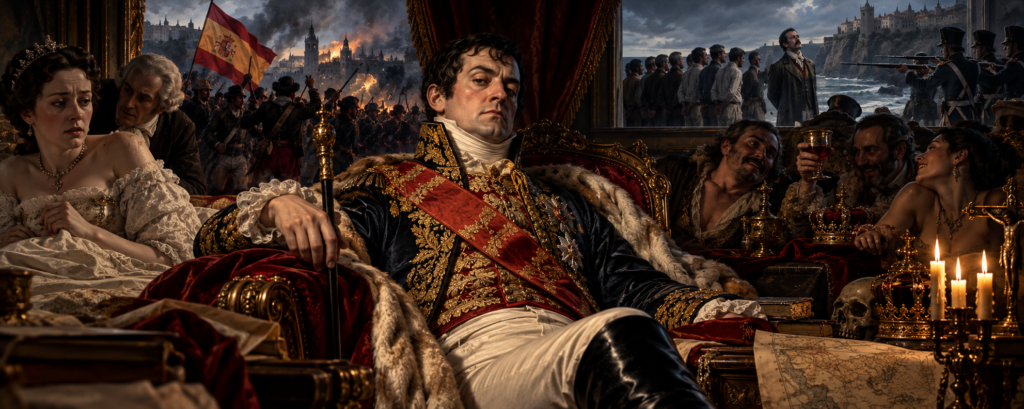
Ferdinand VII of Spain: The Felon King, the Betrayal of a Nation, and the Dark Reign of Revenge
King of Spain, 1808 and 1813–1833 | “The Desired One” | “The Felon King”
The King Spain Bled to Restore
Spain went to war for Ferdinand VII before most Spaniards had any real opportunity to discover what kind of king he would become. During the terrible years of the Peninsular War, his name became a symbol of legitimacy, resistance, and national survival. Spaniards endured occupation, executions, sieges, famine, guerrilla warfare, and the devastation of armies crossing their country while the king for whom many claimed to be fighting remained in France. In Ferdinand’s absence, people could imagine whatever monarch they needed him to be: a traditional Catholic king, a patriotic hero, a constitutional sovereign, or simply the rightful Bourbon whose restoration would end the nightmare created by Napoleon. He became el Deseado—“the Desired One”—a title filled with hopes Ferdinand himself had done remarkably little to earn.
When he finally returned in 1814, he found a country transformed by the struggle fought in his name. During his absence, the Cortes of Cádiz had produced the Constitution of 1812, one of the most important liberal constitutions of its age. It declared that sovereignty resided in the nation, established representative institutions, limited royal authority, and attempted to create a constitutional monarchy without abolishing the Bourbon throne. Ferdinand therefore returned to an extraordinary opportunity. He could have become the king who reconciled the old monarchy with the political world created by invasion and revolution, preserving the dynasty while acknowledging that Spain could not simply pretend the previous six years had never happened. Instead, within weeks of his return, he destroyed the constitutional settlement, restored absolutism, and unleashed repression against political opponents, including men who had resisted Napoleon while Ferdinand himself was absent.
That decision established a pattern that would define the rest of his reign. Ferdinand conspired against his own parents, sought Napoleon’s favor, surrendered his crown under pressure, flattered the French emperor while Spaniards were dying in a war fought partly in Ferdinand’s name, destroyed the Constitution of 1812 when he returned, accepted that same constitution when military rebellion forced him to do so in 1820, and repudiated it again when French intervention restored his absolute authority in 1823. His promises could be remarkably flexible because Ferdinand’s deepest political principle was not liberalism, conservatism, reform, or even a coherent vision of Spanish government. It was the preservation of Ferdinand VII and the greatest degree of royal authority circumstances would permit him to possess. When weak, he yielded; when strong, he retaliated.
This behavior eventually earned him a very different title from el Deseado. To generations of Spanish liberals, Ferdinand became el Rey Felón—the Felon King, the treacherous king, the monarch whose word could not be trusted. The transformation from Desired One to Felon King is one of the most extraordinary collapses of royal reputation in modern European history. Yet Ferdinand presents an important problem for any collection devoted to “mad monarchs,” because there is no convincing evidence that he suffered from the kind of severe mental illness associated with rulers such as George III during his episodes of incapacity, Philip V during his deepest psychological collapses, or Ferdinand VI during the catastrophic deterioration of his final year. Ferdinand VII appears to have remained firmly connected to political reality, and that may be the darkest thing about him.
His “madness,” if the term is used at all, was therefore political rather than clinical. Contemporary enemies and later historians described him with language suggesting cruelty, perversity, cowardice, paranoia, vindictiveness, and profound moral corruption, but such descriptions should not be converted casually into modern psychiatric diagnoses. Ferdinand understood threats, manipulated factions, remembered injuries, changed tactics when necessary, and repeatedly demonstrated an ability to calculate when resistance was dangerous and when revenge was safe. Some lurid stories surrounding his private life—grotesque sexual competitions, bizarre palace humiliations, exotic virility medicines, courtiers forced to behave like animals, and a government supposedly conducted among jesters and servants in palace kitchens—require much more caution than popular retellings usually give them. The documented Ferdinand is already disturbing enough without turning hostile gossip into medical evidence.
A Prince Raised in a Court of Suspicion
Ferdinand was born on October 14, 1784, at El Escorial, the son of the future Charles IV of Spain and Maria Luisa of Parma. He grew up inside a Bourbon court increasingly dominated by factionalism and by the spectacular rise of Manuel de Godoy, the royal favorite who became one of the most powerful and hated men in Spain. Godoy’s relationship with Charles IV and Queen Maria Luisa generated endless rumor, including the famous allegation that he was the queen’s lover, although the exact nature of their relationship remains disputed. To Ferdinand, however, Godoy was more than an unpopular minister. He was a personal enemy and an obstacle standing between the Prince of Asturias and the political influence Ferdinand believed should naturally belong to the heir to the throne.
The atmosphere surrounding the young prince encouraged suspicion rather than trust. Ferdinand developed his own circle of advisers, while opponents of Godoy increasingly looked toward the heir as a potential alternative to the existing government. Because Godoy had become so unpopular, Ferdinand benefited from a political reputation based largely on what people imagined he might do once he possessed power. He had accomplished little, yet he could appear virtuous simply because he was not Godoy. This would become one of the recurring patterns of his life: Ferdinand was often most popular when other people could project their hopes onto him without having to confront the reality of how he governed.
By 1807, Ferdinand’s hostility toward Godoy had developed into active conspiracy. The prince and members of his circle became involved in intrigues intended to weaken the favorite and improve Ferdinand’s own position. Most strikingly, Ferdinand looked toward Napoleon Bonaparte for assistance, seeking the favor of the very ruler whose invasion of Spain would soon transform him into a patriotic symbol. The irony is enormous. Ferdinand did not begin his political career as the heroic Bourbon standing against French domination; he was willing to court Napoleon when he believed French power might help him defeat his domestic enemies.
The conspiracy was exposed in what became known as the Affair of El Escorial. When incriminating papers were discovered and Ferdinand was confronted, his courage rapidly evaporated. He confessed, pleaded for his father’s forgiveness, and implicated associates, demonstrating a pattern that would become familiar throughout his political life. Ferdinand could be bold while he believed circumstances favored him, but when confronted by overwhelming danger he could become submissive with astonishing speed. Charles IV forgave his son, yet the episode publicly revealed the poisonous divisions within the royal family at precisely the moment Napoleon was looking for opportunities to expand French control over the Iberian Peninsula.
Aranjuez and the Son Who Took His Father’s Crown
The Bourbon crisis exploded in March 1808 at Aranjuez. Godoy’s enemies, popular anger, political conspiracy, and fear that the royal family might flee combined in a violent uprising. Godoy was captured, his political position collapsed, and Charles IV abdicated in favor of his son. Ferdinand suddenly became Ferdinand VII, and for a brief moment his victory appeared complete. Crowds welcomed him enthusiastically because he seemed to represent deliverance from Godoy and the corrupt political world associated with the favorite.
Yet French troops were already inside Spain, and Napoleon had no intention of allowing the dynastic dispute to resolve itself without French involvement. Charles IV insisted that his abdication had been forced, while Ferdinand desperately wanted Napoleon to recognize him as legitimate king. The emperor encouraged the competing members of the Spanish royal family to travel toward Bayonne in France, where Ferdinand made the disastrous decision to place himself within Napoleon’s reach. Advisers warned him, but Ferdinand continued to hope that the most powerful ruler in Europe might support his accession against his father.
Instead, Napoleon found himself in possession of an extraordinary opportunity. The Spanish royal family was divided, humiliated, and physically within his control. Father accused son, son blamed Godoy, Queen Maria Luisa despised Ferdinand, and Napoleon could present himself as the arbiter of a Bourbon family quarrel while steadily stripping the dynasty of its power. Ferdinand had attempted to use the French emperor to secure his crown. At Bayonne, he discovered that Napoleon had been playing a much larger game.
Bayonne: A Monarchy Humiliated
The events at Bayonne were devastating to the prestige of the Spanish Bourbons. Ferdinand resisted Napoleon’s pressure for a time, but his position was hopeless. Meanwhile, on May 2, 1808, Madrid erupted in revolt against the French presence, and French forces responded with brutal repression. The uprising helped ignite the wider Peninsular War, yet the prince whose name would soon become a rallying cry for Spanish resistance remained trapped within Napoleon’s political machinery.
Ferdinand eventually renounced the crown in favor of his father. Charles IV then transferred his rights to Napoleon, who installed his brother Joseph Bonaparte as king of Spain. Ferdinand’s first reign had lasted only a matter of weeks, and the Spanish monarchy appeared to have been transferred from one Bourbon to another before being handed over to the Bonaparte dynasty. It was an astonishing collapse, made possible not simply by French military power but by the internal weakness and mutual hostility of the Spanish royal family.
What happened next transformed Ferdinand’s reputation in ways he could never have achieved for himself. Spaniards rejected Joseph Bonaparte and organized resistance across the country, while Ferdinand became the absent legitimate monarch around whom opposition could rally. Because he was no longer present to disappoint anyone, he could represent almost everything at once. Traditionalists saw the rightful Catholic king, liberals could imagine a monarch who might accept political reform, and ordinary Spaniards suffering under occupation could attach his name to resistance against foreign rule. The man who had surrendered became the symbol of a nation refusing to surrender.
The Desired One in Comfortable Captivity
Ferdinand spent much of the Peninsular War at the château of Valençay in France. He was certainly Napoleon’s captive in the political sense and could not simply return to Spain, but his confinement bore little resemblance to the suffering endured by Spanish civilians, soldiers, and guerrillas. Ferdinand lived in considerable comfort, hunted, entertained himself, and waited while the military struggle determined whether he would ever regain his throne. His physical safety contrasted painfully with the destruction occurring in the kingdom that increasingly worshipped his absent image.
Even more damaging to the later patriotic legend were Ferdinand’s efforts to remain in Napoleon’s favor. He sent communications flattering the emperor and congratulating him on successes, even while French forces were fighting Spaniards who invoked Ferdinand’s name as the justification for resistance. These actions do not prove that Ferdinand desired the slaughter of his subjects, nor should every polite or self-protective communication from a captive prince be interpreted as enthusiastic collaboration. They do, however, reveal that his primary concern remained his own position and eventual restoration rather than heroic resistance to Napoleon.
The contradiction is one of the strangest in modern monarchy. Spaniards could die believing they were fighting for Ferdinand while Ferdinand attempted to preserve a favorable relationship with the man whose armies occupied Spain. His absence allowed both realities to coexist because the king had become an idea detached from the actual person. Ferdinand’s political mythology was being created for him by people who could not see how he behaved at Valençay.
That mythology grew stronger as the war became more terrible. French armies fought Spanish forces, guerrillas, Portuguese troops, and the Anglo-Portuguese army commanded by Arthur Wellesley, the future Duke of Wellington. Cities endured sieges, villages were destroyed, civilians were murdered, and atrocities were committed by multiple sides. The conflict became one of the defining nightmares of the Napoleonic era, immortalized most famously in the brutal images of Francisco Goya. Through it all, Ferdinand remained el Deseado, the Desired One whose return supposedly promised an end to chaos.
Cádiz Builds a New Spain Without Him
Ferdinand’s absence created a fundamental political problem. If the legitimate monarch was a prisoner and Joseph Bonaparte was rejected as an illegitimate French imposition, where did sovereignty reside? Across Spain, local and provincial juntas emerged to organize resistance, and eventually representatives gathered at Cádiz, one of the few major cities the French never successfully occupied. There, under the pressure of war, Spaniards attempted something revolutionary.
The Constitution of 1812 declared that sovereignty resided in the nation. It preserved monarchy but placed the king within a constitutional framework, established representative institutions, and challenged important elements of the old political order. It was not a modern secular democracy; Catholicism remained the exclusive religion of the state, and many social hierarchies survived. Nevertheless, its central principle was revolutionary in the context of Ferdinand’s later beliefs because Spain was no longer treated simply as a political possession of the crown.
Many liberals did not believe they were betraying Ferdinand by creating this new system. On the contrary, they legislated in his name and imagined that the restored king might become the constitutional monarch of a regenerated Spain. The distinction is essential because it reveals the scale of the betrayal many later felt. These were not necessarily republicans plotting to abolish Ferdinand. They were people attempting to preserve the monarchy while transforming the relationship between monarch and nation.
The constitution therefore created a throne Ferdinand could have occupied. He could have returned with enormous popular prestige, accepted limitations on his authority, and presented himself as the king who united resistance, legitimacy, and reform. Such a settlement would not necessarily have been stable, and conservative opposition would have remained powerful, but it represented a genuine historical possibility. Ferdinand would choose another path.
The Triumphant Return of 1814
By 1813, Napoleon’s position in the Iberian Peninsula was collapsing. French armies retreated, Wellington’s forces advanced, and Napoleon faced military disaster across Europe. The Treaty of Valençay opened the way for Ferdinand’s return, and in March 1814 he crossed back into Spain after almost six years of absence. His reception demonstrated how powerful the mythology surrounding him remained.
Crowds celebrated. The restored king was greeted as the embodiment of national liberation, and popular demonstrations of loyalty revealed how desperately many Spaniards wanted the nightmare of invasion and war to end. Ferdinand returned not as a disgraced prince who had surrendered at Bayonne but as a monarch elevated by the sacrifices made in his name. Few kings have ever received such an extraordinary political gift.
The question of the Constitution of 1812 immediately overshadowed the celebrations. Liberals expected Ferdinand to accept the constitutional order, while absolutists urged him to destroy it. A group of conservative deputies produced the famous Manifesto of the Persians, encouraging the restoration of traditional royal authority. Ferdinand carefully observed the political landscape and, once convinced that he possessed sufficient military and political support, revealed what he intended to do.
On May 4, 1814, Ferdinand declared the Constitution of 1812 and the legislation of the Cortes null and void. Constitutional institutions were dismantled, absolutism was restored, and political opponents faced arrest, imprisonment, exile, or prosecution. The king had returned to a country that had fought for him and immediately rejected one of the most important political creations of that struggle. For liberals who had imagined Ferdinand as a constitutional monarch, the shock was profound.
When the Desired One Became an Absolute King
Ferdinand’s destruction of the constitution should not be explained as a sudden irrational outburst. It was a calculated political decision rooted in his understanding of monarchy. The Constitution of 1812 declared that sovereignty belonged to the nation and restricted royal authority, while Ferdinand believed sovereignty should remain concentrated in the crown. Once he knew that he possessed enough support to abolish the constitutional order, he did so.
The repression that followed helped transform his public reputation. Liberals who had participated in resistance against Napoleon could now find themselves persecuted by the king whose restoration they had supported. Political prisoners, censorship, exile, and surveillance became part of the postwar landscape. The Inquisition was restored, although neither Spain nor Europe could truly return to the political world that had existed before 1808.
Ferdinand’s government also became notorious for instability. Ministers could rise quickly and disappear almost as quickly, while royal favor remained uncertain. This tendency is sometimes described as evidence of pathological paranoia, but the political context matters. Ferdinand had grown up amid conspiracy, conspired himself, been deceived by Napoleon, watched military officers become political actors, and returned to a country deeply divided over the nature of monarchy.
His enemies were not imaginary. The destructive problem was that Ferdinand responded to genuine threats by creating a political culture in which distrust became permanent. He preferred advisers dependent upon his favor, remained suspicious of anyone capable of developing an independent power base, and encouraged overlapping networks of influence. Government became intensely personal at precisely the moment Spain needed stable institutions capable of recovering from years of war.
The Camarilla and the Government Behind the Government
One of the most notorious features of Ferdinand’s court was the camarilla, the informal circle of favorites and advisers who could influence the king outside normal ministerial channels. The term eventually became part of European political vocabulary, carrying the sinister implication of secret advisers manipulating power behind closed doors. Under Ferdinand, the camarilla became a symbol of everything critics believed was wrong with his style of rule: secrecy, favoritism, gossip, personal access, and contempt for formal institutions.
Some later accounts transformed the camarilla into something almost grotesque. Ferdinand was supposedly surrounded in palace kitchens and private rooms by jesters, servants, clerics, former bullfighters, water carriers, and low-born sycophants who helped decide the fate of Spain between crude jokes and informal conversations. There were indeed unofficial favorites and unconventional channels of access around Ferdinand, but the theatrical picture of an empire literally governed by a nightly kitchen cabinet of buffoons should not be accepted without qualification. Hostile political memory exaggerated the spectacle because it offered such an effective contrast with dignified constitutional government.
The underlying problem was serious enough without embellishment. Ministers could discover that carefully prepared policies had been undermined by somebody with private access to the king. Rival factions competed for Ferdinand’s ear, while the monarch benefited from keeping those factions uncertain of their position. A ruler who allows several competing channels of influence can prevent any one adviser from becoming indispensable, but the price is instability and mistrust.
Ferdinand’s style encouraged exactly that atmosphere. Officials could never be entirely certain whether formal office guaranteed influence, and personal favor could matter as much as institutional authority. This was not madness in a medical sense. It was personalized monarchy functioning in one of its most corrosive forms.
A King Who Could Not Separate Spain From Himself
Critics of Ferdinand repeatedly emphasized his inability to distinguish the welfare of the monarchy from the unrestricted authority of the monarch. This should not be exaggerated into the claim that he literally cared nothing about Spain. Ferdinand understood that military strength, colonial revenue, administrative order, and economic stability mattered because a stronger Spain meant a stronger crown. Yet whenever institutional reform threatened his personal sovereignty, the preservation of royal power tended to take priority.
This created a dangerous cycle. Political repression encouraged conspiracy, conspiracy intensified Ferdinand’s suspicion, and suspicion produced further repression. Each new plot could then be presented as proof that the king had been right to distrust constitutionalists and liberals all along. Ferdinand therefore helped create the political environment that seemed to justify his own authoritarian instincts.
The result was a kingdom trapped between revolution and reaction. Liberals increasingly believed meaningful reform was impossible while Ferdinand possessed unrestricted power, while royalists regarded liberalism as a threat to throne, church, and social order. Military officers became political actors because normal constitutional mechanisms were either absent or unstable. Ferdinand’s insistence on personal authority did not eliminate political conflict; it pushed conflict into conspiracy, barracks, secret societies, and rebellion.
This is one reason his reign feels so relentlessly unstable. Ferdinand could suppress opponents, but he rarely created a settlement capable of reconciling them. His victories repeatedly postponed conflict rather than resolving it.
The Army Revolts
Spain’s problems after the Peninsular War were enormous. The country had suffered catastrophic destruction, state finances were in disorder, political divisions remained deep, and rebellion was spreading throughout Spanish America. Ferdinand’s government attempted to recover imperial control through military force, assembling an expeditionary army in southern Spain for deployment across the Atlantic.
Conditions among the troops were poor, and discontent spread. Liberal officers recognized an opportunity, and on January 1, 1820, Lieutenant Colonel Rafael del Riego proclaimed the Constitution of 1812 at Las Cabezas de San Juan. The revolt initially appeared uncertain and did not immediately sweep the country, but the government proved unable to crush it decisively. Constitutional uprisings spread, and Ferdinand once again found himself facing circumstances in which his survival depended upon retreat.
The king who had destroyed the Constitution of 1812 now agreed to restore it. In March 1820, Ferdinand swore to uphold the constitutional order and became, once again, a constitutional monarch. His public acceptance was dramatic, but there is little reason to believe he experienced a genuine ideological conversion. Ferdinand had demonstrated before that he could submit when power was against him.
This capacity for surrender was one of his most important political traits. Ferdinand was not the kind of ruler who necessarily chose martyrdom for principle. He could bend when necessary, preserve himself, and wait for circumstances to change. Those who interpreted his concessions as permanent commitments repeatedly discovered how dangerous that assumption could be.
Three Years Under a Constitution He Hated
The period from 1820 to 1823 became known as the Liberal Triennium. Constitutional government returned, but Spain remained bitterly divided. Liberals themselves fractured between moderate and more radical factions, while royalists resisted the new order and attempted to restore absolutism. Ferdinand occupied the center of a system whose principles he fundamentally rejected.
The king publicly operated within the constitutional framework while obstructing it whenever opportunities appeared. He used the powers still available to the crown, encouraged or tolerated counterrevolutionary hopes, and looked increasingly toward foreign intervention. Liberals understood that the constitutional monarchy required cooperation from a monarch who wanted constitutionalism destroyed, while royalists portrayed Ferdinand as a captive of revolutionaries.
The arrangement was therefore unstable from the beginning. A constitutional monarchy can survive disagreement between king and parliament, but it becomes extraordinarily fragile when the monarch rejects the legitimacy of constitutional limitation itself. Ferdinand had sworn another oath, yet his previous conduct gave opponents little reason to trust it. Each side expected betrayal because each side understood that the political struggle was ultimately about who would possess sovereignty.
By 1822 and 1823, the crisis had become international. Conservative European powers feared revolutionary movements spreading across the continent, and the Spanish experiment appeared dangerous within the post-Napoleonic order. Ferdinand’s fate was no longer simply a Spanish question. European absolutism was preparing to intervene.
The Hundred Thousand Sons of Saint Louis
In 1823, France invaded Spain with the support of the conservative European powers. The expedition became known as the Hundred Thousand Sons of Saint Louis and was commanded by Louis Antoine, Duke of Angoulême. Its objective was to destroy the liberal regime and restore Ferdinand’s effective royal authority.
The constitutional government retreated southward, taking the king with it. Eventually Ferdinand was brought to Cádiz, the city most closely associated with the Constitution of 1812. The symbolism was extraordinary: the monarch who had destroyed the constitution in 1814 now found himself effectively held by the constitutional government while a foreign army advanced to restore his absolutism.
As negotiations developed, Ferdinand made assurances concerning moderation and clemency. His position once again required flexibility because he remained dependent upon the liberals controlling him. French forces eventually captured the strategic fort of Trocadero, and the constitutional regime collapsed. Ferdinand regained his freedom and unrestricted authority.
His promises of moderation did not survive the restoration of his power. The king who had yielded while weak returned to the pattern that had already defined his reign. Once again, Ferdinand’s political behavior demonstrated a brutal consistency: concessions lasted as long as the circumstances requiring them.
Revenge and the Beginning of the Ominous Decade
The restoration of absolutism in 1823 opened the period remembered as the Ominous Decade. Liberals faced renewed persecution, including arrests, dismissals, imprisonment, exile, and executions. Rafael del Riego, whose revolt had forced Ferdinand to accept constitutional government three years earlier, became the most famous early victim. Captured after the collapse of the liberal regime, he was tried and executed in Madrid in November 1823.
Riego’s death possessed enormous symbolic importance. The soldier who had compelled Ferdinand to swear allegiance to the Constitution of 1812 was destroyed once the king regained the power to retaliate. To Ferdinand’s enemies, the execution seemed to reveal the essential character of the monarch: submissive when powerless, merciless when safe.
The reaction became severe enough to concern even some of the French responsible for restoring Ferdinand. The invading French government had supported the destruction of revolutionary constitutionalism, but it did not necessarily desire uncontrolled royalist vengeance that might destabilize Spain further. French officials sometimes attempted to restrain the most extreme reactionary impulses, producing the strange spectacle of foreign absolutists appearing more moderate than the Spanish monarchy they had restored.
It would nevertheless be misleading to imagine Ferdinand personally supervising every arrest or gleefully signing endless lists of victims from his private chambers. Repression operated through courts, police structures, local authorities, royalist organizations, and political networks as well as through decisions from the crown. Ferdinand bears responsibility for the regime he restored and protected, but understanding the institutional machinery of repression makes the history more accurate, not less disturbing.
The King as Jailer
Ferdinand’s enemies increasingly imagined him as the chief jailer of Spain. The image was powerful because it reversed the central experience of his own youth. He had spent years as Napoleon’s captive at Valençay, yet his return did not produce sympathy for political prisoners. Instead, imprisonment became one of the defining instruments of his own rule.
Many of the people targeted by Ferdinand’s regime had participated in resistance against the French occupation. That contradiction made repression particularly bitter. Men who had fought for the legitimate monarchy could later be punished because they believed the restored monarchy should be constitutional. The king for whom they had resisted Napoleon could now classify them as threats to royal authority.
Ferdinand’s defenders could argue that revolutionary conspiracy represented a genuine danger. Europe had witnessed the French Revolution, regicide, Napoleon’s rise, military coups, secret societies, constitutional uprisings, and political assassinations. Conservative rulers were not irrational to fear revolutionary violence. Yet Ferdinand’s answer repeatedly made reconciliation more difficult because political disagreement was too easily transformed into disloyalty.
The prisoner had returned from France and become associated with prisons of his own. That transformation is more revealing than any doubtful story about private sadism. Ferdinand did not need to enjoy suffering for repression to become central to his government; he only needed to believe that preserving his authority justified coercion.
Mariana Pineda and the Human Cost of Repression
The political repression of Ferdinand’s later reign produced martyrs whose names survived long after the king’s death. One of the most famous was Mariana Pineda, a young widow from Granada associated with liberal circles. In 1831, authorities connected her to a flag or banner bearing a constitutional slogan, and she was prosecuted for involvement in liberal conspiracy.
The exact details surrounding the evidence and Pineda’s political activities were later romanticized, but the central fact remains that she was condemned and executed by garrote in May 1831. She was only twenty-six years old. Her refusal to betray others and the severity of her punishment transformed her into a powerful liberal symbol.
Later generations remembered Pineda as a martyr to liberty, and her story eventually entered Spanish literature and political memory. The contrast with Ferdinand was devastating. The king who had repeatedly broken constitutional promises survived behind the machinery of absolute monarchy, while a young woman associated with constitutional resistance was executed.
Her death also demonstrates why Ferdinand’s reign cannot be reduced to abstract debates over sovereignty. Absolutism affected actual bodies and families. Decisions about constitutionalism ended in interrogations, prisons, exile, confiscation, and execution. The struggle over whether the king could rule without constitutional restraint was fought not only in palaces and assemblies but in the lives of ordinary political opponents.
Torrijos and the Firing Squad
Another notorious episode occurred in 1831 when General José María Torrijos, a liberal exile and veteran of the struggle against Napoleon, attempted to return to Spain and ignite an uprising against Ferdinand’s regime. Torrijos and his companions were lured into a trap, captured, and taken prisoner near Málaga.
On December 11, Torrijos and dozens of his followers were executed by firing squad. The event became one of the defining atrocities associated with Ferdinand’s later rule, particularly after Antonio Gisbert’s nineteenth-century painting transformed the condemned men into enduring liberal martyrs. The image of dignified prisoners awaiting execution while armed soldiers prepare to fire became part of the visual memory of Spanish absolutism.
The executions reinforced the belief that Ferdinand’s government answered political opposition with vengeance. Whether every decision originated personally with the king is less important than the political order in which such punishments occurred. Ferdinand had deliberately restored and defended that order after 1823.
By this stage, el Deseado had become almost unrecognizable. The monarch once imagined as the embodiment of Spanish liberation was now associated among liberals with censorship, prison cells, exile, and firing squads. The myth created during the Peninsular War had collapsed beneath the experience of his actual government.
Freemasons, Secret Societies, and Real Conspiracies
Freemasonry occupied a particularly sinister place in the reactionary imagination of Ferdinand’s Spain. Secret societies genuinely existed, and some liberals participated in Masonic or quasi-Masonic networks. Yet fear of Freemasonry could expand far beyond the evidence, becoming a convenient explanation for revolutionary activity and a symbol of hidden enemies supposedly conspiring against throne and church.
Ferdinand’s government persecuted suspected Freemasons alongside constitutionalists and other political dissidents. This atmosphere has encouraged later writers to describe the king as clinically paranoid, but that diagnosis oversimplifies the historical reality. Ferdinand did face conspiracies, military rebellions, underground political organizations, and attempts to overthrow his government. His enemies were not hallucinations.
The problem was the way Ferdinand’s government interpreted and answered those threats. Political opposition became increasingly secret because open opposition was dangerous, while the existence of secret networks then appeared to justify further repression. Each side produced evidence confirming the fears of the other.
Ferdinand therefore inhabited a political world partly of his own making. The more completely he attempted to suppress constitutional opposition, the more opposition moved underground. The more underground conspiracy developed, the easier it became to justify authoritarian policing. Suspicion and repression fed one another until political trust became almost impossible.
Spain Loses an Empire
While Ferdinand fought constitutionalism at home, the Spanish Empire in the Americas was coming apart. The crisis had begun during the Napoleonic invasion, when the collapse of legitimate royal authority forced colonial elites to confront the same question that troubled Spain: if the lawful monarch had been removed, where did sovereignty reside?
Juntas emerged in Spanish America just as they had in Spain. Local political struggles developed into wars of independence involving figures such as Simón Bolívar, José de San Martín, Bernardo O’Higgins, Antonio José de Sucre, and many others. The conflicts were not simply Spain against unified colonial populations; they were complex civil and imperial wars involving regional rivalries, racial divisions, competing political visions, royalists, patriots, Indigenous communities, enslaved people, free people of color, and local elites.
When Ferdinand returned in 1814, he attempted to restore imperial authority rather than construct a durable constitutional settlement capable of accommodating the changing political world. Spanish military expeditions temporarily recovered territory, but independence movements survived and expanded. By the 1820s, Spanish control over most of mainland America had collapsed.
The Battle of Ayacucho in 1824 effectively destroyed Spain’s remaining major military position in continental South America. Mexico had already achieved independence, while new states emerged across territories once governed in the name of the Spanish crown. Spain retained Cuba, Puerto Rico, the Philippines, and other possessions, but the enormous continental American empire of earlier centuries was largely gone.
Ferdinand did not single-handedly lose Spanish America, and it would be misleading to pretend he could have prevented every independence movement through enlightened compromise. The causes were too deep and varied for that. Yet his absolutism narrowed the range of political solutions available at precisely the moment when the imperial system required extraordinary flexibility. The king who insisted most fiercely upon undivided sovereignty ultimately ruled over a dramatically diminished empire.
Ferdinand’s Four Queens
Ferdinand married four times, and the repeated marriages reveal the dynastic anxiety surrounding his failure to produce a surviving heir. His first wife was Maria Antonia of Naples and Sicily, whom he married in 1802. Their marriage became entangled in court politics, and Maria Antonia was associated with opposition to Godoy. She experienced pregnancies but produced no surviving child and died in 1806, probably from tuberculosis. Rumors of poisoning circulated, as they so often did around sudden or politically convenient royal deaths, but convincing evidence of murder has never emerged.
His second marriage, to Maria Isabel of Portugal in 1816, also failed to produce a surviving heir. Maria Isabel gave birth to daughters, but neither survived childhood, and the queen herself died in 1818 after a difficult pregnancy and delivery. Ferdinand’s dynastic problem therefore continued, placing increasing importance upon every subsequent marriage.
In 1819, Ferdinand married Maria Josepha Amalia of Saxony. She was young, intensely religious, and inexperienced, and the marriage became associated with stories of profound difficulty surrounding sexual relations. Contemporary concern over consummation appears to have been real, but later accounts added increasingly graphic and sensational details. The marriage remained childless, and Maria Josepha died in 1829.
Ferdinand married for a fourth time later that year, choosing Maria Christina of the Two Sicilies. This marriage finally produced surviving children, though not the son many royalists had expected. Their first daughter, Isabella, was born in 1830, followed by Luisa Fernanda in 1832. The arrival of a surviving daughter transformed the final years of Ferdinand’s reign because his younger brother Don Carlos had previously expected to inherit the throne.
The King’s Body and the Anatomy of a Legend
Few aspects of Ferdinand’s private life have attracted more sensational attention than his sexual anatomy. Popular biographies frequently claim that he possessed an abnormally enlarged penis, sometimes described retrospectively as genital macrosomia or macropenis, and that its unusual dimensions made intercourse painful or difficult for his wives. Some versions add extremely precise descriptions of its shape and claim royal physicians devised a special cushion or ring to prevent injury during intercourse.
There appears to be historical evidence behind the broader tradition that sexual relations presented difficulties in at least one of Ferdinand’s marriages. Maria Josepha Amalia’s fear of consummation, in particular, became a matter of concern because a royal marriage that produced no children created a political crisis. Clerical and court intervention surrounding her marital obligations has a firmer historical basis than many of the lurid details later attached to Ferdinand’s anatomy.
The more graphic claims require caution. Royal sexuality attracted gossip because reproduction was never purely private when dynastic succession depended upon it. Physicians, confessors, diplomats, servants, relatives, and courtiers all had reasons to discuss whether a marriage had been consummated, and hostile political cultures had equally powerful reasons to turn physical abnormalities into ridicule.
Ferdinand may indeed have possessed an anatomical condition that complicated intercourse. What cannot responsibly be done is to transform that possibility into an explanation for his personality or political behavior. A physical abnormality does not produce absolutism, betrayal, vindictiveness, or repression. The temptation to connect a ruler’s body to his moral character is an old form of political storytelling, and Ferdinand’s hated reputation made him particularly vulnerable to it.
The Brothel Stories
Another layer of Ferdinand’s legend portrays him escaping the Royal Palace after dark beneath a cloak and visiting Madrid’s brothels with a group of aristocratic companions. The stories become increasingly extravagant in later retellings, with the king supposedly drinking heavily, boasting about his anatomy, and participating in obscene competitions designed to demonstrate his sexual superiority.
Ferdinand did acquire a reputation for coarse humor and sexual appetite, and clandestine sexual adventures were hardly unknown among European royal men. Nevertheless, the most theatrical versions of these stories are difficult to establish with the certainty required to present them as documented fact. Hostile memoirs and political gossip had every incentive to humiliate a hated monarch by making him sexually grotesque.
This does not mean every brothel story must be false. It means repetition is not the same thing as verification. Ferdinand’s private behavior attracted fascination precisely because it seemed to fit the public image of a ruler regarded by enemies as corrupt, selfish, and morally degraded.
The responsible historical approach is therefore to acknowledge the tradition without building a psychological diagnosis upon it. Ferdinand’s documented political conduct is much more securely known than drunken sexual competitions supposedly held in Madrid’s red-light districts. His reputation does not need those stories to remain dark.
Wedding-Night Tales and the Embroidery Story
One particularly strange anecdote claims that Ferdinand, unable or unwilling to consummate one of his marriages, abandoned his bride and spent part of the wedding night quietly embroidering silk slippers or shoes. It is the kind of detail that survives because it is unforgettable, offering a bizarre contrast between Ferdinand’s later reputation for coarse sexuality and the image of a confused royal bridegroom occupied with delicate needlework.
Yet this is precisely the sort of story that must be separated from securely documented events. Royal wedding nights generated enormous gossip because consummation affected diplomacy, inheritance, and succession. When a marriage remained childless or consummation was delayed, explanations multiplied quickly.
Ferdinand’s marriages genuinely experienced reproductive difficulties, and Maria Josepha Amalia’s reluctance toward sexual relations is historically important. The picturesque embroidery scene, however, belongs in the category of anecdotes requiring stronger evidence before being accepted as fact.
That distinction matters for the Mad Monarchs category. Eccentric stories are tempting because they make historical personalities vivid, but a ruler should not be declared psychologically disturbed simply because hostile or later writers attached bizarre behavior to him. Ferdinand’s real conduct offers more than enough material for a disturbing portrait without presenting every memorable court tale as truth.
Masks, Barking Servants, and Manufactured Madness
Other stories depict Ferdinand humiliating courtiers for amusement. He has been accused of forcing guests to wear masks during dinner, ordering servants to crawl on all fours and bark like dogs, and imposing arbitrary punishments when someone contradicted him over trivial matters. Such anecdotes fit perfectly with the image of a petty sadist surrounded by terrified sycophants.
They are also difficult to verify securely. European court memoirs are filled with episodes designed to reveal a ruler’s character through perfectly theatrical moments. Cruel kings always seem to possess a servant they humiliate, a courtier they terrify, or an absurd test of obedience that summarizes their entire personality.
Some such incidents undoubtedly occurred in royal courts, but Ferdinand’s political cruelty should not automatically authenticate every story of private cruelty. The distinction is especially important because later retellings often combine separate anecdotes until they create the impression of constant deranged behavior.
Ferdinand could be vindictive and authoritarian without forcing people to imitate animals. His government could be oppressive without every dinner becoming a psychological torture chamber. Historical accuracy does not soften him; it prevents the real violence of his reign from becoming lost beneath theatrical inventions.
Strange Medicines and the Grotesque Aging King
Claims about Ferdinand’s medical treatment are similarly elaborate. Some popular accounts describe him swallowing preparations made from crushed gemstones, rhinoceros horn, snake venom, mercury, and other exotic substances in a desperate attempt to preserve sexual vigor or reverse aging. Early nineteenth-century medicine certainly included treatments that modern readers would regard as useless, dangerous, or bizarre, and mercury compounds had long been used for several conditions.
Royal patients also attracted physicians, healers, traditional remedies, and questionable medical entrepreneurs. Ferdinand’s declining health therefore makes it entirely plausible that he received treatments modern medicine would reject. What requires caution is the increasingly extravagant catalogue of ingredients and the claim that a specific obsession with virility dictated his medical life.
Ferdinand did become physically unhealthy. He gained considerable weight, suffered from gout and other ailments, and later observers described his appearance with undisguised disgust. Political hostility amplified those descriptions until his body became almost a physical metaphor for the regime his enemies despised.
This fusion of appearance and morality is historically revealing but medically useless. A bloated or unattractive king is not necessarily a wicked king, just as a handsome monarch is not necessarily a good one. Ferdinand’s physical decline mattered to his image because monarchy depended heavily upon ceremony and appearance, but it should not be treated as the outward manifestation of an evil mind.
The Face of the Felon King
Portraits of Ferdinand from different periods reveal the physical transformation that accompanied his reign. The young Prince of Asturias appears very different from the increasingly heavy monarch of later years. His prominent Bourbon features, large body, and deteriorating health became easy targets for caricaturists and hostile observers.
Political enemies rarely describe hated rulers neutrally. Ferdinand’s appearance therefore became exaggerated alongside his character. He was not merely authoritarian but grotesque, not merely dishonest but physically repulsive, not merely indulgent but almost monstrous.
This pattern has appeared repeatedly throughout royal history. Richard III’s body became inseparable from Tudor portrayals of tyranny. Charles II of Spain’s physical disabilities were transformed into evidence of dynastic degeneration and supposed mental emptiness. Ferdinand’s body likewise became part of the prosecution mounted against his memory.
The temptation is understandable because physical imagery is powerful. Yet Ferdinand’s historical importance does not depend upon whether he was attractive, obese, sexually abnormal, or physically unpleasant. The Constitution of 1812 was not abolished by his face, and Riego was not executed by his waistline. The decisions matter more than the caricature.
The Ultra-Royalists Turn Against Him
The later years of Ferdinand’s reign produced an irony that would have seemed almost impossible in 1814. After years of persecuting liberals and defending absolute monarchy, Ferdinand found himself challenged from the extreme right by royalists who believed he was not absolutist enough. These ultra-royalists increasingly rallied around his younger brother Don Carlos.
The shift reveals how fragmented Spanish politics had become. Ferdinand had imagined absolutism as a way of eliminating political division, yet even absolutism developed competing factions. Some conservatives objected to administrative pragmatism, limited moderation, or any policy that appeared to compromise traditional authority.
Ferdinand therefore began balancing threats from both sides. Liberals remained dangerous, but ultra-royalists could also challenge his control by treating Carlos as the legitimate future of uncompromising monarchy. Ferdinand’s political instinct remained fundamentally consistent: no faction could be permitted to become powerful enough to dictate terms to the king.
This did not transform Ferdinand into a liberal. It merely demonstrated his adaptability. He had always been willing to shift tactics when circumstances changed, and by the late 1820s the most dangerous threat to his dynasty was no longer necessarily coming from the same people he had persecuted earlier.
The Daughter Who Changed Everything
For most of Ferdinand’s reign, his failure to produce a surviving child made Don Carlos the likely heir. The situation changed dramatically after Ferdinand married Maria Christina. In 1830, the queen gave birth to Isabella, creating a succession crisis that would eventually plunge Spain into civil war.
Ferdinand arranged for the Pragmatic Sanction to permit female succession, removing the obstacle that supporters of Carlos believed should exclude Isabella. The legal history behind the succession dispute was complicated, but politically the consequences were simple: Carlos expected the throne, Ferdinand intended his daughter to inherit it, and Spain divided around the competing claims.
Ultra-absolutists increasingly supported Carlos. Maria Christina, recognizing that her daughter’s position would require broader political support, found herself drawn toward moderate and eventually liberal allies. The irony was extraordinary. Ferdinand had spent much of his reign suppressing liberalism, yet the survival of his daughter’s monarchy would increasingly depend upon forces closer to the political tradition he had tried to destroy.
Dynastic self-interest had finally collided with absolutist ideology. Ferdinand chose his daughter. In doing so, he fractured the royalist coalition that had supported his restoration.
La Granja and the Sickbed Conspiracy
In 1832, Ferdinand became gravely ill at the royal palace of La Granja. Many believed he was dying, and the succession question suddenly became urgent. Political factions gathered around the royal sickbed, attempting to determine whether Isabella or Carlos would inherit the crown.
Under intense pressure, Ferdinand was induced to revoke or suspend the arrangements favoring his daughter, apparently restoring Carlos’s prospects. The episode became surrounded by accusations that the dying king had been manipulated while physically incapable of resisting. Then Ferdinand unexpectedly recovered enough to reassert himself.
Once restored, he reversed the decision and reaffirmed Isabella’s succession. Carlos and his supporters refused to accept the outcome, while the government moved against leading Carlists. The king who had spent decades manipulating political factions had now experienced his own sickbed becoming the battlefield upon which others attempted to manipulate the future.
The episode also accelerated Maria Christina’s need for allies outside the ultra-absolutist camp. Ferdinand’s final political decisions therefore helped rearrange the ideological alliances that would dominate Spain after his death. The great enemy of constitutional liberalism was inadvertently preparing a monarchy that would need liberal support to survive.
The Death of Ferdinand VII
Ferdinand VII died in Madrid on September 29, 1833, at the age of forty-eight. His three-year-old daughter became Queen Isabella II under the regency of Maria Christina. Don Carlos refused to recognize the succession and became the focus of a rival movement.
The First Carlist War soon erupted. It was far more than a family argument over inheritance, drawing together conflicting visions of monarchy, religion, regional rights, political reform, and social order. Communities divided, armies formed, and Spain entered another brutal period of internal conflict.
Ferdinand had spent much of his reign attempting to suppress political division through royal authority. He died leaving the monarchy itself divided. The absolutist king who believed concentrated sovereignty could restore order left behind a contested throne that became the center of civil war.
There is a bitter symmetry in that ending. Ferdinand repeatedly achieved short-term victories over his opponents, yet the deeper conflicts survived every victory. His death did not resolve the struggle between absolutism and constitutionalism; it merely transferred the struggle into another generation.
Was Ferdinand VII Clinically Paranoid?
Ferdinand was suspicious, secretive, manipulative, and reluctant to trust powerful subordinates. He replaced ministers frequently, relied upon competing networks of information, and treated political opposition as a potentially existential threat. Those traits make modern labels such as paranoid personality disorder tempting.
The evidence does not justify a confident psychiatric diagnosis. Ferdinand lived in an environment where conspiracy was real. He had personally conspired against his father, Napoleon had manipulated the entire Bourbon family, military officers repeatedly plotted against governments, secret societies existed, liberals sought constitutional limits upon his authority, and ultra-royalists eventually rallied around his brother.
Suspicion under such circumstances was not necessarily delusional. Ferdinand’s problem was less that he imagined nonexistent enemies than that he responded to political conflict in ways that multiplied enemies. His distrust made stable government harder, his repression encouraged underground resistance, and his manipulation of factions discouraged genuine loyalty.
The result can resemble paranoia without requiring a medical disorder. Ferdinand saw threats everywhere partly because threats genuinely existed, and threats existed partly because his own government continually created them. Political pathology and psychiatric illness are not the same thing.
Was Ferdinand a Sociopath?
Modern writers have also described Ferdinand in terms resembling psychopathy, sociopathy, or extreme narcissism. His repeated betrayals, limited loyalty, vindictiveness, apparent lack of remorse toward political victims, and willingness to make promises he later abandoned certainly encourage such comparisons.
Yet retrospective personality diagnosis is exceptionally difficult. Much of the evidence comes from hostile political observers, memoirists, diplomats, and later historians writing within traditions that already regarded Ferdinand as one of Spain’s worst kings. Moreover, authoritarian rulers throughout Europe employed imprisonment, censorship, exile, and execution without necessarily suffering from psychiatric disorders.
This does not excuse Ferdinand. Moral responsibility does not require a diagnosis. A ruler can be selfish, deceitful, vindictive, cowardly, cruel, and politically destructive without meeting modern clinical criteria for any specific disorder.
Indeed, diagnosing Ferdinand too confidently risks making his behavior seem less political than it was. He repeatedly made choices because those choices preserved his authority. The disturbing coherence of that pattern is more historically significant than any speculative psychiatric label.
The King Who Lied Because Lying Worked
Ferdinand’s political career contains a remarkable sequence of reversals, but the reversals become more coherent when viewed through the single principle of self-preservation. When he wanted help against Godoy, he sought Napoleon’s favor. When the El Escorial conspiracy collapsed, he begged Charles IV for forgiveness. When Napoleon controlled him, Ferdinand flattered Napoleon. When Napoleon fell, Ferdinand returned as the symbol of Spanish resistance.
The same pattern continued after restoration. When absolutists gave him sufficient strength in 1814, he destroyed the constitution. When military rebellion threatened him in 1820, he accepted it. When French troops restored his absolute authority in 1823, he destroyed it again and allowed repression to follow.
This was not necessarily ideological confusion. Ferdinand understood the difference between what he wanted and what he could obtain at any particular moment. He could postpone his preferences when circumstances made resistance dangerous.
That capacity helped him survive repeated political catastrophes. It also destroyed trust because opponents learned that promises made while Ferdinand was weak might disappear the moment he became strong. His political flexibility was therefore both his greatest survival skill and one of the central reasons his reputation became synonymous with betrayal.
Cowardice, Calculation, and Survival
Ferdinand has often been called a coward. The accusation draws strength from his behavior during the El Escorial crisis, his submission at Bayonne, his conduct during captivity, his acceptance of constitutional government under pressure, and his willingness to reverse himself when circumstances changed.
Yet simple cowardice does not fully explain him. Ferdinand possessed an extraordinary instinct for political survival. He understood when resistance might destroy him and was willing to retreat rather than sacrifice himself for abstract principle. Once circumstances improved, he attempted to recover everything he had surrendered.
This made him infuriating to enemies who expected political commitments to possess moral permanence. Ferdinand often seemed to treat commitments as instruments rather than obligations. An oath made under pressure did not necessarily bind him once the pressure disappeared.
His behavior therefore combined fear and calculation. Ferdinand could be personally timid while politically ruthless. He could surrender today and punish tomorrow. The same flexibility that made him appear cowardly also made him exceptionally difficult to remove permanently.
The Desired One Who Betrayed His Own Myth
Ferdinand’s greatest inheritance in 1814 was not territory or money. It was affection. Spaniards had transformed him into a national symbol during his captivity, and thousands had suffered while believing they were fighting for his restoration.
Few monarchs have returned to a throne surrounded by such emotional capital. Ferdinand could have used that popularity to build a broad settlement after the Peninsular War. Even if he rejected the full liberal program of Cádiz, he might have pursued reconciliation and reform while preserving substantial royal authority.
Instead, he destroyed the constitutional order and persecuted opponents. The betrayal felt particularly severe because so many victims had not begun as enemies of monarchy. They had fought for Spain and, in many cases, for Ferdinand himself.
This is why el Deseado became such a bitterly ironic title. Spaniards had desired an imagined Ferdinand created during his absence. Once the real Ferdinand returned and possessed power, the fantasy became impossible to maintain.
His greatest political betrayal may therefore have been the betrayal of his own myth. He received a degree of loyalty that rulers normally spend decades trying to build and exhausted it with remarkable speed.
Absolutism Without Grandeur
There is something strangely defensive about Ferdinand’s absolutism. Earlier monarchs had wrapped absolute authority in enormous projects of imperial expansion, religious mission, dynastic ambition, or royal magnificence. Ferdinand’s absolutism often appears narrower, centered overwhelmingly upon preventing anyone from limiting the king.
He did not lack foreign or imperial concerns, but the defining struggle of his reign remained domestic sovereignty. Could a constitution restrict him? Could ministers operate independently? Could military officers compel political change? Could liberals organize openly? Could his brother’s supporters dictate the succession?
Again and again, Ferdinand’s answer was to defend the crown’s immediate freedom of action. Enormous political energy went into suppressing or balancing threats while Spain faced financial weakness, imperial disintegration, administrative problems, and profound social division.
The king seemed to imagine that preserving his unrestricted authority was itself a solution to these crises. Instead, royal absolutism frequently became another source of crisis. Ferdinand defended the throne so relentlessly that he helped make the throne the central object of political conflict.
The Madness of Absolute Power
This is where Ferdinand VII belongs most naturally among the Mad Monarchs. He does not belong because he heard voices, believed himself dead, imagined his body was made of glass, or suffered recurrent episodes of psychosis. There is no convincing evidence for such a clinical picture.
His story instead demonstrates how monarchy can become pathological without the monarch becoming medically insane. Ferdinand’s personal weaknesses were magnified by institutions that allowed royal preference to become political action. His suspicion encouraged a politics of suspicion, his need for personal loyalty encouraged favoritism, his hostility toward constitutional limits encouraged repression, and his instinct for self-preservation encouraged repeated betrayal.
Each individual decision could appear rational from Ferdinand’s immediate perspective. Destroying the constitution protected his authority. Repressing conspirators reduced immediate threats. Accepting constitutional government in 1820 preserved his throne. Welcoming French intervention restored his power. Changing the succession protected his daughter.
The cumulative result was disastrous instability. Ferdinand was skilled at surviving crises but poor at resolving the conflicts that created them. He repeatedly won the immediate contest while leaving Spain with a more poisonous political landscape.
That is not clinical madness. It is the political madness of believing that the ruler’s survival and the country’s welfare are always the same thing.
The Felon King
The nickname Rey Felón ultimately captures Ferdinand better than any psychiatric label. His enemies remembered him above all as a betrayer, and betrayal forms a clearer thread through his life than insanity ever could. He conspired against his father, courted Napoleon, submitted when frightened, destroyed the constitutional expectations surrounding his restoration, accepted the constitution when rebellion forced him to do so, and abandoned it when foreign armies returned absolute power to his hands.
The pattern was so consistent that it becomes almost predictable. Ferdinand made concessions while weak and discarded them when strong. People who trusted his promises therefore discovered that those promises were most reliable only while he lacked the power to break them.
Yet even “Felon King” reflects the perspective of his enemies and should be understood as political language rather than neutral description. Absolutists could regard Ferdinand as the legitimate monarch defending inherited authority against revolutionary forces. Conservatives feared the social and religious upheaval associated with revolution and viewed liberal military conspiracies as dangerous attacks upon lawful government.
Those perspectives help explain why Ferdinand retained supporters. They do not erase the consequences of his choices. Understanding why absolutists supported him is different from pretending the repression, broken commitments, and institutional destruction never occurred.
The Most Disturbing Possibility
There is a strange comfort in explaining a destructive ruler through madness. If a king is psychotic, delusional, neurologically damaged, or cognitively impaired, catastrophe can be placed partly inside a diseased mind. The tragedy becomes medical as well as political.
Ferdinand VII offers no such comfortable explanation. He appears to have remained capable of recognizing political reality throughout most of his reign. He knew when opponents possessed power. He understood when foreign intervention might rescue him. He recognized the usefulness of promises, the danger of independent ministers, and the importance of dynastic succession.
No hallucination ordered him to abolish the Constitution of 1812. No delusion forced him to accept it in 1820 and destroy it again in 1823. No psychotic episode explains why political concessions repeatedly disappeared once he no longer needed them.
These were political decisions made by a ruler pursuing authority. That does not mean Ferdinand possessed perfect judgment or emotional health. It means the central disasters of his reign cannot responsibly be blamed upon a psychiatric condition for which convincing evidence does not exist.
The darkness came from choices.
A Crown That Magnified the Man
Ferdinand’s reign demonstrates one of the oldest dangers of personal monarchy. Concentrated power magnifies the personality of the person who possesses it. A suspicious ruler can create a suspicious government, a vindictive ruler can normalize retaliation, and a ruler who values personal loyalty above institutional competence can surround himself with people skilled at pleasing rather than challenging him.
Ferdinand’s Spain was not simply an extension of Ferdinand’s personality. Institutions, social structures, international pressures, economic problems, ideological movements, military officers, clergy, aristocrats, liberals, royalists, and foreign governments all shaped events. No king controls history completely.
Yet Ferdinand mattered enormously because his position allowed his preferences to determine the direction of government at crucial moments. His rejection of constitutionalism changed Spain’s political trajectory. His repeated reversals shaped the culture of distrust. His handling of succession helped divide royalism and prepare the ground for civil war.
Absolute power did not turn Ferdinand insane. It made the consequences of his character larger.
That distinction is essential.
From Desired One to Felon King
The transformation of Ferdinand’s reputation is one of the most revealing stories of his reign. In 1808, Spaniards could imagine him as the answer to national humiliation. During the Peninsular War, his captivity allowed his image to remain largely untouched by the compromises and failures of actual government.
In 1814, he returned to enormous enthusiasm. The Desired One had come home, Napoleon’s domination was collapsing, and Spain could imagine that the sacrifices of six terrible years had produced renewal.
Then Ferdinand began governing.
The constitutional settlement was destroyed, opponents were persecuted, ministerial instability continued, political conspiracy intensified, military rebellion returned constitutionalism, foreign invasion restored absolutism, and repression followed. Meanwhile, much of the American empire disappeared and the succession question prepared another war.
The nickname changed because experience replaced imagination. El Deseado belonged to the Ferdinand Spaniards hoped for. El Rey Felón belonged to the Ferdinand his enemies believed they had discovered.
Between those names lies the tragedy of his reign.
The King Who Left War Behind Him
Ferdinand died having spent decades attempting to preserve royal authority against revolution, constitutionalism, military rebellion, and foreign political pressure. Yet his final dynastic decisions ensured that royal authority itself became the object of another violent struggle. Isabella inherited the crown as a child, Don Carlos rejected her claim, and Spain descended into the First Carlist War.
The conflict would outlive Ferdinand and expose divisions that absolutist repression had never resolved. Traditionalism, regional identities, religion, liberal reform, dynastic legitimacy, and competing visions of Spain all became entangled. The king who had tried to impose unity through sovereignty left a monarchy divided against itself.
There is no need to pretend Ferdinand deliberately caused every element of the Carlist conflict. The succession dispute had legal, dynastic, ideological, and regional dimensions larger than one man’s personality. Nevertheless, Ferdinand’s political legacy shaped the battlefield upon which those forces collided.
He had spent his reign treating political compromise as weakness whenever he possessed the strength to avoid it. After his death, compromise became even harder. Spain inherited not merely a disputed crown but decades of accumulated distrust.
The Mad Monarch Who Wasn’t Mad
Ferdinand VII therefore occupies an unusual place among Europe’s notorious rulers. He was not Charles VI of France wandering through episodes of psychosis. He was not Philip V collapsing into periods of severe depression and bizarre behavior. He was not Ferdinand VI during the catastrophic deterioration that followed the death of Bárbara de Braganza. His reign does not offer persuasive evidence of comparable psychiatric incapacity.
What it offers instead is a study in destructive personality operating through political power. Ferdinand was suspicious without needing to be delusional, vindictive without needing to be psychotic, and deceptive without losing contact with reality. He could understand the political world around him well enough to manipulate it.
That makes the questionable stories surrounding his private life less important. Whether his sexual anatomy was unusually large, whether he visited brothels, whether an embarrassed wedding night produced an embroidery anecdote, whether unofficial favorites gathered in palace kitchens, or whether bizarre medicines were prescribed to him cannot explain the central history of his reign. The most extravagant tales of barking servants, masked courtiers, grotesque sexual competitions, and magical virility treatments should remain where uncertain evidence places them: in the shadowy borderland between hostile anecdote, court gossip, and later legend.
Removing those stories does not rescue Ferdinand’s reputation.
It exposes the documented record more clearly.
The King Spain Wanted and Learned to Hate
Imagine Spain when Ferdinand returned in 1814. The country had survived six years of invasion and war. Families had been destroyed, cities besieged, villages burned, soldiers killed, civilians brutalized, and an entire generation marked by violence. Through those years, Ferdinand’s name had remained attached to the hope that legitimate monarchy would return and the national nightmare would end.
Then the king crossed back into Spain. Crowds celebrated him, and demonstrations of devotion revealed the extraordinary emotional investment placed in his restoration. Constitutionalists hoped the king would accept the political world created during his absence, while traditionalists believed the old monarchy could finally be restored.
Ferdinand received the loyalty of both groups before choosing which vision he preferred. Once confident of absolutist support, he destroyed the constitutional order and began dismantling the political settlement created during the resistance. The moment captures the central tragedy of his reign because Spain had sacrificed enormously for a king who interpreted restoration very differently from many of those who had restored him.
The people had fought for Ferdinand.
Ferdinand returned believing the crown had been returned to him.
Those ideas were not the same.
The Dark Legacy of Ferdinand VII
Ferdinand survived almost everything that threatened him. He survived the disgrace of the El Escorial conspiracy, the collapse of his family at Bayonne, Napoleon’s captivity, the Peninsular War, constitutional revolution, military rebellion, and the political upheavals of the Restoration era. When forced to yield, he yielded. When circumstances improved, he recovered his authority.
That survival instinct was formidable. It was also deeply corrosive because Ferdinand repeatedly treated temporary submission as something that could be reversed without regard for the trust destroyed in the process. His reign became a sequence of political settlements accepted under pressure and discarded when pressure disappeared.
Spain was less successful at escaping the consequences. The country emerged from the Napoleonic era devastated, endured repeated constitutional crises, lost most of its mainland American empire, experienced political repression and exile, and entered a dynastic civil war immediately after Ferdinand’s death. Not every disaster was his creation, but his decisions repeatedly made difficult problems harder to resolve.
This is why his historical reputation remains so dark. Ferdinand did not merely inherit crisis. He possessed opportunities to moderate it and repeatedly chose forms of government that intensified political polarization.
The Madness Was in the Crown
Ferdinand VII does not need a psychiatric diagnosis to belong among the Mad Monarchs. His story represents another kind of royal madness: the belief that the preservation of a monarch’s unrestricted authority can become more important than building a political system capable of surviving disagreement. His reign demonstrates how rational calculations can accumulate into irrational outcomes when every calculation begins with the same assumption—that the ruler’s power must come first.
He was capable of understanding danger, which is why he survived it so often. He could recognize when resistance was impossible and when retaliation was safe. He could flatter an enemy, accept a constitution, dismiss a minister, reverse an oath, or change political allies according to circumstance. These were not the actions of a man completely detached from reality.
Yet intelligence directed toward survival is not the same thing as wisdom directed toward government. Ferdinand repeatedly protected the immediate authority of the crown while weakening the possibility of lasting political reconciliation. His reign became a lesson in how a monarch can win individual confrontations and still leave the kingdom more divided after every victory.
That is the deeper darkness of Ferdinand VII. There was no obvious madness to excuse the pattern, no catastrophic neurological illness to explain it, and no sustained psychosis separating the king from the consequences of his actions. There was instead a man shaped by fear, resentment, dynastic entitlement, suspicion, and an extraordinary instinct for self-preservation, placed at the center of a political system that allowed those qualities to matter enormously.
The Desired One, the Felon King, and the Ruins Left Behind
Ferdinand VII entered Spanish history surrounded by expectation and left it surrounded by bitterness. He had been the prince whose absence allowed a nation to imagine salvation, the captive king for whom people fought, and the restored Bourbon welcomed home after years of devastation. He possessed a reservoir of loyalty that many rulers could only dream of receiving. What followed transformed that loyalty into one of the most poisonous royal reputations of the nineteenth century.
The Constitution of 1812 was destroyed, restored, and destroyed again. Liberals passed through prisons and exile, Riego went to the scaffold, Mariana Pineda became a martyr, Torrijos and his companions faced a firing squad, and the Spanish American empire largely disappeared while the monarchy fought desperately over the meaning of sovereignty. Ferdinand’s final years then turned the succession itself into another political weapon, leaving Isabella and Carlos at the center of a conflict that erupted into civil war almost as soon as the king was dead.
It would be easy to make Ferdinand more monstrous by accepting every lurid story told about him. The enormous sexual deformity, the custom devices supposedly required for intercourse, the drunken brothel competitions, the kitchen government of jesters and servants, the exotic medicines, the barking courtiers, and the humiliating palace games create a wonderfully grotesque villain. Some of these traditions may preserve fragments of truth, while others are poorly supported, exaggerated, or impossible to verify with confidence. None is necessary to understand why Ferdinand became so hated.
The real Ferdinand is darker because he is more ordinary. He did not need supernatural madness or theatrical depravity. He needed fear of losing power, a talent for deception, a willingness to punish enemies, and a political system in which the personality of one man could repeatedly redirect the fate of millions. His behavior was often opportunistic rather than irrational, and his betrayals were frequently calculated rather than impulsive.
That is why el Rey Felón remains such an effective name. Ferdinand knew when to submit and when to strike back. He knew when an oath could save him, when an alliance could protect him, and when circumstances allowed him to abandon both. He could be frightened without being helpless, cunning without being wise, and politically perceptive without possessing any larger vision capable of healing the country he ruled.
Spain once called him el Deseado because it wanted him back. By the end of his reign, that old name had become one of history’s cruelest ironies. The king for whom Spaniards had suffered returned to imprison political opponents, destroy constitutional government, and defend his own authority through decades of instability. He died with his crown still on his head, but the country beneath that crown was preparing for another war.
Ferdinand VII was not a madman who accidentally became a tyrant. He was something far more unsettling: a ruler capable of understanding the political world around him, adapting to it, manipulating it, and repeatedly choosing his own security over the compromises that might have given Spain greater stability. His reign reminds us that history’s darkest monarchs are not always those who lose touch with reality. Sometimes they understand reality perfectly well and simply decide that everything beyond the throne matters less.
That was the tragedy of Ferdinand VII. The Desired One became the Felon King not because madness consumed his mind, but because power revealed what had been there all along.