
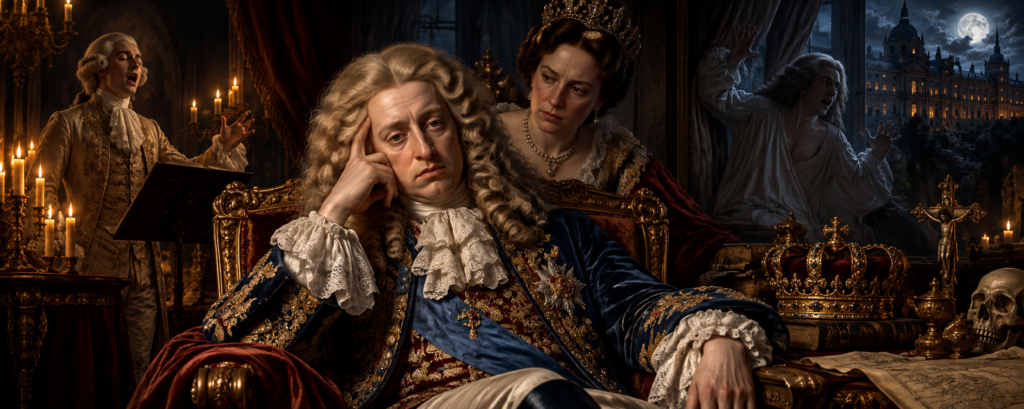
Philip V of Spain: The Melancholy King, the Midnight Court, and the Madness Behind the Bourbon Throne
King of Spain, 1700–1724 and 1724–1746 | First Bourbon King of Spain
The King Who Lived in Darkness
By the final years of Philip V’s reign, the royal court of Spain had learned to live according to the rhythms of a deeply troubled man. Meals came at extraordinary hours. Ministers waited for audiences while the king remained secluded. Important business could be postponed because Philip would not dress, rise, wash, shave, or face the people waiting beyond his apartments. The monarch who had survived one of the greatest wars of the eighteenth century could become so immobilized by despair that even the ordinary rituals of kingship seemed beyond him. At other times he could recover enough energy to hunt, travel, discuss military affairs, obsess over religion, or participate intensely in government before sinking again into the darkness that repeatedly consumed him.
Philip’s behavior became stranger as he aged. Contemporary observers described prolonged episodes of profound melancholy, extreme neglect of his appearance, reversal of his sleeping schedule, obsessive religious fears, and increasingly bizarre ideas about his own body. His second wife, Elisabeth Farnese, became indispensable not merely as his companion but as an intermediary between the king and the government. By the 1730s, the celebrated castrato Farinelli had been summoned to the Spanish court, where his extraordinary voice became intimately connected with the king’s emotional life. Music succeeded, at least temporarily, where physicians, confessors, medicines, diversions, and political responsibilities so often failed.
Later writers have added still more astonishing details. Philip has been described as believing that he was made of glass, that parts of his body had disappeared, that he was already dead, that the sun intended to kill him, and even that he had transformed into a frog and hopped around the palace croaking at ministers. Some accounts give him what would now be called Cotard syndrome; others confidently diagnose bipolar disorder, major depression, somatic delusions, psychosis, or combinations of all four. The stories are irresistible, which is precisely why they demand caution. Philip unquestionably suffered from serious and recurrent mental disturbance, but not every bizarre anecdote repeated about him rests upon equally strong contemporary evidence.
What remains when the embellishments are stripped away is disturbing enough. Philip V experienced periods of incapacitating melancholy that interfered seriously with government, displayed increasingly severe abnormalities of behavior, neglected his body for extended periods, adopted a radically disordered daily schedule, and became profoundly dependent upon the women and attendants closest to him. His condition affected the operation of the Spanish monarchy for years. Unlike many rulers casually placed among history’s “mad kings,” Philip does not require hostile propaganda or a speculative diagnosis to justify serious discussion of his mental health. The surviving descriptions themselves reveal a monarch periodically unable to perform the most basic functions expected of him.
Yet Philip was not always the broken figure remembered from his later reign. He had arrived in Spain as a young French prince, fought to retain his crown through years of war, commanded intense loyalty from many Spanish subjects, and helped inaugurate a new dynasty that still occupies the Spanish throne today. To understand how that young king became the sleepless, unwashed, desperately melancholic monarch of his final decades, it is necessary to begin not in a darkened bedroom in Madrid, but at the glittering court of his grandfather, Louis XIV.
A French Prince Destined for Spain
Philip was born at Versailles on December 19, 1683, the second son of Louis, the Grand Dauphin of France, and Maria Anna Victoria of Bavaria. He was therefore a grandson of Louis XIV, the Sun King, and grew up within one of the most elaborate royal courts in Europe. As the Duke of Anjou, he was not originally expected to become king of France. His elder brother, the Duke of Burgundy, stood ahead of him in the French succession, allowing Philip’s future to be imagined elsewhere.
That future changed because another dynasty was dying. Charles II of Spain, the sickly and childless last Spanish Habsburg, had no direct heir. His enormous inheritance included Spain, the Spanish American empire, territories in Italy, the Spanish Netherlands, and possessions stretching across the globe. France and Austria both possessed dynastic claims, while England and the Dutch Republic feared that either great power might become dangerously dominant if it acquired the whole inheritance. The health of Charles II had therefore become one of the most closely watched political matters in Europe.
Shortly before his death in 1700, Charles named Philip as heir, choosing the Bourbon prince in the hope that the Spanish monarchy could remain intact rather than be divided among foreign powers. When news of Charles’s death reached Versailles, Louis XIV accepted the will on behalf of his grandson. According to the famous ceremonial version of events, the French king presented Philip to the court as the new king of Spain and declared that the Pyrenees no longer existed. Whether every famous phrase attributed to the occasion was spoken exactly as later remembered matters less than the political reality: a Bourbon prince was leaving France to inherit the Habsburg monarchy.
Philip was seventeen. He entered Spain as Philip V and initially inspired considerable enthusiasm, particularly in Castile. The young king was handsome, serious, personally brave, and capable of making a favorable impression. Nothing about the teenager suggested the profoundly incapacitated monarch he would later become. If psychological vulnerability already existed, it had not yet swallowed his ability to function.
His inheritance, however, came with a war attached.
A Crown Won Through Blood
The Bourbon succession alarmed the rest of Europe because Louis XIV appeared unwilling to place sufficient distance between French and Spanish interests. The possibility that the two Bourbon monarchies might eventually be united, or at least operate as a single overwhelming political bloc, was intolerable to rival powers. Austria supported Archduke Charles as the Habsburg claimant to Spain, while England, the Dutch Republic, and other states joined the conflict that became the War of the Spanish Succession.
Philip’s throne was not merely contested abroad. The war divided Spain itself. Castile generally supported the Bourbon king, while important territories of the Crown of Aragon eventually backed Archduke Charles. The conflict therefore became both an international war and a Spanish civil struggle, exposing Philip to rebellion, invasion, military reverses, and the constant possibility that he might lose the crown Charles II had left him.
The young king did not behave like a helpless melancholic during these years. He accompanied armies, demonstrated courage under dangerous circumstances, and took an active interest in military affairs. His performance earned him the nickname el Animoso, often translated as “the Spirited” or “the Courageous.” The contrast with his later condition is one of the most striking features of his life. Philip could function energetically when circumstances demanded it, particularly when military activity engaged him.
His first wife, Maria Luisa Gabriella of Savoy, became essential during the struggle. She married Philip in 1701 while still extraordinarily young and rapidly grew into a politically capable queen. During her husband’s absences she acted as regent and became popular among many Spaniards for her dedication to the Bourbon cause. Her intelligence and energy complemented Philip’s temperament, while the formidable Princess des Ursins became another central figure in the royal household and government.
Philip’s emotional dependence upon his wife appears to have been intense. This would become a recurring pattern in his life. He possessed a strong sexual appetite but also an equally powerful religious conscience, making legitimate marriage the acceptable outlet for desires he otherwise feared could place his soul in danger. Sexuality, Catholic guilt, emotional dependence, and kingship became intertwined in ways that would later make his second wife extraordinarily powerful.
The First Shadows of Melancholy
Signs of Philip’s psychological difficulties appeared well before his most notorious later episodes. Contemporaries described a temperament prone to melancholy, anxiety, religious scruple, and periods of withdrawal. Early modern observers used the broad language of “melancholy” rather than modern psychiatric terminology, and historians should resist turning every such description into a retrospective clinical diagnosis. Nevertheless, the persistence and severity of Philip’s later symptoms make the earlier reports significant.
The pressures surrounding him were enormous. He was a French teenager sent into a foreign court, expected to preserve an immense monarchy while several European powers tried to remove him. His legitimacy was disputed, his territories were invaded, and his own subjects fought on opposite sides. A young man already inclined toward anxiety and melancholy was subjected to years of uncertainty in which losing a battle might mean losing a kingdom.
Philip also possessed an intensely religious personality. Catholic devotion was entirely normal for a Spanish monarch, but his religious concerns could become painfully scrupulous. He worried about sin, salvation, sexual behavior, and moral responsibility with an intensity that appears to have contributed to his psychological distress. Later accounts of his mental crises repeatedly connect bodily fears, sexuality, religion, and guilt.
It would be misleading, however, to describe the war years as one uninterrupted psychiatric collapse. Philip fought, traveled, fathered children, consulted ministers, and demonstrated periods of considerable activity. His psychological history was episodic rather than static. That distinction is essential because the later king has sometimes been projected backward onto the younger man as though he had always been incapable.
The war ultimately confirmed him as king, but victory came at an enormous price. The treaties of Utrecht and related settlements recognized Philip’s possession of Spain while requiring him to renounce his rights to the French throne. Spain lost important European territories, including the Spanish Netherlands and major Italian possessions. The Bourbon dynasty survived, but the European empire inherited from Charles II had been dramatically altered.
Maria Luisa Dies, and Something Changes
In February 1714, Maria Luisa Gabriella died at only twenty-five after prolonged illness. Philip was thirty and had already endured years of warfare and political instability. Her death deprived him not only of a wife but of one of the central emotional supports of his adult life. The effect upon him was profound.
Philip’s dependence upon marital companionship helps explain the speed with which another marriage became politically urgent. Spain needed dynastic security, but Philip himself also appears to have found prolonged separation from a wife psychologically and sexually difficult. The woman selected as Maria Luisa’s replacement would become one of the most formidable queens in eighteenth-century Europe.
Elisabeth Farnese was a princess of Parma, descended from the Farnese dynasty and connected to Italian territorial ambitions that would become central to Spanish foreign policy. She married Philip in 1714. Anyone expecting a pliable provincial princess was quickly disappointed. Elisabeth possessed intelligence, determination, ambition, and a capacity for political maneuvering that allowed her to dominate the royal household.
The Princess des Ursins, who had exercised enormous influence during Philip’s first marriage, discovered this immediately. When Elisabeth arrived in Spain, the two women met at Jadraque. After an explosive confrontation whose precise details were embroidered by later storytellers, Elisabeth ordered the powerful princess removed from her presence and expelled from Spain. Des Ursins, who had survived years at the center of Bourbon power, was suddenly gone.
The episode announced the arrival of a queen who would not remain politically decorative. As Philip’s mental health deteriorated, Elisabeth’s strength became increasingly important. Their marriage would become simultaneously intimate, political, sexual, and profoundly codependent.
Elisabeth Farnese and the King Who Needed a Wife
Philip’s attachment to Elisabeth was extraordinary. Contemporary accounts indicate that the couple spent enormous amounts of time together and that the king depended heavily upon her companionship. His strong sexual drive combined with religious scruples against adultery to intensify that dependence. Unlike his grandfather Louis XIV, whose extramarital relationships had been notorious, Philip appears to have attempted to confine his sexual activity to marriage.
This should not automatically be translated into the modern language of “hypersexual disorder.” Philip fathered numerous legitimate children across his two marriages and was evidently sexually demanding, but retrospective psychiatric labels are difficult to establish. What is clearer is that sex and religion existed in uncomfortable proximity within his mind. Desire could be followed by guilt, while the fear of mortal sin placed enormous importance upon the queen’s availability.
Accounts sometimes claim that Philip insisted upon sexual access to his wives regardless of illness, pregnancy, or recovery from childbirth. Some contemporary reports support the broader picture of a husband whose demands could be exhausting and intrusive, although the most lurid versions require caution. Elisabeth nevertheless appears to have understood that physical and emotional proximity gave her exceptional influence over the king. Their relationship became one of the central mechanisms through which power operated at court.
Her political ambitions were substantial. Elisabeth wanted territories in Italy for her own sons, who stood behind the children of Philip’s first marriage in the Spanish succession. Spanish foreign policy consequently became deeply involved in attempts to recover influence in Italy. The queen’s goals aligned at times with broader Spanish ambitions to reverse losses imposed after the War of the Spanish Succession, but dynastic interests were never far away.
Philip was not merely Elisabeth’s puppet during every phase of their marriage. He possessed his own military interests and shared many of her ambitions. Yet as his periods of psychological incapacity grew more severe, the queen’s ability to control access, information, appointments, and political communication became increasingly important. She did not simply seize power from an indifferent husband; she filled a vacuum repeatedly created when the king could not or would not function.
The Darkness Behind the Devotion
Philip’s religious life could be comforting, but it could also become a source of torment. He was susceptible to scruples—the obsessive fear that one had sinned or failed religiously even when ordinary moral judgment might find no serious offense. For a Catholic monarch who believed himself responsible before God for his personal behavior and the welfare of his kingdoms, such fears could become overwhelming.
His sexual appetite intensified the problem. Philip appears to have been deeply anxious about sexual sin outside marriage, including masturbation, and therefore clung to legitimate marital intercourse as a morally permissible alternative. The resulting dependence upon his wives was not simply romantic affection or physical desire. It could become entangled with his fear of damnation.
This mixture of desire and guilt helps explain some of the apparent contradictions in his personality. Philip could be intensely devout while simultaneously preoccupied with sex. He could seek religious reassurance while repeatedly returning to anxieties his confessors had presumably attempted to calm. He could understand intellectually that certain behavior was permitted while emotionally remaining afraid of spiritual consequences.
Later psychiatric interpretations have sometimes treated these patterns as evidence of obsessive-compulsive symptoms or pathological religious scrupulosity. Such comparisons may be useful descriptively, but they cannot establish a modern diagnosis. Early eighteenth-century Catholic spirituality took sin, confession, damnation, and bodily temptation extremely seriously, and Philip lived within that world.
What distinguished him was not simply that he believed in sin. It was the degree to which fear, guilt, melancholy, and bodily obsession could interfere with his ability to live and govern.
The Abdication Nobody Expected
On January 10, 1724, Philip V abdicated the Spanish throne in favor of his eldest surviving son, Louis. Philip was only forty years old and had reigned for more than twenty-three years. Voluntary abdication by a monarch still capable of ruling was sufficiently unusual to provoke immediate speculation about his motives.
Philip publicly framed the decision in terms compatible with withdrawal from worldly burdens, and his religious temperament makes a genuine desire for retreat plausible. His mental health may also have contributed. The burdens of kingship had weighed heavily upon him, and relinquishing the crown offered escape from responsibilities that could become intolerable during depressive periods.
Another possibility has fascinated historians. The French succession had changed dramatically after a series of deaths within Louis XIV’s family. Philip may have retained hopes that circumstances could somehow reopen a path toward the French crown despite his formal renunciation. The extent to which this influenced the abdication remains debated, and it would be too simple to explain the decision through either mental illness or dynastic ambition alone.
Philip and Elisabeth withdrew to the palace of La Granja de San Ildefonso, where he could pursue a more private existence modeled in part upon the grandeur of Versailles. Their retirement was not destined to last. The new king, Louis I, was only seventeen, and his reign became one of the shortest in Spanish history.
In August 1724, Louis died of smallpox after little more than seven months on the throne. Spain suddenly had no reigning king. Philip’s younger son Ferdinand was next in line, but the political establishment faced the question of whether the abdicated father could or should return.
The King Who Gave Away His Crown and Took It Back
Philip initially hesitated to resume the throne. The religious and legal implications of returning after a solemn abdication troubled him, and his scruples complicated the political emergency. Advisers argued that he could lawfully return because the circumstances had fundamentally changed with Louis’s death. Elisabeth strongly favored his restoration.
Philip eventually resumed the crown in September 1724. His second reign would last nearly twenty-two years, longer than the first reign of many monarchs. The king who had attempted to escape the throne was now trapped within it again.
The psychological significance of the episode is difficult to ignore. Philip had voluntarily relinquished the office that defined his public existence, only to have his son’s sudden death pull him back into it within the same year. If abdication had represented an attempt to relieve psychological strain, that relief had lasted only months.
The return also strengthened Elisabeth’s political importance. She possessed the energy and ambition her husband increasingly lacked during his depressive episodes. Her interests, particularly those involving Italy and the future of her sons, became major forces in Spanish policy.
Philip’s restored reign was not devoid of achievement. Spain pursued administrative reform, expanded naval strength, remained active in European diplomacy, and recovered dynastic influence in Italy. Yet the king’s psychological condition increasingly created a bizarre contrast between the functioning machinery of monarchy and the troubled man at its center.
When Melancholy Became Incapacity
The word “melancholy” can sound almost poetic to modern ears. In Philip’s case, it could be devastating. His depressive episodes involved withdrawal, loss of motivation, neglect of personal care, disturbed sleep, intense religious anxiety, and periods in which performing ordinary royal duties became extremely difficult.
Some observers described him remaining in bed or refusing to dress for extended periods. Hygiene deteriorated. His beard and hair could go unattended, and his nails reportedly became extremely long. Clothing could remain unchanged far beyond the standards expected even in an age whose bathing habits differed from modern ones.
Popular retellings sometimes assign spectacularly precise durations to these behaviors, including the claim that Philip wore one set of clothing continuously for nineteen months. Such exact figures should not be repeated uncritically unless anchored to a strong contemporary source. The broader phenomenon of severe self-neglect, however, is well attested. Courtiers encountered a king whose depression could make washing, shaving, dressing, and appearing in public into major challenges.
The neglect also became self-reinforcing. Long nails, unkempt hair, dirty clothing, lack of movement, disrupted eating, and prolonged confinement could worsen physical discomfort and social withdrawal. What began as psychiatric incapacity could create bodily consequences that made renewed activity even more difficult.
For a private individual, such episodes would have been a family tragedy. For an absolute monarch, they became constitutional problems without a constitutionally simple solution. Spain could not place its king on medical leave.
The King Who Turned Day Into Night
Among the best-known features of Philip’s later life was the extraordinary reversal of his daily schedule. He increasingly remained awake deep into the night and slept through much of the day. Court routines shifted around him because ministers, servants, musicians, cooks, confessors, and members of the royal family had to be available when the king was willing to function.
The most sensational explanation claims Philip believed sunlight itself was stalking or attempting to assassinate him. That story should be treated cautiously. His nocturnal habits are much better established than the specific idea of a murderous sun, and the reversal can be explained without requiring such a delusion. Depression, insomnia, anxiety, irregular habits, and a court capable of accommodating virtually any royal preference could gradually push his schedule later and later.
By the 1730s and 1740s, the timing could become extraordinary. The king might rise in what ordinary people considered the afternoon or evening, eat at hours approaching midnight, conduct business during the night, and retire only after dawn. What began as the king’s disorder became the palace’s routine.
The consequences were absurd but serious. Ministers could not simply insist that Philip attend a nine o’clock morning council. Royal servants existed to serve the monarch, and therefore the institution adapted itself to the man. Candlelight replaced daylight for activities that would normally have taken place during conventional hours.
The nocturnal court became one of the clearest examples of Philip’s illness reshaping the world around him. The king did not need to believe that the sun wanted him dead for the result to seem surreal. A European monarchy was conducting portions of its life according to the sleep disorder of one man.
A Body He No Longer Trusted
Philip’s later mental illness appears to have included somatic ideas—disturbing beliefs or fears concerning his own body. Historians have described episodes in which he believed particular body parts were abnormally large or small, missing, damaged, or otherwise altered. Such reports fit a broader pattern of profound bodily anxiety.
Modern writers have sometimes labeled these experiences “Cotard syndrome,” after the nineteenth-century neurologist Jules Cotard, whose patients could believe they were dead, lacked organs, or no longer existed. Applying that diagnosis to Philip is problematic. The syndrome had not been clinically defined in his lifetime, and surviving descriptions do not provide the systematic psychiatric evaluation necessary to diagnose it retrospectively.
The famous claim that Philip believed himself made of glass presents a similar problem. The “glass delusion” was a genuine phenomenon reported in late medieval and early modern Europe; the most famous royal example is Charles VI of France, who reportedly feared that his body might shatter. Whether every later story transferring a similar belief to Philip V is equally secure is another matter. Philip certainly suffered bizarre bodily fears, but the exact content of those fears varies across accounts.
Claims that he believed his limbs had vanished or demanded to know why a dead king had not been buried should likewise be presented as reported anecdotes rather than unquestionable clinical facts. They are psychologically plausible within the severe illness described by contemporaries, but plausibility does not establish documentation. The temptation to assemble every known historical delusion into Philip’s biography has produced a king stranger than the surviving evidence can always sustain.
The essential point does not depend upon the most theatrical stories. Philip could become profoundly preoccupied with his body, neglect it, fear things were wrong with it, and resist people attempting to care for it. His physical self became another source of anxiety rather than a secure part of his identity.
The Frog That Probably Never Hopped Through the Palace
Few stories about Philip are more memorable than the claim that he sometimes believed he had transformed into a frog. In the most colorful versions, the king supposedly leapt around palace rooms croaking while horrified ministers watched. It is an irresistible anecdote for a collection of mad monarchs, and it is also exactly the kind of anecdote that should make a historian suspicious.
Philip’s mental illness is documented well enough that later storytellers did not need to invent an entirely sane king’s madness. That made him an ideal magnet for bizarre stories. Once readers accepted that he suffered delusions, almost any delusion became believable.
The frog story is not supported strongly enough to be presented as a routine or well-documented feature of his illness. The same caution applies to elaborate descriptions of him howling through corridors, seeing himself transformed into animals, or repeatedly performing theatrical acts of psychosis in front of ministers. Some reports of screaming, agitation, or bizarre behavior may reflect genuine episodes, but the precise dramatic scenes often grow more detailed in later retellings.
Removing doubtful stories does not sanitize Philip. A monarch who could remain filthy and secluded, reverse the palace schedule, become consumed by religious anxiety, suffer disabling melancholy, and develop bizarre bodily fears is historically extraordinary without amphibian transformation.
The frog survives because madness attracts folklore. Philip’s real illness was less comic and considerably more disturbing.
Rage Inside the Depression
Philip’s melancholy was not always quiet. Severe psychiatric disturbance can include agitation, irritability, fear, and aggression as well as immobility, and contemporary descriptions indicate that the king could become extremely difficult during his worst periods. Attendants attempting to wash, dress, shave, medicate, or move him could encounter resistance.
Accounts of biting, striking, screaming, or struggling should be approached according to the quality of their sources, but there is credible evidence that Philip’s episodes could involve violent agitation. Elisabeth and the servants closest to him bore much of the burden because they were physically present when others were excluded. The queen’s role was therefore far more demanding than simply signing papers while her husband slept.
Some modern accounts claim Elisabeth was repeatedly beaten so severely that diplomats saw her covered in bruises. This is the sort of specific assertion that requires particularly strong documentation before being stated as fact. The royal marriage was intensely private, and hostile diplomatic rumor could transform an episode of agitation into a recurring pattern of spousal assault.
What can safely be said is that caring for Philip during severe episodes could be physically and emotionally difficult. Attempts to force hygiene or medical treatment upon an unwilling king created an impossible hierarchy: attendants had to control the body of a man they were socially forbidden to command.
The paradox is striking. Philip possessed enormous theoretical authority over millions of subjects, yet the people in his bedroom sometimes struggled simply to persuade him to change his clothes.
The Queen at the Center of Everything
Elisabeth Farnese’s political role expanded because someone had to bridge the gap between the incapacitated king and the machinery of government. She controlled access, communicated with ministers, promoted allies, pursued dynastic goals, and remained close to Philip when his condition made ordinary political interaction difficult. Her influence made her admired by some and hated by others.
The phrase “el rey y yo”—“the king and I”—has become associated with Elisabeth’s exercise of authority. Like many memorable quotations surrounding powerful royal women, its exact use and significance should not be exaggerated into a formal constitutional arrangement. Spain did not legally become a joint monarchy. Elisabeth’s authority depended ultimately upon her position beside Philip.
That dependence worked in both directions. Philip needed her emotionally and physically, while Elisabeth needed the king’s authority to transform influence into policy. Their marriage therefore became an unusually powerful political partnership even when the balance within it shifted dramatically toward the queen.
Her ambitions in Italy were particularly important. Elisabeth sought thrones and territories for her sons, and Spanish forces became involved in Mediterranean and Italian affairs with that dynastic objective in mind. Her eldest son by Philip, the future Charles III of Spain, eventually acquired Naples and Sicily before later inheriting the Spanish crown.
It would be unfair to reduce Elisabeth to a manipulator exploiting a mentally ill husband. She also functioned as caregiver, intermediary, political manager, dynastic strategist, and stabilizing presence in an extraordinarily difficult household. Yet her power unquestionably grew because Philip could not reliably govern alone.
Madness Did Not Stop the Government
One of the most important corrections to the popular story of Philip V is that Spain did not simply stop functioning whenever the king became depressed. Eighteenth-century monarchy depended upon councils, secretaries, ministers, diplomats, military officers, governors, financial officials, and local institutions. The king was central, but he was not the entire state.
Philip’s reign saw significant administrative centralization. The Nueva Planta decrees, introduced following the War of the Spanish Succession, transformed the political structure of much of the former Crown of Aragon. Institutions and privileges were altered or abolished in territories that had supported the Habsburg claimant, while Castilian-style structures were extended more broadly. The result was a more centralized Bourbon monarchy, although Spain remained far from a completely uniform modern state.
The crown also pursued military and naval rebuilding. Spain returned to active great-power politics and recovered influence in Italy. These developments would have been impossible if government had truly been paralyzed for decades by a permanently catatonic monarch.
Philip’s condition nevertheless mattered enormously because access to royal approval remained important. When he could not engage, those around him gained influence. Policies could depend upon which ministers or family members succeeded in reaching him during periods of relative clarity.
The state adapted. That adaptation allowed Spain to function, but it also meant that Philip’s private illness continually rearranged public power.
War and the Return of Energy
One of the more intriguing features of Philip’s psychological pattern was his capacity for renewed energy when military affairs captured his attention. He had been a courageous young wartime king, and military matters retained a particular ability to engage him. Later observers sometimes noticed that international crises could temporarily awaken an interest that ordinary administration failed to produce.
Modern writers have interpreted these bursts of activity as hypomanic or manic episodes within bipolar disorder. That is possible, and bipolar-spectrum illness has often been proposed as the best modern framework for Philip’s recurrent changes in mood and activity. Yet the historical evidence is far stronger for repeated severe depression than for clearly defined episodes satisfying modern criteria for mania.
A person suffering depression can experience temporary improvement when confronted with an emotionally stimulating event without being manic. Philip’s fascination with war may have activated memories of the period in his youth when he had felt most purposeful. Military crisis also offered clear objectives in contrast to the endless paperwork and ceremonial obligations of peacetime monarchy.
The War of the Polish Succession and later European conflicts provided opportunities for Spanish intervention, particularly in Italy. Philip could become engaged with campaigns and dynastic objectives, while Elisabeth pushed vigorously for the advancement of their sons.
The pattern nevertheless contributed to the impression of instability. Courtiers might see a king emerge from withdrawal with sudden interest and energy, only to sink again once the stimulus faded. Whether that rhythm should be called bipolar disorder remains a question modern medicine cannot settle with certainty.
The Problem With Diagnosing Philip V
Philip is frequently described as having bipolar disorder, and the diagnosis is more plausible than many retrospective labels applied to historical monarchs. He experienced recurrent episodes of severe depression and periods of greater energy, and some descriptions suggest agitation or unusual thought content. Nevertheless, a responsible historical account must stop short of declaring a modern diagnosis proven.
Psychiatric diagnosis depends upon detailed information about duration, symptom clusters, functional impairment, medication or substance effects, medical conditions, and differential diagnoses. Eighteenth-century court reports were not clinical interviews. Observers described what they saw using the language available to them, and their descriptions were shaped by politics, etiquette, rumor, and limited access.
“Melancholia” itself covered a wide range of experiences. Philip may have suffered recurrent major depressive episodes, bipolar-spectrum illness, severe anxiety, obsessive religious scrupulosity, psychotic depression, or some combination of psychiatric and physical conditions. His bizarre somatic ideas suggest that at least some episodes may have included psychotic features.
The distinction matters because declaring him definitively bipolar can create a false sense that every behavior has been explained. It encourages writers to classify energetic wartime interest as mania, sexual desire as hypersexuality, religious devotion as obsession, and every strange anecdote as psychosis. A diagnosis then becomes a machine for converting ordinary or uncertain behavior into symptoms.
Philip was seriously mentally ill. That conclusion does not require pretending we can reconstruct his complete psychiatric chart three centuries later.
The Arrival of Farinelli
In 1737, an extraordinary new figure entered Philip’s world. Carlo Broschi, known by his stage name Farinelli, was one of the most celebrated singers in Europe. A castrato possessing remarkable vocal range, breath control, and technical ability, he had achieved international fame before being drawn into the Spanish royal court.
The conventional story is almost magical. Elisabeth Farnese supposedly arranged for Farinelli to sing unseen in a nearby room while Philip sat trapped in one of his darkest depressive states. The king heard the voice, experienced an immediate transformation, and asked the singer to remain in Spain. Whether the first encounter unfolded with exactly this theatrical perfection is uncertain, but Farinelli did become extraordinarily important to Philip.
Music was already recognized as capable of affecting mood, and Philip responded powerfully to Farinelli’s singing. The singer became a regular feature of the king’s private evenings. His performances offered emotional relief in a court where conventional medical treatment had achieved little.
Farinelli abandoned the ordinary trajectory of an international opera star and remained in Spain for years. His position became unique. He was neither merely a servant nor simply an entertainer; he possessed personal access to the monarch at moments when access itself was political power.
The arrival of Farinelli transformed one of Europe’s most celebrated voices into something resembling royal therapy.
Four Songs in the Darkness
The most famous version of Farinelli’s routine claims that he sang the same four arias to Philip every night for approximately a decade. The repetition has become legendary: night after night, the mentally tormented king sits in darkness while the castrato performs the identical music capable of reaching him when ministers cannot. The image captures the strangeness of Philip’s court so perfectly that it has often been repeated without qualification.
There is substantial evidence that Farinelli sang regularly for Philip and that the king found his performances emotionally beneficial. The exact claim of precisely four unchanged arias every single night for ten years is more difficult to treat literally. Court routines evolved, and later storytelling naturally compressed them into a memorable formula.
What matters is that the musical relationship was real and sustained. Farinelli’s voice became part of Philip’s nightly world, and the singer gained the king’s confidence. Music could soothe anxiety, interrupt despair, provide structure, and perhaps encourage the king to engage with people around him.
Farinelli’s role also demonstrates how desperate the court had become for anything that worked. Physicians could bleed, purge, prescribe, and advise. Confessors could reassure the king about sin and salvation. Elisabeth could coax or pressure him into performing his duties. Yet music sometimes reached him when these methods failed.
In that sense, Farinelli became more than entertainment. His performances were woven into the practical management of a mentally ill monarch.
Did Farinelli Rule Spain?
Farinelli’s access inevitably produced political influence. Anyone who could approach a king during private hours possessed opportunities unavailable to ordinary petitioners. Ministers and diplomats understood this and cultivated the singer accordingly. Farinelli received honors and became an important court figure.
Claims that he effectively governed Spain, however, go too far. He did not replace ministers, determine the entire foreign policy of the monarchy, or become a secret dictator behind the throne. His influence operated through personal access, patronage, cultural projects, and the ability to speak to the royal couple.
Under Philip’s successor Ferdinand VI, Farinelli’s cultural and court influence remained substantial. He became closely associated with elaborate musical productions and royal entertainments. His career in Spain therefore extended beyond his therapeutic relationship with Philip.
The political significance of his presence nevertheless remains remarkable. A singer had become important partly because his voice could penetrate a psychological barrier that separated the king from ordinary government. The situation reveals how private access and public power could intersect within an eighteenth-century monarchy.
Farinelli could not cure Philip. He could, however, make some nights bearable.
The Palace That Stayed Awake
As Philip’s schedule moved deeper into the night, Farinelli’s performances fitted naturally into the inverted court. Music, meals, conversation, religious observance, and sometimes political business unfolded at hours when much of Madrid slept. Servants adjusted because royal service required adjustment.
The logistical consequences were substantial. Kitchens had to operate according to the king’s appetite rather than the sun. Musicians waited for performances. Ministers might remain available for business late into the night. Elisabeth’s own schedule became entangled with Philip’s because his dependence made separation difficult.
This was not merely eccentricity for eccentricity’s sake. Severe depression frequently disrupts sleep, and irregular sleep can in turn worsen psychiatric symptoms. Philip possessed something ordinary sufferers do not: an entire palace capable of accommodating the disorder. Instead of forcing the king back toward a conventional routine, hundreds of people could rearrange their lives around his insomnia.
Royal privilege therefore protected the illness from ordinary social correction. A merchant who slept until evening might lose his livelihood. A king could make evening into morning.
The result was one of the strangest courts in Europe, not because every lurid story told about Philip was true, but because the genuine routines were already extraordinary.
Hygiene, Hair, and the Collapse of Royal Ceremony
European monarchy depended heavily upon appearance. Dressing a king was not merely practical; it could be ceremonial and political. Clothing, grooming, posture, jewels, audiences, and public visibility all communicated authority. Philip’s refusal or inability to participate in these routines during depressive episodes therefore represented more than poor hygiene.
Reports describe periods when he resisted changing clothes, shaving, cutting his hair, or trimming his nails. The contrast between royal magnificence and bodily neglect could be startling. The Bourbon king who had inherited the ceremonial traditions of Versailles sometimes appeared unwilling to perform even the preliminary acts required to look like a monarch.
Long fingernails and toenails became particularly memorable features of later descriptions. Some accounts suggest that they grew sufficiently long to interfere with movement. Once again, exact measurements and dramatic durations vary, but the broader self-neglect is credible.
These behaviors are recognizable today as possible manifestations of severe depression or other psychiatric illness. Tasks that appear simple to an outside observer can become overwhelming to someone experiencing profound psychological collapse. In Philip’s case, resistance could also acquire delusional or anxious dimensions when attendants attempted to touch or alter his body.
The court could conceal much from the public, but it could not entirely conceal a king who no longer wished to look like one.
Medicine Against Melancholy
Philip’s physicians possessed few effective tools for treating severe mental illness. Early eighteenth-century medicine continued to rely heavily upon humoral assumptions, dietary regulation, purging, bleeding, baths, and other physical interventions. Some treatments may have provided temporary relief, while others could weaken an already distressed patient.
The king’s status multiplied medical attention. Several physicians might debate his symptoms, while confessors addressed spiritual causes and attendants tried practical methods of persuasion. The boundary between physical and mental illness was poorly understood by modern standards, and Philip’s somatic complaints encouraged doctors to search repeatedly for bodily explanations.
Religious reassurance was equally important because his fears often involved sin. Confessors could tell him that particular thoughts or acts did not condemn him, but obsessive guilt is not always responsive to logical reassurance. The same question can return even after it has been answered repeatedly.
Music ultimately proved one of the gentler interventions. Farinelli did not claim to diagnose Philip, and singing did not eliminate the underlying illness. It provided emotional regulation, routine, pleasure, and perhaps temporary escape from obsessive thought.
In a medical world capable of harming patients while trying to cure them, that was no small achievement.
A Family Watching the King Disappear
Philip’s illness affected his children as well as his ministers. His eldest surviving son after Louis’s death was Ferdinand, born to Maria Luisa Gabriella. Ferdinand’s relationship with his father and stepmother existed within a court divided by dynastic interests, particularly because Elisabeth wanted positions and territories for her own children.
Ferdinand would eventually succeed Philip as Ferdinand VI. He too suffered devastating psychological collapse later in life, particularly after the death of his beloved wife Barbara of Portugal. His final period of severe withdrawal, self-neglect, and mental disturbance has encouraged speculation about inherited vulnerability within the Bourbon family.
That parallel is suggestive but not proof that father and son possessed the same psychiatric disorder. Genetics can influence susceptibility to mood disorders, but grief, personality, physical illness, upbringing, and circumstance also matter. Retrospective family diagnosis is even more uncertain than retrospective individual diagnosis.
For Philip, however, the presence of heirs removed one source of anxiety that had destroyed Charles II. He had children from both marriages, and the Bourbon succession was secure. The dynasty did not depend upon his reproductive ability in old age.
His crisis was therefore different from Charles II’s. Charles’s body threatened the continuation of the dynasty; Philip’s mind threatened the regular operation of kingship.
Elisabeth’s Sons and the Italian Dream
Elisabeth Farnese devoted enormous energy to securing futures for the children of her marriage because Philip’s sons from Maria Luisa stood ahead of them in the Spanish succession. Italy offered the most promising field for dynastic advancement. The Farnese and Medici successions created opportunities that Elisabeth pursued relentlessly.
Her eldest son Charles eventually became Duke of Parma and later king of Naples and Sicily. Decades afterward, when his half-brother Ferdinand VI died without children, he inherited Spain as Charles III. Elisabeth’s dynastic strategy therefore achieved extraordinary long-term success.
Spanish intervention in Italy was not merely a queen’s private obsession. Recovering influence after the losses imposed by Utrecht appealed to wider Spanish interests and prestige. Nevertheless, Elisabeth’s maternal ambitions gave the policy unusual persistence.
Philip could become energized by these military and dynastic projects. The contrast between his engagement with war and his paralysis during other periods has helped fuel modern bipolar interpretations. Yet his interest in military affairs also reflected his own youth, when fighting for the crown had given his kingship its clearest purpose.
The aging king could still glimpse the energetic prince he had once been when armies moved across maps. Those moments did not last.
The Long Final Decline
During the 1740s, Philip’s mental and physical condition remained deeply troubling. His schedule was profoundly disordered, his personal care could deteriorate, and Elisabeth continued to play a central role in maintaining government around him. Farinelli remained part of the royal environment, his music one of the few dependable sources of comfort.
Europe, meanwhile, was again at war. The War of the Austrian Succession created opportunities for Spain and Elisabeth’s sons in Italy. Philip retained enough interest in military developments to engage intermittently, demonstrating again that his incapacity was neither constant nor absolute.
This fluctuation is essential to understanding his reign. Philip could be gravely ill without being permanently detached from reality. He could suffer weeks or months of terrible depression and later re-emerge sufficiently to participate in decisions. The monarchy operated within these unpredictable cycles.
Contemporaries did not possess the language of recurrent mood disorder, psychotic depression, or bipolar spectrum illness. They saw melancholy, religious scruple, eccentricity, bodily fears, agitation, and royal withdrawal. Some interpreted the condition medically, others morally or spiritually.
Everyone at court, however, understood one practical fact: the king could not always be relied upon to behave like a king.
July 1746
Philip V died at Madrid on July 9, 1746, aged sixty-two. He had occupied the Spanish throne for more than forty-five years if the brief abdication of 1724 is included as an interruption. No Spanish monarch before him had experienced a reign quite like it.
He had entered Spain as a seventeen-year-old foreign prince and survived a massive international war to retain his crown. He had replaced the Habsburg dynasty with the Bourbons, presided over major administrative changes, lost old European possessions, recovered Spanish influence in Italy, strengthened the dynastic future, and transformed the structure of the monarchy. His reign cannot be reduced to psychiatric illness.
Yet neither can the illness be pushed to the margins. It shaped his marriages, his household, his schedule, his relationship with ministers, his abdication, his religious life, and the distribution of political influence around him. It turned a famous singer into an intimate royal necessity and forced one of Europe’s great courts to accommodate behaviors that would have been impossible to ignore in any ordinary household.
Ferdinand VI succeeded him. Elisabeth Farnese, so dominant during Philip’s lifetime, temporarily lost much of her influence under her stepson. Farinelli remained in Spain and continued to flourish at Ferdinand’s court.
The midnight world Philip had created did not disappear instantly, but its reason for existing was gone.
Was Philip V Bipolar?
Modern historians and medical writers frequently identify bipolar disorder as a plausible explanation for Philip’s symptoms. Recurrent severe depression is beyond serious dispute, while periods of increased energy, agitation, sexual intensity, and renewed activity have been interpreted as evidence of the opposite pole. The pattern deserves consideration.
It does not deserve certainty. The surviving evidence is uneven, and many supposed manic behaviors can be interpreted differently. Philip’s sexual appetite was longstanding rather than necessarily episodic, his military enthusiasm had obvious personal and political causes, and bursts of activity do not by themselves satisfy diagnostic criteria for mania.
A diagnosis of recurrent major depression with psychotic or somatic features could explain some aspects of his behavior. So could a bipolar-spectrum disorder. Obsessive-compulsive features may help describe his religious scrupulosity, while severe anxiety could account for other symptoms. Multiple conditions could also have overlapped.
The safest historical language is therefore that Philip suffered recurrent, severe, and sometimes incapacitating mental illness dominated by profound depressive episodes, with periods of agitation and unusual bodily beliefs. Bipolar disorder remains a reasonable retrospective hypothesis rather than an established medical fact.
That formulation may sound less dramatic than declaring him clinically bipolar. It is also more accurate.
The Stories That Grew Around a Sick King
Philip’s documented illness created fertile ground for legend. A king who refused grooming could easily become a king who wore the same clothes for exactly nineteen months. A monarch with bodily delusions could become a man made of glass, missing his limbs, already dead, or transformed into a frog. A nocturnal court could become evidence that he believed the sun was hunting him.
Some of these stories may preserve distorted memories of genuine episodes. Others may have been borrowed from descriptions of other mentally ill rulers. The glass delusion, for example, has a long history independent of Philip and is famously associated with Charles VI of France. Once anecdotes begin circulating between popular histories, repetition can make them appear independently verified.
The same process occurred with Charles II of Spain. Genuine illness became the foundation upon which increasingly grotesque details accumulated. The more extraordinary the ruler’s documented condition, the easier it became to believe the undocumented additions.
Philip does not need them. The image of an aging king awake through the night, unable to maintain ordinary hygiene, tormented by guilt, dependent upon his wife, and listening repeatedly to Farinelli while ministers waited for moments of clarity is powerful precisely because its essential elements belong to the historical record.
Accuracy makes the story darker, not duller.
The Two Philips
There seem at times to be two men inside Philip V’s biography. The first is the young king who crossed the Pyrenees, fought for his inheritance, rode with armies, endured the War of the Spanish Succession, and established a new dynasty in a country that had not originally been his own. He could be courageous, energetic, sexually vigorous, politically engaged, and determined to retain his crown.
The second is the later king hidden inside palace rooms. This Philip slept through daylight, resisted grooming, struggled with bodily fears, depended heavily upon Elisabeth, and periodically withdrew so deeply that government had to find ways around him. Music could reach him when ordinary persuasion failed.
These were not actually separate personalities. Mental illness does not erase everything that came before it, and Philip’s symptoms fluctuated across decades. The courageous young soldier and the debilitated older monarch belonged to the same life.
That continuity makes his story more disturbing. Philip did not begin as a grotesque caricature of royal madness. People around him watched a capable young monarch become increasingly difficult to reach.
His decline was not a single spectacular break with reality. It was recurrent, uneven, and prolonged.
A Monarchy Built Around One Man’s Illness
Philip’s reign demonstrates one of the fundamental weaknesses of hereditary personal monarchy. The political system assumed that the king would perform certain functions because he was king. It had no simple mechanism for what happened when the lawful sovereign remained alive, possessed moments of competence, but repeatedly became incapable of consistent government.
Abdication briefly solved the problem in 1724, but Louis I’s death reversed the solution. Thereafter the monarchy adapted informally. Elisabeth mediated, ministers governed, confessors reassured, physicians treated, servants accommodated, and Farinelli sang.
The arrangement worked surprisingly well in the sense that Spain continued to exist and conduct policy. It was constitutionally strange because enormous practical authority could flow toward people whose influence depended upon personal proximity rather than formal office.
Philip’s illness therefore changed more than palace routine. It changed who could reach power. A queen became indispensable, servants witnessed things ministers could not, confessors could influence political accessibility, and a singer possessed extraordinary personal access to the sovereign.
The royal bedroom became an extension of the council chamber because the king could not reliably leave it.
The Queen Who Held the Pieces Together
Elisabeth Farnese deserves neither the simple role of villain nor that of selfless nurse. She was ambitious, politically calculating, fiercely protective of her children, and capable of using her husband’s dependence to advance her objectives. She was also married for more than thirty years to a man whose recurrent mental illness placed enormous demands upon her.
Her proximity gave her power, but it also gave her responsibility. Ministers could leave the royal apartments; Elisabeth could not so easily escape the man whose emotional and sexual dependence upon her was intense. During periods of illness she became part wife, part political intermediary, part caregiver, and part gatekeeper.
The arrangement inevitably invited accusations that she ruled Spain while Philip existed merely as a signature. There were certainly periods when her practical influence was enormous. Yet government involved many officials, and Philip continued to participate intermittently rather than disappearing completely.
The phrase “the king and I” captures something real even if it is too neat as a constitutional description. Philip’s kingship increasingly became difficult to separate from Elisabeth’s presence beside him.
She did not cure his illness. She built a political life around it.
Farinelli’s Voice in the Dark
Farinelli provides the strangest and perhaps most moving element of Philip’s later story. He arrived as one of Europe’s greatest musical celebrities and became attached to a king whose suffering could not be solved by power, wealth, physicians, or prayer alone. The voice that had astonished opera audiences became part of a private ritual inside the Spanish palace.
It is tempting to romanticize the relationship as a miraculous cure. It was not. Philip continued to experience serious mental illness, and Farinelli’s singing could not permanently restore him. What music seems to have offered was temporary relief, stimulation, emotional regulation, and a reason to engage with the world beyond his own thoughts.
For the court, even temporary improvement mattered. A king who listened might become a king who spoke; a king who spoke might become a king who could be persuaded to attend to business. Music therefore acquired an accidental political function.
Farinelli’s presence also reminds us that historical responses to mental illness were not uniformly brutal. Philip certainly experienced medical interventions that modern readers would find unpleasant or useless, but he also received something recognizably humane: music that gave him pleasure.
In the strangest court in Europe, an aria could sometimes accomplish what authority could not.
Philip V and the Meaning of Madness
Philip V belongs among the Mad Monarchs for reasons far stronger than scandalous rumor. Unlike rulers whose enemies merely called them insane, Philip experienced recurring psychological crises severe enough to alter his ability to govern and the daily operation of his household. Contemporary observers did not need to invent his melancholy.
The difficulty lies in deciding where the documented illness ends and the legend begins. Severe depression is well supported. Self-neglect and disordered sleep are well supported. His dependence upon Elisabeth and the importance of Farinelli are well supported. Somatic abnormalities in his thinking also have historical support, although specific spectacular delusions should be treated individually rather than accepted as a package.
Claims of a frog transformation, a murderous sun, precisely nineteen months in one outfit, a firmly diagnosed Cotard syndrome, or a medically proven bipolar disorder belong in a more cautious category. Some may preserve genuine memories, some are retrospective interpretations, and others appear poorly supported. Presenting all of them as established facts makes Philip more entertaining but less historical.
The real man remains extraordinary without them. His illness was serious enough to bend an entire royal court around his needs.
That is far more consequential than whether he ever croaked like a frog.
The Melancholy Behind the Crown
Philip’s tragedy was not that he lacked power. He possessed almost unimaginable power. His commands could mobilize armies, appoint ministers, alter institutions, determine careers, and reshape the lives of subjects he would never meet. Yet none of that authority allowed him to command his own mind into obedience.
He could order a regiment across Europe but could not always make himself leave his bed. He could preside over a Catholic monarchy while remaining tormented by fears about his own sins. He could inhabit magnificent palaces while neglecting his clothes and body. He could employ physicians, confessors, servants, musicians, and advisers yet remain vulnerable to recurring despair.
That contrast gives Philip’s story its particular darkness. Madness in royal history is often imagined as spectacular violence: a tyrant executing imagined enemies, a king screaming at ghosts, or a ruler destroying his country through delusion. Philip’s illness was frequently quieter. It withdrew him from the world and forced the world to rearrange itself outside his door.
The court responded because it had no alternative. Meals moved later, ministers waited longer, Elisabeth assumed more responsibility, and Farinelli sang into the night.
Spain learned to govern around its king.
The King Who Could Not Abdicate His Own Mind
Philip had once attempted the most radical escape available to a monarch. In 1724, he surrendered his crown. For seven months he was no longer king of Spain, and another man carried the burden he had borne since adolescence. Then smallpox killed Louis I and returned the crown to the father who had tried to abandon it.
There is something haunting about the sequence even without assuming mental illness was the sole reason for the abdication. Philip could renounce a throne, but he could not renounce himself. Whatever anxieties, depressive tendencies, religious fears, and psychological vulnerabilities he carried into retirement accompanied him there.
His second reign became longer than the first. During those decades his illness deepened while the responsibilities he had attempted to escape remained. Elisabeth could absorb some of them, ministers could absorb others, and music could make particular nights easier, but nobody could permanently remove the crown while he remained alive.
That may be the central paradox of Philip V. He possessed the authority to abdicate Spain but lacked the freedom to escape the dynastic system that pulled him back.
Louis I’s death made him king again. His own mind made kingship increasingly difficult to endure.
The First Bourbon’s Complicated Legacy
Philip V transformed Spain in ways that outlasted his illness. His victory in the War of the Spanish Succession established the Bourbon dynasty. The Nueva Planta reforms changed the relationship between the monarchy and its constituent territories. Administrative institutions evolved, royal authority became more centralized, and Spanish power remained active in European affairs.
His reign also carried the scars of civil war and centralization. The suppression or alteration of institutions in territories that had opposed him reshaped Spain’s internal political order. Bourbon government was not simply modernization; it involved victory, punishment, consolidation, and the assertion of a different model of monarchy.
Abroad, Spain lost major European territories but did not disappear as a great power. Under Philip and his successors it rebuilt naval and military capacity and remained deeply involved in Mediterranean, Atlantic, and European affairs. Elisabeth’s Italian ambitions helped establish new Bourbon branches that would rule beyond Spain.
Philip therefore cannot be dismissed as a mad king under whose reign nothing happened except palace eccentricity. His reign was foundational to eighteenth-century Spain.
The remarkable fact is that so much political change occurred while the monarch at the center of the system periodically struggled to dress himself.
The Man Beneath the Diagnosis
Modern diagnosis can create the illusion that naming Philip’s illness explains him. “Bipolar disorder” is neat. “Psychotic depression” is neat. “Somatic delusion” is neat. Philip’s actual life was not.
He was a French prince who became a Spanish king, a courageous young wartime monarch who became a chronically troubled older ruler, a devout Catholic tormented by religious fear, and a husband whose intense dependence gave his wives unusual importance. He was a father whose son briefly replaced him on the throne and then died, forcing him back into the kingship he had surrendered.
He was also a man living before modern psychiatry. He could not understand his illness through neurochemistry, mood disorders, psychotherapy, or evidence-based medication. His world offered melancholy, humors, moral struggle, religious consolation, physical remedies, diversion, and music.
The people around him likewise had to interpret behavior without modern concepts. Some accommodated him, some manipulated him, some cared for him, and some undoubtedly became frustrated or frightened. Elisabeth learned how to govern beside him. Farinelli learned how to soothe him.
Philip lived inside an illness nobody around him could adequately name.
The Long Night of Philip V
The image that best captures Philip’s later reign is not the frog, the glass body, or any other spectacular anecdote. It is the palace at night. Outside, Madrid has gone dark. Inside, candles remain burning because the king is awake.
Servants move through rooms according to a schedule dictated by insomnia and melancholy. Ministers wait for the possibility of business. Elisabeth remains near the husband who has become dependent upon her presence. Somewhere within the royal apartments, Farinelli begins to sing, his voice carrying through rooms occupied by people who have learned that music may reach the king more effectively than argument.
Philip listens. Perhaps the music lifts him for an hour. Perhaps he speaks afterward, eats, prays, discusses a dispatch, or simply becomes calmer. Eventually dawn approaches, but for the king dawn does not necessarily mean morning. His day may finally be ending.
This was not theatrical madness invented for a Gothic novel. The Spanish court really did have to accommodate an increasingly nocturnal and psychologically troubled monarch, and Farinelli really did become part of the extraordinary system built around him. The historical reality needs little embellishment.
The most unsettling feature is how normal the abnormal eventually became. A palace can adapt to almost anything when the person suffering at its center is a king.
The Mad Monarch Who Was More Than His Madness
Philip V should not be remembered solely as the mentally ill Bourbon who listened to a castrato in the middle of the night. Before his darkest periods, he had fought for his crown and survived a conflict that redrew Europe. During his reign Spain underwent major institutional changes, recovered influence in Italy, and established a dynasty that survived long after him.
Nor should his illness be romanticized. Severe depression is not merely poetic sadness, and Philip’s episodes could reduce his ability to care for himself or perform essential responsibilities. His dependence placed enormous pressure upon those closest to him. His position meant that private suffering inevitably produced public consequences.
At the same time, mental illness did not erase his humanity or render every decision irrational. Philip could recover enough to engage with politics, display preferences, pursue military objectives, enjoy music, maintain relationships, and participate in dynastic planning. Incapacity came in episodes and degrees.
That complexity makes him more interesting than the caricature. The young warrior and the unwashed recluse were the same king. The devout Catholic and sexually demanding husband were the same man. The monarch who surrendered his throne and the monarch who reclaimed it belonged to one troubled life.
Madness did not replace Philip V. It became one of the forces with which Philip V lived.
The Crown in the Candlelight
When Philip died in 1746, Spain did not lose a king who had been continuously insane for forty-six years. It lost a monarch whose exceptionally long reign contained war, reform, dynastic transformation, political ambition, family tragedy, and increasingly severe periods of mental illness. The distinction matters because the caricature obscures both his achievements and his suffering.
His wives had carried burdens that ordinary queens did not. Maria Luisa Gabriella helped sustain the Bourbon cause during war, while Elisabeth Farnese became the indispensable companion of a king whose illness repeatedly pushed practical authority toward her. Ministers learned patience, servants learned accommodation, physicians tried treatments of uncertain value, and Farinelli discovered that a human voice could sometimes penetrate a darkness political power could not.
The most lurid stories should remain where the evidence places them: as stories to be examined, not automatically repeated. Philip may have experienced extraordinary somatic delusions, but modern labels such as Cotard syndrome cannot be established confidently. Bipolar disorder is plausible but unprovable. The frog story, murderous sunlight, and other spectacular details should not be allowed to overwhelm the better-attested record of recurrent depression, disturbed routine, self-neglect, anxiety, and periods of severe incapacity.
Those documented realities are enough to make Philip one of Europe’s most compelling psychologically troubled monarchs. His court did not merely witness his illness. It reorganized itself around it.
For years, the Spanish monarchy existed in a strange balance between the public majesty of kingship and the private fragility of the man wearing the crown. The machinery of empire continued moving while Philip withdrew behind palace doors. Elisabeth spoke when he could not, ministers worked when he would not, servants waited when he slept, and Farinelli sang when almost nothing else could reach him.
There is no need to imagine Philip hopping through the palace as a frog to understand why contemporaries found his condition alarming. The more disturbing image is historically simpler: a king lying in darkness while an entire government waits outside for him to become capable of being king again.
Philip V had crossed the Pyrenees as a teenager to claim one of the greatest crowns in Europe. He had fought armies to keep it, surrendered it voluntarily, reclaimed it after his son’s death, and then worn it for another two decades while his mental health repeatedly failed him. He possessed palaces, armies, ministers, queens, physicians, confessors, musicians, and all the privileges eighteenth-century monarchy could provide. None could guarantee command over his own mind.
That is where Philip V belongs among the Mad Monarchs—not because every bizarre legend told about him was true, and not because a modern diagnosis can be imposed upon him with certainty, but because his recurrent psychological suffering was real enough to reshape royal life around him. The king’s world gradually became a world of shuttered rooms, delayed audiences, neglected grooming, anxious religion, marital dependence, nocturnal government, and music performed against the darkness.
The crown survived. The Bourbon dynasty survived. Spain survived. Philip survived for decades as well, but survival was not the same thing as freedom from the illness that followed him into his own palace.
For the first Bourbon king of Spain, the darkest prison was not a dungeon, an enemy fortress, or even the throne he once tried to abandon. It was the troubled mind from which abdication offered no escape.