
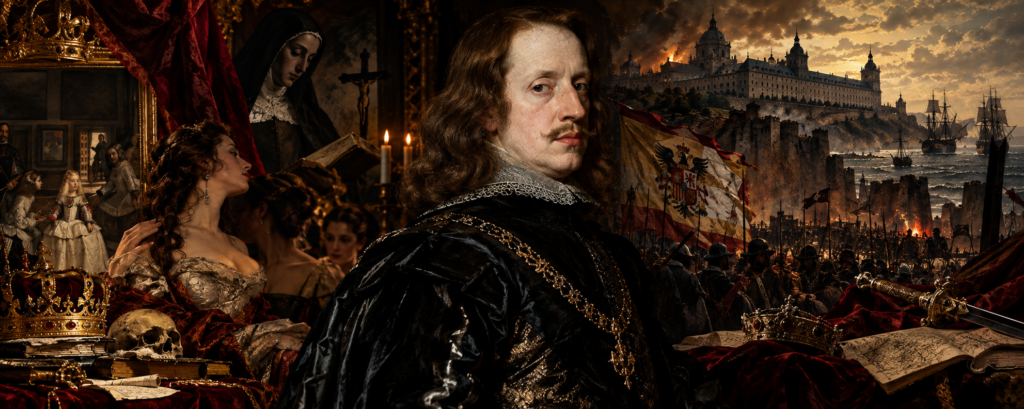
Philip IV of Spain: The Sins of a King, the Collapse of an Empire, and the Dynasty That Consumed Itself
King of Spain, 1621–1665 | The Planet King
The King in Black
In the portraits of Philip IV painted across the long decades of his reign, the king seems to age alongside the empire he inherited. The young monarch appears pale but composed, dressed in the severe black clothing of the Spanish Habsburg court, his long face marked by the distinctive features of a dynasty that had spent generations marrying within a relatively narrow circle of royal families. Later portraits show something heavier. His cheeks sag, his eyes seem more tired, and the confidence of youth disappears beneath an expression that modern viewers can easily interpret as melancholy, even though a painted face cannot diagnose the mind behind it. Diego Velázquez, the extraordinary artist who spent much of his career in Philip’s service, did not need to surround his king with ruins or battlefields to suggest the passing of time. The transformation of Philip’s own face was enough.
Philip had reason to look exhausted. When he inherited the Spanish monarchy in 1621, he became ruler of an enormous collection of kingdoms and territories extending across Iberia, Italy, the Low Countries, the Americas, Africa, and Asia. Spain still possessed formidable armies, enormous imperial resources, extraordinary cultural prestige, and a political reach unmatched by most European rivals. Beneath the grandeur, however, were staggering debts, constitutional tensions, exhausted taxpayers, dangerous enemies, and military obligations accumulated over generations. Philip inherited not a ruined empire but a frighteningly complicated one, powerful enough to intervene almost everywhere and therefore continually tempted to do exactly that.
By the time Philip died in 1665, the political landscape had changed dramatically. Portugal had broken from his authority and would never return to Spanish Habsburg rule, Catalonia had erupted in rebellion, the Dutch Republic had secured recognition of the independence Spain had fought for decades to prevent, and France had increasingly displaced Spain as the dominant military power of western Europe. The monarchy endured repeated fiscal crises while Castile suffered from taxation, epidemic disease, demographic difficulties, and the crushing demands of prolonged warfare. Philip’s first wife died, his promising son and heir Baltasar Carlos died at sixteen, several other children were buried in infancy or childhood, and the continuation of the dynasty eventually depended upon a frail little boy born from Philip’s marriage to his own niece. The king who had inherited the image of Habsburg magnificence spent much of his later life surrounded by reminders that power did not protect a family from death.
Philip IV was not clinically “mad,” and there is no responsible basis for diagnosing him retrospectively with psychosis, bipolar disorder, or another severe psychiatric condition. Descriptions of him as suffering from a modern concept such as “sex addiction” likewise go further than the surviving evidence allows, even though his reputation for sexual affairs was substantial. What his correspondence does reveal is a man capable of deep sorrow, religious guilt, anxiety, introspection, and increasingly pessimistic interpretations of the disasters surrounding him. Philip believed that rulers answered before God for the kingdoms entrusted to them, and he lived in a culture in which military defeat, plague, rebellion, and dynastic death could all be understood partly through divine providence. His personal sins therefore had a significance in his mind that extended far beyond the private chamber.
This tension is what makes Philip such a compelling figure for the Mad Monarchs. He could pursue women while sincerely believing adultery endangered his soul, sponsor magnificent theatrical entertainments while subjects struggled beneath taxation, and support extraordinary artistic achievement while receiving reports of military defeat and political revolt. He spent years corresponding with the mystic Franciscan abbess María de Ágreda about politics, morality, suffering, and divine judgment, seeking spiritual guidance as the political order of his youth slowly fractured. His life was not the story of a king losing contact with reality. It was the darker story of a king who remained aware of reality while increasingly wondering whether the calamities engulfing his monarchy were connected to his own failures.
The Sixteen-Year-Old Who Inherited the World
Philip was born in Valladolid on April 8, 1605, the eldest surviving son of Philip III and Margaret of Austria. His mother died in 1611 when he was only six, leaving the young prince to grow toward kingship within the intensely Catholic and highly ceremonial environment of the Spanish Habsburg court. He received the education expected of a royal heir and developed strong interests in literature, theater, painting, hunting, and court culture. He was intelligent and capable of understanding government, despite later caricatures that portray him as little more than a pleasure-seeking adolescent manipulated by everyone around him. The real difficulty was that no education could fully prepare a sixteen-year-old for the political structure he inherited.
The Spanish monarchy was not a centralized nation-state in the modern sense. It consisted of multiple kingdoms and territories sharing a ruler while preserving different laws, institutions, tax systems, privileges, and political identities. Castile formed the financial and administrative center of much Habsburg power, but Catalonia, Aragon, Valencia, Portugal, Naples, Sicily, Milan, the Spanish Netherlands, and overseas territories could not simply be governed as though they were interchangeable provinces. Royal authority depended upon negotiation as well as command, and attempts to force greater uniformity could provoke fierce resistance. The monarchy looked enormous on a map, but its very diversity made coordinated government extraordinarily difficult.
Philip III died on March 31, 1621, and his teenage son became Philip IV. The change of reign brought a dramatic political transformation because the new king’s circle wanted to distance itself from the corruption associated with the previous court. Rodrigo Calderón, one of the most notorious men connected to the old regime of the Duke of Lerma, was executed in Madrid later that year after a sensational prosecution. His death symbolized the promise that favoritism, corruption, and private enrichment would no longer dominate royal government. The new reign presented itself as vigorous, disciplined, reforming, and morally renewed.
The irony was that Philip IV soon became deeply dependent upon another extraordinarily powerful favorite. Gaspar de Guzmán, Count of Olivares and eventually Count-Duke of Olivares, emerged as the dominant minister of the new reign. Olivares differed considerably from Lerma because he possessed enormous energy, worked relentlessly, and developed ambitious programs intended to strengthen the monarchy rather than merely enrich himself. He wanted Spain to recover its political vitality, distribute military burdens more evenly, reform government, and defend Habsburg interests across Europe. His ambition was formidable, but the scale of his plans would eventually help provoke some of the greatest crises of Philip’s reign.
Philip and Olivares: The King and the Man Who Promised Renewal
Olivares became indispensable to Philip while the king was still very young. Their relationship was not simply one of a weak monarch surrendering government to a predatory minister, although hostile contemporaries and later historians often portrayed it that way. Philip remained involved in government, read state papers, attended councils, corresponded with officials, made appointments, and participated in major decisions. Olivares nevertheless possessed exceptional access to him and became the central coordinator of policy. The arrangement allowed Philip to rely upon a man of immense administrative energy while concentrating royal attention where he believed it was most necessary.
Stories later developed that Olivares deliberately encouraged Philip’s sexual adventures so that the king would remain distracted while his minister ruled Spain. There were certainly courtiers willing to facilitate royal pleasures, and Philip’s appetite for women became notorious enough to inspire scandal and gossip. Yet the more elaborate image of Olivares maintaining a systematic network specifically designed to supply mistresses and politically incapacitate the king is difficult to substantiate. Philip and Olivares shared political goals, and the king continued to participate in government throughout the minister’s ascendancy. Their relationship is better understood as an intense political partnership that gradually became dangerously dependent.
At first, the partnership seemed successful. Spanish forces achieved important victories, reforms were discussed with new urgency, and the court projected an image of restored vigor after the perceived weakness of Philip III’s final years. Olivares believed that the monarchy could be revitalized if its territories contributed more effectively to collective defense, while Philip embraced the promise of renewed Spanish greatness. Both men inherited a political culture that remembered the victories of Charles V and Philip II and regarded the defense of Catholic Habsburg power as a fundamental dynastic responsibility. Retreat could therefore appear not merely pragmatic but shameful.
This was the beginning of one of the great tragedies of Philip’s reign. Olivares correctly recognized that the monarchy possessed structural weaknesses, particularly its dependence upon Castilian resources, but his attempts to solve those problems generated fierce resistance. Philip trusted him through mounting failures because abandoning Olivares meant abandoning policies in which the king himself had invested years of authority and prestige. By the time the relationship finally broke, the monarchy was fighting foreign enemies while confronting rebellion inside Iberia itself. A partnership intended to restore Spain had helped drive it toward its most dangerous internal crisis in generations.
The Planet King and the Glittering Court
Philip became associated with the grandiose image of the Rey Planeta, the Planet King, a monarch around whom a political and cultural universe appeared to revolve. The title captured the magnificence that the Spanish Habsburg court wished to project. Ceremonies, architecture, paintings, theatrical productions, religious festivals, diplomatic spectacles, and royal processions presented Philip as the sovereign of an immense Catholic monarchy whose reach extended across continents. Court magnificence was not merely personal vanity because early modern kingship depended upon visible displays of authority. A ruler who appeared magnificent communicated power to subjects, foreign ambassadors, allies, and rivals.
Philip’s court became one of the great cultural centers of seventeenth-century Europe. He loved theater and literature, and the period witnessed the flourishing of writers such as Pedro Calderón de la Barca alongside a wider explosion of Spanish artistic achievement. The Buen Retiro palace in Madrid became a setting for elaborate court entertainment and royal representation, while Philip assembled and commissioned works of art on a remarkable scale. His patronage reflected genuine taste rather than simple extravagance. Few European monarchs possessed his understanding of painting, and fewer still had the good fortune to employ Diego Velázquez.
Velázquez entered royal service during the 1620s and eventually became one of the defining visual chroniclers of Philip’s world. He painted the king repeatedly, but he also portrayed queens, princes, princesses, courtiers, jesters, dwarfs, military figures, and members of the royal household. His paintings give modern viewers an extraordinary sense of intimacy with a court otherwise separated from us by four centuries. Philip recognized his talent and supported his advancement, creating one of history’s most productive relationships between a monarch and an artist. The king’s political achievements would be debated for centuries, but the paintings created under his patronage became nearly immortal.
The magnificence nevertheless produced an unsettling contrast with conditions elsewhere in the monarchy. Royal entertainments continued while taxes were demanded, soldiers died, villages struggled, and treasuries failed. It would be misleading to blame Spain’s financial problems upon paintings, plays, or palace festivals because military expenditure and structural fiscal weaknesses dwarfed cultural spending. Yet political symbolism mattered, and magnificence could look increasingly detached from reality when subjects were asked to sacrifice more for wars that seemed never to end. Philip’s court therefore became both one of his greatest legacies and one of the most haunting symbols of his reign.
The King’s Women and the Scandals Behind the Palace Walls
Philip married Elisabeth of France in 1615 while both were still young. The marriage formed part of a diplomatic arrangement connecting the French and Spanish royal families, and Elisabeth became known in Spain as Isabel de Borbón. Their relationship unfolded within the peculiar pressures of dynastic marriage, where personal affection existed alongside the relentless political requirement to produce healthy children, particularly sons. Elisabeth would experience repeated pregnancies and losses before producing Baltasar Carlos, the heir whose survival seemed to secure the dynasty. Philip, meanwhile, did not remain sexually faithful.
The king acquired a substantial reputation for extramarital relationships, including affairs with actresses and women connected to court society. Later accounts sometimes claim that he fathered approximately thirty illegitimate children, but such numbers cannot be treated as securely documented. Several illegitimate children were credibly attributed to him, and at least some were acknowledged, while many additional claims came from rumor or later genealogical traditions. The uncertainty surrounding the total should not obscure the broader point that Philip’s sexual behavior was sufficiently conspicuous to become part of his public reputation. His contemporaries did not invent the image of a sexually adventurous king from nothing.
The most famous illegitimate child was Juan José of Austria, born in 1629 to the actress María Calderón, known as La Calderona. Philip acknowledged Juan José, who later became an important military commander and political figure during the troubled reign of Charles II. The relationship with Calderón connected two of Philip’s greatest passions, theater and women, and became an enduring piece of court gossip. Other stories surrounding the king became far more sensational, including allegations associated with the convent of San Plácido in Madrid. Those stories are difficult to disentangle from scandal, hostile testimony, religious controversy, and later embellishment, so the lurid image of Philip simply pursuing a nun inside a convent should not be repeated uncritically.
What made Philip’s sexual behavior psychologically important was not simply its frequency but its collision with his sincere Catholicism. He did not reject the moral standards that condemned adultery, nor does he appear to have regarded religion merely as a public performance. He believed sexual sin was genuinely sinful, yet repeatedly behaved in ways that violated the code he professed. This produced a recurring conflict between appetite and conscience that became increasingly significant as political and personal disasters accumulated. The king who could command armies and appoint ministers discovered that commanding himself was far more difficult.
A King Frightened by His Own Sins
Philip lived in a world where divine providence was considered an active force in history. Kings were expected to defend the true faith, rule justly, and recognize that political authority ultimately came from God. Military defeat, famine, plague, rebellion, and dynastic tragedy could therefore be interpreted not merely as political events but as warnings or punishments. This worldview was widespread in seventeenth-century Catholic Europe and should not be mistaken for evidence that Philip had lost contact with reality. For him, practical causes and divine causes could exist simultaneously.
The problem was that Philip’s personal behavior gave him an obvious source of guilt. He knew that his sexual affairs violated the morality he was supposed to embody as a Catholic monarch, and his correspondence shows repeated concern with sin, repentance, and divine displeasure. As Spain’s fortunes deteriorated, it became increasingly possible for the king to see national calamity through the lens of personal failure. A lost battle could be explained through strategy and logistics while also being interpreted spiritually as a sign that God had withdrawn favor. The distinction that modern readers might make between political analysis and religious interpretation did not exist so cleanly in Philip’s mind.
This does not justify describing him as suffering from “manic melancholy” or another specific psychiatric condition. He experienced grief, pessimism, guilt, and periods of profound discouragement, but those emotions occurred in response to genuine catastrophes and within a religious culture that encouraged penitential introspection. He remained capable of government, diplomacy, artistic engagement, strategic discussion, and sustained correspondence. His emotional suffering was real without needing to be transformed into a modern diagnosis. Historical caution should prevent exaggeration without turning Philip into an emotionless administrative figure.
The darker reality is that his religious worldview could intensify ordinary guilt into something politically enormous. Philip was not merely a private man worrying about whether he had offended God. He was a king responsible, in his understanding, for millions of subjects and for the defense of Catholic monarchy across a vast imperial system. If his sins invited divine punishment, then his private failures might seem capable of endangering entire kingdoms. That possibility followed him through the worst decades of his reign.
María de Ágreda and the King’s Twenty-Year Confession
One of the most remarkable relationships of Philip’s life began in 1643, when he developed a correspondence with María de Jesús de Ágreda, a Franciscan abbess and mystic whose reputation for holiness had spread far beyond her convent. María was already famous for mystical experiences and controversial stories of bilocation, including claims that she had miraculously appeared among Indigenous peoples in North America despite never physically traveling there. To Philip, however, she became something more personal and politically significant. She became a spiritual adviser with whom he could discuss the burdens of kingship outside the ordinary factional world of court politics.
Their correspondence continued for more than two decades and survives in hundreds of letters. Philip discussed political events, wars, family losses, spiritual concerns, and his own failings, while María offered consolation, admonition, practical observations, and religious interpretation. The letters reveal a king who was neither mentally absent nor politically indifferent. He followed events closely and remained capable of detailed thought, but he repeatedly returned to questions of providence, moral responsibility, and whether Spain’s suffering reflected divine displeasure. The relationship provides one of the most intimate surviving windows into his later emotional life.
María should not be reduced to a bizarre mystic manipulating a psychologically broken monarch. Whatever one makes of the supernatural claims surrounding her, she could be thoughtful and politically perceptive, and Philip valued precisely the combination of spiritual authority and distance from ordinary court intrigue. She sometimes challenged him rather than merely comforting him, encouraging reform of both personal behavior and government. Their correspondence became a place where Philip could confront fears that would have been difficult to express in formal councils. The king who appeared impassive in Velázquez’s portraits could write with remarkable vulnerability.
The relationship also demonstrates how completely religion and politics overlapped in Philip’s understanding of monarchy. He did not seek from María a “cure” for a broken mind in the modern psychiatric sense. He sought help understanding what God required of a ruler whose kingdoms seemed to be suffering one calamity after another. The more Spain’s military and dynastic problems multiplied, the more urgent those questions became. Philip’s spiritual life therefore darkened alongside his political world.
Olivares and the Impossible Dream of a Stronger Monarchy
While Philip struggled with private guilt, Olivares attempted to solve one of the monarchy’s greatest political problems. Castile had long carried a disproportionate share of the financial and military burdens required to maintain Habsburg power. Other territories preserved constitutional privileges that restricted Madrid’s ability to demand troops and taxation on the same scale. Olivares believed this imbalance was unsustainable, especially as Spain confronted enemies across multiple fronts. His solution was to make the monarchy function more like a coordinated political system rather than a loose collection of territories contributing unevenly to common defense.
The best-known proposal was the Union of Arms, which envisioned military contributions distributed among the territories of the monarchy according to organized quotas. From the perspective of Olivares and Philip, the logic was obvious. Castile could not indefinitely bear the costs of defending possessions whose inhabitants contributed less to the military burden. A stronger monarchy required broader participation. Yet what appeared reasonable in Madrid could appear unconstitutional and threatening in Barcelona, Lisbon, or other regional centers.
The Spanish monarchy existed precisely because different kingdoms accepted the same sovereign while preserving distinctive laws and privileges. Attempts to impose greater uniformity therefore threatened arrangements upon which Habsburg authority itself depended. Olivares recognized the need for reform but underestimated how deeply regional elites valued their autonomy. Philip supported the broader project because he shared the belief that the monarchy needed greater cohesion and resources. Their mistake was not imagining that reform was necessary but assuming that it could be extracted during wartime without provoking explosive resistance.
As military demands increased, soldiers had to be quartered, supplies requisitioned, and taxes collected. Local populations bore costs that were experienced not as abstract imperial strategy but as men entering homes, consuming food, taking animals, demanding money, and sometimes committing violence. The effort to strengthen the monarchy therefore began generating resentment against the monarchy itself. By 1640, the consequences would become catastrophic.
War Without End
Philip inherited Spanish involvement in the enormous conflict now known as the Thirty Years’ War, which had begun in the Holy Roman Empire in 1618. Spain supported the Austrian Habsburgs while simultaneously renewing war against the Dutch Republic after the Twelve Years’ Truce expired in 1621. These conflicts involved religion, dynasty, commerce, strategic geography, and the European balance of power. Spain’s famous Army of Flanders remained formidable, and the monarchy initially enjoyed significant military successes. The early reign therefore did not look like the beginning of inevitable collapse.
The capture of Breda in 1625 became one of the most celebrated victories. Ambrogio Spinola conducted the siege with great skill, and the surrender later became immortalized by Velázquez in The Surrender of Breda. Other successes that year strengthened the impression that the aggressive policies of Philip and Olivares were restoring Spanish prestige. The young king could plausibly believe that his monarchy remained capable of dominating its enemies. Habsburg military power was still very real.
The difficulty was not winning battles but sustaining an enormous network of wars. Fighting in the Netherlands consumed money relentlessly, while Spain maintained interests in Italy, confronted maritime enemies, supported the Austrian Habsburgs, defended overseas possessions, and protected communications linking its territories. Every strategic commitment could be justified individually. Together they produced a military burden greater than the monarchy could comfortably finance. Spain’s enormous size became both its source of strength and its trap.
France transformed the situation further. Cardinal Richelieu’s government regarded Habsburg power as a strategic threat despite France’s Catholic identity, and in 1635 France entered open war against Spain. Philip now confronted a wealthy and increasingly powerful enemy directly across the Pyrenees while still fighting elsewhere. The monarchy that had once benefited from surrounding France with Habsburg territories now discovered that France could exploit the internal weaknesses of the Habsburg system. Pressure mounted precisely as Olivares demanded more resources from reluctant Spanish territories.
Catalonia and the Corpus of Blood
Catalonia became one of the most dangerous pressure points. The war with France required royal troops to operate near and within the principality, forcing local communities to house and supply soldiers. Relations between troops and civilians deteriorated as requisitions, misconduct, shortages, and resentment accumulated. Catalan institutions already opposed many of Olivares’s centralizing demands, and the presence of soldiers transformed constitutional tension into daily confrontation. The political crisis was therefore inseparable from the material experience of war.
On June 7, 1640, violence erupted in Barcelona during the festival of Corpus Christi. The uprising became known as the Corpus de Sang, the Corpus of Blood, and the royal viceroy, Dalmau de Queralt, Count of Santa Coloma, was killed amid the turmoil. What began as social and political unrest rapidly expanded into a major rebellion against Philip’s government. Catalan leaders sought protection from France, the very enemy whose war had intensified the original crisis. In 1641, Louis XIII of France was recognized as Count of Barcelona by Catalan authorities opposing Philip.
The situation was a nightmare for the Spanish monarchy. Policies intended to mobilize greater resources against France had helped push Catalonia into alliance with France. Philip could not simply abandon the principality without weakening royal authority throughout his territories and handing his greatest rival an enormous strategic victory. Recovering Catalonia therefore required additional troops, money, and political effort at the moment when those resources were already dangerously stretched. The monarchy had attempted to become stronger and instead opened a war inside itself.
Catalonia was eventually recovered for Philip in 1652, but the victory did not erase the damage. The rebellion demonstrated that Habsburg Spain could not treat its constituent territories merely as reservoirs of soldiers and taxation. It also helped destroy Olivares politically and forced the monarchy to recognize the limits of centralizing reform. Philip retained Catalonia, but the price of learning those limits had been twelve years of conflict and foreign intervention.
Portugal Breaks Free
The Catalan revolt would have been dangerous enough by itself, but 1640 brought an even greater disaster. Portugal had been united with the Spanish monarchy since 1580, when Philip II successfully claimed the Portuguese crown. The union preserved Portuguese laws and institutions, yet resentment grew over taxation, military obligations, political influence, and the damage inflicted upon Portugal’s overseas empire by enemies fighting the wider Spanish Habsburg system. Dutch attacks upon Portuguese possessions were especially corrosive because many Portuguese concluded that union with Spain had exposed their empire to enemies without providing adequate protection.
On December 1, 1640, conspirators in Lisbon overthrew Habsburg authority and proclaimed the Duke of Braganza as King John IV. Philip suddenly faced major rebellions on opposite sides of the Iberian Peninsula while simultaneously fighting France and maintaining other European commitments. The timing was devastating. Spain possessed formidable military resources, but it could not concentrate overwhelming force everywhere at once. Portugal’s rebels understood that the monarchy’s very size prevented it from responding decisively to every crisis.
Philip never accepted the permanent loss of Portugal and spent the remainder of his reign attempting to restore Habsburg authority. The effort continued even after other conflicts eased, but Portuguese resistance proved successful. Spanish forces suffered serious defeats, particularly during the final years of Philip’s life. The decisive Battle of Montes Claros in 1665 effectively destroyed realistic hopes of reconquest, although Spain would not formally recognize Portuguese independence until 1668.
For Philip, the loss was deeply personal and dynastic. He had inherited the Iberian union created by his grandfather and regarded Portugal as part of his legitimate monarchy rather than a foreign country Spain had temporarily occupied. Its rebellion therefore represented both territorial loss and the failure of Habsburg kingship. The king who inherited nearly the entire Iberian Peninsula would die knowing that one of its crowns had rejected his dynasty.
The Fall of Olivares
By the beginning of 1643, the political position of Olivares had become untenable. Catalonia was in revolt, Portugal had broken away, France remained at war with Spain, financial pressures were enormous, and the minister’s enemies at court had multiplied. A man who had once embodied the promise of reform now embodied failure. Philip finally dismissed him in January, ending a political partnership that had shaped virtually the entire reign up to that point. Olivares withdrew from court and died two years later.
The dismissal was more than an ordinary ministerial change because Philip had relied upon Olivares since adolescence. For more than twenty years, the minister had organized policy, shaped appointments, interpreted information, and stood beside the king through triumph and disaster. Removing him forced Philip to confront government without the political companion who had dominated his adult life. It also raised an uncomfortable question about responsibility. If Olivares’s policies had brought the monarchy toward catastrophe, Philip had approved those policies and protected the man responsible for implementing them.
Later interpretations sometimes allow Philip to escape too easily by turning Olivares into the villain of the reign. The minister certainly made serious mistakes, but Philip was not an imprisoned puppet. He shared many of Olivares’s assumptions about royal authority, military necessity, Catholic responsibility, and the need to strengthen the monarchy. The king’s eventual dismissal of his favorite proves that he retained the ability to act independently when he finally decided change was necessary. Responsibility for the preceding decades therefore belonged to both men.
The emotional effect on Philip is harder to measure, but the timing was significant. He lost Olivares politically in 1643, his wife the following year, and his son Baltasar Carlos in 1646. These were not equivalent losses, but together they stripped away people and assumptions that had defined his adult life. The confident political world of his youth was disappearing with remarkable speed.
Rocroi and the End of an Illusion
Only months after Olivares’s dismissal, Spanish forces suffered the famous defeat at Rocroi on May 19, 1643. A French army commanded by the young Duke of Enghien, later known as the Great Condé, defeated Spanish forces after intense fighting. The battle quickly acquired symbolic significance because Spanish infantry had enjoyed an almost legendary military reputation. French propaganda understandably celebrated Rocroi as proof that the balance of European power had changed.
Later histories often exaggerated the battle into the precise moment Spanish military supremacy ended forever. Reality was less dramatic. Spain continued to field dangerous armies, win important engagements, and remain a major European power for decades. The famous tercios did not suddenly become obsolete overnight, nor did one battlefield determine the fate of a global monarchy. Nevertheless, symbolism matters, and Rocroi struck directly at Spain’s aura of invincibility.
For Philip, the defeat arrived amid an already terrifying accumulation of crises. Portugal and Catalonia were in rebellion, Olivares had fallen, finances remained strained, and France was pressing the monarchy hard. The king was also beginning the spiritual correspondence with María de Ágreda that would continue for the rest of his life. A military setback that might once have inspired renewed confidence now entered a psychological landscape increasingly shaped by disappointment and religious introspection.
Rocroi therefore matters not because it instantly destroyed Spain but because it became part of a broader pattern Philip could no longer ignore. The monarchy remained powerful, yet its enemies were proving that Spanish power had limits. Victories no longer guaranteed strategic success, while every defeat seemed to expose another vulnerability. The Planet King was discovering that the political universe did not revolve around Madrid.
A Queen Dies and the Court Becomes Colder
Philip’s wife Elisabeth died in October 1644 at the age of forty-one. Their marriage had survived the king’s infidelities, repeated pregnancies, political pressures, and the extraordinary demands placed upon a queen expected to secure the succession. Elisabeth had also taken on political responsibilities at various moments, particularly during Philip’s absences. Her death removed another important figure from the king’s increasingly diminished personal world.
The loss came at a terrible moment. Philip had already dismissed Olivares, Spain had suffered Rocroi, Portugal remained in rebellion, Catalonia remained contested, and the war with France continued. Elisabeth’s death therefore joined private grief to public catastrophe. The king’s correspondence and later behavior suggest that family losses affected him deeply, even though royal mourning always occurred within elaborate ceremonial expectations.
The dynasty at least still possessed Baltasar Carlos. Born in 1629, the prince had been celebrated from childhood as the future of Spanish Habsburg monarchy. Velázquez painted him on horseback as a small child surrounded by the imagery of command, and diplomatic plans increasingly revolved around his eventual marriage. The existence of a healthy male heir offered Philip something increasingly rare in his life: confidence that the future remained secure.
That confidence lasted only two more years. In 1646, while accompanying his father in northeastern Spain, Baltasar Carlos suddenly became ill and died at sixteen. Smallpox has often been proposed as the cause, although certainty is impossible. Whatever killed him, his death transformed Philip’s grief into a dynastic emergency.
The Death of Baltasar Carlos
The death of Baltasar Carlos was devastating because Philip lost both a son and the political future that had been built around him. Every European court understood the consequences immediately. The Spanish monarchy now lacked a surviving legitimate male heir, and the king was already in his forties. Philip’s daughter María Teresa remained alive, but female succession created complicated questions involving marriage, foreign claims, and the future balance of power in Europe.
For Philip, the death also occurred within the religious framework through which he increasingly interpreted suffering. He had already experienced military defeat, rebellion, the fall of his trusted minister, and the death of his wife. Now the son who represented dynastic continuity had been taken as well. It is impossible to know exactly how Philip connected these events privately, but his correspondence demonstrates that questions of divine judgment and personal sin occupied him deeply. The accumulation of catastrophe gave those fears increasingly painful material.
A king could not remain in private mourning indefinitely because succession demanded action. The Spanish monarchy needed a male heir, and European dynastic politics offered a familiar solution: another marriage. The woman selected was Mariana of Austria, daughter of Emperor Ferdinand III and Philip’s sister Maria Anna. She was already intimately connected to the Spanish succession because she had originally been intended as the bride of Baltasar Carlos.
The prince’s death transformed that arrangement in a way that appears startling today. Instead of marrying Philip’s son, Mariana would marry Philip himself. The prospective daughter-in-law became the king’s second wife, and the marriage would become one of the most consequential unions in Habsburg history.
The Forty-Four-Year-Old King and His Fourteen-Year-Old Niece
Philip married Mariana of Austria in 1649. He was forty-four years old, while she was approximately fourteen. She was also his biological niece, making the marriage extraordinarily close by modern standards. The union required the kind of ecclesiastical dispensation commonly used by Catholic dynasties when political strategy demanded marriages within prohibited degrees of kinship.
Historical context explains the decision without making it less disturbing to modern readers. Royal marriages were instruments of diplomacy and succession, and the Habsburgs repeatedly married within the dynasty to preserve alliances between the Spanish and Austrian branches. A princess from the family brought political reliability, shared religion, recognized status, and claims that could be contained within the Habsburg network. Philip’s urgent need for a son made Mariana an obvious dynastic choice according to the logic of his world.
That logic, however, carried biological consequences the Habsburgs could not understand through modern genetics. Repeated close-kin marriages increased the probability that harmful recessive traits would meet in offspring. The family had been intermarrying for generations, and Philip’s own parents were closely related. His marriage to his niece intensified an already extraordinary pattern of consanguinity.
The result should not be described as Philip knowingly choosing genetic catastrophe, because he possessed no concept of Mendelian inheritance or inbreeding coefficients. He understood dynastic risk primarily as the danger of failing to produce a legitimate male heir. The bitter irony is that the solution to that immediate problem deepened another problem the dynasty did not know how to measure. Habsburg blood was supposed to guarantee political continuity, yet the determination to preserve that blood within the family increasingly threatened the health of the people expected to carry it.
Children Born Into a Dynasty Running Out of Time
Philip and Mariana’s marriage produced several children, but survival remained painfully uncertain. Their daughter Margaret Theresa, born in 1651, survived childhood and later became Holy Roman Empress through marriage to her maternal uncle Leopold I. She is the luminous little Infanta at the center of Velázquez’s Las Meninas, surrounded by attendants while her parents appear mysteriously reflected in a mirror behind her. To modern viewers she appears preserved forever in childhood, but her adult life would continue the same pattern of close dynastic marriage that shaped her parents’ union.
Other children died young. María Ambrosia survived only briefly, and the long-awaited prince Philip Prospero, born in 1657, became the focus of intense dynastic hope. Velázquez painted him as a small child surrounded by charms and symbols intended to protect his fragile life. The portrait is particularly haunting because we know the protections failed. Philip Prospero died in November 1661 before reaching his fourth birthday.
Only days after his death, Mariana gave birth to another son. The child was named Charles, and his survival became the central dynastic concern of Philip’s final years. The king was now in his fifties and had already buried more children than any royal ideology of providence could make emotionally simple. The future of the Spanish Habsburg dynasty rested upon an infant born into one of the most consanguineous royal genealogies in Europe.
Charles survived infancy, which must have seemed an enormous mercy. Yet his health would become a source of constant concern. He eventually became Charles II, the final Spanish Habsburg king, remembered for significant physical and developmental difficulties and for his inability to produce an heir. Philip had solved the immediate succession crisis, but the dynasty’s deeper crisis had merely been postponed.
The Habsburg Jaw and a Family Folding Back Upon Itself
Philip displayed the facial characteristics commonly associated with the Habsburg dynasty, particularly mandibular prognathism, popularly called the Habsburg jaw. Portraits show his elongated face and prominent lower lip, although sensational modern descriptions sometimes exaggerate the severity of his own condition. The characteristic appeared in varying degrees among numerous Habsburg relatives and became visually associated with the dynasty itself. It was therefore both a physical trait and, unintentionally, a symbol of the family’s extraordinary intermarriage.
Modern researchers have attempted to analyze Habsburg genealogy using genetic principles unavailable to seventeenth-century physicians. Studies have found striking levels of consanguinity and suggested connections between inbreeding and some physical characteristics observed in portraits and descriptions. Charles II has attracted particular attention because his calculated inbreeding coefficient was extraordinarily high and because he suffered substantial health problems. Retrospective medical analysis still requires caution, since historical records are incomplete and portraits cannot substitute for clinical evidence.
The broader genealogical pattern, however, is beyond dispute. Spanish and Austrian Habsburgs repeatedly married one another, while marriages between uncles and nieces or first cousins were accepted when dynastic interests demanded them. Philip’s marriage to Mariana was therefore not an isolated aberration but part of a system. Every individual marriage had a political explanation, which is precisely why the accumulated result became so difficult to stop.
The tragedy was structural rather than simply personal. Dynastic monarchy rewarded marriages that kept territories, claims, and alliances within a trusted family network. The Habsburgs followed that logic with remarkable persistence, and for generations it appeared successful. By Philip’s lifetime, however, repeated childhood deaths and succession anxieties were exposing how fragile dynastic continuity could become. The family kept turning inward because it feared losing power outward, and eventually the distinction between preservation and self-destruction became dangerously thin.
Velázquez and the Face of a Tired King
The portraits of Philip painted by Velázquez provide an extraordinary visual chronology, but they must be read carefully. A portrait is not a psychiatric record, and the absence of a smile tells us little about depression because formal royal portraiture generally demanded dignity rather than cheerful spontaneity. Clothing, posture, facial expression, lighting, and setting were all governed by conventions intended to communicate rank. We cannot look into Philip’s painted eyes and determine what diagnosis a modern physician might have given him.
What the portraits do show unmistakably is aging. The young Philip appears elegant, controlled, and physically assured. Later paintings show a heavier and more worn face, with the accumulated changes of decades visible despite the formal restraint of royal representation. Velázquez did not freeze his patron in permanent youth. The king was allowed to grow old on canvas.
That visual record becomes powerful when placed beside the chronology of Philip’s life. The face changes while Olivares rises and falls, while Breda is won and Rocroi lost, while Portugal rebels, Catalonia erupts, Elisabeth dies, Baltasar Carlos dies, and the monarchy struggles against France. None of those events can be read directly from a portrait, but knowing them changes how modern viewers encounter the man being painted. The royal mask remains, yet time steadily alters the person beneath it.
Philip’s continuing support for Velázquez also reveals something important about him. He was capable of recognizing exceptional talent and maintaining a long relationship with an artist whose work was often remarkably subtle rather than crudely propagandistic. Velázquez advanced within the royal household and eventually sought the social honor represented by membership in the Order of Santiago. Their relationship survived political crises that destroyed many of Philip’s other attachments. When Velázquez died in 1660, Philip lost another person who had accompanied him through much of his adult life.
Las Meninas and the Fragility Hidden Inside a Masterpiece
In 1656, Velázquez painted Las Meninas, one of the most discussed works in Western art. At its center stands the young Infanta Margaret Theresa, Philip and Mariana’s daughter, surrounded by ladies-in-waiting, attendants, a dog, and the painter himself. In the background, a mirror appears to reflect Philip and Mariana, creating a complex game of perspective and royal presence that has fascinated viewers for centuries. The painting captures the Spanish court at the height of its visual sophistication.
Seen through the history of the dynasty, however, the scene acquires an unintended melancholy. Margaret Theresa belonged to a family struggling desperately to reproduce itself. Her brothers had died or would die, and the surviving Charles would grow into a king whose health became an international political concern. The glittering court surrounding the little Infanta therefore existed beside a succession crisis that no amount of ceremony could disguise.
Margaret herself would eventually marry Emperor Leopold I, her maternal uncle, continuing the Habsburg pattern of close-kin marriage. She experienced repeated pregnancies and died in 1673 at only twenty-one. Her life illustrates how completely dynastic duty governed the bodies of royal women. The little girl immortalized by Velázquez would eventually become another instrument in the same marriage system that had produced her.
Nothing in Las Meninas announces this future. That silence is part of what makes the painting so haunting when viewed historically. The room appears controlled, elegant, and almost timeless, while the dynasty represented within it was moving toward extinction. Art preserved a moment of perfect royal order that biology and politics would not preserve.
Peace With the Dutch and the Limits of Habsburg Power
The claim that Philip irrationally refused peace because he considered compromise an insult to God does not withstand scrutiny. His government negotiated repeatedly and accepted settlements when strategic realities required them. The difficulty was determining what could be surrendered without undermining the monarchy’s wider interests or damaging the reputation upon which royal authority partly depended. Philip could be stubborn, but he was not constitutionally incapable of compromise.
The Peace of Münster in 1648, part of the broader Westphalian settlement, formally ended the long conflict between Spain and the Dutch Republic. Spain recognized Dutch independence, accepting a political reality that generations of Habsburg rulers had spent enormous resources attempting to reverse. The settlement represented a painful retreat, but it also allowed the monarchy to redirect attention toward France and internal problems. Recognition of the Dutch Republic therefore demonstrated Philip’s capacity to accept an unwelcome reality when continued war no longer promised sufficient benefit.
The symbolic loss was nevertheless immense. The Dutch Revolt had begun during the reign of Philip II, and the Spanish monarchy had once imagined that rebellious provinces could eventually be restored to obedience. By Philip IV’s reign, the Dutch Republic had become a powerful commercial, naval, and military state. Recognition meant acknowledging that Habsburg authority had permanently failed in the northern provinces.
For Philip, peace therefore came wrapped in humiliation. He could reduce one military burden, but only by accepting that a major dynastic objective had been lost. This pattern repeated throughout his later reign: compromise became possible only after years of expenditure made the limits of Spanish power impossible to deny. The king was capable of changing course, but often after the cost of resisting change had become enormous.
France Rises While Spain Bleeds
War with France continued after the Dutch settlement. The rivalry between Bourbon France and Habsburg Spain had become one of the defining struggles of seventeenth-century Europe, and neither side could easily accept the other’s dominance. France possessed demographic and strategic advantages that became increasingly significant as Spain’s internal resources weakened. The conflict therefore continued to consume money and men long after the optimism of Philip’s early reign had disappeared.
Spain still won victories and remained militarily dangerous, so the war should not be described as a simple sequence of French triumphs. Yet the long-term balance was moving against Philip. France could increasingly exploit Spanish difficulties while building the power that would reach its most spectacular expression under Louis XIV. Philip had begun his reign as monarch of the European power other rulers feared most. By his later years, France increasingly occupied that position.
English intervention under Oliver Cromwell added further pressure during the 1650s. Anglo-Spanish warfare affected maritime routes and colonial possessions, demonstrating again how Spain’s global reach exposed it to enemies across enormous distances. Every overseas possession represented wealth and prestige but also another coastline, fleet, fortress, or trade route requiring protection. The empire’s scale magnified vulnerability along with power.
By the end of the decade, both Spain and France had reasons to seek peace. Philip had spent much of his adult life at war, and the monarchy could no longer pretend that every inherited objective remained achievable. Negotiations produced the Treaty of the Pyrenees in 1659. The settlement marked another major stage in the redistribution of European power.
The Treaty of the Pyrenees and the Daughter Given to France
The Treaty of the Pyrenees ended the long Franco-Spanish war and required Spain to cede territories to France. The settlement also arranged one of the most consequential marriages of the seventeenth century: Philip’s daughter María Teresa would marry Louis XIV. Dynastic marriage once again became the instrument through which European rulers attempted to secure a peace that armies had failed to produce.
María Teresa renounced her rights to the Spanish succession as part of the marriage arrangements, while France was promised an enormous dowry. The dowry was never fully paid, creating a legal and political complication Louis XIV would later exploit when advancing claims connected to his wife’s inheritance. What appeared in 1659 as a mechanism for stabilizing relations between the two monarchies therefore contained the seeds of future conflict. Dynastic diplomacy repeatedly solved immediate problems by creating longer-term ones.
Philip met Louis XIV at the Isle of the Pheasants in 1660 in a magnificent ceremonial encounter. The aging Spanish king confronted the young French monarch whose reign was beginning to embody the power and confidence Spain had once projected across Europe. Philip’s daughter then crossed into her new life as Queen of France. The scene represented peace, but it also dramatized the shift in continental power.
Philip could not know exactly how the succession crisis would unfold after his death, yet the possibility that his male line might fail was impossible to ignore. If Charles died without children, descendants of Spanish Habsburg princesses would possess competing claims regardless of renunciations and legal arguments. Four decades later, that nightmare would become reality. The marriage intended to reconcile Spain and France would become part of the legal foundation for the War of the Spanish Succession.
The Financial Machinery Begins to Crack
Philip’s wars demanded staggering sums. Castile remained heavily burdened, while the crown struggled repeatedly to service debts and maintain military commitments. American silver continued to play an important role in imperial finance, but the popular image of treasure fleets providing unlimited wealth is misleading. Much revenue was already committed before it arrived, and the costs of war could consume resources faster than the monarchy obtained them.
The crown suspended payments several times during Philip’s reign, including in 1627, 1647, 1652, and 1662. These events are often called bankruptcies, although early modern sovereign defaults differed from modern corporate bankruptcy. The monarchy negotiated with creditors, converted debts, altered repayment structures, and continued functioning. Nevertheless, repeated suspensions revealed the chronic mismatch between political ambition and available revenue.
Monetary policy created additional difficulties. Manipulation of vellón copper currency offered short-term fiscal advantages but contributed to instability, price distortions, and uncertainty. Such policies were not evidence that Philip irrationally believed money could simply be created without consequence. They were desperate tools used by governments attempting to extract resources from economies that could not comfortably meet military demands.
The central problem was that almost every expense could be defended as essential. Abandoning the Netherlands threatened prestige and strategy, abandoning Italy threatened the Mediterranean balance, abandoning Catalonia threatened royal authority, abandoning Portugal meant accepting rebellion, and abandoning the Austrian Habsburgs threatened dynastic solidarity. Philip inherited a political system in which too many commitments had become sacred. The treasury could not distinguish between honor and arithmetic, but eventually arithmetic imposed its own limits.
Philip Was Not a King Who Simply Did Nothing
One of the most persistent caricatures of Philip presents him as a pleasure-seeking ruler who left Olivares to govern while he disappeared into theaters, hunting grounds, bedrooms, and chapels. The image contains enough truth to be seductive because Philip genuinely loved theater, hunting, art, and women, while Olivares genuinely exercised enormous influence. Yet it becomes misleading when converted into a claim that Philip effectively abandoned government. Surviving documentation demonstrates sustained royal involvement.
Philip read state papers, corresponded with officials, considered appointments, participated in diplomatic decisions, and became more personally involved after Olivares’s dismissal. He could work hard when circumstances required it, and his later correspondence reveals detailed awareness of military and political developments. His problem was not that he possessed no interest in government. It was that the problems confronting his monarchy were often larger than the administrative capacity available to solve them.
This distinction does not absolve him. Philip supported Olivares for more than two decades, endorsed policies that contributed to regional rebellion, pursued expensive military commitments, and failed to recover Portugal. He also inherited many problems from previous generations, including debts, wars, constitutional tensions, and the enormous strategic burden of Habsburg possessions. Both realities must be held together if the reign is to be understood rather than moralized.
The more disturbing conclusion is that Philip could be intelligent, informed, hardworking at times, and still preside over disaster. Historical catastrophe does not require a stupid ruler. Governments can fail because their objectives contradict one another, institutions resist reform, resources prove inadequate, enemies exploit weaknesses, and leaders continue policies that once seemed reasonable after circumstances have changed. Philip’s reign provides examples of nearly all of these problems.
Death Moves Into the Royal Family
Royal families were not protected from the high mortality of the seventeenth century. Wealth provided better food, housing, and access to physicians, but elite medical treatments were frequently ineffective and infectious diseases ignored rank. Philip’s family experienced repeated pregnancies, infant deaths, childhood deaths, and premature adult deaths. Each loss carried emotional consequences for the parents and political consequences for Europe.
The death of a royal child could alter diplomatic alliances overnight. A prince who had been promised in marriage might disappear, forcing courts to renegotiate years of planning. A queen’s death could require another marriage, while the death of an heir could transform younger siblings or foreign relatives into potential successors. Philip therefore experienced grief in a world where private mourning immediately became public calculation.
This was particularly cruel after the deaths of Elisabeth and Baltasar Carlos. Philip could not simply retreat into mourning because the monarchy demanded another wife and another attempt at producing an heir. Mariana’s repeated pregnancies then created a new cycle of hope and loss. Each surviving child temporarily reassured the dynasty, while every death reopened the possibility of extinction.
For a man already concerned with providence, these events must have been spiritually difficult as well as emotionally devastating. His letters repeatedly reveal resignation before divine will alongside anxiety about what God intended for the monarchy. Philip could command that court mourning be observed, but he could not command children to survive. The limits of kingship were nowhere more intimate than in the nursery.
Was Philip IV Depressed?
Philip’s writings contain unmistakable melancholy, guilt, weariness, grief, and pessimism, especially during the middle and later decades of his reign. It is therefore reasonable to describe him in ordinary historical language as suffering periods of deep melancholy. Whether those experiences would satisfy modern diagnostic criteria for major depressive disorder cannot be established from the surviving evidence. Retrospective psychiatric diagnosis requires far more information about symptoms, duration, physical conditions, daily functioning, and alternative explanations than historians possess.
Religious language complicates the issue further. Catholic devotional culture encouraged expressions of personal unworthiness, sinfulness, resignation, and dependence upon divine mercy. A seventeenth-century king describing himself as sinful or deserving punishment was not necessarily exhibiting pathological self-loathing. The language could be conventional while still expressing genuine emotion.
Philip also continued functioning at a high level in many areas. He followed political affairs, maintained correspondence, participated in government, supported artists, negotiated diplomatic settlements, and remained engaged with family and court life. His periods of despair did not amount to a complete withdrawal from reality. The evidence therefore supports a picture of a deeply burdened and sometimes melancholy ruler more securely than a specific psychiatric diagnosis.
Historical caution should not erase his suffering, however. Philip had compelling reasons to grieve. He buried a wife, an heir, and several children; watched a trusted minister fall; experienced rebellion in his kingdoms; saw Portugal escape; endured major military defeats; and watched France increasingly eclipse Spanish power. A person does not need a psychiatric disorder to be emotionally devastated by such a life.
The King Who Wondered Whether God Was Punishing Spain
Philip’s religious interpretation of political events became especially painful because he believed rulers carried moral responsibility before God. His sexual behavior gave him a recurring source of shame, while military and dynastic disasters supplied apparent evidence that divine favor had been withdrawn. The relationship between these ideas should not be exaggerated into a claim that Philip believed every defeat occurred specifically because he had committed adultery. His correspondence was more complex than such a simplistic equation.
Nevertheless, he repeatedly connected personal morality, good government, and divine providence. This meant that political failure could become spiritually intimate. A modern leader might blame a lost battle upon intelligence failures, poor logistics, enemy superiority, or bad strategy. Philip could consider all those explanations while still asking what the defeat revealed about God’s judgment.
The burden was enormous because it transformed kingship into a moral test with consequences beyond his own salvation. Philip was not merely responsible for his soul; he believed he had obligations toward the souls and welfare of his subjects. If his government failed, he could worry that the failure reflected both political error and moral deficiency. María de Ágreda’s counsel became valuable precisely because she could address both dimensions simultaneously.
This is one of the places where Philip’s story becomes genuinely unsettling without any need to call him insane. He possessed enormous power but repeatedly confronted events beyond his control. Religion gave those events meaning, yet that meaning could intensify rather than relieve his guilt. The throne made him responsible for almost everything, while reality ensured that he could control only part of it.
Portugal: The Wound That Would Not Close
After peace with France and the recovery of Catalonia, Philip possessed greater opportunity to concentrate upon Portugal. He remained unwilling to accept the permanent loss of the Portuguese crown because he regarded the Braganza monarchy as rebellion against legitimate Habsburg authority. Recovering Portugal therefore became one of the great unresolved objectives of his final years. Unfortunately for Philip, the military results remained disappointing.
Spanish campaigns suffered significant defeats, including Ameixial in 1663. The monarchy continued preparing further operations because abandoning the struggle meant accepting that the Iberian union created under Philip II had permanently failed. Portuguese forces, however, had their own experienced commanders, defensive advantages, and increasingly secure international position. The longer the conflict continued, the more difficult restoration became.
The Battle of Montes Claros in June 1665 effectively settled the military question. Portuguese forces decisively defeated the Spanish army, making a successful reconquest increasingly unrealistic. Philip was already in declining health and would die only a few months later. Formal recognition of Portuguese independence came under his successor in 1668.
The timing gave Philip’s reign a particularly grim ending. He had inherited Portugal as part of his monarchy at sixteen and spent the final quarter-century of his life trying unsuccessfully to recover it. His last months offered no dramatic restoration of Habsburg prestige, only another demonstration of political limits. The king who had once been presented as the Planet King died without regaining one of the crowns his dynasty considered rightfully his.
The Final Years of the Planet King
By the early 1660s, Philip had outlived many of the people who defined his youth. Olivares had been dead for years, Elisabeth was gone, Baltasar Carlos was gone, and Velázquez died in 1660. The wars of Philip’s early reign had changed shape or ended, but new problems had replaced them. France had grown stronger, Portugal remained independent in practice, the treasury remained fragile, and the future of the dynasty depended upon a young child whose health already inspired concern.
Philip continued governing and corresponding despite declining health. The image of him simply retreating into complete religious paralysis is inaccurate. He remained attentive to political affairs and continued trying to manage the monarchy he would leave to Charles. Yet the tone of his later life was inevitably different from the optimism of 1621. Four decades of kingship had demonstrated how often royal plans failed when confronted by geography, money, disease, local privilege, enemy strategy, and chance.
His correspondence with María de Ágreda continued to provide a place for spiritual reflection. The king who once stood at the center of magnificent festivals now increasingly contemplated mortality, divine judgment, and the uncertain future awaiting his family. He could look at his surviving son and know that the succession technically existed while also understanding how fragile it remained. Charles was a child, Philip was aging, and another long regency seemed increasingly likely.
Philip died in Madrid on September 17, 1665, at the age of sixty. His reign had lasted forty-four years, making him one of the longest-reigning monarchs in Spanish history. Three-year-old Charles II inherited the crown under the regency of Mariana of Austria. The dynasty had survived Philip’s death, but its survival depended upon a child who would spend his entire life under the shadow of physical illness and succession anxiety.
Charles II and the Consequences Philip Could Not Foresee
Charles II eventually became one of the most medically scrutinized rulers in European history. Contemporary observers commented upon his physical weakness, and later accounts described developmental and health problems that made him an object of fascination, pity, political calculation, and cruel ridicule. His nickname El Hechizado, “the Bewitched,” reflected a culture searching for supernatural explanations for conditions it could not medically understand. Claims about his exact diagnoses remain speculative because the evidence does not permit certainty.
Modern genetic studies have focused upon the extraordinary degree of consanguinity in Charles’s ancestry. Generations of marriages between close Habsburg relatives meant that his family tree contained repeated ancestors appearing through multiple lines. Philip’s marriage to Mariana contributed significantly to that pattern, though it was only one link in a much longer chain. Researchers have argued that the accumulated inbreeding likely increased the risk of recessive genetic disorders and may help explain some of Charles’s health problems.
Philip could not have understood this scientifically. His decision to marry Mariana should therefore be judged within a world where dynastic politics emphasized bloodline without possessing modern knowledge of heredity. Yet historical ignorance does not make the consequences disappear. The marriage produced the son Philip desperately needed, but that son never produced an heir of his own.
When Charles died childless in 1700, the Spanish Habsburg dynasty ended. Competing European powers then fought over the inheritance in the War of the Spanish Succession. The dynastic crisis Philip had spent so much of his life trying to prevent was postponed rather than solved, and the eventual conflict would engulf Europe long after he was buried.
The Real Meaning of Philip’s “Madness”
Philip IV does not belong among history’s genuinely psychotic monarchs. There is no convincing evidence that he suffered hallucinations, delusions that detached him from reality, severe mania, or cognitive deterioration that made him incapable of kingship. His mistakes arose from politics, personality, inherited obligations, religious assumptions, and the structural problems of his monarchy rather than obvious mental disease. Calling him insane can therefore become a way of avoiding the more difficult historical questions raised by his reign.
His sexual behavior was excessive enough to create scandal, but describing it as a diagnosed addiction is unwarranted. His religious guilt could become intense, but it belonged to a culture in which providence and kingship were inseparable. His dependence upon Olivares was politically dangerous, but royal favorites and chief ministers were common throughout seventeenth-century Europe. His marriage to his niece had terrible dynastic implications, but close-kin marriage was a calculated Habsburg strategy rather than an act of incomprehensible personal madness.
What makes Philip appropriate for the broader Mad Monarchs category is the way his reign exposed the madness that can exist within perfectly rational systems. Every war could be justified individually, yet together they overwhelmed the treasury. Every dynastic marriage could be defended politically, yet generations of them endangered the dynasty. Every attempt to strengthen the monarchy could be explained administratively, yet excessive pressure helped provoke rebellion. Every palace spectacle could serve legitimate political purposes, yet magnificence increasingly contrasted with the exhaustion of the society supporting it.
Philip did not have to be insane for this system to become self-destructive. He needed only to inherit assumptions that had once produced power and continue applying them after circumstances changed. The result was not the spectacular chaos of a ruler detached from reality but something slower and more tragic: a rational monarchy repeatedly trapped by the logic of its own priorities.
Velázquez’s King and the Man Behind the Portrait
The enduring image of Philip is still the man painted by Velázquez. He stands against restrained backgrounds in dark clothing, his posture controlled, his expression unreadable, and his identity unmistakably royal. There are no piles of corpses, burning villages, bankrupt treasuries, rebellious provinces, or dead children surrounding him. Court portraiture removes chaos and replaces it with order.
History restores what the paintings omit. Behind the controlled face lies a young king who trusted Olivares, a husband who betrayed his wife, a father who buried his heir, a Catholic monarch who repeatedly confessed sexual sins, and a ruler who watched territories rebel against him. Behind the famous Habsburg jaw lies a dynastic system that increasingly turned marriage inward in its desperate attempt to preserve itself. Behind the black clothing lies one of the most magnificent artistic courts in Europe, funded and protected by a monarchy under extraordinary pressure.
Velázquez’s genius prevents Philip from becoming a cartoon. The king appears neither heroic nor monstrous, neither obviously joyful nor theatrically tormented. He simply remains present as the decades pass. That restraint suits the historical Philip better than sensational claims about insanity.
He was a complicated man occupying an almost impossibly complicated throne. His face became the surface upon which later generations projected decline, guilt, decadence, artistic greatness, dynastic exhaustion, and national tragedy. The real Philip cannot be reduced to any one of those things, but all of them became part of the world he ruled.
The Dynasty That Consumed Itself
Philip’s family history offers the most disturbing metaphor for his reign because the dynasty’s attempts at preservation repeatedly generated new dangers. Habsburg rulers married close relatives to protect alliances, territories, and succession rights. Those marriages helped create the political network that made the dynasty powerful, and for generations the strategy appeared successful. The Spanish and Austrian branches reinforced one another through blood as well as diplomacy.
By Philip’s lifetime, however, the pattern had become extreme. His own ancestry already contained repeated consanguineous unions, and after Baltasar Carlos died he responded to the succession crisis by marrying Mariana, his niece. Politically, the decision made sense within the assumptions of Habsburg statecraft. Biologically, it added another close union to a family whose genetic diversity had been narrowing for generations.
The resulting children became the human cost of a political system obsessed with bloodline. Several died young, Margaret Theresa survived only into early adulthood, and Charles II endured lifelong health problems before dying childless. Not every death can be blamed upon inbreeding because childhood mortality remained high throughout early modern Europe, and infectious disease killed people regardless of ancestry. The broader genetic vulnerability of the dynasty, however, cannot simply be dismissed.
The terrible irony is that the Habsburgs’ obsession with preserving dynastic continuity helped produce the extinction of the Spanish male line. Philip’s second marriage succeeded in its immediate purpose because it gave Spain a surviving male king. It failed in the longer term because Charles never produced the next generation. The dynasty repeatedly folded inward to protect itself until there was nowhere left for it to go.
A Reign of Contradictions Rather Than Madness
Philip’s reign is filled with contradictions that make simple judgment impossible. He presided over military decline while Spain remained a formidable great power, suffered catastrophic territorial losses while recovering Catalonia, and endured financial crises while ruling a global empire that survived him. He was sexually unfaithful yet sincerely religious, politically dependent upon Olivares yet capable of dismissing him, and deeply attached to dynastic tradition while participating in marriage strategies that ultimately weakened the dynasty.
His cultural legacy is equally paradoxical. Some of the greatest paintings and plays in Spanish history emerged from a period remembered politically for crisis and decline. Velázquez, Calderón, and the wider artistic world of Philip’s Spain flourished amid war, taxation, epidemic disease, and political instability. The court could therefore be brilliant and troubled at exactly the same time.
This complexity matters because decline narratives often make history look inevitable. Knowing that Charles II eventually died childless and that Bourbon France rose to European dominance can make Philip’s failures appear predetermined. They were not. Spain remained powerful, alternative decisions were possible, wars could have ended differently, children might have survived, and political compromises might have succeeded.
Philip lived forward through uncertainty rather than backward through a textbook. He did not know which battle would later symbolize decline or which marriage would become a genealogical warning. He made decisions according to the pressures and assumptions of his own moment. The tragedy lies partly in how reasonable some disastrous choices could appear before their consequences became clear.
The King Who Remained Sane While His World Changed
Philip IV’s place among the Mad Monarchs should therefore be understood carefully. He was not another Joanna of Castile, whose mental condition became the center of a political struggle, nor another Charles II, whose physical and developmental difficulties shaped perceptions of the dynasty’s final years. Philip’s story is about a different kind of royal darkness. He was sufficiently lucid to understand that his government faced grave problems and sufficiently powerful to influence them, yet neither lucidity nor power allowed him to control the forces reshaping Europe.
His reliance upon Olivares demonstrates how intelligent rulers can become trapped by trusted advisers without becoming puppets. His wars demonstrate how individually defensible strategic commitments can collectively become unsustainable. His religious guilt demonstrates how sincere faith can provide both comfort and a framework for painful self-condemnation. His second marriage demonstrates how rational dynastic calculation can produce consequences no participant understands.
The longer Philip reigned, the more these contradictions accumulated. He did not suddenly awaken one morning to discover that Spain had collapsed because Spain never collapsed in that simple sense. Instead, territories were lost, enemies became stronger, finances deteriorated, victories became harder to translate into lasting advantage, and dynastic security became increasingly precarious. The monarchy survived every individual crisis while emerging altered from their accumulation.
That slow transformation is more historically accurate and more unsettling than the image of a mad king destroying everything around him. Philip did not lose his mind while Spain declined. He watched, worked, prayed, sinned, repented, negotiated, fought, grieved, and continued ruling. The world changed around a king who remained painfully capable of recognizing much of what he was losing.
The Final Portrait
By the time Philip died in September 1665, the young Planet King of 1621 had become a very different man. He had watched Olivares rise to extraordinary power and fall into disgrace, seen Catalonia rebel and return, lost Portugal beyond realistic recovery, accepted Dutch independence, made peace with a strengthening France, and endured repeated financial crises. His private life had been equally transformed by the deaths of Elisabeth, Baltasar Carlos, several younger children, and many of the people who had surrounded him in youth. Even Velázquez, the painter who had preserved Philip’s changing face across decades, had died before him.
Yet the Spanish monarchy still stood. Its fleets crossed oceans, its governors administered territories around the world, its aristocracy retained enormous prestige, and its cultural achievements remained extraordinary. Philip did not leave behind a pile of imperial ruins. He left a powerful but strained monarchy whose position in Europe had changed dramatically and whose future depended upon a fragile three-year-old king.
That distinction is essential to understanding his tragedy. Philip did not preside over a single theatrical collapse in which everything disappeared at once. He presided over erosion: of military supremacy, fiscal flexibility, territorial unity, dynastic confidence, and the assumption that Spanish Habsburg power could impose its will indefinitely. Erosion is harder to dramatize than catastrophe because institutions continue functioning while their foundations weaken.
Philip’s personal life followed a similar pattern. He did not descend spectacularly into madness. Instead, years of war, bereavement, guilt, disappointment, and dynastic anxiety accumulated around a man who remained conscious of his responsibilities. His correspondence with María de Ágreda shows someone repeatedly searching for moral meaning in events that practical politics alone could not make emotionally bearable.
The result is a darker story than the easy legend of a mad monarch. Philip could understand his mistakes without always knowing how to repair them, regret his sins without permanently escaping them, recognize the costs of war without being able to abandon every strategic commitment, and love his family while participating in the dynastic system that placed such terrible pressure upon it. His failures were not products of a mind detached from reality but of a ruler caught inside political and religious structures that often rewarded the very choices producing long-term danger.
When Philip died, Charles II inherited the throne under the regency of Mariana of Austria. The child represented everything Philip had spent his later years trying to preserve: legitimate succession, Habsburg continuity, Catholic monarchy, and the survival of the Spanish branch of the dynasty. Yet Charles also embodied the fragility Philip’s dynastic strategy had been unable to escape. His health would become a matter of European diplomacy, his marriages would fail to produce children, and his eventual death without an heir would unleash the succession crisis Philip had spent decades trying to prevent.
Philip IV therefore belongs among the Mad Monarchs not because he was insane but because his reign exposes how little insanity is required for history to become tragic. Rational men can pursue systems that are no longer sustainable, intelligent ministers can design reforms that provoke rebellion, devout rulers can be tormented by appetites they cannot master, and dynasties can destroy their future while desperately attempting to secure it. Philip’s Spain produced extraordinary beauty while enduring terrible strain, and the king himself embodied much the same contradiction: cultivated, intelligent, sinful, devout, powerful, vulnerable, and increasingly burdened by the consequences of decisions made across a lifetime.
The portraits leave him standing in black, outwardly controlled even as age transforms his face. They cannot show the dead wife, the dead children, the lost battles, the rebellious kingdoms, the confessions written to a distant nun, or the fear that heaven itself might be judging his reign. History places those things back around him and makes the silence of the paintings feel heavier. Philip IV did not become a raving madman as his world changed. He remained lucid enough to watch much of it happen, religious enough to wonder whether he deserved it, and powerful enough to know that history would hold him responsible for events that even a king could never completely control.
That was the tragedy of Philip IV. His throne gave him immense authority but not mastery over disease, heredity, economics, geography, enemy ambition, regional identity, or the unpredictable survival of children. His dynasty had spent generations constructing an image of almost providential greatness, yet by the end of his life its future rested upon one vulnerable boy. The Planet King had discovered that even the greatest monarch could not command the heavens, and the Spanish Habsburgs were approaching the moment when neither faith, bloodline, art, armies, nor royal ceremony could save their dynasty from the consequences of its own history.