
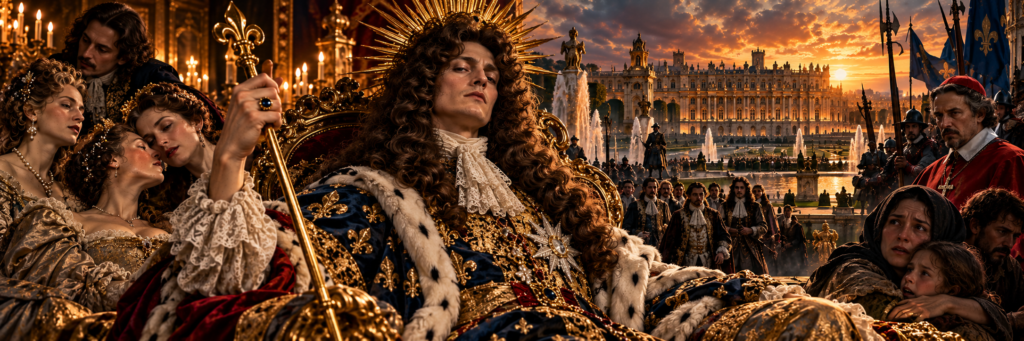
Louis XIV of France: The Sun King, the Madness of Absolute Power, and the Palace Built on a Kingdom’s Suffering
King of France and Navarre, 1643–1715 | Known as Louis the Great and the Sun King
On September 1, 1715, an extraordinary reign finally came to an end. Inside the magnificent Palace of Versailles, surrounded by the architectural splendor that had become the defining symbol of his monarchy, Louis XIV of France died at the age of seventy-six. He had occupied the French throne for more than seventy-two years, longer than any other sovereign in the history of France. He had transformed his kingdom into Europe’s leading cultural power, built one of the most spectacular royal residences ever conceived, and made his court the model against which other European monarchies measured themselves. His name had become synonymous with magnificence, ceremony, military glory, and the seemingly limitless authority of kings.
Yet the France he left behind was deeply troubled. Decades of warfare had imposed enormous financial burdens upon the monarchy, repeated taxation had strained ordinary communities, and catastrophic harvest failures had brought famine and death to large parts of the population. His determination to impose religious unity had driven substantial numbers of Protestants into exile, while his ambitious foreign policies had repeatedly united neighboring powers against him. Even his family had suffered devastating losses. During the final years of his life, death swept through the royal succession, taking his son, grandson, and great-grandson in a succession of tragedies that left a five-year-old child as his heir.
The contrast between royal splendor and national suffering was difficult to ignore. Versailles glittered with mirrors, chandeliers, elaborate gardens, and ceremonial apartments, while beyond its gates ordinary people struggled under the demands of taxation, military recruitment, and recurring food shortages. The king who had spent decades presenting himself as the embodiment of order and permanence could not prevent the destruction of much of his own immediate family. His magnificent court survived, but the political and financial problems confronting his successor were formidable.
Louis XIV was not clinically insane. The surviving historical evidence does not establish that he suffered from psychosis, delusions, or a psychiatric disorder comparable to the severe episodes experienced by certain other monarchs. He was disciplined, politically intelligent, capable of sustained concentration, and remarkably attentive to the practical business of government. His administration could be calculating and methodical, even when its policies produced destructive consequences.
Nevertheless, his reign offers one of history’s most compelling examples of how absolute power can encourage dangerous assumptions about personal authority, national destiny, and the limits of royal ambition. His pursuit of glory helped make France culturally dominant and militarily formidable, but it also encouraged expensive wars and policies that placed extraordinary burdens upon his subjects. His obsession with ceremony was not simply vanity; it was a sophisticated instrument of government. His religious persecution was not an isolated irrational outburst; it emerged from deeply held assumptions about monarchy, Catholicism, and political unity.
The disturbing question surrounding Louis XIV is therefore not whether he was mad in a medical sense. It is how a ruler of considerable intelligence and discipline could become so committed to his own conception of greatness that he repeatedly accepted immense human and financial costs in pursuit of it.
A Crown Before He Could Walk: The Childhood of a Future Absolute Monarch
Louis XIV was born on September 5, 1638, at the Château de Saint-Germain-en-Laye. His arrival was greeted with extraordinary celebration because his parents, Louis XIII and Anne of Austria, had been married for more than twenty-two years without producing a surviving child. The infant was given the name Louis-Dieudonné, meaning Louis the God-given, reflecting the widespread belief that his birth represented a providential answer to years of anxiety about the succession. For the Bourbon dynasty, his arrival promised continuity after generations marked by religious conflict, assassination, and struggles over royal authority. He was born into a monarchy that had already begun strengthening its institutions under Louis XIII and Cardinal Richelieu, but its future remained vulnerable to factional rivalries.
When Louis XIII died on May 14, 1643, his son was only four years old. The child inherited the crown, while his mother assumed the regency and Cardinal Mazarin became the dominant minister of government. Anne of Austria and Mazarin continued many of the policies associated with Richelieu, particularly the effort to strengthen royal authority and resist Habsburg power. Their government, however, faced serious financial and political difficulties caused by prolonged warfare and opposition to centralizing reforms. Powerful nobles resented the influence of ministers, while judicial institutions and urban populations objected to taxation and administrative interference. These tensions would erupt into a series of rebellions that profoundly shaped the young king’s understanding of power.
The Fronde, beginning in 1648, was not a single unified uprising but a succession of interconnected conflicts involving the Parlement of Paris, aristocratic factions, royal ministers, and military commanders. Its participants pursued different objectives, ranging from resistance to taxation and ministerial authority to personal struggles for influence within the monarchy. The instability repeatedly threatened the regency government and exposed the vulnerability of a child sovereign. Paris became a particularly dangerous center of opposition, with barricades, demonstrations, and political agitation challenging the authority exercised in Louis’s name. The young king witnessed a world in which royal dignity offered little protection against the ambitions of powerful adults.
One of the most frequently repeated stories from this period concerns an episode in which crowds entered the royal residence to verify that the young king had not escaped. According to accounts associated with the disturbances of 1651, Louis was observed lying in bed while suspicious Parisians satisfied themselves that he remained present. Later retellings transform the incident into a terrifying scene in which armed strangers surrounded the child while he pretended to sleep. The basic episode belongs to the history of the Fronde, but the precise details of his thoughts, emotions, and behavior are less certain than dramatic narratives suggest. It is reasonable to recognize that such experiences could be frightening without claiming to know exactly how they shaped his adult psychology.
Louis and his household also experienced periods of flight and insecurity as the regency struggled to maintain control. The young king learned that aristocratic loyalty could change quickly, that political institutions might resist royal commands, and that the capital itself could become hostile to the monarchy. These lessons would remain relevant throughout his reign. Yet historians should resist the temptation to explain every feature of his later government as a direct reenactment of childhood trauma. The Fronde influenced his political education, but his policies also developed from inherited institutions, contemporary theories of sovereignty, and the practical experience of ruling a powerful European kingdom.
The Fronde’s Lasting Shadow: Why Louis Distrusted Rebellion
The Fronde ended without permanently limiting royal authority, but its consequences extended far beyond the immediate defeat of rebellious factions. Mazarin survived the political struggles, and the monarchy gradually restored control, demonstrating the resilience of the institutions developed under Louis XIII. Louis emerged from the period with a strong awareness of the dangers posed by powerful nobles acting independently of the crown. He had seen princes, magistrates, and military commanders challenge the government while claiming to defend the kingdom’s interests. The experience reinforced his conviction that political authority required a clearly recognized center. Divided sovereignty appeared to him not as a safeguard against tyranny but as an invitation to disorder.
His later treatment of the aristocracy reflected this concern, although it did not involve a simple campaign to imprison every independent noble. Louis understood that powerful families remained essential to military command, administration, diplomacy, and court life. Rather than attempting to eliminate aristocratic status, he sought to make noble advancement increasingly dependent upon royal favor. Offices, pensions, military appointments, ceremonial privileges, and access to the sovereign became instruments through which ambition could be directed toward service. The strategy did not abolish noble influence, but it helped change the relationship between aristocratic prestige and the crown. Versailles eventually became the most visible expression of this political arrangement.
The notion that Louis deliberately forced nobles to crowd around his bed every morning as revenge for the intrusion into his childhood bedroom is an appealing story, but it should not be presented as established fact. Royal waking and sleeping ceremonies had precedents before his reign, and the development of Versailles etiquette reflected broader traditions of court hierarchy. Louis expanded and refined these practices because they helped organize access to his person and display distinctions of rank. The connection between childhood humiliation and adult ceremony is an interpretation rather than a documented personal explanation. His desire for control was evident, but it operated through calculated political institutions rather than an identifiable compulsive reenactment.
The Fronde nevertheless helps explain why Louis placed such importance upon obedience and political stability. He had experienced rebellion during a period when the monarchy appeared vulnerable, and he spent much of his adult reign attempting to prevent similar challenges. His government emphasized continuity, hierarchy, and the visible supremacy of the sovereign. Those priorities could strengthen administration, but they also encouraged the belief that resistance to royal policy threatened the entire political order. The resulting concentration of authority would become both a source of France’s strength and a major limitation of its political system.
The Death of Mazarin: When Louis Announced He Would Rule
Cardinal Mazarin died on March 9, 1661, leaving behind a monarchy that had survived rebellion and emerged from prolonged conflict with a stronger international position. Many courtiers expected Louis, then twenty-two years old, to appoint another principal minister who would manage government in his name. Instead, he announced his intention to direct the administration personally. The decision marked a decisive transition in French political history because the king would no longer rely upon a single chief minister in the manner associated with Richelieu and Mazarin. He retained experienced officials and delegated substantial responsibilities, but he insisted that major decisions remain subject to his authority.
Louis’s personal government was not merely theatrical. He developed a disciplined routine of council meetings, correspondence, administrative review, and consultation with ministers. He examined military affairs, financial reports, diplomatic developments, and appointments with considerable attention. His officials included talented administrators such as Jean-Baptiste Colbert, who worked to improve revenue collection, encourage manufacturing, and strengthen commercial activity. François-Michel Le Tellier, Marquis de Louvois, became central to military administration, while experienced commanders helped expand the effectiveness of French armies. Louis’s achievements depended upon these individuals, but he understood their work and remained actively involved in directing policy.
The famous declaration L’État, c’est moi, commonly translated as “I am the state,” is frequently attributed to Louis XIV. There is no reliable contemporary evidence that he actually spoke those words, and the quotation should not be treated as an authentic statement of his political philosophy. His government nevertheless embodied a strong conception of royal sovereignty in which ultimate political authority rested with the crown. Louis believed that kings were accountable to God and responsible for governing their subjects, but he did not accept that representative institutions possessed a general right to direct royal policy. His conception of kingship combined personal duty with exceptional authority.
This combination helps explain why describing him simply as an egomaniac is historically inadequate. Louis worked hard, understood administrative detail, and considered government a demanding responsibility. His pursuit of magnificence coexisted with a serious commitment to the practical business of monarchy. Yet the same political system that enabled sustained decision-making also concentrated responsibility for errors. When policies failed, there were limited institutional mechanisms capable of compelling the king to reconsider them. His intelligence did not eliminate the dangers of absolute authority; in some circumstances, it made his ambitious projects more effectively organized.
The Sun King: When Royal Image Became Political Power
Louis XIV’s identification with the sun became one of the most recognizable elements of his public image. The symbolism drew upon classical mythology, particularly Apollo, and upon established traditions connecting rulers with light, order, and magnificence. In 1653, the young king performed in the Ballet de la Nuit, appearing in a role associated with the rising sun. The performance has become closely connected with the development of his solar imagery, although the relationship between this particular appearance and his later title should not be oversimplified. Court entertainment provided opportunities to represent royal authority through allegory, music, costume, and movement. Louis understood the political value of spectacle long before Versailles reached its mature form.
His involvement in ballet was serious and sustained. He received training, participated in court performances, and supported the institutional development of dance. In 1661, he founded the Académie Royale de Danse, helping establish professional standards that would influence the future of ballet. Dance was not regarded merely as frivolous entertainment within aristocratic society. It demonstrated physical control, grace, discipline, and the ability to perform according to elaborate rules of hierarchy. A king who danced well could display mastery over his own body while occupying the central position within a carefully arranged spectacle. Louis’s participation therefore reflected the political culture of his age rather than an irrational belief that he was literally Apollo.
The court’s artistic productions increasingly presented Louis as the source of harmony and order within the kingdom. Paintings, sculptures, medals, festivals, and architectural decorations celebrated his victories and virtues, often drawing upon mythological imagery. Such representations could appear extravagant to modern observers, but royal propaganda was a familiar feature of European monarchy. Louis’s innovation lay partly in the scale, coordination, and consistency of the image he cultivated. The sun became an especially effective symbol because it suggested a central force around which everything else revolved. In the political world he constructed, the monarch occupied a similarly commanding position.
The danger of this imagery was not that Louis necessarily believed himself divine. Rather, the repeated presentation of royal authority as the source of national greatness could make criticism appear disloyal or even unnatural. Court artists and writers had strong incentives to celebrate success, while ministers depended upon maintaining royal confidence. Military victories were incorporated into an increasingly elaborate narrative of personal glory. Defeats and failures could be harder to acknowledge within a system devoted to projecting magnificence. The Sun King’s public image therefore strengthened monarchy while creating pressures that sometimes distorted the relationship between appearance and reality.
Versailles: The Palace That Became a Kingdom Within a Kingdom
Versailles began as a hunting residence established by Louis XIII, but Louis XIV transformed it into an enormous architectural and political project. From the 1660s onward, successive building campaigns expanded the château, gardens, ceremonial spaces, and surrounding infrastructure. Architects, artists, engineers, gardeners, and thousands of workers contributed to a complex whose scale astonished contemporaries. Louis Le Vau, Jules Hardouin-Mansart, Charles Le Brun, and André Le Nôtre were among the figures associated with its development. The resulting palace combined royal apartments, state rooms, fountains, formal gardens, and extensive facilities necessary to support a large court. In 1682, Louis established Versailles as the principal seat of the royal court and government.
The palace was undoubtedly expensive, but the claim that Versailles alone bankrupted France is misleading. Its construction and maintenance required substantial resources, yet prolonged warfare represented a far greater and more persistent burden upon royal finances. Versailles was also not simply a private monument to vanity. It provided a setting for diplomacy, administration, ceremonial hierarchy, and the distribution of royal favor. Foreign ambassadors encountered a carefully staged representation of French power, while nobles competed for access to the king. The palace functioned as both residence and political instrument, making royal authority visible through architecture and daily ritual.
Life at Versailles was organized around distinctions of rank that could appear absurdly intricate. Access to the king’s apartments, invitations to particular ceremonies, and opportunities to participate in intimate aspects of royal routine carried social significance. Nobles competed for privileges that demonstrated their proximity to the sovereign, sometimes treating apparently minor ceremonial honors as matters of considerable importance. Such arrangements helped Louis reward loyalty and maintain influence over aristocratic society. The system did not require every noble to live permanently at Versailles, nor did it eliminate regional power. Nevertheless, it encouraged important families to devote time and resources to court life, where their ambitions could be observed and managed.
Versailles also displayed the contradictions of royal magnificence. Its fountains, gardens, and decorated apartments celebrated order and abundance, while maintaining the enormous household required complicated logistics and constant expenditure. Thousands of servants, officials, guards, and courtiers depended upon the palace’s operations. The surrounding community developed in response to the demands of court life, creating an urban environment closely connected to royal government. The palace could be uncomfortable, crowded, and unpleasant in ways that modern visitors might not expect. Its beauty concealed a complicated world of competition, labor, expense, and political dependence.
The Levée and Coucher: Turning a King’s Bedroom Into a Political Theater
Louis XIV’s daily routine became one of the most famous examples of ceremonial monarchy. The levée, or rising ceremony, organized access to the king as he began his day, while the coucher marked his retirement in the evening. Participation was regulated according to rank and privilege, with certain courtiers permitted greater proximity than others. These ceremonies developed from established royal customs, but Louis refined them into a particularly elaborate system of court hierarchy. Activities that modern observers might consider private became opportunities to display political relationships. The king’s person served as the central point around which the ambitions of the aristocracy revolved.
The privilege of assisting with clothing or attending particular stages of the morning routine could carry significant prestige. Such honors did not necessarily confer direct administrative authority, but they demonstrated access and favor in a society where personal proximity to the monarch mattered enormously. Courtiers invested time and energy in obtaining positions that placed them near the sovereign. Rivalries over precedence could become intense because ceremonial distinctions reflected broader questions of social standing. Louis used these expectations to reinforce a hierarchy in which the king determined the value of access. The result was a court culture that combined political calculation with extraordinary attention to ritual.
It would be inaccurate to describe every participant as a helpless prisoner forced to witness the king’s daily activities. Many nobles actively sought court appointments because they offered opportunities for advancement, patronage, and influence. Others maintained substantial interests away from Versailles and did not participate continuously in its ceremonies. The system operated through incentives as well as obligations, rewarding those who successfully navigated its rules. Louis understood that ambition could be directed toward competition for royal favor rather than independent political action. The elaborate etiquette was therefore less an expression of irrational vanity than a method of organizing aristocratic society around the crown.
Yet the ceremonies also encouraged a political culture in which appearances mattered enormously. Nobles could spend considerable effort pursuing privileges that had limited practical value outside the court’s hierarchy. Royal favor became a source of personal security, while exclusion could damage careers and reputations. The system strengthened Louis’s control over elite society, but it also created incentives for flattery and conformity. The monarch occupied the center of an environment designed to reinforce his exceptional status. Such constant deference did not necessarily produce madness, but it could make independent criticism increasingly difficult to hear.
The Red Heels: Fashion, Height, and the Politics of Appearance
Louis XIV became closely associated with elaborate clothing, magnificent wigs, and shoes featuring distinctive red heels. His portraits emphasize richly embroidered garments, stockings, lace, jewelry, and carefully arranged poses that projected authority and elegance. High heels formed part of fashionable aristocratic dress during the seventeenth century, particularly among elite men. Red heels became associated with prestigious court fashion and royal favor, eventually developing into a recognizable symbol of aristocratic distinction. Louis understood that clothing could communicate rank and political importance. His appearance was therefore part of the wider system through which monarchy displayed its authority.
Popular accounts frequently claim that Louis was only five feet four inches tall and wore heels four or five inches high because he was desperately insecure about his stature. These assertions should be treated cautiously. Estimates of his height vary, and some evidence suggests that he was relatively tall by the standards of his period. The dimensions of his footwear are also frequently exaggerated in popular retellings. High heels were fashionable among aristocratic men and cannot be explained solely through personal insecurity. The claim that Louis wore shoes decorated with elaborate battle scenes or jewels in every instance similarly requires specific evidence rather than general repetition.
The so-called red-heel rule is another example of a genuine association transformed into an overly precise legend. Red heels became connected with elite court status, and royal regulation of clothing and rank was part of the broader culture of monarchy. Nevertheless, the familiar claim that Louis issued a single universal law allowing only his favorites to wear red heels is difficult to establish in the simplified form often repeated. Fashion privileges developed through custom, court expectation, and changing regulations rather than necessarily through one dramatic decree. Losing royal favor could certainly damage a nobleman’s position, but the relationship between political disgrace and footwear was not as mechanically direct as popular stories suggest.
Louis’s clothing nevertheless mattered politically because it helped define the visual language of monarchy. Portraits presented him as physically commanding, richly dressed, and surrounded by symbols of authority. His appearance became a model imitated by European elites, reinforcing France’s growing influence over fashion and luxury production. The development of textile industries, skilled craftsmanship, and court consumption contributed to the wider cultural economy encouraged by Colbert’s policies. Fashion was therefore connected to economic ambition as well as personal display. The king’s magnificent wardrobe was one element of a larger system that made French culture internationally influential.
Nicolas Fouquet: The Minister Who Became Too Magnificent
Nicolas Fouquet, Louis XIV’s superintendent of finances, became one of the most dramatic casualties of the transition to personal government. Fouquet had accumulated considerable wealth and influence during the years when Mazarin dominated the administration. His magnificent château at Vaux-le-Vicomte, designed with contributions from leading artists and architects, displayed the extraordinary resources available to a powerful royal minister. In August 1661, Fouquet hosted a lavish entertainment attended by Louis, featuring elaborate hospitality and artistic spectacle. The event later became central to the legend that the king was so consumed by jealousy that he immediately decided to destroy the man who had dared to outshine him.
The reality was more complicated. Fouquet was already under investigation before the famous celebration, and Louis and Colbert had concerns about his financial administration, political ambitions, and extensive network of influence. His position as superintendent involved a financial system that was opaque, heavily dependent upon credit, and vulnerable to corruption. Fouquet had also developed personal resources and connections that made him appear politically dangerous to a young king determined to exercise direct control. The entertainment at Vaux-le-Vicomte may have reinforced Louis’s unfavorable impression, but it was not the sole cause of the arrest. Presenting the affair simply as a narcissistic tantrum ignores the political and financial circumstances surrounding the case.
Fouquet was arrested on September 5, 1661, by royal musketeers under the command of d’Artagnan. His trial became a prolonged and controversial affair involving accusations of financial misconduct and abuse of office. In 1664, the court sentenced him to banishment, but Louis increased the punishment to imprisonment. Fouquet spent the remainder of his life confined, eventually dying in 1680. His treatment demonstrated the king’s determination to prevent ministers from developing independent political power. It also revealed the severity of royal authority when judicial outcomes failed to satisfy the sovereign.
Louis later employed artists and designers associated with Vaux-le-Vicomte in projects connected with Versailles, contributing to the impression that he had simply confiscated Fouquet’s magnificence for himself. The relationship between the two residences is historically important, but it should not be reduced to an act of personal imitation motivated by envy. Versailles developed through multiple architectural campaigns and reflected broader royal ambitions. Fouquet’s downfall was nevertheless a warning to every powerful servant of the crown. Wealth, talent, and magnificent patronage could become liabilities when they appeared to compete with royal authority. Under Louis XIV, no minister was supposed to rival the king in either political influence or public splendor.
The Women Behind the Sun King: Marriage, Mistresses, and Court Scandals
Louis XIV’s marriage to Maria Theresa of Spain in 1660 formed part of the diplomatic settlement associated with the Peace of the Pyrenees. The marriage strengthened relations between the French and Spanish monarchies while creating dynastic connections that would later become politically significant. Maria Theresa was a devoted Catholic and occupied the formal position of queen, but Louis maintained relationships with several mistresses during their marriage. These relationships became important features of court politics because royal favorites could receive wealth, titles, and influence. Their households attracted supporters and rivals, while questions concerning legitimacy and succession complicated the distribution of favor. The king’s private life therefore had consequences far beyond personal romance.
Louise de La Vallière became one of Louis’s early prominent mistresses, and their relationship produced children, some of whom were later legitimized. She eventually withdrew from court life and entered a convent, a decision often presented through the language of repentance and religious devotion. Her successor in royal favor, Françoise-Athénaïs de Rochechouart, Marquise de Montespan, became one of the most influential women at court. Montespan’s relationship with Louis produced several children and placed her at the center of a powerful network of patronage. Her position attracted admiration, resentment, and intense scrutiny because access to the king could translate into political advantage. Court rivalries surrounding royal mistresses contributed to an atmosphere in which personal scandal and public authority were closely connected.
The Affair of the Poisons, which emerged during the late 1670s, cast a particularly disturbing shadow over the court. Investigations uncovered networks associated with fortune-telling, alleged poisoning, and illicit practices involving magical or religious rituals. Testimony implicated numerous individuals, while allegations eventually reached figures connected to Montespan. The evidence was complicated by coercive interrogation, unreliable witnesses, and the sensational nature of the accusations. Although Montespan’s name became associated with the affair, the most extreme claims concerning her involvement in poisoning or ritual murder remain disputed. Louis’s government restricted aspects of the investigation as the scandal threatened to damage the monarchy’s reputation. The affair revealed how fear, superstition, criminal activity, and political rivalry could become entangled within the world of royal patronage.
After Maria Theresa died in 1683, Louis developed an increasingly important relationship with Françoise d’Aubigné, Marquise de Maintenon. They are widely believed to have entered into a secret marriage, although no surviving marriage record establishes the precise circumstances beyond dispute. Maintenon became an influential figure in the king’s private life and was associated with a more restrained, religiously serious atmosphere during his later years. Her political influence has often been exaggerated, particularly in accounts seeking to blame her for religious persecution or unpopular policies. Louis remained responsible for the decisions of his government, and his ministers and advisers pursued their own objectives. Nevertheless, Maintenon’s proximity to the king made her an important participant in the emotional and religious environment of the later court.
The Revocation of the Edict of Nantes: When Religious Unity Became Persecution
Louis XIV’s religious policies became increasingly severe toward French Protestants during the later decades of his reign. The Edict of Nantes, issued by Henry IV in 1598, had provided a framework of limited rights and protections for Huguenots after generations of religious warfare. Although its provisions had already been restricted under earlier rulers, it remained an important foundation for Protestant worship and community life. Louis gradually intensified pressure upon Huguenot institutions, encouraged conversions, and permitted policies that made Protestant existence increasingly difficult. His government believed that religious unity would strengthen political unity, reflecting a widespread early modern assumption that confessional division threatened the stability of the state. The resulting campaign, however, produced coercion, suffering, and widespread displacement.
The dragonnades became among the most notorious instruments of pressure. Soldiers were quartered in Protestant households, where their presence could involve intimidation, harassment, and abuse intended to encourage conversion to Catholicism. The policy created an environment in which religious conformity could be obtained through fear rather than conviction. Reports of conversions were then used to support the claim that Protestantism was disappearing from France. The government increasingly treated the remaining Huguenot communities as obstacles to the desired religious unity of the kingdom. Such methods demonstrated the coercive character of the policy long before the formal revocation of the Edict of Nantes.
In October 1685, Louis issued the Edict of Fontainebleau, revoking the Edict of Nantes. Protestant churches were ordered destroyed or converted, public Protestant worship was prohibited, and ministers were required to convert or leave the kingdom. Lay Protestants were officially forbidden to emigrate, but large numbers nevertheless escaped despite the risks. Estimates of the total exodus vary, with many historians placing the number of refugees in the broad range of approximately 150,000 to 200,000 or more over time. These refugees settled in places including the Dutch Republic, England, Brandenburg-Prussia, and other territories where they contributed skills, capital, and commercial connections. The flight represented a major human and political consequence of the king’s pursuit of confessional uniformity.
The economic effects of the Huguenot exodus were significant in particular regions and industries, although claims that it single-handedly devastated the entire French economy are too sweeping. Refugees included skilled artisans, merchants, soldiers, and professionals, and their departure benefited several of France’s competitors. Yet France remained a major European economic power, and its later financial difficulties cannot be attributed solely to religious persecution. Warfare, taxation, debt, harvest failures, and structural weaknesses in royal finance also played important roles. The revocation nevertheless damaged France’s international reputation among Protestant powers and contributed to hostility toward Louis abroad. It also imposed severe suffering upon people whose religious beliefs placed them outside the monarchy’s preferred definition of national unity.
The policy illustrates one of the most troubling aspects of Louis’s conception of kingship. He believed that religious conformity could strengthen the kingdom, but the methods used to pursue that objective undermined the lives and liberties of substantial numbers of subjects. His decision was not a sudden irrational episode; it developed through years of pressure and reflected the assumptions of influential religious and political advisers. That makes its consequences no less severe. The persecution reveals how a disciplined ruler could implement destructive policies through the ordinary machinery of government. Religious intolerance became more dangerous because it was systematic, organized, and supported by the authority of the crown.
The King’s Wars: Glory Purchased With Blood and Treasure
Military glory occupied a central place in Louis XIV’s conception of monarchy. France possessed substantial resources, a large population, and a strategically important position in Europe, making it capable of sustaining powerful armies. Louis and his ministers pursued territorial security, dynastic claims, and international prestige through repeated conflicts. The War of Devolution, the Franco-Dutch War, the Nine Years’ War, and the War of the Spanish Succession became defining episodes of his reign. These conflicts differed in their causes and objectives, and it would be inaccurate to describe them all as wars fought solely for personal vanity. Nevertheless, Louis’s pursuit of prestige and strategic advantage repeatedly contributed to the escalation of European rivalries.
The War of Devolution in 1667–1668 emerged from dynastic claims associated with Louis’s marriage to Maria Theresa of Spain. French forces occupied territories in the Spanish Netherlands, demonstrating the effectiveness of the monarchy’s military organization. The conflict ended through diplomatic settlement, but it increased concerns among neighboring powers about French expansion. The Franco-Dutch War beginning in 1672 represented a more ambitious effort to weaken the Dutch Republic and reshape the regional balance of power. Initial French successes were followed by prolonged resistance and the formation of wider coalitions. The war demonstrated that French military strength could provoke alliances capable of limiting royal ambitions.
The Nine Years’ War, beginning in 1688, brought France into conflict with a broad coalition of European powers. The fighting imposed heavy financial demands and contributed to widespread suffering, particularly when combined with harvest failures and taxation. Military campaigns devastated contested territories, while the destruction of parts of the Palatinate became especially notorious. French policy in the region involved systematic devastation intended to deny resources to enemy forces, producing lasting hostility and propaganda against Louis. The war ended with the Treaty of Ryswick in 1697, requiring diplomatic compromises that fell short of the king’s earlier ambitions. France remained powerful, but the costs of prolonged conflict were becoming increasingly apparent.
The War of the Spanish Succession, beginning in 1701, became the final great struggle of Louis’s reign. The death of Charles II of Spain without a direct heir created a dynastic crisis involving competing claims and fears that the French and Spanish crowns might become united under Bourbon control. Louis supported the succession of his grandson Philip, Duke of Anjou, who became Philip V of Spain. Other European powers resisted the possibility of excessive Bourbon dominance, producing a prolonged international conflict. The war brought major battles, shifting fortunes, and severe financial pressure upon France. Although the eventual settlement preserved Philip V on the Spanish throne, it required renunciations designed to prevent the union of the French and Spanish monarchies.
The wars contributed enormously to the burdens carried by French society. Armies required recruitment, equipment, transport, fortifications, and constant financial support, while the monarchy struggled to raise sufficient revenue. Taxes increased, borrowing expanded, and communities experienced the disruption associated with military demands. France’s territorial and diplomatic achievements were substantial, but they came at immense cost. Louis’s reputation for military glory therefore cannot be separated from the suffering imposed upon ordinary subjects. His reign demonstrates how strategic ambition, dynastic prestige, and personal reputation could combine to sustain conflicts long after their costs had become painfully visible.
Famine Beyond the Palace Gates: The Human Cost of Royal Ambition
The most devastating crises of Louis XIV’s reign were not confined to battlefields. Severe harvest failures in the early 1690s produced widespread famine, with the crisis of 1693–1694 causing extraordinary mortality across France. Estimates vary, but historians commonly describe deaths numbering well over a million during the wider subsistence catastrophe. Poor harvests, high grain prices, disease, and the vulnerability of impoverished communities combined to create suffering on an enormous scale. War intensified the difficulties by placing additional demands upon resources and public finance. The monarchy’s administrative system struggled to provide effective relief across a large and diverse kingdom. For many subjects, the magnificence of Versailles offered little comfort amid hunger and disease.
The winter of 1708–1709 brought another severe crisis. Exceptional cold damaged crops, disrupted transport, and contributed to food shortages at a time when France was already exhausted by the War of the Spanish Succession. Grain prices rose sharply, and the consequences were particularly severe for households with limited reserves. Communities faced hunger, illness, and increasing dependence upon charity or local assistance. The crisis revealed the vulnerability of an agricultural society to climatic extremes, especially when government finances were strained by prolonged warfare. Louis’s administration attempted various responses, but its capacity to prevent suffering was limited. The catastrophe further weakened public confidence in a monarchy that presented itself as the guardian of national prosperity.
It would be historically inaccurate to claim that Louis personally caused these famines through royal extravagance. Climatic conditions, agricultural failures, disease, market disruption, and regional inequalities played essential roles. Nevertheless, the financial demands of warfare reduced the government’s flexibility and increased the burdens upon vulnerable populations. The monarchy’s fiscal system was also marked by exemptions and inequalities that made taxation particularly difficult for many ordinary households. The contrast between court expenditure and rural suffering therefore reflected deeper structural problems. Versailles was not the sole cause of financial distress, but it became an enduring symbol of the distance between royal magnificence and the lives of subjects.
The suffering also complicates the image of Louis as a universally admired national hero. His reign produced genuine achievements in culture, administration, diplomacy, and military organization, but these accomplishments did not benefit all subjects equally. The costs of state-building were distributed unevenly, and those with the least political influence often had the fewest resources to withstand crisis. Royal propaganda celebrated victories and magnificence, while famine exposed the limitations of a system centered upon sovereign glory. The monarchy could command armies and construct palaces, but it could not guarantee bread. That contradiction would remain central to later criticism of the Bourbon state.
The Sun King’s Teeth: Royal Medicine at Its Most Horrifying
Louis XIV’s medical history provides a disturbing glimpse into the limitations of seventeenth-century medicine. His health was monitored closely by royal physicians and surgeons, whose records document illnesses, treatments, and bodily complaints in considerable detail. He experienced dental problems, digestive difficulties, infections, and other conditions that required repeated attention. Medical practice relied upon theories and interventions that modern observers often find alarming, including purging, bloodletting, and invasive procedures performed without contemporary anesthesia or antiseptic methods. The king’s privileged position gave him access to leading practitioners, but it did not protect him from the dangers of their treatments. Royal medicine could be elaborate and attentive while remaining painfully ineffective.
One of the most notorious episodes involved the extraction of teeth and damage to the palate. Accounts describe serious dental interventions during the 1680s, including the removal of upper teeth and the creation of an opening between the mouth and nasal cavity. Such injuries could cause considerable discomfort and difficulties with eating or drinking. Later retellings frequently claim that liquids poured from the king’s nose whenever he drank, presenting the complication as a permanent grotesque spectacle. The underlying dental injury is supported by historical medical accounts, but the frequency and dramatic details of these stories are often exaggerated. The episode nevertheless demonstrates the risks of early modern surgery, particularly when practitioners lacked modern understanding of infection control and tissue damage.
Louis also underwent treatment for an anal fistula in 1686, a condition that caused severe pain and required a dangerous operation. The surgeon Charles-François Félix developed instruments and techniques for the procedure, which was performed successfully enough for the king to recover. The operation became famous because it demonstrated the growing prestige of surgery within French medicine. Louis’s recovery was celebrated at court, where even intimate medical events could acquire political and ceremonial significance. The success did not mean the treatment was painless or free from danger. It reflected the extraordinary lengths to which physicians and surgeons would go to preserve the health of a monarch whose survival mattered to the state.
His medical experiences also reveal the vulnerability concealed beneath royal magnificence. The king who commanded armies and received elaborate ceremonial honors remained subject to pain, infection, and the uncertain knowledge of his physicians. His body became an object of intense scrutiny because its condition affected the political future of France. Medical reports could circulate through court networks, while periods of illness generated anxiety about succession and government. Louis’s personal authority did not eliminate the fundamental limitations of human life. The contrast between his carefully cultivated image and the realities of disease became increasingly striking as he aged.
The King’s Appetite: Gluttony, Digestion, and Autopsy Legends
Louis XIV possessed a reputation for a substantial appetite, and court accounts describe elaborate meals served according to ceremonial routines. Royal dining displayed wealth, hierarchy, and the resources of the household, while the king’s preferences became matters of interest to observers. His meals could include numerous dishes, although the presence of many courses does not mean he consumed every item offered. Seventeenth-century elite dining followed conventions different from modern meals, with dishes often presented simultaneously or in elaborate sequences. Louis’s appetite was nevertheless remarked upon, contributing to later portrayals of a monarch whose physical consumption matched his political ambition. The image of the king as an insatiable eater became another element of his eccentric reputation.
Popular accounts frequently claim that an autopsy revealed his stomach and intestines to be twice the normal size, supposedly proving that decades of overeating had transformed his internal anatomy. Such claims should be treated cautiously because historical descriptions of organs do not necessarily provide reliable measurements or permit modern medical conclusions. Autopsy reports from the period reflect contemporary terminology and assumptions, while later writers often amplified unusual details for dramatic effect. The idea that a large appetite caused his organs to double in size is not established by the evidence. Louis may have eaten substantial meals, but the biological explanations attached to that habit are often speculative.
His digestive complaints were also shaped by medical treatment. Purging and other interventions were common practices, and royal physicians frequently interpreted health through theories of bodily evacuation and balance. Such treatments could cause discomfort and potentially worsen existing problems. The king’s medical routine therefore combined genuine illness with practices that modern medicine would often consider unnecessary or harmful. His willingness to undergo repeated treatment reflects the authority physicians possessed within elite households, as well as the importance attached to preserving royal health. The grotesque reputation of his bodily habits owes much to the contrast between magnificent public imagery and the intimate realities preserved in medical records.
The fascination with Louis’s digestion also reveals how later generations have attempted to undermine royal grandeur through bodily detail. Stories about excessive eating, dental injuries, unpleasant smells, and medical procedures make the seemingly untouchable monarch appear vulnerable and ordinary. Such details can be historically illuminating when grounded in reliable evidence, but they become misleading when exaggerated into sensational legends. Louis’s medical history is compelling precisely because it exposes the limitations of wealth and power. He could command the finest physicians available, yet those physicians remained constrained by the knowledge of their age. His body was no more immune to suffering than the bodies of the subjects over whom he ruled.
The Smell of Versailles: Perfume, Plumbing, and Palace Reality
Versailles has acquired a notorious reputation for unpleasant smells, inadequate sanitation, and courtiers supposedly relieving themselves wherever convenient. Some of these stories reflect genuine difficulties associated with maintaining a vast, crowded palace before modern plumbing. The residence housed large numbers of people, required extensive cleaning, and depended upon servants to manage waste, water, and household facilities. Chamber pots, privies, and other sanitation arrangements were part of daily life, while the scale of the court created practical challenges. Strong perfumes were fashionable among elites, and concerns about odors were not unique to Versailles. Nevertheless, the familiar claim that the palace had no toilets and that everyone routinely used corridors as latrines is an exaggeration.
Versailles possessed sanitary facilities appropriate to its period, although their number, accessibility, and effectiveness varied. Royal apartments and privileged households could enjoy arrangements unavailable to many servants or visitors. Waste management remained difficult, particularly during major gatherings when the population of the palace increased. The gardens, kitchens, stables, and service areas also produced odors that required constant attention. Contemporary complaints about unpleasant conditions should therefore be understood within the practical realities of seventeenth-century urban and palace life. The existence of sanitation problems does not mean that the entire residence was permanently overwhelmed by filth.
Bathing practices also differed from modern expectations. Europeans did wash, but full immersion bathing was influenced by changing medical beliefs, social customs, and access to facilities. Linen changes, partial washing, perfumes, and other grooming practices formed part of elite hygiene. Louis XIV’s personal habits should not be reduced to the claim that he never bathed, a statement frequently repeated without adequate qualification. Court records and household practices reveal a more complicated picture of cleanliness and bodily care. The king’s magnificent appearance required substantial attention from attendants, even if the methods differed from contemporary routines.
The enduring fascination with Versailles’s odors reflects the palace’s symbolic importance. Its architecture presented a vision of order, beauty, and control, while its daily operations depended upon imperfect systems of sanitation, labor, and maintenance. The contrast makes the palace appear both magnificent and strangely human. Yet the most important contradictions of Versailles were political rather than merely hygienic. The court’s luxury depended upon resources drawn from a kingdom experiencing repeated financial and agricultural crises. Its elaborate ceremonies reinforced hierarchy while encouraging competition for favor. The palace was a triumph of architecture and political theater, but it also embodied the inequalities and pressures of absolute monarchy.
François Vatel: The Tragedy Behind a Royal Feast
One of the darkest stories associated with Louis XIV’s court concerns François Vatel, a celebrated steward employed by Louis II de Bourbon, Prince de Condé. In April 1671, Condé hosted an elaborate reception for the king at the Château de Chantilly, hoping to impress Louis and strengthen his political position. The event required extraordinary organization, including entertainment, accommodation, and magnificent meals for numerous guests. Vatel bore responsibility for coordinating important aspects of the hospitality, making the success of the festivities closely connected to his professional reputation. The pressure was immense because aristocratic magnificence could influence political relationships and royal favor. A failed reception might damage the standing of the host and those responsible for its arrangements.
According to the famous account preserved in Madame de Sévigné’s correspondence, Vatel became distressed by problems surrounding the preparations and the apparent insufficiency of fish deliveries. Believing that the arrangements had failed, he took his own life. The story is frequently simplified into the claim that he died because a seafood shipment was late, but the surviving account describes a broader atmosphere of exhaustion, anxiety, and perceived failure. The tragedy occurred within a system where elaborate hospitality carried enormous social and political significance. Vatel’s death became an enduring symbol of the pressures imposed by aristocratic display. It also illustrates how the pursuit of magnificence could place extraordinary burdens upon those responsible for creating it.
Louis XIV did not order Vatel’s death, and there is no basis for portraying the tragedy as a deliberate act of royal cruelty. Nevertheless, the circumstances reveal the demanding culture surrounding the king’s presence. A visit from Louis could become an event requiring immense expenditure and meticulous organization, particularly for nobles seeking favor. The expectations of magnificence encouraged competition that extended far beyond architecture and clothing. Food, entertainment, gardens, and hospitality became instruments through which aristocrats demonstrated status. Vatel’s death exposes the human cost that could accompany this culture of display. The splendor celebrated by guests depended upon labor and anxiety that remained largely invisible until something went terribly wrong.
The War of the Spanish Succession: The Final Gamble for Bourbon Glory
The War of the Spanish Succession became the defining military crisis of Louis XIV’s final years. When Charles II of Spain died in 1700 without a direct heir, the question of succession threatened to alter the European balance of power. His will designated Philip, Duke of Anjou, a grandson of Louis XIV, as heir to the Spanish monarchy. Louis accepted the arrangement, and Philip became Philip V of Spain. Other powers feared that the combined influence of the French and Spanish Bourbon dynasties would threaten their security, particularly if the crowns could eventually be united. The dispute therefore developed into a major European conflict involving dynastic rights, strategic interests, and competing visions of international order.
The war imposed enormous demands upon France. Military campaigns extended across several regions, while major battles produced heavy casualties and shifting fortunes. The defeats at Blenheim in 1704, Ramillies in 1706, and Oudenarde in 1708 demonstrated the effectiveness of the opposing coalition. French armies remained formidable, but the kingdom struggled under the combined pressures of military expenditure, taxation, and agricultural crisis. The winter of 1708–1709 intensified the suffering, contributing to food shortages and widespread distress. Louis faced a situation in which continued resistance threatened further exhaustion, while accepting enemy demands risked sacrificing important dynastic objectives. The conflict tested the limits of the monarchy’s resources and the king’s determination.
Negotiations eventually produced settlements that ended the war through a series of treaties, including the Treaty of Utrecht in 1713 and subsequent agreements. Philip V remained king of Spain, but renunciations were intended to prevent the French and Spanish crowns from being united. France retained its status as a major European power, although the war had imposed severe financial and human costs. The outcome was neither a simple triumph nor a complete defeat. Louis had preserved an important dynastic achievement while accepting restrictions that reflected the determination of other powers to maintain a balance of power. The settlement demonstrated that even the Sun King could not impose his will upon Europe without compromise.
The final war also revealed the limits of a political system organized around royal glory. Louis had pursued a dynastic objective that he considered legitimate and strategically valuable, but the conflict required sacrifices far beyond the royal household. Ordinary subjects bore the burden through taxation, military service, and economic disruption. The monarchy’s ability to mobilize resources was impressive, yet its financial structure struggled to sustain prolonged conflict. The war therefore exposed both the strength and vulnerability of the centralized state Louis had developed. His government could organize enormous armies, but it could not escape the consequences of exhausting the society that supported them.
Death at Versailles: The Sun King’s Family Tragedies
The final years of Louis XIV’s life were marked by a succession of deaths that devastated the royal family. His eldest legitimate son, Louis, known as the Grand Dauphin, died in April 1711. The loss was followed in February 1712 by the deaths of his grandson, Louis, Duke of Burgundy, and the duke’s wife, Marie Adélaïde of Savoy, during an outbreak of illness. Their elder surviving son, the Duke of Brittany, died shortly afterward. The rapid sequence of deaths transformed the succession and left the aging king confronting the disappearance of several generations of heirs. The dynasty that had once appeared secure suddenly depended upon the survival of a very young child.
The future Louis XV, born in 1710, survived the illnesses that killed other members of his immediate family. His survival preserved the direct Bourbon succession, but it also meant that another child would inherit the crown. Louis XIV had spent decades strengthening royal authority and creating institutions designed to express the permanence of monarchy. Yet the succession crisis revealed how dependent dynastic government remained upon the unpredictable survival of individuals. The king could control court appointments, military campaigns, and ceremonial hierarchy, but he could not prevent disease from destroying much of his family. The contrast between absolute authority and personal helplessness became increasingly apparent.
Louis’s own health deteriorated during the summer of 1715. Gangrene developed in his leg, and the condition progressed despite medical attention. The king endured considerable suffering as physicians attempted treatments available to them, but the disease proved fatal. He died on September 1, 1715, only days before his seventy-seventh birthday. His great-grandson succeeded him as Louis XV, beginning another minority reign under a regency government. The death ended an extraordinary period of personal rule that had shaped European politics, culture, and monarchy for more than half a century.
Contemporary reactions to his death were mixed. Louis had been celebrated as a magnificent sovereign, but decades of warfare and taxation had also produced resentment. Later accounts describe expressions of relief among parts of the population, although such reactions varied and should not be treated as a universal national judgment. The king’s funeral and succession followed established royal procedures, preserving the continuity of the monarchy despite the disappearance of its dominant figure. Versailles remained, as did the institutions and traditions Louis had cultivated. Yet the kingdom faced serious financial and political problems that would continue to challenge his successors.
Did Louis XIV’s Extravagance Cause the French Revolution?
Louis XIV died in 1715, more than seven decades before the French Revolution began in 1789. It would therefore be misleading to claim that his spending or wars directly caused the revolutionary collapse of the Bourbon monarchy. The intervening reigns witnessed major political, economic, intellectual, and social changes, including additional wars, fiscal crises, administrative reforms, and growing criticism of inherited privilege. The immediate financial crisis of the late eighteenth century developed through circumstances that cannot be explained solely by Louis XIV’s policies. Nevertheless, his reign contributed important elements to the institutional structure that later monarchs inherited. His expansion of royal authority, military expenditure, and court culture shaped the expectations and obligations of the Bourbon state.
The monarchy’s financial system remained deeply unequal, with exemptions and privileges complicating taxation. Louis’s government made significant efforts to increase revenue and improve administration, but prolonged warfare repeatedly overwhelmed fiscal resources. Borrowing and extraordinary taxation helped sustain military campaigns while creating burdens that could persist beyond individual conflicts. Later rulers inherited a political culture in which royal prestige was closely associated with military strength and international influence. These expectations encouraged continued expenditure even when financial reform proved difficult. The problem was not simply that Louis had built an expensive palace, but that the monarchy had developed obligations that were increasingly difficult to finance through its existing institutions.
Versailles also became an enduring symbol of the distance between monarchy and ordinary society. Its magnificence represented cultural achievement and political authority, but later critics could interpret the same splendor as evidence of extravagance and privilege. During the eighteenth century, changing ideas about government, public finance, and political representation altered how royal power was evaluated. Practices that had once appeared essential to monarchy increasingly became targets for criticism. Louis XIV’s court therefore contributed to a political legacy that could be admired and condemned for different reasons. The palace survived as an architectural masterpiece while acquiring a powerful place in the history of royal excess.
The relationship between Louis XIV and the French Revolution is best understood through long-term institutional consequences rather than a simple chain of personal blame. His reign strengthened the monarchy, expanded its ambitions, and reinforced the expectation that sovereign authority should remain concentrated at the center. Those achievements helped make France a dominant European power, but they also created financial and political pressures that later governments struggled to manage. The revolution emerged from a much broader combination of circumstances, including eighteenth-century fiscal crisis, social inequality, political conflict, and changing intellectual ideas. Louis XIV did not create those conditions alone. His reign nevertheless formed an important part of the history through which the Bourbon monarchy acquired both its extraordinary prestige and its enduring vulnerabilities.
Was Louis XIV Mad? The Difference Between Megalomania and Absolute Monarchy
Louis XIV is sometimes described as megalomaniacal because of his magnificent public image, concentration of authority, and repeated pursuit of military glory. The term can convey a criticism of excessive ambition or self-importance, but it should not be confused with a clinical diagnosis. The surviving evidence does not demonstrate that Louis suffered from delusions of grandeur in the psychiatric sense. He did not need to believe himself literally divine to embrace a political system that presented monarchy as sacred and hereditary. His identification with the sun was symbolic, drawing upon classical mythology and royal propaganda. His elaborate ceremonies were political instruments rather than proof that he had lost contact with reality.
The king’s administrative discipline also complicates attempts to portray him as irrational. He maintained a demanding schedule, consulted ministers, reviewed reports, and understood the importance of military and financial organization. His policies often followed recognizable strategic objectives, even when those objectives proved costly or misguided. The revocation of the Edict of Nantes emerged from assumptions about religious unity shared by influential advisers, while his wars reflected dynastic claims and European rivalries. These decisions deserve criticism for their consequences, but they cannot be explained adequately through psychiatric labels. Louis’s capacity for rational planning was precisely what made his government capable of implementing policies on such an enormous scale.
The more disturbing issue is the effect of concentrated authority upon political judgment. Louis operated within a system that encouraged deference, rewarded loyalty, and made royal prestige central to the functioning of government. Ministers could advise him, but their positions depended upon his confidence. Courtiers competed for access, while artists and writers celebrated his achievements through carefully constructed imagery. Such an environment could reinforce assumptions about the wisdom and necessity of royal decisions. The danger was not necessarily personal madness, but the possibility that institutional power would magnify errors and make correction increasingly difficult.
His reign therefore belongs in a discussion of controversial monarchs because it illustrates how intelligence, discipline, and political effectiveness can coexist with destructive ambition. Louis strengthened France’s international position, supported cultural achievements, and developed institutions that influenced European government. He also pursued prolonged wars, imposed religious persecution, and maintained a system of authority that placed immense burdens upon subjects. These outcomes cannot be reduced to a single personality trait. They emerged from the interaction of royal ambition, inherited institutions, international competition, religious assumptions, and the political culture of absolutism. Louis XIV was not demonstrably insane, but his reign exposes the dangers of a system in which one ruler’s conception of greatness could shape the lives of millions.
The Last Sunset: The King Who Possessed Everything Except the Future
Louis XIV’s life remains one of the most extraordinary demonstrations of royal power in European history. He inherited the crown as a child during a period of rebellion and uncertainty, survived the Fronde, and eventually established a system of personal government that made his authority the organizing principle of French political life. He transformed Versailles into an architectural masterpiece, supported artists and institutions that helped establish French cultural dominance, and presided over military campaigns that reshaped the European balance of power. His court became a model imitated by rulers across the continent, while his public image established standards of royal magnificence that endured long after his death. Few monarchs exercised such sustained influence over the political and cultural development of their age.
Yet the achievements of the Sun King cannot be separated from their costs. His religious policies deprived Protestants of important protections and drove large numbers into exile. His wars consumed enormous resources, imposed heavy burdens upon taxpayers, and contributed to suffering during periods of agricultural crisis. His court encouraged artistic brilliance while reinforcing social hierarchy and dependence upon royal favor. The monarchy became more powerful, but the concentration of authority also made the consequences of royal misjudgment more extensive. Louis’s reign demonstrated both the possibilities and the dangers of centralized government when political ambition faced limited institutional restraint.
The final years exposed the limits of the authority he had spent a lifetime cultivating. Military setbacks forced compromise, financial difficulties persisted, and disease devastated the royal succession. The king who had made his own presence the center of court life watched as the future of his dynasty passed into the hands of a small child. His physicians could not prevent his death, and his magnificent palace could not protect his family from suffering. The ceremonies that had once celebrated his strength continued around a body increasingly weakened by illness. Royal power remained formidable, but it could not overcome the ordinary vulnerabilities of human existence.
Louis XIV was not a mad king in the medical sense. He was something more historically consequential: an intelligent, disciplined, ambitious ruler whose extraordinary authority allowed his achievements and mistakes to affect an entire continent. His magnificence helped define an age, but his pursuit of glory also revealed how easily national prosperity could become subordinate to dynastic prestige. Versailles remains a monument to artistic achievement and political power, yet its beauty cannot erase the suffering that accompanied the reign of the monarch who transformed it. The Sun King spent his life making himself the center of France, but even the most carefully constructed image of greatness could not guarantee the future he imagined.
In the end, Louis XIV’s most unsettling legacy is not that he believed himself to be a god or suffered from some mysterious madness. It is that he possessed enough intelligence to understand government, enough discipline to control it, and enough power to pursue his ambitions even when the consequences became devastating. He built a monarchy that dazzled Europe, but he also helped establish expectations and burdens that his successors would struggle to sustain. The palace survived, the crown passed to another Bourbon, and the rituals of monarchy continued. Yet beyond the glittering mirrors of Versailles remained a kingdom whose people had paid dearly for royal greatness. Louis XIV had succeeded in making himself the Sun King, but his long reign demonstrated a truth that absolute monarchs could never entirely escape: a kingdom might revolve around its sovereign, but it could still suffer beneath his light.