
Henry III of France: The Last Valois King, His Scandalous Favorites, and the Assassination That Ended a Dynasty
King of France, 1574–1589 | King of Poland and Grand Duke of Lithuania, 1573–1575
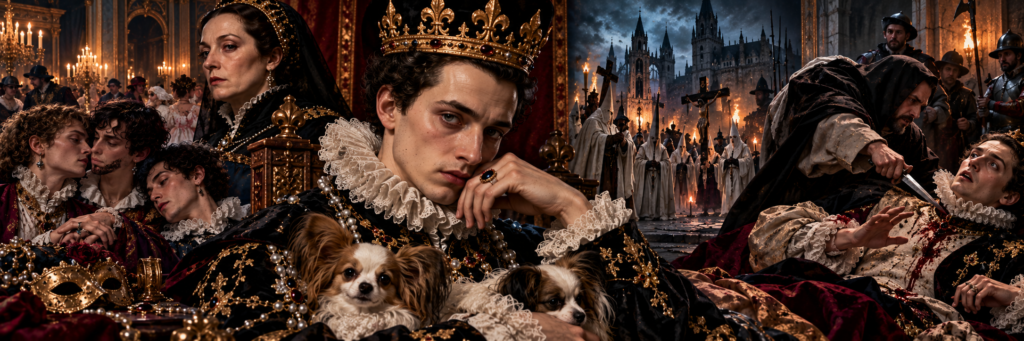
In the summer of 1589, the last king of the Valois dynasty was living under the protection of an army, unable to return safely to his own capital and surrounded by enemies who believed that killing him might be an act of religious devotion. Paris had turned against him, Catholic preachers denounced him as a tyrant, and pamphleteers portrayed him as a monstrous creature corrupted by luxury, sexual vice, witchcraft, and bloodshed. His once-magnificent court had become a symbol of everything his enemies claimed was wrong with France. The king’s elaborate clothing, expensive jewels, intimate male friendships, religious processions, and sometimes extravagant displays of mourning were held up as evidence that he was unfit to rule. His political opponents did not merely accuse him of making disastrous decisions. They attacked his masculinity, his faith, his morality, and even his humanity, constructing an image of a deranged monarch whose destruction was necessary for the salvation of the kingdom.
The man behind that reputation was Henry III of France, a ruler whose life had been shaped by civil war almost from childhood. He had commanded armies while still a teenager, become implicated in the political catastrophe surrounding the St. Bartholomew’s Day massacre, accepted election to the Polish-Lithuanian throne, and then returned to France after the death of his brother Charles IX. Intelligent, ceremonious, politically ambitious, and intensely concerned with royal authority, Henry inherited a kingdom whose religious divisions had become almost impossible to reconcile. Catholic extremists distrusted his attempts at compromise, Protestant leaders feared renewed persecution, and powerful aristocratic families repeatedly challenged his government. His marriage produced no children, leaving the succession increasingly uncertain and giving his enemies another reason to question the future of the monarchy. Every political decision took place beneath the growing shadow of a dynasty approaching extinction.
Henry’s reputation for madness was never based upon evidence comparable to the severe mental disturbances experienced by Charles VI of France nearly two centuries earlier. Instead, it emerged from an extraordinary combination of courtly behavior, religious conflict, political hostility, and increasingly vicious propaganda. His male favorites, known as the mignons, became targets of accusations that exploited contemporary anxieties about gender, sexuality, and aristocratic privilege. His devotional practices attracted ridicule because they appeared to contradict the luxury of his court. His grief over personal losses was interpreted as weakness, while his willingness to order political killings made him appear cruel and unpredictable. Even his fondness for small dogs became material for hostile stories portraying him as absurdly self-indulgent. By the end of his reign, the boundary between documented eccentricity and invented scandal had become almost impossible for ordinary observers to distinguish.
The most disturbing feature of Henry’s story is that his enemies eventually transformed ridicule into a justification for murder. In December 1588, he ordered the killing of Henry, Duke of Guise, a powerful Catholic rival whose popularity threatened royal authority. The assassination intensified hatred against the king, and radical preachers increasingly presented resistance to him as a religious obligation. Less than eight months later, a Dominican friar approached Henry under the pretense of delivering important information and stabbed him. The wounded king died the following day, ending the male line of the Valois dynasty that had ruled France since 1328. His death brought the Bourbon dynasty to the throne, but it did not immediately end the wars that had destroyed his authority. Henry III left behind a historical reputation as extravagant, unstable, and morally corrupt, yet the reality was far more complicated than the monstrous figure created by his enemies.
Born Into a Dying Dynasty: The Childhood of Henry III
Henry was born on September 19, 1551, at Fontainebleau, the son of King Henry II and Catherine de’ Medici. He was originally known as Alexandre-Édouard before receiving the name Henry, and his position within the royal family changed repeatedly as deaths altered the succession. His father ruled a powerful kingdom that remained deeply involved in European military rivalries, while his mother belonged to the influential Medici family of Florence. The French court celebrated Renaissance art, elaborate ceremonies, hunting, tournaments, and magnificent architecture, but its outward splendor concealed intense political competition. Powerful noble families sought access to royal favor, religious tensions were increasing, and France’s long struggle against the Habsburg dynasty consumed enormous resources. Henry’s earliest years unfolded within this environment of privilege and insecurity, where family relationships were inseparable from questions of political power.
The first major catastrophe of his childhood occurred in 1559, when his father suffered a fatal injury during a tournament celebrating the Peace of Cateau-Cambrésis. A shattered lance penetrated Henry II’s helmet and struck his face near the eye, producing injuries that proved fatal after eleven days of suffering. The crown passed to Henry’s elder brother Francis II, whose marriage to Mary, Queen of Scots, strengthened the influence of the powerful Guise family. Francis died in December 1560, leaving the throne to another brother, Charles IX, who was only ten years old. Catherine de’ Medici became the dominant figure in the government during Charles’s minority, attempting to preserve royal authority while Catholic and Protestant factions moved toward open confrontation. Henry therefore grew up watching his mother manage crises that threatened not merely individual ministers or noble families, but the stability of the monarchy itself.
The outbreak of the French Wars of Religion in 1562 transformed Henry’s adolescence into a period of repeated military and political emergencies. Protestant communities had expanded throughout France, attracting supporters among urban populations, scholars, merchants, and sections of the nobility. Catholic authorities regarded the movement as a threat to religious unity, while Protestant leaders feared persecution and sought guarantees for their worship and security. Attempts at compromise repeatedly collapsed under the pressure of local violence and aristocratic rivalry. The massacre at Vassy in March 1562, involving troops associated with Francis, Duke of Guise, helped ignite the first major war. Henry was still a child when these conflicts began, but their consequences would shape every stage of his adult life. By the time he inherited the crown, religious warfare had become a permanent feature of French political life.
Catherine recognized the importance of preparing her sons for government, and Henry received an education appropriate to a Renaissance prince. He developed interests in literature, political affairs, ceremony, and military leadership, while his position within the succession made him increasingly valuable to competing court factions. Later accounts sometimes portray him as his mother’s favorite son, an interpretation supported by their close political relationship but difficult to measure in purely emotional terms. Catherine relied upon Henry during important negotiations and campaigns, while Charles IX sometimes appeared sensitive to the influence and prestige enjoyed by his younger brother. Such tensions were hardly unusual within ruling families, especially when military command and political advancement were concentrated among a small number of princes. Yet in a kingdom divided by civil war, sibling rivalry could have consequences extending far beyond the royal household. Henry’s growing prominence would soon make him one of the most important political figures in France.
The Young Commander: Military Glory and the Shadow of Civil War
Henry acquired substantial military responsibilities while still in his teens, benefiting from his royal position and the experienced commanders surrounding him. In 1569, royal Catholic forces achieved important victories over Protestant armies at Jarnac and Moncontour, campaigns associated with Henry’s command. The Battle of Jarnac resulted in the death of Louis I, Prince of Condé, one of the leading Protestant commanders, while Moncontour inflicted another serious defeat upon Huguenot forces. These victories strengthened Henry’s reputation and made him an important symbol of Catholic military success. Nevertheless, the campaigns did not end Protestant resistance, which remained capable of rebuilding armies and maintaining fortified positions. The conflict demonstrated that battlefield victories could not easily resolve the religious and political divisions underlying the wars. Henry learned that military success brought prestige, but not necessarily lasting peace.
His role in these campaigns also placed him within the network of powerful noble families whose support was essential to royal government. Military commanders possessed personal followings, regional connections, and considerable influence over the distribution of rewards. The Guise family remained important, although its relationship with the monarchy could become strained when royal policies threatened its ambitions. Catherine attempted to maintain a balance among these interests while preventing any single faction from dominating the crown. Henry’s military reputation made him valuable to the government, but it also created potential competition with his brother Charles IX, whose authority depended upon recognition as sovereign. Later writers sometimes exaggerated this rivalry into a story of uncontrollable jealousy and resentment. The surviving evidence supports political tensions, but not the sensational psychological portrait often attached to them.
Henry’s military experience shaped his understanding of royal authority. He witnessed the destruction caused by sieges, battles, and religious violence, while also learning how aristocratic commanders could challenge or support the crown according to their interests. These lessons would become important after his accession, when he attempted to strengthen royal institutions and reduce dependence upon powerful noble factions. Yet the same experience may also have reinforced his willingness to use coercion when he believed the monarchy faced an immediate threat. His later decision to eliminate the Duke of Guise would reflect the dangerous intersection of royal authority, aristocratic rivalry, and political violence. The young prince who had achieved military prestige during the civil wars would eventually become a king struggling to survive their consequences.
St. Bartholomew’s Day: Henry’s Controversial Place in the Massacre
Henry’s reputation remains inseparable from the St. Bartholomew’s Day massacre of August 1572, one of the most devastating episodes of the French Wars of Religion. The violence occurred shortly after the marriage of Henry of Navarre, a prominent Protestant prince, to Marguerite de Valois, Henry’s sister. The wedding had been intended to strengthen reconciliation between Catholic and Protestant interests, bringing numerous Huguenot nobles to Paris under the expectation of royal protection. Tensions intensified after an assassination attempt against Admiral Gaspard de Coligny, a leading Protestant commander whose growing influence at court alarmed several political factions. During the night of August 23–24, royal authorities moved against selected Protestant leaders, and the violence expanded into a wider massacre involving armed groups and civilians. Thousands were killed in Paris and in subsequent provincial massacres, although the exact death toll remains disputed.
Henry, then Duke of Anjou, was an important member of the royal family and a prominent Catholic military figure. His proximity to the court and involvement in the political environment have made his precise role in the massacre a subject of historical debate. Some contemporary and later accounts attributed substantial responsibility to him, while others emphasized the decisions of Charles IX, Catherine de’ Medici, and their advisers. The private deliberations preceding the killings cannot be reconstructed with complete certainty, and historians disagree about the extent of individual initiative. Henry’s position makes it implausible to treat him as entirely detached from the crisis, but it is equally misleading to present every allegation about his involvement as established fact. The massacre emerged from collective political decisions, religious hostility, and violence that expanded beyond the initial operation against selected leaders. Its responsibility cannot be reduced to one prince acting independently.
The massacre became a defining event in Henry’s political education. It demonstrated how quickly a royal attempt to eliminate perceived enemies could produce violence beyond the government’s immediate control. It also destroyed Protestant confidence in promises of reconciliation, making future negotiations increasingly difficult. Henry’s subsequent reign would be haunted by the consequences, because the monarchy struggled to convince Protestant leaders that agreements could be trusted. Catholic extremists, meanwhile, became increasingly willing to challenge royal authority when they believed the crown insufficiently committed to religious persecution. The massacre therefore intensified the political environment that would eventually destroy Henry’s government. His controversial association with the events of 1572 also provided material for later writers seeking to portray him as cruel, hypocritical, or morally corrupted long before he inherited the French throne.
The King Who Fled His Crown: Henry’s Strange Polish Adventure
In 1573, Henry was elected king of the Polish-Lithuanian Commonwealth, an extraordinary development that briefly placed him at the head of a political system very different from the hereditary monarchy of France. The Commonwealth’s throne was elective, and its nobility possessed extensive privileges that limited royal authority. Henry’s candidacy attracted support through diplomatic negotiations, promises, and the expectation that a French prince might strengthen international relationships. His election required acceptance of constitutional arrangements that restricted the monarch’s power, including obligations associated with the Henrician Articles. For a prince raised within the traditions of French kingship, the political environment presented unfamiliar challenges. Henry traveled to the Commonwealth and was crowned in Kraków in February 1574, beginning a reign that would prove remarkably brief.
The circumstances of his departure became one of the most memorable episodes of his life. In May 1574, Charles IX died without a surviving legitimate son, making Henry the heir to the French throne. News of his brother’s death reached him in Poland, creating a conflict between his recently acquired elective crown and his hereditary claim to France. Rather than remaining to negotiate a prolonged settlement, Henry left Kraków secretly during the night of June 18–19, 1574. His departure was hurried and controversial, and Polish officials attempted to persuade him to return. The episode has frequently been described as a disguised escape, with the king supposedly fleeing like a thief while furious subjects pursued him. Although the secrecy and urgency of his departure are well established, the most theatrical details of disguises and frantic pursuit belong to accounts that require careful evaluation.
Henry’s decision was politically understandable despite the scandal it created. The French crown offered greater dynastic significance, more familiar institutions, and the opportunity to rule the kingdom of his ancestors. Remaining in Poland might have endangered his succession in France or allowed rival factions to consolidate power during his absence. Nevertheless, his abrupt departure damaged his reputation in the Commonwealth and demonstrated the difficulty of reconciling two different systems of monarchy. Polish nobles had elected him under conditions intended to preserve their political privileges, while Henry regarded the French succession as an overriding priority. The episode became an early example of the tension between his personal ambitions and the expectations of those who believed he owed them loyalty. Later hostile writers used it to portray him as irresponsible and incapable of fulfilling royal obligations.
Instead of traveling directly to France, Henry made a celebrated journey through parts of central Europe and Italy, including an extended stay in Venice. The Venetian reception was magnificent, reflecting the importance attached to a French king whose political relationships could influence European diplomacy. Henry encountered elaborate ceremonies, artistic displays, and the sophisticated culture of one of the Mediterranean’s most powerful republics. His visit became associated with luxury and entertainment, encouraging later stories that he squandered time and money while France remained unstable. Yet diplomatic travel and ceremonial receptions were normal features of Renaissance monarchy, and his journey cannot be reduced to an irresponsible holiday. He eventually returned to France and was crowned at Reims in February 1575. His Polish adventure remained an unusual chapter in his life, but the challenges awaiting him in France were far more dangerous than those he had left behind.
Louise of Lorraine: A Marriage Without an Heir
Shortly after his coronation, Henry married Louise of Lorraine-Vaudémont, a noblewoman whose family connections placed her within the political world of the French court. Their wedding took place in February 1575, and the marriage became an important element of Henry’s public identity. Unlike the image of a monarch interested only in male favorites, Henry maintained a close relationship with his wife, and contemporary evidence suggests genuine affection between them. Louise was not a dominant political figure in the manner of Catherine de’ Medici, but she occupied an important ceremonial and dynastic position. The couple’s failure to produce children became increasingly significant as the reign progressed. Without a legitimate son, the continuation of the Valois male line depended upon uncertain possibilities, and succession questions gradually became central to the kingdom’s political crisis.
The absence of an heir encouraged speculation about Henry’s sexuality, fertility, and physical health. Hostile pamphleteers used the situation to reinforce accusations that his relationships with male favorites were sexually improper or that his court had become corrupted by luxury. Such accusations were politically useful because dynastic continuity was a fundamental responsibility of monarchy. Yet the absence of children does not establish infertility in either spouse, nor does it prove anything about the king’s sexual orientation. Contemporary evidence does not permit a reliable reconstruction of Henry’s private sexual life, and modern categories cannot be imposed confidently upon sixteenth-century relationships. His marriage to Louise remained part of his life throughout his reign, while his friendships with male courtiers operated within a political and cultural system in which intimacy, patronage, and personal loyalty were closely connected. The failure of the marriage to produce an heir was politically disastrous, but it should not be transformed into proof of psychiatric or sexual abnormality.
The succession problem became particularly dangerous after the death of Henry’s younger brother Francis, Duke of Anjou, in 1584. Francis had represented the last plausible male heir within the immediate Valois family, and his death made Henry of Navarre, a Protestant Bourbon prince, the next heir under the traditional rules of succession. For militant Catholics, the prospect of a Protestant king was intolerable. The Catholic League gained renewed strength, presenting itself as the defender of the kingdom’s religious identity and challenging Henry’s willingness to recognize Navarre’s hereditary claim. The king now faced a conflict between dynastic legitimacy and the demands of powerful Catholic interests. His inability to produce a son had become a national political crisis, and his enemies increasingly used the succession question to undermine his authority. The personal disappointment of a childless marriage therefore developed into one of the principal causes of the final struggle that would destroy his reign.
The Mignons: The Young Men Who Became a National Scandal
Few aspects of Henry III’s reign attracted more hostile attention than his relationships with the young male courtiers known as the mignons. The term could refer to favorites or intimate companions, but it acquired increasingly negative associations as political opponents attacked the king’s household. Henry cultivated a circle of men whose loyalty depended upon personal access, patronage, and opportunities for advancement. Among the most prominent were Anne de Joyeuse and Jean Louis de Nogaret de La Valette, later Duke of Épernon, whose careers demonstrated the extraordinary rewards available through royal favor. These men did not simply entertain the king or participate in fashionable court life. They occupied military and political positions, received titles and resources, and helped Henry construct networks of loyalty that could counterbalance the influence of older aristocratic families.
The rise of the favorites angered nobles who believed that rank, ancestry, and established service should determine access to royal patronage. Henry’s willingness to elevate relatively younger courtiers threatened the political expectations of families accustomed to dominating government. The resulting resentment was expressed through accusations that the favorites were effeminate, extravagant, arrogant, and sexually immoral. Their elaborate clothing, jewelry, hairstyles, and courtly manners became convenient targets because they appeared to challenge traditional ideals of martial masculinity. Yet Renaissance aristocratic fashion was itself highly elaborate, and the distinction between acceptable magnificence and supposedly excessive display was often politically constructed. A nobleman favored by the king could be praised for elegance by supporters and condemned for effeminacy by enemies. The mignons became symbols of a broader struggle over who deserved influence within the monarchy.
Accusations of sodomy were particularly damaging because they carried severe religious and moral implications in sixteenth-century Europe. Hostile pamphlets portrayed Henry and his favorites as participants in sexual practices condemned by contemporary law and theology, using insinuation and ridicule to undermine royal legitimacy. Such allegations have influenced popular representations of Henry for centuries, but they cannot be accepted as proof of specific sexual relationships. The surviving evidence documents close male friendships, political favoritism, ceremonial intimacy, and elaborate courtly behavior, while the private sexual conduct of the individuals involved remains uncertain. Modern historians have increasingly emphasized the political function of these accusations, which allowed opponents to portray the king as incapable of fulfilling the masculine and dynastic responsibilities of monarchy. The distinction matters because hostile descriptions of gender presentation do not establish psychiatric illness, and allegations of same-sex activity should not be treated as evidence of madness. Henry’s enemies exploited contemporary prejudices to transform court politics into a moral scandal.
The mignons also reflected Henry’s attempt to govern through personal loyalty at a time when powerful aristocratic families repeatedly challenged the crown. By promoting men whose advancement depended upon him, Henry hoped to create reliable supporters capable of carrying out royal policy. The strategy was not inherently irrational, since Renaissance monarchs frequently relied upon favorites to balance established noble interests. Nevertheless, the extraordinary rewards granted to certain courtiers created resentment and intensified factional competition. The king’s political difficulties made the favorites especially vulnerable to attack, because critics could portray their privileges as evidence that royal resources were being wasted while the kingdom suffered from taxation and warfare. The resulting propaganda proved remarkably effective. Even centuries later, Henry’s reign is often remembered through caricatures of perfumed courtiers and extravagant clothing rather than through the administrative and political challenges that made favoritism attractive.
The Duel of the Mignons: Bloodshed Among the King’s Favorites
The most famous tragedy involving Henry’s favorites occurred in April 1578, when a confrontation among young noblemen developed into the event remembered as the Duel of the Mignons. The encounter took place near Paris and involved several men associated with rival court circles. What began as a dispute over honor and personal rivalry escalated into a deadly fight in which participants were killed or mortally wounded. Jacques de Lévis, Count of Caylus, one of Henry’s favorites, suffered severe injuries and died after lingering for weeks. Louis de Maugiron was killed during the encounter, while other participants also suffered fatal or serious wounds. The violence shocked the court because it involved men closely connected to the king and demonstrated how aristocratic codes of honor could produce destructive private conflicts. The incident also gave Henry’s enemies another opportunity to ridicule the extravagance and instability of his household.
Henry’s grief over the deaths became one of the defining images of his reign. He arranged elaborate funerary honors and commemorations, demonstrating the importance he attached to the men who had served him. The king’s mourning was unusually conspicuous, particularly because the dead courtiers had been involved in a private duel rather than a major military campaign. Critics interpreted his response as excessive and unmanly, suggesting that his emotional attachment to the favorites revealed a disturbed or morally corrupted personality. Yet royal mourning also possessed political significance, because honoring loyal servants could reinforce the value of personal service to the crown. Henry’s grief may have been genuine, but its public expression was shaped by ceremonial expectations and political calculation. The incident therefore illustrates how difficult it can be to separate personal emotion from the performance of monarchy.
Later accounts added sensational details to the story, claiming that Henry preserved locks of hair, removed earrings from the dead, or treated personal objects as relics of his companions. Such anecdotes fit the image of a monarch consumed by theatrical grief, but their reliability varies and should not be assumed. The documented importance of the funerary ceremonies does not establish every macabre detail repeated in popular histories. Nor does intense mourning prove clinical depression or emotional instability. Renaissance culture possessed elaborate traditions of commemorating the dead, and aristocratic relationships could involve forms of affection expressed more openly than modern stereotypes of masculinity might suggest. Henry’s reaction attracted hostility because his enemies already regarded the favorites as symbols of corruption. The deaths became politically useful evidence in a campaign portraying the king’s court as a place where private indulgence had displaced the responsibilities of government.
Jewels, Ruffs, Perfumes, and the Politics of Royal Appearance
Henry III’s appearance became one of the most recognizable elements of his historical reputation. Contemporary portraits and descriptions show a monarch interested in elaborate clothing, fashionable collars, jewelry, and carefully managed courtly presentation. The large starched ruffs associated with late sixteenth-century fashion could create an imposing visual effect, framing the face and emphasizing the wearer’s status. Henry’s court participated in the broader development of European aristocratic fashion, where clothing communicated rank, refinement, wealth, and political identity. Yet hostile observers portrayed his attention to appearance as evidence of vanity and effeminacy, particularly when contrasted with the ideal of a warrior king. The accusations became more intense as France’s political and financial difficulties worsened. A ruler who appeared magnificently dressed while his subjects endured taxation and war offered an obvious target for resentment.
The claim that Henry spent hours each morning applying heavy cosmetics, sleeping in special gloves, or preserving his hairstyle beneath elaborate nightwear appears frequently in popular descriptions. Some elements reflect genuine early modern grooming practices, while others belong to hostile caricature or later embellishment. Cosmetics, perfumes, gloves, and carefully arranged hair were not unusual among European elites, although the degree of Henry’s personal involvement in particular rituals remains uncertain. The assertion that he routinely painted his face with dangerous quantities of white lead cannot be accepted without reliable evidence establishing the practice. Likewise, stories that he was terrified of aging or unable to function without prolonged grooming impose psychological motives that the surviving sources do not securely reveal. His appearance was certainly important to his public identity, but royal fashion was also a political language through which authority and distinction were expressed. The controversy surrounding his clothing reveals as much about the expectations of his critics as it does about Henry himself.
Cross-dressing and masquerade stories require similar caution. Renaissance courts organized elaborate entertainments in which participants adopted costumes, performed theatrical roles, and temporarily crossed conventional boundaries of appearance. Henry participated in a culture that valued such spectacles, and hostile writers sometimes used these events to accuse him of gender inversion or sexual misconduct. Yet the surviving evidence does not justify treating every claim that he dressed as a woman as an established account of habitual behavior. Some descriptions were produced by opponents who deliberately exaggerated his appearance to portray him as incapable of masculine kingship. The political significance of the accusations was considerable because royal authority was closely associated with military courage, dynastic fertility, and conventional gender expectations. By depicting Henry as effeminate, his enemies suggested that he lacked the qualities necessary to defend the kingdom. The result was a propaganda campaign in which fashion became a weapon against legitimacy.
The King’s Little Dogs: Affection, Luxury, and an Enduring Legend
Henry’s fondness for small dogs became another celebrated feature of his eccentric reputation. Stories describe him carrying miniature dogs in baskets, allowing them extraordinary privileges, and devoting substantial attention to their comfort. Some accounts portray him receiving ambassadors while wearing a basket containing sleeping puppies, carefully avoiding movement so that the animals would not be disturbed. Others claim that he maintained hundreds of lapdogs, employed servants to care for them, and provided special food prepared exclusively for their consumption. These anecdotes have been repeated because they create an irresistible contrast between the responsibilities of monarchy and the apparent frivolity of a ruler preoccupied with pets. Yet the precise numbers and details are difficult to verify, and the most elaborate versions may reflect exaggeration. Henry’s association with small dogs is historically plausible, but the entire collection of sensational stories should not be treated as a single documented account.
The popularity of these anecdotes reflects the political atmosphere in which Henry’s reputation developed. A king who spent time with small dogs could be portrayed as gentle or affectionate by sympathetic observers, but as weak and absurd by enemies determined to attack his masculinity. The alleged confiscation of attractive dogs from their owners, including religious women, added another element of arbitrary behavior to the caricature. Such stories suggested that Henry used royal authority to satisfy trivial personal desires while neglecting serious affairs of state. Yet individual incidents require independent evidence, and later retellings often lack the context necessary to determine whether they occurred. The image of a king surrounded by pampered animals became useful because it condensed broader accusations of extravagance, selfishness, and political incapacity into a memorable scene. It remains one of the clearest examples of how minor personal interests could be transformed into evidence of supposed madness.
Henry’s fondness for dogs also demonstrates the difficulty of interpreting royal behavior through modern expectations. Small companion animals were present in elite European households, and affection for them did not necessarily indicate unusual psychological dependence. Royal courts maintained animals for hunting, display, companionship, and entertainment, making the presence of dogs entirely ordinary. What made Henry’s reported behavior controversial was the suggestion that he preferred the company of pets to the responsibilities of government or the expectations of aristocratic masculinity. That interpretation was shaped by political hostility rather than medical observation. Even if he carried small dogs during certain activities, the behavior would not establish a psychiatric disorder. The historical significance lies in the way opponents used an apparently harmless preference to undermine the image of a ruler already struggling to preserve his authority.
The Death of Marie de Clèves: Love, Loss, and the King’s Dark Mourning
Before becoming king of France, Henry developed a strong attachment to Marie de Clèves, a noblewoman whose marriage to Henry I, Prince of Condé, placed her within the politically important Bourbon family. Their relationship has become the subject of romantic traditions portraying Henry as deeply in love with a woman he could not marry. Marie died in October 1574 after childbirth, while Henry was returning from Poland to assume the French crown. Her death reportedly affected him profoundly, and later accounts describe elaborate mourning and a period of withdrawal. The circumstances were emotionally significant because Henry had recently lost his brother Charles IX and was preparing to inherit a kingdom in crisis. Yet the precise intensity of his grief and the details of his private behavior cannot be established with certainty. The familiar image of a prince locking himself away for days without food belongs partly to a tradition that dramatized his emotional life.
Stories of Henry adopting skulls, death’s-head symbols, and dark clothing after Marie’s death have contributed to his reputation for morbid fascination. Mourning dress and imagery associated with mortality were common features of early modern aristocratic culture, especially in religious and commemorative contexts. The use of such symbols did not necessarily indicate pathological obsession with death. Nevertheless, Henry’s reported grief became politically meaningful because critics later connected it with his elaborate mourning for the mignons and his participation in penitential religious ceremonies. These separate events were combined into a portrait of a monarch whose emotions supposedly overwhelmed his judgment. The resulting narrative made his private losses appear to explain his political failures. A more careful interpretation recognizes that grief, ceremonial display, and religious devotion could coexist without establishing clinical depression or mental instability.
Marie de Clèves also occupied a complicated political position because of her marriage to the Protestant Prince of Condé. Her relationship with Henry therefore existed within a world where romantic attachment could intersect with religious and dynastic rivalry. The surviving evidence does not support every dramatic story about their relationship, but the association became important to later portrayals of Henry as a man whose emotional life was unusually intense. His subsequent marriage to Louise of Lorraine did not erase the memory of Marie in popular historical writing. Instead, the two relationships were often contrasted, with Marie presented as the lost romantic ideal and Louise as the devoted but childless queen. Such interpretations may reveal more about later literary expectations than about Henry’s private emotions. The historical record permits recognition of personal attachment and grief, but not a complete reconstruction of his psychological state.
The Penitent King: Barefoot Processions and Public Self-Mortification
Henry’s religious practices became among the most controversial aspects of his reign because they combined elaborate Catholic devotion with the magnificence of a Renaissance court. He participated in penitential confraternities and supported religious ceremonies emphasizing humility, repentance, and spiritual discipline. Processions involving penitential clothing, covered faces, candles, and public prayer attracted considerable attention, particularly when the king himself participated. Such practices belonged to established Catholic devotional traditions, although their public prominence could appear unusual when performed by a monarch expected to embody worldly authority. Henry’s involvement reflected genuine religious interests, but it also served political purposes by demonstrating his Catholic identity during a period when militant factions questioned his orthodoxy. The contrast between penitential humility and royal luxury made the ceremonies vulnerable to ridicule. Critics portrayed the king as alternating irrationally between indulgence and self-punishment, interpreting religious devotion as evidence of emotional instability.
Some accounts describe Henry and his companions walking barefoot, wearing penitential garments, or engaging in forms of self-mortification during religious observances. Such practices were not unique to him, and they existed within a broader European tradition of public penance. Nevertheless, the spectacle of a king participating in rituals associated with humility could challenge expectations of royal dignity. For subjects suffering from war, taxation, and economic uncertainty, elaborate religious ceremonies might appear disconnected from the practical problems facing the kingdom. Political opponents exploited this tension, accusing Henry of hypocrisy because his devotional practices coexisted with expensive court entertainments and the privileges granted to favorites. Yet the accusation that he was mentally unstable because he engaged in penance confuses religious culture with psychiatric diagnosis. His behavior may have been controversial, but it was intelligible within the devotional world of Counter-Reformation Catholicism.
Henry’s religious commitments also complicated the claims of the Catholic League, which portrayed itself as the defender of the faith against Protestantism. The king remained Catholic and supported Catholic worship, but he increasingly resisted the League’s attempts to dictate royal policy. His participation in penitential ceremonies did not satisfy extremists who believed that political compromise with Protestant interests constituted betrayal. The League therefore attacked him not simply for insufficient religious devotion but for refusing to surrender royal authority to its leaders. His visible piety became a target because opponents could portray it as theatrical and insincere. The resulting propaganda transformed a religiously observant monarch into an alleged hypocrite whose ceremonies concealed moral corruption. Henry’s devotional life reveals the difficulty of maintaining royal legitimacy when religious identity had become a weapon in political conflict.
Catherine de’ Medici and Her Most Difficult Son
Catherine remained an important adviser throughout Henry’s reign, drawing upon decades of experience managing the political crises that had threatened the Valois dynasty. Their relationship was close, but it was not free from disagreement, and Henry did not simply obey every recommendation she offered. Catherine pursued negotiations with rival factions, participated in diplomatic missions, and attempted to preserve the monarchy through compromises that often satisfied neither Catholic extremists nor Protestant leaders. Her influence depended upon her experience and dynastic position, while Henry retained the authority to make final decisions. The popular image of Catherine attempting to control an uncontrollable son oversimplifies their relationship. She had helped prepare him for kingship and continued to support the dynasty, but the political problems confronting them were too extensive to be resolved through personal influence alone.
The king’s favorites created particular difficulties because their advancement could threaten established noble interests and complicate Catherine’s efforts to balance factions. Yet she understood the importance of patronage and had long operated within a court where personal relationships shaped political authority. Henry’s reliance upon trusted companions was not necessarily irrational, especially when powerful families repeatedly challenged the crown. Catherine could recognize the strategic value of such relationships while remaining concerned about the resentment they produced. Their disagreements therefore reflected competing political calculations rather than a simple conflict between maternal restraint and childish extravagance. The monarchy needed loyal servants, but excessive rewards could alienate other nobles whose cooperation remained essential. Henry’s court became increasingly difficult to manage because every attempt to strengthen royal authority risked intensifying factional hostility.
Catherine’s final years were overshadowed by the growing power of the Catholic League and the king’s deteriorating political position. She continued to seek negotiated solutions, but the conflicts surrounding the succession and the Guise family became increasingly dangerous. By 1588, the monarchy faced a crisis in which royal authority was openly challenged by militant Catholic interests. Catherine’s experience could no longer guarantee compromise, and Henry increasingly relied upon decisions that reflected his own determination to preserve sovereignty. The assassination of the Duke of Guise in December 1588 occurred during this final period of political breakdown. Catherine died in January 1589, only weeks after the killings at Blois, leaving Henry without the mother who had guided the dynasty through decades of crisis. Her death removed an experienced adviser at precisely the moment when the king’s enemies were becoming more determined to destroy him.
The Catholic League: When Defending the Faith Became Rebellion
The Catholic League emerged as a powerful political force during the later stages of the French Wars of Religion, presenting itself as the defender of Catholicism against Protestant influence. Its strength increased dramatically after the death of Francis, Duke of Anjou, in 1584, which made the Protestant Henry of Navarre the next heir to the French throne. Militant Catholics feared that Navarre’s accession would threaten the religious identity of the kingdom and undermine the privileges of the Catholic Church. Henry III remained Catholic, but his recognition of hereditary succession and willingness to negotiate with Protestant interests made him increasingly suspect. The League attracted support among nobles, urban populations, clergy, and political figures who believed that religious unity justified resistance to royal policy. Its leaders included Henry, Duke of Guise, whose military reputation and family connections made him a formidable rival. The conflict transformed a religious movement into a direct challenge to the monarchy.
Henry III attempted to manage the League through negotiation, concessions, and political maneuvering, but his position became increasingly difficult. The Treaty of Nemours in 1585 imposed severe restrictions upon Protestant worship and reflected the pressure exerted by militant Catholic interests. The resulting conflict became part of the War of the Three Henrys, involving Henry III, Henry of Navarre, and Henry of Guise. Each represented a different political position within the struggle over religion and succession, although their alliances and objectives were more complicated than a simple division between Catholic and Protestant. Henry III sought to preserve royal authority while confronting the League’s demands and the military strength of Protestant forces. Guise increasingly presented himself as the defender of Catholic France, attracting support that threatened to eclipse the king’s own popularity. The rivalry became particularly dangerous in Paris, where militant Catholic opinion was strongly influenced by League leaders and preachers.
The League’s propaganda attacked Henry’s personal conduct as well as his policies. Pamphleteers accused him of sexual immorality, effeminacy, witchcraft, religious hypocrisy, and tyranny, drawing upon familiar scandals surrounding his favorites and court ceremonies. These accusations were designed to undermine the sacred authority traditionally associated with French kingship. A monarch who could be portrayed as morally monstrous became easier to resist, and a ruler accused of betraying the faith could be presented as an enemy of the religious community he was supposed to protect. The campaign therefore served a political purpose extending far beyond personal ridicule. It helped create an atmosphere in which opposition to Henry could be justified as a defense of religion and the kingdom. By the late 1580s, the king’s reputation had become a battlefield as important as the military campaigns themselves.
The Day of the Barricades: Paris Turns Against Its King
In May 1588, tensions between Henry III and the Catholic League erupted in Paris. The Duke of Guise entered the capital despite royal objections, and his presence encouraged supporters who already regarded him as the champion of Catholic interests. The confrontation escalated into the Day of the Barricades on May 12, when Parisians erected obstacles throughout the streets and royal forces found themselves threatened by an increasingly hostile population. The uprising demonstrated the strength of League organization and the weakness of royal authority within the capital. Henry could no longer assume that Paris would obey his commands or that his troops could restore order without provoking wider violence. The situation became so dangerous that he withdrew from the city. The departure was a humiliating moment for a monarch whose authority was supposed to extend throughout the kingdom.
The Day of the Barricades transformed the political balance between Henry and Guise. The duke’s popularity in Paris gave him extraordinary influence, while the king’s withdrawal exposed the limitations of royal power. Henry subsequently accepted concessions intended to restore stability, including arrangements that strengthened the League’s position. Yet the underlying conflict remained unresolved because Guise’s ambitions threatened the independence of the crown. The king faced the possibility that his government would become subordinate to a noble faction claiming to act in the name of Catholic France. His earlier efforts to balance rival interests had failed, and the monarchy appeared increasingly isolated. The crisis encouraged Henry to consider more drastic measures against the man whose influence had become intolerable.
Murder at Blois: The King Strikes Against the Duke of Guise
In December 1588, Henry III convened the Estates-General at Blois amid continuing political tension. The assembly reflected the depth of the kingdom’s crisis, with religious conflict, financial difficulties, and the question of royal authority dominating political discussion. The Duke of Guise remained a powerful figure whose influence threatened the king’s position, and Henry increasingly regarded him as an immediate danger. On December 23, Guise was summoned to the royal apartments at the Château de Blois, where members of the king’s guard attacked and killed him. The assassination was deliberate and organized, carried out within a royal residence under circumstances that demonstrated the king’s willingness to use lethal force against a powerful rival. The following day, Guise’s brother, Louis II, Cardinal of Guise, was also killed. The murders shocked France and transformed an already dangerous political conflict into an open struggle over the legitimacy of the monarchy.
The killings at Blois have often been portrayed as evidence of Henry’s unstable temperament or sudden descent into cruelty. Yet the decision was politically calculated, even if its consequences proved disastrous. Guise had challenged royal authority, enjoyed immense popularity among militant Catholics, and threatened to reduce the king to a figurehead. Henry’s action reflected the belief that eliminating the duke might destroy the League’s leadership and restore the monarchy’s independence. The calculation failed because the League possessed broader support and organizational strength than one individual. Rather than collapsing, the movement intensified its opposition and portrayed the murdered duke as a martyr. Henry had removed a dangerous rival, but he had also given his enemies a powerful symbol around which to unite.
The assassination destroyed much of the remaining legitimacy Henry possessed among militant Catholics. Preachers denounced him as a murderer and tyrant, while pamphleteers intensified attacks upon his morality, religious sincerity, and personal conduct. The king’s earlier scandals were now interpreted through the murder of Guise, creating a portrait of a ruler whose supposed depravity had culminated in sacrilegious violence. Paris became increasingly hostile, and the League encouraged resistance to royal authority. Henry’s position deteriorated rapidly because he could no longer rely upon the loyalty of important Catholic constituencies. The monarchy that had once attempted to balance religious factions now faced rebellion from those claiming to defend the faith. The decision at Blois therefore became one of the most consequential acts of Henry’s reign, setting the stage for his eventual assassination.
The Black Legend: How Propaganda Turned Henry Into a Monster
Henry III’s historical reputation was shaped by one of the most aggressive propaganda campaigns directed against a French monarch during the sixteenth century. His enemies portrayed him as sexually corrupt, effeminate, extravagant, hypocritically religious, and dangerously tyrannical. The accusations drew upon recognizable elements of court life but frequently exaggerated them into grotesque caricature. His clothing became evidence of gender inversion, his favorites became proof of sexual misconduct, his religious ceremonies became signs of madness, and his affection for small dogs became a symbol of absurd indulgence. After the murder of Guise, these themes were intensified by claims that Henry had betrayed the Catholic faith and forfeited the right to rule. The propaganda was effective because it connected personal scandal with political grievance, making opposition to the king appear morally justified. It also exploited the anxieties of a society in which monarchy, masculinity, religion, and dynastic continuity were closely linked.
The League’s pamphleteers did not merely seek to embarrass Henry. They attempted to undermine the sacred foundations of royal authority by portraying him as a ruler whose conduct placed him outside the moral community of Christian kings. Accusations of witchcraft and heresy were especially useful because they suggested that his apparent Catholic devotion concealed spiritual corruption. Claims of sexual deviance served a similar purpose, attacking the masculine legitimacy expected of a monarch and connecting the absence of an heir with supposed moral failure. These allegations were not neutral descriptions of private behavior. They were political weapons intended to encourage resistance and justify extraordinary action against the crown. The distinction is essential because many later histories repeated the accusations without fully considering the circumstances in which they were produced.
Henry’s reputation also suffered because the political world he attempted to govern was already deeply divided. Protestant writers remembered the St. Bartholomew’s Day massacre and remained suspicious of Valois intentions, while militant Catholics condemned his negotiations with Protestant interests and his killing of Guise. The king therefore faced hostility from opposing sides for different reasons, making it difficult for his supporters to construct a stable public image. His administrative efforts, political intelligence, and attempts to preserve royal authority were overshadowed by stories that were more dramatic and easier to remember. The resulting black legend survived long after his death, influencing popular histories, literature, and artistic representations. Henry became a symbol of decadent monarchy, even though the evidence for many of the most sensational accusations remained uncertain. His case demonstrates how political propaganda can transform selective observations into an apparently coherent portrait of psychological abnormality.
The Bourbon Succession: A New Dynasty and the Memory of the Valois
The accession of the Bourbon dynasty after Henry’s death created a new political context in which the reputation of the last Valois king could be interpreted. Henry of Navarre, who succeeded as Henry IV, faced the enormous challenge of establishing legitimacy in a kingdom where militant Catholics had resisted the prospect of a Protestant monarch. His eventual conversion to Catholicism in 1593 and his entry into Paris in 1594 helped strengthen his position, but the process of pacification required years of political negotiation and military effort. The Bourbon monarchy benefited from presenting itself as the force that restored stability after decades of civil war. Within that narrative, the final Valois reigns could appear as a period of weakness, factionalism, and dynastic exhaustion. Henry III’s scandals and assassination provided especially dramatic material for contrasting a troubled past with the promise of renewed order.
Nevertheless, the claim that the Bourbon dynasty deliberately invented or uniformly preserved Henry’s black reputation to glorify itself requires qualification. Much of the hostile material had already been produced during Henry’s lifetime, particularly by the Catholic League, and its origins cannot be attributed to Bourbon propaganda. Henry IV had also been Henry III’s political ally during the final months of his reign, making a simple narrative of Bourbon hostility historically misleading. Later royal historiography could emphasize the restoration of peace under the Bourbons, but interpretations of the Valois past varied according to political, religious, and literary circumstances. The negative image of Henry III survived because it had become embedded in influential narratives, not because one dynasty exercised complete control over historical memory. His reputation was shaped by multiple generations of writers whose purposes differed considerably. The Bourbon succession contributed to the context in which his reign was remembered, but it did not create the scandals from nothing.
The contrast between Henry III and Henry IV became particularly attractive to later historians and storytellers. Henry IV could be celebrated as a vigorous, pragmatic ruler who restored order, while Henry III was portrayed as extravagant, indecisive, and absorbed in courtly pleasures. Such comparisons simplified both men, overlooking the complexity of their political circumstances and the difficulties each faced. Henry III had governed during a period when religious factions challenged the authority of the crown and dynastic uncertainty encouraged rebellion. Henry IV inherited those conflicts but eventually achieved greater success in stabilizing the kingdom. The difference in outcomes influenced historical judgment, sometimes allowing the earlier king’s failures to be interpreted as personal defects rather than consequences of structural political crisis. Henry III’s reputation therefore became part of a broader story about the decline of one dynasty and the rise of another.
The Final Alliance: Henry III and Henry of Navarre
After the killings at Blois, Henry III found himself increasingly isolated from the Catholic League and unable to regain control of Paris. His enemies portrayed him as a tyrant whose murder of Guise had destroyed his legitimacy, while militant preachers encouraged resistance in religious language. The king’s remaining options were limited because he lacked sufficient support to defeat the League independently. In this desperate situation, he entered into an alliance with Henry of Navarre, the Protestant heir whose succession had previously alarmed Catholic extremists. The partnership was politically remarkable because it united a Catholic king with a Protestant prince against a movement claiming to defend Catholic France. Yet it reflected the overriding importance of royal authority and dynastic legitimacy in the final struggle. Both men had reasons to oppose the League’s attempt to control the monarchy.
The alliance brought together forces capable of threatening Paris, and by the summer of 1589 the two Henrys were preparing operations against the capital. Henry III established himself at Saint-Cloud, outside Paris, while military plans developed around the possibility of recovering the city. The king remained vulnerable because his enemies controlled influential religious and political networks, and the atmosphere of hostility had become increasingly extreme. League propaganda portrayed him as a legitimate target of resistance, while the memory of Guise’s murder encouraged demands for vengeance. The danger was not confined to the battlefield, because assassination had become an accepted instrument within the political culture of the wars. Henry had ordered the killing of a rival in December 1588, and his enemies now contemplated the destruction of the king himself. The final stage of his reign unfolded within a world where political legitimacy could be challenged through violence presented as religious duty.
The Assassin in the Royal Camp: Jacques Clément Strikes
On August 1, 1589, a young Dominican friar named Jacques Clément approached Henry III at Saint-Cloud. Clément had connections with the militant Catholic environment that opposed the king, and he sought access under the pretense of delivering important information. Accounts of the encounter differ in certain details, but the central event is clear: Clément gained an audience and stabbed Henry in the abdomen. The attack occurred within the royal camp, demonstrating the vulnerability of a monarch whose enemies could exploit religious status and claims of urgent communication to approach him. The wound was serious, and the king’s attendants immediately confronted the assassin, who was killed. Henry initially survived the attack, allowing time for medical attention and political preparations. Yet the injury proved fatal, and he died on August 2, 1589.
The assassination shocked Europe because it represented the killing of a reigning monarch by a religious figure acting within a climate of militant political hostility. Clément’s motives were connected to the belief that Henry had betrayed Catholic France through his policies and the murder of Guise. The attack was not simply an isolated act of personal anger, because it emerged from an environment in which radical preachers and pamphleteers had repeatedly questioned the king’s legitimacy. Nevertheless, the precise extent of any organized conspiracy behind Clément remains disputed. Some contemporaries celebrated the assassin as a defender of the faith, while others condemned the murder as a shocking violation of royal and religious order. The contrasting reactions revealed the depth of France’s divisions. A king whose authority had once been presented as sacred had become, in the eyes of some subjects, an enemy whose death could be justified.
Henry’s final hours became the subject of numerous accounts emphasizing his concern for the succession and the future of the kingdom. He recognized Henry of Navarre as his legitimate successor, although the exact wording of speeches attributed to him varies across sources. The political significance of the succession was unmistakable because the death of Henry III ended the direct male line of the Valois dynasty. The crown passed to the Bourbon heir, but his Protestant faith made immediate acceptance impossible among many Catholic opponents. Henry IV would spend years fighting to secure recognition and control of the kingdom. The assassination therefore did not bring peace, despite the hopes of those who believed removing Henry III would resolve the crisis. Instead, it opened another phase of conflict while marking the end of a dynasty that had ruled France for more than two and a half centuries.
The End of the Valois: A Dynasty Dies With Henry III
The Valois dynasty had ruled France since 1328, when Philip VI inherited the crown after the extinction of the direct Capetian male line. Over the following centuries, Valois monarchs confronted the Hundred Years’ War, aristocratic rebellion, foreign invasion, religious upheaval, and the transformation of medieval kingship into Renaissance monarchy. Their reigns included celebrated military achievements, cultural patronage, territorial expansion, and repeated dynastic crises. Henry III inherited the accumulated authority of this long history, but he also inherited the consequences of decades of religious conflict and political fragmentation. His failure to produce an heir, combined with the deaths of his brothers, made the continuation of the dynasty impossible through its legitimate male line. When Jacques Clément stabbed him in August 1589, the attack ended more than one life. It brought a historic royal house to its conclusion.
The succession of Henry IV marked the beginning of Bourbon rule, but the transition was neither peaceful nor universally accepted. The new king faced resistance from Catholic League supporters who rejected a Protestant monarch, while foreign powers continued to intervene in French affairs. Henry IV’s eventual conversion to Catholicism and his efforts to pacify the kingdom helped establish the dynasty, but those achievements required years of conflict. The Edict of Nantes in 1598 later provided a framework for limited Protestant rights and contributed to the restoration of stability, although it did not eliminate religious hostility. The Bourbon monarchy therefore inherited the problems that had overwhelmed the final Valois kings and gradually developed policies intended to contain them. Henry III’s death became a symbolic dividing line between dynastic eras, but the underlying conflicts did not disappear with the change of ruling family. The transition demonstrated both the vulnerability of hereditary monarchy and the capacity of royal institutions to survive the extinction of a dynasty.
Was Henry III Mad? Eccentricity, Propaganda, and the Politics of Masculinity
Henry III’s reputation for madness emerged from behavior that challenged contemporary expectations of kingship and from accusations deliberately constructed by political enemies. His elaborate clothing, close male friendships, interest in small dogs, devotional ceremonies, and public mourning became evidence in a campaign portraying him as effeminate, morally corrupt, and psychologically unstable. Yet none of these characteristics establishes clinical insanity. Renaissance aristocratic culture permitted elaborate fashion, ceremonial intimacy, religious penance, and intense expressions of grief, even when individual practices attracted criticism. The political meaning of Henry’s behavior depended heavily upon who described it and what they hoped to achieve. Supporters could interpret his actions as refinement, loyalty, and devotion, while enemies presented the same conduct as proof of weakness or depravity. His reputation therefore reveals the power of hostile interpretation more clearly than it reveals a diagnosable psychiatric condition.
Modern historians have increasingly questioned the traditional portrayal of Henry as an incompetent ruler absorbed entirely in pleasure. His government attempted administrative reforms, developed ceremonial practices intended to strengthen royal authority, and confronted political challenges that would have tested even a highly successful monarch. Henry’s reliance upon favorites was politically controversial, but it reflected a recognizable strategy for balancing powerful noble families. His religious devotion was sometimes theatrical, but it belonged to established Catholic traditions rather than necessarily indicating emotional instability. His decision to kill Guise was ruthless and ultimately disastrous, yet it was calculated within a political environment where the duke’s influence threatened royal sovereignty. The distinction between a failed political strategy and mental illness is essential. Henry’s reign contained serious errors and acts of violence, but those failures do not justify the psychiatric labels attached to him by hostile writers.
The accusations surrounding his sexuality and gender presentation also require careful treatment. Sixteenth-century pamphleteers used charges of sodomy, effeminacy, and moral corruption to undermine rulers whose legitimacy they wished to challenge. Such allegations reveal contemporary prejudices and political strategies, but they do not establish the private sexual conduct of the individuals accused. Henry’s close relationships with male courtiers were documented, while the precise nature of those relationships remains uncertain. Even if particular accusations had been true, sexual orientation or gender expression would not constitute evidence of madness. The historical significance lies in the way enemies weaponized social expectations to attack royal authority. Henry’s reputation demonstrates how a monarch could be portrayed as psychologically unfit because his behavior challenged conventional ideals of masculinity and dynastic responsibility.
The Last Valois King: A Reputation More Powerful Than the Truth
Henry III died in August 1589, leaving behind a kingdom exhausted by religious warfare and a historical reputation shaped by some of the most vicious propaganda of the French Renaissance. His enemies had portrayed him as a tyrant, hypocrite, sexual deviant, and lunatic, using every available scandal to undermine his authority. His favorites became symbols of corruption, his religious ceremonies became evidence of madness, and his elaborate appearance became a weapon against his masculinity. The murder of Guise transformed political hostility into a campaign that helped justify resistance to the crown, while the assassination by Jacques Clément demonstrated how far that hostility had progressed. Henry’s death ended the Valois male line, but it did not resolve the conflicts that had destroyed his government. The Bourbon dynasty inherited a kingdom still divided by religion and aristocratic ambition, requiring years of struggle before stability could be restored.
The historical Henry was more complicated than the caricature that survived him. He was an experienced political figure who had commanded armies, governed an elective monarchy, cultivated sophisticated court culture, and attempted to preserve royal authority during one of the most dangerous periods in French history. His decisions were not always successful, and some were devastatingly ruthless, particularly the assassination of Guise. Yet his failures cannot be explained through an unsupported diagnosis of insanity, nor can his private relationships and religious practices be treated as evidence of psychological incapacity. He governed within a political environment where compromise could be condemned as betrayal, religious identity could justify rebellion, and noble factions possessed enough power to threaten the crown. His enemies exploited every weakness, real or imagined, until the image of the king became almost inseparable from the accusations directed against him. The resulting black legend proved more durable than many of the political institutions he struggled to defend.
The tragedy of Henry III lies partly in the destruction of the boundary between political criticism and the denial of a ruler’s legitimacy. His opponents did not merely argue that his policies were mistaken or that his government had failed. They portrayed him as a monstrous figure whose personal conduct placed him outside the moral community of Christian kings, making violence against him appear defensible. The assassination at Saint-Cloud was the final consequence of a political culture in which religious certainty and personal hatred had become powerful instruments of rebellion. Henry’s death demonstrated that the sacred authority of monarchy could be undermined when subjects were persuaded that their king had forfeited the right to rule. It also revealed the limitations of political violence, because killing the monarch did not end the conflict or restore peace. France would continue struggling with the consequences long after the last Valois king had been buried.
Henry III was not demonstrably mad, but he ruled a kingdom whose political divisions made ordinary categories of loyalty, faith, and legitimacy increasingly unstable. His elaborate court, intimate friendships, religious devotion, and controversial decisions became material for a propaganda campaign that transformed eccentricity into evidence of corruption and political opposition into a justification for murder. The last Valois king died because a religious fanatic believed that killing him served a higher cause, while the dynasty he represented disappeared with him. His story remains disturbing not because it proves that a mentally unstable monarch destroyed France, but because it shows how a fractured society could construct a monstrous image of its ruler and then use that image to excuse his destruction. The king’s crown passed to another dynasty, but the hatred that had consumed his reign survived the man himself. In the end, Henry III’s most enduring legacy may be the warning that when political enemies succeed in turning a human being into a symbol of absolute evil, violence can begin to appear not merely acceptable, but righteous.