
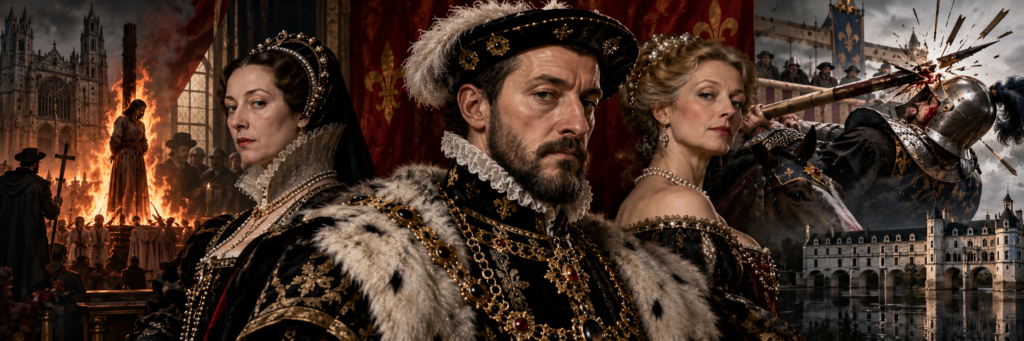
Henry II of France: The Ruthless King, His Powerful Mistress, and the Joust That Ended in Blood
King of France, 1547–1559
Henry II of France survived a childhood spent as a political hostage, inherited one of Europe’s most powerful kingdoms, and spent much of his reign fighting enemies abroad while persecuting religious dissenters at home. His marriage to Catherine de’ Medici produced ten children, yet his extraordinary devotion to Diane de Poitiers, a woman nearly twenty years his senior, created one of the most remarkable romantic and political arrangements in French royal history. His court became a dangerous world of competing favorites, ambitious noble families, religious persecution, and whispered accusations of betrayal. Henry was not clinically insane, but his severity, stubbornness, and willingness to pursue dangerous ideals of royal honor contributed to a reputation for fanaticism and questionable judgment. His reign ended in circumstances so extraordinary that later generations struggled to separate the historical tragedy from the legends surrounding it. During a magnificent tournament celebrating peace, a shattered lance penetrated the king’s helmet, leaving him to endure eleven days of increasingly desperate medical treatment before his death. The accident destroyed more than a monarch’s life. It removed a powerful ruler from a kingdom already approaching the religious and political catastrophe that would become the French Wars of Religion.
The Tournament That Turned a Royal Celebration Into a Nightmare
Paris was celebrating in the summer of 1559. After decades of exhausting warfare between France and the Habsburg powers, the Peace of Cateau-Cambrésis promised a new period of stability. The settlement was reinforced through dynastic marriages, including the marriage of Henry II’s daughter Elisabeth to Philip II of Spain and that of his sister Marguerite to Emmanuel Philibert, Duke of Savoy. For a royal court accustomed to magnificent ceremonies, the occasion demanded an equally magnificent spectacle. Elaborate festivities were organized, and among their principal attractions was a tournament in which the king himself intended to compete. Henry was forty years old, experienced in martial sports, and still determined to demonstrate the physical courage expected of a Renaissance monarch. Few attending the celebrations could have imagined that an event intended to display royal strength would end by exposing the terrifying vulnerability of the man who ruled France.
On June 30, Henry entered the tournament lists in Paris, near the Hôtel des Tournelles. His opponent in the encounter that proved fatal was Gabriel de Lorges, Count of Montgomery, a captain of the Scottish Guard. Montgomery was an experienced participant in aristocratic martial culture, and the contest was not intended as a personal confrontation. Jousting remained an important demonstration of noble skill, despite the considerable danger involved when armored horsemen charged toward one another carrying heavy wooden lances. Henry had participated in such events throughout his adult life, and his enthusiasm for riding, hunting, and tournaments was widely recognized. Accounts differ concerning the precise sequence of his final encounters and whether he insisted upon an additional course after an earlier exchange. What is certain is that the contest with Montgomery produced a catastrophic accident that would bring his reign to an end.
As the horsemen met, Montgomery’s lance shattered against Henry’s armor. A fragment of the broken weapon entered the opening of the king’s helmet and struck his face near the right eye. The force of the impact inflicted a severe injury, with damage extending beyond the visible wound. Henry did not die immediately, and the fact that he survived the initial impact offered some hope to those surrounding him. Nevertheless, the danger was unmistakable, and the royal festivities gave way to confusion and alarm as attendants carried the wounded monarch away. The court suddenly faced a situation for which neither magnificent ceremony nor royal authority could provide an easy solution. The king who had survived military campaigns and years of international conflict now lay gravely injured because of a few moments in the tournament lists.
The accident later became surrounded by stories of ominous warnings and supernatural predictions. One of the most famous concerned Nostradamus, whose writings included a prophecy about a young lion overcoming an older lion in combat and injuring his eyes through a golden cage. Subsequent generations interpreted the imagery as a prediction of Henry’s death, identifying the lions with the competing horsemen and the cage with the king’s helmet. Yet the connection is retrospective, and the language of the prophecy is sufficiently ambiguous to permit many interpretations. Stories that Catherine de’ Medici had been warned of the precise danger and begged her husband not to compete are similarly difficult to verify. They belong to the dramatic traditions that developed around the accident rather than to a securely documented account of the queen’s actions. Henry’s death requires no supernatural explanation, because the physical dangers of jousting were substantial and well understood.
The most disturbing aspect of the tragedy was that Henry survived for eleven days. His physicians faced an injury involving the eye, surrounding tissues, and possibly the structures within the skull, but they lacked the diagnostic methods necessary to determine the full extent of the damage. His condition reportedly fluctuated, allowing moments of hope before deterioration became increasingly evident. The court watched anxiously as medical specialists attempted to understand an injury that modern medicine would recognize as potentially devastating even with advanced treatment. During those eleven days, France remained a kingdom whose ruler was alive but whose future had suddenly become uncertain. When Henry finally died on July 10, 1559, the consequences reached far beyond his immediate family. His death placed the crown upon the head of a teenage son and exposed the monarchy to rivalries that the king’s personal authority had helped contain.
A Prince Born Into War: The Childhood of Henry II
Henry was born at Saint-Germain-en-Laye on March 31, 1519, the second son of King Francis I and Queen Claude of France. His father was among the most celebrated monarchs of the Renaissance, a ruler who combined military ambition with extraordinary enthusiasm for architecture, art, and courtly magnificence. Francis patronized artists, commissioned magnificent residences, and pursued territorial ambitions that repeatedly brought him into conflict with the Habsburg dynasty. Henry’s mother, Claude, was the daughter of Louis XII and Anne of Brittany, and her position helped reinforce the legitimacy of the reigning Valois dynasty. From birth, Henry belonged to a family whose personal relationships were inseparable from the struggle for European power. He was not initially expected to inherit the throne, since his elder brother Francis occupied the position of dauphin. Nevertheless, both boys would become central figures in one of their father’s greatest political humiliations.
The rivalry between Francis I and Holy Roman Emperor Charles V dominated European diplomacy during Henry’s childhood. Both rulers claimed extensive territories and possessed competing ambitions in Italy, where the political balance remained unstable. In February 1525, French forces suffered a devastating defeat at the Battle of Pavia, and Francis himself was captured. The king’s imprisonment created a crisis because Charles V demanded substantial concessions in exchange for his release. Francis eventually agreed to the Treaty of Madrid in January 1526, accepting terms that included territorial renunciations and guarantees of compliance. Among those guarantees was the surrender of his two eldest sons as hostages. The arrangement transformed Henry and his brother from royal children into instruments of international diplomacy, making their freedom dependent upon negotiations they were too young to understand or influence.
In March 1526, the princes were exchanged for their father near the frontier between France and Spain. Henry was not yet seven years old, while his brother was approximately eight. The boys entered Spanish custody and remained there until 1530, spending nearly four years separated from their family and familiar surroundings. Their confinement was not identical to the imprisonment of ordinary criminals, because their royal status gave them political value and required their captors to consider their safety. Nevertheless, they were hostages whose movements, surroundings, and daily lives were controlled by others. Accounts suggest that conditions varied during their detention, and later descriptions sometimes emphasize harsh confinement and humiliating treatment. Although the precise severity of every episode cannot be reconstructed, the fundamental experience was extraordinary: two young princes were deprived of their liberty because of their father’s military defeat.
The consequences of captivity became an important subject for later historians attempting to explain Henry’s adult personality. He was frequently described as reserved, serious, and less outwardly charming than Francis I, leading some writers to suggest that the experience left him permanently withdrawn or melancholy. Such interpretations are understandable, but they must be distinguished from medical conclusions. There is no sufficient evidence to establish that Henry developed a lifelong psychiatric disorder as a direct consequence of his imprisonment. Similarly, the popular claim that he completely forgot how to speak French during captivity should be treated cautiously, since prolonged residence abroad does not establish total linguistic loss. What can reasonably be concluded is that Henry experienced an unusually disruptive childhood in which family separation and political uncertainty occupied several formative years. His later personality may have been influenced by these events, but it cannot be explained entirely through them.
The princes finally returned to France in 1530 following diplomatic arrangements associated with the Peace of Cambrai and the payment of a substantial ransom. Henry resumed his place within the royal household, but the experience of being used as a political guarantee remained part of his personal history. He grew up in a court where loyalty, ambition, and political advantage were constantly negotiated, and where even members of the royal family could become vulnerable to international conflict. The contrast between his childhood captivity and his father’s magnificent public image was striking. Francis could present himself as the embodiment of Renaissance kingship, while his sons had endured years of confinement because of his defeat and diplomatic obligations. Later writers sometimes imagined this contrast producing lasting resentment between father and son, although their private feelings cannot be reconstructed with certainty. What is clear is that Henry’s early life had exposed him to the darker realities of monarchy long before he possessed any authority of his own.
The Shadow of Francis I: A Serious Son at a Magnificent Court
Francis I cultivated a public identity built upon courage, elegance, artistic sophistication, and personal magnificence. His court celebrated hunting, tournaments, music, elaborate entertainments, and the patronage of Renaissance culture. Henry participated in many of these activities, especially hunting and martial sports, but contemporaries often perceived him as less flamboyant than his father. His reserve later encouraged descriptions of him as gloomy or emotionally detached, although such judgments were shaped by expectations about how a king should behave. A quiet or serious disposition could appear unusual beside the theatrical personality of Francis without indicating psychological instability. Henry’s developing political identity was also influenced by the powerful courtiers and advisers who sought relationships with the future rulers of France. These connections would become increasingly important after an unexpected family tragedy changed his position within the succession.
In August 1536, Henry’s elder brother Francis, the dauphin, died after a sudden illness. The death generated suspicions of poisoning, and Sebastiano de Montecuccoli, an Italian associated with the prince’s household, was accused and executed. Contemporary political rivalries encouraged speculation that the Habsburgs had been involved, but historians have questioned whether the dauphin was poisoned at all. His symptoms could have resulted from natural illness, and the surviving evidence does not establish an assassination conspiracy. Whatever the cause, the consequences were immediate: Henry became heir to the French throne at seventeen. His status changed dramatically, bringing increased attention from courtiers and foreign diplomats. The young prince was now expected to preserve the Valois succession, lead armies when necessary, and eventually govern one of Europe’s most powerful kingdoms.
Henry’s position as heir was politically delicate because he remained subordinate to a father who exercised considerable personal authority. Courtiers seeking future advancement cultivated relationships with him, while established favorites of Francis I had reason to fear changes after the succession. Anne de Montmorency, an experienced nobleman and military commander, became an important figure within Henry’s political world. Other aristocratic families, including the Guise dynasty, recognized the opportunities created by proximity to the heir. These relationships did not necessarily indicate organized opposition to Francis, but they produced networks of influence that could compete with those surrounding the reigning king. Henry’s personal preferences therefore acquired political importance long before his accession. A prince’s friendships, advisers, and romantic attachments could determine which families would prosper when he inherited the crown.
When Francis I died on March 31, 1547, Henry became king at the age of twenty-eight. His accession brought immediate changes in the distribution of royal favor, as individuals associated with the new monarch gained influence and some established figures lost their positions. Henry restored Montmorency to prominence and strengthened relationships with nobles who had supported him during his years as dauphin. Yet the most remarkable beneficiary of the succession was not a military commander or minister. It was Diane de Poitiers, a noblewoman nearly twenty years older than Henry whose relationship with him had become one of the defining features of his private life. Under the new king, her influence would become impossible to ignore. For Henry’s legitimate wife, Catherine de’ Medici, the accession offered the dignity of queenship while also confirming the extraordinary power of another woman within her husband’s household.
Diane de Poitiers: The Older Mistress Who Captured a King’s Devotion
Diane de Poitiers was born around 1499 or 1500 into a noble family with established connections to the French court. She married Louis de Brézé, a prominent royal official, and maintained her position in aristocratic society after his death in 1531. Diane possessed considerable experience of court politics, having lived through the reigns of Louis XII and Francis I before Henry inherited the throne. Her maturity, social connections, and understanding of royal patronage distinguished her from younger women whose influence depended primarily upon beauty or fashionable prominence. Later accounts emphasized her elegance and apparent preservation of youthful attractiveness, contributing to a legend of extraordinary personal fascination. However, the most important explanation for her influence was not simply physical appearance. Diane combined a close personal relationship with Henry and a sophisticated understanding of the political networks through which royal favor operated.
The beginning of their intimate relationship remains uncertain. Romantic traditions describe Diane comforting Henry after his return from Spanish captivity, sometimes presenting her as the one person capable of understanding the emotional wounds left by his childhood. The story has become central to popular portrayals of the couple, but the precise details of their earliest interactions are not securely documented. Diane was certainly familiar with the royal household, and Henry’s attachment to her became increasingly evident as he matured. By the time he became king, she was firmly established as his principal favorite. Their relationship endured despite the substantial difference in their ages and despite Henry’s marriage to Catherine de’ Medici. Its longevity was unusual enough to attract sustained attention from contemporaries and later historians, who frequently struggled to explain why the king remained so devoted to her.
Diane’s position extended far beyond private companionship. She received valuable gifts, exercised influence over patronage, and maintained relationships with important courtiers who understood the advantages of her access to Henry. The king granted her the magnificent Château de Chenonceau, which became closely associated with her wealth and cultural ambitions. She developed its gardens and undertook improvements that helped transform the residence into one of the most celebrated architectural sites of the French Renaissance. Her possession of Chenonceau also demonstrated the material rewards available to someone occupying the king’s confidence. Such generosity inevitably attracted resentment, particularly from those who believed royal property and privileges should remain within the legitimate queen’s household. Diane’s influence therefore created political consequences that extended beyond the emotional relationship between two individuals.
The decorative symbolism associated with Henry and Diane has become another famous feature of their story. Intertwined royal initials appeared in architectural and artistic programs, and later observers frequently interpreted combinations of H and C as concealed references to Diane. Yet Catherine was Henry’s legitimate wife, and her initial naturally belonged within royal monograms, making it misleading to assume that every decorative device was secretly dedicated to the mistress. Henry’s use of personal emblems and the prominence of Diane’s colors also became subjects of romantic interpretation. These symbols reveal the importance of courtly representation, but their precise meanings varied according to context. The claim that Diane formally co-signed all royal decrees or exercised authority equivalent to that of a sovereign is likewise exaggerated. She influenced appointments and decisions through access and patronage, but Henry remained the king, and the institutions of government continued to function through councils, officials, and legal procedures.
Nevertheless, Diane’s influence was substantial enough to shape the atmosphere of the court. Courtiers seeking advancement cultivated her favor, while rivals attempted to undermine her position or strengthen competing networks. She maintained connections with influential aristocratic families and became associated with the political relationships surrounding Henry’s government. Her power depended upon the king’s affection, but it also required careful management of the people and interests competing for his attention. Diane was not simply an ornamental mistress installed in a luxurious residence. She was an experienced participant in a political culture where personal relationships could determine access to offices, pensions, and influence. Her prominence would remain one of the most striking characteristics of Henry’s reign, and it created an extraordinary challenge for the woman who occupied the throne beside him.
Catherine de’ Medici: A Queen Living in Another Woman’s Shadow
Catherine de’ Medici was born in Florence in 1519, the same year as Henry, and belonged to the wealthy and politically influential Medici family. Her marriage to Henry in October 1533 was arranged when both were fourteen years old, reflecting diplomatic interests involving France, the papacy, and Italian politics. At the time, Henry was not expected to become king because his elder brother occupied the position of dauphin. Catherine therefore entered the French royal household as a politically useful bride, but not initially as the future queen. Her circumstances changed after the dauphin’s death in 1536, when Henry became heir to the throne. From that moment, Catherine’s ability to produce children acquired enormous political importance. A royal marriage was expected to secure the succession, and failure to provide heirs could expose a queen to criticism, insecurity, and pressure for the marriage to be reconsidered.
For approximately ten years after their wedding, Henry and Catherine had no children. Their prolonged childlessness generated anxiety within a court where dynastic continuity was a central concern. Catherine faced the additional humiliation of knowing that Diane de Poitiers occupied an exceptionally important position in her husband’s personal life. Later accounts frequently portray the queen as consumed by jealousy, but the surviving evidence cannot establish the full extent of her private emotions. She was required to maintain the dignity of her position while navigating a household in which another woman enjoyed extraordinary access to the king. Public confrontation would have carried considerable risks, particularly while Catherine remained vulnerable because of the absence of an heir. Her survival depended upon patience, careful observation, and the cultivation of relationships within a court where personal resentments could quickly become political liabilities.
The royal couple’s fertility difficulties produced a collection of stories that later became almost as famous as their marriage itself. Some medical historians have suggested that Henry may have possessed an anatomical condition such as hypospadias, which could potentially complicate intercourse, while other writers have attributed the eventual success of the marriage to advice concerning sexual positioning. These theories remain uncertain because no reliable clinical examination establishes the supposed condition. Similarly, sensational claims that Catherine consumed mule urine, applied animal dung to her body, or underwent elaborate fertility rituals should not be repeated as documented facts without adequate contemporary evidence. Early modern medicine certainly included remedies that modern readers would find unusual, and the pressure upon Catherine to conceive was real. Yet the precise treatments she received cannot be reconstructed confidently from later anecdotes. The story is revealing chiefly because it demonstrates how intensely the reproductive lives of royal couples were scrutinized and how easily uncertainty encouraged gossip.
In January 1544, Catherine finally gave birth to a son, Francis, who would eventually become Francis II. More children followed, and she ultimately bore ten children during her marriage to Henry, although several died in childhood. The arrival of heirs transformed her position within the dynasty, reducing the immediate danger that the marriage might be challenged because of infertility. Catherine became the mother of the future kings Francis II, Charles IX, and Henry III, as well as daughters whose marriages would play important roles in European politics. Her growing family secured her dynastic importance even while Diane continued to dominate Henry’s personal affections. The contrast between Catherine’s legitimate authority as queen and Diane’s informal influence as mistress became one of the defining tensions of the royal household. Yet Catherine’s greatest political importance would emerge only after Henry’s death, when the children she had struggled to produce inherited a kingdom increasingly threatened by religious conflict.
A Dangerous Court: The Guise Family, Montmorency, and the Battle for Influence
Henry’s court was divided among powerful noble families whose ambitions extended into military command, ecclesiastical appointments, provincial government, and international diplomacy. Anne de Montmorency, Constable of France, was among the most influential figures, having served Francis I before experiencing periods of political difficulty. Henry restored him to prominence, demonstrating the importance of relationships formed during the king’s years as heir. Montmorency possessed substantial military experience and belonged to an aristocratic network capable of exercising influence across the kingdom. His position made him valuable to the monarchy, but it also created resentment among rivals who sought access to the same resources and offices. The distribution of royal favor was never merely a question of personal affection, because appointments and privileges affected the balance of power among France’s greatest families. Henry therefore governed through a political environment in which every significant promotion could strengthen one faction while alarming another.
The Guise family emerged as another major force during Henry’s reign. Francis, Duke of Guise, became a celebrated military commander, while his brother Charles, Cardinal of Lorraine, exercised influence in religious and political affairs. Their family possessed extensive connections and ambitions that extended beyond ordinary court advancement. The Guise brothers benefited from military success and royal patronage, gradually acquiring a position that would become even more significant after Henry’s death. Their rivalry with Montmorency and other noble interests contributed to the factional atmosphere of the court. Diane de Poitiers maintained relationships within these networks, while Catherine’s household provided another center around which political connections could develop. The king’s personal preferences affected these relationships, but they operated within a broader aristocratic system rather than emerging solely from impulsive favoritism.
The danger of this arrangement became increasingly apparent as religious divisions intensified. Some powerful families remained committed to militant Catholic policies, while other aristocrats became sympathetic to Protestant reform or developed alliances with Protestant communities. These differences did not always produce immediate open conflict, because personal interests and political calculations could complicate religious loyalties. Nevertheless, the combination of aristocratic rivalry and confessional division created a potentially explosive situation. Henry’s authority helped contain disputes among competing nobles, but it did not eliminate the underlying causes of conflict. His government relied upon men whose families would later become central participants in the French Wars of Religion. The court therefore contained many of the rivalries that would dominate France after the king was gone.
The Burning Chamber: Henry II’s Ruthless Campaign Against Protestantism
Religious persecution became one of the most troubling features of Henry II’s reign. Protestant ideas had spread through France during the government of Francis I, encouraged by printing, scholarly exchange, and connections with reformers elsewhere in Europe. French Protestants did not initially form a single unified political movement, but their growing presence alarmed Catholic authorities who considered religious conformity essential to public order. Henry inherited an established system of persecution and strengthened efforts to suppress beliefs regarded as heretical. His government viewed religious dissent not merely as a theological disagreement but as a potential challenge to royal authority and social stability. The consequences for individuals accused of Protestant sympathies could be severe, including imprisonment, confiscation, exile, and execution. The monarchy’s determination to enforce religious unity would ultimately contribute to deeper divisions rather than eliminate them.
In 1547, a special chamber of the Parlement of Paris became associated with the prosecution of heresy. It acquired the name Chambre Ardente, or Burning Chamber, because of its connection with proceedings that could lead to execution by burning. The institution has often been presented as evidence of Henry’s personal cruelty, and its activities certainly formed part of a harsh system of religious repression. Nevertheless, the chamber operated within established legal structures, and burning for heresy had existed in European judicial practice long before Henry’s accession. The king did not personally invent every punishment associated with religious persecution, nor did he independently conduct every prosecution. His responsibility lay in supporting and strengthening a political and legal system that treated religious dissent as a punishable offense. The distinction does not diminish the suffering of victims, but it places the persecution within the institutional realities of sixteenth-century government.
The Edict of Châteaubriant, issued in 1551, reinforced measures intended to prevent the spread of Protestant ideas. It addressed prohibited religious literature, the responsibilities of officials, and the prosecution of individuals suspected of heresy. The growing availability of printed books presented particular difficulties for authorities attempting to control religious discussion. Texts could circulate through commercial networks, private households, and connections with reformers beyond French borders. Protestant communities increasingly developed their own forms of organization, worship, and mutual support, making suppression more complicated than the punishment of isolated individuals. Henry’s government responded through legislation and judicial pressure intended to strengthen Catholic conformity. Yet every new measure also demonstrated the difficulty of containing a religious movement that continued to attract adherents despite the dangers involved.
One especially disturbing aspect of religious persecution concerned the treatment of condemned Protestants during public executions. Protestant martyr narratives and other early modern accounts describe attempts to prevent prisoners from speaking, praying, or singing before assembled crowds. Authorities feared that a condemned person’s final declaration of faith might transform an execution intended as a warning into a demonstration of religious courage. Reports of gagging and mutilation appear within the broader history of these persecutions, although the details of individual cases require careful examination. The popular claim that Henry personally introduced a universal law requiring the tongues of suspected heretics to be cut out is not securely established. Such assertions risk replacing a documented history of repression with an exaggerated image of personal sadism. The actual judicial violence was already severe enough to demonstrate the dangers faced by people whose religious convictions differed from those approved by the monarchy.
By 1559, the crown had adopted an increasingly forceful position against Protestant dissent, reflected in measures associated with the Edict of Écouen. Henry’s policies were intended to defend religious and political unity, but they failed to halt the growth of Reformed communities. Protestantism had gained adherents among urban populations, educated circles, and sections of the nobility, making the conflict increasingly difficult to resolve through punishment alone. The monarchy’s reliance upon coercion encouraged fear and resentment, while accounts of executed believers circulated as examples of martyrdom. These developments contributed to the formation of hardened confessional identities that would later become central to civil warfare. Henry was not clinically insane because he persecuted Protestants, and religious intolerance should not automatically be interpreted as psychiatric instability. He was, however, responsible for supporting policies that inflicted suffering and helped prepare the ground for one of the most destructive periods in French history.
The Warrior King: Henry’s Military Ambitions and the Struggle Against the Habsburgs
Henry inherited the long rivalry between France and the Habsburg dynasty, particularly the struggle over influence in Italy and along the kingdom’s eastern frontiers. His father had devoted enormous resources to these conflicts, achieving celebrated victories but also suffering humiliating defeats. Henry continued pursuing French strategic interests while confronting the immense territorial power associated with Charles V. The conflict was not simply an expression of inherited personal hatred, because the political geography of Europe created genuine disputes over territory, influence, and security. French rulers feared encirclement by Habsburg possessions, while the emperor and his successors sought to defend their own dynastic interests. Military campaigns therefore remained central to Henry’s reign, consuming substantial financial resources and reinforcing the importance of experienced commanders. The king’s enthusiasm for martial culture was visible both in his personal activities and in the policies of his government.
In 1552, Henry reached arrangements with German Protestant princes who opposed Charles V, despite his own determination to suppress Protestantism within France. The cooperation reflected the difference between domestic religious policy and international strategic calculation. French forces occupied Metz, Toul, and Verdun, territories whose relationship with the Holy Roman Empire involved complicated legal and political arrangements. The acquisitions strengthened France’s position along its eastern frontier and became among the most important territorial developments of Henry’s reign. Charles V attempted to recover Metz during the winter of 1552–1553, but the city’s defense under Francis, Duke of Guise, proved successful. The campaign enhanced Guise’s military reputation and demonstrated the importance of fortifications, supplies, and organized resistance in contemporary warfare. It also strengthened a noble family whose growing influence would later have profound consequences for French politics.
The struggle continued as Charles V gradually withdrew from direct government and divided his possessions between different branches of the Habsburg dynasty. Philip II of Spain became one of Henry’s principal opponents, inheriting substantial territories and responsibilities. In August 1557, French forces suffered a serious defeat at the Battle of Saint-Quentin, an event that exposed weaknesses in French military arrangements and intensified concern about the kingdom’s security. The loss was politically damaging, particularly because Montmorency was captured during the campaign. Nevertheless, French fortunes were not uniformly disastrous. In January 1558, the Duke of Guise captured Calais, ending more than two centuries of English possession of the strategically important port. The victory carried enormous symbolic significance and strengthened the prestige of both the monarchy and the Guise family.
The financial consequences of continued warfare were substantial. Armies required recruitment, wages, artillery, fortifications, transportation, and provisions, while diplomatic negotiations and the maintenance of military alliances imposed additional costs. Henry inherited a fiscal system already strained by the campaigns of Francis I, and the demands of his own wars increased pressure upon royal revenues. Taxation, borrowing, and financial administration became essential to sustaining military operations. The monarchy remained powerful, but military achievement could not be separated from the resources required to obtain it. By the late 1550s, exhaustion and financial pressure encouraged serious negotiations for peace. The resulting settlement would bring the long Italian struggle toward an important conclusion, although its consequences were not entirely favorable to French ambitions.
The Peace of Cateau-Cambrésis: A Diplomatic Triumph Shadowed by Defeat
The Peace of Cateau-Cambrésis, concluded in April 1559, brought an end to a major phase of warfare involving France, Spain, and England. The settlement required Henry to abandon important French claims in Italy, effectively acknowledging the predominance of Habsburg interests across much of the peninsula. France nevertheless retained significant territorial advantages, including Calais and its position in the Three Bishoprics, although the legal status of certain territories remained complicated. The agreements reflected the military and financial exhaustion of the competing powers, which had spent decades pursuing objectives that repeatedly proved difficult to secure. For Henry, the peace represented both an admission of strategic limitations and an opportunity to stabilize the kingdom. It also allowed the monarchy to celebrate dynastic marriages intended to reinforce diplomatic relationships. Those celebrations would produce the tournament in which the king received his fatal injury.
The marriage of Henry’s daughter Elisabeth to Philip II of Spain was particularly significant because it linked the French and Spanish royal families after years of hostility. His sister Marguerite’s marriage to Emmanuel Philibert of Savoy formed another element of the diplomatic settlement. Such marriages were intended to support political arrangements by creating personal and dynastic relationships between ruling houses. The French court prepared elaborate festivities appropriate to the importance of the occasion, including ceremonial entertainments and martial competitions. Henry’s decision to participate in the tournament reflected his continued identification with the ideals of chivalric kingship. He was not merely attending the festivities as a spectator, because the public display of personal courage remained important to his royal identity. The terrible irony was that a celebration intended to announce peace and dynastic security would instead leave France without its reigning monarch.
The Fatal Joust: Stubbornness, Chivalry, and a Shattered Lance
Henry’s enthusiasm for jousting belonged to a long tradition of aristocratic martial culture. Tournaments offered opportunities for noblemen to demonstrate skill, courage, and physical discipline before influential audiences. Although they were not identical to actual warfare, the contests preserved elements of combat training and personal competition that remained highly valued among European elites. Henry had developed considerable experience in riding and martial sports, and his participation in tournaments was consistent with his broader interests. Later writers sometimes portrayed his final encounter as the result of an uncontrollable obsession with physical danger, but such language exaggerates what can be established. The surviving evidence does not demonstrate that he possessed a psychiatric compulsion toward self-harm or that physicians had diagnosed a neurological condition making participation uniquely reckless. His fatal decision is better understood within the dangerous conventions of aristocratic honor and royal display.
Accounts of the tournament frequently emphasize Henry’s determination to continue competing despite warnings or earlier difficulties. Some narratives suggest that he insisted upon another encounter after an unsatisfactory result, while others differ concerning the sequence of events. The precise details should not be treated as certain simply because they have become familiar through repeated retellings. What is clear is that Henry faced Montgomery during the contest that caused his death, and that the shattering of the lance produced a penetrating injury near his eye. The accident demonstrated how a single failure of equipment or unfortunate impact could overwhelm the protection offered by elaborate armor. Even an experienced horseman could not control every movement of the horses, weapons, and opposing rider during a collision. Henry’s royal status made the consequences politically extraordinary, but the underlying physical danger was one shared by other participants in the sport.
The later association of the accident with Catherine’s supposed warnings and the prophecies of Nostradamus helped transform the event into a story of destiny. Such interpretations were attractive because they offered an explanation for a death that appeared almost unbearably ironic. A king who had survived the political dangers of his father’s wars and the military challenges of his own reign was fatally injured during celebrations of peace. The image of the monarch ignoring warnings and riding toward a foretold catastrophe became a powerful narrative, particularly for writers interested in astrology and supernatural prediction. Yet historians must distinguish the emotional force of these stories from the reliability of the evidence supporting them. The tragedy was not diminished by the absence of a prophecy. Its historical importance lay in the sudden destruction of royal continuity at a moment when France desperately needed political stability.
Eleven Days Between Life and Death: The Desperate Medical Battle
Henry’s injury presented Renaissance physicians with an exceptionally difficult problem. A wooden fragment had penetrated the region near his right eye, creating the possibility of damage to the eye socket, surrounding bones, blood vessels, and brain. The wound was dangerous not only because of its immediate physical effects but also because of the potential for infection, swelling, and internal bleeding. Physicians could examine visible injuries and observe the king’s symptoms, but they possessed no modern imaging techniques capable of revealing what was occurring inside his skull. Their understanding of anatomy had improved considerably during the Renaissance, yet effective treatment of severe intracranial trauma remained beyond their capabilities. The king’s survival after the initial accident therefore offered hope without providing any assurance that recovery was possible. As the days passed, his condition became an increasingly urgent concern for both the royal household and the government.
Two of the most celebrated medical figures associated with Henry’s treatment were Ambroise Paré and Andreas Vesalius. Paré had developed extensive experience as a military surgeon and contributed significantly to the improvement of surgical practice. Vesalius was renowned for his anatomical scholarship, particularly his work correcting errors inherited from earlier medical authorities. Their involvement demonstrated the importance attached to the king’s survival and the willingness of the court to seek the most distinguished expertise available. Nevertheless, neither man possessed the means to reverse serious brain injury or reliably treat infections deep within the skull. Renaissance surgery could remove accessible foreign material and address certain visible wounds, but its possibilities remained limited by contemporary technology and medical knowledge. The presence of celebrated physicians could not guarantee a favorable outcome when the underlying injury was so severe.
The treatment later became surrounded by particularly disturbing stories. One popular account claims that surgeons deliberately reproduced the king’s wound by driving broken lances into the heads of condemned prisoners, hoping to discover how the injury might be treated. Other versions describe experiments involving corpses or attempts to study comparable wounds through anatomical examination. The details vary considerably, and the sensational claim that living prisoners were repeatedly injured for Henry’s benefit is not securely established. The broader possibility that physicians examined bodies or investigated similar injuries is consistent with Renaissance medical interests, but individual procedures must be evaluated according to the surviving evidence. Such stories became attractive because they reflected the extraordinary value placed upon a monarch’s life and the limited protections available to people condemned by the legal system. Yet historical accuracy requires resisting the temptation to present every horrifying anecdote as documented fact.
Henry’s condition reportedly fluctuated during the eleven days following the accident. He survived the initial injury and remained capable of some interaction, but signs of deterioration eventually suggested that the damage was more serious than the visible wound alone indicated. Modern medical discussions have proposed several possible explanations for his death, including traumatic bleeding within the skull, infection, and complications associated with penetrating injury. Some reconstructions emphasize the possibility of a subdural hematoma, while others consider the role of infection or damage to deeper structures. Without modern clinical records or reliable anatomical findings, no single diagnosis can be established with certainty. The physicians attending Henry could observe his decline, but they could not accurately determine every process contributing to it. On July 10, 1559, the king died, leaving France to confront a political crisis that medical skill had been powerless to prevent.
Catherine’s Revenge: The Fall of Diane de Poitiers
Henry’s death immediately transformed the position of the two women who had dominated his private life. Catherine de’ Medici remained the queen mother, while Diane de Poitiers lost the personal protection upon which much of her influence depended. For years, Catherine had occupied the legitimate position of royal wife while Diane enjoyed extraordinary access to Henry and received magnificent gifts. The king’s death altered the balance of power because Diane no longer possessed the affection of a reigning monarch to protect her political interests. Catherine could now assert greater control over property, ceremonial precedence, and the relationships surrounding the royal household. Later accounts often portray her actions as a long-awaited personal revenge, but the redistribution of influence also reflected ordinary political consequences following the death of a ruler. Diane’s position had been exceptional, and its continuation was never guaranteed once Henry was gone.
The most famous dispute concerned the Château de Chenonceau, which Henry had granted to Diane during his reign. Catherine eventually obtained the property through an exchange involving the Château de Chaumont. The arrangement has often been simplified into a dramatic story in which the queen immediately expelled her rival from the magnificent residence. In reality, the transfer involved legal and political considerations, although the symbolic significance was unmistakable. Chenonceau had represented Diane’s influence and the extraordinary generosity of her royal lover. Its passage into Catherine’s possession demonstrated that the balance of power within the royal household had changed. Catherine subsequently developed the château further, leaving her own architectural and cultural imprint upon a residence already associated with one of the most famous romantic rivalries in French history.
Diane withdrew from the center of royal politics but did not disappear into poverty or imprisonment. She retained considerable wealth and lived until 1566, spending her later years away from the extraordinary prominence she had enjoyed under Henry. Catherine, meanwhile, confronted responsibilities far greater than the management of a personal rivalry. Her eldest son had inherited the throne while still a teenager, and the kingdom remained divided by powerful aristocratic factions and increasingly hostile religious communities. The Guise family possessed exceptional influence because the young king, Francis II, was married to Mary, Queen of Scots, whose maternal relatives belonged to that dynasty. The political environment therefore favored men whose ambitions could threaten the authority of the royal household itself. Catherine’s future would be shaped less by memories of Diane than by the struggle to preserve the monarchy during a period of growing instability.
The Boy Kings: Henry’s Children Inherit a Kingdom on the Edge
Francis II succeeded Henry in July 1559 at the age of fifteen. His marriage to Mary, Queen of Scots, strengthened the influence of the Guise family, whose leading members already possessed considerable military and ecclesiastical authority. Francis, Duke of Guise, and Charles, Cardinal of Lorraine, became central figures in the new government, provoking resentment among rival aristocratic interests. The young king’s limited experience made the question of who exercised practical authority especially important. Catherine remained influential as queen mother, but she could not simply command the political environment without considering the power of established noble families. Religious divisions also continued to intensify, with Protestant communities increasingly organized and Catholic authorities determined to suppress them. Henry’s death had removed an adult monarch whose personal authority helped maintain a fragile balance among competing interests.
Francis II died in December 1560 after a reign of little more than a year. His younger brother Charles IX inherited the throne as a child, placing Catherine in a position of much greater political responsibility. She became central to the government and attempted to manage the kingdom’s religious and aristocratic conflicts through a combination of negotiation, compromise, and coercion. Her policies changed according to circumstances, reflecting the difficulty of preserving royal authority while powerful factions pursued competing objectives. The tensions inherited from Henry’s reign could no longer be contained through ordinary court management. Protestant and Catholic interests increasingly organized around rival political and military leaders, while disputes over worship, law, and royal policy intensified. In 1562, open warfare erupted, beginning the series of conflicts known as the French Wars of Religion.
The wars would devastate France for decades, producing massacres, assassinations, sieges, political conspiracies, and repeated attempts at settlement. Catherine became one of the most controversial figures of the period, particularly because of her association with decisions surrounding the Saint Bartholomew’s Day massacre of 1572. Henry’s surviving sons would inherit a monarchy whose authority was repeatedly challenged by religious and aristocratic factions. The Guise dynasty remained powerful, while Protestant leaders developed military and political networks capable of resisting royal policies. The violence eventually threatened the continuation of the Valois dynasty itself, culminating in the assassination of Henry III in 1589. These developments cannot be attributed entirely to Henry II, since the causes of the conflicts were broader and extended across Europe. Nevertheless, his persecution of Protestantism and the factional relationships cultivated during his reign formed part of the political inheritance his children were forced to confront.
Was Henry II Mad? The Difference Between Fanaticism, Stubbornness, and Mental Illness
Henry II has sometimes been portrayed as emotionally damaged, pathologically melancholy, obsessively attached to Diane de Poitiers, and dangerously fixated upon physical displays of courage. Such descriptions draw upon genuine features of his biography, including his childhood captivity, reserved personality, enduring romantic relationship, and enthusiasm for hunting and tournaments. Yet they often transform historical observations into psychological conclusions that the surviving evidence cannot support. His captivity may have influenced his development, but it does not establish lifelong clinical depression or a specific trauma-related disorder. His devotion to Diane was unusual in its duration and political consequences, but intense personal attachment does not automatically indicate psychiatric dependence. His willingness to participate in dangerous martial sports reflected aristocratic values widely shared among European elites. The fatal accident was a tragedy, not proof that the king possessed an uncontrollable desire to injure himself.
The same distinction applies to Henry’s religious persecution. His government supported harsh measures against Protestant dissent, and those policies contributed to imprisonment, execution, exile, and the growth of confessional hostility. Such actions deserve serious moral and historical scrutiny, but cruelty should not be treated as evidence of clinical insanity. Henry’s policies emerged from recognizable religious convictions and political assumptions about the relationship between monarchy, public order, and religious conformity. Similar forms of intolerance existed under other rulers who were not considered mentally ill. The important historical question is therefore not whether persecution made Henry mad, but how his decisions contributed to the increasingly violent divisions within French society. His responsibility lies in the policies he supported and their consequences, rather than in an unsupported psychiatric explanation for his conduct.
Henry’s personal and political behavior was also more complicated than the image of an irrational monarch dominated entirely by his mistress. He relied upon experienced advisers, conducted major military campaigns, supported important diplomatic negotiations, and presided over a government capable of significant territorial achievements. His court contained rival factions, but such competition was characteristic of Renaissance monarchy rather than proof of personal incapacity. Diane exercised influence through access and patronage, while Catherine fulfilled essential dynastic responsibilities and eventually became the mother of several kings. Henry’s military record included both victories and defeats, reflecting the uncertainties of warfare rather than a consistent pattern of reckless incompetence. His reign therefore cannot be reduced to religious fanaticism, romantic obsession, or a fatal tournament. It was a period of consequential political decisions made by a ruler whose strengths and failures operated within the larger structures of sixteenth-century France.
The Splintered Crown: Henry II’s Final Legacy
Henry II inherited a powerful monarchy shaped by the ambitions of Francis I and continued the struggle for European influence that had dominated his father’s reign. His government achieved important successes, including the recovery of Calais and the occupation of the Three Bishoprics, while also enduring serious military defeats and mounting financial pressures. His court combined Renaissance magnificence with intense political competition, as powerful noble families sought influence through military service, religious authority, and access to the king. Diane de Poitiers occupied an extraordinary position within this world, exercising influence that attracted admiration, resentment, and generations of romantic speculation. Catherine de’ Medici endured the difficulties of a marriage overshadowed by another woman while fulfilling the dynastic responsibilities upon which the succession depended. The personal relationships surrounding Henry were therefore inseparable from the political arrangements of his reign. Their consequences became especially apparent when his sudden death transformed the distribution of power within the royal household.
The religious policies of Henry’s government left an even more troubling inheritance. His determination to enforce Catholic conformity contributed to the persecution of Protestant communities at a time when religious divisions were becoming increasingly difficult to contain. The monarchy’s use of judicial repression failed to eliminate Protestantism and instead helped strengthen the atmosphere of fear, resentment, and hostility that would later fuel civil conflict. Henry’s death did not create every cause of the French Wars of Religion, but it removed an experienced adult monarch from a kingdom already approaching a dangerous turning point. His sons inherited the crown in succession, yet their youth and political vulnerability exposed the monarchy to the ambitions of powerful aristocratic families. Catherine’s subsequent struggle to preserve Valois authority unfolded against a background of religious violence and factional rivalry that repeatedly threatened the kingdom’s stability. The consequences of Henry’s reign therefore extended far beyond the eleven days of suffering that ended his life.
The circumstances of his death remain among the most haunting episodes in European royal history. Henry entered the tournament lists during celebrations intended to announce peace, dynastic continuity, and the restoration of political stability after decades of warfare. A shattered lance penetrated his helmet, and the resulting injury defeated the efforts of some of the most accomplished physicians of the Renaissance. The king survived long enough for his court to witness the gradual collapse of hopes for his recovery, but not long enough to prepare the kingdom adequately for the challenges ahead. The tragedy encouraged stories of prophecies, warnings, and supernatural destiny, yet its historical consequences were more significant than any legend. A monarchy that appeared secure during the celebrations of June 1559 suddenly faced the uncertainty of minority rule, factional competition, and deepening religious division. Henry’s death exposed how much political stability had depended upon the authority of a single individual.
Henry II was not a mad monarch in the clinical sense, but his reign demonstrates how personal attachments, religious conviction, martial ideals, and political ambition could shape the destiny of an entire kingdom. His devotion to Diane de Poitiers transformed court relationships, while Catherine de’ Medici endured a difficult position that eventually prepared her for an extraordinary political career. His persecution of Protestantism contributed to suffering that would continue long after his death, and his reliance upon powerful noble families helped create a political environment in which competing factions could become dangerously influential. His military achievements were substantial, but they did not resolve the underlying pressures facing France. The tournament accident brought his life to an abrupt and agonizing conclusion, leaving young heirs to confront problems that even an experienced ruler might have struggled to control. The deepest tragedy of Henry II’s reign was not simply that a king died because of a broken lance, but that his death removed the authority holding together a kingdom already beginning to fracture. The monarch disappeared in July 1559, yet the rivalries, resentments, and religious conflicts gathering around his throne were only beginning to reveal their destructive power.