
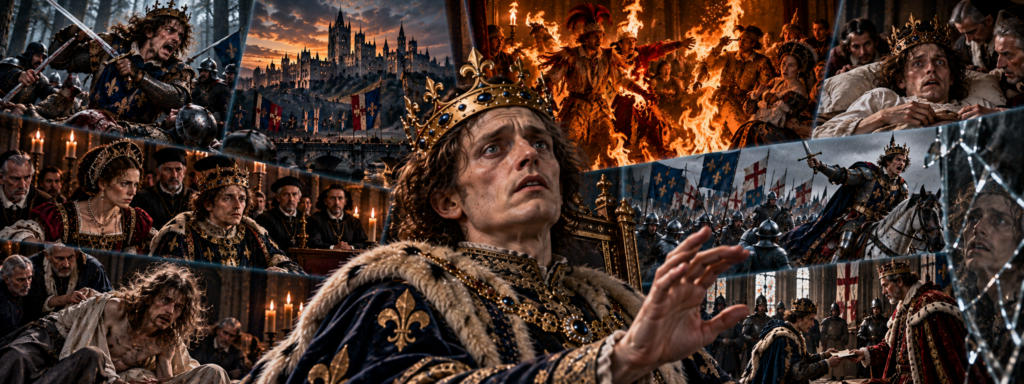
Charles VI of France: The Mad King, the Glass Delusion, and the Madness That Tore a Kingdom Apart
King of France, 1380–1422
He was crowned as a child, celebrated as Charles the Beloved, and destined to become one of the most tragic monarchs in French history. For more than three decades, King Charles VI suffered recurring episodes of severe mental disturbance that sometimes left him unable to recognize his family, understand his royal identity, or participate meaningfully in government. His first great crisis erupted during a military expedition in 1392, when he suddenly attacked members of his own entourage with a sword. Months later, a masquerade at the royal court ended in flames, leaving several men dead and the king narrowly escaping disaster. As his condition worsened, extraordinary stories circulated about his fear of shattering like glass, his neglect of personal care, and the desperate measures taken by servants attempting to protect him. Meanwhile, ambitious relatives competed for control of the monarchy, political rivalries erupted into assassination and civil war, and England exploited France’s divisions. By 1420, the Treaty of Troyes had effectively disinherited Charles’s own son and recognized the English king Henry V as heir to the French throne. Charles VI was not merely a ruler whose behavior later generations exaggerated into madness. He experienced a genuine, profoundly disabling illness. Yet the destruction that followed cannot be explained by his condition alone, because the men who fought over his authority were often perfectly capable of understanding the consequences of their actions.
The King Who Drew His Sword Against His Own Men
In August 1392, King Charles VI rode through the forest near Le Mans with an army preparing to march into Brittany. The French monarch was twenty-three years old, had occupied the throne since childhood, and had recently begun exercising greater personal authority. He was pursuing a political and military confrontation involving Pierre de Craon, a nobleman implicated in an attempted assassination of the king’s constable, Olivier de Clisson. The expedition promised to demonstrate that the crown could punish those who challenged its authority.
The weather was oppressive, and contemporary accounts describe the king as exhausted and troubled before the crisis began. As the royal party traveled through woodland, an unfamiliar, disheveled man reportedly approached and warned Charles that he was being betrayed. The warning became an important element of later narratives, although its precise wording and significance cannot be independently established. Charles continued the journey, but chroniclers remembered the atmosphere as increasingly tense.
The decisive moment came when a sudden metallic noise startled the king. According to well-known accounts, a lance or weapon struck a helmet or another piece of equipment, producing a sharp sound. Charles abruptly drew his sword and attacked members of his own company, apparently perceiving danger where his companions saw none. The king’s entourage struggled to restrain him without causing injury to their sovereign.
Several men were killed or wounded during the episode. Traditional accounts often give the number of deaths as four, although some retellings say five, and the precise tally varies in later narratives. What matters historically is that the king turned violently against men serving in his own party, creating a terrifying situation in which ordinary methods of self-defense could not easily be used against the monarch.
Charles was eventually disarmed and subdued. He then entered a period of profound incapacity, described by contemporaries in terms that suggest severe confusion, reduced responsiveness, and physical exhaustion. Some later writers call this a catatonic coma, but that expression imposes a modern clinical interpretation upon descriptions that do not provide enough information for such a precise diagnosis.
The attack shocked the court. A king who had recently asserted his independence had suddenly become incapable of exercising reliable command. His companions had witnessed something that could not be explained as ordinary anger, military excitement, or calculated violence. The episode marked the beginning of a prolonged pattern of illness that would transform the French monarchy.
Charles eventually recovered sufficiently to resume some royal duties. The improvement offered hope that the crisis had been temporary, but subsequent episodes destroyed that expectation. His illness would return repeatedly, sometimes leaving him incapacitated for extended periods and sometimes allowing periods of substantial lucidity.
The kingdom now faced a question for which medieval political institutions had no simple answer: what happened when the person who embodied royal sovereignty could no longer consistently exercise it?
A Boy King in the Shadow of the Hundred Years’ War
Charles VI was born on December 3, 1368, the son of Charles V of France and Joan of Bourbon. His father, remembered as Charles the Wise, had devoted much of his reign to recovering territory lost during the earlier disasters of the Hundred Years’ War. Through administrative reforms, diplomacy, and military campaigns, Charles V had strengthened royal authority and reduced England’s continental possessions.
When Charles V died in September 1380, his son was only eleven years old. The young Charles VI was crowned at Reims in November, inheriting a kingdom that had made substantial gains but remained vulnerable to renewed warfare and domestic unrest. His minority created opportunities for powerful relatives to dominate government.
Several royal uncles exercised influence during the early years of the reign, particularly Louis I, Duke of Anjou; Philip the Bold, Duke of Burgundy; and John, Duke of Berry. Louis II, Duke of Bourbon, also belonged to the influential circle of royal relatives. Their political interests did not always coincide, and the government had to balance territorial ambitions, military obligations, and financial demands.
The kingdom’s fiscal problems were considerable. War required taxation, while urban communities and provincial groups resisted measures they regarded as oppressive. Revolts occurred in several parts of France during the early 1380s, including the Maillotins uprising in Paris in 1382. The government responded with a mixture of military force, punishment, and political negotiation.
Charles’s youth unfolded amid the ceremonial splendor of the Valois court. Royal magnificence served a political purpose, reinforcing the dignity of a dynasty whose legitimacy had been contested during the previous generation. Yet the young king also inherited the unresolved contradictions of French government: powerful princes expected influence, subjects resisted taxation, and the English threat had not disappeared.
In 1385, Charles married Isabeau of Bavaria, daughter of Stephen III, Duke of Bavaria-Ingolstadt. The marriage formed part of the diplomatic relationships connecting the French monarchy to the wider European aristocracy. Isabeau would eventually become central to the politics of the reign, although her reputation was later distorted by hostile propaganda and accusations concerning her personal conduct.
Charles was initially remembered as an attractive, personable young ruler who enjoyed courtly entertainment, hunting, and the activities expected of a nobleman. His early reputation contributed to the nickname the Beloved, which contrasted sharply with the later designation the Mad. These labels reflect changing perceptions of his reign rather than two separate personalities that can be neatly divided.
By 1388, Charles was ready to assert greater independence from his uncles. He began relying upon experienced officials who had served his father, a group whose opponents derisively called the Marmousets. Their return suggested a possible restoration of the administrative methods associated with Charles V.
For several years, the young king appeared capable of pursuing an active political program. The sudden breakdown of 1392 therefore represented more than a private medical emergency. It interrupted a transition in royal government and reopened the struggle over who would control France.
The First Breakdown: Illness, Exhaustion, and the Fear of Betrayal
The events of 1392 have attracted centuries of medical speculation. Contemporary descriptions suggest that Charles experienced an acute disturbance involving violent behavior, confusion, and a subsequent period of serious incapacity. The symptoms were alarming enough that observers struggled to reconcile them with the king’s previous conduct.
Some chroniclers connected the attack to heat, exhaustion, and the emotional strain of the Brittany expedition. Others emphasized the mysterious warning delivered by the stranger in the forest. In a society where divine punishment, sorcery, poisoning, and supernatural influence were familiar explanatory frameworks, such details acquired particular significance.
The possibility of poisoning or magical interference circulated because royal illness was inherently political. A king’s sudden incapacity could benefit rivals, while accusations against supposed enemies might explain an otherwise incomprehensible event. Yet there is no convincing evidence that Charles’s breakdown was caused by a deliberate poisoning or supernatural attack.
The king’s medical attendants attempted treatments consistent with contemporary practice. Physicians understood illness through frameworks involving bodily humors, diet, environmental conditions, and the balance of physical and emotional influences. They lacked modern psychiatric concepts, but that does not mean they failed to recognize the severity of his condition.
Charles’s subsequent recovery was encouraging. He became capable of participating in government again, and the court could hope that the crisis would not recur. Nevertheless, the political consequences had already begun. His uncles returned to positions of influence, while the officials associated with his earlier independent government lost authority.
This shift illustrates how quickly illness could alter the distribution of power. The king did not need to be permanently incapacitated for rivals to benefit from his temporary inability to govern. Every recurrence created opportunities for princes to assert that they were acting in his interests.
The illness would eventually become chronic and episodic, but its precise course is difficult to reconstruct. Modern estimates sometimes identify approximately fifty or more attacks, with the frequently repeated figure of fifty-six derived from attempts to count episodes recorded in chronicles and other documents. Such numbers are retrospective reconstructions rather than a complete medical record.
Some episodes lasted weeks, while others extended considerably longer. The symptoms also varied, and the surviving evidence does not support treating every attack as identical. Charles’s condition became a defining feature of his reign precisely because periods of recovery repeatedly raised expectations that were later disappointed.
The Bal des Ardents: A Royal Celebration Becomes a Living Inferno
On January 28, 1393, the French court gathered for festivities associated with a wedding in Queen Isabeau’s household. The celebration took place at the Hôtel Saint-Pol in Paris, a royal residence that formed an important center of court life. Music, dancing, elaborate costumes, and theatrical entertainments were familiar features of aristocratic festivities.
Charles participated in a masquerade that became known as the Bal des Ardents, or Dance of the Burning Men. He and five other men dressed as wild men, figures associated with medieval folklore and courtly entertainment. Their costumes were made with combustible materials, including fabric or linen covered with resinous substances and fibers intended to imitate shaggy hair.
The disguises were visually striking but dangerously flammable. Precautions were reportedly taken to keep torches away from the dancers. Nevertheless, the king’s brother, Louis, Duke of Orléans, entered the scene carrying or accompanied by a lighted torch, according to the best-known accounts.
The flame ignited one of the costumes, and the fire spread rapidly among the dancers. The festive hall became a scene of panic as men struggled to escape their burning disguises. Four of the six participants died from their injuries, while another survived after escaping into a container of water or liquid, according to chroniclers.
Charles survived because his aunt, Joan, Duchess of Berry, shielded him with her clothing and prevented the flames from reaching his costume. The precise movements of the participants differ among accounts, but the king’s narrow escape became central to the story.
The tragedy horrified Paris. A royal celebration had ended in a spectacle of burning bodies, and the incident reinforced concerns about the judgment of those surrounding the king. Louis of Orléans faced criticism for his role in the accident, while the court attempted to contain the political damage.
The disaster has sometimes been described as the event that permanently destroyed Charles’s mental stability. That claim is not supported by the chronology. His first major breakdown had occurred months earlier, and there is no reliable basis for asserting that the fire caused all subsequent episodes.
Nevertheless, the incident added another layer of fear and uncertainty to the royal household. The king had survived a terrifying accident shortly after experiencing a severe psychiatric crisis. Courtiers who had witnessed both events could hardly have felt secure about the future.
The Bal des Ardents became one of the most haunting images of late medieval monarchy: a king disguised as a wild man, surrounded by flames, while the royal court struggled to save him. Its symbolism was irresistible to later writers, but the actual tragedy was sufficiently disturbing without embellishment.
The Glass Delusion: A King Terrified of Breaking Apart
Among the most famous symptoms attributed to Charles VI was the belief that his body was made of glass. According to later accounts, he feared that physical contact or sudden movement might cause him to shatter. The story became so closely associated with his reign that it remains one of the defining examples of the historical phenomenon called the glass delusion.
The glass delusion appeared in accounts of several individuals in late medieval and early modern Europe. Some sufferers reportedly believed that parts of their bodies were fragile or transparent, while others feared that they might break if touched. The condition has attracted attention because it demonstrates how the content of delusions can reflect cultural ideas and available materials.
In Charles’s case, the most familiar versions describe protective measures intended to prevent injury. He supposedly wore reinforced clothing and avoided physical contact. Some retellings claim that iron rods were sewn into his garments to protect his fragile body.
These details require caution. The glass belief is part of a substantial historical tradition concerning Charles, but the surviving descriptions vary in date and reliability. The precise construction of his clothing, the frequency of the belief, and the circumstances in which it appeared cannot all be established with equal confidence.
The story nevertheless reflects a broader pattern of disturbances in identity and perception recorded during his illness. Contemporary and later sources describe periods in which Charles appeared unable to understand who he was or recognize familiar people. Such symptoms would have been profoundly disruptive for a monarch whose political authority depended upon personal identity and dynastic relationships.
A king who believed himself physically fragile presented practical challenges to attendants. Servants had to provide care without provoking fear, while officials needed to determine whether he could participate in ceremonies or decisions. Even ordinary activities such as dressing, movement, and personal contact could become difficult.
The glass delusion should not be treated as a separate disease that explains the entirety of Charles’s illness. It was one reported manifestation within a much broader pattern of recurring mental disturbance. Modern psychiatric interpretation remains uncertain because the available evidence is incomplete and filtered through medieval and later narratives.
The image of the glass king remains powerful because it captures a striking contradiction. Charles possessed one of the most prestigious crowns in Europe, yet at times he reportedly believed that his own body could not withstand an ordinary touch.
The King Who Forgot He Was King
Charles’s illness was particularly disruptive because it sometimes affected his sense of identity. Sources describe periods during which he failed to recognize his wife or other familiar individuals, denied his royal position, or behaved as though he belonged to a different social or personal world. These episodes challenged the fundamental assumptions upon which hereditary monarchy operated.
Royal government depended upon the continuity of the sovereign’s identity. Charters, appointments, diplomatic agreements, and ceremonies were issued in the king’s name. His physical presence symbolized the legitimacy of institutions that operated throughout the kingdom.
When Charles became unable to recognize his own position, courtiers faced an extraordinary contradiction. The man remained legally king, but his capacity to understand or authorize government actions could be severely impaired. Removing him from office was neither politically straightforward nor compatible with ordinary assumptions about hereditary kingship.
Accounts sometimes state that Charles believed he was named George or Saint George. Such reports belong to the wider tradition describing disturbances of identity, but the exact content and frequency of these beliefs remain uncertain. Later summaries have occasionally combined different episodes into a single exaggerated portrait of continuous delusion.
Stories about howling, animal-like behavior, and uncontrolled wandering also require careful treatment. Some chroniclers recorded highly disturbing conduct, while later retellings added dramatic details that are difficult to verify. The existence of severe illness does not make every sensational anecdote reliable.
Charles’s condition was not constant. During periods of lucidity, he could recognize people, participate in ceremonies, and express political preferences. The unpredictability of these changes made the situation especially difficult because officials could not assume that an apparent recovery would endure.
The king’s intermittent capacity also created opportunities for political manipulation. Rival princes could claim to possess his confidence during periods when he was capable of speaking, while opponents might challenge whether particular decisions reflected his independent judgment. His royal authority remained valuable even when his ability to exercise it was uncertain.
The result was a monarchy in which the sovereign’s name retained immense power while control over his person became a central political objective.
Five Months Without Washing: The Horrors Inside the Royal Household
As Charles’s illness continued, some episodes interfered with the most basic aspects of personal care. Chroniclers described periods when he resisted bathing, changing clothes, or allowing attendants to approach him. One particularly disturbing episode, generally associated with 1405, reportedly lasted approximately five months.
The king’s condition became so neglected that his clothing and body were infested with lice and other vermin. Accounts describe damaged skin and serious concerns about his physical health. Such reports are among the most unsettling evidence of the extent to which his illness could compromise ordinary functioning.
One narrative describes a piece of iron concealed against his body, where it caused injury. This detail is sometimes combined with the famous glass delusion, but the two stories should not automatically be treated as descriptions of the same episode. The records do not establish a continuous pattern in which Charles always wore protective iron rods or maintained a fixed belief about his body.
His attendants faced a dangerous practical problem. Charles sometimes resisted assistance, and approaching him could provoke distress or aggression. Yet leaving him without care risked infection, worsening illness, and further physical deterioration.
A famous account describes a physician arranging for several strong men to enter the king’s chamber in disguises, their faces darkened and their bodies protected against possible injury. They were instructed to restrain Charles so that he could be cleaned and his clothing changed. The episode has often been retold as a bizarre operation involving masked men deliberately terrifying the monarch.
The essential story appears in historical accounts, although its precise details and the intentions of everyone involved are difficult to establish. It should not be transformed into a theatrical tale of servants amusing themselves by frightening a helpless king. The circumstances described suggest a desperate attempt to provide care to someone who could no longer reliably accept it.
Other reports describe Charles running through the corridors of the Hôtel Saint-Pol. Some accounts state that entrances were blocked or walled up to prevent him from wandering into unsafe areas. Such measures suggest that attendants sometimes resorted to environmental restrictions when ordinary supervision proved insufficient.
The palace, ordinarily a setting for ceremony and magnificence, could become a place of confinement. The king’s servants were responsible for preserving his dignity while confronting behavior that made even routine care difficult. Their actions were shaped by the medical knowledge, political expectations, and practical limitations of their time.
These episodes reveal the human cost of Charles’s illness more clearly than the famous legends about glass. Beneath the crown and embroidered robes was a person who sometimes could not maintain his own health or understand the assistance offered to him. The horror lay not in supposed eccentricity but in the severity of his suffering.
Queen Isabeau: Marriage, Fear, and the Politics of a Sick King’s Household
Queen Isabeau of Bavaria occupied an exceptionally difficult position throughout Charles’s illness. She was expected to maintain the dignity of the royal household, produce legitimate heirs, participate in dynastic politics, and support the monarchy during repeated periods of instability. Yet her husband sometimes failed to recognize her, and his unpredictable behavior complicated their personal relationship.
The marriage produced numerous children, including the future Charles VII and Catherine of Valois, who would marry Henry V of England. Their family relationships became central to the struggle over the French succession. The deaths of several royal children also complicated the monarchy’s efforts to maintain a stable line of inheritance.
Later chroniclers frequently portrayed Isabeau as extravagant, immoral, or indifferent to her husband’s suffering. Accusations of adultery circulated, particularly concerning Louis, Duke of Orléans, Charles’s brother. These allegations became politically useful to rival factions, but they cannot be accepted as established facts simply because hostile writers repeated them.
Isabeau’s political activities must be understood within the constraints imposed upon a medieval queen. She could exercise influence through her household, dynastic connections, patronage, and participation in royal councils. Nevertheless, her authority depended heavily upon shifting relationships with princes who commanded territories and armed supporters.
The king’s illness made her position especially vulnerable. When Charles was lucid, he could express preferences that affected the distribution of power. During his incapacity, other relatives competed to govern in his name, leaving Isabeau to navigate alliances that could change rapidly.
Accounts sometimes suggest that the queen abandoned Charles because she feared his behavior. The relationship was certainly strained by his illness, and there were periods when they lived separately. Yet the evidence does not support reducing their marriage to a simple story of cruelty or desertion.
Isabeau maintained an important political role during the later reign, particularly as rival factions sought to control the monarchy. Her decisions remain controversial because she eventually participated in arrangements supporting the Treaty of Troyes. However, the political circumstances surrounding that treaty were shaped by military defeat, civil conflict, and the assassination of leading nobles, not merely by the queen’s personal preferences.
Her reputation suffered further because later supporters of Charles VII needed to discredit the settlement that had excluded him from succession. Accusations against Isabeau became part of a wider struggle over legitimacy. The image of the faithless queen abandoning her mad husband therefore requires the same skepticism applied to other politically motivated stories of the period.
Odette de Champdivers: The Woman Who Comforted the King
One of the most intriguing figures associated with Charles’s later life was Odette de Champdivers, traditionally described as his mistress and companion. She appears in historical accounts as a woman who enjoyed a close relationship with the king during his final years. Later narratives sometimes portray her as uniquely capable of soothing him during episodes of illness.
Odette’s presence has encouraged romantic stories in which Isabeau deliberately supplied a substitute companion because Charles had become too dangerous to approach. Such accounts simplify a complicated household arrangement and should not be treated as a fully documented sequence of events. The precise circumstances under which Odette entered the king’s life remain uncertain.
She became associated with Charles’s private domestic world rather than the formal political authority exercised by the queen. Some accounts suggest that her companionship provided comfort and familiarity. The extent to which she could influence his symptoms or manage his behavior, however, cannot be medically established.
Odette and Charles had a daughter, Marguerite de Valois, whose later life provides evidence of the relationship’s recognized place within royal history. The existence of this child complicates attempts to portray Charles as permanently incapacitated throughout his final decades. His condition fluctuated, and he continued to participate in aspects of ordinary life during periods of relative stability.
The stories surrounding Odette also reveal the tendency of later writers to turn royal illness into a drama of contrasting women. Isabeau becomes the supposedly cold and calculating queen, while Odette becomes the devoted companion who asks nothing of the king. The historical record is more complex and does not justify such a neat division.
Both women lived within a political environment profoundly affected by Charles’s condition. Their positions differed, but neither can be understood solely through the sensational anecdotes that accumulated around the king’s illness.
How France Was Governed When Its King Could Not Rule
Charles VI’s recurring incapacity created a constitutional and political problem that medieval France had no permanent mechanism to resolve. The crown remained hereditary, and the king’s authority did not automatically disappear when he became ill. Royal government therefore continued in his name even when he could not consistently participate in its decisions.
Councils, officers, clerks, financial administrators, and regional institutions continued performing essential functions. Medieval government was not dependent upon the king personally supervising every transaction. Written procedures and established offices provided continuity, allowing taxation, justice, diplomacy, and military administration to proceed.
The central difficulty concerned political control. Powerful princes competed for influence over appointments, finances, military decisions, and access to the king. Whoever controlled the royal household could gain opportunities to present policies as expressions of Charles’s wishes.
Philip the Bold, Duke of Burgundy, became particularly influential after the breakdown of 1392. He possessed substantial territories, financial resources, and political experience. His position made him one of the most formidable figures in the kingdom.
Louis, Duke of Orléans, the king’s younger brother, emerged as a competing center of power. His relationship to Charles gave him a strong claim to participate in government, while his territorial ambitions and political connections brought him into conflict with Burgundy.
Queen Isabeau attempted to maintain a position within this unstable arrangement. At different moments, she cooperated with different factions, sometimes seeking to preserve the authority of the crown and the interests of her children. These shifting relationships were frequently interpreted by opponents as evidence of treachery.
Periods of royal lucidity complicated matters further. Charles could occasionally resume participation in councils or ceremonies, and his decisions retained legal and symbolic importance. Yet a policy adopted during one period might be challenged or reversed when his condition changed and another faction gained influence.
The monarchy therefore developed a dangerous pattern of alternating authority. Institutions continued functioning, but the political leadership lacked consistency. Rival princes could invoke loyalty to the king while pursuing incompatible objectives.
The result was not an immediate collapse of France. Government survived for decades, demonstrating the resilience of royal institutions. But the repeated struggles over authority weakened the monarchy’s ability to respond coherently to the military and diplomatic challenges that eventually overwhelmed it.
Murder in the Streets of Paris: The Assassination of Louis of Orléans
On November 23, 1407, the struggle between royal factions crossed a devastating threshold. Louis, Duke of Orléans, was murdered in Paris by armed men acting on behalf of John the Fearless, Duke of Burgundy. The killing transformed an already dangerous rivalry into a conflict that would fracture the kingdom.
John the Fearless had succeeded his father Philip the Bold as Duke of Burgundy in 1404. He inherited extensive territories and a powerful political position, but he also faced competition from Louis for influence over royal government. Disputes involved taxation, appointments, military policy, and access to the king.
The assassination was deliberate. Louis was attacked while traveling through Paris and killed by men connected to the Burgundian duke. John subsequently acknowledged responsibility, and supporters attempted to justify the murder through arguments that Louis had endangered the kingdom.
Jean Petit, a theologian associated with the Burgundian cause, developed a notorious defense of the killing by portraying Louis as a tyrant whose removal could be justified. The argument demonstrated how political murder could be presented as an act of public necessity.
The assassination had consequences far beyond the death of one prince. Louis’s relatives and supporters demanded justice, while Burgundy possessed the military resources to resist punishment. The monarchy lacked the unified authority necessary to impose a settlement.
Charles VI’s illness made the crisis more difficult to resolve. A consistently active king might have possessed greater capacity to arbitrate between competing princes, although success would not have been guaranteed. Instead, both factions claimed to defend royal interests while undermining the kingdom’s stability.
The murder also intensified propaganda against Queen Isabeau. Allegations about her relationship with Louis circulated among hostile political groups, making her personal reputation part of the struggle for control. Such accusations served factional purposes and should not be confused with reliable proof of adultery.
By killing his rival, John the Fearless had removed an important opponent. He had also helped create a conflict that would become increasingly difficult to contain.
Armagnacs and Burgundians: The Civil War That Opened France to England
The assassination of Louis of Orléans helped produce the prolonged struggle between the Armagnac and Burgundian factions. The Armagnac party developed around supporters of the Orléans family and their allies, including Bernard VII, Count of Armagnac. The Burgundian faction remained associated with John the Fearless and his political network.
Both groups claimed loyalty to Charles VI. Neither could simply declare the king irrelevant, because his hereditary authority remained central to the legitimacy of government. Instead, they competed to control royal institutions, the capital, and the political language of lawful rule.
Paris became a crucial prize. Its wealth, population, and symbolic importance made control of the city essential to anyone seeking to dominate the monarchy. Urban groups participated in factional politics, sometimes supporting Burgundy because of resentment toward taxation and royal officials.
In 1413, the Cabochien uprising in Paris exposed the volatility of these alliances. Reform demands became entangled with violence, intimidation, and factional struggle. The Burgundian position eventually weakened, allowing Armagnac supporters to recover influence.
The civil conflict involved massacres, arrests, confiscations, and cycles of revenge. Families and institutions were forced to navigate shifting loyalties, while armed groups competed for strategic positions. The suffering extended beyond the aristocracy into towns and rural communities.
Charles remained king throughout these struggles, but his illness limited his ability to impose a durable settlement. Rival factions could secure royal orders or claim his approval without establishing lasting consensus. The continuity of kingship could not compensate for the absence of unified political leadership.
The divisions also affected military readiness. Resources that might have been directed against England were consumed by internal conflict. Strategic coordination became difficult, and competing princes sometimes pursued foreign alliances to strengthen their domestic positions.
The civil war did not result solely from Charles’s illness. The rivalries involved substantial territorial, financial, and dynastic interests, and the men directing them made deliberate choices. Nevertheless, the king’s recurring incapacity created opportunities for those rivalries to develop without effective central restraint.
England would soon exploit the fractured political landscape. The consequences became devastating in 1415.
Agincourt: The English Return to a Divided Kingdom
In August 1415, Henry V of England invaded France, reviving the English monarchy’s ambitions on the continent. Henry inherited the longstanding claims of his predecessors, but he also possessed personal determination and a political opportunity created by French divisions. The Armagnac-Burgundian conflict had weakened the kingdom’s ability to coordinate its response.
Henry initially besieged Harfleur, a strategically important port in Normandy. The siege succeeded, but disease and casualties reduced his army. Rather than continuing an extensive campaign, Henry attempted to march toward English-held Calais.
French forces intercepted him near Agincourt on October 25, 1415. The French army included numerous nobles and men-at-arms, but its command arrangements were complicated by political rivalries and the absence of unified royal leadership. Charles VI did not personally command the army.
The battle ended in a crushing French defeat. Muddy ground, restricted space, English defensive organization, and effective archery contributed to the collapse of French attacks. Many French nobles were killed or captured, depriving the kingdom of experienced military and political leaders.
The disaster recalled the defeats at Crécy and Poitiers during earlier phases of the war. Once again, the French monarchy confronted the consequences of military organization that struggled against English tactics under unfavorable conditions.
Charles’s illness did not directly cause the defeat. Responsibility for battlefield decisions belonged to the commanders present, while the outcome depended upon numerous military factors. Nevertheless, the kingdom’s political fragmentation had weakened its capacity to organize a coherent national defense.
Agincourt also altered the balance of power within France. The loss of prominent nobles affected factional leadership, while Henry gained prestige and opportunities for further conquest. His subsequent campaigns would systematically threaten French control of Normandy.
The king’s recurring illness had become one element in a much larger national emergency. France was divided internally, its armies had suffered another humiliating defeat, and an ambitious English monarch was preparing to exploit the situation.
The Fall of Paris and the Murder at Montereau
By 1418, the civil war had entered another violent phase. Burgundian forces gained control of Paris, and the city experienced a wave of killings directed against Armagnac supporters. Bernard VII, Count of Armagnac, was among those murdered during the upheaval.
The dauphin Charles, the future Charles VII, escaped from Paris and established a rival political center in territory beyond Burgundian control. France now possessed competing authorities claiming to act in the interests of the same monarchy.
Meanwhile, Henry V continued his conquest of Normandy. The English captured Rouen in January 1419 after a prolonged siege, gaining control of one of the region’s most important cities. The military situation increased pressure upon the French factions to negotiate.
John the Fearless and the dauphin’s supporters attempted to reach an accommodation. Their negotiations culminated in a meeting at Montereau on September 10, 1419. The encounter took place on a bridge, where the duke of Burgundy was killed by members of the dauphin’s entourage.
The precise responsibility for planning the assassination remains disputed. The dauphin was present, but historians have debated his knowledge and intentions. The killing nevertheless occurred under circumstances that made reconciliation extraordinarily difficult.
John’s son Philip the Good succeeded him as Duke of Burgundy. The murder of his father transformed his political calculations and encouraged an alliance with England. Henry V now possessed the opportunity to negotiate with a powerful French faction against the dauphin.
The assassination at Montereau became a decisive turning point. It helped destroy the possibility of a united French response to English conquest and prepared the political conditions for the Treaty of Troyes.
Charles VI remained the legitimate king, but the future of his dynasty was increasingly being determined by rival princes, military commanders, and diplomatic negotiations conducted around him.
The Treaty of Troyes: The Agreement That Disinherited a King’s Own Son
On May 21, 1420, the Treaty of Troyes established one of the most extraordinary settlements in the history of the French monarchy. The agreement recognized Henry V of England as the successor to Charles VI and provided for Henry’s marriage to Catherine of Valois, Charles’s daughter.
Under its terms, Charles would retain the French royal title during his lifetime. Henry would exercise governing authority and inherit the French crown upon Charles’s death. The arrangement contemplated the continuation of the French and English kingdoms under a shared monarchy.
The treaty excluded the dauphin Charles, the king’s surviving son and customary heir. Supporters of the settlement justified his exclusion through accusations concerning his involvement in the assassination of John the Fearless at Montereau. The treaty did not establish that the dauphin was illegitimate, despite later popular stories claiming that Queen Isabeau had publicly declared him another man’s child.
The settlement was supported by the Burgundian faction and the English monarchy, with Isabeau participating in the political arrangements. It emerged from military pressure and the collapse of relations between the dauphin and Burgundy. The queen’s role was significant, but portraying her as the sole architect of the treaty distorts the circumstances.
Charles VI’s mental condition raised profound questions about his ability to consent independently. His illness had been recurring for decades, and the extent of his understanding during particular negotiations is difficult to reconstruct. Yet the treaty cannot be explained simply as a document invented by a sick king. It was the product of powerful political interests that sought to establish a new succession.
French jurists supporting the dauphin challenged the legality of the settlement. Their arguments emphasized that the crown followed established hereditary principles and was not private property that a reigning monarch could freely transfer. These legal ideas helped support the dauphin’s continuing claim.
The treaty also arranged Henry V’s marriage to Catherine, celebrated in June 1420. The marriage connected the Lancastrian dynasty directly to the Valois royal family and strengthened the appearance of dynastic legitimacy.
For supporters of Henry, the agreement offered a possible conclusion to generations of warfare through a union of crowns. For supporters of the dauphin, it represented an unacceptable attempt to deprive the lawful heir of his inheritance.
The treaty revealed how completely the struggle for control of Charles’s government had transformed French politics. The king remained alive, but arrangements had been made for his kingdom to pass to a foreign ruler instead of his own son.
His illness contributed to the vulnerability of royal authority, but the treaty’s terms were shaped by political actors who understood the stakes.
The Last Years of Charles VI: A Crown Without Control
After the Treaty of Troyes, France remained divided. English and Burgundian authorities controlled extensive territories, including Paris and much of northern France. The dauphin maintained a rival government in the south, supported by nobles and officials who rejected the settlement.
Charles VI continued to appear in royal ceremonies and public life when his health permitted. His illness was severe and recurring, but it did not mean that he spent every remaining day unconscious or completely detached from events. Historical records preserve examples of participation in activities and occasions during his later years.
The king’s household continued to maintain the ceremonial dignity of monarchy. Servants, officials, and attendants cared for him, while political authorities used his name to support the legitimacy of their government. The distinction between the king’s personal capacity and the continuing legal authority of the crown remained fundamental.
Henry V pursued military operations intended to secure the territories and succession promised by the treaty. His campaigns imposed heavy burdens upon French communities already exhausted by decades of war. The promised peace had not immediately ended the fighting.
In August 1422, Henry V died at Vincennes, apparently from illness contracted during his campaigns. His death created an extraordinary reversal because he died before Charles VI, the man whose crown he was supposed to inherit.
Henry left an infant son, the future Henry VI, born in December 1421 to Catherine of Valois. The succession arrangements therefore depended upon a child who could not govern personally. English authorities prepared to administer the territories and claims inherited from Henry V.
Charles VI died on October 21, 1422, at the Hôtel Saint-Pol in Paris. He was fifty-three years old and had reigned for more than forty-one years. The immediate cause of death is not securely established, and it should not automatically be attributed to his psychiatric illness.
His death created two competing claims to the French crown. Supporters of the Treaty of Troyes recognized the infant Henry VI as king of France and England. The dauphin Charles rejected the settlement and asserted his own right to succeed as Charles VII.
France thus entered another phase of dynastic conflict. The king whose illness had destabilized government for decades died leaving a divided kingdom and a disputed succession.
Charles VII, Joan of Arc, and the Struggle to Undo His Father’s Legacy
Charles VII inherited a difficult position. His supporters controlled important territories, but English and Burgundian forces held much of northern France. His authority remained contested, and the Treaty of Troyes provided his opponents with a legal and diplomatic justification for supporting Henry VI.
The conflict continued throughout the 1420s. English armies maintained pressure upon French positions, while the dauphin’s government struggled to secure resources and political support. The possibility of restoring the monarchy appeared uncertain.
In 1429, Joan of Arc emerged as a remarkable figure within the French war effort. Claiming divine guidance, she became associated with the campaign that relieved Orléans and helped create the conditions for Charles VII’s coronation at Reims.
The coronation carried immense symbolic importance. Reims was the traditional site of French royal consecration, and the ceremony strengthened Charles’s claim to hereditary legitimacy. It challenged the political assumptions underlying the Treaty of Troyes.
The war did not end immediately. Joan was captured in 1430 and executed in 1431 after an ecclesiastical trial conducted under English influence. Nevertheless, the French monarchy continued recovering strength.
The Treaty of Arras in 1435 reconciled Charles VII with Philip the Good of Burgundy, weakening the alliance that had supported English claims. French military and administrative reforms gradually strengthened the crown’s position.
By 1453, French victories had reduced English territorial control on the continent to Calais and a few remaining holdings or claims. The long struggle demonstrated that the Treaty of Troyes had failed to create the permanent Anglo-French union its supporters envisioned.
Charles VII’s eventual success did not erase the suffering of his father’s reign. The civil war, foreign conquest, and dynastic divisions had left deep scars upon French society. Yet the monarchy survived, and the Valois line continued.
The contrast between the reigns of Charles VI and Charles VII became an important feature of later historical narratives. The father was remembered for illness and political collapse, while the son became associated with recovery and restoration. That contrast reflects genuine differences in circumstance, but it should not obscure the roles of war, factional politics, and institutional change.
Was Charles VI Schizophrenic? What Modern Medicine Can and Cannot Explain
Charles VI presents a stronger case for serious psychiatric illness than many rulers retrospectively described as mad. The historical record contains repeated descriptions of disturbances in perception, identity, recognition, behavior, and ordinary functioning. His condition recurred over many years and sometimes rendered him incapable of participating meaningfully in government.
Modern medical writers have proposed several possible diagnoses, including schizophrenia-spectrum disorders, bipolar disorder with psychotic features, and other conditions capable of producing episodic psychosis. Each interpretation attempts to explain the combination of delusions, agitation, confusion, periods of incapacity, and intervals of recovery.
Schizophrenia has attracted attention because of the reported delusions and disturbances of identity. The glass belief, inability to recognize familiar individuals, and episodes of disorganized behavior resemble symptoms that may occur in psychotic disorders. Nevertheless, medieval descriptions do not establish all the criteria required for a modern diagnosis.
Bipolar disorder with psychotic features has also been proposed, partly because some accounts describe dramatic changes in activity and behavior. Yet there is insufficient reliable information about sustained manic or depressive episodes to confirm that interpretation. Periods of agitation or recovery do not independently establish bipolar disorder.
Other neurological, infectious, metabolic, or medical explanations have occasionally been considered. Retrospective diagnosis is especially difficult because the records lack systematic observations of physical symptoms, medication effects, family history, and the course of individual episodes.
The often-repeated figure of fifty-six breakdowns illustrates the limitations of the evidence. Chroniclers and administrative records documented periods of illness unevenly, and later historians have attempted to organize these references into a chronology. The resulting number should be understood as an estimate rather than an exact clinical count.
The famous glass delusion also requires historical context. The belief appears in accounts associated with Charles, including later testimony, but the surviving evidence does not establish every detail of its onset, duration, or frequency. It should not be treated as proof of a particular modern diagnosis.
What can be stated with greater confidence is that Charles experienced severe, recurring mental disturbances with profound personal and political consequences. His illness was not simply an insult invented by enemies, nor was it an eccentricity that can be explained away as unusual royal behavior.
The distinction between illness and responsibility is equally important. Charles did not choose his symptoms, and the condition should not be used as a moral judgment against him. The political decisions made by relatives, ministers, military commanders, and rival factions require separate historical examination.
His story therefore illustrates both the possibilities and limitations of medical history. The evidence supports recognizing genuine suffering and disability, but it does not permit certainty about the precise disorder that caused them.
The Legacy of Charles the Mad: The King Who Lost Himself While France Fell Apart
Charles VI occupied the French throne from 1380 until 1422, one of the longest reigns in medieval French history. His childhood began with the promise of continuity after the achievements of Charles V, and his early adulthood suggested that he might restore active royal government. Yet the breakdown of 1392 altered the course of his life and created opportunities for political struggles that would destabilize the kingdom.
His illness was severe, recurring, and unpredictable. During some episodes, he attacked those around him, failed to recognize his family, or appeared unable to understand his own identity. Accounts of the glass delusion, resistance to personal care, and desperate interventions by attendants reveal the extraordinary difficulties faced within the royal household.
The Bal des Ardents became an enduring symbol of the reign’s atmosphere of danger and uncertainty. Four men died during a court entertainment, while Charles narrowly escaped the flames. The incident did not cause his original illness, but it added another tragedy to a period already marked by fear.
The political consequences extended far beyond the palace. Royal uncles, the king’s brother, the dukes of Burgundy, and other powerful nobles competed for authority during his periods of incapacity. Their rivalries culminated in assassination, civil war, and the weakening of French resistance to England.
The murder of Louis of Orléans in 1407 and the killing of John the Fearless in 1419 intensified the divisions that enabled Henry V to secure extraordinary concessions. The defeat at Agincourt and the conquest of Normandy placed further pressure upon the monarchy.
The Treaty of Troyes represented the culmination of these crises. It excluded Charles’s surviving son from succession and recognized the English king as heir to France. Although the settlement ultimately failed, its adoption demonstrated how vulnerable royal authority had become.
Charles’s reign is often remembered as the story of a king whose madness destroyed France. That interpretation contains an important historical truth but also a serious oversimplification. His illness impaired his ability to govern, yet it was the political ambitions, assassinations, factional struggles, and military decisions of others that turned vulnerability into catastrophe.
Charles VI of France was crowned as a boy and remembered first as the Beloved, but history would eventually attach a far darker name to him. For decades, he lived with an illness that could strip away his recognition of familiar faces, his understanding of his own identity, and his ability to perform the duties expected of a king. The most haunting stories describe a man who feared that his body might shatter like glass, who sometimes resisted the care necessary to preserve his health, and who depended upon attendants struggling to understand what was happening to him. Beyond his chambers, France was being torn apart by men who claimed to defend the monarchy while competing for its power. His relatives fought for influence, political rivals arranged assassinations, and English armies advanced through a kingdom weakened by civil conflict. By the end of his reign, an international treaty had attempted to transfer the French succession away from his own son. Yet Charles himself should not become the convenient explanation for every disaster. His illness was real, but so were the ambitions of the princes who exploited the monarchy’s instability. He was neither the architect of every catastrophe nor merely a passive symbol of national decline. He was a suffering human being whose hereditary position made his condition a matter of extraordinary political consequence. His reign leaves an unsettling lesson about the fragility of institutions built around a single person: when a monarch loses the ability to govern, the fate of a kingdom depends not only upon the illness of its ruler, but upon the judgment, restraint, and ambitions of everyone who claims to act in his name.