
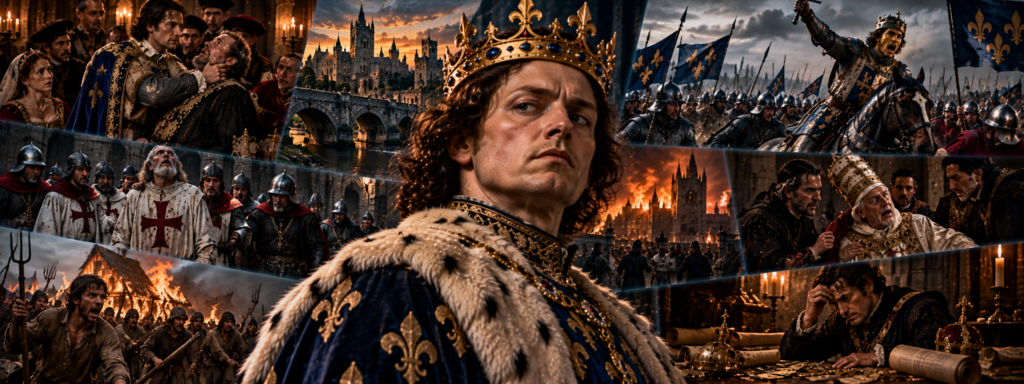
John II of France: The Reckless King, the Bloody Banquet, and the Battle That Nearly Destroyed a Kingdom
King of France, 1350–1364
He was called John the Good, yet his reign brought France to the edge of political and financial collapse. He ordered one of his highest officers executed without a public trial, showered a controversial favorite with honors, and turned a royal dinner into a terrifying spectacle of arrests and executions. He founded an exclusive order of knights devoted to courage and honor, only to preside over one of the most humiliating military defeats of the Hundred Years’ War. At Poitiers in 1356, John II refused to abandon the battlefield, fought desperately as his army disintegrated, and became a prisoner of the English. His capture plunged France into a crisis of royal authority, urban rebellion, peasant violence, financial disorder, and political betrayal. The ransom demanded for his freedom was enormous, while the peace settlement required France to surrender vast territories. Yet perhaps the strangest decision came after his release, when John voluntarily returned to English captivity following the unauthorized departure of his hostage son. His conduct appeared to embody the ideals of medieval chivalry, but the consequences for his kingdom were devastating. John was not clinically insane, and claims that he suffered from a severe psychiatric disorder are unsupported by reliable evidence. His reign presents a different kind of royal catastrophe: a monarch whose understanding of honor, loyalty, punishment, and kingship repeatedly collided with the political realities of a kingdom already devastated by war and plague.
The King Who Refused to Leave the Battlefield
On September 19, 1356, the fate of France hung upon a battlefield near Poitiers. The French army had confronted an English-led force commanded by Edward of Woodstock, Prince of Wales, later remembered as the Black Prince. John II of France possessed substantial military resources and the prestige of kingship, but neither guaranteed victory. The French had suffered a catastrophic defeat at Crécy ten years earlier, and another major failure threatened to undermine the authority of the relatively new Valois dynasty.
The fighting developed into a disaster. French attacks failed to break the English position, important nobles were killed or captured, and the army’s cohesion deteriorated. John remained in the battle as the situation worsened. Surrounded by enemies, he fought alongside his youngest son Philip, who would later become Duke of Burgundy. Eventually the king was captured, turning a military defeat into a national political catastrophe.
A medieval king’s capture carried consequences far beyond the battlefield. John was the central figure of French royal government, the source of appointments, authority, and dynastic legitimacy. His imprisonment deprived the monarchy of its reigning sovereign at a moment when the kingdom desperately needed stable leadership. The responsibility for government fell upon his nineteen-year-old eldest son, Charles, who would confront some of the gravest crises in fourteenth-century French history.
John’s refusal to withdraw became one of the defining images of his reign. Admirers interpreted his conduct as the courage expected of a chivalrous king. Critics, both historical and modern, have questioned whether preserving the monarch’s freedom should have taken precedence over the personal pursuit of honor. The tension between these interpretations lies at the center of his reputation.
Yet it would be too simple to claim that John deliberately sacrificed France because he wanted a glorious last stand. Medieval kings were expected to demonstrate personal courage, and withdrawal from a collapsing battlefield could itself become dangerous. The circumstances of his capture were shaped by tactical developments, command failures, and the difficulty of escaping once fighting closed around him.
The battle nevertheless exposed a central weakness of John’s kingship. He possessed the symbols and ideals of royal authority but struggled to reconcile them with the practical demands of military command and political survival. The consequences would haunt France long after the battlefield had fallen silent.
To understand how a king celebrated for courage became associated with disastrous judgment, it is necessary to return to the unsettled beginnings of the Valois monarchy.
A Crown Born From a Disputed Succession
John II was born on April 26, 1319, the son of Philip of Valois and Joan of Burgundy. His childhood unfolded during a period when the French monarchy faced a profound dynastic transition. The direct male line of the Capetian dynasty ended in 1328 with the death of Charles IV, leaving the question of succession politically sensitive.
John’s father became Philip VI of France, establishing the Valois branch of the Capetian dynasty upon the throne. Edward III of England, grandson of Philip IV through his mother Isabella of France, possessed a competing hereditary claim. The French political establishment accepted Philip VI, relying upon principles that excluded succession through a female line, but the dispute contributed to tensions between the kingdoms.
The Hundred Years’ War began in 1337 amid disagreements involving sovereignty, territory, feudal obligations, and dynastic legitimacy. The English crown controlled lands in southwestern France, where its rulers held territories under complicated relationships with the French monarchy. Commercial interests in Flanders and alliances across Europe further intensified the conflict.
John grew up as heir to a dynasty whose legitimacy had been challenged by a powerful foreign ruler. That circumstance shaped the political environment of his youth, but it does not prove that he developed a psychological disorder or permanent insecurity. The Valois kings had genuine reasons to defend their hereditary claims and the authority of the French crown.
His early life prepared him for aristocratic and royal responsibilities. In 1332, he married Bonne of Luxembourg, daughter of John of Bohemia. The marriage connected the Valois dynasty to an influential European royal family and produced numerous children, including the future Charles V, Louis of Anjou, John of Berry, and Philip the Bold.
Bonne died in 1349 during the period of the Black Death, although the exact circumstances of her illness are not securely established. John married Joan I, Countess of Auvergne and Boulogne, the following year. These marriages reflected the importance of dynastic alliances and territorial relationships within medieval politics.
John’s father suffered a devastating defeat at the Battle of Crécy in 1346. English archers and disciplined defensive positions helped defeat a larger French army, exposing serious weaknesses in French military organization. The English subsequently captured Calais in 1347, establishing a strategically important foothold on the French coast.
When Philip VI died in August 1350, John inherited a kingdom already weakened by warfare, disease, taxation, and political discontent. The new king was thirty-one years old, experienced in aristocratic politics, and determined to defend the authority of the Valois crown.
He would soon demonstrate how ruthlessly he was prepared to act against anyone he regarded as a threat.
The First Blood: The Secret Execution of Raoul de Brienne
One of the most shocking events of John’s early reign occurred in November 1350, only months after his accession. Raoul II de Brienne, Count of Eu and Guînes, served as Constable of France, one of the kingdom’s highest military officers. The position carried enormous prestige and placed its holder close to the center of royal military authority.
Raoul had previously been captured by the English and spent time in captivity. Following his release, he returned to France, where he was arrested on John’s orders. The king had him executed in Paris without the kind of public trial that might have clarified the accusations against him.
The suddenness of the execution generated uncertainty and suspicion. Later accounts offered competing explanations, including allegations that Raoul had made improper territorial concessions to the English or compromised royal interests during his captivity. Other interpretations have connected the episode to court politics and the king’s determination to redistribute power.
The precise reasons remain disputed. The absence of a transparent judicial process makes it difficult to establish what evidence John possessed or whether Raoul had committed any offense deserving punishment. Historians have consequently treated the execution as an important example of the opacity and severity of royal government.
The political consequences were immediate. The constableship became vacant, allowing John to appoint a new holder. His choice was Charles de la Cerda, a young nobleman closely associated with the royal household and the king’s personal favor.
The appointment transformed a violent episode into a broader aristocratic crisis. Charles de la Cerda’s advancement alienated powerful nobles who believed that military offices and territorial rewards should reflect established rank and service. The resentment became especially dangerous because one of the most formidable opponents was Charles II of Navarre.
John’s decision to execute Raoul without a public explanation encouraged the impression that the king could act unpredictably against even the highest aristocrats. Yet describing the episode as proof of paranoia or madness would go beyond the evidence. It demonstrates an extraordinary exercise of royal power whose motives remain incompletely documented.
The execution also revealed a recurring problem in John’s reign. Attempts to strengthen his own authority through dramatic punishment could instead deepen mistrust among the nobles whose cooperation he needed.
Charles de la Cerda: The Favorite Who Divided the Kingdom
Charles de la Cerda became one of the most controversial figures at John II’s court. He belonged to a noble family with connections to the French royal household and enjoyed exceptional royal favor. His appointment as Constable of France in 1350 placed him at the center of military and political power.
John granted him offices, privileges, and valuable rewards, provoking resentment among aristocrats who believed themselves more entitled to royal generosity. Favoritism was an ordinary feature of medieval monarchy, but its political consequences could be severe when a favored individual appeared to monopolize access to the king.
Charles de la Cerda’s rise was particularly offensive to Charles II of Navarre, whose territorial interests and dynastic ambitions already placed him in conflict with the Valois monarchy. Disputes over lands and compensation intensified the rivalry. The favorite became a symbol of the king’s willingness to reward one faction at the expense of another.
Later writers sometimes describe John’s attachment to de la Cerda as obsessive or psychologically abnormal. Such language is difficult to substantiate. The surviving evidence establishes strong political favoritism and personal confidence, but it does not permit a clinical assessment of the king’s emotional life.
The relationship became explosive in January 1354. Charles de la Cerda was murdered at L’Aigle in Normandy by men associated with Charles of Navarre’s faction, including his brother Philip of Navarre. The killing was not an accidental consequence of ordinary rivalry; it was a deliberate act of political violence.
Charles of Navarre acknowledged responsibility for the action within the political negotiations that followed, although the precise extent of his personal planning has been debated. The murder threatened to provoke civil war because Navarre possessed supporters in Normandy and could seek assistance from England.
John faced an extraordinary dilemma. His favored constable had been murdered by a powerful royal relative, yet immediate punishment risked driving Navarre openly into alliance with the English. The king was forced to negotiate with a man whose associates had killed one of his closest political supporters.
The Treaty of Mantes in February 1354 temporarily addressed the conflict through concessions and reconciliation. The settlement, however, did not remove the underlying hostility. Navarre remained suspicious of the crown, while John had little reason to trust a rival whose political ambitions could threaten Valois authority.
The murder of de la Cerda became a turning point. It intensified personal and factional hostility within the French aristocracy and helped create the conditions for one of the most dramatic confrontations of John’s reign.
Charles the Bad: The Dangerous Cousin Who Challenged the Valois Crown
Charles II of Navarre, remembered as Charles the Bad, was one of the most complicated political figures of fourteenth-century France. Born in 1332, he inherited the kingdom of Navarre and possessed important territories in Normandy. Through his mother, Joan II of Navarre, he descended from the senior Capetian royal line.
His dynastic background gave him a position of considerable prestige. He could present himself as a prince whose hereditary claims and status deserved recognition from the Valois monarchy. His marriage to John’s daughter Joan in 1352 further connected him to the French royal family, making him both a relative and a son-in-law of the king.
The nickname the Bad emerged from hostile historical tradition and should not be mistaken for a neutral contemporary description of every aspect of his career. Charles pursued ambitious policies, negotiated with rival powers, and repeatedly challenged French royal authority. His conduct was controversial, but it operated within the complex political landscape of the Hundred Years’ War.
His Norman territories gave him influence in a strategically important region. Normandy contained powerful aristocratic families and lay close to the areas contested by English and French forces. A rebellion there could threaten the security of the French crown while offering England valuable opportunities.
Charles also possessed political supporters who resented royal taxation and the growing influence of John’s favored officials. His ability to attract such alliances made him more dangerous than an isolated noble opponent. He could present his grievances as part of a broader criticism of Valois government.
The murder of Charles de la Cerda intensified the rivalry. Although negotiations produced temporary settlements, mutual suspicion continued. Charles of Navarre maintained contacts that raised fears of cooperation with England, while John sought to contain his influence.
The relationship was therefore not simply a contest between an unstable king and a malicious cousin. Both men pursued political objectives within a kingdom facing war, financial pressure, and contested authority. Their conflict became increasingly personal, but it also reflected structural tensions between monarchy and aristocracy.
By 1356, John had decided that accommodation was no longer sufficient. His next move would turn a gathering of nobles into a spectacle of royal violence.
The Bloody Banquet at Rouen: When the King Came for His Guests
On April 5, 1356, Charles of Navarre attended a gathering at Rouen hosted by the dauphin Charles, John’s eldest son and future successor. The event brought together important members of the French aristocracy at a time of intense political tension. What began as a courtly occasion ended in arrests and executions.
John II arrived unexpectedly with armed supporters and seized Charles of Navarre. Accounts describe a dramatic confrontation in which the king personally challenged his rival. Later chroniclers supplied vivid details, including accusations of treachery and scenes of physical intimidation, but the precise words and gestures cannot be verified.
The familiar image of John bursting into the room in full armor with exactly one hundred knights and grabbing Navarre by the throat should therefore be treated cautiously. The essential event is well established: the king intervened personally, arrested Charles of Navarre, and ordered severe punishment against members of his circle. The more theatrical details vary across accounts.
Several of Navarre’s associates were executed, including the Count of Harcourt and other prominent Norman nobles. The proceedings were swift, and the executions shocked aristocratic opinion. The king’s actions demonstrated that even powerful nobles could face sudden punishment when royal authority was challenged.
Charles of Navarre was imprisoned rather than executed. His captivity removed him temporarily from political activity, but it did not eliminate his supporters. Instead, the arrests and executions intensified resentment among factions already suspicious of John’s government.
The dauphin’s position was especially difficult. The gathering had occurred under his auspices, and his father’s intervention undermined the atmosphere of trust surrounding the event. Later historians have sometimes portrayed the episode as a formative lesson for the future Charles V, who would adopt a more cautious political style. Such an interpretation is plausible, but the surviving evidence does not reveal the dauphin’s private thoughts with certainty.
The Rouen affair has become central to John’s reputation for impulsive violence. It was a dramatic and politically consequential decision, but it also emerged from genuine concerns about Navarrese alliances and possible treason. The danger was real even if the king’s methods proved counterproductive.
The executions did not stabilize Normandy. They helped deepen divisions that would become even more dangerous after the French military catastrophe later that year.
The Order of the Star: A Brotherhood of Knights and a Dangerous Ideal
In 1351, John II founded the Order of the Star, an elite chivalric institution intended to enhance royal prestige and strengthen loyalty among the French nobility. The order reflected the flourishing culture of aristocratic knighthood, in which military courage, religious devotion, honor, and ceremonial display occupied central positions.
Its foundation also responded to developments across the Channel. Edward III of England had established the Order of the Garter, creating an exclusive association of knights linked closely to the English crown. John’s order offered a French counterpart that could celebrate Valois kingship and reinforce relationships among important nobles.
The Order of the Star was associated with elaborate ceremonies, distinctive insignia, and demanding ideals of martial conduct. Its statutes emphasized loyalty and courage, including restrictions upon retreat from battle. The precise interpretation and application of these provisions require care because later popular accounts have simplified their wording and consequences.
The familiar claim that every member swore never to retreat more than four acres from a battlefield is not a reliable description of the order’s rules. Medieval chivalric obligations were expressed in more complicated terms, and the relationship between ceremonial vows and actual battlefield behavior varied. It would also be inaccurate to claim that the order directly caused the destruction of France’s most experienced commanders at Poitiers.
Nevertheless, the order’s ideals could encourage an uncompromising attitude toward military honor. A knight’s reputation depended heavily upon courage and loyalty, and retreat could carry social consequences even when tactically sensible. The culture of chivalry sometimes made it difficult to reconcile personal reputation with collective military necessity.
The Battle of Mauron in 1352, where French forces suffered a defeat against an Anglo-Breton army, became associated with the losses sustained by members of the order. The disaster damaged its prestige and revealed the vulnerability of elite knights confronting disciplined opponents.
John’s decision to found the order was not irrational by medieval standards. Kings regularly used ceremonial institutions to bind nobles to the crown, reward service, and project authority. The order also expressed the religious and cultural values expected of a Christian monarch.
Its significance lies in the tension between symbolism and military effectiveness. John invested in an institution that celebrated courage at a time when France desperately needed disciplined command, financial stability, and tactical adaptation. The order could strengthen loyalty, but it could not by itself solve the kingdom’s military problems.
The contrast became especially painful at Poitiers, where personal bravery proved insufficient to prevent catastrophe.
A Kingdom Devastated by Plague, War, and Financial Desperation
The France inherited by John II was already suffering from problems no individual monarch could easily resolve. The Black Death had reached the kingdom in 1348, bringing immense mortality and disruption. Its effects continued long after the initial epidemic, altering patterns of labor, agriculture, trade, inheritance, and taxation. Communities lost workers, families lost property holders, and local institutions struggled to maintain their ordinary functions.
War compounded these difficulties. English armies conducted destructive campaigns through French territory, often burning settlements, seizing supplies, and demanding payments. These expeditions, known as chevauchées, were designed partly to undermine the French king’s authority by demonstrating his inability to protect his subjects. Even regions that avoided major battles could suffer serious economic losses from raiding and the threat of attack.
John’s government needed money to maintain armies, fortifications, garrisons, and administrative institutions. Yet the economic disruption caused by plague and warfare weakened the resources available to the crown. The monarchy increasingly depended upon extraordinary taxation and cooperation from representative assemblies. These arrangements created political opportunities for groups seeking greater influence over royal financial decisions.
The gabelle, a tax associated with salt, formed part of the developing fiscal system. Salt was essential for preserving food, particularly meat and fish, making taxation politically sensitive. However, the familiar account that John personally invented an entirely new and uniform salt tax to finance tournaments is inaccurate. Salt taxation had earlier origins, and its administration varied across regions and periods.
Currency policy created additional difficulties. Fourteenth-century French governments repeatedly altered coinage standards and monetary valuations to obtain revenue or respond to financial pressures. Such changes could disrupt commercial contracts, affect wages, and undermine confidence in money. John continued practices already employed under earlier rulers, sometimes producing serious hardship.
It would nevertheless be misleading to attribute every instance of inflation or economic decline directly to royal debasement. Warfare, harvest conditions, plague, population loss, taxation, and commercial disruption all influenced prices and purchasing power. Medieval economic crises rarely possessed a single cause.
John’s court also maintained the expensive ceremonies and material display expected of monarchy. Royal clothing, jewels, horses, household furnishings, and ceremonial events represented status and authority. Such expenditure could provoke resentment when subjects were suffering, but it was not necessarily evidence of compulsive extravagance.
The more difficult question concerns priorities. John’s government devoted considerable attention to aristocratic ceremony and military prestige while struggling to establish dependable revenue and effective defense. Critics could reasonably question the balance between royal display and practical necessity. Yet descriptions of the king as pathologically obsessed with luxury are not supported by a clinical record.
The same caution applies to claims that John maintained an enormous traveling library which accompanied him into battle. Royal households possessed books and valuable manuscripts, and John’s son Charles V would become particularly famous for his library. The image of John dragging an immense personal collection onto military campaigns, however, is not established by reliable evidence.
John’s financial difficulties were genuine and serious. They arose from the demands of monarchy during one of the most destructive periods in medieval French history, aggravated by military failures and political conflict. His policies sometimes intensified the crisis, but the underlying pressures extended far beyond his personal habits.
The Road to Poitiers: The Black Prince’s Devastating Campaign
By 1355, the Hundred Years’ War had entered another dangerous phase. Edward of Woodstock, Prince of Wales, commanded English forces operating from territories in southwestern France. His campaigns demonstrated the effectiveness of mobile warfare directed against the economic foundations of French royal authority.
The prince’s expedition through Languedoc in 1355 inflicted extensive destruction. English forces burned settlements, damaged agricultural resources, and carried away valuable goods. Such operations were intended to weaken the French monarchy while avoiding the risks of attacking heavily defended positions.
In 1356, the prince conducted another campaign, moving northward from the English-controlled southwest. His army included English and Gascon troops, supported by experienced commanders familiar with the tactics that had proved effective at Crécy. The force was relatively compact compared with the armies that the French crown could theoretically assemble.
John responded by gathering an army to intercept the English. His objective was understandable. Allowing the prince to continue devastating French territory without serious resistance would damage royal prestige and expose subjects to further destruction. A successful interception might restore confidence in the monarchy after years of humiliation.
The two forces eventually approached one another near Poitiers. Their precise numbers remain disputed, as medieval chroniclers frequently exaggerated army sizes. Most reconstructions suggest that the French possessed a numerical advantage, but the extent of that advantage cannot be stated with certainty.
The English occupied a defensible position, using terrain and obstacles to complicate French attacks. Their army included experienced archers and dismounted men-at-arms. French commanders had to decide whether to assault the position, negotiate, or attempt to prevent the English from escaping.
Negotiations occurred before the battle, involving Cardinal Talleyrand of Périgord as a mediator. Accounts indicate that the English offered concessions, including the surrender of prisoners or plunder and an agreement not to fight for a period. The exact proposals differ among sources, and the familiar version in which the prince simply offered to return everything in exchange for safe passage is an oversimplification.
John declined to accept a settlement that would allow the English army to withdraw on the proposed terms. His decision has frequently been attributed to pride and an overwhelming desire for victory. Yet military and political considerations also mattered. The English had inflicted extensive damage, and allowing them to escape could appear to reward destructive campaigning.
The negotiations failed. On September 19, the armies fought, and the consequences transformed the history of the war.
The Battle of Poitiers: Chivalry Meets a Military Catastrophe
The Battle of Poitiers unfolded across difficult terrain where hedges, vineyards, lanes, and uneven ground complicated the movement of troops. The English position offered defensive advantages, while French commanders attempted to coordinate attacks against an experienced opponent. The battle was not simply a confrontation between foolish mounted knights and disciplined English archers.
The French employed substantial numbers of dismounted men-at-arms, reflecting lessons learned from earlier defeats. Mounted troops also participated in the fighting, but the popular image of John ordering his entire army into repeated cavalry charges is inaccurate. French commanders attempted different approaches, including attacks intended to disrupt the English archers.
The English longbowmen remained important, but their effectiveness depended upon circumstances. Armor, terrain, distance, and the organization of attacks influenced the results. The French army suffered from problems of coordination and cohesion, while English forces exploited opportunities created by the developing battle.
Several French formations failed to achieve their objectives. Some troops withdrew or became separated from the main fighting. The departure of John’s older sons from the battlefield, apparently intended to protect the succession, later attracted criticism, although preserving royal heirs was a recognizable dynastic concern.
John remained with his own division as the battle deteriorated. His youngest son Philip stayed beside him, an episode that became celebrated in later chivalric memory. Father and son were eventually surrounded by English and Gascon soldiers, and the king was captured after fierce fighting.
The scale of the defeat was enormous in political terms. Important French nobles were killed or taken prisoner, and the reigning monarch became an English captive. The victory gave Edward III’s government extraordinary leverage in negotiations.
The battle also damaged the reputation of the French aristocracy. Nobles claimed military leadership and enjoyed privileges partly justified by their obligation to defend society. Their inability to protect the kingdom from repeated defeats encouraged resentment among townspeople and peasants who bore much of the war’s financial and physical burden.
John’s conduct remains open to differing interpretations. His personal courage was recognized, and his refusal to abandon his companions fitted contemporary expectations of chivalry. Yet his capture deprived France of its sovereign at precisely the moment when effective leadership was essential.
The defeat was not caused by a single impulsive charge or an isolated failure of judgment. It resulted from a combination of tactical decisions, English military effectiveness, French command difficulties, and the broader challenges of fourteenth-century warfare. Nevertheless, the consequences of John’s leadership were catastrophic.
A King in Captivity: The Strange Comforts of an English Prisoner
Following Poitiers, John was taken into English custody. He was initially held in English-controlled territory before being transported to England in 1357. His arrival represented an enormous diplomatic triumph for Edward III, who now possessed the reigning king of France as a prisoner.
John’s captivity differed dramatically from the imprisonment experienced by ordinary soldiers or political detainees. As a captured monarch, he received treatment appropriate to his rank. He occupied prestigious residences, maintained a household, and enjoyed access to servants, furnishings, and expensive goods.
Among his places of residence were the Savoy Palace in London and other royal or aristocratic properties. His movements and privileges were controlled, but he was not ordinarily confined in the miserable conditions associated with a dungeon. English authorities understood that maintaining his dignity could serve diplomatic purposes and reinforce the prestige of their victory.
Records associated with his captivity reveal expenditure on the royal household and its comforts. Clothing, food, ceremonial occasions, and other necessities of elite life continued to occupy an important place. These arrangements were not evidence that John had ceased to care about France, although they created an uncomfortable contrast with the hardships suffered by his subjects.
The English king also had practical reasons to treat John well. A captive monarch was an extraordinarily valuable political asset. His safe return could be exchanged for territory, money, and diplomatic concessions. Humiliating or mistreating him might complicate negotiations and damage the chivalric reputation of his captors.
John’s position was therefore paradoxical. He retained the dignity and ceremony of kingship while lacking the freedom to govern his kingdom directly. His captors could honor his rank precisely because they controlled his person.
In France, meanwhile, his son Charles faced a crisis that would reveal how deeply the defeat had weakened royal authority.
Étienne Marcel: The Parisian Revolt Against Royal Government
The dauphin Charles was only nineteen when his father was captured. He inherited responsibility for a kingdom whose finances were strained, whose military reputation had been shattered, and whose political factions were increasingly divided. His youth and relative inexperience made the task especially difficult.
The Estates-General assembled in Paris in October 1356 to address the financial and political emergency. Representatives demanded reforms in exchange for supporting taxation. They criticized royal officials and sought greater oversight of government finances. The defeat at Poitiers had created an opportunity to challenge established practices of royal administration.
Étienne Marcel, provost of the merchants of Paris, became a leading figure in the reform movement. He represented important urban interests and argued for changes intended to limit abuses of royal authority. His position reflected the growing political importance of Paris, whose merchants and municipal institutions possessed substantial resources.
The Great Ordinance of 1357 embodied significant reform proposals, including greater scrutiny of royal officials and financial administration. Yet implementation proved difficult. The dauphin faced competing demands from reformers, nobles, royal supporters, and the faction associated with Charles of Navarre.
Marcel’s relationship with the dauphin deteriorated as political tensions intensified. In February 1358, an armed crowd entered the royal residence in Paris. Two senior marshals, Jean de Conflans and Robert de Clermont, were killed in the dauphin’s presence. The violence demonstrated that the conflict had moved far beyond arguments about taxation.
The dauphin’s personal danger was considerable. Marcel attempted to control the political situation in Paris, while Charles sought support outside the capital. The struggle threatened to divide the kingdom between rival centers of authority.
Charles of Navarre exploited the instability. Released from imprisonment in 1357, he presented himself as an alternative political figure and cultivated supporters dissatisfied with Valois government. His ambitions complicated Marcel’s movement, which contained different groups with competing objectives.
The Parisian revolt was not simply an irrational uprising against legitimate monarchy. It emerged from real grievances concerning taxation, military failure, and the accountability of royal officials. Nevertheless, the movement became entangled with factional conflict and violence that undermined its original reform objectives.
By the summer of 1358, the crisis had reached a dangerous point. Marcel’s alliances and political calculations alienated important sections of Parisian society, while the dauphin worked to recover control. Marcel was killed on July 31, and Charles subsequently reentered the capital.
The revolt revealed the political consequences of John’s capture. Without the reigning king, the monarchy struggled to maintain authority, and demands for reform became inseparable from struggles over who should govern.
The Jacquerie: When the French Countryside Rose in Fury
While Paris struggled with political rebellion, violence erupted across parts of the French countryside. In late May 1358, a peasant uprising spread through regions north of Paris, particularly the Beauvaisis and neighboring territories. The revolt became known as the Jacquerie, a name derived from Jacques, a conventional designation used for peasants.
The uprising emerged from years of accumulated suffering. Rural communities had endured plague, warfare, taxation, military raids, and demands imposed by landlords. Armed companies moved through the countryside, seizing supplies and threatening settlements. The inability of the nobility to protect the population, particularly after Poitiers, weakened traditional expectations of aristocratic leadership.
The rebels attacked noble residences, destroyed property, and killed members of aristocratic households. Some medieval chronicles describe extreme atrocities, but these accounts were often written from aristocratic perspectives and require critical examination. The violence was real, yet sensational descriptions could serve to portray the rebels as monstrous and justify severe retaliation.
The movement included more than the poorest peasants. Some participants possessed land or other resources, while artisans and inhabitants of small towns also became involved. Their grievances varied, but anger toward aristocratic privilege and military failure helped unite them temporarily.
Guillaume Carle, also known as Guillaume Cale, emerged as an important leader. He attempted to organize the rebels, although the movement lacked the centralized command of a professional army. Its rapid spread reflected the intensity of local resentment rather than a single carefully prepared national conspiracy.
Charles of Navarre intervened against the rebels despite his own conflicts with the Valois monarchy. His forces defeated the uprising near Mello in June 1358. Carle was captured during negotiations and subsequently executed. The suppression was followed by extensive reprisals against rural communities.
The Jacquerie demonstrated how thoroughly the social order had been destabilized. Peasants who were expected to sustain aristocratic warfare through labor, taxation, and supplies had begun attacking the nobles who claimed responsibility for their protection. The rebellion was brief, but its violence left a lasting impression upon contemporaries.
John II was still in captivity when these events unfolded. He did not personally direct the suppression, and attributing every atrocity to his decisions would be inaccurate. Nevertheless, the uprising occurred within the political and military crisis created by the collapse of royal authority after Poitiers.
The kingdom had reached a frightening condition. Its king was imprisoned abroad, its capital had experienced rebellion, its countryside had erupted into violence, and its aristocracy remained divided. France needed peace, but the price demanded by England would be enormous.
The Treaty of Brétigny: The Terrible Price of a King’s Freedom
Negotiations for John’s release became one of the most consequential diplomatic struggles of the Hundred Years’ War. Edward III possessed a captive monarch and substantial military advantages, allowing him to demand extraordinary concessions. The French government, however, could not simply accept every English proposal without risking further political resistance.
Earlier negotiations produced the Treaties of London, whose proposed territorial concessions were exceptionally severe. The French political leadership rejected the most demanding arrangements. Edward subsequently conducted another campaign in France, hoping to strengthen his negotiating position.
The eventual settlement emerged in 1360. The preliminary Treaty of Brétigny was agreed in May, and the arrangements were subsequently formalized through the Treaty of Calais in October. The agreement provided for John’s release in exchange for an immense ransom and major territorial concessions.
The ransom was fixed at three million gold écus, an extraordinary sum relative to the financial resources of the French monarchy. Payment was to be made in installments, with hostages provided as security. The arrangements placed a continuing burden upon royal finances and required the cooperation of territories and communities already suffering from war.
The territorial concessions were equally significant. England received greatly expanded possessions in southwestern France, including territories associated with Aquitaine, Poitou, and neighboring regions. Calais and other holdings also remained under English control. The settlement altered the political geography of western France and strengthened the English position on the continent.
The agreement included provisions concerning Edward III’s claim to the French crown and the sovereignty of the transferred territories. Yet the formal renunciations required to settle these questions were not fully exchanged as originally intended. This failure would later become important when conflict resumed.
The treaty has often been described as surrendering one-third of France. That expression conveys the magnitude of the concessions, although precise calculations depend upon how territories and jurisdictions are measured. The essential point is that the settlement transferred extensive lands and rights away from French royal authority.
John returned to France in 1360, but his freedom was conditional upon continuing financial obligations. His release did not end the kingdom’s difficulties. The monarchy still faced taxation disputes, damaged infrastructure, aristocratic rivalries, and the problem of soldiers who remained armed despite the peace.
The treaty represented a temporary settlement rather than a lasting solution. England had gained territory and financial promises, while France recovered its king at a staggering price.
The Great Companies: The Soldiers Who Continued the War Without Kings
One of the most destructive consequences of the war was the emergence of large groups of unemployed or loosely organized soldiers who survived through plunder and extortion. These forces became known as the Great Companies. Their activities continued even when formal hostilities between England and France were suspended.
The companies included men from different regions and political backgrounds. Some had served in English armies, others in French forces, and many followed captains whose principal concern was maintaining employment and obtaining resources. Their loyalties could shift according to opportunity.
For rural communities, the distinction between official warfare and mercenary violence mattered little. Armed men seized livestock, demanded payments, occupied buildings, and threatened inhabitants. Villages that had survived earlier campaigns could be devastated by soldiers who were no longer receiving regular wages.
The Treaty of Brétigny did not solve this problem. Peace reduced some forms of organized warfare but also left experienced fighters without dependable employment. The French crown lacked sufficient resources and authority to suppress every company operating within its territory.
The problem became especially severe in regions where castles, roads, and river crossings could be exploited for extortion. Armed groups established bases from which they threatened surrounding settlements. Local communities sometimes paid substantial sums simply to avoid attack.
John’s government attempted to address the disorder, but success was limited. The monarchy was simultaneously struggling to meet ransom obligations and restore its authority over territories damaged by years of conflict.
The Great Companies exposed a fundamental weakness of medieval warfare. Kings could negotiate treaties, but they could not always control the soldiers who had fought in their names. Military violence had developed an economic life of its own.
For the population of France, the king’s return did not bring immediate security. The war’s destructive consequences continued to shape daily life, even during periods officially described as peace.
Royal Luxury and the Problem of John’s Reputation
John’s personal tastes have sometimes been presented as evidence that he was indifferent to the suffering of his kingdom. Accounts emphasize elaborate clothing, precious objects, court ceremony, and expensive aristocratic entertainments. His captivity in England, where he maintained a household appropriate to his rank, has further encouraged comparisons between royal comfort and popular misery.
The contrast is historically meaningful, but it requires context. Medieval monarchy depended upon visible displays of dignity. Clothing, jewels, horses, household personnel, and ceremonial generosity communicated status and reinforced relationships among nobles. A king who abandoned such practices entirely could risk appearing impoverished or politically diminished.
John certainly participated in this culture. His patronage and ceremonial expenditure reflected the values of the aristocratic world in which he had been raised. Yet descriptions of pathological collecting, compulsive spending, or an inability to restrain himself are not established by surviving financial records alone.
His supposed aversion to physical activity is similarly questionable. John participated personally in warfare and remained on the battlefield at Poitiers, where he was captured after fighting. Whatever his individual preferences concerning tournaments, the claim that he was physically incapable of meeting aristocratic expectations conflicts with evidence of his military involvement.
Nor is there sufficient evidence to describe a recurring pattern of clinical depression alternating with manic activity. Fourteenth-century records were not designed to document psychiatric symptoms according to modern diagnostic standards. Political inactivity, ceremonial expenditure, or sudden military decisions cannot independently establish a mood disorder.
John’s reputation is better understood through his political conduct and the values of his social environment. He placed great importance upon aristocratic honor, royal dignity, and personal loyalty. These priorities could produce decisions that appeared admirable within chivalric culture but damaging when measured against the needs of government.
His final return to English captivity would become the most famous example of that contradiction.
Louis of Anjou: The Hostage Who Abandoned His Captivity
The Treaty of Brétigny required hostages to guarantee payment of John’s ransom and fulfillment of the peace arrangements. Among them was Louis of Anjou, one of the king’s sons. His position reflected a common diplomatic practice: the relatives of powerful rulers could be held as security for agreements.
Louis was detained at Calais, an English possession on the French coast. His captivity was not necessarily equivalent to imprisonment in a dungeon, but his freedom remained restricted. The arrangement depended upon the understanding that the hostages would remain available until the agreed conditions were fulfilled.
In 1363, Louis left English custody without authorization. His departure violated the arrangements supporting John’s release and created a serious diplomatic problem. The French king remained responsible for a ransom that had not been fully paid, and the escape undermined confidence in the guarantees provided to England.
John’s response became one of the most remarkable decisions of his reign. Rather than remaining in France while attempting to negotiate the consequences, he announced his intention to return to England.
The decision has traditionally been explained as an expression of chivalric honor. A king who had pledged hostages as security could regard their unauthorized departure as a stain upon his own good faith. Returning personally might restore confidence in his promises and demonstrate that royal honor remained intact.
Yet historians have also considered political and diplomatic explanations. John may have hoped to negotiate more favorable arrangements directly with Edward III. He also faced difficult conditions in France, including financial obligations and continuing disorder. His precise combination of motives cannot be established with certainty.
The return nevertheless exposed him to criticism. France needed its sovereign, and his absence would again place responsibility for government upon his son Charles. The decision prioritized obligations connected with personal and dynastic honor at a time when the kingdom remained politically fragile.
It was not necessarily an irrational act by the standards of medieval chivalry. But its practical consequences were difficult to ignore.
The King Who Voluntarily Returned to Prison
John traveled to England in January 1364 and was received with considerable ceremony. Edward III treated him as a royal guest and captive of exceptional importance. The French king again occupied prestigious accommodations and participated in the formal social world of the English court.
His return fascinated contemporaries because it appeared to reverse the ordinary logic of captivity. Most prisoners sought freedom, while John voluntarily surrendered his own. The action seemed to demonstrate an extraordinary commitment to keeping faith, even when doing so imposed political costs.
Later writers celebrated the decision as the ultimate proof that John deserved his nickname the Good. In this interpretation, he was a monarch whose personal honor mattered more than convenience, safety, or political advantage. His return became an exemplary story about the obligations of kingship.
Other interpretations have been less admiring. France remained financially exhausted and politically unsettled. The crown needed to restore its institutions, address armed disorder, and manage the consequences of territorial losses. A king who voluntarily left his kingdom could be accused of placing personal reputation above public responsibility.
Neither interpretation fully captures the complexity of the decision. Medieval political culture placed enormous value upon oaths, fidelity, and the honor of sovereigns. Diplomatic agreements depended upon trust, and a king who openly disregarded his obligations risked damaging his authority. John’s return can therefore be understood as an attempt to preserve a form of legitimacy that mattered deeply to his contemporaries.
Yet the episode also demonstrates the limitations of that political culture. A monarch’s personal reputation was not identical to the welfare of his subjects. The act that preserved John’s image as an honorable knight could simultaneously weaken his effectiveness as a ruler.
John’s second captivity was brief. He became ill in England and died at the Savoy Palace in London on April 8, 1364, aged forty-four. The precise cause of death remains uncertain, and the surviving evidence does not support a retrospective psychiatric explanation.
His body was returned to France and buried at the royal abbey of Saint-Denis. The king who had once been captured in battle and later returned voluntarily to captivity had died outside his own kingdom.
Charles V: The Son Who Inherited the Ruins
John’s eldest son succeeded him as Charles V in 1364. The new king inherited an extraordinary collection of problems: financial instability, territorial losses, military insecurity, aristocratic rivalries, and the continuing threat posed by Charles of Navarre. His reign would demonstrate a different approach to government.
Charles had already gained substantial political experience during his father’s captivity. He had confronted the Estates-General, survived the Parisian revolt, navigated the ambitions of Charles of Navarre, and worked to restore royal authority after the crisis of 1358. These experiences gave him practical knowledge of the dangers associated with political confrontation.
Unlike his father, Charles V became known for cautious administration and strategic patience. His nickname, the Wise, reflected a reputation for deliberation, learning, and effective government. Such descriptions should not be taken to mean that every policy succeeded or that his personality can be reconstructed without uncertainty. Nevertheless, his reign differed significantly in political style from that of John II.
Charles relied upon experienced advisers and military commanders, including Bertrand du Guesclin. French strategy increasingly emphasized avoiding unnecessary pitched battles, recovering fortified positions, and exploiting opportunities created by English difficulties. This approach reflected lessons drawn from earlier defeats.
The king also pursued financial and administrative reforms intended to support sustained military operations. Stable revenue was essential because recovering territory required more than isolated victories. The crown needed resources for garrisons, fortifications, soldiers, and diplomacy.
Charles’s reign witnessed important French successes. Following the renewal of war in 1369, French forces recovered substantial territories previously controlled by England. By the time Charles died in 1380, the English continental position had contracted considerably from its extent after Brétigny.
These achievements did not erase the devastation caused by decades of conflict. The French countryside continued to suffer from taxation and warfare, and the monarchy remained vulnerable to future crises. Nevertheless, Charles restored much of the authority that had been damaged during his father’s reign.
The contrast between father and son became irresistible to later historians. John appeared as the courageous but imprudent knight, while Charles represented the calculating administrator who understood the limitations of chivalric warfare.
The comparison contains genuine historical differences, but it should not become a simplistic judgment about intelligence or psychological stability. Both men governed under difficult circumstances, and Charles benefited from lessons learned during the catastrophes of his father’s reign.
The Burgundy Decision: A New Dynasty of Powerful Dukes
One of John’s most consequential dynastic decisions involved the duchy of Burgundy. The death of Philip of Rouvres in 1361 created a succession dispute over the duchy and associated territories. John asserted the French crown’s rights and brought the duchy under royal control.
In 1363, he granted Burgundy to his youngest son Philip, who had remained beside him at Poitiers. Philip’s loyalty during the battle had earned him the enduring nickname the Bold, although the grant also reflected broader dynastic considerations.
The decision strengthened a younger branch of the Valois family by giving it a wealthy and prestigious territorial base. In the short term, the arrangement could serve royal interests by placing an important duchy under a prince closely connected to the crown.
Its longer-term consequences were far more complicated. Philip the Bold married Margaret of Flanders in 1369, after John’s death, connecting Burgundy to territories and commercial interests in the Low Countries. His descendants would develop one of the most powerful princely states in late medieval Europe.
The Burgundian dukes eventually became formidable rivals of the French monarchy. Their wealth, territories, and political ambitions contributed to the factional struggles that destabilized France during the reign of Charles VI. The conflict between Burgundian and Armagnac factions would become a central feature of the later Hundred Years’ War.
John could not have foreseen the precise developments that followed. Granting territories to royal sons was an established dynastic practice, and the creation of a powerful Burgundian branch was not inherently irrational. Nevertheless, the decision illustrates how attempts to reward loyalty and strengthen family authority could produce unforeseen political consequences.
The prince who had stood beside John during the disaster at Poitiers became the founder of a dynasty whose power would eventually challenge the very monarchy from which it had emerged.
Was John II Really Mad? The Difference Between Chivalry and Clinical Illness
John II’s reputation for impulsiveness, stubbornness, and erratic judgment has encouraged occasional attempts to interpret his reign through modern psychiatric language. Such interpretations are difficult to support. The surviving sources document political actions, military decisions, ceremonial behavior, and hostile characterizations, but they do not establish a diagnosable mental illness.
The execution of Raoul de Brienne demonstrates the severity of John’s government and the opacity of some royal decisions. It does not prove that the king acted from paranoid delusions. The charges and political circumstances remain incompletely understood.
His favoritism toward Charles de la Cerda generated serious aristocratic resentment, but royal patronage was a normal instrument of medieval government. The consequences were damaging, especially after de la Cerda’s murder, yet the relationship cannot reliably be described as a pathological fixation.
The Rouen arrests of April 1356 offer stronger evidence of John’s willingness to employ sudden and dramatic coercion. The executions of prominent nobles intensified factional hostility and contributed to political instability. Even so, the action occurred within a recognizable conflict involving possible treason, territorial disputes, and the ambitions of Charles of Navarre.
John’s military leadership at Poitiers was unsuccessful, but the battle cannot be explained simply as the product of a reckless personality. French commanders confronted an experienced English force occupying favorable terrain. Tactical decisions, organizational weaknesses, and battlefield developments all contributed to the defeat.
The Order of the Star reflected the chivalric ideals of its time. Its emphasis upon courage and loyalty could encourage dangerous expectations, but founding such an institution was not evidence of mental illness. Similar orders existed elsewhere in Europe, and they served political as well as ceremonial purposes.
Claims that John alternated between clinical depression and manic activity lack adequate documentation. So do assertions that he possessed a pathological obsession with luxury or routinely abandoned government for months. These descriptions transform fragmentary historical evidence into modern psychological categories that the sources cannot sustain.
His voluntary return to England in 1364 remains his most unusual decision. Yet it can be understood within the medieval importance attached to oaths, honor, and the personal credibility of rulers. The action was politically consequential without being inexplicable.
John’s reign therefore belongs in a discussion of reputedly mad monarchs because it exposes the distance between contemporary ideals of kingship and the demands of effective government. His choices could be severe, controversial, and disastrous, but they do not establish clinical insanity.
His story is ultimately about the dangers of a political culture in which personal honor, dynastic authority, and aristocratic loyalty could become more important than the practical needs of a suffering kingdom.
The Legacy of John the Good: A King Remembered for Honor and Disaster
John II ruled France for fourteen years, from 1350 until 1364. His reign unfolded during one of the most destructive periods in medieval French history, when war, plague, taxation, and political instability threatened the foundations of royal authority. He inherited serious problems from his father, but several of his own decisions deepened the crisis.
The execution of Raoul de Brienne damaged confidence among the nobility, while the promotion of Charles de la Cerda intensified aristocratic rivalries. The murder of the royal favorite brought John into increasingly dangerous conflict with Charles of Navarre. His intervention at Rouen in 1356 demonstrated the severity of royal punishment but failed to eliminate factional opposition.
The Battle of Poitiers became the defining catastrophe of his reign. John’s capture deprived France of its reigning sovereign and gave England extraordinary negotiating power. His son Charles was left to confront financial disorder, the Parisian revolt, the Jacquerie, and the continuing ambitions of rival princes.
The Treaty of Brétigny secured John’s release but imposed immense costs. France surrendered extensive territories and accepted a ransom of three million gold écus. The kingdom remained burdened by armed companies, taxation, and political instability even after the king returned.
John’s decision to go back to England in 1364 became the final paradox of his life. His willingness to honor the obligations associated with his son’s departure from captivity strengthened his reputation for chivalric integrity. Yet it also removed him from a kingdom that urgently needed stable leadership.
His death left Charles V to restore royal authority and recover territory through a different approach to government. The contrast between their reigns became one of the enduring lessons drawn from the first phase of the Hundred Years’ War.
John II of France was called the Good because medieval kingship celebrated courage, loyalty, generosity, and the defense of personal honor. He possessed qualities that contemporaries could admire, particularly his willingness to remain with his soldiers at Poitiers and his determination to uphold obligations associated with his captivity. Yet those same ideals existed alongside decisions that contributed to extraordinary suffering. His reign witnessed political executions, bitter aristocratic feuds, military catastrophe, urban rebellion, peasant revolt, financial instability, and territorial surrender. The kingdom he inherited was already wounded, but his government struggled to prevent those wounds from deepening. His final journey to England captured the contradiction at the heart of his reputation: a king prepared to sacrifice his own freedom for honor while leaving the burdens of government to others. John was not a clinically mad monarch whose behavior can be explained through an unsupported diagnosis. He was a medieval ruler whose understanding of honorable conduct did not always align with the practical responsibilities of sovereignty. His son Charles V would recover much of what France had lost, but the memory of Poitiers and the humiliation of royal captivity endured. John the Good remains a reminder that personal bravery and political judgment are not the same thing, and that a king could preserve his reputation as a knight even while his kingdom paid an extraordinary price.