
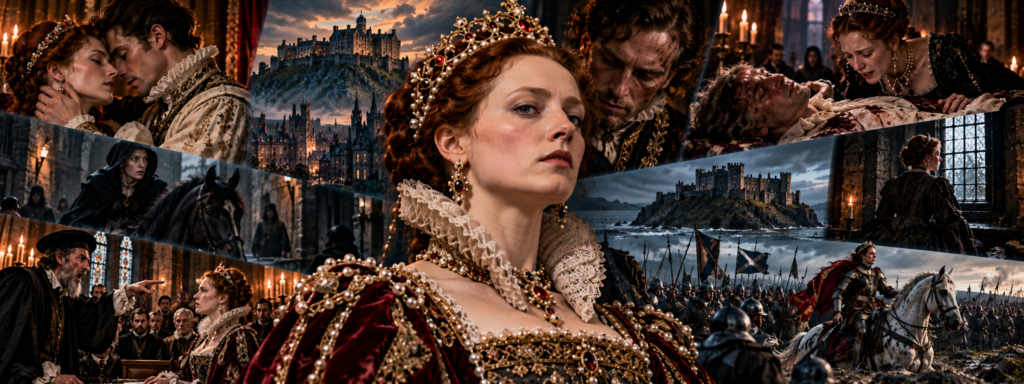
Mary, Queen of Scots: The Doomed Queen, Her Dangerous Lovers, and the Betrayals That Led to the Executioner’s Block
She became Queen of Scotland when she was only six days old, Queen of France before her eighteenth birthday, and a prisoner of her own nobles before she turned twenty-five. Her life unfolded through assassination plots, forbidden romances, religious conflict, accusations of adultery, and political betrayals that destroyed nearly everyone she trusted. Mary, Queen of Scots, was celebrated for her beauty, intelligence, charm, and courage, but her enemies portrayed her as dangerously impulsive, morally corrupt, and incapable of controlling either her passions or her kingdom. She married a handsome nobleman who became an ambitious and increasingly troublesome husband, watched her closest secretary murdered before her eyes, and then entered a marriage with the powerful earl widely suspected of arranging her husband’s assassination. Within months, she had lost her throne. Her escape from imprisonment offered a brief opportunity to recover her crown, but her decision to cross into England placed her at the mercy of her cousin Elizabeth I. What Mary expected to be temporary refuge became nineteen years of captivity, political intrigue, and growing suspicion. Her name became attached to conspiracies against Elizabeth, her correspondence was intercepted, and in February 1587 she walked toward an executioner’s block at Fotheringhay Castle. Yet behind the familiar portrait of a passionate, reckless queen lies a more complicated woman whose political choices were shaped by religious division, dynastic ambition, coercion, illness, and the relentless struggle for power. Mary was not demonstrably mad. She was a sovereign whose life became a battleground for competing loyalties, and whose enemies often transformed political controversy into accusations about her character.
A Queen in the Shadow of the Executioner’s Axe
On the morning of February 8, 1587, Mary Stuart entered the great hall of Fotheringhay Castle in Northamptonshire, where an execution scaffold had been erected. She was forty-four years old and had spent almost nineteen years in English custody. Once the crowned queen of two kingdoms, she now faced death under the authority of another reigning monarch.
The sentence followed her conviction for involvement in a conspiracy against Elizabeth I. English officials had intercepted correspondence connecting Mary with Anthony Babington and his associates, who planned to remove Elizabeth and restore Catholic influence. Mary denied authorizing Elizabeth’s murder, but the commissioners appointed to try her concluded that the evidence established her participation in the conspiracy.
Her execution raised questions that reached far beyond the fate of one prisoner. Mary was an anointed sovereign, and the killing of a queen by another monarchy challenged powerful assumptions about hereditary authority. Elizabeth herself had long hesitated to authorize such an outcome. Mary’s continued existence, however, had become a recurring focus for plots that threatened the English crown.
Mary approached her death with a carefully maintained sense of royal dignity. Contemporary accounts describe her wearing a dark outer gown, beneath which she revealed clothing of crimson or reddish-brown, a color often associated with Catholic martyrdom. Her attendants accompanied her until the final preparations. Protestant clergy were present, but she maintained her Catholic devotion.
The execution was gruesome. The headsman required more than one stroke to sever her head, and the scene became a source of horror in contemporary accounts. Afterward, the executioner displayed the severed head according to custom. Reports describe the discovery that Mary’s carefully arranged hair concealed a wig, revealing the effects of age and imprisonment upon a woman once celebrated for her appearance.
Her death immediately became a political and religious symbol. Catholic supporters portrayed her as a martyr, while defenders of Elizabeth’s government regarded the execution as a necessary response to repeated threats. Neither interpretation captures the entire history of the woman who died at Fotheringhay.
For more than two decades before her imprisonment in England, Mary had occupied the center of some of the most violent political struggles in Scotland and France. Her reputation for reckless passion developed from events that were often poorly documented, fiercely contested, or deliberately manipulated by her opponents.
To understand how she reached the scaffold, it is necessary to begin with a royal inheritance that placed extraordinary power upon an infant.
A Crown Before a Childhood: The Infant Queen of Scotland
Mary was born at Linlithgow Palace on December 8, 1542, the daughter of James V of Scotland and his French wife, Mary of Guise. Her father died on December 14, when she was only six days old. The infant princess immediately became Queen of Scots, inheriting a kingdom divided by aristocratic rivalry and threatened by its powerful southern neighbor.
James V’s death followed a period of military and political difficulty. Scottish forces had suffered a serious defeat at Solway Moss in November 1542, and the king died shortly afterward. Later tradition attributed his death to despair over the defeat and the birth of a daughter rather than a son. Such stories reflect contemporary expectations about succession, but they do not provide a secure medical explanation for his death.
Mary’s accession created an opportunity for competing factions. Scotland needed a regency because its sovereign could not govern. James Hamilton, Earl of Arran, initially assumed the role of governor, while Mary of Guise remained an influential figure in the royal household. Powerful nobles debated the kingdom’s relationship with England and France, and religious reform added another source of tension.
Henry VIII of England sought to arrange Mary’s marriage to his son Edward, hoping to bring Scotland under stronger English influence. The proposal became part of the Treaty of Greenwich in 1543, but Scottish opposition prevented its implementation. England responded with military campaigns that became known as the Rough Wooing.
The name sounds almost playful, but the conflict was devastating. English forces attacked Scottish towns, destroyed property, and sought to force the marriage through military pressure. The young queen’s existence became the central issue in a struggle involving national independence and dynastic control.
Mary spent portions of her early childhood in protected royal residences, including Stirling Castle. Her mother and advisers understood that possession of the queen’s person carried immense political significance. An enemy who captured Mary could potentially dictate the future of the Scottish crown.
France offered an alternative to English domination. Scotland’s longstanding alliance with France made a French marriage politically attractive, and the prospect became increasingly important as English attacks continued. In 1548, arrangements were completed for Mary to marry Francis, the French dauphin.
At five years old, she was sent across the sea to France. She left behind the kingdom she ruled and entered a royal household whose culture would shape her expectations for the rest of her life.
The French Court: Splendor, Power, and a Dangerous Education
Mary arrived in France in 1548 and was raised within the household of Henry II and Catherine de’ Medici. The French court offered an education in languages, music, dancing, literature, religion, and ceremonial conduct. It also exposed her to the complexities of one of Europe’s most powerful monarchies.
She learned to move confidently within an environment where royal magnificence was a political instrument. Court festivals, elaborate clothing, poetry, and carefully managed appearances reinforced the authority of the French crown. Mary became accomplished in the cultural expectations of a Renaissance princess and developed a reputation for intelligence and charm.
Her education was not limited to entertainment. French court politics involved rival noble families, religious tensions, and diplomatic maneuvering. The Guise family, her mother’s relatives, held substantial influence and strongly supported Catholic interests. Mary grew up surrounded by people who regarded her Scottish crown and English dynastic claim as valuable political assets.
On April 24, 1558, she married Francis, the French dauphin, at Notre-Dame Cathedral in Paris. The marriage fulfilled the alliance planned during her childhood and strengthened the connection between Scotland and France. Mary was fifteen, and Francis was fourteen. Their union was dynastic, but contemporary accounts generally suggest that they had developed an affectionate relationship.
In July 1559, Henry II died after injuries sustained in a tournament. Francis became Francis II, and Mary became queen consort of France while remaining sovereign of Scotland. For a brief period, she occupied an extraordinary position within European monarchy.
The French crown, however, was already facing serious religious and political tensions. Protestantism had gained adherents, while powerful Catholic families sought to preserve their influence. Francis was young and physically fragile, and his government depended heavily upon senior advisers.
On December 5, 1560, Francis II died after a short reign. Mary was eighteen and a widow. Her position at the French court changed dramatically because she was no longer the reigning queen consort. Catherine de’ Medici gained influence as the mother of the new king, Charles IX, while the Guise family’s position became more uncertain.
Mary now faced a decision that would determine the rest of her life. She could remain in France as a widowed queen with diminished political authority, or return to Scotland and govern the kingdom she had inherited as an infant.
She chose Scotland. The decision brought her into a country whose religious and political landscape had changed profoundly during her absence.
The Return to Scotland: A Catholic Queen in a Protestant Kingdom
Mary returned to Scotland in August 1561, arriving at Leith after more than thirteen years in France. She was nineteen years old and had little direct experience governing her native kingdom. The country she encountered differed sharply from the Scotland she had left as a child.
During her absence, Protestant reformers had gained substantial influence. The Scottish Reformation of 1560 had challenged papal authority and established a new religious settlement, although its implementation remained uneven. Powerful nobles supported the Protestant cause, while Catholic practices continued among sections of the population.
Mary remained committed to Catholicism. Her private celebration of Mass immediately became controversial among reformers who feared that the queen might attempt to restore Catholic dominance. Yet she initially pursued a relatively cautious policy, allowing the Protestant establishment to continue while maintaining her own religious worship.
This approach was politically significant. Mary possessed the legal authority of the crown, but she lacked the military and institutional resources to impose her religious preferences upon the kingdom. Her half-brother James Stewart, later Earl of Moray, became an important adviser. He was Protestant and helped her navigate relationships with powerful nobles.
Mary also understood the importance of maintaining a relationship with Elizabeth I of England. Both queens were descendants of Henry VII, and Mary’s hereditary claim to the English succession created tension. Catholic critics of Elizabeth’s legitimacy could regard Mary as a preferable claimant, especially because Elizabeth’s parents’ marriage had been rejected by the Catholic Church.
Mary’s French relatives had previously promoted her English claim through heraldic and diplomatic symbolism. Elizabeth never forgot the implications. The two women therefore faced a difficult relationship in which kinship, succession, religion, and national security were inseparable.
Mary’s court in Scotland retained many elements of French Renaissance culture. She enjoyed music, dancing, elaborate clothing, hunting, and other aristocratic pursuits. These interests were not inherently unusual, but they attracted criticism from religious reformers who regarded some forms of entertainment as morally dangerous.
Her greatest challenge was to establish a form of kingship—or, more precisely, queenship—that could command respect across competing factions. She needed Protestant cooperation without abandoning Catholic identity, noble loyalty without surrendering royal authority, and diplomatic security without provoking England.
For a time, she managed these competing pressures with considerable skill. Her later downfall should not obscure the fact that the early years of her personal rule were relatively successful.
Mary and John Knox: The Queen Against the Fiery Preacher
Few relationships better illustrate the religious tensions of Mary’s reign than her confrontations with John Knox. Knox was one of the leading figures of the Scottish Reformation, a forceful preacher who believed that rulers were accountable to divine law. He had previously written against female political authority in The First Blast of the Trumpet Against the Monstrous Regiment of Women, although his arguments and their political applications were complicated by the circumstances in which he wrote.
Mary and Knox represented profoundly different understandings of religious authority. Mary believed that she possessed the right to practice her Catholic faith and expected the dignity traditionally accorded to an anointed monarch. Knox regarded Catholic worship as idolatrous and believed that religious truth could justify resistance to rulers who supported it.
Their meetings became famous for their intensity. Knox’s own account, preserved in his History of the Reformation in Scotland, describes confrontations in which Mary challenged his preaching and its implications for royal authority. He presented himself as defending religious truth against a queen whose emotional responses demonstrated the weakness of her position.
According to Knox, Mary sometimes wept during their exchanges. He interpreted her tears within his broader criticism of female rule and Catholic monarchy. Yet his account was not neutral. He was a participant with strong religious convictions and an interest in portraying his own conduct favorably.
Mary’s reactions should therefore not be treated as evidence of hysteria or emotional instability. She was confronting a preacher who publicly challenged her religion, criticized royal conduct, and defended the possibility of resistance to rulers. Anger or tears under such circumstances would not establish psychiatric illness. The political stakes were substantial.
One confrontation followed Knox’s criticism of Mary’s proposed marriage negotiations. He objected to the possibility that she might marry a Catholic prince whose influence could threaten Protestant Scotland. Mary regarded his intervention in her private and dynastic affairs as unacceptable. Knox insisted that religious concerns justified his public commentary.
Another dispute arose after Knox criticized court festivities and the queen’s household. Mary enjoyed dancing and music, activities that Knox and other strict reformers could associate with moral disorder. Their disagreement was not simply a quarrel between a pleasure-loving young woman and an austere preacher. It reflected competing visions of society, religion, and political authority.
Mary’s ability to tolerate Knox’s continued activity also complicates the image of a ruler governed entirely by impulse. Despite their confrontations, she did not simply eliminate him as a political opponent. Her government operated within constraints imposed by the Protestant nobility and the broader religious settlement.
The encounters became famous partly because Knox’s writings survived and influenced later Protestant histories. They helped create an enduring image of Mary as emotional, theatrical, and unable to withstand moral criticism. Yet that portrait reveals the preacher’s perspective as much as the queen’s character.
Mary and Knox were engaged in a struggle over who possessed the authority to define the religious identity of Scotland. Their arguments were fierce because the consequences extended far beyond personal disagreement.
Dancing, Disguises, and the Queen Who Refused to Live Quietly
Mary’s enthusiasm for music, dancing, hunting, and courtly entertainment became a recurring target for her critics. She had been raised at the French court, where elaborate festivities were familiar expressions of royal status. In Scotland, however, stricter Protestant reformers viewed some forms of entertainment with suspicion, especially when associated with Catholic worship or conducted at times they considered inappropriate.
Mary continued to enjoy dancing and masquerades. Court entertainments could involve costumes, disguises, and theatrical reversals of social roles. Such activities were common in Renaissance court culture. They offered opportunities for amusement, diplomatic display, and controlled departures from ordinary ceremonial behavior.
Popular accounts sometimes claim that Mary regularly dressed as a stable boy and wandered secretly through Edinburgh’s night markets. That vivid story is not securely supported as a recurring habit by contemporary evidence. It should not be presented as established fact. The existence of courtly disguise traditions does not prove that the queen routinely escaped her guards in male clothing.
There are also stories of Mary wearing masculine attire during festivities or adopting disguises for particular entertainments. These claims require attention to the sources and occasions involved. Masquerade costume was not equivalent to permanently rejecting social conventions, and a woman wearing male clothing in a staged entertainment would not necessarily have been regarded as clinically unstable.
Mary’s love of outdoor activity is better documented. She enjoyed riding, hunting, and other pursuits associated with aristocratic life. She possessed considerable physical stamina and could travel through difficult terrain when political circumstances required it. Such activities were not unusual for noblewomen, although the demands of queenship made her movements politically significant.
Golf is also associated with Mary’s reputation. A famous accusation held that she played golf at Seton shortly after Darnley’s murder, behavior her enemies portrayed as evidence of indifference to his death. The allegation appeared in hostile material associated with the case against her. Its evidentiary value is limited, and it should not be treated as an uncontested account of her conduct.
The criticism of dancing after deaths or during religiously sensitive periods likewise belonged to a broader campaign against her reputation. Political opponents could interpret entertainment as proof of moral corruption. Supporters might regard the same activities as ordinary royal recreation. The disagreement reflected religious and political hostility rather than an objective assessment of mental health.
Mary’s lifestyle became controversial because it symbolized the kind of monarchy she represented. She embodied Catholic, French-influenced court culture within a kingdom increasingly shaped by Protestant reform. Her critics attacked her entertainments partly because they opposed the religious and political world associated with them.
The image of a queen slipping through Edinburgh disguised as a boy remains appealing, but the historical Mary requires no invented adventures to make her fascinating. Her documented life already contained extraordinary danger, movement, secrecy, and political intrigue.
Lord Darnley: The Handsome Husband Who Became a Threat
In 1565, Mary married Henry Stuart, Lord Darnley, a young nobleman with an important claim to royal blood. Darnley was a descendant of Henry VII through Margaret Tudor, making him a significant figure in both Scottish and English dynastic politics. His marriage to Mary could strengthen the hereditary claims of their future children. It also threatened to complicate Elizabeth I’s position.
Mary and Darnley married on July 29, 1565, at Holyrood Palace. The match was controversial because Darnley was Catholic and because the marriage had proceeded without Elizabeth’s approval. Some Scottish nobles feared that the union would strengthen Catholic influence and undermine their political position. Mary’s half-brother Moray became associated with opposition to the marriage.
The marriage is often described as the result of Mary’s overwhelming romantic infatuation. Contemporary observers certainly commented upon Darnley’s appearance and the queen’s apparent affection for him. Yet the union also possessed substantial dynastic advantages. It would be misleading to reduce the decision entirely to passion.
Darnley soon proved difficult to manage. He demanded greater political authority, including the crown matrimonial, which would have given him a more secure position as king. Mary resisted granting him powers that could threaten her own sovereignty. Their relationship deteriorated as personal disappointment became entangled with political ambition.
Accounts describe Darnley as arrogant, immature, and prone to drinking. Some of these descriptions come from hostile observers, but his conduct created genuine political difficulties. He formed alliances with men who opposed Mary’s advisers and resented the influence of individuals close to the queen. His position as royal husband did not satisfy his desire for independent authority.
The marriage also strained Mary’s relationship with Protestant nobles. The Chaseabout Raid of 1565 followed resistance to her policies, and Moray eventually fled into England. Mary temporarily strengthened her position, but the political divisions surrounding her marriage remained unresolved.
Darnley’s resentment became especially dangerous when he turned against David Rizzio, the queen’s Italian secretary. Rizzio had acquired influence through his administrative position and personal access to Mary. His rise attracted jealousy and suspicion. Darnley became involved with nobles who regarded the secretary as an obstacle to their ambitions.
The conspiracy against Rizzio would produce one of the most shocking acts of violence in Mary’s reign. It would also destroy whatever trust remained between the queen and her husband.
The Murder of David Rizzio: Blood in the Queen’s Chambers
On March 9, 1566, Mary was dining in a small chamber at Holyrood Palace when armed conspirators entered her apartments. Among those involved were men associated with Darnley and Protestant nobles hostile to David Rizzio. The queen was heavily pregnant. The intrusion transformed a private meal into a violent political attack.
Rizzio was seized in Mary’s presence and dragged away. He was stabbed repeatedly and died from his wounds. The murder occurred within the royal residence, violating the security of the queen’s household and demonstrating the willingness of conspirators to use violence at the center of government.
Later accounts sometimes describe Rizzio being stabbed more than fifty times. The exact number varies and should not be treated as a precise forensic finding. The essential facts are that he was murdered by conspirators who entered the queen’s private rooms and that Darnley was implicated in the plot.
Mary’s immediate position was dangerous. She was pregnant, politically isolated, and surrounded by men who had demonstrated their willingness to kill. The conspirators sought to control her government and reverse policies they opposed. Their actions were not merely the result of personal jealousy; they formed part of a wider political struggle.
Mary managed to persuade Darnley to help her escape from the conspirators. The couple fled Holyrood and reached Dunbar, where loyal forces gathered around the queen. She then returned to Edinburgh with sufficient support to regain control. Her response demonstrated considerable political resourcefulness under extraordinary pressure.
The murder permanently damaged her relationship with Darnley. He had participated in a conspiracy that endangered her security and killed a member of her household. Even if he later attempted reconciliation, the betrayal was profound. Their marriage continued formally, but its political and personal foundations had collapsed.
On June 19, 1566, Mary gave birth to a son, James, at Edinburgh Castle. The child would become James VI of Scotland and later James I of England. His birth secured the succession, but it did not restore harmony between his parents.
Darnley remained a destabilizing presence. His demands, alliances, and behavior continued to trouble the court. Mary faced the challenge of preserving royal authority while married to a man whose ambitions repeatedly threatened her position.
The crisis would become even more dangerous in the following year, when Darnley was found dead after an explosion in Edinburgh.
Jedburgh, 1566: The Queen Who Nearly Died
In October 1566, only months after Rizzio’s murder and the birth of her son, Mary experienced one of the most serious illnesses of her life. She was staying at Jedburgh in the Scottish Borders, where she was conducting royal business and overseeing matters connected with justice and regional administration. The queen was twenty-three years old, but the preceding year had exposed her to political rebellion, marital betrayal, violence within her household, and the physical demands of pregnancy and childbirth.
During her stay, Mary learned that James Hepburn, Earl of Bothwell, had been wounded in an encounter with border outlaws. Bothwell was an important nobleman and royal lieutenant whose responsibilities included maintaining order in the turbulent border region. Mary rode to visit him at Hermitage Castle, traveling across difficult country before returning to Jedburgh. The journey was demanding, but it should not automatically be interpreted as an impulsive romantic adventure.
Later writers frequently portrayed the ride as proof that Mary was already passionately attached to Bothwell. That interpretation became particularly attractive after their marriage in 1567. Yet the journey occurred while Bothwell was performing duties on the queen’s behalf, and a royal visit to an injured officer had an intelligible political purpose. The ride alone cannot establish that the two were lovers.
Soon afterward, Mary became gravely ill. Contemporary reports describe severe abdominal symptoms, vomiting, episodes of unconsciousness, and a condition serious enough to make attendants fear for her life. Her illness developed rapidly and prompted considerable anxiety among those responsible for the government. The prospect of another royal death threatened to plunge Scotland into a new succession crisis.
Some later accounts describe her losing her sight and speech, suffering convulsions, or vomiting blood repeatedly. These details are not equally well established across the surviving evidence, and dramatic retellings sometimes combine symptoms from different reports. The essential historical fact is that Mary experienced a severe, potentially fatal illness from which she eventually recovered.
Her physicians and attendants employed treatments consistent with sixteenth-century medical practice. Such interventions were based upon theories of bodily balance and the management of internal illness that differed considerably from modern medicine. Their effectiveness cannot be established with confidence. Mary’s recovery was nevertheless regarded as remarkable by those who had expected her to die.
The Jedburgh episode became central to later arguments about Mary’s physical and emotional stability. Some writers suggested that her illness resulted from nervous exhaustion, grief, or overwhelming stress. Others proposed gastrointestinal disease, infection, or complications involving her internal organs. The surviving descriptions do not allow a definitive diagnosis.
Her experience also demonstrates the danger of interpreting physical illness through later political events. Because Mary eventually married Bothwell, historians and storytellers repeatedly transformed the ride to Hermitage into evidence of uncontrollable passion. Because her political life subsequently collapsed, her illness became part of a narrative of psychological instability.
Neither conclusion follows automatically from the evidence. Mary had undertaken a difficult journey, was living under considerable pressure, and became seriously ill. Those facts deserve attention without requiring an invented romantic motive or psychiatric explanation.
Porphyria, Ulcers, and the Medical Mystery Surrounding Mary’s Collapses
Mary’s episodes of illness have inspired retrospective medical theories, including suggestions of gastrointestinal disease, stress-related disorders, and porphyria. These interpretations attempt to explain reports of abdominal pain, vomiting, weakness, and altered consciousness. The problem is that sixteenth-century descriptions rarely contain the detail needed for modern diagnosis.
Porphyria refers to a group of metabolic disorders involving the production of heme, an essential component of hemoglobin and other proteins. Certain acute porphyrias can produce severe abdominal pain, neurological disturbances, and changes in mental functioning. Because some symptoms resemble those described in historical accounts of royal illness, porphyria has occasionally been proposed as an explanation for otherwise mysterious episodes.
The theory became especially prominent in discussions of Mary’s distant descendant George III. For much of the twentieth century, some researchers argued that George’s episodes of mental illness might have resulted from hereditary porphyria. That explanation has since faced substantial criticism, and retrospective psychiatric interpretations, including bipolar disorder, have also been proposed. Neither diagnosis can be established conclusively from historical descriptions alone.
The connection to George III does not provide evidence that Mary suffered from porphyria. More than two centuries separated their lives, and a proposed diagnosis in one descendant cannot establish a hereditary disease in an ancestor. No genetic testing of Mary has demonstrated such a condition. The suggestion remains speculative.
Other explanations for the Jedburgh illness include severe gastrointestinal disease, infection, and conditions that could produce dehydration or circulatory collapse. Some accounts have raised the possibility of a perforated ulcer or related abdominal emergency. Yet the reported recovery and incomplete symptom descriptions make confident conclusions impossible.
The term psychosomatic also requires care. Psychological stress can influence physical symptoms and contribute to illness, but it should not become a convenient explanation whenever historical physicians failed to identify a disease. Mary’s symptoms were serious, and the evidence does not establish that they originated primarily from emotional distress.
Later descriptions of her supposed hysteria are even more problematic. Historically, hysteria was often used to pathologize women’s emotions and behavior, particularly when they challenged social expectations. Reports of crying, anger, exhaustion, or fainting cannot establish a psychiatric condition. A queen confronting assassination plots, imprisonment, and threats to her child had substantial reasons to experience fear and distress.
Mary also suffered periods of illness during her English captivity. Chronic pain, reduced mobility, and recurrent health complaints appear in correspondence and reports from her household. Conditions of confinement, limited exercise, and the medical treatments available at the time may all have affected her health.
The most responsible conclusion is that Mary experienced genuine episodes of serious physical illness whose causes remain uncertain. Her symptoms should neither be dismissed as theatrical behavior nor transformed into proof of inherited madness. The historical evidence supports medical uncertainty, not a definitive retrospective diagnosis.
Kirk o’ Field: The Explosion That Destroyed Lord Darnley
By early 1567, Mary’s marriage to Darnley had deteriorated almost beyond repair. The king consort had become politically isolated, and his involvement in Rizzio’s murder continued to damage relations with the queen. He was also suffering from an illness, often described by contemporaries as smallpox or a similar eruptive disease, although its exact identity is uncertain.
Darnley returned to Edinburgh and took accommodation at Kirk o’ Field, a residence near the city walls. Mary visited him during his recovery, and there were outward signs of attempted reconciliation. Yet powerful figures at court continued discussing his removal from political life. The circumstances surrounding his death would later become central to the accusations against Mary.
During the night of February 9–10, 1567, an explosion destroyed the house where Darnley was staying. Gunpowder had been placed within the building, and the blast devastated the residence. The discovery of Darnley’s body outside the ruined house made the incident even more sinister.
Darnley and a servant were found dead in a nearby garden or orchard. Their bodies did not display the destruction that might have been expected from direct exposure to the explosion. Contemporary observers therefore suspected that the victims had escaped the building before being killed, possibly by strangulation or suffocation. The precise method remains disputed.
Suspicion quickly fell upon Bothwell and men associated with him. Bothwell possessed influence at court, commanded armed followers, and had connections to individuals implicated in the arrangements surrounding the explosion. Evidence concerning his involvement accumulated through testimony, correspondence, and subsequent political investigations.
Mary’s own role became the most controversial question. Her enemies accused her of knowing about the conspiracy or participating in it. Supporters maintained that she was innocent and had herself become vulnerable to the ambitions of powerful men. The surviving evidence does not establish her personal responsibility beyond reasonable historical dispute.
Bothwell was formally tried for Darnley’s murder in April 1567. He was acquitted after proceedings that his critics regarded as inadequate and politically compromised. The acquittal did little to remove public suspicion. Many nobles believed that the principal suspect had escaped meaningful punishment.
Mary faced an impossible political situation. Her husband had been murdered, powerful nobles were implicated, and her government was increasingly divided. Her response would determine whether she could preserve royal authority.
Within weeks, she entered a relationship with Bothwell that transformed suspicion into open rebellion.
Bothwell: Abduction, Coercion, and Scotland’s Most Controversial Royal Marriage
James Hepburn, Earl of Bothwell, was one of the most powerful and controversial men in Mary’s final months as reigning queen. He had supported her government during earlier crises and possessed military resources that made him an important political figure. After Darnley’s murder, however, his position became inseparable from accusations of conspiracy.
In April 1567, a group of nobles signed what became known as the Ainslie Tavern Bond, expressing support for Bothwell as a suitable husband for Mary. The circumstances surrounding the agreement remain disputed. Some signatories later claimed coercion or attempted to distance themselves from the arrangement. The document nevertheless demonstrated that Bothwell possessed influential supporters.
Later that month, Bothwell intercepted Mary while she was traveling and took her to Dunbar Castle. The incident is often described as an abduction. Whether Mary had prior knowledge of the plan, willingly accompanied him, or was subjected to coercion remains fiercely debated.
The question of sexual violence is especially important. Contemporary and later accounts contain allegations that Bothwell forced himself upon Mary, while other interpretations suggest that the encounter was arranged or that she subsequently consented to the marriage. The evidence does not permit a definitive reconstruction of what occurred in private. It would be irresponsible either to dismiss the possibility of coercion or to present rape as an established fact.
Bothwell had recently been married to Jean Gordon. His marriage was dissolved through proceedings whose speed and political circumstances attracted attention. Mary then married Bothwell on May 15, 1567, at Holyrood. The ceremony was conducted according to Protestant rites, despite Mary’s Catholic identity.
The marriage produced immediate outrage. Bothwell remained widely suspected of involvement in Darnley’s murder, and many nobles regarded the union as intolerable. Mary’s enemies portrayed it as proof that she had been complicit in the assassination. Others argued that she had been manipulated or coerced by a man who had acquired extraordinary power over her government.
The marriage was politically disastrous, but calling it simply an act of reckless passion conceals the uncertainty surrounding Mary’s freedom of choice. Her position was weakened, Bothwell commanded armed supporters, and Scottish politics had become increasingly violent. A woman who was also a sovereign could be constrained by forces that later chroniclers minimized or ignored.
Within a month, the kingdom had moved toward armed confrontation. The nobles who opposed Bothwell assembled forces, claiming that they intended to rescue the queen from his influence and defend the interests of her infant son.
Mary had survived religious conflict, rebellion, and the murder of her husband. Her marriage to Bothwell now threatened to cost her the crown itself.
Carberry Hill: The Queen Surrounded by Her Enemies
On June 15, 1567, Mary and Bothwell confronted an army of rebellious nobles at Carberry Hill, east of Edinburgh. The opposing forces claimed to be acting against Bothwell and in defense of the young Prince James. Mary and Bothwell attempted to maintain their position, but the military and political circumstances were unfavorable.
The confrontation involved negotiation and maneuvering rather than a major pitched battle. Bothwell eventually departed, while Mary surrendered to the opposing lords. The arrangement did not secure the treatment she may have expected. Instead, she was taken into custody.
Her return to Edinburgh became a public humiliation. Hostile crowds gathered, and opponents displayed a banner depicting Darnley’s murdered body with the infant prince calling for divine vengeance. The imagery communicated the rebels’ accusation that Mary and Bothwell bore responsibility for the king consort’s death.
The banner was political propaganda, not proof of Mary’s guilt. Its purpose was to present the rebellion as an act of justice and religious duty. By placing the infant heir at the center of the accusation, the nobles sought to legitimize their opposition to his mother.
Mary was subsequently imprisoned at Lochleven Castle, situated on an island in Loch Leven. Her captors controlled her movements and access to supporters. The queen who had returned from France expecting to exercise sovereign authority now found herself confined by her own subjects.
In July 1567, Mary was compelled to abdicate in favor of her infant son. He became James VI of Scotland, while government was exercised through a regency. Her half-brother Moray eventually assumed the position of regent.
The abdication occurred under coercive circumstances. Mary later maintained that she had not freely surrendered her crown. Her supporters therefore regarded the transfer of power as illegitimate. The opposing lords argued that her conduct had made her unfit to govern.
The conflict reveals how accusations about a queen’s personal relationships could become instruments of political revolution. Mary’s marriage to Bothwell gave her enemies a powerful justification for intervention. Yet the nobles who removed her also acquired substantial political advantages.
Bothwell escaped Scotland but was eventually detained in Denmark, where he died in 1578. He never returned to restore Mary’s position. The marriage that had contributed to her downfall ended in separation and political ruin.
Mary remained imprisoned, but her story was far from over.
The Casket Letters: Evidence, Forgery, and the Battle Over Mary’s Reputation
One of the most enduring controversies surrounding Mary concerns the so-called Casket Letters. These documents were presented by her opponents as evidence of an intimate relationship with Bothwell and possible knowledge of the conspiracy against Darnley. Their authenticity became a central issue in the political case against her.
The letters were allegedly discovered in a silver casket associated with Bothwell. The collection reportedly included letters and poems attributed to Mary. Some passages appeared to suggest romantic involvement and awareness of events surrounding Darnley’s death.
The documents were politically explosive. If genuine and accurately interpreted, they could support accusations that Mary had been involved in an adulterous relationship and perhaps in the circumstances preceding her husband’s murder. If forged, altered, or selectively presented, they represented an attempt to destroy her reputation and justify her removal.
Mary denied their authenticity. Her supporters challenged the circumstances of their discovery and the reliability of the evidence. The original documents eventually disappeared, leaving historians dependent upon copies, translations, and descriptions produced in politically charged circumstances.
The surviving versions present substantial problems. Questions concern handwriting, chronology, translation, completeness, and possible alteration. Historians have reached different conclusions about whether some material may have been genuine, whether the collection was manipulated, or whether the letters were fabricated.
The casket controversy became especially important during proceedings in England in 1568–1569. Elizabeth’s government examined accusations against Mary without producing a definitive judicial judgment that established her guilt. The political objective was complicated: Elizabeth did not wish to endorse the overthrow of an anointed monarch, but neither did she want to restore a dangerous claimant without resolving the allegations.
The letters illustrate how evidence could become a weapon in dynastic conflict. Documents were copied, translated, interpreted, and circulated by men whose political interests were directly affected by their contents. Their survival in incomplete form makes certainty impossible.
Mary’s reputation suffered enormously. The image of a queen driven by passion and implicated in murder became entrenched in Protestant polemic and later historical writing. Yet the strongest accusations against her remain contested.
A responsible account cannot declare the casket letters conclusively genuine or fraudulent. Their importance lies in the political consequences they produced and the unresolved questions they continue to raise.
Lochleven Castle: Imprisonment, Loss, and a Desperate Escape
Mary’s imprisonment at Lochleven Castle was one of the most difficult periods of her life. She had lost her throne, been separated from Bothwell, and was deprived of ordinary freedom. Her infant son had been crowned king, while men who had opposed her exercised authority in his name. The political settlement left little room for her independent action.
During her confinement, Mary experienced a serious reproductive loss, commonly described as a miscarriage of twins. The pregnancy was associated with Bothwell, although surviving accounts differ in detail. The physical and emotional consequences of the event cannot be reconstructed precisely, but it occurred during an exceptionally difficult period.
Her health deteriorated at times, and later descriptions emphasize illness, exhaustion, and despair. Such accounts must be read carefully because they are often filtered through sympathetic or hostile narratives. The conditions of imprisonment, recent pregnancy, political trauma, and uncertainty about her future provide substantial context for physical distress.
Mary nevertheless worked to secure her release. Supporters outside the castle remained committed to restoring her authority. Within the household, she developed relationships that helped create an opportunity for escape. Her ability to organize assistance demonstrates that she had not abandoned political ambition.
On May 2, 1568, Mary escaped from Lochleven Castle with help from members of the household, including Willie Douglas. She crossed the water and reached supporters who had prepared for her arrival. The escape became one of the most dramatic episodes of her life.
Once free, she gathered forces and attempted to recover her throne. Her supporters included nobles who rejected the legitimacy of her forced abdication. The resulting conflict brought her into direct confrontation with the government established in the name of James VI.
On May 13, 1568, her army was defeated at the Battle of Langside near Glasgow. The defeat destroyed her immediate opportunity to regain control of Scotland. Mary fled southward, pursued by the consequences of another failed political gamble.
She faced several possible destinations, but her circumstances were urgent. France offered longstanding connections, yet reaching it would have required a difficult journey. Remaining in Scotland risked capture by hostile forces. England appeared to offer the possibility of assistance from Elizabeth, a fellow queen and relative.
Mary crossed the border into England in May 1568. She expected protection and hoped that Elizabeth might help restore her position.
Instead, she entered a captivity that would last until her execution.
The Flight to England: Refuge That Became a Prison
Mary’s decision to seek refuge in England has often been portrayed as one of the most disastrous choices of her life. She entered the territory of a monarch who had strong reasons to fear her dynastic claim. Yet the decision must be understood within the immediate aftermath of Langside, when her military position had collapsed and her freedom was endangered.
Mary crossed into England near the Solway Firth and came under the protection of English officials. She was initially accommodated at Workington and then moved to Carlisle Castle. Her arrival created an immediate diplomatic problem for Elizabeth’s government.
Elizabeth could not simply ignore a deposed sovereign seeking assistance. Supporting Mary’s restoration might uphold the principle of hereditary monarchy, but it could also strengthen a Catholic claimant to the English throne. Refusing assistance risked appearing to endorse rebellion against an anointed queen. The situation demanded caution.
Mary expected Elizabeth to recognize her status and help recover Scotland. Elizabeth instead required examination of the accusations concerning Darnley’s murder. Mary objected to being judged by subjects of another monarch and insisted upon her sovereign dignity. The resulting negotiations became prolonged and inconclusive.
The English proceedings considered accusations presented by Mary’s opponents, including the casket letters. Yet Elizabeth’s government avoided a final determination that would clearly condemn or vindicate Mary. This ambiguity served political interests by preventing immediate restoration while preserving diplomatic flexibility.
Mary’s residence in England gradually became confinement. She was moved between castles and great houses under the supervision of appointed custodians. Her household was regulated, her correspondence monitored, and her movements restricted. She remained a queen in title but lacked the freedom ordinarily associated with sovereignty.
The decision to cross the border proved disastrous in its consequences. Yet describing it as irrational overlooks the limited choices available after military defeat. Mary had reason to believe that Elizabeth might hesitate to support the deposition of another hereditary monarch. She underestimated the extent to which her presence would become entangled with English religious and succession politics.
The refuge she sought became a prison because she was politically valuable and politically dangerous. Elizabeth could neither safely release her nor easily eliminate her. That contradiction would dominate the next nineteen years.
Nineteen Years Behind Closed Doors: The Captive Queen of England
Mary’s imprisonment in England was not a continuous stay in a single dungeon. She occupied a succession of castles and aristocratic residences, including Bolton Castle, Tutbury Castle, Sheffield Castle, Sheffield Manor, Chartley, and eventually Fotheringhay. Her accommodations varied, and she retained servants, possessions, clothing, and elements of a royal household. Nevertheless, she remained under guard and could not freely determine where she lived or whom she contacted.
George Talbot, Earl of Shrewsbury, and his wife Bess of Hardwick played important roles in her custody during much of the imprisonment. Their responsibility was politically sensitive and financially demanding. They had to maintain a household appropriate to Mary’s rank while preventing escape or unauthorized communication. The arrangement placed considerable pressure upon their domestic lives.
Mary occupied her time with embroidery, reading, correspondence, and religious observance. Her needlework became an important form of expression, allowing her to incorporate symbols associated with dynastic identity, captivity, and personal experience. She continued to regard herself as Scotland’s legitimate sovereign and maintained an interest in political developments beyond her confinement.
Her health deteriorated over the years. She complained of recurring pain, swelling, and difficulties with mobility, particularly during later captivity. Historical accounts frequently associate these symptoms with rheumatic conditions, although a precise modern diagnosis cannot be established. The physical effects of aging, restricted movement, and prolonged confinement undoubtedly complicated her circumstances.
Her emotional experiences were equally difficult to reconstruct. She expressed frustration, anger, hope, and despair in correspondence, but these responses belonged to a woman deprived of liberty for nearly two decades. They do not demonstrate a psychiatric disorder. The political uncertainty surrounding her future was genuine and persistent.
Mary’s relationship with Elizabeth remained complicated by the fact that the two queens never met in person. Their correspondence could be formal, conciliatory, accusatory, or emotionally charged. Mary repeatedly sought recognition and release, while Elizabeth’s government regarded her as a potential focus for Catholic opposition.
The passage of time altered Mary’s position. She entered England as a twenty-five-year-old deposed queen hoping for restoration. By the early 1580s, she had become a middle-aged prisoner whose political significance increasingly rested upon the possibility that others might use her claim to challenge Elizabeth.
The captivity was therefore both personal and constitutional. Mary was deprived of freedom not because she had been convicted of a crime upon entering England, but because her existence created problems Elizabeth’s government could not resolve. Over time, those problems became increasingly dangerous.
The Plots That Gathered Around Her: Ridolfi, Throckmorton, and Catholic Resistance
Mary’s hereditary claim to the English throne made her a potential alternative sovereign for Catholics who rejected Elizabeth’s religious settlement. Her existence became entangled with plots involving English nobles, foreign powers, and supporters of Catholic restoration. These conspiracies varied in purpose and seriousness, but together they strengthened the argument that Mary represented an ongoing threat.
The Ridolfi Plot of 1571 involved plans to remove Elizabeth and replace her with Mary, with support sought from Catholic powers abroad. Roberto Ridolfi, a Florentine banker, played a central role in the negotiations. The scheme contemplated foreign intervention and the involvement of Thomas Howard, Duke of Norfolk, who had ambitions to marry Mary.
The conspiracy was uncovered, and Norfolk was executed in 1572. Mary was implicated in the political plans surrounding her proposed marriage, although the precise extent of her knowledge of every conspiratorial element remains debated. The episode reinforced Elizabeth’s determination to prevent her release.
In 1583, the Throckmorton Plot involved further efforts to coordinate Catholic intervention against Elizabeth. Francis Throckmorton communicated with individuals connected to Mary and foreign Catholic interests. English authorities uncovered the scheme, and Throckmorton was eventually executed. The discovery contributed to tighter restrictions upon Mary’s correspondence and household.
These plots unfolded against the background of European religious conflict. Elizabeth’s Protestant government faced opposition from Catholic powers, while English Catholics differed considerably in their loyalties and political objectives. Some remained loyal to Elizabeth despite religious disagreements. Others supported foreign intervention or regarded Mary as a legitimate alternative.
Mary’s involvement cannot be treated as identical across every conspiracy. Her position encouraged others to invoke her name, sometimes without clear authorization. At other times, her correspondence demonstrated willingness to pursue plans for liberation and restoration. The challenge for historians is to distinguish what she knew, what she approved, and what conspirators merely claimed on her behalf.
English officials increasingly regarded her continued captivity as insufficient protection. A living claimant could inspire new plots even when confined. The government’s response involved surveillance, informants, restrictions upon communication, and legislation designed to address threats against Elizabeth.
The conflict was moving toward a dangerous conclusion. Mary remained a symbol of dynastic legitimacy for some and a source of insecurity for others. Her final opportunity to influence events would come through a correspondence network that English intelligence had already penetrated.
The Babington Plot: The Letters That Sealed Mary’s Fate
In 1586, Anthony Babington became involved in a conspiracy to overthrow Elizabeth and place Mary upon the English throne. The plan involved Catholic sympathizers who hoped to coordinate domestic action with foreign support. Its most consequential feature was the proposal to assassinate Elizabeth.
Mary had been placed under the custody of Sir Amias Paulet, whose supervision was considerably stricter than some earlier arrangements. Her communications were restricted, but a covert correspondence system developed through which messages could be exchanged. The letters were concealed in a container associated with beer deliveries and passed through intermediaries.
The system was compromised. Sir Francis Walsingham, Elizabeth’s principal secretary and intelligence organizer, had agents monitoring the correspondence. Messages were intercepted and deciphered, allowing the government to examine the conspirators’ communications. Mary believed she had obtained a channel through which she could negotiate with supporters, but the authorities were reading her letters.
Babington wrote outlining plans involving Mary’s liberation and Elizabeth’s removal. A reply attributed to Mary discussed preparations for foreign assistance, the organization of supporters, and the proposed action against Elizabeth. The precise interpretation of the correspondence remains important, particularly because Mary later disputed aspects of the evidence and denied authorizing murder.
The intercepted letters became central to the prosecution. English officials argued that Mary’s response demonstrated participation in the conspiracy. The government also obtained testimony from individuals connected with the correspondence. The evidence was assembled within a political environment in which officials were determined to prevent further threats against Elizabeth.
Mary was arrested and transferred to Fotheringhay Castle. Her papers were seized, and members of her secretarial household were interrogated. The investigation marked the end of any realistic prospect that she would regain freedom through ordinary diplomatic negotiation.
The Babington Plot differed from earlier conspiracies because it provided the English government with a documentary basis for prosecuting Mary under legislation addressing threats against the queen. Whether the correspondence established every element alleged by the prosecution remains a subject of historical interpretation. What is certain is that the commissioners accepted the evidence and found Mary guilty.
After eighteen years of confinement, Mary faced the possibility that her imprisonment would end not in restoration or exile, but in execution.
The Trial at Fotheringhay: Can One Queen Condemn Another?
Mary’s trial began at Fotheringhay in October 1586. Commissioners appointed under English law examined the evidence connecting her with the Babington Plot. Mary challenged their authority, maintaining that she was an independent sovereign who should not be subjected to the jurisdiction of another kingdom. Her objection raised a fundamental question about the relationship between monarchy and law.
The English government maintained that her alleged participation in a conspiracy against Elizabeth brought her within the relevant legislation. The commissioners proceeded despite Mary’s objections. She was not represented by counsel in the manner expected in a modern criminal trial, and her access to documents and witnesses was limited.
Mary defended herself vigorously. She denied authorizing Elizabeth’s assassination and challenged the reliability of the evidence. She acknowledged her desire for freedom and restoration but disputed the conclusion that those aims proved participation in murder. Her defense emphasized both her sovereign status and the distinction between seeking liberation and conspiring to kill another monarch.
The commissioners found her guilty. The judgment placed Elizabeth in a difficult position because executing Mary would establish a dangerous precedent. Monarchs claimed authority through hereditary succession and divine sanction, and the judicial killing of an anointed queen could undermine assumptions shared by rulers throughout Europe.
Elizabeth hesitated before allowing the sentence to be carried out. Her reluctance reflected political, diplomatic, and constitutional concerns, although her private motives cannot be established with certainty. Advisers argued that Mary’s continued existence encouraged further conspiracies. Foreign Catholic powers might respond angrily to an execution, but the threat to Elizabeth’s security appeared increasingly serious.
Elizabeth eventually signed the death warrant in February 1587. The circumstances surrounding its dispatch and execution later became controversial. Elizabeth claimed that her instructions had not been followed as she intended, while her secretary William Davison became the focus of blame. Historians continue to debate the degree to which Elizabeth sought to distance herself from responsibility.
Mary received notice of her impending execution and prepared for death. She arranged personal possessions, attended to religious matters, and wrote farewell correspondence. Her final hours were shaped by the determination to preserve the dignity of a queen who had lost every practical instrument of sovereignty.
On February 8, the sentence was carried out. The conflict between the two queens ended with Mary’s death, but the consequences continued through diplomacy, religion, and historical memory.
Mary and Elizabeth: Rivals Who Never Met
The relationship between Mary and Elizabeth has often been presented as a personal rivalry between two women competing for power. The image is compelling, but it can obscure the structural forces that made their relationship dangerous. They were cousins, sovereigns, and claimants within an interconnected dynastic system. Their religious identities added another dimension to an already complicated political situation.
Elizabeth had inherited the English throne in 1558 and established a Protestant religious settlement. Mary remained Catholic and possessed a hereditary claim through Margaret Tudor. The legitimacy of Elizabeth’s parents’ marriage was rejected by Catholic authorities, encouraging some Catholics to regard Mary’s claim more favorably.
Yet Mary did not simply spend her life attempting to destroy Elizabeth. Their correspondence included expressions of kinship and efforts at negotiation. Mary sought recognition of her position in the English succession, while Elizabeth resisted arrangements that might weaken her own authority. Each woman faced pressures from advisers and political factions with interests beyond their personal relationship.
The fact that they never met is particularly striking. Their lives became deeply entangled, and each influenced the other’s political calculations for decades. Nevertheless, their relationship unfolded through letters, ambassadors, intelligence reports, and the actions of intermediaries.
Popular drama often imagines confrontations in which Mary and Elizabeth accuse one another directly. Such scenes can illuminate themes of power and rivalry, but they are fictional. The historical queens never stood face to face in the exchanges portrayed by plays and films.
Their different circumstances also shaped later reputations. Elizabeth retained her throne and governed England for forty-four years. Mary lost Scotland after six years of personal rule and spent the remainder of her life in captivity. The survival of Elizabeth’s government allowed its interpretation of events to exert considerable influence.
Mary’s supporters developed an alternative narrative, emphasizing her Catholic faith, suffering, and execution. The two traditions became intertwined with religious and national identities. One queen was celebrated as a successful Protestant ruler; the other became a symbol of Catholic martyrdom and lost sovereignty.
Neither image is sufficient on its own. Both women operated within political systems that constrained their choices, and both made decisions whose consequences extended far beyond their personal lives. Mary’s execution ended their immediate conflict, but it did not settle the historical argument over her responsibility or character.
Was Mary, Queen of Scots, Really Mad? Passion, Illness, and Political Propaganda
There is no reliable evidence that Mary, Queen of Scots, suffered from a clinical psychiatric disorder. The reputation for madness or irrationality associated with her life developed primarily from interpretations of her marriages, emotional responses, political defeats, and episodes of physical illness. These events deserve examination, but they do not establish mental incapacity.
Her marriage to Darnley is frequently described as evidence that passion overwhelmed judgment. Yet the union offered substantial dynastic advantages, including the prospect of strengthening the hereditary claims of their children. The marriage became disastrous because Darnley’s ambitions and conduct undermined their relationship. A politically unsuccessful marriage does not demonstrate psychiatric illness.
The marriage to Bothwell presents greater difficulties. He was widely suspected of involvement in Darnley’s murder, and the union provoked intense opposition. Yet the circumstances surrounding Mary’s seizure and confinement at Dunbar remain disputed. The possibility of coercion prevents any simple explanation based upon uncontrolled romantic desire.
Mary’s episodes of serious illness likewise cannot establish madness. The Jedburgh collapse was a genuine medical crisis whose cause remains uncertain. Theories involving porphyria, gastrointestinal disease, or psychological stress are retrospective interpretations rather than confirmed diagnoses. Her later health problems during imprisonment require similar caution.
Reports of crying, anger, fainting, or emotional distress were often filtered through the writings of political and religious opponents. John Knox’s descriptions of their confrontations reflected his convictions about religious authority and female rule. Such accounts reveal the political culture surrounding Mary but do not provide objective psychiatric evidence.
Her love of dancing, hunting, music, and courtly entertainment was consistent with Renaissance aristocratic culture. Claims that she routinely disguised herself as a stable boy to wander through Edinburgh are not securely documented. Her alleged golf-playing after Darnley’s murder emerged within hostile political narratives. These stories should not be converted into evidence of instability.
Her decision to seek refuge in England proved catastrophic, but it followed military defeat and the loss of her throne. Elizabeth was a fellow monarch and relative whose assistance Mary hoped to obtain. The choice involved serious miscalculation, but it was not incomprehensible within the circumstances.
Mary’s life also demonstrates the dangers of applying different standards to male and female rulers. Male monarchs could pursue marriages, mistresses, military campaigns, and political alliances without every failure being interpreted as evidence of emotional instability. Mary’s relationships and expressions of distress became central to arguments that she was incapable of governing.
Her story belongs in the broader history of reputedly mad monarchs because accusations of irrationality helped shape her reputation. Yet the surviving evidence supports a different conclusion: Mary was a politically embattled sovereign whose decisions were made within extraordinary constraints, and whose conduct was interpreted through hostile religious, dynastic, and gendered assumptions.
The Legacy of Mary, Queen of Scots: A Crown Lost, a Dynasty Preserved
Mary Stuart’s life was marked by extraordinary reversals. She inherited Scotland’s throne as an infant, became queen consort of France, returned to govern a divided kingdom, and lost her crown before reaching twenty-five. Her marriages became political crises, her closest associates were murdered or accused of murder, and her authority collapsed under pressure from nobles who claimed to act in the interests of her son.
Her personal rule in Scotland lasted only from 1561 until 1567. During those years, she attempted to maintain Catholic worship while governing a kingdom increasingly influenced by Protestant reform. She negotiated with powerful nobles, confronted religious critics, and pursued dynastic marriages intended to strengthen her position. Her government experienced periods of relative stability before the violence surrounding Rizzio, Darnley, and Bothwell destroyed its foundations.
The circumstances of Darnley’s murder remain central to debates about her responsibility. Bothwell’s involvement has long been suspected, while Mary’s knowledge or participation remains contested. The casket letters, used by her enemies as evidence, survive only through problematic copies and translations. Their disputed authenticity prevents a definitive reconstruction of the accusations.
Her imprisonment at Lochleven and forced abdication transformed the Scottish monarchy. Her infant son became James VI, while regents exercised power in his name. Mary’s escape briefly revived hopes of restoration, but defeat at Langside forced her into exile. Her decision to enter England became the beginning of nineteen years of captivity.
During those years, her claim to the English throne made her a focus for conspiracies involving Catholic opposition and foreign intervention. Some plots invoked her name without clearly establishing her direct involvement, while the Babington correspondence provided the basis for her eventual conviction. Her execution at Fotheringhay in 1587 ended her life but intensified the religious and political symbolism surrounding her.
The dynastic consequences were extraordinary. In 1603, her son James VI inherited the English throne as James I after Elizabeth’s death. The crowns of Scotland and England were united in one monarch, although the kingdoms remained legally distinct. The hereditary connection that had made Mary so politically dangerous ultimately placed her son upon the throne of the woman who had authorized her execution.
Mary’s reputation continued to evolve. Catholic writers celebrated her suffering and religious devotion, while Protestant histories emphasized her controversial marriages and political failures. Romantic literature later transformed her into a tragic heroine governed by passion. Modern scholarship has increasingly examined the ways in which gender, religion, propaganda, and incomplete evidence shaped these competing portraits.
Mary, Queen of Scots, spent much of her life surrounded by people who claimed to act in her interests while pursuing ambitions of their own. Her father died when she was an infant, her first husband died before she reached adulthood, her second husband was murdered, and her third marriage helped destroy her authority. She endured rebellion, imprisonment, serious illness, accusations of conspiracy, and nearly two decades of confinement before facing execution. Yet the image of a queen driven mad by passion reveals more about the stories told against her than about any established psychiatric condition. Mary made consequential decisions, some of which proved disastrous, but those decisions unfolded within a world where royal marriage was political strategy, religious disagreement could provoke rebellion, and powerful nobles could imprison a sovereign while claiming to defend her kingdom. Her tragedy was not simply that she loved unwisely or trusted the wrong men. It was that her crown made every relationship a potential struggle for power, every private action a matter of public judgment, and every mistake an opportunity for her enemies. She died believing herself a queen, although she had been deprived of the power to rule for almost twenty years. The woman condemned at Fotheringhay did not live to see her son inherit England, but the dynasty she represented survived the political forces that destroyed her. More than four centuries later, Mary remains one of history’s most compelling examples of how a monarch’s reputation can become inseparable from the accusations, ambitions, and fears of those determined to control the crown.