
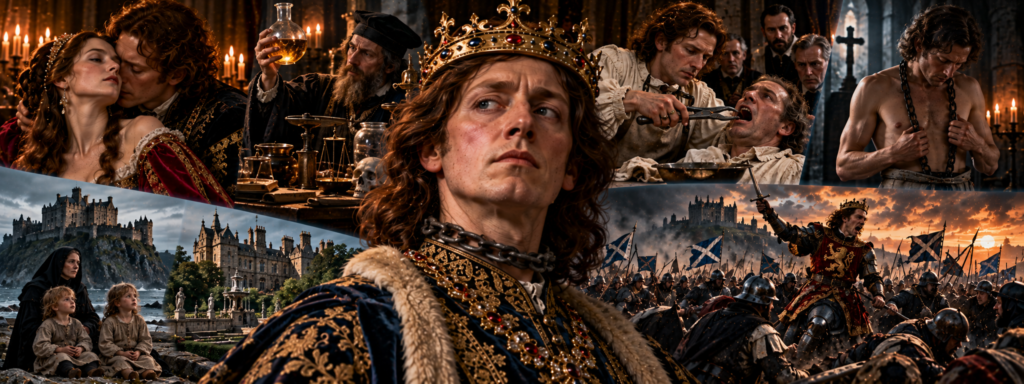
James IV of Scotland: The Penitent King, His Dangerous Experiments, and the Bloody Disaster at Flodden
He was a Renaissance king with a medieval burden of guilt, a monarch who financed alchemists, experimented with dentistry, entertained extraordinary theories about human language, and transformed Scotland into a court of artistic and intellectual ambition. Yet beneath the brilliance of James IV’s reign lay a darker story. As a teenager, he had become the figurehead of a rebellion against his own father, James III, who died following the Battle of Sauchieburn in 1488. Later tradition claimed that James carried the guilt for the rest of his life, wearing an iron chain against his body and adding weight to it as the years passed. His curiosity could be equally unsettling: royal accounts record payments associated with tooth extractions and medical procedures, while a chronicler attributed to him an experiment in which two infants were isolated on an island to discover humanity’s original language. His court supported an alchemist whose attempt at human flight became one of Scotland’s strangest historical anecdotes. His private life brought further controversy, including the mysterious deaths of his mistress Margaret Drummond and her two sisters. And in 1513, after years of diplomatic maneuvering, military preparation, and royal ambition, James led a Scottish army into England and died at the Battle of Flodden, alongside many of his kingdom’s leading noblemen. Was he an obsessive ruler driven by guilt and reckless curiosity, or a capable Renaissance monarch whose achievements have been overshadowed by sensational stories and one catastrophic defeat? The answer lies in a reign where genuine accomplishments, disturbing experiments, courtly intrigue, and fatal decisions became inseparably entwined.
The King Who Carried His Father’s Death
On September 9, 1513, the fields near Branxton in Northumberland became the scene of one of the greatest disasters in Scottish royal history. James IV, King of Scots, had crossed the border with a substantial army and occupied a strong position on elevated ground. His forces possessed formidable artillery and infantry armed with long pikes. He had entered England while Henry VIII was campaigning in France, intending to exert pressure upon England in support of Scotland’s French allies.
By the end of the day, James was dead. Thousands of Scottish soldiers had fallen, including leading nobles, churchmen, and members of the king’s household. The army that had marched south under the banners of a confident monarchy had been shattered. Scotland faced the prospect of another royal minority, with James’s infant son succeeding to the throne as James V.
The catastrophe was especially striking because James IV had been a far more politically successful ruler than his father. He had strengthened royal authority, pursued active diplomacy, developed Scotland’s navy, and cultivated an impressive Renaissance court. His reign witnessed substantial architectural, artistic, and educational patronage. The Scottish monarchy possessed a degree of magnificence and international visibility that earlier generations had struggled to achieve.
Yet James’s reputation was never entirely free from the violence that had brought him to power. In 1488, when he was approximately fifteen years old, rebellious nobles had used him as the dynastic alternative to his father, James III. The rebellion culminated in the Battle of Sauchieburn, where the older king’s army was defeated. James III died shortly afterward, in circumstances that remain uncertain.
Later tradition described the young James as tormented by his involvement. According to the story, he wore an iron chain or belt against his skin as a continuing act of penance. Some versions claim that he increased its weight each year, making his remorse a physical burden that grew heavier with time. The image is unforgettable, although the evidence for its precise details requires caution.
It is tempting to connect that iron chain directly to his death at Flodden, presenting the entire reign as the tragedy of a guilt-ridden man seeking punishment. But history rarely offers such a simple explanation. James’s religious observances belonged to a culture in which penance, pilgrimage, and bodily mortification were familiar practices. His military decisions in 1513 arose from diplomacy, strategic calculation, noble expectations, and the pressures of the Auld Alliance.
What makes James IV fascinating is not that he can be reduced to a single obsession. It is that his reign combined extraordinary energy and curiosity with episodes that later generations found disturbing, reckless, or inexplicable. His story begins with the violent collapse of his father’s government.
A Teenage Prince in the Shadow of Rebellion
James IV was born on March 17, 1473, probably at Stirling Castle, the eldest son of James III and Margaret of Denmark. He entered a dynasty familiar with sudden death and political upheaval. His grandfather, James II, had been killed by an exploding cannon during the siege of Roxburgh in 1460, leaving James III to inherit the throne as a child. His great-grandfather, James I, had been assassinated in 1437. Violence was not an occasional interruption in the history of the Stewart monarchy; it was a recurring danger.
His father, James III, developed a troubled relationship with powerful Scottish nobles. Critics accused the king of favoring men of comparatively modest social origins, neglecting aristocratic expectations, pursuing questionable financial policies, and allowing unsuitable advisers to dominate the royal household. These complaints were shaped partly by political hostility, and later chronicles sometimes exaggerated the king’s supposed eccentricities. Nevertheless, the underlying conflicts were genuine.
In 1482, James III experienced a humiliating crisis when nobles seized several royal favorites during a military mobilization near Lauder. Some of those men were executed, and the king was confined in Edinburgh Castle. His brother Alexander, Duke of Albany, meanwhile pursued ambitions involving English support. Although James III eventually recovered his authority, the episode exposed how vulnerable the crown had become.
The young prince grew up amid these divisions. As heir apparent, he represented the future of the dynasty, but that position also made him politically useful. Nobles dissatisfied with his father could support the son without openly rejecting hereditary monarchy. They could claim to be defending the kingdom from misgovernment while preserving the royal succession.
By 1488, opposition to James III had developed into rebellion. The prince became associated with the insurgents, providing their movement with legitimacy. His exact degree of independence remains disputed. He was young, surrounded by influential adults, and operating within circumstances that gave him limited freedom to determine events.
The distinction matters because later accounts sometimes portray him either as a willing conspirator against his father or as an innocent teenager manipulated by ambitious nobles. Neither interpretation can be established with complete confidence. He participated in the political movement that challenged James III, but the extent to which he understood or controlled its consequences remains uncertain.
The rebellion culminated on June 11, 1488, at the Battle of Sauchieburn, near Stirling. James III’s army was defeated, and the king died following the battle. A later tradition described him seeking shelter after falling from his horse and being murdered by a man disguised as a priest. The story is dramatic, but its precise details are not securely established.
The young prince inherited the crown as James IV. He was approximately fifteen years old, and his accession followed the violent destruction of his father’s authority. His position depended upon the nobles who had supported the rebellion, yet he also inherited the responsibilities and expectations of kingship.
For the rest of his reign, the events of Sauchieburn remained part of his political and personal history. Whether the famous iron chain was exactly as later chroniclers described it, the circumstances of his accession gave the story of royal penance an enduring power.
The Iron Chain: A King’s Extraordinary Act of Penance
Among the most memorable stories about James IV is the claim that he wore an iron chain or belt against his body in repentance for his involvement in the rebellion against James III. The tradition appears in later historical writing and has become almost inseparable from his reputation. It presents the king as a man who transformed guilt into a permanent physical punishment.
Some versions describe a chain worn beneath his clothing, while others call it an iron belt. The accounts also claim that James added further weight over time, often said to be annually. The image suggests a king deliberately increasing his suffering as the years passed. Yet the precise form, weight, and regularity of this practice are not established by a continuous series of contemporary records.
Religious penance was familiar in late medieval Scotland. Christians could undertake pilgrimages, fasting, confession, charitable giving, and other acts intended to express repentance. Bodily mortification, including the wearing of uncomfortable objects, also had a place in medieval devotional culture. Such practices were not automatically interpreted as evidence of mental illness.
James was notably attentive to religious observance. He supported churches and religious institutions, made offerings, and undertook devotional journeys. His conduct reflected the expectations of a Christian monarch who believed that royal authority carried spiritual obligations. The circumstances of his father’s death may have given particular significance to those practices, but the surviving evidence does not reveal every aspect of his private conscience.
The iron-chain story also served a political purpose in later narratives. It allowed chroniclers to acknowledge the troubling circumstances of James’s accession while presenting him as a repentant ruler. A king who carried visible or hidden punishment for his father’s death could be portrayed as morally aware rather than indifferent. His penitence became part of the explanation for how a monarch associated with rebellion could nevertheless achieve a respected reign.
Modern descriptions sometimes call his behavior obsessive or pathological. That interpretation goes beyond the evidence. Even if James wore a penitential chain, its meaning must be understood within the religious culture of his time. A devotional practice that appears extreme today may have been intelligible to contemporaries familiar with bodily acts of repentance.
Nor can the chain establish that James was consumed by guilt every day of his life. The historical record does not provide access to the continuous emotional state implied by such claims. His reign was filled with political activity, personal relationships, artistic patronage, military planning, and diplomacy. He was not a withdrawn monarch incapable of governing because of remorse.
The chain remains important because it expresses the moral shadow cast by Sauchieburn. James had become king through a rebellion that ended in his father’s death. Whether he carried that burden in iron, prayer, or political memory, the circumstances could never be entirely separated from his crown.
The Renaissance Court: Where Science, Spectacle, and Superstition Met
James IV did not spend his reign brooding over the circumstances of his accession. Once established on the throne, he became an energetic ruler who traveled extensively, supervised government, cultivated foreign relationships, and supported a remarkably varied collection of intellectual and artistic pursuits. His court attracted musicians, poets, physicians, craftsmen, engineers, and scholars. The king took an interest not merely in the prestige such people could bring him, but also, according to surviving accounts, in some of the practical activities they performed.
This curiosity placed James within the broader intellectual culture of Renaissance Europe. Courts in Italy, France, Burgundy, and the German territories increasingly supported specialists whose knowledge promised military, medical, or financial advantages. Astronomy and astrology were often studied together, while medicine overlapped with alchemy. The boundaries separating legitimate investigation from speculation were very different from those recognized today.
James also understood the political value of magnificence. A royal court filled with accomplished musicians, elaborate furnishings, impressive buildings, and learned visitors projected authority. Scotland was smaller and less wealthy than several of its European neighbors, but its king could still present himself as a sophisticated Renaissance prince. Cultural patronage became one means of strengthening the monarchy’s international standing.
Among his literary associates was the poet William Dunbar, whose surviving work provides a vivid glimpse into the world surrounding the Scottish court. Dunbar celebrated royal occasions, commented upon courtly life, and mocked individuals whose ambitions exceeded their accomplishments. His poetry is particularly important for understanding the extraordinary career of the royal alchemist John Damian. It also reminds us that some of the strangest episodes associated with James IV were already subjects of amusement in his own lifetime.
The king’s curiosity was not limited to intellectual entertainment. He developed an interest in medicine and practical treatment, including dentistry, bloodletting, and the care of wounds. The financial records of his household preserve evidence of purchases and payments connected with these activities. They are among the most revealing sources for the personal interests of any Scottish medieval monarch.
Yet there was a darker side to this intellectual enthusiasm. Royal power made it possible for James to experiment upon people who occupied much lower positions in society. Even where money changed hands, the imbalance of authority between a king and his subjects complicates assumptions about voluntary participation. One particularly disturbing story involving isolated children would later become central to his reputation for bizarre experimentation.
James’s Renaissance curiosity was therefore neither wholly admirable nor simply irrational. It could encourage practical innovation, reward talented individuals, and produce achievements that benefited Scotland. It could also support dangerous medical practices and projects whose underlying assumptions were deeply mistaken.
The King with the Dental Instruments: James IV’s Unusual Medical Experiments
Of all the activities recorded in James IV’s household accounts, his interest in dentistry is among the most startling. Modern readers might expect a king to summon physicians whenever he experienced pain, leaving uncomfortable procedures to trained specialists. James certainly employed medical practitioners, but he also became interested in performing procedures himself. The royal accounts contain entries that have made him famous as an unusually hands-on monarch.
In 1503, a payment of fourteen Scottish shillings was recorded in connection with a barber extracting one of the king’s teeth. The following year, the accounts document the purchase of dental implements, including gold toothpicks and a tooth-extraction instrument described in Scots as a turcase. This was not simply an ornament for the royal collection. Other entries indicate that James experimented with extracting teeth himself.
One particularly remarkable record concerns the extraction of two teeth from a royal barber-surgeon, for which the practitioner received fourteen shillings. The arrangement reverses the relationship modern readers would expect: the professional became the patient, while the monarch handled the instruments. It is impossible to reconstruct the exact circumstances of the procedure. We do not know whether the teeth were already diseased, how the individual felt about participating, or precisely how James carried out the extraction.
The amount is often repeated in popular accounts as though James paid fourteen shillings to every subject who allowed him to remove a tooth. That broader claim is not securely established by the particular entries usually cited. The records document specific transactions, not a standardized royal payment scheme for dental volunteers. Nor can fourteen sixteenth-century Scottish shillings be converted reliably into a single modern dollar figure without specifying what kind of economic comparison is intended.
Dentistry in James’s lifetime was physically unpleasant and medically hazardous. Practitioners lacked modern anesthesia, antiseptic techniques, and knowledge of bacterial infection. Tooth extraction involved considerable pain, and complications could include bleeding, infection, and damage to surrounding tissue. A king experimenting with dental instruments therefore raises uncomfortable questions about the experiences of those subjected to his curiosity.
James also took an interest in bloodletting and the treatment of wounds and ulcers. Bloodletting was an accepted medical procedure based upon theories of bodily balance that had developed through classical and medieval medicine. Although its usefulness was limited and it could be harmful, contemporary practitioners did not generally regard it as bizarre. James’s participation was unusual because of his royal status, not because bloodletting itself lay outside established medical practice.
His interest may have reflected a genuine desire to understand practical medicine. It may also have involved the pleasure of mastering specialized skills or demonstrating unusual accomplishments. The records cannot reveal his precise motives. What they do show is a monarch willing to cross the customary boundary between royal patron and practitioner.
This distinction matters when evaluating claims of madness. James’s dental activities were extraordinary, but curiosity about medicine does not establish psychiatric instability. They are better understood as evidence of an unusually active interest in practical knowledge, exercised within a society where royal authority could make such experimentation possible.
The most unsettling aspect is not that a king wanted to learn how teeth were extracted. It is that his position gave him access to other people’s bodies in pursuit of that knowledge.
What the Royal Accounts Actually Reveal About His Spending
The surviving Accounts of the Lord High Treasurer of Scotland offer an unusually intimate view of James IV’s interests. Unlike later stories constructed around the king’s reputation, these financial records document payments made through the royal administration. They preserve purchases of materials, rewards to individuals, and expenses associated with particular projects. They do not always explain why a payment was made, but they provide firmer evidence than an anecdote repeated centuries afterward.
The dental entries are especially memorable because they concern small, specific sums and objects. Fourteen shillings appears in records associated with dental procedures, while the purchase of toothpicks and extraction instruments demonstrates the king’s practical interest. These entries do not establish a vast medical budget. They reveal particular expenditures within a much larger royal household.
The alchemical accounts provide evidence of a more sustained undertaking. Materials purchased for John Damian’s work included mercury, other metallic substances, fuel, and equipment associated with heating and distillation. The records also mention payments to men maintaining furnaces and supplying the materials needed for experimental operations. These were not merely gifts to an entertaining courtier; they supported a functioning workshop.
One surviving account records a payment of £9 16s. to Damian, styled Abbot of Tongland, on January 4, 1506, using modern year numbering. Other entries document purchases associated with the pursuit of the quinta essentia, or quintessence. Payments for spirits, chemicals, furnace operations, and specialized equipment recur across the surviving accounts.
A few examples convey the texture of this spending. An entry cited from the accounts records twenty-four shillings for a gallon of aqua vitae supplied to the Abbot of Tongland. Another records twenty-eight shillings for aqua vitae associated with the quintessence work in 1505–1506. Such payments demonstrate that the laboratory consumed materials over time, rather than existing merely as a fanciful proposal.
These figures must be interpreted carefully. The Scottish pound was a unit of account with a different value from the English pound, and historical prices cannot be translated straightforwardly into modern purchasing power. The same expenditure may appear modest when compared with a royal building campaign but substantial when compared with the income of an ordinary worker. A meaningful assessment requires comparison with contemporary wages, household expenditure, and the broader finances of the Scottish crown.
It would also be misleading to add together isolated entries and claim that they represent the complete cost of James’s experiments. Payments may have been recorded under different headings, while some equipment or labor may have served more than one purpose. The surviving accounts are valuable precisely because they offer concrete evidence, but they do not provide a simple modern budget labeled royal scientific hobbies.
Nevertheless, they establish that James committed real resources to experimental pursuits. Furnaces required fuel, equipment required craftsmen, and chemical substances had to be obtained. The king’s support was sustained enough for his alchemist to maintain an active place at court. That commitment reveals how seriously James could take projects that modern readers might dismiss as absurd.
His spending should also be considered alongside his investments in shipbuilding, artillery, architecture, and diplomacy. The same ruler who financed alchemy supported substantial military and technological development. His interests formed part of a broad pattern of royal patronage, rather than a single uncontrolled obsession.
The financial records therefore complicate the popular caricature. They confirm that James funded remarkable experiments, including some whose scientific foundations were mistaken. They do not prove that he spent ruinous sums upon every curiosity or neglected the rest of government to indulge them.
The Children of Inchkeith: Scotland’s Disturbing Language Experiment
Perhaps the most unsettling story associated with James IV concerns an experiment supposedly conducted on Inchkeith, an island in the Firth of Forth. According to the sixteenth-century chronicler Robert Lindsay of Pitscottie, James wanted to discover what language human beings would naturally speak if they grew up without hearing ordinary speech. The king supposedly arranged for two infants to be placed on the island with a woman unable to speak. The children were to grow up without exposure to spoken language.
The underlying question was not unique to James. Medieval scholars and earlier writers had speculated about humanity’s original language, often connecting the subject to biblical history. Hebrew held particular significance because of its association with the Hebrew Scriptures. Some believed that identifying an original human language might reveal something about creation and the earliest relationship between humanity and God.
The story attributed to James belongs to a longer tradition of accounts about rulers attempting similar experiments. Ancient and medieval authors described other sovereigns supposedly isolating children to determine which language emerged naturally. Such stories sometimes served as illustrations of royal curiosity or intellectual arrogance. Their recurrence makes it especially important to assess each account independently.
Pitscottie wrote decades after James’s death. His chronicle preserves valuable Scottish traditions, but it is not a contemporary laboratory record. There is no securely documented experimental report establishing the children’s identities, the precise arrangements on Inchkeith, or the duration of their isolation. The story should therefore be presented as a chronicler’s account rather than an independently verified event.
In the familiar version, the children supposedly began speaking Hebrew. That result is not credible as a scientific conclusion. Human language develops through social interaction and exposure to communication, and severe linguistic deprivation would be harmful rather than reveal an innate spoken vocabulary. The alleged result reflects the religious and intellectual assumptions surrounding the story.
If an experiment resembling the account occurred, it would raise serious ethical concerns. Infants deprived of ordinary language and human interaction would face potentially profound developmental harm. The presence of a caregiver would not remove the dangers associated with deliberate communication deprivation. Such treatment would be deeply disturbing regardless of the intellectual question being investigated.
Yet the historical uncertainty must remain visible. We cannot confidently describe the precise suffering of two identifiable children because their existence within this experiment is not independently established. Nor can we accept the claim that they emerged speaking Hebrew. The story is valuable evidence of what later Scottish chroniclers believed or wished to communicate about James’s curiosity, but its factual details remain unverified.
The episode has become a favorite example of James’s supposed madness because it combines royal power, scientific ambition, and a deeply unsettling disregard for vulnerable subjects. It is more historically responsible to say that James was credited with a language-deprivation experiment whose details cannot be confirmed. The anecdote reveals the dangerous possibilities of unchecked royal curiosity, whether as an actual event, an embellished tradition, or a cautionary tale.
John Damian: The Alchemist Who Promised Extraordinary Discoveries
James’s patronage of John Damian is more securely documented than the Inchkeith story. Damian, often described as an Italian alchemist, became associated with the Scottish court around the beginning of the sixteenth century. His origins and qualifications remain uncertain, but his position under James IV is established through royal financial records. He received support for experimental work involving metals, distillation, and the pursuit of quintessence.
Alchemy occupied a complicated position in Renaissance intellectual life. Its practitioners investigated substances through heating, mixing, distillation, and other operations. Some sought the transmutation of base metals into gold, while others pursued medicinal preparations believed capable of restoring health or prolonging life. The field included serious experimentation, theoretical speculation, secrecy, and fraud.
Damian’s activities appear to have involved the search for quintessence, a supposedly purified substance with exceptional properties. The Scottish accounts record expenditures associated with mercury, spirits, metals, and furnaces. A laboratory operated at Stirling Castle, supported by craftsmen and attendants. The work continued over a number of years, indicating sustained royal interest.
From a modern perspective, many alchemical objectives were impossible. Base metals cannot be transformed into gold through ordinary chemical operations, and no universal life-extending elixir emerged from Damian’s laboratory. Yet it would be anachronistic to assume that everyone involved knew the enterprise was fraudulent. Alchemy belonged to the accepted intellectual landscape of the period, and even accomplished scholars pursued its promises.
Damian’s royal position extended beyond laboratory work. He acquired the title of Abbot of Tongland, despite the unusual character of his career. The appointment illustrates the extraordinary opportunities available to someone who secured the king’s confidence. It also shows how royal patronage could elevate a specialist into an institutionally privileged position.
Such advancement could attract criticism. Courtiers and churchmen might question why a foreign experimenter enjoyed royal favor and ecclesiastical rewards. The poet William Dunbar satirized Damian, presenting him as a figure whose pretensions invited ridicule. His poetry provides important contemporary evidence that the alchemist’s activities were noticed and mocked.
The king’s continued support is sometimes portrayed as proof that James was easily deceived. That interpretation is possible but incomplete. Renaissance rulers routinely invested in uncertain technologies, including military inventions, mining ventures, navigation, and medicinal preparations. Patronage could be speculative without being wholly irrational. The difficulty lay in distinguishing promising experimentation from extravagant claims.
Damian’s most famous undertaking, however, moved beyond the laboratory. He attempted to conquer the air.
The Flying Alchemist: A Leap from Stirling Castle
The story of John Damian’s attempted flight has survived because it possesses almost everything a memorable historical anecdote requires: an ambitious inventor, a royal castle, a pair of artificial wings, a disastrous descent, and an excuse that became famous for its absurdity. Damian supposedly constructed wings from feathers and attempted to fly from the walls of Stirling Castle. Instead of reaching the skies, he fell and injured himself.
The episode is commonly dated to 1507, although accounts and interpretations vary. William Dunbar’s satirical poetry provides near-contemporary evidence of Damian’s reputation as an unsuccessful would-be flyer. The precise construction of the wings, the exact point of departure, and the circumstances of the landing are less securely documented than the general tradition of a failed attempt.
Popular versions describe wings made from chicken feathers and a landing in a dung heap. Damian supposedly explained his failure by claiming that the feathers came from birds naturally associated with the ground rather than from eagles capable of soaring. The excuse became a perfect symbol of misplaced confidence. Yet the precise wording and physical details belong to the anecdotal tradition and should not be treated as a verbatim experimental report.
The claim that James intended Damian to fly all the way from Scotland to France is likewise best understood as part of the extravagant tradition surrounding the episode. The distance would have been impossible for a person using simple feathered wings. Whether Damian seriously expected such a journey or was boasting about his ambitions cannot be determined with confidence.
Dunbar’s ridicule is significant because it shows that Damian’s claims did not go unquestioned. The Scottish court was not universally convinced by the alchemist’s abilities. Intellectual curiosity coexisted with skepticism and humor. The king’s patronage did not prevent courtiers from recognizing the comic possibilities of failure.
Accounts sometimes state that Damian fractured his thigh during the fall. This detail is widely repeated, but the evidence for the exact injury is not as secure as the broader story. What survives most clearly is the reputation of a failed attempt and the mockery it inspired.
James’s response has also been romanticized. Later retellings suggest that he found the incident amusing and continued supporting Damian rather than punishing him. The surviving records establish that Damian remained connected with royal patronage, but they do not provide a reliable transcript of the king’s reaction. We cannot know whether James laughed, expressed disappointment, or treated the attempt as a useful lesson.
The episode nevertheless captures something distinctive about his court. James was willing to support experimentation whose ambitions extended far beyond established practical knowledge. Sometimes such curiosity could encourage innovation. In Damian’s case, it produced a failure remembered long after more serious achievements had faded from popular memory.
The flying alchemist became an emblem of Renaissance ambition at its most extravagant: a man attempting to overcome nature with insufficient understanding, supported by a king whose appetite for unusual knowledge appeared almost limitless.
Margaret Drummond: The Royal Mistress Who Died in Mysterious Circumstances
Among the women associated with James IV, Margaret Drummond occupies a particularly haunting place in Scottish history. She belonged to the influential Drummond family and became one of the king’s mistresses before his marriage to Margaret Tudor. Their relationship produced a daughter, Margaret Stewart, who later received recognition and support within the royal family. The affair therefore had consequences beyond a temporary romantic attachment.
James’s relationships with women were not unusual for a Renaissance monarch. He had several acknowledged mistresses and fathered children outside marriage. Such relationships could create networks of patronage and obligation, especially when the women involved belonged to established aristocratic families. The Drummonds’ connection to the king offered opportunities for influence but could also provoke rivalry.
Margaret’s death became the subject of an enduring mystery because two of her sisters died around the same time. The sisters were Margaret, Eupheme, who was married to Lord Fleming, and Sibylla Drummond. Their deaths are generally placed around 1501, although the precise chronology has been disputed. Later family traditions claimed that all three women died after consuming poisoned food at Drummond Castle.
The traditional story describes the sisters gathering for a meal, sometimes identified as breakfast. Shortly afterward, they supposedly became violently ill and died. Their deaths were interpreted as evidence that someone had deliberately introduced poison into the food. The three women were buried at Dunblane Cathedral, reinforcing the memory of a family tragedy.
But the historical evidence is less conclusive than the dramatic narrative suggests. Much of the detailed poisoning story comes from later family histories and retrospective accounts. The deaths themselves are historically significant, but the exact cause has not been established through contemporary medical evidence. Accidental food poisoning, infectious illness, and deliberate poisoning have all been considered.
The theory of murder became especially attractive because Margaret had been romantically involved with the king. According to one tradition, powerful interests feared that James might marry her, thereby frustrating negotiations for a dynastic marriage with England. Her death would then have removed an obstacle to a politically advantageous union. The theory supplies an obvious motive, but the surviving chronology makes it problematic.
Negotiations concerning James’s marriage to Margaret Tudor were already underway before the Drummond sisters died. The assertion that Margaret Drummond’s death was necessary to permit the English marriage is therefore not supported by the available evidence. There is also no reliable proof that James intended to make Margaret Drummond his queen. The idea became influential in romanticized accounts, but it should not be treated as established fact.
Another accusation emerged in later correspondence involving Margaret Tudor. In a letter written years after the deaths, the queen attributed responsibility to Lord Fleming, husband of Eupheme Drummond. The allegation is historically noteworthy because it demonstrates that suspicion persisted within aristocratic circles. Yet it was not a judicial finding, and the letter does not independently establish that Fleming committed murder.
The possibility of accidental poisoning deserves serious consideration. Food preparation and storage in the early sixteenth century carried substantial risks. Contaminated ingredients, bacterial illness, and toxic substances could cause fatal outbreaks without deliberate criminal action. The deaths of several people who shared a meal might suggest a common exposure without identifying whether that exposure was intentional.
James’s response to Margaret’s death is difficult to reconstruct emotionally. Accounts and records indicate continuing arrangements for remembrance and for the welfare of their daughter, but they cannot establish the depth or precise nature of his grief. It would be tempting to imagine him devastated by the loss of a beloved mistress, but such language would go beyond what can be demonstrated.
The mystery remains compelling because the principal questions cannot be answered conclusively. Three sisters died, later generations believed poison was involved, and accusations circulated against possible perpetrators. No reliable surviving evidence identifies a murderer or proves that murder occurred.
Margaret Drummond’s story is therefore not a solved royal assassination. It is a tragedy whose uncertain circumstances became entangled with dynastic politics, family memory, and the romantic mythology surrounding James IV.
Margaret Tudor: The Marriage Intended to End Generations of War
In August 1503, James IV married Margaret Tudor, eldest daughter of Henry VII of England and Elizabeth of York. The marriage formed part of the Treaty of Perpetual Peace concluded in 1502. It was one of the most consequential diplomatic achievements of James’s reign, intended to reduce hostility between Scotland and England through a dynastic connection.
Margaret was considerably younger than her husband. Their marriage reflected the political expectations of royal families, where alliances and succession frequently outweighed personal preference. For Henry VII, the arrangement offered greater security along England’s northern border. For James, it strengthened his international standing and established a direct relationship with the Tudor dynasty.
The marriage also carried enormous long-term consequences. Through Margaret Tudor, the Scottish Stewart dynasty acquired a hereditary connection to the English royal family. A century later, her great-grandson James VI of Scotland would inherit the English throne as James I following the death of Elizabeth I in 1603. That eventual union of the crowns was not inevitable in 1503, but the marriage helped establish the dynastic circumstances that made it possible.
James and Margaret established a royal household that combined Scottish traditions with elements of English and continental court culture. The king continued his artistic and architectural patronage, while Margaret occupied an important ceremonial position. Their relationship produced several children, but most died young. Only the future James V survived infancy and eventually inherited the throne.
The deaths of royal children were devastating events with both personal and political consequences. Infant mortality remained high even within wealthy households possessing access to physicians and attendants. For a monarchy, each death also threatened succession arrangements. The survival of a legitimate male heir was essential to dynastic continuity.
James’s marriage did not end his relationships with other women. His illegitimate children remained part of the broader royal family, and their mothers occupied positions within aristocratic networks. This was a familiar pattern in European courts, but it could generate tensions involving patronage and status.
The peace with England also proved fragile. Henry VII died in 1509, and his son Henry VIII inherited the throne. The new English king pursued an increasingly assertive foreign policy, particularly against France. The diplomatic environment that had supported the marriage alliance began to change.
By 1513, James faced conflicting obligations. He was married to Henry VIII’s sister, but Scotland remained connected to France through the Auld Alliance. The two relationships were not necessarily incompatible during peacetime. Once England and France entered open conflict, however, James had to determine which obligations would govern his actions.
The marriage that had promised peace could not prevent the confrontation that ultimately destroyed him.
Scotland’s Renaissance King: The Achievements Behind the Strange Stories
James IV’s reputation for unusual experiments can obscure the scale of his accomplishments. He was an active administrator who worked to strengthen royal authority throughout Scotland. He traveled extensively, cultivated relationships with nobles and regional leaders, and pursued measures intended to improve government. His reign brought a degree of political stability after the upheaval surrounding his father’s overthrow.
He also supported education and learning. The establishment of the University of Aberdeen in 1495, through a papal bull obtained at the request of Bishop William Elphinstone and with royal support, formed part of a broader commitment to scholarship. James’s court encouraged literary production and the development of Scots as a language of sophisticated poetry. His reign became associated with writers whose work remains central to Scotland’s literary heritage.
The king’s interest in languages was particularly notable. Contemporary accounts describe him as possessing knowledge of several languages, although claims about the exact number and his level of fluency require caution. His diplomatic relationships made linguistic ability valuable. His curiosity about language also provides context for the later Inchkeith story, although it does not independently verify that the experiment occurred.
Architecture flourished under his patronage. Stirling Castle became an important center of royal building activity, and James invested in residences intended to express the dignity of the monarchy. Linlithgow Palace also benefited from royal attention. Such projects contributed to the development of a distinctive Scottish Renaissance court.
His military interests were equally substantial. James invested in artillery, fortifications, and naval development. The Scottish fleet expanded, and shipbuilding became a major royal undertaking. These activities required skilled labor, imported materials, administrative coordination, and significant expenditure.
The most famous naval achievement was the construction of the Great Michael, an enormous warship launched in 1511. Contemporary descriptions emphasized its exceptional size and impressive armament. The vessel represented an ambitious attempt to enhance Scotland’s maritime power and royal prestige. Its construction demonstrated that James’s fascination with technology extended well beyond alchemical speculation.
The Great Michael also illustrates the financial demands of Renaissance monarchy. Large ships required timber, iron, craftsmen, sailors, weapons, and maintenance. Such investments could strengthen military capability but placed considerable pressure upon royal resources. James’s government devoted money to projects whose practical value varied widely.
His enthusiasm for artillery likewise reflected developments in European warfare. Gunpowder weapons were transforming siege operations and battlefield tactics. James sought to equip Scotland with formidable guns, and his artillery train became a prominent feature of the campaign of 1513. The tragedy was that impressive equipment did not guarantee effective battlefield performance.
The broader picture is therefore of a king who combined intellectual curiosity with serious efforts at state-building. His reign was not dominated solely by bizarre hobbies. The same monarch who financed John Damian also supported universities, naval construction, architecture, and military modernization.
That combination makes his eventual defeat especially striking. James possessed resources and ambitions that suggested a confident monarchy, yet one campaign would destroy much of what he had built.
The Auld Alliance: Why James IV Chose War with England
The origins of the Flodden campaign lay in the complex diplomacy of early sixteenth-century Europe. Scotland’s longstanding relationship with France, commonly known as the Auld Alliance, remained an important element of its foreign policy. The alliance offered Scotland a counterweight to English power and created obligations of mutual assistance under particular circumstances.
Henry VIII’s decision to campaign against France in 1513 placed James in a difficult position. England’s king was his brother-in-law, and the marriage to Margaret Tudor had been intended to preserve peace. Yet France requested Scottish intervention to divert English military resources away from the continent. James also had grievances involving maritime disputes and Anglo-Scottish relations.
The decision to invade was therefore not simply an inexplicable act of aggression. James operated within a diplomatic system in which alliances, honor, military credibility, and strategic opportunity mattered. Supporting France could preserve an important relationship and demonstrate Scotland’s capacity to influence European affairs. Remaining neutral, however, might have avoided the dangers of a major campaign.
James chose intervention. He assembled a substantial army and prepared an impressive artillery train. The preparations demonstrate that the campaign was organized rather than an entirely spontaneous decision. Scottish forces mobilized, supplies were gathered, and the king led his army toward the border.
French appeals helped encourage the expedition. Anne of Brittany, queen of France, became associated with requests for Scottish assistance, including a famous appeal asking James to take English territory. Such communications formed part of the chivalric and diplomatic language of the period. They should not be interpreted as proof that James was irrationally manipulated by a romantic appeal.
His decision has frequently been described as reckless because of its outcome. Yet an assessment made before the battle would have included Scotland’s military resources, the absence of Henry VIII in France, and the possibility of capturing English border strongholds. The campaign carried risks, but it was not undertaken without strategic considerations.
The most consequential question was what James intended to achieve. A limited invasion might pressure England without requiring the destruction of its northern army. Capturing castles and threatening territory could force Henry VIII to reconsider his continental campaign. Seeking a decisive pitched battle introduced far greater uncertainty.
The evidence suggests that James initially pursued recognizable military objectives. The Scottish army captured important border fortifications and established a strong position. The disaster arose through subsequent maneuvering and battle, not simply from the decision to cross the border.
The March into England: An Army Prepared for Victory
James’s forces moved south in August 1513. The Scottish army included noble contingents, infantry armed with pikes, artillery, and the supporting personnel required for a major expedition. Contemporary figures for its size vary considerably, and later estimates sometimes include noncombatants. It was nevertheless one of the largest Scottish military mobilizations of the period.
The army crossed into northern England and began securing strategic positions. Norham Castle, an important English stronghold, fell after bombardment. Other fortifications, including Etal and Ford, also came under Scottish control. These successes demonstrated the effectiveness of James’s artillery in siege warfare.
The king established a strong defensive position at Flodden Edge. The site offered commanding ground and opportunities for fortification. Scottish forces prepared defenses while awaiting the English response. James was not initially behaving like a commander determined to throw away every advantage through an immediate charge.
England’s northern defense was organized by Thomas Howard, Earl of Surrey, an experienced commander who had fought in the Wars of the Roses. Surrey understood the danger posed by the Scottish army but also recognized the difficulties of attacking a fortified position. He therefore maneuvered to threaten James’s communications and route toward Scotland.
The English advance created a serious strategic problem. Remaining at Flodden Edge risked allowing Surrey to move behind the Scottish army. James responded by shifting his forces toward Branxton Hill on September 9. The movement preserved some advantages of elevated ground but changed the tactical circumstances.
The Scottish army possessed long pikes modeled upon weapons used successfully by continental infantry. Such formations could be extremely effective when disciplined soldiers maintained cohesion. Yet pikes required suitable terrain and coordinated movement. Wet, uneven ground could disrupt the formation and leave soldiers vulnerable in close combat.
James’s artillery presented another complication. Heavy guns that performed well during sieges were less flexible in a rapidly developing field battle. The English possessed lighter pieces that could fire more quickly and adjust more easily to changing circumstances. The difference would become important once fighting began.
The campaign had reached a decisive moment. James had achieved initial successes and still commanded a substantial army. Surrey had maneuvered effectively, but the English position was not without danger. Neither side could be certain of victory.
The outcome would depend upon terrain, discipline, command decisions, and the brutal uncertainties of battle.
Flodden: The Battle That Destroyed Scotland’s King
Fighting began on the afternoon of September 9, 1513, with an exchange of artillery fire. The Scottish guns were formidable weapons, but their position and slow rate of fire limited their effectiveness. English artillery proved more adaptable, striking Scottish guns and formations. The bombardment placed increasing pressure upon James’s army.
Scottish infantry then advanced downhill. The first major assault, involving forces under Lord Home and the Earl of Huntly, initially achieved success against the English right. Edmund Howard’s troops came under severe pressure, and the English position appeared vulnerable. Reinforcements under Lord Dacre helped prevent a complete collapse.
Elsewhere, the terrain proved disastrous for the Scots. Formations advancing from Branxton Hill encountered wet and marshy ground that disrupted their movement. Soldiers carrying long pikes struggled to maintain cohesion. The weapons that could dominate an orderly advance became difficult to use in a confused close-quarter struggle.
English infantry armed with bills possessed an advantage once the formations broke apart. A bill combined cutting and thrusting capabilities and was well suited to close fighting. Scottish soldiers who lost the momentum of their advance found themselves facing opponents equipped for precisely that kind of combat. The result was a series of violent encounters rather than one perfectly coordinated engagement.
James became directly involved in the fighting near the center. Later accounts often describe him abandoning a safe hilltop position and charging recklessly into the enemy. That version captures the tragedy but oversimplifies the tactical situation. The Scottish army had moved because Surrey’s maneuver threatened its position, and the decision to advance involved more than a sudden personal impulse.
Nevertheless, James’s decision to fight near the front exposed him to extraordinary danger. Medieval kings were expected to demonstrate courage, but their deaths could have consequences far beyond the battlefield. A commander directing operations from a protected position might preserve the ability to respond to changing circumstances. James instead became entangled in the fighting that overwhelmed his troops.
The exact sequence of his final movements cannot be reconstructed with certainty. Contemporary accounts establish that he was killed during the battle against English forces. His death occurred amid intense fighting involving the Scottish center and the troops commanded by Surrey. The king’s personal courage did not prevent the collapse of his army.
The casualties were devastating. Estimates vary, but thousands of Scots died, including numerous nobles and senior figures. The losses extended beyond ordinary soldiers to the leadership of the kingdom. The destruction of so many experienced men created political and administrative consequences that lasted long after the survivors returned home.
Flodden was not simply a defeat caused by English archery, although archers participated in the battle. Artillery, difficult terrain, the limitations of pike formations, English bills, and the decisions of commanders all contributed. The battle’s complexity is essential to understanding why a powerful Scottish army suffered such a catastrophe.
By evening, James IV was dead, and Scotland faced a national disaster.
The King’s Body: Death, Identification, and an Uncertain Resting Place
James’s death created immediate questions about the fate of his body. English forces recovered a corpse identified as the Scottish king. The identification carried political significance because it confirmed that the invading monarch had been killed. The English victory could therefore be presented not merely as a successful defense but as the destruction of Scotland’s sovereign.
The body was taken into English custody. Because James had invaded a kingdom ruled by his brother-in-law and had died while subject to ecclesiastical complications associated with the conflict, his burial became a difficult matter. The remains were not returned to Scotland for a conventional royal funeral. Instead, they were eventually associated with the monastery at Sheen in Surrey.
The subsequent fate of the body remains uncertain. Later traditions describe the remains being disturbed after the dissolution of the monasteries. Stories concerning the king’s head and other relics circulated, but their details are difficult to verify. No securely identified royal tomb now provides an undisputed resting place for James IV.
This uncertainty adds a final indignity to the tragedy of Flodden. James had invested heavily in the magnificence of Scottish kingship, yet he died far from his principal residences and did not receive the burial normally expected of a reigning monarch. His body became part of the aftermath of an enemy victory. The physical remains of the king disappeared into a history of disputed identifications and later disturbances.
In Scotland, the political consequences were immediate. His son, James V, was only an infant. The kingdom faced another royal minority, recalling the circumstances under which James IV’s father and grandfather had inherited the throne. Noble factions would once again compete for influence around a child monarch.
Margaret Tudor became a central figure in the regency arrangements, but her English connections complicated her position. The same marriage that had once promised peace now connected the Scottish royal household to the kingdom responsible for the military defeat. Political instability followed, while the loss of experienced nobles weakened the machinery of government.
James’s death therefore carried consequences beyond the battlefield. It deprived Scotland of an active adult ruler, disrupted noble leadership, and exposed the kingdom to the dangers of minority government. The achievements of his reign could not shield his successor from those difficulties.
Was James IV Really Mad? Guilt, Curiosity, and the Dangers of Retrospective Diagnosis
James IV was not demonstrably clinically mad. The surviving evidence does not establish a psychiatric disorder capable of explaining his religious practices, intellectual interests, relationships, or military decisions. His reputation for obsessive behavior derives from a mixture of documented activities, later traditions, and modern interpretations. These categories must remain distinct.
The iron chain is the clearest example. The story suggests an unusually intense form of penance, but religious mortification was familiar within medieval Christianity. Even if James wore the chain and increased its weight, the practice would not independently establish pathological guilt. His private emotional state cannot be reconstructed from the tradition alone.
His dental experiments were unusual and potentially dangerous, but they were connected to genuine curiosity about medicine. The royal accounts establish that he purchased instruments and participated in procedures. They do not establish that he compulsively extracted teeth or subjected large numbers of people to treatment. The evidence supports an unusually involved royal amateur, not a clinical diagnosis.
The Inchkeith language experiment is more disturbing, but its historical basis is less secure. The account comes from a later chronicler, and its reported result is scientifically implausible. If an experiment occurred, it would represent a serious ethical violation. Yet an uncertain anecdote cannot be transformed into proof of mental illness.
John Damian’s alchemical activities are securely connected with royal patronage. James supported a laboratory, purchased materials, and maintained the services of an experimenter whose ambitions exceeded the scientific capabilities of his age. Alchemy was widespread among Renaissance intellectuals and patrons. Financing it was speculative, but it was not necessarily considered irrational by contemporary standards.
The poisoning story involving Margaret Drummond and her sisters presents another problem. Their deaths became surrounded by accusations of murder, but deliberate poisoning has not been established. The tragedy reveals the dangers of interpreting rumor as fact. It does not provide evidence about James’s psychiatric condition.
Flodden has perhaps contributed most strongly to the idea of an irrational king. James led an invasion that ended in catastrophic defeat and exposed himself to fatal danger during battle. Yet the campaign arose from recognizable diplomatic and strategic circumstances. His battlefield decisions can be criticized and analyzed without attributing them to madness.
The distinction is important because James IV was an accomplished ruler in many respects. He strengthened royal authority, supported learning, developed Scotland’s military resources, and cultivated a sophisticated court. His reign produced achievements that cannot be reconciled with a simplistic portrait of a man overwhelmed by obsession.
James’s story belongs in a discussion of reputedly mad monarchs because his conduct has often been characterized as strange, excessive, or irrational. But those descriptions reveal the changing expectations placed upon rulers as much as they reveal the man himself. A responsible interpretation recognizes both his extraordinary curiosity and the limits of the evidence.
The Legacy of James IV: Scotland’s Brilliant King and His Fatal Gamble
James IV ruled Scotland for twenty-five years, from 1488 until 1513. His accession followed a rebellion that ended in his father’s death, leaving a troubling moral legacy that later generations expressed through the famous story of the iron chain. Yet his reign was not defined solely by guilt. He developed into an energetic monarch whose achievements transformed the Scottish court and strengthened the kingdom’s cultural and political position.
His intellectual interests were remarkable. The royal accounts document unusual medical activities, purchases of dental instruments, and sustained support for alchemical experimentation. John Damian’s failed attempt at flight became an enduring source of amusement and criticism. The Inchkeith language story, although historically uncertain, added a darker dimension to his reputation for experimentation.
His personal life was equally complicated. Relationships with mistresses produced children and connections among powerful families. Margaret Drummond’s death, alongside those of her sisters, became the subject of an enduring poisoning mystery. Later accusations suggested murder, but the surviving evidence does not identify a killer or establish deliberate poisoning.
His marriage to Margaret Tudor strengthened diplomatic relations with England and eventually contributed to the dynastic circumstances that allowed the union of the crowns in 1603. At the time, however, it did not eliminate the competing obligations of the Auld Alliance with France. James’s decision to support France in 1513 brought him into conflict with Henry VIII.
The invasion of England was not an isolated act of inexplicable recklessness. It followed military preparation, diplomatic appeals, and recognizable strategic objectives. Scottish forces captured border strongholds and occupied defensible ground. Yet the campaign culminated in a battle where terrain, artillery, weapons, and command decisions combined to produce catastrophe.
At Flodden, James’s presence in the fighting became fatal. His army suffered enormous losses, and the kingdom lost much of its political and military leadership. The infant James V inherited the crown, beginning another dangerous royal minority. The defeat overshadowed the accomplishments of the preceding decades.
James IV’s legacy therefore resists a simple judgment. He was a patron of learning and a ruler fascinated by the possibilities of his age. He could support serious institutional development while financing experiments that now appear extraordinary or misguided. He pursued diplomatic peace through marriage and later chose war under circumstances that destroyed him.
The most haunting image of James IV is not necessarily the alchemist falling from Stirling Castle, the king holding dental instruments, or even the battlefield where he died. It is the tradition of the iron chain concealed beneath his royal clothing, a symbol of a burden that no crown could entirely erase. Whether every detail of that story is true, it captures the contradiction at the center of his life: a monarch who inherited power through violence and spent the following decades pursuing knowledge, magnificence, and authority. His curiosity helped create one of Scotland’s most accomplished Renaissance courts, but it also inspired experiments whose methods and ambitions remain troubling. His courage strengthened his image as a warrior king, yet at Flodden it placed him amid the destruction of his own army. James IV was not demonstrably mad, nor can his downfall be explained by an obsession with guilt or an irresistible desire for battle. He was a talented, ambitious, and fallible ruler whose extraordinary achievements could not protect him from the consequences of a disastrous decision. In September 1513, the king who had sought to elevate Scotland among the powers of Renaissance Europe died on an English battlefield, leaving behind a magnificent court, an infant heir, and a kingdom struggling to comprehend the scale of its loss.