
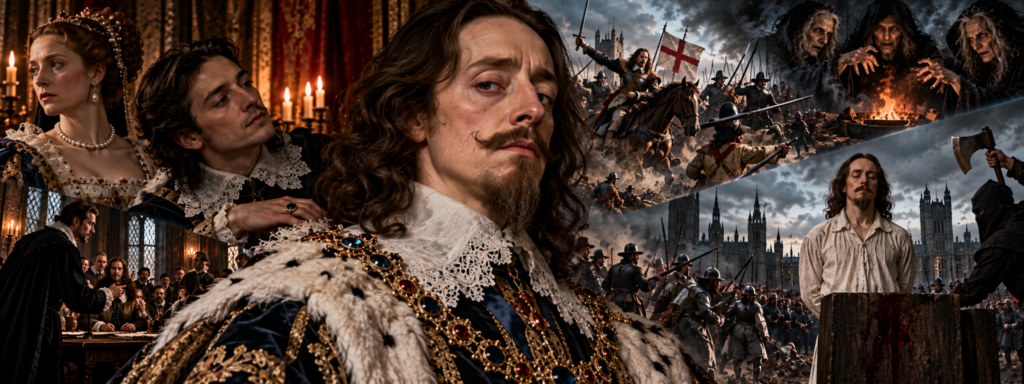
Charles I: The King Who Defied Parliament, Plunged England Into Civil War, and Lost His Head
He was born into a dynasty that believed kings ruled by the will of God. He inherited three kingdoms, married a French Catholic princess, surrounded himself with controversial advisers, and insisted that the authority of the crown could not be surrendered to those who challenged it. For eleven years, Charles I governed England without Parliament, collecting disputed taxes, punishing outspoken critics, and defending religious policies that alarmed many of his Protestant subjects. When rebellion erupted in Scotland and Ireland, the political order he had struggled to control began collapsing around him. England descended into civil war, families divided against one another, and thousands died in battles fought over religion, government, and the limits of royal power. Even after military defeat and imprisonment, Charles continued negotiating as though his crown gave him a position his captors could never entirely deny. His opponents increasingly believed that no settlement could be trusted while he remained capable of renewing the conflict. On January 30, 1649, the King of England walked onto a scaffold outside the Banqueting House at Whitehall and was publicly executed for treason against his own people. His death was an extraordinary rupture in the history of monarchy, and it left a question that would haunt Britain for generations: how had a king who believed his authority came from God become a prisoner condemned by his own subjects?
The King Who Would Rather Lose His Crown Than Surrender Its Authority
On a bitter January morning in 1649, Charles Stuart prepared to face the executioner. He had spent much of his adult life defending the dignity and independence of monarchy, yet he was now imprisoned by the forces that had defeated him in civil war. His judges had condemned him as a tyrant, traitor, murderer, and public enemy. Charles rejected the legitimacy of the court and maintained that no lawful authority existed to place an anointed king on trial.
The execution was not simply the death of a defeated ruler. It represented a radical challenge to the political assumptions upon which English monarchy had rested for centuries. Kings could be overthrown, imprisoned, murdered, or forced to abdicate, but Charles’s opponents attempted something different. They subjected him to a public judicial process and claimed that the sovereign himself could be held accountable for violence committed against his subjects.
The king refused to recognize that claim. Throughout his trial, he questioned the authority of the commissioners and declined to enter an ordinary plea. His resistance was consistent with the political convictions he had defended for decades. Charles believed hereditary monarchy possessed a legitimacy that could not be replaced merely by military victory or parliamentary assertion.
His enemies saw matters differently. After years of conflict, broken negotiations, and renewed warfare, leading figures in the parliamentary army had concluded that the king remained an obstacle to peace. They feared that any agreement allowing him to retain meaningful power might become the foundation for another war. The execution was therefore presented by its supporters as an extraordinary measure necessary to prevent further bloodshed.
Charles’s reputation has long been shaped by the contrast between his personal dignity and his political decisions. Admirers portrayed him as a Christian martyr who died defending the lawful monarchy. Critics described a ruler whose inflexibility, religious policies, and repeated attempts to recover authority helped destroy the political settlement he had inherited. Neither tradition provides a complete explanation of his reign.
Charles was not clinically mad, and there is no reliable evidence that he suffered from a psychiatric disorder that explains his conduct. His belief in divine-right monarchy belonged to a recognizable political and theological tradition. The question is not whether those convictions were symptoms of mental illness, but how they interacted with his personality, the expectations of his subjects, and the extraordinary crises of the seventeenth century.
To understand why Charles ended his life on a scaffold, it is necessary to return to the beginning of a reign that initially promised dynastic continuity but soon became consumed by distrust.
The Second Son Who Was Never Supposed to Be King
Charles was born at Dunfermline Palace in Scotland on November 19, 1600, the second surviving son of James VI of Scotland and Anne of Denmark. His father had inherited the Scottish throne as an infant and spent decades navigating noble factionalism, religious controversy, and disputes over royal authority. When Elizabeth I died in 1603, James also inherited the English crown, becoming James I of England. Charles was therefore raised within a dynasty ruling three kingdoms: England, Scotland, and Ireland.
His early childhood was marked by physical difficulties. Contemporary accounts describe him as a delicate child who developed more slowly than his elder brother Henry Frederick, Prince of Wales. Charles experienced problems with walking and speech during his youth, although the precise causes remain uncertain. Later writers sometimes interpreted these difficulties as evidence of weakness, but they provide no basis for retrospective psychiatric diagnosis.
Prince Henry was the expected heir and attracted considerable admiration. He developed a reputation for martial interests, Protestant commitment, and princely accomplishment. Charles occupied a secondary position in the succession and was not initially expected to inherit the crown. His prospects changed dramatically in November 1612, when Henry died at eighteen, probably from typhoid fever.
The death transformed Charles’s future. He became heir apparent and gradually assumed responsibilities associated with the succession. His education and preparation for kingship continued under the supervision of his father’s court. The contrast between his early vulnerability and his later insistence upon royal dignity became a recurring theme in accounts of his life.
Charles developed strong interests in art, architecture, ceremony, and religious worship. He became an important collector and patron, eventually assembling one of Europe’s remarkable royal art collections. His taste for elaborate ceremonial display reflected his understanding of monarchy as an institution whose authority should be visible. Court ritual, architecture, and religious observance became closely connected to his conception of kingship.
His relationship with his father also shaped his political outlook. James VI and I defended hereditary monarchy and the divine origin of royal authority, although he sometimes displayed considerable flexibility in practical government. Charles inherited many of these convictions but would face circumstances in which compromise became increasingly difficult. The political culture of England required negotiation with Parliament, while Scotland possessed its own religious and institutional traditions.
Charles’s preparation for kingship therefore occurred within a complicated constitutional environment. He inherited not one unified state but three kingdoms whose political institutions, religious expectations, and historical grievances differed. The challenge of governing them would become one of the central causes of his downfall.
The Spanish Match: A Prince, a Failed Marriage Scheme, and the Rise of Buckingham
Before becoming king, Charles became involved in a diplomatic venture that exposed the influence of George Villiers, Duke of Buckingham. Buckingham had risen rapidly through the favor of James I and became one of the most powerful figures at court. His relationship with Charles developed into a close political partnership. Together, they would shape the opening years of the new reign.
James hoped to secure a marriage between Charles and the Spanish Infanta Maria Anna. The proposed union formed part of broader diplomatic efforts to improve relations with Catholic Spain and address conflicts involving the Palatinate, where James’s daughter Elizabeth and her husband Frederick V had suffered political and military losses. The negotiations were controversial in England because many Protestants feared closer ties with a Catholic power.
In 1623, Charles and Buckingham traveled secretly to Spain in an attempt to advance the marriage negotiations. The journey was extraordinary for an English prince and reflected the importance attached to the proposed alliance. The negotiations ultimately failed, partly because of religious and diplomatic obstacles. Charles returned to England disappointed, and Buckingham became associated with a more confrontational policy toward Spain.
The failure transformed English foreign policy. Parliamentarians who opposed the Spanish marriage initially welcomed the collapse of negotiations. Charles and Buckingham supported a more aggressive approach toward Spain, but war required substantial financial resources. The tensions between royal ambition and parliamentary funding would become apparent almost immediately after Charles inherited the throne.
The Spanish journey also strengthened Buckingham’s position. He remained Charles’s principal adviser and exercised considerable influence over appointments and military planning. His prominence generated resentment among established courtiers and parliamentarians who regarded him as excessively powerful. Buckingham’s political fortunes became closely connected to those of the new king.
When James died in March 1625, Charles inherited the crown at twenty-four. He entered his reign with ambitious foreign-policy commitments, a powerful favorite, and growing expectations that England would confront Catholic powers abroad. These commitments required cooperation with Parliament, but the relationship soon deteriorated.
The king who would later govern without Parliament began his reign needing its financial support.
Henrietta Maria: The Catholic Queen Who Divided Protestant England
In 1625, Charles married Henrietta Maria, daughter of Henry IV of France and Marie de’ Medici. The marriage connected the Stuart dynasty to the French royal family and offered diplomatic advantages. Henrietta Maria was Catholic, however, and her arrival provoked suspicion among English Protestants. Many feared that the queen’s religious household might encourage Catholic influence at court.
The marriage initially experienced difficulties. Charles and Henrietta Maria differed in language, religion, and expectations, while disputes arose over her household and attendants. The king eventually ordered the removal of many members of her French entourage. Over time, however, their relationship developed into a close and affectionate partnership. Their surviving correspondence reveals considerable personal attachment.
Henrietta Maria became an important figure in the royal household and the mother of several children, including the future Charles II and James II. Her influence extended into patronage, court culture, and political relationships. She also maintained her Catholic faith, which remained a source of controversy. Her religious identity made her vulnerable to accusations that she encouraged policies hostile to Protestantism.
Opponents of Charles increasingly associated the queen with fears of Catholic conspiracy. Such accusations were sometimes exaggerated and shaped by anti-Catholic prejudice, but they drew strength from genuine disagreements over religious policy. Charles’s support for ceremonial worship and his appointment of controversial churchmen intensified suspicion. Henrietta Maria became a convenient symbol of these anxieties.
During the civil wars, the queen actively supported the royalist cause. She traveled abroad to seek financial and military assistance and helped secure supplies for her husband’s forces. Her activities demonstrated political determination rather than passive dependence. They also provided ammunition for opponents who portrayed the royal court as dangerously connected to foreign Catholic interests.
The marriage remained personally significant to Charles throughout his reign. His affection for Henrietta Maria complicates portrayals of him as entirely cold or incapable of emotional attachment. Yet their relationship also illustrates how private royal life could become inseparable from public political conflict.
The queen’s Catholicism did not cause the civil wars by itself. Religious tensions involved the policies of the crown, the English church, Scottish Presbyterian resistance, Irish Catholic grievances, and competing Protestant movements. Nevertheless, Henrietta Maria’s position intensified distrust at moments when Charles desperately needed political confidence.
The royal marriage that had promised diplomatic advantages became another source of suspicion surrounding the Stuart monarchy.
Parliament Turns Against the Crown: Taxes, War, and the Petition of Right
Charles’s early relationship with Parliament deteriorated rapidly. His government needed money for military campaigns against Spain and later France, but parliamentary grants fell short of royal expectations. Members questioned the competence of Buckingham and criticized the direction of foreign policy. Charles interpreted some of these challenges as improper interference with royal government.
The king’s financial difficulties were aggravated by unsuccessful military operations. The expedition against Cádiz in 1625 failed to achieve its objectives, while subsequent campaigns produced further disappointment. Buckingham became the principal target of criticism. Parliamentarians attempted to investigate his conduct, and Charles defended his favorite against political attack.
In 1626, Charles dissolved Parliament amid growing hostility. He then sought alternative sources of revenue, including forced loans imposed upon subjects. Those who refused payment could face imprisonment. The policy generated resistance because critics argued that taxation required parliamentary consent.
The Five Knights’ Case, also known as Darnell’s Case, emerged from the imprisonment of men who refused to contribute to the forced loan. The proceedings raised fundamental questions about detention by royal authority. Critics feared that the crown could imprison subjects without providing adequate legal justification. The controversy intensified demands for constitutional safeguards.
When Parliament assembled in 1628, members pressed for recognition of established liberties. The resulting Petition of Right challenged taxation without parliamentary consent, arbitrary imprisonment, compulsory billeting of soldiers, and the use of martial law in peacetime. Charles eventually accepted the petition, although disagreements persisted over its meaning and implementation. Parliament regarded it as an important affirmation of legal protections.
The king’s acceptance did not restore trust. Charles continued to defend royal prerogative, while parliamentarians remained suspicious of his intentions. Religious disputes added further tension, particularly concerning the influence of clergy associated with ceremonial worship. The political atmosphere became increasingly hostile.
Buckingham’s assassination in August 1628 removed the king’s most controversial adviser. John Felton, a disgruntled army officer, stabbed the duke at Portsmouth. Buckingham’s death was celebrated by some of his enemies, revealing the intensity of public resentment. Charles was deeply affected by the loss of his close companion.
The assassination did not resolve the underlying disputes. Parliament continued challenging royal financial and religious policies, while Charles resisted what he considered encroachments upon his authority. In 1629, the relationship collapsed completely.
Charles dissolved Parliament and began governing without summoning another for eleven years.
Eleven Years Without Parliament: The Personal Rule
From 1629 until 1640, Charles governed England without Parliament in a period traditionally known as the Personal Rule. Critics later called it the Eleven Years’ Tyranny, although that label reflects a hostile interpretation rather than a neutral description. Charles maintained that he possessed lawful authority to govern without Parliament when circumstances permitted. He relied upon existing institutions, royal councils, courts, and administrative officials.
The absence of Parliament did not mean the disappearance of government. Charles continued administering justice, conducting foreign relations, and collecting revenue through established and disputed mechanisms. His government sought financial stability and avoided the costs of major continental warfare. Some aspects of administration functioned effectively, but the methods used to raise money generated increasing resentment.
Ship money became the most famous controversy. Traditionally associated with maritime defense and coastal communities, the levy was extended more broadly during the 1630s. Charles argued that the crown possessed authority to require contributions for national defense. Critics maintained that the expanded demands amounted to taxation without parliamentary consent.
The case of John Hampden became particularly significant. Hampden refused to pay a relatively small assessment and challenged the legality of the levy. In 1637, judges ruled narrowly in favor of the crown, but the divided decision exposed serious disagreement about royal fiscal powers. Ship money remained politically damaging despite the legal outcome.
Other revenue measures also attracted criticism. Charles revived or enforced certain feudal dues, forest fines, and monopolies. These policies provided income but could appear arbitrary or oppressive to those affected. The government increasingly depended upon legal interpretations that opponents regarded as stretching royal prerogative beyond acceptable limits.
Religious policy created another source of tension. Charles supported Archbishop William Laud and churchmen who emphasized ceremonial worship, episcopal authority, and religious uniformity. Their reforms included attention to church decoration, altar placement, and liturgical practice. Many Puritans feared that these developments represented a movement toward Catholicism.
The crown used ecclesiastical and prerogative courts to enforce conformity and punish critics. The Star Chamber became particularly notorious for severe sentences against outspoken opponents. William Prynne, Henry Burton, and John Bastwick suffered humiliating punishments in 1637, including mutilation and imprisonment. Their treatment became a powerful symbol of the government’s intolerance of dissent.
Yet the Personal Rule was not universally experienced as continuous crisis. Some subjects valued peace and administrative order, while others remained politically disengaged until particular policies affected them. Opposition developed unevenly across regions and social groups. The eventual collapse of the system resulted from the interaction of financial pressures, religious resistance, and military failure.
Charles had succeeded in governing without Parliament for more than a decade, but the arrangement depended upon avoiding circumstances that required extraordinary taxation. His attempt to impose religious uniformity upon Scotland would destroy that fragile balance.
The Prayer Book Rebellion: Scotland Defies Its King
Charles ruled Scotland as well as England, but the Scottish church possessed traditions that differed significantly from those of the English establishment. Many Scots strongly defended Presbyterian forms of church government and resisted attempts to impose greater episcopal control. Charles’s religious policies increasingly threatened those expectations. His determination to establish uniform worship across his kingdoms created a serious political crisis.
In 1637, a new prayer book was introduced in Scotland. The liturgy was associated with royal attempts to reshape Scottish worship along lines that critics regarded as dangerously close to English ceremonial practice. Opposition erupted in Edinburgh, where protests disrupted services. The disturbances became symbols of a much broader movement against royal religious policy.
The National Covenant of 1638 united opponents of the reforms. Covenanters pledged to defend the Scottish religious settlement and resist innovations they regarded as unlawful. Their movement combined theological conviction with political resistance. Powerful nobles, ministers, and ordinary supporters participated.
Charles regarded the challenge as a threat to royal authority. He attempted negotiation but also prepared for military confrontation. The resulting Bishops’ Wars of 1639 and 1640 exposed the limitations of his financial and military resources. His government struggled to raise effective forces and sustain operations without parliamentary support.
The first conflict ended without decisive battle through the Pacification of Berwick in 1639. The settlement did not resolve the underlying disagreements. Renewed confrontation followed in 1640, when Scottish forces invaded northern England and defeated royal troops at Newburn. The Scots occupied important territory, creating enormous financial pressure upon Charles.
The king could no longer sustain government through ordinary revenues and disputed taxation alone. He needed substantial funds to maintain an army and negotiate with the Scottish forces. His earlier refusal to summon Parliament became increasingly impractical. The crisis forced him to reopen the institution he had excluded for eleven years.
The Scottish rebellion demonstrated that Charles’s authority depended upon more than hereditary legitimacy. Religious communities, political institutions, and armed forces could resist policies they regarded as unlawful. The king’s attempt to enforce uniformity had instead produced organized opposition.
The road to civil war began not with a single parliamentary confrontation but with the collapse of royal authority across the interconnected kingdoms.
The Short Parliament and the Long Parliament: The Crown Begins to Collapse
In April 1640, Charles summoned Parliament for the first time since 1629. He hoped members would provide funds for the war against Scotland. Instead, parliamentarians demanded discussion of grievances accumulated during the Personal Rule. The king refused to allow prolonged criticism before financial assistance was granted.
The assembly became known as the Short Parliament because Charles dissolved it after only three weeks. The decision demonstrated the continuing gulf between royal expectations and parliamentary priorities. Charles still hoped to preserve his freedom of action, but the military situation deteriorated. Scottish success in the Second Bishops’ War left him with little choice.
In November 1640, Charles summoned another Parliament. This assembly became known as the Long Parliament because it continued, in changing forms, for many years. Its members moved rapidly to dismantle institutions associated with the Personal Rule. The political initiative increasingly shifted away from the crown.
Thomas Wentworth, Earl of Strafford, became a principal target. Strafford had served Charles in Ireland and was associated with vigorous royal administration. Parliament accused him of attempting to establish arbitrary government. His prosecution became one of the most dramatic political struggles of the period.
Strafford’s impeachment encountered legal difficulties, leading his opponents to pursue an act of attainder. Charles initially resisted sacrificing a trusted servant, but mounting pressure and fears of unrest changed the situation. He eventually approved the legislation. Strafford was executed in May 1641.
The execution deeply affected Charles and later became associated with his sense of guilt over abandoning a loyal minister. Historians cannot determine the precise emotional consequences, but the event demonstrated how far royal authority had weakened. A king who had defended his prerogative for years had authorized the death of one of his principal advisers under political pressure.
Parliament also abolished the Star Chamber and High Commission and restricted the crown’s ability to govern without parliamentary sessions. The Triennial Act required regular parliaments, while further legislation prevented the Long Parliament from being dissolved without its own consent. These measures fundamentally altered the relationship between monarchy and Parliament.
Yet opposition to Charles was not united. Parliamentarians disagreed about the extent of reform, the future of bishops, and the proper limits of royal authority. Some feared that attacks upon the crown were becoming excessive. Religious divisions complicated political alliances.
The collapse of the Personal Rule did not produce a stable constitutional settlement. Instead, it opened a struggle over who would control the institutions of government, the armed forces, and the future of the church.
Ireland in Flames: Rebellion, Massacre, and the Fear of Catholic Conspiracy
In October 1641, rebellion erupted in Ireland. The uprising began among Irish Catholic leaders who sought to address grievances involving land, religion, and political authority. The conflict rapidly expanded into violence across several regions. Attacks upon Protestant settlers produced deaths, displacement, and widespread fear.
Reports of atrocities circulated through England and Scotland. Some accounts described genuine killings and expulsions, while others exaggerated numbers or included unverified claims. The resulting atmosphere of panic intensified anti-Catholic sentiment. Many Protestants feared that the rebellion formed part of a wider conspiracy against their religion.
The crisis created an urgent question: who should control the army raised to suppress the rebellion? Parliamentarians distrusted Charles and feared that he might use military forces against them. The king maintained that command of the armed forces belonged to the crown. The dispute exposed the central constitutional problem that negotiations had failed to resolve.
The Irish rebellion also affected perceptions of Henrietta Maria and the royal court. Rumors connected Catholic interests with the uprising, although claims of a coordinated royal conspiracy were not established. Religious suspicion increasingly shaped political argument. Both sides used fears of violence to justify their positions.
In November 1641, Parliament presented the Grand Remonstrance, a lengthy statement of grievances against Charles’s government. The document narrowly passed the House of Commons, demonstrating that parliamentary opinion was deeply divided. Its supporters sought to expose the dangers they associated with royal policy. Opponents feared that the language would make reconciliation more difficult.
The king rejected the implication that his government had deliberately endangered the kingdom. He continued defending his authority while attempting to preserve support among moderates. Yet the political atmosphere was becoming increasingly hostile. Rumors of plots and military preparations circulated throughout London.
The Irish rebellion transformed a constitutional dispute into an immediate security crisis. Parliament and crown both claimed responsibility for defending the kingdom, but neither trusted the other with the necessary military power. The question of who commanded the army became inseparable from the question of who governed England.
The remaining possibility of peaceful settlement was severely damaged by Charles’s next extraordinary decision.
The Five Members: Charles Enters Parliament and Destroys What Trust Remained
On January 4, 1642, Charles entered the House of Commons accompanied by armed attendants. He intended to arrest five members whom he accused of treason: John Pym, John Hampden, Denzil Holles, Arthur Haselrig, and William Strode. The king also sought the arrest of Lord Mandeville, a peer, through related proceedings. The attempted arrests represented a dramatic escalation of the conflict.
The five members had been warned and were absent when Charles arrived. The king entered the Commons chamber and occupied the Speaker’s chair. Speaker William Lenthall refused to identify the missing members, maintaining that he was bound by the authority of the House. The confrontation became one of the most famous moments in parliamentary history.
Charles’s action was widely regarded by opponents as a violation of parliamentary privilege. It intensified fears that he intended to use force against political critics. London became increasingly hostile to the crown, and demonstrations supported Parliament. The king’s attempt to assert authority had instead weakened his position.
Charles soon left London, accompanied by members of his household and supporters. He never returned to the capital as a reigning monarch exercising ordinary authority. The departure marked a decisive geographical and political separation between the crown and Parliament. Both sides began organizing military resources.
Negotiations continued, but distrust was profound. Parliament issued demands concerning control of the militia, royal advisers, and religious policy. Charles rejected proposals that he believed would strip the monarchy of essential authority. The dispute had reached a point where compromise required concessions neither side was prepared to make.
In August 1642, Charles raised his royal standard at Nottingham, traditionally marking the beginning of the First English Civil War. The country was not divided into two perfectly coherent camps. Loyalties varied according to religion, locality, family relationships, economic interests, and political convictions. Some people supported the king while criticizing aspects of his government; others defended Parliament without seeking the abolition of monarchy.
The conflict would become a devastating struggle involving battles, sieges, disease, displacement, and economic disruption. It would also expose the limits of Charles’s belief that hereditary authority could command obedience in a kingdom whose political institutions had turned against him.
The First English Civil War: Families Divided and Kingdoms Torn Apart
The First English Civil War began in 1642 and continued until 1646. Royalist forces supported Charles, while Parliament organized armies to resist him. The conflict spread across England and Wales, drawing in local communities whose loyalties were often complicated. Towns, counties, and families could be divided between opposing causes.
The first major battle occurred at Edgehill in October 1642. Neither side achieved a decisive victory, and the result demonstrated that the war would not end quickly. Charles established his principal wartime headquarters at Oxford, while Parliament retained control of London. The capital’s financial resources, population, and political institutions gave Parliament significant advantages.
The war developed through campaigns, sieges, and regional struggles. Royalist forces achieved successes in parts of western and northern England, while parliamentary armies maintained important positions elsewhere. The fighting disrupted agriculture, trade, and ordinary life. Civilian populations suffered from requisitioning, taxation, disease, and the destruction associated with military operations.
Charles’s supporters included nobles, gentry, clergy, and ordinary subjects who defended monarchy or opposed parliamentary radicalism. Parliament’s coalition included committed Puritans, constitutional reformers, and individuals motivated by local grievances. Neither side was ideologically uniform. The conflict involved competing visions of religion and government rather than a simple struggle between freedom and tyranny.
The war also depended upon developments outside England. Scottish Covenanters eventually allied with Parliament through the Solemn League and Covenant of 1643. Their intervention provided substantial military support against the king. Charles sought assistance from Ireland and negotiated with various factions, creating further controversy.
One of the war’s most important battles occurred at Marston Moor in July 1644. Parliamentary and Scottish forces defeated a royalist army in northern England. The victory weakened Charles’s position and increased the prominence of commanders associated with Parliament, including Oliver Cromwell. Royalist control of the north was severely reduced.
The conflict revealed weaknesses in parliamentary military organization as well. Rival commanders and regional armies sometimes operated without sufficient coordination. Parliament responded by creating the New Model Army in 1645, a more centralized and disciplined force. Sir Thomas Fairfax became its commander-in-chief, while Cromwell played a major role in its cavalry and leadership.
The New Model Army transformed the military balance. Its organization, discipline, and political commitment helped Parliament achieve decisive victories. Charles’s forces increasingly struggled to replace losses and maintain effective coordination.
The king continued defending his cause, but the resources available to him were shrinking. His conviction that he remained the lawful sovereign did not overcome the growing superiority of parliamentary arms.
Naseby: The Battle That Broke the Royalist Cause
On June 14, 1645, royalist and parliamentary armies met near Naseby in Northamptonshire. The battle became the decisive engagement of the First English Civil War. Charles was present with his forces, while Sir Thomas Fairfax commanded the New Model Army. Oliver Cromwell led important elements of the parliamentary cavalry.
The fighting began with royalist cavalry attacks that achieved initial success on part of the battlefield. Prince Rupert, Charles’s nephew and a prominent royalist commander, led cavalry that drove opponents away. However, the royalist army failed to convert these gains into overall victory. Parliamentary forces maintained cohesion and exploited weaknesses in the royalist position.
Cromwell’s cavalry contributed significantly to the parliamentary victory. The New Model Army defeated the royalist infantry and captured substantial numbers of prisoners. Charles escaped, but his principal field army suffered devastating losses. The battle destroyed much of his ability to continue the war through conventional military operations.
Parliamentary forces also captured royal correspondence. The letters became politically damaging because they revealed negotiations involving foreign assistance and Irish Catholic interests. Parliament published selected correspondence to undermine Charles’s credibility. The documents reinforced accusations that he had sought outside support against his own subjects.
The use of captured letters illustrates the importance of political propaganda during the civil wars. Both sides published pamphlets, declarations, and accounts designed to influence public opinion. Charles’s correspondence provided genuine evidence of his diplomatic efforts, but its publication was also intended to shape perceptions of his conduct. The resulting controversy deepened distrust.
After Naseby, royalist resistance continued in various regions, but the strategic situation had changed decisively. Parliamentary forces captured strongholds and reduced the king’s remaining resources. Charles moved between locations while seeking opportunities for negotiation or renewed support. His military options became increasingly limited.
In 1646, Charles surrendered himself to the Scottish army at Southwell. The decision reflected his hope that negotiations with the Scots might produce more favorable terms than surrender to Parliament. The Scots eventually transferred him to English parliamentary custody in 1647 after negotiations concerning their interests and financial claims.
The king had lost the war, but he had not abandoned his claim to authority. His captivity opened another phase of political conflict in which negotiations, religious demands, and competing armies would determine his fate.
A Captive King Who Still Believed He Could Win
Charles’s surrender did not immediately settle the future of monarchy. Many parliamentarians hoped to reach an agreement that would preserve kingship under revised constitutional arrangements. The Scots possessed their own religious and political priorities, while the New Model Army developed increasingly independent demands. Charles attempted to negotiate among these competing interests.
The king’s position remained complicated because he was still the hereditary sovereign. Even in captivity, he possessed symbolic authority and could influence political divisions. Different factions believed that an agreement with him might legitimize their preferred settlement. Charles used this leverage in negotiations, sometimes offering concessions while resisting permanent limitations upon royal power.
The army’s political role became increasingly important in 1647. Soldiers demanded payment, protection from prosecution, and recognition of their service. Army leaders also questioned whether Parliament could be trusted to secure the settlement for which they had fought. The conflict between Parliament and its own army created opportunities for Charles.
Negotiations produced proposals such as the Heads of the Proposals, which offered a framework for constitutional settlement. Charles did not accept the arrangement. He remained unwilling to concede certain religious and political demands. His resistance reflected conviction, calculation, and the belief that divisions among his opponents might improve his position.
In November 1647, Charles escaped from Hampton Court but was soon confined on the Isle of Wight at Carisbrooke Castle. The circumstances of his departure remain debated, including whether he expected a safer refuge or hoped to regain greater freedom. His subsequent imprisonment did not end negotiations. Instead, he continued communicating with political allies.
In December 1647, Charles concluded a secret agreement with Scottish representatives known as the Engagement. Under its terms, Scottish supporters would assist him militarily in return for religious concessions involving Presbyterianism. The agreement helped trigger renewed conflict in 1648. For many parliamentary soldiers, the king’s willingness to support another war after his defeat appeared to confirm their worst fears.
The Second English Civil War was shorter than the first but politically decisive. Royalist uprisings occurred in several regions, while a Scottish army invaded England in support of Charles. Parliamentary forces defeated the uprisings and crushed the Scottish invasion at Preston in August 1648. The renewed fighting intensified anger toward the king.
Leading army figures increasingly argued that Charles could not be trusted to maintain peace. His negotiations with different factions were interpreted as evidence that he would continue seeking opportunities to recover unrestricted authority. The question of settlement began giving way to demands for accountability.
The king’s belief that time and division might restore his position had produced the opposite result. His opponents were becoming more determined to prevent him from ruling again.
Pride’s Purge: Parliament Is Broken Before the King Is Tried
The decision to place Charles on trial emerged from a profound political crisis within the parliamentary cause. Many members of Parliament still favored negotiation with the king. The New Model Army, however, increasingly rejected further attempts at settlement. Army leaders argued that renewed warfare demonstrated the danger of allowing Charles to retain power.
In December 1648, Parliament considered the results of negotiations known as the Treaty of Newport. A majority of members supported continuing efforts toward settlement. The army opposed this direction and intervened directly. Soldiers under Colonel Thomas Pride prevented numerous members from entering the House of Commons.
The event became known as Pride’s Purge. It removed or excluded members considered favorable to negotiation, leaving a reduced assembly commonly called the Rump Parliament. The intervention was extraordinary because an army that had fought in Parliament’s name now used force to reshape Parliament itself. The legitimacy of the resulting government was therefore deeply contested.
The Rump moved toward establishing a court to try Charles. The House of Lords refused to approve the proposed proceedings, but the Commons asserted its authority to act without the Lords or the king. The legal and constitutional basis of the trial was revolutionary. It challenged established assumptions about sovereignty and the relationship between monarch and subjects.
The court was established under an ordinance of the Commons, and commissioners were appointed to conduct proceedings. Not all those named participated. Some refused involvement, while others attended only certain sessions. The process reflected the divisions that continued even among opponents of Charles.
Oliver Cromwell supported the move toward trial and execution, but the decision emerged from a broader group of army and parliamentary leaders. Their arguments combined political necessity, religious conviction, and claims of accountability for bloodshed. They regarded the king as responsible for wars that had devastated the kingdoms.
Critics maintained that the court lacked lawful authority and that the proceedings were predetermined. Royalists regarded the trial as an act of rebellion against legitimate monarchy. Some parliamentarians who opposed Charles’s policies also rejected the idea that he could lawfully be tried by such a tribunal. The controversy extended beyond a simple division between royalists and republicans.
The stage was now set for an unprecedented confrontation. A king who believed his authority came from God would face judges claiming to act on behalf of the people.
The Trial of Charles I: A King Refuses to Recognize His Judges
Charles’s trial began in Westminster Hall on January 20, 1649. The proceedings were conducted before a specially established High Court of Justice. John Bradshaw served as president of the court. The king appeared under guard, facing commissioners who claimed authority to judge him for actions committed during the civil wars.
The charge accused Charles of using his power to wage war against Parliament and the people of England. It portrayed him as responsible for violence and destruction arising from the conflict. The prosecution argued that he had pursued personal authority at the expense of the kingdom’s liberties. The indictment represented a radical reversal of traditional treason law, which had ordinarily protected the sovereign against rebellion.
Charles refused to recognize the court’s jurisdiction. He repeatedly demanded to know by what lawful authority he had been brought before it. His objections reflected the constitutional argument that no court established without legitimate royal and parliamentary authority could judge the king. He did not enter an ordinary plea of guilty or not guilty.
The court interpreted his refusal as an obstruction rather than a successful legal challenge. Proceedings continued despite his objections. Witness testimony and documentary material were considered, although Charles did not participate in a conventional defense. The court’s authority rested upon the political transformation produced by military victory and Pride’s Purge.
Charles’s conduct during the trial was controlled and deliberate. Contemporary accounts describe his insistence upon the dignity of his office and his refusal to acknowledge the legitimacy of the proceedings. He did not behave as a man unaware of his circumstances. His resistance was grounded in a consistent political and legal position.
On January 27, the court pronounced sentence. Charles was condemned to death by beheading. The judgment declared him responsible for treason and other grave offenses against the people. The decision was extraordinary because it treated the monarch as accountable to an authority claiming to represent the nation.
The death warrant was subsequently signed by fifty-nine commissioners. The document became one of the most famous records of the English Revolution. Its signatures would later expose participants to prosecution after the restoration of the monarchy. The men who authorized the execution understood that their actions could carry enormous consequences if political circumstances changed.
Charles was given only a short time to prepare for death. He met with his children and received religious assistance. His final days were marked by the contrast between his reduced physical circumstances and his continued insistence upon royal dignity.
The king had lost the power to command armies, summon Parliament, or direct government. Yet he refused to concede that his judges possessed legitimate authority over him.
January 30, 1649: The Execution of a King
Charles I was executed outside the Banqueting House at Whitehall on January 30, 1649. The scaffold had been erected outside a building closely associated with royal ceremony and the artistic magnificence of the Stuart court. The setting created a powerful contrast between the monarchy’s former splendor and the violence of its destruction. The king who had patronized art and defended sacred kingship would die beneath the windows of his own palace.
Charles prepared carefully for the execution. Contemporary accounts describe his attention to clothing and his concern that trembling from the cold might be mistaken for fear. He wore additional garments against the January weather. The detail became central to later portrayals of his composure, although accounts of his final hours were shaped by political and religious loyalties.
Before his death, Charles addressed those near the scaffold. His speech defended his understanding of lawful monarchy and rejected the legitimacy of the proceedings against him. He distinguished between the liberty of subjects and the authority to govern, maintaining that freedom did not require subjects to participate directly in sovereignty. His words reflected the political convictions that had shaped his reign.
The king then prepared for beheading. Accounts describe him arranging his hair and positioning himself upon the block. The executioner struck, and Charles died. The precise details of the crowd’s reaction vary among contemporary narratives, but the event produced shock and intense political emotion.
The execution was intended by its supporters to establish accountability for the devastation of civil war. It also removed a monarch whose continued existence had become a focus for renewed conflict. Yet the act did not immediately create political stability. The abolition of monarchy and the House of Lords followed, while England entered a republican experiment under the Commonwealth.
Royalists interpreted Charles’s death as martyrdom. The publication of Eikon Basilike, a work presented as the king’s spiritual reflections, helped establish the image of a suffering Christian sovereign. Its authorship has long been disputed, with John Gauden later claiming responsibility. Regardless of its origins, the book became influential in shaping royalist memory.
Opponents of the king defended the execution as an extraordinary response to tyranny and war. They argued that rulers could not claim unlimited immunity from accountability. The debate over Charles’s death became inseparable from larger questions about sovereignty, representation, and the legitimacy of resistance.
The scaffold at Whitehall therefore became a symbol of competing political traditions. For some, it represented the destruction of lawful monarchy. For others, it marked the assertion that even a king could be held responsible for the consequences of government.
The execution ended Charles’s life, but it did not end the struggle over the meaning of his reign.
Oliver Cromwell and the Republic That Followed
After Charles’s execution, England entered a period without a reigning monarch. The Commonwealth was proclaimed, and the House of Lords was abolished. The Rump Parliament continued governing, supported by the army. The political settlement was unprecedented in English history, but it remained unstable.
Oliver Cromwell emerged as one of the central figures of the new regime. He had played an important role in the parliamentary military victories and supported the decision to bring Charles to trial. His religious convictions and political outlook developed within the extraordinary circumstances of civil war. He did not initially possess a single, fully formed plan for the government that would replace monarchy.
The Commonwealth faced serious challenges. Royalist resistance continued, particularly in Ireland and Scotland. The new government also confronted disputes among its supporters over religious freedom, parliamentary reform, and the role of the army. Military campaigns imposed substantial costs and produced further suffering.
Cromwell led the campaign in Ireland in 1649, where parliamentary forces captured Drogheda and Wexford amid severe violence. The events became central to Irish historical memory and remain subjects of intense debate concerning responsibility, military practice, and the treatment of civilians. The conquest involved widespread destruction and displacement. It demonstrated that the end of monarchy did not end coercive government.
In Scotland, Charles II was recognized as king by supporters who opposed the English republic. Cromwell’s forces defeated Scottish and royalist armies, culminating in victory at Worcester in 1651. Charles II escaped and eventually went into exile. The Stuart claim survived despite the execution of Charles I.
Political tensions within the Commonwealth continued. In 1653, Cromwell dissolved the Rump Parliament by force. He subsequently became Lord Protector under a new constitutional arrangement. The Protectorate preserved republican forms while concentrating considerable authority in Cromwell’s hands.
The revolution had therefore replaced one contested system of sovereignty with another. The execution of Charles had not resolved every disagreement about representation, religion, or executive power. The new regime struggled with many of the same problems that had troubled the monarchy, although within different institutions.
Cromwell died in 1658, and the Protectorate soon collapsed. Political instability created conditions for the restoration of the Stuart monarchy. In 1660, Charles II returned to England and became king.
The monarchy that Charles I had died defending was restored, but the political world had changed. The experience of civil war, republican government, and military rule remained part of the constitutional memory of the kingdoms.
The Martyr King: How Charles’s Death Became a Political Legend
Charles’s execution transformed his reputation almost immediately. Royalist writers portrayed him as a Christian martyr who had suffered unjustly at the hands of rebels. His composure at the scaffold became evidence of personal virtue and religious devotion. The image of the suffering king helped sustain loyalty to the Stuart dynasty during the Commonwealth.
The publication of Eikon Basilike played a major role in this transformation. The book presented reflections associated with Charles and encouraged readers to view his suffering through the language of Christian sacrifice. Its enormous popularity demonstrated the power of print in shaping political memory. The work also became controversial because questions arose about its authorship and authenticity.
Royalist imagery frequently emphasized Charles’s dignity, piety, and resignation. Portraits and commemorative works depicted him as a ruler whose authority had been violated by unlawful violence. These representations minimized or reinterpreted the political decisions that had contributed to civil war. The king’s death became the central event through which his reign was remembered.
Opponents offered a sharply different interpretation. Republican writers argued that Charles had endangered the kingdom through arbitrary government, religious policies, and repeated warfare. They defended the principle that rulers could be accountable for abuses of power. The execution became a symbol of resistance to tyranny rather than martyrdom.
After the Restoration in 1660, the monarchy encouraged commemoration of Charles as a royal martyr. January 30 became an official day of remembrance within the Church of England. The political and religious meaning of the anniversary reflected the restored regime’s desire to condemn the revolution. Commemoration also reinforced loyalty to hereditary monarchy.
The Restoration government pursued individuals associated with the regicide. Some were executed, while others fled or escaped punishment. The bodies of Cromwell, Henry Ireton, and John Bradshaw were exhumed and subjected to posthumous humiliation. These acts demonstrated the continuing bitterness surrounding Charles’s death.
The king’s reputation therefore developed through competing traditions. Royalist accounts emphasized personal virtue and unlawful execution, while parliamentary and republican narratives stressed political responsibility. Later historians have attempted to examine both the king’s convictions and the circumstances that shaped his decisions. The result is a more complicated portrait than either martyrdom or villainy alone can provide.
Charles’s death became one of the most powerful symbols in British political history because it raised questions that survived the restoration of monarchy. Could a sovereign be held accountable to subjects? What limits existed upon royal authority? When did resistance become lawful, and who possessed the right to decide?
The scaffold at Whitehall did not settle those questions. It made them impossible to ignore.
Was Charles I Really Mad? Divine Right, Political Conviction, and the Limits of Compromise
Charles I was not documented as suffering from a psychiatric disorder that explains his political conduct. His belief in divine-right monarchy, insistence upon royal authority, and resistance to parliamentary demands belonged to recognizable traditions of early modern political thought. These convictions were controversial and sometimes contributed to disastrous decisions, but they were not evidence of clinical delusion. The historical challenge is to explain his actions through political beliefs, institutions, and circumstances rather than retrospective diagnosis.
His commitment to monarchy was sincere and deeply rooted. Charles regarded kingship as a sacred office carrying obligations before God. He believed that surrendering essential royal powers could violate his duty as sovereign. This understanding shaped his responses to parliamentary demands and his refusal to recognize the court that tried him.
Yet Charles was not incapable of all negotiation. Throughout his reign, he considered proposals, accepted certain measures under pressure, and pursued agreements with different political factions. His difficulty lay partly in the limits he placed upon acceptable concessions and the distrust his conduct generated. Opponents increasingly feared that agreements would not remain secure if he recovered political or military strength.
The accusation of political duplicity requires careful treatment. Charles negotiated simultaneously with different groups and sometimes pursued arrangements that appeared inconsistent. His secret Engagement with Scottish supporters after the First Civil War intensified the belief that he would renew conflict to recover authority. Critics interpreted these actions as proof that he could not be trusted, while royalists regarded them as legitimate efforts to restore lawful monarchy.
His financial policies also reflected conflict over constitutional authority rather than simple irrationality. Charles sought revenue without parliamentary grants during the Personal Rule, using measures such as ship money. The legality of these practices was contested, and judicial decisions did not eliminate political opposition. The disputes exposed uncertainty about the boundaries of royal prerogative.
Religious policy proved equally important. Charles supported ceremonial worship and episcopal government, while many Protestants feared a movement toward Catholicism. His attempt to impose religious changes in Scotland helped trigger military conflict. These decisions reflected theological convictions and political misjudgment, not evidence of mental illness.
The civil wars resulted from multiple causes extending beyond the king’s personality. Religious division, financial disputes, parliamentary privilege, Scottish resistance, Irish rebellion, military mobilization, and competing political visions all contributed. Charles’s decisions were central, but they interacted with institutions and movements that possessed their own goals. Reducing the conflict to the supposed madness of one ruler would obscure those wider forces.
His trial and execution further demonstrate the importance of political interpretation. Charles refused to recognize the court because he rejected its legal authority. His judges regarded that refusal as an obstacle to accountability, while royalists considered it a defense of lawful monarchy. The confrontation involved incompatible claims about sovereignty rather than a clinically irrational inability to understand events.
The historical evidence therefore supports a portrait of a ruler whose convictions remained remarkably consistent even as circumstances changed around him. Whether particular decisions were prudent, lawful, or justified remains a matter of historical analysis and debate. What cannot be established is that Charles’s downfall resulted from psychiatric illness.
His reign demonstrates how political principles can become destructive when institutions lose the ability to negotiate their competing claims. The king’s determination to preserve authority and his opponents’ determination to restrict it eventually produced a conflict that neither side could control.
The Legacy of Charles I: The Crown, the Scaffold, and the Price of Absolute Authority
Charles I inherited a monarchy that appeared secure in its hereditary legitimacy but faced profound tensions beneath the surface. England, Scotland, and Ireland possessed different religious traditions, political institutions, and historical grievances. The king attempted to preserve authority across all three kingdoms while pursuing policies that increasingly provoked resistance. His reign exposed the difficulty of governing a composite monarchy through a single conception of royal power.
His early disputes with Parliament concerned finance, foreign policy, and the influence of advisers such as Buckingham. The Petition of Right challenged arbitrary imprisonment and taxation without parliamentary consent. Charles accepted the petition but continued defending royal prerogative. The resulting distrust contributed to the collapse of cooperation.
The Personal Rule demonstrated both the possibilities and limitations of government without Parliament. Charles maintained administration for eleven years, but controversial revenue measures and religious enforcement damaged confidence. His attempt to impose religious changes upon Scotland triggered rebellion and military defeat. The crisis forced him to summon the Parliament he had excluded.
The Long Parliament dismantled institutions associated with the Personal Rule and challenged the crown’s authority. Strafford’s execution, the abolition of prerogative courts, and disputes over control of the militia transformed the constitutional landscape. Charles resisted demands he believed threatened the essential nature of monarchy. The attempted arrest of the Five Members destroyed much of the remaining trust.
Civil war followed, bringing devastation to communities throughout England and Wales while conflicts in Scotland and Ireland intensified the crisis. Battles such as Edgehill, Marston Moor, and Naseby determined the military struggle. The New Model Army eventually defeated the royalist cause. Yet Charles continued negotiating in ways that convinced leading opponents he might renew warfare.
The Second Civil War became decisive because it transformed political opposition into demands for the king’s removal. Pride’s Purge reshaped Parliament, and the Rump established a court to try Charles. The proceedings challenged centuries of assumptions about royal immunity. His execution in January 1649 marked an extraordinary rupture in the history of English monarchy.
The Commonwealth and Protectorate that followed did not resolve every constitutional problem. Military authority, religious division, and disputes over representation continued. The restoration of Charles II in 1660 demonstrated that monarchy retained substantial support. Nevertheless, the memory of the regicide remained central to later debates about sovereignty and accountability.
Charles’s reputation continues to divide historians because his life combined personal dignity, religious conviction, political inflexibility, and catastrophic conflict. He was not clinically mad, and his downfall cannot be explained through psychiatric speculation. His decisions must be understood within the constitutional and religious struggles of his time. The consequences, however, were profound.
Charles I believed that kingship was a sacred responsibility bestowed by God, yet his subjects increasingly challenged the extent of the authority he claimed. He defended royal prerogative, governed without Parliament, and resisted reforms that opponents regarded as essential protections against arbitrary power. His policies helped produce rebellion, civil war, and the destruction of the political order he sought to preserve. Even in captivity, he refused to accept that his judges possessed lawful authority over him. On the scaffold at Whitehall, the conflict between hereditary sovereignty and political accountability reached its most violent conclusion. The king died, the monarchy was abolished, and England entered an uncertain experiment in republican government. Yet Charles’s execution did not end the struggle over power; it ensured that the question of who possessed ultimate authority would remain central to British history. His tragedy was not the madness of a ruler detached from reality, but the collision of deeply held convictions with a political world that would no longer accept them without challenge.