
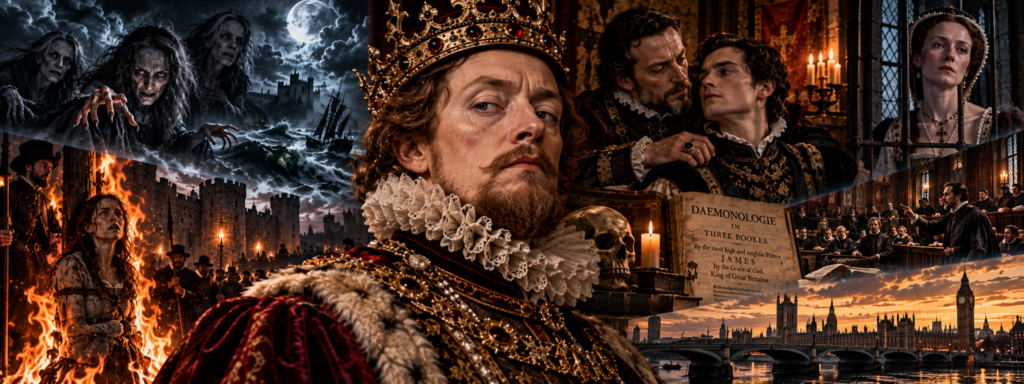
James VI and I: The Witch-Hunting King, His Dangerous Favorites, and the Dark Obsessions of Britain’s Wisest Fool
He was crowned King of Scotland before his first birthday, grew up surrounded by political violence, inherited the English throne from the woman who had ordered his mother’s execution, and became one of the most intellectually accomplished monarchs of his age. Yet James VI of Scotland and James I of England also believed that witches could conspire with the Devil to destroy kings, defended an exalted vision of royal authority, and presided over a court notorious for extravagant favorites, bitter rivalries, and scandal. His fascination with witchcraft helped shape the atmosphere surrounding Shakespeare’s Macbeth, while his disputes with Parliament exposed tensions that would become increasingly dangerous under his successors. To admirers, he was a learned ruler who brought peace between kingdoms and survived terrifying conspiracies. To hostile critics, he was an awkward, fearful, extravagant monarch whose intelligence rarely translated into good judgment. Behind both reputations stood a complicated man whose childhood had been shaped by assassination, captivity, rebellion, and the violent destruction of his family. Was James truly the eccentric and unstable ruler described by his enemies, or did the notorious Wisest Fool in Christendom possess a political intelligence that later generations have underestimated?
The King Who Feared Witches, Assassins, and the Limits of His Own Power
In the autumn of 1590, Scotland’s young king became personally involved in an extraordinary investigation. Men and women were being accused of using witchcraft to summon storms, threaten royal lives, and participate in a supernatural conspiracy against the monarchy. The allegations emerged in an atmosphere of fear surrounding the dangerous voyages undertaken by James VI and his Danish bride, Anne. What began as accusations involving supposed magical activity developed into one of the most notorious witchcraft investigations in Scottish history.
The North Berwick trials brought together beliefs about demons, accusations extracted through coercion, and the political anxieties of a king who regarded himself as divinely appointed. Suspects were interrogated, tortured, and pressured into describing gatherings where the Devil supposedly presided over conspiracies against James. The king became involved in examining allegations and questioning accused individuals. Some testimony appeared to provide details that convinced him supernatural forces had genuinely targeted his life.
To modern readers, the spectacle is disturbing. A highly educated monarch, familiar with theology, classical scholarship, and political philosophy, accepted claims that witches could influence weather and conspire with demonic powers. People accused of impossible crimes suffered imprisonment, torture, and execution. The investigation demonstrated how sincerely held supernatural beliefs could become deadly when supported by royal authority.
Yet James was not alone in believing witchcraft existed. Across early modern Europe, Catholic and Protestant authorities accepted the possibility of harmful magic and demonic intervention. Witchcraft prosecutions were shaped by legal traditions, religious teaching, local tensions, and popular fears. James’s involvement was unusually prominent, but his beliefs were not evidence of a uniquely irrational or clinically disturbed mind.
His reputation became more complicated after he inherited the English throne in 1603. James arrived with ambitious plans for closer union between England and Scotland, a strong conviction that monarchy possessed divine authority, and a preference for diplomacy over expensive continental warfare. He also brought habits and personal relationships that English courtiers found unfamiliar. His speech, physical mannerisms, hunting, and affectionate treatment of male favorites became subjects of gossip and ridicule.
Critics eventually portrayed him as a monarch whose intellectual accomplishments were undermined by foolish behavior. The expression the Wisest Fool in Christendom became attached to his reputation, although its precise origin and attribution are uncertain. It captures the contrast between James’s considerable learning and the judgments later writers made about his political conduct.
The darker story of his reign, however, cannot be understood through eccentricity alone. James had been raised in a kingdom where noble factions could seize the king’s person, assassinate his advisers, or threaten the monarchy itself. His mother had been forced from her throne, and his father had died violently before James could remember him. By adulthood, he had every reason to understand how quickly royal power could collapse.
His fascination with supernatural conspiracy, his insistence upon royal authority, and his reliance upon trusted companions developed within that dangerous political world. Whether those experiences produced particular psychological consequences cannot be established, but the historical circumstances help explain why security, obedience, and personal loyalty mattered so much to him.
The king who feared witches was also a ruler who had spent his entire life surrounded by human conspiracies.
Born Into Bloodshed: The Murder of Lord Darnley and the Fall of Mary, Queen of Scots
James was born at Edinburgh Castle on June 19, 1566, the only son of Mary, Queen of Scots, and her second husband, Henry Stuart, Lord Darnley. His birth should have strengthened the Scottish monarchy by providing a legitimate heir. Instead, he entered a royal household already divided by suspicion, factional rivalry, and violence.
Mary’s marriage to Darnley had deteriorated rapidly. Darnley possessed royal ancestry and political ambitions of his own, but his relationship with Mary became increasingly hostile. In March 1566, only months before James’s birth, conspirators murdered Mary’s Italian secretary David Rizzio inside the royal palace of Holyroodhouse. Darnley was implicated in the conspiracy, although his precise role and subsequent attempts to distance himself from the murder complicated the political aftermath.
The killing took place while Mary was pregnant. According to contemporary accounts, she was present when armed men seized Rizzio, who was then stabbed to death. The murder demonstrated the extraordinary insecurity of the Scottish court. Royal authority could be challenged not merely through parliamentary opposition or diplomatic maneuvering but through violence within the queen’s own household.
In February 1567, Darnley himself was murdered. An explosion destroyed the house at Kirk o’ Field in Edinburgh where he had been staying, but his body and that of a servant were discovered outside the building. The circumstances suggested that the explosion had not directly killed them. The precise sequence of events remains disputed, and historians continue examining the involvement of powerful Scottish nobles.
Suspicion quickly focused upon James Hepburn, Earl of Bothwell. Bothwell was tried and acquitted in proceedings widely criticized by opponents of the queen. Mary subsequently married him in May 1567, an extraordinary decision that intensified hostility among the Scottish nobility. Whether Mary had knowingly participated in Darnley’s murder remains one of the most contested questions of her life.
The marriage to Bothwell proved politically disastrous. A coalition of nobles rebelled against Mary, and she was forced to surrender after confrontation at Carberry Hill. She was imprisoned at Lochleven Castle and compelled to abdicate in July 1567.
Her infant son became James VI of Scotland.
He was barely thirteen months old.
The kingdom was now ruled in the name of a child whose father had been murdered and whose mother had been removed from power. James was crowned at Stirling on July 29, 1567, while regents governed on his behalf. His coronation was conducted within a Protestant political settlement, despite his mother’s Catholic identity.
Mary escaped captivity in 1568 and attempted to recover her authority, but her forces were defeated at the Battle of Langside. She fled into England, expecting assistance from her cousin Elizabeth I. Instead, she entered a captivity that would last almost nineteen years.
James would grow up without a personal relationship with either parent. His father was dead, and his mother remained a political prisoner in another kingdom. Her continuing claim to the Scottish throne created an enduring challenge to the government established in her son’s name.
The young king’s childhood was therefore inseparable from questions of legitimacy, rebellion, and the violent removal of monarchs. Before he could understand the meaning of sovereignty, he had inherited a crown from a mother who had been forced to surrender it.
A Child King Surrounded by Assassination and Betrayal
The regency governments that ruled Scotland during James’s childhood were repeatedly destabilized by factional conflict. His first regent, James Stewart, Earl of Moray, was assassinated in January 1570. Moray’s death was particularly significant because he had been one of the principal leaders of the Protestant government established after Mary’s deposition. His murder demonstrated that even the most powerful figures in the kingdom could be eliminated through political violence.
The next regent, Matthew Stewart, Earl of Lennox, was James’s paternal grandfather. He was killed in 1571 during an attack on Stirling associated with the continuing civil conflict between supporters of Mary and those governing for James. The death deprived the young king of another close family connection. It also reinforced the instability surrounding his minority.
John Erskine, Earl of Mar, succeeded Lennox but died in 1572. His death was not established as an assassination, although rumors circulated in the politically charged atmosphere of the time. James Douglas, Earl of Morton, subsequently became regent and exercised considerable authority. Morton eventually fell from power and was executed in 1581 in connection with allegations concerning his knowledge of Darnley’s murder.
These repeated changes of government created a world in which political survival depended upon shifting alliances. Noble families competed for control of the king’s household, access to patronage, and influence over policy. James himself became the central prize in these struggles. Whoever controlled the young monarch could claim authority to govern in his name.
His education, however, was unusually rigorous. The scholar George Buchanan became one of his principal tutors and subjected him to an intensive program of classical learning. James studied Latin, Greek, theology, rhetoric, and political philosophy. He developed intellectual interests that remained important throughout his life, eventually producing works on kingship, religion, and witchcraft.
Buchanan’s political ideas did not always align with those James would later defend. The tutor supported theories of monarchy that allowed resistance to tyrannical rulers under certain circumstances. James eventually became a prominent defender of hereditary royal authority and divine right. Their intellectual relationship illustrates the complexity of his education: he was exposed to arguments he would later reject.
In 1582, a group of Protestant nobles seized James during an event known as the Ruthven Raid. The king was held under their control for approximately ten months while they attempted to direct government policy. James was sixteen years old, and the episode demonstrated that his personal freedom could still be restricted by powerful subjects.
He eventually escaped their control in 1583 and began asserting greater independence. Yet the experience was another reminder that kingship did not guarantee security. The crown gave James enormous symbolic authority, but nobles with armed supporters could still control his movements.
These experiences help explain his later insistence that monarchy required obedience and respect. They do not prove that he developed a psychiatric condition or a pathological fear of betrayal. They do, however, reveal the political environment in which his ideas about sovereignty matured.
For James, the danger of rebellion was not an abstract subject discussed in books. It was part of his childhood.
The Mother He Never Knew: Mary, Queen of Scots, and the Execution That Changed Everything
Mary, Queen of Scots, remained a central figure in European politics throughout James’s youth. Although she had been removed from the Scottish throne, she continued to possess supporters who regarded her as the legitimate sovereign. Her Catholicism also made her an important figure for opponents of Elizabeth I’s Protestant government. Her hereditary claim to the English throne complicated relations between Scotland and England.
James’s position was delicate. He was Mary’s son, but his own kingship depended upon the political settlement established after her deposition. Openly supporting her restoration could threaten his authority in Scotland. At the same time, rejecting her completely risked damaging his reputation and alienating powerful interests.
His relationship with Elizabeth I was equally complicated. Elizabeth represented a potential source of financial and diplomatic support, and James possessed a strong claim to succeed her if she died without children. Preserving good relations with England therefore offered considerable advantages. Yet Elizabeth was also responsible for holding his mother captive.
The situation reached its crisis in 1586 when Mary became implicated in the Babington Plot, a conspiracy involving plans to assassinate Elizabeth and replace her with a Catholic monarch. English intelligence agents intercepted correspondence that was used as evidence against Mary. She was tried, condemned, and sentenced to death. The extent of her knowledge and involvement has remained the subject of historical debate, but the English government regarded the evidence as sufficient.
Mary was executed at Fotheringhay Castle on February 8, 1587. James was twenty years old. The execution of an anointed queen was a deeply controversial event, particularly because it involved a sovereign who had once ruled independently. James protested and expressed anger, but he did not launch a military campaign against England.
His restraint has attracted different interpretations. Some historians emphasize his concern for the English succession and his determination not to jeopardize relations with Elizabeth. Others point to the limitations of Scottish military power and the risks of confrontation. The evidence supports the conclusion that James pursued diplomatic protest rather than armed retaliation, but his private emotional response cannot be reconstructed confidently.
Later writers sometimes portray the execution as the defining psychological wound of James’s adult life. Such claims go beyond the evidence. He had been separated from Mary since infancy and had developed his political identity within the government that replaced her. Their relationship was shaped more by dynastic politics and correspondence than by personal familiarity.
Nevertheless, the execution reinforced a question that would dominate James’s political writing: could subjects or other rulers legitimately remove an anointed monarch?
James increasingly defended the principle that kings derived their authority from God. His mother’s fate provided a powerful example of the dangers he associated with challenges to hereditary sovereignty. His later writings would reject the idea that subjects possessed an unrestricted right to depose their rulers.
The king who had inherited a throne through his mother’s forced abdication became one of Europe’s most prominent defenders of royal authority.
Anne of Denmark: The Marriage That Led James Into the World of Witchcraft
In 1589, James married Anne of Denmark, daughter of Frederick II of Denmark and Norway. The marriage offered diplomatic advantages and connected Scotland to an important Protestant royal dynasty. Anne was considerably younger than James, but their union initially appeared promising. It also brought James into direct contact with the maritime dangers of northern Europe.
Anne’s voyage to Scotland was disrupted by severe storms and unfavorable weather. Her ships were forced to seek refuge in Norway, delaying her arrival. James eventually decided to travel personally to Scandinavia to meet his bride, an unusual undertaking for a reigning Scottish monarch. He sailed from Scotland in October 1589 and married Anne in Oslo in November.
The couple spent time in Denmark before returning to Scotland in 1590. Their experiences became associated with extraordinary weather and maritime danger. In the political and religious culture of the period, storms could be interpreted through supernatural explanations as well as natural observation. Accusations soon emerged that witches had attempted to interfere with the royal voyages.
It is important to distinguish the storms themselves from the later witchcraft allegations. The dangerous weather was real, and the voyages were disrupted. The claim that witches had caused the storms through demonic magic was an accusation arising within contemporary beliefs about witchcraft. No evidence establishes supernatural intervention.
James became increasingly interested in the possibility that witches had conspired against him. Investigations in Scotland developed alongside accusations originating in Denmark, where witchcraft prosecutions were also occurring. The connection between royal travel, storms, and alleged magical conspiracy created an atmosphere in which extraordinary testimony could appear politically significant.
Anne’s role in James’s life extended far beyond the witchcraft controversy. She became queen consort of Scotland and later England, maintained her own household, and developed interests in court culture and patronage. Their marriage produced several children, including Henry Frederick, Prince of Wales; Elizabeth, later Queen of Bohemia; and Charles, the future Charles I.
The marriage also experienced tensions. Disagreements arose over the upbringing and custody of Prince Henry, who was placed under the care of the Earl of Mar according to Scottish royal custom. Anne sought greater control over her son, while James resisted changes to the arrangement. The conflict became a significant source of strain.
Later accounts sometimes exaggerate the breakdown of their relationship or interpret James’s affection for male favorites as proof that his marriage was entirely loveless. The surviving evidence supports a more complicated picture. James and Anne experienced periods of affection, separation, disagreement, and changing political priorities.
Their marriage helped secure the succession, but it also became connected to one of the darkest episodes of James’s Scottish reign.
The North Berwick Witch Trials: Torture, Confessions, and a Royal Conspiracy
The North Berwick witch trials began in 1590 and developed into a series of investigations involving accusations of harmful magic and demonic conspiracy. The trials took their name from the coastal town of North Berwick, although the investigations extended beyond a single locality. Suspects were accused of participating in gatherings, invoking the Devil, and attempting to harm the king through supernatural means. The alleged conspiracy became especially alarming because it supposedly targeted the royal family.
One of the central figures was Agnes Sampson, a woman described in contemporary accounts as a healer or midwife. She was arrested and interrogated about alleged witchcraft activities. Reports describe severe torture and coercion during the investigation. Such methods undermine the reliability of the confessions obtained.
According to contemporary accounts, Sampson was subjected to humiliating searches and physical torment. Her interrogators sought evidence of supposed witch marks and demanded descriptions of meetings with the Devil. Under pressure, she confessed to participation in supernatural activities. The testimony included claims about storms and conspiracies against James.
A famous story alleges that Sampson revealed private details of conversations between James and Anne, convincing the king that she possessed supernatural knowledge. The account circulated in early narratives of the trials and became central to later retellings. Its precise circumstances are uncertain, and the possibility of ordinary information gathering, leading questions, or embellishment cannot be excluded.
Another important figure was John Fian, a schoolmaster accused of witchcraft. Contemporary pamphlets described his interrogation and torture in graphic detail. He was subjected to severe punishment, including methods intended to force confession. Accounts of his alleged supernatural activities were published in a sensational narrative titled Newes from Scotland in 1591.
The pamphlet presented the trials as evidence of a conspiracy involving witches and the Devil. It described supposed gatherings in which participants plotted against James and attempted to summon storms. The narrative was designed to impress readers with the danger of witchcraft and the king’s role in exposing it. It is an important source for contemporary beliefs, but it cannot be treated as a neutral record of events.
The trials involved numerous accused individuals, although precise totals vary depending upon which investigations are included. Claims that James personally supervised the torture of more than seventy suspects oversimplify a complex series of prosecutions. He participated in aspects of the investigation and took a strong interest in the allegations, but not every interrogation or punishment can be attributed directly to his personal supervision.
Several accused individuals were executed. Their deaths reflected the deadly consequences of witchcraft accusations within a legal system that accepted supernatural crimes as possible. Torture, coercion, rumor, and religious fear contributed to convictions that modern historical analysis cannot regard as proof of actual witchcraft.
The North Berwick trials became one of the most notorious episodes of Scottish witch-hunting. They demonstrated how royal involvement could intensify accusations and lend authority to extraordinary claims. James’s belief that witches had threatened his life helped transform local investigations into a matter of national significance.
The king who feared assassination had become convinced that enemies might attack him through forces no ordinary guard could stop.
Daemonologie: The King Who Wrote About Demons
In 1597, James published Daemonologie, a treatise examining witchcraft, demons, and the supposed activities of supernatural forces. Written in dialogue form, the work presented arguments supporting the reality of witchcraft and the need to prosecute those accused of practicing it. James drew upon biblical passages, theological reasoning, and contemporary demonological literature. The book reflected his intellectual interests as well as his experiences during the North Berwick investigations.
The publication was unusual because it came from a reigning monarch. European scholars and theologians had written extensively about witchcraft, but James’s royal authorship gave the subject particular prominence. He approached demonology as a serious intellectual and religious question. His arguments were intended to persuade readers that disbelief in witchcraft could be dangerous.
James distinguished between different forms of alleged supernatural activity and discussed the relationship between witches and demons. He argued that the Devil could deceive human beings and that witches might enter into harmful agreements with demonic powers. These claims reflected the theological assumptions of his period. They were not supported by evidence of actual supernatural events.
The book also revealed James’s concern about skepticism. Some writers had questioned the reliability of witchcraft accusations or challenged particular claims about demonic activity. James rejected excessive doubt and defended the possibility of supernatural wrongdoing. His position contributed to the broader intellectual debate over witchcraft in early modern Europe.
Nevertheless, his views were not entirely static. During later years, James sometimes expressed skepticism toward particular accusations and became involved in exposing fraudulent claims. His conduct in individual cases demonstrated that he did not automatically accept every allegation of witchcraft. This development complicates the image of a monarch permanently consumed by uncontrolled supernatural fear.
The relationship between Daemonologie and witchcraft prosecutions must also be understood carefully. The book reflected and reinforced beliefs already widespread in parts of Europe. It did not create witch-hunting or single-handedly determine the course of prosecutions. Local courts, ministers, magistrates, and community tensions played essential roles.
James’s authorship nevertheless mattered. A king who publicly defended the reality of witchcraft could influence the atmosphere in which accusations were evaluated. His intellectual authority gave additional legitimacy to beliefs that could have fatal consequences for vulnerable individuals.
The treatise also became part of his later cultural legacy. Its discussion of demons, witches, and supernatural deception resonated with the theatrical world of early Stuart England. Most famously, it helped create a context in which Shakespeare’s Macbeth could appeal to the interests and political concerns of James’s court.
Shakespeare’s Macbeth: How a Witch-Hunting King Inspired a Tragedy
William Shakespeare’s Macbeth, generally dated to around 1606, emerged during the early years of James’s English reign. The play presents a Scottish nobleman whose encounter with three witches encourages ambitions that lead to regicide, tyranny, and destruction. Its themes of prophecy, supernatural temptation, and the murder of a king would have resonated strongly in the political atmosphere of James’s court. The connection between the play and James’s interests has long attracted scholarly attention.
James’s fascination with witchcraft provided one important context. His Daemonologie had discussed demonic deception and the dangers of supernatural influence. Macbeth similarly portrays witches whose predictions manipulate human ambition. The play does not simply reproduce James’s treatise, but it participates in a culture where witchcraft was regarded as a serious religious and political concern.
The Scottish setting was also significant. James traced his ancestry through the Scottish royal line, and Shakespeare drew upon historical material concerning Macbeth and King Duncan. The playwright used Raphael Holinshed’s chronicles and other sources, adapting them for dramatic purposes. The resulting tragedy transformed medieval Scottish history into a story about illegitimate power and moral destruction.
The character of Banquo held particular importance. Early Stuart genealogical traditions connected James to Banquo through the Scottish royal ancestry. Shakespeare portrayed Banquo more favorably than some earlier historical narratives, presenting him as a figure whose descendants would inherit kingship. The play’s prophecy concerning Banquo’s line could therefore be understood as flattering the reigning monarch.
The theme of regicide carried additional significance after the Gunpowder Plot of 1605. The attempted destruction of the king and Parliament had intensified public concern about treason. Macbeth explores the consequences of murdering a rightful sovereign and depicts political disorder following the crime. Its dramatic world reflects anxieties that were especially powerful in early Stuart England.
Yet it would be misleading to describe Macbeth as a straightforward work of royal propaganda. Shakespeare’s tragedy examines ambition, guilt, moral responsibility, and the instability of political authority in ways that exceed simple praise of James. The witches are central to the drama, but Macbeth’s own decisions drive the tragedy. The play remains open to interpretations that complicate its relationship with royal ideology.
The exact circumstances of its composition and first performances are not fully documented. Scholars generally regard the early Jacobean context as important, but individual scenes cannot always be tied to specific statements or wishes of James. The connection between the king’s interests and the play is persuasive as historical context rather than proof of direct royal instruction.
James’s influence upon the theatrical imagination therefore operated through culture, patronage, and political atmosphere. His court provided an audience interested in questions of monarchy, succession, and supernatural danger. Shakespeare transformed those concerns into a tragedy that would outlive the king’s own writings.
The monarch who had once questioned suspected witches in Scotland became associated with one of literature’s most famous portrayals of witchcraft and royal murder.
The English Crown: James Inherits Elizabeth I’s Kingdom
Elizabeth I died on March 24, 1603, without children. James VI of Scotland succeeded her as James I of England, becoming the first monarch to rule both kingdoms under a single crown. His accession ended the Tudor dynasty and began the Stuart monarchy in England. The transition was remarkably peaceful considering the succession anxieties that had troubled Elizabeth’s reign.
James possessed a strong hereditary claim through Margaret Tudor, daughter of Henry VII. His Protestantism also made him acceptable to influential English political figures who opposed a Catholic successor. Robert Cecil and other officials helped manage the transition, ensuring that James’s accession received broad recognition. The new king traveled south from Scotland to take possession of his English inheritance.
The scale of his new responsibilities was enormous. England was wealthier and more populous than Scotland, with a different political culture and more extensive institutions of government. James had spent decades navigating Scottish noble factions, but English politics required new relationships with Parliament, established courtiers, and powerful regional interests. His arrival generated both optimism and uncertainty.
James hoped to create a closer political union between England and Scotland. He adopted the title King of Great Britain in his royal style, although the kingdoms remained legally distinct. His proposals for fuller union encountered resistance, particularly from English parliamentarians concerned about law, nationality, and political privilege. The project demonstrated his ambition to reshape the relationship between his two kingdoms.
The new king also sought peace with Spain. The long conflict inherited from Elizabeth’s reign had imposed substantial financial burdens. James negotiated the Treaty of London in 1604, ending the Anglo-Spanish war. His preference for diplomacy reflected both financial considerations and a genuine interest in avoiding unnecessary conflict.
Religious expectations were more difficult to satisfy. English Catholics initially hoped James might ease restrictions, while Puritans sought further Protestant reform. The king attempted to maintain the established church while addressing selected concerns. His religious policies disappointed groups that had expected more extensive changes.
James’s accession therefore created a mixture of continuity and change. He inherited Elizabeth’s institutions but brought his own ideas about monarchy, religion, and government. His intellectual confidence and strong views about royal authority would soon produce conflict with Parliament.
The Scottish king who had survived decades of factional politics now faced a different kind of struggle: governing a kingdom whose representatives expected to participate in decisions about taxation, law, and the limits of royal power.
The Divine Right of Kings: James’s Vision of Sacred Monarchy
James developed a political philosophy that emphasized the divine origin of royal authority. His treatise The True Law of Free Monarchies, published in 1598, defended hereditary kingship and argued that monarchs possessed authority derived from God. The work reflected his experiences in Scotland, where noble factions had repeatedly challenged royal government. It also responded to political theories that justified resistance to rulers.
James described kings as God’s representatives on earth and emphasized the duty of subjects to obey lawful authority. He rejected the idea that ordinary subjects could freely depose monarchs whose conduct they disliked. His arguments were intended to protect monarchy from rebellion and political instability. They also reinforced his understanding of sovereignty as a sacred responsibility.
However, describing James as believing that kings were completely above all human law oversimplifies his position. He distinguished between the moral duties of a good king and the question of whether subjects possessed a right to punish him. James maintained that rulers should govern justly and respect the laws of their kingdoms, even while insisting that their authority came from God. The tension lay in how such obligations could be enforced.
His later writings, including Basilikon Doron, presented advice on kingship and royal conduct. The work emphasized religious duty, education, moral behavior, and the responsibilities of government. James regarded monarchy as demanding considerable intellectual and ethical discipline. His conception of divine right therefore involved obligations as well as privileges.
Nevertheless, his political language could appear threatening to parliamentarians who defended traditional rights and privileges. English political culture included longstanding expectations concerning taxation, legislation, and the role of Parliament. James’s statements about royal authority sometimes seemed to challenge those expectations. Disagreements emerged over whether particular powers belonged exclusively to the crown.
The king’s approach was shaped by his conviction that monarchy represented an institution established by divine providence. Parliament, however, possessed its own historical claims and institutional traditions. Conflicts arose when these competing understandings of authority intersected with practical questions of finance and government. Neither side operated according to a fully modern theory of constitutional monarchy.
James’s writings became influential beyond his lifetime. His son Charles I adopted strong views about royal authority and eventually entered into a catastrophic conflict with Parliament. Yet it would be historically misleading to treat James’s political philosophy as the sole cause of the English Civil War. The crisis of the 1640s developed through multiple religious, financial, military, and constitutional disputes.
James’s divine-right theory was therefore both an expression of his personal convictions and part of a wider European debate about sovereignty. It did not demonstrate delusional thinking. It represented a political and theological position that could be defended through contemporary intellectual traditions, even when opponents rejected its implications.
The danger emerged when competing institutions claimed authority that neither was willing to surrender.
Parliament Against the Crown: Money, Privilege, and Royal Authority
James’s relationship with the English Parliament became increasingly difficult because of disputes over finance, taxation, and constitutional privilege. The monarchy required substantial revenue to maintain government, support the royal household, and conduct foreign policy. Yet the crown’s ordinary income was insufficient to meet its expanding obligations. James’s expenditure intensified the problem.
His first English Parliament assembled in 1604. Disagreements quickly emerged over disputed elections, parliamentary privilege, and the proposed union of England and Scotland. Members defended their right to determine questions concerning their own proceedings. James asserted the importance of royal authority and sometimes reacted sharply to challenges.
The financial relationship between crown and Parliament was particularly contentious. Parliament controlled important forms of taxation, while the king possessed other sources of revenue. James sought ways to increase income without becoming entirely dependent upon parliamentary grants. These efforts generated disputes about the legality and extent of royal fiscal powers.
One controversy concerned impositions, customs duties levied by royal authority. The decision in Bates’s Case in 1606 supported the crown’s power to impose certain duties on imports. Parliamentarians nevertheless challenged the broader implications of such revenue measures. The dispute reflected competing understandings of royal prerogative and parliamentary consent.
The Great Contract of 1610 represented an ambitious attempt to resolve financial tensions. Robert Cecil proposed that Parliament provide a substantial annual income in exchange for the surrender of certain feudal revenues and royal rights. Negotiations ultimately failed because neither side could agree upon acceptable terms. The collapse left the underlying financial problems unresolved.
James’s spending attracted criticism, particularly his generosity toward favorites and courtiers. Royal gifts, pensions, and patronage formed part of the political culture of monarchy, but their scale could become controversial. Parliamentarians complained that public resources were being distributed excessively. The king defended his authority to reward service and maintain royal magnificence.
The Addled Parliament of 1614 proved especially unsuccessful. It met for only a short period and failed to pass legislation or grant subsidies. The breakdown reflected deepening distrust between crown and Commons. James subsequently governed without summoning another Parliament until 1621.
The Parliament of 1621 brought renewed conflict over foreign policy, religion, and parliamentary privilege. Members debated the possibility of war with Spain and expressed concerns about Catholic influence. James objected to parliamentary discussion of matters he regarded as belonging to royal prerogative. The Commons responded by asserting its privileges, leading to another confrontation.
James dissolved Parliament in 1622. The disputes demonstrated that his intellectual defense of monarchy could not eliminate the practical importance of parliamentary cooperation. Financial needs repeatedly forced the crown to negotiate with an institution whose members defended their own rights.
The conflicts were serious, but they did not produce civil war during James’s lifetime. He retained considerable political flexibility and sometimes compromised when circumstances required it. His reign exposed tensions that would intensify under Charles I, but the later catastrophe was not inevitable.
The Gunpowder Plot: The Night Parliament Nearly Exploded
On November 5, 1605, English authorities uncovered a conspiracy to destroy the king and Parliament through an explosion beneath the House of Lords. The Gunpowder Plot became one of the most famous assassination attempts in British history. Its discovery intensified anti-Catholic sentiment and reinforced fears of religiously motivated rebellion. For James, the plot represented a direct threat to his life and the continuity of the monarchy.
The conspiracy involved a group of English Catholics dissatisfied with the government’s religious policies. Robert Catesby emerged as the principal organizer, while Guy Fawkes became the most famous participant because he was discovered guarding the explosives. The conspirators intended to kill James, members of the royal family, and leading political figures during the opening of Parliament. They hoped the destruction would create an opportunity to replace the government with one more favorable to Catholic interests.
The plotters obtained access to a cellar beneath the House of Lords and stored barrels of gunpowder there. Their preparations remained concealed for months. The conspiracy was exposed after an anonymous warning letter reached Lord Monteagle, prompting investigation. Authorities searched the parliamentary buildings and discovered Fawkes with the explosives.
Fawkes was arrested and interrogated. Under royal authorization, torture was used to obtain information about the conspiracy. His statements and the subsequent investigation led authorities to identify other participants. Several conspirators died while resisting arrest, while others were captured and prosecuted.
The surviving plotters were executed in 1606. Their punishments were severe, reflecting the government’s view that the conspiracy represented an extraordinary act of treason. The discovery of the plot became a major event in English Protestant memory. Annual commemorations developed around the survival of the king and Parliament.
The Gunpowder Plot provided James with powerful evidence that threats to his life were real. It also strengthened the government’s justification for surveillance and religious restrictions. Yet the conspiracy involved a particular group of plotters and did not demonstrate that English Catholics generally supported assassination. Many Catholics remained loyal to the crown despite opposition to the religious settlement.
James initially distinguished between the conspirators and Catholics as a whole in some public statements. Nevertheless, the political aftermath contributed to stricter enforcement and renewed suspicion. The government faced the challenge of responding to a genuine assassination attempt without treating every religious dissenter as a conspirator.
The plot’s significance extended beyond immediate security. It reinforced James’s conviction that monarchy required protection against rebellion and religious extremism. It also shaped the political culture inherited by his successors. The memory of 1605 remained influential for generations.
The king who had once feared witches summoning storms had now survived an entirely human conspiracy involving enough gunpowder to devastate the political leadership of his kingdom.
The King’s Favorites: Robert Carr, George Villiers, and the Scandals of the Stuart Court
James’s relationships with favored male courtiers became among the most controversial features of his reign. Royal favorites were common in European monarchies, where personal access to the sovereign could produce enormous political influence. James, however, displayed unusually demonstrative affection toward certain companions, attracting gossip and criticism. His generosity also created resentment among nobles who felt excluded from patronage.
Robert Carr, later Earl of Somerset, became an important favorite during the early years of James’s English reign. Carr’s rise was rapid, and he received titles, wealth, and access to the king. His influence alarmed established courtiers who feared the concentration of power around an individual whose position depended upon royal affection. Court factions developed around competing interests.
The scandal surrounding Carr intensified after the death of Sir Thomas Overbury in 1613. Overbury had opposed Carr’s marriage to Frances Howard, who was seeking an annulment from her first husband. Overbury was imprisoned in the Tower of London and died there. Subsequent investigations revealed that he had been poisoned.
Frances Howard and several accomplices were convicted in connection with the murder. Carr was also convicted, although his precise responsibility has remained a subject of historical debate. James commuted the death sentences of Carr and Frances, and they were eventually released from imprisonment. The scandal severely damaged Carr’s political position and contributed to public criticism of court corruption.
George Villiers subsequently rose to prominence. He became one of James’s closest companions and eventually received the title Duke of Buckingham. Villiers’s advancement was extraordinary, and his influence extended into political appointments, patronage, and foreign policy. His position provoked resentment among established courtiers and parliamentarians.
James’s letters and reported behavior reveal considerable emotional intimacy with Buckingham. The king used affectionate language and demonstrated a degree of personal attachment that contemporaries noticed. Historians have debated whether their relationship included sexual intimacy. The surviving evidence supports the existence of a close and emotionally expressive relationship, but its precise sexual nature cannot be established conclusively.
It is important not to treat affection between men as evidence of mental illness or political incapacity. Early modern expressions of friendship and intimacy differed from modern conventions, and royal relationships could combine personal attachment with political dependence. The historical questions concern the distribution of influence, patronage, and authority rather than the assumption that same-sex affection was inherently pathological.
Buckingham’s influence became increasingly controversial during the final years of James’s reign. His role in foreign policy, particularly the failed Spanish marriage negotiations involving Prince Charles, contributed to political tensions. Critics accused him of excessive ambition and favoritism. His prominence continued after James’s death, when he became a central figure in Charles I’s government.
The court scandals of James’s reign reveal the dangers of a political system organized around personal access to the monarch. Favorites could rise rapidly, acquire extraordinary wealth, and provoke factional conflict. James’s generosity and affection contributed to these tensions, but they were also features of a broader culture of royal patronage.
The king’s private relationships became public political controversies because proximity to the sovereign carried enormous consequences.
The King’s Body: Speech, Movement, and the Hostile Portraits of His Enemies
James’s physical appearance and mannerisms became subjects of ridicule, particularly in accounts written by hostile observers. Sir Anthony Weldon, whose writings appeared after James’s death, produced an especially unflattering portrait. He described the king’s speech, posture, clothing, and personal habits in terms designed to undermine his dignity. Such descriptions became influential in later popular histories.
Weldon’s account portrayed James as physically awkward and lacking royal composure. He described difficulties with speech and movement, as well as unusual clothing and personal habits. The narrative encouraged readers to regard the king as ridiculous despite his intellectual accomplishments. Yet Weldon’s hostility and the circumstances of publication require caution.
Some physical characteristics may have been genuine. Contemporary observers reported that James possessed an unusual manner of speaking and sometimes appeared physically ungainly. His preference for hunting and outdoor activity, however, complicates claims that he was consistently incapable of movement. The evidence does not support a precise modern medical diagnosis.
Various retrospective theories have proposed neurological or developmental conditions to explain his reported mannerisms. Suggestions have included cerebral palsy, porphyria, and conditions associated with autism. Such diagnoses are speculative because they rely upon incomplete descriptions, often written by critics. There is insufficient evidence to establish any of them.
Claims about an oversized tongue, constant drooling, or an inability to walk normally should therefore be treated cautiously. They derive largely from accounts that may exaggerate physical traits for political effect. Early modern writers frequently used bodily descriptions to communicate moral judgments. A monarch portrayed as physically grotesque could also be presented as politically defective.
James’s clothing attracted particular attention. Some accounts describe heavily padded garments and a fear of weapons. Such details have been interpreted as evidence of extreme anxiety or a pathological fear of assassination. Yet the use of protective clothing would not be inherently irrational for a ruler who had experienced political violence and survived serious threats.
His personal hygiene also became the subject of hostile anecdotes. Claims that he rarely washed or maintained unpleasant habits reflect contemporary standards of ridicule as much as reliable observation. Bathing practices varied widely in early modern Europe, and isolated descriptions cannot establish a medical or psychological condition.
The most important historical distinction is between physical difference and mental incapacity. James’s intellectual achievements are well documented. He wrote extensively, engaged in theological debate, and participated actively in government. Unusual speech or movement, even if accurately described, would not establish psychiatric illness.
The grotesque image of James became part of a broader political tradition in which critics used the monarch’s body to symbolize perceived failures of government. His reputation was shaped not only by what he did, but also by how opponents chose to describe him.
The King James Bible: Scholarship, Religion, and an Enduring Cultural Legacy
One of the most significant achievements associated with James’s reign was the publication of the King James Bible in 1611. The translation emerged from discussions at the Hampton Court Conference of 1604, where James considered proposals concerning the English church. Although he did not personally translate the Bible, he authorized and supported the project. The resulting work became one of the most influential English-language texts in history.
The translation was produced by teams of scholars working from Hebrew, Greek, and earlier English biblical texts. They sought to create a version suitable for public worship and acceptable within the established church. The project reflected both religious and political concerns. A widely accepted translation could strengthen religious unity and reinforce the authority of the English church.
James’s involvement demonstrated his intellectual interest in theology and religious controversy. He had received an extensive education and regarded religious scholarship as an important royal responsibility. His support for the translation contrasted with later caricatures of him as incapable of serious thought. The project required coordination, scholarly expertise, and institutional support.
The King James Bible did not immediately replace every earlier translation. Its influence developed over time through church use, printing, and literary reception. Eventually, it became central to English-speaking Protestant culture. Its language shaped literature, preaching, and religious expression for centuries.
The translation also reflected the limitations of James’s religious settlement. He hoped to maintain a unified national church, but divisions persisted among Puritans, conformists, Catholics, and other groups. The Bible project did not resolve disputes over church government or religious practice. Nevertheless, it became a lasting cultural achievement of his reign.
James’s support for scholarship extended beyond biblical translation. He wrote poetry, political treatises, and theological works. His intellectual interests were broad, ranging from kingship and religion to demonology. The combination of serious scholarship and belief in witchcraft may appear contradictory to modern readers, but it reflected the intellectual world of early modern Europe.
His reputation as the Wisest Fool therefore captures only part of the historical reality. James possessed substantial learning and could engage with complex political and theological questions. His weaknesses in finance, patronage, and relations with Parliament did not erase those abilities.
The king who wrote about demons also helped sponsor a translation that became one of the defining works of English religious and literary history.
The Final Years: Buckingham, Parliament, and the Approach of a New Crisis
During the final years of James’s reign, political tensions intensified around foreign policy, finance, and the influence of George Villiers, Duke of Buckingham. The king continued seeking diplomatic solutions to European conflicts, particularly through marriage negotiations involving his son Charles and the Spanish royal family. These negotiations became increasingly controversial because many English Protestants feared closer ties with Catholic Spain. Parliamentarians pressed for a more confrontational policy.
The proposed Spanish marriage occupied considerable diplomatic attention. James hoped that a marriage alliance might improve relations with Spain and assist in resolving disputes involving the Palatinate, where his daughter Elizabeth and her husband Frederick V had suffered political and military losses. The wider conflict formed part of the early Thirty Years’ War. James preferred negotiation, although his efforts produced limited results.
In 1623, Prince Charles and Buckingham traveled secretly to Spain in an attempt to advance the marriage negotiations. The mission failed, and both returned to England disappointed. Buckingham subsequently became associated with a more aggressive anti-Spanish policy. His influence contributed to the changing direction of government during James’s final years.
Parliament met again in 1624 and supported measures directed against Spain. The political atmosphere had shifted considerably from the earlier years of James’s reign. Financial demands remained substantial, and disagreements persisted over the extent of parliamentary involvement in foreign policy. The king’s health was also declining.
James experienced recurring illness during his later years, including attacks of gout and other physical complaints. His condition deteriorated in 1625. Contemporary accounts describe fever and weakness, but the precise medical cause of death remains uncertain. Later speculation about poisoning or deliberate medical mistreatment lacks convincing evidence.
James died at Theobalds House on March 27, 1625, aged fifty-eight. He had ruled Scotland for nearly fifty-eight years and England for twenty-two. His son succeeded him as Charles I. The transition preserved the Stuart dynasty, but many of the political disputes that had troubled James remained unresolved.
Charles inherited tensions concerning taxation, religion, foreign policy, and royal authority. His government would eventually enter into conflicts with Parliament that culminated in civil war and his execution in 1649. James’s political writings and practices formed part of the background to those events, but the later catastrophe resulted from developments extending beyond his reign.
James’s death marked the end of a remarkable political career. He had survived childhood factionalism, his mother’s execution, witchcraft scares, assassination plots, and disputes with Parliament. He had also established the Stuart monarchy in England and promoted cultural achievements that endured long after his death.
His legacy remained divided between admiration for his learning and criticism of his government.
Was James VI and I Really Mad?
James VI and I was not documented as suffering from a severe psychiatric disorder. His belief in witchcraft, strong defense of royal authority, physical mannerisms, and relationships with favorites do not establish clinical insanity. The historical record instead reveals a learned monarch whose ideas and conduct were shaped by the religious, political, and intellectual assumptions of his age. Some of those beliefs had harmful consequences, but they cannot be converted into psychiatric diagnoses.
His fascination with witchcraft was particularly significant because it contributed to prosecutions involving torture and execution. James accepted the possibility that witches could conspire with demonic forces and threaten royal lives. These beliefs were shared by many contemporaries, although skeptics also existed. His participation in the North Berwick investigations demonstrates the dangers of supernatural accusations supported by state authority.
The king’s childhood experiences provide important political context. His father was murdered, his mother was forced from the throne, regents were killed, and noble factions repeatedly attempted to control him. These events exposed him to genuine threats and helped shape his understanding of royal security. Yet the surviving evidence does not permit a clinical assessment of trauma or anxiety.
His political philosophy also requires careful interpretation. James defended divine-right monarchy and rejected broad claims that subjects could depose their rulers. These arguments were controversial, but they belonged to recognizable traditions of early modern political thought. They were not evidence of delusional grandiosity.
The hostile descriptions of his body and habits are especially unreliable as medical evidence. Writers such as Anthony Weldon sought to ridicule the king and diminish his reputation. Their accounts may preserve genuine observations, but they also reflect political hostility and literary exaggeration. Retrospective diagnoses based upon such material remain speculative.
James’s relationships with male favorites have similarly been subjected to moralizing interpretations. His affection for Robert Carr and George Villiers became politically controversial because of the wealth and influence they received. The nature of his personal intimacy remains debated, but it provides no basis for diagnosing mental illness. The relevant political issue concerns patronage and the concentration of influence.
The most persuasive historical portrait is therefore neither that of a mad tyrant nor that of a misunderstood genius. James was an intellectually accomplished ruler with strong convictions, personal vulnerabilities, and significant political limitations. His government achieved peace with Spain, sponsored the King James Bible, and maintained the union of crowns. It also experienced financial disputes, court scandals, and conflicts over royal authority.
His reputation as the Wisest Fool in Christendom reflects the difficulty of reconciling those contrasting features. The phrase captures a historical judgment rather than a medical conclusion. James’s life demonstrates that intellectual ability, eccentric behavior, political miscalculation, and sincere religious belief can coexist without establishing psychiatric illness.
The Legacy of James VI and I: The King Who United Crowns but Could Not Escape His Fears
James VI and I occupies a distinctive position in British history because his reign connected two kingdoms and two political traditions. He inherited the Scottish crown as an infant after his mother’s forced abdication and became King of England following Elizabeth I’s death. His accession united the crowns of England and Scotland under one monarch, although the kingdoms retained separate institutions. The achievement reshaped the political future of the British Isles.
His childhood was marked by extraordinary instability. His father was murdered, his mother was imprisoned and eventually executed, and several regents died amid factional conflict. Noble conspiracies repeatedly threatened his freedom and authority. These experiences provided a political background for his later insistence upon obedience and the sacred nature of monarchy.
His fascination with witchcraft remains one of the darkest aspects of his reign. The North Berwick trials exposed accused individuals to torture and execution, while Daemonologie gave royal authority to beliefs about demonic conspiracy. James’s involvement demonstrated how intellectual conviction could contribute to persecution. The victims of witchcraft prosecutions suffered consequences far more serious than the ridicule later directed at the king’s eccentricities.
His cultural influence was also substantial. The King James Bible became one of the most important works in the English language, while the political and supernatural concerns of his court helped shape the atmosphere surrounding Shakespeare’s Macbeth. James’s writings contributed to debates about monarchy, religion, and sovereignty. His intellectual interests were broad and deeply connected to the concerns of his age.
The disputes with Parliament revealed tensions that would become increasingly dangerous under Charles I. James defended royal authority while Parliament asserted its privileges and financial powers. The disagreements did not produce civil war during his lifetime, but they exposed unresolved constitutional questions. His son’s later fate would give those debates tragic significance.
James’s personal relationships and court patronage added another layer to his reputation. His favorites acquired wealth and influence, provoking resentment and scandal. Hostile observers exaggerated his physical mannerisms and portrayed him as ridiculous. These accounts helped establish the image of a monarch whose learning was undermined by foolishness.
Yet James survived political dangers that destroyed many of his contemporaries. He maintained his Scottish throne through decades of factional conflict, secured the English succession peacefully, and avoided major war with Spain for much of his English reign. His preference for diplomacy and negotiation reflected identifiable political priorities. His government was imperfect, but it was not the product of a ruler demonstrably incapable of rational thought.
James VI and I began life as a royal infant surrounded by murder, rebellion, and the destruction of his parents’ marriage. He grew into a scholar-king who wrote about demons, defended the divine authority of monarchy, and feared conspiracies both human and supernatural. His reign produced witch trials, court scandals, bitter parliamentary disputes, and cultural achievements that endured for centuries. There is no reliable evidence that he was clinically mad, but his life reveals how fear, conviction, and authority could combine in unsettling ways. James understood the dangers of rebellion because he had experienced them, yet his determination to protect monarchy sometimes encouraged beliefs and policies that inflicted suffering upon others. He united the crowns of England and Scotland, but he could not resolve every conflict between sovereign power and political obedience. His son would inherit those tensions and eventually lose his head upon a scaffold. The Wisest Fool in Christendom remains a compelling contradiction: a learned monarch who feared witches, a defender of sacred kingship whose dynasty would confront revolution, and a ruler whose greatest intellectual gifts existed alongside some of the darkest assumptions of his age.