
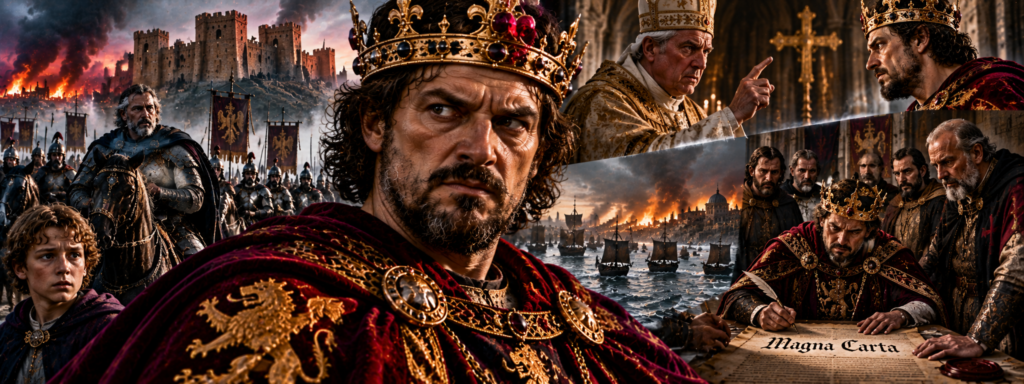
King John: England’s Most Hated King, the Murder of a Prince, and a Reign of Betrayal
He betrayed his father, conspired against his brother, imprisoned his enemies, defied the pope, and drove England’s most powerful nobles into open rebellion. King John inherited one of the greatest collections of territories ever ruled by an English monarch, yet within five years he had lost Normandy and much of his family’s continental inheritance. His enemies accused him of cruelty, treachery, sexual misconduct, and even the murder of his own nephew, a young prince whose disappearance became one of medieval England’s darkest royal mysteries. When John attempted to recover his lost lands, he squeezed his subjects for money through increasingly aggressive taxation, enormous fines, confiscations, and the manipulation of royal justice. His conflict with the Church brought England under a papal interdict, while his treatment of rebellious nobles helped turn political resentment into civil war. By 1215, the king had been forced to accept Magna Carta, only to repudiate the settlement almost immediately. He died the following year with his kingdom divided, foreign troops occupying parts of England, and his dynasty fighting for survival.
A King Dies While His Kingdom Falls Apart
In October 1216, King John of England was dying in the middle of a civil war. His enemies controlled London, rebellious barons had invited a French prince to claim his throne, and royal authority had collapsed across substantial parts of the kingdom. The king who had spent seventeen years defending his privileges now struggled to hold together the inheritance he intended to leave his nine-year-old son. His final weeks were marked by military retreat, illness, and the knowledge that much of England had turned against him.
John’s last campaign had carried him across eastern England, where he attempted to disrupt rebel communications and preserve the remaining centers of royal support. During these movements, part of his baggage train was lost while crossing the tidal estuary of the Wash. Medieval chroniclers described valuable possessions disappearing into dangerous waters, and later storytelling transformed the incident into the famous legend of the king losing his crown jewels. The precise contents of the lost baggage cannot be established, but the disaster became an enduring symbol of his collapsing fortunes.
Soon afterward, John became seriously ill. Contemporary and near-contemporary accounts describe an illness involving digestive distress, traditionally identified as dysentery, although the exact medical cause cannot be established. He reached Newark Castle in Nottinghamshire, where his condition deteriorated. On the night of October 18–19, 1216, he died at approximately forty-nine years of age.
His death ended one of the most turbulent reigns in medieval English history. John had inherited the throne in 1199 after the death of his celebrated brother Richard I, yet his seventeen years as king had been dominated by conflict. He lost Normandy to Philip II of France, alienated powerful aristocratic families, became embroiled in a prolonged dispute with Pope Innocent III, and provoked a rebellion that threatened the survival of the Plantagenet monarchy.
His reputation was already deeply damaged before he died. Chroniclers associated with religious institutions described him as oppressive, treacherous, irreligious, and morally corrupt. Some accusations reflected genuine abuses of royal authority, while others emerged from writers whose monasteries had suffered during his conflict with the Church. Separating documented conduct from hostile exaggeration remains essential to understanding the man behind the reputation.
John was not an incapable administrator. He understood finance, law, government records, and the practical mechanisms of kingship with considerable sophistication. His court generated extensive documentation, allowing historians to reconstruct many aspects of his government in unusual detail. Yet administrative skill did not prevent him from making political decisions that repeatedly undermined trust.
The tragedy of his reign was not simply that he encountered powerful enemies. It was that his methods of dealing with those enemies often created new ones, turning ordinary political disagreements into bitter personal conflicts. To understand how John became the monarch whose name would forever be associated with royal tyranny, it is necessary to return to his childhood in one of medieval Europe’s most dangerous families.
The Youngest Son of a Dangerous Dynasty
John was born on December 24, 1166, or possibly during the night leading into Christmas Day, to Henry II of England and Eleanor of Aquitaine. His parents ruled an extraordinary collection of territories stretching from northern England to the Pyrenees. Henry possessed England, Normandy, and Anjou through inheritance, while his marriage to Eleanor brought him influence over the vast duchy of Aquitaine. Together, their lands formed what historians commonly call the Angevin Empire, although it was not a unified state in the modern sense.
John was the youngest surviving son of a family notorious for internal conflict. His older brothers included Henry the Young King, Richard, and Geoffrey, each of whom expected territories, titles, and political influence. Their father attempted to distribute authority among them while retaining ultimate control. The arrangement repeatedly generated resentment because the sons wanted real power rather than impressive titles dependent on their father’s approval.
As the youngest, John initially appeared unlikely to inherit substantial territory. His father affectionately referred to him as “Lackland,” a nickname reflecting his limited prospects for an independent inheritance. The name later became inseparable from his reputation, particularly after his territorial losses as king. Yet its original meaning belonged to the complicated inheritance politics of Henry II’s household.
John grew up surrounded by disputes over land, marriage alliances, and succession. His brothers challenged their father, sometimes with support from Eleanor or the French monarchy. The rebellion of 1173–1174, led by Henry the Young King and supported by Richard and Geoffrey, nearly tore the Angevin dominions apart. John was still a child during that uprising, but the conflict established the political environment in which he would mature.
Henry II nevertheless sought opportunities for his youngest son. Plans for marriage alliances and territorial grants gradually improved John’s prospects. He received lands and revenues in England, while his father considered ways to establish him in Ireland. These arrangements provoked tensions with his brothers, who feared that their own inheritance might be diminished.
The family’s relationships were unusually volatile, even by the standards of medieval royal politics. Henry II possessed immense political ability but struggled to maintain harmony among his children. Eleanor supported her sons’ interests and spent years confined under royal supervision after the rebellion against her husband. The household was therefore both a ruling dynasty and a collection of competing political factions.
John learned kingship within this atmosphere of rivalry. He witnessed how inheritance disputes could become military conflicts, how alliances could change suddenly, and how personal loyalty often depended on political advantage. His later betrayals were not entirely unusual within his family, although the frequency and consequences of his decisions became especially damaging.
The youngest son would eventually inherit everything his brothers had fought to possess. But long before he became king, he demonstrated that loyalty was not always his strongest political instinct.
The Disaster in Ireland: John’s First Taste of Power
In 1185, Henry II sent the eighteen-year-old John to Ireland with a substantial expedition. The mission was intended to establish his authority over territories claimed by the English crown following earlier Anglo-Norman expansion. Ireland was politically fragmented, with powerful Gaelic rulers, established Anglo-Norman lordships, and complex regional alliances. Governing it required diplomacy, military judgment, and sensitivity to existing political relationships.
John’s expedition became a failure. Gerald of Wales, whose writings provide important but sometimes partisan evidence, described the young prince and his companions behaving arrogantly toward Irish leaders. One famous story claims that members of John’s entourage mocked visiting Irish nobles by pulling their beards. The incident may contain exaggeration or literary embellishment, but it reflects contemporary criticism of the expedition’s conduct.
Relations with local rulers deteriorated, while John’s forces struggled to establish effective control. The expedition consumed resources without achieving its principal objectives. John returned to England before the end of the year, leaving his father disappointed. His first significant independent political assignment had demonstrated the dangers of arrogance and poor diplomacy.
The failure did not destroy John’s prospects. Henry II continued attempting to provide for him, and the deaths of his older brothers gradually transformed the succession. Henry the Young King died in 1183, followed by Geoffrey in 1186. Richard remained the principal heir, but John’s importance within the dynasty increased substantially.
The relationship between Henry II and Richard deteriorated during the late 1180s. Richard feared that his father intended to favor John at his expense, particularly regarding the succession to the family’s continental territories. Philip II of France exploited these tensions, encouraging divisions within the Angevin family. The result was another rebellion against the aging king.
John initially appeared loyal to his father. Henry II had repeatedly favored him and attempted to secure his future, making John’s support politically valuable. Yet as Richard and Philip gained the advantage, John changed sides. His decision became one of the most painful episodes in Henry’s final years.
According to contemporary accounts, Henry learned that John had joined his enemies shortly before his death in July 1189. Chroniclers presented the revelation as a devastating personal betrayal. The precise emotional details cannot be verified, but John’s defection is historically well established.
Henry II died defeated and estranged from several members of his family. Richard inherited the throne, while John had demonstrated his willingness to abandon even the father who had spent years advancing his interests.
It would not be his last betrayal.
Richard the Lionheart and the Brother Who Wanted His Crown
Richard I became king in 1189 and quickly prepared to participate in the Third Crusade. His departure created opportunities for ambitious nobles and royal relatives, including John. Although Richard possessed considerable military prestige, his absence from England required a system of officials capable of governing without him. The arrangement was complicated by rivalries among bishops, aristocrats, and members of the royal household.
John received substantial lands and political advantages during Richard’s reign. Yet he was excluded from the immediate succession arrangements in favor of Arthur of Brittany, the young son of their deceased brother Geoffrey. The question of inheritance was especially complicated because different territories followed different customary practices. John’s status as Richard’s surviving brother competed with Arthur’s claim through the line of an older brother.
Richard’s departure on crusade in 1190 left England vulnerable to political maneuvering. John became involved in disputes with William Longchamp, the royal chancellor and one of Richard’s principal representatives. Longchamp’s authority was widely resented, allowing John to present himself as a defender of aristocratic interests. His intervention contributed to Longchamp’s removal from power in 1191.
John’s ambitions expanded when news arrived that Richard had been captured while returning from the crusade. The king was imprisoned by Duke Leopold V of Austria and subsequently held under the authority of Emperor Henry VI. Richard’s captivity created a crisis because his government needed enormous sums to secure his release. It also encouraged speculation that he might never return.
John exploited the situation. He negotiated with Philip II of France, Richard’s principal continental rival, and attempted to strengthen his own position. The agreement between John and Philip involved concessions that threatened Richard’s territories. John’s conduct amounted to a serious betrayal of his imprisoned brother.
The conspiracy ultimately failed. Richard’s supporters maintained control of much of the government, while the ransom was raised through extraordinary financial measures. Richard returned to England in 1194 and moved against John’s supporters. The younger brother was forced to seek reconciliation.
Richard eventually forgave John and restored much of his position. The reconciliation reflected practical political considerations rather than proof that all distrust had disappeared. Richard needed family cooperation while continuing his struggle against Philip II, and John remained a potential successor. By the time Richard died in 1199, John had regained sufficient standing to claim the throne.
Yet his earlier conduct had established a pattern that would haunt his reputation. He had betrayed his father when defeat seemed imminent and conspired against his brother while Richard was imprisoned. These actions were politically calculated, but they also damaged confidence in his loyalty.
When John finally became king, he inherited a dynasty already scarred by family betrayal. His own accession would produce another struggle over legitimacy, this time involving a nephew who would eventually disappear into captivity.
The Crown That Belonged to Two Men
Richard I died on April 6, 1199, after being wounded during the siege of Châlus-Chabrol in France. He left no legitimate children, creating a succession dispute between John and Arthur of Brittany. John was Richard’s surviving brother, while Arthur was the son of their deceased older brother Geoffrey. Both claims possessed political and customary foundations, depending on the territory and the principles used to determine inheritance.
John moved quickly to secure support. He obtained recognition in England and Normandy, where influential figures favored his claim. His mother Eleanor of Aquitaine played an important role in supporting him, particularly within the family’s southern French territories. John was crowned king of England at Westminster Abbey on May 27, 1199.
Arthur’s claim remained formidable. He received support from Philip II of France and from political interests in Brittany and parts of the Angevin territories. Philip recognized the opportunity to weaken the English king’s continental power by encouraging division within the ruling family. The succession dispute therefore became part of a broader struggle between the Capetian and Plantagenet dynasties.
John’s position was complicated by the nature of his inheritance. He was not merely king of England but also duke of Normandy and ruler or overlord of several French territories. In those continental lands, he owed feudal obligations to the king of France. Philip could exploit legal and political disputes to challenge John’s authority.
The early years of John’s reign involved warfare and negotiation. In 1200, the Treaty of Le Goulet temporarily settled aspects of the conflict. Philip recognized John’s possession of important continental territories, while John accepted certain obligations and made concessions. The agreement appeared to offer a chance for stability.
Yet the peace was fragile. Arthur remained a potential rival, and the territorial interests of powerful French nobles were not easily reconciled. John’s marriage plans soon created another crisis. His personal choices became entangled with the politics of Aquitaine and the authority of the French crown.
The succession dispute was therefore not resolved simply because John had been crowned. Arthur remained alive, supported by influential enemies, and capable of becoming the center of another rebellion. John’s greatest dynastic threat was a young nephew whose existence challenged the security of his throne.
Their rivalry would end in one of the most disturbing mysteries of medieval royal history.
Isabella of Angoulême: The Marriage That Helped Ignite a War
In 1200, John married Isabella of Angoulême, a young heiress whose lands and family connections made her politically valuable. Isabella was probably around twelve years old, although her exact birth date is uncertain. The marriage strengthened John’s interests in southwestern France, particularly in territories where powerful aristocratic families competed for influence. Yet the arrangement also created bitter resentment.
Isabella had previously been promised to Hugh IX of Lusignan, a prominent nobleman whose family possessed important holdings in Poitou. John’s marriage to her disrupted the expected alliance and threatened Lusignan interests. The dispute became more than a private grievance because it involved feudal rights, territorial influence, and the king’s treatment of powerful vassals.
The Lusignans appealed to Philip II of France, who was John’s overlord for his continental possessions. Philip used the complaint as part of a wider challenge to John’s authority. The legal dispute provided a framework for demanding that John answer accusations concerning his conduct. John’s refusal or failure to satisfy the proceedings contributed to the renewed conflict.
In 1202, Philip declared John’s French fiefs forfeited. The legal basis and precise procedural history remain debated, but the political consequences were unmistakable. Philip now claimed justification for attacking John’s continental territories and supporting rival claimants. Arthur of Brittany became central to the campaign.
John’s marriage to Isabella has often been portrayed as an impulsive act of desire that destroyed his empire. Such an explanation is too simple. Isabella’s inheritance offered strategic advantages, and the marriage belonged to the broader politics of aristocratic alliances. Nevertheless, John’s handling of the Lusignan dispute demonstrated a failure to manage powerful regional interests.
The marriage itself later produced five children, including the future Henry III. Isabella remained queen throughout John’s reign, although their relationship is difficult to reconstruct in personal terms. Medieval chroniclers made allegations about John’s sexual conduct and treatment of women, but many details are uncertain or shaped by hostility. The surviving evidence does not justify treating every scandalous accusation as established fact.
The political damage caused by the marriage dispute was far more securely documented. John alienated an important aristocratic family, provided Philip with opportunities for intervention, and intensified the conflict over his continental inheritance. The resulting war would bring him face to face with Arthur.
The young nephew who challenged John’s throne was about to fall into his hands.
Arthur of Brittany: The Prince Who Vanished
In 1202, Arthur of Brittany joined the campaign against John with support from Philip II and disaffected nobles. The conflict intensified around Mirebeau, where Arthur’s forces threatened Eleanor of Aquitaine, John’s elderly mother. Eleanor was trapped in a vulnerable position, and the situation created an immediate danger to the Angevin dynasty. John responded with remarkable speed.
On August 1, 1202, John launched a sudden attack at Mirebeau and captured Arthur along with numerous important opponents. The operation was a significant military success. It demonstrated that John possessed tactical ability and could act decisively when circumstances demanded. His rapid movement surprised the enemy and prevented Eleanor from falling into their hands.
Arthur’s capture appeared to resolve the succession problem. The young prince was now a prisoner, while John controlled his fate. Yet the treatment of a captured dynastic rival required considerable political judgment. Arthur possessed supporters in Brittany and elsewhere, and his safety mattered to powerful families whose cooperation John needed.
John initially held Arthur under guard, and the prince was eventually imprisoned at Rouen. After 1203, Arthur disappeared from the historical record. No reliable account establishes exactly when, where, or how he died. His disappearance became one of the most notorious mysteries of the Plantagenet dynasty.
Contemporary and later sources accused John of arranging Arthur’s murder. The Margam annals preserve a particularly dramatic account claiming that John personally killed his nephew while intoxicated and disposed of the body in the Seine. Other traditions describe Arthur being murdered by royal agents or disappearing under suspicious circumstances. These accounts cannot be independently verified, and their details differ.
Nevertheless, the circumstances strongly implicated John’s government. Arthur had been held in royal custody, and his disappearance benefited the king by removing a rival claimant. The absence of a body, confession, or reliable eyewitness account prevents certainty about the precise events. It is historically reasonable to regard John as responsible for Arthur’s fate while acknowledging that the manner of death remains unproven.
The political consequences were disastrous. Arthur’s disappearance intensified hostility among nobles who had supported him or regarded his treatment as a violation of aristocratic expectations. The incident damaged John’s credibility and encouraged resistance to his authority. Even those willing to accept imprisonment of a rival might recoil from the suspected killing of a young prince.
The mystery also transformed John’s reputation. His earlier betrayals had involved political opportunism, but Arthur’s disappearance introduced the possibility of murder within the royal family. Later chroniclers made the episode central to their portrayal of John as a cruel and treacherous ruler.
The king had eliminated a dynastic rival, but he had also undermined the loyalty needed to preserve his continental territories.
The Fall of Normandy: How John Lost His Father’s Empire
The years following Arthur’s disappearance witnessed the rapid collapse of John’s position in northern France. Philip II intensified his military campaign, exploiting divisions among John’s vassals and the weakening of Plantagenet authority. Important fortresses came under pressure, while local nobles reassessed their loyalties. The political consequences of John’s conduct combined with Philip’s military and administrative strengths.
One of the most important defensive positions was Château Gaillard, the formidable fortress constructed by Richard I overlooking the Seine. Its location helped protect the approaches to Rouen and the heart of Normandy. The castle represented the military sophistication of Richard’s continental strategy. Losing it would expose much of the duchy.
Philip’s forces besieged Château Gaillard in 1203–1204. The defenders resisted, but the fortress eventually fell in March 1204. Its capture opened the way for further French advances. Norman resistance weakened as Philip’s armies gained control of strategic positions.
John did not remain in Normandy throughout the decisive phase of the campaign. He returned to England in December 1203, a decision later historians have criticized. His departure reflected political and military calculations, including the need to secure resources and manage affairs across the Channel. Yet it also damaged confidence among supporters who expected their duke to defend his territory.
By June 1204, Rouen had surrendered, and Philip controlled most of Normandy. The loss was an extraordinary reversal. The duchy had been associated with the English crown since William the Conqueror’s invasion of England in 1066. Its separation from the Plantagenet monarchy fundamentally altered the political relationship between England and France.
John also lost control over Anjou, Maine, and Touraine, while his position in Poitou and Aquitaine became increasingly contested. The territorial collapse transformed the Angevin inheritance. Henry II had ruled an enormous collection of lands across western Europe, but his youngest son now faced the disappearance of much of that continental power.
The loss was not caused by one mistake alone. Philip II possessed considerable military and political ability, while John’s continental territories contained conflicting loyalties and regional interests. The disappearance of Arthur damaged John’s reputation, and the Lusignan dispute weakened his support. Financial and logistical difficulties further complicated his position.
Nevertheless, the scale of the defeat was devastating for John’s legitimacy. Medieval kings were expected to defend their inherited lands, reward loyal followers, and preserve the honor of their dynasties. John had failed in all three respects for many of his continental supporters.
The nickname “Lackland” now acquired a cruel new significance. The youngest son who had once possessed little inheritance had become the king who lost much of the inheritance he finally received.
The King Who Turned England Into a Source of Money
After losing Normandy, John devoted enormous attention to recovering his continental territories. Military campaigns required money, and the king possessed extensive powers to raise revenue through feudal obligations, royal justice, taxation, and control of lands. His government became exceptionally active in exploiting these resources. The surviving administrative records reveal both sophistication and growing pressure on his subjects.
John’s officials collected scutage, a payment that could substitute for military service under certain circumstances. Scutage was not his invention, but he imposed it frequently and sometimes at unusually demanding rates. Nobles who resisted military service or disagreed with royal policy could find themselves facing substantial financial obligations. The burden contributed to resentment among the aristocracy.
The king also exploited the financial opportunities associated with wardships, marriages, inheritances, and reliefs. Under feudal custom, the crown possessed rights over certain heirs and estates, particularly when landholders died leaving underage successors. These rights could be used to reward supporters or generate revenue. John frequently treated them as valuable financial assets.
Royal justice offered another source of income. Fines and payments could influence access to legal remedies, while the king’s discretion allowed him to impose substantial penalties. Some individuals paid enormous sums to secure favor, recover property, or avoid punishment. The system generated revenue but also encouraged the perception that justice could be manipulated through money.
John’s financial demands were not entirely arbitrary. The government needed resources to defend territories, maintain castles, pay soldiers, and support military campaigns. The loss of continental lands increased the pressure because traditional sources of revenue had disappeared. Yet the intensity and unpredictability of John’s demands made his rule increasingly unpopular.
The king’s administrative ability was considerable. His reign produced detailed records, including the famous series of royal letters and financial accounts that allow historians to examine his government closely. He traveled extensively, supervised officials, and paid attention to the practical workings of administration. His reputation for cruelty should not obscure his competence in these areas.
The problem was that administrative effectiveness could serve oppressive purposes. John understood how to use the machinery of government to reward loyalty, punish opposition, and extract money. His methods made the crown more intrusive in the lives of powerful landholders. Nobles who had once regarded royal government as a source of protection increasingly experienced it as a threat.
Financial resentment would become one of the principal forces behind the rebellion of 1215.
The King and the Church: A Kingdom Under Spiritual Punishment
John’s conflict with the Church began with a dispute over the appointment of the archbishop of Canterbury. Archbishop Hubert Walter died in 1205, creating a vacancy in the most important ecclesiastical office in England. The monks of Canterbury Cathedral and the king disagreed over the succession. Their competing choices eventually brought Pope Innocent III into the dispute.
Innocent III was one of the most powerful medieval popes, committed to strengthening papal authority across Christian Europe. He rejected the rival candidates and selected Stephen Langton, an accomplished theologian and churchman. John refused to accept the appointment. The king regarded control over major ecclesiastical offices as an essential part of royal authority.
The disagreement escalated into a prolonged confrontation. In 1208, Innocent placed England under an interdict, restricting many public religious services. The measure did not mean that all religious activity ceased, but it profoundly affected the ordinary rhythms of Christian life. Church ceremonies, public worship, and burial practices were disrupted in ways that could distress communities.
John responded by seizing church revenues and properties. Clergy who opposed him faced pressure, while some bishops left England. The crown benefited financially from ecclesiastical resources that would otherwise have supported religious institutions. The conflict therefore became both a struggle over authority and another means of raising money.
In 1209, the pope excommunicated John. Excommunication excluded the king from full participation in the sacramental life of the Church and carried serious political implications. It could weaken the religious legitimacy of his rule and encourage opponents to question their obligations. Yet John continued governing despite the sanction.
The confrontation lasted several years. John’s position became increasingly dangerous as Philip II considered military action against England with papal support. The king faced the possibility that religious condemnation could combine with foreign invasion. His financial and military preparations intensified.
In 1213, John unexpectedly submitted to papal authority. He accepted Stephen Langton as archbishop and agreed to hold England and Ireland as papal fiefs, paying an annual tribute. The settlement restored relations with Innocent III and transformed the pope from an opponent into an important protector of John’s kingship.
The reversal was politically significant. John had resisted papal authority for years, yet he ultimately recognized that reconciliation offered strategic advantages. The agreement deprived Philip of a potential justification for invasion and strengthened John’s position against domestic enemies. It also demonstrated his willingness to make dramatic concessions when circumstances demanded.
To hostile chroniclers, the conflict confirmed John’s impiety and greed. To modern historians, it reveals a struggle over jurisdiction, resources, and political authority in which both sides pursued substantial institutional interests. The king’s actions were often coercive, but the dispute cannot be understood solely as a personal rejection of religion.
John had escaped one dangerous confrontation by submitting to the pope. His next crisis would come from the nobles whose loyalty he had steadily undermined.
The Families John Destroyed: Hostages, Prisoners, and Revenge
John’s treatment of aristocratic opponents contributed heavily to his reputation for cruelty. Medieval kings possessed extensive powers to confiscate lands, demand hostages, and punish rebellion. Such measures were not unique to John, but his willingness to employ them harshly against powerful families created lasting hostility. His subjects increasingly feared that political disagreement could end in imprisonment or ruin.
One of the most notorious cases involved William de Braose, a powerful Marcher lord who had previously benefited from royal favor. William possessed extensive lands along the Welsh border and had supported John’s government during important campaigns. His family enjoyed wealth and influence, making its sudden fall especially dramatic. The precise origins of the dispute remain complicated, involving financial obligations, political suspicion, and possibly knowledge of Arthur’s fate.
By 1208, relations between John and the de Braose family had deteriorated severely. The king demanded hostages and pursued the family through legal and military pressure. William eventually fled, while his wife Maud and their children became targets of royal action. The family lost much of its property and political position.
Maud de Braose became associated with a famous story concerning Arthur of Brittany. According to later accounts, she refused to surrender her son as a hostage because she feared the king might treat him as he had treated Arthur. The exact wording of the alleged statement cannot be verified, and the narrative may have been shaped by later hostility toward John. Nevertheless, it reflects the reputation that Arthur’s disappearance had created.
John’s treatment of Maud and her eldest son William became one of the darkest episodes of his reign. They were captured and imprisoned, probably at Corfe Castle, where they died in custody in 1210. Medieval sources report that they were deliberately starved to death. Although the precise circumstances cannot be reconstructed in every detail, the accusation is supported by a strong historical tradition and fits the documented severity of the king’s campaign against the family.
The deaths horrified later chroniclers. Starvation was a particularly disturbing form of punishment because it implied prolonged suffering rather than immediate execution. The victims included a noblewoman and her son, making the episode especially damaging to John’s reputation. It also demonstrated that aristocratic status did not guarantee protection from royal vengeance.
The de Braose affair had political consequences beyond the family itself. Other nobles could imagine themselves facing similar treatment if they fell from favor. The king’s use of hostages and confiscations encouraged distrust among those whose cooperation he needed. Fear might secure obedience temporarily, but it could also motivate rebellion when opportunities arose.
John’s government possessed the legal and military mechanisms to destroy powerful opponents. The problem was that using those mechanisms without restraint made the crown appear increasingly dangerous to its own aristocracy.
Suspicion, Sexual Scandal, and the Reputation of a Tyrant
John’s personal reputation deteriorated sharply during his reign and in the historical writing that followed. Chroniclers accused him of cruelty, dishonesty, sexual misconduct, and irreligion. Some allegations are supported by identifiable events, while others belong to the moral language commonly used to condemn unpopular rulers. The distinction is particularly important when discussing claims about his private behavior.
Roger of Wendover and Matthew Paris, both associated with St Albans Abbey, contributed significantly to the later image of John as a wicked king. Their narratives contain valuable historical material but also reflect ecclesiastical hostility toward a ruler who had seized church revenues and challenged papal authority. Their descriptions of his character often serve moral and political purposes. They should not be treated as impartial psychological profiles.
John was accused of pursuing the wives and daughters of his nobles. Such allegations were especially damaging because aristocratic marriage and household honor were central to medieval political relationships. A king who violated those expectations could provoke personal hostility extending beyond ordinary political disagreement. Yet specific stories often lack independent corroboration, making it difficult to determine their accuracy.
The king also had several illegitimate children, a fact that indicates relationships outside his marriages. Illegitimate offspring were not unusual among medieval rulers, and their existence does not verify every scandalous accusation preserved by hostile writers. John acknowledged or provided for some of these children. His sexual conduct should therefore be discussed through documented relationships rather than sensational claims presented as fact.
His reputation for suspicion has a stronger political foundation. John repeatedly demanded hostages, imposed severe financial penalties, and moved aggressively against families he regarded as disloyal. The treatment of the de Braoses and the disappearance of Arthur contributed to the perception that royal displeasure could be fatal. Such conduct encouraged fear among nobles who might otherwise have remained loyal.
Yet describing John as clinically paranoid would go beyond the evidence. Medieval kings faced genuine threats from rival claimants, rebellious vassals, and foreign rulers. John’s concerns about conspiracy were not necessarily imaginary, even when his responses were excessive or destructive. The historical question concerns how he exercised power, not whether modern psychiatric labels can be applied to him.
His behavior often displayed a troubling contradiction. He could negotiate skillfully, supervise administration, and recognize political opportunities, yet he repeatedly undermined relationships through coercion and mistrust. He understood the mechanisms of government but struggled to maintain the confidence of those governed. His reputation for tyranny emerged from this combination of administrative ability and punitive rule.
By the second decade of his reign, resentment had spread among influential nobles. The king’s next attempt to recover his continental territories would push those tensions toward open rebellion.
The Battle of Bouvines: John’s Last Great Gamble
John never accepted the permanent loss of Normandy and his other northern French possessions. Recovering them remained a central objective of his foreign policy. He raised money, recruited soldiers, and negotiated alliances intended to weaken Philip II. The effort culminated in a major campaign in 1214.
John planned a coordinated attack involving his own forces in western France and allies operating farther north. His coalition included Emperor Otto IV and several powerful continental nobles opposed to Philip. The strategy sought to divide French forces and create opportunities for territorial recovery. It was ambitious but depended on effective coordination among politically independent allies.
John campaigned in Poitou and advanced into Anjou, but his operations encountered resistance. At La Roche-aux-Moines, his position deteriorated when important allies refused to support a decisive confrontation. He withdrew, leaving the campaign without the success he needed. The failure weakened his ability to influence the wider war.
The decisive engagement occurred at Bouvines on July 27, 1214. Philip II defeated the coalition led by Otto IV and his allies. John was not personally present at the battle, but its outcome destroyed the broader strategy on which his hopes depended. The French king emerged with greatly strengthened prestige and political authority.
Bouvines became one of the most consequential battles of medieval European history. It consolidated Philip’s position and weakened his continental opponents. For John, it meant that the enormous financial demands imposed on England had failed to produce the promised recovery of lost territories. The political consequences were immediate.
English nobles had endured years of taxation and military obligations in support of John’s campaigns. Many resented the burden, particularly when the king’s policies appeared arbitrary or punitive. The defeat made it harder for John to justify continued demands. His failure abroad intensified opposition at home.
The king returned to England facing a dangerous political situation. His military ambitions had collapsed, his financial policies had alienated important landholders, and his reputation for harsh treatment had undermined trust. The nobles who opposed him now possessed both grievances and an opportunity to organize.
Within a year, they would force him to accept one of the most famous documents in English constitutional history.
The Road to Runnymede: When England Turned Against Its King
The rebellion against John developed from a combination of financial grievances, political resentment, and demands for limits on royal authority. Many barons believed the king had abused traditional feudal rights and manipulated justice for his own advantage. Others feared arbitrary imprisonment, confiscation, or punishment. The loss of continental territories and the failure of the 1214 campaign intensified dissatisfaction.
The opposition did not represent the entire population of England. It was led principally by aristocrats, although its demands involved institutions and legal practices affecting broader groups. Some nobles remained loyal to John, while others changed sides as the crisis developed. The rebellion was therefore a struggle within the ruling elite rather than a unified national uprising.
Archbishop Stephen Langton played an important role in the political environment surrounding the dispute. He supported the principle that royal authority should operate within recognized legal limits, although the precise extent of his involvement in drafting the eventual charter remains debated. The rebels drew upon earlier royal coronation charters, especially that of Henry I, to argue that kings had obligations as well as rights. Their demands combined established custom with responses to John’s specific abuses.
In early 1215, the opposition became increasingly organized. Rebel barons rejected the king’s authority and eventually captured London in May. The loss of the capital placed John under enormous pressure. London was economically important, politically influential, and symbolically significant. Its occupation demonstrated that the rebellion could not easily be dismissed.
John negotiated while attempting to preserve his position. He sought papal support, maintained loyal garrisons, and explored ways to divide his opponents. The barons demanded guarantees that royal government would respect established rights and procedures. Both sides understood that the dispute concerned the future balance between the crown and the aristocracy.
The negotiations culminated at Runnymede, a meadow beside the Thames between Windsor and Staines. On June 15, 1215, John accepted the terms that became known as Magna Carta. The agreement was intended to resolve the immediate crisis through a formal statement of obligations and protections.
The charter did not establish modern democracy, nor did it guarantee equal rights to every inhabitant of England. It was a medieval political settlement concerned primarily with the relationship between the king, the Church, and the kingdom’s free inhabitants, especially its landholding elite. Nevertheless, several provisions articulated principles that would acquire enduring significance.
John had been forced to recognize limits on the exercise of royal power. Whether he intended to respect those limits was another matter.
Magna Carta: The Charter John Never Intended to Keep
Magna Carta contained provisions addressing feudal payments, inheritance, wardship, taxation, legal procedure, and the administration of justice. It sought to restrain practices that the rebels regarded as abusive. Some clauses responded directly to John’s financial methods, while others reflected broader concerns about lawful government. The charter’s language emerged from the specific political circumstances of 1215.
One of its most famous provisions declared that no free man should be imprisoned, dispossessed, outlawed, exiled, or otherwise punished except through lawful judgment or the law of the land. Another insisted that justice should not be sold, denied, or delayed. These principles later became central to English constitutional traditions. Their original application, however, was narrower than modern interpretations sometimes suggest.
The charter also established a mechanism for enforcement. A committee of twenty-five barons could take action against the king if he violated the agreement. This security clause represented an extraordinary limitation on royal authority. It effectively recognized the possibility of organized resistance to enforce the settlement.
For John, the arrangement was deeply threatening. He had spent years using royal rights to extract revenue and control political opponents. The charter challenged those methods and empowered nobles who had already rebelled against him. Accepting it under military pressure did not mean he regarded its provisions as legitimate or permanent.
John quickly sought to overturn the agreement. He appealed to Pope Innocent III, who had become his feudal overlord through the settlement of 1213. Innocent condemned the charter and annulled it in August 1215, treating it as an agreement imposed through coercion. The papal intervention gave John a powerful legal and religious argument against the rebels.
The annulment destroyed the fragile peace. The barons regarded the king’s actions as evidence that he could not be trusted to honor his commitments. John, meanwhile, considered the rebellion a direct challenge to legitimate royal authority. Negotiation gave way to renewed warfare.
Magna Carta therefore failed as an immediate peace settlement. Its enduring significance developed through later reissues, reinterpretations, and political struggles. John himself did not preside over a stable constitutional transformation. Instead, his rejection of the charter helped plunge England into civil war.
The king had signed the document that would define his historical reputation, but he remained determined to recover the authority it attempted to restrain.
The First Barons’ War: A Kingdom Divided
The conflict that followed Magna Carta became known as the First Barons’ War. John mobilized loyal forces, including professional soldiers and foreign mercenaries, while rebel nobles organized resistance. The fighting spread across England, affecting castles, towns, and rural communities. The struggle threatened the stability of the kingdom at a moment when the king’s legitimacy was already badly damaged.
John initially achieved important military successes. His forces captured rebel positions and conducted campaigns intended to isolate opponents. He possessed considerable experience in siege warfare and understood the strategic importance of castles. His government retained enough resources to sustain substantial operations despite widespread opposition.
One of the most significant campaigns involved Rochester Castle in 1215. Rebel forces held the fortress, threatening royal communications and control of southeastern England. John personally supervised the siege, demonstrating determination and military organization. His engineers undermined part of the castle’s defenses, contributing to its eventual surrender.
The siege was brutal, and John reportedly considered executing members of the captured garrison. Accounts suggest that advisers persuaded him to avoid a massacre because retaliatory killings might endanger royal prisoners held by the rebels. The episode illustrates the harsh calculations of medieval warfare. It also reflects the king’s reputation for severity, although the precise details depend on chroniclers whose narratives require critical reading.
The rebels eventually sought foreign assistance. They invited Prince Louis, the son of Philip II of France, to claim the English throne. The invitation represented a dramatic escalation because it transformed an internal rebellion into an international dynastic conflict. The barons were prepared to replace their own king with a foreign prince rather than submit to John’s authority.
Louis landed in England in May 1216 and gained substantial support. He entered London and received recognition from important rebel leaders. Although he was never crowned king of England, his position became formidable. John now faced a rival claimant supported by foreign troops and domestic opponents.
The conflict exposed the fragility of John’s authority. He retained loyal supporters, particularly in parts of the west and north, but large areas of the kingdom were contested. The royal government struggled to maintain communications and secure resources. The king’s military abilities could not compensate entirely for the collapse of political trust.
By the autumn of 1216, England was divided between competing rulers. John continued campaigning, but his health was deteriorating. The civil war he had helped provoke would outlive him.
The Lost Treasure of the Wash
During his final campaign, John traveled through eastern England while attempting to disrupt rebel operations and maintain control of loyal territories. His movements brought him into the region surrounding the Wash, the broad tidal estuary separating parts of Lincolnshire and Norfolk. The landscape was dangerous for travelers unfamiliar with its shifting channels and rapidly changing tides. Medieval crossings required careful timing and local knowledge.
In October 1216, part of John’s baggage train was lost while attempting to cross the estuary. The incident occurred during the king’s movements between eastern towns, although the precise route and location remain debated. Wagons, animals, and valuable possessions were reportedly swallowed by the tidal waters. The loss was serious enough to attract attention from chroniclers.
Later tradition transformed the event into the famous story of King John losing the crown jewels. Some versions describe treasure chests disappearing beneath the mud, never to be recovered. Others embellish the incident with dramatic descriptions of the king watching helplessly as his wealth vanished. The surviving evidence does not establish that the royal crown itself was lost, and the phrase “crown jewels” can mislead modern readers into imagining a fixed collection resembling that of later monarchies.
Nevertheless, the baggage disaster became symbolically powerful. John had spent much of his reign extracting money from his subjects, accumulating resources for military campaigns, and using wealth to enforce royal authority. Now, near the end of his life, valuable possessions disappeared into the waters while his kingdom was collapsing around him. The image offered later storytellers an irresistible moral lesson.
The incident also occurred during a period of serious physical strain. John was traveling extensively, managing military operations, and confronting the possibility of defeat. His illness developed or worsened during these movements. Chroniclers described digestive symptoms and weakness, but their accounts do not permit a precise medical diagnosis.
John eventually reached Newark Castle, where his condition became critical. He arranged matters concerning his succession and received religious ministrations. His young son Henry remained the principal heir, although the boy’s ability to inherit depended on the survival of royal support. The kingdom was still at war, and Louis’s supporters controlled important territories.
The king who had once ruled lands stretching across much of western France now faced death in a divided England. His final campaign had failed to restore unity, and his authority was increasingly dependent on a shrinking circle of loyal nobles.
The end came at Newark.
The Death of King John: Illness, Rumor, and a Final Confession
John died during the night of October 18–19, 1216, at Newark Castle. He was forty-nine years old and had ruled England for seventeen years. His death occurred while the First Barons’ War remained unresolved, leaving the monarchy in immediate danger. The succession passed to his nine-year-old son Henry, whose future depended on the loyalty and skill of the remaining royalist leadership.
Medieval chroniclers recorded several stories about John’s final illness. Some associated his decline with excessive eating or drinking, while others described symptoms consistent with a severe intestinal disease. Later legends suggested that he had been poisoned by a monk, sometimes through contaminated food or drink. These poisoning stories lack reliable contemporary evidence and are generally regarded as legendary.
The most plausible explanation is that John died from an acute illness, traditionally described as dysentery. Yet even this identification should be treated cautiously because medieval medical descriptions do not provide the information needed for a definitive diagnosis. The circumstances of his death were sufficiently dramatic to encourage moral storytelling. A hated king dying during civil war offered chroniclers an opportunity to interpret his fate as divine judgment.
John received religious rites before his death and was buried at Worcester Cathedral, in accordance with his wishes. His tomb became one of the surviving physical monuments of his reign. The choice of Worcester reflected his devotion to Saint Wulfstan, a former bishop of the city. Despite his prolonged conflict with the Church, John maintained religious attachments and patronage that complicate the image of a uniformly irreligious ruler.
His death transformed the political situation. Many rebels had opposed John personally, and the accession of a child offered opportunities for reconciliation. William Marshal, the elderly but respected nobleman who became regent for Henry III, worked to preserve the monarchy. His reputation and political skill helped attract support away from Louis.
The royalist government reissued Magna Carta in modified form in November 1216, removing some controversial provisions while preserving important protections. The decision was strategically significant because it separated the young king’s government from the policies of his father. The charter became a tool for restoring legitimacy rather than merely a concession extracted through rebellion.
The war continued into 1217, when royalist victories and diplomatic negotiations forced Louis to abandon his claim. Henry III’s monarchy survived, and Magna Carta was reissued again in revised form. The settlement demonstrated that the political order John had nearly destroyed could be reconstructed after his death.
John’s personal unpopularity had become so severe that removing him from the political equation helped make peace possible.
The Temper of a Tyrant: Rage, Cruelty, and the Legend of Mad King John
Long before historians began examining King John’s reign through the surviving financial records, royal correspondence, and chronicles, popular storytelling had already transformed him into one of England’s most recognizable royal villains. In the Robin Hood legends, Prince John became the greedy, treacherous usurper who exploited England while his heroic brother Richard the Lionheart was away. Surrounded by corrupt officials and oppressive sheriffs, the fictional John represented everything a ruler was supposed to avoid: cruelty, selfishness, dishonesty, and contempt for ordinary people. The familiar portrayal developed through centuries of storytelling rather than providing an accurate account of twelfth-century events. Nevertheless, it drew much of its appeal from the historical king’s exceptionally troubled reputation.
That reputation had substantial historical foundations. John betrayed members of his own family, imposed severe financial penalties on political opponents, and pursued powerful aristocratic households with a determination that could become devastating. His government was capable of extraordinary administrative efficiency, but that efficiency sometimes enabled exceptionally harsh treatment. The same king who carefully supervised revenues and legal proceedings could also confiscate estates, imprison relatives of his enemies, and use hostages to enforce obedience. His actions created an atmosphere in which royal favor offered considerable rewards, while royal displeasure could threaten an entire family’s future.
Nothing illustrates the darker side of his reign more clearly than the disappearance of Arthur of Brittany. The teenage prince was John’s nephew and a rival claimant to the Plantagenet inheritance. After capturing Arthur at Mirebeau in 1202, John placed him in custody, and by 1203 the young prince had disappeared. Medieval accounts offered disturbing explanations, including an allegation preserved in the Margam annals that John personally murdered Arthur in a drunken rage and disposed of his body in the Seine. The exact circumstances remain unknown, and the allegation cannot be established as fact. Nevertheless, Arthur’s disappearance while under royal control became one of the most damaging accusations against John and helped turn important continental nobles against him.
The fate of Maud de Braose and her son William provided another example of the king’s terrifying capacity for punishment. Following the collapse of relations between John and the powerful de Braose family, Maud and her son were captured and imprisoned in 1210. Accounts report that they died from starvation while in royal custody, a punishment that became notorious among later chroniclers. The precise location and circumstances are disputed in some historical treatments, but the deaths themselves became central to John’s reputation for ruthless treatment of political enemies. For other noble families, the message was deeply unsettling: wealth, ancestry, and years of royal service offered no guarantee of safety once the king turned against them.
John’s temper also became the subject of extraordinary stories. One of the most memorable traditions describes his reaction after being compelled to accept Magna Carta in June 1215. In later retellings, the humiliated king returned to his residence, threw himself onto the floor, and gnawed sticks or straw in an uncontrollable outburst of fury. The image is almost grotesque: the ruler of England, stripped of his customary political freedom by rebellious nobles, reduced to a display of rage that seemed entirely incompatible with royal dignity. The story circulated widely in historical and popular accounts, but its precise details are not securely established by contemporary eyewitness evidence. It is better understood as a dramatic tradition illustrating how later generations imagined John’s response to humiliation, rather than proof that he literally behaved this way.
The story nevertheless survived because it fitted the reputation John had acquired. His enemies portrayed him as a man who could not tolerate opposition, who remembered insults, and who punished disobedience long after an immediate dispute had passed. His aggressive use of fines, hostages, confiscations, and imprisonment gave substance to that portrait, even when chroniclers exaggerated his emotional reactions. To those who feared him, John could appear dangerously unpredictable, capable of moving from negotiation to coercion when his authority was challenged. His reign demonstrates how a monarch could possess considerable intelligence and administrative ability while repeatedly destroying political relationships through harsh and retaliatory decisions.
Whether these behaviors amounted to madness is another question entirely. Medieval sources provide no reliable basis for diagnosing John with a psychiatric condition, and terms such as clinical paranoia or sadism should not be applied as established medical findings. His suspicions frequently arose within a political environment containing genuine conspiracies, rival claimants, and rebellious nobles. Yet the existence of real threats did not make every response proportionate or defensible. John’s willingness to employ extreme punishment and his repeated failure to preserve trust among his supporters contributed directly to the crises that eventually overwhelmed his reign.
The contrast between the historical king and his legendary counterpart is particularly revealing. The Prince John of popular entertainment is often a ridiculous villain whose greed and tantrums provide an entertaining contrast to Robin Hood’s courage. The real John was more complicated and, in certain respects, more disturbing. He was an experienced ruler who understood the machinery of government and could use it with remarkable precision against people he regarded as threats. His most consequential actions were not childish outbursts but political decisions that ruined families, damaged alliances, and undermined confidence in royal justice.
By the time his barons confronted him in 1215, John’s reputation had become inseparable from the fear he inspired. Magna Carta emerged partly from an attempt to restrain the arbitrary exercise of royal power that his opponents believed had become intolerable. The king’s subsequent rejection of the settlement reinforced their distrust and helped plunge England into civil war. Centuries later, Robin Hood stories would preserve a simplified version of John as the greedy and cruel prince who preyed upon his subjects. The historical record reveals something darker than a theatrical villain: a monarch whose methods of controlling his enemies helped persuade those enemies that England could no longer safely remain under his unrestricted authority.
Was King John Really Mad?
John frequently appears in popular accounts of medieval tyranny because of his cruelty, suspicion, betrayals, and apparent inability to maintain stable relationships. His treatment of Arthur of Brittany, the de Braose family, and rebellious nobles provides substantial evidence of harsh and sometimes destructive conduct. His financial demands and manipulation of royal justice contributed to widespread resentment. Yet these actions do not establish that he suffered from a mental disorder.
The surviving sources provide no reliable basis for diagnosing John with paranoia, psychopathy, or another modern psychiatric condition. Medieval chroniclers used moral and religious language to condemn rulers they considered wicked. Their descriptions of anger, cruelty, lust, or treachery reflect contemporary expectations of kingship rather than clinical observation. Applying modern diagnoses to such material would create a misleading impression of certainty.
John’s suspicion of rivals was not entirely irrational. Arthur possessed a genuine dynastic claim, Philip II actively sought to weaken Plantagenet power, and rebellious nobles repeatedly challenged royal authority. The king faced serious political threats throughout his reign. His failures lay less in recognizing danger than in responding through coercive methods that often intensified opposition.
His conduct also reveals significant administrative competence. John understood government finance, maintained detailed records, supervised officials, and organized military campaigns. His rapid victory at Mirebeau in 1202 demonstrated tactical ability, while his siege operations during the civil war showed determination and practical military knowledge. He was capable of calculated political decisions rather than merely reacting through anger or fear.
The distinction between cruelty and madness is important because it changes how his actions are understood. If every act of violence is attributed to mental instability, the political calculations behind those actions disappear. John’s treatment of rivals often served identifiable purposes: eliminating threats, extracting resources, punishing resistance, or intimidating opponents. Those purposes do not excuse the consequences, but they demonstrate that his conduct belonged to the exercise of power rather than necessarily to psychiatric illness.
His reputation was also shaped by the circumstances of his defeat. Medieval historians frequently portrayed unsuccessful rulers as morally deficient, while successful monarchs could receive more favorable treatment despite engaging in comparable forms of coercion. John’s territorial losses, conflict with the Church, and defeat by his barons created an especially hostile environment for his historical memory. The resulting portrait contains genuine evidence of oppression alongside exaggeration, moral judgment, and retrospective explanation.
John’s inclusion among notorious or supposedly mad monarchs is therefore best understood through his reputation for extreme behavior and destructive kingship rather than through an unsupported medical diagnosis. His reign demonstrates how fear, ambition, mistrust, and the abuse of royal authority could destabilize an entire political system. The evidence reveals a ruler capable of sophisticated administration but repeatedly willing to use coercion in ways that undermined his own security.
The question is not whether John possessed a diagnosable disorder. It is how a king with substantial resources and administrative abilities managed to alienate so many of the people whose loyalty was essential to his survival.
The King Who Helped Create the Limits of Kingship
King John’s reign ended in defeat, but its consequences extended far beyond his lifetime. The loss of Normandy transformed the political geography of the Plantagenet inheritance, while his financial policies and treatment of opponents intensified demands for restraints on royal authority. His conflict with the Church demonstrated the limits of royal independence within medieval Christianity. His rejection of Magna Carta helped provoke a civil war that nearly destroyed his dynasty.
Yet the monarchy survived. Henry III inherited the throne as a child, and the regency government used Magna Carta to rebuild political support. The charter was reissued in revised forms, eventually becoming an enduring part of English constitutional tradition. Its later significance developed through centuries of legal interpretation and political conflict rather than through a single settlement in 1215.
John’s reputation remained exceptionally hostile. Chroniclers emphasized his cruelty, treachery, and impiety, while later storytelling transformed him into the villain of the Robin Hood legends. His name became associated with tyranny and the dangers of unchecked royal power. Yet the surviving administrative records reveal a ruler more capable and politically engaged than the traditional caricature suggests.
That complexity makes his reign particularly unsettling. John was not simply an incompetent monarch who stumbled from one disaster to another. He could negotiate, organize armies, supervise government, and exploit legal institutions with considerable skill. His failures emerged partly from the ways he chose to use those abilities, particularly when confronting political opponents.
The disappearance of Arthur of Brittany remains the darkest unresolved accusation against him. The deaths of Maud de Braose and her son demonstrate the severity of royal punishment during his reign. His financial demands helped provoke aristocratic resistance, while his refusal to accept lasting restrictions on royal authority turned negotiation into warfare. These events explain his reputation more convincingly than unsupported claims of clinical madness.
His final months provided an almost theatrical conclusion. A king who had fought to preserve his authority watched foreign troops establish themselves in England while rebellious nobles rejected his rule. His baggage disappeared into the waters of the Wash, his health deteriorated, and he died at Newark with the succession uncertain. The dynasty survived partly because his death made reconciliation easier.
John had inherited an extraordinary collection of territories from his father and brother, but he left his son a kingdom struggling to survive civil war. His reign demonstrated the dangers of a political system in which royal authority depended on personal relationships that could be destroyed through fear and coercion. His opponents sought protection from precisely the forms of power he had exercised so aggressively.
King John remains one of medieval England’s most notorious rulers not because every accusation against him can be proven, but because the documented consequences of his government were extraordinary. He lost much of his continental inheritance, alienated powerful families, defied the Church, and helped provoke a rebellion that forced him to accept limits on royal authority. The legends of his rage, the mystery of Arthur’s disappearance, and the deaths of noble prisoners gave his reign an enduring atmosphere of cruelty and betrayal. Yet his most lasting legacy emerged from the resistance his methods inspired. The king who fought so fiercely to preserve unrestricted authority became inseparable from Magna Carta, a document later generations would invoke to challenge arbitrary government. In that contradiction lies the enduring darkness of his story: John spent his reign defending the power of the crown, only to become one of history’s most memorable examples of why that power needed limits.