
Heraclius: The Emperor Who Defeated Persia, Lost the Holy Land, and Feared the Sea
He inherited an empire on the verge of destruction, defeated one of the ancient world’s most formidable powers, and returned to Constantinople celebrated as the savior of the Roman Empire. Heraclius had accomplished what once seemed impossible: he had driven the Persians from Byzantine territory, restored imperial prestige, and recovered Jerusalem after years of occupation. Yet within a decade, much of that extraordinary victory had been undone. A new military power emerged from Arabia, Byzantine armies suffered catastrophic defeats, and the provinces Heraclius had fought so desperately to recover began slipping from his grasp. In his final years, the aging emperor reportedly became so reluctant to cross the water separating him from Constantinople that an extraordinary covered bridge had to be constructed to conceal the sea from his view. The story has often been presented as evidence of a ruler psychologically shattered by defeat, although the historical evidence does not support a confident psychiatric diagnosis. What remains is a remarkable and deeply unsettling contrast: a commander who crossed mountains, deserts, and enemy territory to save his empire was remembered as a man who struggled to cross the narrow waters outside his own capital.
The Emperor Who Could Conquer Persia but Could Not Cross the Water
The Bosporus had always been one of Constantinople’s greatest advantages. The narrow strait separated Europe from Asia, connecting the Black Sea to the Sea of Marmara while surrounding the imperial capital with natural defenses. For centuries, emperors had relied on these waters to protect their city from invading armies. Ships carried soldiers, merchants, diplomats, and officials between the capital and the provinces, making the crossing an ordinary part of imperial life.
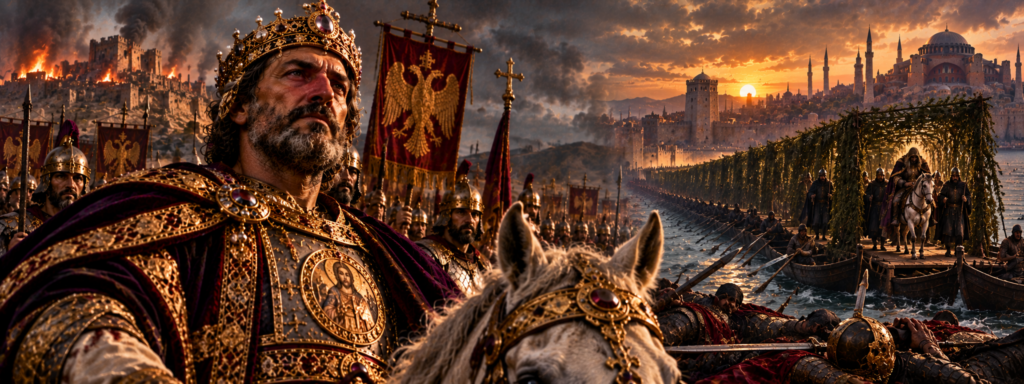
Yet one of Byzantium’s most famous emperors became associated with an extraordinary story about those same waters. According to a later Byzantine historical tradition, Heraclius developed such an intense aversion to crossing the sea that he remained on the Asian side of the Bosporus rather than return directly to Constantinople. His attendants supposedly arranged a bridge of boats, concealing the water with branches and vegetation so that the emperor could make the journey without seeing the strait beneath him.
The account appears in the historical tradition preserved by Nikephoros, patriarch of Constantinople, who wrote decades after Heraclius’s death. Its unusual details have fascinated historians and popular writers alike. The episode is sometimes described as proof that Heraclius suffered a psychological collapse following the Arab conquests, but the surviving evidence is considerably more complicated. We cannot establish a clinical diagnosis from a medieval narrative, nor can we confidently reconstruct the emperor’s emotional condition from the story alone.
Even the precise timing and duration of his reluctance are less certain than popular retellings suggest. Claims that he remained stranded for a particular number of weeks, completely incapacitated by fear, often give the impression of a more detailed contemporary record than actually survives. The tradition is historically significant, but it should not be treated as a modern medical case history.
Nevertheless, the story captures something essential about the final years of Heraclius’s reign. The emperor who had once commanded armies across the Armenian highlands and into the Persian heartland was aging, politically embattled, and confronting military disasters that threatened everything he had achieved. The empire he had rescued from the Sasanians was losing vast territories to an adversary its leaders had initially struggled to understand.
To appreciate the tragedy of his final years, it is necessary to understand just how extraordinary his earlier victories had been. Heraclius was not a ruler who inherited an empire at peace and simply watched it decline. He came to power during one of the most dangerous crises in Roman history and spent much of his reign fighting to prevent its destruction.
For a time, he succeeded beyond almost anyone’s expectations. That success made the reversals of his final decade all the more dramatic.
Born Into an Empire Under Siege
Heraclius was probably born around 575, although the exact year and birthplace remain uncertain. His father, also named Heraclius, became an important Byzantine military commander and eventually served as exarch of Africa, governing a major imperial territory from Carthage. The family’s background has been variously associated with Armenian and other eastern Roman connections, but the surviving evidence does not establish every aspect of its ancestry. What mattered politically was its place within the military elite of the eastern Roman Empire.
The empire of Heraclius’s youth was still recognizably Roman, although its language, religious institutions, and political culture had evolved considerably since antiquity. Constantinople served as the imperial capital, while the government controlled extensive territories across the Balkans, Anatolia, the eastern Mediterranean, North Africa, and parts of Italy. Its inhabitants spoke several languages, and its armies recruited soldiers from diverse communities. Christianity occupied a central position in public life, but theological disagreements continued dividing the population.
The empire’s most dangerous long-standing rival was Sasanian Persia. The Romans and Persians had competed for centuries over Armenia, Mesopotamia, and the strategic routes connecting the Mediterranean to the Iranian plateau. Their wars involved sieges, raids, fortified frontiers, and shifting alliances with neighboring peoples. Neither empire had succeeded in permanently destroying the other, despite repeated attempts to dominate contested territories.
During the reign of Emperor Maurice, who ruled from 582 to 602, the Byzantines achieved an important diplomatic and military success against Persia. Maurice helped restore the Persian ruler Khosrow II to his throne after a civil conflict, creating a period of cooperation between the two states. The arrangement appeared to offer the possibility of stability along the eastern frontier. Yet Maurice’s government faced severe difficulties elsewhere, particularly in the Balkans, where Avar and Slavic incursions placed enormous pressure on imperial defenses.
Maurice attempted to maintain military operations while controlling expenditure, but his policies generated resentment among soldiers. Campaigning far from home, delayed payments, and harsh conditions contributed to growing dissatisfaction. In 602, a military revolt erupted, and the emperor lost control of his army. The rebellion brought an obscure officer named Phocas to power.
Maurice and his sons were subsequently executed, an act that became one of the most notorious episodes of early Byzantine dynastic violence. Later accounts describe Maurice being forced to witness the deaths of his children before his own execution. Although the narrative details require caution, the destruction of the imperial family was real and had immediate political consequences. The murder provided Khosrow II with a powerful justification for renewed war.
The Persian king could present his invasion as an effort to avenge Maurice, the emperor who had helped him regain his throne. Whatever the mixture of diplomatic justification and strategic ambition, the result was a devastating conflict. Byzantine defenses began collapsing under sustained Persian attacks, while Phocas struggled to establish legitimacy and maintain political order.
Heraclius’s family would soon become central to the struggle over who controlled the empire.
Phocas: The Emperor Whose Reign Opened the Gates to Disaster
Phocas seized the throne in 602 through military rebellion and the violent removal of Maurice. His government faced opposition from aristocratic families, military officers, and communities dissatisfied with the new regime. Later Byzantine historians portrayed him as an exceptionally cruel and incompetent tyrant, although their accounts were strongly influenced by the political interests of his successors. His reputation cannot be separated from the fact that the dynasty which replaced him had powerful reasons to condemn him.
The military situation nevertheless deteriorated dramatically during his reign. Persian armies advanced through Byzantine frontier territories, capturing important positions and threatening the eastern provinces. Internal political instability weakened the government’s ability to coordinate resistance. The empire was forced to confront external invasion while struggling with divisions at the center of power.
In Africa, the elder Heraclius possessed substantial military and administrative resources. His position as exarch gave him control over forces and revenues far from Constantinople, making him a dangerous potential opponent of Phocas. By 608, the African leadership had openly challenged the emperor’s authority. The revolt developed into a major effort to replace the government.
The younger Heraclius emerged as the principal figure in the expedition against Constantinople. While other forces operated in Egypt and the eastern Mediterranean, he assembled a fleet and advanced toward the capital. His movement was both a military campaign and a bid for imperial legitimacy. Supporters portrayed the rebellion as an effort to rescue the empire from disastrous government.
By 610, Phocas’s position had become increasingly fragile. The Persian war continued, and opposition to his rule had spread. Heraclius’s fleet approached Constantinople, where political loyalties shifted rapidly. The capital’s defenses did not produce a prolonged struggle, and Phocas was captured.
Heraclius entered Constantinople in October 610 and became emperor. Phocas was executed, ending the regime that had overthrown Maurice eight years earlier. The transition was violent, but it also created expectations that the new ruler would reverse the empire’s military disasters.
Heraclius had won the throne. Saving the empire would prove far more difficult.
A Crown Won Through Rebellion and Blood
Heraclius’s accession did not immediately improve the military situation. The new emperor inherited exhausted finances, weakened armies, political divisions, and a Persian offensive that had already gained enormous momentum. His government needed to reorganize military resources while defending territories scattered across several continents. The scale of the crisis threatened the survival of Byzantine power in the eastern Mediterranean.
The emperor also faced the problem of legitimacy. He had overthrown Phocas through rebellion, making him vulnerable to the same accusations of usurpation that had damaged his predecessor. Marriage, dynastic continuity, religious ceremony, and military success could all strengthen his position. Heraclius therefore needed to establish a stable imperial household while demonstrating that he could protect the state.
In 610, he married Fabia, who took the imperial name Eudokia. Their marriage produced children, including a son who would later become Emperor Constantine III. Eudokia died in 612, leaving Heraclius a widower at a time when the empire’s political future remained uncertain. Her death created another dynastic problem because the emperor needed to secure succession while confronting military disaster.
Heraclius subsequently married Martina, his niece, a union that became one of the most controversial aspects of his reign. Byzantine Christian society generally prohibited such close marriages, and ecclesiastical objections were significant. The marriage generated criticism during Heraclius’s lifetime and became an enduring source of hostility toward Martina. Later accounts sometimes connected the couple’s children’s disabilities or illnesses with divine punishment, interpretations that reflect religious polemic rather than reliable medical explanation.
Martina nevertheless became an influential imperial figure. She accompanied Heraclius during parts of his career and later played an important role in succession politics. Their marriage produced several children, creating competing dynastic interests alongside the descendants of Eudokia. The imperial household thus became increasingly complicated.
These personal and political difficulties unfolded against the background of a war that threatened the existence of the empire itself. Heraclius could not simply concentrate on palace affairs or dynastic arrangements. Persian armies were advancing through territories that had belonged to Rome for centuries.
Within a few years, the scale of the losses would become almost unimaginable.
Jerusalem Falls: The Empire’s Holiest City Is Taken
In 614, Persian forces captured Jerusalem after a siege that became one of the most traumatic events of the war. The city held immense religious importance for Christians because of its association with the life, crucifixion, and resurrection of Jesus. Its churches and sacred sites attracted pilgrims from across the empire, while its possession carried enormous symbolic significance for Constantinople. Losing Jerusalem was therefore both a military disaster and a profound blow to imperial prestige.
Accounts of the conquest describe widespread killing, destruction, and the capture of inhabitants, although casualty figures and some descriptions of the violence are difficult to verify. The Persians also removed the relic revered as the True Cross, traditionally associated with the crucifixion of Christ. Its removal became one of the most powerful symbols of Byzantine humiliation. Later Christian writers emphasized the loss as a catastrophe demanding religious as well as military redemption.
Heraclius faced a terrible problem. His armies were struggling to contain Persian advances, while the empire lacked sufficient resources to defend every threatened province. Syria and Palestine were increasingly exposed, and military commanders could not reverse the momentum of the invasion. The emperor had gained the throne promising restoration, but the situation continued deteriorating.
The crisis deepened when Persian armies advanced into Egypt. By approximately 619, Alexandria had fallen, and much of the province came under Sasanian control. Egypt was economically important because of its agricultural production, tax revenues, and role in supplying Constantinople. Its loss threatened the empire’s financial stability and disrupted established patterns of Mediterranean commerce.
The Persian offensive also reached Anatolia, bringing enemy forces dangerously close to Constantinople. The ancient rivalry between Rome and Persia had produced many territorial changes, but the scale of these conquests was extraordinary. For the first time in generations, the Byzantine government faced the possibility of losing nearly all its eastern possessions. Its remaining resources were concentrated in a shrinking territory.
The emperor’s position appeared increasingly desperate. His enemies controlled Jerusalem, occupied Egypt, and threatened the approaches to the capital. At home, the government needed money, soldiers, and political loyalty. The situation required a response far more ambitious than simply defending the next fortress.
Heraclius eventually decided to carry the war into enemy territory.
The Desperate Gamble That Changed the War
Beginning in 622, Heraclius organized a series of counteroffensives that fundamentally changed the direction of the conflict. Rather than remain behind defensive lines while Persian armies advanced, he sought to attack vulnerable positions and force his opponents to respond. The strategy required considerable mobility, coordination, and a willingness to accept risks. If his army were destroyed far from Constantinople, the empire might have little remaining capacity to resist.
The government also needed extraordinary financial measures to support the campaigns. Church wealth was mobilized for military expenditure, with ecclesiastical resources helping provide precious metals and funds. Such measures reflected the seriousness of the emergency. The war was presented not merely as a struggle between rival states but as a defense of the Christian Roman Empire.
Heraclius personally accompanied his armies, a decision that distinguished his later career from emperors who governed military operations primarily through generals. His presence could strengthen morale and demonstrate imperial commitment. It also exposed him to the dangers of campaigning through mountainous and hostile territory. The emperor was risking both his throne and his life.
The precise chronology of the early campaigns remains debated because the surviving sources do not always agree. George of Pisidia, a contemporary poet who celebrated Heraclius’s achievements, provides valuable evidence but wrote in a highly rhetorical style intended to glorify the emperor. Later chroniclers preserved additional material while sometimes introducing chronological confusion. Reconstructing the campaigns therefore requires distinguishing military events from literary embellishment.
Nevertheless, the broad development is clear. Heraclius reorganized his forces, conducted successful operations against Persian armies, and began shifting the initiative away from Khosrow II. His campaigns exploited the geography of Anatolia, Armenia, and the Caucasus, where movement through mountain routes could complicate Persian defensive planning. The emperor increasingly threatened territories that his opponents had not expected to defend against a major Roman offensive.
His strategy was not simply to recapture one city after another. He sought to undermine the Persian war effort by forcing enemy armies to defend multiple regions and by threatening politically important territory. The approach placed pressure on Khosrow’s military resources and challenged the confidence created by years of victories.
The transformation was remarkable. An empire that had seemed close to destruction was beginning to fight back.
Into the Persian Heartland: Heraclius Becomes a Warrior Emperor
The campaigns of the 620s brought Heraclius into regions far beyond the empire’s immediate frontier. He operated through Armenia and the Caucasus, seeking allies and exploiting divisions among communities subject to Persian influence. His armies attacked strategic positions and disrupted enemy communications. The operations demanded endurance because soldiers had to move through difficult terrain while maintaining supplies.
Heraclius also cultivated relationships with peoples north of the Caucasus, including forces associated with the western Turkic political world. These alliances offered military assistance and placed additional pressure on Persia. The precise identities and numbers of allied troops remain subjects of scholarly debate. Their involvement nevertheless illustrates the international scope of the war.
In 624, Heraclius’s operations brought his army into the region of Adur Gushnasp, an important Zoroastrian religious center in Iranian Azerbaijan. Byzantine forces attacked and damaged the sanctuary, an action that possessed symbolic significance comparable, in some respects, to the Persian removal of the True Cross. The destruction demonstrated that sacred institutions could become targets in a conflict increasingly presented through religious imagery. It also reveals that Heraclius’s victories involved violence against communities beyond the battlefield.
The emperor’s campaigns required repeated movement rather than a single uninterrupted advance toward the Persian capital. He maneuvered between enemy armies, avoided unfavorable engagements, and exploited opportunities to strike important targets. His success depended on the quality of his troops and commanders as well as his own strategic decisions. Byzantine military strength had not vanished during the earlier disasters; it had needed reorganization and effective direction.
Khosrow II continued attempting to destroy the Byzantine resistance. Persian commanders operated across several theaters, while diplomatic efforts sought to coordinate pressure on Constantinople. The struggle became increasingly intense as both empires committed enormous resources. Years of warfare had already devastated provinces and exhausted populations.
By 626, the conflict reached another dangerous turning point. Heraclius remained away on campaign while Constantinople itself faced a major attack. The empire’s survival would depend on the capital’s defenses and the ability of its inhabitants to resist without their emperor physically present.
Constantinople Under Siege: The Empire’s Last Great Barrier
In 626, Constantinople faced a coordinated threat involving the Avars and their Slavic allies, while Persian forces operated on the Asian side of the Bosporus. The attackers hoped to exploit the absence of Heraclius and the empire’s military difficulties. If Constantinople fell, the political structure of the Byzantine state might collapse. The city contained the imperial government, major religious institutions, financial resources, and the ceremonial heart of Roman authority.
The capital’s defensive walls provided formidable protection. The Theodosian Walls had resisted numerous attacks, and the city’s position complicated attempts to coordinate armies operating on opposite shores. Byzantine naval control also limited the ability of Persian forces to cross the Bosporus and cooperate directly with the besiegers. These advantages became decisive.
Patriarch Sergius and other imperial officials played important roles in maintaining morale and organizing resistance. Religious ceremonies and processions reinforced the belief that Constantinople enjoyed divine protection. Later traditions associated the city’s deliverance with the Virgin Mary, strengthening her place in Byzantine religious identity. Such interpretations reflected the spiritual significance contemporaries attached to the siege.
The attackers failed to breach the defenses, and their operations eventually collapsed. The defeat was a major setback for the coalition opposing Byzantium. Constantinople remained secure, allowing Heraclius to continue his campaigns against Persia. The city’s survival prevented a military crisis from becoming the destruction of the imperial government.
The victory also strengthened Heraclius’s position. His decision to campaign far from the capital had exposed Constantinople to danger, but the defensive system proved capable of surviving the attack. The emperor could now concentrate on striking Persia while its military resources were increasingly stretched. The strategic initiative had shifted.
The final confrontation would take place near the ruins of one of antiquity’s most famous cities.
Nineveh: The Battle That Destroyed Persia’s Hopes
In December 627, Heraclius confronted a Persian army near Nineveh in northern Mesopotamia. The region had been important in the ancient Near East for centuries, and its landscape now became the setting for a decisive phase of the Roman-Persian conflict. The Byzantine emperor had advanced into territory that threatened the Sasanian state’s political and military foundations. His movements forced Persian commanders to respond under increasingly unfavorable conditions.
The battle was hard fought, and later accounts celebrated Heraclius’s personal courage. Some narratives describe individual combat and dramatic battlefield encounters, but their heroic details may reflect literary conventions. The central military result is secure: Byzantine forces defeated the Persian army, weakening Khosrow’s ability to continue the war. The victory marked the culmination of Heraclius’s extraordinary counteroffensive.
Heraclius continued threatening important Persian territories and royal possessions. The offensive exposed the failure of Khosrow’s strategy, which had relied on conquering Byzantine provinces while preserving the security of the Persian heartland. Military defeat damaged the king’s authority among powerful figures within his own government. Opposition to his rule intensified.
In early 628, Khosrow II was overthrown by a conspiracy involving his son Kavadh II and other members of the Persian elite. The deposed king was imprisoned and killed. The coup ended the reign of the ruler who had once seemed capable of destroying the Byzantine Empire. Persia now faced internal instability and a succession crisis.
Kavadh sought peace, and negotiations led to the withdrawal of Persian forces from conquered Byzantine territories. The empire recovered its claims to Syria, Palestine, and Egypt. The settlement reversed much of the territorial damage caused by the long war. Heraclius had achieved a victory that seemed almost miraculous after the disasters of his early reign.
Yet the price was enormous. Both empires had exhausted financial resources, lost soldiers, and suffered extensive destruction. Persia entered a period of dynastic instability, while Byzantium needed to rebuild provinces that had endured years of occupation and warfare. The apparent restoration concealed profound structural weakness.
Heraclius had defeated his greatest enemy, but neither empire emerged from the war as strong as it had been before.
The Return of the True Cross: Heraclius at the Height of His Glory
One of the most celebrated events of Heraclius’s reign was the restoration of the relic revered as the True Cross. The Persians had removed it from Jerusalem during the conquest of 614, making its recovery a powerful symbol of Byzantine victory. After the peace settlement, arrangements were made for its return. Heraclius became closely associated with the restoration of the relic to Christian custody.
In 630, according to the chronology generally accepted by modern scholarship, Heraclius participated in ceremonies connected with returning the Cross to Jerusalem. Later Christian traditions developed elaborate stories about his entrance into the city, including accounts emphasizing humility and divine intervention. These narratives contain devotional elements that cannot all be verified. Their significance lies partly in how later generations interpreted the emperor’s victory.
The ceremonies represented an extraordinary reversal. Jerusalem had been captured, its religious institutions damaged, and its sacred relic carried away. Now the Byzantine emperor could present himself as the ruler who had restored Christian control. The achievement enhanced his prestige and offered a religious explanation for his military success.
Contemporary praise sometimes compared Heraclius with biblical figures and celebrated him as a divinely supported conqueror. George of Pisidia portrayed the emperor’s campaigns in elevated language that emphasized courage, piety, and imperial destiny. Such works are valuable evidence for contemporary ideology, but they were also intended to glorify their subject. They should not be mistaken for impartial assessments.
For ordinary inhabitants of the recovered provinces, however, restoration did not necessarily mean an immediate return to stability. Communities had experienced conquest, military occupation, disrupted trade, and religious conflict. Rebuilding imperial administration required taxes, officials, soldiers, and renewed cooperation with local elites. The government faced substantial challenges even after its victory.
Heraclius also sought to resolve theological divisions among Christians. His efforts would become entangled with controversies over the nature and will of Christ, creating new tensions between Constantinople and important religious communities. The emperor who had restored the Cross could not easily restore religious unity.
The empire celebrated victory while serious weaknesses remained unresolved. Within a few years, those weaknesses would be exposed by an unexpected new adversary.
A New Power Rises From Arabia
During the final stages of the Roman-Persian war, a major religious and political transformation was taking place in Arabia. Muhammad had established a community centered on the teachings of Islam, and his followers increasingly formed a political movement capable of organizing military forces. After his death in 632, the early caliphs consolidated authority over much of Arabia and began campaigns beyond the peninsula. These developments would fundamentally alter the political geography of the Middle East.
The Byzantine government had longstanding relationships with Arab communities along its frontiers. Arab groups served as allies, intermediaries, and sometimes opponents of both the Roman and Persian empires. The emergence of a new political authority in Arabia therefore did not introduce an entirely unfamiliar population into imperial affairs. What changed was the scale and organization of the military movement.
The early Muslim armies operated with mobility and strategic flexibility. Their commanders exploited opportunities created by the exhaustion of the two great empires. The Byzantine government had only recently recovered Syria and Palestine, while Persian political authority was fragmented. Both states faced difficulties organizing sustained resistance.
Heraclius initially confronted Arab incursions as one of several frontier threats. The surviving evidence does not allow us to reconstruct exactly how he assessed the new movement at every stage. Later narratives sometimes portray him as immediately recognizing its world-changing significance, while others suggest he underestimated it. Neither characterization can be confidently established as a complete account of his thinking.
What became clear was that the new armies could achieve major victories against Byzantine forces. Fighting intensified in Syria and Palestine during the 630s, with imperial commanders attempting to protect cities and strategic routes. The conflict was not simply a repetition of the Persian war. It involved different political structures, military organization, and relationships with local communities.
Heraclius faced these developments as an aging ruler whose empire had barely recovered from decades of devastating warfare. The troops and financial resources needed for a prolonged defense were limited. Provincial populations had endured repeated changes of government, and theological disputes complicated relations between Constantinople and some local Christian communities.
The emperor who had defeated Persia now faced an enemy whose victories threatened to undo the territorial restoration he had celebrated only a few years earlier.
Yarmouk: The Catastrophe That Changed Everything
In August 636, Byzantine and Muslim armies fought a major battle near the Yarmouk River, in the region bordering modern Syria and Jordan. The confrontation became one of the decisive engagements of the early Islamic conquests. Byzantine commanders assembled substantial forces to challenge the advancing armies, while Muslim forces operated under experienced military leadership. The exact numbers involved remain uncertain because medieval accounts frequently exaggerate army sizes.
The fighting unfolded over several days, with both sides attempting to exploit terrain and maneuver against enemy positions. The Byzantine army ultimately suffered a devastating defeat. Its losses weakened the empire’s ability to defend Syria and contributed to the rapid collapse of imperial authority across much of the region. The battle marked a major turning point in Mediterranean history.
Heraclius was not personally commanding troops on the battlefield. He had been involved in coordinating the broader defense from Syria, but the precise extent of his operational control remains debated. Later accounts sometimes attribute the defeat directly to his decisions, while others emphasize problems among field commanders and the exhaustion of imperial military resources. The outcome resulted from a complex combination of strategic and operational factors.
The defeat was especially damaging because Syria had only recently been recovered from Persian occupation. Heraclius had spent years campaigning to restore imperial authority, and now that authority was disappearing again. The loss also threatened Palestine and the approaches to Egypt. The Byzantine government faced the possibility that its eastern provinces could be permanently separated from Constantinople.
The consequences extended beyond military geography. Syria contained important cities, agricultural regions, commercial networks, and Christian religious centers. Its loss reduced imperial revenue and weakened the state’s strategic depth. The empire could no longer rely on the same resources that had supported its earlier military power.
Later traditions describe Heraclius leaving Syria after recognizing that the region could not be defended. Some accounts preserve a farewell lament attributed to him, but the wording belongs to later historical storytelling and should not be treated as a securely recorded statement. The image of an emperor departing territory he had fought to recover became a powerful symbol of reversal.
The defeat at Yarmouk did not immediately end Byzantine resistance everywhere in the Levant. Cities and fortresses continued negotiating or fighting, and the chronology of individual surrenders varied. Nevertheless, the battle destroyed the possibility of a straightforward restoration of imperial control.
Heraclius returned toward Constantinople confronting a disaster of extraordinary magnitude. The circumstances surrounding that return gave rise to the famous story of his fear of the sea.
The Emperor at Hiereia: A Strange Refusal to Return Home
After the defeat in Syria, Heraclius eventually reached the Asian shore near Constantinople. Rather than immediately crossing into the capital, he remained at the imperial residence of Hiereia, located near the Sea of Marmara. The delay became the subject of one of the most unusual anecdotes preserved about a Byzantine emperor. It also inspired later interpretations of Heraclius as a ruler overwhelmed by the consequences of military defeat.
Nikephoros’s Short History, written in the eighth century, describes Heraclius developing a fear of water and refusing to make the crossing. The narrative reports that his reluctance persisted despite the political need for his presence in Constantinople. Eventually, an unusual arrangement was devised to bring him across the Bosporus. Boats were joined together to form a bridge, and vegetation was placed along the sides to obstruct his view of the water.
The story has often been retold as evidence of profound psychological trauma. Yet it is important to distinguish the medieval account from modern interpretation. Nikephoros did not possess the diagnostic concepts used in contemporary psychiatry, and his narrative does not provide the kind of evidence needed to identify a specific disorder. Terms such as hydrophobia, phobia, or psychological collapse should therefore be used cautiously when discussing Heraclius.
There are also political reasons to question a purely medical explanation. Heraclius had recently suffered a devastating military reversal, and his return to Constantinople would have exposed him to public scrutiny. Remaining at Hiereia may have served political or ceremonial purposes that are not fully preserved in the surviving narrative. The unusual crossing might also have been intended to create a distinctive imperial spectacle rather than simply conceal the sea.
Modern scholarship has drawn attention to these possibilities. Nadine Viermann’s study of the Yarmouk defeat and the bridge-of-boats episode specifically challenges the tendency to repeat the story uncritically as evidence of psychological breakdown. Research on imperial mobility has likewise examined how Heraclius’s movements and public appearances communicated political authority. These interpretations do not prove that the emperor experienced no fear; they demonstrate that the evidence supports more than one explanation.
The episode therefore remains fascinating precisely because it cannot be reduced to a simple diagnosis. A ruler famous for extraordinary military endurance was remembered as reluctant to cross a narrow strait, and later generations interpreted that reluctance through the disasters of his final years. Whether the story preserves a personal fear, a political decision, a ceremonial strategy, or a mixture of these factors remains uncertain.
The most vivid element of the tradition is the extraordinary bridge constructed to bring him home.
The Floating Bridge Hidden Behind Trees
According to Nikephoros, the solution to Heraclius’s reluctance was to create a crossing that concealed the surrounding water. Boats were arranged to form a temporary bridge across part of the Bosporus, while branches and foliage were placed along its sides. The resulting passage supposedly allowed the emperor to travel across without looking directly at the sea. Later descriptions elaborate the arrangement into a floating roadway resembling a path through dense vegetation.
The construction would have required considerable organization. Boats had to be positioned and secured, a stable passage maintained, and protective barriers arranged along the route. Byzantine engineers and naval personnel possessed experience building temporary crossings and organizing maritime operations. The technical possibility of such a bridge is not inherently implausible.
The story’s interpretation, however, remains uncertain. If the arrangement was designed solely to conceal water from a frightened emperor, it suggests an extraordinary accommodation by the imperial court. If it also served ceremonial purposes, the crossing could have transformed an awkward return into a controlled public event. The vegetation might have carried symbolic or practical functions beyond those emphasized in the later narrative.
Some modern retellings describe Heraclius as completely immobilized for weeks, unable to tolerate even the sight of the sea. Such descriptions often amplify the emotional implications of the account. The evidence supports a tradition of reluctance and an unusual crossing, but not every dramatic detail attached to the story. A careful historical interpretation must preserve that distinction.
The emperor’s physical condition may also have affected his movements. Later sources describe illnesses and bodily weakness during his final years, including conditions traditionally characterized as dropsy, a historical term for fluid accumulation. These reports suggest that Heraclius experienced significant health difficulties, but they do not establish a precise modern diagnosis. Physical illness, political pressure, and the demands of travel could all have influenced his behavior.
The bridge episode became memorable because it inverted the image of the victorious warrior emperor. Heraclius had crossed mountains and hostile territories to defeat Persia, yet the chronicler presented him as needing an extraordinary device to cross the water beside his capital. The contrast was irresistible to later storytellers. It transformed an uncertain episode into a symbol of imperial decline.
Whatever its original circumstances, the story reveals how Heraclius’s final years came to be remembered. His earlier victories were overshadowed by the speed with which new disasters followed them.
A Court Filled With Suspicion and Betrayal
The final years of Heraclius’s reign were marked by renewed political tensions within the imperial family. The emperor had children from both his marriages, creating competing lines of succession. His eldest surviving son from his marriage to Eudokia, Constantine, possessed a strong dynastic position. Martina, meanwhile, sought to protect the interests of her own children.
The controversial nature of Heraclius’s marriage to Martina complicated these ambitions. Religious objections to their close relationship had never entirely disappeared, and opponents could use the marriage to challenge the legitimacy of her influence. The imperial household therefore contained tensions that extended beyond ordinary questions of inheritance. Political factions could exploit religious criticism and family rivalry to promote their preferred successors.
Around 637, a conspiracy involving members of the imperial family was uncovered. Heraclius’s illegitimate son Atalarichos and his nephew Theodore were implicated in a plot against the emperor. The precise circumstances remain uncertain, but the punishments were severe. Accounts describe mutilation, including the cutting of noses and hands, followed by exile.
Such punishments reflected established Byzantine methods of disabling political rivals. Mutilation could mark an individual as unfit for imperial authority while avoiding immediate execution. The practice was brutal, but it was not unusual within the political culture of the period. Heraclius’s response demonstrated that he remained capable of exercising coercive authority even during his declining years.
Later interpretations sometimes connect the conspiracy to the emperor’s alleged fear of water or reluctance to return to Constantinople. Yet the evidence does not establish a straightforward psychological relationship between these events. The political threat was real enough to provoke punishment, while the bridge story survives in a separate narrative framework. Combining them into a single account of mental collapse risks imposing a modern explanation on fragmentary sources.
The episode nevertheless reveals the insecurity of Heraclius’s position. He had defeated the Persian monarchy, restored imperial territories, and celebrated the return of the True Cross, but he could not eliminate the dangers of palace intrigue. Members of his own family were now implicated in opposition to his authority. The dynasty he had established faced serious internal divisions.
As the emperor aged, these tensions became increasingly important because the question of succession remained unresolved.
The Religious Compromise That Deepened Division
Heraclius also spent considerable energy attempting to resolve theological disagreements within the Christian communities of his empire. The central controversy concerned how to describe the relationship between the divine and human aspects of Christ. Earlier church councils had established positions accepted by the imperial church, but substantial Christian communities in Egypt, Syria, and Armenia maintained different theological traditions. These disagreements carried political consequences because religious affiliation could influence relationships with Constantinople.
Heraclius and Patriarch Sergius sought formulas that might reconcile divided communities. One approach emphasized a single divine-human operation in Christ, while a later formulation associated with Monothelitism taught that Christ possessed one will. Supporters hoped such language would provide common ground without abandoning the authority of earlier councils. Opponents argued that the compromise failed to represent orthodox teaching adequately.
In 638, the imperial government issued the Ecthesis, a religious statement associated with the attempt to settle the controversy. The document supported the teaching of one will in Christ while seeking to restrict further disputes. Rather than creating lasting unity, it contributed to additional theological conflict. The controversy continued after Heraclius’s death and eventually resulted in the condemnation of Monothelitism at the Third Council of Constantinople in 680–681.
The religious policy has sometimes been blamed for weakening Byzantine resistance to the Arab conquests. Communities dissatisfied with imperial religious authority may have had limited enthusiasm for restoring Constantinople’s control. Yet it would be misleading to explain the conquests primarily through theological resentment. Military exhaustion, local politics, taxation, strategic circumstances, and the effectiveness of the advancing armies also mattered.
Heraclius’s efforts reveal a ruler attempting to preserve unity within an empire that had become increasingly difficult to govern. He had recovered territories through military victory but struggled to reconcile their religious communities. The problem was not new, and no simple solution was available. His policies reflected both political calculation and genuine theological concerns.
The result was another disappointment. The emperor who had restored the Cross to Jerusalem could not restore lasting agreement among his Christian subjects. His religious initiatives became controversial, while the territories he hoped to unify were increasingly threatened by foreign conquest.
The final years of his reign therefore combined military disaster, dynastic rivalry, and unresolved religious conflict. Each problem complicated the others, leaving the imperial government under enormous pressure.
Jerusalem Lost Again: The Collapse of an Extraordinary Victory
After the defeat at Yarmouk, Byzantine authority in Palestine deteriorated rapidly. Jerusalem eventually surrendered to Muslim forces, generally dated to 637 or 638, although the precise chronology varies among sources. The city’s transfer marked a profound reversal for Heraclius. Only a few years earlier, he had celebrated the restoration of the True Cross and the recovery of Christian control.
The circumstances of the surrender differ across Christian and Muslim narrative traditions. Later accounts emphasize the role of Caliph Umar and describe arrangements protecting inhabitants and religious institutions. The details of these narratives developed over time, making it necessary to distinguish broad historical developments from later literary elaboration. What is clear is that Jerusalem passed out of Byzantine control.
For Heraclius, the loss was politically devastating. The city had become a central symbol of his victory over Persia, and its recovery had been celebrated throughout the Christian empire. Now the same territory was lost to a new power. The speed of the reversal exposed the fragility of the settlement achieved in 628.
The loss also altered the religious geography of the eastern Mediterranean. Jerusalem remained sacred to Christians, but it now existed under a different political authority. Christian communities continued living in the region, while new arrangements developed between local populations and Muslim rulers. The transition was complex and varied across communities.
The emperor’s inability to prevent the loss did not mean that he had abandoned the region without resistance. Byzantine armies had fought major campaigns, and individual cities continued defending themselves or negotiating surrender. Yet the empire lacked the resources to reverse the strategic consequences of Yarmouk. The military system that had defeated Persia could not immediately adapt to the new situation.
The contrast between 630 and 638 became one of the defining tragedies of Heraclius’s reign. He had restored Jerusalem after years of warfare, only to see it lost again before his death. His achievement remained historically significant, but its territorial consequences proved painfully brief.
The crisis was not confined to Palestine. Egypt, another province recovered from Persia, was now threatened.
Egypt: The Final Province Slipping Away
Egypt had long been one of the most economically important territories of the Roman Empire. Its agricultural wealth, tax revenues, and commercial connections supported imperial government across the Mediterranean. Losing the province would significantly weaken Constantinople’s financial position. The Persian occupation had already demonstrated how vulnerable the empire became when Egyptian resources were interrupted.
In 639, Muslim forces under the commander Amr ibn al-As began operations against Byzantine Egypt. The invasion developed through campaigns against fortified positions and strategic settlements. Byzantine resistance was complicated by political and religious tensions, as well as the difficulties of organizing an effective defense after years of warfare. The region’s military situation deteriorated during Heraclius’s final years.
The fortress of Babylon in Egypt, near the site of modern Cairo, became an important focus of operations. Fighting and negotiations continued into 641, while the future of Alexandria remained unresolved. The conquest of Egypt was not completed during Heraclius’s lifetime. Alexandria’s eventual surrender and the consolidation of Muslim control occurred after his death, with important developments continuing into 642.
This distinction matters because popular summaries sometimes claim that Heraclius personally witnessed the complete loss of Egypt. He lived to see the invasion and serious Byzantine reverses, but not the final outcome. The province’s fate was still being contested when he died. His successors inherited the responsibility for managing the crisis.
Religious tensions complicated the situation. Many Egyptian Christians belonged to traditions that disagreed with the imperial church’s theological positions. The government had attempted to impose religious conformity, generating resentment among some communities. Yet the political attitudes of Egyptian Christians were diverse, and it would be inaccurate to suggest that the entire population welcomed the invaders.
The invasion of Egypt threatened the last major economic foundation of Byzantine power in the eastern Mediterranean. With Syria and Palestine already largely lost, the empire faced a transformation far more severe than the temporary reversals of earlier wars. Its political center remained Constantinople, but its territorial reach was shrinking dramatically.
Heraclius had once recovered Egypt from Persia. Now he was dying while another conquest unfolded.
The Emperor’s Final Illness
By the late 630s, Heraclius was an elderly ruler by the standards of his time. He had spent decades confronting rebellions, invasions, prolonged military campaigns, and political disputes. The surviving sources describe declining health during his final years, although their details are inconsistent. Some accounts refer to dropsy or other bodily ailments, but the evidence does not permit a secure modern medical diagnosis.
Descriptions of his physical condition have sometimes been combined with the bridge-of-boats story to construct a narrative of total psychological collapse. Such an interpretation is more definite than the evidence allows. Heraclius continued to exercise imperial authority, address political threats, and participate in religious policy. His government did not simply cease functioning because of personal incapacity.
Nevertheless, the pressures surrounding him were extraordinary. The eastern provinces were being lost, the imperial family was divided, and the state faced severe financial and military challenges. A ruler who had once celebrated a remarkable victory now confronted the possibility that much of his life’s work would not survive him. The historical record establishes these circumstances even if it cannot reveal his private emotional response.
Heraclius also faced the problem of succession. Constantine, his son from his first marriage, possessed established dynastic legitimacy. Heraclonas, his son by Martina, also occupied an important position within the imperial family. The competing interests of these heirs created the possibility of conflict after the emperor’s death.
Martina remained politically influential and sought to protect her children’s future. Her controversial marriage to Heraclius made her vulnerable to opposition from religious and political figures. The succession arrangement therefore carried risks that could destabilize the empire at a moment when unity was urgently needed. Heraclius’s efforts to provide for multiple heirs did not eliminate the underlying tensions.
The emperor died on February 11, 641, after a reign of more than thirty years. He was approximately sixty-five years old, although uncertainty about his birth date prevents complete precision. His death ended one of the most extraordinary careers in Byzantine history.
He left behind an empire that had survived the Persian war but was undergoing another profound transformation.
Martina and the Succession Crisis
Heraclius’s death immediately exposed the tensions within his imperial household. Constantine III and Heraclonas became joint emperors, representing the two principal branches of the family. The arrangement was intended to preserve dynastic continuity, but it depended on cooperation among factions with competing interests. Martina’s position made the settlement particularly controversial.
Constantine III died after only a few months, in May 641. His death generated rumors that Martina had arranged his poisoning, but the accusation cannot be established as fact. The surviving sources reflect political hostility toward Martina, and some accounts were written from perspectives sympathetic to her opponents. Constantine may have died from illness, but the precise cause remains uncertain.
Heraclonas and Martina then faced growing opposition. Political factions supported Constantine III’s young son, Constans II, as an alternative ruler. The dispute developed into a serious crisis involving the army, palace officials, and the population of Constantinople. The imperial government could ill afford such instability while the eastern provinces remained under attack.
By the autumn of 641, Martina and Heraclonas had been overthrown. Accounts describe their mutilation, with Martina’s tongue cut and Heraclonas’s nose removed, before exile. These punishments reflected the Byzantine practice of physically disqualifying political rivals. The violence also demonstrated the continuing brutality of imperial succession.
Constans II eventually emerged as the dominant emperor, inheriting a state transformed by the conquests of the preceding decade. The loss of Syria and Palestine had altered the empire’s strategic position, while Egypt remained under threat. The government needed to reorganize its defenses and finances around a reduced territorial base.
Heraclius’s dynasty survived, but the transition was marked by conflict and mutilation. The emperor who had spent years defending his throne and organizing military recovery left behind a family divided by competing claims. His death did not end the crisis; it merely transferred responsibility to a new generation.
Was Heraclius Truly Broken by Defeat?
The popular image of Heraclius’s final years is that of a military genius destroyed by the collapse of his achievements. The story has considerable dramatic force. He defeated Persia, recovered Jerusalem, restored the True Cross, and then watched the newly expanding Muslim state conquer territories he had fought to regain. The bridge-of-boats anecdote appears to offer a vivid symbol of his decline.
Yet historical interpretation requires separating events from assumptions about the emperor’s mental state. Heraclius unquestionably experienced extraordinary political and military reversals. The Byzantine defeat at Yarmouk was catastrophic, and the subsequent losses transformed the empire. His health appears to have deteriorated during his final years. None of these facts, however, establishes a specific psychiatric condition.
The account of his fear of water comes from a later narrative rather than a contemporary medical observation. It may preserve an authentic episode, but its meaning remains disputed. Modern scholars have examined the possibility that the unusual crossing reflected political ceremony, imperial mobility, or the need to manage a difficult public return. These interpretations challenge the assumption that the story can only be explained through psychological trauma.
Heraclius’s behavior after Yarmouk also complicates claims of complete incapacity. He remained involved in government and succession arrangements, while imperial officials continued administering the state. Political conspiracies were investigated, religious policies were issued, and military resistance continued in threatened provinces. The government faced enormous difficulties, but it did not become inactive.
It is reasonable to describe Heraclius’s final years as a period of declining health and severe political disappointment. It is also reasonable to recognize that military defeat could have affected him personally. What cannot be established is the precise nature or severity of any psychological condition. Claims that he suffered a complete mental breakdown or developed a clinically identifiable phobia exceed the available evidence.
The tragedy of his reign does not depend on such a diagnosis. The historical reversal was dramatic enough without reconstructing emotions that the sources cannot securely reveal. Heraclius had achieved a victory that transformed the balance of power between Rome and Persia, only to confront another conflict that transformed the region even more profoundly.
His final years reveal the limits of military achievement in a world undergoing rapid political change.
The Last Great Roman-Persian War and the End of an Era
Heraclius’s reign occupies a pivotal place in the transition from late antiquity to the medieval world. The war between Byzantium and Persia was the culmination of centuries of rivalry between two powerful imperial traditions. Their conflict devastated territories, consumed resources, and weakened political structures across the Middle East. The eventual Byzantine victory appeared to restore the old balance, but the exhaustion of both states created opportunities for new powers.
The early Islamic conquests transformed that balance permanently. Within a generation, Muslim rulers controlled territories that had belonged to the Roman and Persian empires for centuries. The Sasanian state eventually collapsed, while Byzantium survived with a substantially reduced territorial base. The eastern Mediterranean became part of a new political world.
Heraclius did not cause these transformations alone, nor could any single ruler have controlled every factor involved. The Roman-Persian war had begun before his accession, and the emergence of Islam developed through processes beyond Byzantine government. Military organization, regional politics, religious communities, economic pressures, and individual decisions all shaped the outcome. His reign intersected with these developments at an extraordinary historical moment.
His achievements nevertheless remain substantial. He preserved Constantinople’s imperial government, defeated Persian armies, and secured a peace settlement that restored territories lost during the war. His campaigns demonstrated strategic adaptability and considerable personal commitment. Few Byzantine emperors confronted a crisis of comparable scale and achieved such a dramatic reversal.
The subsequent Arab conquests do not erase those achievements, but they change how they are understood. The victory over Persia was real, yet it did not produce the lasting stability that contemporaries hoped for. The empire emerged from the war exhausted and vulnerable. Heraclius’s success therefore became part of a larger transformation rather than the beginning of a permanent restoration.
The bridge-of-boats story survives because it offers a human image for that historical reversal. Whether the emperor feared the water or participated in an unusual ceremonial crossing, later generations saw the episode through the knowledge of what followed. The victorious commander had become associated with hesitation, weakness, and the loss of provinces.
His reign demonstrates how quickly military glory could become overshadowed by events that no ruler had anticipated.
The Emperor Who Saved an Empire but Could Not Save His Victory
Heraclius began his reign in 610 with the Byzantine Empire facing possible destruction. Persian armies were advancing through its eastern territories, political divisions weakened the government, and the capital confronted severe strategic threats. The new emperor had seized power through rebellion, making his legitimacy dependent on restoring stability. For years, his efforts appeared insufficient as Jerusalem, Egypt, and other territories fell.
His counteroffensive transformed the war. Through a series of demanding campaigns, he carried the conflict into Persian territory, defeated enemy forces, and helped trigger the overthrow of Khosrow II. The peace settlement of 628 restored Byzantine claims to the provinces lost during the war. The return of the True Cross became a symbol of extraordinary triumph.
Yet the empire’s apparent recovery concealed the damage caused by decades of warfare. Its finances were strained, provincial communities had endured occupation and destruction, and religious divisions remained unresolved. When the early Muslim armies advanced into Byzantine territory, the government faced a new military challenge with depleted resources. The defeat at Yarmouk in 636 accelerated the loss of Syria and Palestine.
Heraclius’s final years were marked by these reversals, along with declining health and political tensions within his family. The famous story of his reluctance to cross the Bosporus became a symbol of personal collapse, but its historical interpretation remains uncertain. The account should not be treated as proof of a psychiatric disorder. Its significance lies partly in how later writers remembered an emperor whose final years contrasted so sharply with his earlier triumphs.
The loss of Jerusalem was especially painful in historical perspective. Heraclius had celebrated its recovery after the Persian war, only to see it pass from Byzantine control again. Egypt was also under invasion when he died in 641, although its final conquest occurred after his death. The emperor left behind a state that had survived one existential crisis but was undergoing another transformation.
His succession arrangements failed to prevent conflict. Constantine III died shortly after inheriting the throne, Martina and Heraclonas were overthrown, and Constans II emerged as ruler amid political instability. The violence within the imperial family demonstrated that the dangers of palace politics had not disappeared. Heraclius’s dynasty survived, but the empire it governed was profoundly changed.
The final image of Heraclius is therefore not simply that of a defeated emperor trembling before the sea. That interpretation gives too much certainty to an ambiguous medieval account and too little attention to the scale of his achievements. He was a ruler who rescued Constantinople from a seemingly hopeless military situation, defeated the Sasanian Empire, and restored territories that appeared permanently lost. Yet he also lived long enough to witness a new power overturn much of that victory, while illness, dynastic rivalry, and religious controversy darkened his final years. Whether or not he truly feared the waters of the Bosporus, the story of the concealed crossing captured a profound historical irony. Heraclius had spent his life fighting to preserve the Roman world, only to discover that even an extraordinary victory could not prevent that world from changing beyond recognition.