
Irene of Athens: The Byzantine Empress Who Blinded Her Own Son to Seize the Throne
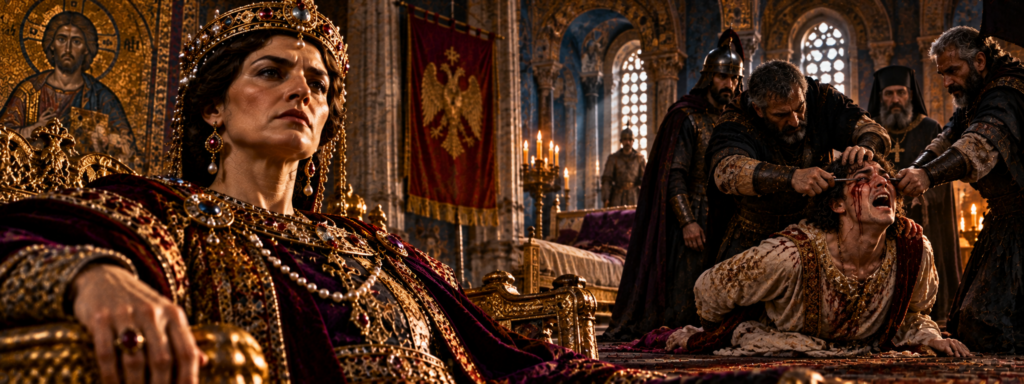
She entered Constantinople as a beautiful young bride chosen to marry the heir to the Byzantine Empire. She became an empress, a mother, a widow, and eventually one of the most powerful women in medieval history. Irene of Athens restored the veneration of religious icons, outmaneuvered ambitious generals, manipulated imperial politics, and achieved something almost unimaginable in the Byzantine world: she ruled the Roman Empire in her own name. But her extraordinary rise came at a terrible price. In August 797, her only son, Emperor Constantine VI, was arrested and blinded inside the imperial palace, reportedly in the very chamber where she had given birth to him. The mutilation was carried out by men acting on her orders, ending his effective reign and clearing her path to sole power. Whether Constantine died from his injuries remains uncertain, but the act itself became one of the most notorious betrayals in Byzantine history. Irene had spent years defending her son’s throne, only to become the person who destroyed his ability to occupy it.
The Mother Who Took Her Son’s Eyes
On August 15, 797, an extraordinary act of violence unfolded inside the Great Palace of Constantinople. The victim was not an enemy general, a rebellious governor, or a foreign prisoner captured in battle. He was Constantine VI, the reigning Byzantine emperor, a young man whose mother had governed in his name for much of his childhood. The person who ordered his mutilation was that same mother, Irene of Athens, who had spent years struggling to retain control of the empire.
According to the Byzantine chronicler Theophanes the Confessor, Constantine was blinded in the Porphyra, the imperial birth chamber where he had entered the world approximately twenty-six years earlier. The location gave the episode a disturbing symbolic quality. A room associated with the legitimacy of imperial birth had become the setting for the destruction of an emperor’s political future. Theophanes also reports that the sun darkened afterward, a phenomenon he interpreted as a sign of divine judgment. The alleged darkness should be treated as a chronicle tradition rather than an independently established supernatural event.
Blinding was a recognized instrument of Byzantine political punishment. An emperor’s physical integrity carried symbolic importance, and mutilation could render a rival unacceptable as a ruler without requiring his immediate execution. The practice did not always prevent political activity, but it was intended to eliminate a claimant’s ability to exercise imperial authority. In Constantine’s case, the punishment was particularly severe, and the surviving account makes clear that it was carried out to remove him from power.
The popular claim that Constantine died shortly afterward from his wounds is less secure. Theophanes does not establish an immediate death, and some later evidence has been interpreted as suggesting that Constantine survived for years after his blinding. His ultimate fate remains uncertain. What is beyond serious dispute is that his mother became sole ruler after the mutilation, exercising imperial authority from 797 until her own overthrow in 802.
The event was the culmination of a long and bitter struggle between mother and son. Irene had originally governed as regent after the death of her husband, Leo IV, in 780, when Constantine was still a child. Her position depended on protecting the boy’s legitimacy while managing the ambitions of generals, courtiers, and members of the imperial family. Yet as Constantine grew older, the question of who truly controlled the empire became increasingly contentious.
Their relationship deteriorated through competing political factions, military rebellions, personal grievances, and disagreements over imperial authority. Constantine eventually attempted to free himself from his mother’s influence, while Irene cultivated supporters who favored her continued control. The struggle was not simply a private family dispute. It involved the future of the Byzantine monarchy, the role of the army, the influence of palace officials, and the religious controversies that had divided the empire for generations.
Irene’s career presents an uncomfortable contradiction. She was a capable political operator who achieved important diplomatic and religious objectives, most famously restoring the public veneration of icons at the Second Council of Nicaea in 787. She also demonstrated extraordinary determination in preserving her authority against powerful opponents. Yet the same determination culminated in an act of calculated violence against her only son.
To understand how a mother could order the mutilation of the emperor she had raised, it is necessary to return to the beginning of Irene’s remarkable journey from Athens to the imperial palace.
A Young Woman From Athens Enters the Imperial World
Irene was born in Athens around the middle of the eighth century, probably between 750 and 755, although the exact date is unknown. Her family background remains frustratingly obscure. Later traditions sometimes associate her with prominent Athenian families, but the surviving evidence does not establish her ancestry with certainty. What is clear is that she came from a world far removed from the immediate center of imperial politics in Constantinople.
Athens in the eighth century was no longer the political and cultural capital of the classical Greek world. It remained an important regional settlement with an extraordinary architectural inheritance, including temples and monuments that had survived centuries of political transformation. The city formed part of the Byzantine Empire, whose administrative and military structures had changed considerably since the age of Justinian I. Imperial authority remained strong in principle, but the empire had lost extensive territories during the preceding century.
The Byzantine world into which Irene was born had endured repeated military disasters. Arab-Muslim conquests had removed Syria, Palestine, and Egypt from imperial control, while Byzantine forces struggled to defend Anatolia against continuing attacks. In the Balkans, Slavic communities and the Bulgarian state challenged Constantinople’s authority. The empire remained formidable, but its rulers faced threats that demanded constant military organization and financial resources.
Religious controversy also shaped imperial politics. Since the early eighth century, emperors had promoted policies restricting or condemning the religious use of icons. Supporters of these measures believed that certain forms of image veneration violated Christian teaching, while opponents defended icons as legitimate expressions of religious devotion. The controversy involved theology, imperial authority, monastic communities, and the relationship between church and state.
Irene would eventually become one of the most important figures in the restoration of icons, but little is known about her personal religious convictions before marriage. Later iconophile writers portrayed her as a defender of orthodoxy, sometimes suggesting that her beliefs were firmly established from an early age. Such descriptions reflect the religious importance she acquired after becoming empress. They should not be treated as reliable access to the thoughts of an otherwise poorly documented young woman.
Her life changed dramatically in 769, when she was selected to marry Leo, the son and heir of Emperor Constantine V. The circumstances of her selection are uncertain. The marriage was arranged within the imperial political system, where choosing a suitable bride for the heir could strengthen legitimacy and establish useful connections.
Irene traveled to Constantinople, where she married Leo in December 769. The ceremony transformed an Athenian woman of uncertain family prominence into the wife of the future emperor. Her position brought wealth, ceremonial prestige, and access to the highest levels of government. It also placed her inside a dynasty whose survival depended on military loyalty, religious policy, and the production of legitimate heirs.
The palace offered extraordinary privilege, but it was also a dangerous place for anyone caught between competing political ambitions.
Marriage to Leo IV: A Bride Beneath the Imperial Purple
Irene’s husband, Leo IV, belonged to the Isaurian dynasty, which had governed the empire since Leo III became emperor in 717. His father, Constantine V, was an energetic military ruler remembered for campaigns against the Bulgarians and Arab forces. Constantine V also strongly supported iconoclast religious policy, making him deeply controversial among later writers who favored the restoration of icons. His reign created the political and religious environment Irene would inherit.
Leo and Irene’s marriage produced a son, Constantine, born on January 14, 771. His birth was a major dynastic event because it provided the ruling family with a legitimate male successor. Constantine was born in the imperial palace and would later be associated with the title porphyrogennetos, meaning born in the purple, a designation emphasizing birth during an imperial reign. The birth chamber known as the Porphyra carried powerful ceremonial significance within Byzantine political culture.
For Irene, motherhood strengthened her position. The mother of an imperial heir possessed a role that could become politically important, particularly if the reigning emperor died while the child was still young. Byzantine history contained numerous examples of imperial women acting as regents, advisers, and political intermediaries. Yet their authority remained vulnerable to challenges from male relatives and military commanders.
Constantine V died in September 775, and Leo IV succeeded him as emperor. Irene became empress consort, occupying a prominent ceremonial position alongside her husband. Their son Constantine was crowned co-emperor in 776, securing his place in the succession. The arrangement appeared to promise continuity for the dynasty.
Leo IV continued aspects of his father’s religious policy, although historians debate the extent to which his approach differed from that of Constantine V. Later iconophile accounts describe a period of relative moderation followed by renewed pressure against icon supporters. Some stories portray Irene secretly venerating icons despite her husband’s opposition. These anecdotes may reflect genuine tensions, but they also served the interests of writers eager to celebrate her religious devotion.
One particularly famous tradition alleges that Leo discovered icons among Irene’s possessions and became angry with her. The story appears in later narrative traditions and cannot be independently verified. It is therefore unsafe to present it as a documented marital confrontation. The surviving evidence reveals little about the couple’s private relationship.
Their marriage ended abruptly when Leo IV died in September 780, apparently after a relatively short illness. Later stories connected his death with a jeweled crown supposedly taken from a sacred treasury, but the details are legendary and uncertain. There is no reliable basis for concluding that Irene poisoned or otherwise arranged his death.
The emperor’s death left their nine-year-old son Constantine VI as ruler. Irene, now a widow in her twenties, assumed the regency.
The young empress had entered a political world in which her survival would depend on outmaneuvering men who believed they had stronger claims to authority.
A Widow, a Child Emperor, and a Dangerous Throne
When Leo IV died, Irene became the dominant figure in the government of Constantine VI. Her regency was legitimate in the sense that she was the mother of the reigning child emperor, but legitimacy did not guarantee security. Powerful military officers, palace officials, and members of the imperial family could challenge her authority. The empire’s government required experienced leadership, and a female regent faced particular scrutiny in a political culture that normally expected an adult man to command armies and exercise sovereign power.
One immediate threat came from the sons of Constantine V, Leo IV’s half-brothers. These imperial princes possessed dynastic connections that could make them attractive alternatives to the young Constantine VI. Their presence created opportunities for factions dissatisfied with Irene’s government. The regency therefore faced a serious challenge almost immediately after Leo’s death.
A conspiracy developed around Nikephoros, one of Constantine V’s sons. The precise extent of his personal involvement remains uncertain, but the government treated the movement as a threat to the succession. Irene responded by removing the conspirators from positions of influence and forcing some imperial relatives into religious life. Such measures were intended to prevent them from becoming rival emperors.
The use of religious retirement as a political instrument was well established in Byzantium. A man compelled to become a monk could be deprived of the public position necessary to claim imperial authority. The punishment was less final than execution or blinding, but it could still destroy political ambitions. Irene employed these methods to protect her son’s throne and preserve her own control over the regency.
Her early actions demonstrate that she was neither politically inexperienced nor passive. She recognized the danger posed by rival dynastic claimants and moved decisively to neutralize them. She also understood the importance of controlling palace appointments and cultivating loyal officials. These skills would become central to her later career.
Yet every successful intervention strengthened her personal authority. The more effectively Irene governed, the more difficult it became to distinguish the interests of Constantine VI from those of his mother. What began as a regency intended to preserve a child’s inheritance gradually developed into a government centered on Irene herself.
The seeds of their eventual conflict were already present.
The Empire of Icons and Broken Images
The most consequential religious issue confronting Irene was Byzantine iconoclasm. For decades, imperial policy had restricted or condemned the veneration of religious images, while defenders of icons argued that depicting Christ, the Virgin Mary, and the saints was compatible with Christian belief. The controversy was not simply a disagreement about decoration. It concerned theology, worship, imperial authority, and the boundaries of religious practice.
Iconoclast emperors had supported measures against religious images, although the precise policies varied across reigns and regions. Later iconophile accounts describe widespread destruction of icons and persecution of monks, but modern historians caution that some narratives were shaped by polemical exaggeration. The controversy nevertheless produced genuine conflict within the church and imperial society. Monastic communities became particularly important defenders of icon veneration.
Irene’s regency created an opportunity to change religious policy. She favored restoring the public veneration of icons and gradually placed supporters of that position in influential offices. Her approach required caution because significant elements of the army remained attached to the religious traditions associated with Constantine V. A sudden confrontation could threaten both religious reform and political stability.
The appointment of Tarasios as patriarch of Constantinople in 784 became a major step. Tarasios had previously served as an imperial official rather than pursuing a conventional clerical career, making his elevation unusual. He supported reconciliation with the wider church and the convening of an ecumenical council. His cooperation gave Irene a prominent ecclesiastical ally.
The proposed council was intended to resolve the icon controversy through formal theological deliberation. Irene sought to restore the veneration of images while maintaining the authority of the imperial government. The undertaking required diplomatic communication with Rome and the participation of bishops from across the empire. It also risked provoking resistance from soldiers and officials opposed to the change.
The attempt to hold a council in Constantinople in 786 ended in disorder. Soldiers associated with iconoclast sympathies disrupted the proceedings, preventing the assembly from continuing. The incident exposed the limits of Irene’s control over the military and demonstrated that religious reform could not succeed through ceremonial authority alone.
Rather than abandon the project, Irene reorganized the political and military environment. Forces considered unreliable were moved or replaced, reducing the danger of another disruption. The council was then reconvened in a different location.
In 787, Irene achieved the religious victory for which she would be remembered long after her political downfall.
The Second Council of Nicaea: Irene’s Greatest Triumph
The Second Council of Nicaea convened in 787 and became one of the defining events of Irene’s career. The assembly brought together bishops and ecclesiastical representatives to address the controversy surrounding religious images. It ultimately endorsed the veneration of icons while distinguishing that practice from the worship owed to God alone. The decision restored icon veneration within the imperial church and repudiated earlier iconoclast positions.
Irene and Constantine VI formally supported the council, although the empress was the dominant political force behind its organization. The council’s proceedings emphasized continuity with Christian tradition and the authority of earlier church teaching. Its decisions became foundational for later Orthodox Christian theology and religious practice. The event remains commemorated in Eastern Orthodox tradition.
The distinction between veneration and worship was central to the council’s reasoning. Supporters argued that honor shown to an image passed to the person represented rather than terminating in the material object. Critics had maintained that religious images risked idolatry or misrepresented the divine. The council resolved the issue in favor of icon veneration, though the controversy would return in the ninth century.
For Irene, the council was both a religious achievement and a political triumph. She had overcome military resistance, secured cooperation from influential church leaders, and presented herself as a defender of Christian orthodoxy. Her position as a female regent did not prevent her from exercising decisive influence over an issue of enormous importance. The council enhanced her prestige among icon supporters.
Yet the victory also created political divisions. Elements of the military remained associated with iconoclast traditions, while some religious figures questioned the treatment of bishops who had previously supported iconoclasm. Irene needed to balance reconciliation with the demands of more uncompromising icon defenders. The settlement did not eliminate every source of tension.
Her religious success would eventually influence how later generations remembered her. In Eastern Christian traditions, Irene could be celebrated for restoring icons even while historians condemned her treatment of Constantine VI. The contrast reveals how political and religious reputations could develop along different lines.
The council of 787 was Irene’s most enduring achievement, but it did not resolve the question that would determine her personal future: how long could she continue ruling in the name of a son who was approaching adulthood?
A Son Growing Up in His Mother’s Shadow
By the late 780s, Constantine VI was no longer a small child. He had been crowned co-emperor during his father’s lifetime and had inherited the throne in 780, but Irene continued exercising dominant authority. As he grew older, the arrangement became increasingly difficult to justify. An adult emperor was expected to command armies, appoint officials, and make political decisions in his own name.
Constantine’s frustration emerged within a court divided between supporters of the empress and those who favored the young emperor’s independence. Palace officials possessed considerable influence because access to the imperial household shaped appointments and policy. Irene’s closest advisers had strong reasons to preserve her position. Their political survival could depend on preventing Constantine from replacing them.
One of the most influential figures was the eunuch Staurakios, who held high office and became a central supporter of Irene’s government. Eunuchs frequently occupied important positions in Byzantine administration because they could serve within the palace without establishing conventional hereditary dynasties. Their dependence on imperial favor could make them valuable political allies. Staurakios used his position to help maintain Irene’s authority.
Constantine increasingly resented the influence of his mother’s advisers. Theophanes describes tensions between the emperor and Staurakios, including efforts to undermine the official’s position. The precise details are difficult to verify because the chronicle reflects particular religious and political sympathies. Nevertheless, the struggle between Constantine and the regency is historically secure.
Military loyalty became decisive. Soldiers had served under Constantine V and Leo IV, and many regarded Constantine VI as the legitimate continuation of the dynasty. Some were uncomfortable with Irene’s religious policies, while others simply preferred an adult male emperor. Their support offered Constantine an opportunity to escape his mother’s control.
The conflict intensified in 790, when the army of the Armeniac theme supported Constantine’s claim to independent authority. The movement spread, and Irene’s position became increasingly vulnerable. Her attempt to maintain control through oaths and palace influence could not overcome the determination of military forces demanding the emperor’s independence.
Constantine finally emerged as sole effective ruler, while Irene was removed from direct control of the government.
For the first time, the son had defeated the mother.
The Rebellion of 790: Constantine Takes His Throne
The events of 790 represented a dramatic reversal of Irene’s fortunes. Military units refused to accept the continuation of her dominant authority and demanded that Constantine VI govern independently. The movement gained sufficient strength to force a political settlement. Irene was deprived of effective control and confined within the imperial palace.
The rebellion demonstrated the importance of military legitimacy in Byzantine politics. Constantine possessed hereditary authority as the reigning emperor, but that authority had remained largely ceremonial while his mother governed. The army’s intervention transformed his formal status into practical power. He could now appoint officials and direct policy without relying on the regency.
Staurakios, one of Irene’s principal advisers, was punished and removed from his position. His treatment reflected Constantine’s desire to dismantle the network that had restricted his independence. Other officials associated with Irene also faced dismissal or reduced influence. The young emperor attempted to establish a government loyal to himself.
Yet Constantine’s victory created new difficulties. He had limited experience exercising independent authority and faced major military challenges. The empire remained threatened by the Bulgarians and by Arab forces along its eastern frontier. Successful government required military judgment, administrative cooperation, and the ability to manage aristocratic factions.
Constantine also faced the problem of his mother’s continuing legitimacy. Irene was not merely a defeated regent; she was the widow of Leo IV, the mother of the reigning emperor, and the political figure associated with the restoration of icons. She retained supporters within the palace and among religious circles. Removing her permanently could create new opposition.
In 792, Constantine restored Irene to the position of empress and allowed her to share imperial honors. The decision has often been interpreted as a disastrous political mistake because it enabled her to rebuild influence. Yet it may also have reflected an attempt at reconciliation within a divided imperial household. The surviving evidence does not establish Constantine’s private motives.
The restoration reopened the struggle for authority. Irene regained access to political networks, while Constantine remained vulnerable to criticism over military failures and personal decisions. Their relationship had survived a rebellion, but trust had been severely damaged.
The next years would turn reconciliation into renewed conflict.
Military Defeat and the Weakening of Constantine VI
Constantine VI inherited an empire facing dangerous enemies. The Bulgarian ruler Kardam challenged Byzantine authority in the Balkans, while Arab forces continued pressuring Anatolia. Military success was essential to imperial legitimacy because emperors were expected to defend Christian territory and protect their subjects. Defeat could weaken support among soldiers and aristocrats who had previously favored a ruler.
In 792, Constantine suffered a serious defeat against the Bulgarians at the Battle of Marcellae. The engagement damaged his military reputation and exposed the limits of his command experience. Byzantine forces suffered losses, and the emperor faced criticism for the outcome. The defeat was particularly damaging because his independence had been secured through military support.
The political consequences extended beyond the battlefield. Soldiers who had demanded Constantine’s authority now questioned his effectiveness. Members of the aristocracy and imperial family could exploit dissatisfaction to promote alternative arrangements. Irene’s supporters benefited from the growing perception that Constantine was unable to govern successfully.
The emperor also faced conspiracies involving relatives and military officers. His response included harsh punishments, demonstrating that political brutality was not confined to his mother. Byzantine rulers frequently used blinding, mutilation, and forced religious retirement against perceived rivals. Constantine’s actions reflected the same political culture that would later be turned against him.
One particularly important episode involved Nikephoros, the uncle who had previously been implicated in opposition to Irene. Constantine ordered him blinded after renewed accusations of conspiracy. Other relatives were subjected to mutilation or confinement. These punishments weakened potential rivals but also damaged the emperor’s reputation.
The severity of Constantine’s actions undermined his position among groups that had expected better government after Irene’s removal. Military defeat and political repression created a dangerous combination. The emperor appeared increasingly unable to secure either military success or broad political loyalty.
Irene’s return to influence occurred within this deteriorating environment. She did not need to create every problem her son faced. His own decisions provided opportunities for opponents to challenge his authority.
The most damaging controversy, however, emerged from Constantine’s private life.
The Marriage Scandal That Shook the Empire
Constantine VI’s marriage to Maria of Amnia had been arranged during Irene’s regency. Maria came from a family associated with the Byzantine aristocracy, and the marriage produced daughters, including Euphrosyne, who would later become empress through marriage to Michael II. The union initially served dynastic interests by providing a legitimate consort and potential heirs. Yet Constantine eventually became dissatisfied with the marriage.
In 795, he divorced Maria and married Theodote, a woman associated with the imperial court. Theodote was connected to Irene’s family, making the marriage politically sensitive. Constantine’s decision created a major religious controversy because the church’s rules concerning divorce and remarriage were contested. His treatment of Maria also generated criticism among religious figures who regarded the second marriage as illegitimate.
The controversy became known as the Moechian dispute, from a Greek term associated with adultery. Some monks and clerics condemned Constantine’s remarriage and challenged the willingness of church authorities to accommodate the emperor. Theodore the Studite and his uncle Plato became prominent opponents of the marriage. Their resistance reflected broader concerns about the relationship between imperial authority and ecclesiastical discipline.
Patriarch Tarasios faced a difficult situation. He did not personally celebrate the second marriage, but the ceremony was performed by another priest, Joseph. Critics argued that the church had failed to enforce its own standards against the emperor. The dispute damaged Constantine’s relationship with influential monastic communities.
Irene’s role in the scandal remains uncertain. Some later interpretations suggest that she encouraged circumstances that would weaken her son, but direct evidence of a deliberate plot is lacking. What can be established is that the controversy benefited her politically by alienating religious groups that might otherwise have supported Constantine. His personal decision created a crisis of legitimacy at a moment when his military reputation was already damaged.
The marriage also revealed the limits of imperial authority. Constantine could order political punishments and command armies, but he could not easily compel religious leaders to accept his private conduct. The dispute divided the church and weakened the emperor’s moral standing. Irene’s supporters were able to operate within an increasingly hostile political environment.
By 797, Constantine’s position had become dangerously fragile. His military failures, harsh treatment of relatives, and marriage controversy had damaged relationships with important constituencies. Irene, meanwhile, had rebuilt influence within the palace and among officials whose careers depended on her favor.
The final confrontation was approaching.
The Palace Conspiracy: Irene Moves Against Her Son
The overthrow of Constantine VI in 797 was the culmination of a political struggle that had developed over several years. Irene possessed loyal supporters within the palace, including officials capable of organizing opposition and controlling access to the imperial household. Constantine retained the formal authority of emperor, but his support had weakened. The balance of power increasingly favored his mother.
Theophanes describes a conspiracy involving Irene and influential courtiers who sought to remove Constantine from power. The details of individual meetings and negotiations cannot be independently verified, but the existence of a coordinated movement against the emperor is clear. Irene’s supporters exploited dissatisfaction among soldiers and officials, while the emperor struggled to identify reliable allies. The palace became the center of a dangerous political confrontation.
Constantine attempted to escape when the conspiracy became apparent. He fled toward Anatolia, where he hoped to find military support. The eastern provinces contained armies that had previously supported his independence, making them a plausible refuge. Yet his political position had deteriorated since the rebellion of 790.
The attempt failed. Constantine was captured by forces acting for Irene and returned to Constantinople. The surviving accounts suggest that his supporters were unable or unwilling to organize effective resistance. The emperor who had once used military backing to escape his mother’s control now found himself isolated.
Irene faced a decisive choice. She could imprison Constantine, force him into religious retirement, or attempt another reconciliation. Each option carried political risks because he remained the legitimate emperor and could become a rallying figure for opposition. Blinding offered a more permanent solution within the brutal conventions of Byzantine succession.
The decision to mutilate Constantine was therefore not an isolated outburst of anger. It occurred within a calculated political struggle in which Irene sought to eliminate her son’s ability to reclaim the throne. The sources do not allow us to reconstruct her private emotions, but the political purpose of the punishment is unmistakable.
The emperor was taken into the palace where he had been born.
There, the struggle between mother and son reached its terrible conclusion.
August 797: The Blinding in the Purple Chamber
Theophanes dates the blinding of Constantine VI to August 15, 797. According to his account, the emperor was taken to the Porphyra, the chamber associated with his imperial birth. The room had once symbolized his legitimacy as a child born into the ruling dynasty. Now it became the setting for the punishment that ended his effective reign.
The chronicler states that Constantine was blinded by men acting under Irene’s orders. The punishment was carried out with exceptional severity, and Theophanes presents it as an act intended to destroy the emperor’s political future. The account does not provide reliable grounds for reconstructing every physical detail of the procedure. Its central claim, however, is supported by the subsequent transfer of sole authority to Irene.
The symbolism of the location is difficult to ignore. Constantine had been born in the imperial palace during the reign of his grandfather Constantine V. His birth established him as a legitimate member of the dynasty, and his coronation as co-emperor had secured his place in the succession. The same palace that had celebrated his arrival now witnessed his removal through mutilation.
Theophanes also records that the sun darkened after the blinding, interpreting the event as a sign of divine displeasure. Such reports belong to a medieval historical tradition in which extraordinary natural phenomena could be presented as judgments upon human actions. Whether an astronomical event occurred at that time is a separate question from the chronicler’s theological interpretation. The narrative should not be treated as proof that the blinding produced a supernatural darkness.
Constantine’s fate after the mutilation remains uncertain. Some later accounts imply that he died from his injuries, while other evidence has been interpreted as suggesting that he survived for a considerable period. The historical record does not securely establish the date or circumstances of his death. Claims that he certainly died shortly afterward therefore go beyond what the surviving evidence can demonstrate.
What is certain is that Constantine never regained effective imperial authority. His political career ended in the palace, and Irene emerged as the sole ruler of the Byzantine Empire. The mother who had governed in her son’s name for seventeen years had finally removed him from the throne.
The act became one of the most notorious examples of dynastic violence in Byzantine history, not because blinding was unknown, but because the person who ordered it was the emperor’s own mother.
Irene Becomes Emperor: A Woman Rules the Roman Empire
After Constantine’s blinding, Irene assumed sole imperial authority. Her position was extraordinary because the Byzantine political system had traditionally centered sovereign power on male emperors. Women had served as regents, empress consorts, and influential advisers, but Irene now governed without a reigning male emperor beside her. She exercised the powers of the throne in her own name.
Some surviving documents and seals associate Irene with masculine imperial terminology, including basileus, while other evidence uses feminine titles. The variation reflects the unusual nature of her position and the conventions of Byzantine administration. It would be misleading to claim that she exclusively used one title in every context. Nevertheless, her exercise of sole sovereignty was a remarkable development.
Irene controlled appointments, diplomatic relations, financial policy, and imperial ceremonial authority. She also relied heavily on palace officials whose loyalty had helped secure her victory over Constantine. Her government continued operating through established institutions, demonstrating that the empire could function under a female sovereign. Yet her legitimacy remained vulnerable because her accession depended on the mutilation of the reigning emperor.
The political consequences were immediate. Supporters of Constantine had been defeated, but resentment toward Irene persisted among military and aristocratic groups. Some regarded her religious policies favorably, while others questioned her authority or condemned the violence against her son. The government therefore depended on maintaining support among officials capable of controlling the capital and provinces.
Irene’s sole reign also attracted attention abroad. Western rulers were familiar with female regencies, but the absence of a male emperor in Constantinople created unusual diplomatic possibilities. The political relationship between Byzantium and the Frankish kingdom would become especially important during her final years. The question of who could legitimately claim Roman imperial authority was about to become a major issue in European politics.
For Irene, however, the immediate challenge was preserving the throne she had obtained at such a terrible cost. She had defeated her son, but she had not eliminated the rivalries that made Byzantine politics dangerous. Powerful officials continued competing for influence, while military threats remained unresolved.
The empress had achieved sole power, but her victory rested on fragile foundations.
The Price of Power: Court Rivalries and Imperial Isolation
Irene’s government depended on officials who had helped her defeat Constantine VI. Among the most important were Staurakios and Aetios, powerful eunuch courtiers who competed for influence. Their rivalry became increasingly significant during her sole reign. Both men understood that access to the empress could determine appointments, wealth, and political authority.
Staurakios had served Irene for many years and played a central role in her earlier regency. His influence reflected the importance of experienced palace administrators in Byzantine government. Yet his position was challenged by Aetios, who sought to expand his own authority. The competition created factions within the imperial court.
Theophanes describes conflicts between these officials and suggests that their ambitions contributed to instability. The exact details of their intrigues are difficult to reconstruct because the surviving narrative reflects the historian’s judgments about palace politics. Nevertheless, the rivalry was real enough to affect the government. Irene’s authority depended on managing men who possessed considerable administrative power.
Staurakios died in 800, leaving Aetios in a stronger position. Aetios reportedly attempted to promote his brother Leo as a possible successor, demonstrating that the question of succession remained unresolved. Irene had removed her son but had not established a secure alternative dynasty. Her own political future therefore depended on the ambitions of officials who might seek to control the next emperor.
The absence of a clear heir created opportunities for conspiracy. Byzantine political culture did not possess a rigid hereditary system capable of resolving every succession dispute. Military support, aristocratic connections, religious legitimacy, and control of Constantinople could all influence the outcome. Irene’s government remained vulnerable because no widely accepted successor stood ready to inherit her authority.
Her personal isolation may have increased as court factions competed for power, although the surviving sources do not permit confident conclusions about her emotional state. What can be established is that the political structure supporting her reign became increasingly divided. The same palace networks that had helped her seize power could eventually be used against her.
Meanwhile, events in western Europe were creating an entirely new challenge to Byzantine claims of universal Roman authority.
Charlemagne and the Imperial Crown: A Rival Emperor in the West
On Christmas Day in 800, Pope Leo III crowned Charlemagne emperor in Rome. The ceremony marked a major development in medieval European history because it established a western imperial title that challenged Constantinople’s traditional claim to represent the Roman Empire. The Byzantine government continued regarding itself as the legitimate Roman state, tracing its authority through centuries of imperial continuity. Charlemagne’s coronation complicated that claim.
The circumstances were shaped by political and religious relationships between the papacy and the Frankish kingdom. Charlemagne had become the dominant ruler in western Europe, while the papacy sought protection and political support. The coronation expressed a new arrangement of power that did not depend on recognition from Constantinople. It also reflected longstanding tensions between Rome and the Byzantine imperial government.
Later interpretations sometimes suggest that Irene’s position as a woman ruling alone provided a justification for the western coronation. The idea that the imperial throne was effectively vacant because no male emperor ruled in Constantinople appears in discussions of the event, but the precise role of this argument remains debated. It would be too simple to claim that Charlemagne was crowned solely because Irene was female. Papal politics, Frankish power, and competing conceptions of Roman authority were also central.
For Irene, the coronation created a diplomatic problem. Two rulers now claimed imperial dignity within a political world that had long regarded Roman sovereignty as theoretically universal. Negotiations between the courts became increasingly important, and both sides had reasons to avoid unnecessary conflict. The Byzantine Empire remained powerful, but its western influence had declined considerably since earlier centuries.
One remarkable tradition concerns a proposed marriage between Irene and Charlemagne. Theophanes reports diplomatic discussions that later historians have interpreted as involving a possible union of the two rulers. The details remain uncertain, and scholars disagree about how serious the proposal was or whether it could realistically have succeeded. Nevertheless, the possibility reflects the extraordinary diplomatic circumstances created by Irene’s sole reign.
A marriage between Irene and Charlemagne would have raised enormous questions about imperial authority, succession, and the relationship between eastern and western political institutions. It might have offered a symbolic solution to competing claims, but practical obstacles were formidable. Differences in administration, geography, religious politics, and court interests would have complicated any union. The surviving evidence does not justify imagining a fully developed plan for reunifying the Roman Empire.
The proposal never came to fruition. Irene’s government would collapse before any such arrangement could be realized.
The Empress Who Tried to Buy Stability
Irene’s sole reign involved significant financial and diplomatic challenges. The empire faced continuing pressure from the Abbasid Caliphate along its eastern frontier, while the Balkans remained vulnerable to Bulgarian expansion. Maintaining military defenses required substantial expenditure. The government also needed to preserve loyalty among officials and urban populations whose support could determine political survival.
Irene employed financial measures that included tax concessions and reductions in certain obligations. These policies may have been intended to encourage economic activity, relieve burdens on particular groups, and strengthen political support. Later accounts sometimes portray them as excessive generosity that weakened the treasury. The precise fiscal consequences are difficult to establish because surviving financial records are limited.
One important measure involved reducing or abolishing certain commercial taxes in Constantinople. Such concessions could benefit merchants and urban residents, making them politically attractive. They also reflected the importance of the capital’s economy to imperial government. Yet reducing revenue could create difficulties when military expenditure remained high.
The empire’s relationship with the Abbasid Caliphate required repeated diplomatic negotiation. Byzantine armies suffered defeats during Irene’s period of influence, and agreements involving tribute or payments were sometimes used to secure temporary peace. These arrangements were not necessarily evidence of simple weakness; tribute could function as a practical instrument of diplomacy when prolonged warfare threatened greater costs. Nevertheless, they could damage imperial prestige among military factions.
Irene’s government also sought to preserve influence in Italy and the Balkans. Byzantine authority in these regions had been weakened by earlier territorial losses, and local commanders possessed considerable autonomy. Diplomatic relationships with neighboring rulers were essential to maintaining imperial interests. The empress faced the same strategic problems that had challenged her predecessors.
Her policies reveal a ruler attempting to balance military necessity, financial stability, and political survival. She was not merely a palace conspirator concerned with eliminating rivals. She exercised substantial administrative authority and pursued recognizable diplomatic objectives. Yet the legitimacy problem created by Constantine’s blinding continued overshadowing her achievements.
By 802, her government was vulnerable to officials who believed that a change of ruler could secure their own interests.
The Conspiracy of 802: Irene Is Betrayed
The overthrow of Irene in October 802 emerged from a conspiracy involving senior officials within the imperial administration. The central figure was Nikephoros, a high-ranking financial official who held the position of logothetes tou genikou, responsible for important aspects of imperial revenue. His office gave him administrative experience and connections within the government. He also possessed access to the political networks necessary to organize a coup.
The conspirators acted while Irene was away from the principal palace complex, according to the surviving accounts. They moved quickly to secure important positions in Constantinople and present Nikephoros as the new emperor. The precise sequence of events is difficult to reconstruct, but the coup succeeded without a prolonged civil war. Irene’s supporters were unable to organize effective resistance.
Nikephoros was crowned emperor on October 31, 802. His accession ended Irene’s five-year period of sole rule and the longer era of her political dominance that had begun in 780. The transition demonstrated that imperial authority remained vulnerable to palace conspiracies even when the ruler possessed established ceremonial legitimacy. Irene had removed her son to secure power, but she could not prevent officials from using similar methods against her.
Theophanes describes the coup in terms that reflect his religious and political perspective. Although he admired Irene’s restoration of icons, he also recorded the circumstances of her downfall. His account suggests that the conspirators exploited dissatisfaction with court politics and administrative conditions. The precise motivations of individual participants remain uncertain.
Nikephoros’s accession also ended the immediate possibility of diplomatic arrangements involving Irene and Charlemagne. The new emperor faced his own challenges, including financial pressures and military threats. His government would pursue different policies while attempting to establish legitimacy. Irene’s removal marked another abrupt change in Byzantine political leadership.
For Irene, the consequences were personal and final. The woman who had controlled the empire for more than two decades was stripped of authority and removed from Constantinople. She would never return to the throne.
Exile and Death: The Fall of the Woman Who Ruled Rome
After her overthrow, Irene was initially sent into exile on the island of Prinkipo, one of the Princes’ Islands near Constantinople. She was later transferred to Lesbos in the Aegean Sea. Exile was a common method of removing former rulers and powerful political figures without necessarily executing them. It isolated them from supporters and reduced their ability to organize resistance.
Irene’s final months were spent far from the ceremonial world she had dominated. The sources provide limited information about her daily life in exile. Later traditions sometimes emphasize poverty or humiliation, but the precise circumstances cannot be established with certainty. What is clear is that she had lost the authority that had defined her adult life.
She died on August 9, 803, less than a year after her overthrow. Her death ended a political career that had transformed Byzantine history. She had entered Constantinople as a young bride, become empress consort, governed as regent, restored icons, defeated her son, and ruled alone. Her final removal demonstrated the instability of the imperial system she had mastered.
The contrast between her rise and fall was extraordinary. Irene had survived conspiracies involving imperial relatives, military rebellions, religious controversy, and repeated struggles for control of the palace. She had achieved sole authority through a calculated act of violence against Constantine VI. Yet she was ultimately overthrown by officials within the same administrative structure she had relied upon.
Her death also left unresolved questions about her son’s fate. Constantine had disappeared from effective political life after the blinding of 797, and the surviving evidence does not securely establish when he died. Irene’s own death occurred in exile, while the dynasty she had sought to preserve through her marriage and motherhood had effectively ended. The political victory of 797 had produced no lasting hereditary succession.
The empire continued under Nikephoros I, but Irene’s religious legacy remained influential. Her restoration of icons would be remembered even after iconoclasm returned under later emperors. The final triumph of icon veneration in 843 would give renewed significance to the council she had sponsored in 787.
Irene’s political career had ended in failure, but her influence on Byzantine religious history endured.
Saint, Sinner, or Tyrant? The Contradictions of Irene’s Reputation
Irene’s reputation has always been divided between admiration for her religious achievements and condemnation of her treatment of Constantine VI. In Orthodox Christian tradition, the restoration of icon veneration became a defining achievement of her government. Some later devotional traditions praised her as a defender of the faith. Yet claims that she was universally or formally canonized require caution, because her ecclesiastical status has been represented inconsistently in popular accounts.
The Second Council of Nicaea remains central to her positive legacy. It restored the veneration of icons and established theological principles that continue influencing Eastern Orthodox Christianity. Irene’s political support was essential to the council’s success. Without her intervention, the restoration might have been delayed or taken a different form.
Her political reputation is considerably darker. The blinding of Constantine VI was an extraordinary act of dynastic violence, even within a society familiar with mutilation as a political punishment. The fact that Irene was his mother gave the episode a particular emotional force in later historical narratives. Writers repeatedly contrasted maternal duty with political ambition, presenting the event as evidence of unnatural cruelty.
Yet the sources do not allow us to reconstruct Irene’s private feelings. It is impossible to know whether she experienced guilt, fear, regret, or satisfaction after Constantine’s mutilation. Such emotions are sometimes imagined in modern retellings, but they are not established historical facts. The political consequences of her decision are sufficiently clear without inventing a psychological explanation.
Her achievements also complicate any attempt to portray her as incapable or irrational. She governed during a difficult period, managed diplomatic relationships, organized a major church council, and survived repeated challenges to her authority. Her political skills were substantial, even when employed toward destructive ends. The blinding of Constantine was not evidence that she lacked the ability to govern; it demonstrated the extreme measures she was willing to authorize to preserve power.
Modern historians therefore examine Irene through several overlapping perspectives. She was a female ruler operating within a political system dominated by men, a religious patron whose policies shaped Orthodox Christianity, and an ambitious sovereign who used violence against her own family. None of these identities cancels the others. Her historical significance lies partly in the difficulty of separating them.
The most revealing question is not whether Irene should be remembered as a saint or a monster. It is how the same ruler could sponsor a major religious settlement while ordering the mutilation of the son whose throne she had once sworn to protect.
Was Irene Driven by Ambition, Fear, or Political Necessity?
Irene’s decision to blind Constantine VI has often been explained through personal ambition. She had governed for years as regent and resisted attempts to reduce her authority. When Constantine asserted independence, she eventually returned to power and removed him. The sequence strongly supports the conclusion that preserving political control was central to her actions.
Yet ambition alone does not explain the entire conflict. Byzantine government depended on the loyalty of military commanders, palace officials, aristocratic families, and religious leaders. Constantine’s military failures and controversial marriage weakened his position, while Irene’s supporters feared losing influence under his independent rule. The struggle involved competing political networks as well as the personal relationship between mother and son.
Irene also faced the vulnerability associated with female authority in Byzantine political culture. Although women could exercise substantial influence, their legitimacy as independent rulers was less established than that of adult male emperors. Constantine’s adulthood threatened to make her regency unnecessary. Her efforts to preserve authority therefore occurred within a system that offered limited secure roles for a former regent.
These circumstances help explain the political pressures surrounding her decision, but they do not make the blinding inevitable. Other rulers had used imprisonment, exile, religious retirement, or negotiated settlements to remove rivals. Each option carried risks, but mutilation represented a particularly severe choice. Irene and her supporters selected a punishment intended to eliminate Constantine’s capacity to reclaim the throne.
The act also reflected a broader Byzantine tradition in which physical injury could become a political instrument. Blinding was used against rival emperors, generals, and aristocrats because it could disqualify them from leadership. The practice was brutal, but it was not invented by Irene. Her case became notorious because the victim was her own son and the legitimate emperor.
The distinction between political calculation and personal emotion remains essential. The sources establish the struggle for power and the resulting mutilation, but they do not reveal Irene’s internal reasoning. Describing her as clinically disturbed, consumed by hatred, or incapable of maternal feeling would go beyond the evidence. Her actions can be understood through the political structures and conflicts of her time without assigning a modern psychological diagnosis.
The tragedy is that Irene’s success in eliminating Constantine did not produce lasting security. Five years later, she was overthrown by officials who recognized the same vulnerability she had exploited. Her victory over her son was politically decisive but ultimately temporary.
The Woman Who Changed Byzantine History
Irene of Athens occupies an unusual position in the history of the Byzantine Empire. She was one of the few women to exercise sole imperial authority, and her religious policies shaped Christian practice for centuries. Her career demonstrated that a female ruler could control appointments, diplomacy, financial policy, and major ecclesiastical decisions within a system traditionally dominated by men. She possessed political abilities that allowed her to survive crises that destroyed other rulers.
Her restoration of icons remains her most enduring achievement. The Second Council of Nicaea established principles that became central to Orthodox Christianity, and her sponsorship of the council gave her a lasting place in religious history. The event required careful political preparation, particularly after the disruption of the attempted council in 786. Irene’s success revealed her capacity for strategic patience and institutional coordination.
Yet her government also exposed the dangers of personal rule. Her regency gradually became a struggle to preserve authority against the growing independence of Constantine VI. Military rebellion temporarily removed her from power, but she regained influence through palace networks and political alliances. The conflict culminated in the blinding of her son, an act that destroyed the legitimate emperor’s political future.
The violence of 797 cannot be separated from her achievements. Irene did not merely inherit a throne after the natural death of a predecessor; she obtained sole authority through the mutilation of the reigning emperor. The fact that Constantine was her son made the event especially disturbing, but its political significance extended beyond family betrayal. It demonstrated the willingness of Byzantine rulers to use bodily punishment to resolve succession disputes.
Her reign also intersected with major developments in western Europe. Charlemagne’s coronation in 800 challenged Constantinople’s claim to exclusive Roman imperial authority, while diplomatic discussions raised the possibility of new arrangements between eastern and western rulers. Irene’s position as a woman ruling alone contributed to the unusual political circumstances, although the western coronation had multiple causes. Her government stood at a turning point in the relationship between the Byzantine Empire and Latin Europe.
The coup of 802 ended her authority and exposed the fragility of her political settlement. Officials who had operated within the imperial administration replaced her with Nikephoros I, demonstrating that control of the palace and bureaucracy could determine succession. Irene was exiled and died the following year. Her fall revealed that the methods used to secure personal power could not guarantee its permanence.
The legacy she left was therefore divided. Religious tradition remembered the restoration of icons, while political history preserved the story of a mother who ordered her son’s blinding. Both belong to the same extraordinary career, and neither can be understood fully without the other.
The Purple Chamber and the Price of a Crown
The story of Irene of Athens begins with a young woman arriving in Constantinople to marry the heir to an empire. Her marriage to Leo IV placed her within the Isaurian dynasty, and the birth of Constantine VI secured her position as the mother of a future emperor. When Leo died in 780, she assumed the regency and began exercising authority in a political environment filled with ambitious relatives, military commanders, and religious controversy. Her survival required determination, alliances, and an ability to recognize threats before they became overwhelming.
Irene proved capable of navigating those dangers. She defeated conspiracies, controlled palace appointments, and organized the restoration of religious icons through the Second Council of Nicaea. Her government achieved a major theological settlement that would influence Orthodox Christianity for centuries. She also demonstrated that a woman could exercise substantial political authority within the Byzantine imperial system.
Yet the relationship between Irene and Constantine became increasingly destructive as he grew older. The son who had once depended on her protection demanded the authority that belonged to him as emperor. Military intervention briefly secured his independence, but his defeats and personal controversies weakened his support. Irene regained influence and eventually organized the political movement that removed him.
The blinding of August 797 remains the defining tragedy of her career. According to Theophanes, Constantine was mutilated in the very chamber where he had been born, transforming a symbol of dynastic legitimacy into the setting of his political destruction. The precise details of his later life remain uncertain, and claims that he died immediately from his wounds cannot be securely established. His effective reign, however, ended that day.
Irene’s victory gave her sole control of the empire, but it did not provide lasting stability. Court rivalries continued, military and financial pressures remained, and the absence of a secure successor encouraged further intrigue. In 802, officials overthrew her and elevated Nikephoros I. The woman who had removed her son from power was herself removed by a conspiracy within the imperial administration.
Her final year was spent in exile, far from the palace where she had exercised authority for more than two decades. She died in 803, leaving behind a reputation that could never be reduced to a single achievement or crime. The restoration of icons remained central to her religious legacy, while the blinding of Constantine became an enduring symbol of dynastic betrayal. Her political brilliance and her willingness to authorize extreme violence existed within the same historical life.
Irene of Athens reached a position few women in the medieval world could imagine. She ruled the Roman Empire in her own name, reshaped its religious history, and outmaneuvered powerful opponents who sought to control or remove her. Yet the act that secured her sole authority also exposed the terrible cost of her struggle for power. In the imperial birth chamber, where Constantine VI had entered the world as the heir to a dynasty, his mother ordered the punishment that ended his ability to reign. Five years later, Irene herself was stripped of the throne and sent into exile. Her story remains one of Byzantium’s darkest contradictions: a ruler remembered for restoring sacred images who secured her crown by taking away her own son’s sight.