
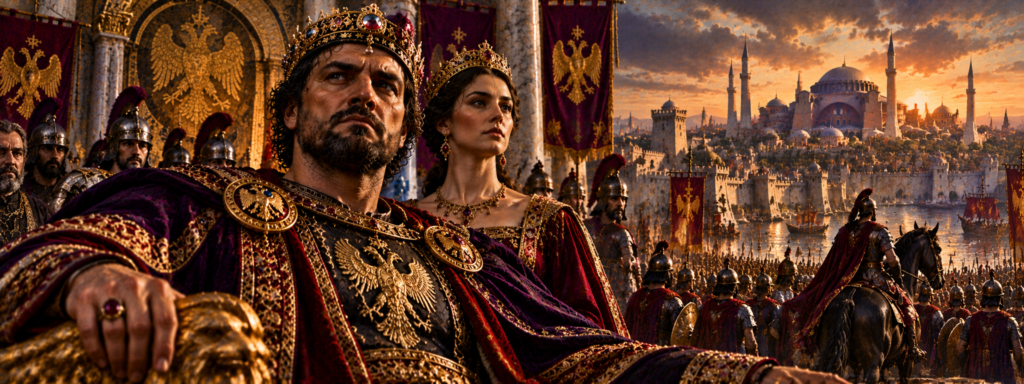
Andronikos I Komnenos: The Ruthless Byzantine Emperor Who Drowned His Empire in Blood
He was a handsome prince, a notorious seducer, a daring fugitive, and one of the most charismatic figures ever to emerge from the Byzantine imperial family. For decades, Andronikos Komnenos wandered between royal courts, foreign kingdoms, and dangerous political intrigues, leaving behind scandal, broken alliances, and powerful enemies. When he finally seized the throne of Constantinople in 1183, he promised to rescue the empire from corruption and aristocratic greed. Instead, his government became associated with executions, political terror, and increasingly desperate attempts to eliminate anyone who threatened his authority. Two years later, the people who had once welcomed him as their deliverer dragged him through the streets, subjected him to appalling public humiliation, and killed him in one of the most infamous episodes of violence in Byzantine history.
The Emperor Who Was Torn Apart by His Own People
In September 1185, the streets of Constantinople witnessed a spectacle that exposed the terrifying instability of imperial power. Andronikos I Komnenos, the emperor who had ruled the Byzantine Empire through a combination of popular promises and increasingly severe repression, had lost control of his capital. His enemies had seized the political initiative, his supporters were abandoning him, and the population that had once celebrated his arrival now demanded his destruction. The man who had spent much of his life escaping imprisonment and political danger had finally run out of places to hide.
Only two years earlier, Andronikos had presented himself as the savior of an empire supposedly corrupted by selfish aristocrats and incompetent officials. His reputation as a courageous adventurer, combined with his membership in the prestigious Komnenian dynasty, made him attractive to people frustrated by the government of the young emperor Alexios II. He promised to defend legitimate imperial authority, restrain abuses, and restore order. Those promises helped him enter Constantinople as a powerful political figure before he transformed himself into its ruler.
The transformation was accompanied by bloodshed. Political opponents were imprisoned, blinded, executed, or driven into exile, while the young emperor whose rights Andronikos had claimed to defend was murdered. Members of the imperial aristocracy became targets of suspicion, and the government increasingly relied on coercion to suppress resistance. Ancient and medieval political violence was hardly unusual, but Andronikos’s reign acquired an especially notorious reputation because his initial promises of justice gave way to an atmosphere of fear.
The historian Niketas Choniates, one of the most important sources for the period, portrays Andronikos as a ruler whose attractive appearance and persuasive manner concealed extraordinary cruelty. Choniates wrote with the perspective of an educated Byzantine official who had strong reasons to condemn the emperor’s attacks on the aristocracy. His account therefore requires critical reading, particularly when describing motives and sensational incidents. Nevertheless, the broad sequence of political purges, rebellions, military failures, and violent overthrow is supported by the historical record.
By the summer of 1185, Andronikos faced a military disaster. Norman forces from the Kingdom of Sicily had invaded Byzantine territory, captured Thessalonica, and threatened the empire’s security. The fall of one of Byzantium’s most important cities exposed the weakness of the government and intensified resentment in Constantinople. The emperor’s increasingly harsh responses to perceived enemies did little to restore confidence.
When a rebellion erupted in the capital, Andronikos attempted to escape. He was captured and brought back before a population determined to punish him. The accounts of his final hours describe a succession of humiliations and injuries inflicted by a crowd that had abandoned any pretense of imperial reverence. He was eventually killed, and his body was treated with contempt.
His death became a grim reversal of the political violence through which he had governed. Yet reducing Andronikos to a bloodthirsty tyrant obscures the complicated circumstances that allowed him to rise. His reign emerged from genuine problems within the Byzantine state, including aristocratic competition, administrative corruption, dynastic uncertainty, and resentment toward foreign merchants. His promises appealed to real grievances, even if his methods ultimately deepened the crisis.
The story of Andronikos I is therefore more than a tale of cruelty. It is the history of a charismatic reformer who exploited popular anger, destroyed rivals in the name of justice, and discovered that terror could not guarantee the survival of his throne.
Born Into the Komnenian Dynasty
Andronikos Komnenos was born around 1118, although the precise date remains uncertain. He belonged to the Komnenian dynasty, one of the most powerful families in Byzantine history. His grandfather was Isaac Komnenos, a son of Emperor Alexios I Komnenos, while his father was another Isaac Komnenos, a prominent member of the imperial family. These connections placed Andronikos close to the throne from birth, even though he was not the direct heir.
The Komnenian dynasty had restored a measure of Byzantine strength after the severe military and political crises of the late eleventh century. Alexios I, who ruled from 1081 to 1118, reorganized imperial defenses, negotiated with the leaders of the First Crusade, and stabilized important aspects of government. His successors continued efforts to preserve Byzantine authority in the Balkans, Anatolia, and eastern Mediterranean. The empire remained wealthy and sophisticated, but its security depended on careful diplomacy and military leadership.
Andronikos grew up in a world where family relationships were inseparable from politics. Imperial marriages connected the Komnenoi to aristocratic households, foreign dynasties, and military commanders. The emperor’s relatives occupied influential positions, while rival branches of the family competed for prestige and access to power. A prince could enjoy enormous privilege while remaining vulnerable to suspicion if his ambitions threatened the reigning ruler.
The young Andronikos was reportedly educated alongside his cousin Manuel Komnenos, who became Emperor Manuel I in 1143. The two men shared dynastic connections and familiarity with the imperial court, but their relationship became increasingly troubled. Manuel was an energetic ruler with ambitious foreign policies, while Andronikos developed a reputation for independence, romantic scandals, and political unreliability. Their rivalry would shape much of his adult life.
Byzantine aristocratic culture valued education, eloquence, physical appearance, and military ability. Andronikos appears to have possessed several of these qualities. Choniates describes him as handsome, physically impressive, and capable of charming those around him. Such descriptions may contain literary embellishment, but they reflect a consistent tradition that regarded him as unusually charismatic.
His personal appeal mattered because imperial politics depended heavily on relationships. A prince who could attract supporters among soldiers, aristocrats, and foreign rulers possessed opportunities unavailable to less persuasive figures. Andronikos repeatedly exploited those opportunities during his long career of exile and intrigue. His charm would help him survive situations that might have destroyed a less resourceful man.
Yet the same qualities also made him dangerous to the reigning emperor. His ambitions, romantic relationships, and willingness to challenge authority repeatedly brought him into conflict with Manuel I. Long before he became emperor, Andronikos had acquired a reputation as one of the most troublesome members of the imperial family.
The Handsome Prince With a Dangerous Reputation
Andronikos’s early adult life became notorious for its combination of political intrigue and romantic scandal. Byzantine sources portray him as a man who pursued relationships without much regard for the expectations governing imperial relatives. His affairs created embarrassment within the court and contributed to tensions with powerful families. Some details are preserved through hostile or moralizing narratives, but his reputation for unconventional relationships is a consistent feature of the surviving tradition.
One of the most controversial relationships attributed to him involved Eudokia Komnene, a woman closely related to the imperial family. Byzantine writers treated the affair as scandalous because of the degree of kinship involved and the expectations surrounding aristocratic marriage. The relationship reportedly provoked anger among Eudokia’s relatives, creating personal dangers for Andronikos. The exact sequence of incidents is difficult to verify, but the broader scandal became part of his public reputation.
Choniates describes episodes in which Andronikos narrowly escaped attacks by offended relatives. These stories emphasize his courage, quick thinking, and willingness to take risks. They also fit a literary pattern in which a charismatic aristocrat survives through daring and physical agility. Individual details may have been dramatized, but they help explain how later generations remembered him as a reckless adventurer.
His relationship with Manuel I deteriorated amid accusations of disloyalty and political ambition. Andronikos held military responsibilities during his career, including assignments connected with the empire’s eastern territories. Yet he repeatedly came under suspicion, and his movements were restricted. The precise causes of each confrontation remain uncertain because the sources combine political accusations with personal grievances.
The emperor’s concerns were not necessarily irrational. Members of the Komnenian family possessed dynastic legitimacy that could attract supporters during periods of instability. A charismatic prince with military experience and aristocratic connections could become a dangerous rival even without openly proclaiming himself emperor. Manuel therefore had strong political reasons to monitor Andronikos’s activities.
Andronikos’s behavior also reflected the opportunities available to an imperial relative who refused to accept a subordinate role. He could seek appointments, cultivate foreign alliances, and exploit family connections across the Byzantine world. His career became a sequence of attempts to gain influence followed by conflict with the government. The pattern would continue for decades.
The future emperor’s most extraordinary adventures began when he found himself imprisoned.
Imprisonment, Escape, and the Making of a Legend
Andronikos spent periods of his life in confinement after falling under suspicion during Manuel’s reign. Byzantine chronicles describe his imprisonment in Constantinople and several attempts to escape. The accounts contain dramatic details involving hidden passages, deception, and remarkable endurance. Although the precise circumstances are not always secure, his eventual escape from imperial custody is an important part of his historical career.
One famous tradition describes Andronikos exploiting a concealed opening in his prison and hiding while guards believed he had disappeared. The story presents him as resourceful and patient, capable of enduring extraordinary discomfort to regain freedom. Later narratives also describe further attempts to escape confinement, reinforcing his reputation as a man who refused to submit to imperial authority. These episodes may have been embellished through repeated storytelling.
His successful flight eventually carried him beyond the immediate reach of Constantinople. He traveled through territories where Byzantine influence intersected with the interests of neighboring rulers. Such journeys were dangerous because political refugees could become valuable bargaining assets. A foreign ruler might protect an imperial exile, but that protection could disappear if diplomatic circumstances changed.
Andronikos sought refuge among rulers who recognized the potential advantage of sheltering a member of the Komnenian dynasty. His movements brought him into contact with courts in eastern Europe and the eastern Mediterranean. These experiences exposed him to different political systems and provided opportunities to cultivate relationships beyond the Byzantine aristocracy. They also made him increasingly difficult for Manuel to control.
The emperor repeatedly attempted to secure Andronikos’s return or submission. The political stakes were significant because an exiled imperial relative could serve as a figurehead for opposition. Foreign rulers might threaten to support his claims in exchange for concessions from Constantinople. Andronikos’s continued freedom therefore complicated Byzantine diplomacy.
His adventures helped create a romantic reputation that later contributed to his political appeal. He appeared to possess the courage, charm, and determination associated with an idealized warrior-prince. Yet the same record also revealed a willingness to disregard established authority and exploit political divisions. These qualities would become far more dangerous when he eventually controlled the imperial government himself.
A Fugitive Among Foreign Kings
Andronikos’s years outside Constantinople took him through a remarkable range of political environments. Byzantine sources associate him with courts in Galicia, Antioch, Jerusalem, and territories influenced by Muslim rulers. His movements were shaped by personal relationships, diplomatic opportunities, and the need to avoid capture by Manuel’s agents. The surviving chronology is not always straightforward, but the broader pattern of prolonged exile is clear.
During one period, Andronikos found refuge in the Principality of Antioch, a crusader state whose rulers maintained complicated relations with Byzantium. Antioch occupied a strategic position between Byzantine territories, Muslim powers, and other crusader principalities. Its politics involved dynastic marriages, military alliances, and disputes over sovereignty. A Byzantine prince could find opportunities there, but his presence could also create diplomatic difficulties.
Andronikos became associated with Philippa of Antioch, a sister of Empress Maria of Antioch, Manuel’s wife. Their relationship reportedly caused scandal and further angered the Byzantine emperor. The affair also complicated Andronikos’s position because Philippa belonged to a family connected to both crusader and imperial politics. Personal relationships once again became entangled with diplomatic consequences.
He later traveled to the Kingdom of Jerusalem, where he received a favorable reception from King Amalric I. The kingdom’s rulers valued connections with Byzantium because imperial support could strengthen their position against neighboring Muslim powers. Andronikos’s dynastic status made him a potentially useful guest. Yet his conduct again created controversy.
His relationship with Theodora Komnene, a young widow related to the imperial family, became one of the most famous episodes of his exile. Theodora had previously been married to Baldwin III of Jerusalem, and her position gave her considerable prestige. Andronikos reportedly began a relationship with her despite the ecclesiastical objections associated with their kinship. The couple eventually left the kingdom together.
The relationship appears to have been enduring, and Theodora accompanied Andronikos through subsequent years of wandering. They had children together, including a son named Alexios. Their partnership became an important part of his personal history, although later accounts often emphasized the scandalous circumstances of its beginning. The available evidence does not permit a complete reconstruction of their private relationship.
Andronikos and Theodora eventually found protection in territories under Muslim rule, including areas associated with the ruler of Damascus. Their presence demonstrated the flexibility of medieval diplomacy, where religious boundaries did not prevent political alliances or personal refuge. For Manuel, however, the continued independence of his troublesome cousin remained a source of frustration.
The emperor eventually succeeded in bringing Andronikos back into a subordinate relationship with the imperial government, but the reconciliation did not erase decades of mistrust.
The Return From Exile and the Promise of Obedience
By the late 1170s, Andronikos had spent much of his adult life in conflict with Manuel I. His wanderings had made him famous, but they had also deprived him of a stable political position within the empire. Manuel eventually sought to bring him back under imperial authority, using pressure and negotiation to secure his submission. The reconciliation was important because it reduced the danger posed by a prominent dynastic exile.
Andronikos returned to Constantinople and formally acknowledged Manuel’s authority. Byzantine accounts describe ceremonial acts of submission, including public gestures intended to demonstrate repentance. Such ceremonies were politically significant because they transformed a rebellious aristocrat into an apparently obedient imperial relative. They also allowed Manuel to display generosity while preserving his supremacy.
The reconciliation did not place Andronikos at the center of government. He was eventually assigned a residence or administrative position away from Constantinople, commonly associated with Oinaion on the Black Sea coast. The arrangement allowed him to live within imperial territory while limiting his access to the capital’s political networks. It was a compromise between imprisonment and unrestricted freedom.
Manuel’s death in September 1180 transformed the situation. The emperor left a young son, Alexios II Komnenos, as heir, while the government passed into the hands of a regency dominated by the boy’s mother, Maria of Antioch, and influential court figures. The succession created an opportunity for ambitious relatives who questioned the regency’s legitimacy or policies. Andronikos was among those capable of exploiting the uncertainty.
The political environment was already tense. Manuel’s ambitious foreign policies had placed considerable demands on imperial resources, while the defeat at Myriokephalon in 1176 had damaged Byzantine prestige in Anatolia. Aristocratic competition remained intense, and resentment toward Latin merchants and advisers complicated court politics. The regency inherited these problems without the authority of an experienced adult emperor.
Andronikos now possessed a powerful political argument. He could present himself as a loyal member of the dynasty determined to protect the young emperor from corrupt advisers. His earlier scandals and conflicts with Manuel could be reinterpreted as evidence of independence from an unpopular political establishment. The adventurer who had spent decades defying authority was preparing to become its champion.
The Child Emperor and the Hated Regency
Alexios II became emperor in 1180 at approximately eleven years old. His youth made a regency unavoidable, and his mother Maria of Antioch emerged as a central figure in the government. Maria had been born into the Latin Christian aristocracy of the crusader states, and her foreign background became politically controversial. Byzantine resentment toward Latin influence provided opponents with an opportunity to attack her authority.
The regency also depended heavily on Alexios Komnenos, a powerful court official whose influence provoked hostility among rival aristocrats. Contemporary and later accounts describe resentment toward his position, although the details of his relationship with Maria and the nature of his authority were shaped by hostile political narratives. Opponents portrayed the government as corrupt, self-serving, and excessively favorable to Latins. These accusations became central to Andronikos’s campaign.
Anti-Latin sentiment had deep roots in Byzantine society. Italian merchants, particularly Venetians, Genoese, and Pisans, enjoyed commercial privileges that could generate resentment among local traders and urban populations. Religious differences between eastern and western Christians also contributed to suspicion, although political and economic competition often mattered as much as theology. The regency’s association with Latin interests made it vulnerable to accusations of betraying Byzantine society.
Andronikos began presenting himself as the defender of Alexios II and the legitimate imperial order. His public argument was not initially that he intended to replace the young emperor. Instead, he claimed that the regency had endangered the dynasty and that intervention was necessary to protect it. This distinction was politically useful because it allowed him to attract supporters who might have opposed an openly declared usurper.
The appeal proved effective. Aristocrats dissatisfied with the regency, soldiers seeking political advantage, and members of the urban population began supporting Andronikos. His charisma and dynastic connections strengthened his position, while his reputation as a daring opponent of court corruption made him attractive to people frustrated by the government. The movement gathered momentum as he advanced toward Constantinople.
The stage was set for a confrontation that would transform political resentment into violence.
The March on Constantinople
In 1182, Andronikos moved toward Constantinople with forces gathered from regions under his influence. His campaign was framed as an effort to rescue Alexios II from corrupt advisers rather than to overthrow the dynasty. The distinction helped him secure support from people who remained loyal to the young emperor but opposed the regency. It also complicated the government’s response because military resistance could be portrayed as opposition to legitimate reform.
The regency attempted to organize forces against him, but its position weakened as commanders and officials shifted allegiance. One important development involved the defection of military and naval elements that might otherwise have defended Constantinople. The precise sequence of defections is complicated, but the broader pattern is clear: Andronikos gained strength as the regency lost confidence and support. His advance became increasingly difficult to stop.
The political crisis also intensified hostility toward Latin residents of Constantinople. The city contained substantial communities of western merchants, clergy, and other foreigners whose privileges had long generated resentment. As the regency collapsed, these communities became vulnerable to popular violence. The resulting events would become one of the darkest episodes of the period.
Andronikos’s supporters portrayed him as a liberator who would restore justice and protect the empire from foreign influence. Yet the movement contained forces that he could not necessarily control. Popular anger, aristocratic rivalry, and anti-Latin hostility combined in an unstable political environment. The promise of reform became entangled with demands for revenge against perceived enemies.
By the time Andronikos entered Constantinople, the regency’s authority had largely collapsed. The young Alexios II remained emperor in name, but real power was shifting toward his ambitious relative. Andronikos had achieved the first stage of his political transformation without openly declaring himself emperor. The next stage would involve eliminating those who stood between him and the throne.
The Massacre of the Latins: Constantinople Turns on Its Foreigners
The events of 1182 included a violent attack on Latin communities in Constantinople, commonly known as the Massacre of the Latins. The violence occurred during the collapse of the regency and the rise of Andronikos’s supporters. Western merchants, clergy, and other residents became targets of popular anger, reflecting longstanding resentment over commercial privileges and political influence. The massacre severely damaged relations between Byzantium and the Latin West.
Contemporary western accounts describe extensive killing, looting, and the destruction of property. Some narratives include particularly disturbing allegations involving religious institutions and vulnerable inhabitants. The scale of the violence is difficult to determine because surviving sources contain exaggerations and polemical elements. Nevertheless, the massacre itself is historically secure and represented a major episode of communal violence.
Andronikos’s precise responsibility requires careful distinction. The violence occurred in the political environment created by his campaign, and his movement benefited from anti-Latin sentiment. Yet the surviving evidence does not establish that he personally ordered every attack or controlled the actions of the crowds. His role is best understood through the political consequences of a movement that exploited resentment toward the regency and its foreign associations.
The massacre had lasting diplomatic effects. Western rulers and merchants regarded the killings as evidence of Byzantine hostility, while Byzantine authorities faced the consequences of damaged commercial relationships. The event contributed to the deepening mistrust between eastern and western Christian societies. That mistrust would become increasingly important in the decades leading to the Fourth Crusade.
For Andronikos, the violence also demonstrated the dangerous power of popular mobilization. Crowds could help destroy a government, but their anger could become difficult to restrain once political authority collapsed. The same urban population that welcomed him could later turn against him. His eventual death would reveal how quickly the instruments of popular vengeance could be redirected.
The massacre therefore foreshadowed the central tragedy of his reign. Andronikos rose by presenting himself as the enemy of corruption and foreign influence, but the forces unleashed by that campaign contributed to instability and violence. His government would struggle to transform popular anger into lasting political order.
The Destruction of the Regency
After gaining control of Constantinople, Andronikos moved against the principal figures associated with the regency. Alexios Komnenos, the powerful court official who had dominated the government, was arrested and blinded. Blinding was a common Byzantine punishment intended to remove political rivals from public life without necessarily killing them. It also served as a visible demonstration of the victor’s power.
The removal of Alexios weakened the regency’s political network. Other officials and aristocrats associated with the previous government faced dismissal, imprisonment, or punishment. Andronikos’s supporters presented these actions as necessary measures against corruption and disloyalty. Yet the concentration of power in his hands increasingly threatened the young emperor whose rights he had claimed to defend.
Maria of Antioch became another target. Her foreign background and association with the unpopular regency made her politically vulnerable. Andronikos’s government accused her of treasonous activity, including alleged correspondence with foreign rulers. The charges were politically useful, but the surviving evidence does not establish that every accusation was genuine.
Maria was condemned and executed in 1182. The circumstances were particularly disturbing because she was the mother of the reigning emperor. Byzantine accounts describe Alexios II being compelled to authorize or sign the order for her death, although the precise procedural details are uncertain. The episode became a symbol of the young emperor’s helplessness under Andronikos’s control.
The execution removed a major dynastic obstacle. Maria had possessed legitimacy as the emperor’s mother and could have served as a rallying figure for opposition. Her death also demonstrated that Andronikos was prepared to use extreme measures against members of the imperial household. The promise to protect Alexios II had become increasingly hollow.
By the end of 1182, Andronikos controlled the government while the child emperor remained a ceremonial figure. The regency had been destroyed, its principal supporters eliminated, and the capital brought under his authority. The final step toward the throne would require removing Alexios himself.
The Murder of Alexios II: A Child Emperor Betrayed
The murder of Alexios II Komnenos in 1183 became the defining crime associated with Andronikos’s seizure of power. The young emperor had inherited the throne legitimately after Manuel I’s death and had initially served as the figurehead for Andronikos’s campaign against the regency. Yet once Andronikos controlled Constantinople, Alexios’s continued existence represented a political obstacle. As long as the boy lived, opponents could rally around him as the rightful emperor.
Andronikos was proclaimed co-emperor before Alexios’s death, establishing a formal position within the imperial hierarchy. The arrangement could have allowed him to govern as senior ruler while preserving the young emperor’s dynastic status. Instead, Alexios was killed, ending the direct succession from Manuel I. The murder transformed Andronikos from guardian into usurper.
Choniates reports that Alexios was strangled and that his body was disposed of in the sea. The historian also attributes a direct role in the killing to individuals acting under Andronikos’s authority. The exact details of the murder are difficult to verify independently, but the central fact that Alexios was killed during Andronikos’s seizure of power is secure. His death removed the most important legitimate rival to the throne.
The murder was especially shocking because Alexios was still a child. Byzantine political culture recognized the dangers posed by dynastic claimants, but the killing of a young emperor by a relative who had promised to protect him carried profound moral and political consequences. Later writers treated the episode as evidence of Andronikos’s hypocrisy and cruelty. It became central to the hostile tradition surrounding his reign.
The elimination of Alexios also damaged the legitimacy of Andronikos’s government. He could claim membership in the Komnenian dynasty, but he had destroyed the direct heir of Manuel I. Aristocrats who had supported his campaign against the regency now faced a ruler whose methods threatened the entire imperial family. The political coalition that brought him to power began to fracture.
Andronikos had finally obtained the throne, but the murder of Alexios II ensured that his reign would be haunted by the circumstances of its beginning.
The Elderly Emperor and His Teenage Bride
One of the most controversial episodes of Andronikos’s reign was his marriage to Agnes of France, the young widow of Alexios II. Agnes was a daughter of King Louis VII of France and had been sent to Constantinople as a child to marry the Byzantine heir. Her marriage to Alexios formed part of the diplomatic relationships between the Komnenian dynasty and western European royalty. After the young emperor’s murder, her position became politically precarious.
Andronikos married Agnes in 1183, despite the enormous age difference between them. He was approximately sixty-five years old, while Agnes was around twelve or thirteen. The marriage was intended to strengthen his legitimacy by connecting him to the previous imperial household and preserving an important diplomatic relationship. Yet the union became notorious because of the circumstances surrounding Alexios’s death and the bride’s youth.
Choniates condemned the marriage in strongly moralizing terms, portraying it as evidence of the emperor’s lack of restraint. His account reflects genuine concerns about the political and personal circumstances of the union, but it also belongs to a hostile narrative that emphasized Andronikos’s sexual misconduct. The surviving evidence does not permit reconstruction of Agnes’s private experiences or feelings. Her position as a young royal woman within a violent political environment is nevertheless clear.
The marriage reinforced the impression that Andronikos intended to appropriate every symbol of the previous dynasty. He had removed the regency, killed the young emperor, and taken the imperial throne. By marrying Alexios’s widow, he also absorbed a relationship that had originally served Manuel’s diplomatic strategy. The act was politically calculated, even if later writers emphasized its scandalous character.
Agnes survived Andronikos’s overthrow, although her later life is imperfectly documented. Her survival contrasts with the fate of many figures associated with the political struggles of the period. She had been married first to a child emperor who was murdered and then to the older relative responsible for replacing him. Her story illustrates the limited control that dynastic women often possessed over marriages arranged for political purposes.
The marriage became another element in Andronikos’s notorious reputation. It combined dynastic ambition, personal scandal, and the violent destruction of the previous government. Yet it was only one part of a broader transformation that would soon make his reign synonymous with political terror.
The Purge of the Aristocracy
Andronikos’s government initially gained support by promising to restrain the power of wealthy aristocrats and corrupt officials. Many Byzantine subjects resented abuses associated with tax collection, provincial administration, and the influence of powerful families. The Komnenian political system had concentrated important offices and resources among networks of relatives and allies, creating opportunities for favoritism. Andronikos exploited these grievances by presenting himself as a ruler determined to restore justice.
His administration appears to have undertaken measures against corruption and official exploitation. Choniates, despite his hostility toward Andronikos, acknowledged aspects of the emperor’s efforts to improve government and restrain abuses. These reforms complicate the image of a ruler motivated solely by cruelty. They suggest that his initial program addressed genuine administrative problems.
Yet the campaign against corruption became increasingly entangled with attacks on political opponents. Aristocrats who possessed independent influence could be accused of disloyalty, while members of prominent families faced imprisonment, confiscation, blinding, or execution. The distinction between punishing corruption and eliminating rivals became progressively blurred. A government that claimed to protect ordinary subjects increasingly relied on fear.
The purges affected the political elite whose cooperation was essential to imperial administration and military command. Byzantine government depended on educated officials, experienced commanders, and provincial landowners who could mobilize resources. Destroying or alienating these groups weakened the state’s capacity to respond to external threats. Andronikos’s hostility toward aristocratic power therefore created practical problems for his own government.
The emperor also faced genuine conspiracies and rebellions. His seizure of power had alienated members of the Komnenian family and other aristocrats who questioned his legitimacy. Some opponents attempted to organize resistance, making the threat of rebellion more than a product of hostile imagination. Yet the severity of his responses encouraged further opposition among those who feared punishment.
The political atmosphere became increasingly dangerous. Powerful families could not assume that loyalty would protect them, while military commanders might regard rebellion as preferable to waiting for accusations of treason. Andronikos’s government began reproducing the very instability it claimed to eliminate.
A Reign of Fear: Blinding, Imprisonment, and Execution
Byzantine political punishment often involved methods intended to remove rivals without necessarily killing them. Blinding, mutilation, confinement, and forced religious retirement could render an opponent politically ineffective while avoiding the direct consequences of execution. Such practices were not unique to Andronikos, but his reign became notorious for their frequent association with political repression. The surviving chronicles describe an atmosphere in which prominent individuals feared sudden arrest or punishment.
Choniates presents Andronikos as increasingly suspicious of aristocratic opposition. The emperor’s government pursued individuals accused of conspiracy, sometimes extending punishment to relatives and associates. The precise number of victims cannot be established, and later narratives may exaggerate the scale of repression. Nevertheless, the repeated rebellions and punitive responses indicate a serious breakdown in trust between the ruler and influential groups.
The historian’s descriptions also contain moral judgments that require caution. He frequently contrasts Andronikos’s attractive appearance and persuasive speech with his alleged cruelty, creating a literary portrait of deceptive tyranny. This structure makes the narrative compelling but can encourage readers to interpret every decision as evidence of personal wickedness. A careful reconstruction must distinguish documented actions from the author’s explanations of motive.
The emperor’s political position was genuinely insecure. He had seized power through a movement that destroyed the regency and killed the legitimate heir. Other members of the Komnenian dynasty possessed claims that could attract supporters, while provincial commanders retained military resources. Repression was therefore partly intended to prevent rival claimants from organizing resistance.
Yet coercion could not eliminate the underlying problem of legitimacy. Every execution or blinding might remove one opponent while creating resentment among surviving relatives and allies. The government increasingly depended on officials willing to enforce harsh measures, narrowing the circle of trusted supporters. Such conditions made the emperor vulnerable when military defeat or popular unrest weakened his authority.
The result was a dangerous political spiral. Fear encouraged conspiracy, conspiracy justified repression, and repression created further fear. Andronikos’s initial popularity could not survive indefinitely under those circumstances.
Rebellion in the Provinces
Resistance to Andronikos developed beyond Constantinople. Provincial aristocrats and military commanders possessed resources that could support rebellion, particularly in regions where imperial authority depended on cooperation with local elites. The emperor’s attacks on prominent families threatened these relationships and encouraged some opponents to challenge his rule openly. The resulting conflicts further weakened the empire’s ability to respond to external dangers.
One important center of opposition emerged in Nicaea, a major city in northwestern Anatolia. Members of the aristocracy associated with the Angelos family and other prominent groups resisted Andronikos’s authority. The rebellion reflected broader dissatisfaction among elites who feared the consequences of his purges. It also demonstrated that the emperor’s control over the provinces was less secure than his ceremonial authority in Constantinople suggested.
Andronikos responded with military force. Byzantine accounts describe sieges and harsh punishments directed against defeated opponents. Some details are sensational and require caution, but the use of coercive military operations against rebellious cities is historically secure. The campaigns consumed resources that might otherwise have supported frontier defense.
The emperor’s government also faced resistance in other regions, including territories where local commanders possessed substantial autonomy. These challenges were not necessarily coordinated into a single movement, but they collectively weakened central authority. The state increasingly devoted attention to suppressing internal opposition rather than confronting external threats. The political consequences were severe because Byzantium remained surrounded by powerful rivals.
Rebellion also damaged the emperor’s reputation among ordinary subjects. Military campaigns against Byzantine cities could produce destruction, displacement, and economic disruption. Communities that had initially welcomed promises of reform now faced the consequences of civil conflict. The distinction between protecting the population and punishing enemies became increasingly difficult to sustain.
The provincial revolts revealed the limits of Andronikos’s political strategy. He could eliminate individual opponents, but he could not easily replace the networks of cooperation that sustained imperial government. His attacks on aristocratic power weakened the very institutions needed to defend the empire.
The Norman Threat: Disaster Approaches From the West
While Andronikos struggled with internal opposition, the Byzantine Empire faced a major external threat from the Norman Kingdom of Sicily. The Normans had long competed with Byzantium for influence in southern Italy, the Adriatic, and the eastern Mediterranean. Their rulers possessed substantial military and naval resources, making them formidable opponents. Relations between the two states had alternated between diplomacy, marriage negotiations, and warfare.
In 1185, King William II of Sicily launched a major expedition against Byzantine territory. The campaign exploited the empire’s internal instability and the weakness of Andronikos’s government. Norman forces crossed the Adriatic and advanced through important coastal regions, threatening cities whose defenses depended on effective imperial coordination. The invasion created a crisis at a moment when Byzantine resources were already strained by rebellion.
The Norman army captured Dyrrhachium, a strategically important city on the Adriatic coast, before advancing toward Thessalonica. The fall of Dyrrhachium opened a route deeper into Byzantine territory and demonstrated the vulnerability of imperial defenses. Andronikos’s government attempted to organize resistance, but military coordination was inadequate. Commanders faced pressure from both external enemies and internal political suspicion.
Thessalonica was one of the empire’s largest and most important cities. Its commercial wealth, religious significance, and strategic location made it a major center of Byzantine life. Losing the city would be a severe blow to imperial prestige and security. The Norman advance therefore threatened far more than a single provincial fortress.
The government appointed commanders to defend Thessalonica, but preparations proved insufficient. The city faced a determined enemy with substantial military resources, while its own defenses suffered from organizational weaknesses. The approaching siege would expose the consequences of a political system increasingly consumed by internal conflict.
The Sack of Thessalonica: A City Left to Suffer
The Normans captured Thessalonica in August 1185 after a siege that exposed serious weaknesses in Byzantine defense. The city’s fall was one of the most devastating military disasters of Andronikos’s reign. Its inhabitants experienced violence, plunder, and disruption, while the empire lost control of a major urban center. The event intensified the political crisis already threatening Constantinople.
The archbishop Eustathios of Thessalonica, an important contemporary witness, described the siege and its aftermath in detail. His account provides valuable evidence of the suffering experienced by the population, although it also reflects his personal perspective and literary style. He criticized failures of leadership and the inadequate preparations that contributed to the city’s capture. His testimony reveals the depth of contemporary anger toward the imperial government’s handling of the crisis.
The Norman victory demonstrated that Byzantine military resources had been weakened by internal divisions. Commanders struggled to coordinate defense, while political suspicion complicated decision-making. Andronikos’s government had devoted substantial attention to suppressing domestic opponents, leaving it less capable of responding effectively to invasion. The consequences were now visible in the destruction inflicted on one of the empire’s greatest cities.
The fall of Thessalonica also damaged the emperor’s legitimacy. Byzantine rulers were expected to defend Christian cities and preserve the security of their subjects. A government that claimed to restore justice but failed to protect a major urban center faced severe criticism. The disaster strengthened the belief that Andronikos’s rule had become dangerous to the empire itself.
Norman forces continued threatening Byzantine territory after the capture. Their success encouraged further anxiety in Constantinople, where rumors of military failure and political betrayal spread. The emperor’s response became increasingly severe as he attempted to identify those responsible for the disaster. Yet punishment could not reverse the loss or restore confidence.
Thessalonica became the event that transformed widespread dissatisfaction into an immediate crisis of imperial survival.
The Final Days: Constantinople Turns Against Andronikos
By September 1185, Andronikos’s government was collapsing. The Norman invasion had exposed military weakness, provincial rebellions had damaged central authority, and the emperor’s harsh treatment of opponents had alienated powerful groups. Constantinople itself became increasingly unstable as rumors and accusations circulated. The ruler who had once entered the city as a popular reformer now faced a population prepared to abandon him.
The immediate crisis centered on Isaac Angelos, a member of a prominent aristocratic family associated with opposition to Andronikos. The emperor’s officials attempted to arrest Isaac, apparently suspecting him of involvement in conspiracy. The circumstances remain uncertain, but the attempted arrest triggered a violent confrontation. Isaac resisted and killed the official sent to seize him, creating a dramatic challenge to imperial authority.
Isaac sought refuge in Hagia Sophia, where his actions attracted supporters. The great cathedral possessed immense religious and political significance, and sanctuary there could transform an individual’s predicament into a public issue. Crowds gathered, and opposition to Andronikos rapidly intensified. The movement developed into a full-scale uprising.
The population proclaimed Isaac emperor, creating a direct rival to Andronikos. The speed of the rebellion demonstrated how thoroughly the existing government had lost confidence. Soldiers and officials who might once have defended the emperor hesitated or changed allegiance. The political structure that had sustained his authority began disintegrating.
Andronikos attempted to respond, but his position was increasingly hopeless. He had relied on fear to suppress opposition, yet fear could no longer guarantee obedience when the population believed his downfall was imminent. His enemies now possessed a legitimate alternative ruler and growing popular support. The emperor’s remaining options narrowed rapidly.
The man who had spent decades escaping political danger was once again forced to flee.
Flight, Capture, and the End of a Tyrant
Andronikos attempted to escape Constantinople after the uprising succeeded. He reportedly sought to leave by sea, accompanied by members of his household, including Agnes of France. The precise details of the attempted flight vary among the sources, but he was unable to reach safety. He was captured and returned to the capital, where the new government and hostile population awaited him.
The treatment of Andronikos after his capture became one of the most infamous episodes in Byzantine history. Choniates describes a succession of humiliations and physical abuses inflicted on the former emperor. The narrative emphasizes the reversal of power, portraying the once-feared ruler as helpless before those he had governed. Some details may have been shaped by literary conventions of tyrannical downfall, but the broad fact of his violent public humiliation is secure.
Andronikos was subjected to severe mistreatment before his death. Accounts describe beatings, mutilation, and public exposure, with the crowd participating in the destruction of a ruler it had once supported. The violence was not a formal judicial proceeding in any ordinary sense. It was an eruption of political vengeance in which the boundary between punishment and mob brutality disappeared.
The former emperor was eventually killed in September 1185. His death ended a reign of approximately two years and marked the beginning of the Angelos dynasty under Isaac II. The new government inherited an empire weakened by internal conflict and external invasion. Removing Andronikos eliminated the immediate source of political terror but did not resolve the structural problems that had contributed to his rise.
The manner of his death became central to his historical reputation. Choniates presented the spectacle as a moral reversal in which a cruel ruler experienced the violence he had inflicted on others. Such interpretations reflect the historian’s ethical framework and hostility toward Andronikos. The event nevertheless illustrates the extreme volatility of Byzantine political power.
An emperor who had commanded executions and inspired fear could become the victim of collective violence within hours of losing authority.
The Fall of the Komnenian Order
Andronikos’s death marked the end of direct Komnenian rule in Constantinople. The dynasty had governed the empire since 1081, overseeing periods of military recovery, diplomatic ambition, and administrative transformation. Under Alexios I, John II, and Manuel I, the Komnenian emperors had restored substantial imperial prestige after the crises of the eleventh century. Their political system depended heavily on family networks, aristocratic alliances, and the personal authority of powerful rulers.
Andronikos’s seizure of power exposed the weaknesses of that system. The young Alexios II lacked the experience to control competing aristocratic factions, while the regency became vulnerable to accusations of corruption and foreign influence. Andronikos exploited those grievances but ultimately destroyed much of the political cooperation required to sustain the empire. His purges and military campaigns weakened the institutions he claimed to reform.
Isaac II Angelos inherited a difficult situation. The Norman invasion still required attention, provincial rebellions had damaged central authority, and aristocratic relationships needed rebuilding. The new dynasty faced challenges that could not be resolved simply by replacing one emperor. The empire’s military and administrative problems continued shaping its future.
The Komnenian family did not disappear from history. Members of the dynasty retained influence in various regions, and descendants would later establish the Empire of Trebizond after the Fourth Crusade. Nevertheless, the political order centered on the Komnenian emperors of Constantinople had ended. Andronikos’s reign became the violent conclusion to a century of dynastic rule.
The empire would survive for centuries, but the instability of the late twelfth century contributed to the conditions that made the catastrophe of 1204 possible. The Fourth Crusade’s capture of Constantinople occurred nearly two decades after Andronikos’s death and resulted from a complex sequence of political, financial, and diplomatic developments. It would be inaccurate to attribute that disaster solely to his reign. Yet his government formed part of the broader weakening of imperial authority that preceded it.
Was Andronikos Really a Mad Emperor?
Andronikos I is sometimes described as mad, paranoid, or consumed by pathological cruelty. These characterizations reflect the violence of his reign and the hostile descriptions preserved by Byzantine historians. Yet the surviving evidence does not permit a reliable clinical diagnosis. Choniates and other chroniclers were describing political behavior through moral and literary frameworks, not conducting psychiatric assessments.
His actions can be examined without assigning him a modern medical condition. He seized power through political manipulation, ordered or authorized the elimination of rivals, and relied increasingly on coercion. His government suppressed rebellions with harsh measures and became associated with widespread fear among aristocrats. These developments provide substantial grounds for discussing authoritarian rule and political brutality.
The claim that he was driven entirely by paranoia requires more caution. Andronikos faced genuine threats from rival members of the Komnenian family, provincial commanders, and foreign enemies. His accession had been achieved through the destruction of a regency and the murder of the legitimate emperor, creating powerful reasons for opponents to challenge him. Suspicion was therefore not necessarily irrational, even when his responses were excessive or destructive.
His early popularity also complicates the image of an inherently incapable ruler. Andronikos recognized genuine grievances involving corruption, aristocratic privilege, and unpopular foreign influence. His promises attracted substantial support, and some administrative measures appear to have addressed real abuses. The problem was that his methods of securing authority increasingly undermined the cooperation required for effective government.
Choniates’s portrait remains invaluable but must be read critically. The historian belonged to the educated elite threatened by Andronikos’s policies and wrote within a tradition that condemned tyrannical rulers through vivid moral contrasts. His descriptions of cruelty may preserve genuine events while also emphasizing sensational details. A balanced interpretation must distinguish the historical record of repression from literary explanations of personality.
The central issue is therefore not whether Andronikos was clinically mad. It is how a ruler capable of attracting popular support and identifying administrative problems became associated with such severe political violence that his government collapsed within two years. His reign illustrates the danger of attempting to reform an empire through coercion while destroying the institutions needed to govern it.
The Charismatic Reformer Who Became a Tyrant
Andronikos’s political career contains a striking contradiction. For much of his life, he appeared as an outsider challenging established authority, surviving imprisonment, exile, and the hostility of powerful rulers. His adventures created a reputation for courage and independence, while his charisma allowed him to cultivate supporters across political and cultural boundaries. When the regency of Alexios II became unpopular, these qualities helped him present himself as a defender of justice.
His rise depended on genuine dissatisfaction with the existing government. Aristocratic privilege, administrative abuses, and resentment toward Latin influence created an environment in which promises of reform could attract support. Andronikos understood how to exploit these grievances and transform them into a political movement. His campaign against the regency succeeded because it appealed to more than personal ambition.
Yet the movement also contained dangerous contradictions. Andronikos claimed to protect the young emperor while gradually removing the people responsible for his government. Once he controlled Constantinople, he eliminated Alexios II and assumed the throne himself. The transition from guardian to usurper undermined the legitimacy of his rule and encouraged opposition among aristocrats who had initially supported him.
His subsequent purges deepened the problem. By treating powerful families as potential enemies, he weakened the administrative and military networks necessary for effective government. Rebellions followed, requiring further coercion and diverting resources from external defense. The empire became increasingly vulnerable to threats that demanded coordinated leadership.
The Norman invasion exposed the consequences. The fall of Thessalonica demonstrated that the government could not adequately protect one of its most important cities. The disaster destroyed remaining confidence in Andronikos’s authority and created the conditions for his overthrow. His political survival had become inseparable from repression, but repression could no longer compensate for military failure.
The transformation from popular reformer to feared ruler was therefore not simply a change in personal character. It reflected the destructive interaction between ambitious promises, contested legitimacy, aristocratic resistance, and increasingly coercive government. Andronikos’s methods made the problems he inherited more difficult to solve.
The Dark Legacy of Andronikos I Komnenos
Andronikos I Komnenos remains one of the most controversial rulers in Byzantine history. His extraordinary personal career combined aristocratic privilege with rebellion, imprisonment, exile, foreign alliances, and romantic scandal. He possessed the charisma and determination necessary to survive decades of political danger, eventually returning to Constantinople as the leader of a movement that promised reform. His rise demonstrated the appeal of a ruler who claimed to challenge corruption and defend ordinary subjects against powerful elites.
The promises that brought him to power did not produce lasting stability. His campaign against the regency culminated in the destruction of its principal supporters and the murder of the young emperor Alexios II. The marriage to Agnes of France further associated his government with the appropriation of the previous dynasty’s legitimacy. These actions transformed a movement presented as dynastic protection into an unmistakable seizure of power.
Once emperor, Andronikos attempted to restrain aristocratic abuses while simultaneously eliminating political opponents. Some reforms addressed genuine administrative problems, but the use of imprisonment, blinding, confiscation, and execution created widespread fear. Provincial rebellions followed, weakening the state’s ability to respond to external threats. The government became increasingly dependent on coercion at the very moment when it needed cooperation.
The Norman invasion of 1185 exposed the consequences of this instability. The capture of Thessalonica was a devastating military and political defeat, intensifying resentment against the emperor. When Isaac Angelos resisted arrest and sought sanctuary in Hagia Sophia, popular opposition rapidly developed into rebellion. Andronikos lost control of Constantinople and attempted to flee, only to be captured and subjected to violent public humiliation.
His death was a grim reversal of the political violence associated with his reign. The crowd that killed him had once belonged to the population that welcomed his promises of reform. The transformation illustrates the volatility of popular support when political legitimacy depends on personal charisma and fear rather than stable institutions. Andronikos could command obedience while his authority appeared secure, but he could not preserve that obedience once military failure exposed his weakness.
His reputation for cruelty rests on substantial historical events, although the most sensational details preserved by hostile chroniclers require caution. The murder of Alexios II, the repression of aristocratic opponents, and the violent suppression of rebellions are central to understanding his government. Claims about his private motives or mental condition cannot be established with comparable certainty. His actions were politically consequential enough without treating every hostile anecdote as unquestionable fact.
The larger tragedy lies in the relationship between reform and repression. Andronikos recognized grievances that threatened the Komnenian political order, but his methods damaged the institutions necessary to address them. By destroying rivals and weakening aristocratic cooperation, he made the empire more vulnerable to rebellion and invasion. His government became an example of how attempts to restore justice through coercion can produce instability rather than renewal.
Andronikos Komnenos spent much of his life escaping the consequences of his ambitions. He survived imprisonment, crossed foreign kingdoms, cultivated powerful allies, and eventually seized the throne of Constantinople through a movement that promised to rescue the empire from corruption. Yet the ruler who claimed to protect the weak became associated with the destruction of political opponents, while the dynasty he professed to defend was shattered by the murder of its young emperor. His final downfall revealed how little protection imperial authority could provide once soldiers, aristocrats, and ordinary citizens withdrew their support. The charismatic adventurer who had charmed courts across the medieval world ended his life as a condemned ruler at the mercy of an enraged crowd. His reign remains a haunting example of the distance between promises of justice and the consequences of governing through fear.