
Gallienus: Rome’s Besieged Emperor and the Empire That Fell Apart Around Him
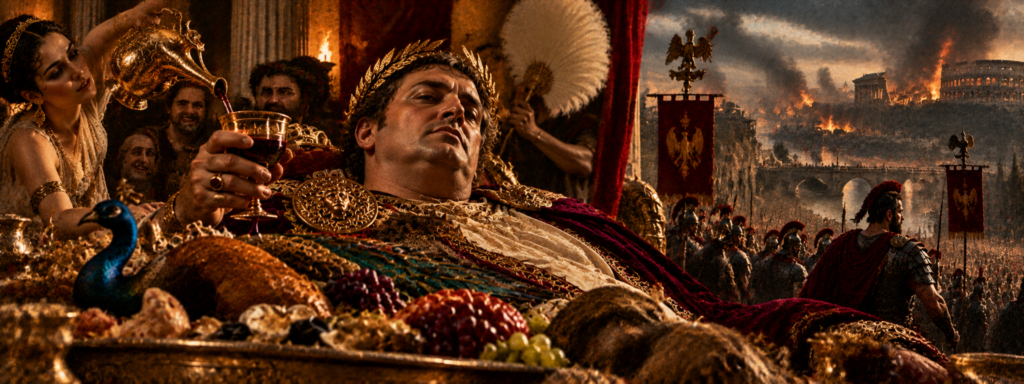
His father was captured by Rome’s greatest eastern enemy, his son was murdered by a usurper, and entire provinces broke away from imperial control. While foreign armies crossed the frontiers and rival emperors seized territory, ancient writers accused Gallienus of surrendering himself to luxurious banquets, extravagant entertainment, and the pleasures of the imperial court. They portrayed him as a ruler who laughed while his empire collapsed, punished soldiers for trivial offenses, and seemed more interested in personal enjoyment than saving Rome. Yet behind this scandalous reputation lies a far more complicated story. Gallienus spent fifteen years fighting to preserve an empire threatened by invasion, plague, rebellion, and political fragmentation, only to be murdered by officers within his own army.
In the summer of AD 260, the Roman Empire suffered one of the most humiliating disasters in its history. Emperor Valerian, who had spent years fighting to defend Rome’s eastern provinces against the expanding power of the Sasanian Persian Empire, was captured by King Shapur I. The circumstances remain disputed, but the outcome was unmistakable. A reigning Roman emperor had fallen alive into enemy hands, an unprecedented catastrophe that shattered the image of imperial invincibility and sent shock waves through the Roman world.
For Valerian’s son and fellow emperor, Gallienus, the consequences were devastating. He had been governing the western provinces while his father conducted campaigns in the east, but the capture transformed their joint government into a crisis of legitimacy. Valerian remained a prisoner, the eastern frontier was exposed, and ambitious commanders began calculating whether the imperial family could survive such a disgrace. Gallienus suddenly found himself responsible for an empire whose enemies were advancing from several directions and whose own military officers were increasingly willing to challenge the throne.
The danger was not confined to Persia. Along the Rhine and Danube, Germanic and other groups launched raids into Roman territory, exploiting weaknesses created by repeated military emergencies. In the western provinces, a commander named Postumus established a separate imperial regime that eventually controlled Gaul, Britain, and parts of Spain. In the east, the wealthy desert city of Palmyra became the center of a powerful regional administration under Odaenathus, whose family would later challenge Roman authority more openly. The empire did not formally dissolve into three equally independent states during Gallienus’s lifetime, but the fragmentation that would later become known as the Gallic and Palmyrene breakaways began under his rule.
Meanwhile, rebellion followed rebellion. Military commanders claimed the imperial title, soldiers shifted their loyalties, and provincial populations faced the consequences of civil war. Gallienus’s eldest son was killed during the struggle against Postumus, while other members of the imperial family became entangled in the violence. The emperor’s authority was challenged so frequently that later writers portrayed his reign as an almost continuous succession of disasters.
And yet, according to some ancient accounts, Gallienus behaved as though none of this mattered.
The most hostile surviving biographies describe an emperor devoted to elaborate meals, fashionable clothing, theatrical performances, and the pleasures of court life. They accuse him of responding to catastrophic news with indifference, enjoying extravagant celebrations while Roman territories slipped beyond his control, and treating the suffering of others as an inconvenience. The Historia Augusta, a notoriously unreliable collection of imperial biographies, presents particularly colorful stories of his alleged frivolity and cruelty.
Those stories helped create the familiar image of Gallienus as an irresponsible ruler who watched the Roman Empire disintegrate while amusing himself with banquets and entertainments. But the historical evidence tells a more complicated story. Gallienus personally conducted military campaigns, defeated rival claimants, reorganized aspects of imperial military leadership, and attempted to preserve central authority during one of the most destructive periods of the third century.
His reign raises a fascinating question: was Gallienus an incompetent pleasure-seeker who allowed Rome to collapse, or a capable ruler overwhelmed by circumstances that might have defeated almost anyone?
The surviving evidence does not support either extreme as a complete explanation. His government suffered devastating territorial losses, and his efforts to restore imperial unity repeatedly failed. At the same time, his military activity and administrative decisions reveal a ruler far more engaged than the scandalous literary portrait suggests. To understand Gallienus, it is necessary to look beyond the accusations of gluttony and indifference to the extraordinary crisis that engulfed the Roman world.
His story is one of family tragedy, military desperation, political betrayal, and an empire struggling to survive.
Born Into a World Already Beginning to Fracture
Publius Licinius Egnatius Gallienus was probably born around AD 218, although the precise year remains uncertain. His father, Publius Licinius Valerianus, belonged to the Roman senatorial aristocracy and possessed the social standing necessary for advancement within imperial government. His mother is generally identified as Egnatia Mariniana, a woman whose family connections helped reinforce the household’s aristocratic position. Gallienus therefore grew up within the privileged world of Roman political society, surrounded by the traditions and expectations associated with senatorial families.
The empire into which he was born remained enormous and wealthy, stretching from Britain and the Atlantic coast to the deserts of Syria and the frontiers of Mesopotamia. Roman cities flourished across the Mediterranean, supported by trade networks, agricultural production, taxation, and an extensive administrative system. The imperial army guarded long frontiers, while governors and local elites managed provincial affairs under the authority of the emperor. Yet beneath this appearance of stability, serious political and military weaknesses were developing.
The assassination of Emperor Severus Alexander in AD 235 marked the beginning of the period conventionally known as the Crisis of the Third Century. His death brought the soldier-emperor Maximinus Thrax to power and helped establish a pattern in which military support became increasingly decisive in determining imperial succession. Over the following decades, emperors were proclaimed, overthrown, and murdered with alarming frequency. Civil wars consumed resources that were desperately needed to defend the frontiers, while the army’s influence over imperial politics grew.
The crisis was not simply the result of poor leadership. Rome faced increasingly dangerous opponents along several frontiers, including powerful groups beyond the Rhine and Danube and the expanding Sasanian Empire in the east. Epidemic disease, commonly associated with the so-called Plague of Cyprian, affected parts of the Roman world during the middle decades of the century, although its precise demographic consequences remain uncertain. Economic pressures, disruptions to trade, and repeated military campaigns added further strain to imperial institutions.
Gallienus’s early career unfolded against this background of instability. He received the education and social preparation expected of an aristocratic Roman, although the details of his childhood are poorly documented. His marriage to Cornelia Salonina produced several sons, including Valerian II and Saloninus, who would later become important figures in the dynasty’s succession plans. The family appeared positioned for political prominence, but the dangers of imperial office would eventually destroy much of its future.
When Gallienus’s father became emperor, the young aristocrat was suddenly elevated into the center of a political struggle far more dangerous than the ordinary competition of senatorial life. The imperial throne offered extraordinary authority, but recent history had demonstrated that it also carried a substantial risk of violent death.
Valerian Takes the Throne: A Father and Son Divide the Empire
In AD 253, the Roman Empire experienced another rapid succession of rulers. Emperor Trebonianus Gallus and his son Volusianus were killed amid military rebellion, while Aemilianus briefly occupied the throne before being murdered by his own soldiers. Valerian, who commanded forces moving toward Italy, emerged as the next emperor. His accession reflected the same unstable military politics that had repeatedly transformed Roman commanders into imperial claimants.
Valerian quickly elevated Gallienus to the rank of Augustus, creating a joint imperial government. The arrangement was significant because it placed two adult emperors in positions of authority at the same time, allowing them to respond to threats across different regions. Rather than attempting to govern the entire empire from a single location, father and son divided military responsibilities. Valerian concentrated increasingly on the eastern provinces, while Gallienus assumed responsibility for major threats in the west.
This division was practical rather than a formal partition of the empire into separate states. Both rulers belonged to the same imperial government, and their authority was presented as complementary. Coins, inscriptions, and official ceremonies reinforced the legitimacy of the joint reign, while the elevation of Gallienus provided a recognized successor if Valerian died. In an era when unexpected imperial deaths frequently triggered civil war, the arrangement offered at least the possibility of dynastic continuity.
Gallienus faced immediate military challenges. The Rhine and Danube frontiers required constant attention, and hostile groups exploited opportunities created by Roman political instability. The emperor spent substantial periods away from Rome, conducting operations intended to restore security and maintain the loyalty of frontier armies. His presence in military regions contradicts the later caricature of a ruler who spent his entire reign enjoying palace entertainments.
The joint government initially offered a workable response to the empire’s geographical scale. Valerian could confront Persian aggression while Gallienus defended western territories, reducing the delays involved in moving one emperor between distant frontiers. Yet the arrangement depended heavily on the personal survival and military success of both rulers. If either emperor suffered a catastrophic defeat, the legitimacy of the entire dynasty could be threatened.
That danger became reality in AD 260, when Valerian’s eastern campaign ended in disaster.
The Persian Catastrophe: When Rome’s Emperor Became a Prisoner
The Sasanian Empire had emerged during the early third century as a formidable rival to Roman power. Its rulers claimed authority over territories previously associated with the Parthian Empire and pursued ambitious military campaigns along Rome’s eastern frontier. Shapur I, who became king in the early 240s, proved particularly dangerous, conducting major operations against Roman territories and challenging imperial control over Mesopotamia and Syria. His campaigns exposed weaknesses in Roman frontier defenses and forced successive emperors to devote substantial resources to the east.
Valerian traveled east to confront the threat, but his campaign encountered serious difficulties. Roman forces suffered from military pressure and possibly epidemic disease, while Persian operations disrupted imperial positions. In AD 260, near Edessa in northern Mesopotamia, Valerian fell into Persian hands. The precise circumstances remain disputed, with ancient and later accounts offering different explanations involving military defeat, negotiations, or deception.
Shapur celebrated the capture as an extraordinary victory. Persian royal inscriptions and monumental reliefs commemorated his success against Roman emperors, presenting the event as evidence of Sasanian military superiority. The famous relief at Naqsh-e Rostam depicts Shapur in a position of triumph over Roman imperial figures, although identifying every figure and interpreting the symbolism requires care. The visual message was unmistakable: Persia had achieved a victory that challenged Rome’s prestige.
Later Roman and Christian writers embellished Valerian’s captivity with humiliating stories. Lactantius claimed that Shapur used the captive emperor as a human mounting block when climbing onto his horse and that Valerian’s body was eventually treated with grotesque indignity. These details are not independently verified and belong to a hostile tradition shaped partly by Valerian’s persecution of Christians. What is securely established is that Valerian was captured and never returned to Roman rule.
For Gallienus, the political consequences were immense. His father remained alive but powerless in enemy captivity, leaving the son to govern without the clear transition that would normally follow an emperor’s death. The capture damaged the dynasty’s prestige and encouraged rivals to question whether Gallienus could preserve imperial security. Military commanders who had previously accepted Valerian’s authority now faced the temptation to establish independent regimes.
The emperor also confronted a painful personal dilemma. Attempting to rescue Valerian through a major eastern expedition would have required forces urgently needed elsewhere, while abandoning western defenses could have encouraged further invasions and rebellions. The surviving evidence does not allow Gallienus’s private response to his father’s capture to be reconstructed. Ancient accusations that he showed no concern should therefore be treated cautiously, particularly because his strategic options were severely constrained.
Valerian’s captivity became a defining humiliation of the third-century crisis. Rome had lost emperors in battle before, but the capture of a reigning emperor alive by a foreign king was unprecedented. The event undermined the aura of invincibility surrounding imperial authority and exposed the vulnerability of a government already struggling to maintain control over distant provinces.
The Empire Begins to Break Apart
Following Valerian’s capture, Gallienus faced a political emergency that threatened the territorial unity of the Roman world. In the west, military commanders questioned the central government’s ability to defend the frontier provinces. In the east, Persian pressure and the collapse of established authority created opportunities for regional leaders. Throughout the empire, soldiers and provincial communities increasingly relied on commanders who could provide immediate protection rather than distant imperial promises.
The resulting fragmentation is often described as the division of the Roman Empire into three parts: the central Roman government, the Gallic Empire, and the Palmyrene Empire. This description is useful for understanding the later stages of the third-century crisis, but it can be misleading when applied directly to Gallienus’s reign. The Gallic regime emerged under Postumus in AD 260, while Palmyra’s transformation into an openly competing imperial power occurred more fully after Gallienus’s death. During his lifetime, Odaenathus of Palmyra generally operated within a framework that acknowledged Roman imperial authority, even while exercising extraordinary regional independence.
Nevertheless, the fragmentation was real. Gallienus lost effective control over substantial western territories, while eastern defense increasingly depended on commanders whose autonomy grew beyond ordinary provincial arrangements. The emperor remained responsible for the central provinces, Italy, and important military regions along the Danube, but his resources were stretched across multiple fronts. Restoring unity required defeating rivals while simultaneously preventing foreign invasions.
The political consequences were devastating because each breakaway regime claimed to protect Roman interests. Postumus presented himself as a legitimate Roman emperor rather than the ruler of a foreign kingdom, while Odaenathus fought against Persia and helped restore security in the east. Their success made it harder for Gallienus to portray them simply as enemies of Rome. Provincial populations might reasonably prefer the protection of nearby commanders when the central government appeared unable to respond quickly.
Gallienus therefore confronted an extraordinary contradiction. The men who challenged his authority were sometimes among the most effective defenders of Roman territory. Defeating them could weaken frontier security, but allowing them to remain independent threatened imperial unity. This dilemma shaped his reign and helps explain why military success against one opponent rarely produced lasting stability.
Postumus: The General Who Stole the Western Provinces
The most significant western challenge emerged from Marcus Cassianius Latinius Postumus, a military commander operating along the Rhine frontier. Postumus gained support among soldiers and provincial communities during a period of intense pressure from Germanic raids. His authority grew partly because he appeared capable of defending the region against immediate threats. The conflict with Gallienus developed from a combination of military rivalry, political ambition, and disputes involving members of the imperial family.
Gallienus had placed his young son Saloninus in the western provinces as a representative of dynastic authority. The boy was accompanied by officials and military advisers, including the Praetorian prefect Silvanus, whose responsibilities included protecting the prince and maintaining imperial control. Ancient accounts describe a dispute over booty recovered from raiders, which escalated into confrontation between Postumus and the imperial representatives. The details are uncertain, but the conflict ended in open rebellion.
Postumus’s forces besieged Saloninus and his supporters at Colonia Agrippina, modern Cologne. The city eventually fell, and Saloninus was killed, along with Silvanus. The young prince’s death represented another devastating personal loss for Gallienus, whose family had already suffered the capture of Valerian. It also destroyed an important element of the dynasty’s succession strategy, since Saloninus had been elevated to imperial rank shortly before his death.
Postumus established a separate imperial government in the western provinces, controlling Gaul, Britain, and, for at least part of the period, territories in Spain. His regime developed institutions resembling those of the central empire, including imperial coinage, official titles, and administrative structures. Rather than presenting himself as a separatist king, Postumus claimed Roman imperial legitimacy. His government became known to modern historians as the Gallic Empire, although its rulers continued to identify themselves as Roman emperors.
Gallienus attempted to recover the breakaway territories, but his campaigns failed to eliminate Postumus. Ancient sources describe military operations against the Gallic regime, including an episode in which Gallienus was reportedly wounded during a siege. The chronology and details remain disputed, and the surviving evidence does not permit a complete reconstruction of the campaigns. What is clear is that Postumus survived and retained substantial western territories until after Gallienus’s death.
The failure was strategically serious. Gaul and Britain contained important military resources, agricultural production, and commercial networks, while control of the Rhine frontier was essential to Roman security. Losing these regions reduced the central government’s reach and allowed a rival emperor to claim the prestige of defending Roman populations. Gallienus could not easily ignore Postumus, but repeated invasions and rebellions elsewhere prevented him from concentrating all available forces against the western regime.
Postumus’s success also exposed the limits of imperial legitimacy during the third-century crisis. Provincial soldiers and communities could accept a ruler who provided effective protection even when the central emperor remained alive. Gallienus’s formal authority mattered less in regions where another commander controlled the armies and administration. The western breakaway became one of the clearest examples of how military necessity could undermine political unity.
The Murder of Saloninus: A Father’s Second Great Tragedy
Saloninus’s death deserves particular attention because it illustrates the personal consequences of the empire’s fragmentation. As a member of the imperial family, he represented continuity and the possibility of future dynastic stability. His presence in the western provinces was intended to reinforce Gallienus’s authority and maintain a visible connection between the frontier armies and the ruling household. Instead, he became trapped in a rebellion that the central government could not suppress quickly enough.
The ancient accounts describe Saloninus and his advisers seeking refuge in Cologne as Postumus’s supporters surrounded the city. The siege placed the young prince in an impossible position because his survival depended on forces whose loyalty was already uncertain. When the city fell, he was killed, although the precise circumstances and responsibility for the final decision remain incompletely documented. The murder removed a potential successor and demonstrated that imperial blood offered little protection during military rebellion.
Gallienus’s reaction is not reliably recorded. Later writers sometimes portrayed him as indifferent to family disasters, but such claims reflect the broader hostile tradition surrounding his character. The emperor’s subsequent military efforts against Postumus are consistent with political necessity and may also have been influenced by personal grief, although his private motives cannot be established. The evidence supports the conclusion that Saloninus’s death was a major dynastic catastrophe, not a secure reconstruction of Gallienus’s emotional response.
The loss also weakened the dynasty’s public image. Valerian remained a Persian captive, and Saloninus had been murdered by a rival claimant, leaving Gallienus increasingly isolated as the surviving center of imperial authority. His wife Salonina continued appearing in official representations, but the family succession had been badly damaged. The imperial household that had once promised stability through multiple generations now reflected the violence and uncertainty consuming the state.
Saloninus became one of many young imperial figures whose lives were destroyed by the political instability of the third century. His death demonstrated that succession planning could not succeed when military commanders possessed the power to establish alternative emperors. The tragedy also reinforced the difficulty Gallienus faced in restoring authority over regions that had rejected his government.
Palmyra: The Desert City That Became Rome’s Eastern Savior
While Postumus established an independent regime in the west, a different political arrangement emerged in the eastern provinces. Palmyra, a wealthy city in the Syrian desert, occupied an important position along commercial routes connecting the Roman world with regions farther east. Its inhabitants had developed strong trading networks, local institutions, and a distinctive cultural identity shaped by Roman, Greek, and Near Eastern influences. The city’s prosperity and strategic location made it increasingly important during the conflict with Persia.
Odaenathus, a prominent Palmyrene aristocrat, emerged as a powerful military leader after Valerian’s capture. He organized forces that fought against Persian armies and helped restore Roman positions in the east. His campaigns contributed to the recovery of territory and demonstrated that regional commanders could respond effectively when central imperial resources were stretched. Gallienus appears to have recognized his achievements through honors and authority, although the precise titles and chronology remain debated.
Odaenathus’s relationship with Gallienus was therefore fundamentally different from that of Postumus. Rather than openly establishing a rival Roman imperial government, he generally operated as a regional ruler whose authority could coexist with recognition of Gallienus. His position nevertheless represented a substantial concentration of power outside the emperor’s direct control. The central government depended on a commander whose military resources and local influence made him increasingly autonomous.
Palmyra’s importance grew because the eastern provinces required immediate defense against Persian aggression. Gallienus could not easily transfer all his western and Danubian forces to the east without exposing other frontiers. Odaenathus provided an effective regional solution, allowing Roman interests to be defended even when the emperor was absent. Yet the arrangement also demonstrated how the crisis encouraged decentralization.
Odaenathus was assassinated in AD 267 or 268, and his widow Zenobia subsequently became a central figure in Palmyrene politics on behalf of their young son Vaballathus. The more openly independent expansion of Palmyrene authority occurred after Gallienus’s death, particularly during the reign of Claudius II and the early years of Aurelian. Zenobia’s government eventually challenged Roman control over Egypt and other eastern territories before Aurelian defeated the Palmyrene regime in AD 272. These later events should not be projected backward as though Gallienus had already faced the fully developed Palmyrene Empire.
Nevertheless, the foundations of that later confrontation were established during his reign. The central government increasingly relied on regional leaders whose military success gave them substantial independence. Palmyra’s rise demonstrated both the resilience of Roman provincial society and the weakening of direct imperial control. Gallienus preserved eastern interests partly by accepting arrangements that limited his own authority.
Invasions Across the Frontiers: An Empire Under Siege
The fragmentation of imperial authority occurred alongside repeated invasions and raids across Rome’s northern frontiers. Groups identified in Roman sources as Alamanni, Franks, Goths, and other peoples exploited weaknesses created by civil war and military redeployment. Their movements varied in scale and purpose, ranging from raids intended to seize wealth to larger military operations involving substantial forces. The ancient sources often describe these events in sweeping language, making precise chronology and identification difficult.
Gallienus spent considerable time responding to threats along the Rhine and Danube. His military campaigns were intended to restore frontier security, prevent incursions into Italy, and maintain the loyalty of armies stationed in strategically important regions. Some operations appear to have achieved meaningful success, although later writers often minimized his victories while emphasizing the disasters of his reign. The surviving evidence, including coinage celebrating military achievements, demonstrates that his government actively promoted the image of an emperor defending the empire.
One of the most serious threats involved Alamannic forces advancing toward northern Italy. Gallienus is associated with a Roman victory near Mediolanum, modern Milan, although the chronology and details of the campaign remain uncertain. The encounter illustrates the danger created when frontier conflicts reached regions close to the imperial heartland. Italy had long enjoyed relative security compared with exposed provinces, but the third-century crisis demonstrated that even the peninsula could become vulnerable.
Gothic and related groups also conducted major operations in the Balkans and eastern Mediterranean. Ancient narratives describe raids affecting cities, coastal regions, and important communication routes, sometimes involving maritime expeditions. The precise sequence of these attacks remains debated, particularly because later sources combine events from the reigns of Gallienus and Claudius II. Nevertheless, the broader pattern of sustained military pressure is clear.
These invasions placed enormous demands on the Roman army. Forces needed to move quickly between distant regions, while commanders had to balance frontier defense against the possibility of rebellion within their own ranks. The same troops required to repel foreign enemies might be diverted to fight rival emperors, creating opportunities for further incursions. Gallienus therefore faced a cycle in which military emergencies weakened political stability and political instability made military emergencies more dangerous.
The pressure was compounded by the empire’s geographical scale. Moving armies across hundreds of miles required supplies, transportation, communication, and cooperation from provincial authorities. Repeated campaigning exhausted soldiers and strained local economies, while the loss of western territories reduced the resources available to the central government. Gallienus’s military activity must be understood within this environment of overlapping crises rather than judged solely by the territories he failed to recover.
The Plague and the Suffering Behind Imperial Politics
The middle decades of the third century were also affected by epidemic disease. The outbreak commonly known as the Plague of Cyprian, named after the Christian bishop who described its effects, appears to have spread through parts of the Roman world beginning around AD 249. Ancient accounts describe severe illness, mortality, and social disruption, although the disease’s identity and overall demographic impact remain uncertain. Modern researchers have proposed several possible pathogens, but no diagnosis commands universal agreement.
The epidemic added pressure to communities already struggling with military campaigns and political instability. Illness could disrupt agricultural production, reduce available labor, and weaken the ability of cities to maintain ordinary services. Military forces were particularly vulnerable because soldiers traveled extensively and lived in concentrated groups. The movement of armies and refugees may also have contributed to the spread of disease, although the surviving evidence does not allow every connection to be demonstrated.
Religious interpretations of the epidemic varied. Christian writers described suffering through theological frameworks, while other communities continued traditional religious practices intended to secure divine protection. The crisis intensified anxieties about the relationship between imperial government, religious obligation, and public welfare. It also formed part of the wider environment in which persecution, social tension, and political uncertainty developed.
Gallienus’s government inherited religious conflicts associated with his father’s reign. Valerian had issued measures against Christians in AD 257 and 258, targeting clergy and restricting aspects of Christian communal life. After Valerian’s capture, Gallienus reversed these policies and allowed Christian communities to recover confiscated property and resume activities. The change represented an important moment in the history of Christianity’s relationship with the Roman state.
The emperor’s religious policy demonstrates a side of his government rarely emphasized in sensational biographies. Rather than continuing his father’s persecution, Gallienus adopted a more accommodating approach that helped establish a period of relative peace for Christian communities. His motives remain uncertain, but the policy had significant consequences. It illustrates that his reign involved deliberate administrative decisions beyond military campaigns and courtly entertainment.
The suffering caused by disease, invasion, and civil war also complicates ancient accusations that Gallienus ignored the population’s distress. The surviving evidence cannot establish his personal concern or indifference, but his government operated amid conditions that would have strained even a stable imperial administration. The crisis affected entire regions and social groups, not merely the emperor and his military rivals. Understanding Gallienus requires recognizing the broader human catastrophe unfolding beneath the political narrative.
The Emperor Accused of Feasting While Rome Collapsed
The most damaging literary portrait of Gallienus appears in the Historia Augusta, a collection of imperial biographies whose accounts of third-century rulers contain extensive invention, exaggeration, and unreliable anecdotes. The work presents Gallienus as a frivolous emperor devoted to luxury, elaborate entertainment, and personal pleasure. It accuses him of responding to military disasters with indifference and suggests that he preferred banquets and amusements to the responsibilities of government. These stories became central to his reputation as a ruler who allowed the empire to collapse around him.
One famous anecdote describes Gallienus reacting dismissively to the loss of Egypt, supposedly treating the province’s agricultural importance as something that could be replaced through other supplies. The story is intended to demonstrate extraordinary political irresponsibility, but it cannot be verified and belongs to a narrative designed to ridicule the emperor. Its historical value lies primarily in revealing how the author wished readers to understand Gallienus. The anecdote should not be treated as a reliable record of an actual imperial conversation.
Other passages describe extravagant clothing, elaborate meals, theatrical interests, and unusual entertainments. The author presents these activities as evidence that Gallienus lacked the discipline expected of a Roman ruler. Yet luxury and public spectacle were familiar features of imperial court culture, and their presence does not establish that the emperor neglected military affairs. Gallienus’s documented campaigns demonstrate that he spent substantial periods engaged in active military leadership.
The accusations of cruelty are similarly difficult to assess. The Historia Augusta preserves stories of arbitrary punishments and humiliations, including episodes involving guards and courtiers, but its reliability is especially weak when describing sensational personal behavior. Specific claims that Gallienus flogged guards for minor slights cannot be accepted without stronger corroboration. Political violence occurred during his reign, but that does not establish the truth of every anecdote about private sadism.
The hostile portrait also reflects broader aristocratic concerns about the changing relationship between emperors and the Senate. Gallienus’s military policies reduced the role of senators in certain commands, challenging traditional expectations of senatorial participation in imperial government. Writers influenced by senatorial values had reasons to regard such changes negatively. Their criticism of the emperor’s character may therefore have been connected to resentment over political and institutional developments.
Modern historians have approached these accounts with considerable skepticism. Coins, inscriptions, papyri, and other evidence reveal a ruler who remained militarily active and pursued administrative changes during a period of extraordinary instability. The contrast does not prove that Gallienus was personally austere or free from indulgence, but it undermines the image of an emperor who simply abandoned government for pleasure. His reputation was shaped by hostile storytelling as much as by the events of his reign.
The Senatorial Aristocracy and the Military Revolution
One of the most consequential developments associated with Gallienus was the changing role of senators in military command. Traditionally, members of the senatorial aristocracy had occupied many important governorships and legionary commands, reflecting the close relationship between political status and military authority. During the third-century crisis, however, the demands of warfare increasingly favored officers with extensive practical experience. Gallienus’s government accelerated this development by relying more heavily on equestrian commanders and professional military figures.
The precise nature of the so-called Gallienic reform remains debated. Older interpretations described a formal decree excluding senators from military commands, but the surviving evidence does not clearly establish such a comprehensive law. What can be observed is a significant shift in appointments and the growing prominence of equestrian officers in positions previously associated with senatorial rank. The change reflected practical military needs as well as the emperor’s political priorities.
For Gallienus, the advantages were considerable. Experienced commanders could respond more effectively to frontier emergencies, while officers whose careers depended on imperial favor might appear more reliable than aristocrats with independent political influence. The emperor needed men capable of moving armies quickly, organizing defenses, and confronting rival claimants. Traditional senatorial prestige did not necessarily provide the skills required for such operations.
The changes also had political consequences. Senators who had long regarded military command as an important part of their public identity could interpret the shift as a loss of status. Their resentment may have contributed to the negative literary tradition surrounding Gallienus, although direct connections between particular authors and specific policies are difficult to establish. The emperor’s reputation for arrogance and irresponsibility may partly reflect aristocratic hostility toward a government that reduced traditional privileges.
Military organization also evolved during his reign. Gallienus made greater use of mobile forces, including cavalry formations that could respond rapidly to emergencies. Modern historians debate whether these developments constituted the creation of a distinct central cavalry army or a more gradual adaptation of existing military practices. Nevertheless, the increasing importance of flexible field forces reflected the strategic challenges of defending multiple threatened frontiers.
These developments would influence later Roman military organization. The empire increasingly required armies capable of responding to sudden invasions and rebellions rather than relying exclusively on troops stationed along fixed frontier lines. Gallienus did not create the later imperial military system in its mature form, but his reign contributed to the transition toward more mobile and professionally commanded forces. The reforms demonstrate that his government attempted to adapt to crisis rather than merely endure it.
Aureolus: The Commander Who Turned Against His Emperor
Among the officers associated with Gallienus’s military system was Aureolus, a commander whose career eventually became central to the emperor’s downfall. Aureolus held important responsibilities involving cavalry forces and operated in regions where rapid military response was essential. His position reflected the growing importance of experienced commanders during the third-century crisis. Yet the same authority that made such officers valuable also gave them the resources to challenge the emperor.
In AD 268, Aureolus rebelled against Gallienus while stationed in northern Italy. The precise motives remain uncertain, and ancient accounts differ concerning his relationship with Postumus and the extent of coordination between the rebels. Some evidence suggests that Aureolus sought support from the Gallic regime, while other interpretations emphasize his own political ambitions. What is clear is that his rebellion threatened the central government’s control over a strategically important region.
Gallienus responded by moving against Aureolus and confronting his forces near Mediolanum. The emperor appears to have achieved military success, forcing the rebel commander into the city and beginning a siege. The campaign demonstrated that Gallienus remained capable of directing military operations even in the final months of his reign. It also exposed the continuing danger posed by ambitious officers within the imperial military establishment.
The siege created an atmosphere of tension among senior commanders. Gallienus had survived numerous rebellions, but repeated crises had made loyalty increasingly uncertain. Officers who possessed substantial military authority could fear punishment, seek advancement, or become involved in conspiracies whose full motives are no longer recoverable. The emperor’s reliance on professional commanders strengthened military effectiveness while also creating powerful individuals capable of challenging his position.
During the operations near Mediolanum, a conspiracy developed against Gallienus. The surviving accounts disagree about its organization and the individuals responsible, but the result was unmistakable. The emperor who had spent fifteen years fighting to preserve Roman authority was about to be murdered by men associated with his own military command.
Murder in the Night: The Assassination of Gallienus
Gallienus was assassinated in AD 268, probably in September, while conducting operations against Aureolus near Mediolanum. Ancient accounts describe a conspiracy involving senior officers, although the precise sequence of events remains disputed. Some narratives claim that the emperor was lured from his quarters by a false report of an enemy attack. Others emphasize the involvement of military commanders who feared his authority or sought to replace him.
The Historia Augusta provides a dramatic account in which Gallienus responded to an urgent warning and rode out expecting to confront danger. According to the story, conspirators exploited the confusion to attack him, inflicting fatal wounds before he understood what had happened. The details are difficult to verify because the source is unreliable and other accounts differ. Nevertheless, the central event is secure: Gallienus was killed through a military conspiracy during the siege of Mediolanum.
The assassination ended a reign of approximately fifteen years, an unusually long period of survival during the third-century crisis. Gallienus had outlasted numerous rival claimants, survived foreign invasions, and continued governing after his father’s capture. His death therefore represented the destruction of one of the few remaining elements of continuity within the imperial government. The emperor who had repeatedly defeated challengers ultimately fell to a conspiracy from within his own military establishment.
Claudius II emerged as his successor, later receiving the title Gothicus because of his victories against Gothic forces. The relationship between Claudius and the assassination remains disputed, with some ancient traditions implicating him or other senior officers in the conspiracy. The evidence does not permit a definitive reconstruction of responsibility. What is clear is that the army accepted a new emperor and the government continued without Gallienus.
His death also endangered his surviving family. Ancient accounts describe violence against members of his household and supporters, although the precise sequence of reprisals is uncertain. The dynasty that had begun with Valerian and Gallienus sharing imperial authority had already suffered the capture of Valerian and the murder of Saloninus. Gallienus’s assassination completed the destruction of its immediate political future.
The circumstances of his death reveal the central tragedy of the third-century imperial system. Gallienus had devoted much of his reign to suppressing military rebellion, yet the officers required to defend the empire possessed the power to overthrow him. His reforms strengthened the role of professional commanders, but they could not eliminate the political ambitions and personal fears that made conspiracy possible. The emperor died not because a foreign enemy conquered Rome, but because the military institution on which his authority depended turned against him.
The Empire After Gallienus: Survival Without Unity
Gallienus’s death did not immediately restore imperial unity. Postumus continued ruling the Gallic regime, while Palmyrene authority remained influential in the east. The central government still faced frontier threats, military pressures, and the financial consequences of repeated warfare. Claudius II achieved important victories, particularly against Gothic forces, but his reign was brief, ending with his death in AD 270.
The task of reunification eventually fell to Aurelian, who became emperor in AD 270. Aurelian defeated the Palmyrene regime and restored Roman authority over the eastern provinces, then moved against the Gallic Empire and secured its submission in AD 274. His achievements earned him the title Restitutor Orbis, meaning Restorer of the World, reflecting the importance of reuniting territories that had slipped beyond central control. The reunification demonstrated that the Roman Empire retained substantial military and administrative resilience despite the disasters of the preceding decades.
Gallienus’s role in that recovery remains debated. He failed to restore direct control over the western breakaway and could not prevent the increasing autonomy of Palmyra. Yet his military activity helped preserve the central empire during a period when collapse was a genuine danger. His administrative adaptations and reliance on experienced commanders also contributed to developments that later emperors would continue.
The empire that Aurelian reunited was not identical to the political system inherited by Gallienus in AD 253. Military leadership had become more professionalized, provincial power had shifted, and the importance of mobile armies had increased. The repeated crises demonstrated that Rome could no longer rely on the same assumptions about frontier security and imperial succession that had characterized earlier centuries. Gallienus’s reign formed an important stage in that transformation.
His failures were substantial, but they occurred within circumstances of extraordinary difficulty. The capture of Valerian, the rise of Postumus, the autonomy of Odaenathus, repeated invasions, and internal rebellions created overlapping emergencies that strained every available resource. The fact that the central imperial government survived those years is itself historically significant. Gallienus did not restore the empire to stability, but neither did he simply abandon it to destruction.
The Emperor’s Reputation: Ancient Scandal Versus Historical Evidence
Gallienus’s reputation has changed considerably as historians have reconsidered the evidence for his reign. Ancient literary sources often portrayed him as frivolous, cruel, and indifferent to imperial disaster. The Historia Augusta was particularly influential in developing this image, preserving sensational stories that emphasized luxury and personal weakness. Later readers inherited a portrait of an emperor whose supposed moral failings appeared to explain the fragmentation of the Roman world.
Modern scholarship has challenged that interpretation by examining the political and military circumstances more closely. Gallienus conducted campaigns, responded to invasions, suppressed rebellions, and pursued administrative changes during a period of extreme instability. His policies toward military command and Christian communities demonstrate that his government made consequential decisions. These facts do not erase his failures, but they contradict the claim that he spent his reign entirely devoted to pleasure.
The distinction between hostile biography and reliable evidence is especially important when considering accusations of cruelty. The surviving accounts describe punishments and humiliations, but many of the most sensational anecdotes cannot be independently confirmed. Political violence was widespread during the third-century crisis, and Gallienus undoubtedly operated within a system that relied heavily on coercion. Yet claims about his enjoyment of suffering or arbitrary punishment for trivial slights require stronger evidence than the Historia Augusta provides.
His alleged indifference to the empire’s collapse is similarly difficult to reconcile with his military activity. A ruler who repeatedly traveled to threatened regions, fought rival commanders, and organized defenses cannot reasonably be described as wholly disengaged from government. His campaigns did not always succeed, and his strategic decisions remain open to criticism, but failure is not the same as indifference. The distinction matters because the ancient moral narrative often transformed military defeat into proof of personal vice.
Gallienus also faced structural problems that no individual emperor could easily resolve. The empire’s frontiers were too extensive for a single army to defend simultaneously, while repeated rebellions diverted resources from external threats. Epidemic disease and economic disruption added further pressure, and the capture of Valerian destroyed the prestige of the joint government. The fragmentation of authority reflected these overlapping crises rather than the personal habits of one ruler alone.
The historical Gallienus therefore emerges as a complicated figure. He was neither the helpless pleasure-seeker of hostile biography nor an unquestioned military genius. His reign included serious defeats, territorial losses, administrative changes, and determined efforts to preserve imperial authority. The most accurate interpretation recognizes both the scale of his failures and the extraordinary pressures under which he governed.
The Dark Legacy of Gallienus
Gallienus ruled during one of the most dangerous periods in Roman history. His reign began as a joint government with his father, Valerian, and ended with his assassination by military conspirators near Mediolanum. Between those events, he witnessed the capture of a reigning Roman emperor by Persia, the murder of his son by a rival claimant, and the emergence of powerful regional governments beyond his direct control. The empire he attempted to preserve was threatened simultaneously by invasion, rebellion, disease, and political fragmentation.
Ancient writers transformed these disasters into a moral indictment of the emperor. They accused him of extravagant luxury, personal cruelty, and indifference to the suffering of his subjects, presenting his reign as an example of what happened when imperial authority fell into irresponsible hands. The stories were vivid, memorable, and often scandalous, making Gallienus an easy figure to condemn. Yet many of the most sensational accusations come from unreliable or hostile sources and cannot be accepted as established fact.
The military record tells a different story. Gallienus spent substantial periods conducting campaigns, confronting invaders, and attempting to suppress rival claimants. His government adapted military leadership to the demands of a changing strategic environment and relied increasingly on experienced professional commanders. He also reversed Valerian’s persecution of Christians, contributing to a period of relative religious peace. These actions reveal a ruler engaged in the practical responsibilities of government even while his authority was repeatedly challenged.
His failures were nevertheless serious. He could not recover the Gallic territories from Postumus, and his government depended on increasingly autonomous regional leadership in the east. His military system remained vulnerable to rebellion, and the officers required to defend the empire eventually became involved in his assassination. The central government survived, but Gallienus did not restore the political unity that had existed before the crisis intensified.
The fragmentation of the empire also carried consequences that extended far beyond the imperial court. Provincial communities faced raids, military requisitions, disrupted trade, and the uncertainty created by competing governments. Soldiers fought both foreign enemies and fellow Romans, while families connected with rival claimants became vulnerable to political violence. The suffering of ordinary inhabitants formed the background against which emperors struggled for legitimacy.
Gallienus’s reign demonstrated how difficult it had become to govern the Roman world through a single center of authority. The empire’s enormous geographical scale, combined with repeated military emergencies, encouraged commanders to exercise power independently. Some defended Roman territory effectively while challenging the central emperor’s authority, creating a situation in which military success could contribute to political fragmentation. Gallienus struggled to resolve that contradiction throughout his reign.
His assassination revealed the ultimate weakness of his position. He had survived the capture of his father, the death of his son, foreign invasions, and repeated rebellions, yet he could not guarantee the loyalty of the officers closest to him. The same military establishment that preserved Roman power also possessed the capacity to destroy its rulers. His death continued the pattern of violent succession that had destabilized the empire for decades.
The recovery achieved by later emperors complicates his legacy further. Claudius II and Aurelian inherited a state that remained capable of organizing armies, defending territory, and eventually restoring unity. Gallienus had not solved the crisis, but the central empire had endured through his fifteen-year reign. His administrative adaptations and military priorities formed part of the broader transformation that allowed Roman government to survive the third century.
Nearly two thousand years later, Gallienus remains overshadowed by the sensational stories preserved in hostile biographies. The image of an emperor feasting while provinces rebelled is compelling, but it simplifies a reign defined by extraordinary military and political pressures. His failures cannot be ignored, yet neither can the evidence of sustained effort to defend the empire. The historical record reveals a ruler struggling against forces that repeatedly threatened to overwhelm the Roman state.
Gallienus inherited an empire already weakened by civil war and frontier pressure, then watched its greatest eastern enemy capture his father and its western armies establish a rival government. He lost family members, territory, and political authority while fighting to preserve what remained of Roman power. Ancient writers accused him of surrendering to luxury as the empire fractured, but the surviving evidence reveals an emperor who spent much of his reign confronting the crisis directly. His efforts were incomplete, his failures consequential, and his death another act of military betrayal. Yet the Roman Empire survived the catastrophe, and the foundations of its eventual recovery remained intact. Gallienus did not prevent the empire from breaking apart, but he governed through years when its continued existence was far from assured. His story is not simply that of a ruler who watched Rome collapse. It is the story of an emperor who fought to hold together a world that was already coming undone.