
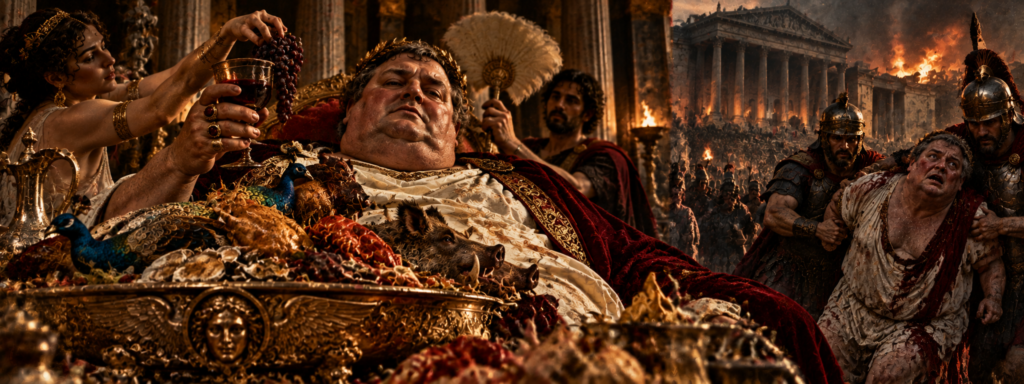
Vitellius: Rome’s Gluttonous Emperor and the Bloody Reign That Ended in the Streets
He ruled the Roman Empire for barely eight months, yet his name became synonymous with extravagant feasting, shameless excess, and the violent collapse of imperial authority. Ancient historians described Vitellius as a man whose appetite knew no limits, who squandered fortunes on elaborate banquets while his soldiers fought to keep him on the throne. His legendary “Shield of Minerva” supposedly contained an extraordinary assortment of exotic delicacies, prepared at a cost that astonished even Rome’s wealthy aristocracy. But behind the stories of gluttony was a far darker political tragedy. Vitellius had inherited an empire already tearing itself apart, and when his enemies finally entered Rome, the emperor who had supposedly lived for pleasure was dragged through the streets, humiliated before a hostile crowd, and brutally killed.
In December AD 69, the Roman Empire’s third emperor of the year found himself trapped inside a city that was rapidly falling into enemy hands. Aulus Vitellius had risen to power through the support of the legions stationed along the Rhine, defeated a rival emperor, and entered Rome expecting to establish a lasting government. Instead, his authority had begun disintegrating almost as soon as he secured the throne. Armies in the eastern provinces had proclaimed another emperor, Vespasian, while forces advancing from the Danube were closing in on Italy. By the time the fighting reached Rome itself, Vitellius faced the terrifying realization that the soldiers who had made him emperor could no longer guarantee his survival.
The final hours of his life became one of the most degrading episodes in Roman imperial history. According to the ancient historians Tacitus, Suetonius, and Cassius Dio, Vitellius attempted to hide as enemy forces occupied the imperial residence. He was discovered, seized, and dragged through the streets toward the Gemonian Stairs, a notorious location associated with the public exposure of executed criminals. His captors reportedly bound his hands, subjected him to insults, and forced him to endure the mockery of spectators who only months earlier might have cheered his arrival as emperor.
The accounts of his death are disturbing. Suetonius describes soldiers and civilians abusing the defeated emperor as he was led through Rome, while Tacitus portrays the scene as a spectacle of humiliation and political vengeance. Vitellius was killed, and his body was subjected to further indignities before being disposed of. The precise details differ among the sources, but the essential event is secure: a Roman emperor was publicly murdered in his own capital after losing a civil war, bringing his brief reign to a violent conclusion.
Yet the manner of his death was only one reason Vitellius became notorious. Ancient writers transformed him into a symbol of uncontrolled appetite, describing a ruler who devoted extraordinary attention to eating, drinking, and elaborate entertainment. Suetonius claimed that he attended multiple banquets each day, consumed extravagant quantities of food, and spent immense sums on delicacies gathered from across the empire. His most famous culinary extravagance was supposedly an enormous dish called the Shield of Minerva, filled with rare ingredients that required an elaborate network of suppliers and costly preparation.
These stories have shaped Vitellius’s reputation for nearly two thousand years. He is frequently remembered as an emperor who ate while Rome burned, squandered imperial resources on luxury, and demonstrated little interest in the responsibilities of government. Some ancient authors also accused him of cruelty, political indifference, and pleasure in the suffering of others. Yet these accusations come largely from writers whose narratives were influenced by the victory of Vespasian and the need to explain why Vitellius had deserved his downfall.
The historical Vitellius was more complicated than the grotesque caricature preserved in popular memory. He had held important offices before becoming emperor, governed a major province, and commanded the loyalty of powerful Roman armies. His rise was not the accidental elevation of a man known only for eating, nor was his defeat caused simply by extravagant banquets. He became emperor during one of the most dangerous succession crises in Roman history, when the death of Nero shattered the political order and competing military commanders fought for control of the empire.
Understanding Vitellius therefore requires looking beyond the legendary feasts to the violent political world that brought him to power. His story involves military rebellion, divided loyalties, aristocratic ambition, financial pressure, and the collapse of imperial legitimacy. It also reveals how quickly Roman society could transform a celebrated ruler into a public enemy once his armies had been defeated.
Vitellius may have been remembered as Rome’s great glutton, but the deeper tragedy of his reign was that he became emperor at a moment when the imperial throne had become a prize to be won and lost through civil war.
Born Into Privilege: The Making of an Unlikely Emperor
Aulus Vitellius was born on September 24, AD 15, into a family that had achieved considerable prominence within Roman political society. His father, Lucius Vitellius, was a distinguished senator who held the consulship three times and exercised substantial influence during the reigns of Tiberius, Caligula, and Claudius. Such repeated honors were exceptional and demonstrated the family’s close connections with the imperial court. Vitellius therefore entered life with advantages that placed him among Rome’s privileged aristocracy, far removed from the poverty and insecurity experienced by most inhabitants of the empire.
His father possessed a reputation for political adaptability. Ancient writers described Lucius Vitellius as exceptionally skilled at maintaining the favor of successive emperors, even when those rulers differed dramatically in temperament and governing style. He served in important administrative positions, including the governorship of Syria, and participated in the political ceremonies through which senators demonstrated loyalty to the imperial household. His career provided the younger Vitellius with an example of how influence could be preserved through personal relationships and careful accommodation of powerful rulers.
The younger Vitellius grew up during the later years of Tiberius’s reign, a period remembered in hostile senatorial literature for treason trials, political suspicion, and the emperor’s prolonged residence on Capri. Suetonius later claimed that Vitellius spent part of his youth on Capri and became involved in the disreputable environment associated with the imperial household. The biographer’s allegations include insinuations of sexual exploitation and favoritism, but these claims are difficult to verify and reflect the scandalous traditions surrounding both Tiberius and Vitellius. They should not be treated as established facts about his childhood.
What can be established is that Vitellius developed connections with successive emperors. Ancient writers associated him with Caligula through an interest in chariot racing, with Claudius through gambling, and with Nero through musical performances. Suetonius presented these relationships as evidence that Vitellius gained favor by indulging the personal interests of rulers rather than demonstrating exceptional political ability. Yet courtly participation in imperial entertainment was a normal feature of aristocratic life, and the hostile interpretation may exaggerate the extent to which his career depended on flattery.
Vitellius married Petronia, a woman from a prominent family, and later married Galeria Fundana, with whom he had children. His household relationships would eventually acquire political importance when he became emperor and his family became vulnerable to the consequences of civil war. The ancient sources devote relatively little attention to his domestic life compared with their fascination with his appetite and personal habits. Nevertheless, his marriages and family connections placed him within the networks of aristocratic society that shaped appointments and political alliances.
Before becoming emperor, Vitellius held significant offices. He served as consul in AD 48 alongside Emperor Claudius, an honor that reflected his standing within the imperial establishment. He also served as proconsul of Africa, a prestigious provincial appointment, and later participated in administrative responsibilities in Rome. These positions demonstrate that he was not entirely inexperienced in government, despite the impression created by later writers who portrayed him as incapable of serious public service.
His reputation before AD 69 remains difficult to reconstruct because the surviving accounts were written with knowledge of his eventual downfall. Once Vitellius had been defeated and condemned, earlier episodes of his life could be interpreted as warnings of the excesses that supposedly defined his reign. The result was a biography in which appetite, indulgence, and personal weakness appeared to explain every stage of his career. The reality was likely more complicated, involving the ordinary mixture of family influence, political accommodation, administrative experience, and personal relationships that characterized Roman aristocratic advancement.
The Shadow of Nero and the Collapse of a Dynasty
Vitellius’s rise to imperial power cannot be understood without examining the final years of Nero’s reign. Nero had ruled since AD 54, but his government became increasingly unstable as political conspiracies, military dissatisfaction, and provincial unrest undermined confidence in his authority. The emperor’s relationships with the Senate and sections of the aristocracy had deteriorated, while his artistic performances and extravagant public image attracted criticism from hostile writers. By AD 68, opposition had developed beyond the imperial court and into the military provinces.
The rebellion of Gaius Julius Vindex in Gaul helped expose the vulnerability of Nero’s position. Although Vindex was defeated, his challenge encouraged other commanders to consider withdrawing their support from the emperor. Servius Sulpicius Galba, governor of Hispania Tarraconensis, emerged as a rival claimant, while military loyalties became increasingly uncertain. Nero’s government could no longer rely on the assumption that provincial armies would obey the ruler in Rome.
In June AD 68, Nero died after losing the support of key military and political institutions. His death ended the Julio-Claudian dynasty, which had ruled the empire since Augustus established the principate. For nearly a century, imperial succession had been managed through family relationships, adoption, political designation, and military acceptance, even when the process involved violence or intrigue. Nero’s death without an accepted successor exposed the absence of a stable constitutional mechanism for choosing the next emperor.
Galba became emperor, but his position was immediately precarious. He was elderly, lacked broad personal support among the soldiers, and inherited a government facing financial and political pressures. His attempts to restore discipline and control expenditure offended groups that expected rewards for their loyalty. The armies stationed along the Rhine, in particular, became increasingly dissatisfied with his leadership.
Vitellius entered this crisis as a provincial military commander. In late AD 68, Galba appointed him governor of Lower Germany, placing him in charge of forces along one of Rome’s most important frontiers. Ancient writers suggested that Galba considered Vitellius politically harmless because of his reputation for indulgence. Suetonius even preserved the idea that an appetite for luxury made him an unlikely conspirator, but this explanation may reflect hindsight rather than the actual reasoning behind the appointment.
Whatever Galba intended, the decision proved disastrous for his government. The German armies were already restless, and Vitellius soon became the figure around whom their opposition gathered. His elevation was less a demonstration of personal ambition than a consequence of military dissatisfaction and the willingness of powerful officers to challenge the emperor. The legions were preparing to make another ruler, and Vitellius happened to occupy the position from which their rebellion could acquire imperial legitimacy.
The Rhine Legions Choose Their Emperor
On January 1, AD 69, Roman troops stationed along the Rhine refused to renew their traditional oath of loyalty to Galba. The refusal was an extraordinary act of defiance because the oath represented the formal relationship between soldiers and the reigning emperor. By rejecting Galba’s authority, the troops signaled that they no longer accepted his right to command them. The rebellion created an immediate political crisis, since the Rhine armies possessed substantial military strength and occupied a strategically important frontier.
The following day, soldiers proclaimed Vitellius emperor. The precise sequence of events varied between military units, but the movement quickly gained support among the armies of Upper and Lower Germany. Senior commanders, including Aulus Caecina Alienus and Fabius Valens, became central figures in organizing the rebellion and preparing military operations. Their involvement demonstrates that Vitellius’s rise depended on experienced officers and organized military forces rather than merely on personal popularity.
Tacitus portrays Vitellius as a man whose elevation was driven by others, suggesting that his commanders possessed greater determination and strategic ability than their nominal leader. This interpretation fits the historian’s broader depiction of Vitellius as weak and indulgent, but it also reflects the practical importance of military officers in the rebellion. Roman emperors did not need to personally direct every operation to benefit from the loyalty of their armies. Vitellius’s position as commander gave the movement a recognized political figure around whom soldiers could unite.
The Rhine troops had several reasons to oppose Galba. They resented the lack of expected financial rewards, questioned the emperor’s treatment of military commanders, and regarded themselves as insufficiently recognized for their service. Their rebellion was therefore connected to broader problems of imperial legitimacy rather than a simple preference for Vitellius as an individual. The soldiers wanted a ruler who would acknowledge their importance and reward their loyalty.
Vitellius accepted the imperial title and began preparing to challenge Galba. His armies moved toward Italy under the leadership of Caecina and Valens, while he remained behind to organize support and resources. The rebellion was now more than a provincial protest. It had become a direct military challenge to the government in Rome, threatening another civil war only months after Nero’s death.
Yet events in the capital were moving even faster than Vitellius’s armies. Before his forces could reach Italy, Galba was overthrown by another contender, creating a struggle between rival emperors whose claims rested on different military groups.
Galba Falls and Otho Seizes the Throne
Galba’s reign ended on January 15, AD 69, when the Praetorian Guard turned against him. Marcus Salvius Otho, a former associate of Nero who had initially supported Galba, emerged as the beneficiary of the conspiracy. Galba was murdered in Rome, and Otho was proclaimed emperor, demonstrating that the imperial throne could change hands through violence within the capital as well as rebellion in the provinces. The new emperor inherited the same fundamental problem that had destroyed his predecessor: he needed the loyalty of armies that were already committed to another claimant.
Vitellius’s forces continued advancing toward Italy. The Rhine armies had proclaimed their commander emperor before Otho seized power, and they had little reason to abandon their campaign merely because Galba had been replaced. Otho attempted to establish his legitimacy and organize resistance, but the military situation deteriorated as the opposing forces approached northern Italy. The empire now faced a confrontation between the Praetorian-supported emperor in Rome and the Rhine-backed claimant advancing from the north.
The struggle culminated in the First Battle of Bedriacum, fought near Cremona in April AD 69. Otho’s forces were defeated by the armies supporting Vitellius after a confused and costly campaign. Ancient accounts emphasize the disorder of the fighting, the exhaustion of the soldiers, and the difficulty commanders experienced maintaining control. The battle demonstrated the destructive consequences of civil war, as Roman soldiers fought and killed one another in support of rival emperors.
Otho responded to defeat by taking his own life on April 16, AD 69. His suicide prevented further immediate resistance by forces that remained loyal to him, although it did not resolve the deeper political instability affecting the empire. Ancient writers sometimes praised Otho’s decision as an attempt to spare additional Roman lives, contrasting his final conduct with the ambition that had brought him to power. Whatever his motives, his death left Vitellius without a major rival in Italy.
Vitellius was now the dominant claimant to the imperial throne. His armies had defeated the forces of the reigning emperor, and the Senate recognized his authority. Yet the victory came at a terrible cost, leaving Italy damaged by military operations and the empire divided by competing loyalties. The soldiers who had fought for Vitellius expected rewards, while the new emperor needed to establish a functioning government after months of instability.
His reign began with military triumph, but the circumstances of his accession contained the seeds of his downfall. He owed his throne to armies whose loyalty depended on recognition and reward, while other provincial forces remained uncertain or hostile. The empire had already experienced three emperors in little more than a year, and there was no guarantee that Vitellius would be the last.
The March to Rome: Victory Among the Dead
After the defeat of Otho, Vitellius traveled toward Rome to assume control of the imperial government. Ancient writers describe his journey as slow and extravagant, emphasizing the luxurious entertainments and elaborate receptions arranged along the route. Suetonius portrays the new emperor as more interested in feasting than in the responsibilities awaiting him, while Tacitus offers a broader account of military disorder and political instability. Their narratives reflect genuine concerns about discipline, but they also contribute to the image of Vitellius as a ruler overwhelmed by appetite.
One of the most disturbing episodes associated with the journey occurred when Vitellius visited the battlefield near Bedriacum. According to Tacitus, the site still bore evidence of the recent fighting, including unburied remains and the visible destruction left by the armies. The historian reports that Vitellius and his companions examined the battlefield, while some participants reacted with indifference or curiosity rather than horror. Later accounts transformed the visit into evidence of the emperor’s alleged insensitivity to suffering.
The scene became especially notorious because ancient writers claimed that Vitellius dismissed complaints about the smell of decomposing bodies. The exact wording and circumstances of the reported remark cannot be verified, and the anecdote may have been sharpened to portray him as morally callous. Nevertheless, the battlefield visit was a powerful symbol of the civil war’s consequences. Roman soldiers had died fighting other Roman soldiers, and the victorious emperor now traveled toward a capital that had already witnessed repeated changes of government.
The army accompanying Vitellius also created problems. Soldiers expected rewards for their service and sometimes behaved as though victory entitled them to seize supplies or intimidate local communities. Maintaining discipline among victorious troops was difficult, particularly when commanders had encouraged expectations of generosity. The new emperor faced the challenge of transforming a successful military coalition into an orderly government.
Vitellius eventually entered Rome in July AD 69, receiving the honors associated with imperial authority. His arrival was accompanied by ceremonies intended to establish legitimacy and demonstrate that the civil war had ended. Yet the political situation remained fragile, and the behavior of his soldiers reinforced concerns about the influence of the army over civilian government. The emperor possessed the throne, but his ability to govern depended on managing competing military and political interests.
The journey to Rome therefore revealed a central contradiction of his position. Military victory had made Vitellius emperor, but the same soldiers who secured his authority could undermine public confidence through indiscipline and demands for reward. His government needed stability, yet it had been created through a process that encouraged further rebellion. The celebration of victory could not erase the conditions that made another civil war possible.
The Emperor of Endless Banquets
Vitellius’s reputation for gluttony became the most enduring feature of his historical image. Suetonius describes him as possessing an extraordinary appetite and claims that he regularly attended multiple elaborate meals in a single day. According to the biographer, the emperor participated in breakfast, luncheon, dinner, and additional drinking or dining occasions, often moving between the houses of wealthy hosts. These accounts present eating not merely as a personal pleasure but as an obsession that supposedly dominated his life.
The most extravagant stories concern the enormous quantities of food consumed during these gatherings. Suetonius claims that individual banquets could involve thousands of fish and birds, along with costly delicacies obtained from distant parts of the empire. The figures are difficult to verify and may have been exaggerated to emphasize imperial excess. Roman aristocratic literature frequently criticized luxury dining as evidence of moral decline, making extravagant banquets a familiar theme in attacks on unpopular rulers.
Vitellius’s alleged appetite also became a convenient explanation for his political failures. Ancient writers suggested that he devoted so much attention to food and entertainment that he neglected military preparations and administrative responsibilities. Such accusations fit the traditional Roman contrast between disciplined leadership and uncontrolled pleasure. A ruler who appeared unable to govern his own desires could be portrayed as incapable of governing the empire.
Yet banquets were an important part of Roman political culture. Wealthy hosts used elaborate meals to demonstrate status, cultivate relationships, and honor powerful guests. Emperors regularly participated in ceremonial dining, and extravagant hospitality was not unique to Vitellius. The distinction between ordinary aristocratic luxury and the extraordinary excess attributed to him is therefore difficult to establish from hostile sources alone.
The financial implications of his reported feasting also require caution. Suetonius claimed that Vitellius spent enormous sums on food during his brief reign, but the surviving evidence does not provide reliable accounts confirming the total expenditure. The imperial treasury faced serious pressures because of civil war, military rewards, and administrative disruption, making it difficult to isolate the financial effects of personal luxury. The claim that banquets consumed massive portions of the treasury should therefore be understood as an ancient accusation rather than a securely measurable fact.
Nevertheless, the stories became inseparable from his identity. Later generations remembered Vitellius not for legislation, diplomacy, or military strategy but for his supposedly insatiable appetite. His brief reign offered little opportunity to establish a substantial administrative legacy, allowing sensational anecdotes to dominate the historical record. The result was one of antiquity’s most recognizable portraits of a ruler destroyed by excess.
The Shield of Minerva: Rome’s Most Infamous Feast
The most famous culinary extravagance attributed to Vitellius was an enormous dish called the Shield of Minerva. Suetonius describes a platter of extraordinary size filled with rare and expensive ingredients, including delicacies taken from fish and birds. The dish supposedly required a specially constructed vessel large enough to contain its elaborate contents. The story became a symbol of imperial luxury carried to absurd extremes.
According to Suetonius, the preparation included ingredients such as the livers of certain fish, the brains of pheasants and peacocks, flamingo tongues, and other unusual delicacies. The ingredients were reportedly gathered from distant regions, suggesting an extravagant use of imperial resources and supply networks. The precise recipe cannot be reconstructed, and there is no independent evidence confirming every detail of the biographer’s description. Nevertheless, the account reflects Roman aristocratic fascination with rare foods and the social prestige attached to elaborate dining.
The name itself carried symbolic significance. Minerva was a major Roman goddess associated with wisdom, skill, and warfare, while a shield evoked military imagery and heroic achievement. Naming an enormous serving dish after a divine shield created a striking contrast between martial symbolism and culinary indulgence. Ancient readers could interpret the image as evidence that Vitellius had transformed the language of military glory into a celebration of appetite.
The dish also served a literary purpose. By concentrating an extraordinary collection of delicacies into a single object, Suetonius provided a memorable image through which readers could understand the emperor’s supposed character. The platter became a symbol of excess more powerful than any financial estimate or administrative criticism. Its details were vivid enough to survive for centuries, even though the historical circumstances of its preparation remain uncertain.
Modern readers should therefore distinguish between the existence of the ancient story and the certainty of the event itself. Suetonius unquestionably recorded the account, and it became an influential part of Vitellius’s reputation. Whether the dish was prepared exactly as described, how often such extravagance occurred, and what it actually cost cannot be established. The Shield of Minerva is historically important partly because it reveals how Roman writers used food to condemn rulers they considered morally unworthy.
The episode illustrates a broader pattern in imperial biography. Emperors praised for discipline were associated with moderation, while those condemned as tyrants were described through luxury, appetite, and bodily excess. Vitellius became an especially powerful example because his short reign ended in spectacular humiliation. The banquet stories helped explain his downfall as a moral consequence of indulgence, even though the political reasons for his defeat were far more complex.
Cruelty, Executions, and the Reputation of a Sadist
Ancient writers did not limit their criticism of Vitellius to gluttony. Suetonius accused him of cruelty, claiming that he ordered executions and sometimes appeared indifferent to the suffering of victims. The biographer preserved stories in which the emperor allegedly punished individuals for trivial reasons or allowed violence to occur for personal satisfaction. These accounts contributed to the image of a ruler whose appetites extended beyond food into the humiliation and destruction of others.
The most disturbing allegations concern Vitellius’s supposed enjoyment of executions. Suetonius describes episodes in which he allegedly treated the deaths of condemned individuals with shocking casualness. Yet such stories are difficult to verify and often resemble conventional literary accusations against tyrants. Roman authors frequently used claims of pleasure in cruelty to demonstrate moral corruption, making it necessary to distinguish documented punishments from assertions about the ruler’s private emotions.
Vitellius’s government did employ coercion, as did other regimes emerging from civil war. Defeated opponents faced the possibility of punishment, while military commanders and political figures could be removed when their loyalty was questioned. The surviving evidence does not support the conclusion that his reign was free from violence. Nevertheless, the extent of systematic persecution under Vitellius is difficult to reconstruct, particularly because his government lasted only a few months.
His treatment of Otho’s supporters appears to have been less uniformly destructive than the darkest literary portrait might suggest. Some individuals associated with the defeated emperor survived and continued political careers, demonstrating that Vitellius did not simply execute everyone connected with his rival. Political accommodation was necessary because the empire’s administration depended on experienced officials, many of whom had served previous rulers. The practical demands of government could therefore encourage moderation even during a period of intense instability.
The accusation of sadism goes beyond what the surviving evidence can securely establish. Vitellius’s responsibility for political violence can be examined through specific actions and policies, but claims that he personally derived pleasure from torture or execution depend on hostile literary testimony. His reputation for cruelty may reflect genuine incidents, exaggeration, and the moral conventions of imperial biography. Treating every anecdote as established fact would obscure the distinction between historical evidence and retrospective condemnation.
The broader political environment was undeniably brutal. During the Year of the Four Emperors, rulers rose and fell through assassination, rebellion, and military defeat, while soldiers and civilians suffered the consequences. Vitellius participated in this system and benefited from the destruction of Otho’s government, but he did not create the crisis alone. His reign became notorious partly because he lost, allowing victorious opponents and later writers to define the meaning of his actions.
The Empire Begins to Turn Against Him
Vitellius’s position deteriorated rapidly during the summer of AD 69. Although his armies had defeated Otho, the eastern provinces had not become firmly integrated into his political coalition. Powerful commanders controlled substantial military forces in Judaea, Syria, and Egypt, and their support was essential to maintaining imperial stability. The distance between Rome and the eastern provinces also created opportunities for alternative claims to develop before the central government could respond effectively.
Vespasian, an experienced general commanding Roman forces involved in the Jewish revolt, emerged as the principal challenger. He had served under Nero and possessed a strong military reputation, while his son Titus was also deeply involved in operations in Judaea. Vespasian’s position gave him access to important military resources and connections with other eastern commanders. His supporters began organizing a movement that would eventually overthrow Vitellius.
On July 1, AD 69, troops in Egypt proclaimed Vespasian emperor. Other eastern forces followed, creating a powerful coalition that included armies in Syria and Judaea. The rebellion demonstrated that Vitellius’s victory over Otho had not resolved the succession crisis. The empire now faced another struggle between competing military coalitions, each claiming the right to determine who should rule Rome.
Vespasian’s supporters benefited from strategic advantages. Control of Egypt was particularly important because the province supplied grain to Rome, giving the eastern coalition potential influence over the capital’s food supply. The movement also gained support from commanders along the Danube, whose armies could advance toward Italy more quickly than forces stationed in the distant east. The combination of military strength and logistical opportunity made Vespasian a formidable opponent.
Vitellius’s government struggled to respond effectively. His armies had already endured difficult campaigning, while rivalries among commanders weakened coordination. The emperor’s reputation for indulgence became a convenient explanation for these failures in later accounts, but the military situation was complicated by geography, divided loyalties, and the exhaustion produced by repeated civil wars. Even a more disciplined ruler would have faced serious difficulties maintaining control over an empire whose armies had become accustomed to choosing emperors.
The rebellion spread as additional forces abandoned Vitellius. His authority depended on the same military loyalty that had brought him to power, and that loyalty could shift when soldiers believed another claimant offered greater security or reward. By autumn, the struggle had moved toward a decisive confrontation in northern Italy. The emperor who had entered Rome in triumph only months earlier was preparing to defend his throne against another army of Roman soldiers.
The Second Battle of Bedriacum: The Beginning of the End
The decisive military confrontation occurred near Cremona in October AD 69, at the Second Battle of Bedriacum. Forces supporting Vespasian, led principally by Antonius Primus and other commanders, confronted the armies loyal to Vitellius. The battle was confused, violent, and prolonged, involving soldiers who belonged to the same imperial military system but fought under rival political allegiances. Its outcome would determine whether Vitellius could retain control of Italy.
The fighting continued through difficult conditions, with units struggling to maintain formation and commanders attempting to coordinate movements amid disorder. Tacitus provides a detailed account of the battle, emphasizing the courage, confusion, and brutality displayed by both sides. His narrative reveals the terrible consequences of civil war, as soldiers who had once served the same empire killed one another for competing emperors. The conflict was not a foreign invasion but an internal struggle over political legitimacy.
The Vitellian forces were defeated, and the victorious army advanced toward Cremona. The city suffered a devastating sack, with soldiers engaging in plunder, violence, and destruction. Tacitus describes the catastrophe in powerful language, portraying the city as overwhelmed by the brutality of troops whose victory had unleashed uncontrolled greed. The destruction of Cremona became one of the most notorious episodes of the Year of the Four Emperors.
The sack demonstrated how civil war could devastate communities that had little control over the political decisions of military commanders. Civilians suffered because armies required supplies, sought rewards, and treated captured cities as opportunities for plunder. The destruction also damaged the legitimacy of the victorious coalition, although Vespasian would ultimately benefit from its military success. The suffering of Cremona revealed that the struggle for imperial power could impose enormous costs on ordinary inhabitants.
For Vitellius, the defeat was catastrophic. His principal military forces in Italy had been broken, and the armies supporting Vespasian could now advance toward Rome. Remaining loyalists attempted to organize resistance, but the balance of power had shifted decisively. The emperor’s position became increasingly dependent on negotiations, local support, and the willingness of soldiers to continue fighting for a ruler whose defeat appeared imminent.
The second battle near Bedriacum completed a grim symmetry. Earlier that year, Vitellius’s armies had defeated Otho’s forces in the same region, securing his path to the throne. Now another Roman army had defeated his supporters, opening the road to his destruction. The location became a symbol of the empire’s political instability, where military victory could create an emperor in spring and destroy him before winter.
Rome Descends Into Chaos
As Vespasian’s supporters advanced toward Rome, Vitellius attempted to negotiate his position. Ancient sources describe discussions concerning abdication, guarantees of safety, and the transfer of authority. The emperor reportedly considered surrendering power in exchange for protection, but the situation was complicated by the determination of some loyalists to continue resisting. The possibility of peaceful transition repeatedly collapsed as armed groups and political factions pursued conflicting objectives.
Flavius Sabinus, Vespasian’s brother and an important official in Rome, became involved in efforts to manage the crisis. His position placed him at the center of negotiations between Vitellius and supporters of the approaching armies. Yet tensions escalated, and fighting erupted within the capital. The struggle demonstrated that the city itself had become a battlefield, with competing forces attempting to control strategic locations and symbols of authority.
One of the most devastating events occurred when fighting reached the Capitoline Hill. The Temple of Jupiter Optimus Maximus, one of Rome’s most sacred and politically significant buildings, was destroyed by fire during the conflict. Ancient sources differ over responsibility for the blaze, and the precise circumstances remain disputed. Nevertheless, the destruction was a profound symbolic catastrophe, suggesting that civil war had reached the heart of Roman religious and political identity.
Flavius Sabinus was captured and killed, while the young Domitian, Vespasian’s son, escaped the violence. The death of Sabinus intensified hostility between the rival factions and made reconciliation increasingly difficult. For Vitellius, the events were disastrous because they associated his government with the destruction of a sacred monument and the killing of a prominent member of the opposing dynasty. Even if he did not personally order every act of violence, the consequences damaged his remaining political position.
The city descended into confusion as armed groups moved through streets and public spaces. Civilians attempted to protect themselves, while soldiers pursued enemies, seized supplies, and fought for control of important buildings. The ordinary structures of urban life were disrupted by the collapse of central authority. Rome, the capital of an empire that claimed to bring order to the Mediterranean world, had become the setting for another violent struggle between Roman armies.
Vitellius’s remaining supporters could not reverse the military situation. Forces loyal to Vespasian entered the city, and resistance gradually collapsed. The emperor’s fate now depended on whether he could escape, negotiate protection, or remain hidden long enough to avoid capture. None of those possibilities offered much hope in a political environment where defeated emperors had repeatedly been murdered.
The Emperor Hides as His Palace Falls
The final hours of Vitellius’s life are described in dramatic detail by ancient historians. Suetonius reports that the emperor attempted to conceal himself within the imperial residence as enemy forces approached. The biographer describes a hiding place associated with the palace’s private quarters, while Tacitus offers a broader narrative of the emperor’s desperate movements through the building. The accounts differ in detail, but they agree that Vitellius was discovered and captured after his remaining authority collapsed.
The scene represented an extraordinary reversal of imperial fortune. Only months earlier, Vitellius had entered Rome as the victorious ruler of the empire, surrounded by soldiers and honored through public ceremonies. Now he was attempting to avoid the men who had defeated his armies and occupied his capital. The ceremonial dignity of the imperial office offered no protection once military support disappeared.
Ancient writers emphasize his fear and humiliation, portraying him as a man whose appetite and weakness had left him unprepared for the consequences of defeat. Such descriptions reflect the moral judgments that shaped his reputation, and some details may have been exaggerated to heighten the contrast between imperial grandeur and personal helplessness. Nevertheless, the essential circumstances were brutal. A defeated emperor faced capture by enemies who had little reason to preserve his life.
Vitellius reportedly attempted to identify himself in ways that might secure temporary protection, but the soldiers who discovered him had already committed themselves to the victorious coalition. The political system offered no reliable procedure for peacefully removing an emperor whose armies had been defeated. Abdication might have been possible under different circumstances, but the repeated violence of AD 69 made promises of safety difficult to trust. The fate of Galba and Otho had already demonstrated how quickly imperial authority could end in death.
The capture of Vitellius therefore marked the effective conclusion of his reign. He no longer commanded armies capable of defending him, and the Senate’s recognition could not restore his position. The emperor’s survival depended entirely on the decisions of his captors. Those decisions would transform his final journey through Rome into a public spectacle of vengeance.
Dragged Through the Streets: The Death of Vitellius
Vitellius was killed on December 20, AD 69, according to the chronology generally accepted from the surviving sources. His death occurred after the forces supporting Vespasian had gained control of Rome, ending a reign that had lasted only a few months from his effective recognition in the capital. Ancient accounts describe soldiers dragging him through the streets while spectators mocked and abused him. The humiliation was deliberate, turning the defeated emperor into a public symbol of the collapse of his government.
Suetonius reports that Vitellius’s hands were bound and that his clothing was torn as he was led through the city. His captors allegedly forced him to keep his head raised while people insulted him and threw objects. Tacitus describes the crowd’s hostility and the emperor’s suffering, presenting the scene as a disturbing example of how quickly public attitudes could change. The details may have been sharpened through literary convention, but the broader spectacle of public humiliation is consistently reported.
The procession moved toward the Gemonian Stairs, a location associated with the exposure of executed criminals near the Roman Forum. The stairs carried powerful symbolic meaning because they represented the degradation of individuals condemned by the state. Bringing Vitellius there transformed his death from a military necessity into a public demonstration that his imperial authority had been destroyed. The emperor who had occupied the Palatine palace was now treated as a criminal.
Ancient sources describe him being killed through repeated blows or stabbing, although the precise sequence varies. His body was subsequently subjected to indignities, with accounts reporting that it was dragged away and disposed of in the Tiber. The violence was extreme, but it belonged to a broader pattern of political vengeance during Roman civil wars. Defeated rulers could be denied honorable burial and subjected to public degradation as a means of demonstrating the victory of their enemies.
The crowd’s behavior also reveals the instability of imperial legitimacy. Public ceremonies had celebrated Vitellius’s accession only months earlier, yet the same city now witnessed his humiliation. Some spectators may have genuinely hated his government, while others may have joined the abuse because the victorious soldiers controlled the streets. The surviving sources do not allow the emotions of the crowd to be reconstructed with certainty. What remains clear is that imperial status could disappear almost instantly when military power changed hands.
Vitellius’s death ended the third imperial government to collapse during AD 69. Galba had been murdered by the Praetorian Guard, Otho had died by suicide after military defeat, and Vitellius was killed after his capital fell to opposing forces. Vespasian emerged as the fourth emperor of the year, establishing the Flavian dynasty that would rule until AD 96. The succession crisis had finally produced a victor, but only after months of civil war and enormous destruction.
The Family Left Behind
Vitellius’s death also endangered his family. His wife, Galeria Fundana, and their children had occupied positions of prominence during his brief reign, but the collapse of his government transformed their status. Members of defeated imperial households could become targets of punishment because their family connections represented potential claims to future authority. The fate of Vitellius’s relatives therefore depended on the policies of the victorious regime.
Ancient accounts indicate that Galeria Fundana survived the overthrow, while the fate of the emperor’s young son was more tragic. Suetonius reports that the boy was eventually killed under Vespasian, although the chronology and circumstances are not fully clear. The elimination of a defeated emperor’s male heir reflected the political dangers associated with dynastic succession. Even a child could be regarded as a possible focus for future opposition.
The treatment of Vitellius’s family demonstrates that the consequences of civil war extended beyond the rulers themselves. Wives, children, relatives, and household officials could suffer because of political relationships they had not chosen. The Roman imperial system offered enormous privilege to members of ruling families, but those privileges could disappear when the emperor lost power. The same dynastic connections that elevated individuals could become reasons for their destruction.
The surviving sources devote far more attention to Vitellius’s appetite and death than to the experiences of his family. This imbalance reflects the priorities of ancient political biography, which often concentrated on the character and downfall of rulers while treating relatives as secondary figures. Yet the family’s fate reveals the human consequences of imperial succession. The struggle for power could destroy households as thoroughly as it destroyed armies and cities.
The Flavian Victory and the Destruction of His Reputation
Vespasian’s victory brought the Year of the Four Emperors to an end and established a new ruling dynasty. His government faced the enormous task of restoring stability after repeated civil wars, rebuilding damaged institutions, and securing military loyalty. Presenting Vitellius as an unworthy ruler helped legitimize the new regime by contrasting its claims of discipline and order with the alleged excesses of its predecessor. The political circumstances therefore encouraged a negative interpretation of Vitellius’s reign.
Tacitus, Suetonius, and Cassius Dio became the principal sources through which later generations understood Vitellius. Their accounts differ in emphasis, but all preserve damaging stories about his conduct. Tacitus provides the most substantial narrative of the military and political events, while Suetonius concentrates heavily on personal habits and scandalous anecdotes. Cassius Dio, writing later, drew on earlier traditions and contributed to the enduring image of imperial excess.
These writers were not simply inventing an entirely fictional ruler. Vitellius’s government did emerge from military rebellion, and his reign ended in catastrophic defeat. His armies committed acts of violence, his political position was unstable, and his administration faced serious challenges. Yet the literary emphasis on gluttony and personal weakness may have simplified the causes of his downfall, making political defeat appear to result naturally from moral corruption.
The stories about enormous banquets served this interpretation particularly well. A ruler who supposedly consumed extravagant meals while neglecting military affairs could be presented as the opposite of the disciplined emperor required to restore Roman order. The Shield of Minerva became a memorable symbol of the excess that allegedly explained his failure. Whether the dish existed exactly as described mattered less to the literary tradition than its usefulness as an illustration of character.
Modern historians have therefore approached Vitellius with greater caution, examining his career within the military and political conditions of AD 69. His earlier offices demonstrate that he possessed experience in public administration, while his elevation by the Rhine legions reflected genuine dissatisfaction with Galba. His defeat resulted from the emergence of a powerful rival coalition, the loss of military support, and the strategic advantages enjoyed by Vespasian’s commanders. Personal indulgence may have affected his government, but it cannot adequately explain the collapse of his reign.
The reputation of Vitellius illustrates how victors influence historical memory. Vespasian’s success established a dynasty whose legitimacy benefited from portraying its predecessor as corrupt and incapable. Later writers inherited that framework and developed it through vivid anecdotes that emphasized appetite, cruelty, and humiliation. The result was a portrait so memorable that it overshadowed the complex political crisis in which Vitellius had lived and died.
Was Vitellius Really Rome’s Greatest Glutton?
Vitellius’s appetite remains the most famous aspect of his reputation, but the surviving evidence does not allow every accusation to be accepted literally. Suetonius’s descriptions of multiple daily banquets, enormous quantities of food, and extravagant delicacies reflect a literary tradition that used luxury as evidence of moral failure. Roman authors frequently criticized wealthy individuals for excessive dining, especially when they wished to contrast indulgence with the virtues of discipline and self-control. Vitellius became an especially prominent target because his reign ended in defeat and public disgrace.
The emperor may genuinely have enjoyed elaborate meals and expensive entertainment. His participation in aristocratic dining culture is plausible, and the consistency of ancient criticism suggests that luxury formed part of his public reputation. Yet the scale of the alleged expenditure remains uncertain. Claims that he consumed vast portions of the imperial treasury through feasting cannot be independently confirmed through surviving financial records.
The Shield of Minerva should be approached in the same way. The story is historically important because it was recorded by an ancient author and became central to Vitellius’s image. However, the precise ingredients, preparation, and cost cannot be verified. The dish may have existed in some form, but its presentation in the surviving biography serves a clear moral and literary purpose.
The more serious problem is that the focus on gluttony can obscure the political significance of his reign. Vitellius became emperor because powerful armies rejected Galba and supported an alternative claimant. He defeated Otho through military force and lost his position when Vespasian assembled a stronger coalition. These events were shaped by military organization, provincial politics, financial expectations, and the absence of a stable succession system. Banquets alone did not determine the outcome.
His reputation for sadistic cruelty also requires careful distinction between documented violence and claims about personal motives. The civil wars involved executions, massacres, plunder, and political revenge, but these were not unique to Vitellius. Ancient allegations that he enjoyed suffering are difficult to verify and may reflect conventional attacks on defeated rulers. His responsibility for the conduct of his government can be examined without assuming that every sensational story accurately describes his private character.
The historical Vitellius was therefore neither an innocent victim of propaganda nor necessarily the grotesque monster of popular legend. He was a Roman aristocrat who rose through established political institutions, became emperor through military rebellion, and failed to preserve power during an exceptionally unstable year. His government was brief, troubled, and ultimately disastrous, but its collapse cannot be explained through appetite alone. The enduring fascination with his feasts reveals as much about Roman moral storytelling as it does about the emperor himself.
The Year That Revealed the Empire’s Greatest Weakness
The Year of the Four Emperors exposed a fundamental weakness within the Roman imperial system. Augustus had established a political order that concentrated extraordinary authority in one ruler while preserving the appearance of republican institutions. For decades, succession had depended on family relationships, adoption, political designation, and military acceptance. When Nero died without an accepted heir, those mechanisms failed to provide a peaceful transfer of power.
Galba, Otho, Vitellius, and Vespasian each claimed authority through different combinations of military support and political recognition. The Senate could acknowledge an emperor, but its approval did not guarantee obedience from provincial armies. The Praetorian Guard could overthrow a ruler in Rome, but its power did not extend automatically to legions stationed on distant frontiers. The result was a political system in which multiple armed groups could support competing claimants.
Vitellius’s rise and fall demonstrated the consequences of this instability. The Rhine legions elevated him because they rejected Galba, and his commanders defeated Otho in northern Italy. Yet eastern and Danubian armies subsequently supported Vespasian, creating another military coalition capable of challenging the government. The emperor’s authority depended less on a universally accepted constitutional process than on the willingness of soldiers to continue fighting for him.
The civil wars also devastated communities that had little influence over imperial succession. Cremona suffered a catastrophic sack, Rome experienced street fighting, and the Temple of Jupiter Optimus Maximus was destroyed during the struggle. Soldiers died fighting fellow Romans, while civilians faced plunder, violence, and disruption. The political ambitions of a small number of commanders imposed enormous costs on the wider population.
Vespasian’s eventual victory restored a measure of stability, but it did not eliminate the underlying dependence of imperial authority on military loyalty. His dynasty would rule for nearly three decades, yet later Roman history repeatedly demonstrated that armies could make and unmake emperors. The events of AD 69 therefore marked an important warning about the fragility of a system in which succession remained vulnerable to military competition.
Vitellius became one of the most memorable victims of that system. His brief reign was overwhelmed by forces larger than his personal character, although his decisions and leadership still influenced events. The grotesque stories about his appetite made him easy to ridicule, but the civil war revealed a political crisis that no amount of personal moderation could have resolved by itself. His death was both an individual catastrophe and a symptom of a wider imperial problem.
The Dark Legacy of Vitellius
Vitellius ruled during one of the most chaotic periods in Roman imperial history. His accession followed the collapse of Nero’s dynasty, the murder of Galba, and the military defeat of Otho. He reached the throne through the support of powerful armies, but his government lasted only a few months before another military coalition challenged his authority. His reign ended in defeat, the occupation of Rome, and a public killing that became one of the most infamous imperial deaths recorded by ancient historians.
His reputation was shaped by accusations of extraordinary gluttony, extravagant luxury, and personal cruelty. Suetonius’s descriptions of repeated banquets and the legendary Shield of Minerva created an enduring image of a ruler consumed by appetite. Yet the most sensational details cannot be independently verified, and the literary tradition was influenced by the political interests of the victorious Flavian regime. The stories remain valuable evidence of how Vitellius was remembered, but they do not provide a complete explanation of his government.
The military events of AD 69 reveal a more complicated history. Vitellius was elevated by soldiers dissatisfied with Galba, secured power through victory over Otho, and lost the throne when Vespasian’s supporters gained control of the empire’s military resources. His commanders played decisive roles in both his rise and downfall, demonstrating the importance of provincial armies in determining imperial succession. The emperor’s personal reputation may have affected his political relationships, but the outcome depended heavily on military strategy and shifting loyalties.
His death exposed the terrifying instability of imperial authority. A man who had entered Rome as emperor only months earlier was captured, humiliated, and killed in the streets of his own capital. The violence demonstrated that imperial titles, public ceremonies, and aristocratic ancestry offered little protection once military support disappeared. The same political system that elevated Vitellius could destroy him with extraordinary speed.
The fate of his family and the devastation caused by the civil wars also remind us that the consequences extended beyond the emperor himself. Soldiers, civilians, relatives, and officials suffered because competing commanders claimed the right to rule. The sack of Cremona and the fighting in Rome were not merely dramatic episodes in the biographies of emperors; they were disasters affecting entire communities. Vitellius’s reign belonged to a year in which the struggle for supreme power repeatedly overwhelmed the institutions intended to preserve order.
Nearly two thousand years later, Vitellius remains remembered primarily through stories of food, luxury, and humiliation. The Shield of Minerva has become a symbol of imperial excess, while his death on the Gemonian Stairs represents the brutality of political defeat. Yet the most revealing aspect of his reign may be the speed with which his fortunes changed. He began the year as a provincial commander, became emperor through military rebellion, entered Rome in triumph, and died before the year ended.
Vitellius inherited no secure dynasty, possessed no universally accepted claim to the throne, and ruled an empire already fractured by civil war. Ancient writers remembered him as a man who surrendered himself to appetite and luxury, but his downfall was also the consequence of a political system in which armies could create emperors and destroy them almost at will. His legendary feasts may have filled the pages of hostile biographies, yet the true horror of his reign unfolded on battlefields, in ruined cities, and finally in the streets of Rome. When Vitellius was dragged toward his death, the humiliation revealed how little protection imperial grandeur could provide once power had slipped away. The emperor remembered for consuming extravagant banquets became, in the end, another victim of the Roman Empire’s insatiable struggle for power.