
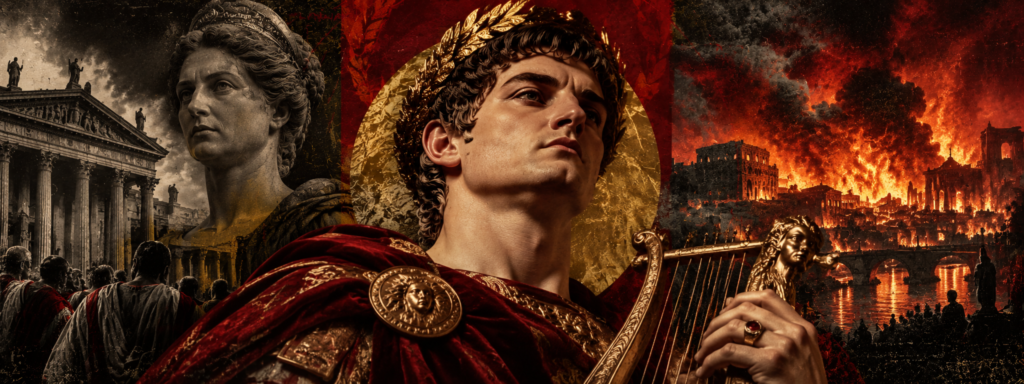
Nero: Rome’s Infamous Emperor of Blood, Fire, and Betrayal
He murdered his mother, eliminated his rivals, humiliated Rome’s aristocracy, and pursued the applause of audiences while his empire descended into political turmoil. When a devastating fire consumed much of Rome, rumors accused him of watching the destruction as though it were a theatrical performance. But behind the legend of the emperor who supposedly fiddled while Rome burned lies a darker, more complicated history of ambition, family betrayal, political violence, and a ruler whose desperate pursuit of glory ended in his own destruction.
On the night of July 18, AD 64, a devastating fire broke out in Rome. Flames spread through crowded neighborhoods, consuming wooden buildings, shops, temples, and homes as residents desperately attempted to escape. The fire raged for days, destroying entire districts and leaving countless Romans homeless. Amid the chaos, rumors began circulating about the emperor himself. Some claimed Nero had deliberately ordered the destruction, while others accused him of performing a song about the fall of Troy as the capital burned.
The image would become one of history’s most enduring symbols of imperial indifference: a ruler so consumed by his own vanity that he supposedly turned the suffering of his people into entertainment. Yet the familiar story of Nero fiddling while Rome burned is historically inaccurate. The violin did not exist in ancient Rome, and the surviving evidence does not establish that Nero started the fire. Tacitus, one of the most important ancient sources for the event, records that Nero was away from Rome when the blaze began and returned as the disaster developed. He also describes the emperor organizing relief efforts, opening imperial properties to displaced residents, and arranging supplies.
Nevertheless, the rumors persisted, partly because Nero had already developed a deeply troubling reputation. By the time Rome burned, he had ordered the killing of his own mother, Agrippina the Younger, and had been implicated in the deaths of other members of the imperial family. His relationship with the Senate had deteriorated, his public performances offended aristocratic expectations, and his increasingly elaborate displays of imperial grandeur attracted criticism. The emperor’s efforts to present himself as an artist and performer seemed particularly inappropriate to Romans who believed that the ruler of an empire should devote himself to military command, government, and public dignity.
The fire became inseparable from everything people already feared or disliked about Nero. When he later constructed an enormous imperial residence across parts of the devastated city, suspicions intensified. To his critics, the project appeared to confirm that Rome’s destruction had created an opportunity for the emperor’s personal ambitions. The fact that the new palace included extraordinary luxury only strengthened the image of a ruler who placed his own desires above the welfare of his subjects.
But Nero’s story did not begin with fire, extravagance, or accusations of cruelty. He had once been a promising young prince, carefully educated and promoted by an extraordinarily ambitious mother who intended to make him emperor. His accession was initially greeted with optimism, and the early years of his reign included policies that even hostile ancient historians regarded relatively favorably.
What followed was a gradual deterioration in the relationships that had brought him to power. Family members became rivals, advisers lost influence, conspiracies threatened his position, and political violence spread through the imperial household and the Roman aristocracy. By the end of his reign, Nero had become the subject of accusations so disturbing that separating historical events from hostile storytelling remains a challenge.
His reputation was shaped primarily by Tacitus, Suetonius, and Cassius Dio, whose surviving accounts differ in chronology, detail, and interpretation. Tacitus was born during Nero’s reign but wrote his account decades later; Suetonius and Dio wrote later still. Their works preserve indispensable information, yet they also reflect aristocratic hostility toward Nero and literary traditions that emphasized the misconduct of unpopular emperors.
Modern historians therefore approach the most sensational allegations cautiously, especially attempts to explain Nero’s behavior through retrospective psychiatric diagnoses. Ancient descriptions of suspicion, cruelty, and emotional instability cannot establish that he experienced psychosis, paranoia as a clinical disorder, or any other specific mental illness.
The documented history is disturbing enough without inventing a diagnosis.
Nero’s reign involved political executions, the killing of close relatives, a catastrophic urban fire, the persecution of Christians, a major conspiracy, rebellion, and a violent struggle over the future of the Roman Empire. His death in AD 68 ended the Julio-Claudian dynasty and helped plunge Rome into civil war.
To understand how a seventeen-year-old emperor who initially inspired hope became one of antiquity’s most notorious rulers, the story must begin with the woman who placed him on the throne.
Born Into a Dynasty of Blood and Betrayal
Nero was born Lucius Domitius Ahenobarbus on December 15, AD 37, at Antium, a coastal town south of Rome. His father, Gnaeus Domitius Ahenobarbus, belonged to a distinguished Roman family, while his mother, Agrippina the Younger, was a great-granddaughter of Augustus and the sister of Emperor Caligula. Through Agrippina, the infant was connected to the most powerful dynasty in the Roman world, a family whose wealth and prestige were matched by its extraordinary history of suspicion, exile, and violent death.
Nero’s childhood unfolded against a backdrop of political upheaval. His maternal grandfather, Germanicus, had died under suspicious circumstances in AD 19, while his grandmother, Agrippina the Elder, and two of her sons were subsequently destroyed during the reign of Tiberius. His mother had survived those years, but her position remained precarious. Under Caligula, she was implicated in an alleged conspiracy and exiled in AD 39, leaving the young Nero separated from her during a critical period of his childhood.
When Caligula was assassinated in January AD 41, the imperial succession took another violent turn. Members of the Praetorian Guard killed the emperor, while his wife and young daughter were also murdered. His uncle Claudius emerged as the new ruler, and Agrippina was recalled from exile. Nero’s father had died the previous year, leaving the boy without either parent present for part of his early childhood.
These events placed Nero within a family where the throne offered extraordinary privilege but also exposed relatives to deadly competition. Emperors could elevate family members through marriages, honors, and appointments, but the same relationships could become threatening when succession was uncertain. A prominent bloodline could provide a path to supreme power while simultaneously making its bearer vulnerable to political elimination.
Agrippina understood that world intimately. She had witnessed the destruction of her mother and brothers, survived exile, and seen her brother murdered by his own guards. Her later political conduct would demonstrate an exceptional determination to secure influence within the imperial household. For her son, that determination would eventually create the opportunity to inherit Rome itself.
Yet the position she sought for Nero was already occupied by another branch of the family. Claudius had a biological son, Britannicus, whose existence complicated any attempt to promote Nero as the future emperor. To place her son on the throne, Agrippina would need to transform her own position within the imperial dynasty.
She began by making herself indispensable to the reigning emperor.
Agrippina: The Mother Who Intended to Rule
Agrippina the Younger became one of the most influential women in Roman imperial history, and her marriage to Claudius in AD 49 fundamentally altered Nero’s future. The marriage followed the downfall and execution of Claudius’s previous wife, Messalina, whose alleged involvement in a political conspiracy had shaken the imperial household. Agrippina was Claudius’s niece, and the marriage required a change to Roman restrictions on unions between an uncle and his brother’s daughter. The extraordinary arrangement placed her at the center of imperial authority.
Once established as empress, Agrippina promoted Nero’s position with remarkable effectiveness. Claudius adopted the boy in AD 50, giving him the name Nero Claudius Caesar Drusus Germanicus and strengthening his place within the ruling family. Nero received public honors and political advancement, while his marriage to Claudius’s daughter Octavia in AD 53 further connected him to the emperor’s household. The arrangements elevated Nero above his earlier status and made him a prominent candidate for succession.
Agrippina also took care over her son’s education. The philosopher Seneca, who had previously been exiled under Claudius, was recalled and became Nero’s tutor. Seneca was an accomplished writer and intellectual whose philosophical works emphasized self-control, reason, and the responsibilities of moral conduct. His presence helped provide Nero with the education expected of a Roman aristocrat destined for public life, while also strengthening Agrippina’s network of influential supporters.
The young prince was introduced to rhetoric, literature, Greek culture, and the intellectual traditions admired by educated Romans. These interests would remain important throughout his life, although Nero’s enthusiasm for music, theater, and public performance eventually became a source of intense controversy. His artistic ambitions were not simply invented by hostile historians; they formed a recognizable part of his public identity. The conflict arose when the emperor’s desire to perform before audiences collided with aristocratic expectations about dignity and status.
Agrippina’s growing influence inevitably created tensions. Britannicus remained Claudius’s biological son, and the emperor’s decisions concerning succession were not entirely beyond dispute. Ancient writers describe Agrippina carefully managing access, appointments, and family relationships to strengthen Nero’s position. They also portray her as ruthless and manipulative, although such descriptions must be read with awareness of Roman hostility toward women who exercised conspicuous political power.
By AD 54, Nero’s prospects had improved dramatically. He was the adopted son of the emperor, married to the emperor’s daughter, and supported by powerful figures within the imperial administration. Agrippina had positioned him close to the throne, but one obstacle remained.
Claudius was still alive.
The Suspicious Death of Emperor Claudius
On October 13, AD 54, Emperor Claudius died at the age of sixty-three. His death immediately raised questions that would haunt Nero’s accession and become central to Agrippina’s historical reputation. Ancient writers alleged that the emperor had been poisoned, with suspicion falling particularly on his wife. According to the most famous version, poison was administered through mushrooms, a food Claudius was known to enjoy.
Tacitus, Suetonius, and Cassius Dio preserve variations of the poisoning story, including disagreements about how the alleged murder was carried out. Some accounts describe a poisoner employed to prepare the fatal substance, while others suggest that a physician participated in ensuring Claudius’s death. These narratives are dramatic, but their details cannot be independently verified. The possibility that Claudius died naturally remains open, and the surviving evidence does not establish poisoning as a confirmed historical fact.
What is beyond dispute is that Nero benefited from the succession arrangements established during Claudius’s lifetime. With the support of the Praetorian Guard, he was proclaimed emperor at seventeen years old. The Senate subsequently recognized his authority, and the Julio-Claudian dynasty continued under a ruler who had not yet reached his eighteenth birthday.
Britannicus, the biological son of Claudius, was still alive. Although younger than Nero, he represented an alternative dynastic figure whose position could become significant if powerful Romans began questioning the new emperor’s legitimacy. The situation contained the potential for serious rivalry, particularly because Roman succession was not governed by a simple, universally accepted hereditary rule.
Agrippina had achieved the central political objective toward which her efforts had been directed. Her son now controlled the Roman Empire, and she occupied an unusually prominent position within the imperial household. Coins and official representations from the early reign emphasized her relationship with Nero, reflecting her exceptional public importance.
But securing the throne and controlling the person who occupied it were not the same thing. Nero was now emperor, surrounded by advisers, soldiers, senators, and courtiers whose interests did not always coincide with those of his mother. The influence Agrippina had exercised during his childhood would become increasingly difficult to maintain as he asserted his independence.
The first serious rupture would emerge within months.
The Young Emperor’s Promising Beginning
Nero’s early reign was not immediately characterized by the extravagance and violence that dominate his later reputation. Ancient accounts describe a government in which experienced advisers exercised substantial influence, particularly Seneca and Sextus Afranius Burrus, the commander of the Praetorian Guard. Their cooperation helped provide administrative stability during the accession of a remarkably young emperor.
The early government emphasized moderation, legal procedure, and a respectful relationship with the Senate. Nero initially appeared willing to present himself as a ruler who would avoid the abuses associated with some earlier emperors. His advisers encouraged an image of restraint, and important administrative responsibilities continued to be managed through established institutions.
Later Roman writers sometimes distinguished the opening years of Nero’s reign from the violence that followed. The expression quinquennium Neronis, or Nero’s five-year period, became associated with the idea that his early government had been comparatively successful, although the precise origin and meaning of the judgment remain debated. It would be misleading to imagine these years as entirely free from political violence, but they were not simply a continuation of the worst features attributed to Caligula or Tiberius.
Nero also displayed genuine interest in cultural activities. He admired Greek artistic traditions, enjoyed music and poetry, and increasingly regarded artistic achievement as an important form of personal distinction. Roman aristocrats were expected to appreciate literature and participate in cultured society, but professional performance carried different social associations. For a member of the ruling elite, publicly appearing as an entertainer could be considered degrading.
At first, these interests did not dominate the political reputation of the new emperor. He was young, surrounded by respected advisers, and capable of attracting public enthusiasm. The Roman people had reason to hope that his reign would bring stability after decades of dynastic conflict.
Yet tensions were already developing within the imperial household. Agrippina expected to retain substantial influence, while Nero increasingly resisted her authority. The advisers who supported the young emperor also had reasons to limit his mother’s involvement in government. What began as a struggle over access and influence would soon become a deadly family conflict.
The first major casualty was Britannicus.
Britannicus: The Young Rival Who Died at Dinner
Britannicus, the son of Claudius and Messalina, was approximately fourteen years old when he died in AD 55. His death occurred during a period of growing tension between Nero and Agrippina, when the young emperor was beginning to distance himself from his mother’s control. As Claudius’s biological son, Britannicus remained a potentially important figure within the dynasty, even though Nero had already secured the throne.
Tacitus describes Britannicus collapsing after drinking during a meal attended by members of the imperial household. According to his account, the drink had been poisoned on Nero’s orders, and the emperor attempted to explain the sudden collapse as an epileptic seizure. Suetonius and Cassius Dio also associate Nero with the death, although the surviving narratives differ in their details.
The poisoning allegation is widely accepted as plausible by historians, particularly given the political circumstances and the agreement among hostile ancient sources that Nero benefited from Britannicus’s removal. Nevertheless, the exact method and sequence of events cannot be independently verified. There is no surviving medical evidence, and the dramatic details of the dinner scene depend on literary accounts written after the event.
Britannicus’s death eliminated a possible rival at a critical moment in Nero’s early reign. It also demonstrated that the emperor’s government could resort to lethal measures within the ruling family, despite the more favorable image associated with his initial administration. The young prince had grown up expecting a prominent place in the imperial household, only to die before reaching adulthood.
For Agrippina, the death was particularly significant. Ancient accounts suggest that she had considered using Britannicus’s position as leverage when her relationship with Nero deteriorated. Whether she genuinely intended to promote him against her son is uncertain, but the possibility would have made him dangerous to an emperor concerned about rival claims.
The episode revealed a brutal reality of Roman dynastic politics. A young man’s family connections could make him valuable while simultaneously exposing him to fatal suspicion. Britannicus possessed the bloodline of Claudius, but that inheritance did not protect him once Nero held supreme power.
His death marked an ominous turning point in a reign that had begun with promises of moderation.
The Mother and Son Turn Against Each Other
Agrippina had devoted years to securing Nero’s position, but her success created a problem she could not easily resolve. The young emperor was no longer a child whose future she could direct through marriage arrangements and political alliances. He possessed independent authority, commanded the loyalty of the Praetorian Guard, and had access to advisers who increasingly encouraged him to govern without his mother’s interference.
Ancient accounts portray Agrippina as furious over her declining influence. She had enjoyed exceptional prominence during the opening months of the reign, but Nero gradually restricted her access and reduced her public role. Their relationship became entangled with disputes over political appointments, personal relationships, and the emperor’s determination to exercise authority independently.
Nero’s romantic involvement with Poppaea Sabina later became part of the traditional explanation for the conflict. Poppaea was an aristocratic woman whose beauty, ambition, and influence were emphasized by ancient writers. Tacitus suggests that she encouraged Nero to free himself from Agrippina’s control, although the chronology of her relationship with the emperor and her precise role in the events remain disputed.
The conflict was not simply a domestic disagreement between an ambitious mother and an independent son. Agrippina possessed political connections, dynastic prestige, and knowledge of the arrangements that had brought Nero to power. Her influence could be valuable, but it could also appear threatening to a ruler determined to establish himself as the unquestioned center of government.
Ancient writers describe accusations, surveillance, and growing hostility between mother and son. Some accounts portray Agrippina as attempting to retain influence through threats or manipulation, while others emphasize Nero’s determination to remove her from political life. The narratives are shaped by hostile portrayals of both figures, making it difficult to reconstruct their private motives.
What is certain is that the relationship deteriorated catastrophically. By AD 59, Nero had moved beyond excluding his mother from government and was preparing to eliminate her altogether.
The murder that followed became one of the most notorious episodes in Roman imperial history.
The Murder of Agrippina: A Mother’s Final Night
In AD 59, Nero arranged the death of his mother, Agrippina the Younger. The surviving accounts differ in some details, but Tacitus provides an especially elaborate narrative involving deception, a specially constructed boat, a failed attempt to kill her at sea, and a subsequent assassination carried out by imperial agents.
According to Tacitus, Nero invited Agrippina to join him during celebrations near Baiae on the Bay of Naples. The invitation appeared to offer an opportunity for reconciliation after their increasingly bitter disagreements. Agrippina traveled to meet her son, unaware, according to the ancient account, that arrangements had been made for a vessel intended to collapse or sink during her return journey.
The supposed plan was extraordinary. Rather than openly ordering an execution, Nero allegedly attempted to disguise his mother’s death as a maritime accident. The boat was constructed or altered in a way intended to cause its destruction at sea, allowing the emperor to distance himself from the killing.
The attempt failed.
Tacitus describes the vessel breaking apart but Agrippina surviving the incident and reaching shore. One of her attendants was reportedly killed during the confusion, while Agrippina escaped and sought safety. The exact mechanics of the alleged collapsing boat remain uncertain, and historians have questioned whether the account preserves an accurate description of an actual device or reflects literary elaboration.
Whatever happened at sea, Agrippina was subsequently killed by men acting under imperial authority. Tacitus attributes the final operation to Anicetus, a naval commander associated with Nero. The killing took place at Agrippina’s residence, ending the life of the woman who had arranged her son’s accession.
The ancient narrative includes a famous scene in which Agrippina supposedly directed her attackers toward the womb that had borne Nero. The line became one of the most memorable moments in Roman historical writing, but it cannot be verified as an authentic statement. Tacitus used dramatic speeches and carefully constructed scenes to communicate moral and political meaning, and the reported words should not be treated as a confirmed transcript.
The underlying event is much more secure than its theatrical details. Nero was responsible for his mother’s death, and the killing shocked the political world. Agrippina had been the sister of Caligula, the wife of Claudius, and the mother of the reigning emperor. Her extraordinary rise through the Julio-Claudian dynasty ended at the hands of the son she had worked to place on the throne.
The murder also created a serious political problem. Nero needed to justify the killing of a woman whose position within the imperial family had been publicly celebrated only a few years earlier.
His government responded by portraying Agrippina as a threat.
Turning Matricide Into an Act of Self-Defense
After Agrippina’s death, Nero’s government circulated explanations intended to justify what had happened. The official version presented her as involved in a conspiracy against the emperor, suggesting that her death had prevented a dangerous attack. Tacitus describes Seneca helping prepare communications that portrayed the killing as a necessary response to treason.
The political challenge was enormous. Roman society placed great importance on family obligations, and the murder of a parent carried profound moral and religious associations. An emperor who killed his mother risked appearing to have violated one of the most fundamental expectations of Roman life. The fact that Agrippina had been so publicly involved in Nero’s rise made the event particularly difficult to explain.
The Senate responded with honors and expressions of gratitude, illustrating the uncomfortable position of an institution whose members depended on imperial favor. Tacitus portrays the response with bitterness, suggesting that public congratulations concealed the disturbing reality of the crime. The Senate’s willingness to endorse the official explanation became another example of how imperial authority could overwhelm moral and political independence.
Ancient writers later claimed that Nero suffered guilt and fear after the murder, describing disturbing dreams, imagined apparitions, and anxiety about his mother’s memory. Such stories contributed to the image of an emperor haunted by his crimes, but they cannot establish his actual mental state. Accounts of supernatural punishment and guilty visions were familiar literary devices used to portray the moral consequences of wrongdoing.
The killing of Agrippina nevertheless marked a decisive transformation in Nero’s reign. The woman who had secured his position was gone, and the advisers who had helped guide his early government were increasingly unable to restrain his decisions. His relationship with the aristocracy became more strained, while his personal ambitions and public performances attracted growing criticism.
The emperor had removed his most influential family rival, but the murder left an enduring stain on his reputation. Later generations would remember Nero not merely as an extravagant ruler but as the son who arranged the death of his own mother.
And Agrippina would not be the last member of his family to die.
Octavia: The Wife Nero Cast Aside
Nero’s marriage to Claudia Octavia had been arranged to strengthen his place within the imperial dynasty. Octavia was the daughter of Claudius and Messalina, making her marriage politically valuable even if the relationship itself was unhappy. Ancient writers portray her as a woman caught in the struggles surrounding succession, unable to protect herself against an emperor who increasingly wished to marry someone else.
By AD 62, Nero had decided to divorce Octavia and marry Poppaea Sabina. The removal of Octavia, however, was not simply a matter of ending an unwanted marriage. As the daughter of Claudius, she possessed a powerful dynastic identity and remained a potential focus of public sympathy. Her treatment therefore carried political consequences that Nero could not entirely ignore.
The official accusations against Octavia included claims concerning her conduct and alleged infidelity. Ancient accounts describe the accusations as manufactured, and the circumstances strongly suggest that they served the emperor’s desire to remove her. Octavia was banished, and public sympathy for her reportedly became so intense that disturbances broke out in Rome.
The protests demonstrated that Nero’s authority did not guarantee public approval. Octavia represented a connection with the previous emperor and an established member of the ruling family, while her sudden disgrace appeared unjust to those who sympathized with her. The government responded harshly, and Octavia’s position became increasingly hopeless.
She was eventually sent to the island of Pandateria, a place associated with the exile of prominent women from the imperial family. In June AD 62, she was executed on Nero’s orders. Tacitus describes her death with considerable sympathy, portraying a young woman destroyed by political circumstances she could not control.
Octavia was approximately twenty-two years old when she died. Her marriage had helped legitimize Nero’s accession, but once he no longer wanted her as his wife, the same dynastic connections that had made her valuable became dangerous. Her execution demonstrated that even an emperor’s former wife could be eliminated when her existence complicated his personal or political ambitions.
Nero married Poppaea shortly afterward. The marriage represented another stage in his separation from the arrangements established by Agrippina and Claudius, but it would eventually become associated with another disturbing death.
Poppaea Sabina and the Death of an Empress
Poppaea Sabina became Nero’s wife in AD 62 and occupied a prominent position during the middle years of his reign. Ancient writers describe her as beautiful, ambitious, and politically influential, although their portrayals are often hostile and shaped by familiar Roman assumptions about powerful women. She had previously been married to Otho, a prominent aristocrat who would later become emperor during the civil wars following Nero’s death.
Poppaea gave birth to a daughter, Claudia Augusta, in AD 63. The child received extraordinary honors but died while still an infant, a loss that affected the imperial succession. Nero’s government celebrated the birth, and the daughter’s death was followed by further honors, illustrating the political importance attached to the emperor’s family.
Poppaea herself died in AD 65 while pregnant. According to Tacitus and Suetonius, Nero killed her by kicking her during an argument, causing her death. Cassius Dio preserves a similar accusation, and the story became one of the most frequently repeated examples of Nero’s alleged cruelty.
The accusation is serious, but its reliability is uncertain. The ancient sources were hostile to Nero, and the circumstances of Poppaea’s death cannot be independently established. Complications of pregnancy or illness are possible explanations, and the surviving evidence does not prove that Nero deliberately or accidentally caused her death through violence.
Nero arranged elaborate funeral honors for Poppaea, and she received divine recognition after her death. These actions do not establish his innocence, but they complicate simplistic accounts that present the alleged killing as an unquestionable fact. The relationship between public mourning and private conduct cannot be reconstructed with certainty from hostile literary narratives.
The story nevertheless became part of Nero’s enduring reputation. His mother had been murdered on his orders, his first wife had been executed, and his second wife’s death was surrounded by accusations of violence. To later writers, the imperial household offered a succession of examples through which Nero could be portrayed as a ruler whose personal relationships ended in destruction.
Whatever the truth about Poppaea’s final moments, the documented deaths within Nero’s family reveal the extraordinary dangers of life close to the imperial throne.
An Emperor Obsessed With Applause
One of Nero’s most distinctive characteristics was his enthusiasm for artistic performance. Unlike emperors who confined their cultural interests to private gatherings, Nero increasingly sought public recognition as a singer, musician, poet, and performer. He admired Greek artistic traditions and believed that achievement in music and theatrical competition deserved serious attention.
For many Roman aristocrats, this was deeply embarrassing. Members of the elite were expected to appreciate the arts, but appearing publicly as an entertainer carried associations with professional performers whose social standing was considerably lower. The emperor’s decision to perform before audiences therefore challenged established expectations about the dignity of imperial office.
Nero’s performances became increasingly elaborate. Ancient accounts describe him singing while accompanying himself on the cithara, participating in competitions, and requiring prominent Romans to attend his appearances. Suetonius preserves stories about spectators being prevented from leaving performances and about the extraordinary lengths to which audiences supposedly went to escape.
Some of these anecdotes may be exaggerated, but they reflect genuine aristocratic discomfort with Nero’s public identity. The emperor’s performances were not merely private hobbies; they became political events in which attendance, applause, and visible enthusiasm could demonstrate loyalty. A senator who appeared bored or insufficiently appreciative risked attracting unwanted attention, at least according to hostile accounts.
Nero also established artistic festivals and competitions, including the Neronia, first held in AD 60. The festival incorporated Greek-style contests and demonstrated his interest in bringing forms of cultural competition associated with the Greek world into Roman public life.
His enthusiasm was not necessarily unpopular with every section of Roman society. Public entertainments, music, theatrical performances, and spectacles attracted large audiences, and Nero’s willingness to participate could appeal to people who did not share senatorial prejudices against professional performance. The hostility preserved in elite literary sources therefore should not automatically be assumed to represent the views of the entire Roman population.
Nevertheless, the contrast between Nero’s artistic ambitions and traditional expectations of imperial conduct became a defining feature of his reputation. His critics portrayed him as a ruler more interested in applause than government, while his own behavior suggested that he regarded artistic achievement as a legitimate expression of imperial glory.
The conflict would reach its most extraordinary form when Nero traveled to Greece to compete publicly before audiences.
Rome Burns: The Great Fire of AD 64
The Great Fire of Rome began on the night of July 18, AD 64, in an area near the Circus Maximus. Strong winds and the crowded arrangement of buildings allowed the flames to spread rapidly, while narrow streets and combustible materials made firefighting extraordinarily difficult. The disaster continued for several days, destroying homes, businesses, temples, and public structures across large sections of the city.
Tacitus records that only four of Rome’s fourteen administrative districts escaped damage entirely. Three districts were devastated, while seven others suffered serious destruction. The scale of the catastrophe was enormous, and countless residents lost their homes and possessions. The precise death toll is unknown, but the fire was among the most destructive disasters in the city’s history.
Nero was at Antium when the fire began, according to Tacitus, and returned to Rome as the disaster developed. He organized relief measures, opened public and imperial spaces to displaced residents, and arranged for food supplies to be made available at reduced prices. These actions complicate the familiar image of an emperor who simply watched the city burn without concern for its inhabitants.
Yet rumors quickly accused Nero of responsibility for the disaster. Some believed that men had deliberately spread the flames, while others claimed that the emperor wanted to clear space for new construction. Tacitus records the rumors without establishing that Nero ordered the fire. The ancient evidence does not permit a confident conclusion about the fire’s initial cause, and accidental ignition remains entirely plausible given the conditions of ancient Rome.
The famous story that Nero played the fiddle while Rome burned is an anachronism, since the violin did not exist in the first century. Ancient accounts instead describe allegations that he performed a song about the fall of Troy while the city was burning. Tacitus presents the story as a rumor, while Suetonius offers a more hostile version of Nero’s conduct.
The distinction matters because the image of Nero performing amid the flames has become more famous than the historical evidence supporting it. The emperor’s artistic interests made the accusation particularly memorable, while his increasingly hostile relationship with the aristocracy gave the rumor political force.
Nero’s reconstruction efforts also became controversial. New building regulations sought to improve urban safety through wider streets and more substantial construction, but the emperor’s decision to build an enormous residence across parts of the devastated area intensified suspicion. To critics, the disaster appeared to have created an opportunity for imperial extravagance.
The fire was a genuine catastrophe. The accusation that Nero deliberately caused it remains unproven.
The Golden House: Luxury Built on the Ruins
After the Great Fire, Nero began constructing an extraordinary imperial residence known as the Domus Aurea, or Golden House. The complex incorporated lavish buildings, gardens, artificial landscapes, and elaborate decorative features, extending across an enormous area of central Rome. Its scale represented a dramatic transformation of the urban landscape and became one of the most controversial projects associated with his reign.
Ancient writers described the residence with astonishment and hostility. Suetonius emphasized its luxurious decoration, enormous spaces, and extravagant features, presenting the palace as evidence of Nero’s uncontrolled appetite for magnificence. The complex reportedly included a large artificial lake, landscaped grounds, and richly decorated interiors.
Archaeological remains confirm that the Golden House was an exceptionally ambitious architectural project. Surviving rooms reveal sophisticated design, painted decoration, and innovative use of space, while later construction under subsequent emperors transformed much of the original complex. The project demonstrates Nero’s interest in architecture and spectacle, but it also reveals the extraordinary resources available to the imperial household.
The timing was politically disastrous. Large parts of Rome had recently been devastated, and many residents were struggling to recover their homes and livelihoods. Against that background, the construction of an enormous imperial residence appeared to critics as a symbol of the emperor’s priorities.
It is not necessary to accept the allegation that Nero started the fire to understand why the Golden House damaged his reputation. The palace was built in the aftermath of a catastrophe, and its luxury provided powerful material for those who already believed the emperor was placing personal grandeur above public responsibility.
The complex also reflected a broader transformation in Nero’s public image. He increasingly associated imperial authority with artistic magnificence, elaborate architecture, and spectacular displays. What he may have regarded as expressions of cultural achievement could appear to traditional aristocrats as evidence that the emperor had abandoned the restraint expected of Rome’s ruler.
The Golden House became a physical monument to that conflict. Long after Nero’s death, subsequent emperors altered or replaced parts of the complex, reclaiming areas for public use and distancing themselves from its associations.
The Christians and Nero’s Search for Blame
The aftermath of the Great Fire included one of the most consequential episodes in the early history of Christianity. Tacitus records that Nero punished Christians, a group already regarded with suspicion by some Romans, in connection with accusations surrounding the disaster. His account is the principal surviving narrative source for the persecution.
According to Tacitus, Christians were arrested and subjected to cruel punishments. He describes executions involving animals, crucifixion, and burning, presenting the suffering of the condemned as a public spectacle. His account is deeply disturbing, particularly because he suggests that sympathy emerged for the victims despite widespread hostility toward their religious movement.
Tacitus portrays Nero as attempting to divert suspicion away from himself by identifying Christians as responsible for the fire. The passage is important, but it should not be interpreted as proof that Nero deliberately started the disaster or that Christians were actually responsible. It records an accusation and the punishment of a vulnerable religious minority within a politically charged environment.
The scale of the persecution is uncertain. The surviving evidence does not establish an empire-wide campaign against Christians during Nero’s reign, and the events described by Tacitus appear primarily connected with Rome. Later Christian traditions associated the deaths of Peter and Paul with Nero’s persecution, although the precise circumstances and chronology of their deaths cannot be established with complete certainty.
The episode nevertheless became central to Nero’s historical reputation, particularly within Christian memory. Later writers portrayed him as an early persecutor whose cruelty anticipated future conflicts between Roman authorities and Christian communities.
For the victims, the distinction between imperial rumor and political reality had deadly consequences. The fire created an atmosphere of fear and accusation, and the emperor’s government responded by punishing people who lacked the political influence necessary to defend themselves effectively.
The persecution illustrates one of the darkest possibilities of imperial power: when a ruler faced public suspicion, vulnerable groups could become targets through which authority was reasserted.
The Pisonian Conspiracy: Rome Plots Against Its Emperor
In AD 65, a major conspiracy against Nero was discovered. The plot became known as the Pisonian conspiracy because Gaius Calpurnius Piso, a prominent Roman aristocrat, was associated with plans to replace the emperor. The conspiracy involved individuals from different parts of Roman elite society, including senators, military officers, and members of the imperial household.
The plot emerged from growing dissatisfaction with Nero’s government, although the participants did not necessarily share identical motives. Some may have opposed his treatment of the aristocracy, while others sought personal advancement or feared for their own positions. The surviving accounts describe plans to assassinate Nero and establish a new ruler, but the precise details of the intended transition remain uncertain.
The conspiracy was exposed before it could be carried out. Nero’s government responded with arrests, interrogations, executions, and forced suicides, creating one of the most violent political episodes of his reign. The punishments extended through influential circles and destroyed individuals who had previously occupied respected positions within Roman society.
Among the most famous victims was Seneca, Nero’s former tutor and adviser. Although the extent of Seneca’s involvement in the conspiracy remains uncertain, he was ordered to take his own life. Tacitus describes his death in a carefully constructed narrative emphasizing philosophical composure and the ideals of Stoicism.
Seneca’s death carried extraordinary symbolic significance. The man who had once educated Nero in philosophy and helped guide his early government was now condemned under the authority of his former pupil. The relationship between teacher and emperor had ended in a political execution.
The poet Lucan, Seneca’s nephew, was also implicated and forced to die. Other prominent figures suffered similar fates, while the government intensified its scrutiny of suspected opponents.
The Pisonian conspiracy demonstrated that Nero faced genuine organized opposition. It also showed how the discovery of a plot could unleash punishment extending beyond those whose involvement was securely established.
The atmosphere of suspicion deepened, and the emperor’s relationship with the aristocracy became increasingly hostile. Men who had once served the government now faced the possibility that an accusation or association could destroy them.
The Death of Seneca and the Destruction of Rome’s Intellectual Elite
Seneca’s forced suicide became one of the most famous deaths of Nero’s reign, partly because of the philosopher’s earlier relationship with the emperor. As Nero’s tutor and adviser, Seneca had helped shape the young ruler’s education and public image. His philosophical writings emphasized reason, moderation, and moral discipline, ideals that later readers contrasted sharply with Nero’s reputation.
By the time of the Pisonian conspiracy, Seneca had largely withdrawn from active political life. His influence had declined after the death of Burrus in AD 62, and his relationship with Nero had become increasingly distant. The discovery of the conspiracy brought him back into the center of imperial politics under circumstances that offered little opportunity for defense.
Tacitus describes Seneca receiving an order to die and attempting suicide by opening his veins. The account includes elaborate details about his final hours, his conversations with companions, and the difficulties surrounding his death. These scenes reflect Tacitus’s literary interests and his admiration for philosophical endurance, so individual details cannot all be treated as independently verified.
The underlying fact remains that Seneca was forced to take his own life under Nero’s authority. His death removed one of the most prominent intellectual figures associated with the early reign and became a powerful example of the political violence that followed the conspiracy.
Other prominent Romans also suffered. The deaths of Lucan and additional conspirators damaged networks of aristocratic and intellectual influence, while the government’s pursuit of suspected opponents reinforced an atmosphere of fear.
Nero’s government had begun with the assistance of educated advisers who promoted moderation and cooperation with the Senate. By AD 65, one of those advisers was dead by imperial order, and the relationship between emperor and aristocracy had deteriorated into a struggle marked by executions and suspicion.
The contrast between the early and later reign became central to Nero’s historical reputation. The young ruler who had once been presented as a promising student of philosophy was now remembered as the emperor under whom his former teacher died.
The Emperor Takes the Stage in Greece
In AD 66, Nero traveled to Greece, where he participated in artistic and athletic competitions and pursued the public acclaim that had become increasingly important to his imperial identity. The journey represented the culmination of his long-standing enthusiasm for Greek culture, music, theater, and competitive performance.
Nero appeared in competitions that traditionally celebrated artistic and athletic achievement, including events associated with major Greek festivals. Ancient writers describe arrangements that allowed him to compete and receive honors, sometimes under circumstances that departed from established festival schedules or expectations.
Suetonius and Cassius Dio portray the emperor as demanding victories and applause, suggesting that judges and audiences could hardly treat him as an ordinary competitor. Their accounts include stories of extraordinary honors, manipulated competitions, and performances in which Nero’s imperial status made genuine rivalry impossible.
The emperor’s participation in chariot racing became particularly notorious. Ancient writers describe an incident in which Nero fell from his vehicle during a race but was nevertheless awarded victory. The story became another symbol of the distortions created when supreme political authority entered competitions supposedly governed by skill and achievement.
The details of individual contests require caution, but Nero’s participation in Greek festivals is well established. His journey also included a significant political gesture when he proclaimed freedom for the Greeks of Achaea, presenting himself as a benefactor of Greek communities.
To Nero, the tour may have represented an extraordinary opportunity to achieve recognition as an artist and cultural patron. To critics in Rome, it demonstrated an emperor more interested in theatrical applause than the responsibilities of government.
The journey also exposed the growing distance between Nero’s personal ambitions and the expectations of the Roman political elite. He regarded artistic achievement as worthy of imperial attention, while senators who valued military command and traditional public dignity often viewed his performances as humiliating.
Nero returned to Italy in AD 67, celebrating his victories and honors. Yet the political foundations of his rule were becoming increasingly unstable, and events beyond the theater would soon determine his fate.
Rebellion Spreads Across the Empire
By AD 68, Nero faced serious opposition from provincial governors and military commanders. The revolt began with Gaius Julius Vindex, the governor of Gallia Lugdunensis, who challenged Nero’s authority and sought support for a change of ruler. Vindex’s rebellion reflected dissatisfaction with the emperor’s government, although the precise motives of those who joined or opposed him varied.
Servius Sulpicius Galba, governor of Hispania Tarraconensis, emerged as a prominent alternative to Nero. His position gave the opposition a potential successor with military and political standing, transforming the crisis from a provincial revolt into a direct challenge to the emperor’s authority.
Vindex’s forces were defeated by troops under Lucius Verginius Rufus, and Vindex died during the campaign. The defeat might have appeared to offer Nero an opportunity to recover his position, but the political situation continued to deteriorate. Support for Galba grew, and the emperor’s ability to command loyalty among influential military and political figures weakened.
The Praetorian Guard, whose support had helped secure Nero’s accession fourteen years earlier, became central to the final crisis. Its prefect, Nymphidius Sabinus, played a role in encouraging the Guard to abandon Nero and support Galba. The loss of Praetorian loyalty deprived the emperor of one of the most important institutions protecting his position.
The Senate also turned against him, declaring him a public enemy. The political system that had sustained Nero since adolescence was collapsing around him, and the ruler who had commanded the Roman world now faced the possibility of capture and execution.
Nero fled Rome with a small group of companions, seeking refuge outside the city. His remaining options narrowed rapidly as news arrived that his enemies controlled the institutions necessary to determine the succession.
The emperor who had once enjoyed extraordinary celebrations at his accession was now abandoned by many of the men whose loyalty had sustained his reign.
Nero’s Final Hours
Nero died on June 9, AD 68, at the age of thirty. His final hours are described most vividly by Suetonius, who portrays the fallen emperor fleeing to a villa outside Rome and struggling to accept the destruction of his position. The account is filled with dramatic details intended to emphasize the contrast between Nero’s former magnificence and his final vulnerability.
According to Suetonius, Nero considered his options while fearing capture and punishment. The Senate had declared him a public enemy, and he faced the possibility of being subjected to a humiliating execution. His companions reportedly urged him to take his own life rather than fall into the hands of his enemies.
The ancient account presents Nero as hesitant and distressed, repeatedly delaying the act while the danger of capture increased. Suetonius attributes to him the famous lament about the death of an artist, a statement that has become inseparable from his reputation. Whether Nero actually spoke those words cannot be established, and they should be understood as part of the literary tradition surrounding his death rather than a verified quotation.
Eventually, Nero took his own life with assistance from a companion, according to the surviving accounts. His death ended a reign of approximately fourteen years and brought the Julio-Claudian dynasty to an end.
The circumstances were extraordinary. Nero had inherited supreme authority as a teenager, enjoyed the support of powerful advisers, and presided over an empire that remained militarily formidable. Yet by the age of thirty, he had lost the loyalty of the Guard, the Senate, and important provincial commanders.
His death did not immediately restore stability. Instead, Rome entered a period of civil conflict remembered as the Year of the Four Emperors, during which Galba, Otho, Vitellius, and Vespasian competed for power.
The struggle revealed that Nero’s downfall had not resolved the underlying problem of imperial succession. The Roman Empire still depended on the support of armies, political elites, and influential individuals whose loyalties could change rapidly.
The emperor was dead, but the violence surrounding the throne continued.
Was Nero Really the Monster of Legend?
Nero’s reputation presents historians with a difficult problem because the surviving literary tradition is overwhelmingly hostile. Tacitus, Suetonius, and Cassius Dio preserve accounts of cruelty, extravagance, sexual misconduct, and political violence, but they wrote within traditions that often emphasized the moral failures of unpopular emperors.
Some accusations are supported by substantial historical evidence. Nero ordered the killing of Agrippina, arranged the execution of Octavia, and presided over severe punishments following the Pisonian conspiracy. His government persecuted Christians after the Great Fire, while his relationships with the Senate and military leadership deteriorated catastrophically.
Other accusations remain uncertain. The claim that he deliberately started the Great Fire is unproven, the story of his performance during the disaster is preserved as rumor, and the allegation that he killed Poppaea by kicking her cannot be independently established. Attempts to diagnose him with a modern psychiatric condition are similarly unsupported by the available evidence.
The distinction between documented conduct and sensational storytelling is essential because Nero’s reputation became a vehicle for broader Roman concerns about monarchy. Aristocratic writers criticized emperors who humiliated senators, ignored traditional expectations, or appeared to elevate personal pleasure above public duty.
Nero’s artistic performances were particularly offensive to elite observers, but they may have been viewed differently by sections of the population who enjoyed public entertainment. His building projects could be interpreted as extravagant self-indulgence, yet they also demonstrate architectural ambition and cultural patronage. His early administration included policies regarded favorably even by later critics.
None of these considerations erases the violence of his reign. They reveal that the historical Nero was more complicated than the familiar caricature of an emperor consumed entirely by cruelty and madness.
The evidence supports a ruler whose government became increasingly violent and politically unstable, but it does not permit confident conclusions about every allegation concerning his motives, private conduct, or mental state.
The most disturbing history is often found not in the stories that sound unbelievable, but in the events that can be established.
The Dark Legacy of Nero
Nero ruled the Roman Empire for fourteen years, longer than Caligula and long enough to leave a substantial mark on its political, cultural, and architectural history. His reign began with a promising young emperor guided by experienced advisers and ended with rebellion, political abandonment, and suicide. Between those moments lay the deaths of close relatives, the destruction of prominent aristocrats, the Great Fire of Rome, the persecution of Christians, and an increasingly bitter struggle between imperial authority and traditional expectations of government.
His relationship with Agrippina remains one of the most disturbing elements of the story. The woman who had maneuvered through the dangerous politics of the Julio-Claudian dynasty to place her son on the throne was eventually murdered on his orders. The event became a lasting symbol of imperial betrayal, demonstrating how the pursuit and preservation of power could destroy even the closest family relationships.
The deaths of Britannicus and Octavia further reveal the vulnerability of those whose dynastic connections made them politically significant. Britannicus represented an alternative claim to succession, while Octavia embodied Nero’s relationship with the family of Claudius. Both died before reaching old age, casualties of a political system in which proximity to the throne could become a fatal liability.
The Great Fire gave Nero’s reputation its most enduring image, even though the accusation that he caused the disaster remains unproven. The spectacle of a burning capital, the rumors surrounding the emperor, and the construction of the Golden House created a narrative that later generations found irresistible. His persecution of Christians added another dark dimension to his legacy, ensuring that he would occupy a prominent place in Christian historical memory.
Yet Nero was not simply a collection of scandals. He was also a ruler who pursued artistic recognition, supported public entertainments, commissioned ambitious architecture, and initially governed with the assistance of respected advisers. These aspects of his reign complicate the traditional portrait without excusing the political violence associated with his authority.
His downfall exposed the fragility of imperial power. Nero had commanded armies, controlled enormous wealth, and occupied the highest position in the Roman world, but none of those advantages could save him once influential military and political figures withdrew their support. The emperor who had sought applause from audiences across the empire died with only a small circle of companions remaining beside him.
The dynasty that had begun with Augustus ended in uncertainty and civil war. Rome survived Nero, but his death demonstrated that the imperial system remained vulnerable to violent struggles over succession. The throne could elevate an individual above nearly everyone else in the empire, yet it offered no guarantee of security when the institutions supporting that authority turned against him.
Nero’s name has endured because his reign brought together so many of the fears associated with absolute power: family betrayal, political persecution, extravagant self-display, public catastrophe, and the destruction of rivals. The legends made him infamous, but the documented events provide more than enough reason to examine his government critically.
Nero did not need to set Rome on fire to leave destruction behind him. By the time his reign ended, his own family had been devastated, his political enemies had been eliminated or driven into rebellion, and the dynasty that placed him on the throne had collapsed. The emperor who spent so much of his life pursuing applause would ultimately discover that the power to command an audience was not the same as the power to command loyalty.