
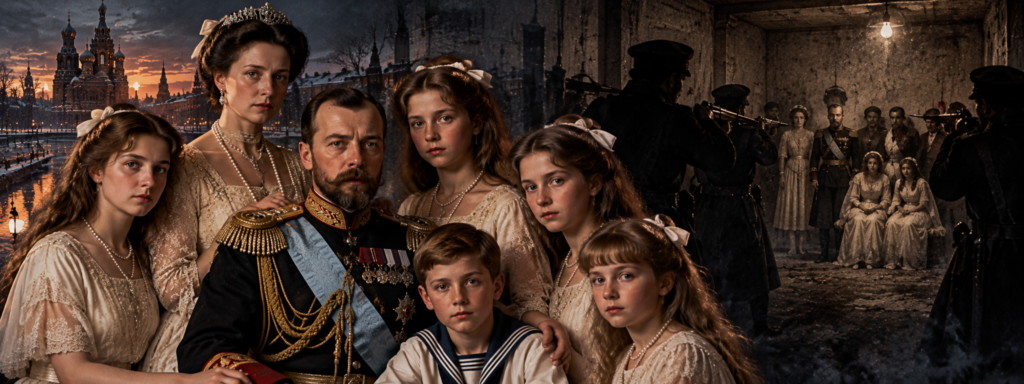
Nicholas II of Russia: The Last Tsar and the Night the Romanovs Were Murdered
The Fall of an Empire, the Imprisonment of a Family, and the Brutal Execution That Ended Three Centuries of Romanov Rule
Nicholas II of Russia (18 May 1868–17 July 1918) was the last reigning emperor of Russia, ruling from 1894 until his abdication in March 1917. Born Nikolai Alexandrovich Romanov, he inherited an immense empire from his father, Alexander III, and presided over a reign marked by political repression, revolutionary unrest, military disaster, and the eventual collapse of the Russian monarchy. His marriage to Alexandra Feodorovna produced five children—Grand Duchesses Olga, Tatiana, Maria, and Anastasia, and Tsarevich Alexei—whose lives became inseparable from the tragedy that overtook their parents. After the February Revolution forced Nicholas from the throne, the family endured months of confinement, first at Tsarskoye Selo, then in the Siberian town of Tobolsk, and finally inside the heavily guarded Ipatiev House in Yekaterinburg. During the early hours of 17 July 1918, Bolshevik authorities executed Nicholas, Alexandra, their five children, and four loyal members of their household in a basement room. The killings were carried out amid the Russian Civil War, as anti-Bolshevik forces approached the city, and were followed by an attempt to conceal and destroy the victims’ remains. Nicholas was forty-nine years old, Alexandra forty-six, and their youngest child, Alexei, only thirteen.
The execution of the Romanov family remains one of the most horrifying episodes in the history of European monarchy. It was not simply the killing of a deposed ruler whose political enemies feared his restoration, but the deliberate destruction of an entire immediate family, including five young people who had exercised no political power and several servants whose only offense was their continued loyalty. The tragedy is made more disturbing by the surviving evidence of the family’s final months: their diaries, letters, photographs, and personal belongings reveal people attempting to maintain ordinary routines while the world beyond their prison walls descended into violence. Their captors controlled their movements, correspondence, food, privacy, and eventually their lives, while the family remained uncertain about what would happen next. The final execution was chaotic and prolonged, and the Bolsheviks’ subsequent efforts to conceal the bodies gave rise to decades of rumors, false claimants, and unresolved grief. Only in the late twentieth and early twenty-first centuries would forensic investigation and genetic evidence establish the fate of all seven members of the imperial family beyond reasonable scientific doubt.
To understand how Nicholas II, the ruler of one of the world’s largest empires, came to die in a basement alongside his wife, children, physician, and servants, it is necessary to examine both the failures of his reign and the human story that unfolded after his downfall. Nicholas was an autocrat whose decisions contributed to the political catastrophe that destroyed his dynasty, but his responsibility as a ruler must be distinguished from the murder of his family. His children did not choose his policies, and the household attendants who remained with them were not participants in the struggle for power. Their deaths were the result of deliberate decisions made by men who regarded the surviving Romanovs as a political danger. The story begins long before the execution, in the imperial world that raised Nicholas to believe that the throne was his sacred inheritance and that surrendering its authority was almost unthinkable.
The Heir to an Empire That Seemed Eternal
Nicholas was born on 18 May 1868 at the Alexander Palace in Tsarskoye Selo, the eldest son of the future Emperor Alexander III and Maria Feodorovna, formerly Princess Dagmar of Denmark. His grandfather, Alexander II, was still emperor, and the Romanov dynasty had ruled Russia since 1613. The young Nicholas grew up surrounded by the ceremonial grandeur of imperial life, but his family also cultivated a comparatively restrained domestic atmosphere. Alexander III was a physically imposing man who valued discipline, family loyalty, and the preservation of autocratic government, while Maria Feodorovna was socially accomplished and deeply attached to her children.
Nicholas’s childhood was shaped by an event that demonstrated how vulnerable even an emperor could be. On 13 March 1881, his grandfather Alexander II was assassinated in St. Petersburg by members of the revolutionary organization Narodnaya Volya. Nicholas was twelve years old when the murder occurred, and the violent death of his grandfather left a lasting impression upon the dynasty. Alexander III responded to the assassination by abandoning the limited political reforms under consideration and reaffirming the authority of the monarchy. The future Nicholas II therefore came of age in a household that regarded revolutionary politics as a mortal threat and concessions to representative government as potentially disastrous.
His education was extensive, covering languages, history, law, military affairs, and the administration of the empire. Nicholas was intelligent enough to understand complex matters, but he was not naturally suited to the demanding political responsibilities that awaited him. He was courteous, personally reserved, and devoted to his family, yet he lacked the commanding presence of his father. His private diaries suggest a young man more comfortable with familiar routines, military life, and personal relationships than with the relentless pressures of government.
Nicholas also inherited a powerful sense of religious obligation. The Russian emperor was not merely a political ruler but a central figure in the Orthodox understanding of the relationship between church, monarchy, and nation. Nicholas believed that his authority carried sacred responsibilities and that abandoning autocracy would betray the duty entrusted to him. This conviction would become increasingly consequential as Russia’s political system faced demands for constitutional government.
In 1894, Alexander III died unexpectedly at the age of forty-nine after suffering from kidney disease. Nicholas, only twenty-six, suddenly became emperor of an empire stretching across Europe and Asia. He was deeply distressed by his father’s death and privately expressed uncertainty about his readiness to rule. Nevertheless, the machinery of monarchy required him to assume power immediately.
Nicholas’s accession occurred at a moment when Russia was changing rapidly. Industrial development was transforming cities, railways were expanding, and a growing educated population was questioning the legitimacy of unrestricted autocratic rule. Workers endured harsh conditions, peasants remained burdened by poverty and land shortages, and national minorities faced policies of imperial centralization. The empire appeared immense and powerful, but its political foundations were increasingly unstable.
Nicholas did not create all these problems, and many had developed over generations. Yet he inherited the responsibility of confronting them and repeatedly chose to defend the autocratic structure rather than embrace fundamental constitutional change. His reign would reveal the consequences of that decision. The dynasty that had survived palace conspiracies, assassinations, and wars would eventually collapse under pressures that the last emperor could neither control nor adequately understand.
Alexandra Feodorovna: Love, Marriage, and an Unpopular Empress
Nicholas’s marriage to Alexandra Feodorovna became one of the defining relationships of his life. Born Princess Alix of Hesse and by Rhine in 1872, Alexandra was a granddaughter of Queen Victoria and had experienced considerable personal tragedy during childhood. Her mother and one of her sisters died during a diphtheria outbreak in 1878, leaving the young princess with a profound awareness of illness and loss. She grew into a serious, deeply religious woman who was often uncomfortable in large social gatherings.
Nicholas and Alexandra developed a strong attachment before his accession, although their marriage initially faced resistance from Alexander III and Maria Feodorovna. Alexandra was reluctant to abandon her Lutheran faith, and the political suitability of the match was questioned. Eventually, she agreed to convert to Russian Orthodoxy, and the couple became engaged in 1894. Their marriage took place shortly after Alexander III’s death, amid the mourning that accompanied Nicholas’s accession.
The timing gave the beginning of their married life a strangely somber character. The imperial household had scarcely completed the ceremonies surrounding the death of one emperor before celebrating the marriage of his successor. Nicholas and Alexandra nevertheless formed a devoted partnership that remained emotionally intense throughout their lives. Their surviving correspondence reveals affection, religious commitment, and a reliance upon one another that became especially important during periods of political crisis.
Alexandra struggled to establish herself as empress. She was shy, frequently anxious, and uncomfortable with the elaborate social expectations of the Russian court. Her reserve was often interpreted as arrogance, particularly when contrasted with the charm and popularity of Nicholas’s mother. Court society could be unforgiving toward those who failed to master its rituals, and Alexandra’s difficulties contributed to her growing isolation.
Her German background became another source of suspicion. Although she had converted to Orthodoxy and embraced her new country, critics continued to regard her as foreign. During the First World War, when Russia fought Germany, malicious rumors about her loyalty spread widely. There is no credible evidence that Alexandra acted as a German agent, but the accusations damaged the monarchy’s reputation.
Alexandra also shared Nicholas’s belief in the sacred character of autocracy. She encouraged him to resist political concessions and frequently interpreted opposition to the throne as a challenge to divinely sanctioned authority. Her influence became increasingly controversial during the later years of his reign. Critics blamed her for political decisions that were ultimately Nicholas’s responsibility, while supporters emphasized her devotion to her husband and children.
Their marriage was genuine and affectionate, but it also contributed to the isolation of the imperial couple. Nicholas increasingly relied upon Alexandra’s advice, even when it conflicted with the recommendations of experienced ministers. Alexandra, in turn, believed that loyalty to the monarchy required firmness against political opponents. Their shared convictions strengthened their personal bond while narrowing their ability to respond effectively to the changing political world.
Five Children and the Family Behind the Imperial Portraits
Between 1895 and 1904, Nicholas and Alexandra welcomed five children. Their eldest daughter, Olga Nikolaevna, was born in November 1895, followed by Tatiana in June 1897, Maria in June 1899, and Anastasia in June 1901. The birth of four daughters created anxiety within a dynasty whose succession laws favored male heirs. Although Nicholas and Alexandra loved their daughters, the absence of a son became a matter of political concern.
The four grand duchesses grew up in a household that was more intimate than the formal image of the imperial family might suggest. Nicholas and Alexandra preferred spending time with their children at the Alexander Palace rather than participating constantly in the elaborate entertainments of court society. The girls shared rooms, performed household tasks, studied languages and music, and developed strong relationships with one another. Their surviving photographs show both the ceremonial grandeur of their position and the ordinary playfulness of childhood.
Olga, the eldest, was thoughtful, sensitive, and sometimes outspoken. She possessed a strong sense of independence and could be critical of people she considered insincere. Tatiana was more disciplined and organized, often taking responsibility for practical matters within the family. Maria was remembered for her warmth and sociability, while Anastasia became known for her humor, mischievous behavior, and lively personality.
The sisters were often referred to collectively by the initials OTMA, formed from their first names. They used the initials in correspondence and shared a closeness reinforced by their relatively sheltered upbringing. Their world revolved around family, tutors, religious observances, outdoor activities, and the routines of imperial residences. Although they occupied an extraordinary social position, many aspects of their private lives were strikingly ordinary.
The long-awaited son, Alexei Nikolaevich, was born in August 1904. His arrival was celebrated throughout the empire because he secured the immediate male succession. Nicholas and Alexandra were overjoyed, but their happiness was soon overshadowed by a devastating discovery. Alexei had inherited hemophilia, a hereditary disorder that impaired the blood’s ability to clot.
The condition made ordinary injuries potentially dangerous. Bruises, internal bleeding, and accidents could produce prolonged pain and life-threatening complications. The imperial couple lived with constant anxiety over their son’s health, while the details of his illness were largely concealed from the public. This secrecy would contribute to one of the most damaging scandals of Nicholas’s reign.
Alexei’s illness also shaped the family’s relationships. His sisters were protective of him, and Alexandra became intensely concerned with his physical safety. Nicholas loved his son deeply and recorded moments of family life with evident affection. The boy’s vulnerability made the political uncertainty surrounding the dynasty even more painful.
The children would eventually become central to the tragedy of 1918. Their surviving letters and diaries reveal young people who experienced the collapse of their world without fully controlling or understanding the forces responsible. They were born into immense privilege, but that privilege could not protect them from the political consequences of their father’s reign. Their final months would strip away nearly everything associated with their imperial status, leaving them dependent upon the loyalty of a few attendants and the decisions of their captors.
The Coronation Disaster and the First Shadow Over the Reign
Nicholas and Alexandra were crowned in Moscow in May 1896, during ceremonies intended to demonstrate the continuity and grandeur of Romanov rule. The coronation brought together members of the aristocracy, foreign dignitaries, clergy, and thousands of ordinary Russians. Elaborate celebrations were planned, including the distribution of food and commemorative gifts to the public. The festivities were meant to strengthen the bond between the new emperor and his subjects.
Instead, the celebrations were overshadowed by catastrophe. On 30 May 1896, a vast crowd gathered at Khodynka Field in Moscow, where gifts and refreshments were to be distributed. Poor crowd management, uneven ground, and rumors of shortages contributed to a deadly crush. More than a thousand people were killed, and many others were injured.
The disaster horrified the country. Nicholas visited the wounded and expressed grief, but his decision to attend a previously scheduled diplomatic ball that evening became a source of lasting criticism. The imperial court regarded the event as an important obligation, yet many Russians interpreted his attendance as evidence of indifference. The episode damaged the image of the young emperor at the very beginning of his reign.
The Khodynka tragedy also revealed the distance between imperial ceremony and the realities of public administration. An event designed to celebrate the monarchy had become a scene of mass death because officials failed to manage the gathering safely. Nicholas inherited responsibility for the response, even though the immediate causes involved numerous administrators and organizers. His handling of the aftermath became an early example of his difficulty understanding how political symbolism could shape public opinion.
The disaster acquired a reputation as an ominous beginning to the reign. Later commentators portrayed it as a warning of the bloodshed that would follow, although such interpretations belong to hindsight rather than historical causation. At the time, Nicholas continued to believe that his duty was to preserve the inherited system of government. The monarchy survived the scandal, but the relationship between ruler and people had suffered an early wound.
Bloody Sunday and the Revolution of 1905
The most serious early challenge to Nicholas’s authority emerged from Russia’s growing industrial workforce and the social tensions accompanying economic modernization. Workers in major cities faced long hours, dangerous conditions, low wages, and limited political rights. Strikes and demonstrations became increasingly common, while revolutionary organizations attempted to mobilize discontent. The government responded through a mixture of policing, limited concessions, and repression.
In January 1905, a peaceful procession of workers and their families approached the Winter Palace in St. Petersburg to present a petition to the emperor. The demonstration was led by Father Georgy Gapon, an Orthodox priest involved in organizing workers. Participants carried religious icons and portraits of Nicholas, reflecting the belief among many that the tsar might intervene against injustice if he understood their suffering. The petition included demands for improved working conditions and political reforms.
Nicholas was not at the Winter Palace when the demonstrators arrived. Troops and police nevertheless confronted crowds at several locations, and soldiers opened fire. The number of people killed remains disputed, but the casualties were substantial and the event shocked the empire. The massacre became known as Bloody Sunday.
The significance of Bloody Sunday extended far beyond the immediate deaths. Many workers who had approached the monarchy with traditional expressions of loyalty lost faith in the emperor as a protective father figure. The belief that the tsar stood above corrupt officials was severely damaged. Nicholas became associated with the violence even though he had not personally ordered the shooting at the scene.
The massacre helped trigger the Revolution of 1905. Strikes, peasant disturbances, military mutinies, and political protests spread across the empire. The defeat of Russia in the war against Japan intensified the crisis, undermining confidence in the government and the armed forces. Nicholas faced the possibility that the political system might collapse.
Under pressure, he issued the October Manifesto, promising civil liberties and the creation of a legislative assembly known as the Duma. The manifesto represented an important concession, but Nicholas remained deeply reluctant to accept limitations upon his authority. Subsequent constitutional arrangements preserved extensive powers for the emperor, including control over ministers and the ability to dissolve the legislature. The resulting system offered a measure of representation without establishing parliamentary government.
The revolution was eventually suppressed, but the political consequences endured. Nicholas had demonstrated that he could make concessions when faced with overwhelming pressure, yet his unwillingness to embrace constitutional monarchy undermined the possibility of lasting cooperation with reformers. The state continued to rely upon police powers, censorship, and restrictions upon political activity. The tensions that had produced the revolution remained unresolved.
The events of 1905 also shaped the fate of the imperial family. Alexandra became more suspicious of political reform and more determined to defend autocracy. Nicholas increasingly viewed opposition as a threat to the dynasty rather than as evidence of legitimate grievances. Their personal convictions hardened as the political environment became more dangerous. The monarchy survived the first revolution, but it emerged weakened and increasingly isolated.
Rasputin, Alexei’s Illness, and the Scandal That Consumed the Court
The illness of Tsarevich Alexei brought the imperial family into contact with Grigori Rasputin, a Siberian religious figure whose influence became one of the most controversial aspects of Nicholas’s reign. Rasputin had acquired a reputation for spiritual insight and healing, attracting followers among members of Russian high society. Alexandra became convinced that he could help her son during episodes of bleeding and severe pain. His apparent ability to calm the family and sometimes coincide with improvements in Alexei’s condition strengthened her trust.
The precise nature of Rasputin’s influence upon Alexei’s health remains debated. Some historians have suggested that his calming presence reduced the boy’s stress, while others have noted that advice to avoid certain medical interventions may have been beneficial. There is no reliable evidence that Rasputin possessed supernatural healing powers. What mattered politically was Alexandra’s conviction that he had helped save her son’s life.
Because Alexei’s hemophilia was concealed from much of the public, Rasputin’s presence at court appeared inexplicable and suspicious. Rumors spread that the empress was under the control of a disreputable mystic. Stories of sexual misconduct, drunkenness, and political manipulation circulated widely, although individual allegations varied in reliability. Rasputin’s actual influence was substantial in certain matters, but later accounts often exaggerated his power and transformed him into a figure of almost supernatural corruption.
The scandal became particularly damaging during the First World War. Alexandra defended Rasputin against critics and sometimes supported appointments or dismissals influenced by his recommendations. Nicholas’s ministers and relatives warned that the relationship was destroying public confidence in the monarchy. The imperial couple often interpreted such warnings as disloyalty or misunderstanding.
Rasputin was murdered in December 1916 by a group of aristocratic conspirators who believed that removing him would help save the dynasty. His death did not restore confidence in Nicholas’s government. Instead, it demonstrated the depth of division within the ruling elite. Members of the aristocracy had resorted to murder because they believed that the emperor and empress could no longer be persuaded to change course.
The Rasputin affair was tragic in part because it began with a parent’s desperation. Alexandra’s fear for her son’s life was genuine, and her reliance upon someone she believed could help him is understandable within that emotional context. Yet the secrecy surrounding Alexei’s illness allowed rumors to flourish, while the imperial couple’s unwillingness to respond effectively to criticism magnified the damage. A private medical crisis became a national political scandal.
For the children, Rasputin was not simply the sinister figure described in hostile newspapers and later popular accounts. He was someone their mother trusted and who was associated with efforts to relieve their brother’s suffering. The difference between the family’s private experience and the public mythology surrounding Rasputin illustrates the growing separation between the imperial household and Russian society. By the time of his murder, the monarchy’s reputation had been gravely damaged.
The First World War and the Destruction of Imperial Authority
Russia entered the First World War in 1914 as part of the alliance opposing Germany and Austria-Hungary. Nicholas and his government viewed the conflict through the lenses of imperial security, diplomatic obligation, and support for Serbia. The war initially produced patriotic demonstrations and expressions of loyalty to the monarchy. Yet the scale of the conflict soon exposed weaknesses in Russia’s military organization, transportation system, and economy.
Russian armies suffered enormous casualties during the early years of the war. Defeats, shortages of equipment, and problems with command undermined morale. The government struggled to supply troops and maintain essential services, while inflation and food shortages placed increasing pressure upon civilians. The war demanded resources that the empire’s institutions were poorly equipped to provide.
In 1915, Nicholas made the consequential decision to assume personal command of the Russian armed forces. He traveled to military headquarters at Mogilev, leaving Alexandra with a more prominent role in the capital. The decision associated the emperor directly with military performance while separating him from the political center of government. It also increased Alexandra’s involvement in appointments and correspondence concerning domestic affairs.
The military situation remained difficult, and the government experienced frequent ministerial changes. Critics accused Alexandra and Rasputin of interfering with appointments and undermining competent administration. Rumors of treason spread, especially because Alexandra was German-born. Although the accusations of deliberate collaboration with Germany were unfounded, they reflected the collapse of trust between the monarchy and influential sections of society.
The Duma became increasingly critical of the government. Politicians who had previously supported the monarchy called for a ministry capable of commanding public confidence. Nicholas resisted proposals that would significantly reduce his authority. His refusal to cooperate with moderate reformers narrowed the political options available to the dynasty.
By the winter of 1916–1917, the empire was approaching crisis. Food shortages, transportation failures, inflation, and war weariness intensified public anger. Soldiers were exhausted, workers were increasingly militant, and members of the political elite feared catastrophe. The monarchy’s legitimacy had been weakened by years of mismanagement and repression.
Nicholas remained personally devoted to his family and religious duties, but his political judgment proved inadequate to the emergency. He underestimated the depth of dissatisfaction and continued to believe that loyalty to the throne would ultimately prevail. The institutions upon which he relied were losing the confidence of the population. The final collapse would come with astonishing speed.
The February Revolution and the Abdication of the Last Tsar
In March 1917, according to the Gregorian calendar, demonstrations erupted in Petrograd, the wartime name for St. Petersburg. The protests began amid food shortages, industrial unrest, and anger over the war. Women workers played an important role in the early demonstrations, and the movement rapidly expanded. Strikes spread through the city as crowds demanded bread, peace, and political change.
The government attempted to suppress the unrest, but soldiers increasingly refused to fire upon demonstrators. Some military units mutinied and joined the crowds, depriving the authorities of the force needed to restore order. The capital descended into revolutionary turmoil. The political system that had survived the upheaval of 1905 was now collapsing.
Nicholas was away at military headquarters when the crisis intensified. His attempts to return to the capital were disrupted by the breakdown of authority and transportation. Senior military commanders and political figures concluded that the emperor’s abdication might be necessary to preserve the army and prevent further chaos. Nicholas found himself increasingly isolated from the institutions that had sustained his reign.
On 15 March 1917, Nicholas signed an abdication document. He renounced the throne for himself and, in the same act, attempted to pass over his son Alexei in favor of his brother, Grand Duke Michael Alexandrovich. The legal validity of excluding Alexei has been debated, but the political situation made such questions secondary. Michael declined to accept the crown without the approval of a representative body, effectively ending the monarchy.
The Romanov dynasty had ruled Russia for more than three centuries. Its collapse occurred not through a foreign conquest or a palace assassination but through a revolutionary crisis that destroyed the emperor’s political authority. Nicholas, who had spent his life believing that autocracy was a sacred obligation, surrendered the throne under pressure from his own commanders and political leaders. The event marked the end of imperial Russia.
For Alexandra and the children, the revolution created immediate uncertainty. They remained at the Alexander Palace, where illness had affected several members of the family. The grand duchesses had suffered from measles, and Alexei’s health remained fragile. The family was suddenly deprived of the protection and status that had defined their lives.
Nicholas returned to Tsarskoye Selo as a private citizen and prisoner rather than as emperor. The Provisional Government placed the family under guard, restricting their movements and communications. The former ruler of an enormous empire now depended upon the decisions of officials who had replaced his government. The transformation was almost incomprehensible.
The abdication did not immediately make the family’s deaths inevitable. Various possibilities were considered, including exile abroad and continued residence under supervision. Yet the political situation deteriorated rapidly, and the Romanovs became increasingly difficult for any government to protect. Their fate would be determined by the struggle for power that followed the monarchy’s collapse.
Prisoners in Their Own Palace
The family’s first period of captivity took place at the Alexander Palace in Tsarskoye Selo. The residence had been their beloved home, filled with personal belongings, family photographs, and memories of childhood. After the revolution, however, guards controlled the entrances and restricted movement beyond designated areas. The palace became a prison despite its familiar surroundings.
Nicholas and Alexandra attempted to preserve a sense of routine. The children continued their studies, participated in religious observances, and spent time outdoors when permitted. Nicholas worked in the garden, chopped wood, and engaged in physical activity. These ordinary tasks provided structure during a period of uncertainty.
The grand duchesses were recovering from illness, and the family remained concerned about Alexei’s condition. Their health problems made the possibility of sudden travel especially difficult. Alexandra’s own health was fragile, and she experienced periods of pain and exhaustion. The household’s daily life was shaped by medical concerns as well as political restrictions.
The Provisional Government faced pressure from those who demanded harsher treatment of the former emperor. Some political groups regarded Nicholas as responsible for the suffering caused by his reign and the war. Others feared that the Romanovs might become a rallying point for counterrevolutionary forces. The government struggled to balance public anger, legal considerations, and the practical difficulties of detention.
The possibility of sending the family abroad was discussed, but no workable arrangement emerged. The political situation in Britain and Russia complicated the idea of asylum, and the Provisional Government eventually abandoned immediate plans for departure. The Romanovs remained in Russia as the revolutionary crisis deepened. Their future became increasingly uncertain.
The family retained a small circle of loyal attendants who chose to remain with them. These individuals provided practical assistance and emotional support during captivity. Their loyalty would eventually expose them to the same dangers as the Romanovs themselves. The distinction between service and personal devotion became increasingly important as conditions worsened.
Nicholas’s diaries from this period reveal a man attempting to adapt to confinement while following events beyond the palace. He recorded daily activities, weather, family concerns, and political developments with a restraint that can appear striking given the circumstances. The entries do not always reveal his deepest emotions, but they document the shrinking world of the former emperor. The man who had once governed millions now measured his days through walks, meals, and the movements of guards.
The family’s captivity at Tsarskoye Selo was restrictive but not yet as severe as the conditions they would later endure. They remained together, retained many personal possessions, and could maintain familiar domestic routines. Yet the loss of freedom was unmistakable. Their lives were now controlled by a government whose survival was itself uncertain.
Exile to Tobolsk: The Romanovs Disappear into Siberia
In August 1917, the Provisional Government transferred the Romanov family to Tobolsk, a remote town in western Siberia. The decision was partly intended to remove them from the increasingly unstable political atmosphere of Petrograd. Tobolsk was distant from major revolutionary centers and appeared to offer a more secure location. The journey marked another stage in the family’s descent from imperial privilege into captivity.
The Romanovs traveled by train and river transport, accompanied by guards and attendants. The journey was long and physically demanding, particularly for Alexandra and Alexei. The children encountered landscapes and communities far removed from their former life at Tsarskoye Selo. Their destination was a provincial town whose quiet streets contrasted sharply with the grandeur of the imperial capital.
The family was housed in the former governor’s residence. Conditions were modest compared with those of their palaces, but they initially retained some comforts and a degree of domestic organization. The children continued their lessons, and religious observances remained central to family life. Nicholas engaged in physical tasks and recorded daily routines in his diary.
Tobolsk offered moments of relative calm, but the family’s isolation deepened. News from the outside world arrived irregularly, and the political situation changed rapidly. In November 1917, the Bolsheviks seized power in Petrograd during the October Revolution, replacing the Provisional Government. The Romanovs were now prisoners of a regime whose leaders regarded the monarchy as a symbol of the old oppressive order.
The Bolshevik takeover transformed the family’s prospects. The new government faced civil conflict, economic breakdown, and opposition from forces seeking to overturn the revolution. The former emperor became a politically dangerous captive whose existence could be exploited by enemies of the Bolsheviks. His family shared that danger despite having no independent political authority.
During the winter, conditions in Tobolsk became more restrictive. Guards changed, supplies became less reliable, and the family’s financial resources were increasingly limited. The Romanovs attempted to maintain dignity through work, prayer, and domestic routines. Their letters reveal concern for one another and uncertainty about the future.
Alexei’s health remained a serious problem. Episodes of bleeding caused severe pain and limited his mobility, making travel difficult. Alexandra was deeply anxious about his condition and reluctant to leave him. The family’s medical vulnerability would influence the circumstances of their next transfer.
The Romanovs spent their final Christmas together in Tobolsk in 1917. Religious observances and family traditions provided comfort amid uncertainty, but the political situation offered little reassurance. The children continued to write letters and occupy themselves with reading, sewing, and household tasks. Their lives had become smaller, quieter, and increasingly dependent upon the decisions of distant authorities.
By the spring of 1918, the Bolsheviks decided to move the family again. The Russian Civil War was intensifying, and the authorities feared that the Romanovs might fall into the hands of anti-Bolshevik forces. The next destination would be Yekaterinburg, an industrial city in the Urals. There, the family’s captivity would become far more severe.
The Separation of the Family
In April 1918, Bolshevik officials arrived in Tobolsk to arrange the transfer of Nicholas and his family. Alexei was suffering from a serious episode of illness and was not fit for immediate travel. Alexandra faced an agonizing decision between remaining with her son and accompanying her husband. She ultimately traveled with Nicholas, taking their daughter Maria, while the other children remained temporarily in Tobolsk.
The separation was deeply distressing because the family had remained closely united throughout captivity. Nicholas and Alexandra had relied upon their children for companionship and emotional support. Leaving Alexei behind while he was ill was especially painful for Alexandra. The decision reflected the uncertainty and coercion surrounding the transfer.
Nicholas, Alexandra, and Maria were taken to Yekaterinburg, where they were confined in the Ipatiev House. The building had belonged to an engineer named Nikolai Ipatiev and was requisitioned by the Bolshevik authorities. Its windows were covered or obscured, and a high wooden fence surrounded the property. The residence was officially designated the House of Special Purpose.
The remaining children—Olga, Tatiana, Anastasia, and Alexei—stayed in Tobolsk until May 1918. Their eventual journey to Yekaterinburg was difficult, particularly because of Alexei’s condition. The sisters were forced to manage their brother’s needs while dealing with guards and uncertain travel arrangements. The transfer marked another loss of security and control.
When the family was reunited, the circumstances were far harsher than those they had known in Tobolsk. The Ipatiev House was heavily guarded, and the prisoners were subject to strict regulations. Their movements were limited, their correspondence was controlled, and their privacy was reduced. The atmosphere was tense and often humiliating.
The family’s reunion did not restore the sense of normality they had tried to preserve. They were now confined in a city where local Bolshevik authorities were particularly hostile to the former monarchy. The civil war was approaching the Urals, and the prisoners’ fate became increasingly entangled with military developments. The Ipatiev House would be their final residence.
The House of Special Purpose
The Ipatiev House stood on a hillside in Yekaterinburg, surrounded by streets and buildings that continued their ordinary activities while the former imperial family remained hidden behind fences. The property was converted into a secure detention site, with guards stationed inside and around the building. Windows were whitewashed or otherwise obscured to prevent the prisoners from observing the outside world. The family was permitted only limited exercise in the enclosed yard.
The conditions were deliberately restrictive. Guards monitored the prisoners’ movements, and personal belongings were searched or confiscated. The Romanovs were required to follow schedules imposed by their captors. Their former imperial rank no longer offered protection from intrusive supervision.
The family occupied several rooms and attempted to maintain domestic routines despite the lack of privacy. Nicholas read, wrote in his diary, and performed physical tasks when permitted. Alexandra spent much of her time seated because of her health problems, while the children assisted with household duties. Religious observances remained an important source of comfort.
The guards varied in their behavior. Some were openly hostile, while others treated the prisoners with greater restraint. The family experienced insults and humiliations, particularly during the early period of confinement. Later changes in the guard arrangements produced somewhat more controlled conditions, but the underlying danger remained.
The Romanovs were not completely cut off from human contact. They interacted with guards, received limited supplies, and were occasionally allowed religious services. Yet every interaction occurred within a system designed to isolate and control them. The family had no reliable means of knowing whether they would be transferred, tried, exchanged, or killed.
Their surviving diaries and letters reveal attempts to preserve ordinary life. The daughters read, sewed, and helped care for Alexei, while Nicholas continued to record daily events. These activities can appear almost painfully mundane when viewed in light of what followed. They show people trying to remain a family even as the conditions of captivity stripped away their freedom.
The Ipatiev House became a place of waiting. The prisoners were aware of the civil war and the possibility that their fate might change suddenly. They could not know the precise plans being discussed by Bolshevik officials. Their future depended upon decisions made beyond their hearing.
The building’s later notoriety has sometimes encouraged exaggerated descriptions of every moment spent within it. The surviving evidence supports a picture of restrictive, humiliating, and increasingly dangerous confinement, but not every sensational anecdote repeated in popular accounts can be verified. The family’s documented experiences are disturbing enough without embellishment. Their final weeks were marked by isolation, uncertainty, and the gradual disappearance of any realistic prospect of escape.
The Loyal Four Who Refused to Leave
Four members of the imperial household died alongside the Romanovs in July 1918. They were Dr. Eugene Botkin, the family’s physician; Anna Demidova, Alexandra’s maid; Alexei Trupp, a footman; and Ivan Kharitonov, a cook. Their presence in the Ipatiev House reflected personal loyalty that endured after the monarchy had collapsed. They were not rulers, ministers, or political decision-makers, yet they shared the family’s captivity and eventual fate.
Dr. Eugene Botkin had served as physician to the imperial family and remained with them during their imprisonment. He was a widower and father whose decision to accompany the Romanovs separated him from much of his own family. His professional responsibilities were especially important because of Alexei’s hemophilia and Alexandra’s poor health. Botkin continued to care for his patients despite the growing danger.
Botkin’s loyalty was rooted in more than professional obligation. His surviving correspondence reveals a strong sense of duty and a willingness to remain with the family during their suffering. He understood that his position was precarious, yet he did not abandon them. His death would later be remembered as an example of devotion carried to its ultimate consequence.
Anna Demidova served as Alexandra’s maid and remained with the empress through the final months of captivity. Her work involved the ordinary intimate tasks of household service, but the circumstances transformed those duties into acts of personal commitment. She had opportunities to separate her fate from that of the imperial family before the final confinement, yet she remained. Her presence in the basement on the night of the execution would become part of the tragedy’s most disturbing testimony.
Alexei Trupp had served the imperial household for many years. He was a Catholic, distinguishing him religiously from the Orthodox Romanovs, but his loyalty to the family was unwavering. Ivan Kharitonov, the cook, continued preparing meals under increasingly difficult conditions. Both men remained in service after the privileges and security associated with imperial employment had disappeared.
The four attendants are sometimes overshadowed by the fame of the Romanovs. Their deaths deserve equal recognition because they were individuals with families, histories, and lives beyond their service. They were not incidental casualties whose identities can be reduced to their occupations. Each made decisions that kept them close to the prisoners during a period of escalating danger.
Their presence also complicates the political justification later offered for the execution. The attendants posed no credible threat of restoring the monarchy. They were killed because they were inside the house and because the authorities intended to eliminate witnesses and members of the captive household. Their deaths expose the indiscriminate brutality of the operation.
Remembering the Romanov execution properly requires remembering all eleven victims. Nicholas and Alexandra were the most politically significant, and their children became the focus of international mourning, but Botkin, Demidova, Trupp, and Kharitonov were equally human. Their loyalty did not protect them. On the final night, the executioners made no meaningful distinction between the former emperor and the people who had continued to serve his family.
The Civil War Closes Around Yekaterinburg
By the summer of 1918, the Russian Civil War was intensifying, and Bolshevik control over parts of the country was increasingly uncertain. Anti-Bolshevik forces, including units associated with the Czechoslovak Legion and emerging White movements, were advancing through the Urals. Yekaterinburg became strategically important because of its location and transportation connections. The presence of the former imperial family created an additional political problem for the local Bolshevik authorities.
The Romanovs could potentially become symbols for anti-Bolshevik forces. Even though Nicholas had abdicated and was deeply unpopular among many Russians, his survival offered possibilities for monarchist propaganda or political bargaining. The Bolsheviks feared that advancing enemies might capture the family and use them against the revolutionary government. These fears contributed to the decision to eliminate the prisoners.
The exact chain of authorization for the execution remains a subject of historical debate. The Ural Regional Soviet played a central role in the decision, and Yakov Yurovsky, the commandant of the Ipatiev House, organized the killings. Historians have debated the extent to which Lenin, Yakov Sverdlov, and other leaders in Moscow gave direct prior approval. The surviving documentary record does not establish every detail beyond dispute.
It is important to distinguish between the clear responsibility of Bolshevik authorities for the execution and the unresolved question of precisely who issued the final authorization. The operation was not an accidental outbreak of violence by undisciplined guards. It was organized by officials acting within the revolutionary power structure. The absence of a complete surviving order does not make the killings mysterious in their basic nature.
The approaching military threat increased the urgency of the decision. Local authorities feared that evacuation might become impossible or that the prisoners might be liberated. The family had no realistic means of influencing these calculations. Their fate was determined by the political and military concerns of their captors.
Nicholas continued to record ordinary details in his diary during the final days. The entries describe weather, walks, reading, and household routines rather than any clear expectation of imminent execution. The family knew that conditions were dangerous, but the surviving evidence does not show that they understood the precise decision being prepared. Their uncertainty made the final deception possible.
The executioners prepared for the operation during the night of 16–17 July. Weapons, personnel, and arrangements for removing the bodies were assembled. The plan was intended to be swift and secret, but its execution would prove chaotic. The murder of eleven people in a confined room was far more difficult than the organizers anticipated.
The tragedy was therefore shaped by two converging forces: the collapse of the monarchy and the violence of the civil war. Nicholas’s political failures had contributed to the destruction of imperial authority, but the decision to kill his family was made after he had ceased to rule. The Bolshevik authorities treated the prisoners as a danger to be eliminated rather than as individuals entitled to legal protection. The approaching armies provided the immediate context for a decision that would stain the history of the revolution.
The Final Evening: Ordinary Hours Before an Unimaginable Night
On 16 July 1918, the Romanov family spent what appeared to be another day of confinement in the Ipatiev House. Their routines had become familiar: reading, prayer, limited exercise, meals, and quiet conversation. The guards maintained control over the building, and the prisoners remained isolated from the military developments outside. Nothing in the surviving family records establishes that they knew the execution had been scheduled.
Nicholas wrote his final diary entry that day. Like many of his entries during captivity, it recorded ordinary details rather than a dramatic farewell. The restraint of his writing has often struck later readers as heartbreaking because it contrasts so sharply with the events that followed. The diary ended not with a declaration of fear or defiance but with the routines of a man who still expected another day.
The family retired for the night unaware of the precise preparations being made. Alexandra’s health remained poor, and Alexei’s mobility was limited by his illness. The daughters had become accustomed to helping their parents and brother manage the difficulties of captivity. Their last evening together was spent within the small domestic world they had preserved behind the fences.
Meanwhile, Yurovsky and the executioners prepared the operation. The authorities needed to gather the prisoners in a location where they could be killed and the bodies removed without attracting immediate attention. The basement area was selected for the execution. Arrangements were also made for transporting the remains away from the city.
The prisoners were awakened after midnight and told that they needed to move because of disturbances or danger in the city. The explanation was deceptive, but it was plausible within the circumstances of the civil war. The family had already experienced several transfers and knew that military developments could alter their confinement. They dressed and prepared to follow the guards.
Nicholas carried Alexei because the boy was unable to walk comfortably. Alexandra and the daughters followed, accompanied by the four attendants. The group descended through the house toward the room where the executioners were waiting. They were not told that they were being led to their deaths.
The room was small and sparsely furnished. Chairs were brought for Alexandra and Alexei, while the others stood nearby. The family waited, apparently expecting some further instruction concerning their supposed transfer. The executioners assembled outside or near the room, preparing to enter.
The final moments before the announcement remain difficult to reconstruct in every detail. Later accounts differ concerning the precise positions of the prisoners and the words spoken by Yurovsky. What is clear is that the family had been gathered under false pretenses and was given no meaningful opportunity to defend itself. The execution was about to begin.
The Basement Room: The Murder of Nicholas II and His Family
During the early hours of 17 July 1918, Yakov Yurovsky entered the basement room with armed men. Nicholas, Alexandra, their five children, and the four attendants were gathered together. The prisoners had been told that they were being moved for their safety, but the men who entered had come to kill them. The room became the setting for one of the most infamous mass executions of the twentieth century.
Yurovsky announced that the family was to be executed. Accounts differ over the exact wording of his statement and Nicholas’s response, and some later narratives contain dialogue that cannot be independently verified. The announcement appears to have been brief, leaving little time for the prisoners to comprehend what was happening. The executioners then opened fire.
Nicholas was among the first to be killed. The shooting immediately filled the confined room with smoke, noise, and confusion. The executioners had not coordinated their fire effectively, and bullets struck walls, bodies, and other objects. The operation that had been intended as a rapid execution became a prolonged and chaotic killing.
Alexandra was also shot, along with the attendants and children. Several victims did not die immediately, and the executioners continued firing or used other weapons to finish the killings. The presence of jewels and valuables concealed within some of the women’s clothing complicated the shooting because the objects could deflect or impede bullets. This detail, supported by later testimony and forensic evidence, contributed to the extraordinary horror of the scene.
The grand duchesses had sewn jewelry and precious stones into garments during captivity, partly to preserve family valuables amid repeated searches and confiscations. These concealed objects were not armor, but they affected the behavior of some bullets during the execution. Later accounts sometimes exaggerated the phenomenon into sensational stories of the daughters being nearly invulnerable to gunfire. The reality was far more terrible: the concealed valuables prolonged the violence and suffering.
Alexei, the thirteen-year-old heir, was also killed. His hemophilia had already caused years of pain and vulnerability, and he had been carried into the room by his father. The boy had never exercised political authority and had spent much of his short life struggling with a serious medical condition. His death eliminated the immediate male heir of Nicholas II.
The four attendants were murdered alongside the family. Dr. Botkin, Anna Demidova, Alexei Trupp, and Ivan Kharitonov had remained with the Romanovs through months of imprisonment. Their loyalty brought them into the basement, where the executioners made no distinction between royal prisoners and household staff. They died because the authorities had decided that everyone present should be eliminated.
The execution was not the orderly firing squad sometimes suggested by simplified accounts. It was a confused and brutal killing carried out at close range in a confined room. The victims were unarmed and had no realistic possibility of resistance or escape. The executioners continued until all eleven were dead.
The horror of the event lies not only in the violence but in the circumstances that preceded it. The family had been awakened from sleep, deceived about the reason for their movement, and assembled together without warning of their fate. Parents and children were killed in one room, while loyal attendants died beside them. The execution was designed to prevent the survival of the immediate imperial family.
The surviving evidence allows historians to establish the essential sequence, but not every individual movement or final utterance. Yurovsky’s accounts and those of other participants contain inconsistencies, and some later retellings introduced dramatic details that cannot be verified. Respect for the victims requires acknowledging those limits rather than inventing conversations or assigning final thoughts. The documented facts are already sufficient to convey the cruelty of what occurred.
By the time the shooting ended, the Romanov dynasty’s immediate imperial household had been destroyed. Nicholas, Alexandra, Olga, Tatiana, Maria, Anastasia, and Alexei were dead, together with Botkin, Demidova, Trupp, and Kharitonov. The basement room had become a place of mass murder. The executioners now faced the task of concealing what they had done.
The Eleven Victims: Lives Reduced to a Single Night
Nicholas II was forty-nine years old when he was killed. He had ruled Russia for more than twenty-two years, presiding over major political crises, military defeats, and the eventual collapse of the monarchy. His failures as a ruler were substantial and remain central to historical assessments of his reign. Yet the circumstances of his death were those of an unarmed prisoner executed without a public trial.
Alexandra Feodorovna was forty-six. Her life had been shaped by childhood bereavement, marriage into the Russian dynasty, the illness of her son, and increasing isolation from the society she was expected to represent. She had become a deeply controversial figure during the final years of the monarchy. In the basement of the Ipatiev House, however, she was a captive mother killed alongside her husband and children.
Olga Nikolaevna was twenty-two years old. She had experienced the responsibilities and expectations placed upon the eldest daughter of the emperor, but she had also shown independence, sensitivity, and concern for others. During the First World War, she and Tatiana trained as nurses and assisted wounded soldiers. Her life ended before she had the opportunity to build an independent future beyond the imperial household.
Tatiana Nikolaevna was twenty-one. She was remembered for her composure, discipline, and practical abilities, qualities that became particularly valuable during the family’s captivity. Like Olga, she had participated in wartime nursing work and witnessed the suffering of wounded soldiers. Her death destroyed a young life that had already been shaped by service and responsibility.
Maria Nikolaevna was nineteen. She was affectionate, sociable, and deeply attached to her family, and she had accompanied her parents during the first stage of their transfer to Yekaterinburg. Her surviving letters and photographs reveal a young woman whose interests and emotions extended far beyond the political identity imposed upon her by birth. She was killed before reaching her twentieth birthday.
Anastasia Nikolaevna was seventeen. Her humor and mischievous personality had made her one of the most memorable members of the family, and later legends would transform her into the subject of countless survival stories. The historical Anastasia was not a mysterious fugitive but a teenage girl who endured captivity and died with her relatives. The persistence of myths about her survival should not obscure the reality of her murder.
Alexei Nikolaevich was thirteen. As heir to the throne, he had been the focus of dynastic hopes, but his hemophilia made his childhood physically painful and medically precarious. His parents had devoted enormous attention to his health, and his sisters had helped care for him. He died in the same room as the people who had spent his life protecting him.
Dr. Eugene Botkin was fifty-three. He had remained with the family despite the personal cost and the dangers of captivity. His medical responsibilities were genuine, but his loyalty extended beyond professional duty. He was killed while accompanying patients who had become prisoners.
Anna Demidova was forty. She had served Alexandra through years of domestic life and continued to assist her after the monarchy collapsed. Her presence at the execution reflected a loyalty that the authorities treated as no reason for mercy. She died alongside the empress she had served.
Alexei Trupp was sixty-one. He had spent much of his life in service to the imperial household and remained with the family after its fall. His Catholic faith and personal background distinguished him from the Orthodox Romanovs, but his fate was identical. He was killed because he remained among the prisoners.
Ivan Kharitonov was forty-eight. He had continued to prepare meals and perform the practical work necessary to sustain the household during captivity. His duties were ordinary, but they became acts of devotion under extraordinary circumstances. He was murdered alongside the family he had chosen to serve.
The eleven victims differed in age, status, personality, and responsibility. Some had exercised enormous political power, while others had never possessed any. Several were young people whose lives had barely begun. The execution reduced those differences to a single fatal decision made by their captors.
Concealing the Bodies: The Attempt to Erase the Crime
After the execution, the Bolshevik authorities faced the problem of disposing of eleven bodies while preventing the discovery of the full circumstances of the killings. Yurovsky and his associates arranged for the remains to be transported away from the Ipatiev House. The operation was carried out in secrecy and under difficult conditions. The executioners were attempting not merely to remove the bodies but to conceal evidence of the murder.
The remains were taken into the countryside near Yekaterinburg. The initial disposal arrangements encountered practical difficulties, including problems with transportation and the chosen burial site. The executioners moved the bodies and attempted to make identification more difficult. The process involved violence against the remains and the use of chemicals and fire.
The handling of the bodies has been the subject of extensive historical and forensic investigation. Earlier accounts contained conflicting descriptions of where the remains were buried and what had been done to them. Later discoveries established that most of the victims were placed in one burial site, while the remains of two children were separated and buried nearby. The concealment contributed to decades of uncertainty.
The attempt to destroy evidence was not entirely successful. Investigators later recovered objects, fragments, and traces associated with the disposal operation. The burial sites preserved skeletal remains that would eventually be examined through modern forensic methods. The executioners could conceal the bodies for decades, but they could not erase every physical trace.
The secrecy surrounding the disposal also encouraged rumors. Because the Bolsheviks initially provided incomplete and misleading information about the fate of the family, speculation flourished. Some believed that Alexandra and the children had been transferred elsewhere. Others claimed that one or more members of the family had escaped.
The authorities’ handling of the announcement contributed to the confusion. The execution of Nicholas was acknowledged, but the deaths of the entire family were not immediately disclosed with comparable clarity. Political considerations shaped the information released to the public. The absence of reliable official statements created space for false stories.
The concealment of the bodies was therefore part of the crime’s long aftermath. The victims were denied not only their lives but also immediate identification, burial, and public mourning. Their relatives and supporters were left uncertain about the fate of the children. The physical remains became evidence that the authorities had attempted to hide.
The eventual recovery of the bodies would provide answers that political statements and rumors had failed to establish. Yet those answers came only after generations had passed. The Romanovs’ final resting places became one of the most enduring mysteries of twentieth-century Russian history. The truth survived beneath the ground long after the executioners had disappeared.
The Announcement That Concealed the Children’s Deaths
The Bolshevik authorities initially announced the execution of Nicholas II while withholding or obscuring the full fate of his family. The public explanation emphasized the military danger posed by approaching anti-Bolshevik forces and the possibility that the former emperor might be liberated. The announcement presented the killing as a revolutionary necessity. It did not immediately provide a truthful and complete account of the deaths of Alexandra and the children.
The distinction was politically significant. Executing a deposed emperor could be defended by revolutionaries as an act against the former ruling class, but killing his wife and five children was more difficult to justify. The authorities therefore had reasons to control the information released. The resulting uncertainty would persist for years.
Anti-Bolshevik forces captured Yekaterinburg shortly after the execution. Investigators began examining the Ipatiev House and surrounding areas, searching for evidence of what had happened. Their work uncovered physical traces and testimony indicating that the entire family had been killed. Yet the bodies remained hidden, limiting the certainty available to early investigators.
Nikolai Sokolov, an investigator associated with the anti-Bolshevik authorities, conducted an extensive inquiry into the murders. His investigation gathered testimony, examined the execution site, and documented evidence from the disposal area. Although some of his conclusions were later revised by forensic discoveries, his work preserved important material. The investigation became a foundation for subsequent historical research.
The absence of recovered bodies allowed competing theories to develop. Some claimed that the children had been moved secretly to another location, while others believed that particular members of the family had escaped. These stories were often fueled by wishful thinking, political propaganda, or deliberate fraud. The uncertainty caused additional suffering for surviving relatives.
The execution also became an international scandal. European royal families were connected to the Romanovs through marriage and kinship, and the murder of the children provoked widespread horror. Nicholas was a controversial ruler, but the killing of his family was condemned far beyond monarchist circles. The event became a symbol of the violence accompanying the Russian Revolution and Civil War.
The Bolshevik government survived the scandal and consolidated its power. The execution did not prevent the continuation of the civil war, nor did it eliminate all monarchist sentiment. Instead, it became part of the bitter historical memory of the conflict. The murder of the Romanovs remained politically charged for generations.
The secrecy surrounding the children’s deaths was particularly cruel because it prolonged uncertainty about their fate. Families and supporters could not mourn with confidence while rumors of survival continued. The authorities had attempted to control the narrative, but the incomplete disclosure created a mystery that outlived the Soviet state. The truth would eventually emerge through archaeology and genetics rather than official revolutionary statements.
Anastasia and the Cruel Persistence of Survival Myths
Among the most enduring legends surrounding the Romanov execution was the claim that Grand Duchess Anastasia had survived. The uncertainty created by the missing bodies and incomplete official announcements made such stories possible. Over the decades, several women claimed to be Anastasia or were presented by others as the missing grand duchess. The most famous was Anna Anderson, whose identity became the subject of prolonged legal and public controversy.
Anderson appeared in Germany during the early 1920s and was eventually identified by supporters as Anastasia. Her claims attracted attention because she appeared to possess knowledge of the imperial family and because some observers believed that she resembled the grand duchess. Other witnesses rejected her identity, and the evidence remained contested for decades. The controversy became one of the most famous cases of disputed identity in modern history.
The survival story had enormous emotional appeal. The murder of five children was so horrifying that many people wanted to believe at least one had escaped. Anastasia’s lively personality and youth made her an especially compelling subject for romanticized accounts. Books, films, and popular culture transformed the possibility of survival into a narrative of lost identity and eventual restoration.
Yet the historical evidence did not support the claim that Anastasia escaped. Later genetic testing demonstrated that Anna Anderson was not a Romanov, and the discovery of the imperial children’s remains established that all five had died. The survival myths were products of uncertainty, hope, and sometimes deception. They should not be treated as plausible alternatives to the forensic record.
The myths also had an unintended consequence. They often shifted attention away from the actual Anastasia and toward fictional versions of her life. The historical girl was seventeen years old when she was murdered, and her surviving letters and photographs reveal a distinct personality. Her memory deserves more than the role assigned to her by stories of miraculous escape.
The same principle applies to Alexei and the other grand duchesses. Rumors of survival sometimes involved different children, reflecting confusion about the burial sites and the number of remains recovered. The later discovery of the missing remains resolved those questions. The family had not been secretly dispersed into exile.
The persistence of survival stories reveals the difficulty of accepting the scale of the crime. The execution was so brutal that many people found it easier to imagine a hidden rescue than to confront the death of every child. Yet historical respect requires accepting what the evidence establishes. The tragedy is not less meaningful because no one escaped.
Anastasia’s real story is already compelling. She was a young woman who experienced the collapse of her family’s world, endured imprisonment, and remained close to her parents and siblings until the final night. Her death was part of a deliberate political killing that destroyed an entire household. Remembering her accurately is a more fitting tribute than preserving legends that deny the circumstances of her murder.
The Discovery of the Romanov Graves
For much of the twentieth century, the location of the Romanov remains remained uncertain to the wider public. Soviet authorities discouraged open investigation of the execution, and the political significance of the family made the subject sensitive. Researchers nevertheless continued examining testimony, documents, and physical evidence. The search eventually led to discoveries that transformed understanding of the case.
In the late 1970s, researchers including Alexander Avdonin and Geli Ryabov located a burial site near Yekaterinburg. The discovery was not immediately made public because of the political climate. After the collapse of Soviet authority, the site was officially excavated in 1991. The remains of nine individuals were recovered.
Forensic examination identified the remains as belonging to Nicholas II, Alexandra, three of their daughters, and four attendants. The absence of two children created renewed speculation, particularly concerning Anastasia and Alexei. However, the missing remains did not establish that either child had survived. The historical evidence continued to indicate that all eleven victims had been killed.
Modern genetic testing played a decisive role in confirming the identities. DNA comparisons involving living relatives of the Romanov family supported the identification of Nicholas and Alexandra. Mitochondrial DNA and other genetic evidence helped establish family relationships among the remains. The results provided a scientific foundation that earlier investigations had lacked.
In 2007, a second burial site was discovered near the first. The remains recovered there were identified through forensic and genetic analysis as those of two Romanov children, generally understood to be Alexei and one of his sisters. The discovery accounted for all seven members of the immediate imperial family. It also resolved the central factual question underlying decades of survival myths.
The identification process was complex and involved multiple scientific investigations. Questions concerning the precise assignment of individual daughters to particular remains have been discussed in forensic literature, but the conclusion that all five children died in 1918 is firmly established. The genetic evidence is overwhelming. No credible basis remains for claims that Anastasia, Alexei, or another child escaped.
The discoveries transformed the historical understanding of the execution. The burial sites confirmed the general accuracy of accounts describing the disposal of the bodies and the separation of two children’s remains. They also demonstrated the limitations of earlier investigations that lacked access to modern forensic methods. The physical evidence provided answers that political narratives had obscured.
The recovery of the remains allowed Russia to confront the crime in a new way. The victims could be identified, commemorated, and buried with public recognition. Yet the discoveries also raised questions about how a nation should remember a dynasty whose reign had been marked by both privilege and suffering. The Romanovs’ remains became central to debates over historical responsibility, national identity, and religious memory.
The Romanovs as Martyrs and the Return of Public Mourning
After the collapse of the Soviet Union, public discussion of Nicholas II and his family changed dramatically. The execution could be examined more openly, and the Romanovs became subjects of renewed historical, religious, and cultural interest. Their personal writings, photographs, and surviving possessions attracted attention from people seeking to understand the family beyond political propaganda. The tragedy of their final months became a central part of their public memory.
In 1998, the remains identified as Nicholas, Alexandra, three of their daughters, and four attendants were interred in the Peter and Paul Cathedral in St. Petersburg. The ceremony marked an important moment of public recognition after decades of secrecy and controversy. It brought together representatives of the Russian state, surviving relatives, and members of the public. The burial acknowledged the victims as individuals whose deaths deserved solemn remembrance.
The Russian Orthodox Church Outside Russia had canonized the imperial family in 1981, while the Russian Orthodox Church canonized Nicholas, Alexandra, and their five children as passion-bearers in 2000. The designation emphasized the manner in which they endured suffering and death rather than presenting Nicholas’s political reign as free from wrongdoing. Their religious commemoration became an important aspect of post-Soviet Russian identity. The four attendants have also been honored in different Orthodox contexts, although ecclesiastical recognition has varied.
The canonization of Nicholas II remains controversial among those who emphasize the political failures and repression of his reign. Supporters of his religious commemoration distinguish between his conduct as emperor and the manner in which he faced imprisonment and death. Critics worry that veneration can encourage an idealized portrayal of the monarchy. These debates reflect the difficulty of separating historical judgment from religious memory.
The Ipatiev House itself was demolished in 1977 during the Soviet period. The decision was associated with concerns that the site might become a focus of monarchist pilgrimage. After the Soviet collapse, the location acquired renewed significance, and the Church on Blood in Honour of All Saints Resplendent in the Russian Land was built nearby. The church became a major memorial to the murdered family.
Pilgrims and visitors now gather at sites associated with the Romanovs’ final days. Religious services, commemorations, and historical exhibitions preserve the memory of the victims. The places once associated with secrecy and destruction have become centers of public remembrance. The transformation reflects the changing relationship between Russia and its imperial past.
Yet commemoration should not require the erasure of historical complexity. Nicholas II’s reign included serious political failures, repression, and decisions that contributed to national catastrophe. His family, however, was murdered after his abdication, and his children were not responsible for the policies of his government. Respectful remembrance can acknowledge both realities without diminishing either.
The most meaningful tribute to the Romanovs may be the recovery of their individuality. Their letters and diaries reveal people with fears, affections, frustrations, humor, and hopes. Their photographs show children growing into adulthood, parents aging, and a family attempting to preserve closeness amid extraordinary circumstances. The execution destroyed those lives, but the surviving record prevents them from becoming merely symbols.
The Historical Responsibility for the Murders
The execution of the Romanov family has often been discussed through the question of who gave the final order. The Ural Regional Soviet and officials responsible for the Ipatiev House clearly played central roles in organizing and carrying out the killings. Yakov Yurovsky directed the operation, and the executioners acted under Bolshevik authority. The broader political context involved the leadership of the revolutionary government and the military crisis surrounding Yekaterinburg.
The precise degree of direct prior authorization from Lenin and other senior Bolshevik leaders remains debated. Some historians argue that the execution could not have occurred without approval from Moscow, while others emphasize the initiative of local authorities under urgent military pressure. The surviving documentary evidence does not resolve every detail of communication and authorization. Responsible historical writing must distinguish established facts from interpretations of incomplete records.
The uncertainty over the highest level of authorization does not alter the nature of the crime. Eleven unarmed prisoners were deliberately killed without a public judicial process. The victims included five children and four attendants who posed no independent political threat. The operation was organized, concealed, and followed by efforts to destroy evidence.
The military circumstances help explain why the Bolshevik authorities considered the family dangerous, but they do not justify the killing of the children or servants. The possibility that anti-Bolshevik forces might capture Nicholas was a political concern, not a legal verdict against every person in the household. The decision to eliminate the entire group reflected a willingness to treat family association and personal loyalty as grounds for death. That distinction is essential to understanding the moral and historical significance of the event.
Nicholas’s own responsibility for the failures of his reign also requires careful separation from the execution. He had defended autocracy, resisted political reform, and presided over repression and military disaster. These decisions contributed to the conditions in which the monarchy collapsed. They do not make the murder of his wife, children, physician, and servants an inevitable or legitimate consequence.
The execution illustrates how revolutionary violence can expand beyond its original political target. Nicholas was the former sovereign, but the operation eliminated everyone present because the authorities sought certainty and secrecy. The children became victims of their parentage, while the attendants became victims of their loyalty. The result was not a trial or an act of battlefield combat but a deliberate killing of captives.
The historical record also warns against turning the execution into a simple morality play in which every political question disappears. The Romanov monarchy had inflicted suffering upon many of its subjects, and the Russian Revolution emerged from real grievances. Yet the existence of those grievances does not erase the humanity of the murdered family. Historical understanding requires the ability to recognize injustice on more than one side of a conflict.
The Romanov execution remains disturbing precisely because it brings these issues together. A ruler whose policies helped destroy his dynasty was killed after losing power, while innocent family members and attendants died with him. The authorities who claimed to be creating a more just society carried out an act of extraordinary cruelty. The tragedy exposes the danger of political systems that treat human beings as obstacles to be removed rather than individuals whose lives possess independent value.
The Last Emperor and the End of the Romanov World
Nicholas II’s death marked the final destruction of the immediate imperial household, but the Romanov dynasty had already ceased to rule in March 1917. The abdication ended more than three centuries of dynastic government, while the execution eliminated the former emperor and his direct family. The distinction matters because the murder did not itself overthrow the monarchy. It occurred after the political system had collapsed and during the struggle over what would replace it.
The Romanovs had once embodied the continuity of the Russian state. Their marriages connected them to European royal families, their ceremonies reinforced the authority of Orthodoxy and monarchy, and their palaces displayed the wealth of an immense empire. Yet the dynasty’s grandeur concealed deep political weaknesses. Nicholas inherited those weaknesses and failed to resolve them before revolution destroyed his authority.
The family’s final journey reversed the geography of imperial power. They moved from the palaces of Tsarskoye Selo to a provincial residence in Tobolsk and finally to a guarded house in Yekaterinburg. Each transfer reduced their freedom, possessions, and contact with the outside world. The progression transformed the former ruling family into isolated prisoners whose lives depended upon hostile authorities.
The execution also destroyed the future represented by the children. Olga, Tatiana, Maria, and Anastasia might have married, pursued charitable work, or lived in exile had circumstances been different. Alexei might have survived into adulthood despite his illness, although hemophilia would have remained a serious medical challenge. None of those possibilities can be known, but their deaths ended every chance of an independent future.
The four attendants represent another lost world. Botkin, Demidova, Trupp, and Kharitonov belonged to the household structures that had supported imperial life, but their loyalty became personal during captivity. They remained when service no longer offered security or advancement. Their deaths demonstrate that the violence of the revolution reached beyond the political figures at its center.
The Romanov execution also influenced the memory of the Russian Revolution. For supporters of the Bolsheviks, the destruction of the old ruling family could be presented as part of the struggle against counterrevolution. For opponents, it became evidence of revolutionary brutality and contempt for human life. The event remained politically contested throughout the Soviet period and beyond.
Modern historical scholarship has made it possible to move beyond some of the propaganda that surrounded the killings. The surviving diaries, letters, photographs, official documents, testimony, and forensic evidence provide a detailed picture of the family’s final years. They also reveal the limits of what can be known about certain decisions and individual moments. The story is most powerful when grounded in that evidence.
Nicholas II was not a successful ruler, and his political failures should not be concealed. Yet he was also a husband, father, and prisoner whose final months were spent trying to protect and comfort his family. His children were individuals whose lives cannot be reduced to the fate of the monarchy. Their murder remains a tragedy regardless of how one judges the reign that preceded it.
The Family That History Could Not Erase
In the early hours of 17 July 1918, eleven people were led into a basement room in Yekaterinburg and killed by men acting under Bolshevik authority. Among them was Nicholas II, the former emperor who had once ruled an empire stretching across two continents. Beside him were his wife Alexandra, their five children, and four attendants who had remained loyal through the collapse of the monarchy. The executioners intended to eliminate a political danger, but their actions destroyed an entire household and left a wound in Russian history that would endure for generations.
Nicholas’s reign had been marked by serious failures. He resisted constitutional reform, presided over repression, and made decisions that contributed to the collapse of imperial authority. His government struggled with revolution, war, and social unrest, while his personal attachment to autocracy prevented him from responding effectively to demands for political change. Those failures belong to the historical record and should not be hidden behind the horror of his death.
Yet the murder of the Romanov family was not a judgment delivered through lawful proceedings. Nicholas had abdicated more than a year earlier and was being held as a prisoner, while his wife and children had no power to restore the monarchy by themselves. The attendants were not political leaders or military commanders. Their deaths resulted from a deliberate decision to eliminate everyone in the captive household.
The most heartbreaking aspect of the tragedy is the contrast between the family’s ordinary humanity and the violence of their final night. The surviving photographs show children playing, sisters laughing, parents embracing, and a young boy whose illness made him dependent upon those who loved him. Their letters reveal affection, irritation, hope, faith, and the small concerns of daily life. These details matter because they restore individuality to people too often remembered only as symbols of a fallen dynasty.
The final months of captivity stripped the Romanovs of nearly everything that had defined their former lives. They lost their palaces, political authority, freedom of movement, privacy, and control over their future. Yet they continued to study, read, pray, care for one another, and maintain domestic routines. Their efforts to preserve family life amid imprisonment make the sudden brutality of the execution especially devastating.
The murder itself was neither swift nor orderly. The first shots did not kill every victim, and the confined room became a scene of confusion and prolonged violence. The executioners then attempted to conceal the bodies, separating two children’s remains from the others and leaving the world uncertain about the family’s fate. The secrecy allowed rumors to flourish and delayed the possibility of proper identification and mourning.
For decades, the Romanovs existed in public memory through fragments of evidence, political accusations, religious devotion, and legends of survival. The missing bodies encouraged stories that Anastasia or Alexei had escaped, offering an imagined alternative to the unbearable reality. Eventually, forensic science established that all seven members of the immediate imperial family had died in 1918. The discovery of their remains did not lessen the tragedy, but it ended the uncertainty that had surrounded their fate.
The Romanov execution remains a warning about the consequences of treating human lives as instruments of political necessity. The Bolshevik authorities feared that the former emperor might become a symbol for their enemies, but that fear did not require the murder of his children or servants. The decision to kill the entire household reflected a brutal logic in which association with a defeated regime became sufficient grounds for death. The victims were denied the most basic distinction between political responsibility and personal innocence.
Nicholas II entered the world as heir to one of Europe’s most powerful dynasties and died as a prisoner in a guarded house far from the imperial capital. His children, raised amid the privileges of monarchy, spent their final months learning how to live without freedom, security, or certainty. Their attendants remained beside them when loyalty had become dangerous rather than rewarding. The executioners destroyed their bodies, but the surviving letters, diaries, photographs, and physical evidence preserved the truth of their lives.
The Romanovs did not disappear into the silence their killers attempted to create. Their names survived in family correspondence, in the memories of those who had known them, and eventually in the scientific evidence recovered from hidden graves. Nicholas and Alexandra remain controversial historical figures, but Olga, Tatiana, Maria, Anastasia, and Alexei deserve to be remembered as young people whose lives were deliberately taken before they could unfold. Botkin, Demidova, Trupp, and Kharitonov deserve remembrance for the loyalty that brought them to the same terrible end. The basement of the Ipatiev House became the final scene of the Romanov dynasty’s immediate imperial family, but it could not erase the humanity of those who died there. More than a century later, the horror of that night lies not simply in the fall of a throne, but in the murder of eleven defenseless people whose lives were treated as expendable. Their story endures because history eventually recovered what the executioners tried to conceal: not merely the remains of a murdered emperor, but the lives of a family and the people who refused to abandon them.