
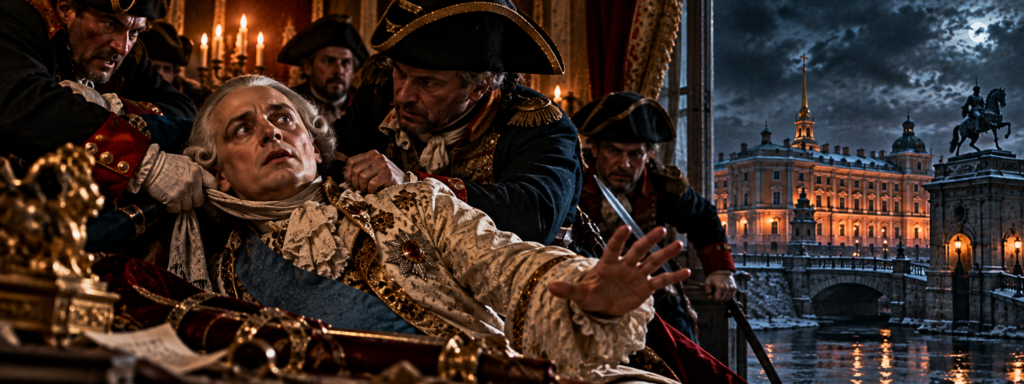
Paul I of Russia: The Paranoid Emperor Who Built a Fortress Against His Enemies—and Was Murdered Inside It
The Son of Catherine the Great, the Palace Conspiracy That Destroyed His Reign, and the Night Russia’s Emperor Was Beaten and Strangled in His Own Bedroom
Paul I of Russia (1 October 1754–24 March 1801, Gregorian calendar) was Emperor of Russia from 17 November 1796 until his assassination at St. Michael’s Castle in St. Petersburg. The only son of Peter III and Catherine the Great, Paul spent much of his life overshadowed by his powerful mother, haunted by the mysterious death of his father, and convinced that the Russian court was a dangerous world of conspirators and traitors. When he finally inherited the throne at the age of forty-two, he attempted to transform the empire through rigid military discipline, sweeping court reforms, restrictions upon aristocratic privilege, and a foreign policy that repeatedly changed direction. His unpredictable punishments, humiliations of senior officers, and increasingly suspicious behavior alienated powerful members of the nobility and military establishment. During the night of 23–24 March 1801, a conspiracy involving senior aristocrats, military officers, and influential courtiers reached its climax when armed men entered his private apartments at the newly completed St. Michael’s Castle. The conspirators intended, or at least publicly claimed, to force Paul to abdicate in favor of his eldest son, Alexander, but the confrontation ended with the emperor being beaten and strangled. His son succeeded him as Alexander I, while the official announcement attributed Paul’s death to a sudden illness rather than murder. Whether Alexander had explicitly authorized his father’s assassination remains disputed, although he knew of the conspiracy to remove Paul and was deeply shaken by the killing. Paul had spent years attempting to protect himself from the fate of his father, yet he ultimately died in another Russian palace coup, murdered by men who claimed that removing the sovereign was necessary to save the state.
The Emperor Who Was Murdered Behind His Own Walls
During the final weeks of his life, Emperor Paul I occupied a palace designed to protect him from assassination. St. Michael’s Castle stood in the heart of St. Petersburg, surrounded by water, guarded approaches, and the elaborate security arrangements of a ruler who had become increasingly afraid of conspiracy. Its architecture was both a royal residence and a declaration of distrust, reflecting Paul’s determination to place barriers between himself and the dangerous world beyond his walls. He had moved into the building only weeks before the night when his enemies came for him.
On the night of 23–24 March 1801, a group of conspirators entered the castle with the assistance of men who possessed access to the imperial household and military guard. They moved through the building toward the emperor’s private apartments, where Paul was preparing for or had already retired to bed. The men included officers and aristocrats whose careers had been threatened, damaged, or humiliated during his reign. Some wanted a change of government, others feared for their positions, and still others believed that Russia could no longer endure the emperor’s unpredictable rule.
What happened inside Paul’s bedroom has been described in several conflicting accounts. The conspirators demanded that he surrender the throne, but Paul resisted or refused to cooperate, and the confrontation became violent. He was struck, knocked down, and strangled, reportedly with a sash, although accounts differ over the precise sequence and the individuals who delivered the fatal blows. By the time the men left the room, the emperor was dead, and the throne belonged to his twenty-three-year-old son Alexander.
The official announcement did not describe a murder. Instead, the government attributed Paul’s death to a sudden medical seizure, commonly rendered in later accounts as apoplexy. The fiction concealed the violence that had taken place inside the imperial residence and protected the new regime from the immediate scandal of admitting that its sovereign had been killed by his own officers. Yet the truth circulated quickly through court society, where few people believed that a healthy emperor had simply died in his sleep.
The irony was almost unbearable. Paul had built St. Michael’s Castle because he feared the vulnerabilities of ordinary palaces, yet its walls could not protect him from men who controlled the guards and knew the routes through his residence. He had devoted his reign to discipline, obedience, and the punishment of perceived disloyalty, but those policies had helped create the coalition that destroyed him. His father had died under suspicious circumstances after being overthrown by Catherine the Great, and Paul now met a similarly violent end at the hands of men determined to replace him.
To understand why the emperor became so feared, and why so many powerful Russians were prepared to remove him, it is necessary to examine the long and troubled life that preceded his assassination. Paul’s reign lasted less than five years, but the resentments that shaped it had accumulated over decades. His murder was the final explosion of a conflict that began in the imperial nursery and developed through family estrangement, political humiliation, and an increasingly bitter struggle over the meaning of absolute monarchy.
Born Beneath the Shadow of a Troubled Marriage
Paul Petrovich was born on 1 October 1754 at the court of Empress Elizabeth Petrovna, daughter of Peter the Great. His parents were Grand Duke Peter Fyodorovich, the future Peter III, and Grand Duchess Catherine Alexeyevna, the German-born princess who would later become Catherine the Great. Their marriage was unhappy, politically important, and surrounded by gossip almost from the beginning. The birth of a male heir should have strengthened the dynasty, but it also placed the infant at the center of a household divided by suspicion and resentment.
Peter and Catherine had been married in 1745, yet their relationship deteriorated over the following years. Catherine later described her husband in deeply unflattering terms, portraying him as immature, insensitive, and poorly suited to the responsibilities of monarchy. Her memoirs also raised questions about the circumstances of Paul’s conception, encouraging speculation that his biological father might have been Sergei Saltykov, one of her early lovers. Historians have debated the allegation, but no conclusive evidence establishes that Peter III was not Paul’s father.
The uncertainty became part of Paul’s historical reputation, although it should not be treated as an established fact. Catherine had personal and political reasons to portray her marriage negatively, and her accounts were written with an awareness of how posterity might judge her. The timing of Paul’s birth and the relationships within the imperial household have encouraged different interpretations. What matters most for Paul’s life is that he was officially recognized as Peter’s son and raised as the legitimate heir to the Russian throne.
Empress Elizabeth took an intense interest in the newborn child. She removed Paul from his mother’s immediate care and placed him under the supervision of attendants selected by the imperial court. Catherine later complained that she was allowed little opportunity to see or influence her son during his infancy. Whether Elizabeth’s actions were motivated primarily by dynastic concern, possessiveness, or distrust of Catherine, they established a pattern of separation that would shape Paul’s relationship with his mother.
The infant grew up surrounded by ceremonial privilege but deprived of an ordinary family environment. He belonged to the ruling dynasty, yet his parents did not control his upbringing, and the empress regarded him as an important political possession. His earliest years unfolded in a court where personal affection was inseparable from questions of succession. The boy who would eventually become emperor learned from childhood that his identity belonged as much to the state as to himself.
The consequences of this upbringing are difficult to measure precisely, and later accounts sometimes exaggerate its psychological effects. Nevertheless, Paul’s childhood was marked by separation, court intrigue, and uncertainty about the relationships among the adults around him. His future would be determined by people whose political interests frequently conflicted. Before he reached adolescence, he would witness the destruction of his father’s reign and the rise of the mother who would dominate the rest of his life.
The Father Who Became Emperor—and Then Disappeared
Empress Elizabeth died in January 1762, bringing Peter III to the Russian throne. Paul was seven years old when his father became emperor, and the accession appeared to secure his position as the next generation’s heir. Peter’s reign, however, was troubled almost immediately by opposition from powerful court factions and military officers. His policies alienated influential interests, and his admiration for Frederick II of Prussia became especially controversial.
Russia had been fighting Prussia during the Seven Years’ War, and Russian forces had achieved significant successes. Peter abruptly reversed the country’s position, ending hostilities and aligning himself with Frederick, whom he greatly admired. The decision angered officers who had fought against Prussia and resented the apparent abandonment of their achievements. His attempts to reshape military practices and court life further damaged his support.
Catherine recognized the opportunity created by her husband’s unpopularity. She had cultivated relationships among influential officers and members of the guards, including the Orlov brothers, whose support would prove decisive. In July 1762, she moved against Peter and secured the allegiance of troops in St. Petersburg. The emperor was forced to abdicate, and Catherine was proclaimed ruler in her own right.
Peter III died only days after his overthrow while being held at Ropsha. The official explanation referred to illness, but the circumstances immediately raised suspicions of murder. Alexei Orlov, one of Catherine’s supporters, was closely associated with the emperor’s custody, and later accounts described a violent confrontation that ended in Peter’s death. The precise circumstances remain disputed, and historians have not established that Catherine personally ordered his murder.
For Paul, the consequences were profound. His father had become emperor and then disappeared from power within a matter of months, leaving the child to grow up under the authority of the woman who had overthrown him. The court could not entirely conceal the political significance of Peter’s death, even if the details remained uncertain. Paul would spend much of his life aware that his father’s throne had been taken through military conspiracy.
Catherine’s accession also created an unresolved question about Paul’s own rights. As the son of Peter III, he possessed a strong hereditary claim, and some supporters of the coup may initially have imagined that Catherine would govern as regent for her young son. Instead, she retained the crown and ruled independently for more than three decades. Paul remained heir apparent, but his mother showed no intention of surrendering authority.
The relationship between mother and son would become increasingly strained. Paul could not forget that Catherine’s reign had begun with the overthrow of his father, while Catherine regarded her son as a potentially troublesome political figure. Their conflict was not merely personal. It reflected competing claims to legitimacy and different understandings of the monarchy itself.
The events of 1762 also established a precedent that would haunt Paul’s own reign. A sovereign could be removed by a coalition of aristocrats and guards officers, and the change could be justified as necessary for the country’s welfare. The deposed ruler might then die under circumstances that the new government preferred not to investigate. Paul would eventually become the victim of the same political machinery.
Growing Up as the Heir Who Was Never Trusted
Paul’s education was supervised by tutors and advisers selected within Catherine’s court. Among the most influential was Nikita Panin, a statesman who favored a more structured system of government and possessed considerable political experience. Panin helped shape Paul’s intellectual development and encouraged an interest in European politics, constitutional ideas, and the responsibilities of monarchy. The young grand duke received an education appropriate to his rank, but he remained excluded from meaningful participation in government.
Catherine’s treatment of her son reflected both dynastic caution and personal distrust. She recognized him as heir, yet she did not give him the political responsibilities that might have prepared him for rule. Important decisions remained in her hands, and the court revolved around her favorites and ministers. Paul occupied a position of extraordinary prestige without corresponding authority.
The contrast between his title and his actual influence became increasingly painful as he grew older. He was expected to behave as a loyal son and future sovereign while watching others exercise the power that he believed would eventually belong to him. Catherine’s reign grew more successful and internationally respected, making her position difficult to challenge. The longer she ruled, the more distant Paul’s accession appeared.
His personality developed within this atmosphere of frustrated expectation. Contemporary observers described him as intelligent, energetic, emotionally intense, and unusually sensitive to questions of respect and obedience. He possessed genuine interests in administration and military affairs, but he could also be suspicious, impulsive, and difficult to please. These characteristics would become more pronounced when he finally gained authority.
Paul’s relationship with Catherine was further complicated by her treatment of his children. She took a close interest in his eldest sons, Alexander and Constantine, and supervised important aspects of their upbringing. The arrangement echoed Empress Elizabeth’s earlier removal of Paul from Catherine’s care. For Paul, the repetition may have reinforced the feeling that the ruling empress intended to control not only his life but also the next generation of the dynasty.
Rumors circulated that Catherine might bypass Paul and designate Alexander as her successor. The extent to which she seriously intended to do so remains debated, and no completed, legally effective arrangement disinheriting Paul was implemented before her death. Nevertheless, the possibility was widely discussed and contributed to Paul’s insecurity. He had waited decades for the throne and feared that even his eventual inheritance might be taken from him.
The grand duke therefore lived in a peculiar condition of suspended authority. He was surrounded by the privileges of monarchy but denied the opportunity to govern, and his mother’s court often treated his ambitions as inconvenient. His resentment deepened with age, especially as Catherine’s favorites enjoyed influence that he could not obtain. By the time he became emperor, he had spent much of his adult life preparing to reverse the political world that had excluded him.
Love, Loss, and the Marriage That Nearly Destroyed Him
Paul’s personal life was shaped by two marriages, the first of which ended in tragedy. In 1773, he married Wilhelmina Louisa of Hesse-Darmstadt, who converted to Russian Orthodoxy and took the name Natalia Alexeievna. The young couple initially appeared affectionate, and Paul became deeply attached to his wife. Her presence offered him companionship within a court where he often felt isolated.
Natalia was intelligent, lively, and interested in political affairs, but her relationship with Catherine was strained. The empress reportedly regarded her daughter-in-law as ambitious and potentially troublesome. Court gossip also connected Natalia with Count Andrei Razumovsky, a close associate of Paul, and later accounts alleged an affair. The evidence surrounding the relationship is complicated by hostile testimony and should not be treated as conclusive proof of adultery.
In April 1776, Natalia died after a prolonged and difficult childbirth. The infant also died, leaving Paul devastated. The circumstances of her death became entangled with accusations and rumors, including claims that Catherine revealed evidence of Natalia’s supposed infidelity to her grieving son. Such stories have been repeated frequently, but the details are uncertain and shaped by the antagonisms of the court.
Paul’s grief was genuine, and the loss occurred at a vulnerable moment in his life. He had placed considerable emotional hope in the marriage, and its sudden end deprived him of an important source of support. The experience also reinforced the atmosphere of distrust surrounding his personal relationships. Even intimate matters seemed vulnerable to political manipulation and scandal.
Catherine quickly arranged a second marriage. In October 1776, Paul married Sophie Dorothea of Württemberg, who became Maria Feodorovna after converting to Orthodoxy. The new marriage proved more durable and produced a large family, including the future emperors Alexander I and Nicholas I. Maria was intelligent, capable, and deeply involved in the management of the household.
The couple’s relationship was not free from difficulties, but Maria remained an important presence in Paul’s life. Their household developed its own routines, interests, and court culture, distinct from Catherine’s glittering political world. Paul found satisfaction in family life and in the ceremonial order he could impose upon his own residences. Yet even within marriage, the pressures of succession and imperial politics remained unavoidable.
Paul’s children became both a source of pride and a source of anxiety. Alexander, in particular, was favored by Catherine and raised partly under her supervision, creating tensions between father and son. Paul feared that the empress might use Alexander to deprive him of the throne. The family relationships that should have provided security instead became another arena of dynastic suspicion.
Gatchina: The Private Kingdom of a Frustrated Heir
During Catherine’s reign, Paul spent much of his time at Gatchina, an estate outside St. Petersburg that became the center of his private world. There he developed a miniature military establishment, organized elaborate drills, and imposed strict standards of discipline upon the troops under his command. The estate offered him something he lacked at the imperial court: an environment where his orders were obeyed. Gatchina became both a refuge and a rehearsal for the monarchy he hoped to create.
Paul admired the military methods associated with Prussia, particularly the emphasis upon precision, uniformity, and obedience. He required his soldiers to perform complicated maneuvers and maintain carefully regulated appearances. The exercises could appear excessive to observers accustomed to Catherine’s more flexible court culture. For Paul, however, military discipline represented a moral principle as much as a practical system.
The grand duke believed that disorder, favoritism, and laxity weakened the state. His experiences at Catherine’s court had convinced him that powerful individuals enjoyed privileges without sufficient accountability. At Gatchina, he attempted to create a world governed by clear rules and personal responsibility. The problem was that his understanding of discipline often depended upon his own changing judgments.
Officers who served under Paul learned to fear sudden criticism and humiliating punishment. Minor mistakes in appearance or drill could provoke disproportionate anger. Yet he could also reward loyalty and display genuine concern for soldiers’ welfare. His behavior combined a desire for order with an emotional volatility that made the system difficult to predict.
Gatchina also became a political symbol. Catherine’s court represented the achievements and social freedoms of her reign, while Paul’s estate embodied a stricter, more militarized vision of government. The contrast was visible in uniforms, ceremonies, and the treatment of officers. Those who disliked Paul increasingly regarded Gatchina as evidence that he would become an oppressive ruler.
The grand duke’s military interests were not merely eccentric hobbies. They reflected his conviction that the army should serve the sovereign through unquestioning obedience rather than personal connections. He resented the influence of aristocratic favorites and officers whose status depended upon court patronage. His future reforms would attempt to impose the standards of Gatchina upon the entire empire.
The isolation of the estate also intensified Paul’s distrust of the capital. He lived apart from many of the political networks that governed Russia, relying upon a smaller circle of loyal attendants and officers. His grievances were reinforced by people who shared or encouraged his criticisms of Catherine’s court. Over time, the distance between the heir and the ruling establishment became increasingly difficult to bridge.
When Paul finally inherited the throne, he would bring the habits of Gatchina into the imperial government. The strict inspections, elaborate uniforms, and relentless emphasis upon obedience would become national policies. What had been a private military experiment would be imposed upon powerful men who had never expected to submit to such treatment. The consequences would prove disastrous.
Catherine’s Death and the Son Who Finally Took the Throne
Catherine the Great died on 17 November 1796 after suffering a stroke. Her death ended a reign of more than thirty-four years and brought Paul to the throne at the age of forty-two. The long-awaited succession occurred without the public confrontation that some observers had feared. Paul became emperor after spending most of his adult life in the shadow of his mother.
His accession was emotionally charged. Catherine had dominated his life, and her death removed the figure against whom he had defined much of his identity. Paul now possessed the authority to reverse policies, dismiss officials, and reshape the court. The opportunity was immense, but so were the resentments he carried into office.
One of his earliest symbolic acts concerned the memory of Peter III. Paul arranged for his father’s remains to be transferred and reburied with imperial honors alongside Catherine. The ceremonies were elaborate and politically meaningful, emphasizing Peter’s status as a legitimate emperor. Paul was publicly restoring the dignity of the father whose overthrow had shaped his childhood.
The reburial also carried an unmistakable message about Catherine’s reign. By honoring Peter III, Paul reminded the court that his mother had seized power from her husband. The ceremony could be interpreted as an act of filial devotion, a statement of dynastic legitimacy, and a rebuke to the political order that had excluded him. The past was being brought into the present with extraordinary force.
Paul also moved quickly to remove or marginalize figures associated with Catherine’s government. Some officials lost their positions, while others faced investigation, exile, or humiliation. The emperor believed that the court required moral and administrative renewal. His methods, however, often appeared vindictive to those who had prospered under his mother.
The new reign began with genuine opportunities for reform. Russia faced problems involving military organization, corruption, provincial administration, and the relationship between the monarchy and nobility. Paul possessed energy and a strong desire to act. Yet his determination to govern personally soon produced conflicts with the institutions upon which his authority depended.
The emperor had waited decades for power, and he now seemed unwilling to tolerate resistance. His decisions could be rapid, detailed, and emotionally charged. Officials struggled to anticipate his wishes, while courtiers feared that a minor offense might destroy their careers. The atmosphere of uncertainty that had surrounded Paul as heir began to spread throughout the government.
His accession therefore contained the seeds of his downfall. Paul intended to restore discipline and strengthen the monarchy, but he approached government with the suspicions of a man who had spent years feeling betrayed. He demanded loyalty from people whose independence he increasingly resented. The result was a reign in which reform and repression became dangerously entangled.
The Law That Changed Russia’s Succession
One of Paul’s most important achievements was the introduction of a new law governing succession to the Russian throne. In 1797, he established a system of hereditary succession intended to reduce the uncertainty that had plagued the monarchy since Peter the Great. The law favored male-line primogeniture, with provisions for succession through female lines if the male dynastic lines failed. It replaced the broad discretionary principle that had allowed rulers to designate successors and encouraged political intervention.
The reform was deeply personal. Paul’s father had been overthrown, his mother had ruled in her own right, and rumors had suggested that she might bypass him in favor of Alexander. He had spent decades fearing that his hereditary claim could be manipulated by the reigning sovereign. The new law was intended to prevent future rulers from repeating such actions.
The legislation also reflected a genuine institutional concern. Russia’s succession crises had encouraged palace coups and undermined stability. By establishing a clearer order of inheritance, Paul hoped to reduce the opportunities for military factions to determine the sovereign. The reform sought to make the monarchy more predictable and less dependent upon personal intrigue.
The irony was that the law could not protect Paul himself. It regulated who should inherit the throne, but it did not prevent powerful officers from conspiring to remove the reigning emperor. The same guards regiments that had helped determine earlier successions remained capable of political intervention. Legal clarity could not eliminate the danger of assassination.
The succession law would outlast Paul’s reign and become one of his most enduring contributions to Russian government. Later emperors inherited a more clearly defined dynastic system, even though political crises continued. The reform demonstrates that Paul was not simply an irrational or incompetent ruler. He recognized a serious structural weakness and attempted to correct it.
Yet the law also revealed his preoccupation with hereditary legitimacy. Paul regarded the throne as a dynastic institution that should not be subject to the whims of courtiers or military officers. His own life had shown him the dangers of uncertain succession. He wanted to establish rules strong enough to survive the ambitions of individuals.
The contradiction between his legislative achievement and his personal behavior became increasingly pronounced. Paul sought to make succession predictable while governing in ways that alienated those responsible for defending the throne. He strengthened the legal framework of monarchy but weakened the political coalition supporting his reign. The gap between institutional reform and personal rule would prove fatal.
The Emperor Who Declared War on His Own Nobility
Paul’s relationship with the Russian nobility deteriorated rapidly after his accession. Catherine had granted the aristocracy significant privileges, including protections against compulsory service and forms of corporal punishment. Paul believed that many nobles had become arrogant, undisciplined, and insufficiently devoted to the state. He attempted to restore obligations and impose stricter standards of conduct.
The emperor’s reforms affected court etiquette, military service, dress, and the behavior of officials. He demanded punctuality, obedience, and careful attention to ceremonial detail. Nobles accustomed to Catherine’s relatively permissive court culture found themselves subjected to a ruler who treated minor breaches of discipline as serious offenses. The atmosphere became increasingly oppressive.
Paul’s punishments could be sudden and humiliating. Officers might be dismissed, transferred, or ordered away from the capital for mistakes that appeared trivial. Courtiers feared that an unfortunate encounter or poorly executed ceremony could provoke imperial anger. The uncertainty encouraged resentment because no one could feel entirely secure.
The emperor also attempted to regulate clothing and public behavior. His hostility toward fashions associated with revolutionary France contributed to restrictions upon certain styles of dress and accessories. Such measures may appear absurd when viewed in isolation, but they reflected his belief that outward appearance revealed political and moral allegiance. Clothing became another field in which the sovereign demanded obedience.
Paul’s conduct was not uniformly hostile to the nobility, and some of his policies addressed genuine administrative problems. He sought to reduce corruption, improve military accountability, and limit abuses associated with powerful favorites. His government also took measures affecting serf labor and estate administration, although the practical impact of these reforms was uneven. The difficulty lay in the methods through which he pursued change.
The emperor’s personal interventions created an atmosphere of fear. Officials could be punished without the predictable procedures that might have protected them from arbitrary decisions. The nobility had long accepted autocratic power, but many aristocrats expected their status to provide some measure of security. Paul’s behavior threatened that expectation.
Resentment spread among officers whose careers depended upon imperial favor. Men who had served with distinction under Catherine found themselves criticized or dismissed. Others feared that their positions could disappear without warning. The military establishment, which Paul regarded as the foundation of order, became one of the principal sources of opposition.
The emperor’s campaign against aristocratic privilege therefore undermined his own political security. He believed that obedience could be enforced through discipline and punishment. Instead, he encouraged powerful men to conclude that their survival required his removal. The monarchy’s most important supporters were gradually transformed into potential conspirators.
The Army Under the Emperor’s Microscope
Paul’s military reforms were among the most visible and controversial aspects of his reign. He sought to impose stricter discipline, standardized uniforms, and elaborate drill procedures inspired partly by Prussian models. The army had achieved major victories under Catherine, but Paul believed that its officers had become complacent and insufficiently obedient. He intended to transform military service into an expression of personal loyalty to the sovereign.
The changes affected daily life throughout the officer corps. Uniform regulations became more demanding, inspections more frequent, and ceremonial requirements more elaborate. Officers accustomed to greater flexibility found themselves judged by standards that emphasized appearance and precision. Minor errors could provoke severe criticism or punishment.
Paul’s interest in military detail was genuine and extensive. He believed that disciplined troops would be more reliable in battle and less vulnerable to disorder. Some of his reforms addressed legitimate problems involving organization and accountability. Yet his insistence upon personal control often overshadowed practical military considerations.
The emperor’s treatment of senior commanders created particular resentment. Experienced officers who had served in major campaigns could be humiliated over matters of drill or uniform. Their professional achievements did not necessarily protect them from sudden dismissal. The message was clear: past service mattered less than immediate obedience to the sovereign.
The famous commander Alexander Suvorov became one of the most prominent figures affected by Paul’s policies. Suvorov’s military reputation was enormous, but his independent temperament and resistance to certain reforms brought him into conflict with the emperor. He was removed from active command before later being recalled for service against France. The episode illustrated the tension between Paul’s disciplinary ideals and the practical value of experienced leadership.
The army also became a stage for the emperor’s personal anxieties. Paul demanded exact obedience because he feared disloyalty, but his harshness encouraged the very resentment he wished to suppress. Officers learned to conceal their opinions while privately criticizing the government. The gap between outward discipline and inward hostility widened.
The imperial guards were especially dangerous because of their political history. These regiments had helped place rulers on the throne and remove others, including Paul’s own father. Paul understood their importance and attempted to control them through strict supervision. Yet the guards retained the ability to participate in conspiracy if enough influential officers turned against him.
By the final year of his reign, military resentment had become a serious threat. Dismissed and disgraced officers possessed personal motives for revenge, while others feared future punishment. The emperor’s determination to command every detail of military life had created a broad community of grievance. The men who would eventually enter his bedroom emerged from this atmosphere of humiliation and fear.
Reform, Contradiction, and the Question of Paul’s Sanity
Paul I has often been portrayed as a mad or paranoid ruler, but the historical evidence requires a more careful assessment. Contemporary observers described emotional volatility, suspicion, sudden anger, and unpredictable decisions. His conduct sometimes appeared irrational, particularly when he punished officials for minor offenses or reversed policies abruptly. Yet these observations do not establish a specific psychiatric diagnosis.
The emperor’s personality was shaped by decades of political exclusion and family conflict. He had grown up knowing that his father had been overthrown and died under suspicious circumstances. He had watched his mother rule while he remained powerless, and he feared that his own succession might be threatened. These experiences provide important context for his distrust, although they do not excuse the suffering caused by his actions.
Some later accounts exaggerated Paul’s eccentricities to justify the coup that removed him. The conspirators and their supporters had an interest in portraying the emperor as dangerously unstable. If his rule could be described as intolerable or irrational, his removal might appear necessary rather than criminal. Historians must therefore distinguish contemporary evidence from retrospective political propaganda.
Paul also demonstrated administrative intelligence and a capacity for sustained reform. His succession law addressed a genuine problem, and his government pursued measures concerning military organization, state finance, and the obligations of landowners. He was capable of detailed work and possessed strong convictions about the responsibilities of monarchy. These qualities complicate simplistic portrayals of him as merely insane.
His behavior nevertheless became increasingly erratic in the eyes of many contemporaries. He could elevate favorites rapidly and then disgrace them, issue sweeping orders, and react harshly to perceived disrespect. The unpredictability made government difficult because officials could not reliably anticipate his decisions. Fear became a defining feature of court life.
The question of mental illness remains unresolved. Modern diagnostic labels cannot be applied confidently to a ruler who lived more than two centuries ago and whose behavior was recorded by politically interested observers. Paul’s suspicion may have reflected personality, experience, political danger, or some combination of factors. His actions can be analyzed without reducing his entire reign to a medical explanation.
What matters most for the assassination is the political effect of his behavior. Whether his fears were justified or exaggerated, they alienated influential officers and aristocrats. His punishments encouraged resentment, and his sudden policy changes undermined confidence in the government. The conspiracy developed because powerful men concluded that the emperor had become a danger to their interests and, in their view, to the state.
Paul’s tragedy was that his attempts to secure obedience often produced disloyalty. He feared conspiracy because he understood the history of Russian palace coups, but his methods made another coup increasingly likely. The distinction between justified caution and destructive suspicion became impossible to maintain. By 1801, the emperor was surrounded by enemies, some of whom occupied positions close enough to reach him.
The Foreign Policy That Turned Allies Into Enemies
Paul’s foreign policy underwent dramatic changes during his short reign. At first, he opposed the revolutionary French government and participated in the wider European struggle against French expansion. Russia joined the Second Coalition, and Russian forces fought in campaigns associated with Suvorov’s victories in Italy and Switzerland. These operations demonstrated the continuing military strength of the empire.
The coalition, however, became strained by conflicting interests among the participating powers. Paul grew increasingly dissatisfied with Austria and Britain, believing that they had failed to respect Russian sacrifices or political objectives. Disputes over territory, strategy, and the treatment of Russian forces contributed to his anger. The emperor began reconsidering the alliances that had defined his earlier policy.
His hostility toward Britain became especially significant. Paul resented British actions in the Mediterranean and believed that British policy threatened Russian interests. The island of Malta, associated with the Knights Hospitaller, became a particular source of dispute. Paul had accepted the title of Grand Master of the Order of St. John, although the legitimacy and circumstances of that position were complicated by the order’s religious traditions and political divisions.
When Britain occupied Malta after the French withdrawal, Paul regarded the situation as an affront. His anger contributed to a broader reversal in Russian foreign policy. He moved toward cooperation with Napoleon Bonaparte, whose rise had previously made France an enemy. The change shocked many officials who had supported the anti-French coalition.
Paul’s government also joined an armed neutrality arrangement involving northern European powers, challenging British maritime practices. The policy threatened commercial interests and raised the possibility of conflict with Britain. Russian merchants and officials concerned about trade viewed the confrontation with alarm. The emperor’s foreign policy now appeared to endanger economic relationships as well as diplomatic stability.
One of the most extraordinary episodes involved plans for a Russian expedition toward British possessions in India. Paul ordered Cossack forces to begin a movement that formed part of a projected campaign against British power in Asia. The plan was ambitious and logistically difficult, and it was abandoned after his death. Its existence contributed to the impression that the emperor was pursuing increasingly unpredictable strategic objectives.
These foreign policy reversals intensified opposition at court. Aristocrats and officials who favored cooperation with Britain feared the consequences of confrontation. Military commanders questioned the practicality of some initiatives, while commercial interests worried about trade. The emperor’s decisions appeared to be driven partly by personal grievances against foreign rulers and governments.
Yet the policies were not entirely without strategic logic. Britain and Russia possessed competing interests, and Napoleon’s diplomacy offered opportunities for realignment. The problem was the speed and unpredictability with which Paul changed direction. His government struggled to maintain stable relationships with allies, and powerful Russians began to see his removal as a means of restoring diplomatic order.
Foreign policy therefore became another factor in the conspiracy. The plotters were not united by a single ideological program, but many shared the belief that Paul’s rule had become dangerous. His conflict with Britain and rapprochement with France added urgency to their concerns. The emperor’s enemies could now portray his removal as necessary for Russia’s international security.
St. Michael’s Castle: A Fortress Built From Fear
Paul’s decision to build St. Michael’s Castle reflected his growing distrust of the imperial residences associated with Catherine’s reign. He disliked the Winter Palace and feared the vulnerability of buildings where court factions and guards officers possessed extensive access. The new residence was intended to provide security, independence, and a physical separation from the political world he distrusted. Its design combined ceremonial grandeur with defensive features.
Construction began in 1797, and the castle rose on a site connected with Paul’s birth and the earlier imperial household. The building was surrounded by waterways and protected by guarded approaches. Its architecture incorporated elements intended to make unauthorized entry difficult. Paul believed that the residence would offer greater safety than the traditional palaces of St. Petersburg.
The castle also expressed his personal taste. Its unusual design, ceremonial spaces, and elaborate interiors reflected the emperor’s interest in chivalric symbolism and military order. The building was not merely a defensive structure but a statement of sovereignty. Paul wanted a residence that embodied his authority and separated him from the legacy of Catherine.
The emperor moved into St. Michael’s Castle in February 1801, before every aspect of the building was fully completed. His decision reflected impatience and a desire to occupy the residence as soon as possible. The move also placed him within a complex environment where security depended upon guards, officers, servants, and household officials. The physical barriers could not eliminate the danger posed by insiders.
The castle’s defensive features became part of the historical irony surrounding his death. Moats, bridges, and guarded entrances were designed to prevent external attack, but the conspirators possessed connections within the military and court establishment. They did not need to besiege the building like an enemy army. They needed access, cooperation, and the willingness of guards to permit their movement.
Paul’s fear of assassination was not entirely imaginary. Russia’s recent history included the overthrow of Peter III, and the emperor had alienated many influential men. Rumors of conspiracy circulated during the final months of his reign. His concern reflected a real political danger, even if his methods of responding to it were often counterproductive.
The castle therefore became a monument to the failure of personal security in an autocratic system. Paul attempted to protect himself through architecture and discipline, but his safety ultimately depended upon the loyalty of men he had frightened or humiliated. The walls could not distinguish between faithful servants and conspirators. The emperor had created a fortress without securing the political foundations necessary to defend it.
He would live there for only a few weeks. The residence intended to guarantee his safety became the scene of his assassination. Its name would remain permanently associated with the violent end of his reign. The building stood as a reminder that a sovereign surrounded by enemies cannot find security simply by constructing stronger walls.
The Conspiracy Takes Shape
By late 1800 and early 1801, opposition to Paul had developed among influential figures at court and within the military establishment. The conspiracy was not a spontaneous gathering of disgruntled officers on the night of the murder. It emerged through discussions among men who feared the emperor’s behavior and believed that his removal was necessary. Their motives included personal grievances, political concerns, and the desire to restore a more predictable government.
Count Peter Pahlen, the military governor of St. Petersburg, became one of the central organizers. Pahlen occupied a position of extraordinary importance because he possessed access to the emperor and influence over security arrangements in the capital. His ability to maintain Paul’s confidence while participating in the conspiracy made him especially dangerous. He could help shape the circumstances under which the plotters would act.
Other important figures included Nikita Panin, a diplomat and relative of Paul’s former tutor, and members of the Zubov family, whose fortunes had been closely connected with Catherine’s court. Platon Zubov had been Catherine’s last powerful favorite, while his brothers also possessed political and military connections. Their involvement reflected the resentment of men whose influence had been threatened by Paul’s reign. The conspiracy drew upon networks associated with the previous government.
General Leonty Bennigsen, a Hanoverian-born officer in Russian service, also became associated with the plot. He would later provide accounts of the events, although his descriptions must be read with awareness of his own involvement. The conspirators did not all agree upon the precise means of removing Paul. Some favored forced abdication, while others were prepared for violence.
The central problem was succession. The plotters needed a legitimate replacement who could command acceptance after Paul’s removal. His eldest son Alexander offered the obvious solution. Alexander possessed hereditary legitimacy under the succession law established by Paul himself. His accession could therefore be presented as continuity rather than revolution.
The conspirators also needed to neutralize the imperial guards. Paul’s authority depended upon soldiers who controlled access to the palace and capital. If the guards remained loyal, an attempt to remove him could fail disastrously. The plotters therefore cultivated officers and arranged support within units capable of influencing the outcome.
The conspiracy was complicated by Paul’s growing suspicion. He had dismissed or threatened several influential figures and appeared increasingly alert to the possibility of betrayal. His unpredictable decisions created urgency because the plotters feared that delay could lead to discovery. Some conspirators believed that their own lives or careers were in immediate danger.
The movement therefore developed under pressure. Its members shared the objective of removing Paul but differed in their willingness to kill him. The ambiguity would become crucial when the conspirators entered his bedroom. A plan publicly framed as forced abdication could easily become murder once the emperor resisted.
Alexander: The Son Who Knew Too Much
Grand Duke Alexander Pavlovich occupied the most morally difficult position in the conspiracy. As Paul’s eldest son, he was the lawful heir to the throne and the person most likely to benefit from his father’s removal. He had been raised partly under Catherine’s supervision and had developed relationships with influential members of the court. His position made him indispensable to any plan that sought to replace Paul without destroying dynastic legitimacy.
Alexander’s relationship with his father was complicated. Paul loved his children but could be suspicious and demanding, while Alexander learned to navigate the tensions between his father and grandmother. The young grand duke developed a cautious political personality, often concealing his opinions to avoid conflict. By 1801, he was aware of growing dissatisfaction with Paul’s rule.
The extent of Alexander’s involvement in the conspiracy remains one of the central historical controversies. Most accounts agree that he knew of plans to remove his father and was persuaded that the emperor would be compelled to abdicate. Alexander reportedly insisted that Paul’s life be spared. Whether the conspirators sincerely intended to honor that condition is uncertain.
Some later narratives portray Alexander as deceived by men who promised a bloodless transfer of power. Others suggest that he should have understood the likelihood of violence, given Paul’s temperament and the dangerous circumstances of a palace coup. The evidence does not establish that Alexander explicitly ordered his father’s murder. It does, however, place him within the political arrangements that made the coup possible.
Alexander’s participation was essential because the conspirators needed assurance that the successor would accept the throne. Without his cooperation, the removal of Paul could produce a succession crisis or civil conflict. The young grand duke’s willingness to benefit from the plot gave it a legitimacy that ordinary military rebellion would lack. His position transformed conspiracy into a potential change of government.
The moral dilemma was severe. Alexander may have believed that his father’s rule endangered Russia and that abdication offered a peaceful solution. Yet the plan required armed men to confront an autocratic sovereign who was unlikely to surrender willingly. The possibility of violence was obvious, even if the conspirators promised otherwise. Alexander’s acceptance of the scheme therefore carried grave risks.
After Paul’s death, Alexander’s reaction was described as one of shock, grief, and horror. Accounts of his emotional collapse have become central to the historical image of the young emperor. The sincerity of his distress is not necessarily inconsistent with his prior knowledge of the conspiracy. A man can consent to a dangerous political plan while refusing to imagine its most terrible outcome.
The burden of his father’s death would shadow Alexander’s reign. Later observers connected his religious interests, melancholy, and moral anxieties with the events of 1801, although such psychological interpretations cannot be proven in every detail. What is certain is that Alexander inherited the throne through a conspiracy that ended in his father’s murder. His legitimacy was secured at the cost of a family tragedy.
The Final Days of Paul I
During the weeks preceding his assassination, Paul’s government continued to operate under an atmosphere of tension. The emperor issued orders, reviewed military affairs, and pursued his foreign policy objectives, apparently unaware of the full extent of the conspiracy surrounding him. Yet reports of his suspicion and anxiety suggest that he sensed danger. The court was filled with men who feared his anger and concealed their own intentions.
Pahlen’s position was especially important. As military governor of St. Petersburg, he possessed authority over aspects of security in the capital and maintained access to the emperor. His involvement allowed the conspirators to coordinate their movements while reducing the risk of immediate detection. The man responsible for protecting the political order was helping organize its overthrow.
Paul’s relationship with senior officers had deteriorated to the point where dismissal or disgrace could occur suddenly. Some conspirators feared that their positions were already threatened. Others believed that the emperor might soon discover the plot. The pressure encouraged them to act before circumstances changed.
The newly occupied St. Michael’s Castle provided both obstacles and opportunities. Its defensive arrangements made unauthorized entry difficult, but the conspirators possessed connections among the guards and household officials. They could exploit the very security system designed to protect Paul. The palace’s internal routes became more important than its external walls.
The conspirators selected the night of 23–24 March 1801 for their action. Accounts describe gatherings among the plotters before they moved toward the castle, including the consumption of alcohol by some participants. Such details appear in later recollections and vary in reliability. The essential fact is that a coordinated group of officers and aristocrats prepared to confront the emperor in his private apartments.
The plan required speed and surprise. Paul could summon loyal troops if given sufficient warning, and a failed attempt would likely lead to severe punishment. The conspirators therefore needed to reach him before resistance could organize. Their success depended upon the cooperation or passivity of guards stationed within the residence.
The emperor’s final evening passed within the ceremonial world he had constructed. He remained surrounded by uniforms, attendants, and the routines of imperial life. Yet the authority represented by those ceremonies was already collapsing. Men who outwardly served him had decided that his reign must end.
March 23–24, 1801: The Night of the Murder
During the night of 23–24 March 1801, the conspirators moved toward St. Michael’s Castle. Their access depended upon cooperation from officers and guards connected with the plot. The building’s defensive features did not prevent their entry because the danger came from within the imperial establishment. The men approached the emperor’s private apartments with the intention of forcing a change of government.
Accounts differ over the precise route taken through the castle and the order in which individual conspirators entered the bedroom. Some descriptions emphasize the role of Bennigsen, while others focus upon members of the Zubov family and additional officers. The narratives were recorded by participants or later observers whose interests and memories were not identical. The exact sequence must therefore be reconstructed cautiously.
Paul was confronted in his private rooms. Some accounts describe him attempting to hide behind furniture or a screen, while others portray him as immediately resisting the intruders. These details have become part of the dramatic legend of the assassination, but they are not uniformly supported. What is clear is that the emperor was surprised by armed men who demanded his removal from power.
The conspirators attempted to compel Paul to abdicate. The demand challenged the central principle of his reign: that the sovereign’s authority was absolute and obedience was obligatory. Paul resisted, argued, or refused to cooperate, according to the surviving accounts. The confrontation became increasingly tense as the men realized that a peaceful surrender was unlikely.
Violence followed. Paul was struck and knocked down, and the struggle continued until he was strangled. A sash is frequently identified as the instrument used, although accounts differ over whether it was part of the emperor’s clothing or belonged to one of the attackers. The murder was brutal and intimate, carried out at close quarters inside the ruler’s own bedroom.
The identity of the individual who delivered the fatal act remains disputed. Several conspirators were present, and later accounts assigned responsibility differently. Some participants had reasons to minimize their own involvement or blame others. The uncertainty should not obscure the collective nature of the crime: the emperor was killed by members of the conspiracy that had entered his apartments to remove him.
Paul died at the age of forty-six. He had ruled Russia for less than five years and had occupied St. Michael’s Castle for only a short period. The fortress he built against assassination had become the place of his murder. The guards, officers, and courtiers upon whom his security depended had failed or betrayed him.
The conspirators now faced the problem of succession. Their intended replacement, Alexander, had to be informed that his father was dead. The official machinery of government needed to continue, and the guards had to accept the new sovereign. The murder was complete, but the political consequences were only beginning.
The Emperor’s Last Struggle: What Can Be Known?
The murder of Paul I has attracted numerous dramatic retellings, many of which present detailed conversations and precise descriptions of the struggle. Some accounts portray the emperor as defiant, others as terrified, and still others as attempting to negotiate with the conspirators. The difficulty is that the principal witnesses were participants in the crime. Their later statements were shaped by memory, self-defense, and political interest.
One recurring story describes Paul being discovered after attempting to conceal himself behind a screen or fireplace. Another depicts a prolonged argument over an abdication document. Some narratives identify specific officers as striking him with a heavy object before the strangling. These details may contain elements of truth, but they cannot all be accepted as equally reliable.
The most secure conclusion is that the conspirators entered his apartments, demanded his removal, and killed him during a violent confrontation. The emperor did not die naturally, and the official explanation of illness was false. His death was the direct result of the conspiracy. The precise allocation of individual responsibility remains uncertain.
The use of a sash in the strangling has become one of the best-known details of the assassination. It appears in numerous accounts and reflects the close, improvised nature of the violence. Yet the specific object and sequence of blows are less certain than the broader fact of strangulation. Historical accuracy requires preserving that distinction.
The murder was especially shocking because Paul was not killed in battle or during a public uprising. He was attacked inside his own residence by men who belonged to the military and aristocratic elite. The violence took place in the intimate space of the sovereign’s bedroom. The scene exposed the vulnerability of absolute power when those responsible for enforcing it withdrew their loyalty.
The conspirators’ claim that they intended only abdication remains difficult to evaluate. Some may genuinely have hoped to remove Paul without killing him, while others likely understood that resistance could lead to violence. The emperor’s temperament made voluntary surrender improbable. A plan to confront him with armed men carried an obvious risk of fatal consequences.
The distinction between intended deposition and intended murder matters for assessing individual guilt, but it does not alter the outcome. The conspirators created the circumstances in which Paul was killed. They entered his residence to force him from power and used violence when he resisted. The emperor’s death was inseparable from their political objective.
The surviving accounts therefore reveal both a murder and a struggle over its meaning. Participants sought to explain why the violence occurred and how much responsibility each man bore. The new government had reasons to suppress the truth, while later historians attempted to reconstruct it from conflicting testimony. Paul’s final moments remain partly obscured by the same political interests that surrounded his life.
Alexander I: A Crown Bought With His Father’s Blood
Alexander learned of his father’s death in the early hours following the assassination. Accounts describe him as overwhelmed by shock and grief, particularly because he had reportedly been assured that Paul would be spared. The young grand duke had expected, or at least hoped for, a forced abdication rather than murder. Instead, he was confronted with the reality that his accession had been secured through violence.
The conspirators needed Alexander to accept the throne immediately. Delay could encourage confusion among the guards and create opportunities for loyalists to resist. The new emperor therefore faced pressure to assume authority despite his emotional distress. His personal grief could not be allowed to interrupt the transfer of power.
Alexander was proclaimed emperor, and the government moved quickly to establish continuity. The official announcement attributed Paul’s death to a sudden illness, avoiding any public acknowledgment of assassination. The fiction protected the new regime from the immediate implications of admitting that the sovereign had been murdered by officers close to the court. It also allowed Alexander to present his accession as lawful succession rather than the result of a coup.
The young emperor’s relationship with the conspirators was complicated from the beginning. They had helped place him on the throne, but they were also responsible for his father’s death. Their continued influence could remind the public and the court of the circumstances of his accession. Alexander therefore had reasons to distance himself from them.
Over time, several leading conspirators lost influence or were removed from important positions. Pahlen, despite his central role, did not remain permanently secure under the new government. Alexander’s actions reflected both political calculation and the desire to escape dependence upon the men associated with the murder. The new emperor needed to establish authority independent of the conspiracy.
Alexander’s reign would become one of the most consequential in Russian history, especially during the struggle against Napoleon. Yet the circumstances of his accession remained a personal and political shadow. Later accounts often emphasized his guilt and religious introspection, connecting them to the murder of Paul. Such interpretations may capture genuine elements of his experience, but they cannot be treated as complete explanations of his later personality.
The central fact remains that Alexander benefited from a conspiracy he knew was being organized against his father. Whether he authorized murder is unproven, but his acceptance of the deposition plan helped make the coup possible. The distinction between knowledge and direct responsibility is important. It does not remove the moral burden created by the outcome.
Paul’s death therefore became a family tragedy as well as a political assassination. A father was murdered, and his son inherited the throne through the actions of the killers. The succession law Paul had established was followed in form, but the transfer of power occurred through the very kind of military intervention he had hoped to prevent. The dynasty survived, while the emperor who sought to secure it was destroyed.
The Official Lie: A Death by Apoplexy
The Russian government did not publicly announce that Paul I had been murdered. Instead, the official explanation attributed his death to a sudden medical event, commonly described as apoplexy. The term was used broadly in the period for conditions involving sudden collapse or loss of consciousness. In Paul’s case, it served as a political fiction intended to conceal the violence of the coup.
The deception was necessary because an open admission of assassination would raise dangerous questions. If officers could kill the sovereign and place his son upon the throne, the legitimacy of the new government might be challenged. The public might also demand punishment of the conspirators. Concealment allowed the authorities to preserve an appearance of lawful succession.
The fiction was not entirely convincing. Court society was familiar with the tensions surrounding Paul’s reign, and rumors of conspiracy had circulated before his death. The sudden announcement of illness, combined with the rapid accession of Alexander, encouraged suspicion. Knowledge of the murder spread through private conversation and diplomatic reports.
The handling of Paul’s body also became part of the historical controversy. Accounts describe efforts to prepare the remains for public viewing despite injuries sustained during the attack. Later narratives sometimes emphasize cosmetic measures used to conceal marks of violence. The precise details vary, but the need to maintain the official explanation shaped the treatment of the death.
The government also avoided a public criminal investigation that might expose the full conspiracy. Leading participants were not subjected to the kind of prosecution that an ordinary murder would have demanded. Their political connections and role in the succession made accountability difficult. The state chose stability over a transparent examination of the crime.
The official lie had a precedent in the death of Peter III. Paul’s father had died under suspicious circumstances after being overthrown, and the government had offered an explanation that did not openly acknowledge murder. Nearly four decades later, Paul met a similar fate. The repetition exposed the continuity of political violence within the Romanov dynasty.
The concealment also shaped historical memory. For years, public discussion of the assassination remained constrained by the interests of the reigning government. Private accounts and later memoirs preserved details that official announcements suppressed. The story gradually emerged through competing narratives, many of which were influenced by personal loyalties and political motives.
The attempt to disguise murder as illness demonstrates the contradiction between autocratic ideology and political reality. The sovereign was officially sacred and supreme, yet powerful men could remove him through violence. The government then concealed the act to preserve the appearance of uninterrupted legitimacy. The monarchy survived by denying the means through which power had changed hands.
Who Was Responsible for Paul’s Death?
Responsibility for the assassination can be examined at several levels. The men who entered Paul’s apartments and used violence were directly responsible for the killing. The organizers who planned the coup created the circumstances in which the murder occurred. Those who knew of the plot and accepted its objectives bear a different, more complicated form of responsibility.
Pahlen’s role was central because he helped coordinate the conspiracy while occupying a position of trust. His influence over security arrangements made the operation possible. He understood the dangers of confronting Paul and nevertheless supported the plan. His involvement illustrates how the emperor’s own officials could become the architects of his downfall.
The Zubov brothers and other participants possessed personal and political motives for removing Paul. Some had suffered under his policies, while others feared further punishment. Their grievances were not identical, but they converged upon the belief that the emperor must be replaced. The conspiracy was therefore a coalition rather than the work of a single assassin.
Bennigsen’s role has been debated because his later accounts attempted to explain the events and his own participation. Like other conspirators, he had reasons to present the killing as an unintended consequence of a plan for abdication. The testimony of participants must be evaluated with caution. Their accounts are valuable but cannot be treated as neutral descriptions.
Alexander’s responsibility remains the most sensitive question. He knew of the conspiracy to remove his father and accepted the prospect of succession, but the evidence does not conclusively show that he ordered or approved the murder. His reported insistence that Paul be spared may have been sincere. Nevertheless, his cooperation gave the plot political legitimacy and made its success more likely.
The broader political establishment also contributed to the conditions that made assassination possible. Paul’s arbitrary punishments had alienated officers and aristocrats, while the history of palace coups demonstrated that military intervention could succeed. The conspirators operated within a political culture that had repeatedly allowed rulers to be removed by force. Their actions were criminal, but they were not without precedent.
Paul himself bears responsibility for policies that intensified opposition, though not for the decision of others to murder him. His harshness, suspicion, and unpredictable government encouraged powerful enemies to unite against him. Yet political failure does not justify assassination. The distinction between explaining the conspiracy and excusing the killing is essential.
The murder was therefore the product of individual decisions within a dangerous political system. It involved ambition, fear, resentment, and the willingness to use violence to settle questions of sovereignty. No single motive fully explains the event. The emperor died because enough influential men concluded that removing him was worth the risks, and because some were prepared to kill when abdication could not be secured.
Was Paul Really a Tyrant?
Paul’s reputation has long been dominated by descriptions of tyranny, paranoia, and eccentricity. His enemies portrayed him as a ruler whose behavior threatened the stability of the empire. The assassination was often justified retrospectively as a necessary response to dangerous government. Yet such portrayals require careful examination because the victors controlled much of the early narrative.
Paul’s reign included genuine abuses of power. He punished officers and officials unpredictably, interfered excessively in personal conduct, and created an atmosphere of fear at court. His sudden dismissals and humiliations damaged careers and encouraged resentment. These actions were not inventions of later propaganda.
At the same time, he pursued reforms that addressed real problems. His succession law strengthened the hereditary framework of the monarchy, while administrative measures sought to improve accountability. He attempted to regulate certain obligations imposed upon serfs, although enforcement was limited and his policies did not fundamentally dismantle serfdom. His government was more complex than a simple catalogue of irrational commands.
The emperor also challenged aristocratic privileges that had expanded under Catherine. Some nobles regarded these measures as intolerable because they threatened their accustomed independence. Their opposition therefore reflected personal interests as well as concern for good government. A ruler who restricted elite privilege could be described as tyrannical by those who lost power.
Paul’s foreign policy reversals likewise combined strategic calculation with personal volatility. His hostility toward Britain and rapprochement with France alarmed influential interests, but the policies were not entirely without geopolitical logic. Russia possessed legitimate reasons to reconsider alliances. The difficulty was the speed and manner in which the emperor pursued change.
The question of tyranny also depends upon the standards applied. Eighteenth-century Russia was an autocracy in which rulers possessed enormous authority over subjects and officials. Catherine herself had used coercion and repression when defending her government. Paul’s methods were often more abrupt and personally humiliating, but they existed within a broader political system that accepted concentrated sovereign power.
The conspirators’ claim to be saving Russia therefore deserves skepticism. Some may genuinely have feared national disaster, while others sought to recover influence or escape punishment. Their decision to murder Paul was not a democratic act of resistance. It was a palace coup organized by members of the elite who intended to preserve the monarchy under a different ruler.
Paul was neither a harmless victim nor the monstrous caricature sometimes presented by his enemies. He was a capable but deeply flawed ruler whose policies combined reforming ambition with destructive suspicion. His assassination cannot be understood without acknowledging both sides. The tragedy lies in the way his weaknesses interacted with a political culture that treated murder as an available solution to dynastic conflict.
The Castle That Became a Monument to Regicide
St. Michael’s Castle remained one of the most powerful symbols of Paul’s reign after his death. The building had been constructed to protect him from assassination, yet he was killed inside it within weeks of moving there. Its defensive features became part of the story’s bitter irony. The emperor’s attempt to create a secure refuge had failed because the danger came from trusted insiders.
Alexander did not continue using the castle as the principal imperial residence. The building’s association with the murder made it an uncomfortable symbol of the new reign. Its rooms and corridors carried memories that the government preferred not to emphasize. The residence eventually acquired other functions, including educational uses.
The castle’s architecture nevertheless preserved Paul’s ambitions. Its guarded approaches, unusual design, and ceremonial spaces reflected his desire for order and separation from the court. The building was an expression of the personality that had shaped his government. It embodied both his fear of conspiracy and his confidence that security could be imposed through structure.
The assassination demonstrated the limits of such thinking. A ruler can construct walls, command guards, and regulate access, but these measures depend upon human loyalty. When officers and courtiers decide to betray the sovereign, physical defenses may offer little protection. The castle was secure against enemies who approached openly, not against conspirators who already belonged to the imperial establishment.
The building also became associated with stories of haunting and supernatural warning. Later legends described Paul’s restless spirit and mysterious signs connected with his death. Such accounts belong to folklore rather than established historical evidence. Their persistence reflects the emotional power of the assassination and the unsettling circumstances surrounding it.
The castle’s reputation was strengthened by the contrast between Paul’s intentions and his fate. He had sought refuge from the political dangers of St. Petersburg, yet the conspiracy followed him into the very rooms designed to exclude it. The residence became a physical reminder that his fears were not entirely imaginary. His enemies existed, and they were capable of reaching him.
For visitors and later generations, St. Michael’s Castle offered a tangible connection to the violence of Russian succession politics. Its walls witnessed the final moments of a ruler who had attempted to control every detail of his government. The building survived, while the man who commissioned it was destroyed. The fortress became a monument not to security but to betrayal.
The assassination also changed the meaning of Paul’s architectural legacy. What had been intended as a symbol of imperial authority became a reminder of the fragility of that authority. The emperor’s power had seemed absolute, yet it depended upon men who could withdraw their obedience. St. Michael’s Castle preserved the contradiction in stone.
The Long Shadow of Peter III
Paul’s assassination cannot be separated from the death of his father. Peter III had been overthrown in 1762 and died shortly afterward under suspicious circumstances. Paul grew up aware that the Russian throne could be seized through military conspiracy. The memory of his father’s fate shaped his distrust of the court and his determination to strengthen monarchical authority.
When Paul became emperor, he attempted to restore Peter’s dignity through elaborate funeral ceremonies. The reburial was an act of filial devotion and a political statement about the legitimacy of his own succession. He wanted the dynasty to acknowledge the father whose reign had been destroyed. The ceremony also challenged the moral foundations of Catherine’s accession.
Yet Paul’s own policies reproduced some of the conditions that had made his father’s overthrow possible. He alienated officers, angered powerful nobles, and pursued foreign policy decisions that alarmed influential interests. His insistence upon personal authority encouraged opposition rather than obedience. The monarchy remained vulnerable to the same forces that had removed Peter III.
The resemblance between the two deaths is striking. Both emperors were overthrown through conspiracies involving military and aristocratic elites. Both died under circumstances that the succeeding government preferred to conceal. Both were replaced by rulers whose accession depended upon the actions of the conspirators. The pattern reveals the instability of eighteenth-century Russian autocracy.
There were also important differences. Peter III was deposed before his death, while Paul was killed during the attempt to force his abdication. Catherine’s role in Peter’s death remains disputed, whereas Alexander’s knowledge of the conspiracy against Paul is more clearly established. The details should not be flattened into a single repeated story. Nevertheless, the broader political mechanism was similar.
Paul’s efforts to prevent another palace coup therefore failed in the most personal way imaginable. He had spent decades fearing the fate of his father, yet he died in a confrontation with men who claimed to be saving Russia from its ruler. The succession law he introduced could not protect him. The castle he built could not save him.
The repetition also exposed the moral contradictions of the dynasty. Rulers claimed absolute authority and demanded obedience, but their own families repeatedly benefited from conspiracies against reigning sovereigns. The monarchy survived by accepting changes of power that its official ideology could scarcely justify. Paul became another victim of that contradiction.
His death completed a tragic circle. The child who had lost his father to a palace coup became the emperor murdered in another. The son who succeeded him inherited the throne under circumstances that echoed Catherine’s accession. Three generations of the Romanov family were bound together by the same pattern of ambition, betrayal, and concealed violence.
Russia After the Murder
Alexander I’s accession brought immediate changes in the atmosphere of government. Many officials and aristocrats welcomed the end of Paul’s unpredictable punishments and restrictions. The new emperor sought to present himself as a more moderate ruler, capable of restoring confidence and reducing fear. The transition was greeted with relief in influential circles.
Some of Paul’s most unpopular measures were reversed or modified. Officials who had been disgraced returned to favor, and the court regained aspects of the social freedom associated with Catherine’s reign. Alexander also pursued administrative reforms and cultivated advisers interested in modernization. The new government sought to distinguish itself from the harshness of the previous reign.
Foreign policy changed as well. Russia moved away from Paul’s confrontation with Britain and reconsidered its relationship with France. The projected expedition toward India was abandoned, and diplomatic priorities were revised. The assassination therefore had consequences beyond the palace, affecting the international position of the empire.
The change of ruler did not transform Russia into a constitutional monarchy. Alexander inherited the same autocratic powers that Paul had possessed, and the political system remained dependent upon the sovereign’s authority. The conspirators had not sought to establish popular government. Their objective was to replace an emperor they considered dangerous with one more acceptable to the ruling elite.
The murder also demonstrated that the guards and aristocracy retained the ability to influence succession through force. Paul’s law had clarified hereditary inheritance, but the events of 1801 showed that legal rules could be overridden by political conspiracy. The monarchy remained vulnerable when powerful institutions withdrew their loyalty. The problem that Paul had attempted to solve survived his death.
Alexander’s reign would later be dominated by the Napoleonic Wars and Russia’s role in the defeat of Napoleon. His achievements gave him a historical reputation far removed from the circumstances of his accession. Yet the murder of his father remained an uncomfortable foundation of his rule. The official silence surrounding the event could not erase its significance.
The conspirators themselves did not all enjoy lasting influence. Alexander gradually distanced himself from several leading participants, recognizing the danger of dependence upon men who had murdered a sovereign. Their role in his accession was both useful and embarrassing. The new emperor needed their support initially but could not allow them to define his authority permanently.
Paul’s death therefore produced a political settlement rather than a moral reckoning. The government continued, the dynasty survived, and the leading institutions adapted to the new ruler. The murder was concealed behind an official explanation of illness. Russia moved forward without publicly confronting the violence that had brought Alexander to the throne.
The Emperor History Struggled to Understand
Paul I remains one of the most controversial rulers in Russian history. His short reign has been interpreted as a period of tyranny, eccentricity, reform, and political instability. Some historians emphasize his authoritarian temperament and destructive suspicion, while others argue that his reputation was distorted by enemies who benefited from his death. The truth requires attention to both his policies and the political interests of those who described him.
He possessed genuine administrative ambitions. His succession law was a significant reform, and his attempts to improve discipline and accountability addressed real weaknesses in the state. He also showed concern for certain abuses affecting soldiers and peasants, although the practical results of his measures were limited. These achievements complicate the image of a ruler concerned only with uniforms and punishment.
At the same time, his government became increasingly difficult for powerful officials to endure. His sudden dismissals, humiliations, and unpredictable commands created fear throughout the court and military. His foreign policy reversals alarmed influential interests, while his personal suspicion encouraged secrecy and resentment. The political consequences were severe.
The question of whether Paul suffered from mental illness remains unresolved. Contemporary descriptions of paranoia and emotional instability cannot be converted into a reliable modern diagnosis. His behavior was observed by people who often disliked him and later had reasons to justify his removal. Historical analysis must distinguish documented conduct from hostile characterization.
Paul’s relationship with Catherine also remains central to understanding his personality. He spent decades under the authority of a mother whose accession had followed the overthrow of his father. His exclusion from government and fear of disinheritance contributed to a profound sense of insecurity. These experiences help explain his preoccupation with legitimacy and obedience.
His assassination was therefore both a personal tragedy and a political event. The conspirators exploited the resentment created by his policies, but they also operated within a system that had repeatedly used military intervention to determine succession. Their decision to kill him was not inevitable, even if the conditions for conspiracy were deeply rooted. The murder resulted from human choices made within a dangerous political culture.
Paul’s historical reputation was further complicated by the success of his son. Alexander I became a celebrated ruler during the struggle against Napoleon, while Paul’s reign remained associated with disorder and fear. The contrast encouraged simplified narratives in which the father’s removal appeared necessary for the son’s achievements. Such interpretations risk allowing later success to excuse earlier violence.
A fuller assessment recognizes Paul as a ruler of contradictions. He sought to strengthen monarchy but undermined the loyalty on which it depended. He attempted to impose order but created uncertainty through arbitrary decisions. He feared conspiracy and responded in ways that made conspiracy more likely. His death exposed the fatal consequences of those contradictions.
The Fortress Could Not Save Him
Paul I spent much of his life haunted by the fate of his father. Peter III had been overthrown by Catherine the Great and died under suspicious circumstances, leaving his young son to grow up within a court where political power could be seized through military conspiracy. Paul never forgot the vulnerability of a sovereign whose guards and advisers turned against him. His childhood and adulthood were shaped by the knowledge that hereditary legitimacy did not guarantee safety.
When he finally inherited the throne in 1796, Paul attempted to create a monarchy governed by discipline, obedience, and clear succession rules. He honored his father’s memory, challenged aristocratic privilege, and imposed strict standards upon the military and court. His reforms reflected genuine concerns about corruption and disorder, but his methods often became harsh and unpredictable. The emperor demanded loyalty while repeatedly humiliating the very men whose support he required.
His reign became increasingly isolated. Powerful officers feared dismissal, aristocrats resented restrictions, and officials struggled to anticipate his decisions. Foreign policy reversals added to the atmosphere of uncertainty, while Paul’s suspicion encouraged the secrecy and resentment he most feared. The court that should have defended him became a breeding ground for conspiracy. His determination to control every aspect of government ultimately weakened his political security.
St. Michael’s Castle was intended to provide the protection that ordinary palaces could not offer. Its guarded approaches, defensive features, and imposing walls reflected Paul’s desire to separate himself from danger. He moved into the residence believing that it would provide greater safety. Yet the building could not protect him from men who already possessed access to the military and imperial household.
During the night of 23–24 March 1801, the conspirators entered his private apartments and demanded that he surrender the throne. The confrontation became violent, and Paul was beaten and strangled inside his own bedroom. The emperor who had devoted his reign to enforcing obedience died at the hands of officers who had abandoned theirs. His fortress had failed because its defenders were part of the danger.
The murder placed Alexander I upon the throne and created a moral burden that would shadow his reign. Alexander knew of the plan to remove his father, although the evidence does not establish that he ordered the killing. The official government concealed the assassination behind a false explanation of sudden illness. Russia’s monarchy continued, but its stability rested upon another act of violence that could not be openly acknowledged.
Paul’s death repeated the tragedy of Peter III in a different form. Both rulers were removed through conspiracies involving powerful military and aristocratic interests, and both died under circumstances that their successors preferred to conceal. The dynasty survived each crisis, but the pattern exposed the fragility of absolute power. A sovereign could command millions of subjects and still be helpless when the men closest to him withdrew their loyalty.
The assassination also revealed the limits of reform imposed through fear. Paul wanted a disciplined state in which officers obeyed orders, nobles fulfilled obligations, and succession followed established law. Yet he governed with a volatility that made obedience increasingly dependent upon terror rather than respect. The system he attempted to strengthen became the instrument of his destruction.
Paul I of Russia was born into a dynasty scarred by betrayal, spent decades fearing that his inheritance would be stolen, and finally became emperor determined never to share his father’s fate. He built a fortress against assassins, surrounded himself with guards, and demanded obedience from men whose resentment he failed to understand. In the end, the danger did not come from a foreign army or a rebellious crowd, but from the officers and aristocrats who moved through his own palace under cover of darkness. They entered his bedroom to take his crown, and when he resisted, they took his life. His son inherited the throne, the government announced a convenient illness, and the men responsible were spared the public reckoning that an ordinary murder would have demanded. Paul had tried to make the Russian monarchy secure through discipline and fear, but he discovered too late that a ruler cannot command loyalty simply by punishing disobedience. The castle he built to escape his father’s fate became the place where that fate returned to claim him. In the final hours of his life, the emperor who feared conspiracy most was destroyed by the very conspiracy his own reign had helped create.