
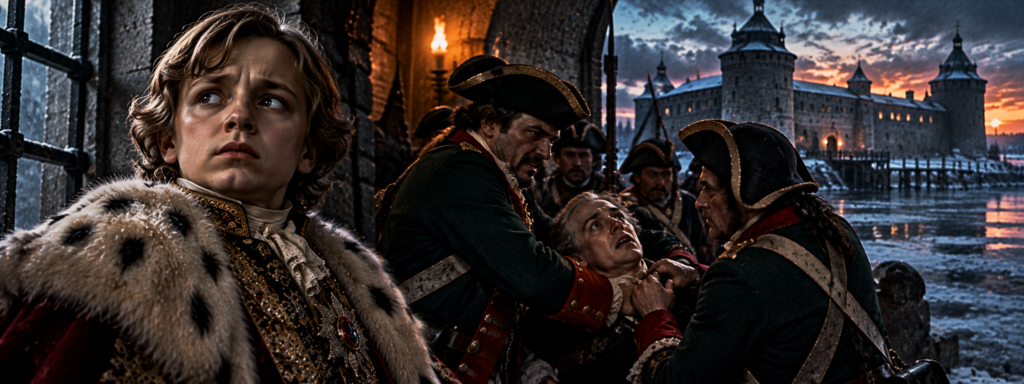
Ivan VI of Russia: The Forgotten Child Emperor Imprisoned for Life and Murdered at Shlisselburg
The Infant Tsar Who Lost His Throne, the Royal Family Erased From History, and the Desperate Rescue Attempt That Ended in Regicide
Ivan VI Antonovich of Russia (23 August 1740–16 July 1764, Gregorian calendar) was Emperor of Russia from 28 October 1740 to 6 December 1741, although he was only an infant throughout his reign and never exercised personal authority. Born in St. Petersburg, he was the son of Prince Anthony Ulrich of Brunswick-Wolfenbüttel and Anna Leopoldovna, a member of the Russian imperial family descended from Tsar Ivan V, the elder half-brother and former co-ruler of Peter the Great. Ivan was proclaimed emperor when he was barely two months old, following the death of Empress Anna Ivanovna, who had selected him as her successor in an attempt to preserve the succession through her branch of the Romanov family. His reign was governed first by the regent Ernst Johann von Biron and then by his mother, Anna Leopoldovna, before a palace coup brought Peter the Great’s daughter Elizabeth Petrovna to the throne in December 1741. The infant emperor was deposed, and his entire family was placed under arrest, beginning a captivity that would eventually consume nearly his entire life. Ivan spent his childhood and adolescence in increasingly severe isolation, separated from his parents and siblings and ultimately confined under extraordinary secrecy at Shlisselburg Fortress. On 16 July 1764, at the age of twenty-three, he was killed by his guards during an attempted rescue organized by Lieutenant Vasily Mirovich, who hoped to free the former emperor and use his hereditary claim to overthrow Catherine II. The guards had received secret instructions requiring them to kill Ivan rather than allow him to escape or be taken by rescuers, making his death a deliberate political killing carried out under standing orders. Catherine the Great denied involvement in planning Mirovich’s attempt, and historians have debated whether the affair was an independent conspiracy or a provocation, but there is no conclusive evidence that she secretly organized it. Ivan’s death ended one of the most extraordinary royal imprisonments in European history and exposed the ruthless logic of eighteenth-century Russian succession politics: a child who had never governed, committed a crime, or even understood the power he supposedly possessed was kept prisoner for more than twenty years because his bloodline made him dangerous.
The Prisoner Who Was Never Supposed to Leave Alive
On the night of 15–16 July 1764, an armed officer attempted to seize control of Shlisselburg Fortress, a grim stronghold standing where the Neva River flows out of Lake Ladoga. Inside the fortress, hidden from ordinary visitors and known to only a restricted circle of officials, was a young man who had spent almost his entire life in captivity. He was twenty-three years old, had once been emperor of Russia, and possessed a name that successive governments had tried to remove from public memory. His existence was considered so dangerous that the men guarding him had been instructed to kill him rather than allow anyone to take him alive.
The prisoner was Ivan Antonovich, known to history as Ivan VI. He had become emperor before he was old enough to speak, lost his throne while still an infant, and spent the following decades imprisoned for a political identity he had never chosen. He had not led a rebellion, issued a decree, commanded an army, or committed an offense against the state. His only crime, in the eyes of those who controlled his fate, was being born into a branch of the Romanov family that could challenge the reigning monarch.
The officer attempting to free him was Vasily Mirovich, a young lieutenant serving in the fortress garrison. Mirovich believed that Ivan’s restoration could transform the political order and perhaps restore fortunes lost by families associated with earlier political struggles. His plan depended upon reaching the prisoner before the fortress authorities could prevent his release. What he did not fully control was the secret system of orders surrounding Ivan’s confinement.
When Mirovich’s men attempted to reach the prisoner, the guards responsible for Ivan’s immediate custody acted upon their instructions. They killed the former emperor rather than surrender him to the rescuers. By the time Mirovich gained access, the man he intended to restore to the throne was dead. The rescue attempt had become an act of regicide.
The killing was not an impulsive response to a prisoner escaping through an open gate. Ivan had been confined under regulations designed specifically to prevent his liberation, and those regulations included the possibility of his death. His guards were not merely expected to resist an attack. They were instructed to ensure that the former emperor could not survive a successful rescue.
The episode reveals an extraordinary contradiction at the heart of Russian imperial politics. Ivan was officially a prisoner whose existence was concealed, yet his hereditary claim remained powerful enough to justify elaborate precautions. The government had spent years preventing him from communicating with the outside world, but isolation had not eliminated the political significance of his birth. Even a man who had never exercised power could threaten a reigning sovereign simply by remaining alive.
For Ivan, the tragedy had begun long before the night of his murder. His childhood had been consumed by confinement, his family had been separated, and his identity had been transformed into a state secret. The final violence at Shlisselburg was the culmination of more than two decades of political imprisonment. To understand why the guards killed him, it is necessary to return to the strange circumstances that placed a two-month-old child on the Russian throne.
Born Into a Dynasty Divided Against Itself
Ivan Antonovich was born on 23 August 1740 in St. Petersburg, during a period when the Russian monarchy was struggling with the consequences of an uncertain succession system. His mother, Anna Leopoldovna, belonged to the branch of the imperial family descended from Tsar Ivan V. Ivan V had ruled jointly with his younger half-brother Peter I before Peter became the dominant figure in Russian government. Although Ivan V had exercised comparatively little independent authority, his descendants retained a legitimate place within the Romanov dynasty.
Ivan’s maternal grandmother was Catherine Ivanovna, daughter of Ivan V and sister of Empress Anna Ivanovna. Through this family connection, the newborn prince possessed a direct hereditary relationship to the reigning empress. His father, Anthony Ulrich of Brunswick-Wolfenbüttel, came from a German princely family whose marriage alliances connected him to several European courts. The marriage between Anthony Ulrich and Anna Leopoldovna had been arranged partly to strengthen the dynastic position of Ivan V’s descendants.
The infant’s ancestry mattered because Russia had experienced repeated succession crises since the death of Peter the Great in 1725. Peter’s reforms had transformed the empire, but his succession arrangements had left considerable room for political maneuvering. The throne had passed among rulers whose claims depended upon family relationships, court factions, and military support. The absence of a universally accepted automatic succession system encouraged competition.
Empress Anna Ivanovna, who had ruled since 1730, had no children of her own. She therefore looked to her niece Anna Leopoldovna and the niece’s offspring as a means of preserving the crown within her branch of the family. The birth of a male child offered a solution to the succession problem. Ivan could become emperor while experienced adults governed on his behalf.
The arrangement appeared sensible from the perspective of dynastic politics. A newborn prince had no political enemies of his own, and his claim could be presented as a continuation of the ruling family. A regency would allow the government to operate until he reached adulthood. Yet the same arrangement created opportunities for powerful courtiers to compete for control.
Ivan’s birth therefore placed him at the center of a political struggle before he could understand his own name. His mother and father belonged to the royal household, but they did not possess the unquestioned authority needed to protect their son’s future. The infant’s value lay in his hereditary position, which others intended to use. The child himself had no voice in the decisions that would determine his life.
The rivalry between the descendants of Ivan V and those of Peter the Great would become decisive. Elizabeth Petrovna, daughter of Peter I, remained a powerful alternative claimant whose supporters regarded her as a more natural representative of the great reformer’s legacy. Ivan’s accession would place the throne in the hands of a baby associated with German relatives and foreign courtiers. That contrast would later become a central weapon in the campaign to overthrow him.
Empress Anna’s Final Decision
Empress Anna Ivanovna had ruled Russia for a decade when her health began to fail in 1740. Her government had been associated with powerful court favorites, extensive political influence exercised by German-born officials, and the continuing importance of the imperial guards. The empress understood that her death could trigger another succession crisis. She therefore sought to establish a successor before the throne became vacant.
Her chosen heir was the infant Ivan Antonovich. The decision preserved the succession through the descendants of Ivan V and excluded Elizabeth Petrovna, daughter of Peter the Great. Ivan was only a few weeks old when the arrangements were made. His accession would depend entirely upon the willingness of powerful adults to recognize and defend his claim.
Anna also selected Ernst Johann von Biron, Duke of Courland and one of her most influential favorites, to serve as regent. Biron had enjoyed extraordinary authority during her reign and possessed enemies among the Russian nobility. His appointment was intended to ensure continuity, but it immediately created political resentment. Many courtiers feared that the government would remain under the control of a man whose power depended upon personal favor rather than hereditary right.
The empress died on 28 October 1740, according to the Gregorian calendar. Ivan was proclaimed Emperor Ivan VI, although he was barely two months old. The ceremonies of monarchy were now attached to a child who could neither speak nor understand the significance of his position. The real struggle concerned the adults who would govern in his name.
Biron’s regency proved extremely short. His enemies moved against him within weeks, and he was arrested in a coup supported by powerful figures at court. The infant emperor remained on the throne, but the regent chosen by Empress Anna was removed. The episode demonstrated that the new government was unstable from the beginning.
Ivan’s mother, Anna Leopoldovna, assumed the regency after Biron’s downfall. She possessed a closer personal connection to the child than Biron and appeared to offer a more acceptable arrangement. Yet her government faced the same underlying difficulties. Court factions remained divided, and the imperial guards could determine the fate of the monarchy.
The succession had therefore failed to produce stability. Instead of a secure regency protecting the infant ruler, Russia experienced a struggle among powerful adults seeking control of the government. Ivan’s name appeared on official documents, but he possessed no independent authority. His crown was already becoming an instrument in the hands of competing factions.
The Regent Who Could Not Hold the Throne
Anna Leopoldovna became regent in November 1740 after the arrest of Biron. She was still a young woman and had limited experience managing the enormous political responsibilities of the Russian Empire. Her position required her to balance powerful ministers, military commanders, foreign diplomats, and members of the imperial family. The task would have been difficult even for an experienced ruler.
The regency was complicated by personal rivalries and conflicting political interests. Influential figures sought access to the government, while foreign diplomats attempted to shape Russian policy. Anna Leopoldovna’s relationships with advisers became subjects of court gossip and political criticism. The government appeared vulnerable to intrigue.
Her husband, Anthony Ulrich, also occupied an uncertain position. As the father of the emperor, he possessed dynastic importance, but he did not automatically command the loyalty of Russian nobles or guards officers. His German background contributed to the perception that foreign influence dominated the court. The family’s political security depended upon institutions that could quickly change allegiance.
Anna Leopoldovna’s government faced criticism for indecision and dependence upon advisers. Some accounts portray her as personally gentle but politically ineffective, although these judgments were shaped by later narratives sympathetic to Elizabeth’s accession. The surviving evidence suggests that she struggled to establish firm authority. Her enemies recognized the opportunity.
Elizabeth Petrovna remained the most dangerous alternative claimant. She was the daughter of Peter the Great, whose memory retained enormous prestige among Russian soldiers and officials. Her supporters could present her accession as the restoration of the great reformer’s direct line. The infant Ivan, by contrast, could be portrayed as a symbol of foreign domination.
The guards regiments were especially important. Their support had already influenced earlier changes of government, and they possessed the military force necessary to seize the capital. Elizabeth cultivated relationships among officers and soldiers who were dissatisfied with the regency. The political foundations of Ivan’s reign were therefore weakening.
Anna Leopoldovna failed to neutralize the threat in time. Warnings of conspiracy circulated, but the government did not prevent Elizabeth’s supporters from acting. The regent’s position became increasingly precarious. The infant emperor remained unaware that his throne was approaching destruction.
The tragedy of the regency lies in the mismatch between its responsibilities and its political resources. Anna Leopoldovna was expected to preserve the crown for her son until he reached adulthood. Yet the monarchy’s stability depended upon personal loyalty, military support, and the ability to defeat rival factions. She could not secure those foundations, and the consequences would fall upon her entire family.
December 1741: Elizabeth’s Palace Coup
In the early hours of 6 December 1741, according to the Gregorian calendar, Elizabeth Petrovna moved against the regency government. Supported by soldiers of the Preobrazhensky Guards, she entered the political struggle that would make her empress. The operation was swift and relied upon the loyalty of troops stationed near the imperial court. The infant emperor’s government was unable to organize effective resistance.
Elizabeth’s claim rested upon her descent from Peter the Great. Her supporters portrayed her as the rightful representative of the dynasty’s most celebrated ruler. The political message was powerful because Peter’s reforms had transformed Russia’s military and international position. The daughter of Peter the Great appeared to possess a legitimacy that a foreign-connected infant could not easily match.
The coup succeeded with remarkably little bloodshed. Anna Leopoldovna, Anthony Ulrich, and the infant Ivan were arrested, while Elizabeth was proclaimed empress. The government that had ruled in Ivan’s name collapsed after little more than a year. The child emperor was deposed before his second birthday.
The seizure of power was not merely a change of ministers. It transferred the throne from one branch of the Romanov family to another and created a continuing problem of hereditary legitimacy. Ivan remained alive and possessed a claim through his descent from Ivan V. Elizabeth’s victory therefore did not eliminate the possibility of future restoration.
The new empress initially faced decisions about the fate of the defeated family. Executing an infant emperor would have been politically shocking and morally difficult to justify. Allowing him to remain in Russia without restrictions could encourage conspiracies. Exile or confinement offered alternatives, but each carried risks.
Elizabeth chose imprisonment. Ivan and his family were placed under guard, and plans for their removal from Russia were considered before political concerns led to continued confinement. The decision transformed the former emperor into a permanent security problem. His childhood would be governed by the fears of the regime that had overthrown him.
The coup also established a precedent that would shape later Russian politics. Military support could determine the ruler even when hereditary claims remained contested. Elizabeth had seized power from a child whose legitimacy had been formally recognized. The monarchy’s authority rested upon the ability to command the guards as much as upon dynastic descent.
For Ivan, the consequences were devastating. He had never governed, yet he lost his throne and freedom because adults had fought over his hereditary position. The child who had been proclaimed emperor in 1740 became a prisoner in 1741. His captivity would last until his murder more than twenty years later.
The Royal Family That Became a State Secret
After Elizabeth’s accession, the defeated Brunswick family was placed under increasingly restrictive supervision. Anna Leopoldovna and Anthony Ulrich remained prisoners, along with their children. The family had once occupied the center of Russian imperial politics, but their position was transformed into one of confinement and surveillance. Their royal blood made them too dangerous to release.
The government initially considered sending the family abroad. Such an arrangement might have removed them from Russia while avoiding the cruelty of lifelong imprisonment. Yet exile carried its own risks because foreign courts could use Ivan’s claim to challenge Elizabeth. A former emperor living beyond Russian control might become the center of diplomatic intrigue.
The decision was therefore made to keep the family under guard. Their movements were restricted, their contacts controlled, and their circumstances became increasingly isolated. The children grew up within a world defined by imprisonment rather than ordinary family life. The royal household had become a collection of political hostages.
The family was eventually confined at Kholmogory, a remote settlement in northern Russia. The location offered isolation from the capital and reduced the likelihood of rescue. The harsh climate and distance from major political centers made it suitable for a government determined to keep the prisoners out of sight. Their lives became dependent upon officials appointed to supervise them.
Ivan’s circumstances were especially severe. Because he had actually occupied the throne, his identity was considered more dangerous than that of his siblings. He was gradually separated from ordinary family contact and subjected to increasingly strict secrecy. The government sought to prevent him from becoming a recognizable figure around whom opposition could gather.
Anna Leopoldovna gave birth to additional children during captivity. The family therefore continued growing even as its freedom disappeared. The younger children had never occupied the throne and possessed no personal responsibility for the political struggles that imprisoned them. Nevertheless, their relationship to Ivan and the former regent made them part of the same security problem.
The conditions of confinement damaged the family’s health and prospects. Anna Leopoldovna died in 1746, only a few years after the coup. Her death left Anthony Ulrich responsible for the surviving children within the limits imposed by imprisonment. The family had lost not only political authority but also the ordinary possibility of raising children in freedom.
Ivan’s fate became increasingly separate from that of his relatives. The former emperor was not simply a member of a defeated household; he was a living alternative sovereign. The government therefore treated him as a special prisoner whose identity required concealment. His name would become something officials avoided rather than celebrated.
A Childhood Behind Locked Doors
Ivan’s childhood was unlike that of almost any other European royal child. He had been born into extraordinary privilege and proclaimed emperor before he could speak. Yet his earliest memories, if they could be recovered, would have been shaped by confinement and supervision. The palace ceremonies associated with his infancy gave way to guarded rooms and restricted contact.
The government feared that knowledge of his location could encourage rescue attempts. Officials therefore limited the number of people who knew the details of his imprisonment. His identity was concealed from many who encountered the security arrangements surrounding him. The secrecy was intended to prevent political organization around his name.
The effects upon his development are difficult to measure. Later reports described him as socially isolated and poorly prepared for ordinary interaction. Some accounts suggested that prolonged confinement affected his mental health or behavior. These observations must be treated cautiously because they were produced by officials operating within the prison system and may have served political purposes.
What can be established is that Ivan was denied the normal experiences of childhood. He could not freely associate with other children, receive a conventional royal education, or develop relationships beyond those permitted by his guards. His world was controlled by the authorities responsible for keeping him imprisoned. The restrictions became more severe as he grew older.
The cruelty of the arrangement was intensified by its duration. A temporary detention during a succession crisis might have ended when the political situation stabilized. Ivan’s imprisonment continued year after year, long after Elizabeth’s government had established itself. His existence remained a political problem that the regime refused to resolve through release.
The former emperor’s isolation also served a symbolic purpose. By preventing him from appearing in public, the government reduced the possibility that people would recognize him as a legitimate ruler. His name could be removed from ordinary political discussion, and his image could be forgotten. The monarchy attempted to erase a rival not through execution but through enforced invisibility.
Yet secrecy could never eliminate the fact of his birth. Ivan remained a descendant of Ivan V and a former emperor whose accession had once been officially recognized. The government could suppress his public identity, but it could not change his ancestry. The contradiction ensured that his imprisonment would continue.
His childhood therefore became a prolonged punishment for a political claim he had never chosen. He was neither tried nor convicted of a crime. He was simply kept under guard because others feared what his existence might mean. The state treated a child as a threat before he had developed the capacity to threaten anyone.
The Erasure of an Emperor
Elizabeth’s government attempted to remove Ivan VI from public memory. Coins and documents bearing his name or image became politically sensitive, and official references to his reign were restricted. The purpose was to reduce the visibility of a former emperor whose hereditary claim could challenge the reigning monarch. The policy transformed historical memory into an instrument of state security.
The erasure was especially striking because Ivan had been a legitimate ruler under the arrangements established by Empress Anna. His name had appeared on official documents, and coins had been issued during his reign. The government had recognized him as sovereign before Elizabeth’s coup. After his deposition, those same symbols became reminders of a dangerous alternative succession.
Removing his name from circulation helped establish Elizabeth’s authority. The new regime could present her accession as the restoration of Peter the Great’s line rather than the overthrow of a recognized emperor. The less visible Ivan became, the easier it was to treat his reign as an interruption. Historical memory was being reshaped to support the victor.
The policy also affected the prisoner personally. Ivan was denied the public identity that had once defined him. His status as former emperor was concealed even from some people responsible for his confinement. The state attempted to make him disappear without physically killing him.
Such treatment was not unique to Russia, but the severity of Ivan’s case was extraordinary. Deposed rulers elsewhere in Europe might be exiled, confined in monasteries, or held under guard. Ivan was subjected to a level of secrecy that deprived him of ordinary recognition. His political danger was considered so great that his very name became sensitive.
The erasure also created a paradox. The more the government concealed him, the more mysterious his existence became. Rumors could flourish precisely because reliable information was unavailable. A hidden former emperor could become a powerful figure in political imagination. Secrecy reduced immediate danger while preserving the possibility of future speculation.
The government’s efforts therefore did not solve the succession problem. Ivan remained alive, and those who knew his identity understood his significance. The authorities could prevent him from speaking publicly, but they could not prevent ambitious men from imagining his restoration. His imprisonment became a permanent reminder of the dynasty’s unresolved legitimacy.
For Ivan, the consequences were deeply personal. He was not allowed to live as an ordinary man, but he was also denied the public role associated with his birth. His existence was reduced to a secret maintained by guards and officials. The former emperor became a prisoner whose identity was both the reason for his captivity and the thing his captors sought to conceal.
Shlisselburg: The Fortress of No Return
In 1756, Ivan was transferred to Shlisselburg Fortress, one of the most secure and symbolically powerful places of confinement in the Russian Empire. The fortress stood on Oreshek Island near the source of the Neva River, controlling a strategic waterway between Lake Ladoga and St. Petersburg. Its walls had witnessed military conflict and political imprisonment. For Ivan, it became the final setting of his life.
The transfer separated him more completely from his family. His parents and siblings remained in confinement elsewhere, while Ivan was placed under a special regime designed for a uniquely dangerous prisoner. The authorities sought to prevent communication between him and the outside world. His isolation became nearly absolute.
The fortress’s geography reinforced the restrictions. Surrounded by water and guarded by soldiers, it was difficult to approach without detection. The island location made escape or rescue especially challenging. The physical environment reflected the government’s determination to keep Ivan beyond the reach of political supporters.
His imprisonment was governed by detailed instructions. Guards were required to prevent unauthorized contact, restrict information, and maintain secrecy concerning the prisoner’s identity. The regulations treated Ivan less as an ordinary captive than as a potential source of dynastic rebellion. His survival was permitted only under conditions that made political action almost impossible.
The secrecy extended to his name. He was sometimes identified through indirect descriptions rather than openly acknowledged as the former emperor. The practice reduced the number of people who could connect the prisoner with the succession dispute. It also stripped Ivan of the ordinary recognition attached to personal identity.
Accounts of his behavior at Shlisselburg vary. Some described him as confused or mentally impaired, while others suggested that he retained awareness of his royal identity. The surviving evidence does not permit a confident medical diagnosis. Prolonged isolation, limited education, and the political interests of observers complicate interpretation.
The fortress also created the conditions for his eventual murder. Because the government considered rescue a serious danger, the guards received instructions concerning what to do if an attempt occurred. These orders would later prove fatal. The prison designed to keep Ivan alive but powerless contained a mechanism for ensuring that he would not leave alive.
By the time Catherine the Great came to power in 1762, Ivan had spent most of his life in captivity. He was twenty-one years old and had never experienced freedom as an adult. His existence remained a secret known to a limited circle of officials. The new empress inherited not merely a prisoner but an unresolved dynastic threat.
Elizabeth’s Death and the Hope That Never Came
Empress Elizabeth died in January 1762, ending a reign of more than twenty years. Her death brought Peter III to the throne and created another transition within the Russian monarchy. For Ivan, the change might have offered the possibility of reconsideration. The ruler who had overthrown him was gone, and a new emperor possessed the authority to alter his confinement.
Peter III, however, faced his own political problems. His reign was marked by rapid reforms, controversial foreign policy decisions, and growing opposition within the court and military. The government had little incentive to release a former emperor whose claim could complicate the succession. Ivan remained imprisoned.
Peter’s position was also vulnerable because his wife Catherine possessed ambitions and supporters of her own. The political instability surrounding the throne made the existence of a rival claimant especially dangerous. Ivan’s release could create another center of loyalty at a moment when the monarchy was already divided. The government therefore maintained the restrictions.
The possibility of Ivan’s restoration was not entirely imaginary. He belonged to a recognized branch of the Romanov dynasty and had once been emperor. Some opponents of the reigning government might prefer him to Peter or Catherine. His lack of political experience could even make him attractive to factions seeking a controllable sovereign.
Yet Ivan himself had no means of exploiting these possibilities. He remained isolated at Shlisselburg, without access to political supporters or reliable information about events in the capital. The succession crisis unfolded beyond his reach. His identity was politically important, but his personal agency was almost nonexistent.
Peter III’s reign ended in July 1762 when Catherine seized power through a guards-backed coup. The emperor was deposed and died shortly afterward at Ropsha under suspicious circumstances. The event demonstrated once again that Russian rulers could be removed through military conspiracy. It also made Ivan’s existence more dangerous to the new government.
Catherine’s accession created a new legitimacy problem. She had overthrown her husband and claimed the throne in her own right, although their son Paul possessed a hereditary connection to the previous ruler. Ivan represented an additional alternative whose claim predated Catherine’s accession. His survival could be used by anyone seeking to challenge the new empress.
The death of Elizabeth therefore brought no freedom for Ivan. Instead, another coup reinforced the reasons for keeping him confined. The former emperor remained a prisoner while the monarchy changed hands around him. His fate was determined by political struggles in which he had no participation.
Catherine the Great Inherits a Dangerous Prisoner
When Catherine II seized the throne in July 1762, she inherited the problem of Ivan VI. He had been deposed more than twenty years earlier, but his hereditary claim remained politically significant. Catherine’s own accession had occurred through a coup against her husband, making questions of legitimacy especially sensitive. A surviving former emperor could become a powerful symbol for opponents.
Catherine understood the danger posed by alternative claimants. Her government depended upon the support of the guards, influential nobles, and administrative institutions. A conspiracy organized around Ivan could threaten that coalition. The prisoner at Shlisselburg therefore required continued attention.
The new empress considered Ivan’s circumstances and received reports concerning his condition. Accounts of possible visits or inquiries have been discussed by historians, although the details are not always securely established. What is clear is that Catherine did not release him. His confinement continued under strict supervision.
The problem was complicated by Ivan’s prolonged isolation. He had spent most of his life without ordinary education or social contact, making it uncertain whether he could function as an independent ruler. Some reports described him as mentally disturbed or incapable of coherent political action. Such descriptions may have reflected genuine effects of confinement, but they also served the government’s interest in portraying him as unfit.
Even if Ivan lacked the ability to govern, his name remained dangerous. A political faction could use him as a figurehead while exercising power on his behalf. His personal competence was therefore less important than his hereditary identity. The government could not dismiss him simply because he had been isolated.
Catherine’s position also encouraged caution. Her husband Peter III had died shortly after deposition, and accusations of murder already shadowed her accession. The death of another former emperor could provoke further suspicion. Yet releasing Ivan would create a potentially serious threat to her authority.
The solution was continued imprisonment under increasingly explicit security arrangements. The authorities sought to ensure that Ivan could not communicate with supporters or be removed from the fortress. His guards were given instructions intended to prevent any successful rescue. Those instructions would later determine his death.
Catherine therefore inherited and maintained a system of confinement that had begun under Elizabeth. She did not create Ivan’s imprisonment, but her government continued it and preserved the lethal precautions surrounding him. The distinction matters when assessing responsibility. Ivan’s death occurred under Catherine’s reign, but the machinery of his isolation had been established over many years.
The Secret Orders That Made Murder Inevitable
The most disturbing feature of Ivan’s imprisonment was the existence of instructions requiring his guards to kill him if a rescue attempt threatened to succeed. These orders reflected the government’s determination that the former emperor must never become available to political conspirators. The prisoner was to remain alive only while securely confined. If that security failed, his life was to be sacrificed.
The orders were not ordinary rules for preventing escape. Guards could normally resist intruders, secure doors, or move a prisoner to safety. In Ivan’s case, the authorities treated the prisoner’s survival as a danger if control over him might be lost. The instructions therefore converted his custody into a conditional death sentence.
The political logic was clear. A living Ivan outside government control could be proclaimed emperor and used to challenge the reigning sovereign. A dead Ivan could no longer serve as a figurehead. The government preferred the certainty of his death to the uncertainty of his restoration.
The cruelty of the arrangement was extraordinary because Ivan had committed no crime. He was not under sentence of death, and no public judicial process had condemned him. His life depended upon secret orders issued for reasons of dynastic security. The state had effectively authorized his murder under specified circumstances.
The instructions also placed the guards in a morally disturbing position. They were responsible for protecting the prisoner from unauthorized contact while simultaneously being required to kill him if rescue became imminent. Their duty to preserve custody could override the duty to preserve life. The system made them potential executioners.
The secrecy surrounding the orders prevented public scrutiny. Ivan could not appeal, defend himself, or challenge the conditions of his imprisonment. The public did not know the full extent of the danger facing him. His fate was controlled by officials operating beyond ordinary accountability.
The existence of such instructions also reveals the government’s assessment of his political significance. If Ivan had truly been harmless, there would have been little reason to prepare for his immediate killing. The authorities understood that his name could inspire rebellion. Their fear was strong enough to justify a permanent contingency plan for murder.
By 1764, the system had been in place long enough to become routine. Guards followed regulations, officials maintained secrecy, and the prisoner remained isolated. The arrangement appeared stable because no successful rescue had occurred. Vasily Mirovich’s conspiracy would expose the lethal purpose of the instructions.
Vasily Mirovich: The Officer Who Wanted to Restore an Emperor
Vasily Mirovich was a young officer serving in the Russian military when he became involved in the plan to free Ivan VI. His family background included grievances connected with earlier political struggles, and his personal circumstances may have encouraged resentment toward the government. He was not a powerful aristocrat commanding a major political faction. His ambitions exceeded the resources available to him.
Mirovich’s motives have been interpreted in different ways. Some accounts portray him as a desperate adventurer seeking advancement, while others emphasize political dissatisfaction and sympathy for the imprisoned emperor. The surviving evidence does not establish a single motive with certainty. His actions nevertheless demonstrate that he believed Ivan’s restoration could transform his own future.
The plan depended upon the symbolic power of the former emperor. Mirovich did not possess an independent claim to the throne or a large army capable of overthrowing Catherine. He needed Ivan’s identity to give the movement legitimacy. The prisoner at Shlisselburg could become the figurehead around whom soldiers and dissatisfied nobles might rally.
Mirovich’s position within the fortress garrison gave him access to information and personnel that ordinary conspirators lacked. He understood aspects of the security arrangements and believed he could persuade or compel soldiers to support him. The plan involved seizing control of the fortress and reaching the prisoner. Its success required rapid action before loyal guards could respond.
The conspiracy was extremely dangerous. Catherine’s government had strong reasons to prevent Ivan’s liberation, and the fortress was heavily guarded. Mirovich risked execution if the attempt failed. His willingness to proceed suggests either strong conviction, desperation, or a serious misjudgment of the obstacles.
The young officer also appears to have underestimated the special instructions governing Ivan’s custody. Even if he could overcome the outer defenses, the guards responsible for the prisoner had orders that made rescue almost impossible. The plan depended upon reaching Ivan alive. The government had prepared precisely for that possibility.
Mirovich’s conspiracy therefore contained a fatal contradiction. He sought to restore Ivan by attacking the fortress, but the attack itself triggered the conditions under which the guards were instructed to kill him. The more forcefully Mirovich pursued the rescue, the greater the danger to the prisoner. The system had been designed to make liberation self-defeating.
The officer’s name would become inseparable from Ivan’s death. His attempted rescue provided the immediate occasion for the killing, even though the lethal instructions originated with the authorities. The episode would later be described as both a failed liberation and a political assassination. Mirovich’s ambition brought the hidden prisoner into the final crisis of his life.
The Night of the Rescue Attempt
The rescue attempt unfolded during the night of 15–16 July 1764 at Shlisselburg Fortress. Mirovich attempted to mobilize soldiers under his influence and seize control of the stronghold. His plan required the cooperation of enough men to overcome resistance and reach Ivan’s place of confinement. The operation began as a military mutiny directed toward a dynastic objective.
Mirovich presented the cause in terms of restoring the rightful emperor. The claim depended upon Ivan’s former status as sovereign and his descent from the Romanov dynasty. Soldiers who accepted the story could imagine themselves participating in a legitimate restoration rather than rebellion. The language of loyalty to Ivan was intended to justify disobedience to Catherine.
The fortress authorities did not simply surrender control. Resistance developed as the conspirators attempted to reach the prisoner. The guards responsible for Ivan’s immediate custody understood that a rescue attempt was underway. Their secret instructions now became decisive.
Rather than allow Ivan to be taken alive, the guards killed him. Accounts identify the immediate custodians as officers acting under the standing orders governing his confinement. The exact sequence of the struggle has been described differently in later narratives, but the essential fact is clear. The former emperor was deliberately killed to prevent his liberation.
The method of killing has commonly been described as stabbing with swords or other bladed weapons. The surviving reports indicate violent death at the hands of his guards, although some details vary. The killing occurred inside the fortress where Ivan had spent the final years of his captivity. He was twenty-three years old.
By the time Mirovich reached the prisoner, the objective of the conspiracy had been destroyed. Ivan was dead, and the restoration movement had lost the person whose identity gave it meaning. The attempt to free him had triggered the very action the government had prepared. The rescue ended in failure before the former emperor could be presented to supporters.
Mirovich’s position became hopeless. Without Ivan alive, he could not plausibly claim to be restoring the legitimate sovereign. The fortress remained under government control, and the mutiny could not develop into a broader political movement. The conspirators faced arrest and punishment.
The night at Shlisselburg revealed the full brutality of the security system. Ivan had been kept alive for decades because the government feared the consequences of killing him openly. Yet the same government had authorized his death if anyone attempted to rescue him. The former emperor’s life was preserved only so long as he remained completely powerless.
July 16, 1764: The Murder of Ivan VI
Ivan VI died on 16 July 1764, killed by the men assigned to guard him. He had been emperor for little more than a year as an infant and had spent the remainder of his life in captivity. His death occurred during Mirovich’s attempted rescue, but the guards’ actions followed secret instructions designed to prevent his liberation. The killing was therefore not merely an accidental consequence of a confused military confrontation.
The former emperor was unarmed and confined. He had no army, no political organization, and no practical ability to command resistance. His danger lay entirely in the hereditary claim that others might use. The guards killed him because a living Ivan could become a rival sovereign if released.
The distinction between the rescue attempt and the murder is important. Mirovich initiated the crisis by attempting to seize the fortress and free the prisoner. The guards carried out the killing under orders that predated the attempt. Both actions contributed to the outcome, but the decision to make Ivan’s death a condition of preventing rescue belonged to the authorities who established the security regime.
The murder also differed from a public execution. Ivan was not brought before a court, accused of a crime, or sentenced through a legal process. His death was carried out secretly within the prison where he had been held for years. The government treated his existence as a political danger rather than a matter of criminal justice.
The brutality of the killing was intensified by his history. Ivan had lost his throne before he could understand monarchy and had grown up without ordinary freedom. His captivity had already deprived him of education, family relationships, and personal independence. The final act took his life because the state refused to accept even the possibility of his release.
The murder ended the political usefulness of his living identity. No conspirator could now produce Ivan as a surviving emperor and demand restoration. The government had eliminated the immediate danger that Mirovich sought to exploit. Yet the death also exposed the extraordinary measures taken to secure the throne.
The event became one of the most disturbing episodes of regicide in Russian history. A former emperor was killed not because he had attempted to reclaim power but because another man tried to rescue him. His guards acted as executioners under a secret contingency plan. The monarchy had turned the protection of its own legitimacy into a justification for murder.
Ivan’s death also raised questions about Catherine’s government. The killing occurred under her reign, and the standing orders reflected the determination to prevent restoration. Whether Catherine personally devised the lethal instructions or simply maintained an inherited system has been discussed by historians. The essential responsibility of the state for the conditions of his death remains clear.
The Guards Who Became Executioners
The immediate killing of Ivan VI was carried out by the officers responsible for his custody. Their instructions required them to prevent the prisoner from being taken alive during a rescue attempt. When Mirovich’s mutiny threatened the fortress, they acted upon those orders. The men assigned to guard Ivan became the instruments of his death.
The situation placed the guards within a system that deliberately subordinated the prisoner’s life to political security. Their duty was not simply to prevent escape or protect the fortress. They were required to ensure that Ivan could not become available to a rival faction. The orders made killing a prescribed response to the possibility of liberation.
The guards’ actions were therefore different from spontaneous violence committed during a riot. They were carrying out a contingency plan established by higher authority. The plan anticipated that an attack might occur and specified the fate of the prisoner. Ivan’s death was built into the security arrangements.
The moral responsibility of the individual guards remains a separate question from the responsibility of the government. They acted under orders, but the act itself was deliberate killing of a helpless captive. The fact that the instructions came from superiors does not change the nature of the death. It does, however, reveal how political systems can distribute responsibility across officials and subordinates.
The guards also faced the danger of being overpowered by Mirovich’s men. If they failed to prevent the rescue, they could be punished for allowing a rival claimant to escape. Their personal incentives therefore aligned with the lethal instructions. Killing Ivan protected both the government and their own positions.
The secrecy of the prisoner’s identity made the situation even more disturbing. Ivan had been reduced to a special object of custody rather than treated as an ordinary person. The guards’ professional obligations centered upon controlling his existence. The system encouraged them to view his survival as conditional upon obedience to state security.
After the killing, the government could present the guards as men who had fulfilled their duty. The rescue attempt had failed, and the former emperor could no longer threaten the throne. The official logic rewarded the outcome that destroyed the prisoner. The murder became evidence of successful security rather than a crime requiring punishment.
The episode illustrates how regicide can occur through bureaucratic procedure rather than open political passion. Ivan was not killed by an angry crowd or an assassin acting from personal hatred. He died because written or transmitted instructions told his custodians that his life must end if rescue became possible. The machinery of state power had made murder part of prison administration.
Mirovich’s Arrest and Execution
The failure of the rescue attempt left Vasily Mirovich without the political figure around whom he had hoped to organize a restoration. Ivan was dead, and the fortress remained under government control. Mirovich was arrested and brought before the authorities. His conspiracy had become a failed military mutiny associated with the death of a former emperor.
The investigation sought to establish the extent of the plot and identify possible accomplices. The government had strong reasons to determine whether Mirovich acted alone or belonged to a wider political movement. A conspiracy involving powerful nobles or foreign interests would represent a serious threat to Catherine’s authority. The inquiry therefore carried implications beyond the fate of one lieutenant.
Mirovich’s motives remained a subject of controversy. Some accounts emphasized personal grievances and ambition, while others suggested political conviction. The surviving evidence does not establish that he possessed a large organized network capable of overthrowing the government. His plan appears to have relied heavily upon the hope that Ivan’s liberation would inspire broader support.
The possibility that the affair was a provocation has also been discussed. According to such theories, Mirovich may have been manipulated or encouraged by forces interested in eliminating Ivan. The idea is politically plausible in the abstract because the rescue attempt triggered the prisoner’s death. However, no conclusive evidence establishes that Catherine or her government secretly organized the conspiracy for that purpose.
Mirovich was condemned and executed in September 1764. His punishment demonstrated the government’s determination to suppress attempts to challenge the throne through Ivan’s claim. The failed conspirator became another victim of the political crisis surrounding the former emperor. His death closed the immediate legal proceedings but did not resolve the historical questions.
The execution also served a public purpose. It warned officers and nobles against organizing restoration movements or attempting to interfere with state prisoners. Catherine’s government needed to demonstrate that the coup of 1762 had produced a secure monarchy. Punishing Mirovich reinforced the authority of the reigning empress.
Yet the trial and execution could not erase the central fact of Ivan’s murder. The former emperor had been killed under standing orders, and the rescue attempt had merely activated those instructions. Mirovich’s punishment did not provide a public judicial examination of the legitimacy of the killing itself. The government controlled both the investigation and the narrative.
The affair therefore ended with two deaths. Ivan was murdered inside Shlisselburg Fortress, and Mirovich was executed for the attempt to free him. The political system that had imprisoned the former emperor emerged intact. The tragedy revealed how little room existed for mercy once dynastic security became the overriding concern.
Did Catherine Arrange the Rescue Attempt?
The circumstances of Ivan’s death have encouraged speculation that Catherine’s government may have deliberately engineered the rescue attempt. The theory rests upon the observation that the standing orders made Ivan’s death likely if an attack occurred. A staged conspiracy could therefore provide a convenient mechanism for eliminating a dangerous prisoner. The result would remove a rival without requiring a public execution.
The idea has appeared in historical discussions because Catherine had clear political reasons to fear Ivan’s survival. Her own accession had occurred through a coup against Peter III, whose subsequent death was already suspicious. Another former emperor remained alive at Shlisselburg, offering potential legitimacy to opponents. His removal would simplify the succession problem.
Yet political benefit does not prove orchestration. The surviving evidence does not conclusively establish that Catherine instructed Mirovich to act or that the conspiracy was secretly directed by the government. Mirovich had personal grievances and ambitions that could explain his actions independently. His plan was reckless but not impossible to understand without assuming manipulation.
The theory also raises practical questions. A staged rescue attempt would require secrecy among participants whose actions could expose the government to serious scandal. If the plot became known, Catherine could be accused of arranging the murder of a helpless prisoner. The political risks were substantial. A ruler seeking stability might prefer continued confinement over a dangerous provocation.
The existing security orders already gave the government a means of preventing Ivan’s liberation. Their purpose was to ensure that any genuine rescue attempt would fail to produce a living claimant. The fact that the orders were activated does not establish that the authorities created the emergency. It demonstrates that they had prepared for such an event.
Catherine’s responsibility for maintaining the system is nevertheless significant. Ivan remained imprisoned under her reign, and the lethal instructions were part of the arrangements governing his custody. The government accepted the killing as the fulfillment of those orders. The former emperor’s death therefore occurred within a security structure maintained by the reigning monarchy.
The most cautious historical conclusion is that Mirovich’s conspiracy was real and that Ivan was killed by his guards under standing instructions. The possibility of provocation remains a subject of speculation rather than established fact. Catherine benefited from the outcome, but direct involvement in organizing the rescue attempt has not been proven. The distinction is essential to understanding the case without turning suspicion into certainty.
The controversy reflects the broader problem of eighteenth-century palace politics. Secret orders, restricted information, and competing narratives make definitive reconstruction difficult. Ivan’s death was politically convenient for the government, but the evidence does not permit every motive or decision to be traced. The mystery survives because the surviving record leaves important questions unanswered.
The Family Left Behind
Ivan’s death did not end the suffering of the Brunswick family. His father, Anthony Ulrich, remained imprisoned with the surviving children at Kholmogory. The family had already endured more than two decades of confinement, and the former emperor’s murder removed the most politically significant member of the household. Their situation remained bleak.
Anna Leopoldovna had died in 1746, leaving her husband to raise their children under guard. Anthony Ulrich’s position was especially tragic because he had once been connected to the imperial succession through marriage and fatherhood. He had lost his political standing, freedom, and eldest son. His remaining life was spent in captivity.
The younger children had been born or raised within the prison system. They had no personal responsibility for the events of 1741 and had never exercised political authority. Nevertheless, their family connection made them objects of continued suspicion. The government feared that releasing them might create new dynastic complications.
Anthony Ulrich died in 1774, still a prisoner. His death came more than a decade after Ivan’s murder and thirty-three years after the family’s arrest. The length of his confinement demonstrates how thoroughly the government had committed itself to preventing the Brunswick line from reentering political life. The punishment extended across generations.
The surviving children were eventually released from Russian captivity in 1780 and sent to Denmark. Their release occurred long after the political circumstances that had originally imprisoned them. By then, their lives had been shaped almost entirely by confinement. Freedom arrived too late to restore the childhoods and family relationships they had lost.
The family story reveals that Ivan’s imprisonment was part of a broader dynastic policy. The government did not simply isolate one former emperor. It confined his relatives because their existence preserved alternative claims and political relationships. The punishment was collective, even though the individuals involved had committed no crimes.
The deaths of Anna Leopoldovna, Ivan VI, and Anthony Ulrich occurred under different circumstances, but all were connected to the consequences of the 1741 coup. The family that had briefly occupied the center of imperial politics was dismantled through imprisonment, separation, and death. Its surviving members emerged only after decades of suffering. Their fate illustrates the human cost of succession struggles that historians often describe primarily through the actions of rulers.
Ivan’s murder therefore cannot be understood in isolation from his family’s experience. His death was the most violent episode in a long campaign to neutralize the Brunswick branch of the dynasty. The same political fears that kept his parents and siblings imprisoned ultimately led to his killing. The monarchy protected its succession by destroying the lives of those who might challenge it.
A Child Emperor in a Century of Palace Coups
Ivan VI’s life unfolded during a period when the Russian throne was repeatedly shaped by palace coups and military intervention. The death of Peter the Great in 1725 had left unresolved questions about succession, and later rulers depended heavily upon court factions and guards regiments. The monarchy possessed immense authority, but the identity of the sovereign could change through conspiracy. Ivan became one of the most tragic victims of that instability.
His accession in 1740 was intended to preserve hereditary continuity through the descendants of Ivan V. Yet the regency government lacked the political support necessary to survive. Elizabeth’s coup in 1741 demonstrated that military allegiance could override formal succession arrangements. The infant emperor was removed without having exercised power.
Elizabeth’s reign established a new dynastic order but did not eliminate the problem of Ivan’s claim. The former emperor remained alive and therefore represented an alternative source of legitimacy. His imprisonment became a permanent feature of the regime. The government treated his existence as a threat that could not be resolved through ordinary legal means.
The accession of Peter III in 1762 created another transition, followed almost immediately by Catherine’s coup. Peter’s suspicious death at Ropsha reinforced the pattern of rulers removed through political violence. Ivan remained imprisoned throughout these events, demonstrating that the monarchy’s instability extended beyond those actively competing for power. Even a hidden prisoner could influence succession calculations.
Catherine’s government sought to consolidate authority, but Ivan’s survival complicated the effort. His hereditary claim could be used by opponents who rejected her accession. The security arrangements at Shlisselburg therefore remained severe. The state prepared to kill him if anyone attempted to restore him.
The Mirovich affair revealed the consequences of that policy. A young officer attempted to free the former emperor, and the guards killed Ivan under standing orders. The event demonstrated that the monarchy considered a living rival more dangerous than the scandal of murder. Dynastic security had become more important than the life of a helpless prisoner.
The broader pattern would continue after Ivan’s death. Paul I, son of Peter III and Catherine, would eventually be assassinated in 1801 during another palace conspiracy. Russian succession politics remained vulnerable to elite violence despite efforts to establish clearer hereditary rules. The deaths of Peter III, Ivan VI, and Paul I reveal the continuing dangers faced by rulers and former rulers.
Ivan’s case was distinctive because he had never governed as an adult. He did not lose power through personal misjudgment, unpopular reforms, or military defeat. He was deposed as a baby and killed as a man whose life had been consumed by captivity. His story exposes the cruelty of a system in which hereditary legitimacy could be both a privilege and a death sentence.
The Emperor Who Never Had a Chance to Rule
Ivan VI’s reign was almost entirely symbolic. He became emperor at two months old and was deposed before reaching the age of two. All political decisions during his reign were made by regents and advisers. He therefore left no personal record of government that can be evaluated in the ordinary way.
His historical significance lies instead in the consequences of his identity. He represented the branch of the Romanov family descended from Ivan V and possessed a claim that rival factions could use. His existence influenced the policies of Elizabeth, Peter III, and Catherine II. The former emperor remained politically important even while completely powerless.
The contrast between symbolic importance and personal helplessness is the central tragedy of his life. Ivan was treated as a dangerous rival despite lacking the freedom to act. He was denied ordinary education and social relationships because his captors feared the possibility of restoration. The state made his identity the reason for his suffering.
The long imprisonment also prevents historians from knowing what kind of person he might have become. Had he grown up freely, he might have developed political abilities, personal relationships, and interests beyond the prison walls. His actual life offered little opportunity for such development. The historical record preserves fragments of a prisoner rather than the career of a ruler.
Reports concerning his mental condition must therefore be interpreted with care. Prolonged isolation can profoundly affect behavior, and the officials observing him operated within a system designed to justify continued confinement. Descriptions of confusion or instability do not establish that he was inherently incapable. They may reflect the consequences of the treatment imposed upon him.
The murder at Shlisselburg completed the destruction of his possible future. At twenty-three, he remained young enough to have lived for decades. Instead, he was killed because a rescue attempt threatened to place him beyond government control. His death was not punishment for anything he had done. It was the final enforcement of a policy intended to prevent what others might do in his name.
Ivan’s story therefore deserves recognition within the history of regicide. He was a former sovereign deliberately killed by state guards under secret instructions. His murder occurred during a rescue attempt, but the lethal decision had been prepared in advance. The killing was an act of political elimination directed against a dynastic claim.
The fact that Ivan had never exercised power makes the case especially disturbing. Other murdered rulers had governed, made enemies, and participated in political struggles. Ivan was imprisoned before he could understand those struggles and killed after spending his life outside them. His fate reveals how completely the politics of monarchy could consume an innocent person.
The Historical Mystery of Ivan’s Mind
One of the most difficult questions surrounding Ivan VI concerns the psychological effects of his prolonged captivity. Contemporary reports sometimes described him as mentally impaired, confused, or incapable of ordinary social interaction. These descriptions have influenced later portrayals of the former emperor. Yet the evidence is too limited and politically compromised to support a confident diagnosis.
Ivan spent his formative years under conditions of severe isolation. He was separated from ordinary family life, denied a conventional education, and subjected to restrictions intended to prevent communication. Such an environment could affect language development, emotional regulation, and social behavior. The precise consequences in his case cannot be reconstructed with certainty.
Some reports suggest that Ivan retained awareness of his royal identity. Others portray him as unable to understand his circumstances fully. The contradictions may reflect differences in observation, changes over time, or political motives. Officials responsible for his custody had reasons to emphasize his supposed incapacity because it could justify continued imprisonment.
The government also feared that Ivan might become a figurehead even if he lacked political competence. A claimant did not need to govern personally to be useful to conspirators. Regents and advisers could exercise authority in his name, just as adults had governed during his infancy. His mental condition therefore did not eliminate the political danger attached to his birth.
The question also raises ethical concerns about interpreting prisoners through the reports of their captors. Ivan’s behavior was observed within an environment that denied him ordinary human contact. Descriptions of abnormality may reveal as much about the conditions of confinement as about the individual. A modern assessment must avoid treating the effects of imprisonment as proof that the prisoner deserved it.
His isolation also deprived him of opportunities to develop a public personality. Other rulers left letters, decrees, speeches, and relationships through which historians can assess their character. Ivan left almost nothing comparable. His identity survives primarily through official records and reports produced by those controlling him.
The result is a historical figure whose inner life remains largely inaccessible. We know the circumstances of his birth, accession, deposition, imprisonment, and death. We know that successive governments considered him dangerous. We cannot know with confidence how he understood the world beyond his prison walls.
That uncertainty should deepen rather than diminish the tragedy. Ivan was not merely a dynastic symbol or a name in a succession dispute. He was a person whose opportunities for ordinary development were systematically restricted. The state feared his identity so intensely that it denied him the conditions necessary to become fully known.
The Political Usefulness of a Living Prisoner
Ivan’s long survival raises an important question about the calculations of the governments that held him. If his existence was so dangerous, why was he not killed immediately after Elizabeth’s coup? The answer lies partly in the political and moral risks of openly murdering an infant emperor. Imprisonment offered a way to neutralize him without provoking the scandal of execution.
Elizabeth’s government could present confinement as a necessary security measure rather than a deliberate act of cruelty. The former emperor was kept alive, but his ability to challenge the throne was removed. The arrangement allowed the regime to avoid the immediate consequences of regicide. It also preserved the possibility of reconsidering his fate if political circumstances changed.
Over time, however, the imprisonment became self-perpetuating. Each year of isolation made release more difficult because the government had invested more heavily in treating Ivan as a dangerous secret. Allowing him freedom could expose the severity of his treatment and create sympathy for his claim. The regime therefore had incentives to continue confinement.
The secrecy also made Ivan politically useful in a different way. His existence justified surveillance, restrictions, and the suppression of potential opposition. Officials could treat interest in the former emperor as evidence of disloyalty. The prisoner became a permanent security concern around which state authority could organize.
Yet the arrangement remained unstable because Ivan’s survival preserved the possibility of restoration. A conspirator needed only to reach him and proclaim his identity. The government could not eliminate that danger without either releasing him under controlled conditions or killing him. The secret orders at Shlisselburg reflected the decision to preserve life only while confinement remained secure.
The Mirovich affair exposed the weakness of the compromise. The attempted rescue activated the contingency plan, and Ivan was killed. The government avoided the risk of a living rival but acquired the moral burden of his death. The system had postponed regicide for more than twenty years before making it inevitable under the specified circumstances.
The episode also demonstrates that imprisonment can function as a form of political destruction even without immediate execution. Ivan lost his childhood, education, family relationships, and freedom long before his death. His eventual murder was the final act in a process that had already consumed his life. The distinction between keeping him alive and allowing him to live meaningfully had become almost meaningless.
Ivan’s case therefore reveals the cruelty of political systems that treat individuals primarily as symbols of legitimacy. His captors did not need him to act against them before restricting his life. They feared what others might do with his name. The former emperor became a prisoner of possibilities rather than deeds.
A Regicide Without a Reigning King
Ivan VI’s murder presents an unusual form of regicide because he had not occupied the throne for more than twenty years. He was a former emperor rather than a reigning sovereign at the moment of death. Yet his killing was inseparable from his former status and hereditary claim. The guards killed him precisely because he could be restored as ruler.
The distinction matters when classifying the event. Ivan was not an ordinary political prisoner who happened to possess noble ancestry. He had been formally proclaimed emperor, recognized by the government, and deposed through a palace coup. His identity remained politically significant throughout his captivity. The murder was therefore a dynastic killing directed against a former sovereign.
The act also differed from tyrannicide. Ivan had never exercised personal authority or governed in a way that could provoke resistance to oppression. He had issued no policies, commanded no persecutions, and committed no political crimes. His death cannot be interpreted as the elimination of a tyrant. It was the destruction of a potential claimant.
The guards’ instructions reveal the preventive nature of the killing. Ivan was to die if a rescue attempt threatened to succeed, regardless of his own wishes or actions. The state considered the possibility of restoration sufficient justification. The murder was designed to prevent a future political challenge rather than punish a past offense.
The case also illustrates the relationship between regicide and succession legitimacy. A former ruler can remain dangerous because hereditary claims survive deposition. The government may control the throne, but it cannot erase the bloodline that supports a rival claim. Killing the claimant becomes a means of resolving the problem permanently.
Yet such violence rarely eliminates the broader instability that produced it. Ivan’s death removed one alternative sovereign, but Russia continued experiencing succession tensions and palace conspiracies. The monarchy remained vulnerable to the ambitions of military and court elites. Regicide could destroy individuals without curing the political system.
Ivan’s murder therefore belongs alongside other cases in which deposed rulers were eliminated after losing power. His circumstances were distinctive because of his infancy at accession and the extraordinary length of his imprisonment. The act was not a dramatic public execution but a secret killing inside a fortress. Its significance lies in the calculated nature of the violence.
The former emperor’s death also challenges the assumption that political importance requires personal action. Ivan influenced Russian politics through his existence alone. His name shaped security policy, inspired a rescue attempt, and ultimately caused his guards to kill him. He became historically consequential precisely because others refused to allow him an ordinary life.
The Legacy of the Forgotten Emperor
Ivan VI occupies a strange place in Russian imperial history. He was formally emperor, yet he never governed. His reign lasted more than a year, but he spent almost all of it as an infant. His name appeared on official documents before being suppressed by the government that replaced him.
His imprisonment lasted more than two decades, making it one of the most extraordinary examples of dynastic captivity in European history. The severity of his isolation reflected the fear that his hereditary claim could inspire rebellion. Successive rulers preferred to keep him hidden rather than risk his release. The former emperor became a living reminder of unresolved succession disputes.
His death at Shlisselburg exposed the final consequence of that policy. The guards had been instructed to kill him if rescue became possible, and they obeyed when Mirovich attempted to free him. The murder was therefore the result of a security system designed to prevent restoration at any cost. The state had made his survival conditional upon permanent helplessness.
The Mirovich affair also demonstrated the continuing political power of Ivan’s identity. A young officer believed that the former emperor’s restoration could challenge Catherine’s government. The plan failed, but its existence confirmed the fears that had justified Ivan’s confinement. The government responded by eliminating the person around whom such a movement might form.
The historical controversy surrounding Catherine’s responsibility remains unresolved in important respects. She inherited the prisoner and maintained the security arrangements that led to his death. The theory that she secretly engineered the rescue attempt has not been conclusively proven. Her government nevertheless accepted the killing as the fulfillment of the instructions governing Ivan’s custody.
Ivan’s family suffered long after his death. His father remained imprisoned until 1774, and his surviving siblings were not released until 1780. The consequences of the 1741 coup therefore extended across decades and generations. The dynasty’s political defeat became a prolonged family tragedy.
The former emperor’s story also reveals the limits of royal privilege. Birth into the imperial family could provide wealth, power, and prestige, but it could also make a person a permanent political threat. Ivan’s ancestry brought him the crown as an infant and imprisonment as a child. The same bloodline that elevated him ultimately caused his murder.
His legacy is therefore not one of policies, victories, or administrative achievements. It is a record of what happened when a monarchy treated a human life as an obstacle to dynastic security. Ivan VI became emperor before he could understand power, lost his freedom before he could exercise it, and died because others feared the political meaning of his survival. His story remains one of the darkest examples of royal captivity and regicide in Russian history.
The Emperor Who Was Never Allowed to Live
Ivan VI Antonovich entered the world as a child whose ancestry made him valuable to powerful adults. His mother descended from Tsar Ivan V, and his father belonged to a German princely family connected with European dynastic politics. Empress Anna Ivanovna selected him as her successor because she wished to preserve the throne within her branch of the Romanov family. At barely two months old, Ivan became emperor of Russia, although he could neither understand the title nor exercise the authority attached to it. His reign was governed by regents whose rivalries and political weaknesses would determine his future.
The government established in his name collapsed in December 1741 when Elizabeth Petrovna seized the throne with the support of the guards. Ivan was deposed before his second birthday and placed under arrest with his family. The new regime feared that his hereditary claim could inspire restoration attempts, making freedom politically unacceptable. The child who had once been surrounded by imperial ceremony became a prisoner whose identity was treated as a state secret. His life was transformed before he had the opportunity to understand what had happened.
The years that followed were marked by increasing isolation. Ivan was separated from ordinary family life, denied a conventional education, and eventually confined at Shlisselburg Fortress under extraordinary restrictions. His name was suppressed, his movements controlled, and his contact with the outside world severely limited. Successive governments regarded him as dangerous not because of anything he had done but because of what others might do in his name. The former emperor became a prisoner of his own ancestry.
The cruelty of the system lay in its permanence. Ivan had no trial, no sentence, and no realistic possibility of proving that he was harmless. His captors could not erase his hereditary claim, so they attempted to erase his public existence. The years of confinement deprived him of childhood, personal freedom, and the ordinary relationships through which a person develops an identity. By the time he reached adulthood, almost everything that might have made his life meaningful had been controlled by the state.
Catherine the Great inherited the problem of Ivan’s existence after her own seizure of power in 1762. Her government maintained the strict security arrangements surrounding him, including instructions requiring his guards to kill him if a rescue attempt threatened to succeed. The orders transformed his imprisonment into a conditional death sentence. Ivan could remain alive only so long as he remained completely powerless. Any serious attempt to free him would place his life in immediate danger.
That danger became reality in July 1764 when Vasily Mirovich attempted to seize Shlisselburg Fortress and restore the former emperor. The plan depended upon reaching Ivan alive, but the guards acted upon their secret instructions. They killed the prisoner rather than allow him to be taken by the rescuers. The man Mirovich hoped to place upon the throne was dead before the conspiracy could succeed. The rescue attempt ended in regicide.
Ivan was twenty-three years old when he died. He had been emperor as an infant, imprisoned as a child, and murdered as a young man who had never known ordinary freedom. The precise details of his final moments remain incomplete, but the central fact is clear: he was deliberately killed by his custodians to prevent his liberation. The state had decided that his death was preferable to the possibility of his restoration. His life ended because the monarchy feared a claim that he had never personally attempted to enforce.
The murder did not bring justice or closure to the family that had suffered since 1741. Ivan’s father remained imprisoned for another decade, while his surviving siblings continued in captivity until 1780. The political struggles that had destroyed the family’s position were long past, but their consequences endured. The Brunswick household had been punished collectively for a succession dispute in which its youngest members had no meaningful choice. Their suffering became one of the hidden costs of Russia’s eighteenth-century palace politics.
Ivan’s story is especially haunting because he never had the opportunity to become the ruler whose title defined his fate. Historians cannot assess his policies, military decisions, or political judgment because he never exercised them. His personality remains obscured by reports produced within the prison system that controlled him. The record preserves the actions of regents, conspirators, guards, and empresses far more clearly than it preserves the thoughts of the man at the center of the tragedy.
Ivan VI of Russia was born an emperor, raised as a prisoner, and killed as a threat to a throne he had never truly possessed. He lost his crown before he could speak, his freedom before he could understand captivity, and his life before he had any meaningful chance to build one beyond the fortress walls. The rulers who imprisoned him feared that his name could inspire rebellion, while the guards who killed him obeyed orders designed to prevent his liberation at any cost. His murder at Shlisselburg was not the fall of a tyrant or the punishment of a criminal, but the deliberate destruction of a man whose existence complicated the ambitions of others. For more than twenty years, the Russian state had treated him as too dangerous to release and too politically inconvenient to acknowledge. When Vasily Mirovich attempted to open the prison doors, the system revealed its final cruelty: the former emperor could leave captivity only as a corpse. His reign had ended in infancy, but his punishment continued into adulthood, turning an accident of birth into a lifetime sentence. In the end, Ivan VI was not murdered because he had tried to reclaim his throne, but because someone else believed he deserved the chance.