
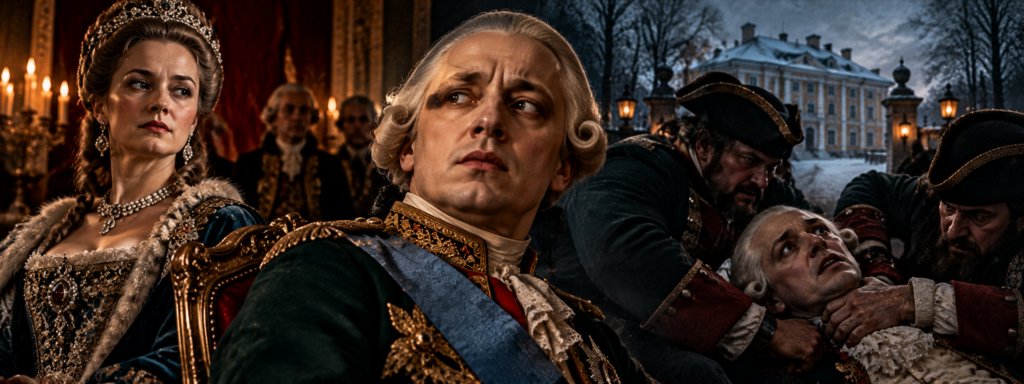
Peter III of Russia: The Emperor Betrayed by Catherine the Great and Murdered at Ropsha
The Disastrous Royal Marriage, the Prussian Obsession, the Palace Coup That Made Catherine Empress, and the Mysterious Death of a Deposed Tsar
Peter III of Russia (21 February 1728–17 July 1762, Gregorian calendar) was Emperor of Russia from 5 January to 9 July 1762, a reign of approximately six months that ended when his wife, the future Catherine the Great, seized the throne in a military-backed palace coup. Born Karl Peter Ulrich in Kiel, in the Duchy of Holstein-Gottorp, he was the son of Charles Frederick, Duke of Holstein-Gottorp, and Anna Petrovna, a daughter of Peter the Great. Through his mother, he was a grandson of Russia’s most celebrated reforming tsar, and through his father, he belonged to the German princely house of Holstein-Gottorp. Chosen as heir by his aunt, Empress Elizabeth Petrovna, Peter was brought to Russia, converted to Orthodox Christianity, and married the German-born princess Sophie of Anhalt-Zerbst, who became Catherine Alexeyevna. Their marriage deteriorated into hostility, infidelity, and competing political ambitions, while Peter’s admiration for Frederick the Great of Prussia alienated influential members of the Russian military and court. After Elizabeth’s death, Peter became emperor and introduced several significant reforms, but his controversial foreign policy, military changes, and increasingly dangerous relationship with Catherine contributed to his overthrow. On 9 July 1762, he was forced to abdicate and was subsequently confined at Ropsha, near St. Petersburg, under the supervision of men connected to Catherine’s supporters. Eight days later, on 17 July, he died in circumstances that have never been conclusively established, although murder has long been considered the most likely explanation. His death was officially attributed to illness, but contemporary reports, suspicious communications from his guards, and the political circumstances surrounding his imprisonment raised serious doubts. Catherine’s direct involvement remains unproven, and historians continue to debate whether she ordered his death, approved it afterward, or was confronted with a murder committed by supporters acting without explicit instructions. Peter’s overthrow and mysterious death became one of the most notorious episodes of regicide in Russian imperial history, clearing the way for Catherine’s thirty-four-year reign and leaving behind a question that has never been satisfactorily answered: did Russia’s future greatest empress knowingly arrange the murder of her husband?
The Prisoner at Ropsha: An Emperor Waiting for Death
In July 1762, the man who had ruled the Russian Empire only days earlier was being held under guard in a country residence at Ropsha, outside St. Petersburg. He no longer commanded the army, controlled the government, or possessed the protection normally attached to the imperial crown. His wife had taken his throne, his closest supporters had been scattered, and the officers responsible for guarding him belonged to the political faction that had engineered his downfall. Peter III, grandson of Peter the Great and emperor for barely six months, had become a prisoner of the woman he had married seventeen years earlier.
The transformation was astonishing even by the standards of eighteenth-century Russian politics. Peter had inherited the throne in January after the death of Empress Elizabeth, and for a brief period, he appeared to possess the authority to reshape the empire. He had ended Russia’s participation in the war against Prussia, issued important domestic reforms, and begun imposing his own preferences upon the court and military. Yet his policies and behavior had alienated enough influential people that his wife could organize a successful coup before the summer was over.
At Ropsha, the political struggle had already been decided. Catherine had been proclaimed empress, the guards regiments had rallied to her, and Peter had surrendered his authority without a decisive battle. He was no longer the reigning sovereign but remained an extraordinarily dangerous figure simply because he was alive. As the legitimate male-line successor through his descent from Peter the Great’s daughter, he could become a rallying point for anyone dissatisfied with Catherine’s seizure of power.
His imprisonment therefore created a problem that no amount of ceremonial triumph could completely eliminate. Catherine possessed the throne, but Peter’s survival preserved the possibility of restoration. His supporters might attempt to free him, foreign rulers could challenge the legitimacy of his deposition, and officers who had joined the coup might later reconsider their allegiance. A living former emperor was a political threat even when deprived of liberty.
On 17 July, that threat disappeared. Peter died at Ropsha under circumstances that immediately provoked suspicion and would remain controversial for centuries. The official explanation attributed his death to illness, but the speed of his decline, the secrecy surrounding his final hours, and reports associated with his guards encouraged accusations of murder. The name most closely connected with the suspected killing was Alexei Orlov, brother of Catherine’s powerful favorite, Grigory Orlov.
The question of Catherine’s responsibility has haunted her reputation ever since. Her enemies portrayed her as a calculating wife who had arranged the destruction of her husband to secure an illegitimate crown. Admirers emphasized the lack of conclusive evidence that she issued an order to kill him. The surviving documents do not permit a definitive reconstruction of what happened inside Ropsha, but the circumstances make the official explanation difficult to accept without serious reservations.
Peter’s death also reveals the brutality concealed beneath the elegant image of Catherine’s later court. Her reign would become associated with imperial expansion, Enlightenment correspondence, magnificent palaces, and extraordinary political ambition. Yet its beginning was inseparable from the overthrow and suspicious death of her husband. The ruler celebrated as Catherine the Great came to power through a coup that left the previous emperor dead within eight days.
To understand how a royal marriage ended in imprisonment and suspected murder, it is necessary to return to Peter’s childhood, long before Catherine became his wife. His story began not in the Russian capital but in a small German duchy, where an unhappy boy inherited dynastic expectations far greater than his personal circumstances could support. His future would be determined by royal blood, political calculation, and the ambitions of two empires. By the time he reached the Russian throne, the seeds of his destruction had already been planted.
A German Prince With Russian Imperial Blood
Peter was born Karl Peter Ulrich on 21 February 1728 in Kiel, the capital of the Duchy of Holstein-Gottorp. His father, Charles Frederick, was Duke of Holstein-Gottorp, a German prince whose family possessed territorial claims and complicated relationships with the Scandinavian monarchies. His mother, Anna Petrovna, was the eldest surviving daughter of Peter the Great and Catherine I of Russia. Through Anna, the infant prince possessed a direct connection to the Romanov dynasty and the legacy of the emperor who had transformed Russia into a major European power.
Anna died in 1728, only months after her son’s birth. Peter therefore grew up without the mother whose Russian ancestry would eventually determine his future. His father died in 1739, leaving the boy orphaned at eleven and placing him under the supervision of relatives and guardians. His childhood was shaped by dynastic obligations, military expectations, and an education that later accounts frequently described as harsh and inadequate.
The traditional portrait of Peter’s upbringing emphasizes emotional neglect and severe discipline. Some accounts describe humiliating punishments and an environment that encouraged childish behavior rather than maturity. These stories became important in later explanations of his personality, but many were transmitted through sources that viewed him unfavorably. It is therefore necessary to distinguish the broader reality of a difficult upbringing from anecdotes that cannot always be independently verified.
Peter was initially raised within the Lutheran traditions of his German family. His education included military interests, court etiquette, and the political concerns of Holstein-Gottorp. The duchy’s territorial disputes, particularly those involving Denmark, would remain important to him throughout his life. His attachment to Holstein was not merely sentimental; it reflected a dynastic inheritance that he considered politically significant.
As a boy, he also became associated with the possibility of succession to the Swedish throne. His family connections made him relevant to Scandinavian dynastic politics, and his future might have unfolded very differently had he remained in that world. Instead, events in Russia redirected his life. The child raised in a German duchy would be summoned to become heir to an empire whose language, religion, and customs were initially foreign to him.
The contrast between Peter’s origins and his eventual position was enormous. Russia under Peter the Great had undergone military, administrative, and cultural transformation, and its monarchy possessed ambitions extending far beyond the German principalities. The young Karl Peter Ulrich had been raised with the concerns of a relatively small duchy. He would eventually be expected to govern one of the largest states in the world.
His German background later became a central accusation against him. Opponents portrayed him as a foreigner who preferred Prussia and Holstein to Russia, while supporters argued that his dynastic position and reforming policies deserved more balanced treatment. Both interpretations were shaped by the political struggle that ended his reign. The young prince’s origins were important, but they did not predetermine his failure.
The problem was that Peter would never fully escape the tension between his inherited identities. He was a Holstein duke by upbringing, a Romanov descendant by blood, and eventually a Russian Orthodox emperor by political necessity. These identities could coexist in principle, but his personal preferences often made the contradictions visible. His attachment to German military culture would become one of the most damaging features of his public reputation.
Empress Elizabeth Chooses Her Heir
In 1741, Elizabeth Petrovna, daughter of Peter the Great, seized the Russian throne in a palace coup. Her accession followed a period of dynastic instability in which rival branches of the imperial family had competed for authority. Elizabeth’s position depended partly upon her direct descent from Peter the Great and the support of guards regiments in St. Petersburg. Securing a successor became an important priority because she had no legitimate children of her own.
Elizabeth selected her nephew Karl Peter Ulrich as heir. He arrived in Russia in 1742 and was introduced into the imperial court, where his life changed almost immediately. He converted from Lutheranism to Orthodox Christianity and received the name Peter Fyodorovich. The transformation was intended to establish him as a suitable successor to the Russian throne.
The conversion carried political significance beyond religion. A Russian emperor was expected to protect the Orthodox Church and embody the traditions of the monarchy. Peter’s German upbringing therefore required adjustment to a court where religious ceremony and dynastic legitimacy were closely connected. His new name symbolized his incorporation into the Russian ruling house.
Elizabeth also attempted to shape his education and behavior. She wanted a successor capable of continuing the imperial dynasty and preserving the achievements associated with her father. Yet relations between aunt and nephew were often strained. Peter’s personality, interests, and resistance to certain expectations contributed to tension within the household.
Contemporary descriptions of Peter frequently portray him as immature, impulsive, and excessively interested in military drills. Some of these observations may reflect genuine weaknesses, but others were influenced by hostility toward him. Catherine’s later memoirs became especially important in shaping his reputation. Because she had overthrown him, her descriptions cannot be treated as neutral testimony.
Peter’s position at court was both privileged and precarious. He was the officially designated heir, but he remained dependent upon Elizabeth’s favor and surrounded by people whose interests did not necessarily coincide with his own. He had little independent authority and limited opportunity to govern. The years before his accession encouraged resentment and frustration.
His relationship with Russia was further complicated by his admiration for Frederick II of Prussia. Frederick had become one of Europe’s most celebrated military rulers, and Peter was fascinated by his discipline, tactics, and reputation. Such admiration was not unusual among eighteenth-century princes, but Peter’s enthusiasm eventually became politically dangerous. Russia would later fight against Prussia, placing his personal loyalties in conflict with the policies of the empire he was expected to inherit.
Elizabeth’s decision nevertheless established Peter’s future. He would become emperor when she died, provided no political upheaval intervened. The succession appeared secure, but the court was already developing the rivalries that would later destroy him. Among the most important decisions made during these years was the selection of a wife.
The German Princess Who Became Catherine
In 1744, a young German princess named Sophie Friederike Auguste of Anhalt-Zerbst arrived in Russia as a prospective bride for Peter. Born in 1729, Sophie came from a relatively minor princely family whose political ambitions exceeded its territorial importance. Her marriage to the Russian heir offered an extraordinary opportunity for advancement. The match was encouraged by dynastic calculation and the interests of influential figures within European politics.
Sophie quickly understood that success at the Russian court required adaptation. She studied the Russian language, embraced Orthodox Christianity, and cultivated the favor of Empress Elizabeth. Upon conversion, she received the name Catherine Alexeyevna. Her determination to become accepted as Russian would later contrast sharply with Peter’s reputation for remaining attached to his German origins.
The marriage took place in August 1745. Peter was seventeen, and Catherine was sixteen, making them both young people entering a union arranged primarily for dynastic purposes. Their personalities and interests differed significantly, and the relationship soon became troubled. What began as a political marriage would eventually develop into one of the most consequential rivalries in European royal history.
Catherine’s later memoirs present Peter as childish, emotionally distant, and incapable of forming a satisfactory marriage. She described humiliations, frustrations, and a household in which the couple spent long periods without meaningful intimacy. Her account became enormously influential in shaping Peter’s historical reputation. Yet it was written by a woman whose later political position depended upon justifying her overthrow of him.
The marriage’s sexual difficulties have attracted particular attention. Some accounts suggest that the union remained unconsummated for years, while later speculation proposed medical or psychological explanations. The surviving evidence does not establish every intimate detail, and many stories originated in memoirs or court gossip. What is clear is that the marriage was deeply unhappy and that both spouses eventually developed relationships outside it.
The birth of their son Paul in 1754 provided the dynasty with an heir. Catherine’s relationship with Sergei Saltykov has encouraged speculation concerning Paul’s biological father, but the matter remains disputed. Peter was legally recognized as Paul’s father, and the child occupied the position of dynastic successor. Claims that Saltykov was certainly Paul’s father go beyond what the surviving evidence can establish.
Elizabeth took a dominant role in the upbringing of the infant Paul, separating him from Catherine for substantial periods. The arrangement intensified Catherine’s frustrations and reflected the empress’s determination to control the succession. Peter’s relationship with his son was also shaped by the complicated household politics. The imperial family was becoming a network of competing loyalties rather than a stable domestic unit.
The marriage continued deteriorating over the following years. Peter developed attachments to other women, while Catherine cultivated relationships that would eventually provide both emotional companionship and political support. Their household became increasingly divided. The future emperor and empress were no longer simply an unhappy couple; they were becoming potential rivals for power.
A Marriage Built on Resentment
The relationship between Peter and Catherine deteriorated gradually rather than collapsing through a single event. Both entered the marriage as teenagers whose personal wishes had been subordinated to dynastic interests. They were expected to produce an heir and maintain the appearance of a stable royal household. Instead, their differences became increasingly visible.
Peter’s enthusiasm for military drills, German customs, and the affairs of Holstein often irritated Catherine. She cultivated a reputation for intellectual curiosity, political awareness, and adaptation to Russian society. Their interests were not inherently incompatible, but their personal relationship offered little foundation for cooperation. Over time, mutual irritation hardened into distrust.
Catherine’s memoirs describe episodes in which Peter behaved foolishly or treated her with contempt. These stories helped establish the enduring image of an emperor who was childish, unstable, and unworthy of his wife. Some anecdotes may preserve genuine observations, but the memoirs were written after Catherine had become ruler. Their political context requires caution.
Peter’s behavior was also criticized by other observers, including foreign diplomats and members of the Russian court. Reports describe impulsiveness, excessive drinking, and a tendency to speak without considering political consequences. Yet such accounts must be evaluated individually because diplomatic observers often relied upon court gossip. The cumulative evidence suggests that Peter had serious difficulties managing relationships, but it does not justify every caricature attached to his name.
The couple’s infidelities further damaged the marriage. Catherine developed relationships with men who eventually became important to her political position, most notably Grigory Orlov. Peter became closely associated with Elizaveta Vorontsova, whose position at court provoked gossip and resentment. Their separate romantic lives made the collapse of the marriage increasingly public.
The possibility of divorce or Catherine’s removal from court became a source of anxiety. Peter’s relationship with Vorontsova encouraged rumors that he might attempt to replace Catherine, although the extent of any concrete plan remains uncertain. Such rumors were politically dangerous because Catherine’s position depended upon her marriage and her status as mother of the heir. If Peter acted against her, she could lose influence, freedom, or even her future security.
Catherine therefore had reasons to fear her husband’s accession. While Elizabeth lived, the empress controlled the succession and limited Peter’s authority. Once Peter became emperor, he would possess the power to reshape the court and determine Catherine’s position. The unhappy marriage could become a struggle in which one spouse’s survival depended upon the other’s downfall.
The relationship eventually ceased to be merely domestic. Catherine cultivated friendships and alliances among nobles, officers, and intellectual figures who admired her abilities or disliked Peter. Peter continued displaying preferences that alienated influential groups. Their marriage became the center of competing political networks, and the possibility of a coup gradually became more realistic.
Peter’s Prussian Obsession
Peter’s admiration for Frederick the Great of Prussia became one of the defining features of his reputation. Frederick was a formidable military commander whose victories and reforms attracted attention throughout Europe. Peter admired Prussian discipline, uniforms, tactics, and the personal image of the king. His enthusiasm was intense enough to become a source of ridicule at the Russian court.
The problem was not admiration itself. European rulers frequently studied foreign military systems and adopted practices they considered effective. Peter the Great had transformed Russia partly through the selective adoption of Western techniques. Peter III’s difficulty was that his attachment to Prussia appeared to outweigh his sensitivity to Russian political interests.
During the Seven Years’ War, Russia fought against Frederick’s kingdom as part of a broader European coalition. Russian armies achieved significant victories, and Prussia faced severe pressure. Peter’s sympathy for Frederick therefore placed him at odds with the foreign policy of Empress Elizabeth. His admiration could be interpreted as disloyalty to the state he was destined to govern.
The tension became especially visible after Russian forces occupied important Prussian territories and contributed to the threat facing Frederick’s monarchy. Officers who had fought and suffered during the war regarded Prussia as an enemy. Peter, however, continued praising the Prussian king. His behavior created resentment among military men whose careers and sacrifices were tied to the conflict.
His attachment to Holstein also complicated the situation. Peter retained ambitions connected with his German duchy, particularly disputes involving Denmark. These interests were legitimate concerns for a Holstein ruler but not necessarily priorities for the Russian Empire. When he eventually became emperor, he would attempt to connect Russian military policy with his dynastic ambitions.
The court’s hostility toward his preferences intensified during the final years of Elizabeth’s reign. Peter appeared increasingly out of step with the political environment in which he would soon exercise power. His enthusiasm for Prussia became a symbol of broader doubts about his judgment. Critics argued that he valued a foreign monarch more than the interests of Russia.
Later historians have sometimes exaggerated this portrait into the claim that Peter was incapable of independent thought and simply worshipped Frederick. The reality was more complicated. His admiration influenced genuine policy decisions, but he also pursued reforms and political objectives of his own. Nevertheless, his public identification with Prussia became one of the most damaging elements of his reign.
When Elizabeth died, Peter finally acquired the authority to act upon his preferences. The consequences were immediate. Russia’s foreign policy changed dramatically, and military officers who had fought against Frederick watched their sacrifices apparently discarded. The emperor’s personal admiration became a national political controversy.
The Death of Elizabeth and the Beginning of Peter’s Reign
Empress Elizabeth died on 5 January 1762, according to the Gregorian calendar. Her death ended a reign of more than twenty years and brought Peter to the throne as Emperor Peter III. The succession occurred without an immediate armed challenge, and the new ruler initially possessed the formal authority of the monarchy. Catherine became empress consort, while their son Paul remained heir.
Peter inherited a powerful empire engaged in the Seven Years’ War. Russian armies had demonstrated their military strength against Prussia, and the government possessed considerable influence in European affairs. The new emperor also inherited the court factions, administrative problems, and social tensions that had developed under Elizabeth. His decisions would quickly reveal the direction he intended to take.
The first months of his reign were marked by energetic activity. Peter issued important decrees, altered foreign policy, and sought to introduce changes affecting the nobility, church, and military. His government was not simply a period of inactivity or drunken disorder, despite later hostile portrayals. Several measures would have lasting significance.
The most controversial decision concerned Prussia. Peter moved rapidly to end Russia’s participation in the war against Frederick the Great. The reversal transformed Russia from a major enemy of Prussia into a potential ally. For Frederick, the change was an extraordinary diplomatic rescue.
Peter’s domestic policies were more varied. He issued the Manifesto on the Freedom of the Nobility, which relieved nobles of the obligation to perform lifelong state service. He also moved against certain coercive institutions and considered changes affecting church property. These measures suggest that his reign contained genuine reforming ambitions.
The problem was that Peter attempted to implement major changes while possessing limited political support. His court relationships were strained, and his behavior continued offending influential people. The army was especially sensitive to his Prussian preferences and military reforms. Catherine’s supporters recognized the opportunity created by this dissatisfaction.
The new emperor also underestimated the danger posed by his wife. Catherine had spent years cultivating relationships and developing a reputation for political intelligence. She understood the importance of the guards regiments and the influence of powerful noble families. Peter’s accession gave her both greater visibility and greater reason to fear his authority.
The first months of 1762 therefore contained a dangerous contradiction. Peter was acting energetically as emperor, but his political position was becoming less secure. His reforms and foreign policy created enemies faster than he could build reliable support. The ruler who had waited years for the crown was already approaching the crisis that would destroy him.
The Peace With Prussia That Shocked Russia
Peter’s decision to end the war against Prussia became one of the most controversial acts of his reign. Russia had participated in the Seven Years’ War as part of a coalition opposing Frederick the Great. Russian troops had fought costly campaigns and achieved important victories, including participation in the occupation of Berlin in 1760. The war had demanded enormous resources and sacrifice.
Peter regarded Frederick with admiration and believed that continued conflict with Prussia was unnecessary or undesirable. He therefore moved rapidly toward peace after becoming emperor. In May 1762, Russia concluded the Treaty of St. Petersburg with Prussia. The agreement restored occupied territories and ended the war between the two powers.
The reversal was astonishing to contemporaries. Frederick had faced severe military pressure, and Russia’s withdrawal dramatically improved his strategic position. The event became part of what later writers described as the Miracle of the House of Brandenburg. Peter’s accession had transformed Prussia’s fortunes almost overnight.
Russian officers who had fought against Frederick were less enthusiastic. Many regarded the peace as a betrayal of their sacrifices and the victories achieved by the army. The restoration of occupied territories without equivalent territorial compensation appeared humiliating to critics. Peter’s admiration for Frederick made the decision seem motivated by personal preference rather than national interest.
Yet the peace was not necessarily irrational. Russia had incurred substantial costs during the war, and continued fighting offered uncertain benefits. A ruler could reasonably conclude that ending the conflict served the empire’s interests. The controversy arose partly because Peter handled the reversal with little sensitivity toward the army and political elite.
His decision to move toward alliance with Prussia intensified the problem. The emperor appeared eager to adopt Frederick’s military system and align Russia with a former enemy. His enthusiasm reinforced the belief that he placed Prussian interests above Russian prestige. The policy became a powerful weapon for his opponents.
Catherine’s supporters could exploit the resentment without needing to develop a detailed alternative foreign policy. They could present her as the defender of Russia’s honor against a ruler supposedly controlled by foreign loyalties. The accusation was politically effective because it appealed directly to the military establishment. The guards regiments, whose support would determine the coup, were especially important.
Peter’s foreign policy therefore contributed significantly to his downfall. It did not alone cause the conspiracy, but it weakened his standing among men whose loyalty was essential. The emperor had ended a major war, yet the political consequences of peace proved dangerous. His admiration for Frederick helped save Prussia while contributing to the destruction of his own reign.
Reforms That History Nearly Forgot
Peter III’s domestic reforms complicate the familiar image of an incompetent emperor. His reign was brief, but it included measures that addressed important questions of noble privilege, state service, and administration. Some policies anticipated developments later associated with Catherine’s government. The existence of these reforms does not prove that Peter was an effective ruler, but it demonstrates that his reign cannot be reduced to foolish behavior.
The Manifesto on the Freedom of the Nobility, issued in February 1762, was among his most significant acts. Under earlier arrangements, Russian nobles had been expected to serve the state through military or civil appointments. Peter’s manifesto relieved them of compulsory lifelong service, while preserving opportunities for voluntary careers. The measure altered the relationship between the monarchy and the noble estate.
The reform was welcomed by many nobles because it increased their personal freedom. It also reflected broader changes in Russian society, where the service obligations established under Peter the Great had become increasingly burdensome. The manifesto did not abolish serfdom or extend equivalent freedoms to the peasantry. Its benefits were concentrated among the privileged classes.
Peter also abolished the Secret Chancellery, an institution associated with political investigation and coercion. The measure suggested an intention to reduce certain forms of arbitrary repression. Its practical consequences were limited by the brevity of his reign, but the decision remains significant. It challenges the idea that he was indifferent to questions of government.
His religious and church policies generated controversy. Peter considered or initiated measures affecting ecclesiastical property and the relationship between the state and the Orthodox Church. Some proposals alarmed religious authorities who feared confiscation or excessive interference. Later accounts sometimes exaggerated his supposed hostility toward Orthodoxy, but his policies did create tension.
He also sought to alter military organization and discipline. His admiration for Prussian methods influenced the changes he wanted to introduce. Such reforms could be defended as attempts to improve efficiency, but they offended officers attached to existing traditions. The emperor’s manner of imposing changes often proved as damaging as the measures themselves.
The reforms reveal a ruler with definite ideas about government. Peter was not merely a passive figure manipulated by advisers or consumed by personal amusements. He attempted to reshape important institutions during his short reign. His failure lay partly in his inability to build the political coalition necessary to sustain those changes.
The tragedy of his domestic program is that it became overshadowed by his overthrow and death. Catherine’s later success encouraged historians to compare her achievements with the caricature of an incapable husband. Yet several of Peter’s measures survived or influenced subsequent policy. His reign deserves examination as a brief but active period of reform interrupted by a successful palace conspiracy.
The Holstein Question and the Threat of Another War
Peter’s attachment to Holstein-Gottorp remained strong after he became emperor. His German duchy possessed longstanding territorial disputes with Denmark, particularly concerning Schleswig. Peter regarded these claims as important dynastic interests. Once he controlled the Russian military, he possessed the resources to pursue them on a scale unavailable to an ordinary German prince.
The possibility of war against Denmark became a major source of concern. Russia had recently ended its participation in the Seven Years’ War, and many officers expected relief from expensive military campaigns. Peter’s willingness to consider another conflict for the benefit of Holstein appeared deeply unpopular. Critics argued that Russian soldiers should not be used to settle the private disputes of the emperor’s German family.
The issue also reinforced suspicions concerning Peter’s priorities. His peace with Prussia had already alienated officers who regarded Frederick as a former enemy. A campaign against Denmark would appear to serve the same foreign dynastic interests. The emperor’s personal identity as Duke of Holstein-Gottorp became increasingly difficult to separate from his role as Russian sovereign.
Peter’s defenders could argue that dynastic politics were normal in eighteenth-century Europe. Monarchs frequently possessed territories and claims outside their principal kingdoms, and military policy often reflected family interests. Russia itself had become deeply involved in European dynastic affairs. The problem was not the existence of Holstein claims but the political cost of pursuing them.
The planned campaign also created practical difficulties. Troops would need to be mobilized, commanders appointed, and resources allocated. Such preparations could disturb the guards regiments and other military institutions already dissatisfied with Peter’s policies. The possibility of deployment increased anxiety among officers whose support he needed.
Catherine’s conspirators recognized the danger this issue posed to the emperor. They could portray his plans as evidence that he intended to sacrifice Russian interests for a German duchy. The accusation strengthened their appeal to military patriotism. It also helped connect foreign policy grievances with broader dissatisfaction over his conduct.
The Holstein question therefore became another factor undermining Peter’s authority. His attachment to his birthplace was understandable, but his political judgment failed to account for the resentment it created. The emperor had inherited Russia’s immense power but continued pursuing ambitions rooted in his German upbringing. His opponents transformed that contradiction into a justification for removing him.
By the summer of 1762, Peter’s foreign policy had alienated important military figures on multiple fronts. He had abandoned the war against Prussia, embraced Frederick, and contemplated action against Denmark. Each decision could be defended individually, but together they created a damaging political image. Catherine’s supporters would exploit that image during the coup.
Catherine and the Orlov Brothers
Catherine’s relationship with Grigory Orlov became one of the most important connections in the conspiracy against Peter. Orlov was an officer associated with the Russian guards and belonged to a family whose members possessed military influence. He became Catherine’s lover during the final years of Elizabeth’s reign. Their relationship combined personal intimacy with growing political significance.
Grigory’s brothers also became involved in the network supporting Catherine. Among them, Alexei Orlov would later acquire particular notoriety because of his role in Peter’s confinement and death. The brothers possessed connections within military circles that were essential to any successful palace coup. Their influence helped transform Catherine’s ambitions into an organized political movement.
The guards regiments occupied a special position in Russian politics. They were not simply ordinary military units but forces stationed near the imperial court and capable of determining succession disputes. Elizabeth herself had seized the throne with guards support in 1741. Catherine understood that control of these regiments could outweigh formal hereditary legitimacy.
The conspiracy also involved members of the political elite who feared or disliked Peter’s policies. Some were concerned about his foreign orientation, while others resented his behavior or anticipated advantages under Catherine. The movement was therefore not merely the project of one ambitious wife and her lover. It drew upon a broader network of dissatisfied officers and nobles.
Catherine’s position was nevertheless central. As the emperor’s wife and mother of the heir, she possessed a recognizable dynastic status, although her claim to rule independently was legally and politically questionable. Her supporters could present her as a protector of Russia and Orthodoxy. The language of national salvation helped justify an action that was, in essence, the overthrow of the reigning sovereign.
The birth of Catherine’s son Alexei, fathered by Grigory Orlov, in April 1762 added another complication to her personal circumstances. The child, later known as Alexei Bobrinsky, was born while Catherine remained married to Peter. His existence reflected the complete breakdown of the imperial marriage. The circumstances surrounding the birth were concealed from the public court.
Catherine’s relationship with the Orlovs gave her both political resources and personal risks. If Peter discovered the full extent of the conspiracy, the consequences could be severe. Her supporters therefore had reasons to act before the emperor could move against them. The atmosphere of suspicion intensified as the summer approached.
The Orlov brothers would become inseparable from the events that followed. Grigory helped support Catherine’s seizure of power, while Alexei became associated with the custody of the deposed emperor. Their involvement connected the palace coup with the mysterious death at Ropsha. The same family that helped place Catherine on the throne would become central to accusations that her husband had been murdered.
The Conspiracy Takes Shape
By the summer of 1762, opposition to Peter had developed into an organized conspiracy. Catherine’s supporters included officers from the guards regiments and members of influential noble families. They shared dissatisfaction with the emperor, although their motives varied. Some feared his policies, others sought advancement, and still others believed Catherine would govern more effectively.
The conspiracy’s success depended upon timing. Peter still possessed the formal authority of emperor and could potentially arrest opponents if he discovered their plans. Catherine’s position was particularly vulnerable because her marriage had deteriorated and rumors circulated about possible action against her. The conspirators needed to move before the government could neutralize them.
The immediate crisis developed when one of the conspirators, Captain Peter Passek, was arrested. His detention raised fears that the authorities might uncover the wider plot. Catherine’s supporters concluded that delay had become dangerous. The coup was accelerated before the emperor could respond.
Catherine was staying at Peterhof when the conspiracy moved into its decisive phase. She was brought to St. Petersburg, where supporters among the guards were prepared to recognize her as sovereign. The operation depended upon rapid public declarations and the mobilization of military units. Once the guards accepted Catherine, Peter’s position would become extremely difficult.
The conspirators also relied upon religious and patriotic language. Catherine could be presented as defending Orthodoxy and Russia against an emperor accused of favoring foreign interests. Such claims did not require a detailed legal argument about succession. They offered a moral justification for military rebellion.
The movement was dangerous because it challenged the fundamental principle of imperial authority. Peter had inherited the throne through the succession arrangements established under Elizabeth. Catherine was his wife, not an independent hereditary successor. Her accession would therefore require the political elite and army to accept a new basis for legitimacy.
The conspirators understood that a successful coup could create its own legality. If the guards, Senate, and church authorities recognized Catherine, the formal institutions of government could be brought into alignment with the new regime. Peter’s legal claim would matter less if he no longer possessed the means to enforce it. The monarchy’s authority would be transferred through military power.
The conspiracy was therefore both a personal betrayal and a political revolution within the ruling elite. Catherine’s husband was about to be removed by officers connected to her intimate circle. The marriage that had begun as a dynastic alliance in 1745 would end in a struggle for the throne. The events of July 1762 would decide which spouse survived politically.
July 9, 1762: Catherine Seizes the Throne
On 9 July 1762, Catherine’s supporters launched the coup that would make her empress. She traveled to St. Petersburg and received the allegiance of guards units whose support was essential to the operation. The movement rapidly gained momentum as soldiers and officials recognized her authority. The emperor’s government was confronted with a political crisis that developed faster than it could effectively respond.
Catherine’s public appearance was carefully designed to establish legitimacy. She presented herself as the defender of Russia and its institutions, while supporters proclaimed her sovereign. Religious ceremonies and military oaths reinforced the transfer of allegiance. The coup transformed a conspiracy into an apparent national movement.
The guards regiments played the decisive role. Their support gave Catherine control of the capital and the military force necessary to enforce her claim. Peter’s formal title could not protect him once the troops responsible for defending the monarchy recognized his wife. The balance of power shifted almost immediately.
Peter was at Oranienbaum when the crisis developed. Reports of Catherine’s actions reached him, and he attempted to assess his options. Some advisers urged resistance or flight, while others recognized the weakness of his position. The surviving accounts differ in their descriptions of his reactions, but they agree that he failed to organize an effective military response.
The emperor’s position was complicated by the absence of reliable forces capable of confronting Catherine’s supporters. He possessed some troops and attendants, but the principal guards units had joined the coup. A direct confrontation could produce civil conflict with little prospect of victory. Peter’s political isolation became unmistakable.
He eventually surrendered and accepted abdication. The exact circumstances and wording of the abdication documents have been discussed by historians, but the political result is clear. Peter relinquished the throne under pressure from the victorious faction. Catherine became the recognized ruler.
The speed of the coup was remarkable. A reigning emperor who had issued major reforms and redirected foreign policy was removed without a decisive battle. The operation succeeded because the political elite and guards accepted Catherine’s authority. Peter’s inability to command loyalty proved fatal to his reign.
The overthrow also exposed the fragility of Russian succession politics. The empire possessed elaborate ceremonies and hereditary claims, but the guards could determine who occupied the throne. Catherine had no stronger direct dynastic claim than her husband, yet she possessed the military support he lacked. The crown passed through force rather than ordinary succession.
For Peter, the consequences were immediate. He lost his title, his freedom, and control over his future. The woman he had married seventeen years earlier now possessed the authority to determine his fate. The political struggle had ended, but the personal tragedy was only beginning.
The Abdication: An Emperor Without a Throne
Peter’s abdication was the decisive moment in his political destruction. He had inherited the throne only six months earlier and had begun governing with considerable energy. Now he was compelled to surrender the authority that had defined his position since Elizabeth’s death. The transition from emperor to prisoner occurred with extraordinary speed.
The abdication was not the result of a freely negotiated constitutional process. Peter acted under pressure from a victorious military-backed faction that had already secured control of the capital. His options were limited by the collapse of loyalty among the guards and political elite. The formal document concealed the coercive circumstances surrounding the decision.
Catherine’s supporters needed the abdication to legitimize their victory. A living emperor who refused to surrender could continue claiming the throne. By obtaining his formal renunciation, the new government could present the transfer of power as completed. The document became an instrument of political necessity.
Yet abdication did not eliminate the danger posed by Peter’s survival. His hereditary position remained unchanged, and he could potentially repudiate the document if circumstances shifted. Supporters might argue that the abdication had been forced and was therefore invalid. Foreign rulers could also question Catherine’s legitimacy.
The problem was especially serious because Catherine’s claim depended upon the coup rather than direct hereditary succession. Their son Paul possessed a stronger dynastic connection to the previous ruler, but Catherine chose to govern in her own right. Peter’s continued existence therefore complicated the political arrangement that had brought her to power. He remained a possible focus for restoration.
Peter’s personal circumstances became increasingly bleak. He was separated from the court, deprived of authority, and placed under guard. His future depended upon the decisions of people who had already betrayed him. The former emperor had little reason to trust the promises of the new regime.
The abdication also marked the final collapse of his marriage. Catherine was no longer merely his estranged wife but the ruler who had displaced him. Their years of resentment, infidelity, and political rivalry had culminated in the destruction of his authority. The private conflict had become an imperial succession crisis.
Peter’s surrender prevented immediate large-scale fighting, but it did not guarantee his safety. The conspirators had achieved power through rebellion and faced the continuing danger of counterrevolution. A living former emperor could become a threat even while confined. The question of what to do with him remained unresolved.
Ropsha: The Emperor’s Final Prison
After his abdication, Peter was taken to Ropsha, a country estate southwest of St. Petersburg. The residence became his place of confinement during the final days of his life. He was guarded by men associated with Catherine’s supporters, including Alexei Orlov. The arrangement placed the former emperor entirely within the power of the faction that had overthrown him.
Ropsha was not a public prison, but its relative isolation made it suitable for controlling a politically dangerous captive. Peter could be kept away from the capital, the guards regiments, and potential supporters. His communications and movements were subject to the authority of his custodians. The estate became a place where the former sovereign’s fate could be decided without public scrutiny.
The exact conditions of his imprisonment are difficult to reconstruct. Accounts describe varying degrees of supervision and restriction, but many details come from sources shaped by later political controversy. It is clear that Peter no longer possessed freedom of movement or the ability to command his guards. His status had been reduced to that of a detained former ruler.
Alexei Orlov’s presence became central to later accusations. He belonged to the family that had helped Catherine seize power and was closely connected to the new regime. His responsibility for Peter’s custody placed him in a position to influence events at Ropsha. The circumstances would make him one of the principal suspects when the former emperor died.
The political danger of Peter’s survival remained considerable. Catherine’s government was still consolidating authority, and the coup had not yet acquired the stability of an established reign. A counterplot could potentially use Peter’s name to rally opposition. His confinement therefore addressed an immediate problem without necessarily providing a permanent solution.
The former emperor’s health became part of the official explanation for his death. Reports described illness, and the government later announced that he had died from a medical condition. The precise nature of any illness remains uncertain. The absence of reliable independent medical evidence makes it difficult to determine whether natural disease contributed to his death.
The isolation of Ropsha also created opportunities for secrecy. If Peter died through violence, the location and control exercised by his guards would make it easier to manage information. If he died naturally, the same circumstances would inevitably encourage suspicion. The new regime had created a situation in which any sudden death would be politically explosive.
Peter remained at Ropsha for only a short period. The man who had waited years to inherit the Russian throne survived his deposition by barely more than a week. His final days were spent not in the Kremlin or an imperial palace but under the supervision of men loyal to his wife’s government. The next event would turn a successful coup into a suspected act of regicide.
July 17, 1762: The Mysterious Death of Peter III
Peter III died at Ropsha on 17 July 1762, eight days after his overthrow. The official announcement attributed his death to illness, commonly described in connection with a severe attack of hemorrhoidal colic or related complications. The explanation was presented by the government that had recently deposed him. Its political interest in controlling the narrative was obvious.
The circumstances immediately raised doubts. Peter had been removed from power through a military coup, confined under guard, and placed in the custody of men closely associated with Catherine’s supporters. His death eliminated the most dangerous potential rival to the new empress. The timing was extraordinarily convenient for the victorious faction.
Reports of violence circulated, and Alexei Orlov became the figure most closely associated with the suspected killing. Later accounts described a struggle in which Peter was strangled or otherwise suffocated. Some versions suggested that the death occurred during a drunken confrontation involving his guards. Others portrayed it as a deliberate assassination carried out to secure Catherine’s throne.
The surviving evidence does not permit the precise method of death to be established beyond dispute. There is no universally accepted forensic record that conclusively proves strangulation, poisoning, or another specific form of violence. The official medical explanation is difficult to verify independently. Historians therefore distinguish the strong suspicion of murder from certainty about the exact events.
A letter attributed to Alexei Orlov has played an important role in the controversy. In its commonly cited form, it appears to describe Peter’s death following a violent altercation and expresses alarm about what had occurred. The document’s authenticity, transmission, and interpretation have been debated. It cannot be treated as an uncomplicated confession establishing every detail of the killing.
The political context nevertheless makes the suspicion of murder compelling. Peter’s survival threatened Catherine’s position, and his custodians belonged to the faction that had seized power. The former emperor possessed no independent protection. His sudden death removed a problem that imprisonment alone could not completely solve.
Whether Catherine ordered the killing remains a separate question. The fact that she benefited from Peter’s death does not prove that she gave instructions to murder him. It is possible that supporters acted independently because they believed his survival endangered the new regime. It is also possible that Catherine understood or encouraged the elimination of the threat without leaving explicit evidence.
The historical record does not allow these possibilities to be resolved conclusively. Catherine’s responsibility remains a matter of debate rather than established fact. What is certain is that her husband died under guard shortly after she seized his throne. The circumstances permanently linked her accession with the suspicion of regicide.
Alexei Orlov and the Men at Ropsha
Alexei Orlov occupied a particularly important position in the events surrounding Peter’s death. As the brother of Catherine’s lover Grigory Orlov, he belonged to the inner circle of the coup. His involvement in the operation that brought Catherine to power established him as a trusted supporter. His subsequent responsibility for Peter’s custody placed him at the center of the Ropsha mystery.
The Orlov brothers had helped mobilize military support for Catherine. Their connections among officers were essential to the rapid success of the coup. Alexei’s role in guarding the deposed emperor therefore reflected both political trust and the need to control a dangerous prisoner. The arrangement also made him vulnerable to accusations when Peter died.
Later narratives frequently identified Alexei as the principal murderer. Some described him personally participating in a struggle that ended in strangulation. Others suggested that he directed or permitted subordinates to kill the prisoner. The accounts differ enough that the precise sequence cannot be confidently reconstructed.
The letter attributed to Alexei became one of the most frequently discussed pieces of evidence. Its language, as transmitted in later versions, has been interpreted as indicating that Peter died during a confrontation involving his guards. Yet historians have questioned aspects of the document’s authenticity and preservation. The uncertainty prevents it from serving as definitive proof of the circumstances.
Alexei’s political position also complicates interpretation. He had strong reasons to ensure Catherine’s security, but he also faced enormous personal risk if the former emperor died without authorization. Murdering Peter could protect the new regime while exposing the killer to punishment or disgrace. The balance between initiative and obedience remains unknown.
Catherine’s response to the death has been scrutinized for evidence of prior knowledge. Her government accepted the official explanation of illness and did not publicly treat the event as a murder requiring prosecution. This response has encouraged accusations of complicity. Yet the absence of punishment does not establish that she ordered the killing beforehand.
The political circumstances also created incentives for concealment even if the death occurred without Catherine’s instructions. A public acknowledgment that her supporters had murdered the former emperor could undermine the legitimacy of her reign. The government therefore had reasons to suppress damaging details. Silence and official denial could serve political survival regardless of the original chain of command.
Alexei Orlov remained an important figure in Catherine’s reign and later achieved distinction in military affairs. His continued prominence has sometimes been interpreted as evidence that he was rewarded for Peter’s death. Such an interpretation is possible but not conclusive, because his services during the coup and subsequent career provided other explanations for favor. The association with Ropsha nevertheless remained a permanent shadow over his reputation.
Did Catherine Order Her Husband’s Murder?
The question of Catherine’s responsibility is the most controversial aspect of Peter III’s death. She had seized the throne through a coup, and her husband remained a potential rival while alive. His death removed a serious threat to her authority. These circumstances created a clear political motive.
Yet motive is not the same as proof. No surviving document universally accepted as authentic establishes that Catherine explicitly ordered Peter’s murder. The accounts that accuse her directly often come from hostile observers or later writers who interpreted the event through political assumptions. The historical evidence therefore requires careful distinction between suspicion and demonstrated responsibility.
Catherine’s defenders have argued that she had reasons to avoid killing Peter. A murdered emperor could become a martyr, and the discovery of an assassination plot could damage her legitimacy. She might have preferred secure confinement or exile if those options were politically practical. The risks associated with murder were substantial.
Her critics emphasize that imprisonment could not eliminate the danger of restoration. Peter possessed a hereditary claim and could potentially rally supporters. The coup had succeeded rapidly, but the new government remained vulnerable. A permanent solution to the problem of the former emperor might appear attractive to ambitious supporters.
The possibility of an unauthorized killing is therefore important. Alexei Orlov and other custodians may have believed that Peter’s survival threatened Catherine and acted without explicit instructions. They could have expected the empress to accept the result because it secured her position. Such an explanation would distinguish direct ordering from political benefit and subsequent concealment.
Another possibility is that Catherine communicated expectations without issuing a formal written command. Political conspiracies often operate through implication, shared interests, and personal relationships. A ruler might encourage a result while avoiding explicit responsibility. The surviving evidence does not establish that this occurred, but it remains one of the interpretations considered by historians.
The official explanation of illness complicates the question further. If Peter died naturally, the accusations against Catherine would rest upon suspicion rather than murder. If he was killed, the government’s decision to present the death as natural suggests at least an interest in suppressing damaging information. The distinction between prior authorization and later concealment remains essential.
Catherine’s later achievements also influenced interpretations of the event. Admirers of her reign sometimes minimized the suspicion of murder, while critics portrayed Ropsha as the foundation of her power. Both approaches risk allowing judgments about her subsequent government to determine conclusions about an uncertain death. The evidence must be evaluated independently of her later reputation.
The most defensible conclusion is that Peter’s death was highly suspicious and that murder remains a strong historical possibility, but Catherine’s direct order has not been conclusively demonstrated. Her political responsibility for the conditions of his imprisonment is undeniable. She led the coup that removed him and benefited from the elimination of the threat he represented. Whether she knowingly arranged the final act remains unresolved.
The Official Story and the Problem of Evidence
The official explanation for Peter’s death attributed it to illness rather than violence. The government presented the former emperor’s sudden demise as a medical event occurring during confinement. Such an explanation offered obvious political advantages. It removed the need to investigate or acknowledge a murder committed by supporters of the new empress.
The absence of reliable independent medical evidence is one of the central difficulties. Modern historians cannot examine Peter’s body or conduct a forensic investigation capable of establishing the cause of death. Surviving reports were produced within a political environment shaped by secrecy and competing interests. The evidence is therefore incomplete and often contradictory.
Contemporary diplomatic correspondence provides important testimony but also requires caution. Foreign representatives gathered information through court contacts, rumors, and official announcements. Their reports sometimes reflected the political interests of the governments they served. A diplomatic dispatch describing murder is valuable evidence of contemporary suspicion, but it does not automatically prove every reported detail.
Catherine’s own accounts also require critical examination. She had a powerful interest in presenting her accession as legitimate and necessary. Her descriptions of Peter emphasized his weaknesses and the dangers supposedly created by his government. Such portrayals helped justify the coup but cannot independently establish the circumstances of his death.
The memoirs of other participants and observers present similar problems. Some were written years after the events, when memories had changed and political reputations had become established. Others relied upon stories circulating within the court. The resulting historical record contains vivid narratives but relatively few uncontested facts concerning the final hours at Ropsha.
The disputed Orlov letter illustrates the problem. If authentic and accurately transmitted, it could provide important evidence of violence. If altered, miscopied, or misunderstood, it could mislead historians. The uncertainty surrounding its history prevents simple conclusions.
The political context remains the strongest reason for suspicion. Peter was a deposed ruler held by the supporters of the woman who had seized his throne. His death occurred within days and removed a major obstacle to her security. Even without conclusive forensic evidence, those circumstances demand serious scrutiny.
The case therefore occupies an uncomfortable position between probability and proof. Many historians consider murder more likely than natural death, but the exact mechanism and responsibility remain uncertain. A responsible account must resist the temptation to convert suspicion into certainty. The mystery of Ropsha survives because the available evidence does not permit a final verdict.
The Funeral of a Deposed Emperor
Peter’s death presented Catherine’s government with another problem: how to bury a man who had recently been emperor but whose legitimacy the new regime wished to diminish. A full imperial funeral could emphasize his former status and encourage sympathy. An excessively degrading burial might provoke outrage or strengthen accusations of murder. The government needed to manage the symbolism carefully.
Peter was buried at the Alexander Nevsky Monastery in St. Petersburg rather than receiving the full ceremonial treatment later associated with reigning Romanov emperors in the Peter and Paul Cathedral. The burial reflected his deposed status and the political circumstances of his death. It also distinguished him from rulers whose authority had passed through ordinary succession. The treatment of his remains became part of the effort to control his memory.
The funeral arrangements did not resolve suspicion. The former emperor had died suddenly while under guard, and the official explanation remained contested. The absence of an elaborate public process could be interpreted as an attempt to minimize attention. The government had little interest in encouraging prolonged discussion of Ropsha.
Catherine’s position nevertheless became more secure after his death. The principal rival whose hereditary claim could challenge her had disappeared. Her supporters could now focus upon consolidating the new reign rather than guarding a living former emperor. The political advantages were immediate.
Peter’s burial also marked the apparent end of his personal story. He had been born in Holstein, brought to Russia as heir, married to Catherine, and eventually crowned emperor. His reign lasted only six months before a coup removed him. His death at thirty-four completed an extraordinary sequence of dynastic reversals.
Yet the memory of Peter remained politically useful. Opponents of Catherine could portray him as a murdered sovereign whose wife had usurped his throne. Supporters of the new regime could describe him as an incapable ruler whose removal saved Russia. The competing narratives ensured that his reputation would remain contested.
His burial would eventually be revisited under his son Paul I. The new emperor’s treatment of his father’s remains would become a dramatic statement about dynastic legitimacy and Catherine’s legacy. The body that had been quietly buried after the coup would return to the center of imperial ceremony. The controversy surrounding Peter’s death would therefore continue into the next reign.
The funeral of 1762 did not close the case. It merely placed the former emperor out of public view while Catherine established her authority. The unanswered questions surrounding his final hours remained. Ropsha would continue haunting the history of her accession.
Catherine the Great and the Shadow of Regicide
Catherine’s reign would become one of the most celebrated in Russian imperial history. She expanded the empire’s territory, strengthened its international position, corresponded with Enlightenment thinkers, and cultivated an image of intellectual and political sophistication. Her court became associated with culture, architecture, and ambitious reform. These achievements helped establish the title by which she is remembered: Catherine the Great.
Yet the circumstances of her accession remained a persistent source of controversy. She had not inherited the throne through direct hereditary succession. She had overthrown her husband with military support and then benefited from his sudden death. The legitimacy of her reign therefore depended upon political success as much as dynastic right.
Catherine understood the importance of controlling her public image. She presented herself as a ruler who had rescued Russia from dangerous policies and restored proper government. Her supporters emphasized Peter’s weaknesses, foreign preferences, and alleged hostility toward Russian traditions. The narrative helped transform a palace coup into an act of national salvation.
The image of Peter as an incompetent and ridiculous ruler served this purpose. If he was incapable of governing, Catherine’s seizure of power could appear necessary. If he threatened Russia’s interests, his removal could be portrayed as patriotic. The more thoroughly his reputation was damaged, the easier it became to justify the coup.
This political context influenced later historical writing. Catherine’s memoirs and the accounts of her supporters helped establish a lasting contrast between a brilliant empress and a foolish husband. Modern historians have increasingly questioned the simplicity of that portrayal. Peter’s reforms and the complexities of his policies suggest a more capable figure than the traditional caricature allows.
The suspicion surrounding his death remained harder to dismiss. Catherine could explain the coup as a response to political necessity, but the death of a captive former emperor raised a different moral question. The official explanation of illness did not eliminate doubts. Her reign began under a shadow that later achievements could not entirely remove.
The controversy also reveals the limits of judging political violence solely through subsequent success. Catherine’s government achieved important results, but those accomplishments do not determine whether Peter was murdered or whether she bore responsibility. Historical evaluation requires separating the achievements of her reign from the circumstances of her accession. A successful ruler can still benefit from an unjust death.
Catherine’s greatness and Peter’s tragedy therefore remain intertwined. Her rise depended upon his removal, and her security increased after his death. The historical record does not prove that she ordered his murder, but it does establish that her reign emerged from a coup followed by a suspicious death. The shadow of Ropsha remained part of the price of her crown.
Paul I and the Father He Barely Knew
Peter’s son Paul was only seven years old when his father was overthrown and died. He had been born in 1754 and raised largely under the supervision of Empress Elizabeth during his early childhood. His relationship with Peter was therefore limited by the unusual arrangements of the imperial household. The events of 1762 deprived him of the opportunity to know his father as an adult.
Paul’s position after the coup was complicated. As Peter’s son, he possessed a hereditary claim that could potentially challenge Catherine’s decision to rule in her own right. Some contemporaries considered whether Catherine should govern as regent for her son rather than as sovereign. She chose to retain the crown herself. Paul remained heir but did not immediately receive the throne.
The relationship between Catherine and Paul became increasingly strained over time. Their disagreements involved personal resentment, political expectations, and questions concerning succession. Paul grew up aware that his father had been deposed and died under suspicious circumstances. The memory of Peter became part of his understanding of the dynasty.
When Catherine died in 1796, Paul finally became emperor. One of his most striking early acts concerned the remains of his father. He ordered Peter’s body exhumed and transferred to the Peter and Paul Cathedral, where it was reburied with imperial honors. The ceremony symbolically restored the dignity denied to Peter after his deposition.
Paul also arranged for his parents to be buried in connection with one another, despite the hostility that had defined their marriage. The gesture carried political and dynastic significance. It asserted the continuity of the imperial family and challenged the treatment of Peter under Catherine’s government. The dead emperor was returned to a position of ceremonial honor.
The reburial became part of Paul’s broader effort to reshape the monarchy. He introduced changes to the succession system intended to prevent the instability that had characterized earlier reigns. His policies reflected a desire to establish clearer hereditary rules. The memory of his father’s overthrow contributed to the political context in which those changes were made.
Paul’s own reign would end violently. In 1801, he was assassinated during a palace conspiracy, repeating the pattern of regicide that had destroyed his father. The circumstances differed, but the underlying danger was familiar. Russian emperors remained vulnerable to conspiracies among the elite and military.
The father and son therefore became linked by more than blood. Both occupied the throne, both faced hostility from powerful political factions, and both died in circumstances connected with palace violence. Peter’s death at Ropsha and Paul’s assassination in St. Michael’s Castle became two of the most notorious episodes in Romanov history. Their stories reveal the continuing fragility of imperial authority.
Was Peter III Really the Fool of History?
Peter III’s reputation has long been dominated by the image of an immature, incompetent ruler whose overthrow was almost inevitable. The portrait emphasizes his admiration for Frederick the Great, his military drills, his unhappy marriage, and his inability to understand Russian political culture. Catherine’s later success made the contrast especially attractive to historians. Yet the traditional image deserves reconsideration.
Peter’s reign included significant reforms that cannot easily be reconciled with the idea of complete incapacity. The Manifesto on the Freedom of the Nobility altered the relationship between the state and the noble estate. The abolition of the Secret Chancellery suggested an interest in reducing certain forms of political coercion. His government also considered changes affecting church property and military administration.
His foreign policy was controversial but not necessarily irrational. Ending Russia’s participation in the Seven Years’ War reduced military commitments and changed the strategic balance in Europe. Critics regarded the peace with Prussia as humiliating, but continued warfare also carried substantial costs. The decision requires evaluation within the broader diplomatic context rather than through personal admiration alone.
Peter’s weaknesses were nevertheless real. He offended influential officers, mishandled relationships, and failed to recognize the danger posed by Catherine’s supporters. His attachment to Holstein and Prussian military culture created the impression that he valued foreign interests above Russian concerns. His political judgment proved inadequate during the crisis that ended his reign.
The evidence also suggests that he struggled with the ceremonial and interpersonal demands of monarchy. A ruler could possess reforming ideas while lacking the ability to secure cooperation. Peter’s policies were introduced during a period when he needed to consolidate authority and build trust. Instead, he alienated groups whose support was essential.
Catherine’s propaganda amplified these weaknesses. Her supporters had strong reasons to portray the deposed emperor as unfit to rule. The more incompetent Peter appeared, the more justified her coup could seem. Later historians sometimes accepted that narrative without sufficiently examining the political interests behind it.
Modern reassessment does not require transforming Peter into a misunderstood genius. His reign was too short to demonstrate sustained administrative success, and his mistakes contributed directly to his downfall. The evidence supports a more complicated figure: energetic, reform-minded in some areas, politically insensitive, and dangerously isolated. He was neither the complete fool of hostile legend nor the flawless victim imagined by sympathetic revisionism.
The most important distinction concerns his death. Even if Peter was an ineffective emperor, incompetence did not justify murder. His deposition removed him from power, and his confinement placed him under the control of his enemies. The circumstances of his death remain suspicious regardless of his abilities as a ruler. The tragedy of Ropsha cannot be dismissed by repeating the caricature of a foolish monarch.
The Pretenders Who Claimed Peter Had Survived
Peter’s death did not eliminate the political usefulness of his identity. Like several earlier Russian rulers whose deaths occurred under suspicious circumstances, he became the subject of rumors and imposture. Some people questioned whether he had truly died at Ropsha. The uncertainty created opportunities for men who claimed to be the surviving emperor.
The most famous was Yemelyan Pugachev, a Cossack leader who launched a major rebellion during Catherine’s reign. Pugachev claimed to be Peter III, presenting himself as the legitimate emperor who had escaped death and returned to reclaim his throne. The claim was false, but it possessed political power. It allowed the rebellion to adopt the language of dynastic restoration.
Pugachev’s movement began in 1773 and attracted support from Cossacks, peasants, and other groups dissatisfied with imperial authority. The rebellion became one of the most serious domestic challenges of Catherine’s reign. Its supporters were motivated by varied grievances, including social oppression, economic hardship, and resentment toward government policies. The supposed survival of Peter provided a symbolic focus for those grievances.
The use of Peter’s identity was particularly significant because it challenged Catherine’s legitimacy. If the real emperor had survived, her authority could be portrayed as the product of usurpation. Pugachev’s claim therefore transformed the memory of Ropsha into a weapon against the reigning empress. The dead husband’s name returned to threaten the wife who had replaced him.
The rebellion was eventually defeated, and Pugachev was captured and executed in 1775. His failure did not erase the historical importance of the claim. It demonstrated that Peter’s identity remained politically useful more than a decade after his death. The uncertainty surrounding Ropsha had become part of Russia’s culture of rebellion.
Other pretenders also exploited the name of Peter III. Their claims reflected the broader tradition of imposture in Russian history, particularly during periods when dynastic legitimacy was disputed. The phenomenon recalled the False Dmitrys of the early seventeenth century. In both cases, a ruler’s uncertain death created opportunities for political challengers.
The emergence of pretenders also reveals the limitations of political murder. Eliminating a ruler can remove the immediate person but preserve the symbolic power of the identity. A dead emperor may become more useful to rebels than a living prisoner. Peter’s supposed survival allowed opponents of Catherine to imagine an alternative legitimate monarchy.
The irony was unmistakable. Peter had been removed because his enemies considered him politically dangerous, yet his name continued inspiring opposition after his death. Catherine’s government could suppress individual rebellions, but it could not completely control popular memory. The emperor who died at Ropsha remained a figure through whom discontent could be expressed.
The Political Logic of Regicide
Peter III’s death belongs to a broader history of rulers eliminated after losing political power. Deposition did not necessarily guarantee safety because a former monarch retained dynastic significance. Even when deprived of authority, a ruler could become the center of restoration movements. The danger was particularly acute in states where succession depended heavily upon hereditary legitimacy and military support.
The Russian monarchy had experienced repeated palace coups during the eighteenth century. Elizabeth’s accession in 1741 demonstrated that guards regiments could overthrow an existing government. Catherine’s coup followed the same general pattern of military intervention in succession politics. Peter’s deposition was therefore not an isolated event but part of a political culture in which armed elites could determine the ruler.
His death, however, raised the stakes. Removing an emperor from office was one matter; killing him while under guard was another. If murder occurred, it represented a deliberate effort to eliminate the possibility of restoration. The political logic was ruthless but understandable within the circumstances of a newly established regime.
The case also illustrates the difficulty of separating individual motives from collective responsibility. Catherine led the coup and benefited from Peter’s death, while Alexei Orlov and other supporters controlled his confinement. The surviving evidence does not establish the precise chain of command. Responsibility may have involved direct orders, tacit approval, unauthorized initiative, or concealment after the event.
The distinction matters because historical accuracy requires more than identifying who benefited. A political murder can serve a ruler’s interests without being personally ordered by that ruler. Conversely, the absence of a written command does not prove innocence. The historian must evaluate the available evidence without pretending that uncertainty has disappeared.
The official explanation of illness remains part of the problem. A sudden natural death was possible, but the circumstances were suspicious enough to provoke enduring doubt. The government had strong reasons to avoid acknowledging murder. The lack of reliable independent investigation left the case unresolved.
Peter’s death therefore demonstrates how political violence can produce permanent historical uncertainty. The people who controlled the prisoner also controlled much of the information about his final hours. Their interests were not neutral. The resulting record contains accusations, denials, and conflicting testimony rather than a definitive account.
The tragedy is that the former emperor had already surrendered. He was no longer commanding an army or directing the government. His death, if deliberate, was not necessary to defeat an immediate military threat. It was an act intended to prevent a possible future challenge, revealing the extreme measures through which political victors sometimes sought security.
The Emperor Catherine Needed Gone
Peter III’s political importance did not end with his abdication. As the grandson of Peter the Great and the designated successor of Elizabeth, he possessed a dynastic legitimacy that Catherine could not simply erase. His marriage to Catherine had given her status within the imperial family, but her independent claim to rule was weaker. The coup transferred authority through military support rather than ordinary hereditary succession.
The existence of their son Paul further complicated the situation. Paul could be regarded as the legitimate heir through his father, potentially making Catherine a regent rather than sovereign in her own right. Her decision to retain the crown created a political arrangement that depended upon acceptance by the elite. Peter’s survival could undermine that acceptance.
A living former emperor could also become useful to foreign governments. European monarchies frequently intervened in dynastic disputes when opportunities arose. Peter’s German connections and relationship with Frederick the Great created possible avenues for diplomatic pressure. Even if no immediate restoration plan existed, the possibility remained.
The conspirators therefore faced a continuing security problem. Peter’s confinement prevented him from exercising authority but did not eliminate his claim. The government would need to guard him indefinitely and prevent communication with potential supporters. Such arrangements were expensive, politically sensitive, and vulnerable to conspiracy.
His death solved those practical difficulties. Catherine no longer needed to maintain a living rival under guard. The succession could be presented as settled, and the new government could focus upon consolidating authority. The political benefit was undeniable.
Yet the benefit came at a moral and reputational cost. Suspicion of murder became inseparable from Catherine’s accession. Her later achievements could not fully erase the circumstances of her husband’s death. The more successful her reign became, the more striking the contrast between imperial glory and the obscure tragedy at Ropsha appeared.
The question of necessity also deserves scrutiny. Peter might have remained confined or been sent into exile under conditions that prevented restoration. Other deposed rulers had survived without immediately reclaiming power. Murder was not the only conceivable solution. The choice to eliminate him, if that is what occurred, reflected the fears and calculations of those controlling his fate.
The phrase that Peter was an emperor Catherine needed gone therefore describes a political reality without proving a murder order. His survival threatened the stability of her new government. His death removed that threat. Whether she actively arranged the outcome remains one of the unresolved questions of Russian imperial history.
A Reign of Six Months, a Mystery of Centuries
Peter III ruled Russia for approximately six months, yet his reign produced consequences far beyond its duration. His peace with Prussia changed the course of the Seven Years’ War and helped preserve Frederick the Great’s kingdom. His domestic reforms altered noble service obligations and challenged established institutions. His military and foreign policy decisions also contributed to the opposition that destroyed him.
The brevity of his reign has encouraged oversimplification. Histories centered upon Catherine often present Peter merely as the incompetent husband whose removal allowed a great ruler to emerge. Such narratives reduce him to a preliminary obstacle in another person’s story. They overlook the political decisions and reforming ambitions that made his reign historically significant.
His personality remains difficult to assess because so much evidence was shaped by hostile observers. Catherine’s memoirs and the accounts of her supporters emphasized his weaknesses, while later sympathetic writers sometimes minimized them. The most balanced interpretation recognizes both his political failures and his genuine activity as ruler. He was a complicated figure whose reign ended before its long-term possibilities could be tested.
The circumstances of his death remain even more uncertain. The official explanation of illness has never fully dispelled suspicion, while accusations of strangulation or other violence lack conclusive forensic confirmation. Alexei Orlov’s role in his custody and the disputed communications associated with Ropsha remain central to the debate. Catherine’s direct responsibility cannot be established beyond doubt.
The case also raises questions about the relationship between political success and historical memory. Catherine’s extraordinary reign helped shape the interpretation of her husband’s failure. Her achievements made the coup appear retrospectively beneficial to Russia. Yet later success does not determine the morality or legality of the events that brought her to power.
Peter’s death also had lasting dynastic consequences. His son Paul eventually restored his father’s ceremonial dignity and introduced succession reforms intended to prevent similar instability. Paul himself would later be assassinated, demonstrating that palace violence remained a threat to Russian emperors. The pattern of regicide continued beyond the generation of Peter and Catherine.
The emergence of pretenders claiming to be Peter III further extended his historical influence. Pugachev’s rebellion showed that the identity of a supposedly dead emperor could inspire mass opposition years after his death. The political usefulness of Peter’s name survived the destruction of his authority. His memory became a weapon against the woman who had replaced him.
The mystery of Ropsha therefore cannot be separated from the wider history of Russian monarchy. It concerns the fragility of succession, the power of military elites, the political dangers of royal marriage, and the methods through which new regimes secured themselves. Peter’s death remains unresolved because the surviving evidence is incomplete and politically compromised. The uncertainty itself has become part of his historical legacy.
The Emperor Who Lost His Crown to His Wife
Peter III of Russia was born with royal blood but spent much of his life struggling to reconcile the identities that inheritance imposed upon him. He was a German duke by upbringing, a grandson of Peter the Great through his mother, and the chosen heir of Empress Elizabeth. His childhood was marked by loss, his education by competing expectations, and his marriage by growing resentment. When he finally became emperor in January 1762, he possessed the authority to reshape one of Europe’s greatest powers. Yet the throne he had waited years to inherit would remain his for only six months.
His reign was not the empty spectacle described by some hostile accounts. Peter ended Russia’s war against Prussia, introduced important reforms, and attempted to change the relationship between the monarchy, nobility, church, and military. Some decisions were controversial, while others anticipated developments that would continue under Catherine. His political weakness lay in his inability to secure the loyalty of the people whose support was essential to governing. His admiration for Frederick the Great, attachment to Holstein, and mishandling of court relationships created enemies at the very moment he needed allies.
His marriage to Catherine became the central tragedy of his life. What began as a dynastic arrangement between two German-born teenagers deteriorated into infidelity, hostility, and political rivalry. Catherine cultivated the support of officers and nobles who believed she could govern more effectively or advance their interests. The Orlov brothers helped transform that network into a conspiracy capable of overthrowing the emperor. By July 1762, the royal marriage had become a struggle for survival.
The coup succeeded with astonishing speed. Catherine secured the allegiance of the guards, entered St. Petersburg as the proclaimed sovereign, and forced Peter to surrender his throne. The emperor who had commanded Russia’s armies was reduced to a prisoner without the means to defend himself. His abdication ended his reign but did not eliminate the political danger represented by his existence. A living Peter remained a potential rival to the wife who had replaced him.
At Ropsha, that danger disappeared. Peter died on 17 July 1762 while confined under the supervision of men connected to Catherine’s supporters. The official explanation attributed his death to illness, but the circumstances encouraged immediate suspicion of murder. Alexei Orlov became closely associated with the alleged killing, while Catherine’s possible involvement remained a matter of controversy. The surviving evidence does not conclusively establish whether she ordered his death, approved it afterward, or was confronted with an act committed by supporters acting independently.
The uncertainty has never disappeared. Peter’s death occurred at the most politically convenient moment for Catherine, but convenience alone cannot prove an assassination order. The absence of reliable independent medical evidence prevents certainty about the precise cause of death. The disputed testimony surrounding Ropsha leaves historians with strong suspicions but no universally accepted reconstruction. The case remains one of the most enduring mysteries of Russian imperial history.
Catherine went on to rule for thirty-four years and became one of the most celebrated monarchs of the eighteenth century. Her achievements in diplomacy, territorial expansion, and culture helped establish the reputation that earned her the title Catherine the Great. Yet the foundation of her reign remained inseparable from the overthrow and suspicious death of her husband. Her political success could not completely erase the question of how Peter died.
Peter’s son Paul later restored his father’s remains to imperial dignity, but even that gesture could not resolve the mystery. The dead emperor had become a symbol of dynastic injustice, and his name continued inspiring pretenders and rebels during Catherine’s reign. The man who had been removed because he was considered politically dangerous remained influential through memory and legend. His short reign became a warning about the fragility of royal authority.
Peter III did not die in battle, defending his empire against a foreign enemy, or leading a rebellion to reclaim his throne. He died as a prisoner, stripped of the crown he had inherited and guarded by men loyal to the wife who had overthrown him. His reign had lasted barely six months, yet his death removed a dynastic obstacle and helped secure one of the most famous reigns in European history. Whether Catherine personally ordered his murder remains uncertain, but the circumstances of his confinement and sudden death have never permitted an innocent explanation to silence suspicion completely. The emperor’s reputation was damaged by hostile accounts, his reforms were overshadowed by his successor’s achievements, and his final hours disappeared into a fog of contradictory testimony. Catherine would become great in the judgment of history, but Peter would remain the husband whose throne she took and whose death she could never entirely escape. At Ropsha, the Russian Empire lost a ruler who had barely begun to govern, and a royal marriage ended in a mystery that would survive for centuries. The palace coup had given Catherine the crown, but the death of Peter III ensured that the story of her triumph would always carry the shadow of a murdered emperor.