
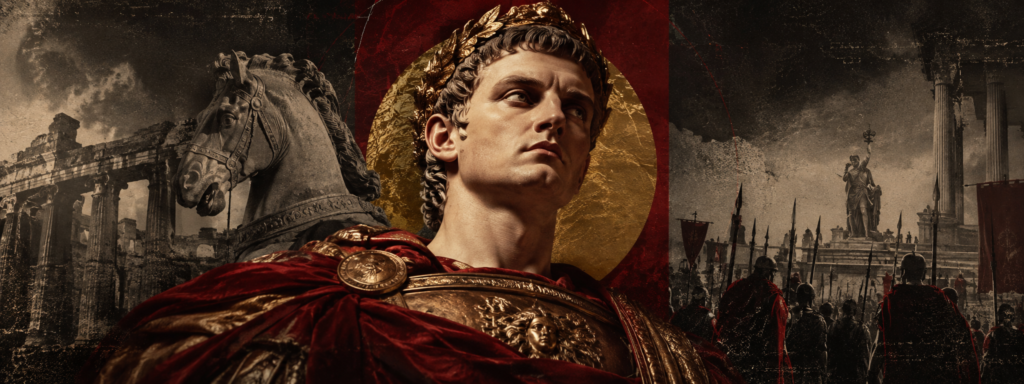
Caligula: Rome’s Golden Boy and the Reign That Ended in Blood
He was the beloved son of Rome’s fallen hero, a survivor of imperial family purges, and the young emperor who seemed destined to restore hope to a frightened empire. Four years later, Caligula was dead, his reputation consumed by stories of cruelty, sexual scandal, extravagant excess, and terrifying abuses of power. But behind the legend of Rome’s infamous emperor lies a history even more complicated—and in some ways more disturbing—than the stories themselves.
When Caligula became emperor in AD 37, Rome had every reason to celebrate. The twenty-four-year-old ruler was the son of Germanicus, a military hero whose popularity had survived long after his death. He was young, carried the prestige of one of Rome’s most beloved families, and seemed to represent everything the Roman people had been missing during the increasingly grim final years of Tiberius. After an aging emperor who had withdrawn to Capri and governed from a distance, Caligula appeared to promise something different. For a brief moment, Rome seemed ready to believe that its darkest days were behind it.
The celebrations would not last. Within four years, the young emperor’s name would become associated with some of the most outrageous stories in Roman history. Ancient writers accused him of humiliating senators, ordering arbitrary executions, pursuing scandalous sexual relationships, squandering enormous wealth, and demanding honors that blurred the boundary between emperor and god. He supposedly threatened to make his favorite horse a consul, staged elaborate spectacles to display his power, and treated the lives of prominent Romans as though they existed entirely at his pleasure. The same young man who had been welcomed with extraordinary enthusiasm would eventually be murdered by members of the guard responsible for protecting him.
Some stories were so extraordinary that they have survived for nearly two thousand years. Others were so disturbing that they helped transform Caligula into a lasting symbol of imperial cruelty. His name became associated with madness, depravity, and the terrifying possibilities of absolute power, while the circumstances of his short reign were frequently reduced to sensational anecdotes. Yet the familiar portrait conceals a serious historical problem: much of what people think they know about Caligula comes from writers who were deeply hostile to his memory.
Suetonius, Cassius Dio, and other ancient authors preserved accounts of his alleged excesses, but their narratives were shaped by political grievances, senatorial values, rumor, and the dramatic traditions of Roman biography. The surviving portions of Tacitus’s Annals do not include Caligula’s reign, depriving historians of an important narrative source for these years. Philo of Alexandria, who lived during Caligula’s reign and personally participated in an embassy to the emperor, provides valuable contemporary testimony, although his perspective was shaped by the serious conflict between imperial policy and Jewish communities.
None of this means Caligula was innocent of everything attributed to him. His violent confrontation with the Senate, the deaths of prominent individuals, the religious crisis surrounding Jerusalem, and his assassination by members of his own guard belong to the historical record. What remains uncertain is how much of the monstrous personality described in later accounts reflects actual conduct and how much emerged from efforts to condemn, explain, and sensationalize his reign.
The reality is not a simple choice between a misunderstood young emperor and a monster without limits. It is the story of a child raised among soldiers, a family destroyed by imperial politics, a young man who survived the dangerous household of Tiberius, and a ruler whose relationship with Rome’s governing elite deteriorated catastrophically. Before Caligula became the emperor whose name was associated with cruelty and scandal, he was a boy watching the most powerful family in Rome destroy itself.
Born Into Power, Raised in the Shadow of Death
Gaius Julius Caesar Germanicus was born on August 31, AD 12, into the Julio-Claudian dynasty, the family that had emerged from Rome’s civil wars to establish imperial rule. His father, Germanicus, was one of the most admired figures in the Roman world, a successful military commander whose popularity extended well beyond the soldiers under his command. His mother, Agrippina the Elder, was a granddaughter of Augustus, Rome’s first emperor. Through both parents, Gaius belonged to a family whose marriages, rivalries, and ambitions shaped the future of the empire. His childhood offered extraordinary privilege, but privilege within the imperial household came with dangers that ordinary Romans could scarcely imagine.
As a young child, Gaius accompanied his parents to military camps along the Rhine frontier, where Germanicus commanded Roman forces. His mother dressed him in miniature military clothing, including the little soldiers’ boots known as caligae. The troops affectionately nicknamed him Caligula, meaning “Little Boots,” and the name followed him throughout his life, although he did not particularly welcome its use as an adult. To the soldiers, the sight of their commander’s young son dressed like one of their own was charming. Long before Gaius held political authority, he was associated with the affection and loyalty his father inspired.
That seemingly fortunate childhood was shattered in AD 19 when Germanicus died in the eastern provinces after a bitter dispute with Gnaeus Calpurnius Piso, the governor of Syria. His death provoked widespread mourning and accusations of foul play, with rumors of poisoning circulating throughout the Roman world. Some suspicions extended toward Emperor Tiberius himself, although there is no conclusive evidence that Tiberius ordered Germanicus’s death. The loss of such a prominent figure created a political crisis, particularly because Germanicus had occupied an important position within the arrangements for imperial succession.
Germanicus’s widow, Agrippina, returned to Rome carrying her husband’s ashes and became a powerful focus of public sympathy. Her family’s popularity, however, also made it politically significant, particularly as relations between Agrippina and Tiberius deteriorated. The children of Germanicus represented a possible future for the dynasty, and their prominence could be perceived as threatening by rival interests within the imperial household. In a political system where family relationships and succession were inseparable, public affection offered no guarantee of protection.
The consequences were devastating. Agrippina was eventually exiled, while Caligula’s older brothers, Nero Caesar and Drusus Caesar, were destroyed by the political conflicts of Tiberius’s later reign. Nero died after his downfall, and Drusus died in confinement in AD 33 following severe deprivation. Agrippina herself died in exile that same year. By the time Caligula reached adulthood, his father was dead, his mother was dead, and two of his brothers had perished amid imperial persecution.
The future emperor had survived a dynasty in which even close family relationships offered little protection. The men and women who should have represented security and influence had instead become casualties of political suspicion, leaving him with a painful family history and an uncertain future. His survival would eventually bring him directly into the household of the man under whose government his family had been destroyed.
Surviving the Emperor Who Destroyed His Family
In AD 31, Sejanus, the powerful Praetorian commander who had exercised enormous influence during Tiberius’s reign, was arrested and executed. His downfall unleashed further investigations and punishments, adding to the atmosphere of suspicion surrounding the imperial household. For Caligula, the destruction of Sejanus did not suddenly make the world safe. His family had already suffered terribly, and the emperor remained a man whose favor could determine whether a potential successor survived.
In AD 31, Caligula was summoned to join Tiberius on Capri, the island that had become notorious in later accounts for its ruler’s isolation and alleged private excesses. For Caligula, however, Capri was not simply the setting of scandalous rumors. It was the residence of the emperor who controlled his future, placing him under close observation within a household filled with political sensitivities. He was expected to behave appropriately toward a ruler whose government had brought destruction upon much of his immediate family, while any suggestion of resentment could potentially threaten his position.
Suetonius portrays the young Gaius as remarkably careful during this period. According to his account, Caligula concealed his resentment and refused to be provoked into displaying hostility toward Tiberius. He endured difficult circumstances without openly challenging the man whose government had destroyed his family. The account may exaggerate his ability to conceal his feelings, and it cannot tell us what he privately thought, but the circumstances reveal how precarious his position was. A young man with a legitimate place in the dynasty had to survive in the household of an emperor who had already eliminated other potential rivals.
Tiberius eventually recognized Caligula as a possible successor, although the succession arrangements also involved his grandson, Tiberius Gemellus. When the emperor died in March AD 37, both young men had claims connected with his will, but political authority was not determined by inheritance alone. The support of the Praetorian Guard, the Senate, and influential figures in Rome would shape what happened next. Caligula possessed a powerful advantage through his father’s reputation, his family connections, and the support of those who wanted a decisive succession.
Caligula emerged as the new emperor at the age of twenty-four, having survived childhood bereavement, dynastic persecution, and years spent close to a ruler whose final reign had become synonymous with suspicion. He now possessed authority greater than that of any senator, magistrate, or general in the empire. For the first time, his future appeared to belong to him, although the political system he inherited remained filled with the same dangers that had shaped his youth.
Rome’s Golden Boy Takes the Throne
The beginning of Caligula’s reign was greeted with extraordinary enthusiasm. Ancient accounts describe widespread celebrations, public sacrifices, and rejoicing at the accession of Germanicus’s son. The young emperor benefited enormously from his father’s memory and from the widespread desire for a more approachable ruler after Tiberius’s long withdrawal. To many Romans, the new reign appeared to offer an opportunity to move beyond years associated with political accusations, executions, and imperial isolation.
Caligula initially encouraged those hopes by honoring deceased members of his family, including his mother and brothers, whose treatment under Tiberius had left painful memories. He arranged for their remains to receive proper recognition and publicly emphasized his connection with Germanicus. Such gestures strengthened his legitimacy while distinguishing his government from the darker episodes of the preceding reign. They also reinforced the idea that Caligula was restoring dignity to a family that had suffered under imperial persecution.
He also took measures that ancient writers presented as signs of generosity and restraint. Accounts describe financial distributions, public entertainments, and efforts to restore a more favorable relationship with the Roman people. Some individuals affected by earlier political proceedings received relief, and the young emperor initially appeared willing to distance himself from practices that had made Tiberius unpopular. The atmosphere seemed dramatically different from the final years of the previous reign, particularly because Caligula was young, publicly visible, and associated with a beloved military hero.
Yet the enthusiasm concealed a dangerous expectation. Romans wanted Caligula to possess supreme authority while exercising it in ways that respected established traditions, and senators expected to retain prestige and influence even though their practical independence was limited. The emperor, meanwhile, inherited a system that placed few effective restrictions on his personal decisions. As long as relations remained friendly, those contradictions could be managed through ceremony, consultation, and carefully maintained appearances.
Once relations deteriorated, the same contradictions could become explosive. Caligula was not merely a young man occupying an important political office; he was the center of an imperial system in which personal authority, military loyalty, and dynastic survival were inseparable. Before the first year of his reign was over, he suffered a serious illness that later historians would transform into one of the defining moments of his story.
The Illness That Supposedly Changed Everything
In the autumn of AD 37, only months after becoming emperor, Caligula fell seriously ill. The illness alarmed Rome, and ancient accounts describe public anxiety and intense concern for his recovery. His popularity was still substantial, while the possibility that the young ruler might die so soon after his accession raised fears about another uncertain succession. The empire had only recently emerged from the long reign of Tiberius, and another abrupt transition threatened to reopen questions about who would inherit supreme authority.
Caligula survived, but according to the traditional narrative, something changed afterward. Suetonius and Cassius Dio present the period following the illness as the beginning of increasingly troubling behavior. The emperor supposedly became more cruel, extravagant, unpredictable, and hostile toward those around him. This sequence helped create one of history’s most familiar explanations for Caligula’s reign: that a mysterious illness transformed a promising young ruler into a dangerous tyrant.
The explanation is memorable, but it is far less certain than popular retellings suggest. We do not know precisely what illness Caligula suffered, and ancient descriptions are insufficient to establish a modern medical diagnosis. Proposed explanations involving neurological disease, infection, or psychiatric conditions remain speculative, and the surviving evidence cannot demonstrate that his personality underwent a sudden, permanent transformation because of the illness. It is equally difficult to determine how much of the supposed change reflects later writers organizing his reign into a dramatic story of initial promise followed by moral collapse.
Ancient historians frequently constructed narratives around turning points that appeared to explain a ruler’s character. A period of apparent virtue followed by a descent into cruelty created a compelling moral account, particularly when the subject had been assassinated and condemned by influential members of the elite. Caligula’s illness was real, and its seriousness should not be dismissed, but the claim that it explains everything that followed goes beyond what the evidence can establish. The political deterioration of his reign had other causes, including tensions over succession, conspiracies, financial demands, and competing ideas about how openly imperial power should be exercised.
What emerged after AD 37 was therefore more complicated than the familiar story of an emperor whose illness supposedly transformed him into a monster. The surviving accounts describe increasingly severe confrontations between Caligula and powerful Romans, but those conflicts unfolded within a political system already vulnerable to suspicion and violence. The illness became an unforgettable part of his legend, while the struggles over authority that followed would prove far more consequential.
The First Blood: Succession and Betrayal
One of the earliest and most consequential deaths of Caligula’s reign was that of Tiberius Gemellus, the grandson of the previous emperor. Gemellus had been named alongside Caligula in Tiberius’s testamentary arrangements, making him a potentially significant figure in the succession. Caligula initially treated him as a member of the imperial household and adopted him, but the relationship did not protect the younger man. Within the first year of the new reign, Gemellus was forced to die, eliminating a possible dynastic rival whose existence complicated the emperor’s position.
Ancient writers describe accusations and suspicions surrounding Gemellus, including allegations that he had taken precautions against poisoning. The precise circumstances remain difficult to reconstruct, and the explanations supplied by hostile sources cannot all be accepted without question. Nevertheless, his death removed a young member of the imperial family who possessed an important connection to the previous ruler. It also demonstrated that the accession of Germanicus’s popular son had not brought an end to the deadly politics of succession.
Another prominent figure to fall was Macro, the Praetorian prefect who had helped Caligula secure power. Macro had played a crucial role in the transition following Tiberius’s death, but his relationship with the new emperor deteriorated. He and his wife, Ennia, were eventually compelled to take their own lives, according to the surviving accounts. The downfall of a man who had helped establish Caligula’s authority revealed how quickly political influence could become dangerous when personal relationships changed.
These deaths exposed the precarious position of anyone close to the throne. Men who had assisted Caligula’s accession could not assume that earlier loyalty guaranteed their safety, while family connections offered limited protection when imperial interests shifted. Caligula had inherited a political system in which succession was uncertain, powerful advisers could accumulate dangerous influence, and suspicion could quickly become fatal. He had witnessed those dangers as a young man, but now he exercised the authority that made them possible.
The contrast between the celebrations surrounding his accession and the deaths that followed was striking. Rome had welcomed a young emperor associated with the suffering of an imperial family, hoping that he would govern differently from Tiberius. Yet the elimination of Gemellus and Macro suggested that the new reign could reproduce some of the same ruthless struggles over influence and survival.
The Senate Learns to Fear Its Emperor
Caligula’s relationship with the Senate deteriorated into open hostility, becoming one of the central conflicts of his reign. Roman senators possessed immense social prestige, and their families celebrated generations of public service, military achievement, and political office. Although Augustus had transformed the Republic into an imperial system, senators continued to regard themselves as guardians of Rome’s traditional political order. Their institutions retained ceremonial importance, but the emperor’s authority outweighed theirs in nearly every meaningful confrontation.
Augustus had understood the importance of concealing that imbalance behind republican language and ceremonies, while Tiberius had often struggled with the arrangement. Caligula increasingly appeared willing to expose it. Ancient accounts describe confrontations in which senators were insulted, humiliated, and reminded of their dependence on imperial favor. Suetonius preserves anecdotes about prominent men being subjected to degrading treatment, while Cassius Dio portrays the emperor as openly contemptuous of senatorial pretensions.
Not every individual story can be verified, particularly because humiliation anecdotes were a familiar feature of Roman writing about unpopular rulers. They often served to demonstrate that an emperor had violated the dignity of the aristocracy, making them useful literary examples of tyranny. Yet the political conflict itself was substantial. Caligula could appoint officials, command military forces, influence legal proceedings, and determine the careers of men who continued to claim the traditions of republican independence.
The crisis intensified after conspiracies and accusations of treason emerged. In AD 39, Caligula removed prominent figures from their positions, and an alleged conspiracy involving the commander Gnaeus Cornelius Lentulus Gaetulicus contributed to a dangerous political confrontation. The emperor’s sisters Agrippina the Younger and Julia Livilla were also implicated in the events and exiled. The surviving evidence does not establish every accusation made during these proceedings, but it clearly indicates that the imperial household and military command became entangled in a serious struggle over loyalty and power.
For Caligula, conspiracies were not merely an imaginary threat. Opposition existed, and his eventual assassination would demonstrate that some powerful Romans were willing to kill him. But the existence of genuine dangers did not make every punishment justified or every accusation reliable. The political atmosphere became one in which suspicion could destroy careers, remove rivals, and turn former allies into enemies, while the emperor’s ability to punish opponents made reconciliation increasingly difficult.
As relations deteriorated, stories of Caligula’s behavior grew more extraordinary. The same emperor who had been celebrated as the son of Germanicus was increasingly portrayed as a ruler who enjoyed degrading the men whose cooperation was supposed to sustain the Roman state. Whether every anecdote reflects an actual event is uncertain, but the underlying conflict reveals the fragility of a system that depended on preserving the appearance of shared government while concentrating extraordinary power in one individual.
The Emperor Who Wanted to Be a God
Among the most controversial features of Caligula’s reign was his association with divine honors. Roman imperial religion already occupied complicated territory, since Augustus had received exceptional religious recognition and the worship of deceased emperors formed part of the developing imperial cult. In parts of the eastern Mediterranean, honors connecting living rulers with divine power were also familiar from earlier Hellenistic traditions. Caligula’s conduct nevertheless provoked serious opposition, particularly when imperial demands appeared to challenge established religious boundaries.
Ancient writers describe him adopting the appearance of different gods, associating himself with divine imagery, and demanding forms of recognition that offended traditional expectations. Some accounts portray him as deliberately presenting himself as a living deity, while others emphasize his willingness to challenge the boundaries separating imperial authority from religious worship. These reports require careful interpretation because Romans did not possess a single, universally accepted distinction between political honor and divine status. What seemed extraordinary or offensive in one context could resemble established practice elsewhere.
One episode, however, demonstrates that the controversy was far more than a collection of scandalous stories. Caligula ordered a statue of himself to be installed in the Temple in Jerusalem, a decision that threatened to provoke a major religious and political crisis. For the Jewish population, the proposed installation represented a profound violation of religious law, since the Temple was sacred and the introduction of an imperial image into it challenged traditions that Roman authorities had generally recognized as deserving special consideration.
Publius Petronius, the Roman governor of Syria, faced the difficult task of implementing imperial instructions while confronting determined opposition from Jewish communities. Philo of Alexandria, a contemporary witness to the broader crisis, describes the intense fear and resistance surrounding the proposal, while Josephus also preserves an account of the confrontation. Petronius delayed implementation and sought to avoid bloodshed, recognizing the danger that forcing the issue could produce widespread unrest. Agrippa I, who enjoyed a personal relationship with Caligula, also played a role in efforts to influence the emperor.
The statue was never installed, and Caligula’s death ended the immediate danger posed by the order. Nevertheless, the episode provides firmer historical ground than many of the stories about his private eccentricities. It demonstrates how imperial demands for honor could collide with deeply held religious commitments and threaten serious unrest across an important region of the empire. Whatever Caligula privately believed about his own divinity, his actions brought Roman authority and Jewish religious practice into a potentially catastrophic confrontation.
The crisis also reveals the limitations of interpreting Caligula solely through stories of personal eccentricity. His religious policies had consequences beyond the imperial palace, affecting communities whose beliefs and traditions could not easily be reconciled with demands for imperial recognition. The danger lay not simply in whether the emperor imagined himself divine, but in his ability to impose decisions that threatened the lives and stability of people far removed from Rome.
The Horse That Supposedly Became a Senator
No story about Caligula has enjoyed greater popular success than the claim that he made his favorite horse a consul. The horse was named Incitatus, and according to Suetonius, Caligula lavished extraordinary attention on the animal. The ancient account describes luxurious accommodations, elaborate furnishings, and preparations intended to ensure that the horse was not disturbed before races. Suetonius also reports that the emperor intended to appoint Incitatus to the consulship, an office that had once represented the highest achievement of Rome’s republican political system.
Cassius Dio preserves a related tradition, and over time the story became simplified into the claim that Caligula actually appointed his horse as consul. But the surviving sources do not establish that the appointment occurred. Suetonius describes an intention rather than a completed appointment, and there is no reliable evidence that Incitatus formally held the consulship or exercised its responsibilities. The familiar version of the story therefore goes beyond what the ancient evidence supports.
The distinction matters because the anecdote is often presented as proof that Caligula had completely abandoned rational government. Yet another interpretation is possible. By threatening to elevate a horse to an office traditionally occupied by Rome’s most distinguished aristocrats, Caligula may have been mocking the Senate and demonstrating his contempt for its political importance. The suggestion could have been a calculated insult, an extravagant joke, or a story exaggerated by hostile observers.
We cannot establish his precise intention, but the anecdote remains revealing because of the relationship it depicts between emperor and aristocracy. The consulship had once represented the pinnacle of republican achievement, carrying enormous prestige and genuine political authority. Under the Principate, its ceremonial importance remained substantial, but its independence was constrained by imperial power. A ruler who suggested giving the office to a horse would be exposing that contradiction in a particularly humiliating way.
The story survived because it captured something Romans found deeply troubling: the possibility that their most honored institutions existed at the pleasure of a single individual. Whether Caligula intended the insult or later writers sharpened it, Incitatus became an enduring symbol of the emperor’s reputation. The horse never needed to become consul for the story to damage the dignity of the Senate, and the legend continued to grow long after the circumstances that inspired it had disappeared.
Extravagance, Spectacle, and the Price of Imperial Glory
Caligula’s reign was also associated with enormous expenditure, and ancient writers accused him of exhausting the financial resources accumulated under Tiberius through lavish entertainments, construction projects, public distributions, and extravagant personal displays. They describe spectacular events intended to astonish audiences and demonstrate the emperor’s wealth. Some accusations are difficult to quantify, particularly claims about the precise amounts of money spent, since Roman historians frequently used extravagant figures to condemn rulers they considered irresponsible. Nevertheless, Caligula undertook substantial projects and public spectacles that demonstrated the remarkable resources available to an emperor.
One of the most famous was the construction of a temporary bridge of boats across the Bay of Baiae. Ancient accounts describe a remarkable floating structure that allowed the emperor to travel across the water in an elaborate display of imperial magnificence. Suetonius associates the event with a story about a prediction concerning Caligula’s chances of becoming emperor, although that explanation cannot be independently confirmed. Whatever motivated the spectacle, it demonstrated the extraordinary resources available to a ruler capable of directing ships, labor, materials, and military organization toward a temporary construction designed to impress spectators.
To admirers, such displays might demonstrate magnificence, generosity, and the extraordinary reach of Roman power. To critics, they represented waste, arrogance, and the misuse of resources that could have served more practical purposes. Caligula also supported public entertainments, including games and performances, while continuing building initiatives associated with imperial Rome. The surviving evidence does not permit every expenditure to be classified as reckless, nor does it establish that the treasury was simply emptied in the manner later writers suggested.
The broader conflict over imperial spending was nevertheless significant. The emperor’s ability to command enormous resources depended on taxation, revenues, and the financial structure of the Roman state. When spending increased or financial pressures intensified, the government could turn toward unpopular measures, including new levies and the pursuit of confiscated wealth. Ancient accounts connect Caligula’s later government with financial exactions that provoked resentment, although individual stories about their implementation require scrutiny.
The emperor’s magnificence and the burdens imposed to sustain it became closely linked in his hostile reputation. Rome had celebrated his generosity at the beginning of his reign, welcoming the distributions and spectacles associated with a young ruler eager to distinguish himself from Tiberius. By its final years, critics were describing a government in which extravagant displays existed alongside increasingly unpopular demands for money. The same public magnificence that initially strengthened Caligula’s popularity could also become evidence against him when political relationships deteriorated.
Scandal Inside the Imperial Household
Caligula’s private life became another major source of hostile stories, particularly in the biographies written after his death. Suetonius accused him of sexual misconduct involving married women and described relationships that violated Roman expectations about family, marriage, and social status. Particularly notorious were allegations of incest involving his sisters, including Drusilla, to whom he was exceptionally close. These accusations became central to later portrayals of Caligula, but their historical reliability remains uncertain.
Ancient writers frequently used sexual scandal to condemn political opponents. Accusations of incest, adultery, and uncontrolled desire could serve as evidence that a ruler had abandoned the moral restraints expected of a respectable Roman aristocrat. Such stories were especially effective when directed against emperors, whose private conduct could be presented as reflecting the character of their government. There is no secure independent evidence establishing that Caligula engaged in incestuous relationships with his sisters, despite the prominence of those allegations in popular accounts.
His public treatment of his sisters was nevertheless unusual. He gave them prominent honors and associated them closely with the imperial dynasty, while their elevated position appeared in official representations of the ruling family. These honors demonstrated that they possessed a degree of public importance unusual for women of their status. The exceptional visibility of Caligula’s sisters may have contributed to later speculation, particularly among writers already inclined to portray the emperor’s family relationships as improper.
Caligula’s relationship with Drusilla attracted particular attention. When she died in AD 38, the emperor arranged extraordinary honors for her, including her deification. Ancient writers describe intense mourning and suggest that his grief was excessive, reflecting both the unusual public response to her death and their hostility toward the emperor’s relationship with her. Yet public grief and exceptional honors do not prove sexual misconduct, and the distinction between documented actions and scandalous allegations is essential.
Caligula’s marriages also attracted criticism, while his final wife, Milonia Caesonia, became an important figure in the closing period of his reign. Their daughter, Julia Drusilla, would become a victim of the violence that followed his assassination. The private lives of Roman emperors were never entirely private, because marriage, childbirth, family honors, and succession carried political consequences. Sexual accusations therefore provided opponents with powerful material for attacking a ruler’s reputation, especially when his relationship with the political elite had already deteriorated.
In Caligula’s case, the scandalous stories became so influential that they frequently overshadowed the better-documented conflicts of his reign. The allegations deserve examination because they shaped his historical image, but they should not be mistaken for proven facts simply because they have been repeated for centuries. His treatment of his sisters, the honors given to Drusilla, and the political importance of imperial marriage can be studied without accepting every sensational claim preserved by later writers.
The Cruel Jokes of an Emperor
Among the darker anecdotes preserved by Suetonius is a story involving a religious sacrifice. According to the account, Caligula was participating in preparations for the sacrifice of an animal when he unexpectedly struck the official assisting with the ceremony, killing him instead of the intended victim. The story portrays an emperor who could transform a solemn religious occasion into an act of lethal cruelty, apparently without concern for the life of the man standing beside him. It became one of several anecdotes used to illustrate Caligula’s alleged disregard for ordinary restraints.
The incident must be understood as an allegation preserved by a later biographer rather than an independently established event. There is no reliable corroboration confirming that it occurred exactly as Suetonius described it. The story also fits a recognizable pattern in ancient writing about tyrants, in which a ruler behaves unpredictably, violates a sacred occasion, and treats another person’s death as an expression of his own power. Its dramatic character made it memorable, but that same quality requires caution when assessing its historical reliability.
Other anecdotes follow similar themes. Caligula supposedly threatened prominent men with execution, humiliated members of the aristocracy, and made disturbing remarks about the vulnerability of those around him. Some accounts describe punishments inflicted for minor offenses or imagined insults, presenting the emperor as someone who enjoyed demonstrating that other people lived entirely at his discretion. Taken together, the stories construct an image of a ruler whose authority had become inseparable from intimidation.
Yet their individual reliability varies considerably. The historical significance lies partly in the existence of the stories themselves, which show how later Romans explained the deterioration of Caligula’s relationship with the political elite. The documented executions and political conflicts provide substantial grounds for examining the violence of his reign, while the more sensational anecdotes require a different level of caution. A dramatic story can illuminate an ancient reputation without proving that every detail happened.
The distinction is important because the popular image of Caligula often treats all surviving accusations as equally reliable. A documented political execution, a hostile biographer’s anecdote, and an allegation repeated generations later are not the same kinds of evidence. Understanding the reign requires examining what can be established while recognizing how rumor and literary hostility helped shape the emperor’s enduring reputation.
Conspiracies in the Shadows
By AD 40, Caligula’s relationship with influential Romans had become increasingly dangerous. The emperor had alienated prominent senators, removed important figures from office, and become the subject of conspiracies. His confrontations with members of the aristocracy were no longer simply disputes over ceremony or dignity, because political survival itself was increasingly at stake. A ruler who possessed overwhelming authority could punish opponents severely, but his personal security still depended on guards, advisers, household officials, and military commanders.
The Praetorian Guard was particularly important. Established as the emperor’s protective force, it had already demonstrated its political significance during the reign of Tiberius. Its commanders could influence succession, control access, and exercise armed authority close to the imperial household. Caligula’s treatment of members of the Guard therefore carried exceptional risks, particularly when officers with direct access to him became involved in opposition.
Among those associated with the conspiracy against him was Cassius Chaerea, a tribune of the Praetorian Guard. Ancient accounts describe Chaerea as having suffered repeated humiliation at the emperor’s hands, including insults directed at his masculinity. These stories may reflect genuine personal hostility, but they also provide the kind of dramatic motivation ancient historians favored when explaining assassinations. The surviving evidence does not establish that personal resentment alone caused Chaerea to participate in the conspiracy.
The plot was broader than one man’s grievances. Other officers and political figures were implicated, and the assassination emerged from a climate in which influential individuals had reasons to fear the emperor’s continuing rule. Caligula had inherited power through the support of institutions capable of sustaining an emperor even when senators disliked him. Now members of the armed establishment closest to him were preparing to turn against him, exposing the vulnerability that lay beneath his seemingly overwhelming authority.
The situation carried a bitter irony. Caligula had survived the deadly intrigues of Tiberius’s household, watched members of his family perish, and eventually inherited the power that had once threatened him. Yet his position as emperor did not free him from the dangers of conspiracy and betrayal. It placed him at the center of them, surrounded by men whose loyalty could no longer be assumed.
January AD 41: Murder in the Palace
On January 24, AD 41, Caligula attended events associated with the Palatine Games. The emperor was moving through a passage within the imperial complex when conspirators struck. Ancient accounts differ in their precise descriptions of the attack, but they agree that members of the Praetorian Guard participated in his murder. Cassius Chaerea was among the principal attackers, and the young emperor was stabbed repeatedly before dying at the age of twenty-eight.
The assassination ended a reign that had lasted less than four years, but the violence did not end with Caligula. His wife, Caesonia, was killed, and their young daughter, Julia Drusilla, was also murdered. The killing of a child reveals the brutality that could accompany a Roman dynastic overthrow, particularly when surviving family members might be viewed as potential symbols of revenge or rival claims. Eliminating the emperor did not necessarily satisfy conspirators who feared that his immediate family could become politically significant after his death.
The exact sequence of events surrounding the murders is reconstructed from ancient accounts that differ in detail. Nevertheless, the central facts are unmistakable: Caligula was assassinated by men connected with his own guard, and his immediate family suffered deadly consequences. The emperor who had once survived the destruction of his mother and brothers now left behind a household devastated by another episode of imperial violence. His position at the summit of Roman power had offered no lasting protection against betrayal.
The assassination created a moment of extraordinary uncertainty. Some senators reportedly considered restoring republican government, hoping that the sudden death of an emperor without an orderly succession might allow Rome’s political arrangements to change. After decades of imperial rule, however, the practical obstacles were enormous, particularly because armed forces and powerful individuals had developed interests in preserving the existing system. The Praetorian Guard was unwilling simply to surrender its influence over the future of the empire.
Claudius, Caligula’s uncle, emerged as the next emperor with the Guard’s support. The Senate ultimately accepted the succession, and the imperial system continued under another member of the Julio-Claudian dynasty. The conspiracy had removed Caligula, but it had not ended the political structure that gave emperors extraordinary authority. For all the violence and upheaval surrounding his death, the system that had made his reign possible survived.
The Monster History Remembered
Caligula’s assassination did more than end his reign. It helped determine how his life would be remembered, particularly because an emperor killed by members of his own guard and condemned by influential political opponents was unlikely to receive sympathetic treatment from every later historian. His successors also had reasons to distance themselves from the violence and controversy associated with his government. The surviving literary tradition became overwhelmingly hostile, preserving an image of Caligula that emphasized cruelty, extravagance, humiliation, and scandal.
Suetonius organized many of his accounts around Caligula’s alleged vices and shocking behavior, while Cassius Dio, writing much later, preserved a similarly unfavorable portrait. Philo, who lived during Caligula’s reign, offered a contemporary perspective shaped by the emperor’s treatment of Jewish communities and the crisis surrounding the proposed statue in Jerusalem. These writers were not interchangeable, and their accounts cannot be dismissed merely because they were critical. Philo’s testimony, for example, is particularly important because he personally participated in an embassy to the emperor and witnessed the broader tensions of the period.
Every source nevertheless requires attention to its purpose, audience, and limitations. The most familiar portrait of Caligula combines documented political violence with anecdotes that cannot be independently confirmed. Stories about his horse, his sexual conduct, his supposed desire for divine worship, and his elaborate humiliations of senators became part of a single narrative about a ruler who had abandoned every restraint. Once assembled into that portrait, the anecdotes reinforced one another, making even the most extraordinary allegations appear consistent with the character later writers attributed to him.
Modern historians have questioned whether that narrative tells us everything we need to know. Some emphasize the hostility of senatorial writers and suggest that Caligula’s behavior can be understood partly as an increasingly open rejection of the political conventions established by Augustus. Others place greater weight on the executions, confrontations, and religious crises that marked the reign. These approaches do not require accepting every scandalous story or dismissing every accusation, but they do require separating different kinds of evidence.
Coins, inscriptions, official honors, and administrative measures provide information that can sometimes be compared with literary accounts. Contemporary testimony offers a different perspective from biographies written generations later, while events such as the Jerusalem Temple crisis can be examined through more than one ancient tradition. The result is a more complicated picture than the familiar image of an emperor who simply became monstrous after an illness. Caligula exercised extraordinary power within a political system that depended heavily on personal relationships, public performance, military loyalty, and the cooperation of the aristocracy.
His confrontations with those institutions contributed to his downfall, while the sensational stories made him unforgettable. The political conflict made his reign fatal, and the hostile literary tradition ensured that his name would remain associated with the darkest possibilities of imperial authority.
The Dark Legacy of Caligula
Caligula ruled Rome for less than four years, yet his name has survived for nearly two millennia as a symbol of imperial excess and cruelty. That reputation owes much to the extraordinary stories preserved by ancient writers, including the horse supposedly destined for the consulship, the accusations of incest, the humiliations of senators, the lavish spectacles, and the alleged acts of arbitrary violence. Together, these accounts created a portrait so dramatic that it has continued to fascinate generations of readers. Yet the darker history of his reign does not depend on believing every allegation.
Caligula came to power as the surviving son of a family devastated by political persecution. He inherited an empire whose institutions preserved republican appearances while concentrating immense authority in the emperor’s hands. His early popularity created expectations that he would govern differently from Tiberius, but those hopes gave way to increasingly dangerous confrontations with the Senate, military figures, and members of his own household. The same political system that had destroyed much of his family now gave him the authority to determine the fate of others.
The deaths of Gemellus and Macro, the political proceedings of AD 39, and the religious crisis surrounding Jerusalem reveal a reign marked by consequential exercises of imperial power. His assassination demonstrates how far relations with influential Romans had deteriorated, while the murder of his wife and daughter exposes the brutality that could accompany a change of ruler. These events are more substantial than the familiar collection of scandalous anecdotes because they reveal the political structures and conflicts that shaped the empire. They also demonstrate that the violence associated with the Julio-Claudian dynasty extended beyond the personality of any single emperor.
The story ends with a bitter historical irony. Caligula had spent his childhood surrounded by the consequences of imperial suspicion, watching members of his family fall victim to political rivalries before enduring the dangerous household of Tiberius. He emerged from that world to inherit supreme authority, becoming the young emperor whom Rome initially celebrated as the beginning of a more hopeful era. Less than four years later, he was dead in a palace passage, brought down by the same combination of fear, personal hostility, and political violence that had shaped his early life.
Whether he committed every outrage attributed to him will never be known. The ancient sources leave too many unanswered questions, and the most sensational accusations remain difficult to verify. What is certain is that his reign exposed the dangerous contradictions of Rome’s imperial system, in which a ruler could possess extraordinary authority while remaining dependent on the loyalty of men who might eventually decide that killing him was preferable to allowing him to continue.
Caligula entered history as Rome’s beloved Little Boots. He left it as an assassinated emperor whose name became inseparable from the darkest possibilities of absolute power.