
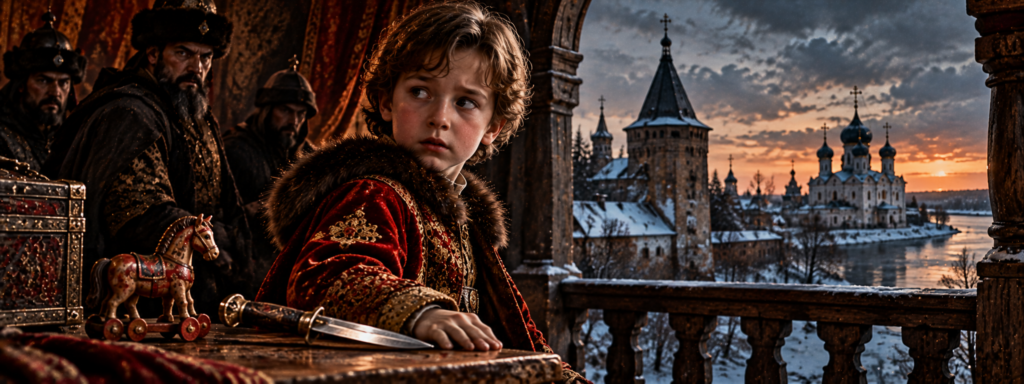
Dmitry of Uglich: The Child Prince Whose Mysterious Death Helped Destroy a Dynasty
Blood in the Palace Courtyard, Accusations of Murder, a Brutal Investigation, and the Dead Tsarevich Who Returned to Haunt the Russian Throne
Dmitry Ivanovich of Uglich (19 October 1582 – 15 May 1591) was the youngest son of Tsar Ivan IV of Russia, better known as Ivan the Terrible, and his final wife, Maria Nagaya. Born into the ruling house of Rurik, Dmitry was a potential successor to the Russian throne, although the disputed canonical status of his parents’ marriage complicated his position. Following Ivan IV’s death in 1584, Dmitry’s elder half-brother Fyodor I became tsar, while the young prince and his mother were sent to the provincial town of Uglich. There, on 15 May 1591, the eight-year-old Dmitry died from a knife wound to his throat under circumstances that immediately provoked accusations of assassination. His relatives claimed that he had been murdered by men acting for Boris Godunov, the powerful brother-in-law of Tsar Fyodor, while an official investigation concluded that the child had accidentally injured himself during a seizure. The investigation was conducted under political circumstances that have left its findings disputed for centuries, and neither the murder accusation nor the accidental-death explanation can be established beyond reasonable historical doubt. Dmitry’s death became one of the most consequential mysteries in Russian history, helping create the conditions for the Time of Troubles, the appearance of several pretenders claiming to be the dead prince, and the eventual collapse of the Rurikid dynasty’s hold on the Russian throne.
The Afternoon a Child’s Death Became a National Catastrophe
On 15 May 1591, the quiet routine of a provincial Russian court was shattered by the discovery of a dead child. The boy was only eight years old, but he was no ordinary victim of an unexplained tragedy. Dmitry Ivanovich was the youngest surviving son of Ivan the Terrible, a member of the dynasty that had ruled the lands of Rus’ for centuries, and a possible heir to the Russian throne. His death would become the subject of accusations so explosive that they would outlive nearly everyone involved.
The child had been living in Uglich with his mother, Maria Nagaya, and members of her family. His elder half-brother Fyodor occupied the throne in Moscow, while Boris Godunov exercised enormous influence over the government. Dmitry’s household existed at a distance from the capital, surrounded by attendants, servants, and officials whose loyalties were not always identical. It was a politically sensitive arrangement, even before the prince was found fatally wounded.
The surviving accounts agree that Dmitry suffered a deadly injury involving a knife, but they disagree profoundly about how it happened. One explanation held that he experienced a seizure while playing and accidentally wounded his own throat. Another claimed that assassins attacked him on the orders of powerful men who feared his eventual claim to the throne. The difference between those explanations was the difference between a terrible childhood accident and a calculated act of dynastic murder.
Within hours, the death had become a public crisis. The prince’s relatives accused members of the local administration of responsibility, an alarm was raised, and an enraged crowd attacked men believed to be involved in the killing. The violence transformed the scene from a private tragedy into an uprising against suspected murderers. By the time investigators arrived from Moscow, the events had already been obscured by grief, rumor, political hostility, and bloodshed.
The official inquiry concluded that Dmitry had died accidentally during a seizure. That finding should have ended the matter, but it did not. The circumstances of the investigation, the political interests of those involved, and the extraordinary consequences of the prince’s death ensured that suspicion survived. Later generations would repeatedly return to Uglich in search of an answer that the surviving evidence could never provide with complete certainty.
Dmitry’s death was especially consequential because of what happened afterward. His half-brother Fyodor died without a surviving heir in 1598, bringing the ruling Moscow branch of the Rurikid dynasty to an end. Boris Godunov became tsar, only to face accusations that he had arranged the child’s murder. Then a man appeared claiming to be Dmitry himself, insisting that the boy killed at Uglich had been someone else.
The dead prince became more politically powerful than he had ever been while alive. His name was used to challenge rulers, justify invasions, inspire uprisings, and legitimize competing claims to the throne. Men fought and died over the identity of a child whose body had been buried years earlier. The mystery of Uglich would become one of the darkest foundations of Russia’s Time of Troubles.
The Last Son of Ivan the Terrible
Dmitry was born on 19 October 1582, during the final years of Ivan IV’s reign. His father had ruled Russia for decades and had transformed the grand princely state of Moscow into a tsardom claiming extraordinary authority. Ivan’s reign was marked by territorial expansion, political experimentation, religious ceremony, and episodes of devastating repression. His reputation for violence would become inseparable from the history of the dynasty he left behind.
The boy’s mother, Maria Nagaya, belonged to a noble family that had gained access to the royal court. She became Ivan’s wife late in his life, after a succession of earlier marriages and relationships. The exact number and canonical status of Ivan’s marriages remain matters of historical discussion because Orthodox ecclesiastical rules restricted repeated marriage. Dmitry’s birth therefore raised questions that would later complicate his position in the succession.
Ivan IV had fathered other sons, but the dynasty’s future was already precarious. His eldest surviving son, Ivan Ivanovich, died in 1581, traditionally after a violent confrontation with his father. The famous story that Ivan the Terrible struck his son in anger has been repeated for centuries, although aspects of the circumstances remain disputed. Whatever the precise cause, the young man’s death removed a capable adult heir and left the succession dangerously narrow.
The remaining principal heir was Fyodor Ivanovich, born to Ivan’s first wife, Anastasia Romanovna. Fyodor was an adult when his father died, but his character and political abilities were described in sharply different ways by contemporaries and later writers. Some portrayed him as deeply pious and uninterested in ordinary political affairs. Others emphasized the role of advisers and powerful courtiers in the government conducted in his name.
Dmitry was much younger than Fyodor, but his existence mattered because the tsar had no surviving son. If Fyodor died without a male heir, the question of succession would become urgent. Dmitry’s descent from Ivan IV gave him an obvious dynastic connection, even if the disputed status of his mother’s marriage complicated his eligibility. In a monarchy where hereditary legitimacy carried immense political weight, such a child could become the center of competing ambitions.
His birth therefore took place under the shadow of an uncertain future. He was the son of a powerful and feared ruler, but his position depended upon circumstances he could not control. His father’s death would leave him in the care of relatives whose political influence was limited. The royal blood that gave him importance would also make him vulnerable.
The Death of Ivan IV and a Dangerous Succession
Ivan the Terrible died in March 1584, leaving the Russian throne to Fyodor I. The succession did not immediately produce a civil war, but it created an environment in which court factions competed for influence. Fyodor possessed the dynastic right to rule, while leading nobles sought positions within the government. Among those who emerged as particularly influential was Boris Godunov.
Godunov’s rise was closely connected to his sister Irina, who was married to Fyodor. This relationship gave him privileged access to the royal household and strengthened his position at court. Over time, Boris became the dominant figure in the administration, although the exact balance between his authority and Fyodor’s personal role has been debated. His influence would eventually make him the principal target of accusations surrounding Dmitry’s death.
The young prince’s position became an immediate concern after Ivan’s death. Dmitry and Maria Nagaya were sent to Uglich, a town on the Volga that had long possessed significance within the political geography of northeastern Rus’. The arrangement provided the child with a princely household and an appropriate residence. It also kept him away from the central court in Moscow.
Later accounts frequently interpret the move as a deliberate attempt to isolate a potential rival. That explanation is plausible within the political circumstances, but it should not be treated as the only possible motive. Providing appanage territories and residences for members of the ruling family was an established practice. The difficulty was that Dmitry’s residence in Uglich combined ordinary dynastic arrangements with extraordinary political sensitivity.
Maria Nagaya and her relatives were not necessarily content with their diminished position. Their access to power had depended heavily upon Ivan IV, whose death weakened their influence. Dmitry’s status offered the family a remaining connection to the throne. Protecting his interests could therefore become inseparable from protecting their own future.
The court in Moscow had reasons to monitor the household carefully. A royal child outside the capital could become a rallying point for dissatisfied nobles, especially if questions arose about Fyodor’s succession. The possibility of competing claims did not require Dmitry himself to possess political ambitions. His existence was sufficient to create potential danger.
The arrangement left the prince living in a politically divided environment. His mother and maternal relatives had interests distinct from those of the officials responsible for administering the territory. The central government expected loyalty, while the Nagoy family had reasons to resent its reduced influence. These tensions would become crucial when Dmitry died.
Uglich: A Provincial Court Under Watch
Uglich was not an insignificant village where the royal family could simply disappear. It was an established town with a long political history, situated along the Volga River. Its churches, fortifications, and princely residences reflected its place within the wider world of Muscovite Rus’. For Dmitry, it became the setting of nearly his entire remembered childhood.
The prince lived within a household that included his mother, relatives, servants, attendants, and officials. Such households were political institutions as well as domestic communities. They managed property, maintained ceremonial status, and preserved relationships with local elites. Their members could also become involved in disputes over authority and influence.
Dmitry’s age meant that he did not govern independently. Adults acted on his behalf, and his household was subject to the political arrangements established by the government in Moscow. The boy’s daily life would have included religious observance, supervision by attendants, and the routines appropriate to his status. The surviving evidence does not allow a detailed reconstruction of his personal habits or education.
Later stories sometimes portray Dmitry as unusually fierce or as inheriting the violent temperament attributed to his father. Such anecdotes should be treated cautiously because they were recorded or repeated within politically charged narratives. Descriptions of a child’s temperament could be used to suggest that he was dangerous, unstable, or unsuitable for future rule. They do not provide reliable psychological evidence.
The prince’s health became one of the most important issues in the later investigation. Accounts associated with the official inquiry describe episodes interpreted as seizures, traditionally identified as a form of epilepsy. Whether those descriptions would support a precise modern diagnosis is uncertain. The evidence does, however, establish that claims about recurring convulsive episodes were central to the explanation of his death.
The existence of such episodes would have mattered to those responsible for his care. A child who experienced sudden loss of control or consciousness could require close supervision, particularly when playing with sharp objects. Yet the surviving testimony was gathered after his death, when witnesses were responding to an inquiry with enormous political implications. The medical evidence cannot be separated entirely from the circumstances in which it was recorded.
Uglich therefore became a place of contradictory meanings. To the boy, it was home, the town in which he lived with his mother and household. To the government, it was a location where a politically sensitive member of the dynasty could be maintained away from the capital. To later generations, it became the scene of an unresolved death that would haunt the Russian monarchy.
A Child Who Might Have Become Tsar
Dmitry’s political significance rested upon his relationship to Fyodor I. The reigning tsar had no surviving male heir, making the question of succession increasingly important. Dmitry was a son of Ivan IV and therefore belonged to the immediate royal family. His youth did not prevent others from regarding him as a possible future ruler.
The difficulty was the disputed status of his parents’ marriage. Orthodox religious rules placed limits upon repeated marriage, and Ivan IV’s later unions created canonical complications. Some contemporaries and later writers questioned whether Dmitry possessed an uncontested right to inherit. Such objections could be used politically by those who wished to exclude him.
Nevertheless, dynastic legitimacy was not determined by ecclesiastical interpretation alone. Political support, recognition by powerful nobles, and the circumstances of a ruler’s death could all influence succession. A claimant whose legal position was disputed might still become a serious contender if influential supporters rallied around him. Dmitry’s royal descent gave him a political importance that could not easily be dismissed.
His mother and her relatives had obvious reasons to preserve his standing. If Fyodor died without an heir, Dmitry’s claim might restore the Nagoy family’s influence at court. Even the possibility of such a future could make the child politically valuable. The family did not need to organize an immediate conspiracy for others to recognize the potential significance of his survival.
Boris Godunov’s position created another source of suspicion. As Fyodor’s brother-in-law and dominant adviser, he possessed enormous influence but lacked the direct dynastic connection enjoyed by Dmitry. If Fyodor died, Boris’s political future could become uncertain. Later accusations would therefore portray Dmitry as an obstacle to Godunov’s ambitions.
That argument supplied a plausible motive for murder, but motive alone cannot establish that a murder occurred. In 1591, Fyodor was still alive, and the precise succession arrangements after his death were uncertain. Godunov’s eventual accession in 1598 was not a guaranteed outcome eight years earlier. A responsible account must distinguish the political possibilities of 1591 from the events that later made the accusation appear compelling.
The boy himself was almost certainly incapable of understanding the full implications of his position. He was a child living under adult supervision, far from the central court. His significance came from his birth rather than his actions. The tragedy of his death lies partly in that contrast between personal innocence and political importance.
The Morning of May 15, 1591
The events of 15 May 1591 are preserved through testimony and chronicle accounts that do not agree on every detail. The official inquiry described Dmitry playing with other children when he suffered a fatal injury. Some versions identify the game as one involving a knife or pointed object, often associated with a form of play called tychka. The precise mechanics of the game remain uncertain.
The official explanation held that Dmitry experienced a seizure while holding the sharp object. During the episode, he allegedly injured his own throat, producing a wound that proved fatal. The account depended upon testimony concerning his previous seizures and the circumstances of the incident. It presented the death as a terrible accident rather than a political crime.
The opposing account was dramatically different. Maria Nagaya and members of her circle accused men connected to the local administration of murdering the child. According to the murder tradition, assassins attacked Dmitry deliberately, carrying out an order originating from powerful interests in Moscow. The accusation transformed the incident from a domestic tragedy into a conspiracy against the royal bloodline.
The surviving evidence does not permit a confident reconstruction of the exact moment of injury. The official investigation recorded testimony supporting the accidental-death explanation, but its political independence has been questioned. The murder accusation was made in an atmosphere of immediate grief and violence, and its details were also shaped by political interests. Neither side can be accepted without scrutiny.
What is beyond dispute is that Dmitry suffered a fatal wound and died that day. The death occurred in the presence or vicinity of members of his household, and news spread rapidly through the town. His mother and relatives reacted with accusations of murder. The event immediately became a public crisis.
The location of the injury also contributed to the mystery. A wound to the throat could be consistent with deliberate violence, but the possibility of accidental injury during a seizure cannot be excluded solely from the general description. Without a reliable modern medical examination, the wound cannot settle the question. The surviving testimony remains the principal evidence.
The uncertainty is central to the case. Dmitry’s death was not followed by a neutral forensic investigation conducted under conditions free from political pressure. It occurred within a monarchy where the identity of the victim made every explanation politically consequential. The truth became entangled with the struggle over who could be trusted to interpret it.
The Cry of Murder and the Violence That Followed
The discovery of Dmitry’s body provoked an immediate and furious reaction. Maria Nagaya accused men associated with the local administration of responsibility for her son’s death. The alarm was raised, and inhabitants of Uglich gathered amid rumors that the prince had been murdered. The atmosphere rapidly became one of fear, anger, and vengeance.
Among those accused were members of the Bityagovsky family, whose connection to the administration made them vulnerable to suspicion. Mikhail Bityagovsky had been associated with official oversight in Uglich and represented interests linked to the government in Moscow. His presence created an obvious target for those who believed the central authorities had arranged the killing. The accusation did not require proof before violence began.
An enraged crowd attacked and killed several men believed to be implicated. The killings were not the result of a completed judicial process. They were acts of collective violence carried out in the immediate aftermath of the child’s death. The bloodshed complicated the subsequent investigation because some of the accused were no longer alive to defend themselves or provide testimony.
The violence also reveals the depth of political mistrust surrounding Dmitry’s household. A fatal accident might have produced grief and religious mourning, but the accusation of assassination mobilized anger against representatives of Moscow. The crowd’s actions suggest that suspicion of official authority was already powerful. The prince’s death became the spark for a broader confrontation.
Maria’s role in the accusations was central. As the child’s mother, she had an immediate personal reason to demand an explanation. She also belonged to a family whose political position had declined since Ivan IV’s death. Her grief and political circumstances cannot be neatly separated, but neither should her accusation be dismissed simply because she possessed interests of her own.
The deaths of the accused created another tragedy. Men were killed on suspicion of participating in a murder that had not yet been established. Their families and associates became victims of the same political panic that surrounded the prince’s death. The events in Uglich therefore involved multiple layers of violence, not only the death of Dmitry.
By the time news reached Moscow, the situation had become a matter of state security. A royal child was dead, officials had been murdered, and the town had experienced a violent uprising. The government needed to determine what had happened and reassert authority. The investigation that followed would become one of the most controversial inquiries in Russian history.
Boris Godunov: The Man Everyone Suspected
Boris Godunov was one of the most powerful men in Russia when Dmitry died. His sister Irina was married to Tsar Fyodor, giving him a close connection to the ruling household. He had risen through the political structures of Ivan IV’s court and emerged as the dominant adviser during Fyodor’s reign. His position made him an obvious figure in any discussion of the succession.
The accusation against Boris rested upon a straightforward political argument. Dmitry was a potential heir, while Boris lacked a direct hereditary claim to the throne. If Fyodor died without children, Dmitry’s existence could complicate Boris’s ambitions. Removing the child might therefore benefit the powerful adviser.
This motive became especially persuasive after later events. Fyodor died in 1598 without a surviving heir, and Boris was chosen as tsar. His accession appeared to confirm that he had benefited from Dmitry’s death. Opponents could portray the events of 1591 as the first stage of a long-planned seizure of power.
Yet the historical evidence does not establish that Boris ordered the prince’s murder. The accusation was politically useful to his enemies, and later narratives were shaped by the turmoil that followed his accession. The official inquiry concluded that Dmitry died accidentally, while opposing traditions claimed assassination. The surviving evidence remains insufficient to prove a direct order from Boris.
The distinction matters because Boris’s reputation has been profoundly influenced by later literature and political memory. He became one of the most famous alleged child-murderers in Russian history, especially through dramatic works that treated the accusation as central to his character. Those portrayals shaped popular understanding but cannot substitute for historical proof. A compelling story is not necessarily a verified account.
Boris also had reasons to avoid a politically explosive murder. The killing of a royal child could provoke unrest, undermine the legitimacy of the government, and create precisely the accusations that later damaged his reputation. An accidental death would have served his interests without requiring a conspiracy. The political benefits of Dmitry’s disappearance therefore do not settle the question.
The accusation nevertheless remained powerful because of the circumstances. Dmitry died while living away from Moscow, under a government dominated by Boris, and his mother immediately alleged murder. The official inquiry was conducted by men operating within that same political system. Suspicion was therefore almost inevitable.
Boris Godunov’s role remains one of the central uncertainties of the case. He possessed influence, potential motive, and later political benefit. What is missing is conclusive evidence connecting him to a deliberate killing. His historical responsibility cannot be established simply by the fact that he eventually became tsar.
The Investigation Led by Vasily Shuisky
The government in Moscow responded to the events at Uglich by sending an investigative commission. One of its leading figures was Prince Vasily Ivanovich Shuisky, a prominent nobleman whose later career would become deeply entangled with the Dmitry controversy. The commission gathered testimony concerning the child’s death and the violence that followed. Its findings became the foundation of the official accidental-death explanation.
The investigation questioned members of the household and other witnesses. Testimony concerning Dmitry’s health, his activities on the day of his death, and the conduct of those present was recorded. The inquiry also examined the killings committed by the crowd after the accusation of murder. The resulting documentation is an unusually important source for a sixteenth-century Russian political crisis.
According to the official conclusion, Dmitry suffered a seizure while playing with a sharp object and accidentally wounded himself. The commission did not accept the allegation that agents of Boris Godunov had murdered him. Instead, it treated the accusations and subsequent killings as acts arising from panic, false claims, or political agitation. The government therefore presented the incident as a tragic accident followed by unlawful violence.
The investigation’s findings have been debated for centuries. Critics argue that the commission operated under the authority of a government with an obvious interest in avoiding accusations of dynastic murder. Supporters of the accidental-death explanation point to the recorded testimony concerning seizures and the absence of conclusive evidence for assassination. Both arguments deserve consideration.
Vasily Shuisky’s later conduct made the controversy even more complicated. During the Time of Troubles, he adopted positions that differed from the original official conclusion. He would eventually recognize Dmitry as a murdered prince and participate in the religious commemoration of his remains. These changes have encouraged accusations that Shuisky shaped his statements according to political circumstances.
Such changes certainly undermine the idea that his public positions can be treated as consistently neutral. Yet they do not automatically prove that the original inquiry was false. Political pressure could influence later statements as well as earlier ones. The problem is that Shuisky became both an investigator and a political actor in the subsequent struggle over Dmitry’s identity.
The investigation remains one of the most valuable and frustrating sources in the case. It preserves details that might otherwise have disappeared, including testimony about the child’s health and the events surrounding his death. At the same time, it was produced within a political system where the consequences of a murder finding would have been enormous. Its conclusions must be evaluated with both its evidentiary value and its limitations in mind.
The official verdict brought legal consequences for those involved in the violence at Uglich. It did not, however, bring lasting agreement about the prince’s death. The inquiry settled the government’s position while leaving the broader political mystery unresolved. The story of Dmitry would continue long after the investigators departed.
Could an Eight-Year-Old Have Accidentally Cut His Own Throat?
The accidental-death explanation has often been challenged because the injury appears so extraordinary. Dmitry was reportedly playing with a sharp object when a seizure caused him to wound his own throat. To modern readers, the scenario may seem improbable, especially when compared with the more familiar possibility of deliberate violence. Yet historical probability cannot be determined by intuition alone.
The official testimony described a child who had experienced episodes interpreted as seizures. Sudden convulsive movements, loss of control, or falls can create serious dangers when sharp objects are present. An accidental injury is therefore medically possible in general terms. The question is whether the particular injury described in the sources occurred in that way.
The surviving records do not provide a modern medical examination. They lack the anatomical precision needed to reconstruct the wound’s direction, depth, and relationship to the child’s position. The descriptions were produced by witnesses and investigators working within the knowledge and political circumstances of the sixteenth century. They cannot support a definitive forensic conclusion.
The murder theory faces its own evidentiary difficulties. The immediate accusations identified alleged perpetrators, but those claims arose amid intense grief and violence. Several accused men were killed before a formal inquiry could establish their involvement. Later narratives added political interpretations that may have been influenced by events occurring years after Dmitry’s death.
The distinction between possibility and proof is essential. An accidental wound during a seizure is possible, but the surviving evidence does not establish that it happened. A deliberate attack by assassins is also possible, but the surviving evidence does not conclusively demonstrate that either. The historical record supports competing explanations without resolving them.
Some later writers have attempted to identify the precise medical condition from which Dmitry suffered. Epilepsy is frequently mentioned, but retrospective diagnosis is inherently uncertain when based upon brief historical descriptions. The term can be useful as a conventional label for the reported seizures, provided its limitations are acknowledged. It should not be used to create a false impression of medical certainty.
The mystery therefore cannot be solved by simply choosing the explanation that seems most dramatic. The surviving evidence is incomplete, politically complicated, and medically imprecise. The official inquiry offers a coherent accidental-death account, while the political circumstances supply reasons for suspicion. Neither eliminates the uncertainty surrounding the child’s final moments.
The Punishment of Uglich
The government treated the violence following Dmitry’s death as a serious disturbance of public order. The killing of officials and suspected assassins could not be ignored, regardless of whether the original death was accidental or deliberate. Those accused of participating in the uprising faced punishment. The response demonstrated the central government’s determination to reassert control over the town.
Members of the Nagoy family also suffered political consequences. Maria Nagaya was compelled to enter religious life and became known by the monastic name Marfa. Her relatives lost influence and faced measures that reflected the government’s suspicion of their role in the unrest. The family that had once possessed a direct connection to Ivan IV’s household was further marginalized.
The punishment of Maria was especially poignant. She had lost her young son and then lost her position as a royal widow living with a princely household. Her accusations had contributed to a crisis that the government regarded as rebellion. The response transformed personal grief into political punishment.
Uglich itself became associated with a lasting tradition of collective suffering. Stories developed concerning the town’s bell, which had been rung to raise the alarm after Dmitry’s death. According to a famous local tradition, the bell was symbolically punished, mutilated, and sent into exile along with inhabitants of the town. The tale became one of the most memorable elements of Uglich’s historical identity.
The story of the bell contains elements of documented punishment and later legend that should not be treated as equally certain in every detail. Its symbolic meaning, however, is unmistakable. The bell represented the town’s collective voice, and its alleged punishment suggested that even the instrument used to summon the people could be condemned. The tradition transformed an act of state repression into a vivid image of communal humiliation.
The punishments also served a political purpose. They reinforced the official conclusion that the crisis had been caused by false accusations and unlawful violence rather than a government-sponsored murder. By condemning the uprising, the authorities sought to restore order and discourage further challenges. The measures did not necessarily persuade those who believed Dmitry had been assassinated.
The events left Uglich with a reputation that extended far beyond its size or political importance. It became the town where a royal child died, where accusations of murder provoked bloodshed, and where the government imposed severe punishment. The memory of the tragedy survived in local traditions, religious commemorations, and later historical writing. Uglich would never again be merely an ordinary provincial residence.
A Dead Prince and an Uncertain Throne
For several years after Dmitry’s death, the Russian throne remained occupied by Fyodor I. The immediate political consequences were therefore limited by the continued existence of the reigning tsar. Boris Godunov maintained his influential position, and the government continued operating within the established dynastic framework. The succession question nevertheless remained unresolved.
Fyodor’s marriage to Irina Godunova did not produce a surviving heir. The absence of a son became increasingly significant as the years passed. Dmitry’s death had removed the most obvious younger male descendant of Ivan IV, leaving the dynasty vulnerable to extinction in its ruling line. The political consequences of the Uglich tragedy grew more serious with time.
When Fyodor died in January 1598, the succession crisis finally arrived. The direct ruling line descended from Ivan IV had no surviving male heir. The monarchy needed a new ruler, and the process of selection became a matter of enormous political importance. Boris Godunov emerged as the successful candidate.
Boris’s accession transformed the meaning of Dmitry’s death. The man who had been accused of arranging the child’s murder now occupied the throne that Dmitry might conceivably have inherited. Opponents could portray the succession as the fulfillment of a long-planned conspiracy. The accusation became politically useful even without new evidence concerning the events of 1591.
The new tsar faced significant challenges. Dynastic legitimacy mattered deeply in a society accustomed to hereditary rule, and Boris did not possess the same direct descent from the reigning royal line. His political abilities and established authority could not entirely eliminate the problem. The memory of Dmitry offered his enemies a powerful weapon.
The accusation of child murder was especially damaging because it combined political illegitimacy with moral horror. A ruler who had allegedly killed an innocent child to seize the throne could be portrayed as fundamentally unworthy of authority. The charge did not require proof to become effective propaganda. Repetition and suspicion could weaken confidence in the government.
Dmitry’s death therefore continued shaping Russian politics long after the official investigation had ended. The prince’s absence created a dynastic vacuum, while the unresolved circumstances of his death supplied a narrative of possible criminal usurpation. The two developments reinforced one another. Russia was entering a period in which a dead child’s identity would become a weapon against the throne.
Boris Godunov Becomes Tsar
Boris Godunov became tsar in 1598 after the death of Fyodor I. His accession was supported through political and ecclesiastical processes that sought to establish legitimacy despite the absence of direct hereditary succession. He possessed extensive experience in government and had already exercised enormous influence during Fyodor’s reign. Yet his position remained vulnerable to those who believed the throne should belong to the Rurikid bloodline.
The accusation concerning Dmitry became part of the opposition to his rule. Critics portrayed Boris as a man who had removed the rightful heir and then taken the throne for himself. The narrative offered a simple explanation for a complicated succession crisis. It transformed political competition into a story of murder and stolen inheritance.
The historical evidence does not justify treating that accusation as established fact. Boris’s eventual accession demonstrates that he benefited from the absence of a surviving Rurikid heir, but it does not prove that he arranged Dmitry’s death seven years earlier. The political circumstances of 1591 were not identical to those of 1598. Retrospective certainty would be misleading.
Boris nevertheless faced the consequences of suspicion. His legitimacy depended upon more than formal selection, because popular acceptance and elite loyalty were essential to stable rule. Rumors of dynastic murder could undermine both. The accusation became especially dangerous when combined with later economic and social disasters.
Beginning in 1601, Russia experienced catastrophic famine associated with severe climatic disturbances and crop failures. The resulting suffering weakened the government and created widespread instability. Hunger, disease, displacement, and social unrest transformed political dissatisfaction into a national crisis. The famine was not caused by Dmitry’s death, but it created conditions in which accusations against Boris could become more influential.
Religious and moral interpretations of disaster also shaped contemporary reactions. Some people understood famine and political instability as signs of divine displeasure. A ruler accused of murdering a child could become an obvious target for such explanations. The political myth of Dmitry’s assassination gained new force.
Boris’s reign therefore became increasingly vulnerable to challenges that combined dynastic claims with popular suffering. The government possessed substantial resources, but legitimacy was difficult to secure when the ruling family was accused of a foundational crime. The dead prince remained a presence in political argument. His name would soon be claimed by a living man.
The Prince Who Returned From the Dead
In the early seventeenth century, a man appeared claiming to be Dmitry Ivanovich, the son of Ivan the Terrible. He insisted that the child who died in Uglich had not been the real prince and that he had survived through a substitution or escape. The claim offered a dramatic solution to the mystery of 1591. It also provided a powerful challenge to Boris Godunov.
The claimant became known to history as False Dmitry I. His actual identity remains debated, although a longstanding tradition identifies him with Grigory Otrepyev, a former monk. The evidence concerning his origins is complicated by political propaganda and later accounts. What matters most is that he successfully presented himself as the surviving royal heir to a significant audience.
The claim was politically explosive because it reversed the meaning of the Uglich tragedy. If the man was truly Dmitry, then the official death of 1591 had been misunderstood or deliberately falsified. Boris’s legitimacy would become even more vulnerable. Supporters of the claimant could present him as the rightful heir returning to reclaim his father’s throne.
The story attracted support beyond Russia’s borders. Polish-Lithuanian magnates and other political actors saw opportunities in the claimant’s ambitions. Religious, diplomatic, and territorial interests became entangled with the question of his identity. The supposed survival of one child became the foundation for a major international political crisis.
The claimant’s success also reveals the power of uncertainty. The official investigation had concluded that Dmitry died accidentally, but the accusation of murder had never disappeared. Now a third possibility entered public debate: perhaps the prince had not died at all. The lack of universally accepted evidence allowed competing narratives to flourish.
The real Dmitry would have been in his early twenties by the time the pretender emerged. Few people outside his childhood household could have possessed detailed personal knowledge sufficient to verify his identity. Years of political turmoil had also weakened confidence in official statements. The circumstances created opportunities for deception, genuine belief, and opportunistic support.
The pretender’s claim demonstrates how a royal death can become politically useful long after the original event. Dmitry had died as a child, but his name retained the authority of dynastic descent. A man who could persuade others that he was Dmitry could claim legitimacy unavailable to ordinary rebels. The mystery of Uglich became the foundation of an attempt to seize the Russian throne.
False Dmitry I Takes Moscow
The claimant launched a campaign against Boris Godunov’s government, attracting supporters who were motivated by dynastic belief, political dissatisfaction, and personal ambition. His forces initially faced significant challenges, but the instability of the period created opportunities. Boris’s government was weakened by famine, unrest, and divisions among elites. The claimant’s identity became a rallying point for opposition.
In April 1605, Boris Godunov died unexpectedly. His death transformed the political situation and deprived the government of its most experienced leader. Boris’s son Fyodor II briefly succeeded him, but the new regime lacked the strength to withstand the rapidly shifting loyalties of the political elite. The dynasty collapsed within months.
False Dmitry I entered Moscow and became tsar in 1605. His accession was one of the most extraordinary developments of the Time of Troubles. A man claiming to be a prince who had supposedly died fourteen years earlier now occupied the throne. The political significance of Dmitry’s childhood death had reached its most dramatic expression.
The claimant’s recognition depended upon a combination of political support and public performance. He presented himself as the legitimate son of Ivan IV and sought to establish continuity with the old dynasty. His supporters treated the story of his survival as evidence that the throne had been unlawfully occupied. The question of his identity became inseparable from the legitimacy of his rule.
Maria Nagaya, Dmitry’s mother, was drawn into the controversy. She publicly recognized the claimant as her son during his period of power, although her later position changed after his overthrow. Her recognition carried enormous symbolic weight because she was one of the few people who could plausibly claim intimate knowledge of the real child. Yet her statements occurred under political circumstances that complicate their evidentiary value.
The recognition did not resolve the historical mystery. A mother might genuinely believe that a claimant was her surviving child, but political pressure and personal survival could also influence public statements. Maria’s later repudiation of the claimant demonstrates the instability of such testimony. Her changing position cannot be treated as conclusive proof of either identity.
False Dmitry I ruled for less than a year before being overthrown and killed in May 1606. His death did not end the political use of Dmitry’s name. Other pretenders would emerge, each claiming to represent the surviving royal heir. The child who died in Uglich had become the center of a recurring crisis of identity and legitimacy.
Vasily Shuisky Changes His Story
Vasily Shuisky’s role in the Dmitry controversy became increasingly extraordinary during the Time of Troubles. He had helped lead the official investigation in 1591, which concluded that the prince died accidentally during a seizure. Years later, he became involved in the political struggles surrounding False Dmitry I. His public positions shifted as the balance of power changed.
Shuisky participated in the conspiracy that overthrew False Dmitry I in May 1606. After the claimant’s death, Shuisky himself became tsar. His accession created a need to establish legitimacy and discredit the pretender who had recently occupied the throne. The story of the real Dmitry’s death became politically useful once again.
Under Shuisky’s government, the remains identified as those of the child prince were transferred from Uglich to Moscow. The event was accompanied by religious ceremony and claims of sanctity. Dmitry was presented as an innocent victim of murder, and his memory became associated with martyrdom. This interpretation differed sharply from the conclusion of the original investigation.
The change has been interpreted as evidence of political manipulation. Shuisky had participated in an inquiry that rejected murder, yet later supported a narrative in which the prince was deliberately killed. His position as ruler gave him reasons to discredit anyone claiming to be the surviving Dmitry. Establishing the child’s death as certain was essential to undermining future pretenders.
The contradiction does not automatically establish which version was true. Shuisky’s original investigation may have been influenced by the government of Fyodor and Boris, while his later statements were made under the pressures of his own reign. Both contexts created incentives for politically useful conclusions. His career illustrates how historical truth could become subordinate to immediate political needs.
The translation of the remains also served a religious purpose. Dmitry was venerated as an innocent child whose death had become associated with suffering and injustice. Reports of miracles contributed to the development of his cult. Religious commemoration transformed a disputed political death into a sacred narrative.
The process further complicated the historical record. The official explanation of accidental death remained preserved in investigative testimony, while religious tradition increasingly emphasized murder. Later writers inherited both narratives and attempted to reconcile them. The result was a mystery made more difficult by the changing positions of those who claimed authority to explain it.
Shuisky’s role remains one of the most striking features of the case. He investigated the death, later challenged the identity of a supposed survivor, and helped promote the child’s veneration as a murdered prince. His political career became inseparable from the mystery he had once been sent to solve. The investigator eventually became a ruler whose legitimacy depended partly upon controlling the meaning of the investigation.
The Child Saint of Uglich
Dmitry’s religious commemoration developed most prominently during the early seventeenth century. His remains were transferred to Moscow in 1606, and he became venerated as a passion-bearer or innocent sufferer within the Russian Orthodox tradition. The religious interpretation emphasized his youth, innocence, and violent death. His story became part of the sacred history of the Russian monarchy.
The distinction between religious veneration and historical proof is important. A saint’s cult reflects the beliefs and practices of a religious community, but it does not independently establish the precise circumstances of death. Dmitry’s veneration developed during a period of intense political conflict. The interpretation of his death was therefore shaped by both devotion and the needs of rulers seeking legitimacy.
The transfer of his remains served a practical political purpose. By establishing that the real Dmitry had died and was buried, Shuisky’s government sought to undermine claims made by pretenders. The public display and religious commemoration of the remains reinforced the argument that anyone claiming to be Dmitry was an impostor. The dead prince became a weapon against living rivals.
The cult also gave the tragedy a moral dimension. Dmitry was remembered as a child who suffered violence despite his innocence. His death could be interpreted as an example of the cruelty of worldly ambition. The narrative resonated strongly within a society exhausted by political upheaval.
Uglich became a center of commemoration. Churches, icons, and local traditions preserved the memory of the prince’s death. The site associated with the tragedy acquired religious significance, attracting attention from later generations. The town’s identity became inseparable from the murdered or mysteriously deceased child.
The religious memory also influenced artistic representations. Dmitry was often depicted as a young prince in richly colored garments, holding symbols associated with martyrdom. Such images emphasized innocence and sanctity rather than the unresolved details of the investigation. The visual tradition helped preserve his identity across centuries.
The transformation from royal child to saint was therefore a remarkable development. Dmitry had possessed no opportunity to rule, command armies, or establish political achievements. His historical importance arose from his death and the interpretations placed upon it. Religious veneration gave that death an enduring significance beyond dynastic politics.
The cult also demonstrates how a disputed historical event can acquire multiple meanings. For historians, the central question remains whether the death was accidental or deliberate. For religious tradition, the emphasis falls upon innocence, suffering, and commemoration. These perspectives overlap but are not identical.
The Time of Troubles: A Country Haunted by Dmitry
The Time of Troubles was a period of dynastic crisis, famine, civil conflict, foreign intervention, and political instability that transformed Russia in the early seventeenth century. Dmitry’s death did not cause every aspect of the crisis, but it played a crucial role in the collapse of dynastic legitimacy. The absence of a surviving direct heir from Ivan IV created uncertainty, while the mystery surrounding the prince’s death supplied powerful political narratives. Together, these developments contributed to the instability that followed Fyodor’s death.
The emergence of False Dmitry I demonstrated how the child’s name could be used to challenge a reigning tsar. His success depended upon more than the claim itself, including political support, military circumstances, and dissatisfaction with Boris Godunov. Yet the dynastic identity he claimed gave his movement a legitimacy that ordinary rebellion lacked. The mystery of Uglich became a source of political authority.
After the death of False Dmitry I, further claimants appeared. False Dmitry II attracted supporters and became a major figure in the continuing conflict, while another claimant later emerged. Their existence demonstrates the extraordinary instability of the succession. The name Dmitry became a political instrument that could be adopted by different men seeking power.
The crisis also drew foreign powers into Russian affairs. Polish-Lithuanian intervention and competing political alliances deepened the instability. Sweden also became involved in the wider conflicts of the period. The struggle over the Russian throne therefore developed into an international crisis.
The human consequences were devastating. Warfare, famine, disease, displacement, and political violence affected communities across the country. Rival governments and armed groups competed for resources and legitimacy. Ordinary people endured suffering far beyond the original dynastic dispute.
The repeated appearance of pretenders reveals how deeply the monarchy’s legitimacy had been damaged. A society confident in the identity and authority of its ruler would have been less vulnerable to claims that a dead prince had returned. The uncertainty surrounding Dmitry’s death helped create a space in which such claims could flourish. Political instability then reinforced the uncertainty.
The eventual restoration of stable monarchy under the Romanov dynasty in 1613 marked the beginning of a new ruling line. The selection of Michael Romanov ended the most acute phase of the succession crisis, although its consequences continued. The new dynasty inherited a state scarred by years of conflict. Dmitry’s death remained part of the historical explanation for the disaster.
The child who died in Uglich had never ruled Russia, yet his name became one of the most powerful symbols of the period. It was invoked by rebels, rulers, foreign supporters, and religious authorities. The mystery of his death outlived the political actors who had first debated it. The Time of Troubles transformed Dmitry from a forgotten provincial prince into a central figure in Russian historical memory.
The Mother Who Recognized a Dead Son
Maria Nagaya’s role in the later history of Dmitry’s death was extraordinary. She had been present in Uglich when her son died and had accused officials of arranging his murder. The government’s response forced her into religious life and removed her from the political position she had once occupied. Years later, she became involved in the controversy surrounding the man who claimed to be Dmitry.
When False Dmitry I gained power, Maria publicly recognized him as her son. The recognition was politically valuable because it appeared to supply the testimony of the child’s own mother. Her statement strengthened the claimant’s legitimacy and complicated the arguments of those who insisted that the real Dmitry had died in 1591. Yet the circumstances surrounding the recognition remain difficult to interpret.
Maria had endured years of political marginalization. The appearance of a claimant who could restore her status created opportunities as well as dangers. Her public position may have reflected belief, pressure, political calculation, or some combination of these factors. The surviving evidence does not permit a confident reconstruction of her private thoughts.
After False Dmitry I was overthrown, Maria’s position changed. She repudiated the claimant and supported the identification of the child buried at Uglich as the real Dmitry. The reversal has often been cited as evidence that her earlier recognition was politically motivated. Yet the later statement was also made under circumstances in which the new government had strong reasons to discredit the pretender.
The contradiction makes Maria one of the most difficult witnesses in the case. As the child’s mother, she possessed a unique personal connection to him. As a woman whose survival and status depended upon powerful rulers, she also faced pressures that could influence public testimony. Neither her recognition nor her repudiation can be treated as completely independent evidence.
Her story also reveals the vulnerability of royal women during dynastic crises. Maria’s position rose and fell according to the fortunes of men claiming political authority. She lost her child, her household, and much of her influence after 1591. The later controversy forced her to participate in a struggle over the identity of the son she had buried.
The emotional dimension is impossible to ignore, even where the historical evidence cannot reveal her private feelings. Maria lived through the death of her child and then witnessed a man claim to be that same child years later. Her public statements became instruments of political legitimacy. The personal tragedy of motherhood was absorbed into the struggle for the throne.
Maria’s changing testimony therefore deepens rather than resolves the mystery. It demonstrates how difficult it became to separate memory from political pressure during the Time of Troubles. The woman who should have been the most important witness could not provide an uncontested answer. The identity of Dmitry remained a question upon which entire governments attempted to build their authority.
Was Dmitry Murdered?
The murder theory has endured because it fits the political circumstances surrounding Dmitry’s death. He was a potential heir to the throne, living away from Moscow under the supervision of a government dominated by Boris Godunov. His mother immediately accused officials of arranging his assassination. The death benefited those who wished to prevent a rival dynastic claim from emerging.
The accusation also gained strength from later events. Fyodor died without an heir, Boris became tsar, and pretenders used Dmitry’s identity to challenge the government. Shuisky’s later recognition of the child as a murdered prince further reinforced the narrative. The sequence created a powerful impression of a conspiracy whose consequences unfolded over many years.
Yet the evidence for murder remains incomplete. The surviving sources do not provide an independently verified account of assassins attacking Dmitry. The immediate accusations arose amid grief and violence, and several alleged perpetrators were killed before they could be formally examined. Later narratives were shaped by political struggles in which the murder accusation had enormous value.
The official investigation’s accidental-death conclusion cannot simply be dismissed. It recorded testimony concerning the child’s seizures and the circumstances of the injury. The explanation is medically possible in general terms, although the surviving evidence does not permit a precise reconstruction. Its political context requires caution, but caution is not the same as rejection.
The murder theory also faces the problem of motive being mistaken for proof. Boris Godunov may have benefited from Dmitry’s absence, but political benefit does not establish that he ordered a killing. The succession in 1591 remained uncertain, and Boris’s eventual accession was not inevitable. A conspiracy cannot be demonstrated solely through the fact that its alleged beneficiary later gained power.
The strongest argument for suspicion lies in the combination of political sensitivity, immediate accusations, and the limitations of the official inquiry. The strongest argument for accidental death lies in the recorded testimony concerning seizures and the absence of conclusive evidence for an attack. Neither argument resolves every difficulty. The case remains genuinely disputed.
It is therefore misleading to describe Dmitry as unquestionably assassinated. It is equally misleading to state with certainty that his death was an accident. The surviving historical record supports both explanations as possibilities while leaving crucial questions unanswered. The uncertainty is not a failure of storytelling but an essential feature of the case.
Dmitry’s death belongs within a broad history of disputed royal killings because assassination was alleged immediately and became central to the political consequences. His case illustrates how the death of a potential heir can generate accusations that reshape a monarchy even when the original circumstances remain uncertain. The mystery itself became a historical force. Russia’s later turmoil was influenced not only by what happened in Uglich but by what people believed had happened there.
The Legacy of a Child Who Never Ruled
Dmitry Ivanovich left no political achievements of his own. He never governed a principality independently, commanded an army, negotiated a treaty, or exercised the authority of a tsar. His life ended before he reached adolescence. Yet his death became one of the most consequential events in the history of the Russian monarchy.
The tragedy lay partly in the contrast between his age and his political importance. Dmitry was a child whose significance came from his birth into the ruling dynasty. Adults around him understood that his survival could affect the succession, while he possessed little control over his own future. His death transformed that potential importance into a national crisis.
The official investigation attempted to settle the matter by declaring the death accidental. The immediate accusations of murder, however, survived the inquiry and became part of the political opposition to Boris Godunov. Later rulers adopted different interpretations according to their needs. The historical record was repeatedly reshaped by the struggle for legitimacy.
The emergence of pretenders demonstrated the extraordinary power of Dmitry’s identity. A man claiming to be the dead prince could attract supporters, challenge a reigning tsar, and eventually occupy the throne. The claim succeeded because the dynasty’s legitimacy had become uncertain and the memory of Uglich remained unresolved. Dmitry’s name became a weapon in the hands of others.
His religious veneration added another dimension to his legacy. The child was remembered as an innocent sufferer whose death symbolized the cruelty of political ambition. Churches and icons preserved his image, while the transfer of his remains helped establish the official memory of his death. The religious tradition endured alongside historical debate.
Uglich itself became inseparable from the tragedy. The town preserved traditions concerning the prince’s death, the uprising, and the punishment of its inhabitants. The story of the exiled bell became one of the most memorable symbols of the event. Local memory transformed the political crisis into an enduring identity.
The historical mystery remains unresolved because the surviving evidence is insufficient to establish one explanation beyond dispute. The official inquiry provides valuable testimony, but its political context complicates interpretation. The murder accusation is historically significant, but its details cannot be independently verified. The case continues to attract attention precisely because the consequences were so enormous and the original event so uncertain.
Dmitry’s story therefore belongs to the history of dynastic vulnerability, political rumor, and the destructive power of disputed legitimacy. His death removed a potential heir, but the uncertainty surrounding it created new claimants and new conflicts. The monarchy struggled to escape the shadow of a child who had died years earlier. The mystery of Uglich became one of the defining tragedies of Russia’s transition from the Rurikid dynasty to the Romanovs.
The Dead Prince Who Would Not Stay Dead
Dmitry Ivanovich was born into a dynasty already weakened by violence, succession uncertainty, and the extraordinary legacy of Ivan the Terrible. His father had ruled Russia with formidable authority, but the deaths of older sons left the future of the royal line dangerously narrow. Dmitry’s birth offered the possibility of another heir, although the disputed status of his parents’ marriage complicated his position. When Ivan died in 1584, the young prince was sent to Uglich with his mother, far from the central court. His childhood unfolded under the shadow of a political future he was too young to understand.
On 15 May 1591, that future ended. Dmitry died from a knife wound to his throat, and the circumstances immediately provoked accusations of assassination. His mother blamed men associated with the government, an enraged crowd killed suspected perpetrators, and Moscow sent investigators to determine what had happened. The official inquiry concluded that the child had accidentally injured himself during a seizure. Yet the political circumstances surrounding the investigation ensured that suspicion survived.
The accusation against Boris Godunov became one of the most enduring controversies in Russian history. Boris possessed influence and later benefited from the absence of a surviving Rurikid heir, but the surviving evidence does not establish that he ordered Dmitry’s murder. The official accidental-death explanation remains possible, although it cannot be proved beyond doubt. The historical record preserves competing accounts rather than a definitive answer. The mystery therefore lies not only in the child’s death but in the political uses to which that death was put.
When Fyodor I died without an heir in 1598, Dmitry’s absence became a dynastic catastrophe. Boris Godunov ascended the throne, but accusations concerning Uglich undermined his legitimacy. The appearance of a man claiming to be the surviving Dmitry transformed the old mystery into a new political crisis. False Dmitry I eventually seized Moscow, while other pretenders continued exploiting the same identity. The dead prince became a figure whose name could raise armies and overturn governments.
The Time of Troubles revealed the devastating consequences of disputed legitimacy. Famine, civil war, foreign intervention, and political instability tore through Russia during the early seventeenth century. Dmitry’s death did not cause every disaster, but it helped create the conditions in which competing claims to the throne could flourish. The uncertainty surrounding his fate supplied a powerful narrative of murder, survival, and stolen inheritance. The monarchy struggled to establish authority while the identity of a dead child remained politically contested.
The later veneration of Dmitry as a saint gave his story another meaning. Religious tradition remembered him as an innocent sufferer, while historical investigation continued questioning the circumstances of his death. His remains were transferred to Moscow, and his memory became part of the sacred history of the Russian monarchy. The town of Uglich preserved the tragedy through churches, local traditions, and the famous story of its punished bell. The child who had never ruled became one of the most enduring figures in Russian historical memory.
The mystery remains powerful because the surviving evidence cannot provide a final answer. Dmitry may have died accidentally during a seizure, as the official investigation concluded. He may have been murdered by men acting for political interests in Moscow, as his mother and later traditions claimed. The available sources do not establish either explanation with certainty. The tragedy lies in the fact that a child’s death became the foundation for accusations that reshaped the fate of an entire country.
In the end, Dmitry of Uglich became more powerful in death than he could ever have imagined in life. He was only eight years old when his body was found wounded in a provincial courtyard, yet the mystery surrounding that moment would haunt the Russian throne for decades. His death helped create a succession crisis, his name became the weapon of pretenders, and his memory was transformed into a symbol of innocence destroyed by political ambition. The men who ruled after him fought over whether he had been murdered, whether he had survived, and who possessed the right to speak in his name. The official investigators could not silence the accusations, and the rulers who followed could not escape the consequences. Russia would endure famine, rebellion, foreign intervention, and the collapse of a dynasty while the story of the dead prince continued to shape political legitimacy. Dmitry never wore the crown, never commanded an army, and never exercised the power that his birth might have given him. Yet long after his body was buried, men claiming to be him would march toward Moscow, seize the throne, and plunge the country into further bloodshed. The child who died in Uglich never returned, but the uncertainty surrounding his death ensured that Russia would spend years fighting over the possibility that he had.