
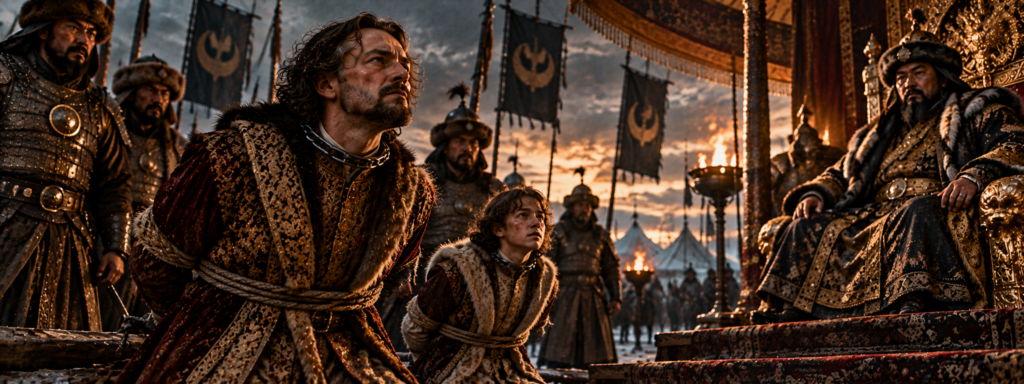
Aleksandr of Tver: The Doomed Grand Prince Who Defied the Golden Horde and Died With His Son
Rebellion, Betrayal, Exile, and the Bloody Struggle Between Tver and Moscow
Aleksandr Mikhailovich of Tver (c. 1301–29 October 1339) was a prince of the Rurikid dynasty who ruled Tver from 1326 to 1327 and again from 1338 to 1339, and held the title of Grand Prince of Vladimir from 1326 to 1327. He was the son of Mikhail Yaroslavich of Tver and Anna of Rostov, later venerated as Anna of Kashin, and the brother of Dmitry Mikhailovich, known as Dmitry the Fearsome Eyes. His political career unfolded during the bitter rivalry between Tver and Moscow for supremacy in northeastern Rus’, a struggle made especially dangerous by the authority of the Golden Horde. After an anti-Horde uprising erupted in Tver in 1327, Aleksandr fled a devastating punitive campaign and spent years in exile, including a period under the protection of Lithuania. He eventually sought reconciliation with Khan Uzbeg and briefly regained his hereditary principality, but his return did not end the hostility between Tver and Moscow. In 1339, Aleksandr and his son Fyodor were summoned to the Horde, where they were executed on 29 October, traditionally described in the chronicles as a particularly brutal killing. Their deaths marked another catastrophe for the ruling house of Tver and strengthened the political ascendancy of Moscow.
The Father and Son Who Never Came Home
By the autumn of 1339, Aleksandr Mikhailovich had already survived more political disasters than most medieval princes could have imagined. His father had been executed by the Golden Horde, his elder brother had suffered the same fate, and his own principality had been devastated by a punitive expedition that forced him into years of exile. He had fled across political frontiers, sought protection from powerful rulers, and eventually returned to the authority of the khan in the hope of recovering his position. For a brief period, that gamble appeared to have succeeded.
Now he was back at the Horde, and the protection he had sought was about to become the instrument of his destruction. His son Fyodor was with him, a young member of the dynasty whose future should have represented the continuation of the family line. Instead, father and son faced a judgment that would remove them both from the political world. Their executions on 29 October 1339 became one of the darkest episodes in the long struggle between Tver and Moscow.
The precise circumstances of their final hours are preserved through medieval chronicles rather than independent eyewitness testimony. Some accounts describe the executions with horrifying physical detail, presenting the deaths as acts of exceptional cruelty. Such descriptions belong to a historical tradition shaped by political allegiance, religious interpretation, and the desire to commemorate murdered princes. The central facts, however, are not in serious doubt: Aleksandr and Fyodor were killed under the authority of Khan Uzbeg, and their deaths were politically devastating for Tver.
For Aleksandr, the tragedy was intensified by the history of his family. His father, Mikhail Yaroslavich, had died in 1318 after accusations arising from his conflict with Moscow. His brother Dmitry had been executed in 1326 after murdering Yuri Danilovich of Moscow at the khan’s court. Aleksandr had inherited their struggle, their enemies, and the dangerous political system that had destroyed them.
What made his fate especially cruel was that he had tried to escape the pattern. He had fled rather than submit to destruction, sought refuge among foreign rulers, and eventually returned to the Horde through an act of political reconciliation. Yet neither exile nor submission could guarantee his survival. The dynasty’s third major execution in just over twenty years would leave Tver mourning another ruler and Moscow enjoying another advantage.
To understand how Aleksandr reached that terrible ending, it is necessary to return to the world into which he was born. It was a world where princes inherited territories, titles, and blood feuds, but rarely inherited security. The ruler who seemed powerful one year might be a prisoner the next, and the decisions of a distant khan could determine the future of an entire principality. Aleksandr’s life would become a devastating illustration of that reality.
A Prince Born Into the Shadow of the Mongol Conquest
Aleksandr was born around the beginning of the fourteenth century, probably about 1301, into the ruling dynasty of Tver. His father, Mikhail Yaroslavich, was among the most important princes of northeastern Rus’, and his mother, Anna, came from the aristocratic world of Rostov. The family belonged to the Rurikid dynasty, whose numerous branches had ruled the lands of Rus’ for centuries. Their ancestry gave them prestige, but it also placed them within a political system notorious for disputes over succession, territory, and seniority.
The Mongol conquest of the thirteenth century had transformed the region long before Aleksandr’s birth. Cities had been devastated, armies defeated, and the surviving princes compelled to recognize the authority of the rulers of the Golden Horde. By Aleksandr’s lifetime, the immediate destruction of the conquest had given way to a more established arrangement of tribute, political dependence, and negotiated authority. The princes continued to govern their own lands, but their freedom was constrained by the khan’s power.
This arrangement created a strange political landscape. A prince might possess fortifications, armed retainers, wealthy towns, and a respected lineage, yet still require recognition from the Horde to claim the most prestigious titles. Rival rulers traveled to the khan’s court to present accusations, defend their interests, and seek appointments. The result was a system in which local dynastic conflicts could become matters of imperial judgment.
The title of Grand Prince of Vladimir was particularly important. It carried the prestige of senior authority among the princes of northeastern Rus’ and was awarded through the khan’s recognition. Its possession did not make a ruler an independent monarch in the modern sense, but it conferred significant political standing. The competition for this title would dominate Aleksandr’s family history.
Tver was a formidable participant in that competition. Situated along important waterways, the principality had grown in wealth and influence during the preceding decades. Its rulers possessed military resources, political connections, and an increasingly strong sense of dynastic importance. At the beginning of the fourteenth century, Tver was a credible contender for leadership in northeastern Rus’.
Its principal rival was Moscow. The Moscow princes were expanding their territories and cultivating relationships that would eventually prove decisive. Their later triumph can make the earlier rivalry appear unequal, but that was not how the situation looked during Aleksandr’s childhood. Tver possessed advantages that Moscow could not simply ignore.
The young prince therefore grew up in a household where political ambition was inseparable from danger. His father was struggling to maintain the family’s position, while Moscow sought to challenge it. Decisions made at the Horde could strengthen or destroy either side. Aleksandr would inherit a world in which family loyalty, political calculation, and survival were closely connected.
The House of Tver and Its Dangerous Ambitions
Mikhail Yaroslavich had become Prince of Tver in the late thirteenth century and secured recognition as Grand Prince of Vladimir in 1304. His position made him one of the leading rulers of northeastern Rus’. He possessed a strong dynastic claim and governed a principality whose growing influence threatened the ambitions of Moscow. His success also placed his family at the center of a dangerous political rivalry.
Aleksandr was one of several sons born to Mikhail and Anna. His brothers included Dmitry, later known as the Fearsome Eyes, and Konstantin, who would also become involved in the succession struggles of Tver. Their family relationships mattered because princely authority was transmitted through dynastic claims that could be contested by relatives and rivals. The deaths or displacement of senior family members could rapidly change the political prospects of younger sons.
The household’s political environment was shaped by Mikhail’s rivalry with Yuri Danilovich of Moscow. Yuri had inherited Moscow in 1303 and pursued the grand princely title with determination. His ambitions threatened Mikhail’s authority and created a conflict that extended beyond personal dislike. Both men sought recognition as the leading prince of northeastern Rus’.
The rivalry drew in the Golden Horde, whose approval could determine the outcome. Yuri cultivated the favor of Khan Uzbeg and strengthened his position through marriage to Konchaka, the khan’s sister. The marriage connected Moscow’s ruler to the Horde’s ruling family and increased the political danger facing Tver. Mikhail could defeat Yuri militarily and still find himself vulnerable at the khan’s court.
Aleksandr’s childhood and adolescence unfolded against this background of escalating conflict. The surviving chronicles provide little information about his private upbringing or personal temperament. They do not allow historians to reconstruct his education, childhood friendships, or early political conversations. What can be established is that he belonged to a family whose future depended upon the struggle with Moscow.
His mother, Anna, would later become one of the most poignant figures in the family’s history. She lived through the executions of her husband and several descendants, eventually entering religious life and becoming associated with traditions of endurance and sanctity. Her later veneration as Anna of Kashin reflected the extraordinary suffering that marked her household. Aleksandr’s life formed one of the central chapters in that tragedy.
The dynasty’s ambitions were substantial, but so were the risks. The family believed it possessed a legitimate claim to the grand princely title, and its rulers repeatedly sought to defend that position. Moscow’s competing claims threatened both their prestige and their political future. Aleksandr would eventually inherit a struggle that had already consumed two of the men closest to him.
The Battle That Led to His Father’s Execution
The conflict between Tver and Moscow reached a major turning point in December 1317 at the Battle of Bortenevo. Yuri Danilovich, supported by forces associated with the Horde, confronted Mikhail Yaroslavich. The battle ended in a victory for Tver, demonstrating that Mikhail remained a powerful military ruler. Yet the triumph created circumstances that would ultimately destroy him.
Among those captured after the battle was Konchaka, Yuri’s wife and the sister of Khan Uzbeg. Her presence among the prisoners transformed the political significance of the confrontation. A woman connected to the Horde’s ruling family was now in the custody of the prince whom Yuri sought to displace. The situation was dangerous even before her subsequent death.
Konchaka died while being held by Mikhail’s side. The cause of her death is not securely established, and the surviving evidence does not prove that Mikhail ordered her poisoning. Yuri nevertheless accused his rival of responsibility, presenting the death as a serious offense against the khan’s family. Other allegations concerning tribute and obedience accompanied the charge.
The accusations placed Mikhail in an almost impossible position. Refusing to answer the khan’s summons could expose Tver to a punitive expedition, while appearing at the Horde placed him in the hands of his enemies. Later religious accounts emphasize his willingness to face danger rather than risk devastation for his people. Those narratives contain devotional elements, but the political dilemma itself was genuine.
Mikhail traveled to the Horde and was subjected to proceedings that ended in his condemnation. His supporters regarded the accusations as unjust and the judgment as politically motivated. The surviving accounts differ in emphasis and detail, making it difficult to reconstruct every stage of the proceedings. The outcome was unmistakable.
On 22 November 1318, Mikhail Yaroslavich was executed while in the custody of the Golden Horde. Accounts of his death describe humiliating treatment and considerable brutality, although individual details belong to sources shaped by religious commemoration. His death removed Tver’s most important ruler and strengthened the position of Moscow. The political rivalry had now become a family tragedy.
Aleksandr was still a young man when his father died. His elder brother Dmitry inherited Tver, while the family struggled to preserve its position against Moscow. Mikhail’s death became central to the dynasty’s memory and political identity. The accusation that had destroyed him would remain a source of bitterness for years.
The execution also demonstrated the limits of military success. Mikhail had defeated his rival at Bortenevo, but the victory had not secured his political survival. The Horde’s authority proved more decisive than the battlefield result. Aleksandr would encounter the same terrible lesson repeatedly throughout his life.
Dmitry the Fearsome Eyes and the Murder That Changed Everything
After Mikhail’s death, Aleksandr’s elder brother Dmitry became Prince of Tver. Dmitry inherited a principality whose political position had been shaken but not destroyed. He also inherited the family’s grievance against Yuri Danilovich, whose accusations had contributed to the circumstances surrounding Mikhail’s execution. The rivalry continued with increasing bitterness.
Dmitry pursued his family’s interests through the Horde and eventually secured recognition as Grand Prince of Vladimir in 1322. His success represented a significant reversal for Moscow and demonstrated that Tver remained a serious political power. Yuri had lost the prestigious title, but his ambitions had not disappeared. The two rulers continued to compete for influence.
Dmitry’s nickname, the Fearsome Eyes, contributed to his reputation as a severe and intimidating figure. Its precise origin is uncertain, and it should not be treated as reliable evidence of a particular personality. His later actions, however, would ensure that he was remembered as one of the most violent participants in the feud. The killing that ended his political career was extraordinary even by the standards of the period.
In November 1325, Dmitry killed Yuri Danilovich while both were at the court of the Golden Horde. The act was widely understood as vengeance for the execution of Mikhail. The surviving chronicles do not provide a neutral, detailed reconstruction of every moment leading to the killing, but they establish Dmitry’s responsibility. The murder violated the authority of the khan and exposed Dmitry to severe punishment.
Khan Uzbeg ordered Dmitry’s detention. The prince remained in custody for months while his fate was determined. His status as grand prince did not guarantee protection, and the killing of Yuri created a political crisis involving two of the most important dynasties of northeastern Rus’. The Horde could not easily ignore a murder committed within its own political environment.
On 15 September 1326, Dmitry was executed by order of Uzbeg. His death came less than eight years after the execution of his father. The prince who had killed to avenge Mikhail now suffered a similar fate under the authority of the same khan. The cycle of violence had consumed another generation.
For Aleksandr, the consequences were immediate. His elder brother was dead, and the leadership of Tver passed to him. The family had lost two major rulers through executions at the Horde. Aleksandr inherited the principality at a moment when its political future remained deeply uncertain.
The murder of Yuri also left Moscow with its own grievance. Yuri’s relatives could now present themselves as victims of violence committed by the ruling house of Tver. The feud had produced deaths on both sides, and neither dynasty had reason to trust the other. Aleksandr’s reign began under the shadow of a conflict that had become increasingly difficult to contain.
Aleksandr Becomes Grand Prince of Vladimir
Following Dmitry’s execution in 1326, Aleksandr inherited Tver and received recognition as Grand Prince of Vladimir. The appointment demonstrated that the Golden Horde had not permanently abandoned the Tver dynasty. Despite the execution of Dmitry, Aleksandr could still secure the khan’s approval. His accession represented both an opportunity and a serious responsibility.
The grand princely title carried considerable prestige. It placed Aleksandr among the leading rulers of northeastern Rus’ and strengthened his position in relations with neighboring princes. The title also involved obligations toward the Horde, including responsibilities connected to tribute and political obedience. Its advantages were inseparable from dependence upon the khan.
Aleksandr’s political situation was particularly difficult because the recent history of his family was so violent. His father and brother had both been executed under Horde authority. Moscow remained a powerful rival, and Yuri’s death had created another source of hostility. The new grand prince needed to defend Tver while avoiding a confrontation that could provoke further punishment.
The surviving chronicles do not provide a complete picture of Aleksandr’s administration during his brief first reign. They focus instead on the dramatic events that soon overwhelmed his position. It is therefore difficult to assess his policies, financial decisions, or relationships with local elites in detail. His historical reputation became dominated by the uprising of 1327.
The appointment nevertheless shows that Aleksandr was not simply a fugitive or rebel from the beginning of his career. He initially operated within the political system established by the Horde. He accepted the grand princely title and governed under the khan’s recognition. His later exile resulted from a crisis that transformed his position.
Tver remained a substantial principality with a strong sense of political identity. Its ruling dynasty had suffered terrible losses, but its ambitions had not disappeared. Aleksandr’s recognition suggested that the family might recover from the executions of Mikhail and Dmitry. For a brief period, the future remained open.
That possibility would collapse within a year. The arrival of a Horde representative in Tver would provoke a violent confrontation whose consequences were devastating. Aleksandr’s first reign would end not through an ordinary succession dispute but through an uprising that brought the wrath of the Horde upon his principality. The prince who had just secured the grand princely title would soon be forced to flee for his life.
The Arrival of Chol-khan: Fear Inside the City
In 1327, a Horde official commonly identified as Chol-khan, also known in some traditions as Shevkal, arrived in Tver with an armed entourage. He was associated with the ruling family of the Horde, and his presence carried considerable political weight. The arrival of such a figure was not unusual within the broader system of Horde overlordship. Yet in Tver, the visit became the immediate background to a violent uprising.
The surviving accounts describe growing resentment among the inhabitants. Some traditions portray Chol-khan and his followers as behaving arrogantly, seizing property, and mistreating local people. Other elements of the narratives contain religious and political accusations that are difficult to verify independently. The sources were written within a world where hostility toward Horde officials could be expressed through dramatic descriptions of oppression.
One particularly important tradition claimed that Chol-khan intended to seize power in Tver and impose Islam upon its inhabitants. Historians must treat this allegation cautiously because it reflects the fears and polemical language of the sources rather than a securely established policy. The surviving evidence does not prove that such a conversion campaign was planned. Nevertheless, the rumor illustrates the atmosphere of suspicion surrounding the Horde’s presence.
The city was already burdened by years of political conflict. Its rulers had been executed, its position challenged, and its inhabitants exposed to the demands of tribute and external authority. The arrival of an armed Horde entourage could therefore become a focus for accumulated resentment. Tension did not require every rumor to be true.
Aleksandr’s precise relationship with Chol-khan is difficult to reconstruct. As grand prince, he was expected to maintain order and fulfill obligations toward the Horde. At the same time, he governed a population whose hostility toward the visiting officials was increasing. His position placed him between imperial authority and local anger.
Later accounts differ over the degree to which Aleksandr encouraged, tolerated, or attempted to restrain the uprising that followed. Some narratives portray him as a participant in resistance, while others suggest that events moved beyond his control. The evidence does not permit a confident reconstruction of his intentions before the violence began. What is certain is that the uprising occurred during his rule and destroyed his political position.
The crisis also revealed how fragile the relationship between the Horde and its subordinate principalities could become. Tribute obligations and political recognition depended upon a degree of cooperation. Armed officials could enforce authority, but their presence could also provoke resentment. In Tver, that resentment was about to erupt.
August 1327: The Day Tver Rose in Blood
The uprising in Tver erupted on 15 August 1327, a date associated in the chronicles with the Feast of the Dormition. The immediate trigger is traditionally described as a confrontation involving Horde men attempting to seize a horse from a local deacon named Dudko. The incident escalated into violence and became the spark for a much wider attack. The precise details come from chronicle traditions, but the outbreak of a major anti-Horde revolt is well established.
The story of the horse is striking because of its apparent simplicity. A dispute over an animal became the catalyst for a confrontation involving an entire city. Such incidents could acquire enormous significance when they occurred within an atmosphere of accumulated anger. The people of Tver were not responding merely to one alleged seizure but to a broader political and social tension.
As the fighting spread, inhabitants attacked members of Chol-khan’s entourage. The violence escalated beyond the initial confrontation and became a general assault upon the Horde presence in the city. The chronicles describe the killing of numerous members of the visiting party. The uprising was no longer a local disturbance that could easily be contained.
Chol-khan and some of his followers reportedly sought refuge in a building associated with the princely residence. According to the traditional account, the building was set on fire, killing those inside. The episode became one of the most memorable and brutal details of the revolt. Although individual narrative elements require caution, the destruction of Chol-khan’s party was central to the crisis.
The uprising represented a direct challenge to the authority of Khan Uzbeg. A prominent Horde representative had been killed, along with members of his entourage, in a principality governed by a ruler who held the grand princely title. The event could not be treated as an ordinary dispute between local inhabitants and visiting officials. It threatened the political relationship through which the Horde controlled northeastern Rus’.
Aleksandr’s role remains one of the most contested aspects of the episode. Some accounts imply that he supported or encouraged the uprising, while others suggest that he was unable to prevent it. The surviving sources do not establish that he personally organized the violence. The distinction matters because later political accusations could benefit from portraying him as the leader of a deliberate rebellion.
Whatever his intentions, Aleksandr was held politically responsible for what had happened in his capital. As ruler of Tver, he was expected to maintain order and protect representatives of the Horde. The killing of Chol-khan made his position almost impossible. He now faced the prospect of punishment from a ruler whose authority had already cost his family two lives.
The uprising also created an opportunity for Moscow. Ivan Danilovich, later known as Ivan Kalita, could present himself as a reliable supporter of the Horde against a rebellious rival. The destruction of Chol-khan’s entourage gave the khan a reason to intervene with overwhelming force. Tver’s greatest political competitor was well placed to benefit from the crisis.
For the inhabitants of Tver, the immediate violence may have appeared to be an act of resistance against hated officials. Yet the consequences would be catastrophic. The Horde possessed the military resources to punish the city and its surrounding territory. The uprising that began with local anger would soon bring devastation upon the entire principality.
The Punitive Expedition: Moscow Helps Destroy Tver
Khan Uzbeg responded to the uprising by authorizing a punitive campaign against Tver. The expedition involved Horde forces and Rus’ princes who cooperated with the khan, including Ivan Danilovich of Moscow. The campaign is sometimes associated in historical tradition with a force of approximately fifty thousand men, although such numerical claims should be treated cautiously. Medieval sources frequently used large figures to emphasize the scale of military operations.
The political significance of Moscow’s participation was enormous. Ivan was not merely observing the destruction of a rival principality. He was cooperating with the authority that had condemned the uprising and ordered punishment. His participation strengthened his relationship with the Horde while weakening Tver.
The campaign devastated the principality. Settlements were attacked, property destroyed, and inhabitants subjected to the violence associated with punitive warfare. The chronicles describe widespread destruction and suffering. Although the exact scale of the losses cannot be calculated reliably, the political and economic damage was severe.
Aleksandr could not effectively resist the expedition. The combined strength of Horde forces and their allies placed him at an overwhelming disadvantage. His earlier recognition as grand prince offered no protection now that he was associated with rebellion. The title that had elevated him had become politically meaningless.
The prince fled rather than remain to face capture. His departure marked the collapse of his first reign in Tver. The city and its surrounding lands were left to endure the consequences of the uprising. Aleksandr’s political future now depended upon finding refuge beyond the immediate reach of the Horde.
The campaign also transformed the rivalry between Tver and Moscow. Moscow had gained an opportunity to present itself as a dependable partner of the khan. Tver, by contrast, had become associated with disorder and rebellion. The political balance shifted sharply in Moscow’s favor.
Ivan Kalita’s cooperation with the Horde would become a major element in Moscow’s rise. He demonstrated that his principality could help maintain the political order desired by the khan. Such cooperation brought advantages that military confrontation could not easily match. Tver’s suffering created opportunities for its rival.
The destruction of 1327–1328 became one of the defining disasters in Tver’s history. The principality had already lost two rulers through executions, and now its capital had become the center of a revolt followed by punitive devastation. Aleksandr survived, but his survival required exile. The dynasty’s struggle had entered a new and desperate phase.
Flight From Tver: A Prince Without a Principality
After the punitive campaign, Aleksandr fled from Tver and sought refuge beyond the immediate control of the Horde. His first destination was associated with the northwestern political world of Rus’, including Pskov, where he found support. The details of his movements are preserved unevenly, but his exile became a prolonged and politically significant episode. He was now a prince without secure possession of his hereditary territory.
Pskov occupied a distinctive position within the political landscape. Its institutions and relationships differed from those of the principalities of northeastern Rus’. The city maintained important connections with Novgorod and the wider Baltic region. Its political autonomy made it a possible refuge for a displaced ruler.
Aleksandr’s presence created difficulties for the city. Protecting a prince who had fallen into disgrace with the Horde could invite pressure from more powerful neighbors. The rulers of Moscow and other political authorities had reasons to seek his removal. Pskov therefore became entangled in a conflict that extended far beyond its own territory.
The exiled prince possessed valuable dynastic connections and political experience, but he also carried considerable danger. His association with the uprising in Tver made him vulnerable to demands for punishment. Any city sheltering him risked being accused of defying the Horde’s authority. His personal survival could threaten the security of his hosts.
The chronicles preserve accounts of pressure placed upon Pskov to surrender or expel Aleksandr. Religious and political authorities became involved in efforts to resolve the situation. The precise sequence of these negotiations is complicated, but the broader issue is clear. Aleksandr’s refuge could not be separated from the struggle between Moscow, Tver, and the Horde.
His exile also illustrates the limits of princely status. Aleksandr had recently held the grand princely title, yet he now depended upon the protection of others. He could not simply command his former subjects or return safely to his capital. His political identity remained important, but his practical power had been severely reduced.
The situation would eventually push him toward Lithuania. The growing Lithuanian state offered possibilities that the cities of Rus’ could not always provide. Its rulers were powerful enough to offer protection and possessed their own interests in the politics of eastern Europe. Aleksandr’s search for safety would therefore become part of a larger diplomatic struggle.
For the displaced prince, exile was not merely a period of inactivity. It involved negotiations, alliances, and attempts to preserve his family’s political future. He remained a potential claimant to Tver and a figure of interest to Moscow’s opponents. His enemies could not assume that his departure had permanently removed him from the contest.
Pskov: The City That Sheltered a Fugitive Prince
Pskov became an important refuge for Aleksandr after his flight from Tver. The city was accustomed to navigating the competing interests of neighboring powers, including Novgorod, Lithuania, and the princes of Rus’. Its political circumstances allowed a displaced ruler to find support outside the immediate control of Moscow. Yet sheltering Aleksandr created serious risks.
The prince’s presence gave Pskov a connection to the powerful dynasty of Tver. He possessed experience in warfare and political affairs, and his lineage gave him considerable prestige. At the same time, he was a fugitive associated with a rebellion that had provoked the Horde’s anger. His protection could become a cause of conflict.
Moscow had strong reasons to oppose Aleksandr’s continued freedom. As long as he remained alive and politically active, he represented a possible rallying point for Tver’s supporters. His return could threaten the advantages Moscow had gained after the punitive campaign. Removing him from Pskov would therefore serve Moscow’s interests.
Pressure on Pskov involved both political and ecclesiastical channels. The chronicles describe efforts to compel the city to abandon Aleksandr, including religious sanctions associated with the dispute. These accounts reflect the close relationship between church authority and princely politics. Religious institutions could become involved in conflicts that were fundamentally political.
Aleksandr’s position was therefore precarious even among those who offered him shelter. He could not demand that Pskov sacrifice its security indefinitely. The city had its own interests and could not ignore pressure from more powerful neighbors. The prince’s survival required a solution that would protect both him and his hosts.
The episode also reveals the complexity of the political landscape. The Golden Horde exercised overlordship over northeastern Rus’, but its influence was mediated through local rulers and institutions. Cities such as Pskov possessed room for independent action, although that freedom was constrained by external pressure. Aleksandr attempted to use these political spaces to remain beyond the reach of his enemies.
His stay in Pskov became part of a larger story of displacement and resistance. He had lost Tver, but he had not surrendered his dynastic identity. His presence remained politically significant because he could still claim a role in the future of his principality. Moscow’s efforts to isolate him demonstrated that he was not regarded as harmless.
Eventually, the pressure surrounding his refuge contributed to his movement toward Lithuania. The exiled prince needed a protector with sufficient power to resist demands from his enemies. Lithuania offered that possibility. The next stage of his life would place him under the protection of one of the most ambitious rulers in eastern Europe.
Lithuania: Refuge Under a Rising Power
Lithuania was becoming a major political force during Aleksandr’s lifetime. Under Grand Duke Gediminas, its influence expanded across a wide region inhabited by diverse peoples and religious communities. The Lithuanian state possessed military resources and diplomatic connections that made it an important participant in the politics of Rus’. For an exiled prince of Tver, it offered a possible refuge beyond the immediate reach of Moscow.
Aleksandr’s family already possessed connections to Lithuania. His brother Dmitry had married Maria, a daughter of Gediminas, strengthening the relationship between the two ruling houses. Such dynastic ties could provide opportunities for political support. They also made Lithuania a natural place for Aleksandr to seek protection.
The relationship between Tver and Lithuania was not simply a matter of friendship. Both powers had interests that could bring them into conflict with Moscow. Lithuania’s rulers sought influence over territories connected to the wider Rus’ political world. Supporting a displaced prince of Tver could serve their strategic ambitions.
Aleksandr’s exile therefore became part of a broader contest for regional influence. Moscow was strengthening its relationship with the Horde, while Lithuania offered an alternative source of political protection. The prince’s presence at the Lithuanian court had implications beyond his personal safety. He remained a potential claimant whose return could affect the balance of power.
The surviving sources do not provide a detailed account of Aleksandr’s daily life in Lithuania. They do not establish his private conversations with Gediminas or the precise terms of every agreement. It would be misleading to invent scenes of elaborate court intrigue without evidence. What can be said is that Lithuanian protection allowed him to survive during a period when returning to Tver would have been dangerous.
Exile also gave Aleksandr time to reconsider his position. He had lost his principality through a rebellion that brought overwhelming retaliation. His enemies had gained influence, but his dynastic claim remained. The possibility of returning to Tver had not disappeared entirely.
Lithuania’s protection could not by itself restore his authority. The Golden Horde still possessed decisive influence over the grand princely title and the political position of Tver. Any durable return would require some accommodation with the khan. Aleksandr therefore faced a difficult choice between continued exile and reconciliation with the authority that had punished his principality.
His eventual decision would be one of the most consequential of his life. He would seek the khan’s forgiveness and attempt to recover his hereditary lands. The gamble offered a path back to power, but it also placed him once again within reach of the political system that had destroyed his father and brother. The apparent promise of restoration concealed the danger of another fatal judgment.
The Long Road Back to Tver
Aleksandr’s exile lasted for years, during which the political position of Tver continued to change. His brother Konstantin became involved in the governance of the principality, while Moscow strengthened its influence through cooperation with the Horde. The family remained politically important, but Aleksandr’s absence weakened his personal authority. His return would require more than a simple declaration of hereditary right.
The political landscape had changed significantly since the uprising of 1327. Ivan Kalita had gained advantages from the punitive campaign and cultivated the khan’s favor. Moscow’s resources and prestige were increasing. Tver, meanwhile, had suffered devastation and the loss of its ruler.
Aleksandr could not ignore these developments. Continued exile preserved his life but offered limited prospects for restoring his position. Lithuania could protect him, yet it could not guarantee recognition from the Horde. A return to Tver required accommodation with the authority that had condemned the uprising.
The prince eventually sought reconciliation with Khan Uzbeg. The surviving accounts describe his submission and request for forgiveness, although the precise details of the negotiations vary. His decision represented a remarkable reversal from the circumstances of his flight. The man associated with rebellion now sought restoration through the khan’s mercy.
Uzbeg accepted the reconciliation, and Aleksandr was permitted to return to Tver in 1338. The decision demonstrated the flexibility of Horde politics. A prince who had fallen into disgrace could sometimes recover favor when circumstances changed. The khan’s authority included the power to forgive as well as punish.
For Aleksandr, the return must have represented a major political achievement. He had survived exile and regained access to his hereditary principality. His family could once again hope to exercise direct authority in Tver. The years of displacement appeared to be ending.
Yet the restoration was incomplete. Aleksandr recovered Tver, but the grand princely title remained associated with Moscow’s political ascendancy. His enemies had not disappeared, and his return created new reasons for suspicion. The prince had regained a foothold in his homeland without recovering the full position he had once held.
The danger was especially serious because his reconciliation depended upon the khan’s continuing favor. Uzbeg had accepted his submission, but the decision could be reconsidered. Political accusations could once again become fatal. Aleksandr had returned to power, but he had not escaped the system that controlled his fate.
A Dangerous Homecoming
Aleksandr returned to Tver in 1338 after years of exile. His restoration marked a significant moment for the ruling dynasty, which had suffered repeated executions and political reversals. The prince had survived the consequences of the uprising and secured permission to resume authority in his hereditary lands. Yet his homecoming occurred in a principality that had changed profoundly during his absence.
The devastation of the punitive campaign had weakened Tver’s political and economic position. Moscow had gained influence, and Ivan Kalita had become an increasingly important figure in northeastern Rus’. Aleksandr’s return therefore did not restore the balance that had existed before 1327. He was coming back to a more dangerous political world.
His relationship with his own family also required adjustment. Konstantin had exercised authority in Tver during Aleksandr’s absence, and the succession arrangements were complicated by the competing claims of different branches of the dynasty. The surviving sources do not provide a complete picture of every negotiation surrounding the restoration. Nevertheless, Aleksandr’s return affected the political interests of relatives as well as rivals.
The restored prince also faced the challenge of rebuilding his authority among local elites. Years of exile could weaken relationships with boyars, military retainers, and religious institutions. His supporters might welcome him, but others had adapted to the political arrangements established during his absence. A successful restoration required careful management of these competing interests.
Moscow had particular reasons to distrust the development. Aleksandr remained a member of the dynasty that had long challenged Moscow for the grand princely title. His Lithuanian connections could make him a useful ally for Moscow’s opponents. His return therefore threatened to revive a rivalry that Ivan Kalita had worked to contain.
The khan’s decision to forgive Aleksandr did not eliminate these concerns. Recognition from the Horde could be influenced by new accusations or changing political circumstances. Ivan had experience in cultivating the khan’s favor and defending Moscow’s interests. The restored prince could not assume that his enemies would accept his return quietly.
The brief period of Aleksandr’s restored rule is poorly documented compared with the dramatic events surrounding his exile and execution. The chronicles do not allow a detailed reconstruction of his administrative policies or daily activities. His second reign lasted too little time to produce a clear record of long-term achievements. Its historical significance lies primarily in the political crisis that followed.
Within approximately a year, Aleksandr would again be summoned to the Horde. The return that had seemed to promise safety would end in captivity and death. His final political gamble had brought him back within reach of the authority he had once fled. The consequences would be irreversible.
Ivan Kalita: The Rival Who Never Forgot
Ivan Danilovich of Moscow, known as Ivan Kalita, was one of the most important figures in Aleksandr’s political downfall. He had emerged as a leading ruler after the death of his brother Yuri and had strengthened Moscow through careful cooperation with the Horde. His policies emphasized the accumulation of resources, political influence, and the cultivation of the khan’s favor. These methods proved highly effective in the competitive world of northeastern Rus’.
Ivan’s relationship with Aleksandr was shaped by the long feud between their dynasties. Aleksandr’s father had been executed after a conflict with Yuri, and his brother Dmitry had murdered Yuri at the Horde. Ivan therefore had both political and familial reasons to oppose the ruling house of Tver. The rivalry was not merely a contest between neighboring territories.
The uprising of 1327 had given Ivan a decisive opportunity. By cooperating with the Horde’s punitive campaign, he strengthened Moscow’s position while Tver suffered devastation. The consequences helped shift the regional balance of power. Aleksandr’s exile removed a dangerous rival from the immediate political arena.
The prince’s return in 1338 threatened to disturb that arrangement. Aleksandr retained a hereditary claim to Tver and connections with Lithuania. His restoration could provide a foundation for renewed opposition to Moscow. Ivan therefore had reasons to view the development with concern.
The chronicles associate Ivan with political efforts that contributed to Aleksandr’s final summons and execution. Some traditions portray him as actively denouncing the prince to Uzbeg, while the precise content and influence of his accusations remain difficult to establish independently. It would be too simple to claim that Ivan personally ordered the killing. The authority to execute Aleksandr belonged to the khan.
Nevertheless, Moscow benefited from the outcome. Aleksandr’s death removed a rival who had demonstrated the ability to survive exile and recover his principality. The execution also eliminated his son Fyodor, weakening the dynasty’s immediate future. The political consequences strengthened Ivan’s position.
Ivan’s success reflected a different approach to the Horde from that associated with the uprising in Tver. He sought to work within the khan’s political system and use its authority to strengthen Moscow. His rivals sometimes attempted resistance or sought alternative alliances. The contrast was not absolute, but it became important in the struggle for regional dominance.
The rivalry between Ivan and Aleksandr therefore reveals the ruthless logic of the period. A prince did not need to defeat his enemy in open battle if he could undermine him at the khan’s court. Accusations and political influence could be as dangerous as armies. Aleksandr’s family had already learned that lesson through the deaths of Mikhail and Dmitry.
The Final Summons to the Horde
In 1339, Aleksandr was summoned to the court of Khan Uzbeg. His son Fyodor accompanied him, placing two generations of the Tver dynasty within the khan’s reach. The summons followed a period of renewed political tension after Aleksandr’s restoration. The surviving accounts connect the crisis to accusations and rivalry involving Moscow, although the precise proceedings are not fully documented.
For Aleksandr, the summons must be understood against the history of his family. His father had traveled to the Horde and been executed in 1318. His brother Dmitry had been detained and executed there in 1326. Aleksandr himself had fled the Horde’s wrath after the uprising of 1327. Returning to the khan’s court therefore involved extraordinary danger.
Yet refusal was not a simple option. Aleksandr had regained Tver through reconciliation with Uzbeg, and his political position depended upon the khan’s favor. Defying a summons could provide grounds for renewed punishment against his principality. The same dilemma that had confronted his father now confronted him.
The presence of Fyodor added another layer of tragedy. A son accompanying his father to a political court was not unusual in dynastic affairs, but it exposed the younger prince to the consequences of the dispute. Fyodor represented the continuation of Aleksandr’s branch of the family. His death would therefore have consequences beyond the immediate removal of his father.
The sources do not provide a reliable account of every conversation or negotiation that occurred after their arrival. They do not establish the exact words spoken by Aleksandr or the private deliberations of Uzbeg. Later narratives may supply dramatic details, but those should be treated cautiously. The historical outcome is clear.
Aleksandr and Fyodor were condemned to death. The decision demonstrated that the reconciliation of 1338 had not secured lasting protection. Whatever political calculations had supported Aleksandr’s restoration were now outweighed by the khan’s decision to eliminate him. The prince’s final attempt to preserve his position had failed.
The execution also revealed the continuing influence of Moscow. Ivan Kalita’s political position had strengthened, and the removal of Aleksandr served Moscow’s interests. The extent of Ivan’s direct responsibility remains a matter of historical interpretation. The authority for the killing, however, rested with Uzbeg.
The final summons therefore brought together the central forces of Aleksandr’s life. His dynastic claim, the rivalry with Moscow, the authority of the Horde, and the vulnerability of his family all converged at the khan’s court. The prince who had escaped destruction in 1327 would not escape it in 1339. His son would share his fate.
October 29, 1339: The Execution of Aleksandr and Fyodor
Aleksandr Mikhailovich and his son Fyodor were executed on 29 October 1339 at the court of the Golden Horde. The deaths were ordered under the authority of Khan Uzbeg, whose political decisions had already shaped the fortunes of the Tver dynasty for decades. Aleksandr had returned to the Horde after securing reconciliation and restoration, but the protection he had sought proved temporary. His final journey ended in the destruction of both himself and his son.
The chronicles describe the executions with particular brutality. Some accounts state that father and son were cut apart or dismembered, emphasizing the horror of their deaths. Such descriptions became important in the later memory of the event, but the precise method of execution is not independently verifiable in every detail. The deliberate killing of both princes is the securely established fact.
The death of Fyodor was especially significant because it extended the punishment beyond Aleksandr himself. The younger prince had not been the ruler associated with the uprising of 1327. His execution removed a member of the next generation of the dynasty. The decision therefore carried implications for succession and the future of Aleksandr’s family line.
Aleksandr’s death completed a remarkable sequence of dynastic catastrophes. His father Mikhail had been executed in 1318, and his brother Dmitry in 1326. Now Aleksandr and Fyodor died in 1339. The family had lost leading members across three generations through political violence associated with the Horde.
The execution also represented the failure of Aleksandr’s strategy of reconciliation. He had survived exile, returned to the khan’s favor, and recovered Tver. Yet his restoration depended upon a political authority capable of reversing its decisions. The same ruler who permitted his return ultimately ordered his death.
For Moscow, the outcome removed a dangerous rival. Aleksandr had possessed a strong dynastic claim, experience in political struggle, and connections with Lithuania. His continued existence offered the possibility of renewed opposition to Ivan Kalita. His execution reduced that threat.
For Tver, the loss was devastating. The principality had already suffered military destruction and repeated disruptions of leadership. Aleksandr’s death removed a ruler who had demonstrated resilience and political determination. The execution of Fyodor further weakened the family’s prospects.
The event was not an assassination in the narrow sense of a secret murder carried out by conspirators. It was a political execution ordered by the khan after a struggle involving accusations, dynastic rivalry, and the legacy of rebellion. That distinction does not lessen its importance within the history of rulers deliberately killed for political reasons. Aleksandr’s death was an act of state violence with consequences for the balance of power in northeastern Rus’.
Was Aleksandr Betrayed by Ivan Kalita?
The question of Ivan Kalita’s responsibility has long shaped interpretations of Aleksandr’s death. Moscow’s ruler had clear political reasons to oppose the restoration of his rival. Aleksandr’s return threatened to revive Tver’s ambitions and strengthen connections with Lithuania. His removal benefited Moscow.
Chronicle traditions associate Ivan with accusations made against Aleksandr at the Horde. These accounts have encouraged portrayals of Ivan as the architect of the prince’s destruction. Yet the surviving evidence does not permit a complete reconstruction of the political proceedings. The precise content of the accusations and their influence upon Uzbeg remain uncertain.
It is therefore important to distinguish political responsibility from direct authority. Ivan may have helped create the circumstances that led to Aleksandr’s condemnation, and Moscow undoubtedly benefited from the outcome. The execution itself was ordered under the khan’s authority. Ivan did not possess independent power to execute a grand prince at the Horde.
The distinction is especially important because later historical narratives were shaped by the rivalry between Tver and Moscow. Writers sympathetic to Tver had reasons to emphasize Moscow’s treachery. Moscow-centered traditions could portray the execution as the consequence of Aleksandr’s own political conduct. Both perspectives require careful evaluation.
The political context nevertheless makes Ivan’s hostility unsurprising. His brother Yuri had been murdered by Dmitry of Tver, and Aleksandr belonged to the same ruling family. The uprising of 1327 had given Moscow an opportunity to strengthen its position. Aleksandr’s return threatened to complicate the advantages Ivan had gained.
The relationship between the two rulers was therefore rooted in years of violence and competition. It involved family grievances, the grand princely title, tribute obligations, and the favor of the Horde. Neither side could easily trust the other. The political atmosphere was one in which accusations could become fatal.
Aleksandr’s execution illustrates how dangerous that environment could be. A prince who regained favor with the khan might still be vulnerable to rivals seeking his removal. Political reconciliation did not guarantee lasting security. The court of the Horde remained a place where competing interests could determine life and death.
Whether Ivan was the decisive architect of the execution cannot be established with certainty. His political benefit is clear, but the precise causal chain is less secure. A historically responsible account must preserve that distinction. The tragedy does not require a fully reconstructed conspiracy to be compelling.
The Mother Who Lost Her Husband, Sons, and Grandson
Anna of Kashin, the mother of Aleksandr, became one of the most poignant figures associated with the tragedies of Tver. She had married Mikhail Yaroslavich and witnessed his rise to the grand princely title. She then endured his execution in 1318 and the violent deaths of members of her family. The destruction of Aleksandr and Fyodor added another generation to her losses.
Her husband Mikhail died after accusations arising from the conflict with Yuri of Moscow. Her son Dmitry was executed after killing Yuri in revenge. Aleksandr was driven into exile after the uprising of 1327, returned to Tver, and was eventually executed with his son. The repeated losses created a family history marked by extraordinary suffering.
Anna’s later life became associated with monastic devotion and religious endurance. She entered religious life and was eventually venerated as a saint within the Russian Orthodox tradition. Her reputation developed through accounts emphasizing piety, patience, and perseverance. These devotional narratives should be distinguished from independently documented personal details.
The historical events behind the tradition were nevertheless devastating. Anna lived through the deaths of her husband, sons, and grandson amid a prolonged struggle for political authority. The family that had once possessed a strong claim to leadership in northeastern Rus’ repeatedly lost its most important members. The consequences extended beyond political succession into the lives of those who survived.
Her story also reveals the position of women within medieval ruling families. Dynastic marriages created political connections, but women often bore the consequences of conflicts they did not directly control. The death of a husband or son could transform a household’s position and security. Anna’s life illustrates the human cost of princely ambition.
The later religious memory of Anna emphasized endurance rather than revenge. Her husband and sons had struggled for political power, sometimes through violent means. Her reputation became associated with withdrawal from worldly conflict and spiritual perseverance. The contrast is striking.
The family tragedies also became part of Tver’s historical identity. Mikhail’s death was commemorated through religious tradition, while Aleksandr’s execution remained a symbol of the principality’s suffering. Anna’s memory connected these events across generations. Her life became a witness to the destruction of a ruling house.
The executions of 1339 therefore had consequences far beyond the political removal of Aleksandr. They deepened the grief of a family already devastated by violence. They weakened the dynasty’s future and reinforced the memory of Tver as a principality repeatedly punished in its struggle with Moscow. Anna’s later veneration preserved an enduring human dimension to that history.
The Fall of Tver’s Great Ambition
Tver had once appeared capable of becoming the leading political center of northeastern Rus’. Its rulers possessed strong dynastic claims, substantial resources, and important military achievements. Mikhail Yaroslavich had held the grand princely title for years, and Dmitry had later recovered it. Aleksandr’s accession in 1326 demonstrated that the family’s ambitions remained alive.
Yet the repeated catastrophes of the early fourteenth century weakened the principality. Mikhail’s execution removed an experienced ruler. Dmitry’s killing of Yuri and subsequent execution disrupted the succession again. The uprising of 1327 brought military devastation and forced Aleksandr into exile.
The execution of Aleksandr and Fyodor in 1339 continued the pattern. The dynasty lost another ruler and a member of the next generation. Tver’s political continuity was repeatedly broken at moments when stable leadership might have strengthened its position. Moscow benefited from these disruptions.
Ivan Kalita’s policies helped consolidate Moscow’s advantages. He cultivated the Horde’s favor, accumulated resources, and strengthened his principality’s political position. His cooperation with the punitive campaign against Tver demonstrated the practical benefits of working within the khan’s system. Moscow’s rise was not inevitable, but its rulers increasingly exploited opportunities created by their rivals’ misfortunes.
The weakening of Tver also altered the broader balance of power. The grand princely title became more closely associated with Moscow, and its rulers gained greater influence over neighboring principalities. The process unfolded gradually and involved many additional developments. Aleksandr’s execution was one important episode within that transformation.
It would be misleading to claim that Tver’s decline resulted solely from the deaths of its rulers. Economic resources, geography, political alliances, and the policies of the Horde all mattered. Moscow possessed advantages that extended beyond the misfortunes of its rival. Nevertheless, the repeated executions of the Tver dynasty were politically consequential.
Aleksandr’s life illustrates the lost possibilities of this period. He had inherited a principality capable of challenging Moscow, secured the grand princely title, survived exile, and regained his hereditary lands. His career demonstrated both the resilience and vulnerability of Tver. His execution removed another opportunity for the dynasty to recover.
The tragedy of Tver was therefore not simply that its rulers lost a competition. It was that their political ambitions repeatedly ended in captivity, exile, and death. The principality remained important, but its claim to regional supremacy was weakened by successive disasters. Aleksandr’s execution became one of the defining moments in that decline.
The Golden Horde’s Power Over Life and Death
Aleksandr’s execution reveals the extraordinary authority exercised by the Golden Horde over the principalities of northeastern Rus’. The khan could recognize rulers, withdraw titles, demand tribute, and order punishment. Local princes retained considerable authority within their territories, but their political status depended upon the Horde’s approval. This dependence created opportunities for advancement and dangers that could prove fatal.
The Tver dynasty experienced both sides of that system. Mikhail secured the grand princely title and later died under Horde authority. Dmitry recovered the title but was executed after killing Yuri. Aleksandr received recognition, lost his position after the uprising, regained Tver through reconciliation, and was eventually executed. Their careers demonstrate the instability of power when ultimate authority rested elsewhere.
The Horde’s political system also encouraged competition among subordinate rulers. Princes could appeal to the khan against their rivals, present accusations, and seek appointments. These practices gave the Horde influence over local disputes and allowed it to manage the balance of power. The same mechanisms could turn dynastic rivalries into lethal political struggles.
Moscow’s rulers proved increasingly effective at navigating this environment. Ivan Kalita cultivated the khan’s favor and used cooperation to strengthen his principality. His policies helped Moscow gain advantages that Tver struggled to match. The contrast between the two principalities became increasingly important.
Aleksandr’s experience also demonstrates the limits of rebellion. The uprising of 1327 was a major act of violence against Horde representatives, but it did not free Tver from external authority. Instead, it provoked a punitive campaign that devastated the principality. The rebellion weakened the very ruler whose position it threatened to defend.
Exile offered Aleksandr temporary safety but not lasting political restoration. Lithuania could protect him, yet it could not guarantee his authority in Tver. To recover his principality, he eventually returned to the Horde and sought forgiveness. His dependence upon the khan remained unavoidable.
The final execution completed the pattern. Aleksandr had attempted resistance, flight, foreign protection, and reconciliation. None of these strategies ultimately secured his survival. The khan’s authority remained decisive.
His death therefore belongs to the broader history of political dependence under the Golden Horde. It illustrates the ways in which local ambition, imperial power, and dynastic rivalry interacted. The prince’s fate was not determined by a single enemy or one isolated accusation. It emerged from a political system in which the struggle for authority could repeatedly end in execution.
A Prince Between Rebellion and Submission
Aleksandr’s political career is often remembered through the contrast between the uprising of 1327 and his later reconciliation with the Horde. At first glance, these events may appear contradictory. He was associated with a rebellion against Horde representatives, yet eventually returned to seek the khan’s forgiveness. The apparent reversal becomes more understandable when viewed through the pressures facing a medieval ruler.
The uprising was not necessarily a carefully planned act of princely resistance. The surviving sources leave Aleksandr’s role uncertain, and the violence may have developed from local tensions beyond his control. As ruler, however, he was held responsible for the consequences. His political position collapsed regardless of his precise intentions.
Flight was therefore a practical response to overwhelming danger. Remaining in Tver could have meant capture and punishment during the punitive campaign. Seeking refuge in Pskov and Lithuania allowed him to survive. His exile preserved the possibility of a future return.
The decision to seek reconciliation was similarly pragmatic. Continued exile offered protection but limited prospects for recovering his hereditary principality. The khan retained the authority to recognize rulers in northeastern Rus’. Aleksandr therefore needed some form of accommodation with Uzbeg if he hoped to regain Tver.
His return in 1338 demonstrated that reconciliation was possible. The Horde could forgive a prince who had previously fallen into disgrace. The political system was flexible enough to permit restoration when circumstances favored it. Aleksandr’s gamble initially succeeded.
The tragedy was that the reconciliation did not endure. Political rivalry continued, and accusations could still undermine his position. The khan’s favor remained conditional. Aleksandr’s return exposed him to the same authority he had once escaped.
His career therefore should not be reduced to a simple story of courage followed by surrender. He was navigating a political environment in which survival required difficult choices. Resistance, exile, and submission were all strategies available to a ruler facing overwhelming external power. None guaranteed success.
Aleksandr’s final fate reveals the limits of those strategies. He survived the immediate consequences of rebellion but died after returning to the Horde. His life was shaped by a series of attempts to preserve his dynasty’s position. The execution of 1339 demonstrated how little security even a restored prince possessed.
Political Execution, Not a Secret Assassination
Aleksandr’s death belongs within the broader history of rulers deliberately killed for political reasons, but it should be classified accurately. He was not murdered by an unknown assassin in a private conspiracy. He was executed under the authority of Khan Uzbeg after a political crisis involving his restoration, accusations, and the rivalry with Moscow. The distinction is essential to understanding the event.
The execution was nevertheless politically motivated. Aleksandr was a ruling prince whose continued existence affected the balance of power in northeastern Rus’. His death removed a rival to Moscow and weakened the dynasty of Tver. The killing of his son Fyodor extended the consequences to the next generation.
The precise reasons for Uzbeg’s final decision remain difficult to reconstruct. The surviving chronicles associate the crisis with political accusations and the influence of Moscow, but they do not provide a complete record of the proceedings. It would be misleading to present every accusation as proven. The khan’s decision may have reflected several political considerations.
The brutality described in the chronicles also requires careful treatment. Accounts of dismemberment and other physical details became part of the memory of the execution. Such descriptions may preserve genuine features of the event, but they were transmitted through sources shaped by political and religious interpretation. The central fact remains the deliberate execution of father and son.
Aleksandr’s death can therefore be included in a broad category of assassinated rulers, regicides, and political executions. His case illustrates the use of state authority to eliminate a politically significant ruler. It also demonstrates how dynastic rivalry could influence decisions made by a superior power. The event was not an ordinary criminal punishment detached from political circumstances.
The execution of Fyodor makes the episode especially disturbing. The younger prince represented the continuation of Aleksandr’s family line. His death removed a potential successor and deepened the dynastic consequences. The killing of both father and son was therefore an act with implications beyond the immediate political dispute.
The broader pattern is unmistakable. Mikhail, Dmitry, and Aleksandr all died under Horde authority within a little more than two decades. Their circumstances differed, but their deaths repeatedly weakened Tver. The dynasty’s struggle for power became inseparable from the danger of execution.
Aleksandr’s story is therefore not one of a mysterious murderer whose identity remains unknown. It is the story of a ruler caught between rebellion, exile, reconciliation, and political judgment. His death was ordered by the khan, and its consequences benefited Moscow. The tragedy lies in the repeated destruction of a dynasty struggling to preserve its place in a changing political world.
The Legacy of a Doomed Dynasty
Aleksandr Mikhailovich left behind a historical reputation shaped by catastrophe. His first reign ended in rebellion and devastation, his exile lasted for years, and his restoration proved brief. His final execution with Fyodor became one of the most memorable episodes in the history of Tver. The prince’s life was marked by repeated attempts to recover a political position that never became secure.
The dynasty’s suffering also contributed to the religious and historical memory of Tver. Mikhail Yaroslavich became associated with martyrdom, while Anna of Kashin was remembered for endurance through extraordinary family losses. Aleksandr’s execution formed part of this wider narrative of suffering. The political history of the principality became inseparable from the memory of its dead rulers.
Moscow’s rise gave the story additional significance. The rivalry between the two principalities was not merely a local feud but part of the process through which northeastern Rus’ developed new political centers. Tver had once possessed a credible claim to leadership. Its repeated disasters helped create opportunities for Moscow.
The Golden Horde remained central to this transformation. Its rulers recognized princes, enforced tribute obligations, and intervened in disputes. The khan’s decisions could strengthen one principality while weakening another. Aleksandr’s execution demonstrated the political consequences of that authority.
The prince’s career also illustrates the difficulty of maintaining independence within a system of external overlordship. He could not simply reject the Horde without risking destruction. Exile offered temporary safety, but restoration required reconciliation. His eventual death showed that even submission did not guarantee protection.
Aleksandr’s personal character remains difficult to reconstruct. The chronicles preserve political events more clearly than private motives. It would be speculative to portray him as either a heroic nationalist rebel or a cowardly ruler who surrendered his principles. His actions reveal a man attempting to preserve his dynasty’s position under extraordinary pressure.
His survival through exile suggests political adaptability and determination. His return to Tver demonstrates that he could negotiate a restoration after years of displacement. Yet his final execution shows the limits of those achievements. The political environment remained too dangerous for his position to become secure.
The legacy of Aleksandr is therefore one of resilience overshadowed by catastrophe. He survived the destruction of his first reign and recovered his principality, only to die at the court of the ruler whose favor he had regained. His son died beside him, deepening the tragedy. The dynasty’s struggle continued, but its hopes of regional supremacy were increasingly diminished.
The Prince Who Escaped the Horde, Only to Die in Its Hands
Aleksandr Mikhailovich of Tver was born into a family that possessed power, prestige, and a dangerous claim to leadership in northeastern Rus’. His father, Mikhail Yaroslavich, had held the grand princely title and challenged Moscow’s ambitions. Yet Mikhail’s execution in 1318 transformed the family’s political struggle into a tragedy that would consume generations. Aleksandr grew up beneath the shadow of that death and inherited a rivalry that had already become inseparable from the authority of the Golden Horde.
His elder brother Dmitry attempted to avenge Mikhail by killing Yuri Danilovich of Moscow in 1325. The murder brought another execution upon the family when Khan Uzbeg ordered Dmitry’s death in 1326. Aleksandr then inherited Tver and received recognition as Grand Prince of Vladimir, briefly restoring the dynasty’s position. For a moment, it appeared that the family might recover from its losses. The uprising of 1327 destroyed that possibility.
The revolt against Chol-khan and his entourage brought overwhelming retaliation. Horde forces, supported by Moscow and other allies, devastated Tver and forced Aleksandr into exile. His flight preserved his life but cost him his principality. The ruler who had recently held the grand princely title became a fugitive dependent upon the protection of Pskov and Lithuania. His political future seemed uncertain, but he refused to disappear from the struggle.
After years of exile, Aleksandr sought reconciliation with Uzbeg and recovered Tver in 1338. His return was a remarkable achievement for a prince who had once fled the khan’s wrath. Yet the restoration depended upon a political authority capable of reversing its decisions. Moscow remained hostile, and the rivalry between the two principalities continued. Within a year, Aleksandr was summoned back to the Horde.
On 29 October 1339, Aleksandr and his son Fyodor were executed under Uzbeg’s authority. The chronicles remembered their deaths as particularly brutal, and the killing of both generations gave the event a devastating dynastic significance. Aleksandr had survived rebellion, military destruction, exile, and political disgrace, but he could not survive the final judgment of the khan. His son shared the punishment, ensuring that the consequences extended beyond the prince himself.
The executions weakened Tver and strengthened the political position of Moscow. Ivan Kalita benefited from the removal of a rival whose return had threatened to revive the ambitions of the Tver dynasty. The deaths also continued a terrible pattern that had already claimed Mikhail and Dmitry. Three major rulers of the family had now died under Horde authority within little more than twenty years. The struggle for the grand princely title had become a succession of funerals.
Aleksandr’s life reveals the cruel instability of political power in medieval Rus’. He could hold a prestigious title, command a principality, and secure recognition from the khan, yet none of these achievements guaranteed safety. He could flee to foreign courts and survive for years beyond the reach of his enemies, but recovering his homeland required returning to the authority he feared. His final fate demonstrated that reconciliation could be as dangerous as rebellion when political favor remained uncertain.
The tragedy also exposes the human cost of dynastic rivalry. Behind the contest for Vladimir stood families repeatedly bereaved by execution, exile, and war. Anna of Kashin lived through the deaths of her husband, sons, and grandson, while Tver endured the destruction of its political ambitions. Moscow’s eventual rise was shaped not only by its rulers’ achievements but also by the disasters suffered by their rivals. Aleksandr’s execution became one of the darkest moments in that transformation.
In the end, Aleksandr of Tver was a prince who spent much of his life trying to escape the fate that had destroyed his family. He inherited a powerful dynasty already wounded by political executions, survived a rebellion that devastated his capital, and endured years of exile before recovering his homeland. His return should have marked the restoration of his fortunes, but the political world that had condemned his father and brother remained unchanged. When he appeared before Khan Uzbeg in 1339, the authority that had permitted his restoration became the instrument of his destruction. His son Fyodor died with him, turning a political execution into another devastating blow against the future of the dynasty. Aleksandr had escaped the Horde’s vengeance once, crossed borders to preserve his life, and returned in the hope of securing peace. He died beneath the power of the same ruler whose forgiveness he had sought, leaving Tver to mourn another generation lost to the struggle for a crown that none of them could safely hold.