
Dmitry the Fearsome Eyes: The Prince Who Avenged His Father and Was Executed by the Golden Horde
Blood Feud, Betrayal, and the Deadly Struggle Between Tver and Moscow for the Grand Principality of Vladimir
Dmitry Mikhailovich of Tver (1299–15 September 1326), remembered as Dmitry the Fearsome Eyes, was a prince of the Rurikid dynasty who ruled Tver from 1318 and held the title of Grand Prince of Vladimir from 1322 until 1326. He was the son of Mikhail Yaroslavich of Tver, the grand prince executed at the court of the Golden Horde in 1318, and Anna of Rostov, later venerated as Anna of Kashin. Dmitry inherited a principality locked in a bitter struggle with Moscow, whose ruler, Yuri Danilovich, had benefited from the accusations that destroyed his father. After securing recognition as grand prince from Khan Uzbeg, Dmitry continued the rivalry over political authority, tribute, and the favor of the Horde. In 1325, while both princes were at the khan’s court, Dmitry killed Yuri in an act widely understood as vengeance for Mikhail’s death. The killing violated the authority of the Horde and exposed Dmitry to the khan’s judgment, despite the political position he had previously secured. After months in custody, he was executed on 15 September 1326, traditionally understood as a punishment ordered by Uzbeg rather than an independently organized assassination. His death, at approximately twenty-six or twenty-seven years of age, became another bloody chapter in the feud between Tver and Moscow and helped shape the political struggle that would eventually establish Moscow as the dominant power of northeastern Rus’.
A Murder at the Khan’s Court
The man Dmitry of Tver wanted dead was standing within the political world that had already destroyed his father. Yuri Danilovich of Moscow had spent years maneuvering for the grand princely title, cultivating the favor of the Golden Horde, and challenging the authority of Tver. His rivalry with Dmitry’s father, Mikhail Yaroslavich, had ended in accusations, captivity, and a brutal execution. Now, in 1325, Yuri found himself confronted by the dead man’s son at the court of Khan Uzbeg, where political disputes could become matters of life and death.
Dmitry was no longer the young prince who had watched his family suffer the consequences of his father’s downfall. He had inherited Tver, challenged Moscow, and secured recognition as Grand Prince of Vladimir, the most prestigious title available to the rulers of northeastern Rus’. Yet political advancement had done nothing to extinguish the grievance that defined his relationship with Yuri. To Dmitry and his supporters, the Moscow prince remained inseparable from the death of Mikhail, whatever the precise degree of Yuri’s responsibility for the judgment that had condemned him.
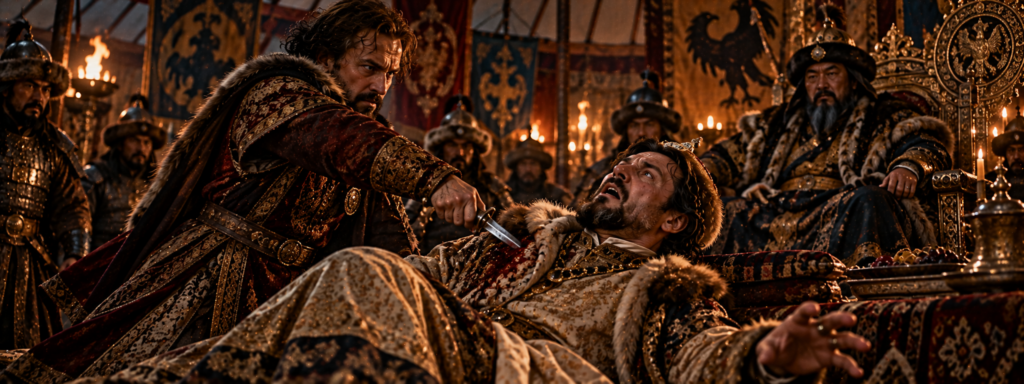
The encounter ended in blood. On 21 November 1325, according to the commonly accepted chronology, Dmitry killed Yuri while they were at the Horde. The surviving chronicles do not provide a neutral, detailed account of every movement or conversation preceding the killing, and later narratives have interpreted the act through the powerful themes of vengeance and dynastic justice. What cannot reasonably be disputed is that Dmitry deliberately killed his principal political rival in a setting where the khan’s authority was supreme.
The consequences were immediate and terrible. Dmitry had eliminated the man associated with his father’s destruction, but he had also committed a killing that Khan Uzbeg could not easily overlook. The Horde’s court was supposed to be a place where subordinate princes submitted their disputes to the khan, not where they settled them by murdering one another. Dmitry had transformed himself from a powerful grand prince into a prisoner whose fate depended upon the very authority that had executed his father.
For months, his life remained suspended between possible mercy and punishment. His princely status, his political connections, and the grievances he had inherited could not guarantee his survival. Uzbeg ultimately ordered his execution, and Dmitry was put to death on 15 September 1326. The prince who had killed to avenge his father died under the authority of the same khan who had condemned that father eight years earlier.
It was a grimly fitting ending to a feud that had consumed two generations. Mikhail of Tver had defeated Moscow in battle and lost his life through proceedings at the Horde. Dmitry had secured the grand princely title and then lost his life after murdering the man he blamed for Mikhail’s destruction. Neither military victory nor revenge had freed the family from the political system in which the khan could raise a prince to power and then order his death.
Born Into a World of Princes, Tribute, and Fear
Dmitry was born in 1299, at a time when the principalities of northeastern Rus’ remained under the overlordship of the Golden Horde. The Mongol conquests of the thirteenth century had transformed the political order of the region, destroying cities, displacing rulers, and forcing surviving dynasties to acknowledge the authority of the khans. Local princes continued to govern their territories, but their independence was limited by tribute obligations and the need for political recognition. The khan’s approval was especially important for anyone seeking the title of Grand Prince of Vladimir.
The world Dmitry inherited was not one of constant, direct occupation by Mongol armies. Rus’ princes administered their own lands, maintained military forces, conducted diplomacy, and competed for influence over neighboring territories. They also traveled to the Horde’s court, sought appointments, negotiated obligations, and sometimes used Horde support against their own relatives. This arrangement created a political system in which local ambitions and imperial authority became dangerously intertwined.
The grand princely title was the central prize in this competition. It carried prestige rooted in the older political traditions of northeastern Rus’ and could provide important advantages in relations with other princes and the Horde. Recognition was normally expressed through a patent of appointment, often called a yarlyk, granted by the khan. A prince who secured the title gained status, but his position remained vulnerable if a rival could persuade the Horde to withdraw its favor.
Dmitry’s father, Mikhail Yaroslavich, was one of the most important rulers competing within this system. As Prince of Tver, he governed a wealthy and increasingly influential principality situated along important river routes. In 1304, he secured recognition as Grand Prince of Vladimir, strengthening Tver’s position among the rulers of northeastern Rus’. His success brought him into direct conflict with the ambitious rulers of Moscow.
Tver and Moscow were not yet the unequal powers they would become in later centuries. Tver possessed considerable resources, a strong ruling dynasty, and a credible claim to leadership. Moscow was expanding, but its eventual dominance was far from certain. Dmitry grew up in a world where the future political center of northeastern Rus’ might plausibly have been his father’s capital rather than the city of his enemies.
The rivalry was intensified by family connections. Both dynasties belonged to the wider Rurikid ruling house, whose branches had competed for territories and titles for generations. Their shared ancestry did not prevent conflict; it supplied rival claims that could be defended through warfare, diplomacy, and appeals to the khan. The young Dmitry therefore inherited not merely a principality but a struggle embedded in the political traditions of his family.
The House of Tver: A Family Marked for Tragedy
Dmitry was the son of Mikhail Yaroslavich and Anna, a princess associated with Rostov who later became known as Anna of Kashin. His parents’ marriage connected important ruling families and strengthened the political position of Tver. The household included several sons who would become deeply involved in the struggle for power, among them Dmitry, Alexander, and Konstantin. Their family history would eventually be marked by executions, exile, rebellion, and repeated political catastrophe.
The surviving sources offer only limited information about Dmitry’s childhood. Medieval chronicles were generally more interested in dynastic affairs, military campaigns, and religious events than in the private development of young princes. It is therefore impossible to reconstruct his early personality with confidence or to identify a particular moment when his hostility toward Moscow began. What is clear is that he grew up while his father was engaged in a prolonged and increasingly dangerous rivalry with Yuri Danilovich.
Mikhail’s position as grand prince gave the family prestige, but it also exposed them to political danger. His authority depended partly upon recognition from the Horde, and rival princes continually sought to challenge that recognition. Dmitry would have been familiar with a political environment in which negotiations, accusations, and military preparations could determine the future of an entire principality. The household’s security depended upon decisions made both in Tver and far away at the khan’s court.
Anna’s later reputation adds another dimension to the family’s story. She would outlive her husband and witness the violent deaths of several members of her family, eventually becoming associated with religious endurance and monastic life. Her later veneration as a saint developed through traditions shaped by suffering, piety, and the memory of dynastic tragedy. These devotional accounts must be distinguished from securely documented personal details, but the losses that defined her life were real.
Dmitry’s relationship with his father became central to his later historical identity. Mikhail was not merely a predecessor whose title he hoped to inherit; he became the murdered parent whose death demanded an answer. The execution of 1318 would transform the political rivalry with Moscow into a deeply personal grievance. The young prince’s subsequent actions cannot be understood without that inheritance.
The family also possessed a strong sense of its own legitimacy. Mikhail had held the grand princely title for many years, and his descendants could present themselves as rightful claimants to the leadership of northeastern Rus’. Moscow’s growing influence threatened that position. Every appointment made by the Horde, every dispute over tribute, and every military campaign therefore carried consequences for the family’s future.
The Enemy Across the Rivers: Yuri of Moscow
Yuri Danilovich became prince of Moscow in 1303, inheriting a principality that had grown under his father, Daniel. Ambitious and politically active, Yuri sought to expand Moscow’s influence and secure the grand princely title. His most formidable obstacle was Mikhail of Tver, whose senior dynastic claim and recognition by the Horde gave him an advantage. The rivalry between them became one of the defining political conflicts of the early fourteenth century.
Moscow’s position was strengthened by geography, economic development, and the determined policies of its rulers. The principality occupied a useful position within the network of routes connecting northeastern Rus’. Its rulers acquired territories and cultivated relationships that gradually increased their resources. Yet these advantages did not make Moscow’s success inevitable, particularly while Tver remained powerful.
Yuri’s most important political achievement was his cultivation of the Horde. After Uzbeg became khan in 1313, the political relationships surrounding the grand princely title could be renegotiated. Yuri sought the new ruler’s favor and eventually secured a remarkable marriage alliance. He married Konchaka, a sister of Uzbeg, who received the Christian name Agafia.
The marriage changed the balance of the rivalry. Yuri was now connected by marriage to the khan’s family, giving his political claims an additional source of influence. His relationship with the Horde became more than an ordinary diplomatic arrangement between a subordinate prince and his overlord. A conflict involving Yuri could now involve a woman of exceptional dynastic importance.
For Mikhail, the development was dangerous. He had held the grand princely title for years, but Yuri’s new connections threatened his position. The two princes increasingly competed not only through political arguments but through military action. Their rivalry drew in Horde officials, local armies, and communities whose inhabitants had little control over the ambitions of their rulers.
Dmitry was still a young man when these developments occurred, but they would shape his future. Yuri’s political maneuvering placed the House of Tver under mounting pressure. The rivalry that began as a struggle for authority would soon become associated with the death of the khan’s sister and the execution of Dmitry’s father. By the time Dmitry inherited Tver, Yuri’s name had become inseparable from the family’s greatest tragedy.
Bortenevo: The Victory That Destroyed Dmitry’s Father
In December 1317, the rivalry between Tver and Moscow reached a decisive military confrontation near Bortenevo. Yuri returned to Rus’ with support associated with the Horde, including the official Kavgady, and challenged Mikhail’s position. Mikhail assembled his forces and resisted the campaign. The resulting battle ended in a significant victory for Tver.
For the House of Tver, the victory should have been a moment of triumph. Mikhail had demonstrated that his principality remained capable of defeating Moscow and resisting forces connected to the Horde. His military strength had not been broken by Yuri’s diplomatic successes. The result appeared to preserve Tver’s claim to regional leadership.
Yet the battle created a crisis more dangerous than the military campaign itself. Among the prisoners taken by Mikhail’s side was Konchaka, Yuri’s wife and the sister of Khan Uzbeg. Her capture placed a member of the Horde’s ruling family in the custody of the very prince whom Yuri sought to displace. The political consequences were potentially enormous.
Konchaka subsequently died while in captivity. The cause of her death is unknown, and no reliable evidence establishes that Mikhail ordered her murder. Nevertheless, Yuri accused his rival of poisoning her, transforming a battlefield defeat into an opportunity to pursue a devastating charge before the khan. The accusation concerned not merely Yuri’s wife but Uzbeg’s sister, making it especially serious.
Other allegations accompanied the poisoning charge. Mikhail was accused of failing to fulfill tribute obligations and disobeying the khan’s authority. These accusations placed him in danger regardless of the uncertain circumstances surrounding Konchaka’s death. The Horde possessed the power to remove princes, punish disobedience, and order executions.
Mikhail was summoned to answer the charges. Later religious narratives portray him as understanding the danger but choosing to appear rather than expose Tver to a punitive campaign. The precise words attributed to him in these accounts cannot be verified, but the political dilemma was genuine. Refusing the summons could have endangered his principality, while obeying placed his life in the hands of a ruler influenced by his enemies.
Dmitry would soon discover that his father’s military victory had become the prelude to his destruction. The Battle of Bortenevo had defeated Moscow in the field, but it had not settled the struggle for the khan’s favor. Instead, the death of Konchaka provided Yuri with an accusation capable of overturning the result. The young prince of Tver was about to inherit a feud transformed by blood.
November 1318: A Father Executed Far From Home
Mikhail Yaroslavich traveled to the Horde and faced proceedings shaped by the accusations against him. His supporters later described the judgment as unjust and the charges as false. The surviving narratives were influenced by political loyalties and the religious tradition that developed around his death, making it difficult to reconstruct every detail independently. The essential outcome, however, is clear: Mikhail was condemned and held in custody.
Accounts of his imprisonment describe humiliation and harsh restraints, including a heavy wooden collar. Such details became important in the later narrative of his martyrdom because they emphasized the contrast between his former rank and his helplessness as a prisoner. The grand prince who had governed Tver and defeated Moscow was now dependent upon the khan’s will. His dynastic status offered no protection.
On 22 November 1318, Mikhail was killed while in the custody of the Horde. The execution was carried out under the authority of Khan Uzbeg, although the precise details of the killing are preserved through narratives that include devotional and dramatic elements. Some accounts describe particularly brutal treatment of his body. Historians can establish the violent death more securely than every detail of the scene.
The execution removed Tver’s most powerful ruler. Mikhail had held the grand princely title for more than a decade and had successfully resisted Moscow in battle. His death created an immediate political opportunity for Yuri, who benefited from the removal of his principal rival. The circumstances also left Mikhail’s family with a grievance that could not easily be resolved.
Dmitry inherited the principality of Tver after his father’s death. He was still in his late teens, yet he now carried responsibility for a territory threatened by Moscow and dependent upon the Horde’s recognition. His political career began under the shadow of an execution that his supporters regarded as a profound injustice. The struggle for power had become a family tragedy.
Mikhail’s remains were eventually returned to Tver, where his memory developed into a religious tradition of martyrdom. His willingness to face danger rather than risk devastation for his people became central to that tradition. The historical record cannot establish every motive attributed to him, but his death undoubtedly acquired enormous significance for his descendants. Dmitry’s later killing of Yuri would be understood against this background.
The death of Mikhail also demonstrated the central contradiction of the political system. The Horde had recognized him as grand prince, yet the same authority could condemn him. A ruler might possess armies, fortifications, and dynastic legitimacy while remaining vulnerable to accusations at the khan’s court. Dmitry inherited this vulnerability along with his father’s title and enemies.
The Young Prince Who Inherited a Blood Feud
Dmitry became prince of Tver in 1318, entering power under circumstances that would have tested a far older ruler. His father was dead, Moscow had gained a major political advantage, and the Horde remained the ultimate authority over the grand princely title. Tver still possessed resources and supporters, but its position had been shaken. The young prince needed to preserve his principality while confronting the man associated with his father’s destruction.
His inheritance included a strong dynastic claim. As Mikhail’s son, Dmitry could present himself as the continuation of a ruling line that had held the grand principality of Vladimir. His family’s prestige had not disappeared with the execution. Yet Yuri’s influence at the Horde made the contest dangerous.
The young prince also inherited the expectations of his supporters. Tver’s political elites had invested in Mikhail’s leadership and could not easily accept Moscow’s ascendancy. They had witnessed a military victory followed by their ruler’s execution. Dmitry’s ability to defend the principality’s interests would therefore be measured against the achievements and fate of his father.
The surviving sources do not provide a reliable psychological account of Dmitry’s grief. They do not allow historians to reconstruct his private conversations or the precise development of his desire for revenge. His later actions, however, demonstrate that the conflict with Yuri remained central to his political life. The killing of 1325 was widely understood as a response to the earlier execution.
Dmitry did not immediately attempt to settle the dispute through murder. He participated in the political competition that had defined his father’s career, seeking recognition and influence through the Horde. This distinction matters because it shows that his actions were not simply those of an impulsive avenger. He pursued the grand princely title before the fatal confrontation.
The position of Tver remained uncertain. Moscow had gained prestige, but its dominance was not secure. Other Rurikid princes also possessed interests that could complicate the struggle. The Horde’s decisions could shift the balance from one ruler to another.
Dmitry’s political future therefore remained open. He could attempt to restore his family’s position through diplomacy, military strength, and recognition from the khan. He could also pursue the grievance that had shaped his inheritance. Eventually, those paths would converge in the most dangerous possible setting.
Why They Called Him the Fearsome Eyes
Dmitry became known by the epithet Groznyye Ochi, commonly translated as “Fearsome Eyes” or “Terrible Eyes.” The nickname has contributed greatly to his later image as a fierce, intimidating prince. It suggests a ruler whose gaze inspired fear, anger, or respect. Yet the surviving evidence does not establish a precise incident that gave rise to the name.
Medieval princely epithets often developed through reputation and later storytelling. They could reflect physical appearance, political conduct, military achievements, or the judgments of chroniclers. A nickname might preserve a genuine contemporary impression while also becoming exaggerated through repetition. Dmitry’s epithet should therefore be treated as part of his historical reputation rather than a reliable description of his personality.
The word translated as “fearsome” carried associations with severity and awe. It did not necessarily mean that the prince was mentally unstable or uncontrollably violent. Later readers may be tempted to interpret the nickname through his killing of Yuri, but that would be too simple. The relationship between the epithet and the murder cannot be established with certainty.
The nickname nevertheless fits the dramatic reputation that developed around his life. Dmitry inherited a blood feud, challenged a powerful rival, and eventually killed that rival in the court of the Horde. His actions demonstrated a willingness to cross boundaries that other princes might have feared to violate. The consequences were fatal.
His reputation also reveals the difficulty of separating character from political circumstances. A prince who appeared ruthless to his enemies might be remembered as courageous by his supporters. A killing interpreted as revenge by one tradition could be condemned as a violation of the khan’s authority by another. Dmitry’s historical identity was shaped by these competing judgments.
The epithet has sometimes encouraged portrayals of him as a figure driven entirely by rage. Such interpretations overlook his political achievements and the years of maneuvering that preceded Yuri’s death. Dmitry was capable of securing the grand princely title and navigating the Horde’s political environment. His final act was violent, but it did not define every aspect of his career.
The name Fearsome Eyes endured because it captured something compelling about the prince’s place in history. He belonged to a generation in which dynastic ambition and personal vengeance could become inseparable. His gaze, whether genuinely intimidating or embellished by later memory, became a symbol of the unresolved anger surrounding his father’s death. The nickname survived long after the political position he fought to preserve had been lost.
A Marriage Between Rival Dynasties
Dmitry married Maria, a daughter of Gediminas, the ruler of Lithuania, in 1320. The marriage connected Tver to one of the most important rising powers in eastern Europe. It also demonstrated that Dmitry’s political ambitions extended beyond his immediate rivalry with Moscow. Dynastic diplomacy offered opportunities to strengthen Tver’s position.
Lithuania was becoming an increasingly significant force in the region. Under Gediminas, its influence expanded across territories inhabited by different peoples and religious communities. Marriage alliances could create useful political relationships between Lithuanian rulers and the princes of Rus’. Dmitry’s union with Maria belonged to this wider diplomatic world.
The marriage was particularly important because Tver needed powerful connections. Moscow’s influence at the Horde presented a persistent threat. An alliance with Lithuania offered the possibility of additional political support and greater flexibility. It could also signal that Tver was not isolated in its competition with Moscow.
The surviving sources do not provide enough information to reconstruct the private relationship between Dmitry and Maria in detail. Their marriage was dynastically significant, but descriptions of their personal feelings would be speculative. Medieval political marriages often combined family obligations with strategic calculations. Dmitry’s marriage should be understood within that context.
The union also illustrates the international dimensions of the rivalry. Tver and Moscow were not competing in a political vacuum. Their ambitions intersected with the interests of Lithuania, Novgorod, and the Golden Horde. Alliances across these boundaries could alter the balance of power.
Dmitry’s marriage did not eliminate his dependence upon the Horde. The khan still controlled recognition of the grand princely title. Lithuanian connections could strengthen his position but could not guarantee his safety at Uzbeg’s court. His later execution would demonstrate the limits of external alliances.
The marriage nevertheless reveals a prince engaged in serious political planning. Dmitry was not merely waiting for an opportunity to avenge his father. He sought to strengthen his dynasty through diplomacy and strategic relationships. The violent end of his career should not obscure these efforts.
The Struggle for Vladimir Continues
After Mikhail’s death, Yuri Danilovich secured the grand princely title, but his position remained contested. Dmitry refused to abandon his family’s claim. The struggle continued through political maneuvering and appeals to the Horde. The khan’s favor remained the decisive prize.
The conflict involved more than dynastic prestige. The grand princely title carried responsibilities and advantages connected to relations with the Horde, including tribute obligations. Disputes over revenue could therefore become central to political accusations. A prince who failed to deliver payments could be vulnerable to rivals seeking his removal.
Yuri’s position became increasingly difficult as allegations arose concerning his handling of tribute. Dmitry pursued his case at the Horde, seeking to persuade Uzbeg that Moscow’s ruler should no longer hold the title. The surviving accounts vary in their presentation of the accusations and their precise circumstances. The essential result was that the khan’s favor shifted.
In 1322, Dmitry secured recognition as Grand Prince of Vladimir. The appointment represented a major victory for Tver and a reversal of the political outcome that had followed Mikhail’s execution. The young prince had restored his family’s claim to one of the most prestigious positions in northeastern Rus’. Yuri’s advantage was no longer secure.
The achievement demonstrates Dmitry’s political ability. He had succeeded within the same system that had destroyed his father, persuading the khan to recognize him over Moscow’s ruler. His success required diplomacy and the ability to exploit Yuri’s vulnerabilities. It was not the result of military vengeance.
Yet the appointment did not resolve the underlying hostility. Yuri remained a rival with his own supporters and claims. The political system allowed the khan to transfer authority, but it did not erase the ambitions of those who lost favor. Dmitry’s new title therefore brought prestige without lasting security.
The rivalry continued to involve tribute, political recognition, and personal accusations. Each prince had reasons to fear the other’s influence at the Horde. The unresolved death of Mikhail remained part of the conflict. Dmitry had gained the title he sought, but the grievance against Yuri survived.
This was the central danger of Dmitry’s position. Political success had not produced reconciliation. He could govern as grand prince while still regarding Yuri as the man responsible for his father’s destruction. The opportunity for revenge remained, and the court of the Horde would eventually bring the rivals together.
Grand Prince of Vladimir: Power Without Security
Dmitry’s recognition as Grand Prince of Vladimir in 1322 marked the height of his political career. He had restored his family’s prestige and displaced Yuri from the title. For Tver, the appointment demonstrated that Moscow’s rise could still be challenged. The political future of northeastern Rus’ remained uncertain.
The title carried considerable symbolic importance. Vladimir had long been associated with senior princely authority in the region. Holding the grand principality strengthened Dmitry’s standing among rival rulers. It also placed him in a position of greater responsibility toward the Horde.
Yet the authority was conditional. Uzbeg could recognize Dmitry, but he could also withdraw that recognition. The khan’s decisions depended upon political circumstances, tribute obligations, and relationships with competing princes. Dmitry’s status therefore remained vulnerable.
The situation created a paradox. The prince who had watched his father die under the Horde’s authority now depended upon that same authority for his own advancement. His political success required him to operate within the system that had caused his family’s suffering. He could not simply reject the khan without risking his position and his principality.
Dmitry’s reign as grand prince was also overshadowed by the unresolved conflict with Yuri. The Moscow ruler had lost the title but retained political ambitions. His connections and experience made him a dangerous opponent. Dmitry could not assume that the appointment had permanently settled the dispute.
The years following 1322 were therefore marked by continuing tension. The surviving chronicles focus on political developments rather than the details of Dmitry’s administration. They do not provide a complete picture of his government or the daily life of Tver under his rule. His historical reputation remains dominated by the struggle with Moscow.
The title also exposed him to greater scrutiny at the Horde. A grand prince had obligations that could become grounds for accusation. The same political mechanisms that had allowed Dmitry to displace Yuri could eventually be turned against him. His authority was substantial but never absolute.
By 1325, Dmitry had achieved what his father had lost. He ruled Tver and held the grand princely title. Yet the man associated with Mikhail’s execution remained alive and politically active. The unresolved feud continued to threaten everything Dmitry had gained.
Yuri’s Return to the Horde
Yuri Danilovich did not disappear after losing the grand princely title. He continued to pursue his political interests and sought opportunities to recover influence. His experience at the Horde and his earlier connection to the khan’s family remained important parts of his career. The rivalry with Dmitry therefore continued despite the change in formal authority.
The Horde’s court was the natural setting for renewed political competition. Princes traveled there to present claims, defend their conduct, and seek appointments. Yuri had previously used this environment to challenge Mikhail and strengthen Moscow’s position. Dmitry had used it to secure the grand princely title in 1322.
The political dispute was complicated by the memory of Konchaka’s death. Yuri had lost his wife after the Battle of Bortenevo, and the accusations surrounding her death had contributed to Mikhail’s condemnation. Dmitry, meanwhile, had lost his father through the proceedings that followed. Both families could claim to have suffered grievous losses.
The conflict therefore contained competing narratives of injury. Yuri’s supporters could point to the death of Konchaka and the political claims of Moscow. Dmitry’s supporters could point to Mikhail’s execution and the circumstances they regarded as unjust. Neither side had reason to trust the other.
The surviving sources do not permit a detailed reconstruction of every negotiation preceding the fatal encounter in 1325. They do not establish the precise conversations between Dmitry and Yuri or the intentions of every official involved. The broader circumstances, however, make the danger clear. Two bitter rivals were operating within a political environment where their claims could determine the future of northeastern Rus’.
Dmitry’s position as grand prince did not eliminate Yuri’s ability to challenge him. The khan could reconsider appointments, and allegations concerning tribute remained politically significant. The possibility of another reversal would have been familiar to both men. Their rivalry had already demonstrated how quickly favor could change.
The court of the Horde was therefore a place of both opportunity and fear. It had elevated Mikhail, condemned him, favored Yuri, and then recognized Dmitry. The same political setting now brought the surviving rivals into confrontation. The next decision would not be made through ordinary diplomacy.
November 21, 1325: The Killing of Yuri Danilovich
On 21 November 1325, Dmitry Mikhailovich killed Yuri Danilovich at the court of the Golden Horde. The act was extraordinary because it occurred within the political environment where subordinate princes were expected to submit to the khan’s authority. Dmitry did not defeat Yuri in battle or secure his removal through an appointment. He killed him directly.
The surviving chronicles agree on the central fact of the killing but do not provide a modern eyewitness account of every detail. Later descriptions have sometimes embellished the scene with dramatic confrontations or reconstructed motives. Such additions should not be presented as established fact. The essential historical event is already striking without invented dialogue.
The killing was widely interpreted as vengeance for Mikhail’s execution. Dmitry had inherited a grievance against Yuri, whose accusations and political influence had contributed to the circumstances surrounding his father’s death. The murder occurred almost seven years after Mikhail was killed. The passage of time had not ended the hostility.
Dmitry’s action was politically disastrous. Yuri was a rival prince, but his murder at the Horde’s court challenged the authority of Uzbeg. The khan could not easily allow visiting rulers to kill one another without punishment. The act threatened the order through which the Horde controlled disputes among its subordinate princes.
The killing also transformed Dmitry’s own position. He had entered the political environment as a grand prince seeking to defend his interests. After Yuri’s death, he became responsible for an act that could justify severe punishment. His title could no longer protect him from the consequences.
For Moscow, Yuri’s death created a new dynastic grievance. His relatives and supporters had lost their ruler through deliberate violence. The conflict between the two principalities therefore gained another layer of resentment. The murder did not bring reconciliation or stability.
The act was also deeply ironic. Dmitry had killed Yuri in the same political world where his father had been condemned. He may have believed that vengeance would answer the injustice of 1318, but the Horde remained the ultimate authority. By taking the law into his own hands, he exposed himself to the khan’s judgment.
The murder became the defining event of Dmitry’s career. His political achievements, marriage alliance, and recognition as grand prince were overshadowed by the killing. The prince known as the Fearsome Eyes had crossed a boundary from which he could not easily return. His life now depended upon whether Uzbeg would show mercy.
Revenge, Justice, or Political Murder?
Dmitry’s killing of Yuri raises a difficult question about the difference between revenge and justice in medieval dynastic politics. To supporters of Tver, Yuri was associated with the execution of Mikhail, a ruler remembered as a victim of unjust accusations. Dmitry’s act could therefore be understood as an attempt to avenge a murdered father. Yet the killing was also a deliberate act of violence against a political rival.
The distinction matters because Yuri’s responsibility for Mikhail’s death was political rather than simply personal. Yuri had benefited from the accusations that led to Mikhail’s condemnation, but the execution was ordered under the authority of Khan Uzbeg. The surviving evidence does not establish that Yuri personally carried out the killing. Dmitry’s revenge was directed against the rival whose actions had helped create the fatal circumstances.
The murder also occurred years after Mikhail’s death. Dmitry had already secured the grand princely title and restored much of his family’s political standing. The killing was therefore not an immediate reaction to the execution. It took place after a prolonged period of continued rivalry.
Some historical interpretations emphasize Dmitry’s personal grievance, while others stress the political conflict over Vladimir. Both factors were likely important, but the sources do not permit a precise division between them. Medieval dynastic politics rarely separated family honor from political authority. An injury to a ruling family could become a claim for retaliation as well as a reason for seeking power.
The location of the murder made it particularly serious. The Horde’s court was supposed to be the setting where competing princes appealed to the khan. Dmitry’s decision to kill Yuri there bypassed that authority. Whatever his grievance, he had committed an act that threatened the political order of the Horde.
The killing also created a dangerous precedent. If princes could murder rivals while under the khan’s protection, the Horde’s ability to manage subordinate rulers would be weakened. Uzbeg had reasons to punish Dmitry beyond sympathy for Yuri. The authority of the court itself was at stake.
From a modern historical perspective, the murder can be understood as an act of dynastic vengeance carried out within a political struggle. It was not a judicial execution or a battlefield death. Dmitry deliberately eliminated his rival. The consequences would be determined by the ruler whose authority he had challenged.
The tragedy is that revenge did not resolve the original grievance. Mikhail remained dead, and Tver’s political position remained vulnerable. Yuri’s death brought Dmitry into captivity and ultimately cost him his life. The attempt to answer one execution produced another.
Khan Uzbeg: The Judge of Princes
Uzbeg Khan ruled the Golden Horde from 1313 to 1341 and exercised enormous influence over the principalities of northeastern Rus’. His authority extended beyond military power to the recognition and removal of subordinate rulers. Princes seeking the grand princely title depended upon his approval. The court therefore served as a central arena for political competition.
Uzbeg had already played a decisive role in the conflict between Tver and Moscow. Under his authority, Mikhail was condemned and executed in 1318. Yuri benefited from the outcome and held the grand princely title. Later, Dmitry secured recognition as grand prince when the political balance shifted.
The khan’s decisions were shaped by the interests of the Horde as well as the claims of individual princes. Tribute obligations, loyalty, and political stability mattered to the ruling court. Supporting one prince against another could help maintain control over the region. The system encouraged competition but also required the khan to preserve his own authority.
Dmitry’s murder of Yuri presented Uzbeg with a serious challenge. The killing occurred within the Horde’s political environment and involved two prominent subordinate rulers. Allowing the act to pass without punishment could undermine the court’s authority. The khan therefore had strong reasons to intervene.
The surviving sources do not provide a complete record of Uzbeg’s deliberations. It is impossible to establish every motive that influenced his decision. He may have considered the seriousness of the killing, the political interests of Moscow and Tver, and the broader need to maintain order. The final outcome demonstrates that Dmitry did not obtain lasting protection from his rank.
The khan’s authority was not equivalent to that of a modern independent judiciary. Political and judicial power were closely connected, and decisions could have direct consequences for the balance of power among subordinate rulers. Dmitry’s fate therefore belonged to both legal punishment and political calculation. The distinction between the two was not clear-cut.
Uzbeg’s role also reveals the continuity between the deaths of Mikhail and Dmitry. The same ruler possessed the authority to condemn both father and son. Their political circumstances differed, but their dependence upon the Horde was the same. Neither could escape the ultimate power of the khan.
The judgment against Dmitry would become another example of the dangers faced by Rus’ princes at the Horde. A ruler might gain prestige and authority through the khan’s favor, yet lose everything when that favor was withdrawn. Dmitry’s murder of Yuri made the danger immediate. His life now depended upon a decision he could not control.
The Prisoner Who Had Once Been Grand Prince
After killing Yuri, Dmitry was detained at the Horde. The surviving accounts do not provide a detailed, continuous record of his imprisonment, but they establish that he remained in custody before his execution. His political position had collapsed with remarkable speed. The grand prince who had secured recognition in 1322 was now a prisoner awaiting the khan’s decision.
The months of captivity were politically significant. Dmitry’s fate was not settled by an immediate killing at the scene of Yuri’s death. The delay suggests that the matter remained subject to the Horde’s authority and decision-making. The sources, however, do not allow historians to reconstruct every stage of the process.
Dmitry’s status made the case unusually important. He was not an obscure offender but a recognized grand prince and the ruler of a powerful principality. His execution would affect the political balance of northeastern Rus’. Uzbeg therefore had reasons to consider the consequences beyond the immediate murder.
The delay also created uncertainty for Tver. Its ruler was absent and under guard, while the future of the grand princely title remained unresolved. Dmitry’s relatives and supporters had to confront the possibility that the family would suffer another execution. The memory of Mikhail’s death would have made the danger especially familiar.
The chronicles provide little secure information about Dmitry’s personal experience during captivity. Later storytelling may imagine him consumed by regret, defiance, or fear, but such psychological details cannot be established. His actions before imprisonment reveal a willingness to kill his rival, not necessarily his thoughts afterward. A responsible account must preserve that uncertainty.
The political situation also placed Moscow in transition. Yuri was dead, and his relatives had to respond to the loss of their ruler. The rivalry between the principalities had not ended, but the immediate leadership of both sides was affected. The Horde’s decision would influence what happened next.
Dmitry’s captivity therefore represented more than personal punishment. It was a period in which the political future of Tver and Moscow remained unsettled. The khan could use the crisis to reshape the balance of authority. The prince who had attempted to settle the feud through murder had surrendered control over its consequences.
By September 1326, the uncertainty ended. Uzbeg ordered Dmitry’s execution, and the young ruler was put to death. The act completed a cycle of violence that had begun with the destruction of his father. Dmitry had avenged Mikhail but had not survived the vengeance.
September 15, 1326: The Execution of Dmitry the Fearsome Eyes
Dmitry Mikhailovich was executed on 15 September 1326, according to the traditional chronology. He died while under the authority of the Golden Horde, following his killing of Yuri Danilovich the previous year. The execution was ordered by Khan Uzbeg. The established historical account does not identify Dmitry Romanovich of Tver as the man who murdered him.
The precise method of execution is not securely described in the commonly available historical evidence. Later retellings sometimes supply vivid details, but they should not be mistaken for established facts without reliable support. The central event is sufficiently dramatic: a grand prince was put to death by the political authority that had previously recognized him. His title offered no protection.
Dmitry was still a young man, approximately twenty-six or twenty-seven years old. His political career had been brief but extraordinarily turbulent. He had inherited Tver after his father’s execution, secured the grand princely title, and killed his principal rival. His life ended before he could establish a lasting political settlement.
The execution also carried a powerful dynastic irony. Dmitry’s father had been condemned at the Horde in 1318 after accusations advanced in the rivalry with Yuri. Dmitry had killed Yuri in 1325, apparently seeking vengeance for that earlier death. Now the son died under the authority of the same khan who had condemned the father.
The killing was not an assassination by a secret conspirator. It was a political execution ordered by the Horde’s ruler after Dmitry committed a murder within the khan’s sphere of authority. That distinction is essential to understanding the event accurately. His death nevertheless belongs to the broader history of rulers deliberately killed through political violence.
For Tver, the execution was another devastating loss. The principality had already suffered the death of Mikhail, and now his son had been removed. The family’s claim to the grand princely title remained important, but its leadership was repeatedly disrupted. Moscow gained opportunities from the instability.
For Dmitry’s family, the death added another chapter to a growing tragedy. Anna had lost her husband and now one of her sons. Other members of the dynasty would face political violence in the years ahead. The consequences of the feud extended far beyond the two men who had killed and been killed.
Dmitry’s execution demonstrated the limits of personal revenge in a world governed by overwhelming external authority. He could kill Yuri, but he could not compel Uzbeg to accept the act. He could restore his family’s prestige, but he could not guarantee his own survival. The prince remembered for his fearsome gaze had been destroyed by the political consequences of his own violence.
The Question of Dmitry Romanovich
Some modern lists of assassinated rulers identify Dmitry Romanovich of Tver as the man responsible for Dmitry Mikhailovich’s death. That attribution is not supported by the standard historical account of the events of 1325–1326. The documented sequence identifies Dmitry Mikhailovich as the killer of Yuri Danilovich and Khan Uzbeg as the ruler who subsequently ordered Dmitry’s execution. The claim involving Dmitry Romanovich should therefore not be presented as established fact.
The confusion may reflect the difficulty of distinguishing members of the Rurikid dynasty who shared common names. Dmitry was a frequent princely name, and medieval genealogies contain numerous individuals with similar patronymics. Later summaries can also compress complex political events into misleading descriptions. A careful reconstruction must distinguish the person who committed the murder from the person who was executed.
The relevant figures in this episode are Dmitry Mikhailovich of Tver, Yuri Danilovich of Moscow, and Khan Uzbeg of the Golden Horde. Dmitry killed Yuri in 1325. Uzbeg then held Dmitry responsible and ordered his execution in 1326. These relationships form the securely established framework of the event.
The distinction matters because it changes the interpretation of the death. An assassination by a fellow prince would suggest a private conspiracy or dynastic murder. An execution ordered by the khan reflects the authority of the Horde over subordinate rulers. Dmitry’s fate belongs primarily to the latter category.
It is also important not to confuse Dmitry’s death with that of his father. Mikhail Yaroslavich was executed in 1318 after politically charged accusations involving Konchaka’s death and tribute obligations. Dmitry’s execution followed his own killing of Yuri. The two deaths were connected by the feud, but their immediate causes were different.
The uncertainty surrounding some details of the execution should not be used to invent a specific murderer. Medieval sources often omit the names of the men who physically carried out punishments. Such omissions do not justify assigning responsibility to a named individual without evidence. The responsible conclusion is that Dmitry was executed under Uzbeg’s authority.
This clarification does not diminish the drama of the event. A young grand prince murdered his rival in the khan’s court and then spent months awaiting judgment. The same political system that had destroyed his father now destroyed him. The historical facts already reveal a tragedy shaped by vengeance, power, and the fatal limits of princely independence.
Alexander of Tver Inherits the Ruins
After Dmitry’s execution, his brother Alexander Mikhailovich became a central figure in the political future of Tver. The family had now lost both Mikhail and Dmitry through executions at the Horde. Alexander inherited a principality that remained powerful but increasingly vulnerable. The rivalry with Moscow continued.
Alexander’s position was complicated by the political consequences of Dmitry’s murder of Yuri. The Horde had demonstrated that it would punish violence committed within its authority. Moscow’s ruling family had also suffered a direct loss. The relationship between the two principalities remained poisoned by years of conflict.
Alexander eventually secured the grand princely title, demonstrating that Tver’s political ambitions had not disappeared. The Horde’s recognition could still shift between rival dynasties. Yet the repeated crises had weakened the stability of the Tver ruling house. The principality remained exposed to both internal pressures and external intervention.
In 1327, a major uprising erupted in Tver against a Horde presence associated with the official Chol-khan, also known in some traditions as Shevkal. The revolt resulted in violence against members of the Horde’s party. The surviving accounts differ in their presentation of the immediate causes, but the consequences were severe. The uprising provoked a punitive campaign that devastated Tver.
Moscow’s ruler Ivan I Kalita participated in the response organized under Horde authority. The campaign weakened Tver and strengthened Moscow’s position. Alexander was forced to flee, and the principality suffered a major political reversal. The balance that had once favored Tver shifted further toward its rival.
Alexander later returned to political life, but his position remained precarious. In 1339, he and his son Fyodor were executed at the Horde. Their deaths extended the pattern of dynastic suffering that had begun with Mikhail’s execution. Another generation of Tver’s ruling family was destroyed through political violence.
The succession of deaths was extraordinary. Mikhail died in 1318, Dmitry in 1326, and Alexander in 1339. Each execution occurred within the broader relationship between Tver, Moscow, and the Golden Horde. The family repeatedly attempted to preserve its political position but suffered devastating consequences.
Dmitry’s death therefore cannot be understood as the end of the story. His execution weakened Tver and left unresolved the struggle that had consumed his father. His brother continued the contest, only to face another catastrophe. The feud between Tver and Moscow became part of a much larger transformation of political power.
Anna of Kashin: The Mother Who Buried a Dynasty
Anna, the mother of Dmitry, became one of the most poignant figures in the history of the House of Tver. She had married Mikhail Yaroslavich and witnessed his rise to the grand princely title. She then endured his execution in 1318 and the political struggles that followed. The deaths of her sons deepened a family tragedy that would shape her later religious reputation.
Anna’s life illustrates the human consequences of dynastic politics. Royal marriages connected ruling families, but they also exposed wives and children to the dangers surrounding political competition. A prince’s defeat could mean exile, imprisonment, or death. The women of ruling households were often left to preserve family memory amid repeated losses.
The surviving accounts of Anna’s later life are closely connected to Orthodox religious tradition. She is remembered for her piety, endurance, and eventual monastic life. These narratives emphasize spiritual perseverance in the face of suffering. Their devotional purpose should be distinguished from independently documented details.
The historical losses, however, are undeniable. Her husband Mikhail was executed in 1318. Dmitry was executed in 1326 after killing Yuri. Alexander and his son Fyodor were executed in 1339. The repeated violence devastated the family across generations.
Anna’s later veneration transformed these experiences into a religious narrative of endurance. She became known as Anna of Kashin and was recognized as a saint within the Russian Orthodox tradition. Her memory was associated with patience, faith, and suffering. The political tragedies of her household became part of a wider spiritual legacy.
The contrast between Anna’s reputation and the violence surrounding her family is striking. The men of the dynasty fought for titles, territory, and political authority. Their struggles ended repeatedly in captivity and execution. Anna’s later memory emphasized withdrawal from worldly ambition and perseverance through grief.
Her story also demonstrates that political violence did not end when a prince was killed. Families survived to bear the consequences, preserve grievances, and negotiate the uncertain future of their dynasties. Dmitry’s execution was one event in a series of losses that shaped the lives of those closest to him. The emotional consequences cannot be reconstructed in detail, but their historical scale is unmistakable.
Anna’s memory endured alongside that of her husband and sons. The family became associated with both political ambition and religious suffering. Their tragedy was preserved in chronicles, devotional traditions, and the historical identity of Tver. The executions that weakened the dynasty also contributed to its enduring remembrance.
Moscow’s Opportunity: The Rise of Ivan Kalita
The deaths of Mikhail, Yuri, and Dmitry created a shifting political landscape in northeastern Rus’. Moscow had lost Yuri, but its ruling dynasty remained capable of pursuing power. Ivan I Kalita, Yuri’s younger brother, emerged as a particularly important figure. His policies would help establish Moscow’s growing dominance.
Ivan cultivated the favor of the Golden Horde and strengthened Moscow’s political position. His approach relied heavily upon diplomacy, tribute relationships, and the accumulation of resources. These strategies proved effective in a system where the khan’s recognition remained essential. Moscow’s rise was therefore closely connected to its ability to operate within Horde overlordship.
The crisis of 1327 provided Ivan with a major opportunity. The uprising in Tver against the Horde’s representatives provoked a punitive response. Ivan participated in the campaign against Tver, and the resulting devastation weakened Moscow’s principal rival. The political consequences were profound.
Moscow’s position became increasingly secure as Tver suffered repeated crises. Ivan gained influence and resources that helped strengthen his principality. The grand princely title became more firmly associated with Moscow over time. The process was gradual, but the balance shifted decisively.
Dmitry’s execution contributed to this development by removing a capable ruler who had restored Tver’s claim to Vladimir. His murder of Yuri also gave the Horde a reason to punish him. The act that was intended to avenge his father ultimately weakened his family’s political position. Moscow’s dynasty survived the loss of Yuri and continued to expand.
The contrast between Dmitry and Ivan is revealing. Dmitry’s career was shaped by a personal grievance that culminated in murder. Ivan pursued political advantages through cooperation with the Horde and careful consolidation of power. The difference should not be reduced to a simple moral judgment, because both operated within a competitive and often violent political system. Their strategies nevertheless produced very different outcomes.
Moscow’s eventual dominance has sometimes encouraged the assumption that Tver was destined to lose. The history of Dmitry’s lifetime shows otherwise. Tver had possessed a strong claim to regional leadership, and Dmitry had secured the grand princely title. The outcome depended upon political decisions, military events, and repeated crises.
The execution of Dmitry was therefore one of the turning points in the struggle. It removed a ruler who had demonstrated political ability and left Tver vulnerable to further instability. Moscow gained opportunities that its rulers were able to exploit. The consequences extended far beyond the young prince’s death.
A Dynasty Trapped by the Horde
The deaths of Mikhail and Dmitry reveal the central vulnerability of the Rus’ principalities under Horde overlordship. Local rulers possessed substantial authority within their territories, but the khan retained decisive influence over their political status. The grand princely title could be granted or withdrawn. A ruler who lost the khan’s confidence could face removal or execution.
Mikhail had secured recognition and governed for years before being condemned in 1318. Dmitry later obtained the same prestigious title, only to be executed after killing Yuri. Both men experienced the limits of princely power. Their political ambitions depended upon an authority they could not control.
The system also encouraged rivalry among subordinate rulers. Princes competed for appointments, tribute privileges, and recognition. They could accuse one another of disobedience or financial misconduct. The khan’s court became a place where political disputes were resolved through decisions that could alter the balance of power.
This arrangement did not mean that the Horde controlled every local event. Rus’ princes retained agency and frequently used the system to advance their own interests. Yuri cultivated Uzbeg’s favor, Dmitry secured recognition in 1322, and Ivan Kalita later strengthened Moscow through cooperation with the Horde. Their actions shaped the political outcomes.
The danger arose when competition became inseparable from personal grievance. The execution of Mikhail created a desire for revenge within his family. Dmitry’s killing of Yuri then challenged the khan’s authority. The political system that had encouraged rivalry became the mechanism through which the avenger was punished.
The repeated executions also demonstrated the instability of dynastic leadership. Tver lost rulers at crucial moments, disrupting its ability to consolidate power. Moscow experienced losses but proved increasingly capable of maintaining political continuity. These differences contributed to the shifting balance between the principalities.
The tragedy was not simply the result of foreign domination or local ambition alone. It emerged from the interaction of both. The Horde possessed overwhelming authority, while Rus’ princes competed within the structures it maintained. Dmitry’s death was a consequence of that relationship.
His story therefore belongs to a broader history of political dependence and contested sovereignty. A prince could claim senior authority among his peers while remaining subordinate to the khan. He could avenge a family grievance but not escape the consequences imposed by the ruling court. The title of grand prince offered prestige without ultimate security.
The Price of Vengeance
Dmitry’s life has often been remembered through the dramatic simplicity of his revenge. His father was executed after a bitter rivalry with Yuri of Moscow, and Dmitry eventually killed Yuri at the Horde. The story appears to follow the familiar pattern of a son avenging a murdered parent. Yet the historical circumstances were more complicated.
Mikhail’s death resulted from proceedings under the authority of Khan Uzbeg, not from a private killing carried out personally by Yuri. Yuri’s accusations and political influence contributed to the circumstances, but the khan ordered the execution. Dmitry’s revenge therefore targeted the rival associated with his father’s destruction rather than the ruler who had authorized it. The distinction is essential to understanding the political nature of the feud.
Dmitry also had opportunities to pursue his family’s interests through diplomacy. He secured the grand princely title in 1322, demonstrating that he could achieve political success without killing Yuri. His marriage to Maria of Lithuania strengthened Tver’s connections. His career before 1325 was not simply a sequence of violent reactions.
The murder nevertheless became the act that defined his fate. By killing Yuri within the Horde’s political environment, Dmitry violated the authority of the khan. The consequences were predictable in their seriousness, even if the exact punishment was uncertain. His political achievements could not protect him.
The revenge also failed to bring lasting benefit to Tver. Dmitry died less than a year after killing Yuri. His brother Alexander inherited a dangerous political situation, and the principality soon suffered further catastrophe. Moscow’s ruling dynasty continued to strengthen its position.
The moral meaning of the act depends partly upon perspective. Supporters of Tver could interpret Dmitry’s killing of Yuri as vengeance for an unjustly executed father. Supporters of Moscow could regard it as the murder of their prince. The Horde could treat it as a violation of the khan’s authority. These interpretations were not mutually exclusive in the political world of the time.
The historical record does not allow us to know whether Dmitry regretted the killing during his captivity. It does not preserve a reliable account of his final thoughts. Claims that he died defiantly or repentantly would require evidence that the sources do not securely provide. His actions and their consequences are sufficient to reveal the tragedy.
The price of vengeance was therefore both personal and political. Dmitry killed his enemy but lost his life. His family suffered another execution, and Tver’s position remained unstable. The feud continued to shape the region long after the men at its center were dead.
Was Dmitry an Assassinated Ruler or an Executed Murderer?
Dmitry’s death raises an important question of historical classification. He was a ruling prince and former holder of the grand princely title who was deliberately put to death by a superior political authority. His execution was connected to a dynastic conflict and the murder of another ruler. These circumstances place him within the broader history of political killings of rulers.
Strictly speaking, however, Dmitry was not assassinated in the usual sense. He was not secretly murdered by conspirators acting outside an acknowledged political process. He was detained after killing Yuri and subsequently executed under Khan Uzbeg’s authority. The established account therefore identifies his death as a political execution.
The distinction does not make the event less significant. Executions of rulers could be as politically consequential as assassinations. They could remove dynastic leaders, alter succession, and reshape relations between rival powers. Dmitry’s death contributed to the weakening of Tver and the continuation of Moscow’s rise.
His case also differs from that of his father. Mikhail was executed after accusations involving Konchaka’s death and tribute obligations, with the poisoning charge remaining unproven. Dmitry, by contrast, is historically identified as the man who killed Yuri. The immediate basis for his punishment is therefore clearer.
The political context nevertheless complicates a simple judgment. Dmitry’s murder of Yuri was rooted in a feud that had already produced an execution widely regarded by Tver’s supporters as unjust. The Horde had played a decisive role in both cases. Dmitry’s punishment cannot be separated from the wider struggle over the grand princely title.
The category of regicide also requires care. Yuri was a ruling prince and former grand prince, and Dmitry deliberately killed him. In the broad sense of the killing of a ruler, the act belongs to the history of regicide. Dmitry’s own death was the execution of a ruler who had committed that killing.
The episode therefore contains two distinct political deaths. Yuri was murdered by Dmitry in 1325. Dmitry was executed by order of Uzbeg in 1326. Treating the events separately preserves the historical sequence and avoids confusing the murderer with the condemned prince.
Dmitry belongs in a broad category covering assassinated rulers, regicides, and political executions because his life and death illustrate the lethal consequences of dynastic rivalry. His story is not one of a mysterious assassin but of a prince who murdered his rival and was punished by the khan. The drama lies in the collision between revenge and political authority.
The Lost Possibility of Tver
The rivalry between Tver and Moscow has often been interpreted through the eventual triumph of Moscow. Because Moscow became the center of a powerful state, its earlier rise can appear inevitable. Yet the political world of Dmitry’s lifetime was far more uncertain. Tver possessed resources, prestige, and rulers capable of challenging Moscow.
Mikhail had held the grand princely title for years and defeated Yuri’s forces at Bortenevo. Dmitry later secured recognition as grand prince in 1322. These achievements demonstrate that Tver was not a minor competitor. Its rulers possessed a genuine opportunity to shape the future of northeastern Rus’.
The repeated executions of the Tver dynasty weakened that possibility. Mikhail’s death removed an experienced ruler. Dmitry’s execution eliminated a young prince who had restored the family’s position. Alexander’s later political disasters further damaged the principality. The cumulative effect was severe.
Moscow’s rulers benefited from greater political continuity and increasingly effective relations with the Horde. Ivan Kalita strengthened the principality through diplomacy and resource accumulation. The destruction of Tver after the uprising of 1327 created additional advantages. Moscow’s rise resulted from a series of developments rather than a single decisive victory.
Dmitry’s murder of Yuri was one of the events that shaped this process. The killing removed a Moscow ruler but also destroyed Dmitry’s own political future. The consequences were therefore paradoxical. An act intended to answer Moscow’s earlier success ultimately contributed to the instability of its rival.
The history also demonstrates how personal decisions could affect the fortunes of entire principalities. Dmitry’s grievance was rooted in the death of his father, but his response had consequences for Tver’s political position. The khan’s punishment removed the ruler at a critical moment. Dynastic emotion and state interests became inseparable.
The lost possibility of Tver should not be romanticized as a guaranteed alternative future. Its rulers faced structural challenges, internal disputes, and the continuing authority of the Horde. Moscow possessed advantages that extended beyond the deaths of its rivals. Nevertheless, the repeated crises of the early fourteenth century mattered.
Dmitry’s execution therefore belongs to the history of political paths not taken. Tver might have retained a stronger position under different circumstances. Its decline was shaped by warfare, diplomacy, rebellion, and the deaths of its rulers. The young prince’s fatal act was one part of that transformation.
The Memory of Dmitry the Fearsome Eyes
Dmitry’s historical reputation has remained closely tied to his nickname and the killing of Yuri. Unlike his father Mikhail, whose death became the foundation of a major religious tradition, Dmitry is remembered primarily through political violence. His career is often reduced to the image of a son avenging his father. That image captures an important element of his life but leaves much unexplained.
He was also a ruler who secured the grand princely title through diplomacy. His marriage connected Tver to Lithuania, and his political efforts restored his family’s standing after the execution of Mikhail. These achievements demonstrate that he possessed ambitions beyond personal revenge. His career might have developed differently had the confrontation of 1325 not occurred.
The nickname Fearsome Eyes reinforced the dramatic interpretation of his personality. It suggested severity and intimidation, qualities easily associated with the murder of Yuri. Yet the historical evidence does not establish the precise origin of the epithet. It should not be treated as proof of a particular temperament.
The memory of his father also shaped Dmitry’s reputation. Mikhail was venerated as a martyr, and the family’s suffering became central to Tver’s historical identity. Dmitry’s killing of Yuri could therefore be interpreted within a narrative of vengeance for an unjustly condemned prince. The political act acquired emotional significance through the earlier tragedy.
Moscow-centered narratives had different reasons to remember the episode. Yuri was a murdered ruler whose death demonstrated the dangers of the rivalry with Tver. Dmitry’s punishment could be understood as a consequence of his violation of the khan’s authority. The same event therefore carried different meanings for competing traditions.
Modern historical interpretation requires separating these perspectives. Dmitry’s grievance was genuine in the sense that his father had been executed after a bitter political struggle. His murder of Yuri is also a documented act of violence. The execution that followed was ordered by Uzbeg. These facts can be acknowledged without inventing motives or treating revenge as legal justice.
His short life illustrates the instability of political authority in the early fourteenth century. A prince could inherit a powerful principality, secure the grand princely title, and still die in captivity before reaching thirty. His fate depended upon the interaction of personal decisions and imperial power. The result was both tragic and politically consequential.
Dmitry remains a compelling figure because his story resists a simple division between victim and perpetrator. He was the son of an executed ruler, the killer of a rival prince, and the victim of a subsequent political execution. His life was shaped by injustice, ambition, and violence. His death left the feud unresolved.
The Son Who Killed for His Father and Died by the Khan’s Command
Dmitry Mikhailovich of Tver was born into a dynasty that possessed a credible claim to leadership in northeastern Rus’. His father, Mikhail Yaroslavich, had secured the grand princely title and defeated Moscow in battle. Yet Mikhail’s political position collapsed after the death of Konchaka, the wife of Yuri Danilovich and sister of Khan Uzbeg. Accusations brought against him led to his condemnation and execution in 1318, leaving Dmitry to inherit both Tver and a bitter grievance against Moscow.
The young prince did not surrender his family’s ambitions. He pursued recognition from the Horde and secured the title of Grand Prince of Vladimir in 1322. His marriage to Maria of Lithuania strengthened Tver’s dynastic connections, and his political career demonstrated considerable determination. For a time, it appeared that the House of Tver might recover from the catastrophe that had destroyed Mikhail. The rivalry with Yuri, however, remained unresolved.
In November 1325, Dmitry killed Yuri at the court of the Golden Horde. The act was widely understood as vengeance for his father’s execution, although the surviving sources do not permit a complete reconstruction of his private motives. By killing his rival within the khan’s political environment, Dmitry challenged the authority that governed disputes among the Rus’ princes. His revenge transformed him from grand prince into prisoner. The man who had restored his family’s prestige now faced the possibility of losing everything.
Khan Uzbeg ultimately ordered Dmitry’s execution. On 15 September 1326, the young ruler was put to death after months in custody. His death was not a secret assassination by a named conspirator but a political execution carried out under the Horde’s authority. The distinction matters because it reveals the nature of the power that controlled the fortunes of the Rus’ principalities. The khan could recognize a prince, remove him, or order his death.
Dmitry’s execution did not end the feud. His brother Alexander continued the struggle, and Tver suffered further devastation after the uprising of 1327. Alexander and his son Fyodor were eventually executed at the Horde in 1339. The family that had once challenged Moscow for supremacy experienced a succession of political catastrophes. Meanwhile, Moscow’s rulers strengthened their position through diplomacy, resources, and cooperation with the Horde.
The tragedy of Dmitry the Fearsome Eyes lies in the difference between revenge and victory. He killed the man associated with his father’s destruction, but the act did not restore Mikhail or secure Tver’s future. Instead, it brought another execution upon the dynasty and left the principality exposed to further instability. His political achievements were overshadowed by the killing that ended his career. The feud consumed both the avenger and the man he sought to punish.
Dmitry’s story also reveals the limits of princely authority beneath the Golden Horde. He possessed a prestigious title, ruled an important principality, and belonged to a dynasty with deep political roots. Yet he could not escape the judgment of Uzbeg once he had killed Yuri. The same court that had condemned his father now condemned him. The political system that offered opportunities for advancement also possessed the power to destroy those who depended upon it.
In the end, Dmitry the Fearsome Eyes became both the avenger and another victim of the feud he inherited. He had watched the consequences of his father’s execution shape the fortunes of Tver, and he spent his short political career attempting to restore what his family had lost. When he finally killed Yuri, the act may have answered a personal grievance, but it could not overturn the authority of the khan or end the struggle for power. The revenge that seemed to promise justice became the cause of his own destruction. His execution left Tver mourning another ruler and Moscow facing another chapter in a rivalry that would continue for decades. Dmitry had gained the grand princely title, murdered his enemy, and lost his life before reaching thirty. His story remains a dark reminder that in the violent politics of medieval Rus’, vengeance could destroy the man who sought it as surely as the enemy he killed.