
Eric V of Denmark: The Murder at Finderup and the Conspiracy That Haunted a Kingdom
The Danish King Who Challenged His Nobles, Became Entangled in Rumors of Betrayal, and Was Stabbed to Death in a Lonely Building by Assassins Whose Identities Remain a Mystery
The Night a King Was Murdered
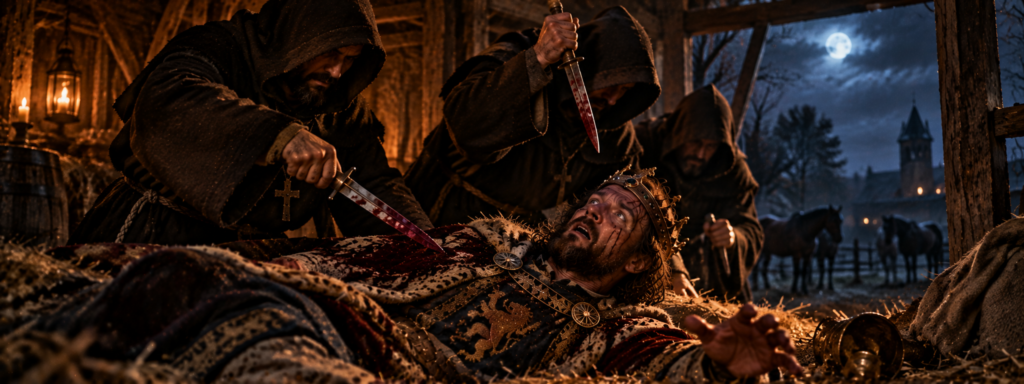
On the night of 22 November 1286, somewhere in the darkness of central Jutland, a Danish king was murdered with extraordinary violence. Eric V, known to history as Eric Glipping, was staying at Finderup, a rural settlement far removed from the imposing royal residences where a monarch might reasonably expect protection. According to the traditional account, he had been hunting and was spending the night in a barn or farm building when armed men descended upon him. By the time the attack ended, the king was dead, his body reportedly bearing fifty-six wounds, and Denmark had been plunged into one of the most enduring murder mysteries in Scandinavian history.
The killing was shocking not simply because a king had been assassinated, but because of the circumstances surrounding his death. Eric was only thirty-seven years old, had ruled Denmark for nearly three decades, and left behind a young son who would inherit a dangerously divided kingdom. The attackers were never identified beyond reasonable doubt, although powerful noblemen were subsequently accused, condemned, and driven into exile. Stories developed about masked assassins, men disguised as Franciscan friars, an outraged husband seeking revenge for the seduction of his wife, and a conspiracy among aristocrats determined to rid themselves of a troublesome monarch. Some of these details belong to later tradition rather than securely established contemporary evidence, but they helped transform Finderup into one of Denmark’s most notorious historical crime scenes.
The assassination took place at a moment when Eric’s relationship with sections of the Danish aristocracy had become deeply strained. His reign had been marked by financial difficulties, disputes over royal authority, conflict with powerful churchmen, and repeated attempts by noble families to defend their privileges against the crown. In 1282, only four years before his death, Eric had accepted a royal charter that imposed significant limitations upon his government. The document represented an important development in Danish constitutional history, but it also revealed how far tensions between king and aristocracy had escalated.
Eric’s murder therefore occurred in an atmosphere of political resentment and competing ambitions. Powerful men had reasons to oppose him, and some possessed the resources necessary to organize a violent conspiracy. Yet motive alone does not establish guilt, and the proceedings that followed the assassination were deeply entangled with the politics of the royal succession. The official condemnation of several noblemen did not resolve the mystery, and historians have continued to question whether the accused were responsible, whether the prosecution served political purposes, or whether the true conspirators escaped punishment entirely.
For centuries, the story has invited a particularly unsettling question. How could a reigning king, surrounded by the authority of the Danish crown, be killed in a rural building without the identity of his assassins ever being established beyond serious doubt? The answer lies partly in the political world Eric inherited, a kingdom where royal power was neither absolute nor secure, and where disputes among the monarchy, aristocracy, and Church could become dangerously personal.
The murder at Finderup was the violent climax of a reign that had begun when Eric was still a child. His father had died unexpectedly, his mother had struggled to protect his inheritance, and his early years had been shaped by civil conflict and imprisonment. By the time he became an independent ruler, Eric had learned that kingship depended upon the loyalty of men who might abandon him when their interests changed. His death would prove just how fragile that loyalty could be.
Eric V of Denmark: The King Behind the Mystery
Eric V of Denmark, commonly known as Eric Glipping or Erik Klipping, was born around 1249 and became king in 1259 following the death of his father, Christopher I. His mother, Margaret Sambiria, played a central role in defending his claim during his minority, when the kingdom was threatened by powerful nobles, ecclesiastical opposition, and rival political interests. Eric’s early reign included military defeat and captivity, and his later government was repeatedly challenged by aristocratic resistance and financial pressures. He married Agnes of Brandenburg, strengthening the monarchy’s dynastic connections with northern Germany, and their children included the future King Eric VI Menved and Christopher II. In 1282, Eric accepted a charter limiting aspects of royal authority and recognizing important aristocratic rights, a measure often compared with other medieval attempts to restrain kingship. On 22 November 1286, he was murdered at Finderup in Jutland, reportedly while sleeping in a rural building after a hunting expedition. A group of noblemen, including Marshal Stig Andersen Hvide, was subsequently condemned for involvement in the assassination, but the fairness of the proceedings and the actual responsibility for the murder remain disputed. Eric was buried at Viborg Cathedral, while his young son inherited a kingdom whose political divisions had been made even more dangerous by the king’s violent death.
Eric’s nickname has itself become part of the mystery surrounding his identity. The Danish form Klipping has sometimes been connected with clipped or debased coinage, reflecting the monetary difficulties associated with his reign, although the precise origin and interpretation of the nickname have been debated. It is tempting to treat the name as a simple judgment upon his government, but medieval royal nicknames frequently acquired meanings that were shaped by later political memory. What matters is that Eric became remembered not primarily for a military conquest or great reform, but for the extraordinary circumstances of his murder.
His reign occupied an important period in Denmark’s medieval development. The monarchy was attempting to maintain authority over a kingdom whose aristocratic families possessed substantial territorial and military power. Church leaders could challenge royal decisions, while neighboring German princes influenced Danish politics through alliances, marriages, and territorial interests. The crown remained powerful, but it depended upon negotiation as well as coercion.
Eric’s assassination cannot be separated from this environment. A king who demanded revenue, exercised judicial authority, and attempted to defend royal rights inevitably came into conflict with people whose wealth and privileges were affected. The tensions did not make murder inevitable, but they created a political atmosphere in which violent opposition was conceivable. Finderup became the place where those tensions appeared to erupt into an act of extraordinary brutality.
A Crown Inherited from a Troubled Dynasty
Eric was born into a royal family whose recent history was filled with bloodshed, rivalry, and disputed succession. His grandfather, Valdemar II, had once been among the most formidable rulers in northern Europe, but the Danish monarchy had suffered significant territorial setbacks during his reign. The loss of influence in northern Germany weakened the kingdom’s position and increased the importance of maintaining authority within Denmark itself. Valdemar’s sons inherited not only the crown and its territories but also the political problems created by decades of expansion and retreat.
The struggle among Valdemar’s descendants became especially destructive during the reigns of Eric IV and Abel. Eric IV, known as Eric Ploughpenny, fought bitterly with his brother Abel, Duke of Schleswig, over territorial rights and royal authority. In 1250, Eric IV was murdered after falling into the hands of men associated with Abel’s political circle, and his body was reportedly thrown into the Schlei inlet. Abel succeeded him as king, although accusations that he had arranged the killing followed him throughout his short reign.
Abel himself died violently in 1252 during a military campaign against North Frisian resistance. His death opened the way for Christopher I, another son of Valdemar II, to become king. The succession did not resolve the disputes within the dynasty, because Abel’s descendants continued to possess important claims associated with Schleswig. The relationship between the Danish crown and the ducal line therefore remained a source of instability.
Christopher I inherited a kingdom whose political divisions extended beyond the royal family. Powerful noblemen resisted attempts to strengthen royal authority, while ecclesiastical leaders defended the privileges of the Church. The monarchy faced financial pressures and disputes over the administration of justice. Christopher’s efforts to assert his position brought him into increasingly serious conflict with influential opponents.
Eric was born into this atmosphere of uncertainty. His father possessed the crown, but the family’s recent history demonstrated how quickly royal authority could be overturned. The deaths of Eric IV and Abel showed that kings could be murdered or killed while attempting to enforce their claims. The young prince’s future depended upon a political system in which dynastic legitimacy alone offered limited security.
Christopher’s relationship with the Church became particularly contentious. The most famous dispute involved Archbishop Jacob Erlandsen of Lund, who defended ecclesiastical independence against royal interference. The conflict escalated into a major political crisis and contributed to opposition against the king. Christopher’s attempt to control the situation revealed the difficulties faced by a monarchy confronting powerful religious institutions.
When Christopher died in 1259, Eric was still a child. The kingdom passed to a boy whose claim would have to be defended by others. His mother Margaret became the central figure in the struggle to preserve the dynasty’s position. The circumstances of his accession ensured that Eric’s first experience of kingship would be shaped by danger rather than security.
Margaret Sambiria: The Queen Who Fought for Her Son
Margaret Sambiria, Eric’s mother, was one of the most formidable figures in the early years of his reign. Born into a noble family connected with the Pomeranian political world, she married Christopher I and became queen of Denmark. Following her husband’s death, she assumed a leading role in defending the rights of their young son. Her position required political determination, military support, and the ability to navigate a kingdom divided by competing interests.
Margaret’s reputation in Danish historical memory is associated with strength and political courage. Later tradition gave her the nickname Sprænghest, often rendered as something resembling “Burst-Horse,” although its exact interpretation and historical development require caution. The nickname reflects the image of a forceful woman unwilling to surrender her son’s inheritance. It should not, however, be treated as a substitute for the complex political circumstances she faced.
Her regency was immediately threatened by opposition associated with the descendants of Abel and their supporters. The conflict over Schleswig remained unresolved, and rival factions saw opportunities in the accession of a minor. Margaret attempted to maintain royal authority while defending Eric’s claim. The resulting struggle became military as well as political.
In 1261, Margaret and Eric suffered a serious defeat at the Battle of Lohede, fought against forces associated with the Holstein interests supporting the ducal opposition. Both mother and son were captured, a devastating humiliation for the royal government. Their imprisonment demonstrated that the monarchy could be defeated by powerful regional opponents. It also placed the young king’s future in immediate danger.
Margaret eventually regained her freedom, while Eric’s captivity continued for a period before his release. The exact details of the negotiations involved several political interests and should not be reduced to a simple rescue story. What is clear is that the monarchy survived despite the defeat. Eric eventually returned to exercise his royal position.
The experience must have exposed him to the vulnerability of kingship at an unusually young age. He had inherited the crown before he was old enough to govern independently and had then been captured during a conflict over his authority. His mother had struggled to preserve his position against opponents with substantial military resources. Such events formed the background to his later dealings with the aristocracy.
Margaret’s political role continued to matter even after Eric reached adulthood. Her efforts helped preserve the royal line during one of its most dangerous periods. She demonstrated that queens could exercise significant political authority when dynastic survival required it. Her son inherited a monarchy that had endured because of her determination, but the conflicts she confronted remained unresolved.
The relationship between Margaret and Eric is difficult to reconstruct in personal detail because the surviving evidence concentrates upon political events. Nevertheless, her importance to his survival is unmistakable. Without her leadership during his minority, the succession might have developed very differently. Eric’s later reign rested upon the fragile victory she had helped secure.
A Boy King in a Kingdom of Enemies
Eric’s childhood reign unfolded amid political instability that would have challenged a far more experienced ruler. He possessed the royal title, but real authority depended upon regents, advisers, military supporters, and the willingness of powerful nobles to recognize his position. The crown’s enemies could exploit his youth to advance their own claims. The monarchy therefore faced a prolonged struggle to preserve its legitimacy.
The Battle of Lohede and Eric’s captivity revealed the weakness of royal power during his minority. The defeat showed that rival factions could mobilize sufficient forces to challenge the crown directly. It also demonstrated the importance of neighboring German interests in Danish politics. The kingdom’s internal disputes were inseparable from the wider political world around the Baltic and North Sea.
Eric’s release did not immediately restore stability. The monarchy still had to negotiate with powerful opponents and rebuild political support. Financial resources were limited, and military action required cooperation from aristocratic families whose loyalty could not be assumed. The young king’s government therefore operated within a difficult balance of compromise and coercion.
As Eric matured, he inherited the responsibility of defending royal rights against those who had challenged his family. The experience of captivity may have influenced his political outlook, but the surviving sources do not allow confident conclusions about his private emotions. It would be tempting to portray him as permanently embittered or obsessed with revenge. Such interpretations remain speculative without direct evidence.
What can be established is that Eric’s reign continued to involve disputes over authority. The monarchy sought to exercise jurisdiction, collect revenue, and maintain control over important territories. Noble families defended their privileges and political influence. The resulting tensions became increasingly serious.
The king’s relationship with the Church also required careful management. His father’s conflict with Archbishop Jacob Erlandsen had demonstrated the dangers of confrontation with ecclesiastical power. Eric inherited a political environment in which churchmen could become important allies or formidable opponents. The relationship between religious and royal authority remained a central issue.
The early instability of Eric’s reign also affected the development of royal government. A monarchy forced to negotiate with powerful aristocratic interests could not easily impose its will. Political agreements became essential to maintaining order. Yet agreements reached under pressure could later become sources of resentment.
By the time Eric approached independent rule, he had experienced a succession crisis, military defeat, captivity, and years of political struggle. These events did not make his assassination inevitable, but they revealed the world in which he governed. Denmark was a kingdom where power depended upon alliances that could shift rapidly. The king’s authority remained vulnerable to the ambitions of the men surrounding him.
Agnes of Brandenburg: Marriage, Diplomacy, and the Royal Household
Eric married Agnes of Brandenburg in 1273, strengthening the Danish monarchy’s connections with the influential Ascanian dynasty. The marriage reflected the importance of diplomatic alliances in northern European politics. Brandenburg possessed substantial political influence within the Holy Roman Empire, and a connection with its ruling family could provide valuable support. For Eric, the marriage also offered an opportunity to establish a secure dynastic succession.
Agnes became queen during a period when Eric was attempting to consolidate his authority. Her position placed her at the center of the royal household, where political relationships and family interests intersected. Medieval queens could exercise influence through patronage, diplomacy, and the management of dynastic connections. The surviving evidence, however, provides limited insight into Agnes’s private role in the conflicts that dominated her husband’s reign.
The marriage produced several children, including Eric VI Menved, who would succeed his father, and Christopher, who later became Christopher II. Their births strengthened the continuity of the royal line. A king with legitimate sons possessed a clearer succession than one whose death might invite competing claims. Yet the presence of heirs did not eliminate the danger of political violence.
Agnes’s family connections also mattered after Eric’s assassination. The murder left her children in a vulnerable position, with the eldest surviving son still a minor. The monarchy again faced the problem of governing through a regency while powerful factions competed for influence. Agnes would become an important figure in defending her son’s position.
The royal marriage therefore linked two generations of political struggle. Margaret Sambiria had defended Eric during his minority, and Agnes would later help protect Eric’s son after the murder at Finderup. Both women occupied positions of responsibility during periods of dynastic crisis. Their experiences reveal the recurring instability of the Danish monarchy.
Later legends concerning Eric’s personal life sometimes overshadow the documented significance of his marriage. Stories of adultery and sexual misconduct became connected with explanations for his assassination. These traditions often portray the king as a reckless seducer whose behavior provoked deadly revenge. Their historical reliability is much weaker than the evidence for his marriage, children, and political conflicts.
The distinction is important because sensational stories can distort the lives of historical women. Agnes was not merely the neglected wife of a supposedly unfaithful king. She was a dynastic figure whose marriage strengthened political alliances and whose children inherited the consequences of their father’s death. Her later role in the succession deserves attention independent of the legends.
Eric’s household was therefore both a family and a political institution. His marriage connected Denmark with Brandenburg, while his children represented the future of the monarchy. The assassination at Finderup would place that future in danger. Agnes would face a challenge disturbingly similar to the one Margaret had confronted decades earlier.
The King and the Nobles: A Dangerous Struggle for Power
One of the central tensions of Eric’s reign concerned the relationship between the crown and the Danish aristocracy. Powerful noble families possessed extensive lands, military resources, and influence within regional communities. Their cooperation was essential to royal government, particularly when the king required armed support or financial contributions. Yet these families also defended privileges that could conflict with royal ambitions.
Eric’s government faced repeated disputes over taxation, judicial authority, and the administration of the kingdom. The crown required revenue to maintain its household, conduct diplomacy, and support military activities. Aristocratic interests often resisted demands they regarded as excessive or inconsistent with established rights. The resulting conflicts were part of a broader European struggle over the limits of royal power.
The Danish nobility was not a unified political body. Individual families possessed different interests, alliances, and relationships with the crown. Some supported Eric, while others opposed particular policies or sought greater influence. Political factions could change as circumstances developed. The complexity makes it misleading to portray the assassination as the inevitable work of an entire social class.
Nevertheless, opposition among powerful nobles became increasingly significant. The king’s authority depended upon recognition and cooperation, but attempts to strengthen the crown could provoke resistance. Aristocrats could demand guarantees of their privileges in exchange for political support. Such negotiations became particularly important during periods of financial or military weakness.
The conflict also involved questions of justice. Medieval kings exercised important judicial functions, and their courts could impose penalties upon nobles and commoners alike. Aristocratic families often sought protection against arbitrary decisions or excessive royal interference. The struggle over legal authority therefore became a major element of political debate.
Eric’s government was also affected by disputes involving royal revenues and coinage. Monetary policy could become controversial when rulers altered the value or quality of coins. Such measures might provide short-term financial advantages but damage confidence and provoke resentment. The association of Eric’s nickname with coinage reflects the importance of these issues in later historical memory.
The political atmosphere became increasingly tense during the years preceding 1282. Noble opposition demanded greater recognition of established rights and limitations upon royal authority. Eric faced pressure to accept formal concessions. The resulting charter would become one of the most important documents of his reign.
The struggle between king and aristocracy did not end with the charter. Agreements could establish principles without resolving the grievances that produced them. Powerful men might continue to distrust the king, while the crown could resent restrictions imposed under pressure. By 1286, the relationship between Eric and sections of the nobility remained dangerously strained.
The Charter of 1282: When the Nobles Forced a King to Yield
In 1282, Eric V accepted a charter that imposed important limitations upon royal government. The document is commonly known as a håndfæstning, a form of royal undertaking associated with the recognition of political and legal obligations. It became an important landmark in Danish constitutional history. Its significance lay in the formal acknowledgment that the king’s authority was subject to established rules and expectations.
The charter emerged from conflict between the monarchy and powerful aristocratic interests. Noblemen sought protection against arbitrary government and demanded recognition of rights they considered essential. The crown faced pressure to accept these conditions. Eric’s agreement reflected the political realities of a kingdom where royal authority depended upon cooperation.
Among the charter’s important provisions were guarantees concerning legal procedure and restrictions upon arbitrary imprisonment or punishment. It also addressed the relationship between royal government and representative political assemblies. Such provisions were intended to protect established rights and limit the king’s ability to act without appropriate legal justification. Their practical enforcement remained a matter of political struggle.
The charter is sometimes compared with Magna Carta in England, although the historical circumstances and legal traditions differed. Both documents reflected attempts by powerful subjects to impose recognized limits upon royal authority. Neither created a modern democracy or eliminated aristocratic privilege. Their immediate purpose was to regulate the exercise of kingship within medieval political society.
For Eric, the charter represented a significant concession. A king who had struggled for years to maintain authority was now formally acknowledging restrictions upon his government. The agreement may have reduced immediate opposition, but it also demonstrated the strength of the aristocratic faction. The monarchy had been compelled to negotiate.
The charter did not necessarily transform Eric into a powerless ruler. Medieval political agreements often reflected compromises between competing interests. Kings retained substantial authority even when they accepted limitations. The difficulty lay in determining how those limitations would be interpreted and enforced.
The years following 1282 remained politically unsettled. The charter had not removed every grievance, and disputes over royal conduct continued. Powerful nobles could accuse the king of violating agreed principles, while royal supporters might regard aristocratic demands as excessive. The atmosphere remained vulnerable to confrontation.
The assassination of 1286 occurred only four years after this major constitutional struggle. The timing encouraged later interpretations that connected the murder with aristocratic opposition. Yet the charter alone does not prove that its supporters organized the assassination. It establishes a context of political tension, not the identity of the killers.
Money, Coinage, and the Unpopular Crown
Financial pressure was a persistent problem for medieval kings. Royal government required resources to maintain courts, support military forces, reward followers, and conduct diplomacy. Revenue could be obtained through taxation, customs, territorial income, and monetary policy. Each method created opportunities for conflict with subjects whose wealth was affected.
Eric’s reign was associated with disputes over coinage and the value of money. The monarchy’s financial difficulties made monetary policy politically sensitive. Changes in coinage could benefit the crown while imposing costs upon those who received or used the currency. Such measures could provoke resentment among merchants, landowners, and ordinary people.
The nickname Glipping or Klipping has sometimes been connected with clipped or debased coins. The exact derivation remains debated, and it would be misleading to treat the nickname as definitive proof of a particular policy. Nevertheless, the association reflects the importance of financial controversy in the king’s later reputation. Economic grievances became part of the broader criticism of his government.
The crown’s financial demands also affected its relationship with the nobility. Powerful landowners possessed resources that the monarchy might seek to tax or regulate. They could resist demands they considered unjustified. Financial disputes therefore overlapped with arguments about legal rights and royal authority.
The kingdom’s earlier conflicts had contributed to these pressures. Military campaigns, territorial disputes, and the maintenance of royal authority required expenditure. Eric inherited a monarchy whose resources had been strained by decades of instability. His government faced the challenge of securing revenue without provoking opposition.
Financial policy also influenced perceptions of royal legitimacy. A king who demanded excessive payments could be portrayed as oppressive, even when the demands reflected genuine governmental needs. Opponents could use economic grievances to strengthen political resistance. The monarchy’s ability to justify its policies was therefore important.
The charter of 1282 addressed aspects of the relationship between royal power and established rights. It emerged within a political environment where financial demands were among the sources of resentment. Yet the charter did not eliminate the crown’s need for revenue. The underlying tensions remained.
By the time Eric was murdered, his government had accumulated years of political controversy. Financial disputes were only one element, but they contributed to the atmosphere of opposition. The king’s assassination cannot be explained through coinage alone. It occurred within a much broader struggle over the exercise of royal authority.
The Shadow of Marshal Stig Andersen Hvide
Among the men later accused of involvement in Eric’s murder, none became more famous than Stig Andersen Hvide, commonly known as Marshal Stig. He belonged to an influential Danish noble family and had occupied a position of considerable importance within the kingdom. As marshal, he was associated with the military organization and leadership of the royal government. His rank made the accusation against him particularly serious.
A marshal was not an ordinary court official. The position involved responsibilities connected with military leadership and the king’s armed forces. A man who held such an office possessed political influence and access to important networks. If someone of that standing participated in a conspiracy against the monarch, the betrayal would strike at the foundations of royal authority.
Stig Andersen’s relationship with Eric became central to the later story of Finderup. Following the assassination, he was among the noblemen condemned for involvement in the killing. His name became inseparable from the mystery. Yet the surviving evidence does not establish his guilt beyond reasonable doubt.
The proceedings against Stig and the other accused were conducted within a highly political environment. The king was dead, his heir was a child, and powerful factions were competing for influence. The prosecution of prominent nobles could serve the interests of those seeking to consolidate the new government. This does not prove that the accusations were fabricated, but it complicates their interpretation.
Stig’s later career contributed to his notoriety. After his condemnation, he became associated with opposition to the Danish monarchy and established a position at Hjelm, an island off the coast of Jutland. From there, he and his allies engaged in activities hostile to the royal government. His exile therefore became part of a continuing political conflict.
The figure of Marshal Stig also entered Danish ballad tradition. In these stories, he was often portrayed as a man driven to revenge by an alleged violation of his marriage. The king was accused of seducing or dishonoring Stig’s wife, creating a personal motive for murder. Such narratives became enormously influential but are not securely established as historical fact.
The distinction between the political Stig Andersen and the legendary avenger is essential. The historical man was a powerful noble condemned after a royal assassination and later associated with armed opposition. The ballad figure was a wronged husband whose personal humiliation supposedly led him to murder a king. The two images became intertwined in popular memory.
Stig Andersen remains one of the most important suspects in the Finderup mystery because of his political position and the official condemnation against him. Yet suspicion and conviction within a medieval political proceeding do not provide the same certainty as independently corroborated evidence. His role remains contested. The mystery survives partly because the most famous accused man cannot be securely identified as the murderer.
The Scandal of the Marshal’s Wife
One of the most sensational explanations for Eric’s assassination concerns an alleged affair with the wife of Marshal Stig Andersen. According to later ballad tradition, the king violated the trust of his marshal by seducing or sexually dishonoring the marshal’s wife. Stig then supposedly organized the assassination as an act of revenge. The story transformed a political murder into a drama of adultery, humiliation, and vengeance.
The tale possesses obvious dramatic appeal. A powerful king abuses his position, a loyal servant discovers the betrayal, and personal outrage leads to a violent reckoning. The contrast between royal privilege and wounded aristocratic honor gives the narrative emotional force. It also provides a simple motive for a crime whose political circumstances were extraordinarily complicated.
The historical evidence, however, does not securely establish that Eric had an affair with Stig’s wife. The story is most closely associated with later literary and ballad traditions rather than reliable contemporary documentation of the murder. Its details vary across retellings. It should therefore be presented as legend, not as a proven cause of the assassination.
The woman at the center of the story is particularly difficult to recover as a historical individual. Later narratives often use her primarily as the object of a conflict between powerful men. Her supposed experiences become the justification for male revenge. The surviving evidence does not permit a reliable reconstruction of the alleged relationship or her own perspective.
The legend also reflects medieval and later ideas about honor. Sexual misconduct involving the wife of a powerful noble could be portrayed as an attack upon the husband’s status and authority. Revenge might then be represented as a response to public humiliation. Such themes were common in heroic and tragic storytelling.
Yet the political context of Finderup provides several alternative explanations. Eric had powerful opponents whose grievances involved taxation, legal authority, and aristocratic privilege. A conspiracy could have emerged from those disputes without any personal scandal. The ballad tradition may have supplied a more memorable motive than the complex realities of medieval politics.
The story’s persistence reveals the appeal of personal explanations for political violence. Audiences often prefer a betrayal within a household to a complicated dispute over constitutional rights. The alleged affair transformed Eric into a morally compromised king and Stig into a figure whose actions could be understood through revenge. That interpretation shaped popular memory for centuries.
The historical question remains unresolved. There is no secure basis for treating the alleged affair as fact or for concluding that it caused the murder. The scandal belongs to the history of Eric’s reputation and the literary development of the Finderup story. Its importance lies in how it shaped the image of the assassination, not in its proven accuracy.
Finderup: The Lonely Setting of a Royal Murder
Finderup was a rural settlement in central Jutland, far removed from the great political centers of medieval Europe. Its landscape was shaped by agricultural communities, local roads, and the ordinary rhythms of rural life. The place would likely have remained obscure in wider historical memory had it not become associated with the murder of a Danish king. After 1286, its name acquired a significance far beyond its size.
The traditional account places Eric at Finderup after a hunting expedition. Hunting was a familiar activity among medieval rulers and aristocrats, serving social, political, and recreational purposes. Royal hunting parties could travel through rural territories and rely upon local accommodation. The presence of a king in such a setting was therefore not inherently extraordinary.
What made the situation dangerous was the apparent vulnerability of the royal party. According to tradition, Eric spent the night in a barn or farm building rather than a fortified residence. Such a location would have offered less protection against a determined attack. The exact building and arrangements cannot be reconstructed with certainty.
Later narratives emphasize the darkness and isolation of the setting. The image of a king sleeping in a rural building while assassins approached became central to the story. It contrasted sharply with the expected dignity and security of monarchy. The setting made the murder appear both intimate and terrifying.
The surviving evidence does not provide a complete record of Eric’s movements that day. The hunting tradition is widely repeated, but many details of the final journey belong to later accounts. It is not possible to identify every member of his entourage or determine precisely why he stayed at Finderup. A responsible reconstruction must acknowledge these limits.
The location nevertheless mattered because it exposed the king to danger outside the usual centers of royal authority. A monarch traveling through the countryside depended upon attendants, local arrangements, and the loyalty of those around him. If attackers possessed information about his movements, they could exploit the opportunity. Whether the Finderup assassins had inside assistance remains uncertain.
The rural setting also complicated the investigation. A murder committed away from a major royal residence might leave fewer surviving records concerning witnesses and immediate events. The political turmoil following the assassination further obscured the circumstances. The crime became known through accounts shaped by later controversy.
Finderup therefore occupies a peculiar place in Danish historical memory. It was an ordinary rural location transformed into the scene of extraordinary violence. The contrast between the modest setting and the royal victim gave the assassination its enduring atmosphere. The king who governed Denmark was killed in a place where his title could not protect him.
The Assassins in the Darkness
The traditional story of Eric’s murder describes a group of armed men attacking him during the night of 22 November 1286. Some later versions claim that the attackers concealed their identities by wearing disguises, including clothing associated with Franciscan friars. The image of assassins dressed as religious men adds a particularly sinister dimension to the narrative. It suggests deception, sacrilege, and a carefully planned assault.
The Franciscan disguise, however, is not securely established by contemporary evidence. It belongs to the body of traditions that developed around the murder and should not be presented as a verified detail. The same caution applies to precise descriptions of the attackers’ number, weapons, and movements. The historical record does not permit a complete reconstruction of the assault.
What is certain is that Eric was murdered violently at Finderup. The killing was not a battlefield death or an execution carried out through a recognized legal process. It was an attack upon a reigning monarch in circumstances that strongly suggest deliberate intent. The perpetrators were never identified with sufficient certainty to end the controversy.
The reported number of wounds became one of the most memorable details. Later accounts frequently state that Eric received fifty-six stab wounds. The figure has been repeated so often that it forms part of the standard popular narrative. Yet the surviving evidence does not provide the kind of forensic documentation that would allow the number to be independently verified with modern certainty.
The detail nevertheless conveys the brutality associated with the assassination. A ruler attacked repeatedly with edged weapons would have had little chance of survival. The violence also invited speculation about the attackers’ motives. Later writers sometimes interpreted the wounds as evidence of personal hatred or collective vengeance.
Such interpretations remain uncertain. Multiple wounds could result from several attackers, a chaotic assault, or an attempt to ensure that the victim was dead. They do not by themselves establish a particular emotional motive. The number of wounds, even if accepted from tradition, cannot identify the conspirators.
The attack also raises questions about the king’s protection. Medieval rulers generally traveled with attendants and armed followers, although the size and composition of their entourages varied. The successful murder of a king during a rural stay suggests that the attackers exploited a moment of vulnerability. Whether they received assistance from members of the royal party remains unknown.
The assassins disappeared into a political landscape already filled with enemies of the crown. The absence of a securely established account of their identities allowed competing explanations to flourish. Some blamed powerful nobles, others emphasized personal revenge, and later historians questioned the official prosecution. The darkness surrounding the murder became as important to its legacy as the violence itself.
Fifty-Six Wounds: The Brutality of the Killing
The tradition that Eric’s body bore fifty-six wounds has become one of the defining features of the Finderup assassination. It appears in numerous later accounts and has helped shape the image of the murder as an exceptionally savage attack. The figure is striking because it suggests violence far beyond a single fatal blow. Yet its historical status requires careful qualification.
Medieval and early modern narratives frequently used vivid numerical details to emphasize the horror of violent deaths. Such numbers could preserve genuine information, but they could also become part of literary tradition. Without a reliable contemporary medical examination, the exact count cannot be treated as independently verified forensic evidence. The safest approach is to identify fifty-six wounds as a traditional report.
The brutality of the assassination is not dependent upon accepting the number literally. Eric was killed by attackers who deliberately targeted the reigning king. The act required a willingness to commit a crime with enormous political consequences. Whether the fatal assault involved a handful of wounds or many more, the result was the same.
The reported violence encouraged speculation about motive. A political conspiracy might seek to remove a ruler efficiently, while personal revenge could produce an especially savage attack. Yet such distinctions are unreliable when applied to medieval violence. Assassins could strike repeatedly simply to ensure success.
The number also contributed to the moral interpretation of the crime. A king covered in wounds could be portrayed as a victim of extraordinary treachery. The image emphasized the violation of royal authority and the destruction of the body that represented the monarchy. It transformed the assassination into a symbol of political disorder.
The alleged use of disguises intensified this symbolism. If the attackers truly wore religious clothing, the murder would involve deception through the appearance of holiness. Yet that detail remains part of later tradition. It should not be combined with the wound count to create a supposedly exact reconstruction unsupported by the evidence.
The body of the king became central to the political response. Eric’s death created an immediate succession crisis, and the physical evidence of violence would have demonstrated that the crown had been attacked. The royal household faced the task of mourning the king while securing the position of his heir. The assassination therefore moved rapidly from a private scene of death into a national political crisis.
The fifty-six wounds remain an enduring part of the Finderup story because they express the horror of the event in a single unforgettable detail. Their exact historical reliability is uncertain, but their influence upon popular memory is undeniable. They have helped preserve the image of Eric as a king destroyed by overwhelming violence. The true identity of the men who inflicted the wounds remains unresolved.
A Murder Without a Confession
The assassination of Eric V created an immediate demand for explanation. A reigning king had been murdered, and the perpetrators had apparently escaped. The royal government needed to establish authority, identify enemies, and prevent the killing from encouraging further rebellion. Yet the surviving evidence does not preserve a reliable confession that conclusively identifies the assassins.
The absence of definitive proof became one of the central problems of the case. Political opponents of Eric possessed possible motives, but motive alone could not establish participation. Powerful noblemen might have resented the king’s policies without supporting murder. Others could have benefited from his death without having organized it.
The investigation unfolded within a political environment that was far from neutral. Eric’s heir was a minor, and the government depended upon regents and influential supporters. Accusations against powerful aristocrats could alter the balance of power. The proceedings therefore carried consequences beyond the punishment of individual suspects.
The legal practices of the period also differed significantly from modern criminal investigation. Medieval courts relied upon forms of testimony, oath, reputation, and political judgment that did not correspond to contemporary forensic standards. A conviction could possess legal authority without satisfying modern expectations of independent evidence. The Finderup case must be understood within that context.
The murder also created opportunities for rival factions to shape the narrative. Those supporting the new royal government could present condemned nobles as dangerous traitors. The accused and their allies could portray the proceedings as politically motivated persecution. Later historians inherited accounts influenced by these competing interests.
The lack of a conclusive confession allowed the mystery to survive. If the attackers had been securely identified and their roles documented, later speculation might have been limited. Instead, the evidence remained open to competing interpretations. The case became a subject of historical debate rather than a settled crime.
The official response nevertheless produced dramatic consequences. Several prominent men were condemned, their property and political positions threatened, and some fled the kingdom. Their exile transformed the murder investigation into a continuing conflict with the monarchy. The assassination therefore generated further violence and instability.
Eric’s death became more than a criminal case. It was a political crisis in which the identity of the killers was inseparable from the struggle for power. The absence of definitive proof did not prevent punishment. It ensured that the legitimacy of the punishment would remain disputed.
The Trial of 1287: Eight Men Condemned
In 1287, the year following Eric’s assassination, a group of prominent noblemen was condemned for involvement in the murder. The proceedings became one of the most consequential political events of the new reign. Among the accused was Marshal Stig Andersen Hvide, whose name would become permanently associated with the crime. The condemnations appeared to provide an official answer to the mystery, but they did not eliminate doubts about responsibility.
The proceedings took place during the minority of Eric VI Menved, the murdered king’s son. The government needed to defend the legitimacy of the succession and demonstrate that royal murder would not go unpunished. Condemning powerful opponents could serve that purpose. Yet the political circumstances also created reasons to question the fairness of the process.
The accused included men connected with influential aristocratic networks. Their condemnation threatened their property, status, and political future. Some fled Denmark and sought support beyond the kingdom. The case therefore contributed to the formation of an opposition that would continue to challenge the monarchy.
The evidence underlying the convictions is not preserved in a form that allows a complete modern reconstruction. Historians have questioned whether the proceedings established genuine guilt or reflected the political interests of the regency. The official verdict remains an important historical fact. It is not equivalent to definitive proof that every condemned man participated in the assassination.
Marshal Stig became the most famous of the condemned. His military position and aristocratic standing made the accusation especially dramatic. Later ballads transformed him into the central figure of a revenge story involving the king and the marshal’s wife. The historical proceedings, however, do not establish the truth of that legend.
The number and identities of the condemned are discussed in historical accounts, but the broader significance lies in the political consequences. The prosecution removed or marginalized powerful men who might otherwise have influenced the regency. It also created exiles with strong reasons to oppose the royal government. The assassination therefore continued to destabilize Denmark after the initial crime.
The condemned nobles did not simply disappear from political life. Some became associated with armed resistance and alliances hostile to the Danish crown. Their activities complicated the reign of Eric VI Menved. The attempt to punish the alleged assassins thus contributed to further conflict.
The trial of 1287 remains central to the mystery because it represents the official response to the killing. It identified suspects and imposed punishment, but the surviving evidence does not conclusively establish their guilt. The case therefore occupies an uneasy position between legal judgment and historical uncertainty. The men condemned for murdering Eric became part of a controversy that would survive for centuries.
Hjelm: The Island of the Outlaws
Following the condemnations, Marshal Stig Andersen and other opponents of the Danish monarchy became associated with Hjelm, an island off the coast of Jutland. The island provided a strategic position from which exiles could maintain resistance against the royal government. Its location offered access to maritime routes and opportunities for armed activity. Hjelm became a symbol of the continuing conflict generated by the Finderup assassination.
The exiles’ position was strengthened by connections with foreign powers hostile to Denmark. Medieval political conflicts frequently crossed territorial boundaries, and displaced nobles could seek support from neighboring rulers. Such alliances were not unusual in the Baltic and North Sea regions. They could transform domestic disputes into wider military confrontations.
Hjelm’s importance lay partly in its defensive potential. An island stronghold could be difficult to attack and could support maritime operations. The exiles could use the surrounding waters to move men and supplies. Their presence therefore posed a challenge to royal authority.
The activities associated with Hjelm included armed opposition and attacks upon interests connected with the Danish monarchy. Later accounts emphasize piracy and raiding, although individual incidents require careful evaluation. The island became associated with a group of men whom the royal government regarded as dangerous enemies. Their resistance demonstrated that the condemnations had not ended the political struggle.
Marshal Stig’s presence at Hjelm also strengthened his legendary reputation. A nobleman accused of murdering a king and driven into exile could easily become the central figure of a dramatic historical narrative. Later ballads portrayed him as an avenger whose conflict with the monarchy continued after the assassination. The literary image developed alongside the historical reality of political resistance.
The exiles’ actions also complicated the position of Eric VI Menved. The young king inherited not only his father’s crown but also enemies who rejected the legitimacy of the proceedings against them. The regency had to defend the kingdom against opposition associated with the condemned nobles. The assassination therefore continued to shape royal policy.
Stig Andersen died in 1293, several years after the murder at Finderup. His death did not resolve the question of his guilt. The historical record remained divided between official condemnation and later doubts. His reputation continued to develop through chronicles, ballads, and historical interpretation.
Hjelm therefore became an important aftermath of the assassination. It demonstrated that the murder investigation had produced a political conflict extending beyond the courtroom. The condemned nobles did not accept their exclusion quietly. Their resistance ensured that Finderup remained a source of instability throughout the early reign of Eric’s son.
Eric VI Menved: A Child Inherits a Murdered Father’s Crown
Eric V’s death left the Danish throne to his young son, Eric VI Menved. The new king was still a child, and the monarchy once again faced the difficulties of a minority reign. His mother Agnes of Brandenburg assumed an important role in the regency. The situation echoed the earlier experience of Margaret Sambiria, who had defended Eric V’s claim after Christopher I’s death.
The succession required immediate political support. A murdered king could leave behind uncertainty, particularly when powerful nobles were suspected of involvement in the assassination. The regency needed to secure recognition of the young heir and prevent rival factions from exploiting the crisis. The stability of the monarchy depended upon the loyalty of influential families.
The prosecution of the alleged assassins became part of this effort. Condemning prominent opponents could demonstrate the government’s determination to defend royal authority. Yet the proceedings also created exiles who continued to resist the crown. The regency therefore faced the consequences of both the murder and its political response.
Agnes’s role was particularly significant because she had to protect the inheritance of her children while navigating competing interests. Her position required diplomacy and cooperation with powerful advisers. The surviving evidence does not permit a detailed reconstruction of every decision she made. Nevertheless, her importance to the continuity of the royal line is clear.
Eric VI eventually became an active ruler whose reign was marked by ambitious policies and financial difficulties. His government continued to face challenges connected with the kingdom’s political and territorial interests. The legacy of the Finderup assassination remained part of the background to his rule. The murder of his father had shaped the circumstances of his accession.
The young king’s position also illustrates the long-term consequences of regicide. Killing a monarch did not necessarily destroy the dynasty. It could instead produce a child ruler whose government became dependent upon regents and powerful supporters. Such arrangements created opportunities for further political conflict.
The assassination therefore altered the balance of power without providing a simple victory for any faction. The royal line survived, but its authority remained contested. The condemned nobles became enemies of the government, while the regency sought to preserve the crown. The kingdom entered another period of instability.
Eric VI inherited a throne shadowed by an unresolved crime. His father’s murder became a central event in the history of his family and reign. The question of who had ordered the assassination remained politically sensitive. The young king’s government had to operate within a kingdom still divided by the violence of Finderup.
The Franciscan Disguise: Sacrilege or Later Invention?
One of the most disturbing details in popular retellings of the Finderup murder is the claim that the assassins disguised themselves as Franciscan monks. The image suggests men exploiting religious clothing to approach a king without arousing suspicion. It adds an element of sacrilege to an already shocking crime. The disguise also makes the attack appear carefully planned.
The historical evidence for this detail is uncertain. The claim belongs to later traditions surrounding the assassination rather than a securely established contemporary description. It should therefore be introduced as a story told about the murder, not as a verified fact. The surviving sources do not allow the attackers’ clothing to be reconstructed with confidence.
The Franciscan order was well established in medieval Europe by the late thirteenth century. Its members were associated with preaching, poverty, and religious life. Clothing resembling that of friars could theoretically have provided a disguise in a society where religious figures traveled widely. Yet the plausibility of a disguise does not prove that it was used at Finderup.
The story’s dramatic force comes from the contrast between holiness and violence. A king might expect religious men to represent spiritual authority rather than physical danger. Assassins adopting such clothing would exploit that expectation. The resulting betrayal would appear especially sinister.
Later storytellers frequently emphasized deception in accounts of royal murder. Disguises, secret signals, and hidden weapons created suspense and explained how powerful victims could be approached. Such elements could preserve genuine memories, but they could also develop through literary convention. The Finderup disguise tradition must be evaluated within that broader pattern.
The claim also affects interpretations of the conspiracy. If the attackers wore coordinated disguises, the murder would appear carefully organized. Yet the absence of reliable evidence prevents that conclusion from resting upon the clothing story alone. The assassination itself demonstrates deliberate violence, but the precise method remains uncertain.
The religious dimension may also reflect later moral interpretation. A king murdered by men dressed as friars would represent a violation of both royal and sacred expectations. Such a narrative could intensify condemnation of the perpetrators. It could also make the story more memorable for audiences.
The Franciscan disguise remains part of the legend of Finderup. Its presence in popular accounts reveals how the murder acquired increasingly dramatic features over time. Historical accuracy requires separating those features from the secure facts. Eric was murdered by attackers whose identities and appearance remain uncertain.
Was the Murder Political?
The political explanation for Eric’s assassination is compelling because his reign had been marked by sustained conflict with powerful aristocratic interests. The charter of 1282 demonstrated that noble opposition had forced significant concessions from the crown. Disputes over taxation, legal authority, and royal government continued to create tension. A conspiracy among dissatisfied nobles therefore fits the broader political context.
The condemnation of Marshal Stig Andersen and other prominent men strengthened this interpretation. The official proceedings identified members of the aristocracy as responsible for the murder. Their later resistance to the monarchy suggested deep hostility toward the royal government. Yet the convictions themselves remain disputed.
A political conspiracy might have aimed to remove a king regarded as oppressive or unreliable. Powerful nobles could hope that a minor successor would be easier to influence. The death of Eric left a child on the throne and created opportunities for regents and aristocratic factions. Such circumstances could provide a motive for assassination.
However, the existence of a possible motive does not establish that a particular group acted upon it. Some nobles who opposed Eric may have preferred negotiation or constitutional restrictions to murder. Others could have feared the instability that regicide would produce. The political consequences of assassination were unpredictable.
The charter of 1282 also complicates the interpretation. Eric had already accepted important limitations upon his authority. Opponents might have believed that continued pressure could secure further concessions without resorting to violence. Conversely, disputes over the charter’s enforcement could have intensified resentment. The surviving evidence does not establish which calculation, if any, motivated the assassins.
The political explanation remains more securely grounded in the known context than the later adultery legend. It relies upon documented tensions between crown and aristocracy. Yet it still cannot identify the actual perpetrators beyond doubt. The distinction between a plausible motive and proven responsibility remains essential.
The assassination may also have involved a combination of political and personal grievances. Medieval aristocratic politics often blurred the boundaries between public authority and private relationships. A nobleman’s dispute with the king could involve property, status, legal rights, and personal honor. The surviving evidence does not permit these possibilities to be separated conclusively.
The political interpretation therefore offers an important framework without solving the mystery. Eric ruled a kingdom where powerful men had reasons to resent him. His murder occurred during a period of serious aristocratic opposition. The official prosecution targeted prominent nobles, but the identity of the conspirators remains uncertain.
Was Marshal Stig Framed?
The possibility that Marshal Stig Andersen was wrongly condemned has been an important part of later historical debate. The proceedings against him occurred during a politically sensitive regency, when the royal government needed to establish authority after the assassination. Powerful nobles could become targets of accusations that served political purposes. The circumstances therefore invite scrutiny.
The surviving evidence does not provide a complete record of the investigation. Historians cannot examine the case with the same materials available in a modern criminal prosecution. The official verdict is known, but the underlying proof remains difficult to evaluate. This limitation prevents a definitive conclusion.
Stig’s political position made him both a plausible suspect and a potentially useful enemy to remove. As a prominent noble and former marshal, he possessed influence that could challenge the regency. His condemnation weakened his position within Denmark. The government therefore benefited politically from his exclusion.
Yet political benefit does not automatically prove that the accusation was false. A powerful noble could genuinely participate in a conspiracy against the king. His rank might provide the connections necessary to organize an attack. The same circumstances that make the prosecution politically suspicious also make his involvement conceivable.
Stig’s later resistance from Hjelm further complicates the picture. His activities demonstrated hostility toward the monarchy after his condemnation. They do not, however, prove that he had murdered Eric before being outlawed. A man unjustly condemned might also become a determined enemy of the government.
The adultery legend cannot resolve the question. It provides a dramatic personal motive, but its historical reliability is weak. Treating it as evidence of guilt would confuse later literary tradition with contemporary documentation. The case must instead be evaluated through the political circumstances and surviving legal record.
Some interpretations have suggested that the prosecution reflected factional conflict within the Danish aristocracy. The regency may have used the murder to eliminate dangerous opponents. This remains a historical hypothesis rather than a conclusively demonstrated explanation. The absence of complete evidence limits certainty in both directions.
Marshal Stig therefore remains neither securely exonerated nor conclusively proven guilty. His condemnation is a historical fact, while his actual participation in the assassination remains disputed. The uncertainty has helped sustain the Finderup mystery. The most famous suspect remains one of its unresolved questions.
The Problem of the Unknown Assassins
The identity of Eric’s killers remains uncertain because the surviving evidence is incomplete and politically complicated. The murder occurred in 1286, and the accounts available to historians were shaped by the interests and assumptions of medieval writers. The official proceedings condemned prominent nobles, but the proof underlying those decisions cannot be fully reconstructed. Later legends introduced additional details that made the story more dramatic without necessarily making it more reliable.
The number of attackers is uncertain. The traditional account describes a group rather than a lone killer, but the precise size of the party cannot be established. The claim that they wore Franciscan disguises is also insecure. The surviving record therefore does not permit a detailed reconstruction of the assault.
The motive remains equally uncertain. Political resentment provides a plausible explanation because Eric had serious conflicts with powerful aristocrats. Personal revenge appears in later ballad tradition, particularly through the alleged affair involving Marshal Stig’s wife. Other possibilities cannot be excluded. None has been established conclusively.
The murder’s timing also raises questions. Eric was killed only four years after accepting the charter of 1282. The political settlement had not removed all tensions between the crown and nobility. Yet the surviving evidence does not identify a specific dispute immediately preceding the attack that can be proven to have triggered the assassination.
The setting at Finderup suggests that the attackers exploited a vulnerable moment. A king staying in a rural building would have been less protected than in a fortified residence. The assassins may have known his movements, but the source of such information remains unknown. The possibility of assistance from within the royal entourage is speculative.
The reported fifty-six wounds have sometimes been interpreted as evidence of exceptional hatred. Yet the figure belongs to tradition and cannot be independently verified. Even if accepted, it would not establish a particular motive. Violent attacks can involve repeated blows for reasons unrelated to personal revenge.
The official condemnation of the noblemen remains the strongest historical basis for identifying suspects. Nevertheless, the proceedings occurred in a political environment where accusations could serve factional interests. The lack of surviving evidence sufficient to evaluate the verdict prevents a definitive conclusion. The condemned men remain suspects rather than proven perpetrators in a modern historical sense.
The mystery survives because the central facts are clear while the most important details remain hidden. Eric was murdered at Finderup, and prominent noblemen were subsequently condemned. The identity of the actual attackers and the motives of those who organized the crime remain disputed. The absence of certainty has allowed the assassination to occupy a unique place in Danish historical memory.
The Murder in Danish Ballads and Popular Memory
The assassination at Finderup became one of the most famous subjects of Danish historical ballad tradition. Stories about the murder circulated through later centuries, transforming the political crisis into a dramatic narrative of betrayal and revenge. Marshal Stig Andersen became a central figure in many versions. The king’s alleged misconduct with the marshal’s wife supplied an emotionally powerful motive.
Ballads were not written as modern historical investigations. They preserved and reshaped memories through performance, repetition, and literary convention. Characters could become more heroic or villainous as stories developed. Events might be simplified to emphasize moral conflict.
The Finderup ballads often portray Eric as a king whose personal behavior provoked deadly consequences. Marshal Stig appears as a man whose honor has been violated and who seeks revenge. The story becomes a conflict between royal power and aristocratic dignity. Its appeal lies in the clarity of the emotional motives.
This literary transformation obscured the complexity of the historical assassination. The actual political context involved taxation, constitutional restrictions, territorial interests, and factional rivalry. These issues were less easily expressed in a dramatic ballad. A story of adultery and revenge offered a more immediate explanation.
The ballads also helped preserve the memory of Finderup as a place of darkness and treachery. The rural setting became part of the emotional landscape of the murder. The image of armed men attacking a sleeping king was repeated across generations. The story acquired an atmosphere that extended beyond the surviving historical evidence.
Later historical writing often incorporated elements of these traditions. The boundary between documented fact and literary embellishment became blurred. Details such as disguises, personal motives, and precise descriptions of the attack could be repeated without sufficient qualification. The resulting narrative appeared more complete than the evidence justified.
The persistence of the ballads demonstrates the cultural significance of the assassination. Eric’s death was not forgotten after the political conflicts of his reign ended. It remained a subject through which Danish audiences explored themes of power, betrayal, justice, and revenge. The murder became part of national historical imagination.
The literary legacy is therefore important even when its factual claims are uncertain. The ballads reveal how later generations understood the assassination and the moral questions it raised. They cannot establish the identity of the killers. Their value lies in the history of memory rather than definitive reconstruction of the crime.
Finderup and the Landscape of Memory
The site associated with Eric’s murder became a place of historical remembrance. Finderup’s significance rested upon its connection with an event that had transformed the Danish monarchy. The assassination was remembered through chronicles, local tradition, and later historical writing. The landscape itself became part of the story.
A memorial cross is associated with the traditional site of the murder. Such commemorations reflect the enduring importance of Finderup in Danish historical memory. They provide a physical focus for remembrance even when the exact details of the medieval event remain uncertain. The memorial tradition therefore connects later generations with the assassination.
The rural character of the location contributes to its atmosphere. Unlike a royal palace or battlefield, Finderup evokes the vulnerability of a king outside the formal centers of power. The contrast between the ordinary setting and the extraordinary violence makes the story memorable. The place became associated with the idea that kingship could offer no protection against betrayal.
The historical landscape has changed considerably since the thirteenth century. Buildings, roads, agricultural patterns, and settlements have been altered over time. It is therefore impossible to reconstruct the exact scene simply by examining the modern location. The surviving memorials commemorate the event rather than preserve a complete physical crime scene.
The memory of Finderup also reflects the unresolved nature of the assassination. A place associated with a solved crime may become a monument to punishment or justice. Finderup instead remains connected with uncertainty. The question of who killed Eric continues to shape its historical significance.
The site has also become part of Denmark’s broader narrative of medieval kingship. Eric’s murder illustrates the dangers faced by rulers during periods of political division. It stands alongside other violent royal deaths in Scandinavian history. The location therefore represents more than a single assassination.
The memorial tradition demonstrates how historical events acquire meanings beyond their immediate consequences. Finderup became a symbol of treachery, political instability, and the fragility of authority. These interpretations were shaped by later generations as much as by the original crime. The place remains important because the story continues to provoke questions.
The landscape of Finderup cannot answer those questions. It can preserve the memory of the murdered king and the violence associated with his death. The identities of the attackers remain hidden in the incomplete historical record. The site therefore commemorates both a tragedy and an enduring mystery.
The Wider Crisis of Medieval Danish Kingship
Eric’s assassination was part of a longer history of political instability within the Danish monarchy. The kingdom had experienced repeated conflicts among royal relatives, powerful nobles, and ecclesiastical authorities. Kings could inherit the crown without possessing the resources necessary to govern securely. The resulting tensions created opportunities for rebellion and violence.
The murder of Eric IV in 1250 had already demonstrated the danger of dynastic rivalry. Abel succeeded his brother under suspicion of involvement in the killing and died violently two years later. Christopher I inherited the crown but faced serious opposition from powerful political interests. His son Eric V began his reign as a child in a kingdom still divided by those conflicts.
The repetition of violent succession crises reveals structural weaknesses. Royal authority depended upon recognition, alliances, and military support. Powerful aristocrats could challenge the king when their interests were threatened. The monarchy could not rely upon hereditary legitimacy alone.
The Church also played an important role. Ecclesiastical leaders possessed authority and resources that could support or oppose royal policies. Conflicts over jurisdiction and privilege could become major political crises. The relationship between crown and Church therefore formed part of the broader struggle over power.
Financial pressures intensified these problems. Kings required revenue to maintain government and military strength. Taxation and monetary policy could provoke resistance from nobles and other subjects. The resulting disputes contributed to demands for limits upon royal authority.
The charter of 1282 represented an attempt to regulate these tensions through formal agreement. It acknowledged important legal and political restrictions upon the crown. Yet the assassination four years later demonstrated that constitutional concessions did not necessarily produce stability. The underlying conflicts remained unresolved.
Eric’s murder also revealed the dangers of minority succession. His young son inherited the crown under a regency, creating opportunities for powerful factions to compete for influence. The prosecution of the alleged assassins became part of that struggle. The monarchy survived, but its authority remained contested.
The wider crisis of Danish kingship therefore provides the essential context for Finderup. The assassination was not an inexplicable eruption of violence in an otherwise stable kingdom. It occurred after decades of dynastic conflict, aristocratic resistance, and disputes over royal power. The mystery concerns the identity of the killers, not the existence of a political environment in which the murder could occur.
Eric V Among Europe’s Murdered Monarchs
The assassination of Eric V belongs to a broader medieval history of rulers killed by political enemies. Across Europe, kings and princes faced threats from rival claimants, rebellious nobles, and conspirators seeking to alter the balance of power. Royal status offered prestige and authority, but it did not guarantee personal safety. The murder of a monarch could become a means of political change.
Denmark itself had experienced earlier royal killings. Canute IV was murdered during a rebellion in 1086, while Canute V died during the Bloodfeast of Roskilde in 1157. Eric IV was murdered in 1250 amid conflict with his brother Abel. These events demonstrated that royal violence was a recurring feature of Danish political history.
The circumstances of Eric V’s death were distinctive because the attack occurred in a rural setting rather than during an open battle or public confrontation. The traditional account places him asleep in a barn or farm building. The attackers apparently exploited a moment of vulnerability. The murder therefore became associated with secrecy and betrayal.
The uncertainty surrounding the killers also distinguishes the case. Many medieval royal murders involved known rivals or clearly identifiable political factions. Finderup produced official condemnations but no universally accepted historical solution. The resulting controversy allowed competing narratives to flourish.
The alleged Franciscan disguises added a further layer of intrigue. Although the detail is not securely established, it became part of the popular image of the assassination. The reported fifty-six wounds similarly emphasized the brutality of the attack. These traditions helped transform the murder into a memorable historical mystery.
The political consequences were also substantial. Eric’s young son inherited the throne, while the condemned nobles became associated with armed opposition. The assassination therefore generated further instability rather than resolving the kingdom’s conflicts. The murder of a king did not automatically produce a stable political settlement.
The case illustrates the dangers of interpreting medieval political violence through a single motive. Personal revenge, aristocratic opposition, and factional rivalry have all been proposed as explanations. The surviving evidence does not establish which, if any, was decisive. The complexity reflects the overlapping nature of political and personal relationships in medieval society.
Eric V therefore occupies an important place among Europe’s assassinated rulers. His death was deliberate, violent, and politically consequential. The mystery surrounding the perpetrators has preserved the case in historical memory. Finderup remains a reminder that even the murder of a king could leave questions that centuries of investigation have failed to answer.
What Historians Can Establish—and What Remains Unknown
The most secure fact about the Finderup assassination is that Eric V was murdered on 22 November 1286. He was the reigning king of Denmark and died in the Jutland settlement of Finderup. His death created an immediate succession crisis because his heir was still a child. The murder became one of the defining events of late thirteenth-century Danish history.
The political context is also well established. Eric’s reign had been marked by conflict with powerful aristocratic interests, financial pressures, and disputes over royal authority. The charter of 1282 reflected the strength of noble opposition. These tensions provide a plausible background for political assassination.
The official response is another important fact. In 1287, prominent noblemen, including Marshal Stig Andersen Hvide, were condemned for involvement in the murder. Some became exiles and continued to oppose the monarchy. The proceedings had major political consequences. Their historical significance does not depend upon assuming that every condemned man was guilty.
The identity of the actual assassins remains uncertain. The surviving evidence does not provide a complete account of the attack or a definitive confession. The official convictions have been questioned because of the political circumstances in which they occurred. Historians therefore continue to debate responsibility.
Several familiar details belong to tradition rather than securely established evidence. The claim that the attackers wore Franciscan disguises is uncertain. The reported fifty-six wounds should be identified as a traditional figure rather than a modern forensic finding. The precise arrangements of the king’s final night also cannot be reconstructed completely.
The alleged affair involving Marshal Stig’s wife is especially problematic. It became central to later ballad tradition but is not securely documented as historical fact. The story provides a dramatic motive for revenge, yet it cannot be used as proof of Stig’s guilt. Its importance lies primarily in the development of the murder’s popular memory.
The political explanation remains plausible but incomplete. Eric had opponents who resented his government, and some possessed the resources necessary to organize a conspiracy. Yet the existence of motive does not identify the perpetrators. The assassination may have involved political grievances, personal conflicts, or a combination of factors.
The historical record therefore supports a compelling account without resolving every question. Eric was murdered in circumstances that suggest deliberate conspiracy, and the royal government condemned prominent suspects. The identities and motives of the actual killers remain disputed. The mystery survives because the surviving evidence cannot sustain a definitive verdict.
The King Who Died Before His Kingdom Could Be Reconciled
Eric V spent much of his life attempting to govern a kingdom divided by powerful interests. He inherited the crown as a child after his father’s death and endured military defeat and captivity during his minority. His mother struggled to defend his claim, while rival factions challenged royal authority. The experience revealed the vulnerability of the monarchy from the beginning of his reign.
As an adult, Eric faced the difficult task of maintaining royal government amid aristocratic opposition and financial pressure. His policies provoked disputes over taxation, legal rights, and the exercise of authority. The charter of 1282 represented an important concession to noble demands. Yet the agreement did not remove the tensions that divided the kingdom.
His marriage to Agnes of Brandenburg established a dynastic connection and produced heirs who could continue the royal line. The presence of sons offered the prospect of stable succession. Nevertheless, the monarchy remained dependent upon political cooperation. A child heir could become vulnerable if the reigning king died unexpectedly.
The assassination at Finderup destroyed Eric’s opportunity to consolidate his reign. He was murdered at thirty-seven, leaving behind a young family and a kingdom whose political divisions remained unresolved. The attack transformed existing tensions into a crisis of succession and justice. The government faced the task of identifying the killers while preserving royal authority.
The proceedings of 1287 appeared to provide an official answer. Marshal Stig Andersen and other noblemen were condemned, and some became exiles. Yet the convictions did not settle the historical question of responsibility. The accused continued to resist the monarchy, and the murder remained politically controversial.
The later ballads gave the assassination a different kind of resolution. They transformed the mystery into a story of adultery, dishonor, and revenge. Marshal Stig became a central figure, while Eric was portrayed as a king whose personal misconduct brought about his death. The narrative was memorable but historically uncertain.
The contrast between documented politics and later legend reveals why the case has remained so fascinating. The historical Eric was a ruler struggling with the limits of royal authority. The legendary Eric became a victim of personal vengeance and secret betrayal. Both images contributed to his reputation, but they belong to different kinds of evidence.
Eric’s death ultimately demonstrated that the Danish monarchy had not overcome the instability inherited from earlier generations. His father had struggled against powerful opponents, and his own childhood had been shaped by civil conflict. His assassination left another child king to confront similar dangers. The cycle of political insecurity continued.
The Murder That Denmark Never Solved
On a November night in 1286, the reign of Eric V of Denmark ended in a rural building at Finderup. The king who had survived childhood captivity, aristocratic opposition, and years of political struggle was killed by attackers whose identities remain uncertain. The traditional account describes a brutal assault upon a sleeping monarch, with fifty-six wounds inflicted by men who may have concealed their identities. Some versions claim that the assassins wore Franciscan disguises, although this detail belongs to later tradition rather than securely established contemporary evidence. What is certain is that Eric died violently and that his murder plunged Denmark into another period of political instability.
The assassination occurred within a kingdom already divided by disputes over royal authority. Eric had inherited the consequences of earlier dynastic conflicts and had struggled to maintain the crown against powerful aristocratic interests. His government faced financial difficulties, legal disputes, and demands for constitutional limitations. The charter of 1282 demonstrated the strength of opposition to his rule, but it did not resolve the tensions that surrounded the monarchy. Four years later, the king was dead, and those tensions became entangled with the search for his killers.
The official proceedings of 1287 condemned prominent noblemen, including Marshal Stig Andersen Hvide. Their convictions provided a legal answer to the crime, but the surviving evidence does not establish their guilt beyond serious historical doubt. Some of the condemned became exiles and continued to resist the Danish monarchy, turning the aftermath of the assassination into a prolonged political conflict. The murder investigation therefore failed to restore the stability that the kingdom desperately needed. Instead, it created new enemies and preserved old divisions.
Later generations transformed the assassination into a story of personal betrayal. Ballads claimed that Eric had dishonored the wife of Marshal Stig, provoking revenge that ended in the king’s death. The narrative offered a dramatic explanation for a crime whose political circumstances were difficult to untangle. Yet the alleged affair is not securely documented, and the story cannot be treated as established historical fact. Its persistence reveals how strongly audiences were drawn to explanations involving adultery, humiliation, and vengeance.
The image of assassins dressed as friars added another sinister element to the legend. The reported fifty-six wounds emphasized the brutality of the killing, while the rural setting made the king appear unusually vulnerable. These details helped preserve Finderup in popular memory, even when their precise historical reliability remained uncertain. The murder became a symbol of treachery and the dangers of royal power. Its atmosphere was shaped as much by later storytelling as by the surviving record of the event.
Eric’s death left the crown to his young son, Eric VI Menved, and placed Agnes of Brandenburg in a position of political responsibility during the regency. The succession survived, but the kingdom remained divided. The condemned nobles became associated with armed opposition, while the government struggled to maintain authority. The assassination therefore failed to produce a clear political settlement. It removed a king without resolving the conflicts that had surrounded his reign.
The enduring horror of Finderup lies in the contrast between the power of the victim and the uncertainty surrounding his killers. Eric V possessed the crown of Denmark, commanded royal authority, and belonged to a dynasty whose history had already been marked by violent succession struggles. Yet none of those advantages could protect him when armed men reached the place where he was staying on that November night. His murder exposed the vulnerability of a monarchy dependent upon the loyalty of powerful men whose interests did not always coincide with those of the crown. The official condemnations failed to establish a verdict that historians could accept without serious reservation, while later legends supplied motives and details that the evidence could not confirm. The king’s body was buried, his son inherited the throne, and the political struggle continued, but the central question remained unanswered. More than seven centuries later, Finderup is still remembered not merely as the place where a Danish king died, but as the scene of a murder whose violence is certain and whose perpetrators remain hidden behind the conflicting accounts of history. Eric Glipping entered the darkness as a reigning monarch and emerged from it as one of Scandinavia’s most enduring royal mysteries, leaving behind a crown, a divided kingdom, and a crime that no surviving evidence has conclusively solved.