
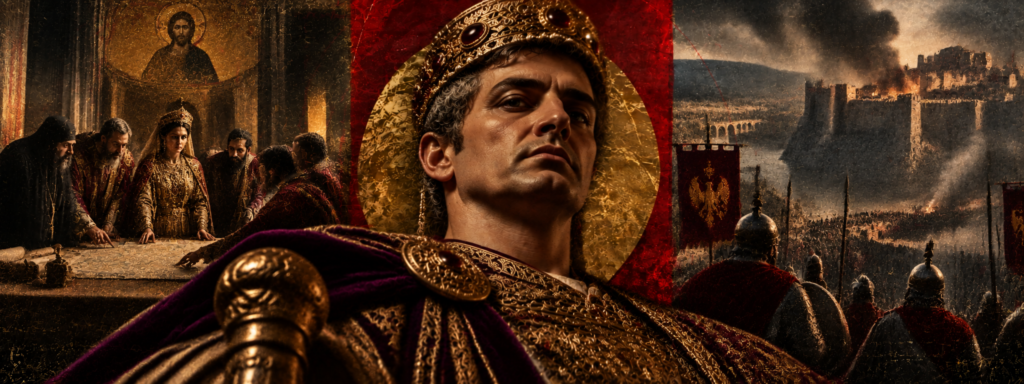
Tiberius: Rome’s Reclusive Emperor and the Dark Rumors of Capri
Behind the walls of an island paradise, Rome’s second emperor became the subject of terrifying rumors, accusations of unspeakable cruelty, and a reign increasingly overshadowed by suspicion, betrayal, and death.
Rome had endured its share of monsters, tyrants, and ruthless men long before Tiberius became emperor. Its history was soaked in the blood of political rivals, betrayed allies, and ambitious generals willing to destroy almost anyone standing between them and power. But there was something particularly unsettling about the final years of Tiberius. Unlike rulers who displayed their authority before cheering crowds or terrified senators, Tiberius increasingly withdrew from public view. He abandoned the capital, retreated to an island in the Bay of Naples, and ruled an empire from behind a wall of secrecy.
From his luxurious residences on Capri, the aging emperor remained one of the most powerful men in the Roman world. His commands traveled across the water to Rome, where a letter bearing his authority could destroy a political career, condemn a prominent family, or send someone to their death. Senators who had once enjoyed his favor suddenly found themselves facing accusations of treason. Friends became enemies, loyalty offered no guarantee of survival, and even members of the imperial family discovered that their bloodlines could make them targets rather than protect them.
Meanwhile, disturbing stories began circulating about what happened behind the closed doors of his island residences. Ancient writers described a ruler who had supposedly surrendered himself to increasingly depraved pleasures, surrounded himself with young victims, and devised humiliating punishments for those unfortunate enough to attract his attention. Some accounts portrayed Capri as a private playground where imperial power had stripped away every restraint on cruelty and exploitation. Others suggested that the emperor’s growing isolation had transformed his fear of betrayal into something far more dangerous.
But how much of this was true?
The darkest allegations come largely from ancient historians writing after Tiberius’s death, particularly Suetonius, Tacitus, and Cassius Dio. Their accounts contain valuable historical information, but they also reflect political hostility, senatorial grievances, literary traditions, and rumors that cannot always be independently verified. The most sensational stories about Capri must therefore be treated as allegations rather than established events.
Yet dismissing everything as hostile gossip would be just as misleading. The treason trials, political purges, executions, and destruction of prominent Roman families were not simply inventions created to make an unpopular emperor appear monstrous. Beneath the scandalous stories lies a documented history of political violence that became especially severe during his later reign.
And perhaps that is what makes Tiberius so disturbing. The legends surrounding his private life may never be fully resolved, but the fear that spread through Rome under his authority was real.
Before the Darkness: The Making of an Emperor
The man who eventually became associated with Capri’s darkest legends did not begin his career as an isolated ruler surrounded by scandal. For much of his life, Tiberius was known as a capable military commander, an experienced administrator, and a disciplined member of Rome’s ruling elite. He had earned his position through decades of service, often carrying out difficult assignments while others enjoyed the public glory.
Born on November 16, 42 BC, Tiberius Claudius Nero entered a Roman world already tearing itself apart. Julius Caesar had been assassinated two years earlier, and the Republic was collapsing under the weight of civil wars, competing generals, and political violence. His childhood unfolded during the struggle that eventually brought Octavian, the future Augustus, to supreme power. When Tiberius’s mother, Livia Drusilla, married Octavian, the young boy became part of a household destined to dominate Rome for generations.
Growing up within that family meant living under extraordinary expectations. Augustus was building a political system that preserved the appearance of republican government while concentrating enormous authority in his own hands. Family marriages, military appointments, and succession arrangements became instruments for securing that system. Personal happiness rarely mattered when weighed against the survival of the dynasty.
Tiberius learned that lesson painfully.
He had married Vipsania Agrippina, and the couple had a son, Drusus. Ancient accounts suggest that Tiberius was deeply attached to his wife, but Augustus required him to divorce her and marry his daughter Julia instead. The marriage strengthened the family’s political arrangements, but it was unhappy. Suetonius later described Tiberius’s distress over the separation, including an encounter in which seeing Vipsania again reportedly left him visibly shaken.
It is impossible to know how profoundly that experience shaped his later personality. Ancient biographers often used unhappy marriages and family tragedies to explain a ruler’s eventual behavior, sometimes creating neat psychological stories from events separated by decades. Nevertheless, the forced divorce reveals something important about the world Tiberius inhabited. Even a successful general with powerful family connections could find his most intimate relationships sacrificed to political necessity.
His military achievements were substantial. He commanded campaigns in the Alps, the Balkans, and along Rome’s northern frontiers, gaining experience that few potential successors could match. His career was not without reversals or periods of withdrawal, but he eventually became indispensable to Augustus. By the time the first emperor died in AD 14, Tiberius was the established successor, with the authority and military standing necessary to take control.
He was already fifty-five years old.
After a lifetime spent serving a dynasty, Tiberius had finally inherited the position that placed him above nearly everyone else in the Roman world. Yet the throne would prove far more difficult to occupy than a military command. On the battlefield, enemies could be identified, orders issued, and victories measured. In Rome, danger could arrive disguised as praise, friendship, or a senator offering an opinion.
The empire had gained an experienced ruler. What it had not gained was another Augustus.
A Throne Surrounded by Fear
Augustus had mastered the delicate performance of appearing to respect republican traditions while exercising supreme authority. He understood the importance of public ceremonies, political relationships, and reassuring gestures toward the Senate. Tiberius inherited the same extraordinary powers, but his relationship with Rome’s political elite was far more strained.
He sometimes appeared reluctant to exercise absolute authority, encouraging senators to deliberate and make decisions for themselves. The difficulty was that nobody could be entirely certain when he genuinely wanted independence and when disagreement might offend him. A senator could believe he was fulfilling the emperor’s wishes by speaking freely, only to discover that his words had been interpreted as criticism. Another might remain silent out of caution and risk appearing uncooperative.
The Senate became a place where political survival increasingly depended on interpreting intentions rather than simply following laws. Tacitus presents the early reign as a world of anxious speeches, carefully calculated flattery, and men trying to determine what the emperor actually wanted. His account is sharply critical, but it captures a fundamental problem within the imperial system: the institutions of the Republic still existed, while real power rested overwhelmingly with one ruler.
That did not mean Tiberius immediately began governing through terror. His early administration included examples of restraint, financial caution, and attention to established procedures. Some contemporary observers, particularly Velleius Paterculus, praised him enthusiastically. Others, writing later, emphasized his suspicious temperament and difficult relationship with the aristocracy.
These contrasting portraits matter because the terrifying image of Tiberius’s final years can make his entire reign seem like an uninterrupted descent into brutality. The historical record is more complicated. His government functioned, Rome’s frontiers remained broadly secure, and many administrative responsibilities were handled competently.
But beneath that stability, tensions were growing.
The imperial family contained competing ambitions, rival branches, and men whose popularity could make them dangerous even without any intention of challenging the emperor. Senators understood that their careers depended on remaining in favor. Informers discovered that accusations could become a means of advancement. And as political trust deteriorated, the consequences of being suspected of disloyalty grew increasingly severe.
For a Roman aristocrat, an accusation of treason was no longer simply a threat to reputation. It could mean exile, confiscation of property, the destruction of a family, or death.
The machinery of fear did not emerge overnight. It developed within a political system where personal authority had become more important than institutional safeguards, and where ambitious men could exploit the emperor’s concerns for their own advantage.
Soon, a series of deaths inside the imperial household would make an already uneasy situation considerably worse.
Death in the Imperial Family
In AD 19, Germanicus, Tiberius’s adopted son and one of the most popular figures in the Roman world, died after falling ill in the eastern provinces. Germanicus had enjoyed enormous public affection, and his military reputation made him a prominent figure within the dynasty. His death was therefore much more than a private family tragedy. It became a political crisis surrounded by grief, anger, and suspicion.
Attention quickly turned toward Gnaeus Calpurnius Piso, the governor of Syria, whose relationship with Germanicus had deteriorated into open hostility. Accusations circulated that Germanicus had been poisoned, and rumors suggested that powerful figures in Rome might have wanted him removed. Some suspicions even reached Tiberius himself, although there is no conclusive evidence that the emperor ordered Germanicus’s death.
Germanicus’s widow, Agrippina the Elder, returned to Rome carrying her husband’s ashes. Her arrival became an extraordinary public display of mourning, and sympathy for her family was intense. Yet that popularity carried dangers of its own. Germanicus’s children represented a possible future for the imperial dynasty, and their prominence could be interpreted as a challenge to other interests surrounding the throne.
The grief did not fade quietly. It became entangled with accusations, rivalries, and a widening struggle over succession.
Then, in AD 23, Tiberius suffered another devastating loss when his biological son Drusus died. Years later, ancient accounts alleged that Drusus had been poisoned as part of a conspiracy involving his wife, Livilla, and Lucius Aelius Sejanus, the powerful commander of the Praetorian Guard. The poisoning allegation emerged after Sejanus’s downfall and cannot be regarded as conclusively established.
Whatever caused Drusus’s death, its political consequences were profound. Tiberius had lost an important potential successor, and the arrangements surrounding the future of the dynasty became more uncertain. Meanwhile, Sejanus was accumulating influence within the imperial household and the government.
He was not an emperor. He did not belong to the ruling family. But he possessed something almost as valuable: the confidence of the man who controlled Rome.
And as Tiberius increasingly distanced himself from public life, that confidence would make Sejanus extraordinarily dangerous.
Sejanus: The Man Who Rose Too Close to the Throne
Sejanus commanded the Praetorian Guard, the military force closely associated with protecting the emperor and maintaining security around the imperial establishment. Under his leadership, the Guard’s concentration near Rome increased its political significance. Armed men loyal to the command structure he controlled were positioned near the center of imperial power, while his relationship with Tiberius gave him access unavailable to most senators.
As his influence expanded, Sejanus became a figure whose friendship could advance careers and whose hostility could ruin them. Those seeking protection had reasons to cultivate his favor. Others feared that standing in his way might expose them to accusations or retaliation. Tacitus portrays him as calculating and ambitious, a man who recognized the opportunities created by the emperor’s withdrawal and the uncertainty surrounding succession.
The surviving accounts also connect Sejanus with efforts to undermine Agrippina the Elder and her children. Their popularity, their place in the dynasty, and the suspicions surrounding Germanicus’s death made them especially vulnerable to political attacks. The struggle was not merely a private feud. Whoever controlled access to Tiberius could influence how he understood events in Rome, which accusations reached him, and which individuals appeared threatening.
For a time, Sejanus seemed almost untouchable.
That appearance would not last.
His extraordinary rise and eventual destruction reveal one of the most frightening characteristics of Tiberius’s later government. Political influence could grow rapidly through proximity to the emperor, but it could disappear just as suddenly. A man praised one day might be condemned the next, and everyone who had publicly supported him could find themselves scrambling to erase the evidence of their loyalty.
Before that dramatic reversal came another development that would define Tiberius’s reputation for centuries.
The emperor left Rome.
Capri: The Emperor Disappears
In AD 26, Tiberius departed Rome, and by AD 27 he had established himself on Capri, the striking island rising from the Bay of Naples. Its rugged cliffs, commanding views, and separation from the mainland offered privacy that would have been difficult to maintain in the capital. Imperial residences provided comfort and space, while the island’s geography made access easier to control.
To an ordinary visitor, Capri might have seemed an extraordinary refuge. The Mediterranean stretched beyond its rocky shores, sunlight illuminated the steep slopes, and the imperial estates offered a setting far removed from Rome’s crowded streets. But in the historical imagination, that beauty would become the backdrop for something sinister.
Tiberius never returned to Rome.
He continued governing through correspondence and representatives, but his physical absence transformed the relationship between the emperor and those who depended on him. Senators could no longer observe his reactions in person. Petitioners needed access through trusted intermediaries. Messages traveled between Rome and Capri, sometimes carrying instructions that would determine whether powerful individuals lived or died.
The precise reasons for his withdrawal remain uncertain. Ancient writers suggested family tensions, discomfort with public life, and a desire to conceal private behavior. It is possible that several considerations influenced his decision. What cannot be established is that he moved to Capri specifically to indulge in the crimes later attributed to him.
Nevertheless, his absence created the perfect conditions for suspicion.
People knew that the emperor possessed almost unlimited authority, but relatively few could witness his daily activities. Those excluded from his household had little opportunity to challenge accounts of what supposedly happened there. Rumors could travel faster than reliable information, and the more inaccessible Tiberius became, the more extraordinary the stories surrounding him grew.
In Rome, his letters remained terrifyingly real. On Capri, his private life became a subject of increasingly disturbing speculation.
The island was no longer simply the emperor’s residence.
It was becoming the setting for one of antiquity’s darkest legends.
The Horrors Allegedly Hidden Behind the Palace Walls
The most notorious accusations against Tiberius come from Suetonius, whose biography describes a ruler supposedly consumed by sexual excess and cruelty during his later years. Writing many decades after the emperor’s death, Suetonius collected stories about elaborate private entertainments, sexual performances, and the exploitation of young people within the imperial residences.
Among the most disturbing allegations were claims that Tiberius abused children, including very young children. Suetonius also described staged sexual activities involving groups of people arranged for the emperor’s entertainment. His account portrayed Capri as a place where wealth, isolation, and absolute authority supposedly allowed Tiberius to satisfy desires that would have horrified Roman society.
These allegations are serious and deeply disturbing. They are also extraordinarily difficult to verify.
Suetonius did not conduct anything resembling a modern investigation, and he wrote long after the alleged events. His biographies frequently include anecdotes, rumors, character judgments, and scandalous material alongside more securely documented information. In describing some of the accusations against Tiberius, he acknowledged their almost unbelievable character.
That uncertainty is essential. There is no reliable basis for presenting every sexual allegation as an established fact, however frequently it has been repeated in popular histories.
Yet the accusations tell us something important about the emperor’s surviving reputation.
To the writers who transmitted these stories, Tiberius represented the possibility that absolute power could transform a ruler’s private desires into acts of exploitation. The alleged victims were people who could not meaningfully refuse the wishes of the most powerful man in the empire. Their vulnerability was central to the horror of the stories, regardless of whether particular episodes occurred as described.
Roman political writing also used sexual misconduct as a way to attack an individual’s character. Accusations of uncontrolled appetite, humiliation, and exploitation could imply that a ruler lacked the restraint necessary to govern others. The private scandal and the public tyranny reinforced one another, producing a portrait of a man supposedly corrupted in every aspect of his life.
That does not establish that the accusations were fabricated. Nor does their survival prove they were true.
The historical problem is that the most shocking details are often the least independently supported. We know that hostile accounts circulated. We know that later writers preserved them. We do not know how many originated from firsthand testimony, political hostility, exaggeration, or stories that became increasingly elaborate with repetition.
The uncertainty did nothing to soften Tiberius’s reputation.
For generations afterward, the name Capri would evoke not only an emperor’s luxurious retreat but the possibility of horrors concealed behind beautiful walls.
Cruelty, Humiliation, and the Power to Destroy
Sexual scandal was only one part of the portrait preserved by ancient writers. Suetonius and Cassius Dio also associated Tiberius’s later years with harsh punishments, humiliations, and episodes of personal cruelty. Some anecdotes describe individuals suffering terrible consequences after offending the emperor, while others present him as a ruler who devised punishments that went far beyond any legitimate political purpose.
These individual stories vary in reliability. Some are difficult to corroborate, and ancient historians frequently organized anecdotes to illustrate the character they believed a ruler possessed. Nevertheless, they contributed to an image of Tiberius as a man whose authority had become inseparable from fear.
The political prosecutions provide stronger evidence for the atmosphere of danger.
Under the Roman law of maiestas, offenses against the dignity or security of the Roman state could become matters of treason. During the imperial period, such accusations increasingly intersected with the emperor’s personal authority. Statements, associations, and alleged intentions could expose individuals to prosecution, particularly when powerful accusers were willing to interpret ordinary conduct as evidence of disloyalty.
The consequences could be devastating.
A senator who had maintained friendly relations with the wrong person might suddenly find that association presented as suspicious. An imprudent remark could become the basis of an accusation. A political rival could use the atmosphere of insecurity to eliminate an opponent. Confiscations and punishments also created incentives for people to denounce others.
Tacitus’s account is especially concerned with the activities of informers and the corrosive effects of fear on public life. His writing is hostile to the later reign, and individual episodes must be assessed critically. But the broader pattern of prosecutions, punishments, and political instability cannot be reduced to literary invention.
The danger extended beyond those directly accused.
Families had to consider what an arrest might mean for their property and future. Friends faced difficult choices about whether to defend the condemned. Public sympathy could be interpreted as political opposition. Even mourning a disgraced person might attract unwelcome attention.
The most unsettling aspect of such a system was not that everyone was constantly under accusation. It was that nobody could be entirely certain when an old friendship, a careless statement, or an ambitious enemy might become a threat.
And the emperor did not need to be physically present for that fear to spread.
The Fall of Sejanus: Rome Turns on Its Own
In AD 31, the political world surrounding Tiberius underwent a spectacular reversal.
Sejanus, the man who had accumulated extraordinary influence as commander of the Praetorian Guard, suddenly fell from favor. The precise sequence of events and the evidence that convinced Tiberius to act remain subjects of historical debate. Ancient accounts suggest that concerns about Sejanus’s ambitions and possible conspiracies played a role, but the full circumstances cannot be reconstructed with certainty.
What is clear is that the emperor moved against him.
Through carefully arranged communications and actions in Rome, Sejanus was stripped of his position, arrested, and executed. Cassius Dio describes the dramatic reversal as men who had once competed to honor Sejanus rushed to distance themselves from him. The figure who had appeared to stand just beneath the emperor was now condemned as an enemy.
The speed of the transformation was terrifying.
Sejanus’s death did not end the punishment. His family and suspected associates were swept into the aftermath, and the violence reached even his children. Ancient accounts describe further investigations, executions, and reprisals against people connected with the fallen favorite.
For those who had cultivated Sejanus’s friendship, every earlier gesture of loyalty could suddenly appear dangerous. A public compliment, a political alliance, or a family connection might be used to suggest involvement in a conspiracy. The destruction of one powerful man created opportunities for others to settle scores, demonstrate loyalty, or protect themselves through accusation.
The purge revealed how unstable imperial favor could be.
Sejanus had risen because Tiberius trusted him. He fell when that trust disappeared. And those caught in the aftermath discovered that they could suffer for having believed the emperor’s favorite was someone worth supporting.
For anyone hoping that Sejanus had been responsible for the worst excesses of the government, the years that followed offered little comfort.
The prosecutions continued.
A Family Destroyed
Among the most tragic consequences of Tiberius’s later reign was the destruction of much of Germanicus’s immediate family. The widow and children of a man once celebrated throughout Rome became entangled in the bitter struggle over succession, and their prominence did not save them.
Agrippina the Elder, whose return to Rome with Germanicus’s ashes had inspired such extraordinary sympathy, was eventually exiled. Her son Nero Caesar also fell victim to political proceedings and died after his downfall. Another son, Drusus Caesar, was imprisoned and died in AD 33 after severe deprivation. Agrippina herself died in exile that same year.
Tacitus’s surviving narrative gives these events particular emotional force. He presents a family gradually broken by suspicion, accusation, and imperial hostility. Although his account reflects his own interpretation of Tiberius’s motives, the deaths and political destruction of these individuals were real consequences of the dynastic conflicts.
The fate of Drusus Caesar was especially grim. Ancient accounts describe his confinement and starvation, presenting his final circumstances as an example of the cruelty surrounding the succession struggle. The details come through hostile literary sources, but the broader fact remains that a member of the imperial family died while held under the authority of his own dynasty.
This was not merely an argument among powerful relatives.
The children of Germanicus had once represented the future of Rome’s ruling house. Their family name brought public affection, military prestige, and a claim to prominence. Yet those same qualities could become dangerous when succession was uncertain and powerful figures feared potential rivals.
Only one of Germanicus’s sons, Gaius, survived to become emperor.
History would remember him by the nickname Caligula.
He spent time in Tiberius’s household during the final years of the reign, occupying an extraordinary position. His mother and brothers had suffered under the government of the man on whom his own future depended. Tacitus portrays him as concealing his emotions and adapting carefully to the emperor’s expectations, although the account cannot reveal his private thoughts with certainty.
The situation illustrates the brutal pressures surrounding dynastic survival. A young man could find himself dependent on a ruler whose government had destroyed much of his family, knowing that any sign of resentment might carry consequences.
For Rome’s imperial household, blood ties offered no promise of safety.
Sometimes they were precisely what made a person vulnerable.
When Even Mourning Became Dangerous
One of the most chilling passages in Tacitus’s account of the later reign concerns the execution of a large group of prisoners associated with Sejanus. He describes condemned individuals whose bodies were exposed after their deaths, while those who might have mourned them faced the possibility that visible grief could attract suspicion.
The scene is horrifying not simply because people were killed, but because fear extended beyond death.
In Tacitus’s portrayal, relatives and friends were forced to calculate whether expressing sorrow might be interpreted as sympathy for an enemy of the emperor. Ordinary human responses became politically dangerous. A person could survive the destruction of someone they loved and still have to conceal the grief that followed.
Tacitus wrote with deliberate dramatic force, and his presentation reflects a moral condemnation of the regime. Nevertheless, his account captures a central fear associated with political repression: punishment does not always end with the condemned. It can spread into households, friendships, and communities, teaching survivors to remain silent.
The Senate played its own part in sustaining this environment.
It would be misleading to imagine every senator as an innocent victim helplessly awaiting instructions from Capri. Senators participated in prosecutions, competed for favor, and sometimes used accusations to advance their own interests. Their cooperation helped give imperial punishments the appearance of established legal procedure.
That complicity made the situation even darker.
The emperor’s authority was immense, but it operated through a political class whose members could benefit from condemning others. Fear encouraged obedience, ambition encouraged accusation, and the distinction between genuine threats and manufactured enemies could become increasingly difficult to maintain.
Tiberius did not have to personally invent every accusation or supervise every prosecution for his government to become dangerous. The structure of power allowed others to act in anticipation of his wishes.
And from Capri, the emperor remained at the center of it all.
The Emperor Who Could Still Govern
For all the darkness associated with his later reign, Tiberius cannot accurately be portrayed as a man who simply abandoned the administration of Rome. Even during his long withdrawal, the imperial government continued functioning, and important decisions were made in response to economic and civic emergencies.
In AD 33, a financial crisis caused serious difficulties in the availability of credit. Tiberius responded by making a substantial sum of money available for interest-free loans secured against property. Tacitus records the intervention, acknowledging a practical response to an economic emergency despite his otherwise critical portrayal of the period.
After a destructive fire in Rome in AD 36, Tiberius also provided compensation to those who had suffered losses. Tacitus reports expenditure amounting to one hundred million sesterces and describes the assistance as favorably received.
These measures do not erase the political executions or the suffering of prominent families. They do, however, prevent the reign from being reduced to a simple story of an emperor who had lost all interest in government.
That contradiction is central to understanding Tiberius.
He could authorize substantial relief for people affected by disaster while remaining associated with severe punishments for political enemies. He could preserve administrative continuity while allowing an atmosphere of suspicion to damage the relationship between the throne and the Senate. He could withdraw from public life without surrendering any meaningful portion of his authority.
The image is more disturbing because it is not entirely one-dimensional.
The ruler portrayed as a monster in later biographies was also an experienced administrator whose government retained the ability to address practical problems. The evidence does not support an uncomplicated picture of either total incompetence or uninterrupted savagery.
Instead, it reveals an imperial system capable of functioning effectively in some areas while becoming deeply threatening in others.
Rome did not collapse because Tiberius withdrew to Capri.
It continued operating beneath the shadow of an increasingly inaccessible ruler.
The Final Days of Tiberius
By AD 37, Tiberius was an old man who had ruled the Roman world for nearly twenty-three years. His health was declining, succession remained a sensitive matter, and the next generation of the dynasty waited for a change that could alter their fortunes overnight.
He died on March 16, AD 37, at Misenum, aged seventy-seven.
Even his death became surrounded by disturbing stories.
Tacitus recounts an account in which Tiberius appeared to be dying and preparations began for the succession, only for him to show signs of recovering consciousness. According to that version, the Praetorian commander Macro then arranged for the emperor to be smothered, ensuring that the transfer of power could proceed.
Other ancient accounts differ, and the allegation of murder cannot be established as historical fact. The details belong to the same tradition of suspicion and dramatic storytelling that shaped so much of Tiberius’s later reputation.
Nevertheless, the story is revealing.
Even at the moment of his death, later writers imagined Tiberius surrounded by men whose loyalty could not be trusted, caught in a final struggle over power, and vulnerable to the same ruthless political calculations that had destroyed so many others during his reign.
His successor was Gaius Caligula, the surviving son of Germanicus.
Tiberius left behind an empire that had successfully passed through its first succession after Augustus and was preparing for another. The imperial system had endured. Its institutions still functioned, its armies remained formidable, and Rome continued to dominate the Mediterranean world.
But the reign had also exposed the dangers of concentrating extraordinary power in one individual while retaining institutions that offered only limited protection against his authority.
A senator might possess wealth, ancestry, and political prestige. A member of the imperial family might enjoy public affection and an apparently secure position in the succession. A trusted adviser might control soldiers and command enormous influence.
None of those advantages guaranteed survival once imperial suspicion turned against them.
Monster, Misunderstood Emperor, or Something More Disturbing?
More than two thousand years after his birth, Tiberius remains trapped between two competing historical portraits.
One is the experienced general and administrator who spent decades serving Augustus, helped secure Rome’s frontiers, and governed an empire that remained structurally stable throughout his reign. This Tiberius was disciplined, intellectually interested, and capable of practical decisions that benefited the state.
The other is the shadowy figure of Capri: an aging ruler accused of sexual exploitation, surrounded by terrifying stories of cruelty, and increasingly associated with political purges, executions, and the destruction of his own family.
Neither portrait can simply be accepted without qualification.
The most sensational accusations about Capri are preserved primarily in literary sources written after his death. They may contain elements of truth, but their specific details often cannot be verified. Ancient political culture encouraged hostile portrayals of unpopular rulers, and scandalous stories could survive precisely because they were shocking.
Yet there is no need to accept every lurid allegation to recognize the darkness of Tiberius’s later reign.
The political prosecutions happened. Sejanus was executed, and his downfall triggered further violence. Agrippina the Elder died in exile. Her sons suffered political destruction, imprisonment, and death. Senators faced a political environment in which accusation could become a weapon, and imperial displeasure could carry fatal consequences.
These are not merely legends about what might have occurred behind closed doors. They are central events in the surviving history of the reign, even where ancient accounts disagree about motives and particular circumstances.
Tiberius’s story is therefore more complicated than the familiar tale of a respectable ruler who retired to a beautiful island and became a monster.
His reign illustrates how an imperial system could continue to govern while becoming increasingly vulnerable to personal mistrust, political manipulation, and severe punishment. His withdrawal did not create every problem, but it intensified the distance between the man who held supreme authority and those whose lives depended on his decisions.
And in that distance, rumor flourished.
The Dark Legacy of Capri
Today, Capri is celebrated for its breathtaking scenery, steep cliffs, clear waters, and Mediterranean beauty. Visitors exploring the remains of Villa Jovis, one of the residences associated with Tiberius, encounter the ruins of an imperial retreat overlooking the sea.
It is difficult to reconcile that peaceful landscape with the reputation that became attached to it.
Nearly two thousand years ago, the same island housed an emperor whose authority extended across a vast empire. Beyond its shores, Roman senators anxiously awaited his decisions. Families struggled to survive political accusations. Men who had once enjoyed extraordinary influence discovered how quickly imperial favor could disappear.
Within the imperial residences, the truth about Tiberius’s private conduct remains obscured by centuries of hostile accounts, sensational allegations, and unanswered questions. We cannot know everything that happened there, and the most disturbing stories must remain separated from what the evidence can establish.
But the uncertainty itself helped create the legend.
Capri became a place where Romans could imagine what absolute power looked like when removed from public scrutiny. Its beauty made the stories more memorable, its isolation made them more believable to hostile audiences, and its powerful resident ensured that even the wildest rumors attracted attention.
The real tragedy of Tiberius’s reign does not depend on proving every horror attributed to him. It lies in a political world where accusations could destroy families, where fear could silence opposition, and where the emperor’s authority reached people who had little ability to defend themselves.
Tiberius had left Rome behind, but Rome had never escaped him.
Across the dark waters of the Bay of Naples, messages continued to arrive from an island few could enter and fewer still could understand. Some carried routine instructions. Others brought accusations, condemnations, or decisions that changed lives forever.
Behind the ruins and the rumors, one image remains: an emperor who had withdrawn from the world without loosening his grip upon it.
Tiberius did not need to sit on a throne in Rome to make Rome afraid.