
Maximilian I: The Habsburg Emperor Who Lost His Throne Before a Firing Squad
An Austrian Archduke, Napoleon III’s Imperial Ambitions, a Crown Built on Foreign Bayonets, and the Bloody Execution That Ended Mexico’s Second Empire
Maximilian I of Mexico (6 July 1832–19 June 1867), born Ferdinand Maximilian Joseph of Austria, was an Austrian archduke of the House of Habsburg-Lorraine and Emperor of Mexico from 1864 until his execution in 1867. The younger brother of Emperor Franz Joseph I of Austria, Maximilian was a naval officer, liberal-minded aristocrat, and former viceroy of Lombardy-Venetia who accepted the Mexican crown following French military intervention and an invitation from Mexican monarchists. Supported by Napoleon III of France and his wife, Charlotte of Belgium, known in Mexico as Empress Carlota, he arrived in Mexico in 1864 hoping to establish a constitutional monarchy capable of reconciling the country’s bitter political divisions. Instead, he inherited a devastating civil conflict, faced determined resistance from the republican government of President Benito Juárez, and became increasingly dependent upon French troops whose withdrawal eventually doomed his regime. After refusing opportunities to abandon the throne, Maximilian was besieged and captured at Querétaro in May 1867, tried by a republican military tribunal, and sentenced to death. On 19 June 1867, at the age of thirty-four, he was executed by firing squad on the Cerro de las Campanas alongside his generals Miguel Miramón and Tomás Mejía. His death shocked European royal courts, inspired one of the nineteenth century’s most famous paintings of political execution, and brought a bloody conclusion to the extraordinary attempt to establish a European-backed monarchy in republican Mexico.
The Emperor Who Faced His Executioners
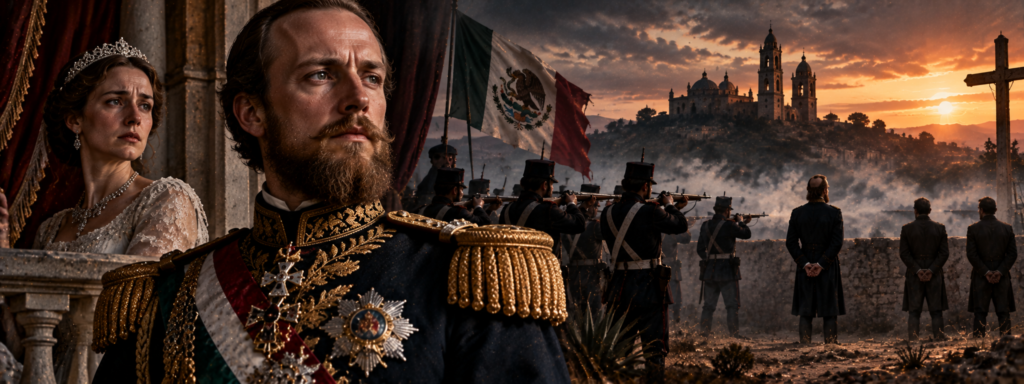
On the morning of 19 June 1867, three condemned men were taken to a rocky hillside outside the Mexican city of Querétaro. One was an Austrian archduke who had once lived among the glittering palaces of the Habsburg dynasty, commanded ships in the imperial navy, and dreamed of creating a prosperous constitutional monarchy across the Atlantic. The other two were Mexican generals who had fought for the conservative cause and remained loyal to the imperial government until its final collapse. All three were about to die before a republican firing squad, their executions intended to demonstrate that the age of foreign-imposed monarchy in Mexico was over.
The Austrian was Maximilian I, Emperor of Mexico, although by that morning his imperial title had become almost meaningless. His armies had been defeated, his capital was lost, and the French emperor who had helped place him on the throne had withdrawn the soldiers upon whom his government depended. The republican president, Benito Juárez, had refused the appeals for clemency that arrived from abroad. Maximilian’s last remaining possession was the dignity with which he hoped to face death.
The execution took place on the Cerro de las Campanas, the Hill of the Bells, a place that would become inseparable from the history of Mexico’s struggle against foreign intervention. Maximilian stood alongside Generals Miguel Miramón and Tomás Mejía, men whose political loyalties had brought them to the same fatal conclusion. According to several accounts, Maximilian made a final statement expressing his hope that his blood might serve the good of Mexico. The exact wording of his reported last words varies between sources, and later retellings have undoubtedly added dramatic details to the scene.
One widely repeated tradition claims that Maximilian distributed gold coins to members of the firing squad, asking them to aim carefully and spare his face so that his mother might recognize him. The story is memorable, but its details cannot all be treated as securely established. Accounts of famous executions often acquire symbolic gestures and carefully polished final speeches as they pass into popular history. What is beyond dispute is that Maximilian was shot by Mexican republican soldiers on 19 June 1867 and that his death marked the definitive destruction of the Second Mexican Empire.
The execution shocked much of Europe. Maximilian was not an obscure adventurer who had seized a crown through a private rebellion, but a member of one of the continent’s oldest ruling dynasties. He was the brother of the Austrian emperor, the husband of a Belgian princess, and the beneficiary of a political enterprise organized by Napoleon III of France. His death therefore seemed to many European observers like a terrifying assault upon the traditional sanctity of monarchy.
Yet the event looked very different from the perspective of the Mexican republicans who had fought for years to defend their country. Maximilian had accepted a throne created under the protection of an invading foreign army, and his government had authorized severe measures against republican fighters. Thousands of Mexicans had died during the struggle over the country’s political future. To Juárez and his supporters, the execution was not simply the killing of a fallen monarch but a declaration that Mexico would determine its own government.
The tragedy was made more unsettling by Maximilian’s personal character. He was not generally remembered as a ruler driven by sadistic cruelty or a desire for indiscriminate bloodshed. He supported certain liberal reforms, expressed concern for Indigenous communities, and imagined himself a benevolent sovereign. Nevertheless, he accepted an empire that could survive only through military coercion and ultimately approved policies that exposed his enemies to execution.
Maximilian’s final morning was the culmination of a disaster that had begun thousands of miles away in European palaces and diplomatic chambers. It involved the ambitions of Napoleon III, the desperation of Mexican conservatives, the resistance of Benito Juárez, and the extraordinary confidence of an Austrian archduke who believed he could become the ruler of a country he barely understood. It was also a story of a royal marriage destroyed by political catastrophe, as Maximilian’s wife Carlota struggled desperately to save the empire before suffering a profound psychological collapse. By the time the firing squad raised its rifles, the dream of a Mexican Habsburg monarchy had become one of the most devastating royal failures of the nineteenth century.
The Habsburg Prince Who Lived in His Brother’s Shadow
Ferdinand Maximilian Joseph was born on 6 July 1832 at Schönbrunn Palace in Vienna, one of the grand residences of the Austrian imperial family. His father was Archduke Franz Karl of Austria, and his mother was Princess Sophie of Bavaria, a formidable figure whose ambitions for her children shaped the dynasty’s political future. Maximilian grew up surrounded by ceremonial splendor, aristocratic privilege, and the expectations placed upon members of Europe’s ruling houses. From birth, he belonged to a family that had governed extensive territories for centuries.
His elder brother, Franz Joseph, was destined for a far more important position within the dynasty. During the revolutionary upheavals of 1848, Franz Joseph became Emperor of Austria, assuming responsibility for a vast multinational monarchy struggling with nationalism, political reform, and social unrest. Maximilian, still a teenager, watched his brother ascend to the imperial throne. The contrast between their futures became a defining feature of his early life.
The brothers possessed markedly different temperaments. Franz Joseph developed a reputation for discipline, formality, and devotion to the duties of monarchy, while Maximilian was more imaginative, romantic, and intellectually curious. He displayed interests in literature, architecture, natural history, and the wider world beyond the rigid conventions of the Viennese court. His personality encouraged the image of a charming and cultivated prince whose ambitions did not fit comfortably within the narrow limits of his position.
Their relationship was complicated by affection, rivalry, and political disagreement. Maximilian possessed talents and aspirations of his own, but his elder brother controlled the empire and its principal institutions. The younger archduke could hold prestigious appointments, yet he would always remain subordinate to Franz Joseph within the Habsburg hierarchy. This imbalance contributed to his desire for an independent sphere of authority.
Rumors concerning Maximilian’s parentage circulated in later years, particularly suggestions that his mother had been romantically involved with Napoleon II, the son of Napoleon Bonaparte. Such speculation has occasionally been used to imply that Maximilian was not the biological son of Archduke Franz Karl. There is no convincing evidence establishing this claim, and it should be treated as court gossip rather than historical fact. Maximilian was legally and dynastically recognized as a Habsburg archduke.
His upbringing nevertheless prepared him for a life of public responsibility. He received an extensive education appropriate to his rank, including languages, military subjects, history, and political affairs. He traveled widely and developed an interest in the natural world that remained important throughout his life. His curiosity distinguished him from the more conventional image of a nineteenth-century military prince.
Maximilian’s imagination was particularly drawn toward the sea. Naval service offered an opportunity to escape the ceremonial restrictions of Vienna while still serving the Habsburg monarchy. It also provided a field in which he could exercise leadership without directly competing with his brother. The imperial navy would become the setting for some of his most successful achievements.
Long before Mexico entered his life, Maximilian had already begun constructing an identity as a reforming, adventurous prince. He wanted to accomplish something significant rather than remain a decorative member of the imperial family. His ambitions were not necessarily unreasonable, but they made him vulnerable to opportunities that promised grandeur without revealing their dangers. The Mexican crown would eventually offer precisely that temptation.
A Prince Who Preferred the Sea to the Palace
Maximilian entered the Austrian navy while still young and developed a genuine enthusiasm for maritime affairs. The navy was smaller and less prestigious than the empire’s land forces, but it offered opportunities for modernization and expansion. Maximilian embraced the service with unusual energy, demonstrating interests that extended beyond ceremonial command. He wanted Austria to possess a modern naval establishment capable of competing with other European powers.
In 1854, he became commander-in-chief of the Austrian navy. The appointment gave him substantial responsibility at an age when many aristocratic officers were still establishing their careers. He supported naval construction, administrative reform, and the development of maritime facilities. His work contributed to the modernization of a service that had previously occupied a relatively secondary position within Habsburg military planning.
Maximilian also participated in voyages that broadened his knowledge of the world. He visited Mediterranean regions and developed interests in geography, botany, and scientific exploration. His travels reinforced his attraction to distant countries and unfamiliar cultures. The experiences later contributed to his belief that he possessed the imagination and adaptability necessary to govern outside Europe.
One of the most important naval enterprises associated with his leadership was the voyage of the Austrian frigate Novara. The ship departed in 1857 on a scientific circumnavigation that became a major achievement for Austrian exploration. Maximilian supported the expedition, although he did not personally accompany the vessel around the world. The voyage reflected his interest in connecting imperial prestige with scientific progress.
His naval career was among the most constructive periods of his public life. Unlike the Mexican enterprise, it involved institutions whose political foundations were relatively secure and whose development could be measured through practical achievements. He was able to promote modernization without depending upon a foreign occupying army. His ambitions, for a time, found a productive outlet.
Yet naval command could not satisfy every aspect of his desire for political significance. Maximilian remained a younger brother within a dynasty whose highest authority belonged to Franz Joseph. He wanted responsibilities that would allow him to shape government and society directly. That desire led him toward another important appointment.
The contrast between his naval achievements and his later imperial disaster is revealing. Maximilian possessed genuine administrative ability, cultural interests, and a capacity to inspire personal loyalty. His failure in Mexico was not simply the result of personal incompetence. It arose from a combination of political misjudgment, unrealistic expectations, foreign intervention, and the fundamental weakness of the monarchy he agreed to lead.
The Viceroy Who Was Too Liberal for Vienna
In 1857, Maximilian was appointed governor-general of the Kingdom of Lombardy-Venetia, the Habsburg territory in northern Italy. The appointment gave him a prominent political role in a region troubled by nationalist sentiment and resentment of Austrian rule. It also placed him within one of the most difficult problems facing the Habsburg monarchy. Italian nationalists increasingly demanded independence or unification, while Vienna sought to preserve imperial authority.
Maximilian approached his responsibilities with a comparatively conciliatory outlook. He favored administrative improvements and believed that a less repressive government might reduce hostility toward Austrian rule. His policies reflected a conviction that monarchy could survive by adapting to modern political expectations. This outlook brought him into tension with more conservative elements of the imperial administration.
His wife, Charlotte of Belgium, shared his enthusiasm for public responsibility. The couple had married in 1857, and Charlotte possessed considerable intelligence, political interest, and personal ambition. She was not content to remain an ornamental consort. Their marriage initially appeared to unite two young royals who believed they could make monarchy more enlightened and effective.
The political environment in northern Italy, however, was moving beyond the reforms Maximilian could offer. Nationalist movements sought independence from Austria rather than merely better government under Habsburg authority. The Kingdom of Sardinia-Piedmont and its allies were preparing to challenge Austrian control. Maximilian’s conciliatory policies could not resolve the underlying conflict over sovereignty.
Franz Joseph became increasingly dissatisfied with his brother’s approach. The Austrian government feared that concessions might encourage nationalist demands rather than weaken them. Maximilian’s position became untenable as tensions escalated. In 1859, he was removed from office shortly before Austria’s war against France and Sardinia-Piedmont.
The dismissal was a personal humiliation. Maximilian had hoped to demonstrate his abilities as a reforming ruler, but his brother had effectively rejected his political judgment. The experience deepened the sense that his ambitions could not be fulfilled within the existing Habsburg system. He began looking toward a future in which he might exercise authority independently.
After leaving Lombardy-Venetia, Maximilian and Charlotte spent much of their time at Miramare Castle near Trieste. The residence, overlooking the Adriatic Sea, reflected Maximilian’s romantic tastes and love of maritime scenery. It was an elegant retreat filled with the promise of a cultivated royal life. Yet the couple’s political ambitions remained unresolved.
Miramare later acquired a tragic reputation because of its association with the Mexican adventure. The castle became the place from which Maximilian departed to claim a distant throne he would never successfully secure. Charlotte would eventually return to Europe without her husband, her hopes for their imperial future shattered. The beauty of Miramare would stand in haunting contrast to the violence of Querétaro.
Charlotte of Belgium: The Princess Who Wanted an Empire
Charlotte of Belgium was born in 1840, the daughter of King Leopold I of Belgium and Louise of Orléans. She grew up within a royal family closely connected to several European dynasties. Intelligent, disciplined, and politically ambitious, she possessed a strong sense of the responsibilities associated with monarchy. Her marriage to Maximilian in 1857 appeared to offer a future of considerable influence.
Charlotte was deeply invested in her husband’s career. She believed in the dignity of monarchy and shared his desire to undertake a significant political mission. The couple’s removal from Lombardy-Venetia was therefore disappointing to both of them. Their subsequent life at Miramare offered comfort and prestige but not the authority they desired.
Their marriage was complicated by differences in temperament and by the pressures of dynastic expectation. Charlotte was often more determined and politically focused than her husband, while Maximilian could be romantic, indecisive, and attracted to elaborate visions of government. The couple had no children together, a circumstance that later created questions about the succession to the Mexican throne. Their childlessness also contributed to the personal pressures surrounding their marriage.
Later accounts sometimes describe the relationship in highly sensational terms, including allegations of infidelity and serious marital estrangement. Some aspects of their private lives remain disputed, and popular biographies have occasionally exaggerated uncertain evidence. What is clear is that Charlotte remained strongly committed to the Mexican imperial project. Her political involvement became increasingly important as the monarchy encountered resistance.
When the possibility of a Mexican crown emerged, Charlotte recognized its significance. It offered the couple something they could never obtain within the Austrian imperial hierarchy: a sovereign throne of their own. They would no longer be merely the younger brother and sister-in-law of Franz Joseph. They would become an emperor and empress ruling a country with enormous territory, resources, and historical prestige.
Charlotte’s enthusiasm did not mean that she fully understood Mexico’s political circumstances. Like Maximilian, she received information filtered through European diplomats, Mexican monarchists, and supporters of French intervention. The picture presented to the couple emphasized the possibility of national reconciliation and popular acceptance. It concealed or minimized the strength of republican resistance.
The Mexican crown would eventually destroy Charlotte’s hopes and profoundly affect her health. She would become one of the most tragic figures of the Second Mexican Empire, traveling through Europe in a desperate attempt to save her husband’s throne. Her psychological deterioration during that mission would leave Maximilian increasingly isolated. The empire that promised to fulfill their ambitions would instead separate them permanently.
Mexico Before Maximilian: A Republic Torn Apart
Mexico’s political crisis did not begin with Maximilian’s arrival. The country had experienced decades of instability following independence from Spain in 1821. Rival political movements disagreed over the structure of government, the role of the Catholic Church, the power of the military, and the distribution of authority between central and regional institutions. These conflicts repeatedly produced coups, rebellions, and civil wars.
The struggle between liberals and conservatives became especially intense during the middle of the nineteenth century. Liberals generally sought constitutional government, limits on corporate privileges, and reforms affecting church and military institutions. Conservatives favored a stronger traditional social order and often defended the political influence of the Catholic Church. Neither movement was entirely uniform, but their disagreements shaped the country’s future.
Benito Juárez emerged as one of the leading figures of Mexican liberalism. Born in Oaxaca in 1806, he was of Zapotec Indigenous origin and rose through education, law, and political service. His career was extraordinary in a society marked by deep racial and social inequalities. He became a central defender of constitutional republican government.
The liberal Constitution of 1857 intensified political conflict. Conservatives rejected important aspects of the reform program, and the country descended into the War of Reform. The struggle lasted from 1858 to 1861 and devastated Mexico’s finances and political institutions. Juárez ultimately emerged victorious, but the republic remained weakened.
The war also left Mexico burdened by substantial debts to foreign creditors. In 1861, Juárez’s government suspended payments on certain foreign obligations, provoking protests from European powers. Britain, Spain, and France agreed to intervene to secure their financial claims. Their initial cooperation concealed very different political objectives.
Britain and Spain eventually withdrew after it became clear that France intended to pursue ambitions extending far beyond debt collection. Napoleon III sought to establish a friendly monarchy in Mexico that would increase French influence in the Americas. Mexican conservatives who had lost the civil war saw an opportunity to overturn the republican government. Their interests converged with those of the French emperor.
The result was a foreign intervention that transformed Mexico’s internal political struggle into an international conflict. The French army advanced into Mexican territory, confronting republican forces determined to resist. Napoleon III’s project would eventually require a European prince willing to accept the throne. Maximilian of Austria became the preferred candidate.
Napoleon III and the Dream of a French Empire in America
Napoleon III, Emperor of the French, was the nephew of Napoleon Bonaparte and a ruler whose ambitions extended well beyond Europe. He sought to enhance French prestige through military victories, diplomatic influence, and overseas expansion. Mexico offered an opportunity to establish a friendly government in the Americas while the United States was consumed by its Civil War. The French emperor believed the circumstances were unusually favorable.
The American Civil War was crucial to his calculations. The United States had long opposed European attempts to establish new colonial or monarchical domination in the Western Hemisphere. Yet the conflict between Union and Confederate forces limited Washington’s ability to intervene directly in Mexico. Napoleon III hoped to exploit that temporary weakness.
French ambitions were also encouraged by Mexican conservatives who opposed Juárez’s liberal republic. Some believed that a monarchy could provide political stability and protect traditional institutions. They sought a European prince whose dynastic prestige might strengthen the new government. The French intervention therefore combined foreign imperial ambitions with genuine Mexican political divisions.
Napoleon III’s project rested upon several dangerous assumptions. He underestimated the determination of Mexican republicans, overestimated the popularity of monarchy, and believed that French military superiority could produce lasting political stability. He also assumed that the international situation would continue favoring French intervention. These miscalculations would eventually destroy the enterprise.
The first major French attempt to advance toward Mexico City ended in defeat at Puebla on 5 May 1862. Mexican forces under General Ignacio Zaragoza repelled the invading army, producing a victory that became an enduring symbol of resistance. The battle demonstrated that French troops were not invincible. It also exposed the weakness of Napoleon’s assumption that Mexico could be subdued quickly.
France responded by sending additional forces. In 1863, a larger French army captured Puebla after a prolonged siege and then occupied Mexico City. Juárez and his government withdrew rather than surrender. The republic continued functioning from territory beyond French control.
The occupation of the capital allowed French authorities and Mexican monarchists to organize a new political arrangement. An assembly of notables supported the establishment of a monarchy and offered the crown to Maximilian. Yet the assembly did not represent a free nationwide expression of Mexican opinion. Its decision occurred under conditions created by foreign military occupation.
Napoleon III now needed Maximilian to accept the offer. The Austrian archduke possessed the dynastic prestige and cultivated personality that French planners believed would make the monarchy respectable. His liberal tendencies might also help attract moderates who distrusted conservative reaction. The emperor of France had found a candidate who appeared capable of giving the intervention a more legitimate appearance.
The Crown Offered at Miramare
The Mexican crown was offered to Maximilian through representatives of the monarchist cause. The proposal appealed directly to his ambition for independent sovereignty. He had experienced the limitations of his position within the Habsburg dynasty and the humiliation of dismissal from Lombardy-Venetia. Mexico promised the opportunity to establish a monarchy shaped by his own ideals.
Maximilian did not immediately accept without conditions. He sought assurances that the Mexican people genuinely desired his rule and that sufficient international support existed to sustain the monarchy. These concerns were reasonable, but the information presented to him was deeply misleading. Supporters of the project had every incentive to exaggerate the strength of monarchist sentiment.
The delegation presented evidence intended to demonstrate widespread support for the new empire. Maximilian interpreted the assurances as confirmation that he had been invited to rule by the Mexican nation. In reality, large parts of the country remained loyal to Juárez or hostile to foreign intervention. The supposed national invitation rested upon a political process shaped by French occupation.
Franz Joseph viewed the enterprise with considerable caution. The Austrian emperor understood that Maximilian would be entering a dangerous conflict far from Europe. He also had dynastic concerns about the consequences of his brother accepting a foreign crown. Maximilian’s decision would require sacrifices within the Habsburg succession system.
Before departing, Maximilian renounced certain succession rights in Austria. The arrangement reflected the political separation between his new position and the Austrian monarchy. The renunciation was painful because it emphasized the irreversible nature of his choice. He was abandoning the security of his dynastic position for an uncertain throne across the Atlantic.
Charlotte strongly supported the decision. She believed that Mexico offered the couple an opportunity to accomplish something historically significant. Their marriage would become the center of a new imperial court, and they would govern a country whose future appeared open to transformation. Her confidence helped sustain Maximilian’s enthusiasm.
On 10 April 1864, Maximilian formally accepted the Mexican crown at Miramare. The ceremony represented the culmination of years of frustrated ambition. An Austrian archduke who had once lived in his brother’s shadow now stood on the threshold of becoming a sovereign emperor. The moment was celebrated by supporters as the beginning of a new political era.
Yet the crown was already stained by the circumstances of its creation. French soldiers occupied major Mexican cities, republican forces continued fighting, and the government Maximilian was replacing had not surrendered. His authority depended upon military intervention rather than a broadly accepted constitutional settlement. The emperor-elect was preparing to cross the Atlantic into a war he had not caused but would soon make his own.
The Voyage to a Throne Built on Bayonets
Maximilian and Charlotte departed Europe aboard the Austrian frigate Novara in April 1864. The voyage carried them from the familiar world of European courts toward a country whose political realities they understood only imperfectly. Their departure was surrounded by ceremony, optimism, and the expectation that they would establish a distinguished new dynasty. Few of those celebrating the journey could have imagined its final outcome.
The couple arrived at Veracruz in May 1864. Their reception was not the universal outpouring of enthusiasm they had been led to expect. The city had suffered from war, political instability, and the presence of foreign troops. The contrast between imperial expectations and local realities became apparent almost immediately.
Maximilian continued toward Mexico City, where supporters organized elaborate ceremonies to welcome the new emperor and empress. The capital offered a more impressive display of loyalty, particularly among conservative elites and those who believed the monarchy might restore stability. Yet the celebrations concealed the fact that much of the country remained outside imperial control. The government of Benito Juárez continued resisting.
The new emperor established his residence at Chapultepec Castle, overlooking Mexico City. The location possessed historical associations with earlier Mexican rulers and offered a dramatic setting for an imperial court. Maximilian undertook improvements intended to transform the residence into a symbol of modern monarchy. The castle became the center of a government that combined European ceremony with Mexican political ambitions.
The imperial couple also adopted elements of Mexican identity. Maximilian sought to present himself as a ruler committed to his new country rather than merely an Austrian prince. He studied Mexican history, supported cultural projects, and attempted to communicate respect for the country’s people. These efforts were genuine in some respects, but they could not erase the circumstances of his accession.
The most fundamental problem was that Maximilian’s authority depended upon French military power. His government controlled important cities and regions, but republican forces remained active across the country. French troops conducted major operations to secure territory and suppress resistance. The empire’s apparent stability therefore rested upon an expensive and continuing foreign occupation.
Maximilian hoped that his political reforms would eventually reduce resistance. He believed that moderate policies could attract liberals while preserving enough conservative support to maintain the monarchy. Yet his position was inherently contradictory. He was attempting to reconcile factions while occupying a throne created through the defeat of one of those factions by foreign soldiers.
The voyage from Miramare had carried Maximilian into a political trap. He possessed a crown, a palace, and the ceremonial dignity of an emperor, but he lacked the broad national consent necessary to make his government secure. His authority could expand only as French troops advanced. The monarch who imagined himself a peacemaker had become the beneficiary of a military occupation.
The Liberal Emperor Who Alienated His Conservative Supporters
Maximilian’s political beliefs complicated the alliance that had brought him to power. Mexican conservatives expected a monarchy that would reverse liberal reforms and restore the influence of traditional institutions. Maximilian, however, had developed comparatively liberal views during his European career. He believed that monarchy could coexist with social reform and modern administration.
He retained important elements of the liberal reform program rather than restoring the old order completely. His government did not simply return confiscated church property or abandon the principle of religious toleration. These decisions disappointed conservatives who had supported the French intervention precisely because they wanted the liberal republic overturned. The emperor’s policies therefore weakened his relationship with some of his original allies.
Maximilian also attempted to attract moderate liberals into his government. He offered positions to figures associated with the republican movement and sought to present his monarchy as a national reconciliation project. Yet many liberals rejected cooperation because they regarded the empire as illegitimate. Their opposition concerned sovereignty and foreign intervention as much as individual policies.
The emperor’s social interests were more progressive than those of many conservative supporters. He expressed concern for Indigenous communities and attempted to address certain abuses affecting rural laborers. His government issued measures intended to regulate labor relations and improve administrative practices. The effectiveness of these policies was limited by war, weak institutions, and the empire’s restricted territorial control.
His reforming ambitions also created practical difficulties. The government required revenue to support administration and military operations, but the country had already been devastated by conflict. French financial demands added further pressure. Maximilian’s ability to implement ambitious programs was therefore severely constrained.
The result was political isolation. Conservatives distrusted his liberal tendencies, while republicans rejected the monarchy regardless of his reforms. French officials sometimes regarded his policies as impractical or insufficiently aligned with military priorities. Maximilian increasingly found himself unable to satisfy the groups upon whom his survival depended.
His experience in Mexico resembled his earlier difficulties in Lombardy-Venetia. In both places, he believed that enlightened monarchy could reconcile political conflict. In both, the underlying struggle concerned sovereignty and legitimacy rather than merely administrative reform. His willingness to offer concessions could not persuade opponents to accept foreign or dynastic rule.
The emperor’s tragedy was that some of his political instincts were more liberal than the regime that sustained him. He wanted to govern as a modernizing monarch, but his throne depended upon the suppression of a republican movement. His personal intentions could not resolve that contradiction. The longer the war continued, the more difficult it became to maintain the image of a benevolent ruler.
Benito Juárez: The President Who Refused to Disappear
Benito Juárez was the central figure in the resistance to Maximilian’s empire. Born into a Zapotec community in Oaxaca, he had risen through education and political service to become one of Mexico’s most important liberal leaders. His career challenged the social assumptions of a country marked by deep inequalities. By the time of the French intervention, he had become the embodiment of constitutional republican legitimacy.
Juárez refused to recognize the monarchy established under French protection. Rather than surrender after the occupation of Mexico City, he moved his government northward and continued directing resistance. His determination ensured that the republic survived as a political institution even when its capital was occupied. This continuity was essential to the eventual defeat of the empire.
The republican struggle was conducted across an enormous and difficult landscape. Mexico’s geography complicated military operations, while regional commanders possessed varying resources and degrees of independence. Republican forces used mobility, local support, and knowledge of the terrain to resist larger imperial armies. Their persistence prevented the French from converting battlefield victories into permanent political control.
Juárez also understood the importance of international diplomacy. The United States continued recognizing his government despite the complications created by the American Civil War. As the Union approached victory, the possibility of stronger American pressure against France became increasingly significant. The republic’s survival therefore depended upon political endurance as well as military resistance.
Maximilian and Juárez represented competing visions of Mexico’s future. Maximilian believed that a constitutional monarchy could provide stability and modernization, while Juárez defended the sovereignty of a republic established through Mexican political struggle. Their conflict was not merely a personal rivalry. It concerned the right to determine the country’s form of government.
The contrast between their backgrounds was extraordinary. Maximilian had been born into one of Europe’s oldest dynasties and educated for a life of aristocratic privilege. Juárez had emerged from a poor Indigenous community and advanced through the institutions of the Mexican republic. Their confrontation became a powerful symbol of the struggle between inherited monarchy and republican sovereignty.
Juárez’s resistance also complicated Maximilian’s claim to be the legitimate ruler of Mexico. The republican president had not abdicated, surrendered, or accepted the monarchy. His government continued issuing orders, maintaining diplomatic relationships, and directing military operations. Maximilian’s empire therefore existed alongside a rival government whose legitimacy was recognized by substantial parts of the population.
The republican president’s refusal to disappear was ultimately decisive. French troops could occupy cities, but they could not eliminate the political movement that sustained the republic. As long as Juárez remained in the field, the empire’s legitimacy remained contested. Maximilian had accepted a crown without first securing the defeat or consent of the government it was intended to replace.
The War That Consumed the Empire
The Second Mexican Empire was never at peace during Maximilian’s reign. French and imperial forces controlled important urban centers, but republican armies remained active across large areas of the country. Military operations involved regular battles, guerrilla warfare, raids, and campaigns against regional strongholds. The conflict placed immense pressure upon civilians and government finances.
French commanders often pursued aggressive military strategies intended to destroy republican resistance. Their forces possessed advantages in training, equipment, and organization, but Mexico’s geography made complete control extremely difficult. Republican fighters could retreat into regions where imperial authority was weak. The war therefore became a prolonged struggle rather than a swift conquest.
Maximilian’s government also relied upon Mexican conservative forces. Generals such as Miguel Miramón and Tomás Mejía had fought against liberal governments before the establishment of the empire. Their military experience made them valuable allies. Yet their presence reinforced the perception that the monarchy was aligned with factions defeated during the War of Reform.
The emperor attempted to build an effective Mexican imperial army. He understood that permanent dependence upon French soldiers would undermine his authority. However, recruiting, equipping, and financing reliable forces proved difficult. The government lacked the resources necessary to replace French military support quickly.
The war also damaged the economy. Agriculture, commerce, and transportation suffered from repeated military operations. Communities faced requisitions, taxation, and the destruction associated with campaigns. The imperial government needed revenue but struggled to collect it from territory it did not securely control.
Civilian loyalties were often complicated. Some communities supported the empire, others favored the republic, and many were primarily concerned with survival. Local grievances could influence political allegiance as much as national ideology. The conflict therefore cannot be reduced to a simple division between all Mexicans and a foreign monarch.
Nevertheless, the central issue of sovereignty remained unavoidable. Maximilian’s throne had been established under French military protection, and the republicans regarded that intervention as an attack upon national independence. The emperor’s personal reforms could not erase the political origins of his government. Every French military victory reinforced the dependence that made his position vulnerable.
As the war continued, Maximilian became increasingly frustrated. He wanted to govern, reform institutions, and establish a stable monarchy, but military necessity dominated his reign. The empire consumed money and lives without achieving decisive legitimacy. The crown that had promised independent authority instead trapped him within a conflict he could neither resolve nor escape.
The Black Decree: Maximilian’s Most Damning Decision
One of the darkest episodes of Maximilian’s reign occurred on 3 October 1865, when he issued a decree imposing severe penalties upon armed opponents of the empire. The measure became known as the Black Decree because of its association with executions of republican fighters. It was justified by the imperial government as a response to irregular warfare and the need to restore order. Its consequences severely damaged Maximilian’s reputation.
The decree targeted armed groups operating without recognition from the imperial authorities. It authorized military proceedings and severe punishment, including death, for individuals captured under specified circumstances. In practice, the measure exposed republican combatants to execution even when they regarded themselves as soldiers defending their legitimate government. The policy reflected the empire’s increasingly desperate attempt to suppress resistance.
The timing was significant. French officials had suggested that the republican cause was collapsing and that Juárez had left the country or lost effective authority. These claims were misleading, and the republic continued resisting. Maximilian’s government nevertheless treated certain republican fighters as unlawful armed bands rather than legitimate military opponents. The distinction allowed harsh measures to be presented as law enforcement.
The decree contributed to executions that became notorious among republican supporters. Its application varied, and not every death attributed to imperial repression can be traced directly to Maximilian’s personal orders. Nevertheless, the decree was an official act of his government, and he bore political responsibility for it. The policy contradicted the image of a ruler committed to reconciliation.
The executions of republican officers at Uruapan in October 1865 became particularly significant. General José María Arteaga and other captured republican officers were executed by imperial forces, provoking anger among supporters of Juárez. The deaths illustrated the severity of the conflict and the dangers facing captured combatants. They also provided republicans with powerful examples of imperial repression.
The Black Decree would later return to haunt Maximilian. When he was captured in 1867, republican authorities cited his responsibility for the war and the executions carried out under imperial rule. His supporters argued that he had acted under difficult military circumstances and that his personal intentions were humane. Yet the decree made it difficult to portray him as an innocent figure detached from the violence of his government.
The episode reveals the central contradiction of his reign. Maximilian wanted to be remembered as a reforming monarch, but he ruled through a military regime fighting for survival. As resistance continued, the government adopted increasingly severe methods. The emperor’s desire for order led him to authorize measures that undermined his claims to benevolence.
The Black Decree did not by itself determine the outcome of the war, but it shaped the moral and legal arguments surrounding Maximilian’s execution. Republican leaders could point to the decree as evidence that the empire had treated their soldiers as criminals and exposed them to death. The fallen emperor would eventually face a military tribunal established by the government he had attempted to destroy. The harsh logic of wartime punishment had come full circle.
Napoleon III Begins to Abandon His Emperor
The survival of Maximilian’s empire depended heavily upon French military support. Napoleon III had supplied the troops that made the monarchy possible, but the intervention became increasingly expensive and politically controversial. French casualties, financial costs, and the persistence of republican resistance weakened enthusiasm for the enterprise. The emperor of France began reconsidering his commitment.
The end of the American Civil War in 1865 transformed the international situation. The United States could now devote greater attention to events in Mexico. Washington had never accepted the legitimacy of the French-backed monarchy and continued recognizing Juárez’s government. American diplomatic pressure increased as the Union emerged victorious.
The United States also permitted greater support to reach Mexican republican forces. Arms and supplies became increasingly available, strengthening the resistance. American officials demanded that France withdraw its troops. The French government could no longer assume that the United States would remain too distracted to challenge its intervention.
Napoleon III also faced growing problems in Europe. The rise of Prussia under Otto von Bismarck threatened the balance of power, and France needed to consider its military position closer to home. Maintaining a large expeditionary force in Mexico became strategically unattractive. The empire across the Atlantic was increasingly viewed as a costly liability.
French withdrawal plans placed Maximilian in an impossible position. His government had not developed the military resources necessary to survive independently. Republican forces remained active and would almost certainly intensify their operations once French troops departed. The monarchy’s apparent strength was about to disappear.
Maximilian felt betrayed by the French emperor who had encouraged him to accept the crown. He had relied upon assurances of military and diplomatic support, and the withdrawal threatened to destroy everything he had attempted to build. Yet Napoleon III had his own political survival to consider. The interests of France and the Mexican monarchy were no longer aligned.
The decision exposed the fundamental weakness of the entire enterprise. A monarchy that depended upon foreign soldiers could not claim secure national independence. Maximilian had hoped to create a lasting Mexican dynasty, but the withdrawal demonstrated that his authority rested upon decisions made in Paris. His throne could be undermined by the same foreign power that had created it.
The French emperor would survive Maximilian’s execution for several years, but the Mexican disaster damaged his prestige. His intervention had consumed resources, provoked international opposition, and ended with the death of the prince he had helped enthrone. The failure became one of the most humiliating episodes of Napoleon III’s reign. For Maximilian, however, the consequences would be far more immediate and fatal.
Carlota’s Desperate Mission to Europe
As the empire’s position deteriorated, Empress Carlota undertook a desperate diplomatic mission to Europe in 1866. She hoped to persuade Napoleon III to maintain French military support and secure assistance from other European powers. The journey reflected her determination to preserve the monarchy and her belief that the crisis could still be resolved through diplomacy. It also marked the beginning of a devastating personal collapse.
Carlota traveled to France and sought an audience with Napoleon III. She confronted the reality that the French emperor had decided to withdraw from Mexico. His government was unwilling to continue supporting a costly intervention with increasingly uncertain prospects. The refusal shattered one of the principal assumptions upon which the Mexican monarchy had been established.
The empress also sought assistance from the papacy. She traveled to Rome and met Pope Pius IX, hoping that religious and diplomatic influence might help save the empire. Her appeals reflected the desperation of a ruler whose government was losing its principal military protector. Yet the pope could not provide the troops or financial resources necessary to reverse the situation.
During her European mission, Carlota experienced a severe psychological crisis. Contemporary accounts describe intense fears, suspicions of poisoning, and behavior suggesting profound mental distress. Her condition has been interpreted in different ways by later historians and medical writers, but a precise retrospective diagnosis cannot be established with certainty. What is clear is that she became unable to continue her political mission effectively.
Her fears of poisoning were particularly striking. She reportedly became suspicious of food and drink, believing that enemies intended to harm her. Such accounts must be read with care because descriptions of royal mental illness were often sensationalized. Nevertheless, her psychological deterioration was real and had lasting consequences.
Carlota never returned to Mexico. She remained in Europe under the care of her family and attendants, living for decades after the destruction of the empire. Her separation from Maximilian became permanent. The couple who had departed Miramare together in hopes of founding a dynasty would never be reunited.
Maximilian received troubling news about his wife’s condition while facing the collapse of his government. Her illness deprived him of one of his closest political and emotional supporters. It also intensified the sense that the Mexican adventure had become a personal catastrophe. The empire had consumed not only military resources but the stability of his marriage and household.
Carlota’s later life was marked by prolonged illness and seclusion. She survived until 1927, dying approximately sixty years after her husband’s execution. Her extraordinary longevity created a haunting contrast with Maximilian’s brief reign and violent death. While Europe changed through wars, revolutions, and the collapse of old monarchies, the former empress remained a living reminder of the failed Mexican crown.
The Emperor Who Could Have Escaped
By late 1866, Maximilian faced the possibility that his empire could not survive. French withdrawal was underway, republican forces were gaining strength, and Carlota’s mission had failed. Advisers urged him to consider abdication and departure. The emperor had opportunities to leave Mexico before the final military collapse.
The decision was complicated by personal pride, dynastic honor, and concern for his Mexican supporters. Maximilian feared that abandoning the throne would be interpreted as cowardice and betrayal. Conservative generals and political allies had committed themselves to his government, sometimes at great personal risk. He was reluctant to leave them to face the consequences alone.
He also continued to hope that the empire might survive through Mexican forces. Generals Miguel Miramón, Tomás Mejía, and others remained willing to fight for the monarchy. Their loyalty encouraged Maximilian to believe that a final military effort could preserve his position. The hope was increasingly unrealistic, but it offered an alternative to humiliation.
At one point, Maximilian moved toward Veracruz, the principal port through which he might have departed. Preparations and discussions concerning abdication took place, but he ultimately decided to remain. The choice became one of the most consequential decisions of his life. Had he left Mexico, he would almost certainly have avoided the firing squad at Querétaro.
His refusal to abandon the empire has often been interpreted romantically. Supporters portrayed him as a ruler who remained loyal to his adopted country and refused to desert his followers. Critics regarded the decision as a tragic mixture of pride, indecision, and political delusion. Both interpretations contain elements of truth, but neither fully explains the pressures he faced.
Maximilian had invested his identity in the Mexican crown. To surrender it would mean acknowledging that the grand project of his life had failed. He had renounced important Austrian succession rights, crossed the Atlantic, and attempted to build a new dynasty. Returning to Europe as a defeated former emperor would have been a profound personal humiliation.
The decision also reflected his limited understanding of the military situation. Republican forces were growing stronger as French troops departed, and the empire lacked sufficient resources to maintain control. Maximilian’s remaining supporters were courageous but could not compensate for the loss of French military power. The monarchy was approaching collapse.
By choosing to remain, Maximilian transformed a political defeat into a personal death sentence. He could not know with certainty that Juárez would execute him if captured, but the risk was substantial. The Black Decree and the violence of the war had created bitter grievances. His final stand would place him directly in the hands of enemies who regarded his entire reign as an illegitimate assault upon the republic.
Querétaro: The Last Refuge of a Dying Empire
In early 1867, Maximilian moved toward Querétaro, a strategically important city in central Mexico. He intended to organize his remaining forces and establish a position from which the empire might resist the republican advance. Generals Miramón and Mejía joined him, bringing military experience and loyal troops. The city became the final stronghold of the imperial cause.
Querétaro offered defensive advantages, but the imperial army faced serious disadvantages. Republican forces were growing in strength and increasingly controlled the surrounding territory. Supplies were limited, communications were difficult, and the monarchy had lost the support of the French expeditionary army. The emperor’s position depended upon the ability of his commanders to resist a determined siege.
Republican forces under General Mariano Escobedo surrounded Querétaro in March 1867. The siege developed into a prolonged struggle involving artillery fire, sorties, shortages, and attempts to break the encirclement. Maximilian remained within the city alongside his troops. His presence was intended to sustain morale and demonstrate his commitment to the cause.
The defenders faced worsening conditions as the siege continued. Food supplies diminished, and military operations became increasingly difficult. The republican army maintained pressure while preventing the imperial forces from escaping. The city that had been chosen as a base for resistance gradually became a trap.
Miramón and Mejía remained important figures in the defense. Miramón had previously served as president of Mexico during the conservative struggle against the liberals, while Mejía was an experienced general with strong connections to the conservative military cause. Their loyalty to Maximilian reflected political commitments that predated the empire. They were not merely foreign mercenaries serving an Austrian prince.
Maximilian participated in military councils and attempted to maintain confidence among his troops. Yet the strategic situation continued deteriorating. The republican forces possessed the initiative, and the defenders lacked sufficient resources to reverse the siege. The possibility of a successful breakout became increasingly uncertain.
The siege also exposed the emperor to the ordinary hardships of military defeat. He was no longer presiding over ceremonies at Chapultepec Castle or planning administrative reforms. He was trapped in a besieged city, dependent upon soldiers whose survival was becoming increasingly doubtful. The distance between his imperial dreams and his actual circumstances had become almost unimaginable.
By May 1867, the position was desperate. The defenders could not sustain the siege indefinitely, and the republican army was preparing to force a conclusion. Maximilian’s final hope rested upon military action or some unexpected political settlement. Neither would save him.
Betrayal at the Convent: The Fall of Querétaro
The imperial defense of Querétaro collapsed on 15 May 1867. Republican forces entered the city, and Maximilian was captured after the final breakdown of his position. The fall ended the last major military effort to preserve the Second Mexican Empire. It also placed the emperor directly under the authority of the government he had attempted to replace.
The circumstances of the city’s capture have long been associated with allegations of betrayal. Colonel Miguel López, an imperial officer, was accused in many accounts of facilitating republican entry through a vulnerable position. The precise nature of his actions and motives remains disputed. Some narratives portray him as a traitor, while others suggest that the situation was more complicated than later accusations allowed.
The betrayal story became especially popular among supporters of Maximilian. It offered an explanation for the sudden collapse of a position that had resisted for weeks. By blaming an individual officer, the narrative could preserve the honor of the emperor and his loyal commanders. Yet military defeat often produces accusations that exceed the available evidence.
What is certain is that the republican forces gained control of Querétaro and captured Maximilian. His remaining troops could no longer sustain resistance. The emperor’s attempt to defend his throne through a final military stand had failed. The monarchy now existed only as a defeated political claim.
Maximilian’s capture presented Juárez with a difficult decision. The republican government had fought for years against a foreign-backed monarchy and suffered severe losses. Its leaders wanted to demonstrate that intervention and armed rebellion against the republic would carry serious consequences. Yet executing a European archduke risked provoking international outrage.
The emperor’s personal conduct during the siege could not erase his political responsibility. He had accepted the crown under French protection, governed during a devastating war, and authorized harsh measures against republican fighters. His supporters emphasized his reforming intentions and personal courage. Republican leaders focused upon the consequences of his rule.
The capture also placed Miramón and Mejía in danger. Both had been prominent commanders of the imperial cause and possessed long histories of opposition to the liberal republic. Their political and military careers made them important targets for prosecution. The three men would eventually face judgment together.
Querétaro became the place where Maximilian’s imperial ambitions finally encountered the authority of the Mexican republic. The emperor had arrived in 1864 expecting to govern a nation that supposedly desired his rule. Three years later, he was a prisoner of the government that had never accepted him. The contrast was devastating.
The Trial of an Emperor
Following his capture, Maximilian was brought before a republican military tribunal. The proceedings took place under the legal framework established by the republican government during the struggle against foreign intervention. The prosecution focused upon his participation in the imperial enterprise and the military actions undertaken against the republic. His status as an Austrian archduke did not exempt him from judgment.
The trial was conducted in Querétaro in June 1867. Maximilian was represented by legal counsel, although he did not personally participate in every aspect of the proceedings. His defense challenged the legitimacy of the charges and emphasized the political circumstances under which he had accepted the crown. The lawyers also sought to distinguish his personal intentions from the violence of the war.
Republican authorities viewed the case differently. Maximilian had accepted sovereignty under the protection of foreign troops and continued resisting the constitutional government. His administration had authorized measures against republican combatants, including the Black Decree. The prosecution therefore treated him as responsible for grave offenses against the republic.
The proceedings were inseparable from the political context. Juárez’s government had survived years of war and was determined to restore its authority. A lenient outcome might have been interpreted by some supporters as weakness toward foreign intervention. The trial therefore carried a significance extending beyond the guilt or innocence of one individual.
Maximilian’s defenders argued that he had acted in good faith. He believed that Mexican representatives had invited him to rule and that his monarchy could provide stability. They emphasized his liberal reforms, his concern for the population, and his attempts to govern responsibly. Yet the republican case rested upon the illegitimacy of the imperial project itself.
Miramón and Mejía faced charges connected with their military service to the empire. Their positions differed from Maximilian’s because they were Mexican officers whose political loyalties had developed through earlier civil conflicts. Nevertheless, the tribunal treated all three as leading figures in the defeated imperial cause. Their fates became linked.
The court sentenced Maximilian, Miramón, and Mejía to death. The judgment created immediate international controversy. European governments and prominent individuals appealed for clemency, arguing that the execution of a fallen monarch would be unnecessarily harsh. The republican leadership remained determined to enforce the sentence.
The trial remains controversial because it combined legal proceedings with the political consequences of civil war and foreign intervention. Maximilian was not executed without any formal judicial process, but the tribunal operated within a victorious government’s military system. His defenders questioned its fairness and authority, while republicans regarded it as a legitimate assertion of national law. The execution that followed would become one of the most debated acts of Juárez’s presidency.
Benito Juárez and the Refusal to Grant Mercy
The death sentence placed Benito Juárez at the center of an international controversy. European monarchs and diplomats appealed for Maximilian’s life, warning that execution would provoke outrage and damage Mexico’s reputation. Some argued that the fallen emperor had been misled by Napoleon III and should not bear the full consequences of the intervention. Others emphasized his dynastic rank and personal character.
Juárez refused to commute the sentence. His decision reflected the political and military circumstances of a country that had endured years of foreign intervention and civil conflict. The republican government wanted to establish that Mexico’s sovereignty could not be violated without consequences. Allowing Maximilian to return to Europe might have appeared to diminish the significance of the republican victory.
The decision was not simply an expression of personal hatred. Juárez had spent years defending the constitutional republic against powerful opponents, often while operating from temporary capitals and insecure territory. The war had devastated communities and consumed lives. His government viewed the empire as an illegitimate political structure imposed through foreign military force.
Maximilian’s Black Decree also influenced the moral arguments surrounding clemency. Republican fighters had been executed under imperial authority, and their supporters demanded accountability. The fallen emperor’s advocates emphasized his humane intentions, but republican leaders could point to the actual consequences of his government’s policies. The question of mercy therefore became entangled with the memory of wartime violence.
The international appeals placed Juárez under considerable pressure. European courts were accustomed to treating members of ruling dynasties as possessing a special status, even after political defeat. Executing a Habsburg archduke challenged that assumption. The republican government rejected the idea that aristocratic birth should place Maximilian beyond Mexican law.
The decision also carried risks. Mexico needed international recognition, economic recovery, and diplomatic stability after years of conflict. Executing Maximilian might complicate relations with European powers. Juárez nevertheless concluded that the political importance of enforcing the sentence outweighed those dangers.
Historians continue debating whether the execution was necessary or wise. Some regard it as a severe but understandable response to foreign intervention and the violence of the imperial war. Others argue that exile would have achieved the same political objective without creating a martyr. The disagreement reflects competing judgments about justice, sovereignty, and the treatment of defeated rulers.
What cannot be disputed is that Juárez made the decisive political choice to allow the sentence to be carried out. The firing squad would act under the authority of the restored Mexican republic. Maximilian’s death was therefore not an assassination by a secret conspirator but a formal execution ordered by the victorious government. Its legality, morality, and political consequences remain subjects of historical debate.
The Last Night of Maximilian I
Maximilian spent his final days as a prisoner in Querétaro, awaiting the outcome of appeals for clemency. The emperor who had once occupied Chapultepec Castle was now confined under guard, his political authority extinguished. His remaining concerns centered upon his family, his personal dignity, and the fate of those who had remained loyal to him. The contrast between his former position and his imprisonment was severe.
He prepared letters and messages intended for relatives and supporters. Such communications reflected both personal affection and an awareness of the historical significance of his death. He understood that his execution would be remembered far beyond Mexico. His final correspondence became part of the documentary record through which later generations interpreted his character.
Maximilian’s thoughts also turned toward Carlota. His wife remained in Europe, suffering from the psychological crisis that had overtaken her during her unsuccessful diplomatic mission. She was not present to comfort him or witness his final hours. The separation added a painful dimension to the collapse of their shared imperial ambitions.
The condemned emperor also faced the religious and emotional preparations associated with death. Catholic rituals and spiritual counsel were important to members of the Habsburg dynasty, and Maximilian approached his execution within that religious framework. Accounts of his final hours emphasize composure and concern for others. Some details may have been shaped by later efforts to portray him as a noble martyr.
Miramón and Mejía were also preparing to die. Their presence complicated the image of the execution as simply the destruction of a foreign monarch. Both were Mexican officers whose careers reflected the country’s long internal political struggle. Their deaths would symbolize the defeat of the conservative military cause as well as the collapse of the empire.
The condemned men had little reason to expect a last-minute reprieve. Juárez had rejected the principal appeals for mercy, and the republican government intended to enforce the tribunal’s sentence. Maximilian’s status as an archduke had not saved him. The protection of European dynastic privilege ended at the walls of his prison.
His final night has been described in numerous biographies, often with dramatic attention to prayers, farewells, and gestures of resignation. The precise details differ between accounts, and some stories cannot be independently verified. Nevertheless, the broad circumstances are clear. Maximilian faced death knowing that the empire he had crossed the Atlantic to establish no longer existed.
The following morning, he would be taken to the Cerro de las Campanas. The journey was short, but it represented the final passage from imperial sovereignty to republican judgment. He would die not in a European palace or on a battlefield commanding his army, but before soldiers of the country he had attempted to rule. The dream that began at Miramare was about to end in gunfire.
The Firing Squad on the Hill of the Bells
On 19 June 1867, Maximilian, Miguel Miramón, and Tomás Mejía were taken to the Cerro de las Campanas outside Querétaro. The location was a rocky hillside whose name derived from the distinctive sound associated with its stones. It would soon become one of the most famous execution sites in Mexican history. The three condemned men faced a firing squad assembled under republican authority.
Accounts describe Maximilian behaving with composure during the final moments. He reportedly expressed forgiveness toward those carrying out the sentence and spoke of his hope for Mexico’s future. The precise wording of his final statements varies, and some later versions appear carefully shaped for dramatic effect. The essential fact is that he faced execution alongside the two Mexican generals who had remained loyal to the imperial cause.
Tradition also records that Maximilian arranged the positions of the condemned men so that Miramón occupied the place of honor. This gesture has been interpreted as recognition of the Mexican general’s courage and service. The details are repeated in many accounts, although historians must remain cautious about the embellishments that often surround famous deaths. The scene became a powerful subject for royalist memory.
The firing squad carried out the sentence. Maximilian was struck by bullets and died at the age of thirty-four, less than three years after arriving in Mexico as emperor. Miramón and Mejía were executed alongside him. Their deaths marked the destruction of the last leadership of the Second Mexican Empire.
The execution was politically deliberate. Juárez’s government wanted to demonstrate that foreign intervention and armed opposition to the republic had been decisively defeated. The death of the emperor made the restoration of the monarchy far more difficult. It also sent a message to European powers contemplating interference in Mexican affairs.
Yet the spectacle carried emotional consequences beyond the intentions of the republican government. Maximilian’s youth, aristocratic background, and reported dignity made him a sympathetic figure to many observers. European newspapers and royal courts reacted with horror. The execution became a symbol of the dangers facing monarchy in an age of nationalism and republican revolution.
For Mexican republicans, the event represented the triumph of national sovereignty. The emperor had accepted a crown created under foreign military occupation, and the republic had survived years of war to defeat him. His death demonstrated that Mexico would not be governed by a European dynasty imposed through intervention. The execution therefore became part of the country’s national historical memory.
The Hill of the Bells remains inseparable from Maximilian’s fate. The site transformed an international political conflict into a single unforgettable scene: three condemned men, a firing squad, and the final destruction of an empire. Yet the gunfire did not end the controversy. It began a struggle over memory in which Maximilian would be portrayed alternately as a tragic idealist, a foreign usurper, a victim of Napoleon III, and a ruler responsible for the violence of his own government.
The Body of an Emperor and the Journey Home
Maximilian’s death created immediate practical and diplomatic questions concerning his remains. The body of a Habsburg archduke carried enormous symbolic importance for the Austrian imperial family. European courts expected that he would eventually be returned for burial among his ancestors. Yet the process was complicated by the political circumstances of his execution.
The treatment of Maximilian’s body became the subject of disturbing stories and later legends. Accounts describe embalming procedures and difficulties associated with preserving the remains for transportation. Some retellings emphasize macabre details, including alleged damage or indignities suffered by the corpse. Such stories require careful evaluation because sensational narratives often developed around the deaths of prominent rulers.
What is certain is that Maximilian’s remains were eventually returned to Austria. The Austrian frigate Novara, the same vessel that had carried him toward Mexico in 1864, transported his body back to Europe. The symmetry was extraordinary. A ship associated with the beginning of his imperial adventure became the means by which his corpse returned home.
The body arrived in Austria in January 1868. Maximilian was buried in the Imperial Crypt in Vienna, the traditional resting place of members of the Habsburg dynasty. The ceremony restored him physically to the dynastic world he had left behind. Yet it could not restore his life, his throne, or the political reputation damaged by the Mexican catastrophe.
Franz Joseph had to confront the death of his younger brother. Their relationship had been complicated by rivalry and political disagreement, but the execution was nevertheless a profound family tragedy. The Austrian emperor had warned of the dangers associated with the Mexican crown. Maximilian’s death confirmed the severity of those risks.
The return of the body also highlighted the unequal consequences of the failed empire. Maximilian received an elaborate dynastic burial in Vienna, while thousands of Mexicans who had died during the intervention remained largely unknown outside their communities. His royal status ensured international attention. The suffering of ordinary soldiers and civilians was less easily preserved in European memory.
The Novara became an especially powerful symbol of the tragedy. It had once represented Maximilian’s enthusiasm for naval modernization and scientific exploration. Later, it carried him toward a crown that promised independent glory. Finally, it returned him as a dead emperor whose ambitions had collapsed. Few vessels have been associated with such a complete reversal of fortune.
Maximilian’s burial did not end the political debate surrounding his execution. European writers continued condemning Juárez, while Mexican republicans defended the decision as an assertion of sovereignty. The dead emperor became a figure through whom competing societies expressed their values. His body rested in Vienna, but his historical legacy remained divided between Europe and Mexico.
Édouard Manet and the Execution That Became Art
Maximilian’s execution inspired one of the most famous artistic responses to political violence in the nineteenth century. The French painter Édouard Manet produced several versions of The Execution of Emperor Maximilian, depicting the firing squad and the condemned emperor. The paintings transformed a distant political event into a powerful visual accusation. They also reflected criticism of Napoleon III’s responsibility for the Mexican disaster.
Manet’s work drew upon the tradition of depicting executions as moments of political and moral significance. The composition has often been compared with Francisco Goya’s The Third of May 1808, which portrayed the killing of Spanish civilians by French soldiers. Both works use the firing squad to confront the viewer with state violence. Yet Manet’s treatment is colder and more restrained, emphasizing the mechanical nature of the execution.
The paintings also carried political implications within France. Napoleon III had helped establish Maximilian’s empire and then withdrawn the military support necessary for its survival. Manet’s imagery suggested that the French government bore responsibility for the archduke’s death. The execution therefore became a subject of criticism directed not only at Mexico but at the emperor of France.
The representation was not a neutral historical record. Manet was working from reports and visual sources rather than personal observation of the execution. His artistic choices reflected political interpretation as well as the desire to create a compelling composition. The paintings should therefore be understood as works of historical commentary rather than exact reconstructions.
Their impact was nevertheless considerable. Maximilian’s death became one of the defining images of failed imperial ambition. The firing squad represented the brutal conclusion of a political enterprise that had begun with diplomatic ceremonies and royal expectations. The contrast between imperial grandeur and violent death gave the subject lasting power.
Manet’s paintings also contributed to the international memory of Maximilian as a tragic figure. Viewers encountered the emperor at the moment of his destruction rather than during the years when his government relied upon foreign occupation and military repression. The image encouraged sympathy for the condemned man. It could also obscure the Mexican perspective on the conflict.
The artistic legacy demonstrates how historical memory can be shaped by images as much as documents. A single scene may become more familiar than the complicated political struggle that produced it. Maximilian’s execution offered an especially powerful subject because it combined monarchy, foreign intervention, betrayal, and death. Manet transformed those elements into an enduring work of political art.
The paintings remain among the most recognizable representations of nineteenth-century regicide. They continue inviting questions about responsibility, legitimacy, and the morality of execution. Their significance lies not only in the death they portray but in the political failure they expose. The emperor was killed by Mexican soldiers, but the catastrophe that brought him before them had been created by decisions made on both sides of the Atlantic.
Carlota: The Empress Who Outlived Her Empire by Sixty Years
Carlota’s fate became one of the most haunting consequences of the Mexican disaster. She had departed Europe with Maximilian in 1864, confident that they would establish a successful monarchy. By 1866, she was desperately seeking diplomatic assistance while her psychological health deteriorated. She never returned to Mexico and never saw her husband again.
The news of Maximilian’s execution reached a woman already suffering from severe mental distress. Her family and attendants managed her care, and she remained largely removed from public political life. The circumstances of her illness have attracted extensive speculation, including attempts to assign modern psychiatric diagnoses. Such retrospective interpretations remain uncertain because the available evidence is incomplete and shaped by the medical assumptions of the period.
Carlota lived for decades in European residences, eventually spending much of her later life in Belgium. Her condition fluctuated, and accounts of her behavior vary considerably. Some descriptions emphasize periods of withdrawal, suspicion, and confusion, while others suggest intervals of greater stability. Her prolonged survival became an extraordinary contrast with Maximilian’s brief life.
She outlived many of the political figures associated with the empire. Napoleon III died in 1873, and Franz Joseph I died in 1916. The Habsburg monarchy itself collapsed in 1918 following the First World War. Carlota survived all these transformations, remaining a former empress whose throne had disappeared more than half a century earlier.
Her longevity made her a living connection to a vanished political world. When she died in 1927, Europe had been transformed by industrialization, nationalism, revolution, and global war. The imperial system into which she had been born no longer existed in its former form. The Mexican monarchy had become a distant historical episode.
The contrast between her youthful ambitions and later life is deeply tragic. Carlota had possessed intelligence, determination, and a strong desire for political responsibility. She had imagined that Mexico would provide a stage upon which she and Maximilian could build a lasting dynasty. Instead, the enterprise destroyed her hopes and separated her permanently from her husband.
Her story also complicates the romantic image of Maximilian’s reign. The empire did not merely fail as a political institution. It inflicted profound suffering upon those who had believed in it, including the royal couple at its center. Carlota’s psychological collapse became one of the most enduring personal consequences of the intervention.
The former empress died at the age of eighty-six, almost sixty years after the execution at Querétaro. Her life stretched across the disappearance of the political order that had made her Mexican crown possible. Maximilian became a symbol of violent royal death, while Carlota embodied the long aftermath of a shattered ambition. Together, their stories reveal the human cost of an imperial experiment that had promised glory and delivered catastrophe.
Was Maximilian a Victim, a Usurper, or Both?
Maximilian’s historical reputation remains deeply contested. European accounts have often emphasized his personal charm, liberal ideals, and tragic death. Mexican republican interpretations have focused upon his acceptance of a foreign-backed throne and his responsibility for the war against the constitutional government. Both perspectives illuminate important aspects of his career. Neither should be allowed to erase the other.
Maximilian was not simply a cruel tyrant who arrived in Mexico determined to exploit its people. He possessed genuine interests in reform, education, administration, and the welfare of disadvantaged communities. His political outlook was more liberal than that of many conservatives who had invited him. He appears to have believed sincerely that he could govern Mexico for its benefit.
Yet sincerity did not make his accession legitimate in the eyes of the republicans. He accepted the crown while French troops occupied the capital and Juárez’s government continued resisting. The assembly that offered him the throne did not represent an uncontested national mandate. His government depended upon military force to survive.
His policies also had consequences beyond his intentions. The Black Decree authorized severe punishment of armed opponents and became associated with executions of republican fighters. The imperial army participated in a conflict that devastated communities and prolonged political instability. Maximilian bore responsibility for the actions of the government he led.
He was also a victim of Napoleon III’s miscalculations. The French emperor encouraged the Mexican monarchy but underestimated the strength of resistance and the eventual consequences of American pressure. When France withdrew its troops, Maximilian was left without the military foundation of his rule. The collapse exposed him to the dangers he had been assured could be managed.
Nevertheless, Maximilian retained agency. He chose to accept the crown, continued ruling despite republican opposition, and ultimately refused opportunities to leave Mexico. His decisions were influenced by misleading information and conflicting loyalties, but they were still decisions. Portraying him solely as an innocent pawn would ignore his political responsibility.
His execution raises a separate moral question. The republican government had legitimate reasons to defend national sovereignty and seek accountability for wartime violence. Yet whether executing a defeated ruler was necessary remains debatable. Exile might have removed Maximilian as a political threat without creating an international controversy.
The most convincing interpretation recognizes the contradictions. Maximilian was a cultivated and often well-intentioned prince who accepted a throne created by foreign intervention. He attempted reform while relying upon military coercion and eventually approved severe measures against his enemies. He was abandoned by the power that had helped enthrone him, but he also chose to remain when escape was possible. His death was tragic without making his reign innocent.
The Execution That Ended Mexico’s Second Empire
Maximilian’s execution marked the definitive end of the Second Mexican Empire. The monarchy had depended upon French intervention, conservative military support, and the hope that a European dynasty could provide political stability. By June 1867, all three foundations had collapsed. The republic had survived and regained control of the country.
The victory strengthened Benito Juárez’s historical reputation. He became associated with the defense of national sovereignty against foreign intervention. His government faced enormous challenges of reconstruction, political reconciliation, and economic recovery. Yet the defeat of the empire represented a major achievement for the republican cause.
The execution also influenced international perceptions of Mexico. European monarchies condemned the killing of a Habsburg archduke, while supporters of republican government emphasized the right of an independent nation to punish those who had attempted to overthrow it. The controversy reflected competing assumptions about political legitimacy. The sanctity of royal birth was increasingly challenged by the principle of national sovereignty.
The Second Empire’s collapse demonstrated the limitations of nineteenth-century European intervention in the Americas. France possessed military advantages but could not establish a durable political order against determined local resistance. The United States’ recovery from civil war further weakened the intervention. The project had depended upon an international situation that could not last.
Maximilian’s death also damaged the prestige of Napoleon III. The French emperor had attempted to create a friendly monarchy in Mexico but instead presided over a costly and humiliating failure. His withdrawal left the Austrian archduke exposed to defeat and execution. The episode became part of the broader decline of his political authority.
For the Habsburg dynasty, the tragedy reinforced the dangers of foreign crowns. Maximilian had abandoned the relative security of his Austrian position to become ruler of a distant country. His execution demonstrated that dynastic prestige could not protect a monarch whose political foundations were weak. The ancient privileges of European royalty offered little defense against a victorious republican army.
The empire’s fall also left unresolved divisions within Mexico. Conservatives who had supported Maximilian faced defeat, exile, imprisonment, or political marginalization. The republic still had to address the social and economic problems that had contributed to decades of conflict. The execution ended the monarchy but did not erase the country’s political wounds.
Nevertheless, the symbolic significance was enormous. A European-backed emperor had been captured, tried, and executed by the forces of the Mexican republic. The event proclaimed that Mexico’s political future would not be determined by Napoleon III or the House of Habsburg. The firing squad at Querétaro became a defining image of the country’s resistance to foreign domination.
The Crown That Became a Death Sentence
Maximilian I of Mexico began life surrounded by the security and splendor of the Habsburg dynasty. Born at Schönbrunn Palace, he was educated for a world in which royal birth conferred privilege, influence, and the expectation of public responsibility. His early career suggested genuine ability, particularly through his work modernizing the Austrian navy. Yet he remained the younger brother of Emperor Franz Joseph, a prince whose ambitions exceeded the opportunities available to him within his family’s empire.
The offer of the Mexican crown appeared to solve that problem. Maximilian and Charlotte imagined that they could establish an enlightened monarchy, reconcile political divisions, and build a lasting dynasty across the Atlantic. Napoleon III promised the military support necessary to make the enterprise possible, while Mexican monarchists presented the crown as the expression of national desire. The couple accepted those assurances and departed Europe in 1864 with extraordinary confidence.
They entered a country whose political reality was far more dangerous than they had been led to believe. Benito Juárez’s republican government had not surrendered, and much of Mexico remained hostile to the monarchy. French troops controlled important cities, but their military victories could not produce universal political acceptance. Maximilian possessed the ceremonial dignity of an emperor without the secure legitimacy necessary to sustain his rule.
His liberal instincts made the situation even more complicated. He disappointed conservative supporters by retaining important reforms, while republicans rejected the monarchy because of its foreign origins. His attempts to govern as a benevolent ruler were undermined by the military conflict upon which his authority depended. The Black Decree of 1865 exposed the darker consequences of that contradiction, authorizing severe punishment against republican fighters and damaging his reputation.
The collapse came when Napoleon III withdrew French military support. The American Civil War had ended, international pressure was increasing, and France could no longer justify the costs of intervention. Maximilian’s empire lacked the resources necessary to survive independently. His wife Carlota traveled to Europe in a desperate attempt to save the throne, but her mission failed and her psychological health deteriorated.
Maximilian still had opportunities to leave Mexico. He could have returned to Europe as a defeated prince, humiliated but alive. Instead, he chose to remain with his Mexican supporters and attempt a final military defense. The decision reflected loyalty and courage, but also pride, misjudgment, and an unwillingness to accept the destruction of his ambitions.
The siege of Querétaro ended his last hopes. Republican forces captured the city in May 1867, and Maximilian was taken prisoner alongside the generals who had remained loyal to him. A military tribunal sentenced them to death, and Benito Juárez refused international appeals for clemency. The restored republic intended to demonstrate that foreign intervention and armed resistance to its government would carry severe consequences.
On 19 June 1867, Maximilian stood before a firing squad on the Cerro de las Campanas. Beside him were Miguel Miramón and Tomás Mejía, two Mexican generals whose lives had become inseparable from the fate of the defeated empire. The soldiers fired, and the Austrian archduke who had crossed the Atlantic to become emperor died at the age of thirty-four. The crown that had promised independence and glory had brought him to a rocky hillside outside Querétaro.
His death shocked Europe and inspired lasting artistic and historical debate. To some, he became a tragic martyr abandoned by Napoleon III and executed despite his humane intentions. To others, he remained a foreign-backed usurper whose government had prolonged a devastating war and authorized the killing of republican fighters. The historical Maximilian was more complicated than either image, a man capable of idealism and serious misjudgment whose personal virtues could not overcome the illegitimacy and violence surrounding his throne.
The final tragedy of Maximilian I is that he traveled to Mexico believing he was accepting a nation’s invitation, only to discover that the nation was still fighting over its own future. He imagined a monarchy that would rise above political divisions, yet his crown depended upon foreign soldiers and the defeat of a government that refused to surrender. He wanted to be remembered as a reformer, but his reign became inseparable from military occupation, executions, and civil war. When Napoleon III abandoned the enterprise, Maximilian discovered that imperial promises offered no protection against political reality. He could have escaped, but he remained, perhaps because he believed honor demanded it and perhaps because he could not bear to surrender the identity he had sacrificed so much to obtain. His execution was the final act of a conflict in which European ambition collided with Mexican sovereignty, leaving behind a dead emperor, a shattered royal marriage, and a country exhausted by war. The House of Habsburg recovered his body, but it could never recover the throne he had lost. His wife survived him for sixty years, living long enough to witness the disappearance of the European imperial world into which they had both been born. And on the Hill of the Bells, where the rifles of the republican firing squad ended his life, the lesson of his downfall remained brutally clear: a crown bestowed by foreign power could make a man an emperor, but it could not make a nation accept him as its ruler.