
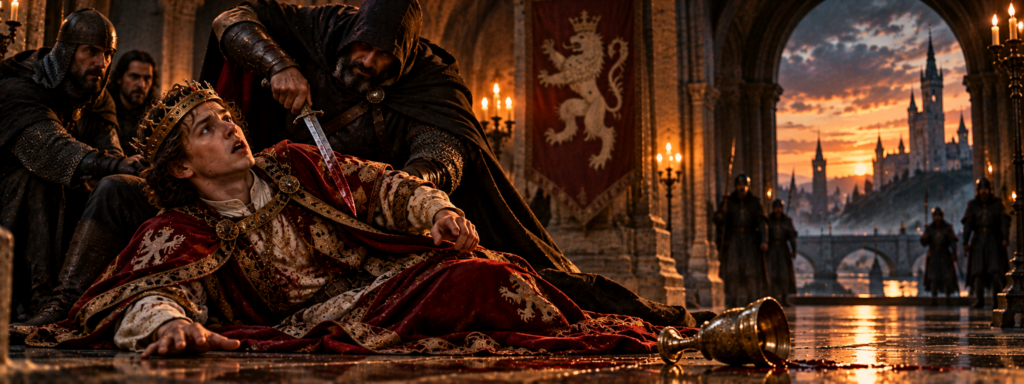
Wenceslaus III: The Teenage King Murdered Before He Could Save His Kingdom
The Last Přemyslid King, the Bloody Assassination at Olomouc, and the Unsolved Murder That Plunged Bohemia and Poland Into Chaos
Wenceslaus III (6 October 1289–4 August 1306) was King of Hungary from 1301 to 1305, under the name Ladislaus V, and King of Bohemia and Poland from 1305 until his assassination in 1306. The only surviving son of King Wenceslaus II of Bohemia and Judith of Habsburg, he inherited the ambitions of the powerful Přemyslid dynasty, whose rulers had transformed Bohemia into one of the wealthiest kingdoms in central Europe. His brief reign was dominated by political instability, rival claimants, aristocratic unrest, and the struggle to preserve his family’s influence in Poland after the collapse of its Hungarian ambitions. On 4 August 1306, while preparing a military expedition into Poland, Wenceslaus was murdered at Olomouc in Moravia, aged just sixteen. A Thuringian knight named Conrad of Botenstein was implicated in early accounts and reportedly killed immediately after the attack, but his guilt, the identity of any accomplices, and the motive for the assassination remain uncertain. Wenceslaus died without legitimate children, extinguishing the Přemyslid dynasty’s male royal line and unleashing a succession crisis that transformed the political future of Bohemia.
A Summer Afternoon, a Dead King, and a Murderer Without a Name
On 4 August 1306, a sixteen-year-old king was preparing to lead an army into Poland when someone entered the residence where he was staying and killed him. The attack took place at Olomouc, a prosperous Moravian city that should have served as a temporary stopping point before a military campaign. Instead, it became the scene of one of the most consequential royal assassinations in medieval European history. By the time the violence ended, Wenceslaus III was dead, the future of three crowns had been altered, and a dynasty that had ruled Bohemia for centuries had lost its last male representative.
The young king had already experienced more political upheaval than many monarchs endured in a lifetime. He had been crowned King of Hungary while still a child, driven from that kingdom by powerful enemies, and elevated to the thrones of Bohemia and Poland following his father’s death. His inheritance included immense wealth, ambitious territorial claims, and a dangerous collection of opponents who had little interest in preserving Přemyslid supremacy. At sixteen, he was attempting to assert his authority over territories that older and more experienced rulers had struggled to control.
His death was sudden, violent, and immediately surrounded by uncertainty. Medieval accounts identified a knight named Conrad of Botenstein, also rendered Konrad von Botenstein or in other variant forms, as a suspected attacker. According to the traditional story, Conrad was killed by members of the royal household before he could be questioned. Whether he actually murdered Wenceslaus, acted on behalf of others, or became a convenient scapegoat remains impossible to establish with confidence.
The murder created an irresistible mystery. Who would benefit from the death of the last Přemyslid king? Was the assassination connected to the Polish campaign, the ambitions of rival dynasties, resentment among the Bohemian nobility, or a personal grievance that disappeared with the suspected killer? The political consequences were enormous, but the surviving evidence does not identify a proven mastermind.
The circumstances were made even more unsettling by Wenceslaus’s youth. He was not an aging ruler whose authority had gradually collapsed, nor a defeated monarch waiting for execution. He was a teenager who had inherited a kingdom at a moment of extraordinary danger and was beginning to make decisions that might determine the survival of his dynasty’s ambitions. Whatever his shortcomings, he had scarcely begun to establish a reign of his own.
The assassination ended far more than one young man’s life. It destroyed the direct male succession of a dynasty whose history was inseparable from the development of the Bohemian state. It opened the way for competing claims by the Habsburgs, the Luxembourgs, and other powerful families. It also helped reshape the struggle for the Polish crown, where the Přemyslid claim had already encountered determined resistance.
Later generations would remember Wenceslaus as the last male Přemyslid, the murdered teenage king whose death brought an ancient royal line to an end. Yet the familiar image of a doomed youth conceals a far more complicated story. His life was shaped by the ambitions of his father, the wealth of Bohemia’s silver mines, the rivalries of central European monarchies, and a political system in which a crown could be both an extraordinary prize and a deadly burden.
To understand why Wenceslaus was murdered—or, more precisely, why so many people might have wished him removed—it is necessary to examine the kingdom he inherited. Bohemia was wealthy, powerful, and increasingly entangled in the affairs of its neighbors. The young king stood at the center of that dangerous political world, and his death would reveal how much depended upon a single surviving heir.
The Last Son of an Ancient Dynasty
Wenceslaus III was born on 6 October 1289 into the Přemyslid dynasty, one of the oldest and most influential ruling families in central Europe. The Přemyslids had governed Bohemia for centuries, first as dukes and later as kings. Their authority was deeply connected with the political development of the Czech lands and the expansion of Bohemian influence beyond its traditional borders. By the time Wenceslaus was born, the dynasty had become one of the most formidable powers within the Holy Roman Empire.
His father, Wenceslaus II, had inherited a kingdom marked by the achievements and disasters of the previous generation. His grandfather, Ottokar II of Bohemia, had pursued an extraordinary expansionist policy that brought Austria, Styria, Carinthia, and other territories under his influence. Ottokar’s ambitions eventually provoked a confrontation with Rudolf I of Habsburg, who had been elected King of the Romans in 1273. Their rivalry culminated in the Battle on the Marchfeld in 1278, where Ottokar was defeated and killed.
The death of Ottokar II was a catastrophe for the Přemyslid dynasty. The kingdom was left to his young son Wenceslaus II, whose early years were overshadowed by political instability and the influence of powerful guardians. Bohemia’s territorial ambitions appeared to have suffered a devastating setback. Yet the dynasty possessed resources that would allow it to recover.
Wenceslaus II eventually emerged as an exceptionally capable ruler. He strengthened royal authority, cultivated political alliances, and exploited Bohemia’s considerable mineral wealth. His reign saw the kingdom become an important financial and diplomatic power. He also pursued opportunities in Poland and Hungary, extending the family’s ambitions across central Europe.
The birth of Wenceslaus III therefore represented more than the arrival of a royal child. He was the heir to a dynasty that had survived military disaster and rebuilt its position through wealth and diplomacy. His future was tied to the continuation of a royal house whose authority had become central to the political balance of the region. As the only surviving son of Wenceslaus II, he carried an extraordinary dynastic responsibility.
His mother, Judith of Habsburg, connected him to the family that had defeated his grandfather. She was a daughter of Rudolf I of Habsburg, making Wenceslaus a grandson of two rival rulers whose conflict had transformed central Europe. Her marriage to Wenceslaus II had helped reconcile competing interests after the Battle on the Marchfeld. The union demonstrated how dynastic marriages could transform former enemies into relatives.
Judith died in 1297, when Wenceslaus was still a child. Her death deprived him of his mother at an early age, although the surviving evidence provides little reliable information about the emotional consequences for him. His father later married Elisabeth Richeza, a Polish princess whose family connections would become important in the struggle for the Polish crown. The young prince grew up in a household where marriage, inheritance, and political ambition were inseparable.
Wenceslaus’s sisters also became important figures in the dynasty’s future. Anne married Henry of Carinthia, while Elisabeth would eventually marry John of Luxembourg. These marriages later played decisive roles in the succession crisis following their brother’s assassination. The survival of the dynasty’s female members ensured that its bloodline continued even after the extinction of its male royal line.
The young prince therefore belonged to a family whose future depended upon carefully arranged relationships. His father had rebuilt the kingdom’s power, his mother connected him to the Habsburgs, and his sisters represented valuable dynastic alliances. Yet the entire structure rested upon the survival of one male heir. The vulnerability would become painfully apparent in 1306.
The Silver Kingdom: Why Bohemia Was Worth Killing For
Bohemia’s wealth was one of the principal reasons its rulers attracted so much attention from neighboring dynasties. The kingdom possessed valuable mineral resources, especially silver deposits that supported royal finances and international trade. The mining center of Kutná Hora became particularly important during the reign of Wenceslaus II. Its production helped transform Bohemia into a major economic power.
Silver was not merely a luxury commodity. It supported coinage, military expenditure, diplomacy, and the ability of rulers to reward supporters. A king with access to substantial silver revenues could hire soldiers, finance campaigns, and compete with neighboring monarchs. The wealth of Bohemia therefore translated directly into political influence.
Wenceslaus II recognized the importance of monetary reform. In 1300, he introduced the Prague groschen, a silver coin that became influential across central Europe. The reform strengthened the kingdom’s financial system and reflected the scale of its mining economy. The coin’s reputation extended well beyond Bohemia.
The wealth of the kingdom also encouraged royal ambition. Wenceslaus II possessed resources that allowed him to intervene in Polish politics and support his son’s claim to Hungary. These ventures required considerable expenditure and diplomatic coordination. Bohemia’s financial strength made such ambitions possible, but it also encouraged rivals to resist the dynasty’s expansion.
Control of Bohemia was therefore an attractive prize. A successful claimant could gain access to a wealthy kingdom, important trade routes, and the prestige of an established royal title. The extinction of the Přemyslid male line would create an opportunity that powerful families could scarcely ignore. The murder of Wenceslaus III consequently had implications far beyond the personal fate of a teenage monarch.
Yet wealth did not guarantee political stability. The Bohemian nobility possessed considerable influence, and royal attempts to strengthen authority could generate resentment. Mining revenues also depended upon effective administration and the cooperation of officials and local interests. A king who inherited great resources still needed to manage the political relationships that allowed him to use them.
Wenceslaus III inherited the benefits of his father’s economic policies without possessing his father’s experience. He became king at a moment when Bohemia’s wealth was supporting ambitious claims abroad. Those claims were increasingly contested, and the kingdom’s resources were being drawn into expensive political struggles. The young ruler faced the challenge of preserving an empire of influence that had expanded rapidly under his father.
The silver mines also shaped the wider succession crisis after his death. Rival dynasties understood the value of the Bohemian crown, and the struggle to control it became part of the competition for power within the Holy Roman Empire. The kingdom was too important to remain politically unclaimed. Its wealth ensured that the death of the last male Přemyslid would provoke immediate conflict.
A Child King in Hungary
Wenceslaus’s first experience of kingship came not in Bohemia but in Hungary. The death of Andrew III of Hungary in January 1301 brought the male line of the Árpád dynasty to an end. The resulting succession crisis attracted several claimants whose family connections provided competing arguments for legitimacy. Wenceslaus II saw an opportunity to extend Přemyslid influence into another kingdom.
The young Wenceslaus possessed a claim through his grandmother Kunigunda of Slavonia, who was connected to the Hungarian royal dynasty. His candidacy also benefited from political support among Hungarian nobles who opposed the claims of Charles Robert of Anjou. The rival claimants represented different international alliances and competing visions of Hungary’s future. The succession quickly became a struggle involving Bohemia, the papacy, and the Angevin dynasty.
In August 1301, Wenceslaus was crowned King of Hungary at Székesfehérvár. He was only eleven years old, and his authority depended heavily upon the nobles who supported his candidacy. He took the royal name Ladislaus, connecting himself with Hungarian dynastic tradition. The coronation gave him a crown but did not secure undisputed control of the kingdom.
Charles Robert of Anjou remained a formidable rival. He possessed strong dynastic claims and enjoyed papal support, which became increasingly important as the conflict developed. Hungary’s powerful aristocratic families were divided, and the country lacked the centralized political structure necessary to enforce the authority of a child king. Wenceslaus’s position was therefore precarious from the beginning.
The Hungarian crown became a burden rather than a secure inheritance. Wenceslaus II attempted to support his son’s claim, but the political situation deteriorated. The papacy increasingly favored Charles Robert, and important Hungarian magnates shifted their allegiance. The young king’s authority was limited and contested.
In 1304, Wenceslaus II traveled to Hungary and brought his son back to Bohemia. The decision reflected the growing difficulty of maintaining the Přemyslid claim. Wenceslaus III retained the royal title for a time, but his practical position had collapsed. The Hungarian adventure demonstrated the limits of his father’s ambitions.
The experience also exposed the young prince to the realities of dynastic politics. A coronation did not guarantee obedience, and a royal title could become meaningless without sufficient military and aristocratic support. The Hungarian nobility possessed its own interests, while the papacy and foreign rulers could influence the succession. Wenceslaus learned these lessons while still a child.
In 1305, he formally renounced his claim to Hungary in favor of Otto III of Bavaria, another claimant. The arrangement included the transfer of royal insignia associated with the Hungarian kingship. The decision ended the Přemyslid attempt to maintain direct control over Hungary. It also marked the beginning of a more realistic political approach under the young ruler.
The loss of Hungary did not eliminate the dynasty’s ambitions. Bohemia and Poland remained central to its position, and Wenceslaus III still possessed considerable resources. Yet the collapse of the Hungarian claim revealed how quickly an apparently impressive collection of crowns could unravel. The young king would soon face a similar challenge in Poland.
The Death of Wenceslaus II: A Boy Inherits Three Crowns and a Crisis
Wenceslaus II died on 21 June 1305, leaving his son to inherit the Bohemian and Polish crowns. The young Wenceslaus was fifteen years old and had already experienced the collapse of his Hungarian kingship. His father’s death placed him at the center of a political system filled with rival claims and unresolved conflicts. The inheritance was magnificent, but it was also dangerously unstable.
The late king had been one of the most successful Přemyslid rulers. He had strengthened Bohemia’s economy, expanded dynastic influence, and secured the Polish crown in 1300. His achievements depended upon years of political experience and carefully maintained alliances. His teenage successor inherited the results without possessing the same authority over the people who had helped create them.
Wenceslaus III became King of Bohemia and continued to claim the Polish kingship. He also retained the complicated legacy of the Hungarian succession struggle until formally abandoning it later in 1305. His titles reflected the extraordinary reach of his father’s ambitions. Yet the actual extent of his authority varied considerably across the territories associated with those titles.
Bohemia remained the center of his power. The kingdom possessed established institutions, valuable revenues, and a royal court capable of supporting government. Poland, however, was politically fragmented and increasingly contested. The young king faced the difficult task of maintaining authority over a region where local rulers and nobles had their own ambitions.
The death of Wenceslaus II also created opportunities for dissatisfied aristocrats. A teenage monarch could be more vulnerable to pressure than an experienced king. Powerful nobles might seek to recover privileges, obtain offices, or influence royal decisions. The surviving evidence suggests that the early reign involved tensions over royal grants and the distribution of property.
Later chroniclers sometimes portrayed Wenceslaus III as immature, pleasure-loving, or excessively influenced by companions. Such descriptions may reflect genuine criticism of his court, but they must be treated cautiously. Medieval writers often used moral judgments to explain political disasters, especially when a young ruler died violently. The available evidence does not support a complete psychological portrait of the king.
The young monarch nevertheless made important decisions. He abandoned the increasingly untenable Hungarian claim and attempted to address the challenges facing his Polish authority. He also entered into a marriage that strengthened his connections with neighboring dynasties. His reign was short, but it was not entirely passive.
The central problem was time. Wenceslaus II had spent years building the family’s political position, while his son had barely begun to govern independently. The young king needed to establish authority, cultivate supporters, and respond to threats before they became irreversible. His assassination would deny him the opportunity to demonstrate whether he could meet those challenges.
The Marriage to Viola of Teschen
In October 1305, Wenceslaus III married Viola of Teschen, a daughter of Duke Mieszko I of Cieszyn. The marriage was politically significant because it connected the Bohemian king with a branch of the Piast dynasty. The Piasts possessed extensive family connections throughout Poland and neighboring territories. Such an alliance could help strengthen Wenceslaus’s position amid the growing struggle for the Polish crown.
Viola came from a comparatively modest princely family when measured against the great royal dynasties of Europe. Her marriage to Wenceslaus therefore represented a substantial elevation in status. The arrangement has sometimes attracted criticism from later writers who considered it politically surprising. Yet dynastic marriages were often shaped by regional interests that are not fully visible in the surviving record.
The marriage may have been intended to strengthen support in Silesia and the surrounding Polish territories. These regions were strategically important to the relationship between Bohemia and Poland. A connection with the Piast family could provide valuable alliances during a period of political uncertainty. The precise negotiations behind the marriage remain incompletely documented.
Wenceslaus was only sixteen when he married Viola. Their union lasted less than a year before his assassination. No legitimate children resulted from the marriage, a fact that became decisive for the succession. The absence of a son meant that the male Přemyslid line ended with Wenceslaus.
Viola’s personal experience is difficult to reconstruct. The surviving sources provide little reliable information about her relationship with the young king or her response to his death. Later narratives sometimes emphasize the tragedy of a teenage widow whose marriage ended almost as soon as it began. The emotional reality is unknowable, but the political consequences were substantial.
After Wenceslaus’s death, Viola remained a figure within the wider aristocratic world. She later married Peter I of Rosenberg, a powerful Bohemian nobleman, in 1316. Her second marriage connected her to another important family within the kingdom. She died in 1317.
The brief marriage illustrates the dynastic expectations placed upon Wenceslaus III. He was expected to secure alliances, produce heirs, and preserve the continuity of an ancient royal house. His youth made those responsibilities especially demanding. The assassination ended the possibility that he would fulfill them.
The absence of children transformed the political meaning of his death. Had Wenceslaus left a legitimate son, the succession might have followed a different course, although a minor heir would still have faced considerable difficulties. Without one, the kingdom became the object of competing claims through the female branches of the dynasty. The marriage that might have preserved the royal line instead became another reminder of how abruptly it ended.
Poland: The Crown That Was Slipping Away
The Polish crown was one of the most difficult parts of Wenceslaus III’s inheritance. His father had been crowned King of Poland in 1300 after years of political maneuvering and military pressure. Yet Poland was not a unified kingdom under uncontested royal authority. Its territories were divided among regional rulers, noble factions, and competing dynastic interests.
Wenceslaus II had established influence over substantial Polish territories, but his authority depended upon local support and the presence of officials capable of enforcing royal decisions. The arrangement was vulnerable to opposition from rulers who regarded the Přemyslid monarchy as an outside power. The death of Wenceslaus II created an opportunity for those opponents. His teenage successor faced a rapidly deteriorating position.
The most important rival was Władysław I Łokietek, later known as Władysław the Elbow-high. A member of the Piast dynasty, he had spent years struggling against competing rulers and attempting to restore his political position. His ambitions included the unification of Polish territories under his authority. The weakening of Přemyslid power created an opening for his return.
Władysław gradually gained support in important regions. His position strengthened as opposition to Bohemian rule increased. The young Wenceslaus faced the possibility of losing the Polish crown before he had established himself securely in Bohemia. The conflict became one of the defining challenges of his reign.
The situation was complicated by the interests of Polish nobles and towns. Some had benefited from Přemyslid administration, while others preferred local rulers. Their loyalties could shift according to political circumstances and expectations of reward. The struggle therefore involved more than a simple confrontation between two kings.
Wenceslaus III initially attempted to preserve his claim through political measures and alliances. Yet the continued advance of Władysław threatened the remaining foundations of Přemyslid authority. The young king eventually decided that military intervention was necessary. His preparations for a campaign became the immediate setting for his assassination.
The Polish expedition was intended to restore or strengthen his position in territories where his authority had weakened. It represented an ambitious decision for a ruler who had only recently inherited the throne. The campaign would require substantial resources and the cooperation of Bohemian and Moravian nobles. It also risked provoking further conflict with Polish opponents.
The assassination at Olomouc occurred before the expedition could proceed. The young king died while preparing to confront the crisis that threatened his Polish crown. His death removed the most important remaining representative of Přemyslid claims to the kingdom. Władysław’s eventual rise became part of the wider political transformation that followed.
A Court of Young Favorites and Angry Nobles?
Later medieval accounts sometimes describe Wenceslaus III as a young ruler surrounded by companions who encouraged pleasure, drinking, and irresponsible generosity. These narratives portray a court in which aristocratic favorites benefited from royal grants while more established nobles became resentful. The image is dramatic and has influenced later interpretations of the assassination. Yet it must be approached with considerable caution.
Medieval chroniclers frequently judged rulers through moral categories. A king who suffered a violent death might be portrayed as sinful, reckless, or insufficiently attentive to government. Such explanations allowed writers to interpret political catastrophe as the consequence of personal failings. They do not necessarily provide a reliable account of everyday court life.
Wenceslaus was undeniably young and inexperienced. He had inherited an extensive political crisis at fifteen and had little time to develop an independent governing style. Powerful nobles and courtiers were likely to compete for influence around him. Such competition was common during the reigns of young monarchs.
The distribution of royal property and offices could create serious resentment. A king who rewarded one group of nobles might alienate another. Grants of land or privileges could affect the resources available to the crown and alter the balance among aristocratic families. These tensions were especially dangerous when the monarchy faced external threats.
Some later narratives connect Wenceslaus’s alleged generosity toward favorites with dissatisfaction among the nobility. The possibility is plausible within the political circumstances of the period. Yet the surviving evidence does not establish a direct connection between particular grants and the assassination. It would be misleading to identify disgruntled nobles as the proven organizers of the murder.
The young king’s personal reputation also requires careful treatment. Claims about drinking, sexual conduct, or reckless behavior appear in sources shaped by moral judgment and political hindsight. They may preserve elements of contemporary criticism, but they cannot be accepted without qualification. Wenceslaus’s brief reign provides too little evidence for confident conclusions about his character.
His decision to prepare a military expedition into Poland complicates the image of a ruler interested only in pleasure. Whatever his personal habits, he was attempting to address a major political threat. The campaign required planning, resources, and the mobilization of supporters. His final actions suggest a monarch engaged in the struggle to preserve his inheritance.
The court’s internal tensions remain relevant because they provide one possible context for the murder. A young king surrounded by competing aristocratic interests could become vulnerable to conspiracy. Yet possibility is not proof. The assassination remains unsolved precisely because the surviving sources do not establish which grievances, if any, led directly to the attack.
The Road to Olomouc
By the summer of 1306, Wenceslaus III had decided to lead a campaign into Poland. His authority there had been undermined by Władysław Łokietek and other opponents, and the remaining Přemyslid position required military support. The king began assembling forces and preparing for the expedition. His journey brought him to Olomouc, an important city in Moravia.
Olomouc was a significant political and ecclesiastical center. It possessed a bishopric and occupied an important position within the Moravian lands of the Bohemian crown. The city was suitable for the gathering of troops and the organization of a campaign. Its location also placed the king closer to routes leading toward the contested Polish territories.
Wenceslaus stayed in a residence associated with the cathedral chapter, traditionally identified with the dean’s house near the cathedral precinct. The precise details of the accommodation have been discussed by historians, but the broad setting is established. He was not on a battlefield when the assassination occurred. He was in a place where royal business and military preparations were being conducted.
The presence of soldiers, nobles, servants, and officials would have made the city unusually busy. A royal campaign required provisions, horses, weapons, money, and coordination among participants. The young king would have been surrounded by people whose interests were connected to the expedition. Such circumstances could create opportunities for both political negotiation and personal access.
The military preparations also meant that Wenceslaus’s plans were widely known. His opponents in Poland had reason to fear the expedition, while supporters within Bohemia expected him to defend the crown’s authority. The campaign could alter the balance of power in the region. His assassination therefore occurred at a politically significant moment.
The king’s presence at Olomouc was not unusual in itself. Medieval monarchs traveled frequently, moving between residences, cities, and military gathering points. Their authority depended partly upon personal presence, and their households were accustomed to temporary accommodation. Yet travel also created security challenges.
A ruler staying away from his principal residence depended upon local arrangements and the loyalty of attendants. Access to his quarters could be difficult to control, especially during a large political gathering. The presence of armed men was normal in a military context. These circumstances may have contributed to the opportunity for assassination, although the exact method of access remains uncertain.
The city was therefore the setting for a convergence of political pressures. Wenceslaus was preparing to defend his Polish crown, powerful nobles were gathered around him, and the future of the Přemyslid dynasty depended upon his survival. On 4 August 1306, those preparations ended in blood. The king would never reach Poland.
4 August 1306: Murder in the Royal Residence
The assassination of Wenceslaus III occurred on 4 August 1306 while he was staying at Olomouc. The surviving medieval accounts agree that the king was violently killed, but they differ in important details concerning the attack. The precise sequence of events cannot be reconstructed with certainty. The lack of reliable eyewitness testimony is one reason the murder remains a historical mystery.
The traditional narrative places the attack inside or near the king’s accommodation. Wenceslaus was separated from the full protection of his entourage when the assailant reached him. Some accounts describe the king resting, while others provide different details about his activities. These variations should not be combined into a single supposedly definitive scene.
The weapon is generally described as a blade, and the attack was fatal. Later narratives sometimes specify the number or location of the wounds, but the surviving evidence does not support a confident modern reconstruction. The essential fact is that the sixteen-year-old king was deliberately murdered. His death occurred before he could begin the planned Polish expedition.
A knight commonly identified as Conrad of Botenstein became associated with the crime. According to the traditional account, he was found near the scene and killed almost immediately by members of the royal household or guards. The speed of his death prevented any reliable interrogation. His role therefore remained uncertain.
The killing of the suspected attacker created an immediate problem for later investigators and chroniclers. If Conrad had acted alone, his death removed the only person who could explain his motive. If he had acted for others, the killing prevented him from identifying accomplices. If he was innocent, the true murderer may have escaped while suspicion focused upon a convenient victim.
The surviving sources do not establish which possibility is correct. Some chroniclers accepted Conrad’s guilt, while later historians have questioned the evidence. The identity of the murderer and any possible organizers remains unresolved. No surviving judicial record provides a definitive answer.
The assassination was particularly devastating because Wenceslaus had no legitimate heir. His death immediately ended the male royal line of the Přemyslid dynasty. The political system that had depended upon his succession suddenly lacked a direct male representative. The resulting crisis would extend far beyond Olomouc.
The scene therefore combined personal tragedy with dynastic catastrophe. A teenage king was killed while preparing to defend his crown, and the suspected murderer died before his role could be established. The political consequences were enormous, but the crime itself remained obscure. More than seven centuries later, the central question still has no certain answer.
Conrad of Botenstein: Murderer, Accomplice, or Scapegoat?
Conrad of Botenstein occupies a peculiar place in the history of Wenceslaus III’s assassination. His name appears in the tradition surrounding the murder, yet the surviving evidence does not establish his guilt beyond reasonable doubt. He is commonly described as a knight of Thuringian origin. His association with the crime rests upon medieval narratives whose details require careful evaluation.
According to the familiar account, Conrad was discovered near the scene of the murder and killed immediately. The circumstances have sometimes been interpreted as evidence that he was caught fleeing after the attack. Yet the sources do not provide a reliable modern investigation of his movements or actions. The absence of interrogation makes the accusation especially difficult to assess.
The immediate killing of a suspect was not unusual in a medieval environment where armed retainers might respond violently to an attack upon their lord. A royal assassination could provoke panic, anger, and a desire for instant punishment. Such reactions could destroy evidence as easily as they could capture a criminal. The fate attributed to Conrad therefore raises questions rather than resolving them.
If Conrad was the assassin, the motive remains uncertain. He may have acted from personal resentment, political loyalty, financial inducement, or some other grievance. The surviving sources do not establish a reliable explanation. Any confident account of his motives would require evidence that has not survived.
If he was acting on behalf of a larger conspiracy, the political implications would be substantial. Powerful individuals might have benefited from removing Wenceslaus before the Polish campaign. Yet no contemporary evidence conclusively identifies a patron who ordered the killing. The existence of possible beneficiaries does not prove that they arranged the assassination.
The possibility that Conrad was a scapegoat has also attracted attention. A convenient suspect killed immediately after the crime could prevent further inquiry and allow the actual perpetrator to escape. Yet this interpretation is itself speculative. There is no conclusive evidence demonstrating that Conrad was deliberately framed.
The variations in his name and identity also reflect the difficulties of medieval documentation. Chroniclers wrote in different languages and used forms that could change over time. Later historians have attempted to reconcile these references, but uncertainty remains. The name associated with the crime should not be treated as equivalent to a proven conviction.
Conrad’s story therefore illustrates the central problem of the assassination. The surviving narratives preserve suspicion without establishing certainty. A man was reportedly killed because he was believed to have murdered the king, but his death prevented the questions that might have clarified the crime. The suspected assassin became another victim of the violence surrounding Wenceslaus’s final day.
Who Wanted the King Dead?
The murder of Wenceslaus III immediately raises the question of motive. The young king had inherited several political conflicts, and his death benefited more than one powerful interest. Yet the existence of plausible motives does not establish responsibility. The surviving evidence does not identify a proven conspiracy behind the assassination.
One possible line of suspicion concerns the struggle for Poland. Wenceslaus was preparing a campaign against opponents who threatened his authority, particularly Władysław Łokietek. His death removed the immediate danger of a royal expedition. The political benefit is clear, but no reliable evidence proves that Władysław ordered the murder.
Another possibility involves dissatisfied Bohemian nobles. The young king’s court was associated in later accounts with disputes over royal grants, influence, and the distribution of property. Aristocrats who feared losing privileges or resented royal policies might have possessed motives for opposition. Yet the sources do not identify a particular noble faction as the proven organizer of the attack.
The Habsburg dynasty also benefited from the extinction of the Přemyslid male line. King Albert I of Germany sought to secure the Bohemian crown for his son Rudolf III after Wenceslaus’s death. This rapid political intervention has encouraged later suspicion. Yet benefiting from a murder is not evidence of having planned it.
The distinction is especially important because Albert’s family connections gave him legitimate political reasons to intervene in the succession. His mother and marriage alliances connected the Habsburgs to the Přemyslid dynasty. The death of Wenceslaus created an opportunity that Albert could exploit without having caused it. No reliable contemporary evidence establishes his involvement in the assassination.
Other possibilities include personal disputes within the royal household or grievances unrelated to the great dynastic struggles. Medieval courts contained individuals with competing ambitions, financial interests, and personal rivalries. A private quarrel could produce violence with enormous political consequences. Yet no securely documented personal motive explains the attack.
The lack of reliable evidence has allowed speculation to flourish. Later writers have sometimes treated political advantage as proof of guilt or interpreted the murder through the events that followed. Such reasoning risks transforming a historical mystery into a fictional conspiracy. The available sources do not support that certainty.
The most responsible conclusion is therefore limited but important. Wenceslaus III was deliberately murdered at Olomouc, and the traditional suspect’s role remains uncertain. Several political groups had reasons to welcome his removal, but none can be identified as the proven instigator. The assassination remains one of the great unresolved royal murders of medieval Europe.
The End of the Přemyslid Male Line
The death of Wenceslaus III brought the male royal line of the Přemyslid dynasty to an end. The family had ruled Bohemia for centuries, shaping its political institutions, territorial ambitions, and relationship with the Holy Roman Empire. Its members had transformed the duchy into a kingdom and established Bohemia as a major central European power. The extinction of its direct male succession was therefore an event of enormous historical significance.
The dynasty’s origins were surrounded by traditions that connected it with the earliest formation of the Czech state. Legendary figures such as Přemysl the Ploughman and Libuše became central to later accounts of the ruling family’s beginnings. These stories reflected the dynasty’s cultural importance, although they cannot be treated as straightforward historical records. The Přemyslids had become inseparable from Bohemian political identity.
Over the centuries, the dynasty produced rulers who expanded royal authority and competed with neighboring powers. Ottokar II pursued extraordinary territorial ambitions before his defeat in 1278. Wenceslaus II rebuilt the family’s position and extended its influence into Poland and Hungary. Wenceslaus III inherited the culmination of those achievements.
His death did not extinguish the dynasty’s bloodline. His sisters and other female relatives continued to possess dynastic claims and connections. Their marriages became central to the succession struggle. Yet the absence of a direct male heir created a political vacuum that could not be resolved automatically.
The Bohemian nobility now faced the question of whom to recognize as king. Competing candidates possessed claims through marriage, kinship, election, or imperial authority. The succession became an opportunity for powerful families to pursue their interests. The death of one teenager transformed the political future of the kingdom.
The extinction of the male line also affected Poland. The Přemyslid claim had depended heavily upon the authority of Wenceslaus II and his son. With both dead, the political basis for continued Bohemian kingship in Poland weakened dramatically. Rival Polish rulers gained opportunities to consolidate their positions.
The dynastic consequences therefore extended across central Europe. Bohemia entered a succession crisis, Poland moved further away from Přemyslid control, and Hungary had already escaped the dynasty’s ambitions. The three crowns associated with Wenceslaus III’s short life were no longer united by a single claimant. The extraordinary expansion achieved under his father had collapsed.
The tragedy is sharpened by the king’s age. Wenceslaus was sixteen and had not yet produced an heir or established a long-term political settlement. His assassination ended possibilities that remain unknowable. The Přemyslid dynasty’s male royal history concluded not with a peaceful succession but with an unsolved murder.
Henry of Carinthia: The First Struggle for the Vacant Throne
The immediate succession crisis in Bohemia brought Henry of Carinthia to the forefront. Henry was married to Anne, a sister of Wenceslaus III, giving him a claim through the female line of the Přemyslid dynasty. His position was supported by sections of the Bohemian nobility. Yet his authority was contested from the beginning.
Henry’s claim reflected the importance of dynastic marriage in medieval succession politics. Anne’s relationship to the murdered king provided a connection with the previous ruling family. Yet the Bohemian crown also depended upon the recognition of powerful nobles and the wider political circumstances of the empire. Marriage alone did not guarantee effective rule.
The Habsburgs quickly challenged Henry’s position. King Albert I of Germany sought to secure Bohemia for his son Rudolf III. The family possessed substantial military resources and political influence. The succession therefore became a confrontation between competing dynastic interests.
Henry initially gained recognition but was unable to maintain his position against Habsburg pressure. Rudolf III became King of Bohemia in 1306, strengthening his claim through marriage to Elisabeth Richeza, the widow of Wenceslaus II. The arrangement connected the Habsburg prince to the previous royal household. It also demonstrated how quickly the surviving women of the dynasty became central to succession politics.
Rudolf’s reign was brief. He died in 1307, reopening the succession struggle. Henry of Carinthia returned to the throne, but his authority remained weak and contested. The kingdom experienced further instability as rival factions competed for influence.
The rapid changes demonstrate the political consequences of Wenceslaus’s assassination. A secure male heir might have provided continuity, although no medieval succession was entirely free from dispute. Without one, the kingdom became vulnerable to competing claims and military intervention. The murder had created a crisis that could not be resolved through a single election.
Henry’s position ultimately proved unsustainable. Opposition within Bohemia grew, and influential nobles sought an alternative ruler capable of restoring stability. Their search would eventually bring the Luxembourg dynasty to the throne. The consequences of the assassination continued to unfold years after Wenceslaus’s death.
The succession crisis therefore transformed Bohemia’s political identity. The ancient Přemyslid dynasty had disappeared from the male royal line, and foreign-connected dynasties competed to inherit its crown. The kingdom’s future would depend upon new alliances and rulers. The murder at Olomouc had opened a chapter that would reshape central Europe.
The Habsburg Opportunity: Albert I and Rudolf III
King Albert I of Germany recognized the opportunity created by Wenceslaus III’s death. The Habsburg dynasty had longstanding connections with the Přemyslids through marriage and political rivalry. Albert’s mother was not a Přemyslid, but his family had developed important dynastic ties with the Bohemian royal house. The extinction of the male line created a chance to expand Habsburg influence.
Albert sought to secure the Bohemian crown for his son Rudolf III. The plan reflected the family’s broader strategy of acquiring valuable territories through political intervention and dynastic marriage. Bohemia’s silver wealth and strategic position made it an especially attractive prize. Control of the kingdom would strengthen Habsburg power in central Europe.
Rudolf’s marriage to Elisabeth Richeza provided additional legitimacy. She had been the wife of Wenceslaus II and possessed connections with the Polish royal tradition. Her marriage to the Habsburg prince linked him with the previous royal household. The arrangement was politically useful even though it did not eliminate rival claims.
Rudolf became King of Bohemia in 1306, but his reign lasted less than a year. He died in 1307, leaving the succession unresolved. His death was a major setback for Albert’s ambitions. The Habsburg attempt to establish lasting control over Bohemia had failed.
Albert continued to pursue the family’s interests, but his own life would end violently in 1308. He was assassinated by his nephew John of Swabia near Windisch in the Habsburg ancestral territories. The murder arose from an inheritance dispute within the dynasty. The coincidence is striking: within two years, two rulers closely connected to the Bohemian succession were assassinated.
The deaths of Wenceslaus III and Albert I were separate events with different known circumstances. There is no reliable evidence establishing a connection between their murders. Yet both demonstrate the vulnerability of medieval rulers amid dynastic ambition and inheritance disputes. The struggle for power could produce violence from unexpected directions.
The Habsburgs did not permanently secure Bohemia at this stage. Their ambitions would continue over subsequent centuries, eventually producing a much more extensive dynastic position. In the immediate aftermath of Wenceslaus’s death, however, their intervention failed to create lasting stability. The succession remained contested.
The Habsburg episode therefore illustrates the scale of the opportunity created by the assassination. A teenage king’s death allowed one of Europe’s rising dynasties to attempt the acquisition of a wealthy kingdom. The attempt was short-lived, but it altered the political landscape. The murder had transformed Bohemia into a prize for competing royal houses.
Elisabeth of Bohemia and the Rise of the Luxembourgs
The succession crisis eventually brought Elisabeth of Bohemia, a sister of Wenceslaus III, to the center of political negotiations. Elisabeth possessed a direct connection to the extinct male royal line through her father Wenceslaus II. Her dynastic position made her marriage especially important. A husband chosen for her could claim legitimacy through the Přemyslid inheritance.
The Bohemian nobility became increasingly dissatisfied with Henry of Carinthia’s rule. His authority was weakened by political opposition and the inability to establish a stable government. Influential figures sought a new candidate who could provide stronger leadership. The Luxembourg dynasty emerged as an attractive alternative.
In 1310, Elisabeth married John of Luxembourg, the son of Henry VII, King of the Romans. The marriage connected the Přemyslid bloodline with a rising dynasty that possessed substantial political influence. John became King of Bohemia, beginning a new period in the kingdom’s history. The union provided a solution to the succession crisis that had followed Wenceslaus’s assassination.
The Luxembourg dynasty would eventually produce some of Bohemia’s most celebrated rulers. John of Luxembourg became known for his military ambitions and extensive political activities. His son Charles IV later became Holy Roman Emperor and transformed Prague into a major imperial center. The dynasty’s achievements were rooted partly in the opportunity created by the extinction of the Přemyslid male line.
Elisabeth’s role was essential to the transition. Her marriage provided dynastic continuity even though the ruling house changed. The Přemyslid bloodline survived through female descendants, and its prestige continued to support the legitimacy of later rulers. The dynasty’s political influence therefore outlived its male royal succession.
The rise of the Luxembourgs also demonstrates the long-term consequences of the assassination. Wenceslaus III’s death did not simply replace one king with another. It opened a struggle that eventually transformed the ruling dynasty and the political direction of Bohemia. The kingdom’s later imperial prominence developed under rulers who inherited its crown through the crisis of 1306.
The young king could not have foreseen these consequences. His immediate concern in August 1306 was the preservation of his Polish authority. Yet his death made possible a new dynastic settlement whose effects would last for generations. The assassination became a turning point in the history of central Europe.
The Luxembourg succession therefore provides one of the clearest measures of the murder’s significance. A single violent death ended an ancient male royal line and created the conditions for a new dynasty to rise. The political future of Bohemia was transformed. The mystery of the killer remained unresolved, but the consequences were unmistakable.
Poland After Wenceslaus: The Return of the Piasts
Wenceslaus III’s death also altered the struggle for the Polish crown. His father had established Přemyslid kingship in Poland through a combination of military pressure, political alliances, and dynastic claims. The young king inherited that position but faced growing opposition from Władysław Łokietek. His assassination removed the most important remaining representative of direct Přemyslid royal authority.
Władysław had already been gaining ground before the murder. He possessed strong connections to the Piast dynasty and sought to restore his position in the fragmented Polish territories. His struggle was part of a broader movement toward the reunification of Poland under a native ruler. The weakening of Bohemian authority created opportunities for his ambitions.
The planned expedition of 1306 was intended to challenge that process. Wenceslaus was preparing to lead forces into Poland when he was killed at Olomouc. The campaign never took place. The absence of military intervention allowed the political balance to continue shifting away from the Přemyslid claim.
The situation did not become immediately simple. Polish territories remained divided, and other rulers possessed competing interests. The struggle for unification continued for years. Władysław’s eventual success was the result of sustained political and military effort rather than the assassination alone.
In 1320, Władysław was crowned King of Poland. His coronation marked an important stage in the restoration of the Polish monarchy under the Piast dynasty. The achievement came fourteen years after Wenceslaus III’s death. The intervening period demonstrated how difficult the process of consolidation remained.
The assassination nevertheless removed a major obstacle. A living Wenceslaus might have continued to contest the Polish crown and deploy Bohemian resources in support of his claim. His death ended that immediate possibility. The political consequences were therefore substantial even though they did not determine every later development.
The Polish story also illustrates the limits of the Přemyslid expansion. Wenceslaus II had assembled an impressive collection of royal titles, but the authority supporting them was uneven. Hungary had already slipped away, and Poland was increasingly contested. The assassination prevented his son from attempting to restore the family’s position.
The three-crown ambition that had once made the Přemyslids appear dominant in central Europe therefore collapsed within a few years. Hungary passed beyond their control, Poland returned toward Piast kingship, and Bohemia entered a succession crisis. The death of Wenceslaus III marked the final end of that extraordinary dynastic project. The consequences extended across the political map of the region.
The Murder Mystery That Refuses to Die
The assassination of Wenceslaus III remains unresolved because the surviving evidence is incomplete, inconsistent, and shaped by later interpretation. Medieval chroniclers preserved accounts of the killing, but they did not conduct an investigation according to modern standards. Their narratives often emphasized moral lessons or political consequences. The result is a historical record that establishes the murder without securely identifying its cause.
The traditional suspect, Conrad of Botenstein, remains central to the mystery. His reported death immediately after the attack prevented interrogation and left his role uncertain. Some accounts accepted his guilt, while later historians have questioned whether the evidence was sufficient. The uncertainty has encouraged speculation about accomplices and possible masterminds.
The political circumstances provide several plausible motives. Wenceslaus was preparing a campaign into Poland, where his opponents had reason to fear renewed Bohemian intervention. He also faced tensions among nobles who might have resented royal policies or feared changes in their influence. His death created opportunities for rival dynasties seeking the Bohemian crown.
Yet none of these possibilities has been established as the true explanation. Władysław Łokietek benefited from the collapse of the planned expedition, but there is no reliable proof that he ordered the assassination. The Habsburgs gained an opportunity to claim Bohemia, but political advantage does not demonstrate involvement. Dissatisfied nobles may have possessed grievances, but no specific faction can be conclusively identified as responsible.
The mystery is made more difficult by the young king’s brief reign. He had ruled Bohemia for little more than a year and had not developed a long record of policies that might clarify the motives of his enemies. His personal relationships are also poorly documented. The surviving sources reveal political tensions but not the private decisions that led to the murder.
Later retellings sometimes offer confident explanations that exceed the evidence. A dramatic conspiracy can make the story more satisfying, especially when the victim is a teenage king whose death changed the course of history. Yet historical accuracy requires acknowledging uncertainty. The absence of a proven murderer is part of the story rather than a problem to be solved through invention.
The assassination also demonstrates the limitations of medieval justice. The reported killing of the suspected attacker eliminated a potential source of testimony. No surviving trial record provides a reliable account of the crime. The political upheaval that followed may have further complicated efforts to establish responsibility.
The result is a mystery that has endured for more than seven centuries. Historians can reconstruct the political world surrounding Wenceslaus and identify the consequences of his death. They can examine the accusations preserved by medieval writers and assess their reliability. Yet the central question remains unanswered: who killed the last male Přemyslid king, and why?
A Sixteen-Year-Old King Judged by the Disaster That Followed
Wenceslaus III has often been remembered through the circumstances of his death rather than the achievements of his reign. His youth, the brevity of his kingship, and the extinction of the Přemyslid male line have overshadowed his political decisions. Later writers sometimes portrayed him as immature or irresponsible, suggesting that his personal failings contributed to the dynasty’s collapse. Such judgments require careful examination.
The young king inherited a difficult political situation. His father’s ambitions had extended the family’s influence across several kingdoms, but those gains were not equally secure. Hungary had already become untenable, while Poland was increasingly threatened by rival claimants. Bohemia itself contained powerful nobles whose cooperation was essential.
Wenceslaus made decisions that suggest an awareness of these difficulties. He abandoned the Hungarian claim rather than continue an increasingly expensive struggle. He arranged a marriage with a Piast princess, potentially strengthening regional alliances. He also prepared a military expedition to defend his position in Poland.
These actions do not establish that he would have become a successful ruler. His political abilities remain difficult to assess because he died before they could be tested over time. Yet they complicate the image of a passive teenager interested only in pleasure. His final months were dominated by serious questions of dynastic survival.
The accusations of extravagance and irresponsible generosity also require context. Medieval kings were expected to reward supporters, and young rulers were especially vulnerable to competition among courtiers. Grants of property could be politically useful even when later chroniclers condemned them. Without detailed evidence, it is difficult to distinguish reckless behavior from ordinary royal patronage.
The extinction of the dynasty was not solely the consequence of Wenceslaus’s personal choices. His father had created a political structure dependent upon extensive claims and the survival of a single male heir. The death of Wenceslaus II left those ambitions to a teenager. The assassination then removed the heir before he could establish a lasting settlement.
The young king therefore deserves to be understood as a ruler caught in circumstances largely created before he came to power. He inherited wealth, prestige, and political danger in equal measure. His death prevented him from demonstrating whether he could preserve the dynasty’s position. The historical record offers too little evidence for a definitive judgment of his character.
The tragedy is that Wenceslaus’s reign is often evaluated through the consequences of an event he did not choose. His assassination destroyed the male succession and opened the way for rival dynasties. Those consequences were enormous, but they do not prove that the young king was incapable of ruling. His future was taken from him before it could be known.
The Burial of the Last Přemyslid King
After his assassination, Wenceslaus III was buried at Olomouc, where he had been killed. The immediate burial reflected the circumstances of his sudden death and the political uncertainty surrounding the kingdom. His remains later became part of the effort to preserve the memory of the extinct male royal line. The treatment of his body carried dynastic significance.
The Přemyslid dynasty had long maintained connections with important religious foundations. Royal burials reinforced legitimacy and linked rulers with sacred spaces associated with their predecessors. The death of the last male heir created a particularly powerful need for commemoration. His tomb became a reminder of the dynasty’s abrupt end.
Wenceslaus’s remains were eventually transferred to the Cistercian monastery at Zbraslav, also known as Königsaal, near Prague. The monastery had been founded by his father Wenceslaus II and became closely associated with Přemyslid memory. The transfer connected the murdered king with the religious foundation of the dynasty’s final powerful ruler. It placed father and son within a shared commemorative tradition.
Zbraslav was an important center of historical writing as well as religious life. The Zbraslav Chronicle became a major source for the history of Bohemia during this period. Its authors interpreted political events through the perspectives and concerns of their religious community. Their work preserves valuable information while also reflecting the moral and political assumptions of the time.
The monastery’s connection with the royal family gave it a special role in preserving the memory of Wenceslaus III. His death was not simply another royal burial but the end of a dynastic era. The religious community could commemorate the king while recording the political upheaval that followed. The resulting historical memory combined mourning, judgment, and reflection.
The later history of the monastery and its remains was complicated by political and religious upheavals. Medieval burial sites were vulnerable to destruction, relocation, and the loss of records. The exact physical history of every royal remain cannot always be reconstructed with certainty. The commemorative significance of Zbraslav, however, remains clear.
Wenceslaus’s burial therefore formed part of the dynasty’s final chapter. The young king who had been preparing for war was placed within a religious setting associated with his father’s ambitions. His death became a subject of prayer and historical remembrance. The dynasty survived in chronicles, monuments, and the bloodlines of its female descendants.
The contrast between his planned campaign and his burial is stark. He had intended to march into Poland and defend the royal claims inherited from his father. Instead, his body became the center of dynastic mourning while rival families contested his crown. The military future he had prepared for was replaced by a struggle over his succession.
The Kingdom That Survived Its Dynasty
The extinction of the Přemyslid male line did not destroy Bohemia. The kingdom retained its institutions, wealth, cities, and political identity. Its nobility continued to exercise influence over the choice of rulers, while its economic resources remained attractive to competing dynasties. The succession crisis was severe, but the state itself endured.
The rise of the Luxembourg dynasty eventually brought a new period of prominence. Under John of Luxembourg and Charles IV, Bohemia became closely connected with the highest levels of imperial politics. Prague developed into a major political and cultural center. The kingdom’s later achievements were built upon foundations established during the Přemyslid era.
The silver economy remained important, as did the administrative structures developed under earlier rulers. Wenceslaus II’s monetary reforms had lasting consequences. The Prague groschen continued to circulate widely, demonstrating the durability of the economic system created before the assassination. The wealth that had attracted rival dynasties did not disappear with the royal family.
The Přemyslid legacy also survived through dynastic marriage. Elisabeth of Bohemia transmitted the family’s bloodline into the Luxembourg dynasty. Later rulers could claim continuity with the ancient royal house through her descent. The extinction of the male line therefore did not mean the complete disappearance of Přemyslid influence.
The kingdom’s political development after 1306 also demonstrates the importance of aristocratic institutions. The Bohemian nobility played a central role in the succession struggle and the eventual acceptance of new rulers. Their influence could destabilize the monarchy, but it also helped preserve the kingdom’s political continuity. The crown survived even when the dynasty changed.
The assassination therefore marks both an ending and a beginning. It ended the direct male succession of a royal house that had shaped Bohemia for centuries. It also opened the way for new dynastic arrangements that would transform the kingdom’s relationship with the Holy Roman Empire. The political consequences were profound but not uniformly destructive.
Wenceslaus III’s death remains central to this transition because it removed the person who embodied the continuity of the old dynasty. His survival might have produced a different political future, but such possibilities remain speculative. What can be established is that his assassination accelerated a succession crisis and changed the ruling house. The kingdom continued, but the Přemyslid era had ended.
The young king’s historical significance therefore extends beyond the mystery of his murder. He stands at the boundary between two major periods in Bohemian history. His death marked the disappearance of one ruling dynasty and the emergence of another. The violence at Olomouc became a turning point in the political development of central Europe.
The King Who Never Reached His Seventeenth Birthday
Wenceslaus III inherited a remarkable but dangerously unstable political legacy. His father had transformed Bohemia into a wealthy and influential kingdom, extended Přemyslid authority into Poland, and attempted to secure Hungary for his son. The young prince grew up surrounded by crowns, alliances, and the ambitions of powerful dynasties. Yet those achievements depended upon political relationships that were already beginning to unravel.
By the time Wenceslaus became King of Bohemia in 1305, the Hungarian claim had become untenable and the Polish crown was under serious threat. He abandoned the struggle for Hungary, entered a politically significant marriage, and prepared to defend his position in Poland. His reign lasted little more than a year, but it was shaped by urgent decisions concerning the survival of his family’s ambitions. At sixteen, he was confronting problems that had challenged experienced rulers.
The assassination at Olomouc ended those efforts before they could be tested. On 4 August 1306, Wenceslaus was murdered while preparing for a military expedition. A knight named Conrad of Botenstein became associated with the crime, but the evidence does not establish his guilt or reveal a certain motive. The suspected attacker was reportedly killed almost immediately, leaving the central questions unanswered.
The political consequences were immediate and devastating. Wenceslaus died without legitimate children, extinguishing the male royal line of the Přemyslid dynasty. Bohemia entered a succession crisis in which Henry of Carinthia, the Habsburgs, and eventually the Luxembourgs competed for the crown. The struggle transformed the kingdom’s political future and altered the balance of power in central Europe.
Poland also moved beyond the Přemyslid project. The young king’s planned expedition never took place, and Władysław Łokietek continued his efforts to consolidate authority. The Polish crown eventually returned to the Piast dynasty. The three-crown ambition that had defined the final years of Wenceslaus II’s reign disappeared.
The murder itself remains one of the most troubling mysteries of medieval royal history. Political rivals, dissatisfied nobles, and ambitious dynasties all possessed possible motives, but none can be conclusively identified as responsible. The surviving sources preserve suspicion rather than certainty. More than seven centuries later, the identity of the killer and the reasons for the attack remain unresolved.
Wenceslaus’s youth makes the tragedy especially striking. He had barely begun to govern independently and had not yet produced an heir. His political abilities, ambitions, and potential achievements remain largely unknowable. The historical record preserves the disaster that followed his death more clearly than the person he might have become.
The darkest legacy of Wenceslaus III is not simply that he was murdered, but that his death erased an entire royal future. He was the last surviving male heir of a dynasty that had ruled Bohemia for centuries, the son of a king whose ambitions had reached across three kingdoms, and a teenager preparing to defend what remained of that inheritance. Somewhere in Olomouc, on a summer day in 1306, an unknown assailant struck before the young king could lead his army into Poland. The murderer left no reliable explanation, and the suspected attacker died before the truth could be established. Wenceslaus never reached his seventeenth birthday, never produced an heir, and never had the opportunity to determine whether he could preserve the dynasty’s power. His death ended the Přemyslid male line, unleashed a struggle for the Bohemian crown, and changed the political future of central Europe. Yet the question at the center of the tragedy remains unanswered: who decided that the last Přemyslid king had to die, and what did they hope to gain by killing a boy who had scarcely begun to reign?