
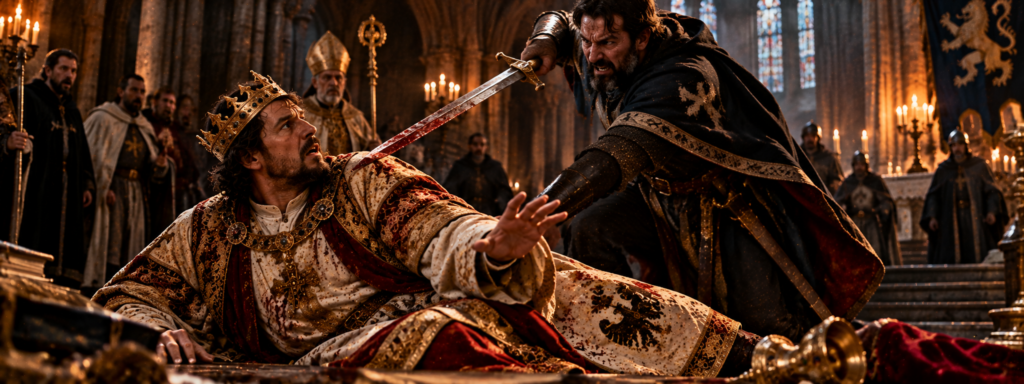
Philip of Swabia: The Murdered King Whose Broken Marriage Promise Ended in Blood
The Hohenstaufen Dynasty, a Divided German Kingdom, a Humiliated Nobleman, and the Assassination at Bamberg That Changed the Fate of an Empire
Philip of Swabia (1177–21 June 1208) was a member of the powerful Hohenstaufen dynasty, Duke of Swabia from 1196, and King of the Germans from 1198 until his assassination in 1208. The youngest surviving son of Emperor Frederick I Barbarossa and Beatrice I, Countess of Burgundy, Philip became an unexpected contender for the German throne after the death of his elder brother, Emperor Henry VI. His reign was dominated by a bitter struggle against Otto of Brunswick, the rival king supported by the Welf dynasty and, for much of the conflict, Pope Innocent III. Married to the Byzantine princess Irene Angelina, Philip gradually overcame his opponents and appeared close to securing undisputed control of the German kingdom. On 21 June 1208, however, he was murdered in Bamberg by Otto VIII of Wittelsbach, a Bavarian count whose grievance was traditionally connected to Philip’s withdrawal of a promised marriage alliance. Philip remains the only medieval King of the Germans generally recognized as having been assassinated while reigning, and his sudden death transformed a dynastic struggle just as victory seemed within his grasp.
The King Who Survived a Civil War but Not a Wedding
On 21 June 1208, King Philip of Swabia was staying in the episcopal residence at Bamberg, a city in the heart of the German kingdom. He had survived ten years of civil war, papal hostility, shifting aristocratic loyalties, and the ambitions of a rival king who refused to surrender his claim to the throne. His political fortunes had improved so dramatically that the long struggle for the German crown appeared to be approaching its conclusion. Yet the man who would kill him was not the rival claimant who had spent years trying to destroy his kingship.
The assassin was Otto VIII of Wittelsbach, a Bavarian nobleman whose anger was traditionally linked to a failed marriage arrangement. Philip had reportedly promised one of his daughters to Otto, only for the proposed match to collapse when the king’s political interests changed. In an age when aristocratic marriages determined alliances, inheritance, and status, the withdrawal of such a promise could be regarded as a devastating humiliation. According to the accounts that followed, Otto chose to answer the insult with murder.
The killing occurred only a day after the wedding of Philip’s niece Beatrice of Burgundy to Duke Otto I of Merania. Bamberg had been the setting for a dynastic celebration, bringing together powerful nobles and members of the royal circle. The festivities should have demonstrated the strength of the king’s political relationships and the security of his position. Instead, the occasion became the prelude to one of the most shocking acts of royal violence in medieval German history.
According to the traditional narrative, Otto VIII gained access to Philip’s private quarters and attacked him with a sword. The king was caught in a setting where he had little reason to expect an armed confrontation. The wound proved fatal, and Philip died before he could enjoy the political settlement that had seemed increasingly likely. The exact sequence of the attack varies among the surviving accounts, but the central fact is firmly established: Otto VIII murdered the reigning king at Bamberg.
The assassination was extraordinary because Philip was not a powerless monarch abandoned by his supporters. He was a ruler whose position had strengthened after years of struggle and whose principal rival was increasingly isolated. His murder did not conclude an inevitable collapse; it interrupted a political recovery. A king who had endured a decade of conflict was killed by a nobleman pursuing a grievance rooted in the personal and dynastic politics of the court.
Later chroniclers emphasized the marriage dispute, portraying Otto as a man whose wounded pride overwhelmed his judgment. Yet medieval accounts also contain different explanations for the failed match, and the precise motives behind the assassination cannot be reconstructed with complete certainty. Personal vengeance was clearly central to the traditional explanation, but the political world in which the grievance developed was anything but simple. The proposed marriage involved the prestige of a royal daughter, the ambitions of a powerful aristocrat, and the king’s freedom to use his children as instruments of diplomacy.
Philip’s death changed the balance of power almost immediately. His rival, Otto of Brunswick, suddenly found himself without the opponent who had steadily defeated him. The Welf claimant eventually gained recognition from many former Hohenstaufen supporters and went on to receive the imperial crown. Yet his apparent triumph would prove temporary, and the consequences of Philip’s murder would continue to shape German politics for years.
The story of Philip of Swabia is therefore much larger than the familiar tale of a rejected suitor taking revenge. It begins with the death of a legendary emperor, passes through a disastrous succession crisis, and unfolds against the ambitions of popes, princes, kings, and rival dynasties. At its center stands a ruler who came close to winning everything, only to discover that the greatest danger was not always waiting on the battlefield. Sometimes it arrived inside the palace, carrying a sword and remembering a promise that had been broken.
Born Beneath the Shadow of Barbarossa
Philip was born in 1177 into one of the most powerful ruling families in medieval Europe. His father, Frederick I Barbarossa, had been King of the Germans since 1152 and Holy Roman Emperor since 1155. His mother, Beatrice I, was the heiress of the County of Burgundy, whose marriage to Frederick strengthened the Hohenstaufen family’s territorial and political position. Philip entered a dynasty whose members possessed enormous prestige but whose power was continually challenged by rival princes and the papacy.
Frederick Barbarossa dominated the political imagination of his age. He pursued imperial authority in Germany and Italy, confronted rebellious cities, struggled with powerful popes, and sought to establish the Hohenstaufen dynasty as the central force within the empire. His campaigns brought both victories and humiliations, and his long reign helped define the relationship between the German monarchy and the Italian territories associated with imperial rule. To his children, he left not simply a prestigious name but an immense collection of ambitions and enemies.
Philip was one of several sons, and his position within the family initially made it unlikely that he would become king. His elder brother Henry had already been designated to succeed their father and would eventually rule as Henry VI. Other brothers received territories or pursued careers appropriate to their dynastic standing. Philip’s early prospects were therefore shaped by the expectation that he would support the family rather than lead it.
As a younger son, Philip was initially directed toward an ecclesiastical career. He received religious education and held church-related positions, including the provostship of Aachen and later Würzburg. Such arrangements were common among aristocratic families, which used ecclesiastical appointments to secure influence and provide for sons who were unlikely to inherit the principal dynastic titles. A church career could bring wealth, prestige, and political authority without requiring a man to become a secular ruler.
Yet Philip’s path changed as the circumstances of the dynasty evolved. His brothers’ deaths and the changing needs of the Hohenstaufen family gradually drew him toward secular responsibilities. In 1196, he became Duke of Swabia, one of the family’s traditional power bases. The title placed him among the important territorial princes of the German kingdom.
Swabia was more than a geographical possession. It represented the ancestral heartland of the Hohenstaufen dynasty, containing estates, castles, religious foundations, and networks of aristocratic loyalty. Control of the duchy provided Philip with resources and supporters that would later prove essential during the succession crisis. His elevation also marked his transformation from a younger son prepared for church service into a significant political figure.
The Hohenstaufen family cultivated an image of imperial grandeur, but its position was never secure. German kings depended upon the cooperation of powerful princes, and their authority could be challenged by rival dynasties. In Italy, imperial ambitions brought repeated conflicts with cities and the papacy. Philip grew up within a political culture where legitimacy was inherited, negotiated, defended, and sometimes destroyed through violence.
His father’s death would eventually reveal how fragile that grandeur could be. Frederick Barbarossa died in 1190 during the Third Crusade, drowning while crossing a river in Asia Minor. The death shocked the Christian world and deprived the dynasty of its most celebrated figure. Yet the Hohenstaufen succession initially appeared secure because Philip’s elder brother Henry was already positioned to inherit the royal and imperial legacy.
The family could not know that within less than a decade, Henry would also be dead and Philip would be fighting for the German crown. The younger son who had once seemed destined for a religious career would become the center of a struggle that divided the empire. His rise was not the fulfillment of a carefully prepared succession plan. It was the consequence of a dynasty repeatedly forced to confront the unexpected deaths of its most powerful men.
Henry VI: The Brother Who Left an Empire Without a Ruler
Philip’s elder brother Henry VI inherited the German kingship and became Holy Roman Emperor in 1191. He possessed considerable political ambition and sought to strengthen the hereditary position of the Hohenstaufen dynasty. His marriage to Constance of Sicily gave him a claim to the wealthy Kingdom of Sicily, which he eventually secured after a difficult struggle. The acquisition transformed the political balance of Europe by placing territories both north and south of the papal lands under Hohenstaufen influence.
The union of the German monarchy and Sicily alarmed the papacy. The popes had long feared domination by powerful rulers whose territories surrounded central Italy. A Hohenstaufen emperor controlling both Germany and Sicily could threaten the political independence of the Papal States. Henry’s success therefore created new possibilities for imperial power while intensifying longstanding conflicts with Rome.
Henry also attempted to make the German monarchy hereditary within his dynasty. Traditionally, the German kingship depended upon election by the leading princes, even when dynastic inheritance strongly influenced the choice. Henry’s proposal would have strengthened the Hohenstaufen family’s control over succession. Yet the princes were reluctant to surrender their electoral privileges.
The emperor eventually secured the election of his young son Frederick as King of the Germans in 1196. The child, later known as Frederick II, represented the dynasty’s future and was expected to inherit an extraordinary combination of territories. His father appeared to have created the foundations of a powerful dynastic monarchy. Yet the arrangement depended upon the continued authority of Henry himself.
In September 1197, Henry VI died unexpectedly in Sicily at the age of thirty-one. His death shattered the political structure he had been constructing. Frederick was still a small child, and the German princes were unwilling to accept an absent minor as ruler without further negotiation. The Hohenstaufen succession suddenly became uncertain.
Philip was in a particularly difficult position. He had been involved in the family’s plans to secure the succession of his nephew Frederick. Yet the death of Henry transformed the political landscape, and support for the child king weakened. German princes began considering alternative candidates who could exercise authority immediately.
The crisis was made more dangerous by the existence of the Welf dynasty, the Hohenstaufens’ longstanding rivals. The Welfs possessed powerful family connections in Germany and abroad, including close ties to the English royal house. Their supporters recognized an opportunity to challenge Hohenstaufen dominance. The death of Henry VI therefore reopened a dynastic conflict that had shaped German politics for generations.
Philip initially appears to have sought to protect his nephew’s interests. Yet the practical difficulties of establishing the child Frederick’s authority became increasingly apparent. Hohenstaufen supporters needed an adult ruler capable of commanding armies, negotiating with princes, and confronting the Welf opposition. Philip gradually emerged as their preferred candidate.
The succession crisis was not simply a family disagreement over inheritance. It concerned the structure of the German monarchy, the power of the princes, the ambitions of the papacy, and the future relationship between Germany and Italy. The death of Henry VI created a vacuum into which competing political interests rushed. Philip would spend the next decade struggling to fill it.
Two Kings, One Crown: Germany Divided Against Itself
In 1198, the German kingdom acquired two rival kings. Philip of Swabia was elected by his supporters in March, while the Welf candidate Otto of Brunswick was elected by a competing group in June. Both claimed legitimate authority, and both sought the recognition of the princes. The result was a prolonged struggle that divided the kingdom into rival political camps.
Philip’s election took place at Mühlhausen in Thuringia. His supporters included important princes who favored the continuation of Hohenstaufen rule. Yet his position was not universally accepted, and the circumstances of the election left room for opponents to challenge its legitimacy. The German monarchy depended upon aristocratic recognition, and competing elections could produce competing claims.
Otto of Brunswick was the son of Henry the Lion, the powerful Welf duke who had been one of Frederick Barbarossa’s greatest rivals. Otto also possessed close connections with the English royal family through his mother, Matilda, daughter of Henry II of England. These relationships provided him with political prestige and access to valuable support. His candidacy represented a serious challenge to the Hohenstaufen dynasty.
Otto was elected by a rival group of princes and crowned at Aachen, the traditional coronation site associated with Charlemagne. Philip, meanwhile, was crowned at Mainz using the appropriate royal insignia but without control of the customary coronation location. The competing ceremonies became part of the struggle over legitimacy. Each side could point to elements of tradition while questioning the other’s claim.
The conflict quickly spread beyond ceremonial arguments. Princes chose sides according to dynastic loyalties, territorial interests, political grievances, and expectations of reward. Some remained loyal to their chosen king, while others shifted allegiance when circumstances changed. The result was a kingdom in which royal authority was repeatedly contested.
The rival kings sought to strengthen their positions through alliances, grants, privileges, and military campaigns. Their supporters could gain lands, offices, or political influence in exchange for loyalty. Such arrangements were expensive and could weaken the long-term resources of the monarchy. The struggle for legitimacy therefore carried a substantial financial and political cost.
Philip possessed important advantages through his Hohenstaufen connections and territorial resources. Otto, however, benefited from Welf support and powerful international relationships. Neither could easily eliminate the other. The conflict developed into a prolonged contest of military pressure and aristocratic negotiation.
The division also affected the wider empire. Italian cities, the papacy, and neighboring monarchs watched the struggle closely because its outcome would determine the future balance of power. A Hohenstaufen victory threatened to revive the imperial ambitions associated with Henry VI. A Welf victory offered the possibility of a different political arrangement.
For Philip, the double election created a problem that would dominate his entire reign. He could not govern as an undisputed king while another crowned ruler claimed the same authority. Every alliance had to be defended, every defection answered, and every political success measured against the rival court. The struggle would shape his marriage diplomacy, his dealings with the Church, and ultimately the circumstances that made Otto VIII of Wittelsbach his enemy.
Innocent III: The Pope Who Held the Crown Between Two Rivals
The election crisis coincided with the beginning of the pontificate of Innocent III, one of the most influential popes of the Middle Ages. Innocent became pope in January 1198, shortly after the death of Henry VI. He inherited a papacy concerned about Hohenstaufen control of Sicily and the possibility of renewed imperial domination in Italy. The German succession dispute offered him an opportunity to influence the future balance of power.
Innocent did not initially resolve the dispute through immediate recognition of one candidate. He examined the claims of Philip and Otto while asserting the papacy’s right to evaluate the suitability of a future emperor. The question was especially important because the German king was the leading candidate for imperial coronation. The dispute therefore concerned not only the German throne but also the relationship between monarchy and papacy.
The pope eventually favored Otto of Brunswick. His decision reflected legal arguments about the competing elections as well as concern about the political consequences of a Hohenstaufen victory. Philip’s family connections with Sicily made him particularly troubling to papal interests. Innocent’s support gave Otto an important source of legitimacy.
The papal intervention intensified the conflict. Philip’s supporters could regard Innocent’s actions as interference in the rights of the German princes. Otto’s supporters could present papal recognition as confirmation of their candidate’s legitimacy. The dispute became part of a wider struggle over the boundaries of ecclesiastical and secular authority.
Innocent’s relationship with Philip was not static. As the Hohenstaufen king strengthened his position, the pope had to reconsider the practical realities of German politics. Diplomatic negotiations gradually opened possibilities for reconciliation. By the final years of Philip’s life, the balance had shifted considerably.
The pope’s policies also reflected the complicated situation in Sicily. Frederick, the young son of Henry VI, remained a central figure in the kingdom’s politics. Innocent sought to protect papal interests while managing the consequences of Hohenstaufen dynastic claims. The German conflict could not be separated from the wider Mediterranean struggle.
For Philip, papal opposition was a serious obstacle but not an insurmountable one. He continued to build support among German princes and demonstrated that his kingship could survive without immediate papal recognition. His military and diplomatic successes gradually undermined Otto’s position. The pope’s initial preference did not determine the final outcome.
By 1208, Philip’s political position had improved so dramatically that reconciliation with Innocent appeared increasingly possible. The king who had once faced a powerful coalition of opponents seemed close to achieving recognition and stability. The assassination at Bamberg therefore interrupted not only a domestic political recovery but also a developing diplomatic settlement with the papacy.
Irene Angelina: The Byzantine Princess at the Hohenstaufen Court
Philip’s wife, Irene Angelina, brought the prestige and complicated political history of the Byzantine imperial family into the Hohenstaufen dynasty. She was a daughter of Emperor Isaac II Angelos, whose reign had been marked by internal difficulties and eventual deposition. Irene’s life was shaped by the shifting alliances between Byzantium, Sicily, and the German monarchy. Her marriage to Philip connected two major political worlds at a moment of extraordinary instability.
Irene had previously been betrothed or married within the complex diplomatic arrangements surrounding Sicily, including a marriage to Roger III of Sicily. Roger died in 1193, leaving her position uncertain. She subsequently came under Hohenstaufen control following Henry VI’s conquest of Sicily. Her marriage to Philip was arranged within the broader framework of imperial diplomacy.
Philip and Irene married in 1197, shortly before Henry VI’s death transformed the German political landscape. Their union strengthened Philip’s dynastic prestige and associated him with the Byzantine imperial tradition. Irene became queen after Philip’s election in 1198. Her presence at court reflected the international character of medieval royal marriages.
The couple had several daughters, whose marriages became important instruments of political alliance. Their surviving daughters included Beatrice, Cunigunde, Maria, and Elisabeth. These children represented valuable connections to powerful European dynasties. Their marriages could strengthen alliances, secure reconciliation, or reward influential supporters.
The marriage of royal daughters was not primarily a private family matter. It involved inheritance, political prestige, territorial interests, and the creation of binding relationships between ruling houses. A promised match could raise a nobleman’s standing and alter his prospects. The cancellation of such an arrangement could therefore have consequences far beyond personal disappointment.
Irene’s daughters became central to the political negotiations that surrounded Philip’s final years. The proposed marriage between one of them and Otto VIII of Wittelsbach was part of this wider world of dynastic bargaining. The precise identity of the daughter involved is not always consistently presented in later retellings. What matters is that the proposed match would have connected Otto directly to the royal family.
Irene herself remains difficult to reconstruct as an individual. The surviving sources provide far more information about her dynastic position than her private thoughts or relationships. Later traditions praised her beauty and status, but they do not offer a reliable account of her emotional life. Her marriage to Philip should therefore be understood primarily through the political circumstances that shaped it.
The assassination would bring catastrophe to Irene as well as her husband. She was pregnant when Philip was murdered and died only weeks later, reportedly following the premature birth of a child. The deaths left their daughters without either parent. The political consequences of the murder were therefore accompanied by a devastating family tragedy.
A Kingdom Bought With Loyalty
The struggle between Philip and Otto required both men to secure the support of powerful German princes. Royal authority depended upon alliances with dukes, counts, bishops, and other influential figures who controlled military resources and territories. A king could not simply command obedience through an administrative system independent of the aristocracy. He had to persuade, reward, threaten, and negotiate.
Philip’s Hohenstaufen inheritance provided him with important resources. His family possessed estates and political relationships that had developed over generations. Yet the demands of civil war forced him to use these advantages carefully. Every major supporter expected recognition and compensation.
The conflict encouraged the granting of privileges and concessions. Princes could receive rights, territories, or political advantages in exchange for allegiance. Such arrangements strengthened a claimant’s immediate position but could reduce the resources available to future kings. The struggle therefore contributed to the continuing importance of territorial princely power within Germany.
Religious institutions also played a major role. Bishops and abbots controlled lands, wealth, and military resources, and their political choices could influence the balance between the rival kings. Ecclesiastical allegiance was not determined solely by papal preference. Local interests and dynastic relationships could produce different outcomes.
Philip’s supporters included influential members of the German aristocracy who believed that Hohenstaufen rule offered the best prospect for stability or advantage. Otto’s supporters made similar calculations in favor of the Welf candidate. Allegiance could change as the military situation developed. The resulting uncertainty made political relationships especially valuable.
Marriage alliances were among the most important tools available to a medieval ruler. A royal daughter could be promised to a powerful nobleman or foreign prince to secure support. Such arrangements were often negotiated years before the children were old enough to marry. The promises created expectations that could become politically dangerous if circumstances changed.
Philip’s use of marriage diplomacy therefore belonged to the ordinary practices of medieval kingship. His daughters were valuable because they connected potential husbands to the Hohenstaufen dynasty. A marriage could elevate a count’s standing and strengthen his influence. The withdrawal of a promise could be interpreted as a public rejection.
The political system made personal honor inseparable from public authority. A nobleman who believed he had been insulted by the king might see the matter as a threat to his reputation and future prospects. Such grievances could be exploited by rivals or develop into lasting hostility. In Otto VIII’s case, the consequences would be fatal.
Otto VIII of Wittelsbach: The Count Who Would Become an Assassin
Otto VIII of Wittelsbach belonged to the Bavarian aristocracy and was connected with a family whose name would become one of the most important in German history. The Wittelsbach dynasty eventually ruled Bavaria for centuries and later supplied kings and emperors. Otto VIII, however, is remembered primarily for a single act of violence. His murder of Philip of Swabia permanently overshadowed his political career.
He should not be confused with other prominent members of the Wittelsbach family who bore the name Otto. Medieval noble families frequently repeated names across generations and branches, making identification difficult without careful attention to titles and chronology. The assassin was a count associated with the Wittelsbach lineage, not the Welf king Otto of Brunswick. The distinction is essential because the two men played very different roles in Philip’s life.
Otto VIII’s relationship with Philip appears to have involved expectations of royal favor. The traditional accounts connect him with a proposed marriage to one of Philip’s daughters. Such a match would have been a significant elevation in status. It would have brought the count into direct connection with the royal household.
The precise circumstances of the proposed marriage remain disputed. Some narratives suggest that Philip had promised his daughter to Otto and later withdrew the arrangement. Others connect the breakdown with concerns about Otto’s conduct or reputation. The surviving sources do not provide a complete record of the negotiations.
The traditional explanation emphasizes Otto’s anger at being rejected. In the aristocratic culture of the period, a broken marriage promise could be interpreted as a serious public humiliation. The count may have believed that Philip had damaged his standing and deprived him of an important political opportunity. Yet the surviving evidence does not allow historians to reconstruct his private thoughts with certainty.
Otto’s position within the Bavarian nobility also mattered. He was not an isolated individual without political connections. His family belonged to a powerful aristocratic network, and his actions inevitably affected relatives and associates. The assassination would therefore create consequences extending beyond the murderer himself.
The count’s grievance developed during a period when Philip’s political fortunes were improving. As the king gained strength, he could reconsider alliances that had once seemed necessary. A marriage promise made under difficult circumstances might become less attractive when the balance of power changed. Such calculations were common in dynastic politics but could produce dangerous resentment.
Otto VIII eventually transformed his grievance into an act of violence. The surviving accounts present the assassination as deliberate, although they differ in details. His access to Philip at Bamberg allowed him to strike at a moment when the king was vulnerable. The resulting murder made him one of the most notorious figures in the history of the German monarchy.
The Marriage Promise That Became a Death Sentence
The proposed marriage between Otto VIII and a daughter of Philip of Swabia became the central explanation for the assassination. According to the traditional narrative, Philip had agreed to the match but later withdrew his consent. Otto interpreted the reversal as an intolerable insult. The dispute transformed a diplomatic arrangement into a personal vendetta.
Royal marriages were political instruments of enormous importance. They could bind rival families together, reward loyal supporters, or establish alliances across territorial boundaries. A marriage to a king’s daughter carried prestige even when the bride was still a child. The promise itself could influence a nobleman’s standing before the marriage took place.
Philip’s daughters were especially valuable because of the Hohenstaufen dynasty’s position. A marriage would connect the husband to a family that had produced emperors and controlled important territories. For Otto VIII, the proposed union represented an opportunity to strengthen his political position. Losing that opportunity could be experienced as a major setback.
The reasons for Philip’s withdrawal are not entirely clear. Later accounts sometimes connect the decision with concerns about Otto’s behavior or with alternative marriage negotiations. Some traditions suggest that Otto had acquired a reputation that made him an unsuitable husband. Such explanations may reflect attempts to justify the king’s decision after the murder.
The surviving evidence does not establish that Philip acted from simple contempt or deliberate cruelty. Medieval marriage negotiations could collapse for many reasons, including changes in political circumstances, competing alliances, and concerns about a prospective husband’s position. The king may have regarded the decision as an ordinary exercise of dynastic authority. Otto apparently regarded it very differently.
The distinction between a political calculation and a personal insult is central to the story. Philip was accustomed to using marriage as an instrument of government. Otto was a nobleman whose honor and ambitions were bound to the promised alliance. The same decision could therefore carry very different meanings for the two men.
Later retellings sometimes present the murder as the inevitable result of Otto’s humiliation. Yet this interpretation risks making the assassination appear more predictable than the evidence allows. Many medieval marriage negotiations failed without producing violence. Otto’s decision to kill the king was extraordinary even within a political culture accustomed to armed conflict.
The marriage dispute nevertheless provides a plausible explanation for the timing and personal character of the attack. Otto did not attempt to defeat Philip through an army or a competing royal election. He entered the king’s presence and struck him directly. The act transformed a grievance over dynastic honor into the assassination of a reigning monarch.
Philip’s Final Triumph: The Rival King Begins to Lose
By the middle of the first decade of the thirteenth century, Philip’s political position had improved substantially. Years of warfare and negotiation had weakened Otto of Brunswick’s support. Important princes shifted toward the Hohenstaufen king, and Philip gained greater recognition across the German kingdom. The balance of power increasingly favored him.
A major turning point came in 1204, when Philip secured important political successes and received a new coronation at Aachen. The ceremony addressed some of the symbolic weaknesses associated with his original coronation in 1198. Aachen carried enormous prestige because of its association with Charlemagne and the traditional German royal coronation. The event strengthened Philip’s claim to legitimate kingship.
Otto’s position deteriorated as supporters abandoned him. His dependence upon a shrinking network of allies made it increasingly difficult to maintain an effective rival court. The Welf claimant remained politically important, but his prospects were far weaker than they had been at the beginning of the conflict. Philip appeared increasingly capable of ending the double kingship.
The shift also affected papal diplomacy. Innocent III had initially favored Otto, but the practical realities of German politics could not be ignored. Negotiations with Philip became more significant as his authority expanded. The possibility of reconciliation suggested that the long conflict might finally be resolved.
Philip’s marriage diplomacy formed part of this changing political environment. His daughters could be used to establish new alliances and reinforce the settlement of the kingdom. Promises made during earlier stages of the struggle might be reconsidered as the king’s needs changed. The same process that strengthened his position could alienate individuals whose expectations were disappointed.
The king’s apparent success made his assassination especially consequential. Had he died during the early years of the conflict, his death might have appeared as the collapse of a failing claim. Instead, he was killed when his political victory seemed increasingly secure. The murder therefore reversed a decade of developments in a single moment.
The circumstances also reveal the limits of medieval royal security. A king could command armies and receive the loyalty of princes while remaining vulnerable to an individual with access to his household. Political strength did not guarantee personal safety. The assassination demonstrated that a private grievance could have consequences equal to those of a major military defeat.
Philip entered June 1208 with reasons to expect a more stable future. His rival was weakened, his alliances were expanding, and negotiations with the papacy offered new possibilities. The wedding at Bamberg should have reinforced the impression of dynastic confidence. Instead, the gathering brought him into the reach of the man who intended to kill him.
Bamberg: A Wedding Celebration Before a Murder
Bamberg was an important episcopal city whose political and religious significance had grown during the eleventh and twelfth centuries. Its bishopric had been founded under Emperor Henry II, and the city possessed strong connections with imperial history. By 1208, it offered a suitable setting for a major dynastic gathering. The presence of King Philip and prominent nobles reflected its importance within the German political world.
The immediate occasion was the marriage of Philip’s niece Beatrice of Burgundy to Duke Otto I of Merania. The wedding took place on 20 June 1208 and brought together members of powerful aristocratic families. Such ceremonies were political events as well as family celebrations. They displayed alliances, reinforced obligations, and provided opportunities for negotiation.
Philip’s attendance demonstrated his connection to the bride and the broader network of Hohenstaufen relationships. The marriage strengthened ties between important noble houses. The king’s presence also emphasized the prestige of the occasion. A successful celebration could reinforce the impression that his authority was secure.
Otto VIII of Wittelsbach was present in Bamberg during the festivities or their immediate aftermath. The surviving accounts do not provide a complete explanation of his movements or the precise arrangements that allowed him access to the king. Yet his presence placed him close enough to act. The contrast between the public celebration and the private murder became central to later narratives.
The wedding setting carried a bitter irony. Philip was murdered because of a grievance traditionally connected with a marriage promise, immediately after attending another dynastic wedding. The occasion displayed the political importance of aristocratic marriage while exposing the danger created when such arrangements failed. A celebration of alliance became the setting for vengeance.
The king stayed in the episcopal residence associated with Bishop Ekbert of Bamberg. The building offered accommodation appropriate to his rank, but medieval residences did not possess the elaborate security systems associated with modern heads of state. Access depended upon household arrangements, attendants, and the expectations of courtly behavior. A nobleman admitted into the king’s presence could become a deadly threat.
The surviving accounts describe Philip as being in a relatively private setting when the attack occurred. Some later narratives include details concerning his clothing, rest, or personal activities, but these vary and should not be treated as securely established. The essential circumstances are clear enough. Otto VIII reached the king and attacked him with a sword.
The wedding festivities had barely ended when Bamberg became the scene of a royal assassination. The political celebration was transformed into a crisis that would spread across the German kingdom. Philip’s death shocked his supporters and created an immediate problem of succession. The man who had appeared close to victory was suddenly gone.
21 June 1208: The Sword in the Royal Chamber
The assassination occurred on 21 June 1208, one day after the wedding celebrations. Philip was staying in the episcopal residence at Bamberg when Otto VIII of Wittelsbach entered his presence. The surviving chronicles agree that the count attacked the king with a sword and inflicted a fatal wound. The precise sequence of movements and the words exchanged, if any, cannot be reconstructed with certainty.
Some accounts describe the king as resting or attending to personal matters when Otto appeared. Others emphasize the suddenness of the attack and the absence of effective protection. These details contribute to the dramatic image of a monarch killed in his own quarters. Yet their variations reflect the limitations of medieval narrative sources.
The weapon was a sword, the familiar instrument of aristocratic warfare and personal violence. In the hands of a nobleman admitted to the royal residence, it became an instrument of assassination. The attack was not a formal challenge or an encounter on the battlefield. It was a direct assault upon the reigning king.
Philip suffered a fatal injury and died at Bamberg. The surviving accounts do not provide a modern medical description sufficient to reconstruct the wound in detail. Later retellings sometimes describe the blow with great precision, but such claims should be treated cautiously unless supported by the relevant sources. The essential fact is that Otto’s attack killed the king.
The murder immediately transformed Otto VIII from an aggrieved nobleman into a fugitive accused of killing the monarch. His act threatened the political order and endangered the standing of his family. The king’s supporters had reason to demand punishment, while rival factions faced the sudden possibility of a new settlement. The consequences extended far beyond the room in which Philip died.
The assassination was particularly shocking because the German kingdom had already endured a decade of civil war. Philip’s supporters had invested enormous resources in securing his claim. His death threatened to render those efforts meaningless. The political future of the kingdom became uncertain at the very moment when the conflict seemed close to resolution.
The surviving evidence strongly supports Otto VIII’s responsibility for the murder. The traditional motive was revenge over the withdrawn marriage promise, although the full circumstances of the grievance remain debated. No reliable evidence establishes that Otto of Brunswick personally ordered the assassination. The distinction matters because the Welf claimant benefited politically from the death but was not thereby proven to have arranged it.
Philip’s murder therefore stands as a rare case in which a reigning German king was killed by a nobleman pursuing a personal grievance rather than by an opposing army. The act was politically transformative even if its immediate motive was not a coordinated dynastic conspiracy. A sword stroke inside the royal residence accomplished what years of warfare had failed to achieve. It removed the Hohenstaufen king at the height of his recovery.
Was It Really Only Personal Vengeance?
The traditional explanation for Philip’s assassination centers upon Otto VIII’s anger over a broken marriage promise. Medieval chroniclers connected the killing with the count’s disappointment and humiliation. The story is compelling because it offers a clear motive for an otherwise extraordinary act. Yet the surviving evidence requires a more cautious interpretation than the claim that the murder was purely personal revenge.
Marriage arrangements among the medieval aristocracy were political transactions. They affected family prestige, territorial interests, inheritance, and access to royal favor. A rejected suitor could lose more than the prospect of a wife. He could also lose a valuable alliance and the status associated with it.
Otto’s grievance therefore occupied the boundary between personal insult and political disadvantage. The two cannot easily be separated within the social world of the early thirteenth century. Honor was a public resource, and a nobleman’s reputation influenced his ability to command respect and maintain alliances. A broken promise could damage both his feelings and his political position.
The surviving accounts also differ concerning the exact circumstances of the failed marriage. Some traditions suggest that Philip withdrew his daughter’s hand because of concerns about Otto’s conduct. Others emphasize the king’s changing diplomatic calculations. The sources do not allow historians to establish every stage of the negotiations.
The possibility of broader political motives has sometimes attracted attention because the murder benefited Philip’s rival. Otto of Brunswick suddenly found himself without the opponent who had defeated him politically. Yet benefit alone does not establish involvement. No reliable evidence demonstrates that the Welf claimant directed Otto VIII’s attack.
The distinction is important because medieval political violence often encouraged accusations of conspiracy. A murdered ruler’s supporters might suspect enemies who stood to gain from his death. Later writers could interpret events through the political consequences that followed. Historical analysis must resist the temptation to transform suspicion into proof.
Otto VIII’s personal grievance remains the most prominent explanation preserved by the sources. It is reasonable to regard the failed marriage alliance as central to the assassination. Yet the language of purely personal vengeance risks obscuring the political significance of marriage and honor in aristocratic society. The insult mattered precisely because it affected Otto’s public standing.
The murder therefore emerged from a world in which personal ambition and political calculation were deeply intertwined. Philip may have regarded the marriage arrangement as one instrument among many in his struggle for the crown. Otto apparently regarded its collapse as an injury that demanded violent redress. The resulting assassination demonstrates how dangerous the intersection of honor, dynastic marriage, and royal authority could become.
The Kingdom Without Philip
Philip’s death created an immediate political crisis. His supporters had spent years defending his claim against Otto of Brunswick, and many had recently enjoyed substantial success. The sudden disappearance of their king forced them to reconsider their position. The Hohenstaufen dynasty still possessed potential heirs, but no adult candidate stood ready to assume Philip’s role.
Frederick, the son of Henry VI, remained in Sicily and was still young. His position was complicated by the political arrangements surrounding the Sicilian kingdom and the papacy. He could not immediately replace Philip as the leader of the German Hohenstaufen party. The resulting uncertainty gave Otto of Brunswick an opportunity to secure wider recognition.
The Welf claimant had been losing ground before the assassination. Philip’s death removed the principal obstacle to his kingship. German princes who had supported the Hohenstaufen ruler now faced the prospect of renewed conflict or reconciliation with Otto. Many chose the latter course.
Otto sought to consolidate his position through political agreements and dynastic arrangements. He eventually secured recognition from important princes who had previously opposed him. The double kingship that had divided Germany since 1198 appeared to be approaching an end. Yet the settlement depended upon new compromises.
The murder also raised the question of how to deal with Otto VIII of Wittelsbach. The assassin’s actions threatened the authority of the monarchy regardless of which dynasty held the crown. Punishing him became a matter of political legitimacy. The new settlement could not simply ignore the killing of the previous king.
Philip’s daughters remained important figures in the dynastic landscape. Their marriages could help reconcile former enemies and preserve elements of Hohenstaufen prestige. The eldest surviving daughter, Beatrice, would eventually become connected with Otto of Brunswick himself. The marriage negotiations reflected the effort to transform a violent succession crisis into a new political arrangement.
The assassination therefore did not immediately produce a simple Welf victory without consequences. It created a period of negotiation in which princes sought to protect their interests and avoid renewed warfare. Otto’s eventual recognition depended upon his ability to accommodate former opponents. The political order had to be reconstructed around the absence of Philip.
The tragedy was that Philip had appeared close to achieving the same result through his own efforts. Years of military and diplomatic success had strengthened his claim, only for his death to transfer the advantage to his rival. The assassination did not merely remove a man. It altered the direction of German political history.
Irene’s Death: A Second Tragedy in the Royal Household
The assassination of Philip was followed by another devastating loss within the Hohenstaufen family. His wife Irene Angelina was pregnant at the time of his death and died only weeks later, in August 1208. Later accounts connect her death with the premature birth of a child. The precise medical circumstances cannot be established, but the sequence of events compounded the family’s tragedy.
Irene had already experienced the instability of dynastic politics before marrying Philip. Her Byzantine family had suffered deposition and internal conflict, while her earlier connections with Sicily had been shaped by the ambitions of competing rulers. Her marriage to Philip placed her at the center of the German succession struggle. His death left her in a vulnerable position.
The surviving sources do not provide a reliable account of Irene’s emotional response to the assassination. Later writers sometimes portray her death through the language of grief and tragedy, but such descriptions should not be treated as medical explanations. Pregnancy and childbirth carried substantial risks in medieval Europe. The circumstances of her death remain uncertain.
The couple’s surviving daughters were left without both parents. Their futures became matters of dynastic negotiation rather than private family choice. Powerful relatives and political leaders had reasons to arrange marriages that would preserve alliances or resolve disputes. The assassination therefore shaped the next generation of the Hohenstaufen family.
Beatrice, Philip’s eldest surviving daughter, eventually married Otto IV in 1212. The union symbolized an attempt to reconcile the rival dynastic claims that had divided Germany. Yet Beatrice died shortly after the marriage, adding another tragedy to the family’s history. The reconciliation did not produce the stable future its architects had hoped for.
Other daughters entered important European dynastic marriages. Cunigunde became connected with the Bohemian royal family, Maria married into the Brabant dynasty, and Elisabeth married Ferdinand III of Castile. These unions extended the Hohenstaufen family’s influence across Europe. The daughters’ political importance survived the destruction of their parents’ household.
Irene’s death also marked the disappearance of a significant link between the Hohenstaufen and Byzantine imperial families. Her marriage had connected two political traditions whose relationships were shaped by rivalry, diplomacy, and the legacy of the crusades. The family tragedy therefore had a wider dynastic significance. It removed both the German king and his Byzantine queen within a matter of weeks.
The assassination at Bamberg is often remembered through the dramatic confrontation between Philip and Otto VIII. Yet its consequences reached into the lives of Philip’s wife and children. The royal household was shattered, and its surviving members became instruments of new political settlements. The murder was a public catastrophe, but it was also a family disaster.
The Hunt for Otto VIII of Wittelsbach
Otto VIII fled after murdering Philip, becoming the target of efforts to punish the royal assassin. His position was dangerous because the killing had offended not merely the supporters of one dynasty but the broader principle of royal authority. A nobleman who could murder a king and escape punishment would represent a serious challenge to the political order. The pursuit therefore carried both practical and symbolic importance.
The assassin’s family connections complicated the situation. The Wittelsbach name belonged to a powerful Bavarian aristocratic network, and the actions of one member could affect the reputation of others. Yet the family as a whole should not be treated as responsible for Otto VIII’s crime. Medieval kinship created political associations, but individual responsibility still matters in reconstructing the event.
Otto was eventually placed under the imperial ban, a severe legal and political sanction that deprived him of protection and exposed him to punishment. The ban reflected the seriousness of the offense. It also demonstrated the desire of the political authorities to distinguish the murderer from the legitimate aristocratic order. The killing of a king could not be accepted as an ordinary private feud.
The pursuit continued into the following year. Otto VIII was eventually killed in 1209 by Henry of Kalden, a prominent ministerial and military figure associated with the Hohenstaufen court. The killing brought the assassin’s flight to an end. It also provided a form of retribution for Philip’s murder.
The surviving accounts do not permit a complete reconstruction of every stage of the pursuit. Later narratives sometimes dramatize the final confrontation or emphasize the moral satisfaction of the assassin’s death. The essential outcome is clear, however. Otto VIII did not survive long enough to establish a lasting political career after the assassination.
His death also prevented any possibility of a later personal explanation. No surviving confession provides a reliable account of his motives or the precise planning of the murder. Historians must therefore rely upon the narratives written by others. The absence of Otto’s own testimony contributes to the uncertainty surrounding the failed marriage arrangement.
The punishment did not restore Philip or reverse the political consequences of the assassination. By the time Otto VIII was killed, the German kingdom was already moving toward a new settlement under Otto of Brunswick. The murderer could be eliminated, but the opportunity created by his act could not be undone. The political world had changed.
The pursuit of Otto VIII therefore offers a grim conclusion to the immediate criminal story. A count murdered a king, fled, and was eventually killed himself. Yet the wider historical consequences continued long after his death. The assassin’s life ended, but the struggle over the German crown entered another phase.
Otto IV: The Rival Who Inherited the Victory
Otto of Brunswick emerged as the principal political beneficiary of Philip’s assassination. His rival’s death removed the man who had steadily gained support and threatened to end the Welf claim. Otto could now negotiate with former Hohenstaufen supporters from a much stronger position. The sudden reversal transformed his prospects.
In November 1208, Otto secured recognition at Frankfurt from a broad gathering of princes. The settlement helped end the double kingship that had divided Germany for a decade. His authority remained dependent upon aristocratic cooperation, but the immediate crisis appeared resolved. The Welf claimant had become the generally recognized German king.
Otto also sought reconciliation with the Hohenstaufen family. His eventual marriage to Philip’s daughter Beatrice formed part of this effort. The union was intended to bridge the dynastic divide and strengthen his legitimacy. Yet the marriage did not take place until 1212, and Beatrice died shortly afterward.
In 1209, Pope Innocent III crowned Otto as Holy Roman Emperor. The ceremony appeared to vindicate the pope’s earlier support for the Welf claimant. Otto had achieved the imperial dignity that Philip had never received. Yet the relationship between emperor and pope soon deteriorated.
Otto’s policies in Italy and his ambitions concerning Sicily brought him into conflict with Innocent. The pope eventually turned against the emperor and supported the Hohenstaufen prince Frederick. The political alignment that had helped Otto secure the crown began to unravel. The struggle between dynasties was therefore not permanently settled by Philip’s death.
Frederick, the son of Henry VI, emerged as a new claimant to the German throne. His position strengthened as Otto lost support. The conflict eventually culminated in Frederick’s recognition and Otto’s political decline. The Hohenstaufen dynasty returned to power through the generation that Philip had originally sought to protect.
The irony is substantial. Otto of Brunswick benefited from the murder of his rival, secured the German kingship, and received the imperial crown. Yet his triumph proved temporary, and the Hohenstaufen dynasty ultimately recovered the position it had lost. Philip’s death changed the immediate outcome without permanently destroying his family’s ambitions.
The assassination therefore belongs to a larger cycle of political instability. It ended one phase of the German succession struggle while creating the conditions for another. The rival who appeared victorious after Bamberg eventually faced the same problems of princely loyalty and papal opposition that had troubled Philip. The crown remained contested long after the assassin was dead.
Frederick II: The Nephew Who Reclaimed the Hohenstaufen Dream
Frederick II was still a child when his father Henry VI died in 1197. His early life was shaped by the struggle to preserve his position in Sicily and the ambitions of powerful European rulers. Philip of Swabia initially emerged as the adult Hohenstaufen candidate who could protect the dynasty’s interests in Germany. The uncle’s assassination eventually reopened the path for the nephew’s return.
Frederick’s political circumstances changed after Otto IV fell into conflict with Innocent III. The pope, who had once supported Otto against Philip, now encouraged opposition to the Welf emperor. Frederick became the alternative candidate. The shifting alliances demonstrate how rapidly medieval political calculations could change.
In 1212, Frederick traveled north and began establishing his claim to the German kingship. His supporters challenged Otto’s authority, and the political balance gradually moved in his favor. The process involved diplomacy, aristocratic alliances, and the continuing consequences of Otto’s conflict with the papacy. Frederick’s rise marked the restoration of Hohenstaufen power.
The Battle of Bouvines in 1214 further weakened Otto’s position. The battle was fought in the context of a wider European conflict involving the French monarchy, England, and imperial allies. Otto’s defeat damaged his political credibility and reduced his ability to resist Frederick. The result contributed to the collapse of Welf hopes for lasting dominance.
Frederick eventually became Holy Roman Emperor in 1220. His reign would be one of the most remarkable and controversial in medieval European history, marked by conflict with the papacy, sophisticated government in Sicily, and extensive political ambitions. The Hohenstaufen dynasty had returned to imperial power. The family project that Philip had defended survived his murder.
Philip’s assassination therefore did not end the dynasty’s history. It interrupted one ruler’s career and transformed the succession struggle, but the Hohenstaufen claim remained alive. Frederick’s eventual success gave the dynasty a new imperial future. The consequences of Bamberg were profound but not final.
The relationship between Philip and Frederick also highlights the contingency of medieval politics. Philip had originally supported his nephew’s succession before becoming king himself. His murder removed him from the struggle, allowing later events to bring Frederick forward again. The dynasty’s fortunes depended upon deaths, alliances, and decisions that no individual could fully control.
The Hohenstaufen story therefore continued beyond Philip’s assassination. His nephew achieved the imperial crown, while Otto IV’s apparent victory faded. The murder at Bamberg remained a decisive turning point, but it did not determine the ultimate fate of the dynasty. The struggle for power outlived the man whose death had briefly transformed it.
The Only Assassinated King of the Germans?
Philip of Swabia is commonly described as the only King of the Germans to have been assassinated while reigning. The distinction reflects the unusual circumstances of his death and the conventional classification of medieval German rulers. Yet it requires careful definition because the history of the German monarchy includes rulers who died violently in battle, rebellion, or other conflicts. Assassination is not identical to every form of violent death.
Medieval German kings frequently faced armed opposition. Some were defeated in battle, while others experienced deposition, imprisonment, or political collapse. The monarchy’s elective character and the power of territorial princes made conflict a recurring feature of its history. Yet direct assassination of a reigning king was comparatively rare.
Philip’s death stands out because it was a deliberate attack by an individual nobleman who gained access to the king’s private quarters. The killing did not occur during a formal battle or as part of a public execution. It was not the result of a judicial sentence. It was an intentional act of personal violence directed against the monarch.
The distinction between the King of the Germans and the Holy Roman Emperor is also important. Philip was elected and crowned King of the Germans but never received the imperial crown. His father and elder brother had been emperors, and Philip might have pursued the imperial dignity had he survived. Yet his death prevented that possibility.
The Holy Roman Empire was not a centralized nation-state. Its rulers governed through a complex political structure involving princes, bishops, cities, and regional authorities. The German kingship formed the principal foundation for imperial power, but the titles were not interchangeable in every circumstance. Philip’s correct historical title therefore matters.
His assassination also differs from the murders of many medieval monarchs who were killed during coups organized by close relatives or political factions. Otto VIII’s traditional motive was a grievance over a marriage promise. The attack had enormous political consequences, but it was not securely established as part of a coordinated effort by Philip’s rival to seize the throne. The personal character of the murder makes it especially distinctive.
The case demonstrates how vulnerable medieval rulers could remain despite their political authority. Philip commanded armies, negotiated with popes, and received the loyalty of powerful princes. Yet his survival depended partly upon the conduct of individuals admitted into his presence. The protections surrounding monarchy were imperfect.
Philip’s death therefore occupies a singular place in the history of German kingship. It was a royal assassination that emerged from the intersection of personal honor and dynastic politics. The murderer was not a foreign invader or rival monarch but a nobleman who believed the king had wronged him. The consequences transformed the political order.
The Burial of a Murdered King
Philip’s death required his supporters to confront both the immediate political crisis and the question of how to honor the murdered ruler. His body was initially buried at Bamberg, the city where he had been killed. The burial connected the king’s memory with the site of the assassination. Yet the political significance of his remains would continue to develop.
Bamberg possessed important religious and imperial associations. Its cathedral and episcopal institutions formed part of the sacred landscape of the German kingdom. Burial in such a setting was appropriate for a ruler of Philip’s rank. The location also emphasized the extraordinary circumstances of his death.
The Hohenstaufen dynasty retained an interest in preserving Philip’s memory. His reign had been part of the family’s struggle to maintain royal authority after the death of Henry VI. His assassination did not erase his dynastic significance. The question of his burial therefore carried political as well as religious meaning.
In 1213, Frederick II arranged for Philip’s remains to be transferred to Speyer Cathedral. Speyer was closely associated with the burial traditions of the Salian and Hohenstaufen rulers. The translation placed Philip within a dynastic setting that emphasized continuity and royal legitimacy. It also reflected Frederick’s growing authority.
The movement of royal remains was a significant political act in medieval Europe. Burial sites could reinforce claims of succession and connect living rulers with revered predecessors. A king’s tomb became part of the visual and ceremonial language of monarchy. Philip’s reburial therefore served more than a commemorative purpose.
Speyer Cathedral remains one of the most important monuments associated with the medieval German monarchy. Its royal and imperial burials demonstrate the close relationship between sacred space and political authority. Philip’s presence among these rulers reinforced his status within the dynastic tradition. The murdered king was incorporated into the monumental memory of German kingship.
The transfer also symbolized the restoration of Hohenstaufen fortunes. Frederick II was reclaiming the political position that Philip had defended. Honoring his uncle’s remains connected the new claimant with the earlier struggle. The act transformed personal remembrance into a statement of dynastic continuity.
Philip’s body therefore traveled from the city of his murder to a cathedral associated with royal legitimacy. The journey reflected the changing political circumstances after his death. His assassin had destroyed his life, but the dynasty continued to claim his memory. The tomb became part of the story of Hohenstaufen survival.
A Murder That Exposed the Weakness of Medieval Kingship
Philip’s assassination reveals a central contradiction of medieval monarchy. Kings possessed extraordinary symbolic authority and could command substantial military resources, yet their power depended upon relationships with aristocrats whose loyalty could never be taken for granted. The monarchy was not protected by a centralized security apparatus capable of eliminating every personal threat. A nobleman with access to the ruler could become more dangerous than an army.
The German kingdom was particularly vulnerable to aristocratic division. Its elective traditions gave powerful princes influence over succession, while territorial lordships provided them with independent resources. Rival kings could compete for support by granting privileges and negotiating alliances. The resulting political system rewarded personal relationships and made betrayal especially consequential.
Philip spent a decade navigating these difficulties. He secured supporters, defeated rivals, and gradually strengthened his position. His success demonstrated considerable political ability. Yet the same system required him to manage the ambitions of nobles whose expectations could become dangerous.
The marriage dispute with Otto VIII illustrates the problem. A royal daughter was a valuable instrument of diplomacy, and a promise of marriage could secure political support. Withdrawing the promise might serve the king’s interests, but it could also create resentment. The personal dignity of a nobleman and the political calculations of a monarch could collide.
The assassination also demonstrates the limitations of military victory. Philip’s rival was weakening, and the king appeared close to securing recognition. Yet no battlefield success could protect him from a sword inside his residence. His death transformed the political balance without requiring a major campaign.
The aftermath reveals another feature of medieval politics. Otto of Brunswick benefited from the murder even though his direct involvement was not established. Princes adjusted their allegiances, and the kingdom moved toward a new settlement. Political consequences did not depend upon the assassin’s original intentions.
The case therefore resists a simple moral narrative. Philip was not killed because he had lost the struggle for the crown. He was killed while winning it. Otto VIII’s grievance was personal in the traditional accounts, but its consequences were political on an imperial scale.
The murder at Bamberg demonstrates how fragile authority could remain in a world governed through dynastic relationships and aristocratic honor. A king could survive years of civil war and still be destroyed by a dispute over marriage. The political order could be transformed by a single act of violence. Philip’s death remains one of the clearest examples of that vulnerability.
The Broken Promise and the Broken Kingdom
The assassination of Philip of Swabia is often summarized as a simple act of revenge. A nobleman expected to marry the king’s daughter, the king withdrew the promise, and the rejected suitor killed him. The outline is memorable because it connects a personal insult with a spectacular political crime. Yet the full story reveals a far more complicated world.
Philip belonged to a dynasty whose ambitions extended across Germany, Italy, Sicily, and the wider Mediterranean. His father had been one of the most famous emperors of the Middle Ages, while his elder brother had sought to transform the German monarchy into a more secure hereditary institution. The sudden death of Henry VI created the crisis that brought Philip to power. His kingship was therefore shaped by dynastic inheritance and political necessity.
The double election of 1198 divided the kingdom and forced Philip into a prolonged struggle against Otto of Brunswick. The conflict involved German princes, the papacy, foreign alliances, and the future of imperial authority. Philip gradually strengthened his position through military and diplomatic success. By 1208, he appeared close to achieving the recognition that had eluded him for a decade.
The proposed marriage with Otto VIII belonged to this world of political negotiation. Royal daughters were used to create alliances, reward supporters, and secure future stability. A promise could elevate a nobleman’s status, while its withdrawal could threaten his ambitions. The resulting grievance was personal precisely because the political stakes were so high.
Otto VIII’s decision to murder Philip transformed the meaning of the dispute. The count did not merely protest or seek compensation. He attacked the king directly and killed him. The act destroyed a ruler whose political position had become increasingly secure.
The consequences extended far beyond the assassin’s expectations. Otto of Brunswick gained recognition, the Hohenstaufen court was shattered, and Irene Angelina died shortly afterward. Philip’s daughters became part of new dynastic settlements, while Frederick II eventually restored Hohenstaufen power. The murder created a political crisis whose effects continued for years.
The assassin himself did not enjoy a lasting triumph. Otto VIII fled, was placed under the ban, and was killed in 1209. His grievance ended in his own death, while the political order continued to change. The count’s name survived primarily because of the king he murdered.
Philip’s story therefore illustrates the destructive power of aristocratic honor when combined with dynastic ambition. A failed marriage negotiation became the pretext for royal assassination. The personal and political worlds of medieval Europe were so closely connected that an insult to one nobleman could alter the future of an empire. The tragedy at Bamberg was the result.
The King Who Was One Sword Stroke Away From Victory
Philip of Swabia spent the final decade of his life fighting for a crown that had seemed secure within his family until the sudden death of his brother. He confronted a rival king, negotiated with powerful princes, endured papal opposition, and struggled to preserve the Hohenstaufen dynasty’s authority. His position was repeatedly threatened, but he gradually overcame the obstacles that stood before him. By June 1208, the long conflict appeared to be moving toward a settlement in his favor.
The assassination at Bamberg destroyed that prospect. Otto VIII of Wittelsbach, a count whose grievance was traditionally connected with a withdrawn marriage promise, entered the king’s presence and attacked him with a sword. The murder occurred immediately after a dynastic wedding, turning a celebration of aristocratic alliance into a scene of political catastrophe. Philip died not because his armies had been defeated, but because a nobleman believed the king had dishonored him.
The traditional motive remains compelling, although the precise circumstances of the failed marriage negotiations are not fully established. Otto’s anger appears to have been central to the killing, but medieval marriage arrangements were political as well as personal. A royal daughter’s hand represented prestige, alliance, and access to power. The collapse of such a promise could threaten a nobleman’s public standing.
Philip’s death transformed the German succession struggle. Otto of Brunswick gained the opportunity to secure wider recognition and eventually received the imperial crown. Yet his triumph was temporary, and the Hohenstaufen dynasty returned through Frederick II. The assassination therefore altered the immediate political landscape without permanently determining the future of the empire.
The murder also devastated Philip’s family. Irene Angelina died only weeks later, leaving their daughters without either parent. The surviving children became part of new dynastic alliances, including an attempted reconciliation with the Welf dynasty. Their futures were shaped by the political consequences of the assassination. The tragedy extended far beyond the royal chamber at Bamberg.
Otto VIII’s own fate provided a grim ending to the criminal story. He fled after the murder, was placed under the ban, and was killed the following year. His death did not restore Philip or reverse the political consequences of the crime. The count had destroyed the king’s life and his own future, while the struggle for power continued.
Philip’s place in German history remains distinctive because he was a reigning king murdered by an individual nobleman rather than killed in battle or removed through a formal deposition. His assassination demonstrates the vulnerability of medieval monarchy even at moments of apparent strength. A ruler could command armies, secure alliances, and negotiate with popes while remaining exposed to the resentment of someone admitted into his private presence. The crown offered power, but it could not guarantee safety.
The most unsettling part of Philip’s story is that he was not a defeated king waiting for the end. He had survived a decade of civil war and appeared close to achieving the authority that had been denied to him since 1198. His rival was weakening, his alliances were expanding, and the possibility of a lasting settlement seemed nearer than ever. Yet a marriage promise, once useful in the dangerous bargaining of medieval politics, became the grievance that brought a sword into his chamber. On 21 June 1208, the future of the German kingdom changed not through a great battle or an imperial decree, but through the anger of one man who believed a king had broken his word. Philip of Swabia had spent ten years fighting to secure his crown, only to lose his life at the moment when he seemed closest to keeping it.