
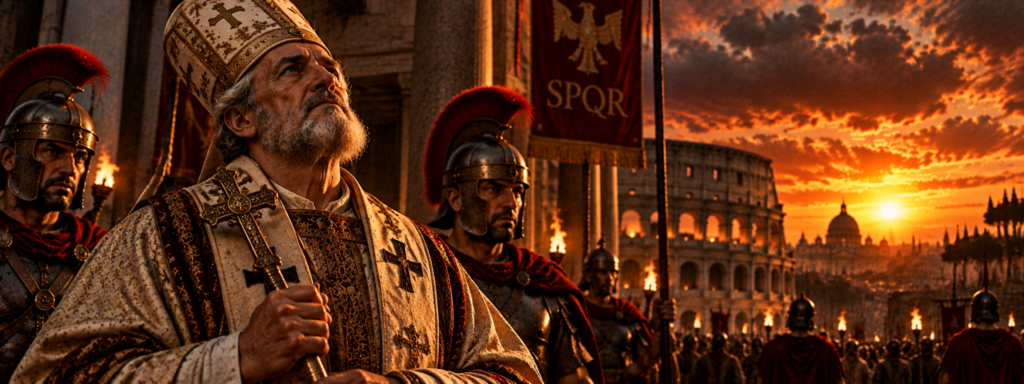
Pope Evaristus: The Forgotten Bishop of Rome and the Martyrdom History Cannot Prove
An Early Pope in Trajan’s Empire, the Dangerous Rise of Christianity, and the Mysterious Death of a Man Remembered as a Martyr
Pope Evaristus (died traditionally c. AD 107–108) is recognized in Catholic tradition as the fifth bishop of Rome, following Saint Peter, Linus, Anacletus, and Clement I. His pontificate is conventionally dated approximately AD 99–108, although the precise chronology remains uncertain. Later ecclesiastical tradition describes him as a man of Greek ancestry, born in Bethlehem to a Jewish father, and credits him with organizing Roman clergy and establishing regulations concerning Christian worship and marriage. He was traditionally honored as a martyr, but no reliable early account establishes that he was executed, assassinated, or otherwise killed for his faith, leaving his death among the unresolved mysteries of the early papacy.
The Pope Who Disappeared Into Rome’s Most Dangerous Century
By the beginning of the second century, Rome had become a city accustomed to blood. Its emperors had been murdered in palace conspiracies, its armies had fought brutal civil wars, and its public entertainments regularly turned suffering into spectacle. The capital’s magnificent temples, marble monuments, crowded markets, and luxurious villas stood alongside prisons, execution grounds, and neighborhoods where ordinary people struggled to survive. Beneath this enormous imperial system, a small Christian community continued to develop, carrying memories of persecution and the deaths of apostles who had supposedly defied Roman authority.
Somewhere within that community, according to the traditional succession of the Roman Church, a man named Evaristus became its leading bishop. He inherited no royal palace, commanded no soldiers, and possessed none of the political power that later popes would exercise over kings and emperors. His authority belonged to a religious movement still struggling to define its organization, preserve its teachings, and establish relationships among scattered congregations. Yet his name would eventually become part of the foundational history of one of the world’s most enduring institutions.
For centuries, Evaristus was remembered as a martyr, another early pope supposedly killed because of his Christian faith. His traditional pontificate coincided with the reign of Emperor Trajan, a ruler celebrated for military victories and administrative achievements but whose government also permitted the punishment of Christians under certain circumstances. The association seemed to provide a plausible setting for a violent death. Later generations could imagine Evaristus standing before Roman authorities, refusing to abandon his religion, and suffering the ultimate penalty.
The surviving historical evidence, however, tells a much less complete story. No contemporary account describes Evaristus being arrested, interrogated, imprisoned, or executed. No reliable early source identifies the emperor, magistrate, or official responsible for his supposed death. Even the manner of his alleged martyrdom remains unknown, and the earliest surviving references to him provide almost no personal information.
The mystery extends beyond his death. Later biographies describe Evaristus as the son of a Jewish father from Bethlehem, a man of Greek ancestry who supposedly organized the Roman Church into distinct ecclesiastical districts. He is credited with appointing priests, establishing rules concerning marriage ceremonies, and strengthening the structure of Christian leadership. Yet these details appear in sources written centuries after his lifetime and cannot be independently verified.
His story therefore presents an unusual challenge. Unlike rulers whose assassinations were recorded by contemporary historians, Evaristus left behind no detailed account of political enemies, religious confrontations, or violent final moments. Unlike Clement I, his immediate predecessor, he is not securely associated with an important surviving letter that might reveal his concerns or personality. His historical identity rests primarily upon his place in the succession of Roman Christian leaders.
That obscurity does not make him insignificant. Evaristus lived, according to tradition, during a period when Christianity was spreading through the Roman Empire and gradually developing the structures that would shape its future. His supposed leadership overlapped with major changes in imperial government, the expansion of Roman military power, and the continuing tension between Christian religious practice and traditional Roman expectations. The world surrounding him was richly documented, even if his personal experiences were not.
To understand Evaristus, we must therefore examine both the historical environment in which he supposedly lived and the traditions that transformed him into a martyr. His story is not a documented account of assassination, and it would be misleading to present it as one. Instead, it reveals how a nearly forgotten religious leader became associated with persecution, institutional authority, and sacred memory. The most unsettling aspect of his life is not a recorded execution but the extraordinary silence surrounding a man whose name survived for nearly two thousand years.
Rome at the Dawn of the Second Century
The Rome of Evaristus’s traditional pontificate was a city of extraordinary wealth, inequality, and political power. It served as the administrative center of an empire stretching from Britain to the eastern Mediterranean and from the Rhine and Danube frontiers to North Africa. Goods, people, and ideas flowed into the capital from across this vast territory. The city was both a symbol of imperial civilization and a place where the consequences of conquest were visible in everyday life.
Its streets were crowded with merchants, laborers, soldiers, officials, freedmen, enslaved people, and immigrants. Wealthy aristocrats occupied elaborate residences while poorer inhabitants lived in densely populated apartment buildings. Public baths, markets, temples, theaters, and entertainment venues provided spaces where different social groups encountered one another. The enormous scale of the city created opportunities for religious communities to develop within its diverse population.
Yet Roman society was deeply hierarchical. Senators and wealthy families enjoyed privileges unavailable to ordinary inhabitants, while enslaved people remained subject to the authority of their owners. Legal status shaped almost every aspect of life, from marriage and property ownership to the punishments imposed by courts. The same offense could produce very different consequences depending upon a person’s social position.
Public religion was woven into this social structure. Temples, sacrifices, festivals, and ceremonies honoring the gods formed part of civic life. Religious observance was not simply a matter of private belief but a public expression of loyalty, tradition, and communal identity. The emperor himself occupied an important position within the religious and political order.
Christianity challenged certain expectations because its adherents rejected participation in forms of worship they regarded as incompatible with their faith. Christians did not necessarily oppose Roman government in a political sense, but their religious commitments could bring them into conflict with established practices. Refusal to sacrifice to traditional gods might be interpreted as stubbornness, impiety, or hostility toward communal obligations. Such tensions could become dangerous when authorities intervened.
The Roman Christian community had existed for several decades before Evaristus’s traditional leadership. The apostle Paul had addressed Christians in Rome during the first century, and later tradition associated the deaths of Peter and Paul with the city. By the beginning of the second century, Roman believers possessed a developing sense of religious identity and continuity. Their community had survived political upheaval and episodes of persecution, although the details of its internal organization remain uncertain.
The city itself was recovering from the instability of the late first century. Domitian had been assassinated in AD 96, ending the Flavian dynasty, and his successor Nerva had attempted to restore political stability. The accession of Trajan in AD 98 introduced a reign that would become associated with imperial expansion and administrative strength. Rome entered a period later remembered as part of the empire’s greatest age.
For Christians, however, imperial prosperity did not necessarily guarantee security. The government that maintained roads, aqueducts, and public order also possessed the power to punish those who challenged accepted religious practices. A Christian community could flourish quietly while remaining vulnerable to accusations or local hostility. Evaristus’s traditional ministry belongs within this complicated environment, where the grandeur of Rome concealed the precarious position of those who stood outside its religious mainstream.
The Man Behind the Name: Who Was Evaristus?
The earliest surviving evidence concerning Evaristus is frustratingly limited. He appears in ancient succession lists identifying the leaders of the Roman Church, but those references provide little information about his personality or personal history. His name is preserved, yet the circumstances of his birth, education, conversion, and appointment remain uncertain. Much of what later generations claimed to know about him comes from ecclesiastical biographies written long after his death.
One of the most frequently repeated traditions describes Evaristus as a man of Greek ancestry whose father was Jewish and originally associated with Bethlehem. The account appears in the Liber Pontificalis, a collection of papal biographies whose earliest entries were compiled centuries after the events they describe. The work gives his father’s name as Judah and identifies Evaristus with the Greek name Aristus in some versions. These details cannot be independently verified from contemporary evidence.
The tradition is intriguing because it places Evaristus at the intersection of several cultures. A Jewish father, a connection with Bethlehem, and a Greek identity would reflect the diversity of the eastern Mediterranean world. Such a background would not have been unusual within the Roman Empire, where migration, commerce, and political change brought different communities into contact. Yet historical plausibility does not establish that the biographical details are true.
The name Evaristus itself is Greek in origin and can be understood as suggesting someone pleasing or well regarded. Greek names were common throughout the Roman world, including among people who had never lived in Greece. Rome contained a substantial Greek-speaking population, and many early Christian texts were written in Greek. A Greek name therefore provides little certainty about birthplace or ancestry.
His supposed connection with Bethlehem is especially difficult to assess. The town possessed enormous significance within Christian tradition because of its association with the birth of Jesus. Later writers may have preserved a genuine family tradition, but the surviving evidence does not permit that conclusion with confidence. The association should remain identified as a later claim rather than an established biographical fact.
We know even less about his early adulthood. No reliable source identifies his occupation, marital status, social position, or circumstances of conversion. He may have belonged to a family already associated with Christianity, or he may have joined the movement as an adult. Both possibilities fit the broader history of early Christian communities, but neither can be demonstrated in his case.
His relationship with earlier Roman leaders is similarly obscure. Evaristus is traditionally placed after Clement I, but there is no reliable account describing their personal interactions. He may have known Clement or participated in the same religious community for years before assuming a leadership role. Yet such possibilities cannot be presented as documented events.
The historical Evaristus therefore remains largely inaccessible. His name survived because it occupied a place within the succession of Roman church leaders, not because contemporary writers preserved his biography. Later generations supplied the details expected of an important religious figure, including family origins and institutional achievements. The result was a portrait far more complete than the earliest evidence allows.
The Fifth Pope and the Uncertain Beginnings of Papal Power
Catholic tradition identifies Evaristus as the fifth pope, following Peter, Linus, Anacletus, and Clement I. This ordering became firmly established within the historical memory of the Roman Church. Yet the meaning of the papal office during the late first and early second centuries remains a subject of scholarly debate. The structures familiar from later medieval and modern Catholicism developed gradually rather than appearing fully formed during the apostolic generation.
Early Christian communities used terms such as bishop, presbyter, and deacon, but the precise relationships among these offices were not always identical across different regions. Some congregations appear to have been governed by groups of elders, while others developed stronger individual episcopal leadership. The process was uneven and influenced by local circumstances. Rome presents particular difficulties because its earliest organizational records have not survived.
The traditional succession lists provide valuable evidence that later Christians remembered identifiable leaders in Rome. Irenaeus of Lyons, writing in the late second century, named the successors of the apostles and included Evaristus in the sequence. His account demonstrates that Evaristus was recognized as part of Roman Christian history relatively early. It does not, however, provide a detailed description of the authority Evaristus exercised.
Irenaeus was writing within a theological controversy. He wanted to demonstrate that churches associated with the apostles had preserved authentic Christian teaching through recognizable succession. The Roman Church was especially important to his argument because of its connection with Peter and Paul. Listing its leaders helped establish continuity between the apostolic generation and the Christianity of his own time.
The succession therefore served both a historical and theological purpose. It preserved names associated with Roman leadership while also supporting claims about legitimate teaching. The existence of the list does not establish that every individual exercised identical responsibilities. Evaristus may have occupied a position quite different from that of a later pope governing an extensive ecclesiastical hierarchy.
The traditional chronology places his pontificate approximately between AD 99 and 108, although ancient lists and later calculations vary. These dates should be understood as conventional reconstructions rather than precise administrative records. No contemporary document establishes the exact day or year he assumed office. The uncertainty reflects the limitations of the surviving evidence.
The term pope itself can create anachronistic impressions. Evaristus did not govern the Papal States, command armies, negotiate as a sovereign with European monarchs, or preside over the elaborate institutions of later Catholicism. His authority belonged to a developing religious community within the Roman Empire. Whatever influence he possessed depended upon recognition among Christians rather than the coercive machinery of a territorial government.
This distinction matters when discussing his supposed martyrdom. Even if Evaristus had been executed, his death would not constitute regicide in the conventional sense because he was not a reigning monarch. It would belong to the history of religious persecution and the killing of religious leaders. His inclusion among assassinated rulers therefore requires an explicit recognition that the circumstances of his death remain unproven.
Clement’s Legacy: A Church Troubled by Rebellion
Evaristus traditionally succeeded Clement I, one of the most important figures in the earliest history of the Roman Church. Clement is associated with the letter known as First Clement, sent from Rome to the Christian community at Corinth near the end of the first century. The document addresses a serious dispute involving the removal of established church leaders. It reveals that early Christian communities were already struggling with questions of authority, jealousy, and internal division.
The Corinthian conflict appears to have involved the deposition of certain presbyters or recognized leaders. The Roman Church condemned the disturbance and urged the restoration of peace and legitimate authority. The letter warned against envy, ambition, and rebellion, drawing upon examples from Jewish scripture and Christian tradition. Its tone suggests that the dispute was regarded as a serious threat to communal stability.
The letter is particularly revealing because it challenges romanticized images of the earliest Christians as uniformly harmonious. Religious communities were composed of ordinary people with competing interests, personalities, and expectations. Leadership disputes could become bitter, especially when individuals believed that authority had been exercised unfairly. The Roman intervention demonstrates that such conflicts could attract attention beyond the local congregation.
Evaristus’s supposed leadership followed this period of controversy. It is possible that the concerns expressed in First Clement continued to influence Roman Christian thinking about legitimate leadership and succession. Yet no surviving source records Evaristus responding to the Corinthian dispute or issuing similar correspondence. His personal role in these developments remains unknown.
The broader significance of First Clement lies in its emphasis upon continuity. The letter argues that the apostles appointed leaders and that established ministers should not be removed through factional ambition. This reasoning became important to later Christian understandings of ecclesiastical authority. The development of such ideas provides context for the succession in which Evaristus was remembered.
The Roman Church’s willingness to address problems in Corinth also suggests growing connections among Christian communities. Letters, travelers, and teachers carried information between cities, creating networks that extended across the Mediterranean. Religious disputes in one location could therefore become matters of concern elsewhere. These relationships would eventually contribute to the development of more extensive ecclesiastical structures.
Yet the historical evidence does not permit a direct narrative linking Clement’s actions with specific decisions made by Evaristus. There is no surviving letter from Evaristus comparable to First Clement. We cannot identify his views on the Corinthian controversy or determine whether he maintained correspondence with other churches. His place in the succession suggests continuity, but the details of that continuity are missing.
The contrast between the two men is striking. Clement is associated with a substantial document revealing the concerns of an early Christian community. Evaristus survives mainly as a name in historical lists and later biographies. His apparent silence may reflect the loss of documents rather than inactivity, but the distinction remains important. The historian cannot fill the gap by inventing a ministry that the evidence does not describe.
Trajan: The Emperor Who Ruled the World Evaristus Inhabited
Trajan became emperor in AD 98, shortly before the conventional beginning of Evaristus’s pontificate. His reign lasted until AD 117 and became associated with military success, administrative activity, and the expansion of Roman territory. Later Roman writers praised him as an exemplary ruler, contrasting his government with the suspicion and political hostility associated with Domitian. Yet his celebrated reputation did not mean that everyone living under his authority enjoyed equal security.
Trajan came from a prominent provincial family associated with Hispania and had established himself through military service. His adoption by Nerva helped secure the imperial succession at a time when military support was essential. Upon becoming emperor, he cultivated relationships with the Senate while maintaining the authority of the imperial office. His government presented itself as a restoration of stability and effective leadership.
Military campaigns became central to his reputation. The Dacian Wars, fought in the early second century, resulted in Roman conquest and the incorporation of substantial territory north of the Danube. The campaigns brought wealth, prestige, and large numbers of captives into the Roman world. They also demonstrated the destructive power of imperial expansion.
Trajan’s Column, erected in Rome after the Dacian victories, preserved an elaborate visual narrative of the campaigns. Its carved scenes depict soldiers, fortifications, battles, and other aspects of Roman military activity. The monument celebrated imperial achievement while also recording the machinery of conquest. It remains one of the most remarkable surviving monuments of the Roman Empire.
For ordinary inhabitants of Rome, military victories could bring public celebrations, construction projects, and displays of imperial generosity. Yet conquest also involved suffering among defeated populations, displacement, enslavement, and the extraction of resources. The prosperity of the capital was inseparable from the power exercised over distant territories. Christians lived within this same imperial system, benefiting from its infrastructure while remaining vulnerable to its authority.
Trajan also supported major public works, including roads, harbors, and monumental construction. His government contributed to the physical development of Rome and the broader empire. Such achievements helped establish his reputation as one of the so-called good emperors. Yet this later label reflects a particular tradition of evaluating imperial government and should not obscure the coercive foundations of Roman power.
The Christian community existed beneath Trajan’s government without possessing formal legal recognition comparable to established civic institutions. Its members participated in ordinary economic and social life while maintaining religious practices that could attract suspicion. The extent of official hostility varied according to local circumstances. The emperor’s later correspondence with Pliny the Younger demonstrates that Christianity could become a matter of legal concern.
Evaristus’s traditional ministry therefore unfolded during a reign remembered for stability and military success but capable of punishing religious nonconformity. The contrast is important because imperial prosperity and religious vulnerability were not mutually exclusive. A ruler could be praised for effective administration while permitting the punishment of Christians. Yet no reliable source establishes that Trajan personally ordered the execution of Evaristus.
The Dangerous Question of Christian Identity
By the beginning of the second century, Christianity had spread beyond its original Jewish environment into communities across the Roman Empire. Its members lived in cities connected by trade, travel, military movement, and imperial administration. They shared religious teachings centered upon Jesus while developing distinctive practices of worship and communal life. Their growing presence raised questions about how Roman authorities should classify and respond to them.
Roman religion was closely connected with public duty. Participation in sacrifices and festivals could demonstrate respect for the gods and loyalty to the community. The imperial cult, although practiced differently across regions, also formed part of the political and religious environment. Refusal to participate could therefore be interpreted as more than a private theological disagreement.
Christians rejected worship they regarded as incompatible with their faith. Their refusal to sacrifice to traditional gods could appear stubborn or socially disruptive to outsiders. They also gathered in private settings and maintained religious practices that were not always understood by their neighbors. Misunderstanding and suspicion could develop when unfamiliar communities appeared unwilling to participate in established customs.
The surviving evidence does not establish that Christians faced constant persecution throughout the empire during Evaristus’s traditional lifetime. Roman officials often responded to particular accusations rather than conducting systematic searches for believers. Local conditions mattered, and communities could experience periods of relative peace. Nevertheless, the possibility of punishment remained real.
The later correspondence between Pliny the Younger and Trajan provides the clearest surviving evidence of official policy during this period. Writing from Bithynia-Pontus around AD 111–113, Pliny asked the emperor how to handle individuals accused of being Christians. He described interrogating suspects and requiring them to demonstrate their willingness to honor the Roman gods. Those who persisted in identifying as Christians could face punishment.
Trajan’s reply instructed Pliny not to search actively for Christians but to punish those who were formally accused and refused to recant. Anonymous accusations were not to be accepted as a basis for prosecution. The policy reflected a pragmatic approach rather than a comprehensive campaign of extermination. Yet it also confirmed that Christian identity could become grounds for punishment.
The correspondence occurred after Evaristus’s traditional death, and it cannot be used as direct evidence of his experiences. Nevertheless, it illuminates the legal and social environment of the early second century. It demonstrates that Christians could become vulnerable when their religious commitments were brought before Roman authorities. It also reveals the absence of a uniform policy requiring officials to hunt believers everywhere.
This distinction is essential to evaluating Evaristus’s supposed martyrdom. The fact that Christians could be executed under Trajan does not establish that Evaristus was among them. No surviving account identifies him as a defendant in a Roman proceeding. His traditional status as a martyr must therefore be assessed separately from the broader evidence of persecution.
The Christians of Rome: Faith Behind Ordinary Doors
The Christian community associated with Evaristus did not worship in the monumental basilicas that later transformed Rome’s religious landscape. Christianity remained a minority movement, and its gatherings generally took place within domestic or other modest settings. The New Testament provides examples of believers meeting in homes, and such arrangements likely remained important during the early second century. The precise locations used by Roman Christians during Evaristus’s traditional ministry are unknown.
Private gatherings offered practical advantages. Homes provided spaces for shared meals, teaching, prayer, and the maintenance of communal relationships. They also allowed groups to meet without constructing expensive public buildings. Yet domestic settings did not necessarily mean that Christians were permanently hiding from authorities.
The movement attracted people from different social backgrounds. Early Christian texts refer to wealthy patrons, household members, laborers, freedmen, and enslaved people. Rome’s diverse population created opportunities for religious networks to develop across social boundaries. The exact composition of the community during Evaristus’s leadership cannot be reconstructed, but its broader social environment was highly varied.
Greek remained an important language within early Roman Christianity. Many Christian texts circulated in Greek, and the city’s population included substantial Greek-speaking communities. The use of Greek names among early Roman leaders reflects this cultural environment. It does not, however, establish the ethnic origins of any particular individual.
Christian gatherings involved more than religious instruction. Communities maintained relationships of mutual assistance, cared for vulnerable members, and addressed disputes affecting communal life. Leaders may have helped coordinate these activities and preserve accepted teachings. Such responsibilities provide a general picture of early Christian organization, although no surviving evidence identifies Evaristus’s specific actions.
The absence of monumental buildings and extensive administrative records helps explain why so little is known about the earliest Roman bishops. Communities could function effectively without producing documents that survived for centuries. Letters might be lost, personal memories could disappear, and local traditions could change as generations passed. The survival of a name did not guarantee the preservation of a biography.
The community’s position within Roman society was therefore both ordinary and precarious. Christians worked, traveled, formed families, and participated in urban life like their neighbors. Their religious commitments could nevertheless become dangerous under particular circumstances. The same city that offered opportunities for communal growth also contained courts, prisons, and authorities capable of imposing severe punishments.
Evaristus belongs to this world of modest religious organization and uncertain legal protection. His later reputation as a pope can obscure how different his circumstances were from those of later church leaders. He did not preside over a vast ecclesiastical bureaucracy or enjoy the public status of a medieval pontiff. His supposed authority emerged within a developing community whose internal arrangements remain only partly visible.
Did Evaristus Divide Rome Into Seven Ecclesiastical Districts?
One of the most frequently repeated traditions concerning Evaristus is that he divided Rome into ecclesiastical districts and assigned priests to serve different parts of the city. Some later accounts associate him with the organization of seven areas or titles, suggesting that he established an early administrative structure for the Roman Church. The claim presents him as a practical reformer responsible for organizing a growing Christian community. Yet its historical foundation is uncertain.
The principal source for such details is the Liber Pontificalis, whose earliest papal biographies were compiled centuries after the first-century events they describe. The work attributes various organizational measures to early bishops, including ordinations and arrangements concerning clergy. These accounts often reflect later assumptions about ecclesiastical government. They cannot automatically be treated as contemporary records.
Rome eventually developed a system of titular churches and ecclesiastical districts associated with clergy and pastoral responsibilities. The origins of these structures were gradual and complex. Assigning their establishment to one obscure early pope may reflect a later desire to identify a founding figure. The evidence does not establish that Evaristus personally created the system.
The number seven carried particular significance within Christian tradition. Seven appears repeatedly in biblical and early Christian contexts, including the selection of seven men in the Acts of the Apostles. Later Roman ecclesiastical organization also employed divisions involving seven. Such patterns may have influenced retrospective accounts of early papal administration.
This does not mean that the Roman Christian community lacked organization during Evaristus’s traditional lifetime. Any functioning congregation required arrangements for worship, teaching, assistance, and leadership. As the community grew, different groups may have gathered in different locations. Yet the precise structure of those arrangements remains unknown.
The claim that Evaristus assigned priests to distinct districts therefore requires caution. It may preserve a memory of early organizational development, but the available evidence cannot establish the specific reform. The later description may also project institutions familiar to medieval writers backward into the first century. Historical plausibility is not equivalent to documentation.
The same uncertainty applies to accounts of the number of clergy he supposedly ordained. Later biographies sometimes provide precise figures for priests, bishops, and deacons appointed by early popes. Such numerical detail can create an impression of administrative accuracy. Yet the figures often lack independent corroboration and should not be accepted without qualification.
Evaristus may have contributed to the organization of Roman Christian life, but his actual achievements remain inaccessible. The image of a founder dividing Rome into neatly administered districts belongs primarily to later ecclesiastical tradition. The historical evidence supports his place in the succession more securely than it supports specific administrative reforms. His reputation as an organizer therefore remains a claim requiring careful qualification.
Marriage, Priests, and the Rules Later Attributed to Him
Later traditions also credit Evaristus with regulations concerning Christian marriage. Some accounts claim that he required marriages to be publicly celebrated or blessed by a priest, emphasizing the importance of religious recognition and communal witnesses. Such measures would fit the later Church’s concern with regulating marriage and protecting its legitimacy. Yet the attribution to Evaristus cannot be securely established.
Marriage in the Roman world was shaped by legal status, family arrangements, property interests, and social expectations. Roman law recognized different forms of marital union, while religious customs varied among communities. Early Christians inherited aspects of Jewish and Roman practice while developing their own teachings about marriage and family life. The process was gradual rather than the result of a single universal decree.
The New Testament contains discussions of marriage, divorce, and sexual conduct, but it does not present the fully developed sacramental and canonical system of later centuries. Christian marriage practices evolved over time as communities became more organized. Clerical involvement and public religious ceremonies acquired greater significance in later periods. Projecting these developments backward onto one early pope risks creating anachronisms.
The Liber Pontificalis and related traditions sometimes attribute specific disciplinary rules to early bishops. Such attributions may reflect later ecclesiastical concerns rather than first-century legislation. Medieval writers frequently sought ancient precedents for practices regarded as important in their own time. Associating a rule with an early pope gave it the appearance of apostolic continuity.
Evaristus’s supposed marriage regulations should therefore be understood as part of his later reputation. No reliable contemporary document records him issuing such a decree. The surviving evidence does not establish that he personally required priestly blessings or witnesses for Christian marriages. The development of these customs cannot be reduced to his individual actions.
The same caution applies to other regulations attributed to him. Later collections sometimes assign disciplinary instructions to early popes whose authentic writings have not survived. These texts may reflect theological and administrative concerns of much later periods. Their historical value lies partly in revealing how later Christians imagined the authority of the earliest bishops.
The attribution of marriage regulations nevertheless demonstrates the importance Evaristus acquired within ecclesiastical memory. He became more than a name in a succession list. Later generations portrayed him as a legislator who helped establish the orderly practices of Christian life. Such a reputation reinforced the idea that the Church’s later institutions possessed ancient foundations.
Yet the historical Evaristus remains elusive. We cannot confidently identify a single regulation that he personally introduced. His supposed reforms may reflect genuine developments within early Christianity, but their attribution to him is not securely documented. The difference between institutional history and individual biography must remain clear.
A Church Without an Army in an Empire Built on Conquest
The contrast between Trajan’s empire and the Christian community of Evaristus could hardly have been greater. Trajan commanded legions, governed provinces, controlled vast financial resources, and possessed the authority to punish individuals throughout the empire. His military campaigns expanded Roman territory and strengthened imperial prestige. Evaristus, by contrast, belonged to a religious community whose influence depended upon persuasion, teaching, and shared belief.
The Roman state maintained order through a combination of law, administration, military power, and public spectacle. Its institutions could provide stability and infrastructure, but they also enforced hierarchy and punished those considered dangerous. Political opposition, rebellion, and certain religious practices could attract severe consequences. The machinery of government was capable of overwhelming violence when authorities chose to employ it.
Christianity developed within this system rather than outside it. Believers used Roman roads, traveled between imperial cities, and participated in the economic life of the empire. Their communities benefited from the connectivity created by Roman administration. Yet their religious commitments could bring them into conflict with the same authorities who maintained that infrastructure.
The relationship was not simply one of constant confrontation. Many Christians lived without attracting official attention, and some may have maintained ordinary relationships with non-Christian neighbors. Roman officials often responded to specific complaints rather than seeking out believers systematically. The experience of persecution therefore varied across different communities and periods.
The memory of Nero’s violence nevertheless remained significant. Later Christian writers associated the deaths of Peter and Paul with his reign, presenting Rome as a city where apostolic witness had been sealed by suffering. Domitian also acquired a reputation as a persecutor, although the extent of his actions against Christians remains debated. These memories shaped the religious environment inherited by later generations.
Trajan’s government added another chapter to this complicated history. His correspondence with Pliny demonstrates that Christian identity could become a legal problem, but it also shows that officials were not instructed to conduct unrestricted searches. The policy created a dangerous uncertainty. Christians might remain undisturbed until an accusation brought them before authorities.
Evaristus’s traditional martyrdom emerged within this broader memory of imperial hostility. The image of a Roman bishop suffering under Trajan fit the narrative of a Church surviving despite persecution. Yet no reliable early source identifies Evaristus as a victim of a specific prosecution. The general danger cannot establish the details of his personal fate.
The contrast between imperial power and Christian vulnerability remains central to his story. Trajan’s monuments still testify to the military and political achievements of his reign. Evaristus left no comparable physical record, yet his name survived through the institution that later claimed him as one of its earliest leaders. The emperor’s authority was immediate and overwhelming, while the bishop’s legacy depended upon the endurance of religious memory.
Ignatius of Antioch: A Martyrdom Better Remembered
The early second century also witnessed the emergence of another important Christian figure, Ignatius of Antioch. According to early Christian tradition, Ignatius was taken toward Rome under guard and expected to face death because of his faith. A collection of letters attributed to him survives, offering valuable evidence of early Christian leadership and attitudes toward martyrdom. His story provides an important comparison with the much less documented death of Evaristus.
Ignatius’s letters address Christian communities in several cities and discuss unity, leadership, and religious teaching. They emphasize the importance of bishops, presbyters, and deacons, reflecting a developing understanding of ecclesiastical organization. The letters also reveal a strong concern with preserving communal harmony. Their themes overlap with the broader institutional questions surrounding the earliest Roman bishops.
Ignatius’s attitude toward martyrdom is particularly striking. In his letter to the Romans, he expresses a desire not to be prevented from facing the death he anticipates. The language reflects a religious understanding of suffering as a form of witness. It also demonstrates how martyrdom could become an important element of early Christian identity.
The exact chronology and circumstances of Ignatius’s death remain debated, and later accounts added details that cannot all be verified. Nevertheless, the letters provide substantially stronger early evidence of his expectation of martyrdom than exists for Evaristus. They allow historians to examine the thoughts and concerns of a Christian leader facing possible execution. Evaristus left no comparable testimony.
The comparison is especially revealing because both men belong to the traditional history of Christianity under Trajan. Ignatius became associated with a journey toward Rome and a willingness to suffer for his faith. Evaristus became associated with martyrdom largely through later commemoration. Their reputations developed within the same broad religious culture, but the surviving evidence differs significantly.
Ignatius’s letters also illuminate the development of episcopal authority. He repeatedly emphasizes the importance of unity around recognized leaders, suggesting that some Christian communities possessed clearly articulated structures by the early second century. Rome’s precise arrangements remain more difficult to reconstruct. The existence of strong episcopal leadership elsewhere does not automatically establish identical structures in the capital.
The comparison therefore helps place Evaristus within a wider historical process. Christian communities were developing more formal leadership while also confronting the possibility of persecution. The memory of martyrdom strengthened the authority of certain figures. Yet the details of individual lives and deaths varied greatly in the surviving record.
Evaristus’s supposed execution cannot be reconstructed by borrowing details from Ignatius’s story. There is no evidence that he was transported under guard, condemned to an arena, or subjected to a particular form of punishment. His martyrdom remains a tradition without a reliable early narrative. The contrast reinforces the importance of evaluating each case independently.
The Martyrdom of Evaristus: A Death Without Witnesses
For centuries, Evaristus was honored as a martyr, one of the earliest Roman bishops believed to have died because of his Christian faith. His name appeared in ecclesiastical commemorations, and later accounts sometimes presented his death as another example of imperial persecution. The traditional date is commonly placed around AD 107 or 108, during the reign of Trajan. Yet the historical evidence does not establish that he was executed.
Irenaeus, the earliest important witness to Evaristus’s place in the Roman succession, does not describe a martyrdom. He identifies Evaristus as the successor of Clement and predecessor of Alexander, but supplies no account of his death. The omission does not prove that Evaristus died peacefully, because Irenaeus was concerned primarily with succession rather than biography. Nevertheless, the source provides no support for a specific execution narrative.
Other early Christian writers likewise fail to preserve a reliable account of his final moments. No contemporary document records his arrest or trial. No Roman legal source identifies him as a condemned Christian. No early narrative establishes the method by which he supposedly died.
Later martyrological traditions assigned him the status of martyr, but such commemorations were often based upon inherited religious memory rather than contemporary evidence. Inclusion in a list of martyrs demonstrates that a person was venerated in that capacity. It does not independently prove that the individual suffered a violent death. The distinction is especially important for the earliest popes, many of whom acquired martyrdom traditions despite limited historical documentation.
The reign of Trajan provides a plausible setting for persecution, but plausibility cannot substitute for evidence. The emperor’s correspondence with Pliny shows that Christians could be punished under certain circumstances. It does not establish that Evaristus was among those punished. No reliable source connects his death directly with an imperial order.
The possibility of an isolated act of persecution cannot be excluded. Roman authorities possessed broad powers, and a Christian leader might have become vulnerable through accusation or local conflict. A violent death could have occurred without leaving a surviving record. Yet the evidence does not permit historians to identify such an event in Evaristus’s life.
A natural death remains equally possible. Evaristus may have died from illness, age, or another ordinary cause, leaving no detailed account for later generations. His age and health are unknown, and even the traditional date of his death is uncertain. Any confident description of his final hours would therefore be speculative.
The most accurate conclusion is that Evaristus was traditionally regarded as a martyr, but his martyrdom is historically unproven. He cannot responsibly be described as a documented assassination victim or as a man whose execution has been established by reliable sources. His story belongs to the history of disputed religious martyrdom traditions rather than verified political murder. The uncertainty is not incidental to his biography; it is one of its defining features.
Why So Many Early Popes Became Martyrs in Memory
The martyrdom tradition surrounding Evaristus reflects a broader pattern in the historical memory of the early papacy. The Roman Church preserved the names of leaders associated with the apostolic generation, and later accounts frequently portrayed them as men who suffered under pagan emperors. Their supposed deaths formed a narrative of continuity through persecution. The image was emotionally powerful and helped define the Church’s understanding of its origins.
The deaths traditionally associated with Peter and Paul provided the model. Both apostles were remembered as having suffered under Nero, and their martyrdoms became central to Rome’s Christian identity. Later generations viewed the early bishops as guardians of the faith inherited from these figures. It was natural for their stories to be interpreted within a framework of suffering and endurance.
Yet the historical evidence does not support the assumption that every early Roman bishop died violently. Some martyrdom traditions are better documented than others, while several appear only in much later sources. The Roman state did not conduct a continuous empire-wide campaign against Christians throughout the first and second centuries. The experiences of Christian communities varied according to local circumstances and political developments.
The scarcity of early biographical information encouraged retrospective interpretation. When later writers possessed only a name and a place in the succession, they often lacked details about the person’s ministry and death. Religious traditions could supply familiar patterns of sanctity, leadership, and persecution. Over generations, these patterns became part of accepted devotional history.
Such developments did not necessarily involve deliberate fabrication. Communities transmitted memories through worship, storytelling, calendars, and written compilations. Details could be expanded or simplified as traditions passed between generations. Once a figure was commemorated as a martyr, later writers might repeat the designation without possessing independent evidence.
The Liber Pontificalis played an important role in shaping the biographies of early popes. Its entries supplied origins, pontificate lengths, ordination figures, decrees, burial places, and sometimes martyrdom traditions. The work became highly influential in medieval ecclesiastical history. Yet its earliest biographies were compiled centuries after the events they purported to describe.
Evaristus’s reputation illustrates the resulting tension between devotional memory and historical reconstruction. He became a recognized saint and martyr, associated with organizational reforms and the development of Roman Christian leadership. Yet the earliest surviving evidence establishes little beyond his name and position in the succession. The detailed biography belongs largely to later tradition.
Modern historical criticism therefore approaches his martyrdom cautiously. It recognizes the significance of his veneration while distinguishing that tradition from documented execution. The absence of reliable evidence does not prove that he died peacefully. It means that the circumstances of his death cannot be established.
The Burial Near Saint Peter: Another Uncertain Tradition
Later ecclesiastical accounts associate Evaristus with burial near the tomb of Saint Peter in Rome. The tradition places him within the sacred landscape that would eventually become central to the Vatican. Such an association reinforced the idea of continuity between the apostles and their successors. Yet the historical evidence does not securely identify his grave.
The Vatican area contained ancient Roman burial grounds, including a necropolis beneath the later basilica of Saint Peter. Archaeological investigations have revealed structures associated with the development of Christian veneration in the region. These discoveries provide important evidence concerning the sacred history of the site. They do not, however, establish the burial location of Evaristus.
The association between early bishops and Peter’s grave became increasingly significant as the Roman Church developed. The apostle’s traditional burial site served as a powerful symbol of religious authority and continuity. Later papal biographies frequently connected early leaders with this location. Such associations helped construct a coherent sacred geography.
Evaristus’s supposed burial near Peter would have carried particular meaning. It placed the fifth pope physically close to the apostle whose memory underpinned the Roman succession. The proximity reinforced the idea that leadership passed from one generation to another. Yet symbolic coherence does not establish archaeological fact.
No securely authenticated tomb belonging to Evaristus has been identified. The ancient burial landscape underwent extensive changes through later construction and religious development. The absence of a verified grave makes it impossible to reconstruct the circumstances of his burial. The tradition remains part of ecclesiastical memory rather than established archaeology.
The uncertainty is characteristic of the earliest papal biographies. Names survived in succession lists, while burial locations and personal histories were supplied through later traditions. Some details may preserve authentic memories, but their reliability varies. Historians must evaluate each claim separately.
The Vatican association nevertheless demonstrates the importance Evaristus acquired within Catholic tradition. His name became part of the sacred history surrounding Peter and the earliest Roman bishops. Even without a verified tomb, his memory was integrated into the Church’s understanding of its origins. The physical landscape of Rome helped reinforce that identity.
Yet the historical Evaristus remains elusive. We cannot identify the place where he died or establish where his body was buried. The later tradition supplies a location that fits the religious narrative of apostolic succession. It does not resolve the mystery of his final years.
Alexander I and the Succession That Continued
According to the traditional Roman succession, Evaristus was followed by Alexander I. Alexander’s pontificate is conventionally placed in the early second century, although its precise dates remain uncertain. Like Evaristus, he became associated with later traditions concerning ecclesiastical regulations and martyrdom. The transition illustrates the continuity of Roman Christian leadership despite the scarcity of surviving personal records.
The succession from Clement to Evaristus and Alexander formed part of the historical argument preserved by Irenaeus. By listing successive leaders, Irenaeus sought to demonstrate that the Roman Church maintained continuity with the apostolic generation. The sequence became central to later understandings of papal history. Evaristus’s place within it ensured that his name would not disappear entirely.
Yet the nature of leadership during this period remains debated. The surviving evidence does not establish that each bishop exercised identical responsibilities or governed through a fully developed administrative structure. Roman Christianity was still evolving, and its institutions changed over time. The succession lists preserve names more securely than they preserve the details of individual offices.
The absence of surviving writings from Evaristus and Alexander creates additional uncertainty. Unlike Clement, whose associated letter provides substantial evidence of early Christian concerns, these figures left no comparable documents securely attributed to them. Later biographies attempted to fill the gaps with accounts of reforms and martyrdom. Their historical reliability remains limited.
The broader Christian movement continued to expand during the early second century. Communities developed in cities across the Mediterranean, maintaining relationships through travel, correspondence, and shared religious traditions. Questions concerning leadership and legitimate teaching became increasingly important. The development of episcopal authority formed part of this process.
The Roman Church’s significance also continued to grow. Its association with Peter and Paul gave it particular prestige, while its position within the imperial capital provided opportunities for communication with other communities. Yet the precise extent of its authority during the earliest generations remains uncertain. Later papal primacy cannot simply be projected backward into the lifetime of Evaristus.
His succession by Alexander therefore marks continuity rather than a clearly documented political transition. There is no reliable account of a contested election, a violent struggle for office, or an imperial intervention in the appointment. The circumstances by which Alexander assumed leadership remain unknown. Any dramatic reconstruction would be speculative.
The transition also reinforces the uncertainty surrounding Evaristus’s death. The succession list establishes that another leader followed him, but it does not explain why his leadership ended. Death is the most obvious possibility, yet its circumstances remain undocumented. The traditional designation of martyr cannot supply the missing evidence.
The Forgotten Pope and the Making of Christian History
Evaristus’s historical importance lies partly in the extraordinary contrast between his obscurity and the institution that remembered him. He is traditionally counted among the earliest bishops of Rome, a position that later acquired enormous religious and political significance. Yet almost nothing about his personal life can be established with confidence. His reputation grew as the papacy developed, even though the evidence concerning his individual actions remained limited.
The Roman Church of his supposed lifetime was a minority religious community within a vast imperial capital. Its members gathered for worship, maintained relationships, and struggled with questions of teaching and leadership. They possessed no territorial state and no military power. Their survival depended upon communal organization and the ability to function within Roman society.
Over the following centuries, Christianity underwent dramatic transformation. The movement expanded, developed more formal ecclesiastical structures, and eventually received imperial support. Bishops became increasingly influential, while the Roman Church asserted growing authority within the Christian world. The institution that later claimed Evaristus as its fifth leader became vastly different from the community he may have known.
His name acquired significance through the doctrine and tradition of apostolic succession. The succession lists connected later bishops with the earliest generations of Christian leadership. Evaristus became one link in that chain. His personal obscurity did not diminish the symbolic importance of his position.
Later biographies transformed him into a more recognizable figure. They supplied family origins, administrative reforms, marriage regulations, burial traditions, and the designation of martyr. These details created the impression of a well-documented pontificate. Yet the historical foundation remained far less secure than the narrative suggested.
The process reveals how institutions construct their memories. Later generations seek continuity with their origins, and historical figures become symbols of enduring identity. Where records are incomplete, traditions can acquire an authority that exceeds their evidentiary basis. Evaristus illustrates this process with unusual clarity.
His supposed martyrdom also reflects the importance of suffering within Christian historical memory. The early Church remembered persecution as a defining experience, and the deaths of saints became models of religious courage. Associating Evaristus with martyrdom placed him within that sacred narrative. Yet the historical evidence does not establish that he suffered such a death.
The result is a figure whose reputation must be understood on two levels. Evaristus belongs to the early succession of Roman Christian leaders, a tradition attested by ancient sources. He also belongs to a later devotional history that attributed specific achievements and martyrdom to him. The distinction between these levels is essential to understanding his legacy.
A Martyr Without a Murderer
Evaristus occupies an unusual position within the history of assassinated rulers and regicides. He was traditionally regarded as a martyr, but no reliable source establishes that he was murdered. He was also not a sovereign monarch in the political sense, despite the later power associated with the papacy. His story therefore requires careful classification.
Regicide ordinarily refers to the killing of a king or other monarch, often in circumstances involving political conspiracy or rebellion. Assassination generally involves the deliberate killing of a prominent individual for political, ideological, or other targeted reasons. Martyrdom is a religious category describing death suffered because of faith or religious witness. These categories can overlap, but they are not interchangeable.
A Christian bishop executed by Roman authorities might be remembered as a martyr without being the victim of regicide. A religious leader murdered during a political struggle might be an assassination victim without necessarily being a martyr. Historical classification depends upon the circumstances of death. In Evaristus’s case, those circumstances remain unknown.
The surviving evidence does not identify a motive for his supposed killing. We cannot say whether he was targeted because of his religious beliefs, caught in a political conflict, or punished for another reason. We cannot even establish that he was deliberately killed. His traditional designation as a martyr therefore remains a matter of religious memory rather than verified historical fact.
The temptation to supply a dramatic execution scene is understandable. A bishop confronting a Roman magistrate, refusing to sacrifice to the gods, and accepting death would fit familiar early Christian martyrdom narratives. Yet no reliable source places Evaristus in such a confrontation. Inventing the scene would create fiction rather than recover history.
The absence of evidence does not diminish the broader history of Christian persecution. Roman authorities sometimes punished believers severely, and later periods produced numerous documented martyrs. The early second century also provides evidence that Christian identity could become grounds for prosecution. Evaristus’s case is different because the sources do not establish his personal fate.
His story is therefore most accurately presented as a disputed martyrdom tradition. The traditional claim deserves discussion because it shaped his place within Catholic memory. The uncertainty deserves equal prominence because it determines what can responsibly be asserted. A historically credible account must resist the temptation to turn an undocumented death into a verified assassination.
The mystery is itself revealing. A man remembered for nearly two thousand years as an early pope can remain almost entirely unknown as an individual. His supposed martyrdom survives without an identified executioner, method, or contemporary witness. The silence surrounding his death is not an invitation to invent the missing details; it is the central historical problem.
The Long Shadow of Trajan’s Empire
Trajan died in AD 117, several years after the traditional death of Evaristus. His reign left a substantial legacy of military conquest, monumental construction, and administrative development. Later Roman writers remembered him as an exemplary emperor, and his reputation remained influential for centuries. Yet the empire he governed also contained communities whose religious practices could bring them into conflict with official authority.
The contrast between Trajan and Evaristus is striking. Trajan’s life is documented through inscriptions, monuments, coins, literary accounts, and the surviving correspondence of officials. Evaristus left almost no personal record. One man exercised power over an enormous empire, while the other occupied a modest position within a developing religious community.
The emperor’s achievements were visible in stone and bronze. His column celebrated military victories, while roads and public works demonstrated the resources of imperial government. His image appeared on coins circulating across the Roman world. The state possessed the means to preserve and promote his memory.
Evaristus’s name survived through a very different mechanism. Christian writers preserved him within a succession of Roman leaders, and later ecclesiastical traditions expanded his biography. His memory depended upon religious continuity rather than monumental self-presentation. The institution that remembered him eventually outlasted the political structures of the Western Roman Empire.
The difference illustrates the unpredictable nature of historical remembrance. Powerful rulers can become distant figures whose monuments survive after their institutions disappear. Obscure religious leaders can acquire enduring significance through communities that preserve their names. Historical influence is not always proportional to contemporary political authority.
Yet the survival of a name does not guarantee the survival of reliable biography. Evaristus became important within Catholic tradition, but his personal history remained inaccessible. Later writers supplied details that made his life appear more complete. Modern historical criticism has exposed the uncertainty beneath those traditions.
The story therefore belongs to the broader history of how institutions remember their beginnings. The papacy developed a continuous succession linking later bishops with the apostolic generation. Evaristus became part of that foundational narrative. His individual achievements and death remained uncertain even as his symbolic importance increased.
The contrast with Trajan also underscores the limitations of historical evidence. The emperor’s government is richly documented, but that documentation does not identify Evaristus as a victim of persecution. The existence of imperial power and the possibility of religious punishment cannot establish a particular execution. The mystery of Evaristus remains unresolved despite the abundance of evidence concerning the world around him.
The Pope Who Survived Only as a Name
Evaristus’s legacy is remarkable because so little of his life can be securely reconstructed. He appears in ancient succession lists, is remembered as an early bishop of Rome, and became associated with later traditions concerning ecclesiastical organization and martyrdom. Yet his personal background, ministry, and death remain largely unknown. The gap between his historical obscurity and religious importance is enormous.
The traditions concerning his ancestry illustrate the problem. Later biographies describe him as a man of Greek origin with a Jewish father connected to Bethlehem. Such a background is historically plausible within the diverse Roman world. Yet no reliable contemporary source confirms the details.
The claims concerning his administrative reforms are similarly uncertain. Later writers credited him with organizing Roman clergy and establishing regulations concerning Christian marriage. These developments may reflect genuine aspects of early ecclesiastical history, but their attribution to Evaristus cannot be verified. The evidence does not establish that he personally introduced the reforms.
His supposed martyrdom presents the greatest uncertainty. The traditional chronology places his death around AD 107 or 108, during Trajan’s reign. Yet no reliable early source describes an execution, and no contemporary record identifies him as a victim of Roman persecution. The designation of martyr belongs to later religious tradition.
The uncertainty is especially striking when compared with the historical importance of his position. Evaristus is remembered as the fifth pope, one of the earliest links in the Roman succession. His name became part of the institutional history of a Church that would eventually exercise enormous influence. Yet the actual man remains almost invisible.
His story challenges the assumption that every important historical figure must have left a detailed record. Some individuals become significant because of the institutions that remember them rather than because of surviving accounts of their personal actions. Evaristus belongs to this category. His importance is inseparable from the later history of the papacy.
The absence of reliable evidence also challenges the temptation to construct dramatic narratives from familiar patterns. The early Church experienced persecution, but not every early leader can be shown to have died violently. Roman emperors possessed the power to execute Christians, but that power does not establish the fate of every bishop. Historical accuracy requires acknowledging the limits of the record.
Evaristus therefore remains a figure of both continuity and uncertainty. His name connects the apostolic generation with the developing Christian communities of the second century. His supposed achievements and martyrdom reveal how later generations understood their religious past. The distinction between those two legacies is essential to understanding his place in history.
The Martyr Whose Death History Forgot
Pope Evaristus stands among the earliest figures in the traditional succession of Roman bishops, yet his personal history remains almost entirely hidden. His supposed pontificate coincided with the reign of Trajan, a period of imperial expansion, administrative achievement, and continuing uncertainty for Christian communities. Later tradition described him as a man of Greek ancestry, credited him with organizing the Roman clergy, and honored him as a martyr. Yet the surviving evidence establishes little beyond his name and place in the succession.
The Roman world in which he lived was capable of extraordinary violence. Emperors could be assassinated, political opponents could be executed, and religious minorities could become vulnerable when their beliefs attracted official suspicion. Trajan’s government permitted the punishment of Christians under certain circumstances, as demonstrated by his later correspondence with Pliny the Younger. Yet no reliable source connects Evaristus with a specific prosecution or execution.
His traditional martyrdom therefore remains unproven. There is no contemporary account of his arrest, no identified executioner, and no established method of death. He may have suffered violence that left no surviving record, but he may also have died naturally. The evidence does not permit historians to choose confidently between those possibilities.
The later traditions surrounding his life reveal how the early papacy constructed its historical memory. Evaristus became associated with administrative reforms, marriage regulations, and sacred burial traditions that reflected the concerns of later generations. His biography grew more detailed as the centuries passed, even though the surviving evidence concerning his actual lifetime remained sparse. The process transformed an obscure Roman Christian leader into a recognizable saint.
His importance nevertheless extends beyond the disputed details. Evaristus represents a generation that helped bridge the world of the apostles and the more organized Christian communities of the second century. The movement continued to develop beneath Roman authority, maintaining its religious identity while navigating an uncertain political environment. The names preserved in the Roman succession became symbols of that continuity.
The contrast with Trajan is particularly revealing. The emperor commanded armies, conquered territories, and left monuments celebrating his achievements. Evaristus possessed no comparable political power, yet his name survived through an institution that eventually outlasted the empire’s western government. One man’s authority was preserved in stone and imperial records, while the other’s memory endured through religious tradition.
For the history of assassinated rulers and regicides, Evaristus remains a disputed case rather than a documented victim. He was not a sovereign monarch, and his supposed execution cannot be established from reliable early evidence. His inclusion in the history of murdered religious leaders must therefore acknowledge the uncertainty surrounding his death. The tradition of martyrdom is historically important, but it cannot replace the missing facts.
Perhaps Evaristus died quietly after years of service to a small Christian community struggling to establish itself in the imperial capital. Perhaps he encountered Roman violence during an episode that left no surviving account, allowing later generations to remember him as a martyr without preserving the circumstances of his death. History cannot establish which possibility is correct, and the silence surrounding him remains almost complete. The empire that surrounded him eventually changed beyond recognition, its emperors became distant figures in ancient histories, and its once-terrifying institutions passed into ruin. Evaristus endured as a name within the Church’s memory, a reminder that history can preserve a man’s importance for nearly two thousand years while losing almost everything about how he lived, what he accomplished, and how he died.