
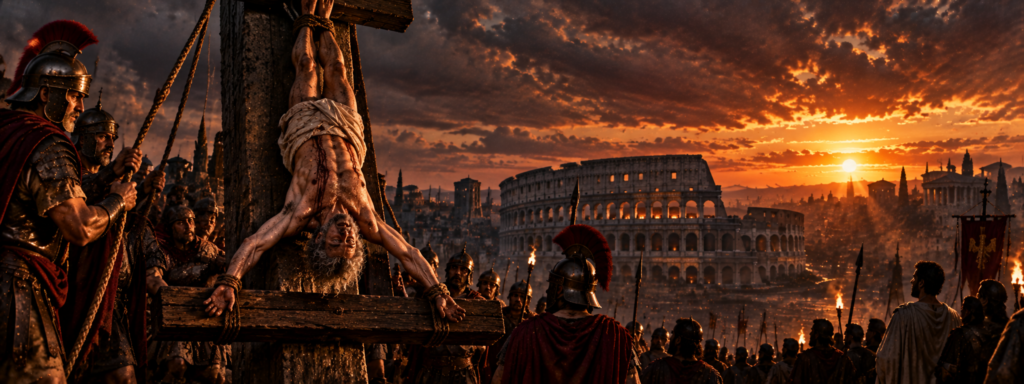
Saint Peter: The Apostle Who Denied Christ and Was Crucified Upside Down in Nero’s Rome
From a Fisherman on the Sea of Galilee to the Bloody Persecution of Rome: Betrayal, Faith, Imperial Terror, and the Martyrdom That Became a Legend
The Apostle Who Would Not Die Like His Master
Somewhere in Rome, during the turbulent years of Emperor Nero’s reign, an early Christian leader named Peter is believed to have met a violent death. Christian tradition remembers him as an aging apostle condemned to crucifixion, a punishment designed by the Roman authorities to inflict suffering, humiliation, and public disgrace. Yet the most famous detail of his execution is also the one that cannot be established with certainty: according to a tradition recorded long after the event, Peter was crucified upside down because he did not consider himself worthy to die in the same manner as Jesus Christ. Whether that extraordinary detail preserves an authentic memory or developed through generations of Christian storytelling remains uncertain, but it has become inseparable from the history of one of Christianity’s most influential figures.
The man at the center of the story had begun his life far from the imperial capital, working as a fisherman in the Jewish communities surrounding the Sea of Galilee. His original name was Simon, and the earliest Christian writings portray him as an outspoken, impulsive, and frequently imperfect follower of Jesus of Nazareth. He was remembered as the disciple who promised loyalty but denied knowing Jesus during the events surrounding the crucifixion. In the decades after Jesus’s death, however, Peter emerged as a prominent leader of the Christian movement, eventually becoming associated with Rome and the tradition of its first bishop.
The contrast between his beginnings and his supposed final moments could hardly have been greater. A provincial fisherman who once feared being identified with a condemned teacher became, in Christian memory, a man who accepted a similar punishment rather than abandon his faith. His execution was attributed to a Roman government that increasingly viewed certain religious movements with suspicion, especially after the devastating fire that swept through Rome in AD 64. The historian Tacitus describes Nero’s persecution of Christians following that disaster, although he does not identify Peter among the victims.
Peter’s martyrdom has traditionally been dated to approximately AD 64–67, with AD 67 frequently appearing in later religious chronologies. The precise year is unknown, and the surviving evidence does not permit historians to reconstruct his arrest, trial, imprisonment, or execution in reliable detail. Early Christian writers strongly associate his death with martyrdom, and later traditions place that death in Rome under Nero. The familiar image of an inverted crucifixion, however, emerges from sources written considerably later than the apostle’s lifetime.
His story is therefore not simply an account of an execution. It is also the history of how an obscure religious movement remembered its leaders, how the Roman Empire punished people considered dangerous or disruptive, and how the death of one man became central to the authority of one of the world’s most enduring religious institutions. The figure who emerges from the surviving evidence is more complicated than the flawless saint of later devotional art. Peter was remembered as courageous and frightened, loyal and fallible, authoritative and capable of bitter disagreement, a man whose weaknesses became part of the very tradition that celebrated him.
For the history of religious persecution and politically motivated executions, Peter occupies an unusual position. He was not a king, an emperor, or a secular ruler assassinated during a struggle for the throne, and there is no reliable evidence that he was executed as a political sovereign. His inclusion among figures associated with regicides and assassinated rulers rests instead upon his status as a foundational leader of the early Christian community, whose death became a defining example of the Roman state’s power over emerging religious authorities. To understand that death, it is necessary to return to a world in which Christianity had not yet become an empire’s religion and the man later revered as Saint Peter was simply Simon, a fisherman from Galilee.
Simon Before Peter: A Fisherman in an Occupied Land
The world into which Simon was born was shaped by Roman power, Jewish religious traditions, and the complicated politics of the eastern Mediterranean. Galilee lay within a region influenced by the Roman Empire, whose rulers relied upon local client kings, governors, taxation, and military force to maintain control. The population included farmers, fishermen, artisans, merchants, and religious teachers whose lives were affected by both local conditions and imperial demands. Political unrest was never far away, especially when Roman authority appeared to threaten religious customs or economic survival.
The New Testament identifies Simon as a fisherman associated with the Sea of Galilee, a freshwater lake surrounded by settlements dependent upon agriculture, trade, and fishing. The Gospels connect him with his brother Andrew and with other fishermen who became followers of Jesus. His family and working relationships suggest that he belonged to an ordinary provincial community rather than the governing aristocracy. Yet fishing was not necessarily an occupation of complete poverty, and the surviving evidence does not allow a precise assessment of his family’s economic position.
The Gospels associate Peter with Bethsaida and Capernaum, communities located near the lake. The Gospel of John identifies Bethsaida as the hometown of Peter and Andrew, while the Synoptic Gospels place Peter’s household in Capernaum during Jesus’s ministry. These details suggest movement within the region, although the exact circumstances cannot be reconstructed. What matters is that Peter’s early life was rooted in the Jewish world of Galilee, far from the political and ceremonial grandeur of Rome.
His original name was Simon, a common Jewish name of the period. The name Peter derives from the Greek Petros, associated with the Aramaic Kepha, meaning rock or stone. The New Testament preserves both forms, reflecting the movement between Aramaic-speaking Jewish communities and the wider Greek-speaking Mediterranean world. The name would eventually acquire immense theological significance because of its association with Peter’s role among the followers of Jesus.
Peter was also married, a detail sometimes overlooked in later portrayals of him as an ecclesiastical patriarch. The Gospels refer to his mother-in-law, and Paul’s First Letter to the Corinthians suggests that Cephas, generally identified with Peter, had a believing wife who could accompany him in his missionary work. The surviving texts do not provide a detailed account of his marriage or family life. Later traditions offer additional stories, but their historical reliability varies considerably.
The political environment surrounding Peter’s early years was tense. Roman authority depended upon the cooperation of local elites, while taxation and economic inequality could generate resentment. Jewish religious life included diverse interpretations of law, worship, and expectations concerning divine intervention. Some groups sought accommodation with existing authorities, while others resisted particular aspects of foreign rule.
It was within this world that Jesus of Nazareth began attracting followers. The Gospels describe Jesus teaching, healing, and announcing the approaching reign of God, drawing crowds while provoking opposition from some religious and political authorities. Peter became one of the most prominent members of the group surrounding him. The decision would eventually carry him from the shores of Galilee into a movement whose conflict with imperial power became central to its history.
The Fisherman Who Followed Jesus
The Gospel accounts of Peter’s first encounter with Jesus differ in their presentation of events. Mark and Matthew describe Jesus calling Simon and Andrew while they were fishing, inviting them to follow him and become participants in a new mission. Luke presents a more elaborate scene involving an extraordinary catch of fish, while John connects Andrew and Simon with the circle surrounding John the Baptist. These narratives share the conviction that Peter’s relationship with Jesus transformed his life, but they should not be treated as identical eyewitness transcripts.
The Gospels portray Peter as an unusually prominent disciple. He appears repeatedly among the closest followers of Jesus and is often named first in lists of the Twelve. Alongside James and John, he is associated with significant episodes in the ministry, including the Transfiguration and the events in Gethsemane. His prominence is one of the clearest features of the surviving Christian tradition.
Yet Peter’s importance did not make him an uncomplicated figure. The Gospel narratives repeatedly show him misunderstanding Jesus, acting impulsively, or expressing confidence that he cannot sustain. He is capable of devotion but also fear, and his attempts to intervene sometimes produce sharp rebukes. These portrayals are striking because the writers preserved embarrassing details about a figure later regarded as foundational to the Church.
The episode of Peter walking upon the water, recorded in Matthew, illustrates the mixture of faith and uncertainty associated with him. He begins moving toward Jesus but becomes frightened and starts to sink, requiring rescue. The story functions as a religious teaching about trust, and historians cannot independently verify the miraculous event. Nevertheless, its portrayal of Peter is consistent with the broader literary image of a disciple whose courage repeatedly gives way to doubt.
His relationship with Jesus also carried political implications. In Roman-controlled territories, public claims about kingship, divine authority, and the arrival of a new kingdom could attract suspicion. Jesus’s message was religious, but religious and political authority were deeply intertwined in the ancient world. Peter’s decision to follow him placed the fisherman within a movement that would eventually confront powerful institutions.
The Gospels do not suggest that Peter understood the full consequences of that decision from the beginning. He appears to have expected an extraordinary transformation of his world, although the nature of those expectations remains debated. Like other disciples, he struggled to comprehend the possibility that Jesus would be arrested and executed. The events surrounding the crucifixion would expose the limits of his confidence.
The later Christian tradition transformed Peter’s willingness to follow Jesus into the beginning of a journey toward martyrdom. That interpretation gives his life a powerful narrative shape, but it should not obscure the uncertainty surrounding his actual thoughts and motivations. The historical Peter cannot be recovered as completely as the literary Peter presented in the Gospels. What survives is the memory of a prominent follower whose relationship with Jesus became central to the identity of the early Church.
The Rock Upon Which a Church Would Be Built
One of the most consequential passages associated with Peter appears in the Gospel of Matthew. In a scene set near Caesarea Philippi, Peter identifies Jesus as the Messiah, and Jesus responds by giving him a special role associated with the image of a rock. The passage also refers to the keys of the kingdom of heaven and the authority to bind and loose. These words would become central to later debates over church leadership and the authority of the bishops of Rome.
For Catholic Christianity, the passage became a foundational text supporting the doctrine of Petrine primacy. Peter was understood as receiving a distinctive responsibility among the apostles, with the bishops of Rome inheriting a form of that authority. Other Christian traditions interpret the passage differently, emphasizing Peter’s confession of faith, the collective authority of the apostles, or the broader community of believers. These disagreements reflect centuries of theological interpretation rather than a simple historical question settled by one text.
The historical context is important. Matthew was written within an early Christian community whose understanding of authority had developed after the lifetime of Jesus. The passage preserves an influential tradition concerning Peter’s importance, but historians debate how directly its language reflects the institutional arrangements of the earliest movement. The fully developed papacy of later centuries should not be projected unchanged into the first century.
Peter’s prominence nevertheless appears in sources earlier than Matthew’s final composition. Paul’s letters, among the earliest surviving Christian writings, refer to Cephas as an important figure within the movement. Paul identifies him among those associated with appearances of the risen Jesus and describes interactions involving leadership disputes. These references provide independent evidence that Peter occupied a significant position in early Christianity.
The image of Peter as a rock also carries a certain irony when placed beside the Gospel accounts of his failures. He is presented as a foundational figure, yet he repeatedly misunderstands Jesus and ultimately denies knowing him. The contrast became important to Christian teaching about weakness, repentance, and restoration. A leader’s authority was portrayed as compatible with personal failure.
Later generations would build extraordinary claims upon Peter’s memory. The Roman Church increasingly connected its authority to his supposed ministry and martyrdom in the imperial capital. His burial place became a focus of pilgrimage, and monumental churches eventually rose over the site traditionally associated with his grave. A fisherman from Galilee became the symbolic foundation of a religious institution that would outlast the western Roman Empire.
Yet in Peter’s own lifetime, none of this later grandeur existed. The Christian movement remained small, decentralized, and vulnerable to opposition. Its leaders possessed no imperial armies, great cathedrals, or established political sovereignty. Peter’s influence depended upon personal relationships, religious conviction, and the authority attributed to his association with Jesus.
The distinction matters because it changes the meaning of his eventual death. The man believed to have been executed under Nero was not the head of a medieval papal monarchy or a ruler commanding the political resources of later popes. He was an early Christian missionary and leader operating within a society where his movement had little institutional protection. His execution, if the tradition is historically correct, demonstrated the vulnerability of religious authority before the machinery of Roman punishment.
The Night of Betrayal: Peter Denies Jesus
The most famous failure in Peter’s life occurred during the events surrounding the arrest and execution of Jesus. All four canonical Gospels preserve traditions in which Peter denies knowing his teacher. The details differ, including the precise sequence of accusations and the circumstances surrounding the denials. The shared theme, however, is unmistakable: the disciple who had proclaimed loyalty became frightened when association with Jesus appeared dangerous.
The Gospel narratives place the denials after Jesus was arrested in Jerusalem. Peter followed events from a distance while Jesus was questioned by religious authorities. People nearby identified him as someone connected with the arrested teacher. Rather than acknowledge the relationship, Peter denied it repeatedly.
The story culminates in the fulfillment of Jesus’s earlier prediction that Peter would deny him before the rooster crowed. In the Gospel tradition, the realization produces grief and shame. Luke includes a particularly memorable moment in which Jesus turns and looks toward Peter, although that detail cannot be independently verified. The scene became one of Christianity’s most powerful portrayals of human weakness.
The historical reliability of the episode has been widely discussed. Its presence in multiple Gospel traditions and its embarrassing portrayal of a prominent apostle have led many scholars to regard some underlying memory of Peter’s failure as plausible. Yet the exact dialogue, sequence, and emotional details remain dependent upon literary sources written decades after the events. The narrative should therefore be treated as an early Christian tradition with possible historical foundations rather than a verbatim record.
The denial acquired particular significance because of Peter’s later martyrdom. Christian writers could present his death as the final reversal of his earlier fear. The disciple who once denied Jesus to avoid danger eventually accepted execution rather than abandon his faith. This interpretation gave his life a dramatic moral structure, although the historical sources do not allow direct access to his final thoughts.
The contrast also made Peter a relatable figure within Christian teaching. Unlike an idealized hero who never faltered, he was remembered as someone who failed at the moment when courage mattered most. His later leadership was therefore associated with forgiveness and restoration rather than flawless conduct. The tradition suggested that moral authority could emerge from repentance.
The violence surrounding Jesus’s arrest and crucifixion provided a warning about the power of Roman punishment. Crucifixion was associated with public disgrace and the suppression of those considered dangerous or subordinate. Peter had seen, or at least belonged to the movement that remembered, the consequences of challenging powerful authorities. His fear was therefore not irrational.
The later story of Peter’s inverted crucifixion draws much of its emotional force from this earlier denial. A man who once tried to escape identification with a condemned teacher was remembered as accepting a comparable death. Whether every detail of the martyrdom tradition is historically accurate remains uncertain. The narrative connection between denial and courage nevertheless became one of the central themes of Peter’s legacy.
The Crucifixion of Jesus and the Collapse of Hope
Jesus’s execution under the Roman prefect Pontius Pilate was the event that transformed Peter’s world. Crucifixion was a Roman punishment used especially against enslaved people, rebels, and others whose public humiliation served the interests of authority. It was designed not merely to kill but to demonstrate the consequences of defiance. The death of Jesus therefore presented his followers with a devastating challenge to their expectations.
The Gospels describe the disciples as frightened, confused, and scattered during the arrest and crucifixion. Their accounts differ in detail, but they consistently portray the execution as a moment of crisis. The movement had gathered around a teacher who spoke of divine authority and the coming kingdom of God. His death at the hands of Roman power appeared to contradict hopes associated with his mission.
Peter’s position was especially difficult because of his prominence. He had been among the closest followers of Jesus and had expressed strong confidence in his loyalty. The denial tradition placed him in a position of shame at the very moment when his teacher faced death. His subsequent emergence as a leader therefore required a profound transformation in the movement’s understanding of what had happened.
The earliest Christian writings attribute that transformation to belief in the resurrection of Jesus. Paul’s First Letter to the Corinthians preserves a tradition that the risen Jesus appeared to Cephas and then to other followers. This passage is historically important because it demonstrates that Peter was associated with resurrection claims within the earliest surviving Christian testimony. Historians can establish the existence and significance of those beliefs without independently verifying the supernatural event itself.
The resurrection tradition provided the movement with a new interpretation of the crucifixion. Rather than viewing Jesus’s death as the final defeat of his mission, believers understood it as part of a divine plan. Peter became associated with the proclamation that Jesus had been raised from the dead. His authority increasingly rested upon his connection with the earthly Jesus and his place within the resurrection tradition.
The transformation was not merely theological. It helped sustain a movement whose central figure had been executed by the state. Followers who might otherwise have dispersed continued gathering, teaching, and attracting new adherents. The movement expanded beyond its original Galilean and Judean settings.
Peter emerged from this period as a prominent leader. The Acts of the Apostles portrays him speaking publicly, performing healings, and confronting authorities in Jerusalem. These accounts were written later and reflect the theological interests of their author, but they preserve an influential tradition of Peter’s leadership. Paul’s letters independently confirm that Peter remained an important figure in the early movement.
The man who had once feared association with Jesus was now remembered as publicly proclaiming his message. This change became central to the story of Peter’s courage. It also placed him on a path that could bring him into conflict with authorities who regarded the new movement with suspicion. The journey toward his traditional martyrdom began with the survival of a community that Roman execution had failed to extinguish.
Peter and the Birth of the Christian Movement
The earliest Christian community developed within the religious world of Judaism. Its members worshipped the God of Israel, interpreted Jewish scriptures, and debated the meaning of Jesus’s life and death. Peter belonged to this environment and remained closely associated with Jerusalem during the movement’s formative years. Christianity had not yet developed the institutional boundaries that would later distinguish it sharply from Judaism.
The Acts of the Apostles presents Peter as a central figure in the community’s early public activity. He delivers speeches, participates in decisions, and appears in accounts of miraculous healings. The narrative emphasizes the expansion of the movement despite opposition from authorities. It also portrays Peter as a leader whose confidence contrasts with his earlier denial of Jesus.
The book of Acts must be read critically because it is a theological history rather than a modern documentary record. Its speeches are literary compositions shaped by the author’s understanding of Christian teaching. Its chronology and emphasis sometimes differ from information preserved in Paul’s letters. Nevertheless, it provides valuable evidence for how early Christians remembered the movement’s development.
Peter’s relationship with other leaders was important. James, the brother of Jesus, became a major figure in the Jerusalem community, while John also appears prominently in early traditions. Leadership was not concentrated in a single person in the manner associated with later ecclesiastical institutions. Authority developed through personal reputation, association with Jesus, and the recognition of different communities.
The movement’s expansion created new questions about membership. As non-Jews became interested in the message, Christians debated whether they needed to adopt Jewish practices, including circumcision and dietary observances. These disputes were not minor matters of ritual. They concerned the identity of the community and the relationship between its Jewish origins and its growing Gentile membership.
Peter became involved in these debates. Acts associates him with the acceptance of Gentile believers, particularly through the story of Cornelius, a Roman centurion. The narrative portrays Peter receiving a divine revelation that challenges existing distinctions between clean and unclean. The episode became important in later Christian interpretations of the movement’s expansion.
Paul’s letters reveal that disagreements continued despite such developments. Different leaders and communities held varying positions concerning Jewish law and Gentile participation. Peter’s authority did not prevent conflict, and his conduct could be challenged by other prominent missionaries. The early Church was therefore a dynamic and sometimes contentious movement rather than a perfectly unified institution.
These disagreements matter because they reveal the historical Peter as more than a symbolic martyr. He participated in decisions that shaped the identity of Christianity and its relationship with the wider Mediterranean world. His influence extended through networks of communities and missionary activity. The movement he helped lead would eventually reach the imperial capital where tradition places his death.
The Confrontation With Paul: When Apostles Disagreed
One of the most revealing episodes involving Peter appears not in the Gospels but in Paul’s Letter to the Galatians. Paul describes a confrontation with Cephas at Antioch concerning shared meals between Jewish and Gentile believers. According to Paul’s account, Peter had previously eaten with Gentiles but withdrew from such meals when certain people associated with James arrived. Paul publicly criticized the behavior because he believed it compromised the principle that Gentile believers should not be treated as religiously inferior.
The episode is significant because it comes from a participant in the dispute. Unlike later narratives that idealize apostolic unity, Paul’s letter preserves a direct account of disagreement among prominent Christian leaders. The passage also demonstrates that Peter’s status did not place him beyond criticism. His decisions could provoke opposition even from another influential missionary.
Paul’s description is not a neutral transcript. He wrote to defend his own authority and interpretation of the Christian message, and his portrayal of Peter served that purpose. The letter does not preserve Peter’s response in comparable detail. Historians must therefore distinguish the fact of a reported dispute from Paul’s interpretation of its meaning.
The disagreement concerned the relationship between Jewish identity and the growing Gentile membership of the movement. Shared meals carried religious and social significance, and withdrawing from them could imply that Gentile believers occupied a different status. Paul regarded such distinctions as incompatible with his understanding of the gospel. Peter’s conduct, as Paul described it, suggested caution or inconsistency in a politically sensitive situation.
The episode also reveals the pressures facing early Christian leaders. They operated within communities divided by cultural expectations, religious practices, and competing interpretations of authority. Decisions that appeared practical in one setting could provoke outrage in another. Peter’s position required him to navigate these tensions without the institutional structures that later churches would develop.
The confrontation complicates the image of Peter as an unquestioned ruler of early Christianity. He was influential, but his authority existed within a network of leaders who could disagree openly. Paul recognized Peter’s importance while insisting upon his own independent mission. The relationship between them was therefore marked by both recognition and tension.
Later Christian tradition frequently associated Peter and Paul as the two great apostolic founders of the Roman Church. Their supposed martyrdoms under Nero became central to Rome’s religious identity. Yet the surviving evidence reminds us that their relationship was not simply one of uninterrupted harmony. The movement’s later unity was built upon a history that included serious internal disputes.
The importance of the Antioch confrontation extends beyond theological controversy. It shows Peter as a historical actor capable of making contested decisions under pressure. His reputation for courage did not eliminate uncertainty or inconsistency. The same complexity that appears in the Gospel accounts continued into his leadership of the early Christian movement.
The Road to Rome: What Do We Actually Know?
Peter’s association with Rome became one of the most consequential traditions in Christian history. The city was the capital of the Roman Empire, a center of political power, commerce, and cultural exchange. A Christian community established there could communicate with believers across a vast network of roads and maritime routes. The presence or memory of a prominent apostle would give that community exceptional prestige.
Yet the surviving evidence does not provide a continuous account of Peter’s journey to Rome. The New Testament does not contain a straightforward narrative describing his arrival, ministry, and death in the city. Acts follows Peter prominently during its earlier chapters but later concentrates increasingly upon Paul’s activities. The absence of a detailed account leaves substantial gaps in the historical record.
Paul’s Letter to the Romans, generally dated to the late 50s, does not mention Peter among the individuals greeted in its final chapter. This omission has sometimes been used to question whether Peter was present in Rome at that time. However, silence in a letter cannot establish that Peter never visited the city. It may simply indicate that he was elsewhere when Paul wrote.
The First Letter of Peter includes a greeting from a community described as being in Babylon. Many Christian interpreters have understood Babylon as a symbolic reference to Rome, drawing upon Jewish and Christian traditions that used the ancient city as an image of oppressive imperial power. If that interpretation is correct, the passage associates Peter with Rome. However, questions surrounding the letter’s authorship and date complicate its use as direct evidence.
The strongest early evidence for Peter’s martyrdom in Rome comes from Christian writers after his lifetime. First Clement, usually dated to the late first century and associated with the Roman Christian community, refers to Peter’s suffering and death in a passage discussing examples of endurance under persecution. The text does not explicitly describe an upside-down crucifixion or provide a precise date. Its Roman setting nevertheless makes it an important early witness to the tradition.
Later writers connect Peter more explicitly with Rome. Dionysius of Corinth, as quoted by Eusebius, associates Peter and Paul with the churches of Rome and Corinth and with martyrdom. Irenaeus, writing in the late second century, identifies Peter and Paul with the foundation and organization of the Roman Church. These testimonies show that the association had become well established within early Christian memory.
The historical question is therefore not whether the Roman tradition existed, but how much of it can be traced directly to Peter’s lifetime. The convergence of early testimonies has led many historians to regard Peter’s death in Rome as probable. Yet the precise chronology, circumstances, and manner of death remain less certain. The distinction is essential because later accounts contain details absent from the earliest sources.
Peter’s presence in Rome also should not be confused with the later office of pope. The first-century Christian community did not possess the fully developed institutional structures of medieval Catholicism. Its leadership arrangements remain imperfectly understood, and the earliest evidence does not describe Peter exercising the functions of a later Roman pontiff. The title of first pope reflects subsequent ecclesiastical interpretation of his role.
Nero’s Rome: The Emperor and the Machinery of Fear
Nero became Roman emperor in AD 54, succeeding Claudius at a time when the imperial system was still relatively young. His reign began under the influence of advisers, including Seneca and the praetorian prefect Burrus, but later became associated with political violence, extravagant expenditure, and increasingly unstable relations with the Roman elite. Ancient writers portray Nero as a ruler whose conduct deteriorated dramatically over time. Their accounts contain important evidence, but they also reflect the hostility of senatorial authors and the conventions of imperial biography.
The political structure of Rome concentrated extraordinary authority in the emperor. Although republican institutions continued to exist, imperial power depended upon control of the army, the court, and administrative appointments. Political rivals could be prosecuted, exiled, or executed, while accusations of conspiracy could become instruments of repression. The atmosphere surrounding the imperial court was therefore capable of becoming deeply dangerous.
Nero’s reign witnessed several notorious deaths. His mother Agrippina the Younger was killed in AD 59 after a conflict over influence and authority. His first wife Octavia was divorced and executed in AD 62, while the Pisonian conspiracy of AD 65 led to a series of executions and forced suicides. These events contributed to his reputation for cruelty and political paranoia.
The emperor’s public image was also shaped by his interest in artistic performance and spectacle. Nero participated in musical and theatrical activities that some members of the Roman elite considered inappropriate for an emperor. His enthusiasm for public performance became a recurring theme in hostile accounts. Yet the historical interpretation of his reign requires separating genuine political violence from exaggerated stories intended to ridicule him.
For Christians living in Rome, the emperor’s personal reputation mattered less than the state’s ability to punish vulnerable communities. Roman authorities possessed legal and coercive mechanisms that could be used against groups considered dangerous. Punishments might include imprisonment, execution, confiscation of property, or public humiliation. The exact legal status of Christianity during Nero’s reign remains debated, but the persecution described after the fire of AD 64 demonstrates that Christians could become targets of imperial violence.
The Christian movement was still relatively small and poorly understood by outsiders. Its members worshipped a figure who had been executed under Roman authority, and their religious practices distinguished them from surrounding communities. Rumors and misunderstandings could easily develop around unfamiliar religious groups. Such conditions made Christians vulnerable when the government sought scapegoats during a crisis.
Nero’s Rome was therefore a dangerous setting for a prominent Christian missionary. The city offered opportunities for spreading the movement’s message, but it also placed believers close to the center of imperial power. A local disturbance could attract attention from officials, while accusations against Christians might become politically useful. The fire of AD 64 created precisely such a situation.
The Great Fire of Rome: A City in Flames
In July AD 64, a catastrophic fire swept through Rome, destroying large areas of the city and leaving many inhabitants homeless. The blaze began in a densely built district and spread rapidly through streets crowded with wooden structures, shops, and residential buildings. Ancient accounts describe widespread destruction and desperate attempts to escape. The disaster became one of the defining events of Nero’s reign.
The historian Tacitus provides the most important surviving narrative of the fire and its political aftermath. He describes the flames spreading through the city and the difficulties faced by those attempting to control them. The destruction affected numerous districts, while the emperor organized relief measures and reconstruction efforts. Yet rumors circulated concerning responsibility for the catastrophe.
One of the most famous accusations was that Nero had deliberately ordered the fire. Ancient writers preserve versions of this suspicion, sometimes connecting it with his plans for rebuilding parts of Rome. However, the claim remains unproven, and historians generally treat it with caution. The popular image of Nero playing a fiddle while Rome burned is an anachronistic legend, since the modern fiddle did not exist in his time.
Tacitus reports that Nero sought to divert suspicion by blaming Christians. The historian describes the group as followers of Christus, who had been executed under Pontius Pilate during the reign of Tiberius. He presents the Christians as unpopular and associated with what he considered a destructive superstition. His account reflects the prejudices of a Roman aristocratic writer, but it is invaluable evidence for the persecution.
According to Tacitus, Christians were arrested and subjected to severe punishments. Some were covered with animal skins and killed by dogs, while others were crucified or burned as part of nighttime spectacles. The punishments were designed to humiliate and terrorize as well as to kill. The suffering was so extreme that Tacitus suggests it provoked pity even among people who disliked Christians.
The account reveals the cruelty of Roman public punishment. Executions could be staged as spectacles, turning condemned individuals into objects of entertainment or political demonstration. The bodies of victims became instruments through which the state displayed its authority. Such violence was not unique to Christians, but the persecution gave the emerging movement a powerful memory of suffering under imperial power.
The precise scale of the persecution remains uncertain. Tacitus does not provide a reliable total number of victims, and the surviving evidence does not establish that a systematic empire-wide campaign began under Nero. The events he describes appear to have been concentrated in Rome in the aftermath of the fire. Later Christian memory sometimes expanded Nero’s role into that of the first great persecutor of the Church.
Peter’s traditional martyrdom is commonly placed within this context. If he was present in Rome during the persecution, his prominence could have made him vulnerable to arrest. However, Tacitus does not mention Peter, and no surviving contemporary record connects him directly to the events of AD 64. The association is historically plausible but not demonstrable in its details.
Christians as Scapegoats: The Terror After the Fire
The persecution described by Tacitus illustrates how quickly a vulnerable minority could become the target of imperial anger. Rome had suffered a disaster that destroyed property, disrupted livelihoods, and generated suspicion toward the emperor. Public fear created an opportunity for the government to identify a group that could be blamed. Christians, unfamiliar and unpopular among some sections of society, became convenient targets.
The accusation did not require a modern standard of evidence. Roman criminal procedures varied according to social status, political circumstances, and the discretion of officials. People without powerful patrons were particularly vulnerable to coercion and severe punishment. The state’s ability to impose spectacular executions made accusations especially dangerous.
Tacitus’s account suggests that Christians were punished not merely for a proven act of arson but also because of hostility toward the group itself. His language reflects contempt for their beliefs, even while criticizing Nero’s cruelty. The historian’s willingness to express pity does not imply sympathy for Christianity. Rather, he regarded the punishment as excessively brutal and politically motivated.
The use of public spectacle intensified the terror. Crucifixion exposed the condemned to prolonged suffering and humiliation, while burning and attacks by animals transformed death into entertainment. The victims’ identities could be reduced to symbols of guilt or imperial vengeance. The punishment communicated a warning to anyone associated with the targeted community.
For early Christians, the persecution became a foundational memory. The deaths of believers were interpreted as acts of witness, and the Greek term martys, meaning witness, gradually acquired its familiar association with those killed for their faith. Stories of suffering and endurance circulated among communities and helped shape religious identity. Martyrdom became a powerful expression of loyalty to Christ.
The later association of Peter and Paul with Nero’s persecution gave the events even greater significance. Both apostles became symbols of Christian endurance in the imperial capital. Their deaths were remembered as evidence that the movement’s leaders had remained faithful despite the threat of Roman violence. The tradition strengthened Rome’s claim to possess a uniquely important apostolic heritage.
Yet the historical record remains incomplete. We do not know whether Peter was arrested during the immediate aftermath of the fire, during a later episode of repression, or under circumstances not preserved in the surviving sources. We do not possess an authentic Roman trial record or a contemporary account of his execution. The familiar narrative combines early evidence for martyrdom with later traditions concerning its details.
The distinction does not diminish the importance of the persecution. Tacitus provides compelling evidence that Christians suffered horrific punishments under Nero after the fire. The early Christian tradition strongly associates Peter with martyrdom, and later writers locate that death in Rome. The uncertainty concerns the precise circumstances, not the broader reality of Roman violence against Christians.
The Arrest of Peter: What History Cannot Tell Us
The traditional account of Peter’s final days often includes imprisonment, confrontation with Roman authorities, and a sentence of crucifixion. These elements appear in various later Christian narratives and devotional traditions. However, the surviving first-century evidence does not describe a specific arrest or trial. Historians cannot identify the official who supposedly ordered Peter’s execution or reconstruct the charges brought against him.
The absence of such information is not surprising. Roman authorities did not preserve detailed public records of every execution, and most documents from the period have disappeared. The deaths of provincial religious figures rarely attracted the attention of major historians. Peter’s later fame therefore far exceeds the documentary evidence available for his final years.
The Gospel of John contains a passage in which Jesus predicts that Peter will die in a manner associated with the glorification of God. The text refers to Peter stretching out his hands and being led where he does not wish to go. Early Christian interpreters understood the passage as an allusion to martyrdom, often specifically crucifixion. The wording, however, does not explicitly describe an upside-down execution.
The passage is important because it suggests that a tradition concerning Peter’s death was known to the community responsible for the Gospel. Its composition is generally placed toward the end of the first century, although scholarly views vary. The text therefore provides relatively early evidence that Peter’s death had acquired religious significance. It does not establish the exact date, location, or method.
First Clement offers another early witness. The letter refers to Peter enduring suffering and bearing witness before departing to a place of glory. Its language is consistent with martyrdom, and its Roman origin gives the testimony particular weight. Yet it does not supply the dramatic details found in later accounts.
The second-century evidence becomes more explicit in associating Peter with Rome and martyrdom. Writers such as Dionysius of Corinth and Irenaeus connect him with the Roman Church, while later authors provide additional details about his death. The development of the tradition can therefore be traced across generations. Each stage adds information, but later detail should not automatically be treated as independent historical confirmation.
The question of Peter’s imprisonment is especially difficult. Later Roman traditions identify the Mamertine Prison as a place where Peter and Paul were held, but the evidence for that specific association is late and uncertain. The prison itself was a real ancient structure, yet its connection to the apostles cannot be securely established. Visitors today encounter a powerful religious tradition rather than a verified location of Peter’s captivity.
The historical Peter’s final days remain largely hidden. He may have been arrested as part of a persecution, condemned by Roman officials, and executed in a public setting. These possibilities fit the broader historical context, but the surviving sources do not allow them to be narrated as confirmed events. The darkness surrounding his death is one reason the later legends became so influential.
Crucifixion: Rome’s Most Humiliating Punishment
Crucifixion was among the most feared punishments employed by the Roman world. It was particularly associated with enslaved people, rebels, and individuals considered socially inferior or dangerous to public order. The punishment could involve binding or nailing a condemned person to a wooden structure, leaving the victim exposed to prolonged suffering. Its purpose was not simply to end a life but to make the death visible, degrading, and exemplary.
Roman writers frequently treated crucifixion as a punishment unworthy of respectable citizens. The orator Cicero described it in language emphasizing its extreme disgrace. The social meaning of the punishment was therefore inseparable from its physical cruelty. To be crucified was to be publicly reduced to a position of humiliation.
The methods of crucifixion varied. Ancient sources describe different arrangements of wooden structures and different ways of securing victims. There was no single standardized form used in every execution. The familiar Christian image of a cross with a vertical post and horizontal beam represents one important tradition but does not encompass every Roman practice.
The duration of suffering also varied. Death could result from a combination of trauma, exhaustion, dehydration, impaired breathing, shock, and other physiological factors. The exact mechanisms remain subjects of medical and historical discussion. The available evidence does not support a universal sequence of symptoms for every crucified victim.
The public setting was essential to the punishment’s purpose. Executions near roads or populated areas exposed condemned individuals to the gaze of passersby. The sight communicated the power of Roman authority and warned against rebellion or disobedience. The victim’s suffering became a form of political messaging.
If Peter was crucified, his death would have carried these associations. A prominent Christian leader executed in this manner would have been subjected to a punishment intended to disgrace him. Yet within Christian memory, the meaning was reversed. What Roman authorities intended as humiliation became a sign of faithfulness and victory over fear.
This reversal was especially powerful because Jesus himself had been crucified. The punishment associated with disgrace became central to Christian theology and worship. Peter’s supposed crucifixion linked his final suffering with the death of his teacher. The later tradition of inversion intensified that connection by presenting Peter as deliberately refusing to imitate Jesus’s posture.
The historical evidence for Peter’s crucifixion is stronger than the evidence for its exact orientation, but it is still mediated through Christian sources. Early references to his martyrdom and the passage in John support the possibility of death by crucifixion. Later accounts make the method explicit. The familiar image of an inverted cross belongs to the development of that tradition rather than to a surviving contemporary execution record.
The Upside-Down Cross: Where the Legend Began
The most distinctive element of Peter’s martyrdom is the claim that he was crucified upside down. According to the traditional explanation, Peter requested this form of execution because he considered himself unworthy to die in the same position as Jesus. The image is dramatic, memorable, and deeply symbolic. It has also become so familiar that it is often repeated without explaining the evidence behind it.
The earliest surviving detailed narrative of Peter’s inverted crucifixion appears in the apocryphal Acts of Peter, generally dated to the late second century. This work belongs to a broader body of early Christian literature that developed stories about the travels, miracles, conflicts, and deaths of apostles. It contains theological teaching and imaginative narrative elements. Historians therefore do not treat it as a straightforward eyewitness account.
In the Acts of Peter, the apostle’s upside-down crucifixion is associated with a symbolic explanation concerning the inverted condition of humanity and the proper understanding of divine truth. The narrative is more elaborate than the familiar modern summary that Peter simply felt unworthy to die like Jesus. The later devotional explanation became dominant because it expressed humility in a direct and emotionally powerful form.
The text also includes episodes involving miraculous confrontations and the apostle’s conflict with Roman society. Such material reflects the religious and literary interests of the communities that transmitted the story. It cannot be used uncritically to reconstruct Peter’s actual final days. The inverted crucifixion may preserve an older tradition, but the surviving evidence does not establish that possibility with certainty.
Later Christian writers repeated the account. Origen, whose statements are preserved by Eusebius, is associated with the tradition that Peter was crucified head downward. By the fourth century, the story had become sufficiently established to appear in influential ecclesiastical histories. Its circulation across generations helped transform it into a central element of Peter’s identity.
The tradition’s emotional appeal is obvious. Peter had once denied Jesus to escape danger, yet he was now remembered as accepting an execution that deliberately emphasized his relationship with the crucified Christ. His request for inversion expressed humility rather than fear. The posture turned a Roman instrument of humiliation into a statement of religious devotion.
Yet the practical circumstances remain unknown. We cannot establish whether Peter requested a particular method of crucifixion, whether Roman officials would have granted such a request, or whether the execution occurred in the form described. Ancient crucifixion practices were varied enough that inversion was physically conceivable. Possibility, however, is not proof.
The distinction between tradition and documented history is essential. Peter’s martyrdom in Rome is supported by an early and substantial body of Christian testimony, although not by a contemporary execution record. The specific claim of upside-down crucifixion appears clearly in later sources and cannot be independently verified. The story should therefore be presented as a longstanding Christian tradition rather than an established eyewitness fact.
Why Would Peter Have Chosen Such a Death?
The familiar explanation for Peter’s inverted crucifixion centers upon humility. According to later tradition, he did not consider himself worthy to die in the same position as Jesus. The request transformed the manner of execution into a final expression of devotion. It also reinforced the image of Peter as a man whose earlier failures had given way to profound spiritual commitment.
The idea fits naturally within Christian teachings about humility and self-sacrifice. Peter’s denial of Jesus had become a central example of human weakness, while his later leadership represented restoration. A death deliberately distinguished from Jesus’s crucifixion could symbolize recognition of his own limitations. The story therefore provided a satisfying conclusion to the moral arc of his life.
Yet the historical basis of the request remains uncertain. The earliest detailed source is not a contemporary account, and its explanation contains theological symbolism that developed within later Christian literature. The popular version emphasizing unworthiness may reflect a simplification of more complex early traditions. It should not be presented as a recorded statement from Peter himself.
The inverted cross also acquired a long symbolic history. In Christian art, it became associated with Peter and his martyrdom. Churches, paintings, and devotional objects used the image to identify the apostle. Its meaning within this tradition was not anti-Christian but specifically connected with one of Christianity’s most revered figures.
In modern popular culture, the inverted cross is sometimes associated with hostility toward Christianity or occult symbolism. That interpretation is separate from its traditional use as the Cross of Saint Peter. The same visual form can therefore carry very different meanings depending upon context. Historical accuracy requires recognizing the symbol’s older Christian associations.
The legend also reflects a broader pattern in martyr literature. Stories of early Christian executions often emphasize courage, voluntary suffering, and the reversal of worldly power. Condemned believers are portrayed as spiritually victorious even when physically defeated. Peter’s inverted crucifixion fits this literary and theological framework.
Such narratives could strengthen communities facing persecution. They offered examples of endurance and suggested that imperial violence could not destroy religious conviction. The suffering of martyrs became a source of collective identity. Peter’s death was particularly influential because of his association with Jesus and his prominence among the apostles.
The historical Peter may indeed have died by crucifixion, and the tradition of inversion may contain an authentic memory. Yet neither conclusion can be demonstrated beyond doubt. The power of the story lies partly in its symbolic meaning, but that meaning should not be confused with documentary certainty. The distinction allows the legend to be understood without presenting speculation as established fact.
The Quo Vadis Legend: Peter’s Last Encounter With Christ
Another famous tradition concerning Peter’s final days is the story known as Quo Vadis, meaning “Where are you going?” In this narrative, Peter attempts to leave Rome during a period of persecution. On the road outside the city, he encounters a vision of Jesus traveling in the opposite direction. The encounter persuades Peter to return and face martyrdom.
The story appears in the apocryphal Acts of Peter and later Christian traditions. Its purpose is to dramatize the apostle’s struggle between fear and duty. Peter’s attempted flight recalls his earlier denial of Jesus, while his return represents renewed courage. The narrative therefore connects the beginning and end of his Christian life.
The episode is not supported by contemporary historical evidence. No surviving first-century source records Peter meeting a vision of Jesus on a Roman road. The account belongs to devotional literature and should be understood as a religious legend. Its historical significance lies in what it reveals about the way later Christians interpreted Peter’s character.
The legend became closely associated with a location along the Appian Way, one of Rome’s most famous ancient roads. A church traditionally connected with the encounter preserves the memory of the story. The physical location reflects centuries of pilgrimage and religious devotion. It does not establish that the reported encounter occurred there.
The emotional structure of the narrative is especially powerful. Peter is not portrayed as a man without fear but as someone who must overcome fear once again. His courage emerges through a final decision to return to danger. The story thus presents martyrdom as the culmination of a lifelong struggle rather than an effortless act of heroism.
The legend also helped explain why Peter remained in Rome despite the threat of persecution. A prominent Christian leader might reasonably have sought safety elsewhere, particularly if the authorities were targeting members of the movement. The story transforms that practical question into a spiritual drama. Peter returns because he understands his death as part of his religious responsibility.
Later art and literature expanded the narrative. Paintings, sermons, and novels transformed the encounter into one of the most recognizable scenes associated with early Christianity. The story’s popularity helped shape public imagination about Nero’s persecution and Peter’s martyrdom. Its influence extended far beyond the historical evidence available for the apostle’s actual final days.
The Quo Vadis tradition should therefore be distinguished from the more secure evidence concerning Peter’s leadership and early Christian memory of his death. It is a powerful legend, but it cannot be treated as a documented event. Its enduring appeal reflects the desire to understand how a frightened disciple became a courageous martyr. The historical record cannot provide a definitive answer to that question, but the legend offers a memorable religious interpretation.
The Vatican Hill: Where Tradition Places Peter’s Death
Christian tradition associates Peter’s martyrdom and burial with the Vatican area of Rome. In the first century, this district lay outside the central urban core and contained gardens, roads, burial grounds, and spaces associated with imperial property. The area was connected with the circus traditionally known as the Circus of Nero. Later Christian memory placed Peter’s execution in or near this setting.
The association is significant because Tacitus describes Nero using his gardens for spectacles involving Christians after the fire. The account provides a plausible geographical context for executions in the Vatican region. However, Tacitus does not identify Peter among the victims or specify the location of his death. The connection between the apostle and the circus belongs to later Christian tradition.
The Vatican area also contained burial grounds. Roman funerary practices varied according to social status, religious custom, and available resources. Graves and mausoleums lined roads outside the city, while communities sometimes preserved the memory of important burials. A Christian leader executed in Rome could plausibly have been buried in such a setting.
By the second century, Christians appear to have associated Peter with a particular memorial site in the Vatican area. Eusebius preserves a statement attributed to the Roman presbyter Gaius, who referred to the trophies of Peter and Paul in Rome. The term trophy has been interpreted as referring to memorials associated with the apostles’ deaths or graves. The passage is important evidence for the existence of an early Roman tradition concerning their burial places.
The development of a memorial site suggests that Peter’s association with Rome was not merely a late medieval invention. Christian communities had established traditions concerning his presence and death within a relatively early period. Yet the existence of a memorial does not automatically prove that the remains beneath it belonged to Peter. Ancient communities could preserve genuine memories, but they could also develop sacred locations through tradition.
The Vatican site became increasingly important as Christianity expanded. Pilgrims visited places associated with martyrs, and burial locations acquired religious significance. The memory of Peter’s death helped transform a Roman funerary landscape into a center of Christian devotion. Over time, the site became one of the most important sacred locations in western Christianity.
The association also strengthened the authority of the Roman Church. Possession of a revered apostolic burial place offered a powerful connection to the earliest generation of Christianity. The bishop of Rome could claim leadership within a community associated with Peter’s ministry and martyrdom. The memory of a violent death therefore became part of the foundation of ecclesiastical prestige.
The transformation was extraordinary. A district associated with Roman imperial property and the punishment of Christians became the location of monumental Christian architecture. The empire that had once persecuted believers eventually supported the construction of churches honoring them. Peter’s traditional burial place became a symbol of that reversal.
The Grave Beneath Saint Peter’s Basilica
The modern Basilica of Saint Peter stands over a site traditionally associated with the apostle’s burial. The present building, constructed during the Renaissance and early modern period, replaced an earlier basilica commissioned under Constantine in the fourth century. The Constantinian church was built in an area containing an ancient necropolis and a memorial associated with Peter. Its construction demonstrated the growing importance of the apostle’s cult after Christianity gained imperial support.
The decision to build a monumental church over the site was significant. Large-scale construction required substantial resources and the support of imperial authority. The project transformed a burial landscape into a major Christian sanctuary. It also reinforced the belief that Peter’s remains rested beneath the new building.
Archaeological investigations beneath the modern basilica have revealed parts of the ancient necropolis and structures associated with early Christian veneration. Excavations conducted during the twentieth century uncovered tombs, walls, and features that scholars have connected with the development of the Petrine memorial. The discoveries provide important evidence for the history of the site. They do not, however, resolve every question concerning the identification of Peter’s actual remains.
One of the most debated aspects of the excavations concerns bones found in association with the memorial area. Some investigators argued that particular remains could belong to Peter, while others questioned the evidence and the circumstances of their discovery and interpretation. The identification has not achieved universal scholarly acceptance. It should therefore be described as a claim supported by some researchers rather than an established archaeological fact.
The distinction between a historical memorial and a securely identified burial is important. Archaeology can demonstrate that Christians venerated a site and constructed structures around it. It may also provide evidence concerning the age and development of the surrounding cemetery. Identifying the remains of a particular first-century individual is a much more difficult task, especially without contemporary inscriptions or other decisive evidence.
The Vatican tradition nevertheless possesses considerable historical depth. The association of Peter with Rome appears in early Christian writings, and the development of a memorial site can be traced through archaeological and literary evidence. These independent lines of information strengthen the case that the tradition was established relatively early. They do not establish the exact manner of his execution.
The basilica’s later grandeur also illustrates the transformation of Peter’s image. The man remembered as a fisherman and persecuted apostle became the central figure associated with one of Christianity’s most magnificent churches. His supposed grave attracted pilgrims, rulers, artists, and religious leaders from across the world. The contrast between the poverty and vulnerability of the earliest Christian movement and the wealth of later ecclesiastical institutions is striking.
Yet the historical questions remain unresolved. We cannot demonstrate beyond doubt that the bones claimed as Peter’s are authentic, nor can we reconstruct the precise events that brought his body to the burial site. The tradition is ancient and influential, but its details require careful evaluation. The distinction between faith, memory, and archaeological proof remains essential.
Peter and Paul: Two Martyrs Who Gave Rome Its Sacred Identity
The Christian tradition frequently associates Peter’s martyrdom with that of Paul. Both men became central figures in the memory of the Roman Church, and both were eventually believed to have died during Nero’s reign. Their supposed executions provided Rome with an extraordinary claim to apostolic heritage. The city that had been the capital of pagan imperial power became, in Christian memory, the burial place of two foundational witnesses.
The historical evidence for Paul’s final years is also incomplete. Acts ends with Paul under house arrest in Rome but does not describe his execution. Later Christian writers associate him with martyrdom, commonly by beheading. The traditional explanation that Paul was beheaded because of his Roman citizenship is plausible within the broader context of Roman punishment, but the specific legal proceedings are not documented.
Peter and Paul represented different aspects of the early movement. Peter was associated with Jesus’s original circle of disciples and the Jewish origins of Christianity. Paul became famous for missionary activity among Gentiles and for letters that shaped Christian theology. Their combined memory symbolized the movement’s expansion from its Jewish beginnings into the wider Roman world.
The tradition that both died in Rome strengthened the city’s religious prestige. Later writers emphasized their shared contribution to the Roman Church, sometimes presenting them as complementary founders. Their martyrdoms became central to liturgical celebrations and ecclesiastical identity. The city possessed not merely a claim to political importance but a sacred history associated with apostolic suffering.
Yet their historical relationship had included disagreement. Paul’s own letters preserve the confrontation at Antioch and reveal tensions concerning the treatment of Gentile believers. The later image of perfect apostolic harmony therefore simplifies a more complicated reality. Their shared martyrdom tradition helped create a narrative of unity that transcended earlier disputes.
The association with Nero also gave their deaths a common persecutor. The emperor became a symbol of worldly cruelty, while the apostles represented religious endurance. This contrast became increasingly powerful as Christianity spread and eventually gained imperial support. The persecuted movement could present its founders as morally victorious over the ruler who had condemned them.
The memory of Peter and Paul also influenced the development of Roman ecclesiastical authority. The bishops of Rome increasingly emphasized their connection to the apostles, particularly Peter. Claims of succession and continuity became central to debates over leadership within Christianity. The deaths of two first-century missionaries thus acquired institutional consequences far beyond their original circumstances.
The historical reality was more modest and more uncertain than the later symbolism. Peter and Paul were influential leaders within a small and developing religious movement. Their deaths are remembered through sources written after the events, and many details remain disputed. Yet the traditions surrounding them helped transform Rome from the city of their supposed persecutor into the center of a major Christian institution.
From Martyred Apostle to First Pope
The identification of Peter as the first pope is central to Catholic tradition, but the historical development of the papacy was gradual. In the first century, Christian communities did not possess the fully developed hierarchy associated with later centuries. Leadership arrangements varied, and terms such as bishop, presbyter, and overseer were not always used in the same institutional sense that they later acquired. The Roman Church’s structure evolved over time.
Peter’s prominence among the apostles provided a foundation for later claims of authority. The Gospel of Matthew’s reference to the rock and the keys became especially important in Catholic interpretation. His association with Rome and its martyrdom tradition strengthened the connection between apostolic leadership and the city’s bishops. The result was a powerful theological and institutional narrative.
Early Christian writers increasingly emphasized the succession of bishops in major churches. Irenaeus, writing in the late second century, presented lists of Roman leaders and connected the church’s authority with the apostles Peter and Paul. Such lists served as arguments for continuity of teaching and legitimacy. They also reflected the growing importance of institutional succession during disputes over doctrine.
The precise nature of Roman leadership during Peter’s lifetime remains uncertain. Some historians question whether the city had a single monarchical bishop at that early date. Others emphasize the continuity of Roman traditions associating Peter with the community’s foundation. The evidence does not support simply projecting the later medieval papacy backward into the first century.
The development of papal authority also depended upon political circumstances. As the western Roman Empire weakened, the bishops of Rome acquired increasing influence in religious and civic affairs. Their claims to Petrine succession became part of a broader struggle over ecclesiastical leadership. Peter’s memory provided an ancient foundation for institutions that developed long after his death.
The contrast between Peter’s traditional martyrdom and later papal power is remarkable. A man believed to have been executed by Roman authorities became the symbolic predecessor of religious leaders who crowned emperors, negotiated with kings, and exercised political influence across Europe. His supposed burial place became the center of monumental architecture and international pilgrimage. The memory of suffering was transformed into a source of authority.
This development does not mean that Peter personally exercised the powers of later popes. Historical accuracy requires distinguishing the apostle’s first-century role from the institution that eventually claimed him as its founder. The connection is central to Catholic theology and tradition, but its historical interpretation remains debated among scholars and Christian denominations. The distinction is especially important when considering Peter within a category devoted to rulers and political executions.
Peter was a leader, but not a sovereign in the conventional political sense. He did not rule a territorial state or command the machinery of government associated with later papal monarchs. His execution, if the traditional account is correct, was the killing of a religious leader by imperial authorities. The later development of the papacy transformed the significance of his death without changing the political circumstances of his lifetime.
The Making of a Martyr: How Peter’s Death Changed Christianity
The memory of Peter’s death became an important part of early Christian identity. Martyrdom offered a way to interpret suffering as faithfulness rather than defeat. The Roman state could destroy bodies, but Christian writers insisted that it could not destroy the spiritual significance of those who remained loyal to their beliefs. Peter’s story became one of the most influential expressions of that conviction.
The development of martyr traditions occurred within communities that faced varying degrees of hostility. Some Christians experienced local persecution, while others lived for long periods without direct state interference. The threat of punishment nevertheless shaped religious imagination and communal identity. Stories of earlier martyrs provided examples of endurance during moments of danger.
Peter’s supposed crucifixion carried special significance because of his relationship with Jesus. The apostle who had once denied his teacher was remembered as accepting a similar death. The inversion tradition added a distinctive expression of humility. Together, these elements created a narrative of repentance, courage, and spiritual victory.
The story also helped establish a hierarchy of sacred memory. Martyrs were honored at burial places, remembered in worship, and celebrated through accounts of their suffering. Their deaths became part of the collective history of Christian communities. Peter’s association with Rome made his memory especially influential.
Over time, martyr narratives acquired increasingly elaborate details. Writers added speeches, miracles, confrontations with persecutors, and symbolic explanations of suffering. Some of these stories may preserve authentic memories, while others reflect theological and literary development. Historians must evaluate each element according to its date, context, and relationship to earlier evidence.
The inverted crucifixion belongs to this process. It is a powerful tradition, but its first detailed surviving presentation appears well after Peter’s lifetime. Its popularity demonstrates the importance of symbolic storytelling within Christian memory. The image communicates humility and courage even when the precise historical circumstances remain uncertain.
The cult of Peter also influenced the geography of Christian Rome. Sites associated with his ministry, imprisonment, death, and burial became destinations for pilgrimage. Churches and monuments transformed the urban landscape. The city that had once represented imperial persecution became a sacred center of the religion it had allegedly tried to suppress.
The transformation was gradual and depended upon centuries of political and religious change. Peter’s memory alone did not create the papacy or the Christian Roman Empire. Yet his martyrdom tradition supplied a powerful narrative linking suffering, apostolic authority, and the city of Rome. The execution of a religious leader became one of the foundations of an enduring institution.
What the Sources Actually Prove
The historical evidence concerning Peter’s death can be divided into several levels of certainty. The earliest Christian writings establish that Peter was a prominent leader within the movement associated with Jesus. Paul’s letters provide particularly valuable testimony because they were written within the first generation of Christianity. The Gospels and Acts preserve additional traditions, although their literary and theological purposes require careful interpretation.
The evidence for Peter’s martyrdom appears relatively early. The Gospel of John contains language interpreted as predicting a violent death, while First Clement refers to Peter’s suffering and witness. These sources suggest that his death had acquired special significance within Christian memory by the late first century. They do not provide a complete account of the execution.
The association with Rome becomes increasingly explicit in second-century Christian writings. Dionysius of Corinth, Irenaeus, and other authors connect Peter with the Roman Church and its apostolic heritage. The convergence of these traditions makes Peter’s death in Rome historically plausible and widely accepted among scholars. Yet the precise circumstances remain uncertain.
The connection with Nero is supported by the broader historical context of persecution. Tacitus records that Christians were subjected to horrific punishments after the fire of AD 64. Later Christian writers associate Peter and Paul with Nero’s reign. However, Tacitus does not name Peter, and the surviving evidence does not establish the exact year of his death.
The claim that Peter was crucified is supported by early Christian interpretation and later explicit testimony. The Gospel of John’s reference to stretching out his hands has often been understood as an allusion to crucifixion. Later writers identify the method more directly. The evidence is meaningful but does not amount to a contemporary Roman execution record.
The upside-down orientation is less securely established. The earliest detailed surviving account appears in the late second-century Acts of Peter, a work containing substantial legendary and theological material. Later authors repeated the tradition, helping establish it within Christian memory. Its historical authenticity cannot be independently verified.
The popular explanation that Peter requested inversion because he felt unworthy to die like Jesus also belongs to the development of tradition. It expresses a powerful religious theme, but no contemporary source records Peter making such a request. The same caution applies to stories of his final imprisonment, miraculous encounters, and exact execution site. These details should be identified as tradition rather than documented fact.
The archaeological evidence beneath Saint Peter’s Basilica adds another dimension. It demonstrates the existence of an ancient burial landscape and a long history of veneration associated with Peter. However, the identification of particular remains as the apostle’s bones remains disputed. Archaeology supports the antiquity of the memorial tradition more securely than it establishes the identity of the individual buried there.
The responsible historical conclusion is therefore carefully qualified. Peter was a prominent early Christian leader whose martyrdom was remembered relatively soon after his lifetime. His death in Rome under Nero is a credible and influential tradition, although its precise date and circumstances are unknown. His upside-down crucifixion remains a famous but unverified detail of later Christian memory.
The Emperor and the Fisherman: Two Very Different Kinds of Power
The contrast between Nero and Peter became one of the most enduring themes in Christian history. Nero possessed the authority of the Roman Empire, including armies, administrators, courts, and the power to order executions. Peter, by comparison, belonged to a small religious movement without political sovereignty. The imbalance between them could hardly have been greater.
If Peter died under Nero, the emperor’s government possessed the power to destroy him physically. Roman execution was intended to demonstrate the authority of the state and the vulnerability of those who defied it. Crucifixion was particularly effective as a public statement of domination. The condemned person’s body became evidence of imperial control.
Yet the later memory of the two men developed in opposite directions. Nero became a symbol of cruelty and persecution within Christian tradition, while Peter became a saint and apostolic founder. The emperor’s political power disappeared with his death and the collapse of his dynasty. Peter’s religious influence expanded through communities that preserved and celebrated his memory.
This contrast should not be romanticized into a simple claim that the historical Peter defeated Nero. The surviving evidence does not establish a personal confrontation between the two men. Nero may never have known Peter’s name, and Peter’s execution, if it occurred under his authority, may have been one among many deaths during a period of persecution. The dramatic opposition belongs primarily to later historical and religious interpretation.
Nevertheless, the broader reversal was real. Christianity survived Nero’s reign and gradually expanded throughout the empire. In the fourth century, emperors began supporting the Church, and Christian institutions acquired unprecedented resources. Rome eventually became a major center of Christian authority. The religion once associated with persecuted minorities became deeply connected with imperial government.
Peter’s memory played a central role in that transformation. His supposed burial place became the site of a monumental basilica, while his name was invoked in debates over ecclesiastical leadership. The fisherman from Galilee became a symbol of continuity between the earliest followers of Jesus and the later Roman Church. His martyrdom was remembered as evidence that spiritual authority could endure beyond political violence.
The transformation also created new contradictions. A religion that celebrated persecuted martyrs eventually acquired political power and sometimes participated in coercion against religious opponents. The history of Christianity cannot be reduced to a permanent opposition between innocent believers and oppressive rulers. Peter’s memory became part of institutions whose later conduct was far more complicated than the circumstances of their earliest generations.
The contrast between Nero and Peter remains historically significant because it reveals the unpredictable afterlife of political violence. An execution intended to eliminate a troublesome individual can become a source of collective identity. A condemned person may be forgotten by the authorities who ordered the punishment but remembered by communities that preserve the story. Peter’s traditional martyrdom became one of the most influential examples of that process.
Saint Peter and the History of Religious Executions
Peter’s traditional death belongs to the broader history of religious persecution under Roman rule. The empire generally tolerated a wide range of religious practices, but that tolerance was not unlimited. Authorities could intervene when they believed religious activity threatened public order, political loyalty, or established institutions. The treatment of Christians varied considerably across time and place.
The persecution under Nero appears to have been associated with the crisis following the fire of AD 64. Tacitus describes Christians being punished in ways that combined cruelty with public spectacle. The evidence does not establish a permanent empire-wide policy of persecution beginning at that moment. Later Roman actions against Christians developed under different emperors and circumstances.
Peter’s death, if connected with this persecution, illustrates the vulnerability of religious leaders who lacked political protection. A prominent missionary could become a target because of his influence within a community. The Roman state possessed the power to punish individuals without recognizing their religious authority as legitimate. The execution of such a figure could be intended to intimidate followers and suppress the movement.
The comparison with assassinated rulers requires care. Regicide normally refers to the killing of a king or sovereign, while assassination generally involves the deliberate killing of a prominent person for political or ideological reasons. Peter’s traditional martyrdom was an execution by state authorities rather than a palace assassination or dynastic regicide. His inclusion within a broader collection of murdered leaders is therefore most accurate when framed as the execution of a foundational religious authority.
The later development of the papacy gives the story additional relevance. Peter became retrospectively identified as the first bishop of Rome and first pope, a title associated in later centuries with considerable religious and political power. Yet the institutional papacy did not exist in its later form during his lifetime. Describing him as a murdered pope without qualification risks imposing later structures upon the first century.
The distinction does not diminish his importance. Peter’s leadership within early Christianity is well supported, and his martyrdom tradition profoundly influenced the history of the Church. His death became a model for understanding religious loyalty under persecution. The memory of his suffering helped shape the identity of communities that eventually became powerful institutions.
The story also illustrates how execution and assassination can become entangled in historical memory. A condemned leader may be remembered as a martyr by supporters and as a criminal or dangerous dissident by authorities. The surviving narratives often reflect the values of the communities that preserved them. Peter’s story is known primarily through Christian sources, making careful source criticism especially important.
The broader lesson concerns the relationship between power and memory. Roman officials could impose death, but they could not determine how future generations would interpret it. The Christian movement transformed the punishment of its leaders into evidence of religious endurance. Peter’s supposed inverted crucifixion became a symbol whose meaning was almost the opposite of what Roman execution was intended to communicate.
The Legacy of the Upside-Down Cross
Few images associated with early Christianity are as distinctive as the inverted cross of Saint Peter. It appears in religious art, architecture, and devotional symbolism as a reminder of the apostle’s traditional martyrdom. The image connects Peter’s death with the crucifixion of Jesus while emphasizing the humility attributed to him. Its visual simplicity has helped preserve the tradition across centuries.
The symbol also reflects the power of narrative detail. The earliest evidence for Peter’s martyrdom does not describe the orientation of his body, yet the later account became the most recognizable feature of his death. A single dramatic image came to represent an entire life of religious leadership and suffering. The process demonstrates how historical memory often favors vivid stories over cautious uncertainty.
Artists repeatedly depicted Peter’s crucifixion, sometimes emphasizing the physical effort required to raise or secure an inverted cross. Such paintings transformed the execution into a scene of intense human suffering. They also invited viewers to consider the apostle’s humility and courage. The artistic tradition helped make the legend familiar even to people who had never read the ancient sources.
The image’s later association with anti-Christian symbolism has sometimes obscured its original religious meaning. Within Christian tradition, the inverted cross was not necessarily a rejection of Christ. It was a sign associated with Peter’s supposed desire to distinguish his death from that of Jesus. The same symbol could acquire different meanings in different cultural settings.
The historical uncertainty surrounding the execution does not erase the symbol’s significance. Religious communities often preserve stories because of their moral and theological meaning rather than because every detail can be independently verified. Peter’s inverted cross became a visual expression of humility, repentance, and endurance. Its influence belongs to the history of Christianity regardless of whether the execution occurred exactly as described.
The symbol also reveals the distance between the historical Peter and his later representation. The fisherman from Galilee lived within a small Jewish movement in the first century. The saint of medieval and modern art became a universal figure associated with the papacy and the Roman Church. The inverted cross helped bridge those worlds through a memorable narrative of death.
Yet historical writing must resist allowing symbolism to replace evidence. The tradition should be presented as a tradition, not as a confirmed account preserved by eyewitnesses. The distinction respects both the importance of religious memory and the limits of historical knowledge. It allows Peter’s story to remain dramatic without becoming misleading.
The upside-down cross therefore stands at the intersection of history, legend, and institutional identity. It represents a death that early Christians remembered as martyrdom, a detail recorded in later literature, and a symbol that acquired enormous religious significance. Its enduring power comes from the story it tells about a frightened disciple who became a courageous witness. Whether the final scene unfolded exactly as tradition describes remains beyond the reach of surviving evidence.
The Fisherman Who Outlived an Emperor
Saint Peter’s life began far from the centers of Roman power, among the fishing communities of Galilee. He became a follower of Jesus, emerged as one of the movement’s most prominent leaders, and was remembered for both remarkable devotion and painful failure. The Gospel traditions preserved his denial of Jesus during the events surrounding the crucifixion, while the earliest Christian writings associated him with the movement’s survival and expansion. His influence developed within a religious community that possessed little political protection and faced an uncertain future.
The circumstances of his death remain less secure than the broad outline of his leadership. Early Christian sources remember Peter as a martyr, and later traditions place his execution in Rome under Emperor Nero. The familiar date of approximately AD 67 is traditional rather than firmly established, and the surviving evidence does not provide an authentic Roman record of his arrest or trial. His association with Nero’s persecution is plausible, but the exact connection cannot be demonstrated.
The most famous detail of his martyrdom is also the most uncertain. The claim that Peter was crucified upside down appears clearly in Christian literature written long after his lifetime. The explanation that he requested inversion because he felt unworthy to die like Jesus became a powerful expression of humility and repentance. It remains a longstanding religious tradition rather than an independently verified historical fact.
The broader context of Roman persecution is more securely documented. Tacitus records that Nero punished Christians after the Great Fire of AD 64, describing executions that included crucifixion, burning, and other forms of public cruelty. The punishments were designed to humiliate victims and demonstrate imperial authority. They also helped create a memory of suffering that became central to Christian identity.
Peter’s martyrdom tradition transformed the meaning of such violence. A punishment intended to disgrace a condemned person became a symbol of religious courage. The apostle who had once denied Jesus was remembered as accepting death rather than abandoning his faith. His suffering became an example of endurance for generations of believers.
The memory of his death also changed the history of Rome. The city associated with his supposed execution became the center of a powerful Christian institution, while his traditional burial place became the site of Saint Peter’s Basilica. Later bishops of Rome claimed continuity with his apostolic authority, and his name became inseparable from the development of the papacy. The historical fisherman was transformed into the symbolic predecessor of religious leaders who would exercise influence over kings and emperors.
Yet the distinction between Peter’s lifetime and his later legacy remains essential. He was not a territorial sovereign or a political monarch, and his death was not a regicide in the conventional sense. He was a foundational religious leader whose traditional execution under imperial authority became one of Christianity’s defining martyrdom narratives. His story belongs to the history of persecution, political punishment, and the transformation of suffering into religious authority.
The contrast with Nero gives the narrative its enduring force. The emperor possessed the power to condemn and execute, while Peter belonged to a movement that appeared politically insignificant. Nero’s government could destroy bodies, but it could not control how the victims would be remembered. The Christian communities that preserved Peter’s story eventually outlasted the dynasty of the emperor traditionally associated with his death.
The final image remains unforgettable even when treated with historical caution. An aging apostle, once frightened enough to deny his teacher, is remembered as facing crucifixion in the capital of the empire that had executed Jesus. The inverted cross, whether an authentic detail or a later development of Christian memory, became the symbol of his final act of devotion. The story transformed an instrument of Roman humiliation into an emblem of spiritual authority.
The Roman Empire possessed the power to crucify a fisherman, but it could not prevent his memory from becoming one of the foundations of Christian history. Peter’s precise final moments remain hidden behind the distance of centuries, the silence of Roman records, and the legends preserved by later believers. Yet the tradition of his martyrdom survived, gathering meaning as emperors died, dynasties collapsed, and the religion once associated with persecution rose to extraordinary power. Whether or not Peter truly hung upside down upon a Roman cross, the historical reversal remains remarkable: the condemned apostle became a saint whose name endured, while the emperor traditionally remembered as his persecutor became a warning about the cruelty of power.