
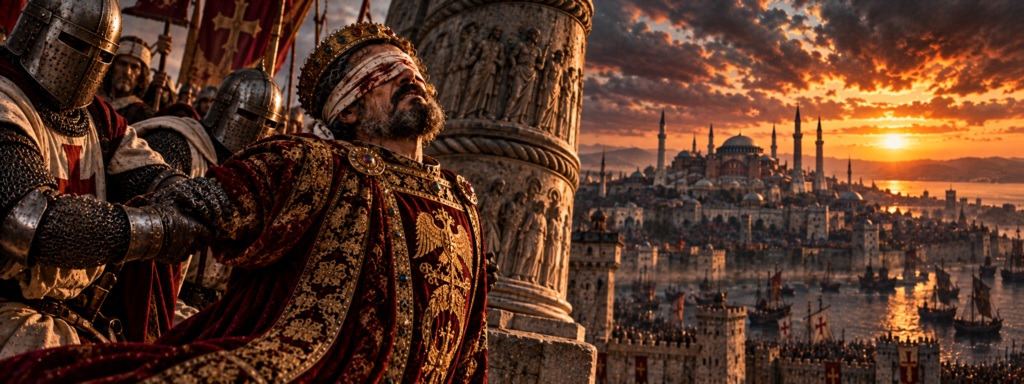
Alexios V Doukas “Mourtzouphlos”: The Emperor Who Murdered His Rival, Lost Constantinople, and Was Thrown From a Towering Column
The Bloody Palace Coup of 1204, the Betrayal That Blinded Byzantium’s Last Defender, and the Terrifying Execution of an Emperor Who Could Not Save His Empire
The Last Emperor Before Constantinople Fell
In the autumn of 1204, a former Byzantine emperor was led through the streets of Constantinople toward a monument that had stood for centuries as a symbol of Roman imperial greatness. His name was Alexios V Doukas, better known by the nickname Mourtzouphlos, and only months earlier he had worn the imperial crown, commanded the defenses of the city, and promised to resist the western crusaders gathering outside its walls. Now he was a prisoner of those same crusaders, stripped of his authority, deprived of his eyesight, and condemned to die in a manner intended to humiliate him before the people whose capital he had failed to protect. His captors chose the great Column of Theodosius as the instrument of his execution, transforming a monument celebrating Roman victory into the setting for the destruction of a Roman emperor.
The condemned man could no longer see the city around him. After fleeing Constantinople in April, he had sought refuge with the former emperor Alexios III Angelos, a man whose own reign had ended when the crusaders arrived in 1203. Instead of finding protection, Mourtzouphlos had fallen victim to another act of Byzantine political treachery. Alexios III, who had already betrayed and blinded his own brother Isaac II years earlier, arranged for his new rival to be blinded as well, leaving him helpless and vulnerable to capture.
The crusaders eventually seized Mourtzouphlos and brought him back to Constantinople, where the government of the newly established Latin Empire treated him as a criminal rather than a legitimate former ruler. His principal offense was the killing of Alexios IV Angelos, the young emperor whom the crusaders had restored to the throne and whose promises had helped draw their expedition to the Byzantine capital. Mourtzouphlos had overthrown Alexios IV in January 1204 and ordered his death by strangulation the following month. To the crusaders, the murder supplied both a justification for condemning the usurper and a convenient explanation for their own violent intervention in Byzantine affairs.
The sentence was designed to be spectacular. According to the historical tradition preserved by contemporary and near-contemporary writers, Mourtzouphlos was taken to the Column of Theodosius and thrown from its summit. The fall ended the life of a man who had briefly ruled what remained of the eastern Roman Empire from Constantinople. His execution was not simply the elimination of a defeated political rival; it was a public demonstration that the city and its ancient imperial monuments now belonged to foreign conquerors.
Yet the story of Alexios V is far more complicated than the final image of a blinded emperor falling to his death. He was a palace conspirator who murdered his predecessor, but he was also one of the few prominent Byzantine leaders who attempted to resist the Fourth Crusade when much of the imperial government had already collapsed. He exploited popular anger against foreign interference, yet his seizure of power helped destroy the fragile agreement that might have prevented another assault upon Constantinople. He presented himself as a defender of the empire, but his brief reign ended with the most devastating conquest the Byzantine capital had experienced in its long history.
The terrible irony of his career was that Mourtzouphlos seized the throne to save Constantinople from foreign domination and ultimately became one of the first Byzantine emperors executed under that domination. His ambition brought him power when the empire was already approaching catastrophe, and his determination to resist could not compensate for years of military decline, financial exhaustion, and political betrayal. The emperor who ordered another ruler strangled would himself be blinded by a former ally and executed by the enemies he had tried to defeat. His life became a brutal illustration of how quickly imperial authority could disappear when the political order supporting it collapsed.
Constantinople Before the Catastrophe: The Greatest City in the Christian East
At the beginning of the thirteenth century, Constantinople remained one of the most impressive cities in the medieval world. Founded as the new imperial capital by Constantine the Great in the fourth century, it had served as the political heart of the eastern Roman Empire for nearly nine hundred years. Its enormous defensive walls, strategic position between Europe and Asia, and access to the Bosporus and Golden Horn made it extraordinarily difficult to conquer. Generations of emperors had filled the city with churches, palaces, public monuments, monasteries, and treasures gathered from across the Mediterranean world.
The inhabitants of Constantinople did not consider themselves citizens of a fallen civilization. They regarded their empire as Roman, its emperor as the legitimate successor of the ancient Caesars, and their capital as the center of a political and religious order that had survived invasions, revolutions, and centuries of warfare. The empire had lost territory over time, but its institutions retained immense prestige. Imperial ceremonies continued to present the ruler as a figure whose authority was closely connected to the protection of Christian civilization.
The city’s wealth was equally remarkable. Merchants from Italy, the Black Sea, the Balkans, and the eastern Mediterranean conducted business in its markets, while its churches possessed magnificent collections of sacred objects. The imperial palace contained ceremonial halls, luxurious furnishings, and symbols of authority accumulated over centuries. Visitors from western Europe frequently expressed amazement at Constantinople’s size and splendor, even when their descriptions were colored by exaggeration or hostility.
Yet beneath this grandeur, the empire had become dangerously unstable. Powerful aristocratic families competed for influence, military resources had declined, and the central government struggled to maintain authority over distant territories. The twelfth century had witnessed both recovery and renewed fragmentation, while the final decades before 1204 brought a succession of increasingly destructive political crises. By the time Mourtzouphlos emerged as a contender for the throne, the empire possessed far less military strength than its impressive capital suggested.
Relations with western Europeans had also deteriorated. Italian maritime republics enjoyed commercial privileges that provoked resentment among Byzantine merchants, while religious disagreements between eastern and western Christianity encouraged suspicion. The massacre of Latins in Constantinople in 1182 had left a particularly bitter legacy, although hostility and violence had occurred on both sides over the preceding decades. Such memories would become increasingly important when a western crusading army appeared outside the city’s walls.
The empire’s political culture added another source of danger. Byzantine succession was not governed by an unbreakable principle of hereditary inheritance, and powerful generals, aristocrats, or palace officials could sometimes seize power through rebellion. Emperors who lost their thrones frequently faced imprisonment, mutilation, monastic confinement, or execution. These practices were intended to eliminate political rivals, but they also encouraged recurring cycles of revenge and usurpation.
Mourtzouphlos entered imperial politics within this atmosphere of distrust. His eventual rise depended upon the collapse of a government that had already been restored through foreign military intervention. The empire’s ancient institutions still existed, but the loyalty necessary to sustain them was disintegrating. When the Fourth Crusade reached Constantinople, it encountered not a united political community but a divided court whose rival factions were prepared to sacrifice almost anything for control of the imperial crown.
Who Was Alexios Doukas Mourtzouphlos?
The early life of Alexios V Doukas remains frustratingly obscure. Unlike emperors whose careers can be traced through decades of military campaigns or administrative appointments, Mourtzouphlos emerges most clearly in the historical record during the political crisis immediately preceding his accession. His family name, Doukas, associated him with one of the most prestigious names in Byzantine aristocratic history. However, the precise details of his ancestry and his connections to earlier members of the Doukas family remain uncertain.
His nickname, Mourtzouphlos, has attracted considerable attention because it appears so frequently in accounts of his brief reign. It is usually explained as a reference to his heavy or closely joined eyebrows, or perhaps to a dark, stern expression. The interpretation is plausible, but the exact origin cannot be established with certainty. Byzantine writers frequently used descriptive nicknames, and this one became so closely associated with Alexios that it often replaced his formal imperial name in later historical narratives.
The surviving sources portray him as a capable and ambitious political operator. He possessed enough standing within Constantinople’s ruling circles to gain access to important offices and influential individuals. His later actions suggest familiarity with palace administration, aristocratic rivalries, and the political expectations of the capital’s population. Yet it would be misleading to reconstruct an elaborate early career for which the evidence does not survive.
His personal relationships were complicated by the dangerous politics of the Angelos dynasty. The sources associate him with Eudokia Angelina, a daughter of the former emperor Alexios III Angelos, although accounts of their relationship and its timing require care. This connection would later become important when Mourtzouphlos fled Constantinople and sought assistance from Alexios III. Rather than protecting him, the former emperor would arrange his blinding.
Mourtzouphlos also appears in accounts of the restored government of Isaac II Angelos and Alexios IV Angelos. By the final months of 1203, he had acquired a position that allowed him to operate close to the center of imperial authority. His precise political loyalties before the coup are difficult to reconstruct, partly because the surviving narratives were written from perspectives shaped by the catastrophe of 1204. What is clear is that he understood the weakness of the restored emperors and the intensity of public anger against the crusaders.
The Byzantine historian Niketas Choniates provides one of the most important accounts of these events. Choniates had served within the imperial administration and witnessed the disintegration of the government and the destruction associated with the conquest. His history offers invaluable detail, but it is also shaped by personal experience, moral judgment, and hostility toward rulers he believed had failed the empire. Mourtzouphlos emerges from this narrative as a dangerous and unscrupulous figure, although the broader political context helps explain why his opposition to the crusaders could attract support.
Western sources present another perspective. Writers associated with the Fourth Crusade regarded Alexios IV as the ruler whose promises justified their intervention, making Mourtzouphlos’s coup and the young emperor’s murder especially significant. Their accounts frequently emphasize the usurper’s treachery and hostility. Such descriptions preserve important evidence, but they also reflect the political interests of men whose expedition ultimately conquered and plundered Constantinople.
The historical Mourtzouphlos therefore stands between competing narratives. He was not simply the heroic defender celebrated in a patriotic reconstruction, nor was he merely the villain of crusader accounts. He was an ambitious Byzantine aristocrat who recognized an opportunity during a moment of extraordinary instability. His decisions would help determine the final fate of Constantinople under Byzantine rule in 1204.
The Angelos Dynasty: A Family That Destroyed Itself
The crisis that brought Mourtzouphlos to power began long before his accession. In 1185, Isaac II Angelos became emperor after a popular uprising overthrew Andronikos I Komnenos, whose reign had become associated with persecution and political violence. Isaac inherited serious military and financial difficulties, including growing unrest in the Balkans and pressure from neighboring powers. His government achieved some successes but struggled to restore lasting stability.
The restoration of Bulgarian independence became one of the most consequential developments of Isaac’s first reign. The uprising led by the brothers Asen and Peter challenged Byzantine authority in the Balkans and eventually established the Second Bulgarian Empire. Repeated campaigns failed to eliminate the rebellion, while aristocratic conspiracies further weakened the government. The emperor’s difficulties encouraged ambitious relatives and military figures to question his ability to rule.
In 1195, Isaac’s elder brother Alexios organized a coup and seized the throne. The new emperor, Alexios III Angelos, ordered Isaac blinded and imprisoned, using a familiar Byzantine method of disabling a political rival. The punishment was intended to make restoration impossible, but it left Isaac alive as a potential symbol of legitimate succession. His son, the future Alexios IV, would eventually exploit that surviving claim.
Alexios III’s reign did little to resolve the empire’s problems. Contemporary accounts criticize his administration for financial extravagance, ineffective military leadership, and the continued weakening of imperial authority. The government struggled to defend its territories and maintain confidence among powerful officials. When the Fourth Crusade approached Constantinople in 1203, the empire was poorly prepared for the confrontation.
Isaac’s son Alexios had escaped from his uncle’s control and sought assistance in western Europe. He promised the crusaders enormous financial rewards and military support if they restored his father and placed him on the throne. The agreement offered a solution to the expedition’s financial difficulties, but it also transformed a Byzantine family dispute into an international military intervention. The young prince had effectively invited a foreign army to determine the succession of the Roman Empire.
The crusaders reached Constantinople in 1203 and began military operations against Alexios III. Despite the city’s formidable defenses, the reigning emperor failed to organize an effective resistance. He eventually fled the capital in July, leaving the government to collapse. Isaac II was released from imprisonment and restored to the throne, while his son was crowned as Alexios IV.
The restoration appeared to resolve the immediate dynastic dispute, but it created an even more dangerous crisis. The crusaders expected the payments and concessions promised by Alexios IV, while the Byzantine population increasingly resented the foreign army. Isaac’s blindness and poor health limited his ability to govern effectively. The younger emperor found himself dependent upon soldiers whose presence made him deeply unpopular.
The Angelos dynasty had thus created the conditions for its own destruction. One brother had blinded another to seize the throne, and the victim’s son had brought a western army to reverse the betrayal. The restored government could not satisfy both the crusaders and the people of Constantinople. Mourtzouphlos would exploit this contradiction and present himself as the man capable of ending the humiliation.
The Fourth Crusade: How a Holy War Reached Constantinople
The Fourth Crusade had not originally been organized to conquer the Byzantine capital. Its leaders intended to campaign against Muslim-controlled territories, with Egypt emerging as a principal strategic target. To transport the expedition, they negotiated an ambitious agreement with Venice, which agreed to provide ships and logistical support. The arrangement required a large payment that the crusaders ultimately struggled to meet.
The financial crisis began when fewer participants assembled at Venice than the original agreement had anticipated. The expedition could not easily pay the full amount owed for the fleet. Venetian leaders, particularly Doge Enrico Dandolo, possessed considerable leverage over the crusaders. The resulting negotiations helped redirect the expedition toward objectives that were not part of its original religious purpose.
In 1202, the crusaders attacked Zara, a Christian city on the Adriatic coast that had rebelled against Venetian authority. The attack provoked controversy and papal condemnation, demonstrating how financial obligations and political interests could divert a crusading army. Some participants refused to take part or abandoned the expedition. Others accepted the diversion as a necessary step toward continuing the campaign.
The appearance of Alexios Angelos offered another solution to the crusaders’ financial problems. The prince promised a substantial payment, supplies, military assistance, and the submission of the Byzantine Church to Roman ecclesiastical authority. These commitments appeared to offer the resources necessary to continue the crusade. Yet the promises were made by a claimant who did not control the empire’s treasury or government.
The decision to support Alexios was controversial. Some crusaders believed that restoring a legitimate Christian ruler would be a justifiable undertaking and might strengthen the expedition. Others regarded the diversion as a betrayal of their original purpose. The leadership nevertheless accepted the proposal, and the fleet sailed toward Constantinople.
When the crusaders arrived in 1203, they discovered that the population did not enthusiastically welcome the young prince. Many Byzantines regarded the western army as an enemy rather than a liberating force. Memories of religious conflict, commercial rivalry, and previous violence shaped their reaction. The restoration of Isaac and Alexios IV therefore required military pressure rather than a spontaneous popular uprising.
The first assault and the flight of Alexios III brought the crusaders their immediate objective. Yet the agreement that justified their intervention soon became a source of conflict. Alexios IV could not easily raise the promised money, while the population opposed the financial and religious concessions demanded by the westerners. The army remained near Constantinople, increasingly frustrated and suspicious.
Mourtzouphlos’s rise must be understood against this background. He did not create the financial crisis that diverted the crusade, nor did he invite the western army to Constantinople. He inherited a situation in which the imperial government had become dependent upon foreign military power. His opportunity came from the growing conviction among the population that the restored emperors had sacrificed Byzantine independence.
A City Burning With Anger
The second half of 1203 was a period of mounting fear and destruction in Constantinople. The restored emperors struggled to raise the money promised to the crusaders, while the western army remained outside the city expecting payment. Religious disagreements intensified hostility, particularly because Alexios IV had promised concessions involving the authority of the Roman Church. The population increasingly regarded the government as subordinate to foreign interests.
The financial demands were especially damaging. The imperial treasury had been weakened by years of mismanagement and military pressure, making it difficult to produce the enormous sums expected by the crusaders. The government resorted to extraordinary measures, including the appropriation of valuable objects and precious metals. Such actions could provoke accusations of sacrilege when religious treasures were involved.
The fires that devastated Constantinople during 1203 further undermined the restored government. Fighting and violence involving western forces and Byzantine inhabitants contributed to destructive conflagrations that spread through large sections of the city. Homes, workshops, churches, and commercial districts were damaged or destroyed. The suffering intensified resentment against the crusaders and the emperors who had brought them to Constantinople.
Relations between Greeks and Latins deteriorated rapidly. The city had long contained western merchants and residents, but the presence of a crusading army made their position increasingly dangerous. Violence and reprisals encouraged communities to view one another with suspicion. The possibility of peaceful cooperation became more remote as each new confrontation deepened the hostility.
Alexios IV found himself trapped between incompatible demands. He needed the crusaders’ support to remain emperor, but that support made him unpopular among his subjects. Refusing payment risked provoking the western army, while attempting to satisfy its demands increased domestic resentment. The emperor lacked the political strength necessary to impose a lasting settlement.
Isaac II could provide little assistance. His blindness and deteriorating health limited his practical authority, leaving much of the government in his son’s hands. The older emperor’s restoration had been symbolically remarkable, but it did not resolve the political crisis. The dynasty remained vulnerable to officials who believed they could secure popular support by opposing the crusaders.
Mourtzouphlos recognized the opportunity. The population wanted a ruler who would confront the foreign army, while influential members of the court were increasingly dissatisfied with Alexios IV. The government had lost much of its legitimacy, and the palace became a center of conspiracy. A determined political operator could present rebellion as an act of national salvation.
The atmosphere was therefore ideal for a coup. Constantinople was exhausted by violence, frightened by the foreign army, and increasingly hostile toward its own rulers. Mourtzouphlos did not need to create the anger that brought him to power. He needed only to convince enough people that he could act upon it.
The Palace Conspiracy of January 1204
By January 1204, the restored government was approaching collapse. Alexios IV had failed to satisfy the crusaders, while the population increasingly demanded resistance to western interference. The imperial palace was filled with uncertainty as officials reconsidered their loyalties. Mourtzouphlos moved within this environment as an ambitious figure who understood the weakness of the reigning dynasty.
Opposition to Alexios IV was not confined to a single conspirator. Different groups within Constantinople sought alternative rulers, and the surviving sources describe political gatherings and efforts to select a new emperor. The precise sequence of events varies between accounts, but the broader picture is clear. The restored government had lost the confidence of influential sections of the capital.
Mourtzouphlos positioned himself as a defender of Byzantine interests. His opposition to the crusaders appealed to those who regarded Alexios IV as a foreign-dependent ruler. He also possessed access to the palace, allowing him to act against the emperor from within the government. The combination of popular anger and insider influence made him particularly dangerous.
The coup unfolded during the final days of January 1204. Mourtzouphlos and his supporters seized Alexios IV, removing him from effective power. The young emperor was imprisoned, while Mourtzouphlos established himself as ruler. His accession marked the end of the short-lived restoration created by the Fourth Crusade.
Isaac II died during the same period of upheaval. The surviving accounts associate his death with illness and distress, but they do not securely establish that he was deliberately murdered. His death should therefore be distinguished from the later killing of his son. The collapse of the restored dynasty nevertheless formed the immediate political context of both events.
Mourtzouphlos assumed the imperial title as Alexios V Doukas. His accession was a usurpation, but it also reflected genuine opposition to the crusaders within Constantinople. Many inhabitants wanted a government that would defend the city rather than continue negotiating under foreign pressure. The new emperor’s legitimacy depended upon his ability to deliver that resistance.
The coup created an immediate problem for the crusaders. Their agreement had been made with Alexios IV, whose promises provided the financial and political justification for their intervention. His overthrow removed the ruler through whom they expected payment and assistance. Mourtzouphlos’s government was openly hostile to their demands.
The new emperor had therefore gained the throne at the worst possible moment. Constantinople faced a powerful western army, severe financial difficulties, and a population exhausted by months of crisis. Mourtzouphlos possessed ambition and determination, but he inherited a government with limited resources and little time. His reign would be measured in weeks rather than years.
The Murder of Alexios IV: A Crown Secured by Strangulation
The imprisonment of Alexios IV did not eliminate the danger he posed to Mourtzouphlos. The young emperor remained the claimant whose promises had brought the crusaders to Constantinople. As long as he lived, the western army could demand his restoration and present its military actions as support for a legitimate ruler. Mourtzouphlos therefore faced the familiar problem of Byzantine usurpers: how to prevent a deposed emperor from becoming the focus of another rebellion.
Imprisonment offered only temporary security. The crusaders possessed the military strength to threaten Constantinople, and they could use Alexios IV’s captivity as a justification for intervention. The new emperor could not easily negotiate with them while their preferred ruler remained alive. Eliminating the prisoner offered a brutal solution.
In February 1204, Alexios IV was murdered by strangulation. Contemporary and near-contemporary accounts identify the killing as an act carried out under the authority of Mourtzouphlos’s government. The exact details of the execution vary between narratives, but the essential fact is firmly established. The young emperor was deliberately killed after being overthrown.
The murder was an unmistakable act of regicide. Alexios IV had been crowned emperor in 1203 and had ruled alongside his father until the coup. His death was not an accidental consequence of imprisonment or an uncertain medical event. It was a deliberate political killing intended to secure the new regime.
Mourtzouphlos’s decision also carried enormous strategic risks. The crusaders could now portray him as a murderer who had destroyed the ruler they had restored. Their leaders no longer needed to negotiate with Alexios IV or consider his political interests. The death of the young emperor strengthened the argument for renewed military action.
The murder also deepened the moral complexity of Mourtzouphlos’s position. He presented himself as a defender of Constantinople against foreign domination, but he had secured his authority by killing a fellow Byzantine emperor. The same political culture of violent succession that had weakened the empire under previous rulers remained active during its final crisis. His determination to resist the crusaders did not prevent him from employing the brutality associated with earlier usurpations.
For the population of Constantinople, the immediate issue remained the foreign army outside the walls. Mourtzouphlos’s opposition to the crusaders could attract support despite the violence of his accession. Yet the murder of Alexios IV made reconciliation with the western leaders even more difficult. The possibility of a negotiated settlement diminished as the conflict became increasingly personal and political.
The killing would eventually return to destroy Mourtzouphlos himself. After the conquest of Constantinople, the Latin authorities used his responsibility for Alexios IV’s death as the principal justification for his execution. The emperor who had ordered strangulation to secure his throne would later be condemned by the men who had supported his victim. His own death would become a public act of political punishment.
Alexios V Takes the Crown: A Defender or a Usurper?
Alexios V’s accession created a government whose legitimacy depended upon two competing claims. He had seized the throne through a palace conspiracy and ordered the death of his predecessor, actions that placed him within the long Byzantine tradition of violent usurpation. Yet he also represented opposition to the foreign army whose presence had humiliated Constantinople. His political appeal rested upon the belief that the restored Angelos government had sacrificed the empire’s independence.
The new emperor attempted to demonstrate that he would resist the crusaders. He adopted a more confrontational policy and sought to strengthen the city’s defenses. His government rejected the financial and political demands associated with Alexios IV’s agreement. The western army was now treated as an enemy rather than an ally awaiting payment.
Mourtzouphlos’s personal determination distinguished him from the previous emperor Alexios III, who had fled Constantinople in 1203. The new ruler attempted to organize military resistance and participated in efforts to confront the crusaders. Contemporary accounts describe his involvement in operations outside the walls and his concern for the city’s defenses. These activities suggest that he understood the importance of appearing as an active military leader.
Yet determination could not compensate for the empire’s weakened position. Constantinople had suffered fires, financial exhaustion, and months of political turmoil. Its military resources were inadequate for the challenge posed by the crusader army and Venetian fleet. The new emperor inherited a defensive system that had already been tested and partially compromised during the previous year’s fighting.
His accession also divided political opinion. Some inhabitants welcomed resistance to the crusaders, while others may have feared that the coup would provoke another assault. The murder of Alexios IV eliminated a potential negotiating figure and strengthened western hostility. Mourtzouphlos had gained the crown, but he had not created a stable political settlement.
The question of whether he should be considered a defender or a usurper therefore has no simple answer. He was unquestionably a usurper who seized power through conspiracy and sanctioned the killing of his predecessor. He was also a ruler who attempted to defend Constantinople against a foreign expedition that would soon conquer and plunder it. Both aspects of his career are supported by the historical record.
The contradiction reflects the desperation of Byzantine politics in 1204. A ruler could gain support by opposing foreign domination while simultaneously undermining the legitimacy of imperial government through murder. Mourtzouphlos embodied that contradiction more dramatically than almost any other figure of the period. His brief reign would reveal both the determination of the city’s defenders and the weakness of the state they attempted to protect.
Preparing for the Final Siege
Once Mourtzouphlos had secured the throne, the confrontation with the crusaders became increasingly unavoidable. The western army remained outside Constantinople, frustrated by unpaid obligations and hostile to the government that had murdered Alexios IV. The new emperor refused to accept the political arrangement established during the restoration of the Angelos dynasty. Both sides increasingly prepared for another military struggle.
Constantinople’s defenses remained impressive. The city possessed enormous land walls, fortified maritime approaches, and a strategic position that had frustrated numerous invaders. Its inhabitants had inherited centuries of experience in resisting sieges. Yet defensive strength depended upon effective leadership, sufficient troops, reliable supplies, and the ability to respond to attacks from multiple directions.
The Venetian fleet posed a particularly serious danger. Venice possessed extensive maritime experience, and its ships could support assaults against the city’s sea walls. During the fighting of 1203, Venetian forces had already demonstrated their ability to threaten sections of the defenses. Mourtzouphlos therefore needed to prepare for attacks from the water as well as pressure from the crusader army on land.
The emperor attempted to strengthen the city’s defensive arrangements. Contemporary accounts describe efforts to repair or reinforce vulnerable positions and prepare for renewed fighting. He also sought to maintain the morale of the defenders and demonstrate personal commitment to resistance. Such measures were necessary, but they could not reverse the empire’s long-term military decline.
The crusaders were not an unlimited or invincible force. Their expedition had suffered financial difficulties, political disagreements, and logistical challenges. Some participants had objected to the diversion toward Constantinople, while others remained concerned about the campaign’s religious legitimacy. Yet the army possessed experienced knights, effective siege capabilities, and the naval support of Venice.
The balance of power was therefore more complicated than a simple confrontation between a strong army and a defenseless city. Constantinople’s walls offered substantial protection, and a determined defense might have imposed serious costs upon the attackers. However, the city’s internal political instability and weakened military organization reduced its ability to exploit those advantages. Mourtzouphlos faced the challenge of defending a capital whose government had changed repeatedly within a single year.
His efforts also suffered from the loss of diplomatic options. The murder of Alexios IV made reconciliation with the crusaders more difficult, while the western leaders increasingly considered conquest and division of Byzantine territory. The conflict was moving beyond the restoration of a claimant toward the creation of a new political order. Mourtzouphlos could resist that outcome, but he could not easily negotiate it away.
The final siege would therefore test the survival of the Byzantine Empire in Constantinople. The emperor had seized power by promising resistance, and his legitimacy depended upon defending the city. If the walls held, he might emerge as the ruler who saved the capital from foreign domination. If they failed, his government would collapse almost immediately.
The Crusaders Decide to Conquer the Empire
The death of Alexios IV and the hostility of Mourtzouphlos’s government transformed the crusaders’ political objectives. The expedition had originally approached Constantinople to restore a claimant who promised financial and military assistance. That arrangement had now collapsed, leaving the western army without the ruler through whom it expected to receive payment. The leadership increasingly considered conquest as the means of resolving the crisis.
The crusaders and Venetians negotiated plans for the division of Byzantine territory and the establishment of a new government. These arrangements reflected the expectation that Constantinople might soon fall. They also revealed how far the expedition had moved from its original religious purpose. A campaign intended to fight in the eastern Mediterranean was preparing to conquer the capital of a Christian empire.
The decision was controversial, but the leadership possessed strong incentives to proceed. The army had invested enormous resources in reaching Constantinople and remained burdened by financial obligations. The city’s wealth offered the possibility of compensation, while its strategic position promised political and commercial advantages. Venetian interests were particularly important because control of maritime routes and commercial privileges could transform the balance of power in the eastern Mediterranean.
Religious arguments also played a role. Western writers criticized Byzantine rulers for alleged treachery and hostility toward the crusade, while the murder of Alexios IV provided a powerful accusation against Mourtzouphlos. The possibility of bringing the Byzantine Church under Roman authority offered another justification. Yet these claims existed alongside unmistakable political and financial motives.
Mourtzouphlos faced an enemy whose objectives had become increasingly expansive. The crusaders were no longer simply demanding payment or the restoration of Alexios IV. They were preparing to replace Byzantine rule with a Latin political order. The emperor’s resistance therefore became a struggle over the survival of Constantinople as the capital of the eastern Roman Empire.
The negotiations among the crusader leaders also demonstrated that the conquest was not merely an accidental consequence of fighting. Plans for distributing territory and selecting a new emperor were developed before the final assault. The expedition’s leadership anticipated the possibility of establishing a new regime. The Byzantine government had become the target of a deliberate political transformation.
The consequences would extend far beyond Mourtzouphlos’s personal fate. The conquest of Constantinople would fracture the empire into competing states and transfer enormous wealth into western hands. It would deepen the religious division between eastern and western Christianity and weaken Byzantine power for generations. The emperor’s brief reign therefore unfolded at the moment when the future of the Roman Empire in the east was being decided.
April 1204: The Walls of Constantinople Are Breached
The decisive assault upon Constantinople began in April 1204. The crusaders and Venetians concentrated their efforts against the city’s defenses, particularly the maritime walls that could be approached from the Golden Horn. The attackers possessed ships, siege equipment, and experienced soldiers, while the defenders relied upon the city’s fortifications and the remaining strength of the Byzantine military. The fighting would determine whether Mourtzouphlos could preserve his throne and the empire’s capital.
An initial major assault on 9 April failed to achieve the desired breakthrough. The defenders resisted, and the attackers encountered difficulties in reaching and overcoming the walls. The setback demonstrated that Constantinople remained a formidable military objective. Even in its weakened condition, the city could impose serious obstacles upon a determined enemy.
The crusaders renewed their attack on 12 April. Venetian ships played an important role in bringing soldiers close to the defenses, while the western army attempted to exploit vulnerable positions. The fighting intensified as attackers gained access to sections of the walls and established footholds within the city. Once the defensive line was penetrated, the situation deteriorated rapidly.
The defenders struggled to contain the breakthrough. Constantinople’s enormous size and complicated defensive arrangements made coordinated resistance difficult once enemy forces entered. The government lacked sufficient reliable troops to restore the situation. Panic and confusion spread as the possibility of conquest became immediate.
Mourtzouphlos attempted to respond, but his position became untenable. The emperor who had seized power by promising resistance could no longer guarantee the defense of the capital. The surviving accounts describe his eventual flight as the city’s military position collapsed. His departure marked the effective end of his reign.
The crusaders entered Constantinople, and organized Byzantine resistance disintegrated. The city that had served as the Roman imperial capital for nearly nine centuries fell to a western Christian army. The conquest was extraordinary not only because of the city’s defenses but because the attackers had originally undertaken a crusade against Muslim powers. The political and religious consequences would be profound.
Mourtzouphlos had ruled for only a few months. His government had attempted to resist the crusaders, but the empire’s weakened military resources and internal divisions proved fatal. His flight preserved his life temporarily, but it also deprived him of the authority and protection that came with the imperial throne. The former emperor now faced the dangerous world of exile, where displaced rulers frequently became victims of betrayal.
The fall of Constantinople transformed his political identity. He was no longer the ruler defending the capital but a fugitive whose enemies controlled the city and its resources. The crusaders regarded him as responsible for the murder of Alexios IV and the resistance that had frustrated their demands. His capture would become a matter of political punishment as well as personal revenge.
The Sack of Constantinople: Three Days That Shattered an Empire
The capture of Constantinople was followed by a devastating sack that shocked observers and left a lasting legacy of bitterness. The crusaders and their allies plundered churches, palaces, monasteries, and private homes, seizing precious metals, sacred objects, artworks, and other valuables. The destruction affected institutions that had preserved treasures accumulated over centuries. The city’s inhabitants endured violence, displacement, and humiliation.
The sack was not simply an uncontrolled moment of battlefield confusion. The conquerors had expected Constantinople’s wealth to provide compensation for their expedition, and the distribution of plunder became an important part of the new political order. Valuable objects were removed from the city and transported westward. Some became famous treasures in European churches and collections, while others were lost or destroyed.
Religious buildings suffered particularly painful violations. Constantinople contained some of the most revered churches in eastern Christianity, including Hagia Sophia. Sacred vessels, relics, and decorative objects were seized, and the dignity of religious spaces was violated. The contrast between the crusaders’ Christian identity and the treatment of the Byzantine capital intensified the moral outrage surrounding the conquest.
The destruction also affected ordinary inhabitants. Homes and businesses were looted, while fires and violence caused additional suffering. Families lost property, livelihoods, and places of refuge. The social and economic consequences extended far beyond the immediate days of the sack.
The Byzantine historian Niketas Choniates recorded the catastrophe with particular bitterness. His account reflects the perspective of a member of the imperial administrative elite who experienced the collapse of the government and the destruction of the capital. His descriptions contain powerful moral judgments, but they also preserve essential evidence of the violence and humiliation inflicted upon the city. Western eyewitnesses likewise acknowledged aspects of the plunder, although their interpretations varied.
The conquest led to the establishment of the Latin Empire of Constantinople. The crusaders divided territories and offices among their leaders and allies, while Venetian interests secured substantial advantages. Baldwin of Flanders was chosen as the first Latin emperor. The Byzantine imperial government that Mourtzouphlos had briefly led was replaced by a foreign regime.
Yet Byzantine political continuity survived elsewhere. Aristocratic families and military leaders established successor states, including the Empire of Nicaea, the Despotate of Epirus, and the Empire of Trebizond. These governments preserved elements of Roman imperial identity and competed for the legitimacy once concentrated in Constantinople. The city itself would not return to Byzantine control until 1261.
Mourtzouphlos did not remain to witness the full consequences of the sack. He had fled as the defenses collapsed, leaving the capital to the conquerors. His attempt to resist had failed, and the government he established through murder had disappeared. The empire he claimed to defend had been fractured, while his personal struggle for survival was only beginning.
The Flight of a Fallen Emperor
After the fall of Constantinople, Mourtzouphlos fled the city and sought refuge beyond the immediate control of the crusaders. He had lost his throne, his army, and the protection offered by the imperial palace. The new Latin authorities controlled Constantinople, while Byzantine political factions struggled to reorganize elsewhere. The former emperor’s survival depended upon finding allies willing to shelter him.
His circumstances were especially dangerous because he remained a recognizable political figure. As a former emperor, he might attract supporters who opposed the Latin conquest. Yet his responsibility for the murder of Alexios IV made him a target of the crusaders. His personal ambition and the violence of his accession had created enemies on multiple sides.
Mourtzouphlos turned toward Alexios III Angelos, the former emperor who had fled Constantinople in 1203. Alexios III was himself a displaced ruler whose earlier betrayal of his brother Isaac II had contributed to the dynastic crisis. He possessed aristocratic connections and some remaining political influence. An alliance between the two men might have offered a means of resisting the new Latin regime.
Their relationship was complicated by family connections. Mourtzouphlos was associated with Eudokia Angelina, a daughter of Alexios III, making the former emperor a potential relative by marriage. Such ties could provide political opportunities, but they did not guarantee loyalty. Byzantine history offered numerous examples of relatives betraying one another when the throne was at stake.
Alexios III had already demonstrated his willingness to use extreme violence against family members. In 1195, he had overthrown and blinded his brother Isaac II to seize the imperial crown. His subsequent flight from Constantinople had exposed the weakness of his government. Mourtzouphlos now placed himself within the power of a man whose political record offered little reason for trust.
The surviving accounts describe a relationship that ended in betrayal. Rather than providing lasting protection, Alexios III arranged for Mourtzouphlos to be seized and blinded. The precise motives are not fully recoverable, but rivalry, distrust, and the desire to eliminate a competing claimant were consistent with the political circumstances. The result was another act of deliberate mutilation within the shattered Byzantine ruling elite.
Mourtzouphlos had escaped the crusaders only to fall victim to a former Byzantine emperor. His attempt to find safety among fellow Greeks ended with the destruction of his eyesight. The man who had ordered the murder of Alexios IV now suffered a punishment similar to that inflicted upon Isaac II by Alexios III years earlier. The cycle of betrayal had come full circle.
Alexios III: The Emperor Who Blinded His Brother and His Rival
Alexios III Angelos occupies a particularly disturbing place in the history of the empire’s final years before 1204. He had seized the throne from his own brother Isaac II in 1195 and ordered him blinded. The punishment was intended to prevent Isaac from reclaiming imperial authority, although the strategy ultimately failed when the Fourth Crusade restored him in 1203. Alexios III’s willingness to mutilate a close relative revealed the brutality of his political ambitions.
His reign had been marked by military weakness, financial problems, and declining confidence in imperial leadership. When the crusaders reached Constantinople in 1203, he failed to organize an effective defense and fled the city. His departure allowed Isaac II and Alexios IV to return to power. Yet Alexios III remained alive and retained connections that could make him a dangerous figure in the political struggles following the conquest.
Mourtzouphlos’s decision to seek his protection was therefore a desperate gamble. Both men had ruled Constantinople, both had been displaced by the crisis surrounding the Fourth Crusade, and both opposed the restored Angelos government in different ways. Their interests might have appeared compatible after the Latin conquest. However, each also represented a potential rival for whatever Byzantine authority might survive.
The sources describe Alexios III arranging Mourtzouphlos’s blinding after the latter entered his power. The act was deliberate and politically significant. By destroying the former emperor’s eyesight, Alexios III attempted to eliminate his ability to compete for the throne. The punishment reflected the same logic that had guided his treatment of Isaac II.
The betrayal was especially cruel because Mourtzouphlos had sought refuge rather than confrontation. He had already lost Constantinople and was vulnerable to capture by the crusaders. Blinding reduced his ability to escape, organize resistance, or defend himself. It transformed a displaced emperor into a helpless fugitive.
The episode also illustrates the destructive rivalries that persisted even after the empire’s capital had fallen. Byzantine leaders who might have cooperated against the Latin conquerors continued to treat one another as threats. The struggle for imperial legitimacy survived the loss of Constantinople. Political ambition remained powerful even when the institutions supporting the throne had been shattered.
Alexios III’s actions did not restore his own authority. He remained a displaced ruler whose political fortunes would continue to deteriorate. Mourtzouphlos, meanwhile, lost the physical capacity to pursue an independent military or political career. The blinding removed one rival but did nothing to reverse the Latin conquest.
The irony was almost unbearable. Alexios III had blinded Isaac II to prevent his restoration, only to see Isaac return through foreign intervention. He then blinded Mourtzouphlos after the fall of Constantinople, repeating the same brutal method against another emperor. The punishment had become a recurring instrument of dynastic ambition, even as the empire itself disintegrated.
Captured by the Crusaders
Mourtzouphlos’s blinding left him vulnerable to the enemies who had conquered Constantinople. The former emperor no longer possessed the military strength or political support necessary to protect himself. The Latin authorities regarded him as a dangerous and criminal figure because of his role in the overthrow and murder of Alexios IV. His capture would allow them to punish a man whose actions had become central to their justification for conquest.
The surviving accounts describe Mourtzouphlos eventually falling into Latin hands after his betrayal by Alexios III. The exact circumstances of his capture are not uniformly presented in modern summaries, but the broad outcome is secure. He was taken prisoner and brought under the authority of the conquerors. His former imperial status offered no protection.
The crusaders had established a new political order in Constantinople. Baldwin of Flanders had been crowned Latin emperor, while the western leadership divided territories and offices among its members. The former Byzantine capital was now the center of a Latin regime seeking to establish legitimacy. Punishing Mourtzouphlos could serve both judicial and political purposes.
His responsibility for Alexios IV’s death became the principal accusation against him. The young emperor had been restored through the crusaders’ intervention and had promised them financial and military support. Mourtzouphlos had overthrown him and ordered his strangulation. The Latin authorities could therefore portray the former Byzantine ruler as a murderer who deserved exemplary punishment.
Yet the proceedings must be understood within the context of conquest. The crusaders were not neutral judges operating outside the political conflict. They had supported Alexios IV, fought against Mourtzouphlos, and conquered the city he attempted to defend. Their decision to execute him also served to demonstrate the authority of the new regime.
The choice of punishment was particularly significant. Rather than simply imprisoning or privately killing the former emperor, the Latin authorities arranged a public execution associated with one of Constantinople’s great imperial monuments. The spectacle would communicate that the conquerors possessed the power to judge and destroy a former Roman emperor. The city itself became the stage for the demonstration.
Mourtzouphlos’s blindness added another layer of humiliation. He had once occupied the imperial throne and commanded the defense of Constantinople. Now he could not see the monument from which he would be thrown or the people gathered around it. The punishment combined physical helplessness with the destruction of imperial dignity.
The man who had seized power through a palace conspiracy was now entirely at the mercy of foreign rulers. His earlier violence had helped secure his brief reign, but it also supplied the accusation used to condemn him. The crusaders had conquered the capital he attempted to defend, and they now possessed his life. His execution would complete the collapse of his political career.
The Column of Theodosius: A Monument Built for Glory, Used for Death
The Column of Theodosius was one of the great imperial monuments of Constantinople. Erected in the late fourth century during the reign of Theodosius I, it celebrated Roman imperial authority and military achievement. The monument stood in the Forum of Theodosius, a major public space associated with the grandeur of the imperial capital. Its sculptural decoration and imposing height made it a powerful symbol of Roman victory.
The column belonged to a tradition of monumental architecture that linked Constantinople with ancient Rome. Roman emperors had long used triumphal columns, arches, and statues to commemorate military success and express political legitimacy. Such monuments transformed public spaces into visual statements of imperial power. Theodosius’s column continued that tradition in the eastern capital.
By 1204, the monument had stood for more than eight centuries. Generations of inhabitants had passed through the surrounding forum, while successive emperors had ruled and fallen. The column represented a continuity that extended far beyond the lives of individual rulers. Its survival made it an especially powerful setting for the execution of a defeated emperor.
The Latin authorities chose the monument for Mourtzouphlos’s death. According to the historical tradition, he was taken to the top and thrown down, dying from the fall. The precise details of the ascent and the execution are not fully recoverable, and later retellings sometimes embellish the scene. The essential account of his death by being cast from the column, however, is well established in the narrative tradition.
The symbolism was extraordinary. A monument erected to celebrate Roman imperial greatness became the instrument through which foreign conquerors executed a Roman emperor. The column’s height ensured that the punishment would be spectacular. The execution transformed a public symbol of victory into a demonstration of defeat.
The location also reflected the conquerors’ desire to establish authority over Constantinople’s historical identity. They had seized the imperial palace, occupied the city’s churches, and established a new Latin emperor. By executing Mourtzouphlos from a monument associated with the Roman past, they asserted power over the symbols of the empire they had conquered. The act was political theater as well as punishment.
The Column of Theodosius no longer survives intact, and its original appearance must be reconstructed from historical and archaeological evidence. Its association with Mourtzouphlos’s execution nevertheless remains one of the most memorable episodes in its history. The monument’s original purpose had been to glorify an emperor. In 1204, it became the place where another emperor’s life ended.
The contrast captures the tragedy of the Byzantine collapse. Constantinople’s monuments had been designed to proclaim the endurance of Roman authority. Yet the empire’s rulers had become vulnerable to palace conspiracies, foreign armies, and public humiliation. Mourtzouphlos’s death turned the architecture of imperial triumph into a symbol of political annihilation.
Thrown From the Column: The Execution of Alexios V
The execution of Alexios V Mourtzouphlos took place later in 1204, after the Latin conquest of Constantinople. The former emperor had already suffered the destruction of his eyesight at the hands of Alexios III. He was now a prisoner of the conquerors who regarded him as responsible for the murder of Alexios IV. His fate had been determined by a regime whose authority rested upon the military defeat of the government he had led.
The surviving accounts describe him being taken to the Column of Theodosius for execution. The monument rose above the surrounding public space, making it a suitable setting for a punishment intended to be witnessed and remembered. Mourtzouphlos was brought to the top and cast down. The fall killed him, ending the life of the emperor who had ruled Constantinople during its final defense.
The execution was deliberately humiliating. Byzantine emperors traditionally surrounded themselves with ceremonial dignity, elaborate clothing, and symbols of sacred authority. Mourtzouphlos had once possessed those privileges, but they offered no protection after his defeat. The conquerors treated him as a condemned criminal rather than as a ruler entitled to imperial respect.
His blindness intensified the cruelty of the punishment. He could not see the height from which he would fall or the city that had once acknowledged him as emperor. The historical sources do not preserve a reliable account of his final thoughts or words, and any attempt to invent them would be misleading. The documented circumstances are already sufficiently disturbing.
The choice of execution also distinguished his fate from that of many other Byzantine rulers. Deposed emperors were often blinded, imprisoned, or confined to monasteries, while some were executed by more conventional methods. Mourtzouphlos was subjected to a spectacular public death from a monumental column. The punishment made his destruction visible and symbolically charged.
The Latin authorities justified the execution through his responsibility for Alexios IV’s murder. From their perspective, Mourtzouphlos had betrayed and killed the emperor they had restored. Yet the punishment also served the political interests of the new regime. It eliminated a former ruler and demonstrated that Byzantine imperial status no longer guaranteed immunity from Latin judgment.
The execution therefore combined revenge, justice as understood by the conquerors, and political intimidation. Mourtzouphlos had ordered the killing of his predecessor to secure his own authority. The conquerors now used that crime to justify destroying him. The cycle of violence that had characterized the imperial succession continued under foreign rule.
His death was the final reversal in an extraordinary sequence of betrayals. He had risen through a palace conspiracy, murdered Alexios IV, attempted to defend Constantinople, fled after the conquest, and been blinded by Alexios III. The crusaders then captured him and executed him from a monument celebrating Roman imperial glory. The emperor who had tried to preserve Byzantine independence died under the authority of the foreign regime that replaced it.
The Strange Justice of the Conquerors
The execution of Mourtzouphlos raises difficult questions about justice, legitimacy, and political violence. He was responsible for the murder of Alexios IV, a ruler who had been overthrown and imprisoned before being strangled. That killing was a deliberate act of regicide and cannot be excused simply because Mourtzouphlos opposed the crusaders. His government had used murder to eliminate a political rival.
Yet the men who condemned him were themselves responsible for the conquest and sack of Constantinople. Their expedition had attacked a Christian capital, plundered religious institutions, and helped destroy the political order that had governed the city for centuries. The execution therefore took place within a setting of extraordinary violence. The conquerors’ claim to punish a murderer existed alongside their own responsibility for widespread suffering.
The crusaders regarded Alexios IV as a legitimate ruler whose promises had justified their intervention. His murder allowed them to portray Mourtzouphlos as a criminal who had destroyed the political arrangement established in 1203. Yet the financial and strategic interests of the expedition had already contributed to the crisis. The execution did not resolve those broader questions of responsibility.
From a Byzantine perspective, Mourtzouphlos’s opposition to the crusaders could appear patriotic even if his methods were brutal. He attempted to defend Constantinople against a foreign army whose conquest would prove catastrophic. His failure did not erase the significance of that resistance. At the same time, his murder of Alexios IV deepened the political instability that made effective defense more difficult.
The contrast between these perspectives explains why Mourtzouphlos remains a morally complicated figure. He was neither an innocent martyr nor merely a villain. He was a usurper whose actions contributed to the crisis and a defender who confronted an army that would devastate the city. His execution reflected both his personal crimes and the political interests of his conquerors.
The public nature of his death also served an important purpose for the Latin Empire. The new regime needed to demonstrate that it possessed legitimate authority over Constantinople and its former rulers. Executing Mourtzouphlos from an imperial monument communicated that the old political order had been defeated. The spectacle reinforced the conquerors’ claim to power.
Yet the Latin Empire would never fully establish secure control over the territories once governed from Constantinople. Byzantine successor states preserved competing claims to imperial legitimacy, while local resistance and regional conflicts weakened Latin authority. The execution of Mourtzouphlos eliminated one former emperor but did not eliminate Byzantine political identity. The struggle over the empire’s future continued long after his death.
The strange justice of 1204 therefore revealed the instability of the new order. The conquerors punished Mourtzouphlos for killing an emperor, but they had also destroyed the government that made the imperial title meaningful in Constantinople. Their victory gave them the power to execute him, yet it did not settle the moral or political questions surrounding the conquest. Mourtzouphlos died as a condemned criminal in the eyes of his enemies and as a failed defender of the capital in the broader history of Byzantine resistance.
The Women and Family Connections Behind the Betrayals
The political struggles surrounding Mourtzouphlos were shaped not only by military ambition but also by family relationships and dynastic marriage. Byzantine aristocratic families used marriage to secure alliances, strengthen claims, and connect themselves to imperial authority. Such relationships could provide opportunities for advancement, but they could also create dangerous rivalries. Mourtzouphlos’s association with Eudokia Angelina illustrates the importance of these connections.
Eudokia was a daughter of Alexios III Angelos, the emperor who had fled Constantinople in 1203. Her family belonged to the ruling dynasty whose internal conflicts had helped bring the Fourth Crusade to the city. Marriage and personal relationships within this circle carried political significance because they could connect a claimant to an established imperial house. Mourtzouphlos’s relationship with Eudokia therefore had implications beyond private life.
The surviving sources do not permit a complete reconstruction of their personal relationship. They provide information shaped by political events and the interests of contemporary writers rather than intimate testimony. It would be misleading to invent conversations, motives, or emotional reactions. What matters historically is that the connection placed Mourtzouphlos within the complicated network of Angelos family politics.
His later flight to Alexios III demonstrates the dangers of relying upon such relationships. A family connection might suggest protection, but it did not eliminate political rivalry. Alexios III had already blinded his brother Isaac II and possessed a record of ruthless ambition. Mourtzouphlos’s arrival created another potential conflict over imperial legitimacy.
The resulting betrayal was devastating. Alexios III arranged for Mourtzouphlos to be blinded, eliminating him as a serious rival. The act demonstrated that family association offered little protection when the imperial crown was at stake. The same pattern had already destroyed Isaac II’s first reign.
The women connected to these political struggles often appear only briefly in the surviving narratives. Their marriages and family relationships were important to dynastic politics, but their personal experiences are less fully documented. Eudokia’s role should therefore be treated with care rather than transformed into an invented romantic tragedy. The evidence supports the importance of her family connection without revealing every private dimension of her life.
The broader pattern is nevertheless clear. Byzantine imperial politics depended heavily upon kinship networks, yet those networks repeatedly failed to prevent betrayal. Brothers blinded brothers, sons sought foreign armies to restore fathers, and relatives by marriage became political enemies. Mourtzouphlos’s career unfolded within a ruling elite whose family connections could be as dangerous as its military rivalries.
His blinding by Alexios III was therefore more than an isolated act of cruelty. It was the continuation of a political culture in which dynastic ambition overrode personal loyalty. The empire’s leaders continued to destroy one another even after Constantinople had fallen to foreign conquerors. The family relationships that should have strengthened political cooperation instead became instruments of suspicion and violence.
The Fall of the Roman Empire in Constantinople
The death of Mourtzouphlos marked the end of one political career, but the conquest of 1204 had consequences that extended far beyond his lifetime. Constantinople had served as the capital of the eastern Roman Empire for centuries, preserving institutions and traditions that connected the medieval state to ancient Rome. Its fall shattered the political unity of the empire and transferred the capital into foreign hands. The resulting fragmentation transformed the eastern Mediterranean.
The Latin Empire established by the crusaders attempted to replace Byzantine imperial authority. Baldwin of Flanders became the first Latin emperor, while Venetian and other western interests acquired territories and privileges. Yet the new regime faced immediate challenges. It lacked the resources and legitimacy necessary to control all the lands claimed through the conquest.
Byzantine successor states emerged in different regions. The Empire of Nicaea, established in western Asia Minor, became particularly important because its rulers claimed to preserve the legitimate Roman imperial tradition. The Despotate of Epirus developed in the western Balkans, while the Empire of Trebizond established a separate center of Byzantine power along the Black Sea. These states competed with one another as well as with the Latin Empire.
The fragmentation weakened the political and military position of the former Byzantine territories. Resources that had once been concentrated under a single imperial government were divided among rival states. Military conflicts and diplomatic competition consumed energy that might otherwise have been directed toward external threats. The consequences would endure for generations.
Constantinople itself suffered from the loss of wealth and population associated with the conquest. The removal of treasures and disruption of commercial and administrative networks damaged the city’s economic position. Although the capital remained symbolically important, it no longer possessed the same resources that had supported Byzantine power. The Latin government struggled to maintain its authority.
In 1261, the Empire of Nicaea recovered Constantinople and restored Byzantine rule under Michael VIII Palaiologos. The reconquest was a major symbolic victory, but it did not reverse the full consequences of 1204. The restored empire controlled a smaller territory and faced continuing financial and military difficulties. Its international position had been permanently weakened.
The sack also deepened the division between eastern and western Christianity. Memories of the violence committed by the crusaders became central to Byzantine perceptions of the Latin West. The conquest undermined trust and complicated later efforts at ecclesiastical reconciliation. Its legacy extended beyond politics into religious identity and historical memory.
Mourtzouphlos’s brief reign stands at the center of this transformation. He was the last Byzantine emperor to rule Constantinople before the Latin conquest, although Byzantine imperial government continued elsewhere and later returned to the city. His failure to defend the capital marked the end of an era. His execution under Latin authority symbolized the humiliation of a political tradition that had endured for centuries.
Was Mourtzouphlos Responsible for the Catastrophe?
The question of Mourtzouphlos’s responsibility for the fall of Constantinople cannot be answered by focusing only upon his final months in power. He seized the throne during an extraordinary crisis created by years of Byzantine political instability and the intervention of the Fourth Crusade. The empire’s military resources had already declined, its treasury was weakened, and its government had become dependent upon foreign support. These conditions existed before he became emperor.
Nevertheless, his actions had serious consequences. By overthrowing Alexios IV, he destroyed the government through which the crusaders expected to receive payment and assistance. The murder of the young emperor intensified western hostility and removed a potential negotiating figure. His coup therefore contributed to the breakdown of the fragile political arrangement established in 1203.
It would be misleading, however, to suggest that the crusaders were innocent participants forced into conquest by Mourtzouphlos alone. Their expedition had already attacked Zara, intervened militarily in Byzantine succession, and imposed enormous financial demands upon the restored government. The decision to conquer Constantinople reflected political and economic interests as well as the collapse of negotiations. Mourtzouphlos’s actions influenced the crisis but did not create all its causes.
His military resistance also deserves recognition. Unlike Alexios III, who fled during the first crusader intervention, Mourtzouphlos attempted to organize the defense of Constantinople. He understood that the foreign army threatened Byzantine independence and sought to confront it. His failure reflected the weakened condition of the empire as well as the effectiveness of the attackers.
Yet his seizure of power through murder undermined the political legitimacy of his government. The killing of Alexios IV supplied the crusaders with a powerful justification for renewed military action. It also continued the cycle of violent succession that had weakened Byzantine authority. Mourtzouphlos attempted to defend the empire while employing methods that contributed to its instability.
The catastrophe of 1204 resulted from the interaction of many decisions. Alexios III’s betrayal of Isaac II created a dynastic dispute, Alexios IV’s promises drew the crusaders into Byzantine politics, and the restored government failed to satisfy its obligations. Mourtzouphlos then seized power and murdered Alexios IV, while the crusader leadership chose conquest rather than withdrawal. Each stage contributed to the final outcome.
Mourtzouphlos should therefore be understood as one of the central participants in the disaster rather than its sole author. He was an ambitious usurper whose violence intensified the crisis, but he also resisted a foreign army that ultimately destroyed the capital’s independence. His actions cannot be separated from the broader collapse of Byzantine political institutions. The empire fell because multiple forms of weakness and ambition converged at the same moment.
The tragedy is that Mourtzouphlos recognized the danger posed by the crusaders but could not overcome it. His determination to resist was genuine enough to produce military action, yet his political methods made reconciliation more difficult. He gained the throne through a coup and lost it through conquest. His career demonstrates how a ruler could correctly identify an external threat while contributing to the internal instability that made resistance ineffective.
A Murderer, a Patriot, or Both?
Alexios V Mourtzouphlos remains one of the most morally complicated figures associated with the Fourth Crusade. He murdered a deposed emperor, seized power through conspiracy, and attempted to eliminate the political arrangement established by foreign intervention. These actions place him firmly within the history of Byzantine usurpation and regicide. His responsibility for the death of Alexios IV is an essential part of his story.
At the same time, Mourtzouphlos attempted to defend Constantinople against the crusaders. He recognized that the restored government had become dependent upon an army whose demands threatened Byzantine independence. His opposition appealed to inhabitants who resented foreign interference and feared the consequences of continued concessions. The subsequent sack demonstrated that those fears were not imaginary.
The temptation to classify him as either a villain or a hero obscures the historical complexity. A ruler could commit political murder while also resisting an external enemy. The existence of one fact does not erase the other. Mourtzouphlos’s career must be understood through both his personal ambition and the desperate circumstances of the empire.
Western accounts naturally emphasized his betrayal of Alexios IV. The crusaders had supported the young emperor and expected him to fulfill his promises. Mourtzouphlos’s coup destroyed that arrangement and gave them a powerful accusation against the new government. Their hostility shaped the way his actions were recorded and remembered.
Byzantine perspectives were more complicated. Niketas Choniates criticized the failures and corruption of successive rulers while also condemning the violence of the crusaders. His narrative does not require readers to admire Mourtzouphlos simply because he resisted the western army. Instead, it reveals a political world in which ambitious leaders repeatedly failed the empire through rivalry and poor judgment.
Modern interpretations sometimes emphasize Mourtzouphlos as the last defender of Constantinople before the Latin conquest. That description captures an important aspect of his reign, but it risks overlooking the murder that secured his authority. Other accounts present him primarily as a criminal usurper, minimizing the significance of his resistance. A balanced interpretation must preserve both elements.
His execution also complicates moral judgment. Mourtzouphlos was condemned for killing Alexios IV, but the conquerors who punished him had inflicted enormous suffering upon Constantinople. Their victory gave them the power to impose punishment, but it did not make their own conduct beyond criticism. The execution was both retribution for a political murder and a demonstration of foreign domination.
The most accurate portrait is therefore one of contradiction. Mourtzouphlos was a murderer who attempted to save his capital, a usurper who resisted foreign conquest, and a defeated emperor who became the victim of further betrayal. His ambition helped bring him to power at the moment of greatest danger. His failure left him exposed to enemies who had no intention of allowing him to survive.
The Final Betrayal and the End of a Dynasty
Mourtzouphlos’s death was the culmination of a sequence of betrayals that had devastated Byzantine imperial politics. Isaac II had been overthrown and blinded by his brother Alexios III in 1195. Alexios IV had then brought the Fourth Crusade to Constantinople to restore his father. Mourtzouphlos seized power from the restored dynasty and ordered the young emperor strangled.
The cycle continued after the fall of Constantinople. Mourtzouphlos sought refuge with Alexios III, only to be blinded by the former emperor. The crusaders then captured him and executed him from the Column of Theodosius. Each stage involved the destruction of a political rival through violence or betrayal.
The pattern reveals how completely the imperial elite had lost the ability to cooperate. Powerful figures repeatedly treated the throne as a prize worth securing through mutilation, imprisonment, and murder. Family relationships offered little protection, while military crises encouraged further conspiracies. The resulting instability weakened the empire at the very moment when unity was most necessary.
Mourtzouphlos’s personal fate was particularly severe. He had occupied the imperial throne for only a few months, yet his career ended with blindness and a spectacular public execution. The punishment inflicted upon him by Alexios III mirrored the earlier mutilation of Isaac II. The final execution by the Latins added a new form of humiliation under foreign authority.
The destruction of the Angelos political order did not end with Mourtzouphlos. Alexios III continued to pursue his interests after the conquest, while surviving members of the aristocracy sought power in the successor states. The struggle for imperial legitimacy shifted away from Constantinople but remained intense. The old capital was lost, yet the ambitions that had helped weaken it survived.
The tragedy of the period lies in the contrast between the empire’s ancient prestige and the conduct of its rulers. Constantinople possessed monuments, institutions, and traditions that had endured for centuries. Yet its leaders repeatedly undermined one another through personal ambition. The empire’s enemies did not need to invent those divisions; they exploited weaknesses already present.
Mourtzouphlos’s execution therefore symbolized more than the punishment of one man. It marked the destruction of a political order whose internal rivalries had become inseparable from foreign intervention. The emperor who attempted to resist the crusaders had himself risen through the same culture of violent succession that weakened the state. His death brought that contradiction to its most brutal conclusion.
The Column of Theodosius stood as a monument to Roman imperial triumph. When Mourtzouphlos was thrown from its summit, the conquerors transformed that symbol into an instrument of humiliation. The act captured the extraordinary reversal of 1204, when the heirs of Rome lost their capital to western Christians. The fallen emperor became a human symbol of the empire’s defeat.
The Emperor Who Fell With Constantinople
Alexios V Doukas Mourtzouphlos ruled Constantinople for only a few months, but his brief reign unfolded during one of the most catastrophic periods in Byzantine history. He rose to power through a palace conspiracy in January 1204, overthrowing the restored government of Isaac II and Alexios IV Angelos. His accession reflected both personal ambition and genuine hostility toward the foreign crusaders whose presence threatened the capital. The new emperor promised resistance, but he inherited an empire weakened by years of political instability and financial exhaustion.
His first decisive act was to eliminate the ruler whose restoration had brought the crusaders to Constantinople. Alexios IV was imprisoned and murdered by strangulation in February 1204, securing Mourtzouphlos’s authority while intensifying western hostility. The killing was a clear act of regicide and became the principal accusation later used against him. It also destroyed the political arrangement through which the crusaders had expected payment and assistance.
Mourtzouphlos attempted to defend Constantinople against the western army. He strengthened defensive preparations, opposed the crusaders’ demands, and sought to rally resistance within the capital. Yet the city’s military resources were inadequate for the challenge, while its political institutions had been weakened by repeated coups and betrayals. In April 1204, the crusaders breached the defenses and captured Constantinople, ending Byzantine rule in the capital for more than half a century.
The conquest was followed by a devastating sack that stripped the city of wealth and sacred treasures. The Latin Empire replaced the Byzantine government, while surviving Roman political traditions continued in successor states elsewhere. Mourtzouphlos fled the capital, hoping to escape the conquerors and preserve his life. His attempt to find protection with Alexios III Angelos ended in another act of betrayal.
Alexios III arranged for Mourtzouphlos to be blinded, repeating the punishment he had inflicted upon his own brother Isaac II years earlier. The former emperor was left helpless and vulnerable to capture by the Latins. Once in their hands, he was condemned for the murder of Alexios IV. His captors chose the Column of Theodosius as the setting for his execution, transforming a monument of Roman imperial glory into an instrument of political punishment.
Later in 1204, Mourtzouphlos was thrown from the column and killed. The execution ended the life of a man who had briefly commanded the defenses of Constantinople and claimed to represent resistance against foreign domination. His blindness, captivity, and public death demonstrated how completely his imperial authority had disappeared. The conquerors who had destroyed his government now controlled the city, its monuments, and the fate of its former ruler.
His legacy remains deeply contradictory. Mourtzouphlos was responsible for the deliberate murder of Alexios IV, and his seizure of power contributed to the breakdown of an already fragile political settlement. Yet he also attempted to resist a crusading army whose conquest devastated Constantinople and fractured the Byzantine Empire. His career cannot be reduced to either villainy or patriotism without losing essential parts of the historical record.
The most unsettling aspect of his story is the way betrayal followed him from the throne to the grave. He betrayed Alexios IV to become emperor, was betrayed by Alexios III after losing the capital, and was finally executed by the foreign conquerors he had attempted to defeat. The same political violence that carried him to power ultimately helped destroy him. His death was both the punishment of a murderer and the humiliation of a defeated Roman emperor.
For centuries, Constantinople’s monuments had proclaimed the endurance of imperial authority. The Column of Theodosius had been raised to celebrate Roman victory, its height and decoration reminding generations of the empire’s power. In 1204, that same monument became the place where a former emperor was cast to his death under the authority of foreign rulers. The symbolism was almost unbearably cruel, transforming the architecture of triumph into a monument of defeat.
Alexios V Mourtzouphlos seized the imperial crown believing that Constantinople could still be saved, but the empire he inherited was already collapsing beneath the weight of ambition, betrayal, and foreign intervention. He murdered one emperor, fought the crusaders who had restored him, and fled when the walls of the greatest city in the Christian East finally gave way. The former ruler who offered him refuge destroyed his eyesight, and the conquerors who captured him turned a Roman monument into the instrument of his execution. When Mourtzouphlos was thrown from the Column of Theodosius, the fall ended more than the life of a defeated usurper; it became one of the darkest symbols of an empire whose rulers had destroyed one another until their enemies could destroy them all.