
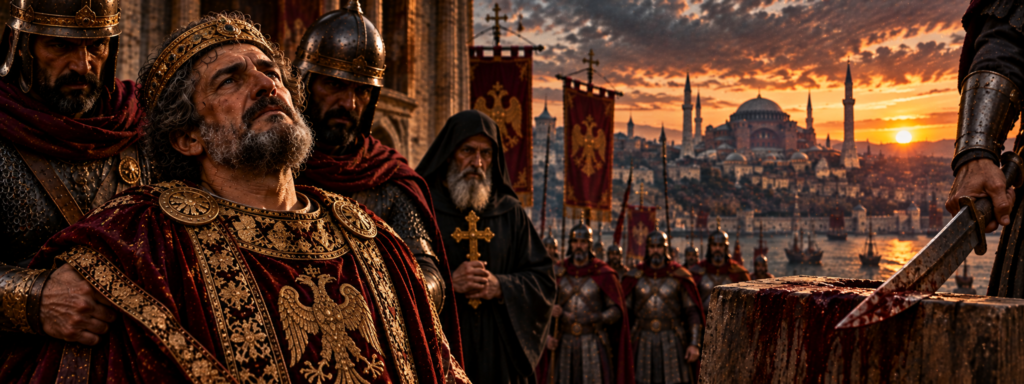
Anastasius II: The Emperor Who Surrendered His Throne, Returned for Revenge, and Lost His Head
The Byzantine Emperor Who Prepared Constantinople for War, Was Betrayed by His Own Fleet, and Died Trying to Reclaim an Empire
Anastasius II (died 719 CE) was Byzantine emperor from 713 to 715, a former imperial secretary named Artemios who rose to the throne following the violent deposition and blinding of Philippikos Bardanes. His reign came during one of the most dangerous periods in Byzantine history, when the Umayyad Caliphate threatened Constantinople and repeated military rebellions destabilized the empire. Anastasius attempted to strengthen the capital’s defenses, restore religious unity, and prepare the imperial fleet for a major confrontation with the Arabs. Yet his own naval forces rebelled, proclaimed another emperor, and forced him to surrender the throne after a prolonged struggle. He was permitted to enter a monastery, apparently escaping the mutilation or execution that had claimed so many of his predecessors. Four years later, however, Anastasius abandoned his retirement, organized a rebellion against Emperor Leo III with support from elements of the Opsikion military command and hopes of Bulgar assistance, and attempted to recover the crown. The revolt collapsed, and Anastasius was captured and executed by beheading in 719, proving that a former emperor could survive deposition but rarely survive the temptation to return.
The Emperor Who Had Already Escaped Death Once
By 719, Anastasius II had already experienced a fate that many Byzantine emperors would have considered almost miraculous. He had lost his throne, surrendered to his enemies, and survived. In an empire where defeated rulers were routinely blinded, mutilated, imprisoned, or executed, he had been allowed to exchange the imperial palace for a monastery. The arrangement should have offered him something precious: the chance to live out his remaining years without the constant threat of assassination or rebellion.
Yet Anastasius was not content to remain a former emperor. Four years after surrendering his crown, he emerged from political retirement and became the figurehead of a conspiracy against Leo III, the man who had recently established himself upon the Byzantine throne. Anastasius had once governed the empire during a period of extraordinary danger, and he apparently believed that his previous authority could still attract supporters. Powerful men within the military establishment were willing to assist him, while the possibility of Bulgar intervention offered hope that Constantinople might once again change hands.
The plan was dangerous from the beginning. Leo III had survived one of the greatest military crises in Byzantine history, defending Constantinople against the enormous Arab siege of 717–718. His victory had strengthened his position and given him a reputation that Anastasius could not easily overcome. Nevertheless, the former emperor and his supporters gambled that military discontent, political intrigue, and foreign assistance might accomplish what an ordinary challenge could not.
The rebellion failed before Anastasius could recover the capital. The Bulgar support upon which the conspirators had apparently placed considerable hope did not produce the restoration they expected. Instead, Anastasius was handed over to Leo III, who had no intention of allowing a defeated rival to return to monastic retirement a second time. The former emperor was executed, and his severed head became the final answer to his claim upon the throne.
His death was the last act in a political career marked by extraordinary reversals. Anastasius had risen to power after the blinding of Philippikos Bardanes, attempted to defend the empire against the Umayyad Caliphate, and lost his throne when his own fleet mutinied. He had then survived deposition through surrender, only to abandon that fragile safety in pursuit of restoration. The man who had once tried to save Constantinople from foreign conquest ultimately died because he could not accept that someone else ruled it.
Anastasius II belongs among the assassinated rulers, regicides, and violently eliminated monarchs not because he was murdered while peacefully occupying the throne, but because he was a former emperor deliberately executed after a failed attempt to reclaim it. His death was an act of political punishment intended to eliminate a rival claimant and discourage further rebellion. It also exposes one of the darkest realities of Byzantine monarchy: losing the crown did not necessarily end an emperor’s political significance, but attempting to recover it could end his life.
A Roman Empire Surrounded by Enemies
The empire Anastasius inherited in 713 was still officially the Roman Empire, although modern historians generally call it Byzantine. Its rulers governed from Constantinople, the magnificent city founded by Constantine the Great in the fourth century. Greek had become the dominant language of administration, Christianity shaped imperial identity, and the state’s territories were much smaller than those once ruled from ancient Rome. Nevertheless, its emperors considered themselves the legitimate successors of Augustus and the guardians of Roman sovereignty.
By the early eighth century, that inheritance had become increasingly difficult to defend. During the seventh century, Muslim armies had conquered Syria, Palestine, Egypt, and much of North Africa, stripping Constantinople of territories that had once supplied enormous wealth and military resources. The Umayyad Caliphate had emerged as one of the most powerful states in the world, commanding armies and fleets capable of challenging Byzantine power across the eastern Mediterranean. Its rulers continued to regard the conquest of Constantinople as a major strategic objective.
Asia Minor had become the principal defensive heartland of the empire. Its fortified cities, mountain passes, agricultural districts, and military forces provided the resources necessary to resist repeated Arab campaigns. Yet the region was vulnerable to devastating raids that could destroy crops, capture inhabitants, and disrupt local economies. Maintaining its defenses required competent commanders, reliable taxation, and a central government capable of organizing military operations across considerable distances.
The Balkans presented another source of danger. The Bulgars had established a powerful state south of the Danube, and their rulers could threaten Byzantine territory or intervene in imperial politics. Their relationship with Constantinople was shaped by warfare, diplomacy, tribute, and opportunistic alliances. Only a few years earlier, the Bulgar ruler Tervel had helped Justinian II recover the Byzantine throne, demonstrating that foreign military assistance could determine who occupied the imperial palace.
The empire’s greatest strength remained Constantinople itself. Its massive land walls, maritime defenses, strategic position, and sophisticated administrative institutions made it extraordinarily difficult to conquer. The city controlled the passage between the Black Sea and the Mediterranean and stood at the crossroads of Europe and Asia. Whoever held Constantinople could claim to rule the Roman Empire, even if much of its territory remained contested.
Yet that concentration of power created a serious political weakness. Military commanders, palace officials, church leaders, and influential urban groups could all participate in struggles over the throne. A ruler might command armies across distant frontiers while remaining vulnerable to conspirators within the capital. Even a successful military campaign could become politically dangerous if soldiers lost confidence in their emperor.
The period from 695 to 717 became notorious for precisely this instability. Emperors were overthrown, mutilated, restored, executed, and replaced in rapid succession. The imperial government continued to function, but the throne itself became extraordinarily insecure. Anastasius would enter this world not as a conquering general but as an experienced administrator who found himself elevated during another violent palace revolution.
Artemios: The Imperial Secretary Before the Crown
Before becoming Anastasius II, the future emperor was known as Artemios. Unlike many Byzantine usurpers who rose through military command, he came from the imperial administrative establishment. The surviving sources identify him as a senior secretary, commonly associated with the position of protoasekretis, or chief of the imperial secretaries. His career placed him close to the machinery of government rather than at the head of a provincial army.
The imperial secretariat was an important institution within Byzantine administration. Emperors depended upon officials to prepare documents, transmit instructions, maintain records, and coordinate communication between the palace and the wider empire. Such work required education, political judgment, and familiarity with the complicated procedures of government. A senior secretary could acquire considerable influence even without commanding troops.
Artemios’s position would have exposed him to the realities of imperial politics. He would have understood how appointments were made, how military orders were communicated, and how court factions competed for influence. The surviving sources do not provide a detailed account of his personal relationships or political opinions before his accession. Nevertheless, his administrative experience helps explain why he later approached government with an apparent concern for organization and military preparation.
His origins remain obscure. His precise date of birth is unknown, and the surviving evidence does not securely establish his parentage, childhood, or family background. Later historians have occasionally attempted to reconstruct the ancestry of obscure Byzantine rulers from their names or careers, but such efforts often exceed what the sources can support. Artemios should therefore be understood primarily through the offices he held and the political events in which he participated.
His rise also demonstrates that imperial authority did not belong exclusively to hereditary princes or victorious generals. A senior bureaucrat could become emperor if powerful factions considered him an acceptable candidate. Administrative competence might make such a figure attractive during a crisis, particularly when the army and court wished to avoid another openly ambitious military ruler. Artemios would benefit from precisely such circumstances in 713.
Yet his background also created potential disadvantages. An emperor without an established dynasty or personal military following depended heavily upon the loyalty of commanders appointed to defend him. His administrative experience could help him organize defenses, but it could not guarantee obedience from soldiers stationed far from Constantinople. That weakness would become decisive when his fleet rebelled two years later.
The future emperor therefore entered politics with an unusual combination of strengths and vulnerabilities. He understood the machinery of government and would prove attentive to the military dangers facing the empire. Yet he lacked the dynastic prestige of Justinian II and the direct military power of a successful provincial commander. His authority would ultimately depend upon men whose loyalty could change without warning.
The Blinding of Philippikos and the Rise of a New Emperor
Anastasius’s opportunity came during the reign of Philippikos Bardanes, who had seized the throne in 711 after the overthrow and killing of Justinian II. Philippikos had emerged from a rebellion associated with Cherson and brought the Heraclian dynasty to a bloody conclusion. His accession was followed by the murder of Justinian’s young son, eliminating the dynasty’s most immediate surviving male heir. The new emperor therefore inherited a throne secured through violence but lacking the stability that dynastic continuity might have provided.
Philippikos soon alienated influential religious authorities through his rejection of the Sixth Ecumenical Council. That council, held in Constantinople from 680 to 681, had condemned Monothelitism and affirmed that Christ possessed two natural wills corresponding to his divine and human natures. Philippikos attempted to reverse the settlement and promote a position associated with Monothelitism. His actions created opposition among church leaders and damaged relations with Rome.
The religious controversy unfolded while the empire faced serious military threats. Arab forces continued to pressure Asia Minor, and the Bulgars remained dangerous in the Balkans. The government needed unity and effective military leadership, but the emperor’s theological policies deepened political divisions. Powerful officers increasingly questioned whether Philippikos could preserve the empire’s security.
In June 713, conspirators connected with the military establishment moved against him. The surviving accounts associate the plot with officers of the Opsikion command, including George Bouraphos and Theodore Myakes. Philippikos was seized during the Pentecost period and blinded, a punishment intended to render him permanently incapable of ruling. His reign ended through an internal conspiracy rather than a foreign invasion.
The conspirators’ success did not automatically determine who would become emperor. Powerful groups within Constantinople still needed to establish a government capable of commanding recognition. Artemios, the experienced imperial secretary, emerged as the chosen successor. His administrative background may have made him attractive to those seeking stability after the violent deposition.
Upon accession, Artemios adopted the imperial name Anastasius. Historians distinguish him as Anastasius II, separating him from the earlier emperor Anastasius I, who had ruled from 491 to 518. The name connected the new ruler with established imperial tradition. Yet his authority rested upon a coup that had mutilated his predecessor.
Anastasius therefore inherited a dangerous political situation from the moment he took the throne. He had not personally led the conspiracy that blinded Philippikos, but his accession was made possible by it. The officers who had destroyed one emperor might become equally dangerous to another. He needed to establish his independence from the conspirators without provoking another rebellion.
The new emperor moved to punish leading participants in the coup, according to the surviving accounts. This action demonstrated his determination to prevent military officers from treating the imperial throne as something they could distribute at will. Yet it also risked alienating men whose support had helped bring him to power. The problem would haunt his short reign: how could an emperor maintain authority over an army that had repeatedly overthrown its rulers?
The Emperor Who Tried to Restore Order
Anastasius II inherited a government weakened by years of instability, and his early actions suggest that he recognized the need for administrative and religious consolidation. He moved to reverse the controversial theological policies of Philippikos Bardanes. The Sixth Ecumenical Council regained official recognition, and the government returned to the doctrinal position that Philippikos had rejected. The change helped repair relations with religious authorities who had opposed the previous emperor.
The restoration of the council’s authority was politically important. Byzantine emperors were expected to defend Christian orthodoxy, and theological disputes could undermine their legitimacy. Philippikos had created enemies by attempting to reverse an established religious settlement. Anastasius sought to remove that source of division and strengthen the relationship between the imperial government and the church.
His religious policy also helped improve relations with Rome. The papacy had rejected Philippikos’s theological position, creating another source of tension between the western church and Constantinople. By restoring the council’s authority, Anastasius returned the government to a position acceptable to influential ecclesiastical leaders. The change did not eliminate every disagreement between Rome and Constantinople, but it removed an immediate controversy.
The emperor’s administrative experience likely influenced his approach to government. He had spent years within the imperial secretariat and understood the importance of coordinated orders, reliable officials, and organized military preparation. His reign is remembered less for extravagant court ceremonies than for practical measures intended to strengthen the empire. Such measures were urgently needed because the Umayyad Caliphate was preparing for another major offensive.
Anastasius also faced the challenge of controlling the military factions that had helped elevate him. The officers responsible for Philippikos’s deposition had demonstrated their willingness to use violence against a reigning emperor. Allowing them to retain unchecked influence could encourage further conspiracies. The new ruler therefore needed to assert imperial authority without provoking the very forces responsible for defending the state.
His efforts produced an image of a relatively capable and energetic emperor. Later Byzantine accounts often treat his preparations for war more favorably than the policies of Philippikos. Yet the sources remain limited, and it would be misleading to portray his government as uniformly successful. His administrative measures could strengthen defenses, but they could not guarantee political loyalty.
The greatest test of his reign would come from the east. Intelligence and military developments suggested that the Umayyad Caliphate was preparing a major campaign against Constantinople. Anastasius understood that the empire could not afford to wait until enemy armies reached the capital. He began organizing defensive measures intended to meet the threat before it became overwhelming.
The tragedy of his reign lies partly in this contrast between preparation and political collapse. Anastasius appears to have recognized the danger facing the empire and taken meaningful steps to address it. Yet the military forces he relied upon would eventually rebel against him. The emperor who tried to organize resistance to foreign invasion would lose his throne to his own fleet.
The Arab Threat Gathering Beyond the Frontier
The Umayyad Caliphate had become the Byzantine Empire’s most formidable enemy by the early eighth century. Its rulers controlled territories stretching across the Middle East, North Africa, and beyond, providing substantial military and economic resources. Arab armies had already conquered some of the empire’s wealthiest provinces, while fleets challenged Byzantine control of the eastern Mediterranean. Constantinople remained the greatest prize that had escaped their reach.
The city had survived earlier Arab attacks, including the major siege traditionally dated to 674–678. Byzantine defenses, naval technology, and the strategic advantages of the capital had prevented conquest. Yet the caliphate’s rulers continued to regard Constantinople as a target of enormous political and symbolic importance. Capturing the Roman imperial capital would represent a spectacular victory.
By the reign of Anastasius II, preparations for another major campaign were becoming increasingly evident. The Umayyad ruler al-Walid I had presided over a period of expansion, and his successor Sulayman would later direct the great offensive against Constantinople. The precise chronology of planning remains debated, but Byzantine authorities had reason to expect a serious attack. Anastasius responded by strengthening the empire’s defensive preparations.
The emperor understood that Constantinople’s walls alone could not guarantee survival. A prolonged siege would threaten food supplies, maritime communication, and the morale of the population. The city needed provisions, effective naval defenses, and reliable military leadership. Anastasius therefore pursued measures intended to prepare the capital for a sustained confrontation.
The surviving accounts credit him with ordering the accumulation of supplies and improvements to defensive readiness. He also directed attention to the imperial fleet, whose role would be essential in preventing enemy ships from isolating Constantinople. Naval operations could disrupt Arab preparations and protect the approaches to the city. The emperor’s strategy therefore involved both defensive organization and the possibility of offensive action.
These measures were important because the empire had already experienced the consequences of inadequate preparation. Military disasters could destroy provinces, undermine imperial legitimacy, and provoke rebellion. Anastasius had risen during a period when such failures repeatedly toppled rulers. He had every reason to believe that a major defeat against the caliphate might destroy both the empire’s defenses and his own political position.
His response suggests a ruler who recognized the scale of the threat. Rather than relying entirely upon the capital’s fortifications, he attempted to organize resources before the enemy arrived. The preparations would later prove valuable during the great siege of 717–718, although the final defense occurred under Leo III. Anastasius’s contribution belongs to the longer history of Byzantine resistance rather than to a victory he personally commanded.
Yet his military policy carried a dangerous risk. Preparing a major naval expedition required placing substantial forces under commanders operating far from the emperor’s direct supervision. In a politically unstable empire, such forces could become instruments of rebellion. Anastasius would discover that the fleet intended to protect Constantinople could also threaten its ruler.
Preparing Constantinople for the Siege That Had Not Yet Begun
Anastasius II’s defensive preparations reflected the strategic realities of Constantinople. The city was protected by formidable land walls, but its survival also depended upon control of surrounding waters and access to supplies. A powerful enemy fleet could threaten maritime communication and complicate the delivery of food. The emperor therefore needed to consider the city as an entire defensive system rather than a collection of walls.
The Theodosian land walls had protected Constantinople for centuries. Their layered defenses, towers, and fortified gates made direct assault extremely difficult. Yet even the strongest fortifications could become vulnerable if defenders lacked provisions or suffered political division. A siege lasting many months could exhaust food supplies and undermine morale without requiring the enemy to breach the walls immediately.
Anastasius reportedly ordered measures to strengthen the capital’s readiness, including the accumulation of provisions and attention to defensive works. Later sources associate him with preparations that helped the city withstand the Arab siege several years afterward. The exact extent of his contribution cannot be measured precisely because subsequent emperors continued the work. Nevertheless, his government clearly recognized the importance of preparing for a major attack.
The imperial fleet was another essential element. Byzantine naval forces could protect the sea approaches to Constantinople, escort supplies, and attack enemy vessels. The empire also possessed the incendiary weapon commonly known as Greek fire, which had become an important advantage in naval warfare. Its precise composition remains uncertain, but its use against enemy ships could have devastating effects.
Anastasius’s strategy involved disrupting Arab preparations before the caliphate could concentrate its full strength against the capital. Such an approach required intelligence, naval mobility, and commanders capable of operating independently. A successful attack upon enemy resources might delay or weaken the planned invasion. It could also demonstrate that the empire remained capable of offensive action.
Yet the emperor faced a fundamental problem. The military establishment had repeatedly intervened in imperial succession, and powerful commanders could not always be trusted to obey orders. A fleet assembled for an important expedition represented a concentration of armed men whose political loyalties might change. The very resources needed for national defense could become the means of overthrowing the government.
Anastasius nevertheless proceeded with military preparations. The threat from the caliphate was too serious to ignore, and passive defense alone offered no guarantee of survival. He needed to act before the enemy reached Constantinople. The resulting expedition would become the turning point of his reign.
The tragedy was that his preparations were strategically understandable but politically disastrous. Anastasius attempted to strengthen the empire against an external enemy, only to provoke or encounter a rebellion among the forces entrusted with that mission. The fleet did not simply fail to accomplish its objective. It became the instrument that destroyed the emperor’s authority.
The Fleet That Refused to Obey
In 715, Anastasius organized a naval expedition intended to disrupt Arab preparations for the anticipated attack upon Constantinople. The surviving accounts associate the operation with a movement toward Rhodes, an important island in the eastern Mediterranean. The expedition brought together forces whose cooperation was essential to the emperor’s defensive strategy. Yet the assembled troops became the center of a mutiny.
The precise causes of the rebellion remain uncertain. Byzantine chronicles describe dissatisfaction among the expeditionary forces, but they do not preserve a complete record of the soldiers’ grievances. Disputes over command, political loyalties, and resentment toward the imperial government may all have contributed. What is clear is that the troops refused to continue under the existing authority.
The mutineers turned against their commanders and rejected Anastasius’s government. Their actions transformed a military expedition into a political rebellion. Instead of attacking the caliphate’s preparations, the fleet began searching for a new emperor. The empire’s defensive strategy had collapsed at the very moment it was supposed to become active.
The soldiers selected Theodosius, a man traditionally described as a tax collector or financial official from Adramyttium in Asia Minor. He was not an obvious imperial claimant, and the surviving narratives emphasize his reluctance to accept the crown. Some accounts portray him as attempting to avoid the responsibility before being compelled by the rebels. The details may have been shaped by later interpretations, but his selection was certainly unusual.
The choice of Theodosius reveals the political character of the mutiny. The rebels did not necessarily need a celebrated general or dynastic prince. They needed a figure around whom they could organize opposition to Anastasius. Once proclaimed emperor, Theodosius provided a political identity for the rebellion.
The mutineers then moved toward Constantinople. Their fleet gave them mobility and military strength, while the instability of imperial politics created opportunities for support. Anastasius now faced the same danger that had destroyed so many of his predecessors. Soldiers who had been assembled to defend the empire were marching against its ruler.
The rebellion was especially damaging because it occurred while the Arab threat remained unresolved. The empire needed unity and coordinated military leadership, but its forces were divided between rival claimants. Resources intended for defense were diverted into civil conflict. The mutiny therefore endangered not only Anastasius’s throne but also the security of Constantinople.
The emperor’s efforts to prepare for invasion had produced the opposite of their intended result. Instead of confronting the caliphate, Byzantine soldiers were preparing to fight one another. Anastasius had attempted to organize an effective military response, but he could not control the political ambitions and grievances of his own forces. His reign was approaching its end.
Theodosius III: The Reluctant Emperor Who Replaced Him
Theodosius III emerged from the mutiny as an unlikely challenger to Anastasius II. The surviving sources portray him as a relatively obscure official rather than a prominent military commander. His elevation reflected the willingness of rebellious troops to create an alternative government around a figure who possessed little independent power. Theodosius’s personal ambitions remain uncertain, and accounts of his reluctance should be treated cautiously.
The rebels advanced toward Constantinople, where control of the capital would determine the outcome of the struggle. Anastasius still possessed the imperial title and the machinery of government, but the mutineers had significant military resources. The conflict threatened to become another prolonged civil war. Both sides understood that the capital was the decisive prize.
The surviving accounts describe fighting and a siege associated with the rebellion. Theodosius’s supporters eventually gained control of Constantinople, while Anastasius withdrew to Nicaea in Asia Minor. The exact chronology of the campaign is not preserved with equal clarity in every source. Nevertheless, the broad sequence is secure: the rebellion succeeded in taking the capital, and Anastasius lost the political center of the empire.
Nicaea offered Anastasius a defensible position and the possibility of continued resistance. The city had substantial fortifications and a long history of strategic importance. A determined ruler might attempt to rally loyal forces there and prolong the struggle. Yet the emperor faced a difficult choice between continued warfare and surrender.
The empire’s external situation made prolonged civil conflict especially dangerous. The Umayyad Caliphate was preparing for a major offensive, and the Byzantine state could ill afford to exhaust its resources in fighting between rival emperors. Anastasius had devoted much of his reign to strengthening defenses against that threat. Continuing the civil war might undermine the very security he had attempted to preserve.
The political balance also favored Theodosius once Constantinople had fallen. Possession of the capital provided access to the palace, administrative institutions, and ceremonial machinery of imperial government. Officials and military commanders could transfer their allegiance to the new ruler. Anastasius’s authority became increasingly difficult to sustain.
The emperor eventually negotiated his surrender. Rather than fight to the death or risk capture after a final defeat, he agreed to abandon the throne. The terms permitted him to enter a monastery, preserving his life while removing him from political activity. The arrangement offered a peaceful conclusion to a struggle that might otherwise have ended in mutilation or execution.
Anastasius’s decision was remarkable because it broke the immediate pattern of violent imperial punishment. He had witnessed the blinding of Philippikos and knew the dangers of deposition. By surrendering, he avoided the fate suffered by several recent emperors. Yet the survival that seemed like a fortunate escape would later become the beginning of another tragedy.
The Siege of Nicaea and the Emperor’s Surrender
After losing Constantinople, Anastasius withdrew to Nicaea, one of the most important cities of northwestern Asia Minor. Its fortifications and strategic location made it a plausible center of resistance. The emperor still possessed supporters, and his claim to the throne had not disappeared merely because the capital had fallen. Yet his position was increasingly precarious.
Theodosius’s supporters controlled Constantinople and could claim the authority associated with the imperial palace. Anastasius faced the prospect of continuing a civil war while the empire remained threatened by the Umayyad Caliphate. Every month of internal conflict risked weakening the defenses he had worked to strengthen. The strategic consequences of prolonged resistance could be severe.
The surviving sources indicate that Anastasius eventually agreed to surrender under terms that preserved his life. The precise negotiations are not documented in detail, but the outcome is clear. He relinquished the imperial office and entered monastic retirement. Theodosius III became the recognized emperor.
The agreement was significant because defeated rulers often suffered mutilation or execution. Justinian II had been mutilated and exiled, Leontius had been mutilated, Tiberius III had been executed, and Philippikos had been blinded. Anastasius avoided these punishments through surrender. His fate suggested that peaceful retirement remained possible even during the violent political climate of the early eighth century.
Monastic confinement served several purposes in Byzantine politics. It removed a former emperor from public life, placed him within a religious institution, and reduced his ability to organize military resistance. Taking monastic vows could also symbolize withdrawal from worldly ambition. Yet such arrangements depended upon the defeated ruler’s willingness to remain politically inactive.
Anastasius’s surrender may have reflected practical judgment rather than personal contentment. He had lost the capital and faced a rebellion supported by substantial military forces. Continuing the struggle might have produced more bloodshed without restoring his authority. Accepting monastic retirement offered survival and the possibility of avoiding further destruction.
The agreement also benefited Theodosius. Sparing Anastasius could reduce resistance among supporters of the former emperor and present the new government as less brutal than earlier regimes. A peaceful settlement might help stabilize the empire before the anticipated Arab offensive. Yet leaving a former emperor alive always carried some risk.
Anastasius entered the monastery as a man who had once commanded the Roman Empire. He had lost his crown but retained his life, an outcome that many predecessors had been denied. The arrangement could have allowed him to disappear quietly from politics. Instead, the memory of imperial authority would eventually draw him back into the struggle for Constantinople.
The Monastery That Could Not Hold an Emperor’s Ambition
Monastic retirement was a common fate for deposed Byzantine rulers and political rivals. Religious institutions offered a means of removing dangerous figures from public life without immediate execution. A former emperor who entered a monastery could be presented as having abandoned worldly ambition. The arrangement also allowed the reigning government to claim a degree of mercy.
For Anastasius II, monastic life followed two years of extraordinary responsibility. He had governed the empire during a period of serious military danger, attempted to restore religious unity, and prepared Constantinople for a major Arab attack. His deposition had come not through an obvious failure of administration but through a mutiny among the forces assembled for defense. The contrast between his imperial career and his new confinement must have been profound, although the sources do not preserve his private reflections.
The surviving record provides little information about his daily life in the monastery. We do not know the full extent of his religious activities, his personal relationships with other monks, or the conditions under which he lived. Nor can we establish whether he immediately began plotting restoration or initially accepted his retirement. Any detailed psychological reconstruction would be speculative.
What is certain is that his political significance did not disappear. He remained a former emperor whose reign was remembered by officials and soldiers. His administrative experience and earlier preparations for defense may have given him a reputation for competence among some groups. In a period of repeated coups, such a figure could become attractive to opponents of the reigning government.
Theodosius III’s own position was insecure. He had been elevated by rebellious troops rather than through hereditary succession or an established political consensus. His government faced the same external threats that had troubled Anastasius. The empire remained vulnerable to another military challenge.
That challenge eventually came from Leo, the commander of the Anatolic military forces, who would become Leo III. Leo’s rise transformed the political situation and brought another change of emperor in 717. Theodosius surrendered and entered monastic retirement, following a path similar to that taken by Anastasius. The empire once again changed rulers without the immediate execution of the defeated sovereign.
Anastasius therefore watched, from political retirement, as another man lost the throne and another military commander claimed it. The rapid succession of rulers demonstrated that imperial authority remained unstable. It also suggested that restoration might be possible if sufficient support could be gathered. The former emperor’s survival preserved a claim that could be revived.
The monastery had removed Anastasius from government, but it had not erased his past. His name remained connected to the imperial office, and powerful men could still regard him as a potential alternative to the reigning emperor. When opposition to Leo III emerged, Anastasius would become the center of another conspiracy. His retirement would prove temporary.
Leo III: The Soldier Who Saved Constantinople
Leo III emerged as one of the most important Byzantine rulers of the eighth century. Before becoming emperor, he held a major military command in Asia Minor and possessed experience confronting the empire’s eastern enemies. His rise occurred during the reign of Theodosius III, whose authority remained vulnerable after the mutiny that had overthrown Anastasius. Leo’s military position gave him the resources necessary to challenge the government.
In 717, Leo secured the imperial throne after Theodosius surrendered. The transition occurred shortly before the Umayyad Caliphate launched its greatest assault upon Constantinople. The new emperor therefore inherited an immediate military crisis. His ability to defend the capital would determine not only his political survival but also the future of the Byzantine state.
The Arab siege of Constantinople in 717–718 was one of the most consequential military confrontations of the early medieval world. Umayyad forces advanced by land and sea, attempting to isolate the capital and overcome its defenses. The campaign involved enormous logistical challenges, prolonged fighting, and severe hardship. The city’s survival depended upon fortifications, naval power, supplies, and the endurance of its defenders.
Leo organized the defense with determination. Byzantine forces used the city’s walls and naval capabilities to resist the attackers, while Greek fire played an important role in maritime operations. The defenders also benefited from the difficulties faced by the besieging army, including supply shortages and harsh winter conditions. The siege became a test of endurance as much as direct military strength.
The Bulgars also contributed to the defeat of the Arab offensive by attacking forces associated with the siege. Their intervention demonstrated the complicated diplomatic environment surrounding Constantinople. Foreign powers could threaten the empire in one circumstance and assist it in another. Leo’s ability to survive the siege depended partly upon exploiting these broader strategic conditions.
In 718, the Arab forces withdrew, ending the campaign in failure. The victory was a major achievement for the Byzantine Empire and strengthened Leo’s legitimacy. He had defended Constantinople against a powerful enemy at a moment when the state appeared exceptionally vulnerable. His success gave him a reputation that distinguished him from many of the short-lived rulers who preceded him.
The defense also benefited from preparations made before Leo’s accession. Anastasius II had recognized the danger of a major Arab offensive and ordered measures to strengthen Constantinople’s readiness. Although Leo deserves substantial credit for directing the successful defense, the city’s survival was not the achievement of a single reign. It reflected the cumulative efforts of Byzantine governments, commanders, and defenders.
For Anastasius, Leo’s victory created a difficult political reality. The former emperor had once attempted to prepare the capital for the same danger, but he had lost his throne before the siege occurred. Leo had now gained the prestige of saving the city. Any attempt to challenge him would require overcoming a ruler whose military reputation had been dramatically strengthened.
The Siege of 717–718 and the Victory Anastasius Never Enjoyed
The great Arab siege of Constantinople deserves special attention because it connects Anastasius’s reign with the government that eventually executed him. During his time as emperor, Anastasius had recognized the possibility of a major Umayyad attack and pursued defensive preparations. He had attempted to strengthen the city’s supplies, fortifications, and naval readiness. Yet his own fleet rebelled before he could confront the invasion.
The siege finally began under Leo III in 717. Arab forces approached Constantinople with the intention of overcoming the city’s defenses and ending Byzantine resistance. The campaign represented a major commitment of military resources by the Umayyad Caliphate. Its failure would have far-reaching consequences for the balance of power in the eastern Mediterranean.
The defenders faced enormous pressure. Enemy forces attempted to isolate the city, while the population depended upon stored supplies and continued access to essential resources. Byzantine naval operations helped prevent complete maritime domination by the attackers. The city’s fortifications remained a formidable obstacle to direct assault.
The siege also exposed the difficulties of sustaining a large army far from secure supply bases. Winter conditions, shortages, disease, and military losses placed severe pressure upon the Arab forces. Byzantine resistance prevented the attackers from achieving a decisive breakthrough. The campaign became increasingly costly.
The Bulgars attacked Arab forces during the siege, contributing to the pressure upon the besiegers. Their involvement demonstrated that Constantinople’s survival depended partly upon the wider political environment. The same Bulgar power that had once restored Justinian II could now influence the outcome of a major international conflict. Their role would later become relevant to Anastasius’s final rebellion.
In 718, the Umayyad forces withdrew. Constantinople had survived another enormous threat, and Leo III emerged with greatly enhanced prestige. His government appeared more secure than those of many immediate predecessors. The victory marked a turning point after years of repeated imperial instability.
Anastasius’s earlier preparations formed part of the background to that success. His government had recognized the danger and attempted to organize defenses before the siege began. The surviving sources do not allow every later achievement to be traced directly to his policies, but his contribution should not be ignored. He had understood the strategic problem even though he never had the opportunity to direct the final defense.
The irony was severe. Anastasius had lost his throne while attempting to prepare the empire for the Arab threat. Leo had retained his throne by defeating that threat. The former emperor now faced a ruler whose legitimacy had been strengthened by the very crisis Anastasius had tried to anticipate. Nevertheless, the temptation to recover imperial power remained.
The Conspiracy of 719: A Former Emperor Returns
In 719, Anastasius II became involved in a conspiracy against Leo III. The surviving accounts associate the movement with elements of the Opsikion military command, whose officers had played important roles in earlier imperial coups. The conspirators sought to replace Leo with Anastasius, reviving the claim of a former emperor who had surrendered his throne four years earlier. The plan demonstrated that monastic retirement had not permanently removed Anastasius from political competition.
The Opsikion was one of the empire’s most important military commands. Its forces operated in strategically significant regions of northwestern Asia Minor and maintained close connections with Constantinople. Commanders associated with the Opsikion possessed the ability to influence imperial succession because their troops could threaten the capital. Their involvement made the conspiracy more dangerous than an isolated plot among disgruntled courtiers.
The surviving sources identify leading participants, including figures associated with the military and imperial administration. Some accounts name Niketas Xylinites among the conspirators, although the precise roles of individual participants are not always clear. The movement appears to have involved a combination of military dissatisfaction and political ambition. Anastasius’s previous reign provided a recognizable imperial figure around whom opposition could gather.
The conspirators also sought foreign assistance. Bulgar support had previously enabled Justinian II to recover the throne in 705, and the Bulgars had recently played a role in the defense of Constantinople against the Arabs. Their military power made them attractive allies for anyone hoping to challenge the reigning emperor. Anastasius and his supporters apparently believed that cooperation with the Bulgar ruler could improve their chances of success.
The decision to seek foreign assistance was politically dangerous. Byzantine rulers frequently used diplomacy and alliances to manage neighboring powers, but inviting foreign troops into an internal struggle could create serious risks. The allies might demand territorial concessions, payments, or political influence. They might also abandon the claimant if circumstances changed.
Anastasius’s willingness to participate reveals the strength of his desire to recover the throne. He had survived deposition and entered a monastery, but he now risked everything by challenging a ruler who had recently defended Constantinople successfully. The political circumstances were not obviously favorable. Leo’s military prestige and control of the capital made restoration difficult.
The conspiracy nevertheless moved forward. Anastasius emerged from retirement as a claimant to the imperial office, supported by men who believed Leo could be overthrown. The plan depended upon military coordination, political loyalty, and the willingness of foreign allies to assist. Any failure in those elements could destroy the movement.
The former emperor was therefore gambling with the life he had preserved through surrender in 715. His earlier retirement had offered safety, but rebellion removed that protection. If the conspiracy failed, Leo would have little reason to spare him. Anastasius was entering the final and most dangerous chapter of his career.
The Opsikion: Soldiers Who Could Make and Destroy Emperors
The Opsikion military command played a recurring role in Byzantine political instability during the early eighth century. Its troops occupied territories close enough to Constantinople to influence events in the capital. The command’s military strength gave its officers considerable political importance. When those officers became dissatisfied with an emperor, they could threaten his government directly.
The Opsikion had already been associated with the conspiracy that deposed Philippikos Bardanes in 713. Officers connected with the command participated in the movement that seized and blinded the emperor. Their actions helped create the circumstances in which Anastasius II became ruler. The same military environment would later contribute to Anastasius’s own downfall and attempted restoration.
The command’s political influence reflected a broader Byzantine problem. The empire needed powerful provincial armies to defend its territories against external enemies. Yet those armies could become dangerous when commanders developed independent political ambitions. A military organization strong enough to protect the state might also possess the resources necessary to overthrow its ruler.
Anastasius understood this danger from personal experience. He had become emperor after a military conspiracy and lost his throne when a naval expedition rebelled. His career demonstrated how rapidly military loyalty could change. Nevertheless, he later relied upon military conspirators in an attempt to recover power.
The Opsikion’s involvement in the revolt of 719 gave the movement a degree of credibility. Anastasius was not merely an isolated former emperor attempting to return from a monastery. He had supporters within a significant military command. Their participation created the possibility of coordinated action against Leo III.
Yet military support alone did not guarantee success. The conspirators needed to overcome Leo’s control of Constantinople and the prestige gained from the Arab siege. They also needed reliable cooperation from foreign allies. A failure to coordinate these elements could leave Anastasius exposed.
The political culture of the Opsikion also created problems for the conspirators. Officers accustomed to influencing imperial succession might pursue their own interests rather than remain loyal to a restored emperor. Anastasius’s earlier experience with military rebellion should have made him aware of that danger. Yet the promise of restoration apparently outweighed his caution.
The conspiracy therefore repeated the pattern that had shaped his entire career. Military forces attempted to determine who should rule the empire, while a claimant depended upon their support to reach Constantinople. The difference was that Anastasius now faced a stronger and more established emperor. His supporters would soon discover that Leo III was not easily displaced.
The Bulgar Alliance That Became a Betrayal
The conspiracy against Leo III depended partly upon the possibility of Bulgar assistance. The Bulgars had become a major military power in the Balkans, and their rulers possessed the ability to influence Byzantine affairs. Their earlier support for Justinian II’s restoration in 705 demonstrated the potential value of such an alliance. Anastasius and his supporters apparently hoped to repeat that success.
The political circumstances of 719 were very different from those of 705. Justinian had sought Bulgar assistance against a government that had occupied his throne during exile. Anastasius was challenging Leo III, whose successful defense of Constantinople had strengthened his authority. The Bulgars had also recently participated in the struggle against the Arab siege, giving them a direct interest in the regional balance of power.
The surviving sources indicate that Anastasius’s supporters sought cooperation from the Bulgar ruler. The precise negotiations and promises are not fully documented. It is therefore impossible to reconstruct every diplomatic calculation involved. Nevertheless, the conspirators clearly regarded Bulgar military power as an important element of their plans.
The expected support did not produce the desired result. Instead, the Bulgars ultimately handed Anastasius over to Leo III. The exact circumstances of the surrender are described only briefly in the surviving accounts, and historians must avoid inventing a detailed scene of betrayal. The central fact is that the former emperor was delivered into the hands of the ruler he had attempted to overthrow.
The decision was politically understandable from the Bulgar perspective. Supporting a failed claimant could provoke conflict with a powerful neighboring emperor. Delivering Anastasius to Leo offered a means of preserving or improving relations with Constantinople. Foreign rulers were not obligated to sacrifice their own interests for the ambitions of Byzantine exiles.
For Anastasius, the consequences were devastating. He had abandoned monastic retirement and risked his life in the hope of restoration. The foreign assistance upon which he had placed confidence failed to secure his position. He now faced the emperor he had challenged without the military strength necessary to defend himself.
The episode also echoed earlier Byzantine history. Justinian II had successfully used Bulgar assistance to recover the throne, but Anastasius failed to achieve the same result. Foreign alliances could elevate a claimant or destroy him depending upon circumstances. The outcome depended upon political interests that the claimant could not fully control.
Anastasius’s final rebellion therefore collapsed through a combination of inadequate support and failed diplomacy. His military allies could not deliver Constantinople, and his foreign contacts did not preserve him. The former emperor was captured and returned to the authority of Leo III. The man who had once surrendered his throne and survived was now unlikely to receive the same mercy.
The Capture of Anastasius II
The collapse of the rebellion left Anastasius II without the protection of an army or a secure refuge. His supporters had failed to overthrow Leo III, and the expected Bulgar assistance had not produced restoration. The former emperor was handed over to the reigning ruler, who now possessed complete authority over his fate. Anastasius’s political gamble had ended in disaster.
The surviving sources do not preserve a detailed eyewitness account of his capture. They do not reliably describe his private conversations, emotional state, or final attempts to negotiate. It would therefore be misleading to invent dramatic pleas or exchanges between Anastasius and Leo. The historical record establishes the failure of the conspiracy and the former emperor’s delivery into imperial custody.
Leo III had powerful reasons to punish him. Anastasius was not an ordinary rebel but a former emperor whose previous reign could provide legitimacy to opposition movements. His participation in the conspiracy demonstrated that monastic retirement had not neutralized his political ambitions. Sparing him again might encourage further attempts at restoration.
The timing also mattered. Leo had recently defended Constantinople against the great Arab siege, and his government needed stability after years of repeated coups. A successful rebellion could undo the political consolidation achieved through military victory. Eliminating Anastasius would remove a recognizable claimant and discourage officers contemplating another conspiracy.
The emperor’s decision was therefore shaped by both personal security and broader political concerns. Anastasius had challenged his authority, sought military support, and attempted to involve a foreign power in the struggle for the throne. Such actions could be treated as treason against the reigning government. The punishment would be severe.
The surviving accounts indicate that other conspirators also suffered consequences. Some were executed, while others faced punishment or removal from office. The precise fate of every participant is not securely documented. Nevertheless, the repression demonstrated Leo’s determination to prevent the rebellion from becoming the beginning of another period of instability.
Anastasius’s capture marked the end of his second political career. He had once governed the empire, surrendered his throne, and survived through monastic retirement. His attempt to return had destroyed the protection that retirement offered. The former emperor now faced a ruler who had every reason to ensure that he never became a claimant again.
The contrast with 715 was stark. Four years earlier, Anastasius had negotiated surrender and entered a monastery rather than continue a civil war. In 719, he had deliberately abandoned that settlement and attempted to overthrow a new emperor. Leo III would not offer him another opportunity to withdraw from politics. The rebellion would end with his death.
Beheaded in 719: The Final Judgment of Leo III
Anastasius II was executed by beheading in 719 after the failure of his rebellion against Leo III. His death eliminated a former emperor who had attempted to recover the throne through military conspiracy and foreign assistance. The execution was a deliberate political punishment rather than an accidental death in battle. It marked the final destruction of his claim to imperial authority.
The surviving sources establish the execution but provide limited information about the precise circumstances. They do not preserve a reliable account of Anastasius’s final words or the detailed proceedings that preceded his death. Later summaries sometimes dramatize such episodes with imagined speeches or emotional confrontations. Those embellishments should not be confused with documented history.
The punishment was consistent with the political logic of the period. A former emperor who remained alive could become a rallying point for dissatisfied soldiers or officials. Anastasius had already demonstrated that he was willing to leave monastic retirement and participate in rebellion. Leo therefore had strong reasons to prevent any further attempt at restoration.
Beheading also carried a clear symbolic meaning. It ended the former emperor’s life and made his political exclusion permanent. Unlike monastic confinement, which depended upon continued obedience, execution removed the possibility of another return. The state could no longer be threatened by Anastasius as a living claimant.
The death was especially tragic because Anastasius had previously escaped the violent fate suffered by many emperors. He had surrendered in 715 and been permitted to enter a monastery. His survival had demonstrated that deposition did not always require mutilation or execution. Yet his later rebellion destroyed that fragile precedent in his own case.
His execution also reflected the changing political position of Leo III. The reigning emperor had survived the Arab siege and gained considerable prestige. He could present himself as the defender of Constantinople against foreign conquest. A rebellion led by a former emperor threatened the stability that victory had helped establish.
The punishment therefore served as a warning to military commanders and political factions. Leo intended to demonstrate that the imperial government would not tolerate repeated attempts to replace him. The execution of Anastasius removed a rival whose name carried the memory of previous imperial authority. It also helped consolidate the new dynasty’s position.
Anastasius’s death completed a career shaped by the very instability he had once attempted to overcome. He had become emperor through a palace coup, lost the throne through a naval mutiny, survived through surrender, and died after another conspiracy. The man who had tried to organize the empire’s defenses against foreign invasion was ultimately destroyed by internal political conflict. His head fell not because Constantinople had been conquered, but because he had failed to conquer it himself.
Why Leo III Could Not Afford to Spare Him
Leo III’s decision to execute Anastasius was shaped by the dangerous political history of the preceding decades. Since 695, the empire had experienced repeated coups, mutilations, restorations, and executions. Several rulers had lost their thrones to military rebellions, while others had returned from exile to reclaim power. The survival of a former emperor could therefore represent a continuing threat.
Justinian II provided the most dramatic example. He had been overthrown, mutilated, and exiled in 695, but he returned in 705 with foreign military assistance. His restoration led to the execution of Leontius and Tiberius III, the men who had occupied the throne during his absence. The episode demonstrated that sparing a defeated emperor could have catastrophic consequences for his successors.
Anastasius’s own career reinforced that lesson. He had surrendered in 715 and entered monastic retirement, apparently abandoning political ambition. Yet four years later, he participated in a conspiracy against Leo. His return demonstrated that monastic confinement did not necessarily eliminate a former ruler’s desire or ability to reclaim the throne.
Leo also faced the challenge of consolidating authority after the Arab siege. His victory had strengthened the empire, but military commanders still possessed substantial influence. A successful conspiracy could undermine the stability that had been achieved through enormous sacrifice. The government therefore needed to discourage further rebellion.
The Opsikion’s involvement made the danger especially serious. The command possessed significant military resources and had already played a role in earlier imperial coups. Its officers could threaten Constantinople if they gathered sufficient support. Executing Anastasius and punishing conspirators helped demonstrate that such challenges would not be tolerated.
The use of Bulgar assistance also increased the perceived threat. Foreign intervention had previously restored Justinian II, and the Bulgars remained a powerful neighboring state. Anastasius’s willingness to seek their support suggested that he was prepared to involve external forces in the struggle for imperial power. Leo could regard such actions as particularly dangerous after the recent siege.
Yet the execution also reveals the brutality of Byzantine political security. Anastasius was killed not because he had successfully overthrown Leo, but because he had attempted to do so. The punishment removed a potential future threat by destroying the claimant himself. It was a decisive solution to a problem that monastic retirement had failed to resolve.
Leo’s government would eventually establish greater dynastic stability than many of its immediate predecessors. Yet that stability was achieved within a political culture where violence remained an accepted instrument of succession and punishment. Anastasius’s execution belonged to that world. His death helped secure another emperor’s throne while demonstrating the terrible price of challenging it.
The Emperor Who Prepared the Victory but Never Received the Glory
One of the most striking aspects of Anastasius II’s career is his connection to the successful defense of Constantinople in 717–718. He had recognized the danger of a major Arab offensive and attempted to strengthen the capital’s readiness. His government pursued measures involving supplies, defenses, and naval organization. Yet he lost his throne before the siege began.
Leo III received the glory of directing the successful defense. His leadership during the siege was essential, and the victory strengthened his political legitimacy. Yet the survival of Constantinople depended upon preparations made over several years. Anastasius’s earlier efforts formed part of that broader defensive history.
The contrast between the two rulers is therefore complicated. Anastasius appears to have been an energetic administrator who understood the military threat. Leo proved capable of directing the empire through the actual siege. Both contributed to Byzantine survival, although in different ways and under different circumstances. Their later political conflict should not obscure those contributions.
Anastasius’s downfall also demonstrates how internal instability could undermine strategic planning. His naval expedition was intended to disrupt Arab preparations, but the troops rebelled and proclaimed Theodosius III. The resulting civil conflict diverted resources away from defense. The empire’s military danger was therefore intensified by political rebellion.
The same pattern had appeared repeatedly during the Twenty Years’ Anarchy. Emperors attempted to defend the state while military commanders challenged their authority. Victories against external enemies could be overshadowed by internal coups. The empire survived partly because its institutions and fortifications remained resilient despite these political crises.
Anastasius’s preparations may have helped create the conditions for later success, but they did not protect his own political career. His military policy failed to secure the loyalty of the forces entrusted with carrying it out. His administrative competence could not prevent the collapse of his government. The emperor who understood the danger from the caliphate underestimated the danger within his own army.
His later rebellion against Leo added another layer of irony. Anastasius attempted to overthrow the ruler who had successfully defended the capital against the very threat he had anticipated. The former emperor may have believed that his previous reign gave him a legitimate claim, but Leo possessed the prestige of victory. The political circumstances were no longer those of 715.
Anastasius’s death therefore represents more than the failure of an ambitious former ruler. It illustrates the separation between serving the empire effectively and retaining the imperial throne. A ruler could make useful preparations, pursue sensible policies, and still lose power through rebellion. His achievements might survive him, while his political career ended in violence.
Was Anastasius II a Good Emperor?
Anastasius II is often regarded more favorably than several of the rulers who preceded him during the Twenty Years’ Anarchy. His short reign was marked by efforts to restore religious unity, strengthen military defenses, and prepare Constantinople for a major Arab attack. These policies suggest administrative competence and an awareness of the empire’s strategic problems. Yet his political failure complicates any simple judgment.
His restoration of the Sixth Ecumenical Council helped reverse the religious controversy created by Philippikos Bardanes. The decision improved relations with influential church leaders and removed a source of theological division. In a state where religious legitimacy mattered greatly, such a policy could strengthen political stability. Anastasius therefore demonstrated an understanding of the importance of ecclesiastical cooperation.
His military preparations were also significant. The Umayyad Caliphate posed a serious threat, and the emperor attempted to respond before the invasion reached Constantinople. His attention to supplies, fortifications, and naval operations reflected practical strategic concerns. The later survival of the capital demonstrated the importance of such preparations, although credit must be shared with subsequent governments.
Yet his decision to organize a naval expedition also exposed the weakness of his political position. The troops mutinied and proclaimed Theodosius III, turning a defensive operation into a rebellion. Anastasius could not maintain control over the forces necessary to execute his strategy. His government therefore failed at the crucial task of securing military loyalty.
His surrender in 715 may be interpreted as a pragmatic decision. Continuing the civil war could have weakened the empire before the anticipated Arab offensive. By accepting monastic retirement, he preserved his life and avoided further conflict. The decision demonstrated a willingness to relinquish power when resistance appeared hopeless.
His later rebellion, however, casts a darker shadow over his career. In 719, he abandoned retirement and attempted to overthrow Leo III, whose victory against the Arabs had strengthened the empire. The conspiracy involved military factions and hopes of foreign assistance. Such actions risked renewing instability at a moment when the state needed consolidation.
The surviving sources do not allow a confident assessment of Anastasius’s private motives. He may have believed that his previous reign gave him a legitimate claim, or he may have been encouraged by ambitious supporters who hoped to use his name. Personal ambition, political pressure, and dissatisfaction with Leo could all have contributed. The evidence does not permit a definitive explanation.
Anastasius was therefore a capable administrator whose political judgment ultimately failed him. He recognized the external dangers facing the empire but could not consistently manage the internal forces that threatened his authority. His first reign ended through military rebellion, and his final attempt at restoration ended in execution. His career demonstrates that competence in government did not guarantee survival in the violent politics of early eighth-century Byzantium.
The Curse of the Surviving Emperor
Anastasius II’s fate reveals a recurring problem in Byzantine imperial politics: what should be done with a defeated ruler who remained alive? Execution could eliminate a rival but provoke resentment or accusations of cruelty. Mutilation could make restoration difficult but did not guarantee permanent exclusion. Monastic retirement offered a less violent alternative, yet it depended upon the former emperor’s willingness to abandon political ambition.
The years before Anastasius’s reign provided several examples of failed attempts to neutralize defeated rulers. Justinian II had been mutilated and exiled but returned to the throne. Leontius had been mutilated and confined before being executed after Justinian’s restoration. Tiberius III had ruled for seven years before being captured and killed. Philippikos Bardanes had been blinded after his deposition, ending his political career.
Anastasius initially appeared to escape this cycle. He surrendered in 715 and entered a monastery without suffering the mutilation or execution that had claimed so many predecessors. His survival suggested that a peaceful settlement remained possible. Yet his later rebellion demonstrated why reigning emperors feared leaving former rulers alive.
The problem was not simply personal ambition. A former emperor could become a symbol around which dissatisfied soldiers and officials organized. Even if he initially accepted retirement, others might encourage him to return. His previous possession of the throne provided a recognizable claim that could be used to justify rebellion.
Anastasius’s involvement with the Opsikion conspiracy illustrates this danger. Powerful military figures could present him as an alternative to Leo III. His earlier reign gave the movement political credibility. The conspiracy therefore transformed a retired monk into a claimant capable of threatening the government.
The Bulgar connection added another dimension. Foreign rulers could use displaced emperors to influence Byzantine politics, as Tervel had done with Justinian II. A former emperor seeking restoration might promise rewards in exchange for military assistance. Such alliances could create threats that extended beyond internal rebellion.
Leo’s decision to execute Anastasius reflected the harsh lessons of this history. Sparing a former ruler could preserve a future enemy. Monastic retirement had already failed to prevent Anastasius from returning to politics. The reigning emperor therefore chose a punishment that would make another restoration impossible.
The tragedy is that Anastasius had once possessed an opportunity to survive. His surrender in 715 had spared him from immediate destruction. He could have remained in retirement while the empire passed through further political changes. Instead, he returned to the struggle for power and became another victim of the system that had elevated him.
The Twenty Years’ Anarchy and the Men It Destroyed
Anastasius II’s career belongs to the period commonly known as the Twenty Years’ Anarchy, a sequence of imperial coups and political instability between 695 and 717. During these years, the Byzantine Empire experienced repeated changes of ruler while facing serious external threats. The succession of emperors reveals how deeply military power had become entangled with political legitimacy. The throne could be gained through rebellion and lost through the same means.
The sequence began with the overthrow of Justinian II in 695. Leontius seized the throne and ordered Justinian’s nose cut off before sending him into exile. Three years later, Tiberius III overthrew Leontius and inflicted the same mutilation upon him. The empire had already experienced two violent changes of ruler within a remarkably short period.
Justinian returned in 705 with Bulgar assistance and reclaimed the throne. He executed Leontius and Tiberius III, demonstrating that mutilation and exile had failed to eliminate his dynastic claim. His second reign ended in 711 when Philippikos Bardanes led another rebellion. Justinian was killed, and his young son was murdered, ending the Heraclian dynasty.
Philippikos ruled until 713, when conspirators seized and blinded him. Anastasius II succeeded him and attempted to restore religious unity and strengthen military defenses. Yet his own fleet rebelled in 715, elevating Theodosius III. Anastasius surrendered and entered monastic retirement.
Theodosius’s reign lasted only until 717, when Leo III secured the throne. The new emperor then defended Constantinople against the great Arab siege of 717–718. His victory marked the beginning of a more durable period of imperial government. Yet Anastasius’s rebellion in 719 demonstrated that the political instability of the previous decades had not disappeared entirely.
The human cost of these struggles was enormous. Emperors were mutilated, executed, imprisoned, and forced into exile. Their families and supporters could suffer punishment after changes of government. Military commanders and officials faced constant uncertainty over which ruler would survive.
The instability also endangered the empire’s defense. Armies and fleets that should have confronted external enemies were repeatedly diverted into civil conflict. Military appointments became political calculations, and commanders could use their forces to challenge the government. The empire survived despite these divisions, but the danger was severe.
Anastasius’s execution in 719 belongs to the final aftermath of this period. His death eliminated one of the surviving claimants associated with the earlier succession of coups. Leo III’s government would eventually establish greater continuity, although it faced new religious and political conflicts. The former emperor’s beheading symbolized the brutal conclusion of an age in which the throne had repeatedly destroyed those who sought it.
The Man Who Could Not Remain a Monk
The most haunting aspect of Anastasius II’s story is the choice he made after surviving deposition. In 715, he had surrendered his throne and entered a monastery, escaping the violent punishments inflicted upon many recent emperors. His life had been spared, and the agreement offered a path away from imperial politics. Yet four years later, he abandoned that safety and participated in a rebellion against Leo III.
The surviving sources do not explain his private reasoning in detail. We cannot know whether he experienced monastic retirement as humiliation, whether he believed his earlier reign had been unjustly ended, or whether ambitious supporters persuaded him to return. His decision may have reflected several motives at once. What is certain is that he accepted the risks of challenging a reigning emperor.
His earlier career provides some context. Anastasius had governed during a serious military crisis and attempted to prepare Constantinople for the anticipated Arab offensive. His deposition had resulted from a mutiny among the forces assembled for that purpose. He may have regarded his removal as the product of military disloyalty rather than administrative failure. Such a perspective could have strengthened his belief that he remained a legitimate ruler.
Yet Leo III’s position was formidable by 719. The emperor had successfully defended Constantinople against the Umayyad Caliphate and gained considerable prestige. His government controlled the capital and possessed the resources necessary to punish rebellion. Anastasius therefore faced a far more difficult challenge than the one that had elevated him in 713.
The conspiracy’s reliance upon the Opsikion and Bulgar assistance also exposed its fragility. Military factions could change their loyalties, while foreign rulers pursued their own interests. Anastasius had already experienced the consequences of military rebellion during his first reign. His decision to trust another coalition of armed supporters was therefore especially dangerous.
The failure of the revolt demonstrated that his political judgment had not improved. The conspirators could not overcome Leo’s authority, and the Bulgars ultimately handed Anastasius over to the reigning emperor. The former ruler was left without the protection of a monastery or the support of an army. His fate was now determined by the man he had attempted to overthrow.
The execution in 719 ended the possibility of another restoration. Anastasius had survived one deposition but not a second challenge to imperial authority. His death demonstrated that the safety offered by monastic retirement depended upon continued political withdrawal. Once he returned to rebellion, the protection disappeared.
His story therefore carries a powerful irony. Anastasius had once been wise enough to surrender rather than prolong a destructive civil war. Yet he later risked his life in another struggle for the same throne. The man who had escaped the violence of imperial succession ultimately returned to it voluntarily. The crown he could no longer possess became the reason he lost his head.
The Emperor Who Survived the Throne but Not the Temptation to Reclaim It
Anastasius II began his imperial career as Artemios, an experienced secretary within the Byzantine administration. His rise to power followed the violent deposition and blinding of Philippikos Bardanes in 713, placing him at the head of an empire threatened by external enemies and internal rebellion. Unlike some of his immediate predecessors, he appears to have approached government with practical concern for religious stability and military preparedness. He restored recognition of the Sixth Ecumenical Council and attempted to strengthen Constantinople against the anticipated offensive of the Umayyad Caliphate.
His reign nevertheless ended through the very military instability he sought to overcome. In 715, a naval expedition assembled to disrupt Arab preparations mutinied and proclaimed Theodosius III as emperor. The rebels advanced upon Constantinople, forcing Anastasius to withdraw to Nicaea. Faced with the prospect of continued civil war, he surrendered and accepted monastic retirement.
The decision saved his life. Anastasius avoided the mutilation and execution that had claimed so many rulers during the Twenty Years’ Anarchy. He entered a monastery as a former emperor whose political career appeared finished. The arrangement offered a rare opportunity to survive the loss of imperial power.
Yet the empire continued to change around him. Theodosius III was overthrown by Leo III in 717, and the new emperor soon faced the enormous Arab siege of Constantinople. Leo’s successful defense of the capital in 717–718 strengthened his legitimacy and marked a turning point in Byzantine history. Anastasius, who had helped prepare the city’s defenses during his own reign, remained outside the government while another ruler received the glory of victory.
In 719, the former emperor abandoned retirement and joined a conspiracy against Leo. Supported by elements of the Opsikion military command and hopes of Bulgar assistance, he attempted to reclaim the throne. The rebellion failed, and the Bulgars handed him over to the reigning emperor. Leo ordered his execution, ending the former ruler’s life by beheading.
Anastasius’s death was the final consequence of a political gamble that had offered little guarantee of success. He had once escaped the violence of imperial succession through surrender, but he could not preserve that safety while pursuing restoration. His previous reign gave him a recognizable claim, yet it also made him dangerous to the ruler who occupied the throne. Leo III chose to eliminate that danger permanently.
His career reveals the contradictions of Byzantine imperial politics. Anastasius was capable enough to recognize the military threats facing the empire and organize meaningful preparations for defense. Yet he could not secure the loyalty of the forces entrusted with carrying out his strategy. He was prudent enough to surrender when continued resistance seemed hopeless, but ambitious enough to abandon retirement when another opportunity appeared.
The tragedy is sharpened by the survival of Constantinople itself. The city Anastasius had attempted to defend endured the great Arab siege under Leo III, preserving the Byzantine Empire through one of its most dangerous crises. The former emperor might have lived to see that achievement from the safety of his monastery. Instead, he returned to the struggle for power and became another victim of the political violence that had nearly destroyed the state.
Anastasius II had worn the imperial crown, lost it, and survived, an extraordinary achievement in an age when fallen emperors were so often mutilated or murdered. He had been granted the chance to exchange political danger for monastic obscurity, and for four years that fragile peace held. Yet the memory of the throne proved stronger than the security of retirement, drawing him into a conspiracy against the ruler who had saved Constantinople. When the rebellion collapsed in 719, Anastasius discovered that the mercy which had spared him once would not be offered again. The emperor who had escaped death by surrendering his crown finally lost his head because he could not stop reaching for it.