
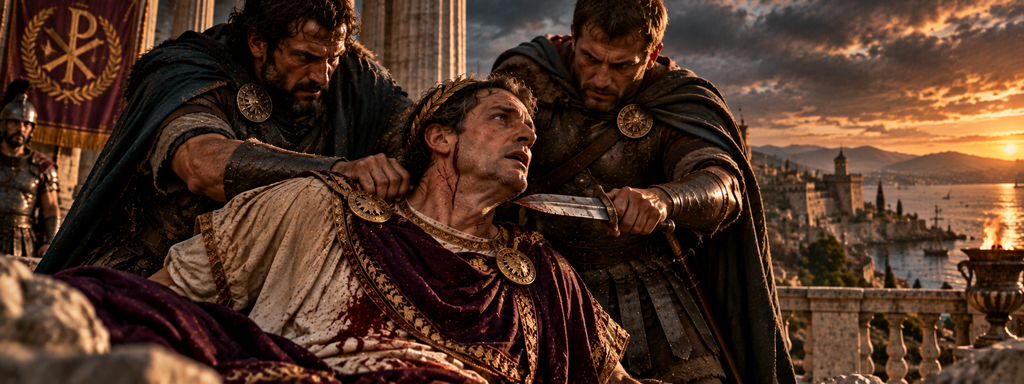
Julius Nepos: Rome’s Forgotten Last Emperor, Betrayed and Murdered in Exile
The Fall of the Western Roman Empire, the Emperor Who Refused to Surrender His Crown, and the Assassination That Ended the Last Claim to the Western Throne
Julius Nepos (died 9 May 480 CE) was Western Roman emperor from June 474 until August 475, when a military rebellion forced him to flee Italy for Dalmatia. Although he lost control of the imperial government in Ravenna, he continued to claim the western throne and remained the last Western emperor recognized as legitimate by the Eastern Roman court. His rival, Romulus Augustulus, was deposed in 476, the year traditionally remembered as the fall of the Western Roman Empire, but Nepos survived for almost four more years. From his refuge in Dalmatia, he retained imperial titles, exercised regional authority, and represented the possibility—however remote—of restoring a Western emperor to Italy. His ambitions ended violently on 9 May 480, when he was assassinated near Salona by men commonly identified in the surviving tradition as the officers Ovida and Viator. The circumstances surrounding the murder remain uncertain, including whether his assassins acted independently or with the encouragement of more powerful political figures. His death eliminated the last surviving ruler who had actually occupied the Western imperial throne and still claimed it with the recognition of Constantinople.
The Emperor History Almost Forgot
When people speak of the fall of Rome, they usually imagine a young emperor surrendering his crown to a barbarian conqueror. The year is 476, the emperor is Romulus Augustulus, and the victorious commander is Odoacer. The scene has become one of the most familiar turning points in European history, a convenient moment at which the ancient world appears to give way to the Middle Ages. Yet the story is not quite as simple as the textbooks suggest, because the man whom the Eastern Roman government regarded as the legitimate Western emperor was still alive.
His name was Julius Nepos, and he was not living in Rome or Ravenna when Romulus Augustulus was deposed. He had already been driven out of Italy by a rebellious general and had retreated across the Adriatic Sea to Dalmatia, a rugged province along the eastern coast of the Mediterranean. There, surrounded by soldiers, provincial officials, and the remnants of his political household, he continued to regard himself as emperor. His name remained attached to the imperial office even though another man controlled the Italian government.
For nearly five years after his flight from Italy, Nepos occupied an extraordinary position. He was an emperor without his imperial capital, a sovereign recognized by Constantinople but unable to command the western territories he claimed, and a potential rival to every ruler who attempted to establish authority in Italy. His continued existence complicated the political settlement that followed the deposition of Romulus Augustulus. As long as Nepos lived, the question of who legitimately possessed western imperial authority remained unresolved.
The situation was dangerous because legitimacy could be a weapon. A ruler might possess soldiers, territory, and practical power, yet still face challenges from someone whose claim enjoyed wider political recognition. Nepos had lost Italy, but he had not surrendered his title. The Eastern emperor Zeno could invoke his rights when dealing with Odoacer, while discontented factions in the West might conceivably use him as a rallying point.
Whether Nepos possessed the resources or political support necessary to recover Italy is another question entirely. His position in Dalmatia was relatively secure for a time, but his military strength was limited compared with the forces controlling the Italian peninsula. The surviving evidence provides little indication that he was close to mounting a successful reconquest. Nevertheless, his continued claim ensured that he remained politically relevant long after his removal from Ravenna.
Then, in May 480, the last Western emperor was murdered. The killing occurred not during a dramatic battle for Rome but in the territory where Nepos had sought refuge after his downfall. Men associated with his own military establishment turned against him, bringing his life and his claim to an abrupt end. The surviving accounts preserve the names of the alleged assassins but leave much of the conspiracy unexplained.
The murder has never occupied the same place in popular memory as the deposition of Romulus Augustulus. It lacked the apparent simplicity of a child emperor surrendering to a victorious general, and it occurred in a province that later narratives often treated as peripheral to Roman history. Yet Nepos’s assassination was historically significant precisely because it removed a surviving claimant whom the Eastern court had continued to recognize. The man whom history frequently overlooks had outlived the conventional fall of his empire, only to be killed by those close enough to reach him in exile.
The Western Empire Before the End
By the time Julius Nepos entered imperial politics, the Western Roman Empire had been struggling for generations. The government still possessed the traditions, titles, and institutions of a state that had once dominated the Mediterranean, but its ability to enforce authority had diminished dramatically. Britain had passed beyond effective imperial control, large areas of Gaul and Hispania were ruled by increasingly independent kingdoms, and North Africa had been lost to the Vandals. The western government remained Roman in its political language and legal traditions, but its territorial and financial foundations had been severely weakened.
The loss of North Africa was especially destructive. When the Vandals captured Carthage in 439, they deprived the Western Empire of a region that had supplied enormous agricultural wealth and tax revenue. The consequences extended far beyond the immediate loss of territory, because the imperial government depended upon those resources to maintain armies and support administration. Without Africa, defending the remaining provinces became increasingly difficult.
Political violence compounded the military crisis. In 454, Emperor Valentinian III personally participated in the assassination of his powerful general Aetius, a commander whose military and diplomatic networks had helped preserve western authority. The following year, Valentinian was himself murdered, setting off another struggle for the throne. Petronius Maximus briefly became emperor before being killed as Vandal forces approached Rome.
The Vandal sack of Rome in 455 inflicted another severe blow upon imperial prestige. Although the city survived and continued to possess immense symbolic importance, the attack demonstrated how vulnerable the western government had become. Powerful foreign rulers could now intervene directly in Roman political affairs. The emperor’s title still carried enormous prestige, but prestige alone could not defend a city or maintain an army.
The years that followed brought further instability. Avitus was overthrown, Majorian attempted an ambitious restoration before being executed on the orders of Ricimer, and Libius Severus ruled under the influence of the same dominant military commander. The Western Empire became increasingly dependent upon powerful generals who could elevate or destroy emperors. A ruler who lacked their support could lose his throne regardless of his formal legitimacy.
Majorian’s death in 461 was particularly damaging because he had demonstrated unusual energy in attempting to restore imperial authority. His campaigns in Gaul and Hispania, administrative reforms, and planned expedition against the Vandals represented a serious effort to reverse the empire’s decline. When Ricimer removed and executed him, the western government lost a ruler capable of exercising substantial personal military leadership. The episode also reinforced the principle that powerful generals could determine who occupied the throne.
The Eastern Roman Empire remained stronger. Constantinople possessed greater financial resources, more secure institutions, and the ability to intervene in western politics. Eastern emperors continued to regard the two halves of the Roman world as parts of a broader imperial order, even when their governments operated separately. Recognition from Constantinople therefore remained an important source of legitimacy for western rulers.
This division between legal authority and military reality would define Julius Nepos’s career. He belonged to a political world in which the Eastern emperor could appoint or recognize a western colleague, but that colleague still needed soldiers and cooperation from the powerful men controlling Italy. The imperial title could be granted through recognized institutions, yet it could be taken away by military rebellion. Nepos would discover how little protection legitimacy offered when the army ceased to obey.
Dalmatia: The Province That Produced an Emperor
Julius Nepos emerged from Dalmatia, a region occupying much of the eastern Adriatic coast and its mountainous hinterland. The province had long been integrated into the Roman world, supplying soldiers, administrators, and several prominent imperial figures. Its coastal cities maintained important commercial and political connections with Italy and the eastern Mediterranean. Although geographically separated from the Italian peninsula by the Adriatic Sea, Dalmatia remained closely connected to western imperial affairs.
The region’s strategic position was important. Its coastline offered ports and maritime routes linking Italy with the Balkans, while its mountainous interior could provide defensible territory. Control of Dalmatia gave a ruler access to valuable military and economic resources, even if those resources were insufficient to restore the entire Western Empire. The province would eventually become Nepos’s refuge after his loss of Italy.
Nepos belonged to a family with significant military and political connections. His father, Nepotianus, had held senior military office during the reign of Majorian and was associated with western campaigns in Hispania. The surviving evidence concerning his father’s career is incomplete, but it places the family within the military aristocracy of the late Western Empire. Nepos therefore inherited connections to a world in which military command and political influence were closely intertwined.
His maternal relationship to Marcellinus was even more important. Marcellinus had established substantial independent authority in Dalmatia during the middle decades of the fifth century. A capable commander, he operated with considerable autonomy from the western government and maintained relationships with the Eastern imperial court. His position reflected the fragmentation of western power, in which regional military leaders could exercise authority while still identifying themselves with Roman institutions.
Marcellinus was not simply a provincial rebel in the conventional sense. He remained involved in Roman military affairs and participated in operations connected with the Eastern Empire. His forces were valuable enough to attract attention from rulers attempting to recover lost western territories. The distinction between independent regional commander and imperial officer had become increasingly uncertain.
In 468, Marcellinus participated in the enormous expedition organized by the Eastern emperor Leo I against the Vandal kingdom. The campaign was intended to recover North Africa and restore Roman control over one of the wealthiest lost provinces. Marcellinus operated in the western Mediterranean and achieved successes in Sardinia. The wider expedition, however, ended in disaster after the main imperial fleet suffered a devastating defeat.
Marcellinus was murdered in Sicily in 468, under circumstances that remain disputed. Some later accounts connect his death to political rivalries involving Ricimer, but the evidence does not establish a complete explanation. His assassination removed another capable military commander from the increasingly unstable western political landscape. It also created an opportunity for Nepos to inherit or assume authority in Dalmatia.
Nepos subsequently emerged as the dominant Roman figure in the province. His position gave him a territorial base, military resources, and valuable connections with Constantinople. Unlike many western politicians whose authority depended entirely upon the shifting alliances of the Italian court, he possessed an established regional power center. That advantage would help him gain the imperial throne and later survive his removal from Italy.
Marriage, Family Connections, and the Road to Power
Nepos’s political position was strengthened by his marriage into the family of the Eastern emperor Leo I. His wife was a niece of Leo’s wife, Verina, making Nepos connected by marriage to the imperial household in Constantinople. Such relationships were enormously valuable in late Roman politics. They could provide access to patronage, diplomatic support, and recognition that might otherwise be difficult to obtain.
Marriage among elite families was rarely a purely private matter. It could create alliances between military commanders, provincial aristocrats, and ruling dynasties. In a political system where succession was frequently contested, family connections could help transform an ambitious commander into a plausible imperial candidate. Nepos’s marriage placed him within the network of people who could influence eastern decisions about the western throne.
The surviving evidence reveals little about his relationship with his wife. Her personal views, political activities, and private influence are largely unknown. It would be misleading to invent a story of marital ambition or palace manipulation without reliable sources. What can be established is that the marriage strengthened Nepos’s connection to the Eastern imperial court.
His position in Dalmatia also made him useful to Constantinople. The Eastern government wanted a western ruler who would recognize its broader imperial authority and maintain some degree of political cooperation. A commander already established along the Adriatic possessed practical advantages. Nepos could potentially enter Italy with a military base behind him rather than arriving as an entirely unsupported court nominee.
The western throne was occupied by Glycerius, who had been elevated in 473 after the death of Olybrius. Glycerius owed his accession largely to Gundobad, a powerful military commander associated with the Burgundian royal family. His government lacked recognition from the Eastern emperor Leo I. This weakness gave Constantinople grounds to support a rival claimant.
Leo selected Nepos as the man who should replace Glycerius. The decision reflected both dynastic connections and political calculation. Nepos possessed regional authority, military experience, and ties to the Eastern court. He also offered the possibility of restoring a western government whose legitimacy would be recognized in Constantinople.
The appointment did not guarantee success. Italy was controlled by forces loyal to the existing regime, and Nepos needed to establish his authority through a combination of military pressure and political negotiation. The Eastern emperor could provide recognition, but the western throne could not be occupied through ceremony alone. Nepos would have to confront the realities of a fragmented empire.
His rise therefore combined legitimate appointment with military intervention. He was not merely an adventurer who seized the purple without recognition, but neither was he a ruler whose accession occurred through an uncontested constitutional process. The late Roman political system no longer possessed a simple mechanism for transferring western imperial power. Nepos’s claim rested upon eastern approval, family connections, and his ability to impose authority in Italy.
The Emperor Sent from Constantinople
In 474, Julius Nepos moved against Glycerius with the backing of the Eastern imperial government. The campaign appears to have involved relatively little major fighting, although the surviving accounts provide limited detail. Nepos arrived in Italy and established control over the imperial government. Glycerius was removed from the throne and subsequently became bishop of Salona in Dalmatia.
The deposition was striking because Glycerius survived. Many western emperors had been killed after losing power, but Nepos did not immediately order the death of his predecessor. The decision may have reflected political calculation, personal restraint, or the circumstances of the transfer of authority. The sources do not allow a confident explanation of his motives.
Nepos was proclaimed Western emperor in June 474, with 24 June commonly given as the date of his accession. His recognition by the Eastern court distinguished him from Glycerius, whose legitimacy had remained disputed. The new emperor entered office with the formal support of Constantinople and an established territorial base in Dalmatia. Yet he inherited a government whose practical authority had been shrinking for decades.
The timing of his accession was difficult. Leo I died in January 474 and was succeeded by his young grandson Leo II, while Zeno soon became co-emperor and then sole ruler after the child’s death later that year. These changes created uncertainty within the Eastern court. Nepos could not assume that the political circumstances supporting his appointment would remain unchanged.
Italy itself was unstable. The western government depended upon military forces containing substantial numbers of soldiers from diverse backgrounds, many of whom maintained strong personal loyalties to their commanders. The emperor’s formal title did not automatically secure their obedience. Powerful officers could threaten the throne if they believed their interests were endangered.
Nepos nevertheless attempted to govern. He appointed officials, pursued diplomatic negotiations, and sought to preserve what remained of western imperial authority. His government operated from Ravenna, the established imperial residence in northern Italy. Rome remained symbolically important, but Ravenna’s defensible position had long made it a preferred center of western administration.
The new emperor faced the challenge of ruling a state whose surviving territories were increasingly disconnected. Italy remained the political center, but Roman authority in Gaul and Hispania was severely restricted. Dalmatia provided an additional base, while other regions were controlled by kings and military commanders who acknowledged imperial authority only when it suited them. Nepos had inherited an imperial title whose geographical meaning was becoming uncertain.
His accession was therefore both an achievement and a warning. He had replaced a rival ruler and gained recognition from the Eastern Empire, but he had not solved the military problems that made western emperors vulnerable. The same forces that had allowed Glycerius to be removed could eventually be used against Nepos. His reign would demonstrate how quickly the distinction between recognized emperor and political exile could disappear.
A Throne Surrounded by Enemies
Nepos became emperor at a moment when the Western Empire had few secure frontiers and even fewer reliable allies. The Visigoths controlled much of southwestern Gaul and had expanded their influence into Hispania. The Burgundians occupied important territories in southeastern Gaul, while other groups exercised authority across regions once governed directly from Rome. The Vandals continued to dominate North Africa and threaten Mediterranean communications.
The most formidable western opponent was Euric, king of the Visigoths. He had succeeded his brother Theodoric II in 466 and pursued an ambitious policy of territorial expansion. Under his leadership, the Visigothic kingdom became increasingly independent of Roman authority. Euric was not content to remain a subordinate ally within an imperial system that could no longer enforce its commands.
The situation in Gaul was particularly difficult. Roman communities and aristocratic families still identified strongly with imperial traditions, but the western government lacked the military resources necessary to defend them consistently. Some local leaders continued to resist Visigothic expansion. Others negotiated with Euric because imperial assistance appeared increasingly unlikely.
Nepos faced a choice between attempting an expensive military confrontation and accepting diplomatic concessions. The Western Empire could no longer mobilize the resources available to earlier emperors. Even a successful campaign might require forces that Italy needed for its own defense. Negotiation therefore offered a practical alternative, although it could involve painful territorial losses.
The emperor also needed to manage relationships with the Burgundians. Their kingdom occupied territory strategically important to communications between Italy and Gaul. Their rulers had participated in Roman military and political affairs, sometimes serving as imperial commanders while pursuing independent interests. Nepos had to navigate these overlapping loyalties.
The Eastern Empire could offer diplomatic recognition and occasional assistance, but it faced its own difficulties. Constantinople was dealing with internal political struggles and external threats. Zeno’s position was not secure throughout this period, and his government could not simply devote unlimited resources to restoring the West. Nepos therefore had to operate within severe constraints.
His military establishment in Italy presented another danger. Powerful commanders controlled soldiers whose loyalty might depend more upon personal relationships and material rewards than upon the emperor’s legal status. The Western Empire had repeatedly witnessed the consequences of this arrangement. Nepos had gained the throne through military intervention, and he remained vulnerable to another intervention.
The emperor’s reign was consequently dominated by the struggle to preserve authority rather than the prospect of major reconquest. He attempted to negotiate with powerful foreign rulers while maintaining control over the forces that remained under imperial command. The balance was fragile. A diplomatic setback or military rebellion could destroy his government.
The Visigothic Crisis and the Sacrifice of Gaul
One of the most controversial aspects of Nepos’s reign concerns his dealings with Euric and the Visigoths. The western government was struggling to defend its remaining territories in Gaul, and the Visigothic kingdom continued to expand. Nepos attempted to negotiate a settlement that would preserve some measure of peace. The resulting arrangements involved recognition or acceptance of territorial losses that Roman communities regarded with bitterness.
The city of Arvernum, modern Clermont-Ferrand, became particularly important in this conflict. The region had resisted Visigothic expansion, and its defenders included members of the Gallo-Roman aristocracy who remained attached to imperial authority. Sidonius Apollinaris, bishop of Clermont, was among the most prominent witnesses to these events. His writings preserve the frustration of provincial elites who believed the imperial government was abandoning them.
Nepos’s government negotiated with Euric through diplomatic representatives, including bishops and aristocrats. The precise sequence and terms of the negotiations remain subjects of historical debate. The settlement is generally associated with the surrender or recognition of Visigothic control over Auvergne. For the people who had resisted Euric, the outcome was deeply painful.
The decision was not necessarily evidence of indifference. Nepos faced a severe shortage of military resources and could not defend every threatened territory. A negotiated settlement might preserve other interests and prevent a wider war. The emperor was attempting to govern within circumstances that offered few satisfactory choices.
Nevertheless, the political consequences were damaging. Provincial elites who had remained loyal to Rome could interpret the agreement as a betrayal. Their resistance had been sustained partly by the expectation that imperial authority would eventually support them. When the government accepted Visigothic control, that expectation collapsed.
Sidonius’s correspondence reveals the emotional intensity of the crisis. His writings express anger and disappointment at the sacrifice of communities that had maintained Roman loyalty. They also demonstrate that Roman identity remained meaningful even when imperial military protection was disappearing. The fall of western authority was experienced not simply as a change of rulers but as the abandonment of political obligations.
Nepos’s decision illustrates the tragic limitations of his reign. He was the legally recognized emperor, yet he lacked the resources to defend communities that still regarded him as their sovereign. Diplomatic compromise could preserve peace in one region while destroying confidence in another. The empire’s shrinking power forced rulers to make choices that undermined their own legitimacy.
The Visigothic settlement also exposed Nepos to criticism within Italy. Military leaders could argue that the emperor was surrendering territory rather than defending it. His reliance upon negotiation might be portrayed as weakness, even when military alternatives were unrealistic. Such criticism contributed to an atmosphere in which his authority could be challenged.
Orestes: The General Who Turned Against His Emperor
The man who would destroy Nepos’s government in Italy was Orestes, a military commander with a complicated background. He had previously served in the political world surrounding Attila the Hun, apparently acting in an administrative or diplomatic capacity. After Attila’s death, Orestes emerged within the western Roman military establishment. His career reflected the fluid loyalties and overlapping political identities of the fifth century.
Nepos appointed Orestes to a senior military position, traditionally identified as magister militum. The appointment placed him in command of important forces within the Western Empire. It also gave him the means to challenge the emperor if their relationship deteriorated. Nepos was repeating a dangerous pattern familiar from the reigns of earlier western rulers.
The reasons for Orestes’s rebellion remain uncertain. Later accounts do not provide a reliable, detailed explanation of his grievances. Disputes over military policy, political influence, and the interests of soldiers may all have contributed. What is clear is that Orestes eventually turned the forces under his command against Nepos.
In 475, Orestes advanced toward Ravenna. The emperor faced the prospect of confronting a rebellious army whose commander had previously served him. The situation resembled the coups that had destroyed earlier western emperors. Formal legitimacy offered little protection when military obedience collapsed.
Nepos did not remain to fight a decisive battle for the capital. Instead, he fled across the Adriatic Sea to Dalmatia, where he possessed an established political and military base. The decision preserved his life and allowed him to maintain his claim to the throne. It also meant surrendering effective control of the Italian government.
Orestes entered Ravenna and established his authority. Rather than assume the imperial title himself, he elevated his young son Romulus to the western throne. The boy became known to history as Romulus Augustulus, a diminutive form of the imperial name Augustus. His accession reflected the power of his father rather than an uncontested transfer of legitimate authority.
The Eastern emperor Zeno did not recognize Romulus as the rightful Western emperor. From Constantinople’s perspective, Nepos remained the legitimate ruler despite his flight from Italy. The result was a divided political situation in which the man exercising imperial office in Ravenna lacked eastern recognition, while the recognized emperor governed only from Dalmatia. The Western Empire had reached a point where legal authority and practical power existed in different places.
Orestes’s rebellion was the decisive turning point in Nepos’s life. The emperor lost the Italian throne he had occupied for little more than a year. Yet unlike many of his predecessors, he escaped execution and retained a territorial refuge. His survival would complicate the political history of the West long after Orestes himself was dead.
Flight Across the Adriatic
Nepos’s escape to Dalmatia in August 475 was both a defeat and an act of political survival. He had lost Ravenna, the administrative center of the Western Empire, and could no longer command the Italian government. Yet he retained access to a province where his family and political connections were strong. The Adriatic Sea separated him from the immediate reach of Orestes’s forces.
The surviving sources provide few details about the journey. They do not preserve a reliable account of the emperor’s private thoughts, the exact composition of his entourage, or the conversations that accompanied his departure. It is therefore impossible to reconstruct the flight as a detailed personal drama without inventing material. The historical circumstances themselves, however, reveal the gravity of the moment.
Nepos had entered Italy as an emperor supported by Constantinople. He had removed Glycerius, occupied Ravenna, and attempted to govern the remnants of the Western Empire. Now he was returning to the province from which his power had originated. His imperial title remained, but his territorial authority had contracted dramatically.
Dalmatia offered more than physical refuge. Nepos had already exercised influence there, and the region possessed military resources sufficient to support a limited independent government. Its coastal cities maintained connections with the eastern Mediterranean, allowing communication with Constantinople. The province therefore provided a base from which Nepos could continue to assert his legitimacy.
The emperor’s position was nevertheless precarious. His forces were too limited to guarantee an immediate recovery of Italy. The military establishment in Ravenna had accepted Orestes’s authority, and Romulus Augustulus occupied the throne. Nepos needed either a change in Italian politics or assistance from the Eastern Empire to restore his position.
His flight also created a problem for Constantinople. Zeno recognized Nepos as legitimate, but recognition did not automatically provide the soldiers necessary to restore him. The Eastern Empire faced its own political crises and could not easily organize a western reconquest. Nepos’s claim therefore remained formally valid but practically difficult to enforce.
The emperor’s survival distinguished him from earlier victims of military rebellion. Majorian had been executed after his removal, and Anthemius had been killed during Ricimer’s struggle for Rome. Nepos escaped the immediate violence of the coup. Yet survival also condemned him to years of uncertainty, during which his imperial title represented both his greatest asset and a continuing source of danger.
His retreat to Dalmatia did not end the history of the Western imperial office. It created an unusual final chapter in which a displaced emperor continued to claim authority while another regime governed Italy. The traditional narrative of Rome’s fall would later overlook much of this complexity. Nepos remained alive, recognized, and politically inconvenient.
Romulus Augustulus: The Boy Who Became the Symbol of Rome’s Fall
After Nepos fled Italy, Orestes placed his son Romulus on the western throne. The young emperor’s age is uncertain, although he is generally understood to have been an adolescent. His diminutive nickname, Augustulus, reflected his youth and perhaps the limited authority he exercised. The real power behind the government remained with his father.
Romulus’s reign lasted only about ten months. During that period, the Italian government continued to face serious military and financial problems. The army contained groups of soldiers who expected land, payment, and recognition for their service. Orestes struggled to satisfy those demands.
The crisis culminated in a rebellion led by Odoacer, a military commander who gained the support of troops dissatisfied with Orestes’s government. Orestes was defeated and killed in 476, while his brother Paulus also died during the struggle. Odoacer then moved against Ravenna. Romulus was deposed on 4 September 476.
The young emperor was not executed. According to the surviving tradition, Odoacer spared his life and arranged for him to live in relative comfort, commonly associated with an estate in Campania. The precise details of his later life remain uncertain. His survival contrasts sharply with the fate of many western rulers who had been murdered after losing power.
The deposition of Romulus Augustulus became the conventional date for the fall of the Western Roman Empire. It marked the disappearance of a separate western imperial court in Italy. Odoacer did not immediately establish another western emperor to replace the boy. Instead, he sought to govern Italy while acknowledging the broader authority of the Eastern emperor.
Yet Romulus had never been recognized by Constantinople as the legitimate Western emperor. That distinction belonged to Julius Nepos, who remained alive in Dalmatia. The conventional date of 476 therefore marks the end of the western imperial government in Italy rather than the death or formal abdication of the last recognized Western emperor. The distinction is essential to understanding Nepos’s historical significance.
The events of 476 also transformed Nepos’s political position. His rival had been removed, and the general who had overthrown him was dead. In theory, the disappearance of Orestes’s regime might have opened the possibility of restoration. In practice, Odoacer now controlled Italy with an army capable of resisting any unsupported attempt to return.
Nepos’s claim therefore survived the event traditionally described as the fall of Rome. He remained the recognized emperor in exile, while Odoacer governed the territory that had once formed the center of his administration. The Western Empire had not simply ended with a single deposition. Its final years involved competing claims, diplomatic negotiations, and the unresolved question of whether an emperor could return.
Odoacer: The King Who Ruled Without Becoming Emperor
Odoacer’s rise marked a decisive transformation in Italian politics. He was a military commander whose forces defeated Orestes and removed Romulus Augustulus. Rather than claim the western imperial title, he established himself as ruler of Italy under a political arrangement that acknowledged the Eastern emperor’s superior status. His government preserved many Roman administrative institutions while operating without a resident Western emperor.
The precise nature of Odoacer’s titles and constitutional position remains debated. He was associated with the title rex, meaning king, and sought recognition of his authority from Constantinople. His regime represented both continuity and change. Roman institutions survived, but the imperial office in Italy was no longer occupied.
The Eastern emperor Zeno faced a complicated situation. He had reason to recognize the practical reality of Odoacer’s control over Italy, but he also maintained the legitimacy of Julius Nepos. Supporting Nepos too strongly might provoke conflict with Odoacer. Abandoning him entirely could undermine the Eastern court’s own claims to determine imperial legitimacy.
The surviving diplomatic accounts describe an exchange involving Odoacer, the Roman Senate, and Zeno. The Italian delegation argued that a separate western emperor was unnecessary and sought recognition for Odoacer’s government. Zeno responded by invoking the rights of Nepos. His position reflected the contradiction between legal continuity and military reality.
Odoacer’s relationship with Nepos was therefore ambiguous. He could acknowledge the exiled emperor’s status while continuing to govern Italy independently. Some evidence indicates that Nepos’s name remained in use in official contexts, including coinage associated with Odoacer’s regime. Such gestures recognized formal legitimacy without transferring practical control.
For Nepos, this arrangement was deeply unsatisfactory. He remained emperor in title, but the government in Italy did not obey him. Odoacer controlled the soldiers, administration, and resources necessary for effective rule. Recognition without restoration preserved Nepos’s claim while leaving him politically powerless beyond Dalmatia.
The situation also created a continuing source of uncertainty for Odoacer. As long as Nepos lived, the Eastern court could invoke his rights when negotiating over Italy. The exiled emperor represented a possible alternative to Odoacer’s authority, even if his actual military prospects were limited. His existence therefore remained politically significant.
Whether Odoacer regarded Nepos as a serious immediate threat cannot be established with certainty. The surviving evidence does not reveal his private calculations. Nevertheless, the unresolved imperial claim formed part of the political landscape in which both men operated. Nepos’s eventual murder would remove one of the principal legal complications surrounding Odoacer’s rule.
The Emperor Without an Empire
From 475 until his death in 480, Julius Nepos governed from Dalmatia while continuing to claim the Western imperial title. His position was unusual but not entirely without precedent in Roman history. Emperors had previously lost capitals, retreated to provincial strongholds, or continued to assert authority after military defeat. What made Nepos distinctive was the scale of the western collapse surrounding him.
The empire he claimed had effectively ceased to function as a unified territorial state. Italy was controlled by Odoacer, Gaul was divided among powerful regional kingdoms, Hispania had largely passed beyond direct imperial authority, and North Africa remained under Vandal rule. Nepos retained Dalmatia, but that province could not support the administrative and military structure of the old Western Empire. His imperial title therefore represented a claim to authority far greater than the territory he actually controlled.
Yet it would be misleading to describe him as entirely powerless. Dalmatia remained an important region with cities, military forces, and economic resources. Nepos possessed enough authority to maintain a political establishment and continue governing locally. His position was closer to that of a regional ruler with an imperial claim than a fugitive without any means of support.
The distinction mattered because his continued rule preserved a form of western imperial continuity. The government in Ravenna had disappeared, but a recognized emperor remained alive and active in a western province. His authority was limited, yet it had not been formally extinguished. The surviving evidence therefore complicates any attempt to assign a single, uncomplicated date to the end of the Western Empire.
Nepos also maintained connections with Constantinople. The Eastern emperor Zeno continued to recognize his legitimacy, although practical assistance remained limited. Diplomatic recognition provided prestige and a possible foundation for future restoration. It did not, however, guarantee that Zeno would commit troops to recover Italy.
The exiled emperor’s position must have required constant political calculation. He needed to maintain loyalty among his own officers, preserve relations with the Eastern court, and avoid provoking an overwhelming military response from Italy. He also had to consider the possibility that Odoacer’s government might eventually weaken. The surviving sources reveal little about his day-to-day administration, but the political pressures were substantial.
His claim could attract supporters who opposed Odoacer, yet it could also make him a target. A recognized emperor in Dalmatia represented a potential rival to the ruler of Italy. Military officers within Nepos’s own establishment might also calculate that his continued ambitions threatened their interests. The same uncertainty that preserved his relevance made his position dangerous.
For almost five years, Nepos survived within this precarious arrangement. He had lost the imperial capital but retained his title and regional authority. The Western Empire existed in a diminished and fragmented form, represented by a man whose claim was recognized but whose restoration remained unlikely. His death would finally close that peculiar chapter.
The Dangerous Question of Restoration
Nepos’s continued claim to the western throne raised an obvious question: could he ever return to Italy? The answer depended upon military resources, political alliances, and the willingness of the Eastern emperor to intervene. Nepos possessed legitimacy but lacked the forces necessary to defeat Odoacer independently. Any serious restoration would therefore require substantial outside assistance or a major change in Italian politics.
The Eastern Empire had previously demonstrated its ability to intervene in western affairs. Leo I had supported Nepos’s original accession, and Constantinople had organized enormous military operations against the Vandals. Yet those campaigns were expensive, and the disastrous failure of the African expedition in 468 had consumed substantial resources. Zeno’s government also faced internal instability.
Zeno himself experienced a period of deposition in 475–476, when Basiliscus briefly seized power in Constantinople. The crisis coincided with the events that removed Nepos from Italy and brought Odoacer to power. The Eastern emperor’s ability to intervene in western affairs was therefore severely restricted at precisely the moment Nepos most needed assistance. Restoring his own authority in Constantinople took priority.
After Zeno regained power, he had to balance competing political interests. Odoacer controlled Italy and could not be removed without a major military commitment. Nepos remained the recognized Western emperor but possessed limited resources. Supporting one side too strongly could provoke conflict without guaranteeing success.
The diplomatic arrangement that emerged preserved ambiguity. Odoacer governed Italy while acknowledging the broader imperial order, and Nepos continued to claim the western title. Zeno could invoke Nepos’s legitimacy without immediately launching a campaign to restore him. The arrangement avoided a direct confrontation but left the central dispute unresolved.
Nepos may have hoped that circumstances would eventually favor his return. Odoacer’s authority depended upon military support, and western political history offered numerous examples of generals being overthrown by rivals. A rebellion in Italy might have created an opportunity for the exiled emperor. Yet the surviving sources do not establish a detailed plan for reconquest.
Later accounts sometimes portray Nepos as preparing to recover Italy shortly before his murder. The claim is plausible within the political circumstances, but the evidence is limited and must be treated cautiously. We cannot confidently reconstruct a specific invasion plan, timetable, or network of conspirators supporting his return. His ambitions are easier to establish than his practical preparations.
The possibility of restoration nevertheless remained politically important. Nepos was not merely a former emperor who had retired from public life. He continued to claim an office recognized by Constantinople, and that claim could affect the calculations of rulers in Italy and Dalmatia. His murder would remove the possibility of his personal return, whatever its actual chances of success.
Salona: The Last Refuge of a Roman Emperor
Salona, near modern Split in Croatia, was one of the most important cities of Roman Dalmatia. It had long served as a major administrative and commercial center, possessing urban institutions, public buildings, and connections with the wider Mediterranean world. Its location made it a natural center for Roman authority along the eastern Adriatic. For Nepos, the region surrounding Salona provided the final refuge of his political career.
The city and its surroundings were associated with the imperial history of Dalmatia. Nearby stood the great palace complex built by Diocletian, the emperor who had reorganized the Roman state at the end of the third century. Diocletian had retired to the region after abdicating in 305, creating a striking historical connection between Dalmatia and imperial power. More than a century and a half later, another emperor would find himself in the same region after losing control of the wider Roman world.
The contrast between the two rulers was profound. Diocletian had voluntarily surrendered the imperial office after exercising enormous authority, while Nepos had been driven from Italy by military rebellion. Diocletian’s retirement followed a deliberate political arrangement, whereas Nepos’s exile reflected the collapse of effective western imperial control. Both men were associated with Dalmatia, but their circumstances belonged to very different phases of Roman history.
Nepos’s residence in the region was not necessarily a life of complete isolation. Dalmatia possessed military forces, officials, and economic resources that allowed him to maintain a regional government. He remained connected to Constantinople and continued to claim the western title. His position was diminished, but it was not entirely ceremonial.
The surviving sources do not provide a detailed description of his household or daily life. We do not know precisely how he spent his mornings, whom he trusted most, or how frequently he received reports from Italy. Such details would make an appealing dramatic narrative, but inventing them would distort the historical record. The available evidence allows us to describe his political circumstances rather than reconstruct private scenes.
His position nevertheless contained obvious tensions. He had to maintain the loyalty of officers who controlled the soldiers protecting him. He also needed to preserve relationships with local elites whose interests might not always align with an ambitious imperial restoration. The longer his exile continued, the more uncertain the future of his government became.
Salona and the surrounding region therefore represented both security and confinement. Nepos had escaped the immediate danger posed by Orestes, but he could not easily recover the throne he had lost. His imperial title connected him to a vast political tradition, while his practical authority remained restricted to a comparatively small territory. The contradiction defined the final years of his life.
The danger ultimately emerged from within that remaining circle of power. Nepos was not killed by a Vandal fleet, a Visigothic army, or an invading force from Italy. He was murdered by men identified as officers associated with his own establishment. The refuge that had preserved his life after the rebellion of 475 became the setting of his assassination.
The Conspiracy Against Julius Nepos
The surviving accounts of Nepos’s assassination are brief, and their limitations are important. They identify the killing as a deliberate act and preserve the names of men associated with it, but they do not provide a complete account of the conspiracy. The motives of the assassins, the precise sequence of events, and the possible involvement of outside political figures remain uncertain. Any detailed reconstruction must therefore distinguish established facts from later interpretation.
The names most commonly associated with the murder are Ovida and Viator. They are generally described as officers or members of Nepos’s military establishment. Their connection to the emperor made the assassination especially significant, because the danger came from men who were close enough to act within his remaining sphere of authority. The murder was not simply an external attack upon a provincial ruler.
The political circumstances offer several possible explanations for the conspiracy. Nepos’s continued claim to Italy may have created tensions among officers who preferred to preserve their local position rather than undertake a dangerous restoration campaign. Personal rivalries within the Dalmatian military establishment could also have played a role. The surviving evidence does not allow these possibilities to be ranked with confidence.
Some later traditions connect the murder to Glycerius, the former emperor whom Nepos had deposed in 474. Glycerius had become bishop of Salona, placing him within the same regional setting where Nepos eventually died. The idea that he might have sought revenge is dramatically appealing, but the evidence is not strong enough to establish his responsibility. The allegation should be treated as a disputed tradition rather than a proven conspiracy.
Odoacer has also been associated with speculation about the assassination. Nepos’s death removed a rival claimant whose legitimacy complicated Odoacer’s position in Italy. That outcome could have benefited the Italian ruler, but political benefit is not proof of involvement. The surviving sources do not establish that Odoacer ordered the killing.
The conspiracy may therefore have originated primarily within Dalmatia. Officers who possessed military influence could have calculated that Nepos’s removal would allow them to seize greater local authority. Such struggles were common in the late Western Empire, where commanders frequently challenged rulers whose legitimacy exceeded their practical power. Nepos’s own career had been shaped by similar conflicts.
The assassination also illustrates the vulnerability of a ruler whose political position depended upon personal loyalty. Nepos possessed imperial recognition but lacked the institutional strength necessary to guarantee obedience. His officers controlled the forces that protected him, and their defection could leave him defenseless. The same structural weakness that had destroyed his government in Italy now threatened his life in Dalmatia.
The full conspiracy remains hidden behind fragmentary evidence. We know that Nepos was murdered and that named associates were implicated in the surviving tradition. We do not know every participant, every motive, or every conversation that preceded the attack. The uncertainty is part of the history rather than an invitation to invent a more elaborate plot.
The Murder of the Last Western Emperor
Julius Nepos was assassinated on 9 May 480, with the killing generally located near Salona in Dalmatia. The date is preserved in the historical tradition, although the surviving accounts differ in their level of detail. The emperor had been living in the region since his flight from Italy in 475. His death ended nearly five years of exile and the last surviving claim of a man who had actually ruled as Western emperor.
The attack was carried out by men associated with his own military establishment. Ovida and Viator are the names most frequently preserved in accounts of the murder. Their involvement made the event an act of internal betrayal rather than a conventional military defeat. Nepos was destroyed by the kind of political violence that had repeatedly devastated western imperial government.
Some accounts place the assassination at or near a villa associated with the emperor. Others provide little more than the location and the names of the alleged killers. The precise circumstances of the attack cannot be reconstructed with confidence. There is no reliable basis for inventing a dramatic final conversation, a particular sequence of wounds, or the emperor’s last words.
The absence of such details does not diminish the event’s significance. Nepos had survived the rebellion of Orestes, the elevation of Romulus Augustulus, and the transformation of Italian government under Odoacer. He had remained recognized by Constantinople despite losing his imperial capital. His assassination brought that unusual survival to an end.
The murder also demonstrated that his refuge in Dalmatia was not secure against internal opposition. Nepos possessed a territorial base and loyal supporters, but his authority depended upon men whose interests could change. Once conspirators within his own establishment turned against him, his imperial title offered little protection. The political system that had destroyed so many western rulers claimed another victim.
The fate of the assassins is only partly recoverable. Ovida appears in the subsequent struggle for control of Dalmatia and was eventually defeated by Odoacer’s forces. The surviving evidence concerning Viator is more limited. Their actions contributed to the collapse of the political arrangement Nepos had maintained in exile.
The killing removed a figure whose existence had complicated relations between Italy and Constantinople. Odoacer no longer faced a living Western emperor whose claim had been recognized by the Eastern court. Zeno could no longer insist upon Nepos’s personal restoration. The legal question of western imperial authority would now be handled through different political arrangements.
Nepos’s death was therefore a second ending to the Western Roman Empire. The first had occurred in 476, when Romulus Augustulus was deposed and the separate imperial court in Italy disappeared. The second came in 480, when the last recognized Western emperor was murdered in Dalmatia. Neither event alone explains the transformation of the Roman world, but together they reveal how the western imperial office finally vanished.
Did Glycerius Arrange the Assassination?
The possibility that Glycerius was involved in Nepos’s murder has attracted attention because it offers a dramatic story of revenge. Glycerius had occupied the western throne before Nepos arrived in Italy in 474. He was removed from power and subsequently became bishop of Salona. Years later, Nepos was murdered in the same region where his deposed predecessor had been placed.
The circumstances naturally invite suspicion. Glycerius had lost the imperial title through Nepos’s intervention, and his later position in Dalmatia placed him near the exiled emperor. A desire for revenge would be understandable as a possible motive. Yet historical investigation requires more than a plausible motive and geographical proximity.
The surviving evidence does not establish that Glycerius organized the assassination. Some later accounts and interpretations associate him with the killing, but the tradition is uncertain. We lack reliable documentation of meetings, payments, orders, or direct cooperation between Glycerius and the named assassins. The allegation therefore remains speculative.
Glycerius’s position as bishop also complicates the narrative. His ecclesiastical office did not necessarily remove him from political affairs, because bishops in late antiquity could exercise considerable influence. Former imperial officials sometimes retained networks of supporters after entering religious life. Nevertheless, the existence of such influence does not prove participation in murder.
It is also possible that later writers connected Glycerius to the assassination because the story possessed obvious dramatic appeal. A deposed emperor taking revenge upon the man who replaced him would fit familiar patterns of Roman political violence. Such narratives could develop even when direct evidence was lacking. Historians must therefore distinguish literary plausibility from documented responsibility.
The accusation against Glycerius should not be dismissed as impossible, but neither should it be presented as established fact. His relationship with Nepos provides a possible political context for hostility. It does not supply proof that he directed the conspirators. The responsible conclusion is that his involvement remains uncertain.
The mystery illustrates the limitations of the surviving record. Nepos’s assassination occurred during a period when western historical documentation was increasingly fragmented. Chroniclers preserved important events but rarely provided the detailed investigations modern readers might expect. As a result, the names of the killers survive more clearly than the motives behind their actions.
The uncertainty also makes the event more unsettling. Nepos had numerous potential enemies, including political rivals, ambitious officers, and rulers who benefited from his removal. Yet the surviving evidence does not reveal which interests ultimately drove the conspiracy. The last Western emperor died in circumstances that remain partly concealed by the collapse of the world he represented.
Did Odoacer Benefit from Nepos’s Death?
Odoacer’s position in Italy was strengthened by the disappearance of Nepos as a living claimant. Since 476, he had governed without a resident Western emperor while acknowledging the broader authority of Constantinople. Nepos’s continued existence complicated that arrangement because Zeno recognized him as legitimate. His death removed a political figure who could potentially be used to challenge Odoacer’s authority.
The benefit was real, but its significance must be interpreted carefully. A ruler can gain from an assassination without having ordered it. The surviving evidence does not establish that Odoacer directed Nepos’s murder or maintained secret contact with the conspirators. Any claim of direct responsibility would require evidence that the sources do not provide.
Odoacer had practical reasons to prefer stability in Dalmatia. The region lay across the Adriatic from Italy and possessed strategic ports and military resources. An independent ruler there could threaten communications or become involved in broader political struggles. Nepos’s imperial claim made the province especially sensitive.
After the assassination, Odoacer moved to establish control over Dalmatia. His forces defeated Ovida, who had emerged as a significant figure following Nepos’s death. The campaign brought the region under Odoacer’s authority. This outcome demonstrates that the murder created an opportunity for territorial expansion.
The sequence can easily encourage retrospective suspicion. Nepos was killed, Ovida gained influence, and Odoacer subsequently conquered Dalmatia. Yet the order of events does not prove that Odoacer had planned the assassination. His campaign may have been a response to instability created by the murder rather than its original purpose.
The Eastern court also had reasons to accept a new political arrangement after Nepos’s death. With the recognized Western emperor gone, the question of restoration became less immediate. Odoacer’s government could continue to operate within a framework of nominal recognition of eastern imperial supremacy. The practical division between Constantinople and Italy remained.
The murder therefore benefited Odoacer by removing a rival claimant and creating conditions that allowed him to extend his control. Whether those benefits were anticipated or merely exploited remains unknown. The distinction is important because late Roman politics produced many situations in which rulers profited from violence they had not necessarily initiated. Historical accuracy requires resisting the temptation to turn every convenient outcome into evidence of conspiracy.
Nepos’s death also exposed the weakness of the remaining Roman political order in Dalmatia. Once he was gone, his local government lacked the authority necessary to resist external intervention effectively. Odoacer’s conquest demonstrated how vulnerable the province had become. The last Western emperor’s refuge was absorbed into the kingdom that had replaced the imperial government in Italy.
The Fate of Ovida and the Conquest of Dalmatia
Ovida’s role in the aftermath of Nepos’s assassination provides one of the clearest indications that the murder was connected to a struggle for political power. The surviving accounts identify him among the men associated with the killing and place him within the subsequent conflict over Dalmatia. After Nepos’s death, Ovida appears to have exercised authority or commanded forces in the province. His position made him a target for Odoacer.
Odoacer moved against Dalmatia in 481 or 482, with the chronology varying somewhat among historical reconstructions. His forces defeated Ovida and brought the province under Italian control. The campaign expanded Odoacer’s authority across the Adriatic. It also eliminated the remaining political structure associated with Nepos’s independent rule.
The fate of Ovida is commonly described as death at the hands of Odoacer’s forces. The precise circumstances are not fully preserved. Whether he died in battle, was captured and executed, or met another violent end cannot be reconstructed with complete confidence from the surviving evidence. What matters is that his attempt to maintain power in Dalmatia failed.
The conquest also altered the strategic balance in the Adriatic. Dalmatia had been a separate Roman power center under Marcellinus and later Nepos. Its incorporation into Odoacer’s kingdom removed that independent political base. Italy and the eastern Adriatic were now linked under the same ruler.
For Constantinople, the change was significant. The Eastern Empire had supported Nepos and recognized his imperial claim, but it had not restored him to Italy. After his murder, Odoacer expanded into the territory where the emperor had maintained his remaining authority. The political settlement that emerged reflected military reality more than formal constitutional principle.
The conquest of Dalmatia also demonstrates how quickly the consequences of assassination could extend beyond the immediate victim. Nepos’s death created a power vacuum that attracted military intervention. The men who had participated in his downfall did not establish a stable successor government. Instead, the province passed into the hands of the ruler who already controlled Italy.
Ovida’s fate contains its own bitter irony. If he expected Nepos’s removal to secure greater personal power, the outcome was temporary. His authority did not survive Odoacer’s intervention. The assassination that eliminated the emperor also helped destroy the political independence of the territory in which the conspirators operated.
The final result was the disappearance of the last separate western imperial claimant and the absorption of his refuge into Odoacer’s kingdom. The Western Empire had lost its Italian court in 476, but Dalmatia had preserved a final fragment of imperial continuity. After 480, even that arrangement was gone. The political map of the western Mediterranean had changed again through murder and conquest.
Was Julius Nepos Really the Last Western Roman Emperor?
The question of who should be called the last Western Roman emperor depends upon what is meant by the title. Romulus Augustulus was the final person to occupy the western imperial court in Italy before its abolition in 476. Julius Nepos was the last ruler recognized by the Eastern imperial government as the legitimate Western emperor. Both descriptions are historically meaningful, but they refer to different aspects of imperial authority.
Romulus’s claim rested upon his elevation by Orestes, the general who had driven Nepos from Italy. He occupied the imperial residence at Ravenna and exercised the ceremonial role of emperor, although his father controlled the government. Constantinople did not recognize him as the legitimate western ruler. His deposition in 476 therefore ended a regime whose legal standing had always been disputed.
Nepos possessed a stronger claim in terms of eastern recognition. He had been elevated with the support of Leo I and continued to be regarded as legitimate after his flight from Italy. His authority in Dalmatia provided a territorial base from which he maintained that claim. He remained alive until 480, four years after the deposition of Romulus.
The distinction reflects the complexity of Roman imperial legitimacy. Emperors could be proclaimed by armies, recognized by other rulers, and accepted by administrative institutions. These forms of authority did not always coincide. During the final decades of the West, the gap between formal recognition and practical control became especially pronounced.
Nepos’s claim was not merely a retrospective invention. The Eastern court treated him as the rightful emperor, and his name continued to carry political significance after 475. Odoacer’s dealings with Constantinople had to account for his existence. His survival therefore mattered to contemporary politics, not only to later historical classification.
Nevertheless, Nepos did not exercise effective authority over Italy after his flight. His government was confined largely to Dalmatia, and he lacked the resources necessary to enforce his claim across the former western territories. Calling him the last legitimate emperor should not obscure the limited extent of his practical power. Legitimacy and control had become separate realities.
The conventional date of 476 remains useful because it marks a major institutional transformation. The separate western imperial court in Italy disappeared, and Odoacer established a government that operated without appointing another Western emperor. Yet the date should not be mistaken for the moment when every western imperial claim vanished. Nepos’s survival demonstrates that the transition was more complicated.
His assassination in 480 therefore provides an alternative endpoint for the history of the Western imperial office. It marks the death of the last surviving ruler who had occupied the recognized western throne and continued to claim it. The empire’s institutions had already fragmented, but the legal continuity represented by Nepos ended with his murder. His death belongs beside 476 in any serious account of the final years of the Western Roman Empire.
The Strange Afterlife of the Western Empire
The death of Julius Nepos did not mean that Roman civilization disappeared from the West. Roman law, administrative practices, religious institutions, and cultural traditions continued under rulers who no longer held the western imperial title. Odoacer’s government preserved many features of late Roman administration. The transformation of the western political world was gradual and uneven rather than a sudden collapse into complete disorder.
The Eastern Roman Empire also continued to exist. Constantinople remained the center of a powerful Roman state whose rulers regarded themselves as emperors of the Roman world. The disappearance of a separate western court did not end the imperial tradition. It changed the political relationship between the surviving eastern government and the territories formerly administered from Italy.
Odoacer’s kingdom lasted until the arrival of Theoderic the Great, who invaded Italy with the backing of the Eastern emperor Zeno. The conflict ended with Odoacer’s defeat and murder in 493. Theoderic established an Ostrogothic kingdom that preserved many Roman institutions while operating under a new political structure. The history of Italy after 476 therefore remained deeply connected to Roman administrative and cultural traditions.
Dalmatia also continued to play a role in these transformations. Its strategic position along the Adriatic made it valuable to rulers seeking control over communications between Italy and the Balkans. The province passed through further political struggles as the balance of power changed. Nepos’s death did not end its importance, but it ended its brief role as the refuge of a recognized Western emperor.
The survival of Roman institutions helps explain why contemporaries did not necessarily regard 476 as the absolute end of an age. Political authority had changed hands many times during the fifth century, and new rulers often adopted familiar Roman titles and administrative practices. The deposition of Romulus was important, but it was not accompanied by the immediate disappearance of Roman society. Later historians gave the event a symbolic significance that exceeded its immediate contemporary impact.
Nepos’s survival reinforces this point. A recognized Western emperor continued to exist after the supposed fall of the Western Empire. His claim remained part of diplomatic relations between Italy and Constantinople. The political transformation was therefore still unfolding when he was murdered in 480.
The final years of the Western Empire cannot be reduced to a single dramatic moment. They involved overlapping claims, military rebellions, diplomatic negotiations, and regional governments that preserved elements of Roman authority. Nepos occupied an unusual position within that process because he represented a form of imperial legitimacy detached from effective control of Italy. His death marked the disappearance of that final personal claim.
The broader Roman world continued, but the separate western imperial office did not recover. Later rulers would claim Roman authority in different forms, and the Eastern Empire would eventually attempt to reconquer parts of the West. Yet the political arrangement represented by Nepos was gone. The last recognized Western emperor had been murdered in the province where he had sought refuge.
The Emperor Who Survived the Fall of His Own Empire
Julius Nepos’s career is remarkable because he survived an event that later generations treated as the end of his political world. He had been driven from Italy in 475, but his claim remained alive when Romulus Augustulus was deposed the following year. The Western imperial court disappeared from Ravenna, yet Nepos continued to hold the title recognized by Constantinople. His existence complicated the convenient narrative of a single, decisive fall.
The emperor’s survival also reveals the importance of regional power. Dalmatia provided him with soldiers, officials, and a territorial base after the loss of Italy. Without that refuge, he might have shared the fate of earlier emperors executed immediately after deposition. His family connections and local authority allowed him to remain politically relevant. Yet the same regional establishment eventually became the setting of his murder.
His position was shaped by contradictions. He possessed legal recognition but lacked the resources to enforce his claim across the West. He remained an emperor but governed only a fraction of the territory associated with the title. He was politically important enough to complicate diplomatic relations, yet too weak to recover Italy without outside assistance.
These contradictions made his final years dangerous. Odoacer had reason to prefer a settlement that secured his control of Italy, while Zeno had reason to preserve the principle of eastern authority over western succession. Officers in Dalmatia had their own interests, which might not align with Nepos’s continued imperial ambitions. The emperor stood at the intersection of competing political calculations.
The assassination exposed the fragility of his position. Men associated with his own military establishment turned against him, and his remaining authority collapsed. The surviving accounts do not establish every motive behind the killing, but they reveal its essential character as an act of internal betrayal. Nepos died because the political system around him could not guarantee the loyalty of those responsible for his protection.
His death also ended the possibility of a personal restoration. Whatever hopes he maintained of returning to Italy vanished with the assassination. The Eastern court could no longer invoke his living claim as the basis for restoring a Western emperor. Odoacer subsequently absorbed Dalmatia into his kingdom, removing the territorial base from which Nepos had continued to rule.
The tragedy is intensified by the relative obscurity of the event. Romulus Augustulus became famous as the last emperor because his deposition offered a convenient symbolic ending. Nepos, who possessed the stronger claim to legal legitimacy, became a secondary figure in many popular accounts. His murder received far less attention than the peaceful removal of the boy who had occupied his throne.
Yet the history of the Western Empire’s final years is incomplete without him. Nepos demonstrates that the disappearance of imperial government in Italy did not immediately extinguish every recognized western imperial claim. He survived the conventional fall of Rome and continued to occupy a political position that mattered to contemporary rulers. His assassination in 480 closed a chapter that the traditional date of 476 leaves unfinished.
The Final Betrayal of Roman Imperial Authority
The murder of Julius Nepos belongs to a long sequence of political killings that weakened the Western Roman Empire during its final century. Emperors, generals, and powerful officials repeatedly fell victim to conspiracies and military rebellions. These acts of violence were not isolated personal tragedies. They undermined the continuity of government and made effective long-term policy increasingly difficult.
The assassination of Aetius in 454 destroyed one of the most important military networks supporting western authority. Valentinian III was murdered the following year, while Petronius Maximus died during the Vandal crisis. Majorian was executed in 461 after attempting to restore imperial power, and Anthemius was killed in 472 following conflict with Ricimer. Nepos’s murder continued this pattern of rulers destroyed by political violence.
The circumstances of his death were distinctive because he no longer controlled Italy. He had survived the military rebellion that removed him from Ravenna and maintained his claim from Dalmatia. His position was weaker than that of a reigning emperor in the imperial capital, but it remained politically significant. The assassins eliminated a man whose title still carried legal recognition.
The event also demonstrated that exile did not necessarily provide safety. Nepos had escaped Orestes’s rebellion by retreating to a province where his family possessed influence. For several years, that decision preserved his life. Yet the political relationships sustaining his refuge eventually proved unstable.
The involvement of men associated with his own military establishment made the betrayal especially revealing. The Western Empire had become dependent upon commanders whose personal interests could override institutional loyalty. Nepos had already experienced this problem when Orestes turned against him in Italy. In Dalmatia, another internal conspiracy finally destroyed him.
His assassination removed the last recognized claimant to the separate Western imperial throne. It did not end Roman civilization or the authority of the Eastern emperor, but it extinguished a particular political continuity. The man who had once governed from Ravenna and later ruled from Dalmatia was gone. No successor would restore the same western imperial office.
The consequences extended beyond the death of one ruler. Odoacer conquered Dalmatia, and the political arrangement that had allowed Nepos to survive disappeared. The Eastern Empire continued to negotiate with rulers in Italy, but the question of restoring Nepos was permanently closed. The western imperial title ceased to have a living claimant of his kind.
The final betrayal therefore symbolized a broader transformation. Roman imperial authority in the West had become detached from the military power necessary to sustain it. Nepos possessed legitimacy but could not guarantee obedience. His murder demonstrated how little protection remained for a sovereign whose political world had already fragmented.
The Last Emperor Died After Rome Had Already Fallen
Julius Nepos lived through the final transformation of the Western Roman Empire. He came from a powerful military family in Dalmatia, gained recognition from Constantinople, and entered Italy as the chosen replacement for an emperor whose legitimacy was disputed. His accession in 474 appeared to offer the possibility of restoring a western government supported by the stronger Eastern Empire. Yet the political and military weaknesses of the West proved too severe for his authority to endure.
His reign in Italy lasted little more than a year. He confronted the expansion of the Visigoths, negotiated difficult territorial settlements, and attempted to govern a state whose resources had been shrinking for decades. His appointment of Orestes placed military power in the hands of a commander who eventually turned against him. When rebellion threatened Ravenna in 475, Nepos fled to Dalmatia rather than risk capture and execution.
The following year, Romulus Augustulus was deposed by Odoacer, creating the event traditionally remembered as the fall of the Western Roman Empire. Yet Nepos remained alive and continued to claim the throne. Constantinople still recognized him as legitimate, while Odoacer governed Italy without restoring a resident Western emperor. The result was a political contradiction in which the recognized sovereign survived outside the territory that had once formed the center of his government.
For almost five years, Nepos maintained his position in Dalmatia. His authority was limited, and his prospects for recovering Italy were uncertain, but his claim remained politically significant. He represented the survival of western imperial legitimacy after the disappearance of the imperial court in Ravenna. His existence prevented the story of Rome’s fall from ending neatly in 476.
On 9 May 480, that final claim ended in blood. Nepos was assassinated near Salona by men associated with his own military establishment, with Ovida and Viator named in the surviving tradition. The possible involvement of Glycerius or Odoacer remains disputed, and the precise motives behind the conspiracy cannot be established. What is certain is that the last recognized Western emperor was deliberately killed in the province where he had sought refuge.
The murder did not cause the collapse of the Western Empire, because the institutions that had once sustained it were already profoundly weakened. It did, however, eliminate the final living claimant whose legitimacy had been recognized by Constantinople. Odoacer subsequently conquered Dalmatia, absorbing the territory that had preserved Nepos’s remaining authority. The separate western imperial office had reached its final personal ending.
Nepos’s story challenges the familiar image of Rome’s fall as a single moment when a young emperor surrendered his crown. The transformation was more complicated, involving military rebellions, disputed legitimacy, regional power centers, and the survival of Roman institutions under new rulers. Romulus Augustulus became the symbol of the end because his deposition marked the disappearance of the imperial court in Italy. Julius Nepos became the forgotten emperor because he continued to exist after that symbolic moment had passed.
His life also reveals the tragedy of an imperial office that retained prestige after losing the power necessary to defend itself. Nepos possessed recognition, dynastic connections, and a territorial refuge, but none of those advantages could guarantee the loyalty of his own officers. He had survived the rebellion that removed him from Italy, only to be murdered by men within the remaining political world he controlled. The imperial title that once commanded armies across continents could no longer protect its holder in a single province.
The Western Roman Empire did not end with one battle, one invasion, or one emperor surrendering his crown. Its final years were marked by a slow separation of legitimacy from power, until rulers could possess the imperial title without commanding the territory or soldiers necessary to sustain it. Julius Nepos embodied that contradiction more completely than almost any other man of his age, surviving the traditional fall of Rome while continuing to claim the throne from exile. In May 480, the last recognized Western emperor was murdered by men associated with his own military establishment, and the final surviving claim to the western purple died with him. History would remember the boy who lost the throne in 476, but the emperor who outlived him deserves a place in the story as well. Rome’s western imperial court had already disappeared; four years later, in Dalmatia, the last man who could still claim its crown was killed.