
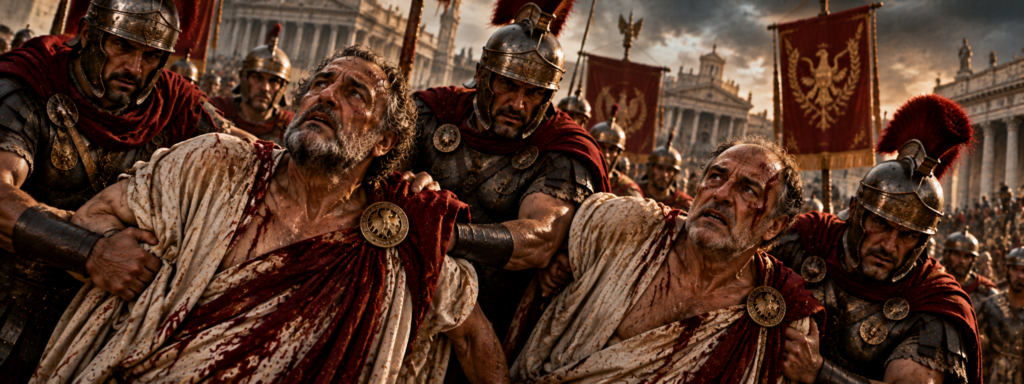
Pupienus and Balbinus: Rome’s Two Emperors Dragged from Their Palace and Murdered by the Praetorian Guard
The Year of Six Emperors, the Senate’s Desperate Rebellion, and the Bloody Betrayal That Destroyed a Joint Reign
Marcus Clodius Pupienus Maximus (c. 164–238 CE) and Decimus Caelius Calvinus Balbinus (c. 178–238 CE) were joint Roman emperors from approximately April to July 238 CE, during one of the most violent succession crises of the third century. Chosen by the Roman Senate to oppose the emperor Maximinus Thrax, they represented an extraordinary attempt to restore senatorial authority over the imperial government. Their brief reign was marked by civil war, popular unrest, mutual suspicion, and growing hostility from the Praetorian Guard. After Maximinus was murdered by his own soldiers, the two emperors found themselves increasingly isolated in Rome, where the guardsmen resented their authority and favored the young Gordian III. In the summer of 238, Praetorian soldiers stormed the imperial palace, seized both emperors, stripped and abused them, and dragged them through the streets before killing them. Their reign lasted only a few months, and their deaths exposed the terrifying weakness of imperial authority when the soldiers responsible for protecting the throne decided to destroy its occupants.
The Day Rome’s Emperors Were Dragged from the Palace
The two emperors were still alive when the Praetorian Guard dragged them out of the imperial palace. That was the detail that made their deaths particularly horrifying. Pupienus and Balbinus had not fallen in battle against a foreign enemy, nor had they been condemned by a court or formally removed from office. They had been seized by the very soldiers charged with protecting the rulers of Rome, and their captors intended to make their humiliation as public as their destruction.
The guardsmen stripped the emperors of their imperial dignity and subjected them to brutal treatment. Ancient accounts describe the elderly rulers being dragged through the streets, beaten, and abused before they were finally killed. The violence was not merely an assassination designed to remove two political opponents. It was an act of deliberate humiliation, a demonstration that the Praetorian Guard considered itself powerful enough to seize, torture, and dispose of emperors without fear of punishment.
Only a few months earlier, Pupienus and Balbinus had been chosen to save the Roman state from a military tyrant. The Senate had elevated them during a rebellion against Maximinus Thrax, a formidable emperor whose rule had alienated influential aristocrats and provincial communities. Pupienus was an experienced military commander and administrator, while Balbinus possessed the distinguished aristocratic background expected of a traditional Roman statesman. Together, they were supposed to provide the leadership necessary to restore order and defend the empire.
Their appointment had been presented as an act of political salvation. Yet from the beginning, the two men faced enemies on every side. The people of Rome distrusted the Senate’s choices, the Praetorian Guard resented the new emperors, and the military establishment remained dangerously divided. Even the two rulers themselves struggled to establish a relationship based upon mutual confidence.
The immediate threat from Maximinus eventually disappeared when his own soldiers murdered him during the siege of Aquileia. His death should have secured the joint emperors’ position, removing the powerful enemy against whom they had been chosen. Instead, it exposed the weaknesses that had been concealed by the common struggle. With Maximinus gone, Pupienus and Balbinus had to confront their own rivalry, the ambitions of the Praetorians, and the growing popularity of a thirteen-year-old boy named Gordian.
Their downfall came with astonishing speed. The guardsmen attacked the palace while the emperors were divided and unable to organize an effective defense. The German troops whom Pupienus reportedly trusted could not intervene in time, and the two rulers were overwhelmed. Their deaths cleared the way for Gordian III, the young prince whose presence had already complicated their reign.
The murder of Pupienus and Balbinus was more than another episode of imperial bloodshed. It was the destruction of a rare attempt by the Senate to regain meaningful control over the Roman throne. The two emperors had been elevated to resist military domination, yet they were killed by soldiers who refused to accept their authority. Their brief reign demonstrated that the Senate could still proclaim emperors, but it could no longer guarantee that those emperors would survive.
An Empire Where Soldiers Made and Unmade Emperors
By 238 CE, the Roman Empire was entering a period of profound instability. The death of Severus Alexander in 235 had brought an end to the Severan dynasty and opened the way for a new kind of military ruler. Maximinus Thrax, a soldier of remarkable physical stature and military reputation, had been proclaimed emperor by troops on the Rhine frontier. His accession demonstrated that the army could elevate a ruler without waiting for the traditional political institutions in Rome.
Maximinus possessed qualities that appealed to soldiers. He had spent much of his career in military service and cultivated an image of strength, endurance, and personal courage. His background differed sharply from that of emperors raised within aristocratic households. To supporters, he represented the virtues of a hardened military commander; to hostile senators, he embodied the dangerous rise of military power over established political authority.
His reign was dominated by military campaigning and the financial demands of maintaining the army. The emperor required substantial resources to support frontier operations, pay soldiers, and sustain the military establishment. These demands placed pressure upon provincial communities and wealthy individuals. Ancient sources describe harsh taxation and confiscations, although their hostility toward Maximinus complicates the assessment of his policies.
The Senate’s relationship with Maximinus was deeply troubled. Many senators resented his social background, his dependence upon the army, and his absence from Rome. The emperor governed largely from military headquarters, leaving the capital without the traditional presence of its ruler. His policies and reputation encouraged fears that senatorial privilege was under threat.
The political atmosphere was made more dangerous by the memory of earlier imperial violence. The Severan period had witnessed the murder of Geta, the assassination of Caracalla, the execution of Macrinus, and the killing of Elagabalus. Each succession crisis had demonstrated the willingness of soldiers and political factions to eliminate rulers. The throne had become a prize that could be won through violence and lost just as quickly.
The assassination of Severus Alexander had been especially significant. His death showed that even a ruler with dynastic legitimacy and years of imperial experience could be destroyed by military dissatisfaction. Maximinus had benefited from that violence, but his own position remained dependent upon the soldiers who had elevated him. The army’s loyalty was powerful but never unconditional.
For the Senate, the growing dominance of military emperors threatened more than individual careers. It challenged the aristocratic traditions through which Roman elites understood their place in government. Senators still possessed wealth, prestige, and administrative experience, but their ability to determine the succession had weakened. The rise of Maximinus intensified the desire among some senators to recover political influence.
The opportunity came from an unexpected rebellion in North Africa. What began as provincial resistance to imperial financial demands would develop into a crisis involving multiple emperors, competing armies, and the Senate itself. Pupienus and Balbinus would emerge from that crisis as the men chosen to confront Maximinus. Their elevation would briefly revive hopes that Rome’s aristocracy could reclaim control over the imperial government.
The African Rebellion That Set the Empire on Fire
The crisis of 238 began in the province of Africa Proconsularis, one of the wealthiest and most important regions of the Roman Empire. The province supplied grain, agricultural wealth, and substantial tax revenues. Its cities contained prosperous landowners and influential local elites who maintained close connections with the Roman aristocracy. These communities had strong reasons to resist policies they considered financially oppressive.
Ancient sources describe a revolt against an imperial financial official whose methods had provoked widespread resentment. Wealthy landowners and their supporters organized resistance, eventually killing the official and openly rejecting Maximinus’s authority. The surviving accounts differ in detail, and some dramatic episodes may have been embellished. Nevertheless, the rebellion reflected genuine hostility toward the emperor’s fiscal administration.
The insurgents needed a legitimate alternative ruler. They turned to Marcus Antonius Gordianus Sempronianus Romanus, an elderly senator serving as governor of Africa. Gordian was a respected aristocrat with a long public career, and his advanced age may have made him appear less threatening to competing political interests. He was reportedly reluctant to accept the imperial title, but the rebels pressed him to lead their movement.
Gordian I was proclaimed emperor alongside his son, Gordian II. The younger Gordian possessed administrative experience and became an essential partner in the rebellion. Their joint rule represented an attempt to combine aristocratic legitimacy with provincial resistance. The father and son quickly became symbols of opposition to Maximinus.
The rebels appealed to the Senate for recognition. Their request placed the senators in a dangerous position because supporting the Gordians meant openly rejecting the reigning emperor. If the rebellion failed, Maximinus could punish those who had supported it. Yet the opportunity to remove him was politically attractive.
The Senate chose to recognize the Gordians and condemn Maximinus. This decision transformed a provincial revolt into an empire-wide struggle for legitimacy. The senators were no longer merely criticizing imperial policy; they had declared that the emperor should be removed. Their political survival now depended upon the success of the rebellion.
The African uprising, however, was militarily vulnerable. The province did not possess forces comparable to the major frontier armies, and the Gordians lacked the experienced military support necessary to defend their claim. The governor of neighboring Numidia, Capelianus, remained loyal to Maximinus and commanded Legio III Augusta. His forces were capable of confronting the rebels directly.
The resulting battle near Carthage ended in disaster for the Gordians. Gordian II was killed, and his elderly father died shortly afterward, traditionally described as taking his own life after learning of the defeat. Their joint reign had lasted only a few weeks. The rebellion that had inspired the Senate to defy Maximinus appeared to have collapsed almost immediately.
The senators now faced a terrifying dilemma. They had publicly supported two men who were dead, while Maximinus remained alive and commanded a formidable army. The emperor had every reason to punish those who had declared against him. The Senate needed new rulers capable of organizing resistance before Maximinus reached Italy.
The Senate Chooses Two Emperors
The Senate’s decision to appoint Pupienus and Balbinus emerged from desperation. The Gordians had been defeated, and Maximinus remained a dangerous enemy. The senators needed leaders who could provide military resistance while maintaining the appearance of constitutional legitimacy. Their solution was to elevate two men rather than entrust the crisis to a single ruler.
The choice reflected the Senate’s desire to balance military competence with aristocratic prestige. Pupienus possessed a reputation for discipline, command, and administrative ability. Balbinus represented the distinguished senatorial establishment and had held important offices within the traditional political system. Together, they appeared to offer complementary strengths.
The precise circumstances of their selection are preserved differently by ancient writers. The Historia Augusta describes a committee of twenty senators involved in organizing resistance, but details of the selection process remain uncertain. The broader fact is clear: the Senate elevated Pupienus and Balbinus as joint Augusti. Their appointment was an extraordinary assertion of senatorial authority during a military crisis.
The arrangement was not without precedent. Rome had experienced joint emperors before, including Marcus Aurelius and Lucius Verus and the Severan brothers Caracalla and Geta. Yet those arrangements had generally involved family relationships or dynastic succession. Pupienus and Balbinus were not close relatives, and their partnership arose from political necessity rather than shared inheritance.
The Senate hoped that dividing authority would prevent either man from becoming an unchecked ruler. Pupienus could concentrate upon military affairs, while Balbinus could oversee administration in Rome. The arrangement offered a practical division of responsibilities. It also created opportunities for rivalry, especially when the immediate threat began to fade.
Their appointment was greeted with hostility by sections of the Roman population. The people had supported the Gordians and regarded the Senate’s new choices with suspicion. Pupienus in particular was unpopular because of his reputation for severity during an earlier prefecture of Rome. The crowd demanded recognition of the younger Gordian family member, the boy who would become Gordian III.
The senators eventually yielded to popular pressure and elevated the young Gordian to the rank of Caesar. The decision was intended to satisfy the crowd and strengthen the legitimacy of the new government. Yet it introduced a third figure into an already unstable arrangement. The boy’s dynastic appeal would later become a threat to the two reigning emperors.
Pupienus and Balbinus therefore began their joint reign under difficult circumstances. They faced an advancing military emperor, a suspicious population, and an army whose loyalty was uncertain. Their partnership had been created to preserve the state, but it lacked the personal trust and political foundations necessary for long-term stability. The seeds of their destruction were present from the moment they received the imperial title.
Pupienus: The Soldier Who Became Emperor
Marcus Clodius Pupienus Maximus was the more militarily experienced of the two rulers. His career had included important administrative and provincial appointments, and ancient sources associated him with a reputation for discipline. He had served as prefect of Rome, an office responsible for maintaining order in the capital. His performance in that role reportedly made him unpopular among sections of the population because of his strict enforcement of authority.
The details of Pupienus’s early life remain uncertain. Ancient writers offered differing accounts of his ancestry and social origins, with some portraying him as a man who rose from relatively modest circumstances. Such descriptions may have been influenced by attempts to contrast him with the aristocratic Balbinus. His documented career nevertheless demonstrates that he had reached the highest levels of Roman public service.
Pupienus had held the consulship and governed important provinces. His experience distinguished him from rulers who reached the throne primarily through dynastic inheritance. He possessed practical knowledge of administration and military affairs. These qualities made him attractive to senators seeking a commander capable of resisting Maximinus.
His reputation for severity was both an advantage and a liability. In a military crisis, discipline and firmness could be essential. Yet those same qualities made him unpopular with citizens who remembered harsh treatment during his prefecture. The Senate valued his competence, while the crowd feared his authority.
Pupienus was also elderly by the standards of Roman military leadership. The exact year of his birth is uncertain, but he was probably in his seventies when he became emperor. His age gave him the appearance of an experienced statesman, yet it also raised questions about his ability to endure a prolonged campaign. Nevertheless, the Senate considered him the strongest available military candidate.
The new emperor was assigned responsibility for confronting Maximinus. He prepared to leave Rome and organize resistance in northern Italy. His mission was dangerous because Maximinus commanded experienced frontier troops. The outcome would determine whether the Senate’s rebellion survived.
Pupienus’s authority depended upon the cooperation of commanders and soldiers who had not necessarily chosen him. He needed to transform senatorial recognition into effective military leadership. The task required diplomacy as well as discipline. A ruler who relied entirely upon severity could alienate the men whose loyalty he needed.
His later downfall would reveal the limitations of his reputation. Pupienus possessed military experience, but he could not secure the loyalty of the Praetorian Guard. His reliance upon German troops reportedly deepened suspicion among the guardsmen. The emperor chosen for his ability to command soldiers would ultimately be killed by soldiers who refused to obey him.
Balbinus: The Aristocrat Who Wanted to Rule Rome
Decimus Caelius Calvinus Balbinus represented a different tradition of Roman leadership. He came from a distinguished senatorial family and possessed the social prestige associated with the old aristocracy. His career included consulships and important administrative responsibilities. Unlike Pupienus, he was not primarily remembered as a military commander.
Balbinus’s background made him attractive to senators who hoped to restore aristocratic influence. He embodied the traditional image of a Roman statesman educated for public office and accustomed to governing through established institutions. His social standing provided legitimacy within the Senate. Yet the qualities that appealed to aristocrats did not necessarily inspire soldiers.
Ancient sources offer limited information about his private life. Some portray him as wealthy, cultured, and inclined toward a comfortable lifestyle. Such descriptions may reflect stereotypes about aristocratic luxury rather than reliable personal observation. His political career nevertheless indicates that he possessed substantial experience and influence.
Balbinus was assigned responsibility for maintaining order in Rome while Pupienus confronted Maximinus. The division of duties appeared sensible because the capital required stable administration during the military crisis. The Senate needed someone capable of managing political relationships and public unrest. Balbinus seemed suited to that role.
Yet Rome was far from peaceful. The population remained divided over the imperial succession, and the Praetorian Guard resented the Senate’s interference in the selection of emperors. Balbinus faced unrest that could not be resolved through aristocratic prestige alone. His authority depended upon soldiers who were increasingly hostile to the joint regime.
His relationship with Pupienus was also complicated by differences in background and temperament. The two men had been elevated together, but neither possessed a natural claim to superiority over the other. Each could fear that his colleague intended to monopolize power. Their partnership required cooperation at precisely the moment when suspicion was most dangerous.
Balbinus’s position became especially difficult after Pupienus departed to confront Maximinus. The military emperor’s advance threatened Italy, while disorder within Rome demanded immediate attention. Balbinus had to govern a city whose inhabitants distrusted the new regime and whose guardsmen could become violent. His inability to secure lasting stability weakened the joint emperorship.
The aristocratic qualities that helped Balbinus reach the throne offered little protection when the Praetorians turned against him. He possessed the Senate’s recognition but not the soldiers’ affection. His death would demonstrate that traditional prestige could not restrain armed men determined to control the succession. The emperor who represented senatorial dignity would be stripped of that dignity in the streets of Rome.
The People of Rome Reject Their New Rulers
The Senate’s appointment of Pupienus and Balbinus did not produce the popular enthusiasm its supporters may have expected. The Roman crowd had developed an attachment to the Gordian family during the rebellion against Maximinus. The deaths of Gordian I and Gordian II had created sympathy for their surviving relatives. Many citizens regarded the Senate’s selection of two unrelated aristocrats as an attempt to monopolize power.
Pupienus was particularly unpopular because of his earlier service as prefect of Rome. Ancient sources describe crowds protesting against his appointment and demanding the elevation of the young Gordian. The demonstrations created a dangerous situation because the new emperors needed public acceptance while preparing for civil war. The Senate could not easily ignore the crowd.
The boy demanded by the people was Marcus Antonius Gordianus, later known as Gordian III. He was approximately thirteen years old and belonged to the family of the defeated African emperors. His exact relationship to Gordian II is disputed in modern scholarship, but he was presented as a surviving dynastic heir. His youth made him an attractive symbol because he could represent continuity without immediately exercising independent power.
The Senate eventually agreed to make Gordian Caesar. The appointment was a political compromise intended to calm the population and strengthen the legitimacy of the joint emperors. The boy’s presence also connected the new regime to the original rebellion against Maximinus. For the moment, the arrangement appeared to satisfy competing interests.
Yet the compromise created a dangerous alternative center of loyalty. Gordian possessed a recognizable family name and enjoyed popular sympathy. Soldiers could support him without appearing to restore Maximinus. His status as Caesar made him an officially acknowledged successor.
The two emperors therefore ruled alongside a young prince whose political value exceeded his personal experience. Pupienus and Balbinus had been chosen for their careers and competence, while Gordian was elevated because of dynastic sentiment. The arrangement exposed the competing sources of legitimacy within the Roman Empire. Administrative experience, senatorial prestige, military support, and family inheritance all competed for authority.
The crowd’s intervention also demonstrated the limits of senatorial control. The senators could select emperors, but they could not simply impose their choices upon the population. Public unrest forced them to modify the succession arrangement almost immediately. Their attempt to restore political authority began with a concession.
The young Gordian would eventually become the greatest beneficiary of the crisis. His elevation to Caesar gave him a recognized place within the imperial government. When the Praetorian Guard later murdered Pupienus and Balbinus, the boy was available as a legitimate successor. The compromise intended to stabilize the joint reign helped make its replacement possible.
Maximinus Marches Toward Italy
While the Senate struggled to establish its new government, Maximinus Thrax prepared to crush the rebellion. He commanded experienced troops stationed along the northern frontiers and possessed the military strength necessary to threaten Italy. The Senate’s condemnation of him had transformed political hostility into open civil war. Maximinus could not ignore the challenge without undermining his authority.
The emperor advanced toward Italy with his army, intending to punish the rebels and restore control over Rome. His movement created widespread fear because the Senate lacked comparable military resources. The new emperors needed to organize resistance quickly. Pupienus was assigned the task of confronting the advancing forces.
The strategic situation was complicated by geography and supply. An army moving into northern Italy required access to roads, provisions, and fortified towns. Maximinus’s forces approached Aquileia, an important city near the northeastern entrance to Italy. The city became the center of resistance against his advance.
Aquileia refused to admit the emperor and prepared to withstand a siege. Its defenders were encouraged by the Senate’s rebellion and the prospect of support from the new government. The city’s fortifications and determination created an obstacle that Maximinus could not easily overcome. His army was forced into a prolonged operation.
The siege became increasingly difficult as supplies diminished. The defenders resisted attacks, while the besieging soldiers endured hunger and frustration. Ancient accounts emphasize the growing resentment within Maximinus’s army. The soldiers had followed him into Italy expecting victory, but the campaign became a struggle against a stubborn fortified city.
Pupienus advanced northward to support the resistance, although he did not personally defeat Maximinus in a decisive battle. The siege itself became the turning point. Maximinus’s soldiers grew increasingly unwilling to continue. Their loyalty, like that of so many Roman armies, depended upon the belief that their commander could provide success and security.
The emperor’s authority collapsed when his own troops turned against him. Maximinus and his son were murdered in their camp during the siege. Their deaths ended the immediate military threat to the Senate’s chosen rulers. The army that had elevated Maximinus in 235 had destroyed him three years later.
For Pupienus and Balbinus, the news appeared to guarantee victory. Their principal enemy was dead, and the Senate’s rebellion had succeeded. Yet the circumstances of Maximinus’s death carried an ominous lesson. If soldiers could murder a powerful military emperor during a failed campaign, they could also destroy two elderly rulers whose authority they resented.
The Murder of Maximinus and His Son
Maximinus’s death at Aquileia was one of the decisive events of 238. His army had been weakened by the siege, and the soldiers’ dissatisfaction had become increasingly dangerous. The emperor’s authority depended upon their willingness to continue the campaign. When that willingness disappeared, his position collapsed.
Ancient sources describe soldiers entering the imperial quarters and killing Maximinus and his son, Maximus. The exact details vary, but the murder was carried out by men associated with his own forces. The killing eliminated both the reigning emperor and his designated heir. It also removed the immediate danger facing the Senate.
The severed heads of Maximinus and his son were reportedly displayed and sent toward Rome as proof of their deaths. Such practices were intended to demonstrate that a defeated ruler could no longer threaten the victors. The display of heads had a long history in Roman political violence. It transformed the bodies of fallen leaders into symbols of victory.
The news was received with celebration by supporters of the Senate. The emperor who had threatened Rome was dead, and the rebellion had succeeded without a major battle between Pupienus and Maximinus. The Senate’s gamble appeared vindicated. Pupienus could return to the capital as a victorious ruler.
Yet the manner of Maximinus’s death exposed the instability of military loyalty. His soldiers had supported him through years of campaigning, but hunger and frustration destroyed their obedience. The emperor’s physical strength and military reputation offered no protection once his troops decided to kill him. The lesson should have been alarming to every ruler in the empire.
The death of Maximinus also removed the common enemy that had held the Senate’s coalition together. Pupienus and Balbinus no longer needed to concentrate upon resisting an external military threat. Their attention could turn toward domestic administration and the distribution of power. The possibility of rivalry increased.
The Praetorian Guard remained a serious problem. Its members had not chosen the two emperors and resented the Senate’s intervention in imperial politics. The defeat of Maximinus did not resolve their hostility. Instead, it left the guardsmen facing rulers whose authority they considered illegitimate.
The victory at Aquileia therefore contained the seeds of disaster. Pupienus and Balbinus had survived the threat from Maximinus, but they had not secured the loyalty of the soldiers in Rome. Their greatest danger was no longer an army approaching from the frontier. It was the armed force stationed within the capital itself.
The Praetorian Guard: Rome’s Most Dangerous Protectors
The Praetorian Guard had originally been created to protect the emperor and provide security for the imperial household. Over time, its political influence had grown enormously. The guardsmen possessed weapons, organization, and direct access to the ruler. Their proximity to the throne made them one of the most dangerous forces in Roman politics.
The Guard had already played decisive roles in earlier succession crises. Praetorian soldiers murdered Caligula in 41 CE and helped elevate Claudius. They killed Pertinax in 193 and participated in the notorious auction of the imperial throne that brought Didius Julianus to power. Their history demonstrated that they could act as kingmakers and assassins.
By 238, the Guard remained deeply conscious of its political importance. Its members expected emperors to respect their privileges and reward their loyalty. The Senate’s decision to elevate Pupienus and Balbinus challenged that expectation. The guardsmen had not been consulted in the manner they considered appropriate.
The new emperors also represented a political program that threatened military influence. The Senate had rebelled against Maximinus partly because of his dependence upon the army. Pupienus and Balbinus were supposed to restore aristocratic authority. The Praetorians could interpret their appointment as an attempt to reduce the political power of soldiers.
The guardsmen’s resentment was intensified by the presence of foreign or frontier troops associated with Pupienus. Ancient sources describe his reliance upon German soldiers as a source of tension. The Praetorians may have feared that the emperor intended to replace or discipline them through forces personally loyal to him. Such suspicions made cooperation increasingly difficult.
The Guard’s hostility did not immediately produce assassination. The soldiers remained within the capital while the Senate’s government confronted Maximinus. Yet tensions grew as public disorder and political rivalry weakened the joint emperors. The guardsmen recognized that the rulers lacked a secure military foundation.
The presence of Gordian Caesar provided an alternative. The boy possessed dynastic legitimacy and popular support, making him a convenient successor if Pupienus and Balbinus were removed. The guardsmen could present his elevation as a restoration of the Gordian family rather than an arbitrary seizure of power. His youth also made him less threatening to their immediate influence.
The Praetorian Guard therefore occupied a position of extraordinary power. It could protect the emperors, but it could also destroy them. Pupienus and Balbinus needed its cooperation yet lacked the means to guarantee obedience. Their failure to resolve that contradiction would prove fatal.
Rome Descends into Violence
The joint reign was troubled by serious unrest within Rome. The capital had already experienced demonstrations against the Senate’s chosen emperors, and hostility toward the Praetorian Guard remained intense. Political tensions could quickly turn into street violence. The city’s dense population and competing armed groups made disorder particularly dangerous.
Ancient accounts describe a confrontation involving Praetorian soldiers and senators during public ceremonies or gatherings. The details vary, but the incident escalated into violence and helped provoke broader unrest. Some guardsmen were killed, and the Guard retaliated. The conflict demonstrated the depth of hostility between the military establishment and supporters of the Senate.
The violence spread through parts of the city. Ancient writers describe fires, attacks, and clashes involving soldiers and civilians. The Historia Augusta provides particularly dramatic accounts, although its details require caution. The broader picture is one of serious disorder that the government struggled to control.
Balbinus was responsible for maintaining order in Rome while Pupienus dealt with Maximinus. His inability to prevent escalating violence damaged the authority of the joint regime. The capital’s inhabitants had expected protection from the new emperors. Instead, they witnessed fighting between groups associated with the government itself.
The Praetorian Guard’s role was especially troubling. Soldiers who were supposed to maintain imperial security became participants in political violence. Their actions increased public resentment and weakened confidence in the government. The emperors faced the difficult task of restraining an armed institution whose loyalty was uncertain.
The unrest also exposed the weakness of the Senate’s attempt to govern through traditional authority. Senators possessed prestige and legal influence, but they lacked an independent force capable of controlling the Praetorians. The government could issue orders, yet enforcement depended upon soldiers who might refuse. The contradiction became increasingly visible.
The violence in Rome did not necessarily result from a single coordinated conspiracy. It reflected overlapping tensions among the Senate, the Guard, the crowd, and competing imperial factions. Yet the disorder created conditions in which assassination became more likely. Armed men could act with increasing confidence that the government was unable to restrain them.
By the time Pupienus returned from the campaign against Maximinus, the capital was deeply unsettled. The victory at Aquileia had removed the external enemy but had not restored domestic peace. The two emperors now faced a crisis within the city they ruled. Their inability to establish control would soon invite a final confrontation.
Two Emperors, One Throne, and Growing Suspicion
The partnership between Pupienus and Balbinus had been created by necessity rather than personal affection. The Senate needed both military experience and aristocratic legitimacy to confront Maximinus. Once the immediate threat disappeared, the reasons for maintaining equal authority became less compelling. Rivalry and suspicion could flourish.
Ancient sources describe tensions between the two emperors, although the precise nature of their disagreements is difficult to reconstruct. Pupienus possessed the prestige of having confronted Maximinus’s advance, while Balbinus had remained in Rome during the crisis. Each could regard the other as a potential threat. The absence of a clear hierarchy made cooperation difficult.
Pupienus’s military experience may have encouraged him to claim greater authority. He had been chosen to lead the campaign and returned after the death of Maximinus. His supporters could portray him as the man who had secured victory. Balbinus, however, possessed distinguished aristocratic credentials and had governed the capital.
The two emperors also faced different sources of support. Pupienus relied partly upon military experience and soldiers associated with his command. Balbinus depended more heavily upon senatorial prestige and political relationships in Rome. Their competing foundations of authority made compromise essential. Yet the atmosphere of distrust encouraged each to fear the ambitions of the other.
Ancient writers suggest that both men suspected their colleague of intending to rule alone. Such claims may reflect later attempts to explain their failure, but they are consistent with the dangers of joint imperial authority. Rome had already witnessed the murderous rivalry between Caracalla and Geta. The memory of that conflict made mutual suspicion understandable.
The presence of Gordian Caesar complicated the arrangement further. The boy possessed popular support and a dynastic claim that neither emperor could match. His status as heir created uncertainty about the future succession. The two rulers needed to manage his position while protecting their own authority.
The Praetorian Guard exploited the weakness of the partnership. The guardsmen understood that the emperors were divided and lacked a unified military response. Their hostility increased as the rulers struggled to cooperate. The opportunity for assassination grew with every sign of disagreement.
The fatal irony was that the Senate had appointed two emperors to prevent the concentration of power. Instead, the arrangement created competing authorities that could not act decisively when threatened. The joint reign required unity, but the political system encouraged rivalry. When the Praetorians finally attacked, the emperors’ inability to trust each other helped seal their fate.
The German Guards and the Fear of a Palace Coup
Pupienus reportedly relied upon German soldiers who had accompanied him or served within his military entourage. Their presence in Rome became a source of tension with the Praetorian Guard. The Germans were associated with the emperor personally rather than with the traditional security establishment of the capital. The Praetorians could interpret them as a rival force.
Ancient sources describe Pupienus placing considerable confidence in these troops. Their loyalty may have seemed more dependable than that of the guardsmen who resented the Senate’s appointment. The emperor had reason to fear that the Praetorians might act against him. Maintaining an alternative body of armed supporters was therefore a rational precaution.
Yet the arrangement also deepened hostility. The Praetorians had long considered themselves the emperor’s principal protectors. The presence of foreign soldiers near the ruler challenged their prestige and influence. They may have feared dismissal, punishment, or replacement.
The relationship between Pupienus and Balbinus complicated the situation. If Pupienus controlled loyal troops, Balbinus could suspect that his colleague intended to use them to seize sole authority. The very force intended to protect the joint emperorship could become a source of mistrust. Military security and political rivalry were inseparable.
Ancient accounts of the final conspiracy emphasize this problem. Pupienus reportedly wanted to summon his German guards when the Praetorians threatened the palace. Balbinus allegedly resisted because he feared that the troops would be used against him. The precise conversation cannot be verified, but the tradition illustrates the fatal consequences attributed to their distrust.
The Praetorians recognized that their opportunity depended upon speed. If the emperors could organize loyal troops, the attack might fail. The guardsmen therefore needed to strike before effective resistance could form. The palace itself became the decisive battleground.
The presence of competing armed groups also revealed the fragmentation of imperial authority. The emperor was supposed to command all soldiers, yet different units possessed different loyalties. The Praetorians resented the Germans, while the emperors distrusted the Praetorians. The government’s security arrangements reflected its political weakness.
The final attack would demonstrate that Pupienus’s precautions were insufficient. His German supporters could not intervene before the guardsmen seized the emperors. The soldiers he feared became his killers, while the soldiers he trusted were unable to save him. The palace coup exposed the complete failure of imperial security.
The Praetorian Conspiracy
The precise planning of the assassination remains uncertain, but the Praetorian Guard’s hostility toward the joint emperors is well attested. The guardsmen resented their appointment by the Senate and feared the growing influence of alternative military forces. They also recognized the political advantages of supporting Gordian Caesar. The combination of resentment, ambition, and opportunity created the conditions for conspiracy.
Ancient sources describe the guardsmen choosing a moment when the emperors were vulnerable. The attack occurred during a period of political tension and uncertainty within the palace. The rulers had not established a unified defense. Their mutual suspicion prevented an effective response.
The conspiracy did not require the support of the entire army. The Praetorian Guard possessed direct access to the imperial residence and could act rapidly within the capital. Its soldiers were armed, organized, and familiar with the palace environment. These advantages made a sudden attack particularly dangerous.
The guardsmen also understood the political value of Gordian. The young Caesar had already been recognized by the Senate and enjoyed popular sympathy. His elevation could provide legitimacy after the murder of the joint emperors. The conspirators therefore had an alternative ruler available.
The timing of the attack has been connected in ancient accounts with military celebrations or moments when the guardsmen could gather without immediately attracting suspicion. The exact occasion remains disputed. What matters is that the soldiers assembled and moved against the palace. Their action transformed political hostility into open violence.
The emperors were reportedly warned or became aware of the danger shortly before the attack. Pupienus attempted to secure assistance from his German troops, but Balbinus’s suspicions interfered with cooperation. The story may have been shaped to emphasize the consequences of rivalry. Nevertheless, it reflects the broader reality that the two rulers could not organize a common defense.
The guardsmen entered the palace and seized the emperors. Their speed prevented the loyal troops from intervening in time. The rulers who had been chosen by the Senate to restore order were now prisoners of their own guards. The assassination had moved from conspiracy to execution.
The attack demonstrated the Praetorians’ confidence in their political power. They did not merely demand concessions or threaten rebellion. They seized the reigning emperors and prepared to kill them. Their actions showed that the military institution responsible for protecting imperial authority had become one of its greatest threats.
Seized Inside the Imperial Palace
The seizure of Pupienus and Balbinus was the decisive moment of the coup. The emperors were within the imperial residence, surrounded by the symbols of Roman authority. Yet those symbols offered no protection when armed soldiers forced their way inside. The palace became the scene of their humiliation.
Ancient accounts describe the guardsmen overpowering the rulers before loyal troops could intervene. Pupienus and Balbinus were elderly men who could not physically resist a determined group of armed soldiers. Their imperial titles did not restrain the attackers. The guardsmen treated them as enemies rather than sovereigns.
The violence was intensified by the rivalry between the emperors. According to the ancient tradition, their inability to agree upon a defensive response delayed assistance. Pupienus’s German soldiers were not summoned in time to prevent the seizure. The precise details remain uncertain, but the failure of coordination was central to the collapse.
The guardsmen stripped the emperors of the outward signs of their office. Removing imperial clothing and ornaments was a deliberate act of degradation. The rulers were no longer being treated as Augusti. They were being transformed into captives whose humiliation would demonstrate the Guard’s power.
The palace setting made the betrayal particularly striking. The emperors had been elevated to defend Rome against military domination. They now faced death at the hands of soldiers stationed within the capital. The danger had not come from a foreign invasion or a distant frontier army. It had emerged from the institution charged with protecting them.
The attack also exposed the weakness of the Senate. The senators had chosen Pupienus and Balbinus, but they could not protect them once the Praetorians acted. The political authority that had created the joint reign possessed no immediate means of resisting the coup. The guardsmen controlled the decisive force.
The emperors’ capture was followed by brutal treatment. Ancient writers describe them being dragged from the palace and subjected to public abuse. The violence served both to punish the rulers and to announce the Guard’s rejection of their authority. Their deaths would be the final stage of a deliberately humiliating spectacle.
The seizure marked the effective end of the joint reign. Even before the emperors were killed, their authority had collapsed. They were no longer issuing orders or commanding soldiers. They had become prisoners in the hands of men who intended to decide the succession.
Dragged Through Rome: The Torture of Two Emperors
The ancient descriptions of the emperors’ final treatment are among the most disturbing accounts of Roman imperial violence. Pupienus and Balbinus were reportedly stripped, beaten, and dragged through the streets by the Praetorian Guard. Their captors subjected them to public humiliation before killing them. The precise sequence of abuse varies among the sources, but the central tradition is consistent.
The violence was not simply a practical means of removing two rulers. It was a symbolic destruction of imperial dignity. The emperors had occupied the highest office in the Roman state, yet they were treated as defeated criminals. Their bodies became instruments through which the guardsmen demonstrated their contempt.
Ancient writers emphasize the humiliation of the scene. The rulers were elderly men who had spent decades in public service. Pupienus had held military and administrative commands, while Balbinus possessed distinguished aristocratic credentials. Their careers offered no protection against the soldiers who had seized them.
The public nature of the abuse mattered. By dragging the emperors through the streets, the guardsmen transformed the assassination into a spectacle of political domination. The population could witness the destruction of the Senate’s chosen rulers. The message was unmistakable: imperial authority depended upon armed force.
Some accounts describe the emperors being beaten with clubs or subjected to other forms of physical abuse. The Historia Augusta contains especially vivid details, but its reliability is uneven. The broad claim that they were stripped, dragged, and killed is supported by the ancient tradition. Specific descriptions of individual injuries should be treated cautiously.
The guardsmen’s actions also reflected the personal resentment that had developed during the joint reign. They had not accepted the Senate’s right to choose emperors without their approval. Pupienus’s reliance upon German soldiers had intensified their hostility. The final violence expressed both political ambition and accumulated anger.
The emperors were eventually killed, ending their brief joint reign. The exact method of the final killing is not described consistently enough to reconstruct every detail. Ancient accounts nevertheless agree that the Praetorians deliberately murdered them after subjecting them to brutal treatment. Their deaths were the culmination of the coup.
The humiliation of Pupienus and Balbinus became a powerful image of the Roman Empire’s political crisis. Two men elevated by the Senate to restore order were dragged through the capital by soldiers who refused to obey them. Their fate demonstrated that the imperial title could become meaningless in the face of military violence. The men who had been chosen to save Rome died as prisoners of Rome’s own guards.
Why the Praetorian Guard Wanted Them Dead
The Praetorian Guard’s hostility toward Pupienus and Balbinus arose from several overlapping causes. The guardsmen resented the Senate’s intervention in the imperial succession, feared the loss of their privileges, and distrusted the new rulers. Their political position had been challenged by an attempt to restore senatorial authority. The assassination offered a means of reasserting military influence.
The Senate’s appointment of two emperors was particularly offensive to soldiers accustomed to participating in the selection of rulers. The Praetorians had previously elevated emperors and expected their support to be rewarded. Pupienus and Balbinus owed their titles primarily to senatorial action. Their legitimacy therefore rested upon an institution the Guard did not fully respect.
Pupienus’s military arrangements increased the tension. His reliance upon German troops suggested that he did not trust the Praetorians. The guardsmen could fear that he intended to replace them or punish them for earlier disorder. Such fears made preemptive violence attractive.
The presence of Gordian Caesar also provided a convenient alternative. The boy possessed dynastic legitimacy and popular support. Supporting him allowed the Guard to claim that it was restoring the family originally chosen during the rebellion against Maximinus. The assassination could therefore be presented as a political correction rather than an arbitrary seizure of power.
The rivalry between the two emperors created the opportunity. Pupienus and Balbinus were unable to establish a unified command structure. Their mutual suspicion weakened palace security and prevented an effective response. The guardsmen exploited that division.
The Guard also had a long institutional history of political intervention. Its members understood that control over the emperor’s person could determine the succession. The murders of earlier rulers had demonstrated that assassination could be an effective political tool. Pupienus and Balbinus became the latest victims of that tradition.
The conspiracy therefore cannot be reduced to a single grievance. It combined institutional resentment, fear of punishment, dynastic preference, and opportunism. The guardsmen acted when they believed the emperors were vulnerable and an acceptable successor was available. Their decision was brutal but politically calculated.
The deaths of Pupienus and Balbinus confirmed the Guard’s ability to destroy rulers. Yet the episode also demonstrated the instability created by such power. An institution capable of murdering emperors could undermine the government it was supposed to protect. The Roman state remained trapped in a system where military loyalty could become military domination.
Gordian III: The Boy Who Inherited the Bloodstained Throne
After the murder of Pupienus and Balbinus, Gordian III became the sole emperor. He was approximately thirteen years old, making him one of the youngest rulers in Roman history. His elevation completed the political transformation that had begun with the African rebellion. The boy whose family had inspired opposition to Maximinus now occupied the throne.
Gordian’s legitimacy rested upon his connection to the earlier Gordian emperors. The Senate had already recognized him as Caesar, and the population had demanded his elevation during the crisis. His status provided a convenient solution after the joint emperors were killed. The Praetorian Guard could support him without inventing an entirely new claim.
The boy’s youth made him dependent upon advisers, officials, and military commanders. He could not personally direct the complex machinery of imperial government with the experience expected of an adult ruler. His accession therefore transferred practical influence to those surrounding him. The Guard’s role in the succession strengthened its immediate political position.
The Senate accepted the new arrangement because it lacked the power to reverse it. The murder of Pupienus and Balbinus had demonstrated the consequences of resisting armed soldiers. The senators could preserve some influence by recognizing Gordian. Open opposition would have risked further violence.
Gordian’s reign would last until 244 CE, considerably longer than those of his immediate predecessors. His government eventually came under the influence of capable officials, including the Praetorian prefect Timesitheus. The young emperor later participated in eastern military campaigns against the Sasanian Empire. His death in 244 remains disputed in its circumstances.
The elevation of Gordian III did not restore the Senate’s control over the imperial succession. It confirmed that military power remained decisive. The boy possessed dynastic legitimacy, but his accession followed the murder of two rulers chosen by the Senate. His reign began under the shadow of that violence.
The fate of Pupienus and Balbinus also shaped the political meaning of Gordian’s accession. Their deaths removed the men who had attempted to govern through senatorial authority. The young emperor represented a return to dynastic symbolism rather than a continuation of their political experiment. The Senate’s attempt to reclaim the throne had ended in failure.
Gordian’s survival for several years should not obscure the brutality of his elevation. He inherited an empire whose rulers had been repeatedly murdered within a short period. The throne he received had been cleared by the Praetorian Guard. His accession was the final act in one of the bloodiest succession crises of the third century.
The Year of Six Emperors
The events of 238 CE are commonly remembered as the Year of Six Emperors. The six rulers were Maximinus Thrax, Gordian I, Gordian II, Pupienus, Balbinus, and Gordian III. Their overlapping claims and rapid successions created one of the most extraordinary political crises in Roman history. Five of the six would die violently during or soon after their brief periods of rule, although Gordian III survived until 244.
The crisis began with Maximinus, whose military government had alienated influential provincial and senatorial interests. The African rebellion elevated Gordian I and Gordian II, but their movement collapsed after military defeat. The Senate then appointed Pupienus and Balbinus to continue resistance. Their joint reign ended when the Praetorian Guard murdered them.
The sequence revealed the fragmentation of imperial authority. Provincial rebels could proclaim emperors, the Senate could recognize or appoint rulers, and soldiers could elevate or kill claimants. No single institution possessed undisputed control over succession. The empire’s political system depended upon competing sources of legitimacy.
The violence also demonstrated the dangers of military dependence. Maximinus was murdered by his own troops when the siege of Aquileia failed. Pupienus and Balbinus were killed by the Praetorian Guard after losing its confidence. The army’s ability to determine the succession had become a defining feature of imperial politics.
The Senate’s role was particularly revealing. It had attempted to use the African rebellion to restore aristocratic authority. Its appointment of Pupienus and Balbinus represented an unusually direct intervention in the selection of emperors. Yet the senators lacked the military power necessary to defend their choices.
The crisis also exposed the importance of dynastic legitimacy. The Gordian family retained popular support even after the deaths of its first two emperors. The young Gordian III became a compromise candidate because his name carried emotional appeal. His elevation demonstrated that family connections could still influence succession despite the dominance of military force.
The Year of Six Emperors therefore marked an important stage in the instability of the third century. The empire had not yet entered its most severe period of fragmentation, but the events of 238 revealed structural weaknesses. Military rebellion, financial pressure, and contested legitimacy could rapidly destroy governments. The deaths of Pupienus and Balbinus became symbols of that instability.
Their murder was especially significant because it destroyed the Senate’s attempt to establish a government independent of military domination. The senators had selected two experienced men, but they could not protect them. The Praetorian Guard demonstrated that armed force remained decisive. The year ended with a young emperor whose authority depended upon the very military establishment that had killed his predecessors.
The Senate’s Last Great Gamble
The elevation of Pupienus and Balbinus represented one of the Senate’s most ambitious attempts to influence imperial succession during the third century. The senators had openly condemned Maximinus and supported the African rebellion. After the Gordians were defeated, they selected two men from their own ranks to continue resistance. The decision was a direct challenge to the dominance of military emperors.
The Senate’s gamble was dangerous because it lacked a reliable army of its own. Its authority depended upon persuading soldiers, provincial officials, and the population to accept its choices. Pupienus’s military experience offered some hope of success. Balbinus’s aristocratic prestige provided continuity with traditional political institutions.
The initial victory over Maximinus appeared to vindicate the strategy. The military emperor was murdered by his own troops, and the Senate’s chosen rulers survived. Yet the victory did not produce stable authority. The Praetorian Guard remained hostile, and the two emperors struggled to cooperate.
The Senate’s weakness became apparent during the unrest in Rome. Senators could issue decrees and recognize rulers, but they could not reliably control the armed forces within the capital. The Praetorians possessed the means to enforce their own political preferences. The balance of power favored soldiers rather than legislators.
The murder of Pupienus and Balbinus therefore marked the failure of the Senate’s attempt to regain decisive influence. The institution remained important in Roman government, but its ability to determine the succession was limited. The guardsmen had demonstrated that senatorial recognition could be overturned through violence. The imperial title depended upon military acceptance.
The failure also reflected the difficulty of creating a joint government without a stable succession framework. Pupienus and Balbinus had been chosen to balance competing interests, but their rivalry weakened the arrangement. The Senate could appoint them together, yet it could not guarantee their cooperation. The political compromise became another source of instability.
The presence of Gordian III further complicated the experiment. His dynastic legitimacy attracted popular support and offered the Guard an alternative ruler. The Senate’s concession to the crowd had created a successor who could replace its chosen emperors. The compromise intended to strengthen the government ultimately made its destruction easier.
The Senate’s gamble ended with two elderly rulers dragged through Rome and murdered. Their deaths demonstrated that political authority could not be sustained through tradition and legal recognition alone. Without reliable military support, the Senate’s choices remained vulnerable. The attempt to restore aristocratic control had been defeated by the very institution it sought to restrain.
The Problem of Two Emperors
Joint rule was not inherently impossible within the Roman Empire. Earlier emperors had successfully shared authority, particularly when family relationships and clear divisions of responsibility supported cooperation. Marcus Aurelius and Lucius Verus had governed together during the second century, while later emperors would develop more formal systems of shared rule. The arrangement could provide administrative flexibility and military coordination.
Pupienus and Balbinus, however, lacked the foundations that made such partnerships workable. They were not close relatives, and neither possessed a natural claim to superiority. Their appointment arose from a political emergency rather than a long-term succession plan. The Senate hoped that complementary skills would compensate for the absence of personal trust.
The division of responsibilities initially appeared practical. Pupienus could confront Maximinus while Balbinus maintained order in Rome. The arrangement allowed the government to address military and domestic threats simultaneously. Yet it also created separate spheres of influence that could become competing power bases.
Pupienus’s military success increased the danger of rivalry. After Maximinus was killed, he returned with the prestige of victory. Balbinus had remained in a capital troubled by unrest and conflict. The imbalance could encourage suspicion about which emperor deserved greater authority.
Ancient accounts suggest that the two men feared each other’s ambitions. Such descriptions may have been exaggerated to explain their downfall, but the political problem was real. Joint rulers required mutual confidence to respond effectively to threats. Pupienus and Balbinus failed to establish that confidence.
The final palace coup exposed the consequences. Pupienus reportedly wanted to summon his German guards, while Balbinus feared that those troops might be used against him. The disagreement delayed effective resistance. The Praetorians exploited the division and seized both emperors.
Their deaths therefore became a warning about the dangers of shared authority without trust. The Senate had appointed two rulers to strengthen the government, but the arrangement weakened its ability to act decisively. The emperors could not protect each other because they feared each other. Their rivalry helped create the opportunity for assassination.
The tragedy was that neither man could survive without the other. Pupienus needed Balbinus’s political support, while Balbinus needed Pupienus’s military experience. Their partnership was essential to the Senate’s strategy. Yet suspicion destroyed the cooperation upon which their survival depended.
The Historical Sources and the Problem of Sensational Detail
The principal ancient accounts of Pupienus and Balbinus come from Herodian, later historical summaries, and the Historia Augusta. Each source provides important information, but their reliability varies. The dramatic nature of the emperors’ deaths encouraged vivid storytelling. Modern historians must distinguish the central events from details that may have been exaggerated or invented.
Herodian is particularly valuable because he wrote relatively close to the events. His account emphasizes the political crisis, the Senate’s appointment of the emperors, and the hostility of the Praetorian Guard. He describes the final seizure and humiliation of the rulers. His narrative provides a coherent explanation of their downfall.
Nevertheless, Herodian was not an eyewitness to every event he described. His work contains reconstructed motives and dramatic scenes intended to explain political behavior. Private conversations between the emperors cannot be verified independently. His account should therefore be read critically rather than treated as a complete transcript of events.
The Historia Augusta provides additional details about the emperors’ careers, personalities, and deaths. Yet the collection is notoriously unreliable, containing invented documents, exaggerated anecdotes, and fictional material. Its descriptions of torture and humiliation may preserve genuine traditions, but individual details require caution. Sensational episodes should not be accepted solely because they appear in its biographies.
The broad outline of the crisis is secure. Pupienus and Balbinus were appointed by the Senate during the rebellion against Maximinus, ruled jointly for a short period, and were murdered by the Praetorian Guard. Their deaths cleared the way for Gordian III. These events are supported by the convergence of ancient evidence.
Other matters remain uncertain. The precise dates of their accession and death are debated, although their reign is generally placed between April and July 238. The exact sequence of the palace attack and the specific forms of abuse inflicted upon them cannot be reconstructed with complete confidence. The motives of individual guardsmen are also difficult to establish.
The uncertainty does not diminish the brutality of the event. The emperors were seized by soldiers who owed them allegiance and deliberately killed. Their public humiliation formed part of the ancient tradition surrounding their deaths. The political meaning of the assassination is clear even where individual details remain disputed.
Responsible historical storytelling therefore requires restraint. The deaths of Pupienus and Balbinus were sufficiently dramatic without inventing dialogue or unsupported scenes of torture. Their story reveals the collapse of military loyalty, the weakness of senatorial authority, and the dangers of imperial rivalry. Those realities provide more than enough material for a dark and compelling account.
Assassination as an Instrument of Roman Government
The murder of Pupienus and Balbinus belongs to a long history of political assassination within the Roman Empire. Emperors had been killed by guards, soldiers, relatives, and conspirators since the early imperial period. Such violence was often presented as a response to tyranny or political danger. Yet it also served the ambitions of those who controlled armed force.
The Praetorian Guard had repeatedly demonstrated its willingness to intervene in succession disputes. Its murder of Caligula in 41 CE had helped bring Claudius to power. Its killing of Pertinax in 193 had created a crisis that led to the elevation of Didius Julianus. The deaths of Pupienus and Balbinus continued that tradition.
The difference in 238 was the political context. The Senate had attempted to restore its authority by choosing two emperors. The Guard’s assassination directly challenged that effort. The killing was therefore not merely a change of rulers but a rejection of senatorial control over the throne.
The public humiliation of the emperors intensified the message. By stripping and dragging them through the streets, the guardsmen demonstrated that imperial dignity could be destroyed through force. The rulers were reduced from sovereigns to captives. Their deaths became a spectacle of military dominance.
The assassination also served a practical political purpose. Removing both emperors cleared the way for Gordian III, whose dynastic claim offered a convenient alternative. The Guard could support the young prince while preserving its own influence. The killing therefore combined revenge, institutional ambition, and succession planning.
The Senate’s inability to punish the assassins revealed the limits of its authority. The institution that had elevated Pupienus and Balbinus could not defend them or enforce accountability after their deaths. The guardsmen had successfully determined the succession. Military force prevailed over legal recognition.
The episode illustrates the instability created when armed institutions become political actors. Soldiers responsible for protecting the ruler may develop interests that conflict with his survival. If they possess the means to remove him, loyalty becomes conditional. The Roman Empire repeatedly suffered from this contradiction.
Pupienus and Balbinus were victims of that system. They had been chosen to resist military domination but depended upon soldiers who rejected their authority. Their assassination demonstrated that the imperial government could not function securely while its protectors retained the power to destroy it. The men appointed to restore order became casualties of the disorder they were supposed to end.
The Forgotten Victims of Rome’s Third-Century Crisis
Pupienus and Balbinus are often overshadowed by more famous Roman emperors. Their reign was brief, and neither achieved a major military conquest or lasting reform. Their names are less familiar than those of Nero, Caligula, or Caracalla. Yet their deaths reveal important features of the empire’s political crisis.
Both men had spent decades within the Roman governing elite before reaching the throne. Pupienus possessed military and administrative experience, while Balbinus represented the traditional senatorial aristocracy. Their careers suggested that they were capable public officials. Their elevation was not an arbitrary choice but a desperate attempt to combine competence and legitimacy.
Their failure was therefore especially revealing. The Senate selected experienced men, yet experience could not overcome the absence of reliable military support. The emperors possessed legal authority but lacked the loyalty necessary to enforce it. Their deaths demonstrated the weakness of institutions that depended upon armed groups beyond their control.
The joint reign also exposed the dangers of political compromise without trust. Pupienus and Balbinus were chosen to balance competing interests, but their rivalry weakened the government. The arrangement required cooperation that never fully developed. The Praetorians exploited their division.
Their assassination further demonstrated the continuing importance of dynastic legitimacy. Gordian III became emperor because his family name carried popular appeal and offered a convenient successor. The two elderly rulers possessed experience, but the boy possessed a recognizable claim. The Guard chose the candidate whose legitimacy could support its political intervention.
The violence surrounding their deaths also reflected the broader instability of the third century. Military rebellion, fiscal pressure, and contested succession repeatedly undermined imperial government. The events of 238 were an early warning of the crises that would intensify in later decades. Pupienus and Balbinus became victims of forces that no individual ruler could easily control.
Their memory survives primarily because of the manner of their deaths. The image of two emperors dragged from the palace and murdered by their own guards is difficult to forget. Yet the deeper significance lies in the political failure that made the violence possible. The Senate could proclaim emperors, but it could not guarantee their survival.
The story of Pupienus and Balbinus therefore deserves attention beyond the sensational details of their assassination. Their reign was an attempt to restore political authority during a moment of imperial crisis. Its collapse revealed the growing dominance of military power over traditional institutions. Their deaths marked the failure of a political experiment that had lasted only a few months.
The Emperors Who Could Not Command Their Own Guards
Pupienus and Balbinus were elevated to the Roman throne during one of the most dangerous succession crises of the third century. The Senate chose them after the collapse of the African rebellion against Maximinus Thrax, hoping that their combined experience would provide the leadership necessary to preserve the state. Pupienus brought military competence and administrative discipline, while Balbinus represented the prestige of the traditional aristocracy. Together, they were supposed to restore order and defend Rome against a ruler whose military power threatened senatorial authority.
Their appointment was extraordinary, but it was also deeply unstable. The people of Rome distrusted the Senate’s choices, the Praetorian Guard resented their authority, and the two emperors struggled to establish mutual confidence. The elevation of Gordian III as Caesar temporarily satisfied popular demands but created an alternative focus of loyalty. Their government began with the seeds of its own destruction already present.
The death of Maximinus at Aquileia appeared to secure their victory. The military emperor was murdered by his own soldiers, removing the immediate threat to the Senate’s rebellion. Pupienus returned to Rome with the prestige of success, while Balbinus continued to face unrest in the capital. Yet the disappearance of their common enemy intensified the tensions within the joint reign.
The Praetorian Guard remained hostile and increasingly confident. Its members resented the Senate’s attempt to control the succession and feared the influence of troops loyal to Pupienus. The emperors’ rivalry prevented them from establishing a unified defense. The guardsmen recognized their opportunity and moved against the palace.
The final attack destroyed the joint emperorship with astonishing brutality. Pupienus and Balbinus were seized by the soldiers responsible for their protection, stripped of their imperial dignity, and dragged through Rome. Ancient accounts describe beatings and public humiliation before the guardsmen killed them. Their deaths cleared the way for the young Gordian III and ended the Senate’s attempt to govern through its chosen rulers.
The political consequences were profound. The Senate had demonstrated that it could still proclaim emperors, but it could not protect them against military opposition. The Praetorian Guard had once again determined the succession through violence. The imperial title offered little security when the soldiers who controlled the palace refused to obey.
The tragedy of Pupienus and Balbinus lies partly in the contrast between their ambitions and their fate. They were experienced men chosen to restore stability, yet their own rivalry contributed to the collapse of their government. They were supposed to restrain military power, but they became victims of its most brutal expression. Their reign lasted only a few months, and their deaths left the empire no closer to a secure system of succession.
In the summer of 238, Rome witnessed the destruction of two emperors who had been chosen to save it. The Senate had placed its hopes in their experience, their prestige, and their ability to resist a military tyrant, but those qualities could not protect them from the soldiers inside their own palace. Dragged through the streets and murdered by the Praetorian Guard, Pupienus and Balbinus became symbols of an empire in which authority belonged less to the men who wore the purple than to those who carried the swords. Their deaths revealed the cruelest truth of Roman imperial politics: an emperor might command the world, but if he could not command the men standing outside his door, he could not even command his own survival.