
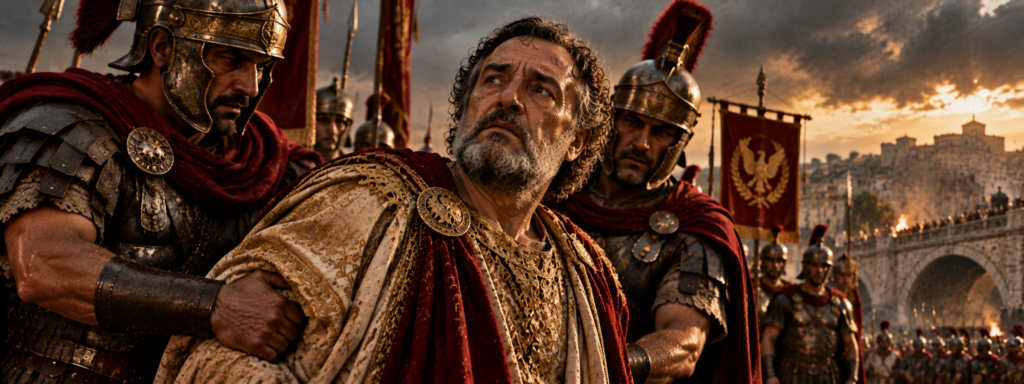
Macrinus: The Emperor Who Murdered His Way to the Throne and Lost It to a Teenage Pretender
The Assassination of Caracalla, the Revenge of the Severan Women, and the Military Rebellion That Ended an Emperor’s Life
Marcus Opellius Macrinus (c. 164–218 CE) was Roman emperor from 11 April 217 until 8 June 218, becoming the first man from the equestrian order to occupy the imperial throne without first entering the Senate. Born in Caesarea in Mauretania, he rose through imperial service to become Praetorian prefect under Caracalla, whose assassination in April 217 was widely believed to have been arranged by Macrinus himself. His reign was plagued by military dissatisfaction, financial difficulties, and a dangerous challenge orchestrated by the powerful women of the Severan dynasty. After his army was defeated near Antioch by supporters of the fourteen-year-old Elagabalus, Macrinus fled in disguise but was captured and executed in June 218. His young son and co-emperor, Diadumenian, was also killed, extinguishing a dynasty that had barely begun.
The Emperor Who Tried to Escape His Own Death Sentence
In June 218 CE, a defeated Roman emperor was fleeing across the eastern provinces of the empire, desperately trying to escape the soldiers who had once sworn to obey him. Macrinus had abandoned the battlefield, discarded the outward appearance of imperial authority, and attempted to disappear among ordinary travelers. His elaborate titles, his purple robes, and the military command that had made him ruler of the Roman world were suddenly liabilities. The man who had risen to power through the murder of an emperor was now being hunted by the supporters of another.
Only fourteen months earlier, Macrinus had been one of the most powerful officials in the Roman Empire. As Praetorian prefect, he had commanded the emperor’s personal guard and possessed intimate knowledge of the movements, fears, and vulnerabilities of Caracalla. When Caracalla was murdered beside a road near Carrhae in April 217, Macrinus emerged as the principal beneficiary. Ancient historians believed that the prefect had helped arrange the assassination because he feared that Caracalla intended to execute him.
The murder had placed Macrinus on the throne, but it had also created a dangerous contradiction. He had eliminated a member of the Severan dynasty, a family whose name still carried enormous weight among the soldiers. He was not a senator, did not possess a distinguished imperial ancestry, and had never commanded the kind of battlefield victories that could silence doubts about his legitimacy. His authority rested upon the loyalty of an army that had loved Caracalla’s generosity far more than it appreciated Macrinus’s attempts to control military expenditure.
The threat that finally destroyed him emerged from a household he had allowed to survive. Julia Maesa, the wealthy sister of Caracalla’s mother, Julia Domna, returned to Syria after Macrinus seized power. There, she and her daughters helped promote her teenage grandson as the supposedly illegitimate son of Caracalla. The boy, later known as Elagabalus, became the center of a rebellion that transformed dynastic nostalgia, religious prestige, and military resentment into a direct challenge to the emperor.
Macrinus underestimated the danger until it was too late. Soldiers began deserting his cause, the rebellion spread, and his attempts to restore discipline only deepened the divisions within his army. Near Antioch, his forces confronted the supporters of the teenage claimant in a battle that would determine the future of the empire. When the fighting turned against him, Macrinus fled, leaving his soldiers to face the consequences.
His escape did not save him. He was captured while attempting to reach safety, and his enemies ordered his execution. His young son, Diadumenian, whom he had elevated to imperial rank in an attempt to establish a dynasty, was also killed. The emperor who had helped destroy Caracalla to save his own life had brought destruction upon himself and his child.
The story of Macrinus is not simply another tale of Roman ambition ending in blood. It is the story of an outsider who reached the highest office in the empire and discovered that holding power required more than removing the previous ruler. It reveals the influence of imperial women, the dangerous expectations of Roman soldiers, and the extraordinary fragility of an emperor whose legitimacy depended upon men who could change their allegiance overnight.
From Mauretania to the Imperial Court
Macrinus was born around 164 CE in Caesarea, the capital of the Roman province of Mauretania Caesariensis, in what is now Algeria. His birthplace placed him far from the traditional centers of senatorial power in Italy, although Roman North Africa had already produced wealthy families, influential administrators, and distinguished political figures. The region was thoroughly integrated into imperial economic and administrative networks. Macrinus’s origins therefore did not make advancement impossible, but they did distinguish him from emperors whose claims rested upon aristocratic ancestry.
Ancient sources offer differing accounts of his family background and social position. Some portray him as having relatively modest origins, while others suggest that his family possessed sufficient resources and standing to support an administrative career. Hostile writers had reasons to exaggerate the obscurity of an emperor who lacked senatorial ancestry. The surviving evidence does not permit a confident reconstruction of his childhood or family wealth.
What is clear is that Macrinus entered the equestrian order, the social rank immediately below the senatorial aristocracy. Equestrians occupied an increasingly important place in Roman administration, particularly in financial management, legal service, military command, and imperial household offices. Unlike senators, who followed a prestigious public career through magistracies and provincial governorships, equestrian officials often advanced through appointments dependent upon professional competence and imperial confidence. This system offered ambitious men a route to extraordinary influence without requiring membership in the Senate.
Macrinus developed a reputation for legal and administrative ability. Ancient accounts associate him with important legal work and positions within the imperial service. Such responsibilities required technical knowledge and familiarity with the complex machinery of Roman government. His career suggests that he was a capable official who understood how imperial authority functioned behind the ceremonial magnificence of the throne.
He eventually attracted the attention of influential figures associated with the Severan court. The reign of Septimius Severus had increased the importance of professional administrators and military officials, creating opportunities for equestrians who could serve the emperor effectively. Macrinus benefited from this environment. His rise was not the product of a single fortunate appointment but of sustained advancement within an increasingly centralized imperial system.
By the reign of Caracalla, Macrinus had reached one of the most powerful offices available to an equestrian. He became Praetorian prefect, a position that combined military command, administrative responsibility, and direct access to the emperor. The office placed him near the center of imperial decision-making. It also exposed him to the dangers of serving a ruler whose suspicion could become fatal.
Macrinus’s ascent was remarkable because it demonstrated how far a talented provincial official could rise within the Roman Empire. Yet his career also created the temptation that would destroy him. The Praetorian prefect stood close enough to the throne to understand its power and close enough to the emperor to recognize his vulnerabilities. In April 217, that proximity would become the foundation of a conspiracy.
The Severan Dynasty and the Empire Macrinus Inherited
To understand Macrinus’s rise, it is necessary to examine the dynasty he would eventually overthrow. Septimius Severus became emperor after the civil wars that followed the assassination of Commodus in 192 CE. He defeated rival claimants, strengthened the army’s political importance, and established a ruling family whose authority rested upon military success and dynastic continuity. His reign created the political world in which Macrinus built his career.
Severus understood that the loyalty of soldiers was essential to imperial survival. He increased military rewards, cultivated the legions, and relied upon experienced commanders to secure his position. These policies strengthened his authority but also increased the financial obligations of the imperial government. His successors inherited an army accustomed to substantial privileges.
When Severus died in 211 CE, he left the empire to his two sons, Caracalla and Geta. The brothers had a deeply hostile relationship, and their joint rule quickly became untenable. Caracalla arranged Geta’s murder later that year, reportedly within the imperial residence and in circumstances involving their mother, Julia Domna. The killing eliminated his principal dynastic rival but stained his reign with the blood of his own family.
Caracalla then ruled alone, relying heavily upon military support. He cultivated the soldiers through generosity, personal attention, and an image of martial toughness. His reign also witnessed extensive political violence and a growing atmosphere of suspicion. Those close to him understood that imperial favor could disappear without warning.
The emperor’s policies imposed significant financial burdens. Military expenditure remained high, and Caracalla’s campaigns required substantial resources. His famous grant of Roman citizenship to nearly all free inhabitants of the empire in 212 CE had wide-ranging legal and fiscal consequences, although historians continue to debate the full range of his motives. His government combined ambitious measures with expensive military commitments.
Macrinus served within this demanding and dangerous environment. As Praetorian prefect, he was responsible for important security and administrative functions while accompanying the emperor during military operations. He therefore understood both the strength of Caracalla’s relationship with the army and the fear generated by his unpredictable behavior. His position offered extraordinary influence but little protection if the emperor turned against him.
The Severan dynasty also possessed powerful women whose political importance extended beyond the conventional expectations of Roman society. Julia Domna, the widow of Septimius Severus and mother of Caracalla, had exercised considerable influence within the imperial household. Her sister Julia Maesa possessed wealth, connections, and an ambitious family of her own. These women would become central to the events that followed Caracalla’s death.
Macrinus inherited an empire whose soldiers expected generosity, whose ruling family retained substantial prestige, and whose finances were under pressure. He would attempt to govern through administrative discipline rather than the extravagant military patronage associated with Caracalla. That decision might have made sense to an experienced official. It would prove disastrous for an emperor whose throne depended upon the army’s affection.
Caracalla: The Dangerous Master Macrinus Served
Caracalla was one of the most feared rulers of the Severan dynasty. His murder of Geta demonstrated his willingness to eliminate even the closest family rival, and his subsequent reign was marked by accusations of executions, confiscations, and political intimidation. Ancient writers portrayed him as cruel, suspicious, and increasingly obsessed with military glory. Although their accounts contain hostile exaggerations, the atmosphere of danger surrounding his court is well attested.
Macrinus occupied a particularly vulnerable position because the Praetorian prefect controlled access to armed force near the emperor. The office required absolute loyalty, but its responsibilities could make the holder appear threatening. A prefect who possessed extensive military contacts and administrative influence might become a target of imperial suspicion. Under Caracalla, that danger was especially acute.
Ancient accounts describe Macrinus becoming convinced that the emperor intended to kill him. Cassius Dio and Herodian preserve traditions involving warnings, predictions, and reports that allegedly placed Macrinus under suspicion. Some stories involve an astrologer’s prediction that Macrinus would become emperor, information that supposedly reached Caracalla or threatened to do so. Such details should be treated cautiously because ancient historians frequently used prophecies to explain dramatic political reversals.
The underlying political problem is nevertheless plausible. Caracalla’s court was dangerous, and Macrinus had reason to fear that suspicion could lead to execution. His position gave him access to the emperor’s movements and security arrangements. If he believed his life was threatened, he possessed both motive and opportunity to act.
Caracalla was preparing for further military operations against the Parthian Empire. His eastern campaigns required movement through regions where imperial security depended upon the coordination of guards, officers, and local authorities. Macrinus accompanied the emperor and participated in the administration of the expedition. The setting placed him close to Caracalla during a period of military tension.
The emperor’s conduct also created enemies beyond Macrinus. Officers who had suffered humiliation, punishment, or exclusion could become receptive to conspiracy. The surviving accounts identify one such man, Julius Martialis, as the individual who physically killed Caracalla. His personal grievances are described differently by ancient writers, but his role in the assassination is central to the tradition.
Macrinus’s alleged involvement remains one of the most important questions surrounding his reign. Ancient historians generally regarded him as the organizer or principal beneficiary of the murder. Yet the precise evidence for his planning is incomplete, and some details may have been reconstructed after he became emperor. His guilt is highly plausible but cannot be established with the certainty of a modern criminal investigation.
The distinction matters because Macrinus’s entire political career changed on the day Caracalla died. If he arranged the assassination, he deliberately removed the ruler he had sworn to protect. If his role was less direct, he nevertheless benefited from the killing and rapidly accepted the throne. Either way, the murder placed him at the center of a succession crisis that would eventually destroy him.
The Roadside Murder That Made an Emperor
On 8 April 217 CE, Caracalla was traveling near Carrhae in northern Mesopotamia when he was assassinated. Ancient accounts place the attack during a journey connected with the emperor’s religious activities or movements between military locations. The precise details vary, but the central event is clear. Julius Martialis, an officer associated with the imperial entourage, attacked and fatally wounded the emperor.
The setting was strikingly undignified for the death of a Roman ruler. Caracalla was reportedly away from the immediate protection of his main escort when the attacker approached. Some ancient narratives describe the emperor stopping to relieve himself, a detail that may have been emphasized for its humiliating effect. The attack occurred quickly, and Martialis was killed shortly afterward.
The assassin’s death prevented a full explanation of his motives from surviving. Ancient writers offered accounts involving personal grievances and encouragement from Macrinus. The rapid killing of Martialis also ensured that the conspiracy could not be openly investigated through his testimony. The circumstances left room for suspicion and political interpretation.
Macrinus emerged from the assassination as one of the most powerful surviving officials in the imperial entourage. His position as Praetorian prefect gave him influence over security and military organization. Yet he did not immediately proclaim himself emperor. The surviving sources describe a short period of uncertainty before the army accepted his elevation.
This delay reflected the political danger of the situation. Caracalla had been popular among many soldiers, who appreciated his generosity and military identity. His murder could provoke anger against anyone suspected of involvement. Macrinus needed to secure the army’s acceptance without appearing too eager to benefit from the assassination.
The absence of an obvious adult male successor created an opportunity. Caracalla had no legitimate surviving son who could immediately inherit the throne. The Severan women remained influential, but they could not simply assume the imperial office themselves. Macrinus possessed the administrative experience and military position necessary to present himself as a practical solution.
The army eventually proclaimed him emperor on 11 April 217 CE. His accession was extraordinary because he belonged to the equestrian order rather than the Senate. Previous emperors had possessed senatorial standing or had been elevated through military careers that placed them within the traditional aristocratic hierarchy. Macrinus crossed a social boundary that had long separated imperial administrators from the men considered eligible to rule.
The assassination of Caracalla therefore created two intertwined stories. One concerned the violent removal of a dangerous emperor by a man who may have feared for his own life. The other concerned the elevation of an equestrian official who had never expected to inherit power through dynastic legitimacy. Macrinus had survived the immediate crisis, but the circumstances of his accession would remain a source of suspicion throughout his reign.
The First Equestrian Emperor
Macrinus’s accession represented a significant departure from Roman political convention. The emperor had traditionally been drawn from the senatorial aristocracy or from families already associated with imperial authority. Macrinus possessed neither a distinguished senatorial ancestry nor a dynastic claim. His rise demonstrated the growing political importance of equestrian officials within the imperial system.
The equestrian order had long supplied the empire with administrators, financial officers, and military commanders. Its members could exercise enormous practical authority while remaining socially distinct from senators. Macrinus’s career illustrated the possibilities created by this system. His elevation to the throne, however, challenged assumptions about who was entitled to govern.
The Senate in Rome was not directly involved in his initial proclamation. Macrinus remained in the eastern provinces, where the army had recognized him. He communicated with the Senate and sought formal acceptance of his position. The senators eventually acknowledged him, but the circumstances were far from ideal.
His absence from Rome created a political disadvantage. An emperor who remained near the army could maintain military support, but he also risked appearing distant from the traditional institutions of government. Macrinus never visited the capital during his reign. His authority therefore depended upon correspondence, appointments, and the recognition of officials who had not personally witnessed his accession.
He attempted to present himself as a legitimate successor through imperial titles and public imagery. Coins and inscriptions emphasized his authority, while his official communications sought to reassure the Senate. He adopted the name Severus, associating himself with the dynasty whose last emperor had just been murdered. The gesture was politically useful but also exposed the contradiction at the heart of his position.
Macrinus had replaced Caracalla, yet he needed the prestige of Caracalla’s family to strengthen his own legitimacy. He could not openly condemn every aspect of the previous regime without alienating soldiers who remained loyal to its memory. Nor could he fully embrace the Severan dynasty while the circumstances of Caracalla’s death remained suspicious. His government therefore rested upon a delicate and unstable political compromise.
The new emperor also faced the expectations of the army. Soldiers who had served Caracalla were accustomed to generous payments and a ruler who cultivated their loyalty. Macrinus approached government as an experienced administrator concerned with financial stability. The difference between those priorities would soon become dangerous.
His accession was historically remarkable, but it did not establish a lasting precedent for equestrian rule. The Senate’s acceptance was conditional, and the army’s loyalty was uncertain. Macrinus possessed the imperial title without the social prestige or dynastic foundation enjoyed by his predecessors. He would spend much of his reign attempting to compensate for that weakness.
Julia Domna: The Empress Who Lost Her Son and Her Power
Caracalla’s death had immediate consequences for his mother, Julia Domna. She had been one of the most influential women in the Roman Empire since her marriage to Septimius Severus. Her position within the dynasty had survived the death of her husband and the murder of her younger son, Geta. Under Caracalla, she continued to possess prestige and political importance.
The assassination of her surviving son destroyed the foundation of her authority. Macrinus became emperor, and the Severan dynasty appeared to have ended. Julia Domna remained a figure of enormous symbolic importance, but she no longer possessed a son on the throne. Her relationship with the new ruler was therefore politically dangerous.
Ancient sources describe tension between Julia Domna and Macrinus. Some suggest that she considered resisting his authority or encouraging opposition. The precise extent of her political activity after Caracalla’s death is uncertain. Nevertheless, her position made her a potential rallying point for those who remained loyal to the Severan family.
Julia Domna was also seriously ill. Ancient writers describe her suffering from a debilitating condition, often interpreted as a form of breast disease, although a precise diagnosis is impossible. Her physical decline coincided with the destruction of her political world. The combination of illness, bereavement, and loss of influence shaped the final months of her life.
She died in 217 CE, not long after Caracalla’s assassination. Some ancient accounts describe her refusing food and allowing herself to die, while others emphasize the effects of illness. The evidence does not permit certainty about the immediate cause. Her death removed one of the most prominent figures of the Severan dynasty.
Macrinus may have believed that her death reduced the danger posed by the imperial family. Yet Julia Domna’s sister, Julia Maesa, remained alive and possessed substantial resources. Her daughters and grandsons provided potential male claimants who could be presented as heirs to the Severan tradition. The dynasty’s political influence therefore survived the death of its most famous woman.
The removal of Julia Domna did not erase the soldiers’ affection for Caracalla. His memory remained powerful among troops who had benefited from his generosity. The Severan name still carried prestige, particularly in the eastern provinces where the family possessed connections. Macrinus had inherited the throne, but he had not inherited the emotional loyalty attached to the dynasty.
The death of Julia Domna therefore marked the end of one phase of Severan power and the beginning of another. Her sister would soon transform family wealth and dynastic memory into the foundations of rebellion. Macrinus’s decision to allow the remaining women of the family to return to Syria would prove one of the most consequential choices of his reign.
The Parthian War and the Price of Peace
Macrinus inherited a dangerous military situation in the East. Caracalla had launched aggressive operations against the Parthian Empire, creating tensions that continued after his assassination. The Parthian king Artabanus IV sought revenge for Roman actions and prepared to confront the imperial army. Macrinus therefore faced a major foreign threat almost immediately after becoming emperor.
The Roman and Parthian forces fought near Nisibis in 217 CE. Ancient accounts describe a prolonged and costly battle in which both sides suffered heavy losses. The precise sequence of the fighting is difficult to reconstruct because the surviving narratives differ in emphasis. What is clear is that Macrinus failed to secure a decisive Roman victory.
The battle placed enormous pressure upon the new emperor. His legitimacy depended partly upon military success, yet he had inherited a war he had not initiated and an army already strained by campaigning. A major defeat could destroy his authority before it became established. Continuing the conflict also threatened the empire’s finances.
Macrinus therefore negotiated a settlement with the Parthians. Ancient sources report that Rome agreed to provide substantial payments, often described as an indemnity, in exchange for peace. The exact financial terms remain uncertain, but the settlement was widely criticized. Roman aristocratic writers regarded it as humiliating because the empire appeared to be paying an enemy to end hostilities.
From an administrative perspective, the decision was understandable. The eastern army had suffered heavy casualties, and prolonged warfare would require additional resources. Macrinus needed stability to consolidate his government. A negotiated peace could allow him to address domestic problems and reduce military expenditure.
The political consequences were more damaging. Soldiers accustomed to Caracalla’s aggressive military posture could interpret the settlement as weakness. A ruler who had never achieved a major battlefield victory was now associated with payments to a foreign enemy. The contrast with the martial image of the Severan dynasty was unfavorable.
Macrinus also faced difficulties with other eastern powers, including Armenia and groups along the frontier. His government attempted to manage these relationships through diplomacy and concessions. Such measures may have been practical, but they did little to strengthen his reputation among soldiers who valued military prestige. The emperor’s administrative caution became a political liability.
The peace with Parthia illustrates the central problem of his reign. Macrinus attempted to govern an expensive military empire through financial restraint and negotiated settlements. Yet the soldiers whose loyalty he needed expected generosity and victory. The policies that might stabilize the treasury threatened to destabilize the throne.
The Fatal Decision to Reduce Military Costs
Macrinus’s financial policies became one of the most important causes of his downfall. The Roman army had grown accustomed to substantial rewards under Septimius Severus and Caracalla. Military pay, donatives, and privileges represented enormous obligations for the imperial government. Macrinus recognized that continued expenditure at the same level could place serious pressure upon available resources.
He attempted to reduce costs without immediately stripping existing soldiers of all their benefits. Ancient accounts suggest that some reductions were directed toward new recruits, while established troops retained earlier rates. The distinction may have been intended to avoid provoking the entire army at once. Nevertheless, the policy created resentment and uncertainty.
Soldiers were acutely aware of differences in pay and privilege. A new recruit receiving less than an experienced soldier might accept the arrangement under ordinary circumstances, but reductions associated with a new emperor could appear threatening. Existing troops might fear that their own benefits would eventually be reduced. The policy therefore undermined confidence even among men not immediately affected.
The army also remembered Caracalla’s generosity. He had cultivated a reputation for sharing wealth with soldiers and treating military service as the foundation of imperial power. Macrinus’s emphasis on economy offered little emotional appeal by comparison. His administrative reasoning could not easily compete with the memory of a ruler who had rewarded the troops lavishly.
The emperor’s position was especially vulnerable because he had not established personal loyalty through years of command. Soldiers who had followed Caracalla in campaigns did not necessarily regard Macrinus as their natural leader. His accession after Caracalla’s assassination remained suspicious. Financial restraint therefore reinforced existing doubts.
The eastern army also experienced prolonged inactivity after the peace with Parthia. Large numbers of soldiers remained in the region, where they could discuss grievances and become receptive to alternative political claims. Military camps provided fertile ground for rumor and dissatisfaction. The emperor’s enemies would soon exploit that environment.
Macrinus may have believed that restoring financial discipline was essential to the empire’s long-term stability. The policy was not inherently irrational, and the costs of military patronage were substantial. Yet Roman imperial government depended upon the army’s willingness to support the ruler. A financially responsible policy could become politically disastrous if it alienated the soldiers.
The reductions therefore created an opening for the Severan family. A claimant who promised to restore Caracalla’s generosity could attract troops dissatisfied with Macrinus. Dynastic nostalgia and financial self-interest reinforced each other. The emperor’s attempt to control expenditure helped create the conditions for rebellion.
Julia Maesa: The Grandmother Who Would Destroy an Emperor
Julia Maesa was one of the most formidable political figures of the Severan family. She was the sister of Julia Domna and belonged to a wealthy and influential Syrian family associated with the city of Emesa. Her connections extended through the imperial household, regional aristocracy, and religious institutions. When Macrinus seized power, she retained resources that could be transformed into political influence.
After Caracalla’s death, Maesa returned to Syria with her family. Ancient sources describe her possessing substantial wealth, although the precise extent of her fortune is uncertain. Macrinus apparently allowed her to retain enough resources and freedom to establish herself in Emesa. The decision may have reflected a desire to avoid unnecessary hostility toward the Severan women.
Maesa had two daughters, Julia Soaemias and Julia Mamaea, each of whom had a son. Soaemias’s son was Varius Avitus Bassianus, the teenager later known as Elagabalus. Mamaea’s son was Alexianus, who would eventually become Emperor Severus Alexander. The family therefore possessed two young male descendants who could potentially be presented as heirs to the Severan tradition.
The older boy held an important religious position as priest of the Syrian sun god Elagabal at Emesa. His role gave him local prestige and placed him within a religious environment that attracted attention from soldiers stationed nearby. The connection between religious authority and dynastic ancestry created an opportunity. Maesa could promote him as both a sacred figure and a legitimate imperial claimant.
The decisive political claim concerned his parentage. Supporters alleged that the boy was an illegitimate son of Caracalla, thereby connecting him directly to the murdered emperor. The allegation was politically useful but cannot be established as fact. Modern historians generally treat it as a dynastic claim promoted to strengthen his legitimacy.
The claim mattered because Caracalla remained popular among many soldiers. A young man presented as his son could become the focus of resentment against Macrinus. Maesa’s wealth allowed her to distribute money and cultivate supporters. Her family connections provided a recognizable political identity.
Ancient historians often portrayed Maesa as the principal architect of the rebellion. Their accounts emphasize her ambition, wealth, and ability to manipulate military dissatisfaction. Although some details may be exaggerated, her central role is strongly supported by the course of events. She transformed a vulnerable family position into a challenge capable of destroying an emperor.
Macrinus had underestimated the political potential of the Severan women. He may have regarded them as remnants of a defeated dynasty whose influence would fade with time. Instead, Maesa used the dynasty’s memory to create a new claimant. The emperor’s greatest threat emerged not from a powerful general but from a grandmother promoting her teenage grandson.
The Teenage Priest Who Claimed Caracalla’s Blood
Varius Avitus Bassianus was approximately fourteen years old when his family began promoting him as a rival to Macrinus. He had not commanded armies, governed provinces, or held the senior offices traditionally associated with imperial authority. His principal public role was religious, connected with the worship of Elagabal at Emesa. Yet his youth and lack of experience could be transformed into political advantages.
Supporters presented him as the son of Caracalla, a claim that connected him to the dynasty soldiers remembered with affection. The resemblance between the boy and the deceased emperor was reportedly emphasized, although ancient descriptions of physical similarity are difficult to evaluate. The allegation of illegitimate descent offered a simple explanation for why the Severan bloodline had supposedly survived. It also allowed soldiers to imagine that supporting the boy meant restoring their former emperor’s family.
The religious setting strengthened the spectacle. The young priest performed ceremonies associated with the local deity, attracting attention through elaborate clothing and ritual. Ancient writers later treated his religious practices with hostility, particularly after he became emperor. Yet in Emesa, his priesthood provided a recognizable source of prestige.
Maesa and her associates cultivated military support among troops stationed nearby. The Legio III Gallica, based at Raphanaea in Syria, became central to the rebellion. Soldiers were reportedly encouraged by promises of money and the claim that the boy was Caracalla’s son. Their dissatisfaction with Macrinus made the appeal more effective.
The boy’s supporters did not need to prove his ancestry beyond doubt. Political legitimacy in the Roman Empire often depended upon recognition, military support, and persuasive public claims. A believable connection to the Severan dynasty could be enough to attract soldiers. The claim became increasingly powerful as more men accepted it.
The young priest was eventually proclaimed emperor by rebellious troops in May 218 CE. He adopted the name Marcus Aurelius Antoninus, deliberately invoking the imperial identity associated with Caracalla. The name was a political weapon as much as a personal title. It presented the rebellion as the restoration of legitimate rule rather than the elevation of an inexperienced teenager.
Macrinus now faced a rival whose military experience was almost nonexistent but whose dynastic appeal was substantial. The contrast was extraordinary. An experienced administrator who had reached the throne through imperial service was being challenged by a boy promoted through family wealth and religious prestige. Yet the Roman army could make an emperor of either man if sufficient soldiers accepted the claim.
The rebellion demonstrated that legitimacy was not simply a matter of competence. Macrinus possessed administrative experience, but he lacked the emotional loyalty attached to the Severan name. The teenager possessed little experience, but he represented a dynasty soldiers remembered favorably. The contest would be decided by which claim could command armed support.
The Mutiny That Began in Syria
The rebellion against Macrinus began among soldiers whose loyalty had been weakened by dissatisfaction with the emperor’s policies. The Legio III Gallica became the principal military force supporting the young claimant. Its officers and soldiers operated within a region where the Severan family possessed deep connections. The combination of local influence, financial promises, and military resentment created a dangerous challenge.
Ancient sources describe the young priest entering the military camp and being proclaimed emperor. The exact circumstances vary among the accounts, but the proclamation marked the transition from family intrigue to open rebellion. Soldiers had now publicly rejected Macrinus and accepted another ruler. The act could not easily be reversed without severe consequences.
Macrinus initially underestimated the scale of the threat. He may have regarded the movement as a localized disturbance that could be suppressed by loyal forces. His government still possessed substantial military resources in the East. A rebellion centered upon a teenage priest might have appeared manageable.
The emperor dispatched troops to confront the insurgents. Ancient accounts identify Ulpius Julianus, a senior officer associated with Macrinus’s government, as leading an early attempt to suppress the revolt. The operation failed when soldiers became unwilling to fight against the claimant. Julianus was killed, and his force did not achieve its objective.
The failure was politically devastating. It demonstrated that the rebellion could attract soldiers beyond its original supporters. The emperor could no longer assume that units sent against the insurgents would remain loyal. Military discipline was collapsing at the very moment when he needed it most.
The rebels also gained confidence from the success. The young claimant’s position became more credible as troops defected or refused to resist. Maesa’s political gamble appeared increasingly successful. The movement could now present itself as a genuine imperial alternative rather than an isolated mutiny.
Macrinus responded by attempting to strengthen his own legitimacy and secure his dynasty. He elevated his young son, Diadumenian, to the rank of Augustus, making him co-emperor. The decision was intended to demonstrate continuity and provide a recognized heir. Yet it also revealed the emperor’s fear that his position was slipping away.
The rebellion had transformed the political situation in a matter of weeks. Macrinus had entered 218 as the recognized emperor of the Roman world. By May, a teenage claimant supported by disaffected soldiers threatened his authority. The army that had elevated him after Caracalla’s murder was now capable of destroying him through another change of allegiance.
Diadumenian: The Child Who Inherited His Father’s Enemies
Macrinus’s son, Marcus Opellius Antoninus Diadumenianus, was still a child when his father became emperor. He had no meaningful experience of military command or imperial administration. Nevertheless, his position as the emperor’s son made him central to Macrinus’s attempt to establish a new dynasty. His elevation was intended to provide continuity in a political system where succession remained dangerously uncertain.
Soon after Macrinus’s accession, Diadumenian received the title Caesar. The honor identified him as the designated heir and associated him with imperial authority. Coins and official imagery presented him as part of the new ruling family. Such measures were conventional, but their political significance was considerable.
Macrinus’s decision to promote his son reflected the importance of dynastic legitimacy. He had reached the throne without belonging to the Severan family, and his equestrian origins remained unusual. Establishing a hereditary succession could strengthen his position by creating the appearance of a stable ruling house. The young Diadumenian became the symbol of that ambition.
As the rebellion intensified in 218, Macrinus elevated Diadumenian to the rank of Augustus. The boy was now formally co-emperor, sharing the highest imperial title with his father. The measure was intended to reinforce the dynasty at a moment of crisis. Yet it also made the child a direct target for anyone seeking to replace Macrinus.
The contrast with Elagabalus was striking. Both claimants were young, and neither possessed the experience necessary to govern independently. Diadumenian relied upon his father’s authority, while Elagabalus relied upon the Severan family’s prestige and military support. The conflict therefore became a struggle between competing dynastic claims centered upon boys who had little control over the forces surrounding them.
Diadumenian’s personal feelings are unknown. Ancient sources provide little insight into his education, character, or understanding of the political danger. It would be tempting to imagine his fear as the rebellion spread, but such emotions are not documented. What can be established is that his imperial status made his survival dependent upon his father’s success.
When Macrinus’s position collapsed, Diadumenian became a liability to the victorious rebels. A surviving son of the defeated emperor could serve as a future focus for opposition. The new regime therefore had strong political reasons to eliminate him. His youth offered no guarantee of protection.
The fate of Diadumenian reveals the brutality of Roman dynastic politics. Macrinus elevated his son to secure the future of his family, but the decision helped make the child a target. The imperial title that promised extraordinary privilege became a death sentence when the dynasty fell. The boy’s brief reign would end almost as soon as it began.
The Battle Near Antioch
The decisive confrontation between Macrinus and the supporters of Elagabalus took place near Antioch on 8 June 218 CE. The battle brought together forces loyal to the reigning emperor and troops supporting the teenage claimant. Its outcome would determine whether Macrinus could preserve his throne or whether the Severan family would return to power. The fighting became the turning point of his reign.
Ancient sources describe Macrinus possessing substantial military resources, but the loyalty of his troops was uncertain. Some soldiers remained committed to him, while others were sympathetic to the Severan claimant. The rebellion had already demonstrated that units could defect or refuse to fight. The emperor therefore entered battle with an army whose cohesion was compromised.
The opposing forces were associated with commanders and members of the Severan household who sought to secure the boy’s claim. Ancient accounts emphasize the role of Julia Maesa and Julia Soaemias in sustaining the rebellion. Some narratives describe the women encouraging soldiers during moments of danger. The precise details may have been dramatized, but their political importance is clear.
The battle itself appears to have been hard fought. Macrinus’s troops initially resisted, and the outcome was not necessarily obvious from the beginning. The emperor’s supporters possessed experience and military organization. Yet the struggle was complicated by uncertainty over loyalty and the possibility of desertion.
Ancient historians describe Macrinus losing confidence as the battle turned against him. Some accounts suggest that he abandoned his position prematurely, causing his troops to collapse. Others emphasize the role of the opposing forces and the morale of the rebels. The precise sequence cannot be reconstructed with complete certainty.
What is clear is that Macrinus fled and his army was defeated. His departure undermined the remaining resistance and allowed the supporters of Elagabalus to claim victory. The emperor who had attempted to restore military discipline had lost control of the soldiers upon whom his survival depended. The battle ended his effective authority.
The victory transformed the teenage priest into the recognized ruler of the Roman Empire. His supporters could present the outcome as the restoration of the Severan dynasty. Macrinus became a defeated claimant whose continued existence threatened the new regime. The political consequences were immediate.
The battle near Antioch therefore completed the process begun by the mutiny in Syria. Military dissatisfaction had created an opening, dynastic propaganda had supplied a rival, and armed conflict had determined the succession. Macrinus’s administrative experience and imperial titles could not compensate for the collapse of loyalty. His reign ended on the battlefield even though his life would continue for a short time afterward.
The Emperor Who Fled in Disguise
After the defeat near Antioch, Macrinus attempted to escape the eastern provinces. Ancient accounts describe him abandoning imperial dress and adopting a disguise to avoid recognition. His goal was to reach a place where he might find safety or reorganize resistance. The journey became a desperate attempt to survive the collapse of his government.
The details of his route vary among the sources. He reportedly traveled northward through Asia Minor, hoping to move beyond the immediate reach of the victorious rebels. Some accounts suggest that he intended to reach Rome or another region where support might still be available. The exact plan cannot be established with certainty.
His disguise reflected the danger of his imperial identity. Only weeks earlier, recognition as emperor had brought obedience, ceremony, and protection. Now the same recognition could lead to immediate arrest. Macrinus needed to conceal the status he had risked everything to obtain.
The journey also exposed the limits of imperial authority. A reigning emperor could command armies, issue laws, and appoint officials, but a defeated ruler depended upon the willingness of strangers to protect him. Macrinus no longer possessed the military escort necessary to guarantee safe passage. His survival depended upon avoiding detection.
Ancient writers describe him attempting to alter his appearance, including changes to his hair or beard. Such details may have been embellished to emphasize his humiliation. The broader fact of his flight and attempted concealment is consistent with the political circumstances. He was a defeated emperor seeking escape from enemies who intended to eliminate him.
His efforts ultimately failed. Macrinus was recognized or betrayed while traveling through Asia Minor and was taken into custody. The precise location and circumstances of his capture differ among ancient accounts. What matters is that he could no longer escape the reach of the victorious regime.
The capture transformed his political defeat into a personal death sentence. He had no army capable of rescuing him and no recognized authority willing to defend his claim. The supporters of Elagabalus had every reason to prevent his return. His continued existence could encourage rebellion or provide a rallying point for dissatisfied soldiers.
The emperor who had once controlled the Praetorian Guard was now a prisoner. His rise had depended upon intimate knowledge of another ruler’s vulnerability. His downfall revealed that vulnerability in its most complete form. Macrinus had become the hunted man he once feared becoming under Caracalla.
Captured and Executed
Macrinus was executed in June 218 CE after his capture during the flight from Antioch. Ancient sources differ over the precise location and details of the killing, but they agree that his death followed the military defeat and collapse of his regime. He was no longer treated as the legitimate emperor. The victorious faction regarded him as an enemy whose survival posed a political danger.
Some accounts place his death in the region of Cappadocia, while others provide differing geographical details associated with his capture and transfer. The exact route remains uncertain. The surviving narratives were written with the knowledge that Macrinus had lost and that the Severan claimant had prevailed. Their emphasis falls upon the humiliation of his escape and the inevitability of his destruction.
The execution was not the result of an independent judicial proceeding. Macrinus had been overthrown through military rebellion, and the victorious regime possessed the force necessary to eliminate him. His death served the practical purpose of removing a rival claimant. It also symbolized the rejection of the government established after Caracalla’s assassination.
The method of execution is not consistently described in the surviving evidence. Some later summaries state that he was beheaded, but the ancient accounts do not provide a uniformly detailed description of the killing. The essential historical fact is that he was captured and deliberately executed after his defeat. The uncertainty surrounding the exact method should not be concealed beneath a more dramatic reconstruction.
Macrinus’s death completed a remarkable reversal. In April 217, he had survived the assassination of Caracalla and emerged as emperor. In June 218, he was killed by the supporters of a claimant promoted through the very dynasty he had displaced. His reign had lasted approximately fourteen months.
The execution also reflected the logic of Roman imperial politics. A defeated emperor could remain dangerous as long as he lived, particularly if soldiers or officials retained loyalty to him. Killing him removed the possibility of an immediate restoration. The new regime therefore treated his survival as incompatible with its security.
Macrinus’s earlier career offered no protection. His administrative experience, legal knowledge, and service as Praetorian prefect had helped him reach the throne. Yet none of those achievements mattered once his army abandoned him. His legitimacy had depended upon military recognition, and military defeat destroyed it.
The man who had allegedly arranged Caracalla’s murder to avoid execution met the same fate he had feared. His assassination of one emperor had created the opportunity for his own elevation. His execution demonstrated that the throne could not protect a ruler who lost the loyalty of his soldiers. The cycle of violence continued with the destruction of his family.
The Murder of Diadumenian
The death of Macrinus did not end the violence associated with his overthrow. His son Diadumenian, whom he had elevated to the rank of Augustus, remained a potential rival to the new regime. Although still a child, he possessed an imperial title and a direct connection to the defeated ruler. His survival could provide a focus for future opposition.
Macrinus had attempted to send Diadumenian toward safety as the rebellion intensified. Ancient sources describe arrangements intended to move the boy away from the immediate danger, possibly toward the Parthian frontier. The precise route and destination remain uncertain. The effort reflects the emperor’s recognition that his son faced mortal danger if the dynasty collapsed.
The escape failed. Diadumenian was captured by forces loyal to the victorious claimant and executed. Ancient accounts generally describe his death as occurring shortly after the defeat of Macrinus. The child’s imperial status made him politically dangerous despite his youth.
The killing illustrates the brutal logic of dynastic elimination. A young heir might possess little personal power, but his name could attract supporters. Roman history contained numerous examples of rival claimants using family relationships to justify rebellion. The new regime had strong incentives to prevent Diadumenian from becoming such a figure.
His death also exposed the cruelty of Macrinus’s attempt to establish a dynasty. The emperor had elevated his son to strengthen his legitimacy and create continuity. Yet the title of Augustus transformed the child into a rival who could not easily be ignored. The very honor intended to secure his future helped place him in danger.
Ancient writers provide little information about Diadumenian as an individual. His childhood, education, and personal character remain largely obscure. He appears in the historical record primarily as the son of Macrinus and the victim of the succession crisis. His death was determined by political circumstances he had not created.
The elimination of father and son ensured that the new regime faced no immediate dynastic rival from Macrinus’s family. Their deaths extinguished the ruling house almost as soon as it had been established. The Severan dynasty returned to power through a teenage claimant whose legitimacy had been promoted by his grandmother. The defeated emperor’s family disappeared from the imperial succession.
The fate of Diadumenian gives the story of Macrinus a particularly grim conclusion. The father’s ambition had brought the family extraordinary power, but the collapse of that power destroyed his child. The Roman throne promised prestige and security while exposing its occupants to lethal danger. For Macrinus and Diadumenian, the dynasty lasted barely long enough to become a target.
The Women Who Won the Empire Back
The victory of Elagabalus was also a triumph for the women of the Severan family. Julia Maesa had transformed her wealth, connections, and dynastic position into a successful challenge against a reigning emperor. Her daughter Julia Soaemias supported the elevation of her son, while the broader family benefited from the restoration of Severan authority. Their success demonstrated the extraordinary political influence women could exercise within the imperial household.
Roman law and custom did not permit women to occupy the imperial throne in their own right. Yet imperial mothers, wives, and grandmothers could wield substantial power through family relationships, patronage, and control over potential heirs. The Severan women exploited those opportunities with remarkable effectiveness. Their influence operated through male claimants whose legitimacy depended upon family connections.
Maesa’s strategy was particularly successful because it combined several sources of support. The claim that Elagabalus was Caracalla’s son appealed to soldiers loyal to the former emperor. The family’s wealth enabled financial inducements, while the boy’s religious position provided local prestige. Military dissatisfaction with Macrinus created the conditions in which these advantages could become decisive.
The rebellion also revealed the limitations of Macrinus’s political imagination. He had understood the importance of military command and administrative authority, but he underestimated the power of dynastic memory. The Severan family retained emotional and symbolic influence even after Caracalla’s death. Maesa recognized that influence and transformed it into a military movement.
Ancient historians sometimes portrayed the Severan women through stereotypes of manipulation and ambition. Their accounts reflect discomfort with women exercising political influence in a male-dominated system. Yet the success of the rebellion cannot be explained without acknowledging their agency. Maesa and her family played central roles in the restoration of Severan rule.
The victory also created new problems. Elagabalus was young, inexperienced, and associated with religious practices unfamiliar to many Romans. His reign would become controversial, and ancient writers would portray his conduct in highly hostile terms. The family’s success in overthrowing Macrinus did not guarantee stable government.
Nevertheless, the political achievement was extraordinary. A grandmother and her daughters had helped defeat an emperor who commanded the resources of the Roman state. Their candidate had been proclaimed by soldiers, survived military confrontation, and secured the throne. The rebellion demonstrated that dynastic legitimacy could be manufactured and defended through family networks as effectively as through conventional military careers.
Macrinus’s downfall therefore cannot be understood solely as a military mutiny. It was a dynastic counterrevolution organized through the surviving members of the family he had displaced. The women he allowed to return to Syria became the architects of his destruction. Their victory restored the Severan name while ending the lives of Macrinus and his son.
Was Macrinus Really Responsible for Caracalla’s Murder?
The question of Macrinus’s involvement in Caracalla’s assassination remains central to his historical reputation. Ancient writers generally believed that he helped arrange the killing, and the circumstances provide a plausible motive. As Praetorian prefect, he possessed access to the emperor’s movements and security arrangements. His rapid elevation after the assassination made suspicion inevitable.
Cassius Dio offers one of the most important accounts because he was a contemporary senator with access to information about the imperial court. He describes Macrinus fearing that Caracalla intended to execute him and becoming involved in the conspiracy. Herodian preserves a similar tradition, emphasizing the danger surrounding the prefect. The accounts differ in detail but agree on the broad suspicion.
The alleged warnings and prophecies require particular caution. Ancient historians frequently used predictions of future emperorship to explain conspiracies and assassinations. Such stories could provide dramatic motives while reflecting later attempts to impose order upon chaotic events. They should not be treated as independently verified evidence.
The role of Julius Martialis is more securely associated with the physical attack. He killed Caracalla and was himself killed immediately afterward. His death prevented a full explanation of his motives from surviving. The absence of direct testimony leaves uncertainty about the precise organization of the conspiracy.
Macrinus’s behavior after the assassination can be interpreted in different ways. His delay before accepting the throne may suggest caution and an attempt to avoid suspicion. It could also reflect genuine uncertainty about whether the army would support him. Neither interpretation proves or disproves his involvement.
The political context makes his participation plausible. Caracalla had demonstrated a willingness to eliminate perceived enemies, and Macrinus occupied a position that could become dangerous if the emperor lost confidence in him. A prefect who believed execution was imminent might regard assassination as his only means of survival. The motive was powerful, even if the precise evidence remains incomplete.
Modern historians generally accept that Macrinus was probably involved in the plot, but responsible treatment of the evidence requires acknowledging uncertainty. The surviving sources are not equivalent to a complete investigative record. They preserve a strong ancient tradition rather than conclusive proof of every action. The distinction matters because his reign has often been reduced to the assumption that he murdered his predecessor.
Whatever his exact role, Macrinus benefited directly from Caracalla’s death. He accepted the throne created by the assassination and attempted to establish a new dynasty. His government therefore remained inseparable from the violent event that made it possible. The suspicion surrounding his accession weakened his legitimacy and contributed to the conditions of his downfall.
The Emperor Who Tried to Govern Like an Administrator
Macrinus’s reign presents a striking contrast between administrative competence and political failure. He had spent much of his career managing legal, financial, and military responsibilities within the imperial system. His instincts as emperor reflected that background. He sought to stabilize finances, negotiate peace, and restore discipline to an expensive military establishment.
These policies were not inherently foolish. The Roman Empire faced substantial financial pressures, and prolonged warfare could strain resources. Reducing military expenditure and avoiding unnecessary campaigns might have strengthened the government over time. A ruler with secure legitimacy and loyal armies could have pursued such measures with greater confidence.
Macrinus, however, lacked that security. His accession followed the assassination of a popular military emperor, and his social background challenged traditional expectations. He needed to cultivate the soldiers whose support had elevated him. Instead, his financial policies created resentment among men already uncertain about his authority.
His peace with Parthia also damaged his reputation. The settlement may have been strategically reasonable, but it appeared humiliating to those who valued military prestige. Macrinus had not achieved a major victory that could compensate for the concessions. His administrative caution therefore reinforced the image of a ruler lacking martial authority.
The emperor also failed to neutralize the surviving Severan family. Allowing Julia Maesa and her descendants to return to Syria may have seemed politically prudent or harmless. Yet the decision gave them access to local networks, wealth, and soldiers receptive to dynastic propaganda. Macrinus underestimated the power of family legitimacy in Roman military politics.
His elevation of Diadumenian further reveals his reliance upon conventional administrative and dynastic solutions. He attempted to create a recognized succession through official titles and public imagery. Yet the boy’s status could not generate loyalty among soldiers who preferred the supposed son of Caracalla. Formal honors were insufficient without emotional and military support.
The failure of Macrinus therefore illustrates the limits of bureaucratic competence in a military monarchy. He understood how to administer the empire but struggled to command the loyalty necessary to rule it. His policies addressed real problems while creating immediate political dangers. The emperor’s greatest weakness was not ignorance of government but misjudgment of the forces that sustained imperial authority.
His reign was too brief to determine whether his reforms could have succeeded under different circumstances. The rebellion prevented any long-term assessment of his financial and diplomatic policies. Yet the political consequences were decisive. Macrinus attempted to govern through restraint at a moment when his survival required generosity, military prestige, and dynastic legitimacy.
The Military Mutiny That Became a Dynastic Revolution
The rebellion against Macrinus began as a challenge within the army, but it quickly became a struggle over the identity of the Roman Empire’s ruling family. Soldiers dissatisfied with pay and leadership found an alternative claimant in the young priest of Emesa. Julia Maesa supplied the dynastic narrative and financial resources necessary to strengthen the movement. The mutiny therefore developed into a political revolution.
The soldiers’ grievances were essential. Macrinus’s attempts to control expenditure had undermined confidence among troops accustomed to Caracalla’s generosity. The army also remained stationed in the East, where local connections and rumors could spread rapidly. The rebellion exploited these conditions. Without military dissatisfaction, the Severan family’s claims might have remained politically ineffective.
Dynastic legitimacy provided the second essential element. The claim that Elagabalus was Caracalla’s son offered a familiar identity around which soldiers could rally. The boy’s lack of experience mattered less than his supposed connection to a ruler they remembered favorably. The Severan name transformed a local religious figure into a plausible imperial claimant.
The rebellion also depended upon leadership and organization. Maesa and her associates cultivated support, distributed resources, and encouraged soldiers to reject Macrinus. The movement survived an early attempt at suppression and gained strength through defections. Its success required more than a spontaneous outburst of discontent.
Macrinus’s response failed because he could not restore confidence quickly enough. His elevation of Diadumenian attempted to create a rival dynastic claim, but the measure lacked the emotional force of the Severan restoration. His military operations encountered uncertainty and desertion. The emperor’s authority weakened as the rebellion gained credibility.
The battle near Antioch completed the transformation. The rebels defeated the reigning emperor’s forces and forced him to flee. Their victory made the teenage claimant the effective ruler of the empire. The mutiny had become a successful dynastic counterrevolution.
The subsequent executions of Macrinus and Diadumenian eliminated the defeated family. The new regime could present itself as the restoration of legitimate Severan authority. The violence also warned potential opponents that the succession had been settled through force. The dynasty’s return was secured by the same brutal methods that had characterized earlier imperial transitions.
The episode demonstrates how quickly Roman military politics could transform personal grievances into a struggle for the throne. Soldiers dissatisfied with pay became supporters of a dynastic claimant. A wealthy grandmother became the architect of an imperial restoration. An experienced emperor lost his army, his authority, and his life in a matter of weeks.
The Price of Killing an Emperor
Macrinus’s story is inseparable from the assassination of Caracalla. His rise began with the violent removal of a ruler whose suspicion may have threatened his life. The murder created an opportunity for an equestrian official to become emperor. Yet the circumstances also ensured that his authority would remain vulnerable to accusations of illegitimacy.
Caracalla’s popularity among soldiers proved especially important. Macrinus could eliminate the emperor, but he could not eliminate the memory of his generosity. The army continued to associate the Severan dynasty with military privilege and prestige. That memory became a weapon in the hands of Julia Maesa.
The assassination also created a problem of dynastic continuity. Caracalla had no legitimate surviving son, allowing Macrinus to claim the throne. Yet the surviving Severan women could promote an alternative heir through allegations of illegitimate descent. The uncertainty surrounding succession made such claims politically effective. Macrinus’s own dynasty lacked the prestige necessary to defeat them.
His attempts to establish legitimacy through titles and official recognition could not overcome these weaknesses. The Senate acknowledged him, and the army initially proclaimed him emperor. Yet neither institution guaranteed permanent loyalty. His position depended upon continuing acceptance by forces whose interests could change.
The rebellion of 218 exposed the fragility of that acceptance. Soldiers dissatisfied with his policies transferred their allegiance to a teenage claimant. The emperor’s military authority collapsed, and his attempts to resist failed. His execution followed the logic of a system in which defeated rulers were eliminated to prevent future challenges.
The death of Diadumenian extended the consequences to the next generation. Macrinus had elevated his son to secure dynastic continuity, but the boy became a target when the regime fell. The family’s brief possession of the throne ended in blood. The political opportunity created by Caracalla’s assassination had destroyed the household that seized it.
The story therefore contains a grim symmetry. Macrinus allegedly arranged the death of an emperor because he feared being executed. He became emperor through the resulting succession crisis. Fourteen months later, another military movement overthrew him, and he was executed to secure the position of his successor.
The cycle reveals the dangers of imperial power in a system without a stable succession mechanism. Assassination could create an emperor, but it could not guarantee his survival. Military loyalty could elevate a ruler, but it could also destroy him. Macrinus learned that the throne was not a refuge from political violence but one of its most dangerous locations.
The Historical Sources and Their Hostility
The surviving accounts of Macrinus’s reign come primarily from Cassius Dio, Herodian, and the Historia Augusta. Each source offers valuable information, but each must be evaluated in light of its perspective and reliability. Ancient historians were not neutral observers recording events without interpretation. Their narratives reflected political assumptions, moral judgments, and literary conventions.
Cassius Dio was a contemporary senator who lived through the Severan period. His proximity to events gives his testimony considerable importance. Yet he belonged to the senatorial aristocracy and could view an equestrian emperor with suspicion. His account of Macrinus therefore reflects both historical knowledge and elite expectations about legitimate rule.
Herodian wrote later and emphasized the dramatic sequence of imperial crises. His narrative provides important information about the rebellion and the role of the Severan women. Yet he often shaped events into vivid stories of ambition, fear, and betrayal. Private conversations and motives described in his work cannot always be independently verified.
The Historia Augusta presents even greater difficulties. The collection was written much later and contains inventions, exaggerations, and unreliable anecdotes. Its biographies can preserve earlier traditions, but details found only in that source require substantial caution. Sensational claims about Macrinus’s character or private behavior should not be accepted uncritically.
The sources agree on the central events of his reign. Macrinus succeeded Caracalla after the assassination of April 217, faced military dissatisfaction, and was challenged by a rebellion supporting Elagabalus. He was defeated near Antioch in June 218, fled, and was executed. His son Diadumenian was also killed.
Other details remain uncertain. The precise organization of Caracalla’s assassination, the personal motives of the conspirators, and the exact circumstances of Macrinus’s capture cannot be reconstructed with complete confidence. The alleged prophecies surrounding his rise may reflect literary embellishment. The methods and locations of the final executions are not uniformly described.
The distinction between established events and uncertain details is essential to understanding Macrinus. His story is dramatic enough without inventing conversations or presenting hostile accusations as proven fact. The surviving evidence supports a narrative of political ambition, military rebellion, and dynastic revenge. It does not justify certainty about every private decision.
Historical accuracy also requires resisting the temptation to reduce Macrinus to a villain who received inevitable punishment. He may have participated in Caracalla’s assassination, but his administrative policies addressed genuine problems. His downfall resulted from a combination of political misjudgment, military resentment, and dynastic opposition. The complexity makes his story more revealing than a simple tale of crime and retribution.
A Throne Without a Dynasty
Macrinus’s reign was unusual because he reached the throne without a recognized dynastic claim. His predecessor had belonged to the Severan family, whose name carried enormous prestige among soldiers. Macrinus attempted to compensate through official titles, senatorial recognition, and the elevation of his son. Yet these measures could not create the historical legitimacy that the Severan dynasty possessed.
The Roman Empire had experienced emperors who rose through military force rather than inheritance. Septimius Severus himself had secured power through civil war after the crisis of 193. Yet Severus possessed a substantial military following and eventually established a dynasty through victory. Macrinus lacked a comparable foundation.
His position as a former equestrian official also complicated his authority. He had reached the highest office without following the traditional senatorial path. Although the equestrian order supplied important administrators, the Senate remained a powerful source of prestige. Macrinus’s social background made him an unconventional ruler in a system that valued aristocratic legitimacy.
His absence from Rome further weakened his position. He remained in the eastern provinces throughout his reign, dealing with military and diplomatic problems. The Senate recognized him from a distance, but he never appeared in the capital to cultivate support personally. His government therefore lacked the ceremonial consolidation that might have strengthened his authority.
The elevation of Diadumenian was intended to address the dynastic problem. By creating a co-emperor and heir, Macrinus attempted to establish continuity. Yet the boy’s claim depended entirely upon his father’s survival. When the army abandoned Macrinus, the dynasty collapsed.
The Severan women exploited precisely this weakness. Their candidate possessed a claimed connection to Caracalla and the emotional loyalty associated with his family. The allegation of illegitimate descent was politically sufficient because soldiers wanted a recognizable Severan heir. Macrinus’s administrative experience could not compete with the symbolic power of the dynasty.
The result demonstrated that imperial legitimacy was not simply a legal status. It depended upon memory, military loyalty, family relationships, and public perception. Macrinus possessed the title of Augustus, but his rivals possessed a narrative that soldiers found more compelling. The struggle was decided when that narrative attracted enough armed support.
His reign therefore illustrates the difficulty of establishing a new dynasty without overwhelming military strength. Macrinus attempted to transform an unexpected accession into a stable hereditary government. The effort failed before his son could reach adulthood. The throne he had seized remained attached to the family he had displaced.
The Assassinated Emperor Who Became an Executed Emperor
Macrinus occupies an unusual position within the history of Roman regicide because his rise and fall were both connected to the deliberate killing of rulers. He became emperor after Caracalla was assassinated, and ancient sources strongly suspected his involvement in the plot. He then lost the throne through military rebellion and was executed after capture. His career therefore links palace assassination, military usurpation, and political execution within a single short reign.
The distinction between these forms of violence matters. Caracalla’s death was an assassination carried out by an attacker within the imperial entourage. Macrinus’s death followed defeat in battle and the collapse of his political authority. The killing was an execution ordered or carried out by the victorious regime rather than a secret attack against a secure ruler. Both events nevertheless involved the deliberate elimination of men who had held supreme power.
Roman political culture frequently treated defeated emperors as dangerous even after their armies were destroyed. A surviving claimant could attract supporters, encourage rebellion, or complicate the legitimacy of the victor. Execution therefore served a practical purpose. It removed the possibility that the defeated ruler might return.
Macrinus’s capture made his death highly likely. The supporters of Elagabalus had fought a rebellion to restore the Severan dynasty. Allowing Macrinus to survive would leave a former emperor available to opponents of the new regime. His execution secured the political settlement by eliminating the most obvious rival.
The death of Diadumenian extended the same logic to dynastic succession. The child had been elevated to Augustus and could potentially claim the throne through his father. His survival therefore represented a future threat. The victorious regime eliminated both father and son.
The executions also reflected the brutality of the imperial system. There was no independent authority capable of protecting a defeated emperor once military support disappeared. The Senate’s recognition could be withdrawn, and legal titles could become meaningless. The ruler’s survival depended upon the willingness of the victorious faction to spare him.
Macrinus’s story therefore belongs to the broader history of assassinated rulers and regicides because it reveals how imperial power could be transferred through deliberate killing. His accession was associated with the murder of Caracalla, while his own reign ended through execution after military overthrow. The violence was not incidental to the succession. It was one of the principal mechanisms through which succession occurred.
The irony is that Macrinus may have arranged Caracalla’s death to escape execution himself. His action, if the ancient tradition is correct, succeeded only temporarily. The throne offered him fourteen months of extraordinary authority before another political crisis placed him in the hands of his enemies. The man who sought safety through assassination ultimately died as a defeated emperor.
The Legacy of a Forgotten Emperor
Macrinus is often overshadowed by the more notorious emperors who ruled before and after him. Caracalla is remembered for his violence, military ambitions, and grant of citizenship, while Elagabalus became infamous for religious controversy and scandalous accounts of his behavior. Macrinus’s reign was shorter and less spectacular. His principal historical significance lies in the circumstances of his accession and downfall.
Yet his career reveals important changes within the Roman Empire. His rise demonstrated the growing influence of equestrian administrators who could exercise enormous power without belonging to the senatorial aristocracy. His accession challenged traditional assumptions about who could become emperor. Although his dynasty failed, the episode anticipated later periods when military and administrative careers would become increasingly important routes to imperial authority.
His financial policies also illuminate the pressures facing Roman government. The army required substantial expenditure, and military loyalty could depend upon continued generosity. Macrinus attempted to control costs but discovered that restraint could provoke rebellion. The conflict between fiscal stability and military expectations remained a recurring problem for later emperors.
His defeat also demonstrated the power of dynastic legitimacy. The Severan family retained influence even after Caracalla’s assassination and Julia Domna’s death. Julia Maesa used that prestige to promote a teenage claimant and mobilize soldiers. Macrinus’s failure showed that administrative competence could not easily overcome the emotional appeal of a recognized dynasty.
The rebellion further revealed the political importance of imperial women. Maesa and her daughters played central roles in organizing the restoration of Severan rule. Their influence operated through family networks, wealth, and male heirs rather than direct possession of the throne. The episode challenges any interpretation of Roman politics that excludes women from the struggle for power.
Macrinus’s death also contributed to the instability of the third century. His overthrow did not immediately produce a secure and peaceful government. Elagabalus’s reign would become controversial and end in another violent palace overthrow in 222 CE. The Severan dynasty continued, but its internal conflicts and military dependence remained dangerous.
The emperor’s personal legacy is therefore more complex than the image of a usurper who received deserved punishment. He was an experienced official who reached the throne through extraordinary circumstances and attempted to govern an empire facing real financial and military problems. His policies failed politically, and his legitimacy remained vulnerable. His downfall resulted from a combination of military resentment, dynastic propaganda, and the determination of a powerful family to recover the throne.
Macrinus’s reign lasted only fourteen months, but it exposed the fragility of Roman imperial authority. The emperor could command armies and issue laws, yet his survival depended upon soldiers whose loyalty was conditional. He could establish a dynasty through official titles, but he could not guarantee his son’s safety. His execution revealed that the throne offered no protection once the army chose another ruler.
The Emperor Who Could Not Escape the Cycle of Blood
Macrinus began his life far from the Roman imperial court and rose through the administrative ranks by ability, ambition, and political opportunity. His career carried him from Mauretania to the position of Praetorian prefect, placing him beside one of the most dangerous emperors of the Severan dynasty. When Caracalla was assassinated in April 217, Macrinus emerged as the principal beneficiary. Ancient historians believed that he had helped arrange the murder because he feared for his own life, although the precise details of the conspiracy remain uncertain.
His accession was extraordinary because he became the first equestrian emperor without first entering the Senate. Yet the achievement concealed serious weaknesses. He lacked dynastic legitimacy, had not established personal loyalty among the soldiers, and inherited an expensive military establishment accustomed to Caracalla’s generosity. His attempts to negotiate peace and control expenditure addressed genuine problems but undermined the support necessary to keep him on the throne.
The surviving Severan women recognized his vulnerability. Julia Maesa used her wealth and family connections to promote her teenage grandson as the supposed son of Caracalla. The claim attracted soldiers dissatisfied with Macrinus and eager to restore the dynasty they remembered favorably. A rebellion that began in Syria became a military challenge capable of overthrowing the emperor.
Macrinus attempted to resist and elevated his son Diadumenian to imperial rank in an effort to secure dynastic continuity. The decision could not reverse the collapse of military loyalty. Near Antioch in June 218, his forces were defeated by supporters of the teenage claimant. The emperor fled in disguise, abandoning the symbols of authority that had briefly made him ruler of the Roman world.
His escape failed, and he was captured and executed. Diadumenian was also killed, ensuring that the new regime faced no immediate rival from Macrinus’s family. The dynasty that had begun with the assassination of Caracalla ended with the deaths of father and son. The throne returned to the Severan family through a rebellion organized by the women Macrinus had underestimated.
The story reveals the terrifying uncertainty of Roman imperial power. Macrinus possessed administrative experience, legal authority, and the title of Augustus, but none of these could protect him when the soldiers abandoned his cause. His financial policies made sense within the logic of government, yet they failed within the logic of military monarchy. The empire demanded both administrative competence and the ability to command loyalty through prestige, generosity, and force.
His downfall also demonstrates that political violence rarely ends with the removal of a single ruler. Caracalla’s assassination created Macrinus’s opportunity, but it left the Severan dynasty’s supporters dissatisfied and dangerous. Macrinus’s execution restored the dynasty but required the murder of his young son. The cycle of assassination, rebellion, and dynastic elimination continued beyond his death.
Macrinus had climbed from provincial obscurity to the highest office in the Roman world, only to discover that the throne was surrounded by enemies he could neither buy nor command. He may have helped murder Caracalla to save himself from execution, but the power he gained through that death lasted barely fourteen months. When the soldiers chose a teenage priest over their reigning emperor, Macrinus abandoned his purple robes and fled across the empire he had once ruled, hoping that anonymity might preserve the life imperial authority could no longer protect. His capture and execution completed the cruelest irony of his career: the man who had tried to escape death by removing an emperor became another emperor destroyed by the same ruthless struggle for power.