
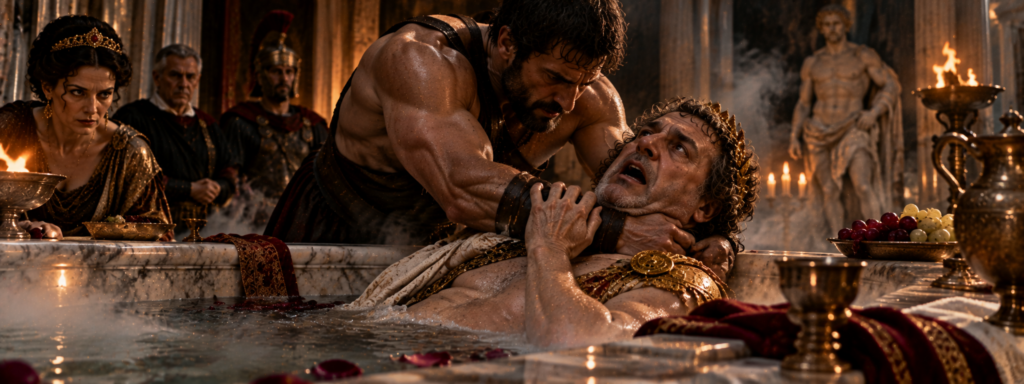
Commodus: The Gladiator Emperor Strangled in His Own Bath
Blood in the Arena, a Palace Conspiracy, and the Violent Death of Rome’s Self-Proclaimed Hercules
Lucius Aurelius Commodus Antoninus (31 August 161–31 December 192 CE) was Roman emperor from 180 to 192 CE, having ruled jointly with his father, Marcus Aurelius, since 177. The son of one of Rome’s most celebrated emperors, Commodus became notorious for his gladiatorial performances, extravagant self-glorification, political purges, and increasingly hostile relationship with the Roman aristocracy. His reign ended on New Year’s Eve in 192 CE when palace conspirators, reportedly including his mistress Marcia, the chamberlain Eclectus, and the Praetorian prefect Laetus, arranged his murder. After an alleged poisoning attempt failed, a wrestler named Narcissus strangled the emperor, bringing the Antonine dynasty’s rule to a violent end and helping precipitate the civil wars of 193 CE.
The Emperor Who Was Murdered Before He Could Celebrate the New Year
On the final night of 192 CE, the most powerful man in the Roman Empire was preparing to enter a new year that he intended to make entirely his own. Commodus had spent the preceding months transforming his public image into that of Hercules reborn, presenting himself as a divine champion whose strength and magnificence surpassed those of ordinary mortals. He had fought in the arena, humiliated the senatorial aristocracy, and demanded honors that would have seemed extraordinary even by the standards of Rome’s increasingly extravagant imperial court. Yet behind the carefully constructed image of invincibility, the emperor had become dangerously isolated from the people responsible for keeping him alive.
The danger was not approaching from a rebellious province or an enemy army gathered beyond the frontiers. It was already inside the palace, among people who knew his routines, understood his temper, and possessed access to his private rooms. According to the ancient accounts, Commodus had recently prepared a list of individuals he intended to execute, and several of the names belonged to members of his own household. Those who discovered the alleged plans understood that the emperor’s next display of power might be their final experience of his reign.
The conspiracy that followed was both desperate and remarkably intimate. Marcia, the emperor’s influential mistress, was said to have administered poison, possibly concealed in his food or drink, while other members of the household prepared for the consequences. When Commodus became ill but failed to die, the conspirators reportedly turned to a man whose profession depended upon physical strength rather than political influence. Narcissus, a wrestler associated with the emperor’s athletic activities, was sent to finish what the poison had apparently failed to accomplish.
The final confrontation took place in the emperor’s private bathing quarters, according to the surviving tradition. Commodus, weakened by illness and possibly recovering from the effects of the suspected poison, was attacked by the wrestler and strangled. The ruler who had presented himself as Hercules, the mythical hero famous for overwhelming monstrous enemies with his bare hands, was supposedly killed by a man who used those same hands against him. The symbolism was so striking that it would have been irresistible to ancient historians even if the precise details had not survived.
By the time Rome entered 193 CE, Commodus was dead, and the conspirators had arranged for Pertinax, an experienced senator and military commander, to become emperor. The Senate welcomed the opportunity to condemn the ruler who had treated its members with contempt, while the new government attempted to distance itself from the excesses of the previous reign. Yet the assassination did not restore the stability that Commodus had inherited from his father. Instead, it opened a struggle for imperial power that would produce further murders, military rebellion, and civil war.
The death of Commodus has often been presented as the inevitable conclusion to a reign of madness and cruelty. That interpretation captures the hostility he inspired, but it also risks turning a complicated political history into a simple morality tale. Commodus was undoubtedly an unconventional and increasingly authoritarian ruler, yet the surviving accounts were written largely by men who despised his behavior and celebrated his removal. Understanding his assassination requires examining not only his excesses but also the fears, ambitions, and political calculations of the people who decided that the emperor had to die.
Born to Rule: The Son of Marcus Aurelius
Commodus entered the world on 31 August 161 CE at Lanuvium, a town southeast of Rome. His father, Marcus Aurelius, had become emperor earlier that year alongside Lucius Verus, establishing a joint reign that would confront major military and political challenges. His mother, Faustina the Younger, belonged to the imperial family through her father, Antoninus Pius. Commodus therefore possessed a dynastic pedigree that few Roman emperors could rival.
His birth carried enormous political significance because the imperial succession had long depended upon adoption rather than straightforward inheritance from father to son. Nerva, Trajan, Hadrian, Antoninus Pius, and Marcus Aurelius had all participated in a system in which an emperor’s successor was selected or adopted into the ruling family. Later writers would idealize this arrangement as a period when capable men inherited power through merit rather than birth. The reality was more complicated, since family relationships and political circumstances heavily influenced those adoptions.
Commodus represented a departure from that pattern because Marcus Aurelius had a surviving biological son who could inherit the throne. The emperor did not need to adopt an unrelated adult successor or elevate a distant relative to preserve continuity. Commodus was raised within the imperial household with the expectation that he would eventually rule. His future was therefore shaped by dynastic privilege long before he possessed the experience required to exercise imperial authority.
He was not originally the only surviving male child in the family. Commodus had a twin brother, Titus Aurelius Fulvus Antoninus, who died in childhood, and several other siblings also failed to survive to adulthood. The repeated deaths within the imperial family reinforced the uncertainty surrounding succession. By the time Commodus approached adolescence, he had become the principal surviving male heir.
Marcus Aurelius took deliberate steps to establish his son’s political position. Commodus received the title Caesar in 166 CE and later accompanied his father during military campaigns along the northern frontiers. In 177 CE, he was elevated to the rank of Augustus, becoming joint emperor while still in his teens. The decision ensured that the empire would recognize him as a legitimate ruler before Marcus Aurelius died.
His education was intended to prepare him for the responsibilities of imperial government. Ancient accounts describe tutors, philosophical instruction, and exposure to military affairs. Yet education alone could not guarantee that Commodus would resemble his father in temperament or priorities. Marcus Aurelius had cultivated a reputation for discipline, duty, and philosophical reflection, while Commodus would become associated with spectacle, personal pleasure, and displays of physical prowess.
The contrast between father and son eventually became one of the most enduring themes in Roman history. Marcus Aurelius was remembered as the philosopher emperor who endured hardship in service of the state. Commodus became the ruler accused of abandoning serious government for gladiatorial entertainment and personal glorification. The contrast was real in important respects, but it was also sharpened by historians who regarded Commodus as a disastrous successor to a respected ruler.
From the beginning, Commodus inherited both extraordinary advantages and dangerous expectations. His ancestry gave him legitimacy, his father’s reputation provided prestige, and his elevation to Augustus secured his position. Yet the same inheritance created a standard against which his conduct would be relentlessly judged. When he eventually abandoned his father’s priorities, the disappointment would become political hostility.
A Childhood in the Shadow of War
Commodus grew up during a period when the Roman Empire faced severe military and economic pressures. The Antonine Plague, which spread through imperial territories during the reign of Marcus Aurelius, caused substantial mortality and disrupted communities across the empire. At the same time, conflicts along the Danube frontier required repeated campaigns against Germanic and Sarmatian peoples. The stability associated with earlier decades of Antonine rule had become increasingly difficult to maintain.
Marcus Aurelius spent considerable time away from Rome directing military operations. The emperor’s responsibilities placed him among soldiers, commanders, and frontier communities rather than permanently within the imperial capital. Commodus eventually accompanied him, gaining exposure to military life while still young. Such experiences were intended to prepare the heir for command and strengthen his relationship with the army.
Ancient historians later suggested that Commodus lacked the seriousness necessary to learn from these experiences. Cassius Dio, a senator who lived through the period, described him in strongly negative terms and portrayed him as vulnerable to corrupting influences. The Historia Augusta, a much later and notoriously unreliable collection of imperial biographies, offered even more sensational stories about his childhood behavior. These accounts must be read critically because they often interpret early life through the knowledge of a ruler’s later reputation.
Stories of youthful cruelty, laziness, or moral corruption were common features of hostile ancient biography. A ruler who eventually became unpopular could be portrayed as having displayed signs of depravity from childhood. Such anecdotes gave the impression that his later actions were inevitable. They also allowed historians to contrast the virtues of Marcus Aurelius with the alleged failings of his son.
The actual relationship between Commodus and his father is difficult to reconstruct. Marcus Aurelius clearly intended him to succeed and took practical steps to secure that outcome. The young emperor was granted honors, political standing, and opportunities to appear beside his father. These decisions indicate that Marcus Aurelius did not simply regard Commodus as incapable of ruling.
The military environment also exposed Commodus to the importance of personal loyalty among soldiers. Roman emperors depended upon armies not only to defend the empire but also to maintain their own authority. A ruler who lost military support could be overthrown regardless of his legal position. Commodus would later discover how dangerous this dependence could become.
His youth therefore combined privilege with insecurity. He was the designated successor to one of Rome’s most respected rulers, but he inherited an empire strained by disease, warfare, and administrative demands. The expectations placed upon him were enormous, and the political consequences of failure could be fatal. When Marcus Aurelius died, Commodus would have to decide whether to continue his father’s demanding military policies or establish a different kind of reign.
The Death of Marcus Aurelius and the Beginning of a Different Empire
Marcus Aurelius died on 17 March 180 CE while campaigning along the northern frontier. The precise location is disputed in the ancient tradition, with Vindobona and Sirmium both associated with his final illness. Commodus, already recognized as co-emperor, inherited sole authority without the immediate succession crisis that had accompanied some earlier imperial deaths. At eighteen years old, he became the ruler of a vast empire.
His accession initially offered the prospect of continuity. The imperial administration remained in place, experienced advisers were available, and the army had already acknowledged his position. Commodus possessed the prestige of his father’s dynasty and the legal authority of an established Augustus. He did not need to seize power through rebellion or persuade the Senate to recognize an unfamiliar claimant.
Yet one of his first major decisions revealed a different set of priorities. Marcus Aurelius had spent years pursuing military operations along the Danube, and some commanders believed further campaigns could strengthen Rome’s position. Commodus instead sought a settlement that would allow him to return to the capital. The decision became a major target of criticism in later historical accounts.
Ancient writers portrayed the withdrawal from the frontier as evidence that Commodus preferred pleasure to military duty. They contrasted his desire for Rome’s entertainments with his father’s willingness to endure hardship among the soldiers. The accusation contributed to the image of a young ruler abandoning the responsibilities of empire. Yet the decision also had practical arguments in its favor.
The northern campaigns had imposed heavy costs upon Roman resources. Disease, casualties, and prolonged military commitments had strained the empire. A negotiated settlement could reduce expenditure and allow the government to address problems elsewhere. Modern historians therefore question whether Commodus’s policy was as irrational as hostile ancient writers claimed.
The peace arrangements involved agreements with frontier peoples and the continuation of Roman influence through diplomacy and military pressure. Commodus did not simply surrender the entire strategic position established by his father. The settlement reflected a choice to stabilize the frontier rather than pursue further expansion. Whether it was the best available policy remains debatable.
His return to Rome nevertheless carried symbolic significance. Marcus Aurelius had become associated with endurance and military responsibility, while Commodus increasingly presented himself through public ceremony, entertainment, and imperial magnificence. The capital offered opportunities to cultivate popularity among the urban population. It also exposed the emperor to court politics and aristocratic resentment.
The early years of his sole reign were not immediately dominated by the extreme behavior for which he later became famous. Administrative continuity remained possible, and influential advisers helped manage government affairs. Yet the foundations of conflict were already present. Commodus possessed enormous authority, limited experience, and a growing preference for personal display that would eventually alienate important sections of the ruling elite.
The Conspiracy That Taught Commodus to Fear His Own Family
In 182 CE, a conspiracy against Commodus dramatically altered the atmosphere of his reign. The plot involved members of the imperial family and senatorial aristocracy, including his sister Lucilla. Ancient sources describe an assassination attempt in which an attacker approached the emperor with a concealed weapon. The attempt failed, and the consequences were severe.
Lucilla had once occupied an exceptionally prestigious position. She was the daughter of Marcus Aurelius and had been married to Lucius Verus, the emperor who ruled jointly with her father until his death in 169 CE. Her status as a former empress gave her considerable social importance. Commodus’s accession, however, reduced her relative position within the imperial household.
The precise motives behind the conspiracy remain uncertain. Ancient writers emphasized Lucilla’s resentment of her brother and dissatisfaction with her diminished status. Political opposition to Commodus may also have contributed, particularly among aristocrats concerned about his conduct and the influence of his advisers. The surviving accounts do not allow every participant’s intentions to be established.
The attempted assassination was reportedly carried out by Claudius Pompeianus Quintianus, a relative connected to Lucilla’s circle. According to the tradition, he approached Commodus with a dagger but failed to strike before being overpowered. The dramatic details of his behavior were preserved by hostile writers and may have been embellished. The essential fact is that a serious conspiracy against the emperor was uncovered.
Commodus responded with executions and punishments. Lucilla was exiled and subsequently killed, while other individuals associated with the plot also suffered. The affair demonstrated that members of the imperial family could become enemies of the ruler. It also showed that Commodus was willing to eliminate relatives when he believed they threatened his authority.
The psychological consequences cannot be known with certainty, but the political effects were substantial. The emperor had survived an attack involving people who possessed privileged access to his household. Trust became more difficult, and suspicion could be directed toward anyone whose influence or ancestry made them dangerous. The imperial court entered a more fearful period.
Ancient historians often treated the conspiracy as a turning point in Commodus’s character. They suggested that he became increasingly suspicious, vindictive, and dependent upon favorites afterward. Such interpretations may exaggerate the transformation, but the attempted assassination clearly intensified political tensions. It provided a precedent for later purges and reinforced the emperor’s awareness that danger could come from those closest to him.
The irony is that Commodus would eventually die through precisely the kind of palace conspiracy he had once survived. His sister’s failed plot exposed the vulnerability of imperial authority within the household. A decade later, another group of insiders would exploit that vulnerability more successfully. The emperor’s response to earlier threats may have contributed to the climate of fear that made his final assassination possible.
The Rise of Perennis: Power Behind the Throne
As Commodus became increasingly absorbed in personal interests, influential officials acquired substantial authority over government affairs. One of the most important was Sextus Tigidius Perennis, a Praetorian prefect who emerged as a dominant figure during the early 180s. His position gave him control over an important military force and access to the emperor. Such authority made him both useful and potentially dangerous.
Ancient sources portray Perennis as an ambitious administrator who exploited Commodus’s limited interest in routine government. Cassius Dio suggested that he accumulated power while the emperor devoted himself to entertainment and private pleasures. The relationship reflected a broader problem within the imperial system. An emperor who delegated extensive responsibilities could become dependent upon advisers whose interests did not always coincide with his own.
Perennis reportedly exercised influence over appointments, prosecutions, and military affairs. His prominence created resentment among senators and other members of the elite. Some regarded him as a threat because he controlled access to imperial power. Others may have feared that his position allowed him to manipulate the emperor for personal advantage.
The circumstances of his downfall remain disputed. Ancient accounts describe accusations that Perennis intended to seize the throne or promote his sons through military appointments. A delegation of soldiers reportedly brought complaints against him, contributing to his removal. The evidence does not establish whether he genuinely planned a coup or fell victim to political rivals.
Commodus ultimately ordered his execution in 185 CE. His sons were also killed, eliminating the family as a potential source of opposition. The episode demonstrated that even the most powerful imperial adviser could be destroyed when the emperor’s confidence disappeared. It also reinforced the atmosphere of insecurity surrounding the court.
The fall of Perennis did not resolve the underlying problem of concentrated power among imperial favorites. Commodus continued to rely upon influential household officials, and the competition for access remained intense. The emperor’s personal authority was immense, but practical administration depended upon men who could become rivals. Each change in favor created opportunities for accusation and betrayal.
The execution also contributed to the image of a ruler increasingly willing to use lethal force against those who served him. Whether Perennis was guilty of conspiracy remains uncertain, but the punishment was decisive. Commodus had learned that removing a powerful adviser could protect his throne. His later enemies would learn that remaining close to him offered no guarantee of survival.
Cleander: The Freedman Who Turned Imperial Favor Into a Fortune
After the fall of Perennis, another figure rose to extraordinary prominence. Marcus Aurelius Cleander, a former imperial slave who became a powerful freedman, gained influence within Commodus’s household. His career illustrated how personal access to the emperor could become a source of enormous political authority. It also exposed the tensions between traditional aristocratic privilege and the growing power of palace officials.
Cleander reportedly controlled appointments and used his influence to accumulate wealth. Ancient sources accused him of selling offices, accepting bribes, and manipulating access to imperial favor. Some allegations may reflect aristocratic hostility toward a freedman exercising power over senators. Nevertheless, his extraordinary prominence and eventual downfall indicate that serious political conflict surrounded his position.
The sale of offices was particularly offensive to Roman ideals of public service. Magistracies and administrative appointments carried prestige and could provide opportunities for influence or enrichment. If such positions were distributed through payments to a palace favorite, traditional political relationships were undermined. The emperor’s household appeared to be converting public authority into private profit.
Cleander’s influence also affected the Praetorian Guard and other powerful institutions. His ability to advance or remove individuals created enemies among those whose careers depended upon imperial favor. Rival factions had strong incentives to accuse him of corruption or disloyalty. The court became a place where personal competition could quickly turn lethal.
In 190 CE, a serious crisis developed in Rome amid food shortages and public unrest. Ancient accounts describe popular anger directed against Cleander, whom many blamed for manipulating the grain supply or profiting from scarcity. The precise causes of the shortage and the extent of his responsibility remain uncertain. What is clear is that hostility toward him became politically explosive.
Crowds reportedly gathered and demanded his punishment. Violence followed, and the situation threatened to become a major confrontation between civilians and armed forces. Commodus eventually ordered Cleander’s execution, apparently sacrificing his powerful favorite to restore order. His head was displayed publicly, according to the ancient tradition.
The fall of Cleander demonstrated how quickly imperial favor could become fatal. A man who had controlled appointments and accumulated wealth was destroyed when his position became politically inconvenient. Commodus survived the crisis, but the episode exposed the fragility of his government. Public anger, military force, and palace intrigue had converged in a way that could threaten the emperor himself.
The execution also reinforced the pattern of instability among Commodus’s closest advisers. Perennis had fallen, Cleander had been killed, and other officials understood that their positions depended upon an unpredictable ruler. The emperor’s reliance upon favorites did not create a stable system of government. It produced a court in which powerful men could rise rapidly and disappear just as suddenly.
Rome’s Emperor Becomes Hercules
During the later years of his reign, Commodus increasingly associated himself with Hercules, the legendary hero celebrated for extraordinary strength and victories over monstrous enemies. Roman emperors had long used divine imagery to express authority and legitimacy. Commodus, however, carried the identification to an unusual degree. He presented himself not merely as a ruler favored by Hercules but as a living embodiment of the hero.
Portraits and statues depicted him wearing the lion skin associated with Hercules and holding the hero’s club. One of the most famous surviving images shows Commodus with these attributes, emphasizing his muscular body and divine association. The imagery was intended to communicate strength, invincibility, and a special relationship with the gods. It also revealed the emperor’s fascination with his own physical prowess.
His public titles became increasingly extravagant. Ancient sources describe him adopting names and honors associated with Hercules, victory, and the renewal of the Roman world. He also sought to connect the identity of Rome itself with his own person. Such measures suggested that imperial authority was becoming inseparable from personal self-glorification.
Commodus’s identification with Hercules had political implications beyond vanity. The hero was associated with overcoming chaos and defeating dangerous enemies. By presenting himself as Hercules, the emperor could claim that his strength protected the empire from disorder. The symbolism offered a form of legitimacy based upon divine power rather than senatorial approval.
Yet the imagery offended many aristocratic observers. Senators were accustomed to imperial claims of divine favor, but Commodus’s personal performances appeared to violate established expectations of dignity. His willingness to display himself in theatrical and athletic contexts blurred boundaries between emperor, performer, and deity. What pleased some spectators could appear humiliating to the ruling elite.
The surviving evidence includes coins, sculptures, inscriptions, and literary accounts. These materials confirm that Commodus promoted an extraordinary public image centered upon Hercules and personal magnificence. They do not prove that he literally believed himself to be a god in the modern psychological sense. His actions can also be understood as political theater, religious symbolism, and an attempt to create a distinctive form of imperial authority.
Ancient writers often interpreted his behavior as evidence of madness. Such judgments reflect their moral and political assumptions rather than a reliable clinical diagnosis. Commodus may have been arrogant, theatrical, and increasingly detached from conventional expectations, but those characteristics do not establish a specific mental disorder. The historical significance lies in the public consequences of his conduct.
By the final months of 192 CE, the emperor’s self-presentation had become inseparable from his political identity. He was no longer simply Marcus Aurelius’s son or the ruler of the Roman Empire. He was Commodus-Hercules, a sovereign whose public image demanded admiration and submission. The more he elevated himself above ordinary political relationships, the more dangerous disagreement with him became.
The Gladiator Emperor and the Blood of the Arena
Commodus’s fascination with gladiatorial combat became the most notorious feature of his reign. Roman emperors had long sponsored games, hunts, and public spectacles, but direct participation in gladiatorial performances was considered deeply inappropriate for a ruler. Gladiators occupied a socially degraded position despite their popularity. For an emperor to enter the arena was therefore a deliberate challenge to established conventions.
Commodus nevertheless appeared before spectators in performances that emphasized his skill with weapons and physical strength. Ancient sources describe him killing animals, demonstrating archery, and participating in staged combats. He reportedly fought numerous opponents under conditions designed to protect his life. The performances allowed him to present himself as an invincible champion.
Cassius Dio, who witnessed aspects of Commodus’s reign, described extraordinary displays in the arena. He reported that the emperor killed large numbers of animals and performed feats intended to astonish the audience. Some accounts emphasize the carefully controlled nature of the contests. Commodus could claim victory without exposing himself to the risks faced by ordinary gladiators.
The distinction mattered because gladiatorial combat was normally associated with genuine danger. Professional fighters could be injured or killed, and their social status reflected the dishonor attached to performing for public entertainment. Commodus appropriated the spectacle while retaining the protections of imperial power. His victories therefore appeared impressive to some spectators but fraudulent or degrading to critics.
Ancient writers also accused him of demanding enormous payments for his appearances. The imperial treasury allegedly provided funds for performances that were presented as personal achievements. Such arrangements contributed to accusations that he exploited public resources for private vanity. The exact sums preserved in literary accounts may be exaggerated, but the criticism reflects serious resentment.
His performances sometimes included elaborate displays involving exotic animals. Roman audiences were accustomed to spectacles featuring creatures imported from distant provinces. Commodus used these events to demonstrate mastery over dangerous beasts, reinforcing his identification with Hercules. The arena became a stage upon which imperial power was represented as physical domination.
The emperor’s participation also placed spectators in an uncomfortable position. Senators and other dignitaries were expected to attend and applaud performances they might privately despise. Refusing to display enthusiasm could be interpreted as disrespect or disloyalty. The arena therefore became a place where entertainment and political intimidation overlapped.
Commodus’s fascination with gladiatorial combat was not merely an eccentric hobby. It formed part of a broader effort to redefine imperial authority through spectacle, strength, and divine imagery. The ruler who claimed to embody Hercules wanted the population to witness his supposed invincibility. Yet his final death would expose the limits of that image when a professional wrestler confronted him without the protections of the arena.
When Entertainment Became Political Terror
The arena offered Commodus an opportunity to display power, but it also became a setting in which members of the elite experienced humiliation and fear. Cassius Dio described senators attending performances while struggling to conceal their reactions. The emperor’s conduct could be absurd, threatening, or both, depending upon the circumstances. Those present understood that laughter or disapproval might have dangerous consequences.
One famous account describes Commodus displaying the head of an ostrich and gesturing toward senators in a manner they interpreted as threatening. Dio claimed that he and others attempted to suppress their laughter by chewing laurel leaves. The anecdote is memorable because it combines theatrical absurdity with the possibility of lethal punishment. It also reflects the author’s personal hostility toward the emperor.
The precise incident cannot be independently verified, but the broader atmosphere is consistent with the political tensions of the reign. Commodus had executed prominent individuals and demonstrated a willingness to punish perceived disrespect. Senators who attended his performances were not simply spectators at a public entertainment. They were members of a political class whose relationship with the emperor had become increasingly dangerous.
The emperor’s displays also undermined traditional distinctions between ruler and performer. Roman aristocratic culture valued military courage, public dignity, and self-control. Gladiators, actors, and professional entertainers were admired by audiences but generally regarded as socially inferior. Commodus’s participation in their activities offended elite expectations.
Yet the reaction of ordinary Romans may have been more complicated. Public spectacles were immensely popular, and an emperor who personally appeared in the arena could attract enthusiasm. The surviving literary accounts were written largely from aristocratic perspectives and may not accurately represent the feelings of every spectator. Commodus’s public image could therefore be both popular and politically divisive.
His behavior also demonstrated the coercive nature of imperial ceremony. When the emperor demanded applause, attendance, or public recognition, refusal could carry consequences. The distinction between genuine admiration and compulsory enthusiasm became difficult to determine. The more extravagant his performances became, the more they exposed the imbalance of power between ruler and audience.
The arena therefore became a symbol of Commodus’s increasingly personal style of government. He used public entertainment to glorify himself, while critics saw the degradation of imperial dignity. His performances reinforced the image of a ruler more interested in physical display than administrative responsibility. They also deepened resentment among individuals whose cooperation remained essential to the functioning of the empire.
By 192 CE, the emperor’s fascination with spectacle had become entangled with plans for the new year. Ancient sources describe his intention to appear in gladiatorial guise during important public ceremonies. Such plans alarmed members of the court who feared further humiliation and unpredictable demands. The spectacle that Commodus intended as a celebration of his power would become part of the immediate background to his assassination.
The Women of Commodus’s Court
Commodus’s personal relationships formed an important part of the political world surrounding his reign. His marriage to Bruttia Crispina, arranged during his father’s lifetime, initially connected him with a distinguished senatorial family. Crispina became empress and received the title Augusta. Yet the marriage eventually collapsed under circumstances that remain imperfectly understood.
Ancient sources accuse Crispina of adultery and describe her exile, followed by her death. The allegations may reflect genuine court conflict, but they also belong to a tradition in which accusations of sexual misconduct were frequently used against politically vulnerable women. The surviving evidence does not allow a confident reconstruction of her conduct. What is clear is that she disappeared from her position as empress and was eventually killed.
Commodus did not establish another formal marriage after Crispina’s removal. Instead, several women occupied influential positions within his household, most notably Marcia. She became his prominent mistress and possessed unusual access to the emperor. Her influence would later place her at the center of the conspiracy that ended his life.
Marcia’s background is not entirely clear, but ancient accounts associate her with the imperial court and with individuals who had previously been involved in political intrigue. She was reportedly connected with the household of Ummidius Quadratus, a senator implicated in the conspiracy of 182 CE. Her survival and subsequent prominence illustrate the complex personal relationships that could exist within the palace. Individuals associated with disgraced figures could sometimes reemerge in positions of influence.
Marcia is also remembered for her reported sympathy toward Christians. Ancient sources suggest that she intervened on behalf of Christian prisoners or assisted in securing their release. The evidence does not establish that she was herself a Christian, and later traditions may have exaggerated her religious commitments. Nevertheless, her influence extended beyond private companionship.
Her position depended upon the emperor’s favor, but it also gave her access to information and opportunities unavailable to most members of the court. She could approach Commodus in private settings and potentially influence his decisions. Such access made her politically valuable to those seeking favors. It also exposed her to danger if the emperor’s attitude changed.
The relationship between Commodus and Marcia became central to the events of December 192 CE. According to the ancient narrative, she discovered that her name appeared on a list of people marked for execution. The alleged discovery transformed her from an influential companion into a participant in a desperate conspiracy. Whether every detail is accurate remains uncertain, but her involvement in the assassination is consistently reported.
Marcia’s role complicates the familiar image of Commodus as a ruler destroyed by hostile senators. His death was not simply the result of aristocratic opposition from outside the palace. It involved a woman who had enjoyed his intimacy and confidence. The final betrayal emerged from the same household relationships upon which his personal security depended.
The Men Who Controlled the Palace
The conspiracy against Commodus involved several individuals whose positions gave them access to the emperor and influence over the imperial household. Among the most important were Quintus Aemilius Laetus, the Praetorian prefect, and Eclectus, a senior palace chamberlain. Both occupied roles that placed them close to the machinery of imperial power. Their participation made the assassination far more dangerous than an isolated attack by a disgruntled individual.
Laetus commanded the Praetorian Guard, the military force responsible for protecting the emperor and maintaining order in the capital. The Guard had played decisive roles in earlier imperial successions, including the elevation of Claudius in 41 CE. Its support could determine whether a new ruler survived the first hours of a reign. A conspiracy involving its prefect therefore possessed an enormous advantage.
Eclectus, as a senior household official, controlled access and participated in the management of palace affairs. Such positions required intimate knowledge of the emperor’s routines and personal relationships. A chamberlain could influence who entered private rooms and when particular information reached the ruler. In a conspiracy, that knowledge could become lethal.
Marcia provided another form of access through her relationship with Commodus. She was able to approach him in circumstances where armed guards and political officials might not be present. Her proximity made the alleged poisoning attempt possible within the ancient narrative. The combination of personal intimacy, administrative authority, and military command gave the conspirators exceptional opportunities.
The precise origins of the conspiracy remain uncertain. Ancient writers suggest that fear of imminent execution drove the participants to act. Political dissatisfaction with Commodus’s conduct may also have contributed. The surviving evidence does not establish whether the conspirators had been planning his removal for an extended period or acted rapidly in response to a specific threat.
Their positions nevertheless made cooperation essential. Marcia could provide access to the emperor, Eclectus could help manage the household, and Laetus could influence the Praetorian Guard. None of these individuals alone could guarantee a successful transfer of power. Together, they possessed the means to remove Commodus and support a successor.
The choice of Pertinax as the next emperor suggests that the conspirators considered the political aftermath. Pertinax was an experienced senator and military commander with a reputation for discipline. His standing made him a plausible candidate for restoring confidence among the aristocracy and military establishment. The succession was therefore not simply an impulsive murder followed by confusion.
The conspiracy illustrates the vulnerability of an emperor who had alienated his closest associates. Commodus possessed legal authority, military resources, and the symbols of divine power. Yet those advantages depended upon individuals who could choose to cooperate against him. When the people controlling his personal security decided that he was a threat to their survival, the palace became a trap.
The Final Days of 192 CE
The closing months of Commodus’s reign were marked by increasingly extravagant displays of personal authority. Ancient sources describe his efforts to rename institutions, reshape public ceremonies, and associate the coming year with his own divine identity. The emperor’s identification with Hercules became more prominent. His behavior alarmed individuals who regarded his plans as dangerous or humiliating.
One particularly controversial proposal involved his appearance during the New Year celebrations. According to the ancient accounts, Commodus intended to present himself publicly in the guise of a gladiator rather than participate in conventional imperial ceremonies. The plan offended members of the court who believed it would degrade the dignity of the imperial office. It also demonstrated the emperor’s willingness to ignore traditional expectations.
The significance of the proposal should not be exaggerated into a complete explanation for the assassination. Commodus had already accumulated enemies through executions, political purges, and unpredictable decisions. His gladiatorial ambitions were part of a broader pattern of conflict with the ruling elite. The immediate danger arose when members of his household allegedly became convinced that he intended to kill them.
Herodian provides a dramatic account of the final crisis. According to his narrative, Commodus prepared a list of people marked for execution, including Marcia, Laetus, and Eclectus. The document supposedly fell into Marcia’s hands, allowing her to discover the danger. The story provides a clear motive for the conspirators, but its precise details cannot be independently verified.
The alleged list is particularly important because it transforms the assassination from an act of political ambition into a struggle for survival. If the conspirators believed they were about to be executed, delay could be fatal. They could not safely confront the emperor or appeal to an independent authority. The Roman imperial system offered few protections against the personal decisions of a ruler.
The conspirators therefore faced a brutal calculation. They could wait and hope that Commodus changed his mind, or they could act before he carried out the alleged executions. Their access to the palace gave them an opportunity, but failure would almost certainly result in death. The decision to murder the emperor required both desperation and confidence that they could control the aftermath.
Ancient historians portrayed the conspiracy as unfolding rapidly. The participants allegedly agreed that Commodus must be killed before the New Year began. They also needed to prevent the Praetorian Guard from responding violently in defense of the emperor. Laetus’s involvement was therefore crucial.
The final hours of Commodus’s reign were shaped by the collision of two competing plans. The emperor intended to celebrate his power through public spectacle and extraordinary honors. His closest associates, according to the ancient narrative, intended to ensure that he never reached the celebrations. The ruler who believed himself invincible was approaching a confrontation for which his titles and ceremonies offered no protection.
The Death List That May Have Sealed His Fate
The alleged execution list occupies a central place in the traditional account of Commodus’s assassination. Herodian describes a document containing the names of individuals whom the emperor intended to eliminate. Marcia supposedly discovered it after it was left in a place accessible to her. The list included people whose positions made them indispensable to the palace.
The story is dramatic because it turns an ordinary administrative document into the instrument of the emperor’s destruction. Commodus had allegedly written down the names of those he considered enemies, but the list reached the very people it threatened. The intended victims then became conspirators. The emperor’s attempt to secure his position supposedly produced the danger that killed him.
The historical reliability of the episode is uncertain. Herodian wrote after the events and may have shaped the narrative to provide a clear explanation for the conspiracy. Ancient historians often used discovered letters, secret lists, and overheard conversations to dramatize political crises. Such devices could preserve genuine traditions while also introducing literary embellishment.
Nevertheless, the alleged list fits the political environment of Commodus’s later reign. The emperor had executed powerful advisers, punished relatives, and demonstrated suspicion toward individuals close to him. Members of the court had reason to fear sudden changes in imperial favor. The possibility of a new purge would have been taken seriously.
Marcia’s involvement is particularly significant. As the emperor’s mistress, she possessed personal access that could allow her to encounter private documents or hear confidential information. Her position also made her vulnerable if Commodus decided to remove her. The alleged discovery therefore provided both motive and opportunity.
Laetus and Eclectus faced similar dangers. Their offices gave them influence, but their survival depended upon the emperor’s confidence. If their names appeared on an execution list, their authority would not protect them. The history of Perennis and Cleander demonstrated how quickly powerful palace figures could be destroyed.
The conspiracy may therefore have emerged from a broader atmosphere of fear rather than a single document. Even if the list was invented or embellished, the participants had reasons to distrust Commodus. His unpredictable punishments and increasingly personal style of government had made loyalty difficult to sustain. The assassination can be understood as the culmination of that insecurity.
The death-list tradition remains historically important because it reveals how ancient writers explained the emperor’s final betrayal. Commodus was portrayed as so dangerous that even his closest companions believed murder was their only means of survival. The narrative transformed the conspirators from ordinary assassins into people acting under imminent threat. Whether that justification was accurate remains impossible to establish.
The Poisoned Meal: Marcia’s Alleged First Attempt
According to the ancient accounts, the conspirators initially attempted to kill Commodus through poison. Marcia was assigned a central role because her relationship with the emperor gave her access to his food or drink. The method was intended to avoid a public struggle and allow the conspirators to manage the transition quietly. A sudden illness could be presented as natural while preparations were made for a successor.
Herodian describes Marcia administering poison after Commodus had returned from his activities. The substance was allegedly mixed with something he consumed, although the surviving accounts differ in their details. The precise composition of the poison is unknown. No physical evidence survives to identify what was supposedly used.
The choice of poison reflected the advantages and uncertainties of covert assassination. A weapon attack could produce noise, resistance, and immediate intervention by guards. Poison might allow the victim to become incapacitated without an obvious confrontation. Yet its effects could be unpredictable, particularly when the conspirators lacked precise control over dosage and absorption.
Commodus reportedly began to feel ill after consuming the substance. Ancient writers describe nausea and vomiting, suggesting that the poison did not immediately kill him. The emperor’s physical condition deteriorated, but he remained alive. The conspirators therefore faced the possibility that their attempt had failed.
The vomiting became a crucial detail in the narrative. If Commodus expelled part of the substance, the amount absorbed might have been insufficient to cause death. Ancient authors interpreted this as the reason the poisoning attempt did not succeed. Modern medicine cannot verify the explanation because the toxin and symptoms are unknown.
The conspirators’ danger increased as the emperor survived. If Commodus recovered and discovered the attempt, the consequences would be catastrophic. Marcia, Laetus, and Eclectus could expect execution, and anyone associated with them might also be punished. The failed poisoning transformed an already dangerous conspiracy into an immediate emergency.
The ancient narrative presents the conspirators as improvising under pressure. They had intended a relatively quiet death but now needed a more certain method. Their access to the emperor remained an advantage, yet time was running out. The solution they chose involved a man whose strength could overcome even a physically formidable ruler.
The poisoning story is widely repeated, but it should not be treated as medically established fact. The surviving evidence comes from literary accounts that may have incorporated dramatic embellishment. What is securely known is that Commodus was assassinated on 31 December 192 CE. The alleged failed poisoning remains part of the traditional reconstruction of how the murder unfolded.
Narcissus: The Wrestler Who Killed Hercules
The man chosen to finish the assassination was Narcissus, a wrestler associated with Commodus’s athletic activities. Ancient accounts describe him as physically powerful and familiar with the emperor. His relationship with Commodus may have included training or participation in exercises that emphasized strength and combat. Such familiarity would have made his presence less suspicious than that of an unknown attacker.
The choice was also symbolically devastating. Commodus had spent years presenting himself as Hercules, a hero celebrated for overpowering enemies through extraordinary physical strength. Narcissus possessed the practical skills of a professional wrestler. The emperor’s carefully cultivated image of invincibility would be tested against someone trained to control and overpower another human body.
According to the traditional account, Narcissus entered the emperor’s private quarters while Commodus was weakened by the effects of the alleged poison. The location is commonly described as a bath or bathing room. Commodus may have been attempting to recover from illness or simply following his usual routine. The exact sequence cannot be independently established.
Narcissus then attacked and strangled him. The surviving sources present the act as a direct physical killing rather than a formal execution. Commodus reportedly struggled, but the wrestler overcame him. The emperor died without the ceremonial protections and public spectacle that had surrounded his gladiatorial performances.
The method of death carried a grim irony. In the arena, Commodus had enjoyed carefully managed contests in which opponents were unlikely to endanger him seriously. His imperial status allowed him to claim victory while controlling the conditions of combat. In the private confrontation with Narcissus, those protections were absent.
The assassination also demonstrates the importance of physical access. Commodus was surrounded by guards and officials, but his personal routines required moments of relative privacy. A familiar wrestler could approach him in circumstances where an armed stranger might have been stopped. The conspirators exploited that familiarity to reach the emperor at his most vulnerable.
Narcissus’s motives remain uncertain. Ancient writers suggest that he acted on behalf of the palace conspirators, possibly in exchange for reward or under pressure. The surviving evidence does not reveal his personal feelings toward Commodus. He may have been motivated by fear, ambition, loyalty to the conspirators, or a combination of factors.
His role nevertheless became central to the emperor’s historical memory. Commodus had claimed the identity of Hercules, but a wrestler killed him with his hands. The contrast offered ancient writers a powerful conclusion to a reign they regarded as grotesque. The ruler who had turned imperial authority into a spectacle of strength died in a private struggle he could not control.
The Emperor’s Final Moments: What the Sources Actually Tell Us
The assassination of Commodus is one of the better-attested violent deaths of a Roman emperor, but the surviving accounts still require careful interpretation. Cassius Dio, Herodian, and the Historia Augusta preserve information about the conspiracy and its participants. They agree on the broad fact that Commodus was murdered and associate his death with individuals close to the imperial household. Their accounts differ in emphasis and detail.
Cassius Dio was a contemporary senator who experienced Commodus’s reign and the political upheavals that followed. His proximity to the events gives his testimony considerable importance. Yet he was also deeply hostile to Commodus and belonged to the aristocratic class that had suffered under the emperor’s rule. His narrative therefore reflects both personal experience and political judgment.
Herodian wrote later and offered a vivid account of the final conspiracy. His description of the death list, poisoning, and strangulation provides much of the familiar narrative. The dramatic structure makes the story compelling, but it also raises questions about how much detail could have been reliably preserved. Private conversations and secret decisions are especially difficult to verify.
The Historia Augusta is more problematic. Although it contains information derived from earlier sources, it also includes inventions, exaggerations, and literary fabrications. Its accounts of Commodus’s behavior are particularly sensational. Details found only in that collection should be treated with substantial skepticism.
The core historical event is secure. Commodus died on 31 December 192 CE as the result of a palace assassination, and Pertinax succeeded him. The involvement of Laetus, Eclectus, and Marcia is strongly represented in the ancient tradition. Narcissus is consistently associated with the physical killing.
The precise sequence is less certain. The alleged execution list may have been genuine, embellished, or invented as an explanation for the conspiracy. The poisoning attempt may have occurred as described, but its medical details cannot be verified. The location and mechanics of the strangulation are preserved through literary narratives rather than forensic evidence.
The distinction matters because the story has often been repeated as though every dramatic detail were established beyond question. Ancient historians were not modern investigators, and their accounts were shaped by political hostility, moral judgment, and literary expectations. The assassination can be described confidently without pretending that every private action is known. Historical accuracy requires preserving the uncertainty surrounding the most theatrical elements.
What remains beyond serious doubt is the extraordinary vulnerability revealed by Commodus’s death. The emperor was killed by people connected to his own household, despite possessing the resources of the Roman state. His military authority and divine titles offered no protection when his immediate circle turned against him. The assassination exposed the fragility of a political system built around the person of the ruler.
A Dead Emperor and a Dangerous Succession
The conspirators understood that killing Commodus was only the first stage of their operation. The Roman Empire could not remain without a recognized ruler, and uncertainty might provoke violence among soldiers or rival political factions. The Praetorian Guard was especially important because its members controlled military force in the capital. A successful assassination therefore required a credible successor.
Pertinax emerged as the chosen candidate. He was an experienced senator and military commander who had served under Marcus Aurelius and possessed a reputation for discipline. His career gave him legitimacy among aristocrats and soldiers. He also represented a possible return to the restrained style of government associated with earlier Antonine rule.
Ancient accounts describe the conspirators approaching Pertinax and informing him of Commodus’s death. He reportedly hesitated or sought confirmation before accepting the throne. Such details may have been shaped by the desire to portray him as a reluctant and virtuous ruler. Nevertheless, his accession was organized rapidly.
The Praetorian Guard accepted Pertinax, although its loyalty would prove fragile. The Senate also recognized him and welcomed the end of Commodus’s reign. The transfer of power appeared successful during the first hours of 193 CE. The conspirators had removed the emperor and installed a replacement without an immediate civil war.
Yet the underlying problems remained unresolved. The Praetorian Guard expected financial rewards and possessed the ability to overthrow a ruler who disappointed it. Senators hoped for restored dignity and influence, while military commanders throughout the empire retained their own ambitions. Pertinax inherited a political system weakened by years of tension.
The new emperor attempted to restore discipline and address financial difficulties. His policies included measures intended to reduce extravagance and stabilize government. Such reforms offended individuals accustomed to the privileges and payments of Commodus’s court. The Praetorian Guard became increasingly dissatisfied.
On 28 March 193 CE, less than three months after his accession, Pertinax was murdered by Praetorian soldiers. His death demonstrated how little stability the assassination of Commodus had achieved. The soldiers who had accepted the new emperor now destroyed him. The imperial succession again became a matter of armed force.
The crisis that followed became notorious when the Praetorian Guard effectively offered the throne to competing claimants. Didius Julianus emerged as emperor after promising substantial payments, but his reign was brief. Provincial commanders, including Septimius Severus, challenged the arrangement. The empire descended into civil conflict.
Commodus’s assassination therefore did not restore the political order associated with Marcus Aurelius. It removed one ruler but exposed the weakness of the institutions responsible for succession. The conspirators had succeeded in killing the emperor, yet they could not control the forces unleashed by his death. The empire entered one of its most turbulent periods.
The Senate’s Revenge
The Roman Senate reacted to Commodus’s death with intense hostility. Ancient sources describe senators condemning his memory and celebrating the end of his reign. Their reaction reflected years of resentment toward an emperor who had humiliated aristocrats, ordered executions, and demanded extravagant honors. The assassination offered an opportunity to reverse some of those humiliations.
The Senate supported measures intended to dishonor Commodus after death. His statues and inscriptions became targets of official condemnation, and his titles were rejected or altered. Such actions formed part of the Roman practice often described by modern historians as damnatio memoriae, although the term itself is not a standard ancient legal designation. The purpose was to damage the public memory of a disgraced ruler.
The destruction or alteration of imperial images carried political meaning. Statues represented authority, legitimacy, and public honor. Removing a ruler’s image symbolized the rejection of his claim to respect. The Senate’s response therefore transformed the dead emperor into an example of condemned tyranny.
Ancient accounts also describe demands that Commodus’s body be dishonored. The precise treatment of his remains is uncertain, but the hostility of the Senate is clear. Pertinax reportedly ensured that the body received burial rather than allowing further public abuse. The decision may have reflected a desire to prevent disorder and establish a more restrained political atmosphere.
The Senate’s condemnation also shaped the surviving historical record. Writers from aristocratic backgrounds had strong reasons to portray Commodus as a monster whose removal was justified. His gladiatorial performances, divine claims, and political purges provided abundant material for hostile narratives. The emperor’s reputation became inseparable from the perspective of the class that celebrated his death.
Yet the condemnation was not permanent. Septimius Severus later rehabilitated Commodus’s memory and secured his deification. The decision reflected political calculations connected with Severus’s desire to associate himself with the Antonine dynasty. The same ruler condemned by the Senate could be restored to divine status when a later emperor found it useful.
This reversal reveals the political nature of imperial memory. Public honor and disgrace were not determined solely by moral judgment. They could be altered according to the needs of succeeding regimes. Commodus’s reputation became a resource that different rulers could use to legitimize their authority.
The Senate’s revenge therefore offers insight into both the emperor’s unpopularity and the limitations of aristocratic power. Senators could condemn Commodus once he was dead, but they had not been able to remove him through constitutional means. His assassination depended upon palace insiders and military cooperation. The Senate’s triumph was largely symbolic, while the struggle for actual power continued elsewhere.
The Year of the Five Emperors
The assassination of Commodus helped trigger the political upheaval remembered as the Year of the Five Emperors. In 193 CE, multiple claimants competed for control of the Roman Empire. The rapid succession of rulers demonstrated that imperial authority depended upon military support as much as legal recognition. The stability of the Antonine period had given way to open conflict.
Pertinax was the first emperor of the year, but his murder after less than three months exposed the danger posed by the Praetorian Guard. Didius Julianus then secured the throne through promises of financial rewards to the soldiers. His accession became notorious because it appeared to reduce imperial authority to a transaction. The Senate recognized him under pressure, but his position was weak.
Provincial armies soon advanced their own candidates. Septimius Severus, commanding forces in the Danubian region, moved toward Rome. Pescennius Niger gained support in the eastern provinces, while Clodius Albinus possessed influence in Britain and the western territories. The empire faced competing centers of military authority.
Severus entered Rome and displaced Didius Julianus, who was executed in June 193 CE. Yet the struggle did not end with his accession. Niger continued to resist in the East, and Albinus later became a rival in the West. The resulting civil wars lasted several years.
The conflict demonstrated the consequences of a succession system without a universally accepted method of selecting emperors. Commodus had inherited power through dynastic legitimacy, but his death left no recognized heir. The conspirators selected Pertinax, yet their choice depended upon military acceptance. When that support failed, rival commanders claimed the throne.
The Praetorian Guard’s behavior also revealed the dangers of concentrating military power near the emperor. Its soldiers had accepted Commodus, supported Pertinax, murdered him, and then backed another claimant. Their loyalty could be influenced by payments, personal relationships, and immediate political advantage. The Guard became both protector and potential executioner of emperors.
Severus eventually established a new dynasty and strengthened the role of the military in imperial politics. His victory restored a measure of stability, but it came through armed conflict rather than peaceful succession. The empire survived the crisis, yet its political character continued to evolve. Military loyalty became increasingly central to imperial legitimacy.
The death of Commodus therefore had consequences far beyond the palace. A conspiracy intended to remove a dangerous ruler helped expose the absence of a secure succession mechanism. The assassins could kill Commodus, but they could not determine who would ultimately control the empire. Their success opened a struggle that reshaped Roman politics.
Was Commodus Really Mad?
Commodus has frequently been described as one of Rome’s mad emperors. His gladiatorial performances, identification with Hercules, extravagant titles, and political violence contributed to that reputation. Ancient writers portrayed him as irrational, cruel, and increasingly detached from conventional expectations. Yet the label of madness requires careful examination.
The surviving evidence does not permit a reliable modern psychiatric diagnosis. Commodus’s behavior was recorded by authors who often despised him and interpreted his actions through moral and political assumptions. Their descriptions emphasize excess, vanity, and cruelty rather than clinical observations. A diagnosis based upon such material would be speculative.
His identification with Hercules is particularly vulnerable to misunderstanding. Roman rulers regularly used divine imagery to communicate authority and legitimacy. Commodus’s claims were unusually personal and extravagant, but they also served recognizable political purposes. Presenting himself as a divine champion could strengthen his public image and distinguish him from earlier emperors.
His gladiatorial performances were similarly unconventional but not necessarily evidence of mental illness. They reflected personal interests, political theater, and a willingness to challenge aristocratic expectations. Commodus may have enjoyed the admiration of spectators and the experience of physical display. His behavior offended elite observers because it violated their ideas of imperial dignity.
The political purges and executions associated with his reign raise more serious questions about cruelty and authoritarianism. Yet Roman emperors possessed enormous power and frequently used violence against perceived enemies. Commodus’s actions were extreme in some respects, but they occurred within a political system where execution and exile were established instruments of rule. His conduct should be judged historically without automatically converting brutality into psychiatric diagnosis.
Ancient historians also had reasons to exaggerate his failings. Commodus’s death was welcomed by the Senate, and his successor initially benefited from portraying him as a tyrant. Later writers inherited this hostile tradition. The image of a mad emperor provided a convenient explanation for the collapse of Antonine stability.
None of this requires denying that Commodus behaved in ways that were dangerous, extravagant, or deeply disturbing. His public self-glorification, coercive spectacles, and treatment of political opponents created genuine hostility. His government became increasingly dependent upon personal favor and fear. These characteristics help explain why members of his own household eventually turned against him.
The most useful historical interpretation is therefore more complex than a simple diagnosis of madness. Commodus was a ruler whose personal interests and political behavior increasingly conflicted with the expectations of Rome’s governing elite. His authority allowed him to pursue those interests without effective restraint. The resulting isolation and resentment created the conditions for assassination.
The Man Behind the Monster
The traditional portrait of Commodus emphasizes cruelty, vanity, and absurdity. Ancient writers described him as a ruler who abandoned government, humiliated senators, and imagined himself a living god. His death at the hands of a wrestler provided an almost theatrical conclusion to that narrative. Yet the historical man was more complicated than the monster created by hostile biography.
Commodus inherited an empire facing serious military and economic pressures. His decision to negotiate peace along the Danube may have reflected practical considerations rather than simple cowardice. His early reign maintained administrative continuity, and some policies were not inherently irrational. The deterioration of his government occurred over time rather than immediately upon his accession.
His relationship with the Senate was a major source of conflict. Aristocratic writers resented his reliance upon favorites, his disregard for traditional dignity, and his willingness to punish prominent individuals. Their hostility shaped the surviving record. The emperor’s reputation therefore reflects both his actions and the perspectives of those who recorded them.
His public performances may also have appealed to audiences beyond the senatorial elite. Roman spectators enjoyed gladiatorial combat and displays of exotic animals. An emperor who participated personally could appear exciting, generous, or extraordinary to some members of the population. The surviving sources provide limited access to those perspectives.
Nevertheless, Commodus’s political failures were substantial. He allowed powerful favorites to dominate important aspects of government, repeatedly removed them through violence, and alienated members of his own household. His increasingly extravagant self-presentation intensified resentment among those expected to support his rule. By the end of 192 CE, his closest associates believed that their survival required his death.
The assassination therefore cannot be explained solely by personal eccentricity. It emerged from a political system in which the emperor possessed immense authority but depended upon the cooperation of advisers, guards, and household officials. When those relationships collapsed, the ruler became vulnerable. Commodus’s personal behavior contributed to the breakdown, but the institutional weakness was larger than one man.
His death also exposes the danger of interpreting Roman history entirely through moral contrasts. Marcus Aurelius was remembered as virtuous, while Commodus became the embodiment of corruption. The difference between their reigns was significant, but the empire’s political structures remained fundamentally similar. Both rulers depended upon military loyalty, administrative networks, and dynastic legitimacy.
Commodus’s failure was not simply that he lacked his father’s philosophical discipline. It was that he increasingly treated imperial authority as an extension of his personal identity while alienating those who sustained that authority. The more he insisted upon his own invincibility, the less secure his position became. His murder was the final expression of that contradiction.
The Assassin Who Disappeared Into History
Narcissus occupies an unusual position among the assassins of Roman emperors. He was not a senator defending republican liberty, a general leading a rebellion, or a member of the imperial family pursuing succession. He was a wrestler whose physical strength made him useful to a palace conspiracy. His role was direct, intimate, and brutal.
The surviving accounts provide little information about his life beyond his association with Commodus and the assassination. His origins, family relationships, and personal ambitions remain obscure. Ancient writers were more interested in the symbolism of the emperor’s death than in the biography of the man who killed him. Narcissus became a figure defined almost entirely by one act.
His involvement also demonstrates the importance of individuals outside the traditional political elite. Roman imperial politics is often described through emperors, senators, generals, and aristocratic families. Yet palace servants, freedmen, guards, physicians, and athletic attendants could possess decisive access. Narcissus’s physical proximity to Commodus made him more immediately dangerous than many powerful senators.
The assassination required cooperation between people occupying very different social positions. Marcia provided intimate access, Eclectus possessed household authority, Laetus commanded military resources, and Narcissus supplied the physical force. Their combined roles allowed the conspiracy to succeed. No single participant necessarily controlled the entire operation.
Narcissus’s fate after the assassination is not securely established in the surviving evidence. Some later traditions associate him with punishment, but the details are uncertain. His historical significance rests upon the role attributed to him in Commodus’s death. The man who killed the emperor did not become a major political figure in the new regime.
The contrast between Narcissus and Commodus remains striking. Commodus had cultivated the image of an unbeatable fighter and divine hero, while Narcissus possessed the practical skills of a professional wrestler. In the arena, the emperor controlled the conditions of combat. In the private confrontation described by ancient historians, those advantages disappeared.
The assassination also reversed the relationship between ruler and performer. Commodus had treated gladiatorial spectacle as a means of demonstrating his superiority. Narcissus belonged to the world of physical competition that the emperor admired. Yet the wrestler’s strength became the instrument of imperial destruction.
His obscurity makes the story even more unsettling. The Roman Empire was governed by a man whose image appeared on coins and statues across vast territories. His death was attributed to someone whose life left almost no independent trace. The greatest political authority in the Mediterranean world could be extinguished by a figure remembered only because he killed it.
The Assassination That Ended an Age
The death of Commodus is often treated as the symbolic end of the period known as the Pax Romana. The phrase refers broadly to the relative stability associated with much of the early Roman Empire, although the period was never free from war, repression, or political violence. Marcus Aurelius’s reign had already experienced serious military and economic pressures. Commodus’s assassination nevertheless marked a dramatic rupture in imperial continuity.
The Antonine dynasty had provided a succession of rulers whose legitimacy rested upon adoption, family relationships, and established political authority. Commodus inherited that system as the biological son of Marcus Aurelius. His death without a recognized successor exposed the weakness of dynastic arrangements when no stable mechanism existed for transferring power. The resulting crisis demonstrated that military force could override senatorial preference and palace planning.
The conspirators who killed Commodus may have hoped to restore a more disciplined government. Pertinax appeared to offer that possibility through his military experience and reputation for restraint. Yet his murder revealed how difficult reform could be when the Praetorian Guard expected financial rewards and political influence. The assassination had removed the emperor but not the conditions that made imperial power unstable.
The civil wars that followed also reshaped the relationship between emperors and armies. Septimius Severus emerged victorious by securing military support and defeating rival claimants. His reign strengthened the importance of the army in imperial politics. The balance between civilian institutions and military authority continued to shift.
Commodus’s death therefore belongs to a larger history of Roman political violence. It was not merely the punishment of a tyrant by frightened courtiers. It was a succession crisis that exposed the empire’s dependence upon personal loyalty and armed force. The conspirators could control the palace for a night, but they could not control the ambitions of generals across the empire.
The assassination also transformed the memory of Marcus Aurelius’s reign. Later writers contrasted the philosopher emperor with his son and treated Commodus’s rule as the collapse of a golden age. The contrast became a powerful historical narrative. It encouraged the belief that Rome’s decline began when hereditary succession replaced the supposed wisdom of adoption.
That interpretation contains some truth but also oversimplifies the political realities. Earlier emperors had experienced conspiracies, military revolts, and succession disputes. The Antonine system had never eliminated the dangers inherent in personal monarchy. Commodus’s reign made those dangers more visible, but it did not create them from nothing.
The end of 192 CE was therefore both a personal tragedy and an institutional warning. Commodus died because people close to him decided that his continued rule was intolerable or dangerous. The empire then discovered that removing an emperor could be easier than replacing him securely. The violence of the palace spread outward into the political life of the entire Roman world.
Hercules Dies in the Bath
Commodus inherited a throne that had been strengthened by generations of imperial authority and the prestige of Marcus Aurelius. He possessed dynastic legitimacy, military recognition, and the resources of one of the most powerful states in the ancient world. His father had attempted to prepare him for government and ensure a peaceful succession. Yet the reign that followed became associated with political purges, extravagant self-glorification, and an increasingly dangerous separation between the emperor and the ruling elite.
His fascination with Hercules and gladiatorial combat made him one of Rome’s most memorable rulers. He transformed the arena into a stage for imperial magnificence and demanded recognition for his supposed physical invincibility. His performances delighted or astonished spectators while offending senators who regarded them as degrading. The emperor increasingly presented himself as a figure whose authority transcended ordinary political expectations.
Yet his personal power depended upon relationships that he could not control through spectacle alone. The executions of Perennis and Cleander demonstrated how quickly imperial favor could become fatal. The conspiracy of Lucilla revealed that even members of his family might seek his death. By the final months of 192 CE, fear and resentment had penetrated the household responsible for protecting him.
The conspiracy that ended his life was extraordinary because of the people involved. Marcia, his influential mistress, reportedly helped administer poison, while Eclectus and Laetus assisted in arranging the removal of the emperor. When the alleged poisoning failed, Narcissus was sent to complete the assassination. The wrestler strangled Commodus in his private quarters, bringing the reign to a sudden and violent end.
The surviving accounts are not equally reliable in every detail. The execution list, poisoned meal, and precise sequence of the strangulation are preserved through ancient narratives shaped by hostility toward Commodus. Yet the broad historical fact of his assassination is secure, and the involvement of palace insiders is central to the tradition. His death was not the result of a foreign invasion or an open military rebellion but of betrayal within his own household.
The political consequences were immediate and devastating. Pertinax inherited the throne but was murdered within three months, while rival claimants competed for imperial authority. The Year of the Five Emperors exposed the fragility of succession and the decisive role of military support. The assassination that ended Commodus’s reign helped unleash a crisis far larger than the conspirators could control.
Commodus’s story is therefore more than a portrait of an eccentric or cruel emperor. It reveals the dangers of a political system in which personal authority could become almost unlimited while the ruler remained dependent upon the loyalty of individuals who feared him. His titles, statues, and claims of divine strength could not protect him when those closest to him decided that he had become a threat. The empire’s most powerful man was ultimately vulnerable in the most private moments of his life.
For years, Commodus had stood before Rome dressed as Hercules, displaying his strength and demanding that the world acknowledge his invincibility. Yet on the final night of 192 CE, the emperor who had conquered staged opponents and claimed the honors of a god was overcome by a wrestler in the privacy of his own palace. His death ended the rule of Marcus Aurelius’s son, shattered the illusion of Antonine continuity, and helped plunge Rome into civil war. The man who had made himself the hero of every spectacle could not control the final scene of his own life, and the empire he left behind would pay for that failure in blood.