
Obelerio Antenoreo: The Exiled Doge Whose Severed Head Became a Warning to Venice
Betrayal, Civil War, the Frankish Invasion, and the Bloody Return of a Ruler Who Refused to Surrender His Throne
Obelerio Antenoreo (died c. 831–832) was an early Doge of Venice who ruled from approximately 804 to 810, during a period of intense rivalry between the Byzantine and Frankish empires. Originally associated with Malamocco, he governed alongside his brothers Beato and Valentino before losing power during the crisis surrounding the Frankish invasion of the lagoon. After roughly two decades in exile, he returned to reclaim the dogeship but was defeated, captured, and executed. According to Venetian tradition, his severed head was publicly displayed as a warning against rebellion.
The Doge Who Came Back from Exile—and Lost His Head
By the early ninth century, Venice had already learned that political power could be a dangerous possession. Its rulers governed a scattered collection of lagoon settlements, where ambitious families competed for authority and foreign emperors regarded the region as a valuable prize. A doge might command ships, negotiate with powerful monarchs, and exercise authority over communities separated by miles of water, yet his position remained vulnerable to rebellion. The institutions that would later make the Venetian Republic famous for stability were still developing, and the struggle for power could end in deposition, mutilation, exile, or death.
Obelerio Antenoreo understood these dangers better than most. He had risen to power through political upheaval, established a government involving his own brothers, and attempted to navigate the rivalry between the two greatest empires of his age. His rule had ended in humiliation when foreign intervention and domestic opposition destroyed his position. Exile should have marked the conclusion of his political career, but Obelerio refused to accept that his days as doge were over.
Years after losing power, he returned to the lagoon and attempted to recover the authority that had once belonged to him. His former political center at Malamocco became the focus of resistance against the government established at Rialto. The rebellion threatened more than the personal security of the reigning doge, because it challenged the new political arrangement that had emerged after the crisis of 810. A successful restoration might have reversed the movement of power away from Malamocco and reopened the bitter struggles of the previous generation.
The attempt failed. Obelerio was defeated, captured, and executed, and his severed head was reportedly displayed as a warning to anyone who contemplated challenging the government. The public exhibition of a former ruler’s remains transformed his death into a political spectacle. It announced that the state would not tolerate an attempt to recover the dogeship through rebellion.
The story possesses all the elements of a dark historical tragedy. A ruler who had once commanded the lagoon returned after years of exile, hoping that old loyalties and political grievances would restore his authority. Instead, the communities that had once supported him became the setting for his final defeat. The man who had helped shape the struggle for Venice’s future was destroyed by the political order that emerged from his own downfall.
Yet Obelerio’s fate cannot be understood simply as the punishment of a failed usurper. His career unfolded during the confrontation between Charlemagne’s empire and Byzantium, when the Venetian lagoon occupied a strategically valuable position between two competing worlds. His alliances, family ambitions, and eventual deposition were shaped by that larger struggle. His execution marked the end of a political contest that had helped determine where Venice would establish its permanent center of government.
The severed head remembered by later chroniclers therefore represented more than the destruction of one ambitious man. It symbolized the triumph of Rialto over Malamocco, the defeat of a former ruling family, and the determination of a developing state to prevent the return of a dangerous rival. The violence was personal, but its meaning was political. Obelerio’s death became one of the earliest and most memorable examples of how mercilessly Venice could treat a ruler who attempted to reclaim lost power.
Before the Fall: Venice Between Two Empires
The Venice of Obelerio’s lifetime was not yet the magnificent city of palaces, bridges, and churches familiar from later centuries. Its political communities occupied islands, coastal settlements, and waterways along the northern Adriatic, where geography provided protection but also complicated government. The inhabitants depended upon maritime trade, fishing, salt production, and connections with the mainland. Their political identity was still developing within a world dominated by much larger powers.
For centuries, the lagoon had remained connected to the Eastern Roman, or Byzantine, Empire. Its inhabitants preserved Roman legal and political traditions, and its leaders maintained relationships with imperial authorities in Italy and Constantinople. Byzantine influence was particularly important because the empire controlled maritime networks extending across the eastern Mediterranean. The lagoon’s access to those networks offered commercial and diplomatic advantages.
Yet Byzantine power in Italy had weakened considerably by the late eighth century. The Lombards had conquered much of the peninsula, and the Byzantine Exarchate of Ravenna had fallen in 751. Imperial authority survived in scattered territories, but Constantinople could no longer exercise the same degree of control over northern Italy. Local communities increasingly managed their own affairs while maintaining formal ties with the emperor.
The rise of the Frankish kingdom created another powerful force in Italian politics. Under Charlemagne, the Franks expanded their authority across western Europe and intervened decisively in Italy. In 774, Charlemagne conquered the Lombard kingdom and assumed its royal title. His empire now bordered regions traditionally associated with Byzantine authority, including the Venetian lagoon.
The rivalry between the Franks and Byzantines intensified when Charlemagne was crowned emperor in Rome on Christmas Day in 800. The ceremony challenged the Byzantine claim to exclusive Roman imperial legitimacy. Although the two empires eventually negotiated arrangements concerning their respective spheres of influence, their relationship remained tense. Venice occupied a particularly sensitive position because its waterways and maritime resources were valuable to both sides.
The lagoon communities could not ignore these competing powers. Byzantine connections provided legitimacy and access to eastern commerce, while the Franks controlled much of the neighboring mainland. Local leaders had to negotiate with both empires while defending their own interests. A policy that pleased one power might provoke hostility from the other.
These tensions divided Venetian political society. Some leading families favored closer relations with the Franks, believing that cooperation with the dominant mainland power offered security and commercial advantages. Others preferred maintaining Byzantine allegiance, fearing that Frankish expansion would threaten their autonomy. The division was not necessarily a simple contest between independence and foreign domination, because both factions could claim to be protecting Venetian interests.
Obelerio emerged from this politically charged environment. His career would become inseparable from the struggle between the two imperial powers. He would attempt to use their rivalry to strengthen his position, but the same conflict would eventually destroy his government. The lagoon’s geography offered protection against armies, yet it could not shield its rulers from the consequences of imperial politics.
Malamocco: The Political Capital Before Rialto
Before Rialto became the center of Venetian government, Malamocco occupied a prominent position in the lagoon’s political life. Located on the barrier island system separating the lagoon from the Adriatic, it provided access to maritime routes and possessed strategic advantages for a community dependent upon ships. The settlement became associated with the ducal government during the eighth century. Its importance reflected the changing geography and political organization of the lagoon.
The earlier center of authority had been Heraclea, a settlement in the northern lagoon traditionally associated with the first doges. Political rivalries, environmental changes, and strategic considerations contributed to the movement of government away from that region. Malamocco offered a different relationship with the sea and the surrounding waterways. Its location made it an important center for maritime leadership.
The political importance of Malamocco also reflected the influence of local families. Leading households possessed wealth, commercial connections, and the ability to organize armed supporters. Their relationships with the doge could determine the stability of government. A ruler who enjoyed the support of Malamocco’s elites might command considerable influence throughout the lagoon.
Obelerio belonged to this political environment. His family connections and support base were closely associated with Malamocco, making the settlement central to his rise and later attempted restoration. The town represented more than a place of residence. It was the foundation of his political identity and the community to which he would eventually return after exile.
Malamocco’s prominence did not guarantee political unity. Rival families competed for authority, and the lagoon’s scattered settlements possessed different interests. The concentration of government in one location could provoke resentment elsewhere. Such tensions became particularly important as rulers attempted to strengthen their authority over the wider lagoon.
The later movement of the ducal seat to Rialto would transform Venetian history. Rialto offered a more protected position within the lagoon and eventually became the heart of the developing city. The shift reduced the political importance of Malamocco and helped establish a new center of government. Obelerio’s downfall became closely connected with that transformation.
When he returned from exile, Malamocco provided the natural setting for his rebellion. It was the place where his authority had once been strongest and where memories of the earlier political order may have survived. His attempt to reclaim power therefore carried a geographic dimension. He was not merely seeking to recover a title, but challenging the movement of political authority away from his former stronghold.
The struggle between Malamocco and Rialto would give his final rebellion particular significance. A victory for Obelerio might have strengthened the old center and weakened the emerging government. His defeat confirmed the dominance of the new political arrangement. The destruction of his rebellion helped shape the future geography of Venetian power.
The Galbaio Dynasty and the Rise of a Dangerous Opposition
When Obelerio entered Venetian politics, the dogeship was controlled by the Galbaio family. Doge Maurizio Galbaio had established a powerful position during the late eighth century, and his son Giovanni became associated with the succession. The family’s efforts to maintain authority within its own household reflected a recurring feature of early Venetian government. Despite the later republic’s hostility toward hereditary rule, early doges frequently attempted to secure power for their relatives.
The Galbaio government developed amid tensions involving Byzantium, the Frankish Empire, and local ecclesiastical authorities. The lagoon’s political elite did not necessarily agree with the family’s policies or its concentration of power. Opposition grew as rival groups sought opportunities to challenge the ruling household. The resulting conflict became increasingly bitter.
Religious politics played an important role in the struggle. The patriarchate of Grado possessed considerable influence in the northern Adriatic, and disputes between secular rulers and ecclesiastical authorities could become politically explosive. Later Venetian accounts describe severe conflict between the Galbaio government and Patriarch Giovanni of Grado. The confrontation became one of the most notorious episodes in the political crisis preceding Obelerio’s rise.
According to the traditional narrative, the patriarch was killed in 802 during an attack associated with the ruling family. Accounts describe him being thrown from a tower, an act that transformed a political dispute into a shocking example of violence against a senior churchman. The surviving narratives were written later, and their details require caution, but the episode became central to the memory of the Galbaio government’s downfall. It provided opponents with a powerful grievance against the ruling dynasty.
The murder of a patriarch carried consequences beyond the immediate political conflict. Ecclesiastical authority was closely connected to wider networks of influence, including the Frankish court. The killing could therefore strengthen opposition to the doge both within the lagoon and beyond it. Religious outrage became entangled with the struggle for political power.
Obelerio emerged among the opponents of the Galbaio regime. His faction was associated with resistance to the ruling family’s authority and with political interests favoring closer relations with the Franks. The precise details of his early activities are difficult to reconstruct. Nevertheless, later tradition presents him as a leading figure in the movement that ultimately overthrew the existing government.
The conflict was not simply a struggle between a tyrant and a liberator. The Galbaio family sought to preserve its position, while Obelerio and his supporters pursued their own political ambitions. Both sides operated within a society where power was closely connected to family influence. The removal of one dominant household could easily produce the rise of another.
The crisis reached its conclusion in 804, when the Galbaio government collapsed and Obelerio emerged as doge. His accession represented a victory for the opposition faction and a major change in Venetian political direction. Yet the methods through which he gained power foreshadowed the instability of his own government. A ruler elevated through factional conflict could later become its victim.
The Coup of 804: Obelerio Takes the Dogeship
The overthrow of the Galbaio regime marked the beginning of Obelerio’s rule. The traditional chronology places his accession in 804, following the collapse of Giovanni Galbaio’s government. The political upheaval reflected growing opposition to the ruling family and the influence of factions seeking a different relationship with the Frankish Empire. Obelerio emerged as the principal beneficiary of the change.
His accession did not immediately resolve the lagoon’s divisions. The communities remained caught between Byzantine and Frankish interests, while powerful families competed for influence. The new doge needed to consolidate authority over a political society that had just demonstrated its willingness to remove an established ruler. His position therefore depended upon maintaining alliances that could prove unstable.
Obelerio’s political orientation was closely associated with the Frankish faction. Supporters of closer relations with Charlemagne’s empire saw opportunities in cooperation with the dominant mainland power. The Franks controlled territories surrounding much of the northern Adriatic, making their influence difficult to ignore. A doge who secured their goodwill might strengthen his government against domestic opponents.
Yet such cooperation carried serious risks. The Byzantine Empire continued to regard the lagoon as belonging within its sphere of authority. A ruler who appeared too closely aligned with the Franks could provoke imperial hostility. Local communities that valued Byzantine connections might also resist a change in political allegiance.
Obelerio’s government therefore began amid competing pressures. He had to reward supporters, manage rival factions, and negotiate with powerful external rulers. The political environment offered opportunities for personal advancement but little security. A decision that strengthened his position in one direction could weaken it in another.
The new doge also faced the problem of succession. Early Venetian rulers often attempted to involve relatives in government, hoping to preserve authority within their families. Such arrangements could provide trusted allies but also provoke fears of hereditary domination. Obelerio would follow this pattern by elevating his brothers.
His accession thus contained the seeds of later conflict. He had overthrown a ruling family whose concentration of power had become unpopular, yet he would create a government involving several members of his own household. He sought support from a foreign empire while ruling communities that remained divided over external allegiance. The contradictions would become increasingly difficult to manage.
For the moment, however, Obelerio had achieved what many ambitious men in the lagoon desired. He held the dogeship and exercised authority from Malamocco. His family stood close to the center of government, and his political faction had defeated its rivals. The triumph would prove temporary.
Three Brothers and One Throne
One of the most distinctive features of Obelerio’s government was the involvement of his brothers Beato and Valentino. Rather than exercising authority alone, he elevated members of his family to positions associated with the dogeship. The arrangement reflected the dynastic tendencies that repeatedly appeared in early Venetian politics. It also created a complicated political structure in which family loyalty and public authority became closely intertwined.
Beato was particularly important because he became associated with the Byzantine side of the political struggle. Traditional accounts describe him receiving recognition from Constantinople, while Obelerio maintained stronger connections with the Frankish world. The arrangement may have been intended to balance competing imperial interests. By cultivating relationships with both powers, the brothers could attempt to protect their position regardless of which empire gained the advantage.
Valentino’s role is less clearly documented, but later traditions include him among the brothers associated with ducal authority. His participation reinforced the impression of a family government. The arrangement may have strengthened the household’s control over political decisions. It could also alarm rival elites who feared that the dogeship was becoming hereditary.
The elevation of relatives was not unprecedented. Earlier doges had attempted to secure succession through their sons or other family members. Such efforts reflected the personal character of early political authority. The mature Venetian system of carefully regulated elections had not yet developed.
Family government could offer practical advantages. Trusted relatives might command military forces, negotiate with foreign powers, or administer different aspects of the lagoon. Their shared interests could provide continuity during periods of crisis. Yet those advantages depended upon the brothers maintaining common objectives.
The rivalry between Byzantium and the Franks complicated the arrangement. If different brothers cultivated different imperial relationships, their political interests could diverge. A policy that pleased one empire might threaten the standing of another member of the family. The attempt to balance competing powers could become a source of internal instability.
Later accounts sometimes portray the brothers as pursuing different political orientations, but the precise details of their disagreements remain uncertain. It would be misleading to reconstruct private arguments or personal betrayals without evidence. The broader political problem is clear enough. The family government operated in an environment where external allegiance was becoming increasingly dangerous.
The involvement of three brothers also raised questions about legitimacy. The dogeship was supposed to provide leadership for the lagoon communities, not merely secure the ambitions of a single household. Rival families could interpret the arrangement as an attempt to monopolize power. Such resentment would become important when the government’s foreign policies began to fail.
Obelerio had risen by opposing a dominant family, yet he now presided over a government closely associated with his own relatives. The contradiction was not unusual in early medieval politics. Men who condemned the ambitions of their predecessors often pursued similar advantages once they gained authority. The struggle for Venice’s future remained inseparable from the struggle among its leading families.
Charlemagne, Byzantium, and the Price of Imperial Friendship
The greatest challenge facing Obelerio was the rivalry between the Frankish and Byzantine empires. Charlemagne’s coronation as emperor in 800 had transformed the political balance of western Europe. The Byzantine government regarded the imperial title as a challenge to its own Roman legitimacy. Both powers possessed interests in Italy and the Adriatic, making the Venetian lagoon a valuable diplomatic and strategic prize.
Charlemagne’s empire controlled much of the mainland surrounding the lagoon. Its rulers could influence trade routes, military access, and political relationships with neighboring territories. Cooperation with the Franks therefore offered practical advantages to Venetian leaders. Obelerio’s faction had reasons to seek their support.
Byzantium, however, remained a maritime power with deep historical connections to the lagoon. Its fleets could operate in the Adriatic, and its commercial networks linked the region with the eastern Mediterranean. The emperor also possessed traditional claims to authority over Venetian communities. A complete rejection of Byzantine allegiance could expose the lagoon to military and economic retaliation.
Obelerio attempted to navigate these competing pressures. His government maintained contacts with both imperial worlds, and the involvement of his brothers may have helped distribute those relationships. The strategy was understandable in a region where neither empire could be ignored. It was also extremely dangerous.
The Franks and Byzantines did not necessarily regard Venetian autonomy as their highest priority. Each sought to protect its own strategic interests. A local ruler might be useful as an ally while circumstances favored cooperation, but he could become expendable when diplomatic priorities changed. Obelerio’s government depended upon powers whose objectives extended far beyond the lagoon.
The struggle intensified during the first decade of the ninth century. Byzantine naval activity in the Adriatic demonstrated that Constantinople remained capable of projecting military power. Frankish influence on the mainland created corresponding pressure from the west. The lagoon communities found themselves between competing forces that could threaten their trade and security.
Obelerio’s political position became increasingly difficult. Support for the Franks could alienate Byzantine interests, while concessions to Constantinople could undermine his relationship with Charlemagne’s court. Domestic factions interpreted these decisions through their own loyalties and ambitions. Foreign policy became a weapon in internal political struggles.
The crisis would eventually culminate in a Frankish military expedition against the lagoon. Obelerio’s relationship with the Frankish world became central to later interpretations of his downfall. Some traditions portrayed him as having betrayed Venetian interests by encouraging foreign intervention. Others suggest a more complicated sequence in which he was trapped by circumstances beyond his control.
Whatever his precise intentions, the consequences were disastrous. The struggle between the empires exposed the fragility of his government and threatened the political future of the lagoon. Obelerio had attempted to strengthen his position through imperial diplomacy. Instead, he found himself caught in a conflict that would destroy his rule.
The Frankish Invasion and the Battle for the Lagoon
The crisis of 809–810 became one of the defining episodes in early Venetian history. Frankish forces under Pepin, Charlemagne’s son and king of Italy, moved against the lagoon during the wider conflict with Byzantium. The expedition threatened the communities that had developed behind the protective barrier of marshes and waterways. Later Venetian tradition remembered the struggle as a dramatic defense of the lagoon against foreign conquest.
The precise military chronology remains disputed. Byzantine and Venetian accounts do not agree on every detail, and later narratives often present the campaign through the lens of Venetian independence. Some traditions describe a prolonged siege and a decisive resistance by the lagoon communities. Modern historians have questioned aspects of those accounts and emphasized the complexity of the political situation.
Pepin’s forces possessed substantial military resources, but the lagoon presented unfamiliar challenges. Movement depended upon boats, channels, tides, and local knowledge. An army accustomed to operating on land could encounter serious difficulties in marshy terrain. The inhabitants possessed advantages that made direct conquest more complicated than a conventional mainland campaign.
The Frankish expedition nevertheless placed enormous pressure upon the lagoon. Settlements closer to the mainland were vulnerable, while the movement of troops and supplies could disrupt local life. Political divisions complicated the defense. Communities and leading families did not necessarily agree about how to respond to the advancing forces.
Obelerio’s position became increasingly precarious. His earlier association with the Frankish faction exposed him to suspicion among opponents of Pepin’s intervention. If he appeared willing to cooperate with the invaders, his legitimacy could collapse. Yet resistance to the Franks might undermine the alliances upon which he had relied.
Later Venetian narratives often present Obelerio as a ruler whose pro-Frankish policy endangered the lagoon. Some accounts accuse him of inviting or facilitating foreign intervention, although the surviving evidence does not establish every detail of such allegations. The charge of betrayal became part of the political explanation for his downfall. It should be treated as a tradition shaped by the perspective of later Venetian writers.
The campaign ended without the permanent incorporation of the lagoon into the Frankish kingdom. Diplomatic negotiations between the empires eventually clarified their respective interests, and the Venetian communities remained within the Byzantine sphere while enjoying considerable practical autonomy. The outcome became central to the later republic’s understanding of its independence. The lagoon’s geography and political resilience had helped preserve a distinct future.
For Obelerio, however, the crisis was catastrophic. His government lost support, and the political order associated with Malamocco was overturned. The struggle that later generations celebrated as a victory for Venice became a personal disaster for the ruling family. The doge who had attempted to balance two empires was swept aside by the consequences of their rivalry.
The Fall of Obelerio and the End of Malamocco’s Dominance
The collapse of Obelerio’s government occurred during the crisis surrounding the Frankish expedition. Later Venetian traditions differ concerning the precise sequence of his deposition and the fate of his brothers. Some accounts emphasize the hostility of the lagoon communities toward the family’s foreign alliances. Others place greater weight upon the military and diplomatic consequences of the imperial struggle.
What emerges clearly is that Obelerio lost the dogeship. His government was replaced by a new political arrangement associated with the Participazio family, whose leadership became central to the development of Venice. The change was more than a transfer of office between rival households. It was connected with the movement of the ducal seat away from Malamocco toward Rialto.
Agnello Participazio, traditionally dated as doge from 811 to 827, became a leading figure in the new order. His government was associated with the consolidation of authority around Rialto, where the developing political center possessed advantages of protection and accessibility within the lagoon. The move would have enormous consequences for Venetian history. It helped establish the location from which the future city would grow.
Malamocco’s decline represented a serious blow to the political world that had supported Obelerio. The settlement remained inhabited and important, but it no longer occupied the same position at the center of ducal government. Families associated with the previous regime lost influence. The political geography of the lagoon was being transformed.
Obelerio’s brothers also suffered from the collapse. Traditional accounts describe different outcomes for Beato and Valentino, reflecting the complexity of the family’s imperial relationships. Beato was associated with exile or removal to Byzantine territory in some narratives, while Valentino is sometimes described as receiving more lenient treatment. The details vary and cannot all be reconciled with certainty.
Obelerio himself was removed from power and sent into exile. Some accounts associate his place of exile with Frankish territory, consistent with his earlier political connections. The precise circumstances of his departure remain uncertain. What matters is that he survived the immediate collapse of his government but lost the authority he had struggled to acquire.
Exile was a common punishment for defeated rulers in early medieval politics. It removed a dangerous figure from the political center without necessarily requiring execution. A former ruler might be placed under supervision, kept at a distant court, or prevented from returning to his former territory. Such arrangements could preserve diplomatic relationships while reducing the risk of renewed conflict.
Yet exile did not always end political ambition. A deposed ruler might retain supporters, family connections, and memories of former authority. Changes in government could create opportunities for restoration. Obelerio would eventually attempt to exploit precisely such an opportunity.
His downfall marked a turning point in Venetian history. The old political center had lost its dominance, a new ruling family had emerged, and the lagoon’s relationship with the great empires was being redefined. Obelerio had become a relic of the previous order. He would spend years away from power while the state he once governed developed in directions that made his restoration increasingly unlikely.
Exile: The Long Years of a Deposed Doge
The years following Obelerio’s deposition are among the least clearly documented periods of his life. Later Venetian chronicles preserve the broad tradition of his exile, but they provide limited reliable information about his daily circumstances. His movements, relationships, and political activities cannot be reconstructed in detail. The absence of evidence is particularly frustrating because these years formed the bridge between his first downfall and his fatal return.
A former doge in exile occupied an ambiguous position. He no longer possessed formal authority, but his name could retain political significance. Supporters might continue to regard him as a legitimate ruler, while opponents feared that he could become the center of a restoration movement. His survival therefore represented a potential threat to the government that had replaced him.
Obelerio’s earlier connections with the Frankish world may have influenced his treatment. A foreign court could provide refuge to a displaced ruler whose restoration might serve diplomatic interests. Such figures were useful because they offered potential leverage against neighboring governments. Yet the surviving evidence does not establish a continuous program of Frankish support for Obelerio’s return.
The political environment changed considerably during his exile. Charlemagne died in 814, and his empire passed to Louis the Pious. Byzantine relations with the Frankish world continued to evolve, while the lagoon communities developed their own institutions. The diplomatic circumstances that had shaped Obelerio’s original government no longer existed in the same form.
Venice itself was changing. The movement of the ducal seat to Rialto strengthened the emerging political center and reduced the importance of Malamocco. The Participazio family consolidated its position, and the government became increasingly associated with the settlement that would develop into the city of Venice. Obelerio’s former political world was gradually disappearing.
The passage of time could weaken a deposed ruler’s prospects. Supporters died, changed allegiance, or accommodated themselves to the new government. Younger generations grew accustomed to different leaders and institutions. A claim that once seemed powerful could become increasingly detached from political reality.
Yet memory could also preserve resentment. Families that had lost influence under the new regime might remain dissatisfied, particularly in settlements whose former importance had declined. A returning exile could offer a rallying point for such grievances. Obelerio’s name still possessed the symbolic weight of a former doge.
The precise moment when he began planning his return is unknown. The surviving narratives do not reveal whether he maintained a long-term conspiracy or responded to a sudden opportunity. His eventual rebellion suggests that he believed sufficient support remained to challenge the government. Whether that belief was based upon reliable promises or misplaced confidence cannot be established.
The years of exile therefore remain a historical silence surrounding a dramatic political ambition. Obelerio survived the destruction of his first government and watched, from a distance, as Venice developed under rival leadership. He had once occupied the highest office in the lagoon. The decision to return would transform his lingering claim into a final confrontation.
The Participazio Dynasty and the Rise of Rialto
The government that replaced Obelerio became closely associated with the Participazio family. Agnello Participazio emerged as doge after the crisis of 810 and helped establish the political center at Rialto. His rule represented an important stage in the development of Venetian government. The lagoon’s leadership was becoming more firmly connected to the islands that would eventually form the heart of the city.
The movement to Rialto offered practical advantages. Its position within the lagoon provided protection from some forms of external attack while allowing access to maritime routes. The surrounding waterways could complicate the operations of invading armies. The location also offered opportunities for the concentration of political and commercial activity.
The new government did not eliminate family ambition. Agnello involved his sons in political authority, continuing the pattern of dynastic participation that had characterized earlier doges. The Participazio household became deeply connected to the office. Its rise demonstrated that the struggle against Obelerio had not produced a fully developed republican system.
Giovanni Participazio eventually succeeded his father, although the chronology of his association with ducal authority is complicated by earlier arrangements involving relatives. His reign became associated with internal opposition and political instability. The family retained considerable influence, but its position was not immune to challenge. The lagoon remained a society in which rival groups could threaten established government.
The political center at Rialto nevertheless continued to develop. The concentration of authority there encouraged the growth of institutions and settlements that would shape Venice’s future. The movement away from Malamocco became increasingly difficult to reverse. A former ruler seeking restoration would therefore confront not merely a rival family but an altered political landscape.
Obelerio’s return occurred during Giovanni’s government. The precise chronology is traditionally placed around 831 or 832, and the surviving accounts differ in some details. The rebellion emerged after the Participazio family had held power for approximately two decades. By then, the political order associated with Rialto had become substantially more established than it had been at the moment of Obelerio’s deposition.
The conflict therefore involved competing visions of political legitimacy. Obelerio could claim the authority of a former doge whose government had been destroyed during an imperial crisis. Giovanni represented the ruling family that had consolidated power after that crisis. Their confrontation became a struggle between an exiled claimant and the state that had replaced him.
The location of the rebellion was particularly significant. Malamocco had been the center of Obelerio’s earlier authority, while Rialto represented the new government. The political rivalry therefore possessed a geographic dimension that made the conflict more than a personal dispute. The outcome would help determine whether the lagoon’s government could permanently escape the divisions of the previous generation.
The Return of Obelerio: A Dead Man’s Political Ambition
Around 831 or 832, Obelerio Antenoreo returned to the Venetian lagoon. He had been absent from power for roughly two decades, during which the government had moved to Rialto and the Participazio family had consolidated its authority. His reappearance represented a direct challenge to the reigning doge. The former ruler was no longer content to remain a political exile.
The traditional accounts place his return in connection with Malamocco. The settlement had been his former stronghold and retained memories of the political order that existed before the crisis of 810. Supporters dissatisfied with the Participazio government may have viewed his return as an opportunity to recover lost influence. The precise identities and motives of those supporters remain uncertain.
Obelerio’s decision was extraordinarily dangerous. He had already lost the dogeship once, and the government he now challenged possessed stronger institutional foundations than the regime that had originally replaced him. The passage of time had weakened the political circumstances that supported his earlier rule. A restoration would require more than nostalgia for the past.
His return also raised questions about legitimacy. A former doge could claim that his removal had been unjust or that his earlier authority remained valid. Yet the lagoon had accepted new rulers and developed a different political center. The conflict therefore involved competing claims about who possessed the right to govern. Such disputes frequently became violent because neither side could easily compromise without surrendering its authority.
The rebellion appears to have attracted support in Malamocco, but the surviving evidence does not establish its full extent. It is unclear how many communities participated or whether Obelerio expected assistance from foreign powers. Later narratives emphasize the danger he posed to the reigning government. They do not provide a complete account of his preparations.
The decision to return suggests that Obelerio believed the political situation offered an opportunity. He may have expected dissatisfaction with Giovanni Participazio to produce wider support. He may also have overestimated the loyalty of families associated with his earlier government. The sources do not reveal his calculations, and any detailed account of his private expectations would be speculative.
What is clear is that the return transformed a dormant claim into an immediate political threat. A former ruler had reentered the lagoon and gathered opposition around a settlement once associated with ducal authority. The government at Rialto could not ignore the challenge. Allowing the rebellion to continue risked encouraging other dissatisfied factions.
The confrontation would become a test of the new political order. If Obelerio succeeded, the movement of power toward Rialto might be reversed or weakened. If he failed, the government could demonstrate its ability to suppress a rival claimant. The stakes were therefore far greater than the personal ambitions of one aging exile.
Malamocco Rebels: The Old Capital Challenges the New
Malamocco became the center of Obelerio’s final political struggle. The settlement had once housed the ducal government and possessed strong associations with his family and supporters. Its diminished importance after the rise of Rialto created a plausible foundation for resentment. A former doge returning to Malamocco could present himself as the representative of an older political order.
The rebellion threatened the authority of Giovanni Participazio. A successful uprising might encourage other settlements to challenge the government or revive disputes over the location of political power. The lagoon’s fragmented geography made such conflicts potentially dangerous. A ruler who lost control of important waterways or settlements could find his authority rapidly weakened.
The traditional accounts describe the government responding forcefully. Giovanni organized military action against the rebellion, determined to prevent Obelerio from rebuilding his former position. The confrontation became a struggle between the established government and a claimant whose authority rested upon memories of an earlier reign. The outcome would determine whether the old political center could still challenge Rialto.
The precise military operations remain uncertain. Later chronicles describe the defeat of the rebellion and the destruction associated with Malamocco, but they do not provide a contemporary campaign narrative. The scale of the fighting, the number of participants, and the sequence of individual engagements cannot be established securely. Dramatic descriptions of particular battles would therefore require caution.
The broader political significance is clearer. Obelerio’s return challenged the government at a moment when the lagoon was still developing its institutions. His supporters represented a threat to the ruling family and to the political settlement that had followed the Frankish crisis. Suppressing the rebellion would demonstrate that the new order could survive a direct challenge from a former doge.
Malamocco’s association with the uprising also had consequences for the settlement’s historical reputation. Later Venetian narratives connected the rebellion with the decline or destruction of the old political center. The details of that process are complicated by environmental change and the shifting geography of the lagoon. Nevertheless, the rebellion became part of the explanation for Malamocco’s loss of prominence.
The conflict was not simply a battle between two men. It reflected the rivalry between communities, families, and political traditions. Obelerio represented the government that had existed before the rise of Rialto. Giovanni represented the ruling order that had emerged after the crisis of 810.
The defeat of the rebellion would therefore confirm a larger transformation. The old center could no longer dictate the political future of the lagoon. Rialto had become the principal seat of authority, and its rulers possessed the means to suppress a rival claimant. Obelerio’s final attempt to recover power would end by strengthening the government he sought to destroy.
The Defeat: When the Former Doge Became a Prisoner
The rebellion failed, and Obelerio was captured by the forces of the reigning government. The surviving traditions do not provide a detailed contemporary account of the moment of capture. They preserve the broad outcome: the former doge’s attempt to reclaim authority ended in military defeat and imprisonment. His political career had reached its final stage.
Capture was particularly dangerous for a deposed ruler who had returned from exile. Obelerio could no longer claim to be a harmless former officeholder living outside the lagoon. By organizing or participating in rebellion, he had challenged the reigning government directly. His survival now depended upon the willingness of his enemies to show mercy.
The political circumstances offered little reason to expect leniency. The Participazio government had faced a serious challenge centered on the former political capital. Allowing Obelerio to return to exile might leave open the possibility of another restoration attempt. His name could continue to attract dissatisfied factions.
The execution of a former doge also carried risks. Killing a ruler who had once held legitimate authority could provoke sympathy or create a martyr for his supporters. Yet the government may have judged that the danger of allowing him to live was greater. A decisive punishment could discourage future rebellion.
Later Venetian accounts describe Obelerio being condemned and executed. The punishment was associated with beheading, a method that carried both practical and symbolic significance. It ended the life of the claimant while allowing the government to display visible proof of his destruction. The severed head became an instrument of political communication.
The precise legal procedure preceding the execution is not securely documented. The surviving sources do not establish whether Obelerio received a formal trial or whether the sentence was imposed directly by the victorious government. The distinction matters because later Venetian institutions developed more elaborate legal procedures. The political world of the early ninth century operated under different conditions.
His capture marked the final reversal of his fortunes. He had once occupied the dogeship and negotiated with emperors, but he now stood powerless before the government that had replaced him. The family alliances and political connections that had supported his first reign could no longer protect him. His attempt to recover authority had instead delivered him into the hands of his enemies.
The execution would transform that defeat into a permanent warning. Obelerio’s death removed a rival claimant, but the treatment of his remains carried an additional message. The government intended not merely to kill him but to demonstrate publicly that his claim had been destroyed. The spectacle would become the most memorable element of his final story.
The Execution of Obelerio Antenoreo
Obelerio’s execution is traditionally placed around 831 or 832, following the defeat of his rebellion. Later Venetian chronicles describe him being beheaded after capture by the forces of Giovanni Participazio. The punishment ended the life of a former doge who had attempted to reclaim his lost authority. It also marked the destruction of a political challenge rooted in the old center of Malamocco.
Beheading was a particularly visible form of execution. Unlike imprisonment or secret killing, it could provide unmistakable evidence that a condemned rival was dead. In societies where political authority depended heavily upon personal loyalty, the death of a claimant could alter the calculations of his supporters. The removal of the individual around whom a rebellion had formed might cause the movement to collapse.
The surviving accounts do not permit a detailed reconstruction of Obelerio’s final moments. His age at death is uncertain, and no reliable contemporary description records his appearance, final words, or conduct before execution. Later narratives focus primarily upon the political meaning of his punishment. Any elaborate scene of his last conversation or emotional response would be an invention.
The execution nevertheless represented an extraordinary reversal. Obelerio had once ruled the lagoon and participated in diplomacy involving the Frankish and Byzantine empires. His government had included his brothers, and his political decisions had influenced the future of Venice. He now faced death at the hands of the state he had formerly governed.
The punishment also reflected the instability of early Venetian politics. Deposed rulers could remain dangerous because their former authority provided a foundation for renewed claims. Exile might remove them temporarily, but it did not necessarily extinguish their ambitions. Obelerio’s return demonstrated the limits of that solution.
The government at Rialto chose a more permanent answer. By executing the former doge, it eliminated the possibility of another restoration attempt led by him. The punishment also communicated the consequences of challenging the reigning authority. It was an act of political security as well as retribution.
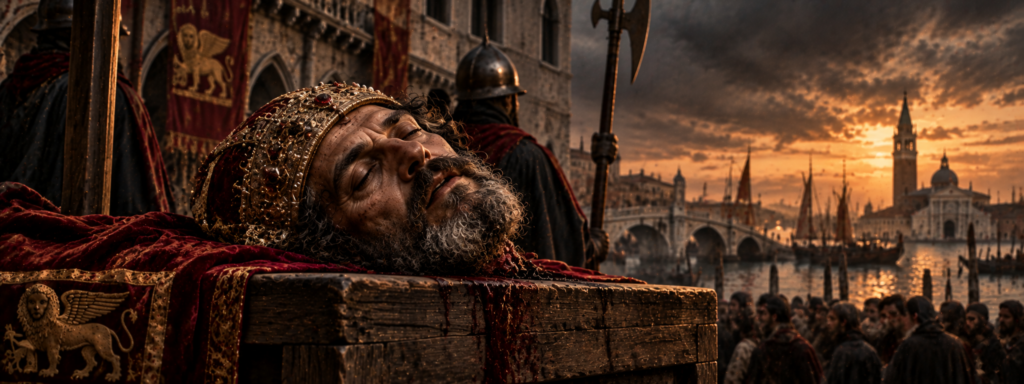
The beheading became particularly notorious because of what reportedly followed. Obelerio’s head was not simply buried with his body. Later chronicles describe it being exposed publicly as a warning to the population. The display transformed a private death sentence into a spectacle of state power.
The historical details of that display require caution, but the symbolism is unmistakable. A man who had once embodied political authority became an object through which the government demonstrated its dominance. The former ruler’s body was stripped of the dignity associated with office. His head became evidence that the rebellion had been defeated.
The Severed Head in the Market
The most chilling element of Obelerio’s traditional fate is the public display of his severed head. Later Venetian accounts describe the head being exposed after his execution, with some versions associating the spectacle with a market at Rialto. The location was politically significant because Rialto had become the center of the government that defeated him. The display therefore connected his punishment with the triumph of the new political order.
The exact site is not consistently described in the surviving traditions. Some accounts emphasize public exposure at the center of Venetian political life, while others provide different geographical details. The precise location should not be treated as securely established without acknowledging those variations. What matters most is the tradition that the government used his remains as a public warning.
Displaying the head of a defeated political rival was a practice found in various medieval societies. It provided visible confirmation of death and demonstrated the authority of the victorious ruler. Such spectacles could discourage supporters from continuing resistance. They also transformed punishment into a message addressed to the wider population.
For Obelerio, the symbolism was especially severe. He had once occupied the highest political office in the lagoon. His name had been associated with the government of Malamocco and with negotiations involving powerful emperors. The public display of his head reduced that former authority to a warning against rebellion.
The market setting, where included in the tradition, added another dimension. Markets were places where inhabitants gathered for trade and exchange, making them effective locations for public announcements and displays of punishment. A severed head placed in such a setting would be encountered by people whose daily lives might otherwise remain distant from the political struggles of leading families. The government could thereby communicate its victory beyond the immediate participants in the rebellion.
The display also reflected the importance of controlling political memory. A defeated claimant might be remembered by supporters as a legitimate ruler unjustly removed from power. Public humiliation challenged that interpretation by presenting him as a condemned rebel. The government sought to define not only the outcome of the conflict but also the meaning of his death.
The cruelty of the spectacle should not obscure its political purpose. The execution eliminated Obelerio as an active threat, while the display of his head discouraged the possibility of further resistance. It transformed his body into a symbol of the state’s ability to punish even those who had once ruled it. The message was intended to outlive the man.
Later generations remembered the image because it captured the ruthless character of early Venetian politics. The republic that would eventually celebrate constitutional restraint had emerged from a world where power could be contested through rebellion and secured through spectacular punishment. Obelerio’s severed head became one of the darkest symbols of that transformation. His final humiliation ensured that his failed return would not be forgotten.
Giovanni Participazio: The Doge Who Destroyed His Predecessor
Giovanni I Participazio occupied the dogeship during Obelerio’s final rebellion. He belonged to the family that had consolidated authority after the crisis of 810 and the movement of government toward Rialto. His position was therefore closely connected to the political order Obelerio sought to overturn. The confrontation between the two men represented a struggle over the legitimacy and future direction of Venetian government.
Giovanni’s own rule was not free from instability. The Participazio family had attempted to preserve authority within its household, continuing the dynastic tendencies of earlier doges. Rival factions remained active, and the political system had not yet developed the elaborate restraints of later centuries. The government therefore faced threats from both internal opposition and former rulers.
Obelerio’s return presented a particularly dangerous challenge because he possessed a recognizable claim to former authority. Unlike an ordinary rebel, he had once held the dogeship. His supporters could appeal to memories of his earlier government and to dissatisfaction with the Participazio regime. The challenge therefore carried a degree of political legitimacy that made it more serious.
Giovanni responded by suppressing the rebellion. The traditional accounts credit his government with defeating Obelerio’s supporters and capturing the former doge. The subsequent execution removed the immediate threat. It also demonstrated the government’s willingness to use severe punishment against a rival claimant.
The destruction associated with Malamocco became part of Giovanni’s historical reputation. Later narratives describe harsh measures against the rebellious settlement, although the precise scale and circumstances remain uncertain. The punishment reflected the political importance of preventing the old center from becoming a recurring base of opposition. It also reinforced Rialto’s dominance.
Yet Giovanni’s victory did not guarantee his own security. His government later faced further unrest, and he was eventually removed from power. The pattern demonstrates that the execution of a rival did not eliminate the underlying instability of early Venetian politics. A ruler could destroy one opponent and still fall victim to another faction.
The contrast between Giovanni and Obelerio is revealing. Both belonged to political families seeking to preserve authority in a society where succession remained contested. Both depended upon support from powerful local groups. Their struggle was therefore not simply a contest between legitimate government and criminal rebellion, but part of a continuing conflict over the concentration of power.
Giovanni’s victory nevertheless had lasting consequences. It prevented the restoration of the old Malamocco government and confirmed the authority of the political center at Rialto. Obelerio’s execution removed a claimant whose survival might have encouraged further attempts to reverse the changes of the previous generation. The triumph was temporary for Giovanni personally, but significant for the development of Venice.
The Destruction of Malamocco and the Triumph of Rialto
The rebellion of Obelerio became closely associated with the decline of Malamocco. Later Venetian traditions describe severe punishment inflicted upon the settlement after the uprising, sometimes portraying its destruction in dramatic terms. The accounts reflect the political importance of the conflict, although their precise details remain uncertain. Environmental change and the long-term movement of political activity also contributed to Malamocco’s altered fortunes.
The settlement had once occupied a central place in Venetian government. Its location near the Adriatic offered advantages for maritime communication, and its leading families possessed considerable influence. The dogeship had been associated with Malamocco during a formative period of lagoon history. Obelerio’s family represented that older political world.
The movement of government toward Rialto after 810 had already weakened Malamocco’s political position. The rebellion attempted to challenge the new order, but its defeat confirmed the dominance of the emerging center. A settlement that had once housed the doge could no longer determine the political direction of the lagoon. The balance of power had shifted.
The traditional destruction of Malamocco should not be understood as proof that every building was razed or that the settlement ceased to exist immediately. The historical and environmental development of the area was more complicated. Coastal erosion, changing waterways, and political relocation affected the region over time. Later narratives may have compressed these processes into a dramatic account of punishment.
Nevertheless, the political symbolism remains important. The defeat of Obelerio represented the failure of the old center to reclaim authority. Rialto had become the seat of government, and its rulers demonstrated that they could suppress opposition from Malamocco. The rebellion helped define the relationship between the two settlements.
Rialto’s rise would eventually transform the lagoon. Its islands became centers of administration, commerce, and religious life. Over centuries, the settlement developed into the city of Venice, with its distinctive canals, bridges, and monumental architecture. The political decisions of the early ninth century therefore had consequences extending far beyond Obelerio’s lifetime.
The decline of Malamocco also illustrates the importance of geography in Venetian history. Political authority followed settlements that offered security, accessibility, and commercial advantages. Changes in the physical environment could reinforce or undermine those advantages. The lagoon was not a static landscape, and its political centers changed accordingly.
Obelerio’s final rebellion became part of this larger transformation. His attempt to restore an earlier government failed at a moment when the political geography of Venice was being permanently reorganized. The execution of the former doge and the defeat of Malamocco reinforced the new center’s authority. His death therefore marked the end of a political world as well as the end of a life.
Was Obelerio a Traitor or a Ruler Fighting for His Throne?
Obelerio’s reputation has been shaped by the political traditions of the Venetian Republic. Later chroniclers often portrayed him as a ruler whose association with the Franks endangered the lagoon’s autonomy. His deposition during the crisis of 810 could therefore be interpreted as the removal of a dangerous or disloyal leader. His later rebellion reinforced the image of a man whose personal ambition threatened the state.
Yet the historical situation was more complicated. Obelerio governed during a period when the lagoon’s relationship with Byzantium and the Frankish Empire remained unsettled. Local leaders had to negotiate with powerful neighbors whose interests could not be ignored. Seeking Frankish support was not necessarily equivalent to deliberately betraying the Venetian communities.
The accusation of treachery must therefore be examined in context. Later Venetians celebrated their independence and interpreted earlier events through that ideal. A ruler associated with foreign intervention could easily become a negative figure in the republic’s historical memory. The political needs of later generations influenced the way his career was described.
Obelerio’s family government also invites criticism. By elevating his brothers, he participated in the dynastic tendencies that repeatedly troubled early Venetian politics. The concentration of authority within one household could provoke resentment among rival elites. Yet the Participazio family that replaced him pursued similar arrangements.
His final rebellion was unquestionably a challenge to the reigning government. After years in exile, he returned and attempted to recover the dogeship through political and military opposition. The attempt threatened the stability of the lagoon and risked renewed conflict among its communities. The government had strong reasons to regard him as dangerous.
Whether he believed himself to be the legitimate ruler remains unknown. The surviving sources do not preserve a reliable statement of his political justification. He may have regarded his earlier deposition as unjust or believed that support in Malamocco entitled him to restoration. Such possibilities are plausible but cannot be presented as established motives.
The severity of his punishment also complicates the moral interpretation. Execution removed a dangerous rival, but the reported display of his head went beyond the practical necessity of ending his rebellion. It was intended to humiliate the defeated claimant and intimidate potential supporters. The spectacle reveals the harshness of early Venetian political culture.
Obelerio therefore resists simple classification. He was neither a clearly documented patriot nor merely a villainous traitor. He was an ambitious early medieval ruler operating within a political system shaped by family rivalry, foreign intervention, and unstable institutions. His downfall reflected both his own decisions and the larger forces transforming the lagoon.
The Politics of Severed Heads and Public Humiliation
The reported display of Obelerio’s severed head belongs to a wider history of political punishment. Medieval rulers frequently used public executions and the exposure of remains to demonstrate authority. Such acts communicated that rebellion had consequences extending beyond the death of the individual. They also attempted to control how the defeated person would be remembered.
A severed head possessed particular symbolic power because it provided visible evidence of death. In a world where rumors of survival could encourage renewed resistance, displaying the remains of a claimant removed ambiguity. Supporters could no longer plausibly expect his return. The government could present the rebellion as decisively ended.
The humiliation was especially severe when the victim had once occupied high office. A former ruler possessed ceremonial dignity and a reputation associated with authority. Public exposure of his remains reversed that status. The body that had once represented government became an object through which government demonstrated its power.
The location of such displays mattered. Public squares, gates, and markets were places where political messages could reach large audiences. The association of Obelerio’s head with Rialto’s market therefore carries obvious symbolic significance. The new political center became the setting in which the old claimant’s defeat was made visible.
The practice also reveals the relationship between punishment and political memory. A ruler who died privately might remain a figure of sympathy or uncertainty. Public humiliation sought to define him as a defeated rebel. The government attempted to shape the interpretation of his life through the manner of his death.
Yet such spectacles could have unintended consequences. Cruel punishment might intimidate opponents, but it could also preserve the memory of the victim. A severed head displayed as a warning could become the most enduring image associated with a ruler. Obelerio’s case illustrates that paradox.
The later Venetian Republic would develop more elaborate legal and political institutions, but the early lagoon remained a world where personal power and public violence were closely connected. The execution of a former doge demonstrates how the state could use punishment to establish legitimacy. It also exposes the brutality beneath the later image of constitutional stability.
Obelerio’s severed head became a symbol of the transformation from contested personal rule toward a more durable political order. The government sought to prevent the restoration of a rival claimant and confirm the authority of Rialto. The spectacle achieved its immediate purpose, but it also ensured that the defeated ruler would remain part of Venetian historical memory. His humiliation became inseparable from the story of the republic’s origins.
The Republic That Emerged from Betrayal and Blood
The Venetian Republic eventually became one of the most durable political states in European history. Its government survived for centuries, and its merchants developed extensive commercial networks across the Mediterranean. The doge became a ceremonial figure whose authority was constrained by councils and elaborate constitutional procedures. The state celebrated its stability and resistance to hereditary monarchy.
The political world of Obelerio’s lifetime was very different. Early doges frequently attempted to involve relatives in government, while rival families challenged their authority through rebellion. Foreign empires influenced internal politics, and the location of the political center remained unsettled. The institutions that later protected the republic had not yet developed.
Obelerio’s career demonstrates these early dangers. He rose through factional conflict, established a family government, and sought support from competing imperial powers. His rule collapsed during the Frankish crisis, and he spent years in exile. His attempt to return ended in execution.
The Participazio family that replaced him did not immediately create a stable constitutional system. Its members also pursued dynastic arrangements and faced opposition from rival groups. Giovanni Participazio’s eventual removal demonstrated that the struggle for authority continued after Obelerio’s death. The early republic remained vulnerable to the same forces that had destroyed previous governments.
Over time, Venetian elites developed institutions intended to prevent the concentration of power within a single household. Councils acquired greater authority, and the doge’s personal freedom became increasingly restricted. Electoral procedures were designed to balance competing interests. The mature republic emerged through centuries of political experimentation.
The memory of early violence helped justify those restrictions. A state that had experienced deposition, rebellion, and assassination had reasons to fear powerful rulers. The doge could remain a symbol of continuity without possessing unrestricted authority. The constitutional system sought to prevent the return of the instability that characterized the earliest centuries.
Obelerio’s death also became part of the narrative of Venice’s independence. The crisis of 810 and the movement of government to Rialto were remembered as turning points in the formation of the republic. The former doge’s association with the Frankish faction made him a convenient symbol of the dangers of foreign influence. His final rebellion reinforced the legitimacy of the government that defeated him.
The historical reality was more complicated than the later patriotic narrative. Venice’s autonomy developed gradually through relationships with Byzantium, the Franks, and other powers. Its institutions emerged from competing interests rather than a single founding act. Obelerio was one participant in that process, and his fate reveals how violent the struggle could become.
A Former Ruler Erased by the City He Helped Create
Obelerio’s final defeat occurred at a moment when Venice was developing a new political identity. The government had moved toward Rialto, and the Participazio family had established a ruling position. The old center at Malamocco no longer possessed the same authority. The former doge’s attempt to reverse these changes ended in disaster.
His execution removed a claimant whose survival threatened the new order. The reported display of his head reinforced the government’s determination to prevent further rebellion. The punishment was intended to make his defeat unmistakable. Yet the spectacle also preserved his memory as one of the most notorious figures in early Venetian history.
The irony is that Obelerio’s career helped shape the very transformation that destroyed him. His government had become entangled in the rivalry between Byzantium and the Franks, and the resulting crisis contributed to the movement of political authority toward Rialto. The state that emerged from his downfall was different from the one he had governed. His attempt to return therefore confronted a political world partly created by the consequences of his own rule.
The new center would eventually develop into the city of Venice. Its canals, palaces, churches, and commercial institutions would become famous throughout Europe. The dogeship would survive for nearly another millennium, although its powers would change dramatically. Obelerio’s former capital would fade from political prominence.
The contrast between his ambitions and the republic’s later achievements is striking. He sought to recover personal authority in a society that was gradually developing institutions capable of outlasting individual rulers. His claim depended upon memories of an earlier political order. The government that defeated him represented a different future.
His story also reveals the instability of early medieval legitimacy. A ruler could hold office, lose it through political upheaval, and later attempt restoration. Supporters might continue to recognize his claim, while opponents regarded him as a dangerous rebel. The absence of settled constitutional rules made such disputes difficult to resolve peacefully.
Obelerio’s death became the final answer to that uncertainty. The government did not merely refuse his claim but destroyed the man who embodied it. The public display of his remains transformed his defeat into a warning against future challenges. His personal ambition ended where the authority of the emerging state began.
The memory of the execution survived because it captured the ruthless character of the transition. Venice would later celebrate itself as a republic governed by law and institutions, but its origins included moments of spectacular violence. Obelerio’s severed head became a reminder that political stability could be established through methods far removed from the ideals later associated with the state. The magnificent republic had emerged from a world in which even former rulers could become victims of public humiliation and death.
The Doge Who Refused to Stay Buried in Exile
Obelerio Antenoreo’s life unfolded during one of the most dangerous periods in the early history of Venice. The lagoon communities were caught between the ambitions of Charlemagne’s empire and the continuing influence of Byzantium. Their political institutions remained unstable, and powerful families competed for control of the dogeship. A ruler who failed to balance these pressures could lose everything.
Obelerio rose to power in 804 after the collapse of the Galbaio government. His accession represented the victory of a faction that favored closer relations with the Frankish world. He elevated his brothers to positions of authority and attempted to preserve his family’s political position. Yet the same imperial rivalry that offered opportunities for advancement eventually destroyed his government.
The Frankish expedition against the lagoon in 809–810 marked a turning point. Obelerio’s political alliances became liabilities, and his government collapsed amid military pressure and internal opposition. The movement of the ducal seat toward Rialto transformed the political geography of the lagoon. The former doge was removed from power and sent into exile.
For approximately two decades, Obelerio remained outside the government he had once controlled. During those years, the Participazio family consolidated authority, and Rialto became increasingly important. The political world associated with Malamocco was gradually disappearing. Yet the former ruler retained enough ambition to attempt a return.
His rebellion around 831 or 832 challenged the reigning doge, Giovanni Participazio. Malamocco became the center of the uprising, linking the attempt at restoration with the old political capital. The government responded with force, defeated the rebels, and captured Obelerio. His final gamble had failed.
The former doge was executed, reportedly by beheading. Later Venetian chronicles describe his severed head being displayed publicly, transforming his punishment into a warning against rebellion. The precise details of the display remain uncertain, but the tradition captures the brutality of early Venetian political conflict. A man who had once exercised the highest authority in the lagoon became an example of the consequences of challenging it.
His death also marked the triumph of a new political order. The rebellion failed to restore Malamocco’s former dominance, and Rialto continued to develop as the center of government. The future city of Venice emerged from this transformation. Obelerio’s defeat helped confirm the direction in which the lagoon’s political institutions were moving.
The later Venetian Republic would become famous for its longevity and elaborate constitutional restraints. Its doges would be honored but carefully restricted, while councils and electoral procedures limited the ambitions of individual families. Such stability was not present in Obelerio’s lifetime. It developed through centuries of conflict, rebellion, and institutional change.
Obelerio’s story therefore belongs to the history of political assassination and execution, but it also reveals the dangerous process through which states establish authority. His first downfall demonstrated the vulnerability of rulers caught between foreign powers and domestic factions. His final rebellion showed that exile did not necessarily extinguish political ambition. His execution revealed the determination of the emerging Venetian government to prevent a return to the old order.
The most haunting image of Obelerio Antenoreo is not the doge negotiating with emperors or the exile dreaming of restoration, but the defeated ruler whose severed head was reportedly displayed before the people of the lagoon. He had returned to reclaim a throne that no longer belonged to him, believing that the past could still be restored through loyalty, ambition, and force. Instead, he discovered that Venice had changed while he was away, and the political world that once sustained him had become the instrument of his destruction. The republic that would endure for nearly a thousand more years had no place for its returning former ruler, except as a warning that some thrones could be lost twice—and the second loss could cost a man his head.